Universitat Polit`
ecnica de Catalunya
PhD Thesis
A time-predictable many-core processor
design for critical real-time embedded
systems
Author:
Miloˇs Pani´
c
Supervisors:
Dr. Eduardo Qui˜
nones
Dr. Francisco J. Cazorla
A thesis submitted in fulfillment of the requirements
for the degree of Doctor of Philosophy
Departament dArquitectura de Computadors
Facultat d’Inform`
atica de Barcelona
Declaration of Authorship
I, Miloˇs Pani´c, declare that this thesis titled, ’A time-predictable many-core processor design for critical real-time embedded systems’ and the work presented in it are my own. I confirm that:
This work was done wholly or mainly while in candidature for a research degree at the Universitat Polit`ecnica de Catalunya.
Where any part of this thesis has previously been submitted for a degree or any other
qualification at theUniversitat Polit`ecnica de Catalunyaor any other institution, this has been clearly stated.
Where I have consulted the published work of others, this is always clearly attributed.
Where I have quoted from the work of others, the source is always given. With the exception
of such quotations, this thesis is entirely my own work.
I have acknowledged all main sources of help.
Where the thesis is based on work done by myself jointly with others, I have made clear
exactly what was done by others and what I have contributed myself.
Signed:
Date:
“I myself know nothing, except just a little, enough to extract an argument from another man who is wise and to receive it fairly.“
Abstract
Critical Real-Time Embedded Systems (CRTES) are in charge of controlling fundamental parts of embedded system, e.g. energy harvesting solar panels in satellites, steering and breaking in cars, or flight management systems in airplanes. To do so, CRTES require strong evidence of correct functional and timing behavior. The former guarantees that the system operates correctly in response of its inputs; the latter ensures that its operations are performed within a predefined time budget.
CRTES aim at increasing the number and complexity of functions. Examples include the incorporation of “smarter” Advanced Driver Assistance System (ADAS) functionality in modern cars or advanced collision avoidance systems in Unmanned Aerial Vehicles (UAVs). All these new features, implemented in software, lead to an exponential growth in both performance requirements and software development complexity. Furthermore, there is a strong need to integrate multiple functions into the same computing platform to reduce the number of processing units, mass and space requirements, etc. Overall, there is a clear need to increase the computing power of current CRTES in order to support new sophisticated and complex functionality, and integrate multiple systems into a single platform.
The use of multi- and many-core processor architectures is increasingly seen in the CRTES industry as the solution to cope with the performance demand and cost constraints of future CRTES. Many-cores supply higher performance by exploiting the parallelism of applications while providing a better performance per watt as cores are maintained simpler with respect to complex single-core processors. Moreover, the parallelization capabilities allow scheduling multiple functions into the same processor, maximizing the hardware utilization.
However, the use of multi- and many-cores in CRTES also brings a number of challenges related to provide evidence about the correct operation of the system, especially in the timing domain. Hence, despite the advantages of many-cores and the fact that they are nowadays a reality in the embedded domain (e.g. Kalray MPPA, Freescale/NXP P4080, TI Keystone II), their use in CRTES still requires finding efficient ways of providing reliable evidence about the correct operation of the system.
This thesis investigates the use of many-core processors in CRTES as a means to satisfy perfor-mance demands of future complex applications while providing the necessary timing guarantees. To do so, this thesis contributes to advance the state-of-the-art towards the exploitation of parallel capabilities of many-cores in CRTES contributing in two different computing domains. From the hardware domain, this thesis proposes new many-core designs that enable deriving reliable and tight timing guarantees. From the software domain, we present efficient scheduling and timing analysis techniques to exploit the parallelization capabilities of many-core architectures and to derive tight and trustworthy Worst-Case Execution Time (WCET) estimates of CRTES.
Acknowledgements
I would like to express my deep gratitude to Dr. Eduardo Qui˜nones, Dr. Jaume Abella, Dr. Carles Hern´andez, and Dr. Francisco Cazorla, my research supervisors, for their patient guidance, enthusiastic encouragement and useful critiques of this research work. I would also like to thank Dr. Theo Ungerer, Dr. Bert B¨oddeker, Dr. Sebastian Kehr, Dr. Pavel Zaykov and Dr. Antoni Roca for their valuable and constructive suggestions during the planning and development of this research work.
My grateful thanks are also extended to the researchers and engineers of the Computer Architecture / Operating System Interface research group of the Barcelona Supercomputing center: Dr. Leonidas Kosmidis, Dr. Javier Jalle and Mr. Mikel Fern´andez, for their help and contribution in the development of the simulation framework.
Moreover, I wish to thank my family for their support and encouragement throughout my study.
This work has been funded by the European Commission through the project PARMERASA (FP7-287519) and by the Spanish Ministry of Science and Innovation (TIN2012-34557, TIN2015-65316-P). Miloˇs Pani´c held the FPU grant FPU12/05966 (Programa Nacional de Formacin de Profesorado Universitario) of the Ministry of Education, Culture and Sports of Spain.
Contents
Declaration of Authorship iii
Abstract vii
Acknowledgements ix
List of Figures xvii
List of Tables xix
Abbreviations xxi
I
Introduction
1
1 Introduction 3
1.1 Real-time Systems . . . 3
1.2 Trends in Critical Real-Time Embedded Systems (CRTES) . . . 5
1.3 Applying multi/many-core technology to CRTES . . . 6
1.3.1 The timing behavior of CRTES in multi/many-core platforms . . . 7
1.3.2 The design of CRTES: Time composability . . . 8
1.4 Thesis Goals and Objectives . . . 9
1.5 Thesis Contribution . . . 11
1.5.1 Hardware . . . 11
1.5.2 Scheduling techniques . . . 11
1.5.3 Probabilistic timing analysis . . . 12
1.5.4 Standards . . . 12
1.5.5 Open source software . . . 12
1.6 Thesis Organization . . . 13 2 Experimental Setup 15 2.1 Simulation framework . . . 15 2.2 Case studies . . . 17 2.2.1 Avionics domain . . . 18 2.2.2 Automotive domain . . . 18 2.2.3 Benchmarks . . . 19 2.3 Timing analysis . . . 19
2.3.1 Static timing analysis – OTAWA . . . 20
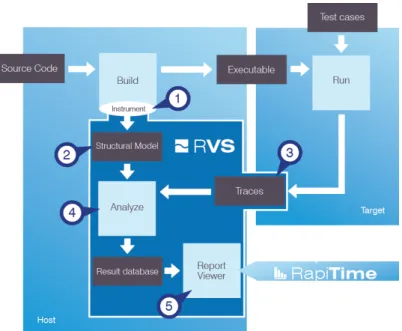
2.3.2 Measurement-based timing analysis – RapiTime . . . 21
Contents xii
II
Manycore Hardware Design and Analysis
23
3 A Time Predictable Architecture 25
3.1 Introduction . . . 25
3.2 Integrated Modular Avionics . . . 27
3.2.1 Interference among processes of a Software Partition (SWP) . . . 28
3.2.2 Interference among SWPs . . . 28
3.2.3 Similarities between IMA and AUTOSAR frameworks . . . 29
3.3 ARINC 653 and many-cores . . . 29
3.4 Parallel Software Partitions . . . 30
3.4.1 Shared Software Resources . . . 30
3.4.2 Shared Hardware Resources . . . 31
3.4.3 Methods to control Intra-SWP interferences . . . 31
3.4.3.1 Computation . . . 32
3.4.3.2 Communication . . . 32
3.4.4 Methods to Control Inter-SWP interferences . . . 33
3.4.4.1 Impact of intra-SWP activities on Inter-SWP communication (RIM/LIM →REM/CEM) . . . 33
3.4.4.2 Impact of Inter-SWP communication on intra-SWP activities (CEM/REM →RIM/LIM) . . . 33
3.4.4.3 Interferences among inter-SWP communication (CEM/REM → CEM/REM) . . . 34
3.4.5 WCET and Time composability under Parallel Software Partition (pSWP) 34 3.5 Guaranteed Resource Partitions: GRP . . . 35
3.5.1 Main timing aspects of Guaranteed Resource Partitions (GRPs) . . . 36
3.5.1.1 Time Predictability . . . 36
3.5.1.2 Transparent execution . . . 36
3.5.1.3 Isolation of intra-SWP communication requests among different GRPs . . . 37
3.5.2 Implementation aspects of GRPs . . . 38
3.5.2.1 Network on Chip (NoC) Design: Physical GRPs . . . 38
3.5.2.2 NoC Design: Virtual GRPs . . . 39
3.5.2.3 Memory Design . . . 41
3.5.3 FromW CT T andM EMW CRT to WCET Computation . . . 43
3.5.3.1 Computing the WCET Estimation in Isolation . . . 43
3.5.3.2 Computing ∆inter: NoC and Memory Impact . . . 44
3.6 Experimental Results . . . 44
3.6.1 Experimental Setup . . . 44
3.6.1.1 Hardware Setup . . . 44
3.6.1.2 Parallel Avionic Applications . . . 45
3.6.1.3 Compuitation of the WCET estimation of Parallel Avionic Appli-cation . . . 46
3.6.2 Impact of intra-SWP Communication on Execution Time . . . 46
3.6.3 Impact of Inter-SWP Communication on Execution Time . . . 46
3.6.4 Executing several SWP into a single GRP . . . 48
3.7 Related Work . . . 49
3.8 Conclusions . . . 51
4 Modeling High-Performance Wormhole NoCs for Critical Real-Time Embed-ded Systems 53 4.1 Introduction . . . 53
4.2 Background . . . 55 4.3 Contention Delay: A New Metric to account for the impact of NoC on WCET . 56
Contents xiii
4.3.1 Worst-Contention Delay (WCD) Properties . . . 57
4.3.2 WCD Assumptions . . . 58
4.4 NoC Parameters Taxonomy . . . 58
4.4.1 Wormhole mesh NoC fundamentals . . . 58
4.4.2 Proposed Taxonomy . . . 60
4.4.2.1 Fixed parameters . . . 60
4.4.2.2 Parameters to adjust . . . 61
4.5 Time-Composable WCD bounds . . . 62
4.5.1 Single-Flit, One Virtual-Channel, Single-entry Queue (F T = 1, nV C = 1, E= 1) . . . 62
4.5.1.1 Single-router traversal . . . 63
4.5.1.2 Worst Contention . . . 63
4.5.1.3 worst-case Destination . . . 63
4.5.1.4 Computing the time-composable upper bound Worst-Contention Delay (W CDi) . . . 64
4.5.2 Single-Flit, Virtual-Channels, Single-entry Queue (F T = 1,1< nV C < cF, E= 1) . . . 65
4.5.3 Multiple-Flit, Virtual-Channels, Single-entry Queue (F T >1,1< nV C < cF, E= 1) . . . 66
4.5.4 Multiple-Flit, Virtual-Channels, Multiple-entry Queue (F T >1,1< nV C < cF, E >1 orE <1) . . . 67
4.5.4.1 Queue size larger than packet size (E >1) . . . 67
4.5.4.2 Queue size smaller than packet size (E <1) . . . 67
4.5.5 Impact of variable size packets . . . 68
4.6 System design considerations . . . 68
4.6.1 Packet Size . . . 68
4.6.2 Virtual Channels . . . 69
4.6.3 Network Size . . . 69
4.7 Modeling existing NoC designs . . . 69
4.7.1 W CDaccuracy and comparison with Worst-Case Traversal Time (WCTT) 70 4.7.2 ReducingW CD values . . . 71
4.7.3 Impact of Wormhole-based Network on Chip (wNoC) interference on WCET 72 4.8 Related Work . . . 73
4.8.1 Quality of Service (QoS) . . . 73
4.8.2 Real-time Specific NoCs . . . 73
4.8.3 WCTT in wNoCs . . . 74
4.9 Conclusions . . . 75
5 Improving Performance Guarantees in Wormhole Mesh NoC Designs 77 5.1 Introduction . . . 77
5.2 Reference mesh network . . . 79
5.3 Wormhole-based mesh NoCs . . . 80
5.3.1 Assumptions . . . 80
5.3.2 Factors impacting WCTT estimates . . . 80
5.4 Computing Worst-case Traversal Time . . . 81
5.5 Flit-Homogeneous Guarantees in Meshes . . . 83
5.5.1 WCTT-aware Packetization (WaP) . . . 83
5.5.2 WCTT-aware Weighted (WaW) . . . 83
5.5.3 WaW implementation . . . 85
5.5.4 Hardware modifications . . . 85
5.6 Evaluation . . . 85
5.6.1 Reducing WCTT with WaW+WaP . . . 86
Contents xiv
5.6.3 Improving WCET estimates for Parallel Applications . . . 87
5.6.4 Average performance . . . 87
5.7 Related Work . . . 87
5.8 Conclusions . . . 88
III
Software Support for Exploiting Manycore Potential –
Schedul-ing
89
6 Intra-GRP Scheduling Strategy for Parallelization of Complex Automotive Applications 91 6.1 Introduction . . . 916.2 Background . . . 94
6.2.1 AUTOSAR Applications . . . 94
6.2.2 Multi-cores and WCET estimation . . . 96
6.3 RunPar Allocation Algorithm . . . 97
6.3.1 Problem Definition . . . 97
6.3.2 Mapping Runnables to Cores . . . 99
6.3.2.1 Runnable classification . . . 99
6.3.2.2 Sorting criteria . . . 99
6.3.2.3 Bin packing heuristics . . . 100
6.3.2.4 Dependent Runnables . . . 100
6.3.2.5 Independent Runnables . . . 101
6.3.3 Allocation Algorithm Solution: Φ . . . 102
6.3.4 Validating the Single-core Task Scheduling . . . 102
6.3.5 Execution of interrupt-driven tasks (CrAn task) . . . 103
6.4 Results . . . 105
6.4.1 Experimental setup . . . 105
6.4.1.1 EMS application . . . 105
6.4.1.2 WCET analysis tool and Processor Setup . . . 105
6.4.1.3 Metrics . . . 105
6.4.2 Choosing the appropriate heuristics . . . 106
6.4.3 WCET Speed-up of Engine Management System (EMS) tasks . . . 107
6.4.4 Increasing Overall Available Central Processing Unit (CPU) Capacity . . 108
6.5 Related Work . . . 109
6.6 Conclusions . . . 111
7 Inter-GRP Scheduling Strategy for Real-time Applications on Many-cores 113 7.1 Introduction . . . 113 7.2 Background . . . 115 7.2.1 CRTES applications . . . 115 7.3 Allocation Algorithm . . . 116 7.3.1 Problem Definition . . . 116 7.3.2 Mapping Applications to GRPs . . . 117 7.3.3 Example . . . 119 7.4 Evaluation methodology . . . 120 7.5 Results . . . 122 7.5.1 4-GRP many-core . . . 122 7.5.2 16-GRP many-core . . . 123 7.5.3 Algorithm complexity . . . 124 7.6 Related Work . . . 125 7.7 Conclusions . . . 126
Contents xv
IV
The Thesis and Beyond – Conclusions and Future Work
127
8 Enabling TDMA Arbitration in the Context of MBPTA 129
8.1 Introduction . . . 129
8.2 Contention analysis for DTA and MBPTA . . . 131
8.2.1 SDTA and MBDTA . . . 131
8.2.2 MBPTA . . . 132
8.3 TDMA impact on execution time . . . 133
8.3.1 Request Types . . . 133
8.3.2 TDMA impact on execution time for synchronous request . . . 134
8.3.3 sad for Multiple Asynchronous Requests . . . 135
8.3.4 Multiple TDMA resources . . . 136
8.3.5 Other considerations . . . 137
8.4 TDMA in the context of MBPTA . . . 138
8.4.1 Timing of MBPTA-Compliant Processors . . . 138
8.4.2 TDMA analysis with MBPTA . . . 139
8.4.3 Full-program padding . . . 140
8.5 Results . . . 141
8.5.1 Evaluation Framework . . . 141
8.5.2 Impact of TDMAsad on Execution Time . . . 142
8.5.3 Performance Comparison . . . 143
8.6 Related work . . . 144
8.7 Conclusions . . . 145
9 Conclusions, Impact and Future Work 147 9.1 Impact and Future Work . . . 149
List of Figures
1.1 Europe embedded system market size, by application (US$ billions). Source: [1] . 4
1.2 Time predictability. Source [2] . . . 6
1.3 Memory accesses in many-cores . . . 7
1.4 Time composability . . . 8
2.1 High-level overview of simulation framework together with system software and WCET tools . . . 16
2.2 Workflow of the static timing analysis tool OTAWA. . . 20
2.3 Workflow of the measurement-based timing analysis tool RapiTime. Sourcehttps: //www.rapitasystems.com/products/rvs/how-does-rvs-work . . . 22
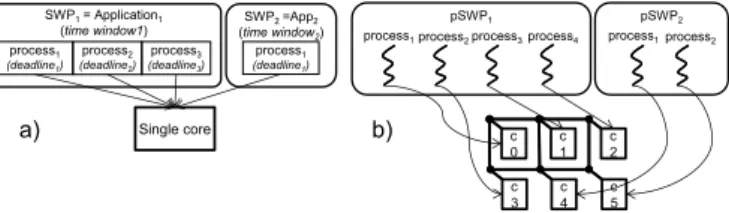
3.1 (a) Time partitioning as defined in ARINC653. (b) 2 pSWP comprising 4 and 2 processes respectively and their mapping to a 6-core multi-core deploying a mesh NoC. . . 28
3.2 Different conflicts among two SWPs and how they are handled by pSWP specification. 32 3.3 Example of execution of SWP over time . . . 34
3.4 Processor architecture comprising 2 GRPs. . . 35
3.5 (a) Clustered design with four clusters, each with four cores. (b) Regular design comprised by four GRPs with different number of cores (6, 2, 4 and 4 cores) . . . 37
3.6 Structure of memory request queues. . . 42
3.7 4 SWPs executed following a software pipelining approach. . . 45
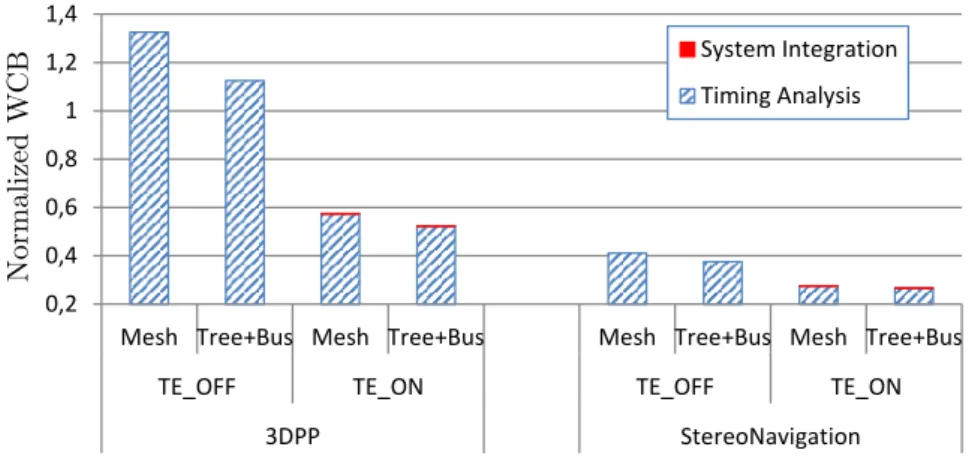
3.8 Worst-Case Execution Time Bound (WCB) of 3DPP and StereoNav. We assume a regular (Mesh) and a clustered (Tree+Bus) architectures. We analyze the impact of activating and deactivating the transparent execution mechanism. . . 47
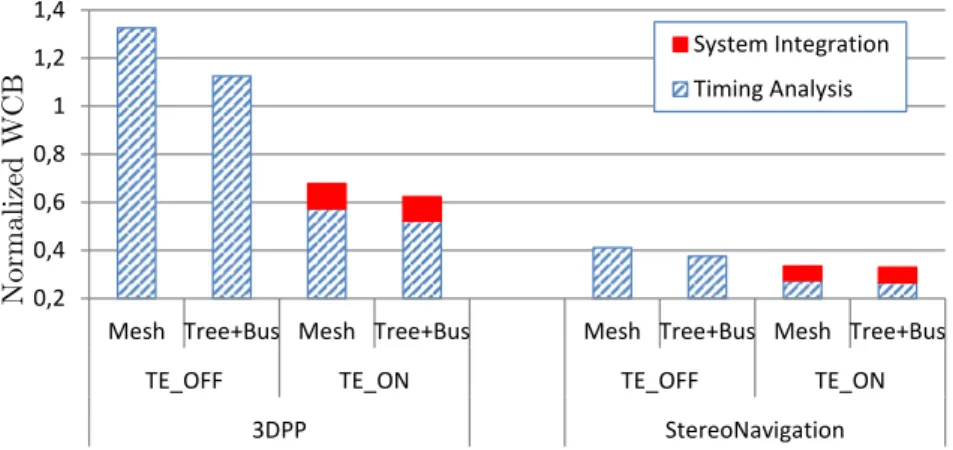
3.9 WCB of 3DPP and StereoNav, assuming regular and hierarchical architectures (Mesh andTree+Busrespectively) and activating and deactivating the transparent execution mechanism. . . 48
3.10 Combining several pSWPs into a single GRP . . . 50
4.1 Simple router and the impact ofatd andetd on traversal time and contention delay. 57 4.2 Mesh basics. (a) Router coordinates in a 4x4 part of a mesh. (b) Canonical 2D-mesh router. . . 59
4.3 (a) Worst destination; and (b) A flow crossing 2 routers . . . 64
4.4 WCD bounds derived in this thesis and adapted WCTT from [3] . . . 71
4.5 Effect of disabling VC and clustering on WCD for the SCC setup . . . 72
4.6 W CETmc estimates derived with WCD and WCTT w.r.t. OET . . . 73
5.1 (a) Router coordinates in a 4x4-Mesh. (b) Unfair bandwidth allocation in wormhole. 81 5.2 WCET estimates for the 16-core parallel avionics application . . . 87
6.1 Inter-runnable dependencies existing among three of the twelve tasks that com-pose the EMS (tasks 1, 4 and 8 ms). Nodes represent runnables and lines the dependencies among them . . . 92
List of Figures xviii
6.2 Part of the runnable flow-graph of an automotive application composed of 3 SWC, 7 runnables and 3 tasks executed in a single-core processor. (a) Structure of the application; (b) application configuration from an AR-OS point of view; (c) a possible single-core task scheduling of the three tasks. . . 94 6.3 Block diagram of our target architectures. . . 95 6.4 Pseudo-code implementation of the allocation algorithm. . . 101 6.5 Valid allocation (Φ) of the automotive application presented in Figure 6.2 in a
two-core processor, executing cycle 20. Ci is the WCET estimate of runnableri. 102
6.6 The CrAn interrupt-triggered task preempting time-triggered one. . . 103 6.7 WCET speed-ups of EMS tasks in a 2-core processor architecture, in which the
WCET estimation accounts and discards the impact ofinterferences (labeled as
interferences andno interferences respectively). . . 107 6.8 WCET speed-ups of EMS tasks in a 4-core processor architecture, in which the
WCET estimation accounts and discards the impact ofinterferences (labeled as
interferences andno interferences respectively). . . 108 6.9 Utilization of EMS tasks being allocated on a single-core, 2-core and 4-core
Electronic Control Unit (ECU) labeled assequential,2-core and4-core respectively).109 7.1 Time-predictable many-core architecture with GRPs resembling [4] . . . 114 7.2 Example of the directed acyclic graph for a CRTES comprising 6 applications . . 115 7.3 Pseudo-code implementation of the allocation algorithm. . . 118 7.4 CAP . . . 119 7.5 Schedulability success rate - CAP vs. BAWF (Composable 1.5-2.15) on a 4-GRP
many-core . . . 122 7.6 Schedulability success rate - CAP vs. BAWF (Composable 1.3-1.6) on a 4-GRP
many-core . . . 123 7.7 Schedulability success rate - CAP vs. BAWF (Composable 1.5-2.15) on a 16-GRP
many-core . . . 124 7.8 Schedulability success rate - CAP vs. BAWF (Composable 1.3-1.6) on a 16-GRP
many-core . . . 124
8.1 Example of 3 requests with ∆inj=
{−,4,1} and their sad. bi are the cycles in
which the request is ready but waiting in the buffer due tosad;sirepresents cycle
in which the request gets access to the bus. Finally blanks represent the cycles with no requests on the bus. . . 136 8.2 Different combinations – in a two Time Division Multiple Access (TDMA)-window
case – forcycrel,T DM A0 1andcycrel,T DM A0 2. . . 137 8.3 Different probabilistic states in which the processor may be after the execution of
each of the 3 loads in the example. . . 139 8.4 Full-program padding in the context of MBPTA. . . 140 8.5 Schematic of the multicore processor considered. . . 141 8.6 Probabilistic Worst Case Execution Time (pWCET) estimates for a cutoff
List of Tables
1.1 Goals and objectives . . . 10
2.1 EEMBC Automotive Suite . . . 19
3.1 WCTT factors (zll+N oCRID) for regular (Mesh) NoC designs assuming pipelined routers withDrouter= 2 andLZi = 4. TheCore Id refers to the location of cores shown in Figure 3.5(b). . . 41
4.1 Summary of main symbols used . . . 58
4.2 List of wNoC main features analyzed . . . 60
4.3 Setups . . . 62
4.4 Technical details of the mesh NoC in high-performance chips: 48-core Intel SCC and 36 core Tilera-Gx36 . . . 70
5.1 Arbitration weights for a 2x2-mesh router R(1,1) in a regular mesh and with WaW 84 5.2 WCTT values for different Mesh sizes for 1-flit packets. . . 85
5.3 Normalized WCET per core of EEMBC with WaW+WaP . . . 86
6.1 Average WCET speed-up of EMS’ tasks . . . 106
6.2 Average WCET speed-up of EMS tasks when combining heuristics . . . 106
7.1 WCET intervals in cycles, assuming 1GHz processor . . . 121
8.1 Random arbitration bus example. . . 132
8.2 Maximum exec. time variations due to TDMAsad. . . 142
Abbreviations
ADAS Advanced Driver Assistance System
AUTOSAR AUTomotive Open System ARchitecture
AR-OS AUTOSAR Operating System
CD Contention Delay
CFG Control Flow Graph
COTS Commercial-Off-The-Shelf
CPU Central Processing Unit
CRTES Critical Real-Time Embedded Systems
DAG Directed Acyclic Graph
DMA Direct Memory Access
DTA Deterministic Timing Analysis
ECU Electronic Control Unit
EMS Engine Management System
FPGA Field-Programmable Gate Array
GRP Guaranteed Resource Partition
GS Guaranteed Service
HPC High Performance Computing
IARA Interference Aware Resource Arbiter
IMA Integrated Modular Avionics
ILP Integer Linear Programming
ISA Instruction Set Architecture
IV incremental verification
MBPTA Measurement-Based Probabilistic Timing Analysis
NIC Network Interface Controller
NoC Network on Chip
OET Observed Execution Time
PME Processor/Memory Element
pSWP Parallel Software Partition
PTA Probabilistic Timing Analysis
Abbreviations xxii
pWCET Probabilistic Worst Case Execution Time
QoS Quality of Service
RAM Random Access Memory
RTOS Real-Time Operating System
SoCLib SoCLib
SMART Specific, Measurable, Achievable, Realistic, Timely
SWaP Size, Weight, and Power
SWC Software Components
SWP Software Partition
TDMA Time Division Multiple Access
UAV Unmanned Aerial Vehicle
UBD Upper-Bound Delay
UoS Unit of Scheduling
VC Virtual Channel
VCI Virtual Component Interface
WaP WCTT-aware Packetization
WaW WCTT-aware Weighted
wNoC Wormhole-based Network on Chip
WCD Worst-Contention Delay
WCET Worst-Case Execution Time
WCB Worst-Case Execution Time Bound
WCRT Worst-Case Response Time
WCTT Worst-Case Traversal Time
To Filip and Tijana.
Part I
Introduction
Chapter 1
Introduction
Embedded systems are ubiquitous nowadays, ranging from mobile phones and medical devices to airplanes and satellites, with a tendency of growth [1,5]. According to the report by Transparency Market Research [1], global spending on embedded systems will reach US$233.13 bn by 2021, growing from US$152.94 bn in 2014. This growth comes with a significant increment in the performance requirements for future embedded devices to cope with the newest ”smart” software functionality. Overall, this tendency is changing the landscape of computer market driving a true convergence of high-performance and embedded computing systems [6–8].This trend can be observed as most chip manufacturers are nowadays targeting embedded systems, diversifying their product portfolio [9, 10]. Furthermore, chip manufacturers are also introducing hardware techniques commonly used in general purpose and high-performance computing into the next generation embedded chips to cope the performance requirements of the modern systems. This thesis advances the current state-of-the-art in this field, boosting the convergence of high-performance and embedded domain, with the emphasis on embedded systems with real-time requirements.
1.1
Real-time Systems
Real-time systems represent a significant part of embedded market [1] with further tendencies of growth [9]. They cover a wide range of applications: from cellphones and routers to medical devices, automobiles, airplanes, satellites, etc. In those systems, time has an essential role in their correct execution, as most of the tasks that form the system have to finish before specific time boundaries – called deadlines – in order to have the system functioning correctly. In order to ensure that tasks deadlines are met, and by doing so guarantee the system correctness from the timing perspective, a process calledtiming analysis is performed. Timing analysis produces upper bounds on the maximum execution times of a task, called Worst-Case Execution Time (WCET) , derived for execution of the task in a specific hardware platform.
Based on the severity of consequences of a task not meeting its associated deadline, we categorize tasks into four groups:
Chapter 1. Introduction 4
Figure 1.1: Europe embedded system market size, by application (US$ billions). Source: [1]
• Hard real-time tasks are controlling the most critical functions of the system, e.g. energy harvesting solar panels in satellites, steering and breaking in cars, flight management systems in airplanes, etc. Unexpected deadline misses for these tasks can cause a system malfunctioning that could lead to a loss of human lives or irreversible damage to the equipment and environment. Thus, system construction must guarantee that no deadline is missed, or countermeasures must be provided to ensure system correctness in the case of a missed deadline. Systems containing hard real-time tasks are also known as Critical Real-Time Embedded Systems (CRTES) (either safety-critical or mission-critical). CRTES are the focus of this thesis.
• Firm real-time tasks can tolerate very rare deadline misses as they don’t have catastrophic consequences. In these systems, the results of tasks are useless after the deadline, leading to controlled degradation of Quality of Service (QoS), e.g. in software defined radio[11].
• Soft real-time tasks have more relaxed deadline constraints compared to the hard and firm real-time tasks. Even though the task output can still be useful to the system after the deadline, missing it can lead to uncontrolled QoS degradation. However, in some cases, a missed deadline might not be even noticed by the end user, e.g. skipping a frame in video decoding.
• Non real-time tasks do not associate system correctness to their timing behavior and they are rare in real-time systems, e.g. a telematics unit of a car sending usage data to a server of an insurance company.
The High-Performance Embedded Architecture and Compilation (HiPEAC) network [12] rec-ognizes the importance of CRTES industry in Europe and necessity of its further growth and development. Figure 1.1 shows compound annual growth rate of embedded systems market in Europe (courtesy of Global Market Insights [5]), highlighting the importance of automotive and aerospace CRTES industries, that are in the focus of this thesis.
Chapter 1. Introduction 5
1.2
Trends in Critical Real-Time Embedded Systems (CRTES)
Similar to the embedded systems in general, CRTES industry aims at increasing the number and complexity of system functions to keep the competitive edge, e.g. in avionics [13] and automotive [14] domains. Covering the performance needs of the new software functionalities in CRTES will lead to an increase in safety and comfort of passengers, a better assistance to pilots and drivers, a reduction of fuel demands and carbon emissions, etc. For instance, modern cars already incorporate complex Advanced Driver Assistance System (ADAS) functionality, state-of-the-art Unmanned Aerial Vehicles (UAVs) feature advanced collision avoidance systems, etc. All these new features are implemented in software, thus leading to an exponential growth in both performance requirements and software complexity [13,15].
Along with a growth in complexity of software functions in CRTES, there is a trend towards integration of multiple systems into the same computing platform. For instance, a modern luxury car can have up to 100 microprocessor based Electronic Control Units (ECUs), ranging from 8-bit, 16-bit, 32-bit microcontrollers, up to multi-core ECUs [16], each executing different functions. There is a severe limitation of space and mass in the car for adding new ECUs. Thus, integration of these multiple functions spread across various ECUs into a single, more powerful computing platform is a must, since it reduces the number of ECUs, cabling and cooling provision, mass and space requirements, etc. This leads to reduction in Size, Weight, and Power (SWaP) costs and keeps the costs of automobiles under constrain imposed by a competitive market.
Overall, in order to support new sophisticated and complex functionality, and integrate multiple systems into a single platform, CRTES require levels of computing power higher than what currently used processors can supply.
Until recently, CRTES have featured simple embedded processors, with single core, short pipelines and in-order execution, suitable for current timing analysis techniques. Even with transistors technology scaling they cannot sustain projected guaranteed performance demands of future CRTES. The computational power deficit cannot be overcome by using more complex single-core processors, i.e. ones with longer pipelines, out-of-order speculative execution of instructions and higher frequencies, due to two major drawbacks: First, such processors can suffer from timing anomalies [17], i.e. events that happen when faster execution of a portion of the code leads to higher execution time in total. This inherently complicates timing analysis that has to consider much higher number of possible states and scenarios of execution in order to derive trustworthy WCET estimates. And second, speculative execution and high-frequencies have high power demands that goes against limited power and cooling budgets in CRTES.
The use of multi- and many-core processor architectures 1 introduced in High Performance Computing industry more than ten years ago, is seen by the CRTES industry as a solution to cope with the performance demand and cost constraints of future CRTES. They provide better performance per watt and maintain simple core design w.r.t. powerful though complex single-core processors, leading to a better thermal and energy efficiency. Moreover, many-cores allow developers to use parallelization as a means to improve applications performance. Finally,
1In this thesis, we consider that multi-core processors have up to 16 cores, while many-core processors have 16
Chapter 1. Introduction 6
Worst-Case Execution Time Problem
·
3 worst-case performancedistribution of times
WCET BCET
time possible execution times
0 Lower timing bound Upper timing bound timing predictability worst-case guarantee Minimal observed execution time Maximal observed execution time
measured execution times The actual WCET must be found or upper bounded
Fig. 1. Basic notions concerning timing analysis of systems. The lower curve represents a subset of measured executions. Its minimum and maximum are theminimal observed execution timesand
maximal observed execution times, resp. The darker curve, an envelope of the former, represents
the times of all executions. Its minimum and maximum are thebest-caseandworst-case execution
times, resp., abbreviated BCET and WCET.
criteria may be used to measure the quality of methods and tools.
The literature on timing analysis has created a confusion by not always making a distinction between worst-case execution times and estimates for them. We will avoid this misnomer in this survey.
For brevity, we will call the problem to determine upper bounds for the execution times theWCET problem. The process of deriving execution-time bounds is called timing analysis, and a tool that derives upper bounds and sometimes also lower bounds on the execution times of application tasks is called atiming-analysis tool. If it only computes upper bounds it is also for short called aWCET tool. We will concentrate on the determination of upper bounds unless otherwise stated. All tools described in Section 5 with the exception of SymTA/P offer timing analysis of tasks in uninterrupted execution. Here, atask may be a unit of scheduling by an operating system, a subroutine, or some other software unit. This unit is mostly available as a fully-linked executable. Some tools, however, assume the availability of source code and of a compiler supporting a subsequent timing analysis.
Organization of the article
Section 2 introduces the problem and its subproblems, describes methods being used to solve it. Section 3 and 4 present two categories of approaches, static and measurement-based. Section 5 consists of detailed tool descriptions. Section 6 resumes the state of the art and the deployment and use in industry. Section 7 lists limitations of the described tools. Section 8 gives a condensed overview of the tools in a tabulated form. Section 9 explains, how timing analysis is or should be integrated in the development process. Section 10 concludes the paper by pre-senting open problems and the perspectives of the domain mainly determined by architectural trends.
ACM Transactions on Programming Languages and Systems, Vol. V, No. N, Month 20YY.
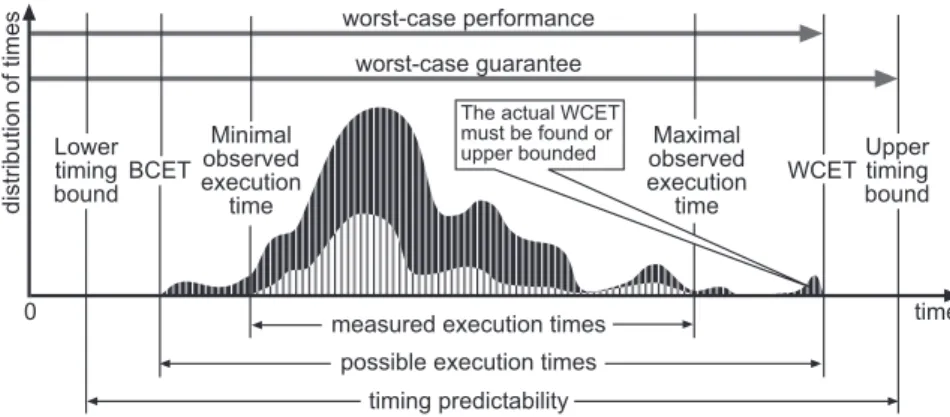
Figure 1.2: Time predictability. Source [2]
their use in CRTES allows scheduling multiple applications into the same processor, maximizing the hardware utilization while meeting SWaP constraints.
However, the use of many-cores in CRTES brings significant challenges. Providing evidence of the functional and timing correctness of system components is not trivial in the case of multi-core processors, especially in the timing domain. This effect is exacerbated in many-cores, due to increment in the number of cores2. Hence, despite the advantages of many-cores and the fact that they are nowadays a reality in the embedded system domain (e.g. Tilera [18], Kalray MPPA [4], Freescale/NXP P4080 [19], TI Keystone II [20]), their use in CRTES environment still requires finding efficient ways of providing tight and trustworthy WCET estimates.
This thesis investigates the use of many-core processors in CRTES as a means to provide a level of guaranteed performance required for future complex applications and integration of several systems into a single platform.
1.3
Applying multi/many-core technology to CRTES
Timing correctness is a mandatory property of CRTES. It is assessed by system designer and it relies on providing evidence that tasks meet their respective deadlines. However, quantifying the execution time of a task is not trivial, as it depends on many factors (input data, programming language, compiler, hardware architecture, etc.). For example, a simple addition of two variables stored in memory can take between few and dozens of cycles, even when executed on a rudimentary hardware. Thus, the execution time of a task cannot be represented by a single value, but with a distribution of execution times (Figure 1.2). As determining exact WCET is mostly infeasible, the goal of timing analysis is to provide WCET estimates, that satisfy the following constraints:
• Trustworthiness– WCET estimate is always higher than actual WCET
• Tightness – The difference between WCET estimate and actual WCET is finite and as low as possible, in order to maximize guaranteed system performance.
Chapter 1. Introduction 7
M1
M2
M3
M4
Figure 1.3: Memory accesses in many-cores
1.3.1
The timing behavior of CRTES in multi/many-core platforms
Proving timing correctness in multi/many-core processor architectures is challenging due to the impact that interferences have on the timing behavior of the system when accessing the shared hardware resource (shared caches, interconnection networks, memory controllers, I/O devices, chip pins, etc.). Interference occurs when several requests coming from different cores (and possibly from various tasks of the system) try to access a shared hardware resource at the same time, requiring some arbitration mechanism in order to handle contention.
As a result, the latency of accessing a shared resource from one core becomes dependent on the contention created (by a given frequency and an access pattern) from other cores on the same shared resource. This makes derivation of tight and precise WCET estimates more difficult as the WCET estimates dependent on the workload. This effect, which occurs in both multi- and many-core architectures, is exacerbated as the number of cores increases. Additionally, in most of the many-core architectures, latency in accessing memory controllers is not uniform, as the requests traverse various distance in the Network on Chip (NoC), making the analysis more complex (see Figure 1.3).
There are two main ways to account for contention among accesses to shared hardware resources, when analyzing the timing behavior:
• The contention can be accounted as a part of the WCET estimation process. In order to do so, for each shared resource we derive an upper-bound on maximum access time to that shared resource when being affected by interferences. This upper bound is called Upper-Bound Delay (UBD) [21]. Then, at the analysis time (performed in isolation), each access to a shared resource is delayed by its UBD, trustworthy upper-bounding the impact of potential interference.
• The contention a task suffers can be alternatively handled factoring in the schedulability analysis, which is performed at system integration. At this point, the workload is known, as well as the individual characteristics of each task forming the system, i.e. their demand for shared resources. As an input to this process, we use WCET estimates computed in isolation and contention impact is accounted by adding to the tasks WCET estimate in isolation the maximum contention that could be generated due to interference by its co-running tasks.
Chapter 1. Introduction 8
Figure 1.4: Time composability
Each approach has its pros and cons. The former allows making WCET estimates time-composable, i.e. independent on the workload, at the cost of WCET over-estimation. The latter enables deriving tighter estimates since it builds upon the knowledge of interference generated by the tasks in the observed task set. However, obtaining time-composability property with the latter approach is extremely challenging [22].
Figure 1.4 highlights the differences among two approaches, when obtaining WCET estimates for thetask A.Task Ais run together with tasks B andC on an example system. Time-composable WCET estimates oftask A(in orange) do not change, regardless of the workload, while the non time-composable ones change depending whethertask Ais run in isolation or co-running with
task B ortask C.
1.3.2
The design of CRTES: Time composability
Software complexity in CRTES is rising with each new generations of systems, e.g. F−22 Raptor fighter jet’s software has 2.2 millions of lines of code compared to around 1 million inF−16C. In order to reduce the complexity, facilitate software development, and improve code portability, maintainability, and interoperability, latest CRTES software is built on top of the standardized software architectures like ARINC 653 (Avionics Application Standard Software Interface), used in avionics domain [23], and AUTomotive Open System ARchitecture (AUTOSAR) used in automotive domain [24].
Along with the growth of software complexity, in CRTES there is a trend towards the integration of various functions into the same devices, further increasing systems complexity. In Integrated Modular Avionics (IMA) [23, 25], as well as in AUTOSAR, engineers rely on robust functional and temporal partitioning, to provide ”freedom from interference” in integrated systems [26]. This thesis focuses on providing temporal partitioning in integrated CRTES, achieved through a means of time composability.
Time composability is a design principle that requires WCET estimates hold regardless of the co-running tasks running on the same chip and accessing the shared resources. In CRTES design, time composability is a pillar that enables incremental development and incremental verification (IV) of integrated systems [27]. During system development, it allows independent application/system development, across several vendors. Furthermore, it enables determining
Chapter 1. Introduction 9
whether application fits its timing budget during the development, while it’s easier and cheaper to make the necessary changes, compared to discovering that during system integration. During the system integration, the ability to incrementally integrate applications without the need of regression tests to validate the timing properties of already-integrated applications heavily reduces integration costs. At system deployment, the ability to update functions and their associated software, without the need for re-analyzing and re-certifying the system, is vital in domains like space where systems operate during dozens of years and whose functionality is usually updated once deployed.
Overall, an increase in functions and systems complexity, combined with the integration of multiple systems into the same platform, comes at the cost of more complex and expensive verification and certification processes. This thesis will consider above-mentioned industrial standards without impacting on system development and integration complexity.
1.4
Thesis Goals and Objectives
This thesis aims at boosting the use of many-core processors in CRTES industry, finding ways of efficiently exploiting their strengths and mitigating their negative impact on timing analysis. In order to do so, this thesis defines the following goals:
Goal 1 Investigate hardware and software solutions to boost guaranteed performance of CRTES applications from avionics and automotive domains through the use of parallel computing. More guaranteed performance in CRTES domain will not only bring benefits in safety of land- and air-borne vehicles, but will also reduce air pollution and energy consumption, with clear positive impact on quality of life and the environment. Furthermore, it would create a competitive advantage for some of the key European industries.
Goal 2 Compliance of proposed solutions to current industrial practices and standards. As stated in Section 1.3.2, avionics and automotive software is built and executed on top of standardized software architectures, namely Integrated Modular Avionics (IMA) [23] and AUTomotive Open System ARchitecture (AUTOSAR) [24]. On top of that, when building CRTES applications, developers comply with the domain-specific safety standards, e.g. DO-178B [28] in the avionics and ISO26262 [29] in the automotive domain. Compliance with these standards is a requirement for all solutions proposed in the thesis to be relevant and useful to these CRTES industries. This thesis is focused on ARINC 653 and AUTOSAR standards.
Goal 3 Re-usability of legacy code of industrial applications and facilitating migration towards many-core platforms. In CRTES, many applications/systems have been developed, tested, improved and fine-tuned for several years. Consequently, the CRTES companies already made significant investments in their legacy applications, ranging from requirements, design, development and verification processes. Thus, proposals made in this thesis cannot require from developers to significantly change their well-tested applications, and ideally, the application should behave the same on the many-core platform as when executed on a
Chapter 1. Introduction 10
Table 1.1: Goals and objectives
O1 O2 O3 O4 O5 Goal 1 X X X X
Goal 2 X X
Goal 3 X X
single-core. Therefore, we must facilitate the reuse of the existing software designs to reduce the cost of migration to many-core platforms, as well as the reuse of test-cases in order to minimize verification and certification costs
This thesis addresses its goals by defining the following objectives (Table 1.1 shows the relation among them):
O1 Providing hardware support for improving guaranteed performance of CRTES applications on many-core processors. Without novel many-core processors designs, tailored to reduce WCET estimates of complex applications, CRTES industry might fall short on reaching its long-term goals. Thus, development of scalable and time-analyzable many-core processor is a must. Furthermore, our envisioned many-core designs, should be as close as possible to Commercial-Off-The-Shelf (COTS) processors, to ease their adoption in CRTES and so that even some low-volume CRTES markets can also exploit their benefits.
O2 Deriving software solutions for enabling parallel execution on many-core platforms. This thesis investigates providing software mechanisms in order to enable efficient parallel/con-current execution of CRTES applications in many-core platforms. Furthermore, it devises new scheduling algorithms for both parallel/concurrent execution of applications and paral-lel/concurrent execution of functions inside applications, aiming to facilitate parallelization of complex legacy code.
O3 Improvement of timing analysis methods and techniques. Improvement of guaranteed perfor-mance of CRTES applications cannot only come from hardware/software solutions. In order to satisfy the guaranteed performance needs of future CRTES, it is necessary to reduce the potential overestimation due to multi- and many-core execution, when computing WCET estimates as much as possible as well as evaluate novel approaches in timing analysis.
O4 Validation of proposals with real industrial applications. This thesis evaluates and validates the proposed solutions with three industrial case-studies: collision avoidance and stereo navigation applications from avionics (provided by Honeywell Int.) and Engine Management System (EMS) from automotive domain (provided by Denso Deutschland GmbH) to assess their applicability to industry.
O5 Recommendation to standardization authorities for extension of standards to support parallel execution of applications on many-core platforms. Current CRTES standards are built and written with single-core processors in mind as the target platform. In order to enable adoption of many-core platforms by CRTES industries, the standards have to be revised. This thesis aims at making same recommendations for updating IMA and AUTOSAR standards, for avionics and automotive respectively.
Chapter 1. Introduction 11
1.5
Thesis Contribution
This thesis contributes to advancing the state-of-the-art toward the convergence of high-performance and embedded domain. It proposes new many-core hardware designs and efficient software tech-niques that exploit their parallelization capabilities, targeting CRTES. These contributions are fully inline with the thesis objectives defined in Section 1.4.
1.5.1
Hardware
We propose time-predictable many-core designs suitable for the CRTES of the future. They aim at enabling time-predictable parallelization of CRTES applications as well as the time-predictable parallel execution of them, in line with objectiveO1. To that end, this thesis proposes two novel concepts as an extension to ARINC 653 standard (objectiveO5).
First, aligned with the objectiveO2, we propose Parallel Software Partitions (pSWPs) which improves the concept of ARINC Software Partitions (SWPs), providing a means for parallel/con-current execution of CRTES applications in many-core platforms.
Second, it proposes physical (hardware) counterparts of the pSWPs – called Guaranteed Resource Partitions (GRPs). For the design of GRPs, we focus on two of the most critical hardware shared resources: (i)Network on Chip (NoC) and(ii)memory controller, and provide two many-core architectures that implement GRPs: one implementing hierarchical NoC (tree+bus) and another featuring mesh-based NoC, and evaluate the proposals with industrial avionics applications provided by Honeywell International (O4). This work, named ”Parallel many-core avionics systems”,was presented at the ACM International Conference on Embedded Software, EMSOFT 2014, in New Delhi, India [30].
Third, in line with objectivesO1andO3, we introduce a new metric called Contention Delay (CD) that captures the impact of interference in NoC on WCET estimates more accurately compared to currently used metrics. We provide a taxonomy of NoC parameters and an analytical model for computing our proposed metric. This work was presented in an article named”Modeling
High-Performance Wormhole NoCs for Critical Real-Time Embedded Systems”, at IEEE Real-Time
and Embedded Technology and Applications Symposium, RTAS 2016, in Vienna, Austria [22].
Finally, we present two mechanisms that improve utilization and guaranteed performance of a mesh-based many-core processor, by providing fair bandwidth distribution across the chip. This work was published in the Proceedings of IEEE Design, Automation & Test in Europe, DATE 2016, Dresden, Germany, as an article named”Improving performance guarantees in wormhole mesh NoC designs” [31].
1.5.2
Scheduling techniques
We propose a set of scheduling techniques targeting proposed many-core designs, along with objectiveO2. First, we present an allocation algorithmRunParthat uses functions (in AUTOSAR
Chapter 1. Introduction 12
called runnable entity or short runnable) as a Unit of Schedulings (UoSs) and maps them into GRPs. It exploits runnable-level parallelism, while reusing legacy code and maintaining the application configuration (Goal 3). We apply and evaluate RunPar with a real automotive application: Engine Management System (EMS) provided by DENSO Deutschland (objective
O4). This work appeared in the ACM International Conference on Hardware/Software Codesign and System Synthesis, CODES+ISSS 2014, New Delhi, India, as an article nameRunPar: An allocation algorithm for automotive applications exploiting runnable parallelism in multicores [32]. Second, aligned with the objectives O2andO3, the thesis builds upon the pSWP and GRP mechanisms and the compositional analysis presented in [30] and provides an algorithm for allocation of parallel applications (wrapped inside pSWPs ) onto a many-core platform featuring GRPs. We present Communication-aware Allocation algorithm for real-time Parallel applications on many-cores (CAP) that takes into account communication among applications and tries to reduce its impact on WCET estimates and overall system throughput. This work namedCAP: Communication-aware Allocation algorithm for real-time Parallel applications on many-cores was presented in the IEEE Euromicro Conference on Digital System Design, DSD 2015, in Madeira, Portugal [33].
1.5.3
Probabilistic timing analysis
In this thesis, we show the applicability of novel Probabilistic Timing Analysis (PTA) techniques to deterministic many-core architectures (objectives O1and O3). We show that is possible to use and analyze Time Division Multiple Access (TDMA) arbitration policy in the context of Measurement-Based Probabilistic Timing Analysis (MBPTA), leading to trustworthy and tight WCET estimates without introducing any hardware changes, just with padding of observed execution times. This work was also presented at the IEEE Euromicro Conference on Digital System Design, DSD 2015, in Madeira, Portugal, as an article namedEnabling TDMA Arbitration in the Context of MBPTA[34]. Extended version of this work appeared as a journal article in Microprocessors and Microsystems - Embedded Hardware Design, volume 52, 2017 [35].
1.5.4
Standards
This thesis makes recommendations for extension of ARINC 653 with pSWPs and GRPs concepts to support parallel execution of IMA applications, sent to Honeywell Int. in order to influence ARINC653 standardization committee (objectiveO5).
1.5.5
Open source software
The work done in this thesis is a part of European FP7 project named Multi-Core Execution of Parallelised Hard Real-Time Applications Supporting Analysability – parMERASA [36]. Thus, the final contribution of the thesis is the open source software that was developed in the scope of the parMERASA project, and that is publicly available athttp://www.parmerasa.eu/index.
Chapter 1. Introduction 13
1.6
Thesis Organization
This thesis comprises four parts, which are further broken down into chapters:
• Part I introduces the reader to the topic and sets the environment for the rest of the thesis. After introducing the problem in Chapter 1, Chapter 2 presents our evaluation framework, including simulation tools SoCLib [37] and gNoCSim [38], WCET analysis tools RapiTime [39] and OTAWA [40], and industrial applications and benchmarks used to evaluate the proposals.
• In Part II , we propose a time-predictable many-core hardware design, together with timing models that improve the analysis. In Chapter 3, we show mechanisms for enabling concurrent execution of parallel applications on many-core processors, implemented in two architectures, together with the suitable analysis. Chapter 4 focuses on improving the modeling of latencies of one of the most important shared resources: Network on Chip (NoC). Further, in Chapter 5, we propose two mechanisms for improving guaranteed performance in wormhole NoCs.
• Part III presents software scheduling algorithms designed to exploit the performance capabilities of the hardware techniques presented inPart II. Chapter 6 presents scheduling techniques for parallelization of complex automotive applications, while in Chapter 7 we investigate the ways of scheduling parallel CRTES applications on many-core platforms supporting GRPs.
• Part IV gives a glimpse into the future of the CRTES. In Chapter 8, we investigate
the use of promising probabilistic timing analysis techniques with deterministic hardware architectures. Chapter 9 concludes the thesis and considers next barriers and challenges for bringing many-core processors into CRTES domain.
Chapter 2
Experimental Setup
This chapter covers the tools used for the experiments performed in the scope of this thesis. It describes simulation framework used to develop hardware platforms and implement the techniques proposed. Furthermore, it presents case studies and benchmarks for evaluation as well as timing analysis tools used to obtain Worst-Case Execution Time (WCET) estimates.
2.1
Simulation framework
Simulation is an established technique in both industry and academia for evaluation of novel techniques and designs. It is even more crucial in the field like computer architecture, where the cost of building a proposal in a silicon chip is extremely high, in both time and money.
Since the focus of the thesis is the timing behavior of Critical Real-Time Embedded Systems (CRTES) applications, we chose an execution-driven, cycle-accurate simulation framework named SoCLib [37, 41] as the basis for our platforms development. As the thesis investigates novel Network on Chip (NoC) models and designs for CRTES, we integrated a powerful NoC simulator named gNoCSim, developed in scope of the NaNoC project [38], into the SoCLib framework. We also implemented a no-overhead tracing mechanism, in order to support a commercial measurement-based timing analysis tool used in parMERASA project.
It is important to remark that development of the simulation framework is a result of a group effort from current and past members of the Computer Architecture/Operating System interface (CAOS) group at Barcelona Supercomputing Center (BSC) and is used in several research projects: parMERASA, PROARTIS, PROXIMA, etc.
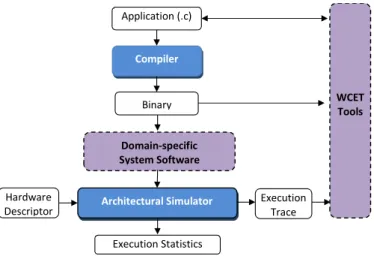
Figure 2.1 gives a high-level overview of the simulation framework and how it integrates with applications, system software and timing analysis tools used in scope of the thesis.
SoCLib is a framework that enables creation of execution-driven cycle accurate simulators. It features its own build system and comes with a set of common components (cores, caches, terminals, memory controllers, buses, NoCs, etc.). Communication among components is carried
Chapter 2. Experimental Setup 16
parMERASA | No. 287519 | D5.1 | Hardware Requirements 7 / 13
1 SIMULATION FRAMEWORK INFRASTRUCTURE
The hardware simulation framework infrastructure is the component in charge of executing the parMERASA target applications and provides the timing information required to compute WCET estimations. The simulation framework is composed of two components: The architectural hardware simulator, in charge of executing the binary and providing the timing information necessary to provide trustworthy WCET estimations, and the compiler, in charge of generating the binary capable to be executed in the simulation infrastructure.
Figure 1 shows the complete execution stack of the parMERASA tool-chain including the domain-specific system software, explained in deliverable D4.1, and the WCET tools, explained in deliverable D3.1. The binary and the domain-specific system software (IMA in case of avionics, AUTOSAR in case of automotive and ESX-3XL in case of construction machinery), which provides the APIs required to fulfil industrial requirements (e.g. ARINC 653 in case of avionics), are executed on top of the architectural hardware simulator. The WCET tools are in charge of analysing the application through static analysis, or execution time measurements obtaining by code instrumentation.
This deliverable focuses on the architectural hardware simulator and the compiler. 1.1 Architectural Hardware Simulator
Three main criteria have been used to select the component architectural hardware simulator:
- Maturity. The following questions have been considered: How mature is the component? How
many users are using the component? By doing so, our confidence in the quality (i.e., accuracy, performance, stability, usability) of the tool increases.
Application (.c) Compiler Binary Domain-specific System Software Architectural Simulator WCET Tools Execution Trace Hardware Descriptor Execution Statistics
Figure 1. Simulation framework infrastructure including the system software and WCET tools
Figure 2.1: High-level overview of simulation framework together with system software and WCET tools
out via Virtual Component Interface (VCI) interfaces. It provides a set of emulators for various Instruction Set Architecture (ISA), which enables application development for the simulated platforms, as well as the tools for debugging those applications. Furthermore, it also provides a significant portion of standard low level system libraries, abstracting the hardware from the developer and facilitating the development of applications.
In order to accomplish the goals set of this thesis, we made the following improvements to the SoCLib (SoCLib) framework:
• We added support for PowerPC750 ISA, by extending PowerPC405 emulator provided by SoCLib. We also added atomic fetch-and-add instructions, to help system software implement time-predictable synchronization mechanisms.
• In the original SoCLib, emulators were fully integrated into the platform, and there was no way of providing application developers only functional emulator without the timing simulator. Thus, we created a layer of separation (called RPIBuffer) between functional emulator and timing simulator, allowing our platforms to execute without timing simulator attached.
• The introduction of RPIBuffer allowed us to decouple functionality of the processor core from the emulator and introduce a means of creating different pipelines. In all of the experiments done in scope of this thesis, we use 3-stage pipeline (Fetch, Execute/Memory-Operations, Commit).
• We implement and use VCI interfaces that support multiple VCI requests. That allowed us to have multiple requests in flight coming from a core, memory controllers handling multiple requests, split transactions on the buses, etc.
• We also implement new component for caches in order to support multi-level caches, novel placement and replacement strategies, etc. First level caches are integrated with the processor core module, in order to speed up simulation (they can be disabled through configuration). Second and higher level caches can be integrated into the core, or connected
Chapter 2. Experimental Setup 17
to several cores via VCI interface, enabling us to build complex cache hierarchies. In scope of this thesis, we use only first level caches, due to the limitations of the analysis methods and to speed up the execution of the simulations.
• We also added support for software controlled cache memories, i.e. scratchpads, as they are widely used in automotive industry. Platform used in Chapter 6 uses scratchpads instead of first level instruction caches.
• We created new memory controller component that supports multiple requests in flight. It allows execution of the applications in the Upper-Bound Delay (UBD) mode and implements prioritization of certain types of requests, as explained in Chapter 3). It provides support for atomic fetch-and-add instructions and can be attached to more complex DRAM simulators.
• SoCLib support for NoCs is lackluster. We created a wrapper component with VCI interfaces around full-blown cycle-accurate flit-level NoC simulator, called gNoCSim [38]. That allowed us to create complex NoC topologies (Chapter 3), implement virtual channels prioritization (Chapter 3). Further, it enabled us to implement weighted round-robin arbitration and packetization (Chapter 5) as well as to experiment with synthetic traffic in gNoCSim standalone mode (Chapter 4 and Chapter 5).
• Alongside gNoCSim, we also added support for buses, both inside the core (between different cache levels in hierarchy) and outside the core with VCI interfaces. We implemented several arbitration policies (Time Division Multiple Access (TDMA), round-robin, etc.) and added support for split-cycle transactions.
• In order to support measurement-based timing analysis (see Section 2.3), we implemented no-overhead tracing mechanism. Inside of RPIBuffer, we detect execution of certain instructions (list of labels provided by the tool) and output the traces of application execution with no calls to instrumentation functions inside the analysed code.
Using this enhanced SoCLib framework, we built a highly-configurable many-core simulation platform, used in the FP7 project parMERASA, that implements designs presented in Chapter 3, Chapter 4 and Chapter 5. Along with objectiveO5, we published this platform as an open-source software project (see Section 1.5.5).
Note that, even though the author contributed in all enhancements listed above, he was the main contributor to the development of the configurable platform, no-overhead tracing mechanism, memory controller, synchronization mechanisms and virtual channel prioritization.
2.2
Case studies
This section presents industrial case studies and benchmarks used in scope of this thesis to evaluate its proposals. In general, there is a lack of standard multi-threaded benchmarks for CRTES applications. Thus, aligned with the objectiveO4, we use 3 industrial applications: 2 from avionics and 1 from automotive domain. We also use a standard suite of single-threaded automotive benchmarks.
Chapter 2. Experimental Setup 18
2.2.1
Avionics domain
From the avionics domain we use two parallel avionics applications: 3D Path Planning (3DPP) and Stereo Navigation (StereoNav), used for the navigation of Unmanned Aerial Vehicles (UAVs), provided by Honeywell Int.
The3DPP application computes the path between the current UAV position (obtained from a satellite) and the target position (defined by a user), while avoiding obstacles in a 3D environment. It employs Laplace’s equation for airborne collision avoidance. It is parallelized based on the split of the 3D obstacle grid into compartments, i.e., sub-grids. Consequent parallel processing depends on data dependencies and thus varies on individual operations. The use of the Gauss-Seidel method [42] in the calculation of the potential matrix creates data dependencies between compartments. Coarse-grained synchronization is required for establishing a proper sequence to process the individual compartments, which follows a well-defined software pipeline pattern.
The StereoNav is intended for determining the direction and speed of UAV movement in case satellite signal is unavailable. TheStereoNav application receives as an input two independent images derived from two cameras pointing at approximately the same direction, and extracts features common for both images in the 3D-space, i.e., dominant entities in the image invariant to rotation and translation. Based on the changes in the features position in different pairs of adjacent images, the absolute translation and rotation of the UAV can be computed.
The parallelization of the StereoNav application is based on the ability to process each of the images in a pair in parallel. Steps up to and including the matching of features in each of the images in a pair are currently executed in parallel. The maximum theoretical speed-up achievable in each of the steps of the application varies significantly.
2.2.2
Automotive domain
From the automotive domain, we use an Engine Management System (EMS) application, provided by Denso Deutschland to evaluate proposals developed in scope of this thesis. An EMS is a typical contorl automotive embedded real-time system application. It controls that the amount of fuel and the fuel injection times which is fundamental in ensuring smooth revolutions of the engine. The injection time and fuel amount depend on the state and the rotation speed of the engine, which changes continuously during operation. The EMS requires updates based on tasks that are time-triggered, with task periods ranging from one millisecond to one second, and a task that is triggered based on position of the crankshaft.
The EMS comprises around 1 thousand functions, grouped by the trigger to eleven time-triggered tasks, with periods of 1, 4, 5, 8, 16, 20, 32, 64, 96, 128 and 1024 ms, and a crank-angle interrupt-triggered task, with a minimum period of 1.25 ms corresponding to the maximum engine rotation speed (4000 rpm, in our case).
Chapter 2. Experimental Setup 19
Name Short Description
a2time Angle to Time Conversion basefp Basic Integer and Floating Point bitmnp Bit Manipulation
cacheb Cache ”Buster”
canrdr CAN Remote Data Request aifft Fast Fourier Transform (FFT) aifirf Finite Impulse Response (FIR) Filter aiifft Inverse Fast Fourier Transform (iFFT) aiirflt Infinite Impulse Response (IIR) Filter matrix Matrix Arithmetic
pntrch Pointer Chasing
puwmod Pulse Width Modulation (PWM) rspeed Road Speed Calculation
tblook Table Lookup and Interpolation ttsprk Tooth to Spark
Table 2.1: EEMBC Automotive Suite
2.2.3
Benchmarks
In order to asses the impact of our designs on single-threaded applications, we use EEMBC Automotive Benchmark suite [43], developed by the Embedded Microprocessor Benchmark Consortium. It captures frequent operations of automotive systems. For instance, a2time simulates an embedded automotive application where the Central Processing Unit (CPU) tries to measures the real-time delay in movement of a crankshaft of an engine.
Table 2.1 shows the list of benchmarks contained in this suite. We execute all of the benchmark on bare-metal system, without any Real-Time Operating System (RTOS) support. Thus, we don’t have to account for impact of RTOS, as benchmarks run end-to-end and without preemption.
2.3
Timing analysis
In order to verify the timing correctness of CRTES, it is necessary to perform WCET analysis, i.e. to compute a WCET estimation. To do so, today industries and academias follow two main approaches for WCET analysis [44]: static analysis and measurements based analysis. The former, e.g. aiT [45], OTAWA [40], relies on the construction of a specific cycle accurate model of the computational unit in which the code will run (e.g. the complete processor or a unique core in a many-core architecture), and the construction of a mathematical representation of the timing behavior of the application under analysis running on that processor. The mathematical representation is then processed with Integer Linear Programming (ILP) techniques to determine a safe upper-bound on the execution time. The latter, e.g. RapiTime [39], relies instead on thorough testing of the application under analysis on the real processor or a cycle accurate timing simulator of that processor, with high-coverage stressful input data, and recording the longest observed execution time.
Chapter 2. Experimental Setup 20
This thesis has considered two WCET analysis tools, one of each type: OTAWA and RapiTime, static and measurement-based timing analysis tools respectively. Next we provide a very short introduction to each them.
2.3.1
Static timing analysis – OTAWA
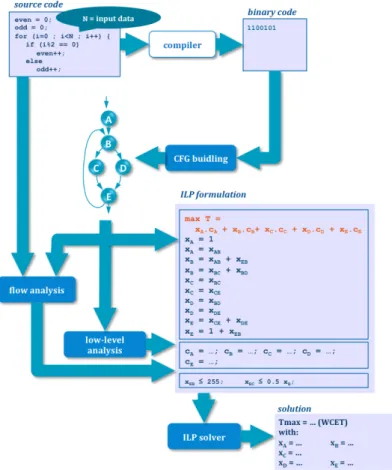
OTAWA is an open-source static timing analysis [40]. In other to determine the WCET estimate of a program, OTAWA does the following steps:
Figure 2.2: Workflow of the static timing analysis tool OTAWA.
1. The Control Flow Graph (CFG) is derived from the executable code.
2. Based on the CFG, the tool performs 3 types of analyses: (i) value analysis, (ii) loop bound analysis and (iii) control flow analysis, in order to construct annotated CFG. Value analysis consists of over-approximating set of values and addresses of memory locations. Loop bound analysis determines the bounds on number of iterations for all of the loops in the code, needed to bound the WCET. Control flow analysis eliminates infeasible paths as well as the target of indirect branches. We can further improve the precision of all of these steps by adding annotations to the source code.
3. After constructing annotated CFG, low-levell analysis is perform (comprising pipeline and cache analysis). It is used to determine bound on the execution time for each basic blocks1
1Basis block is a straight sequence of instructions with single point entry (all jumps go to the first instruction
![Figure 1.1: Europe embedded system market size, by application (US$ billions). Source: [ 1]](https://thumb-us.123doks.com/thumbv2/123dok_us/10113548.2911916/28.893.206.630.122.394/figure-europe-embedded-market-size-application-billions-source.webp)