Table of Contents
U.S. Realm - Interoperability Specification: Genetic Test Result Message to EHR Page i Copyright 2007-2008 © Health Level Seven, Inc. All Rights Reserved.
HL7 VERSION 2 IMPLEMENTATION
GUIDE: CLINICAL GENOMICS; FULLY
LOINC-QUALIFIED GENETIC VARIATION
MODEL, RELEASE 1 (1ST INFORMATIVE
BALLOT)
ORU^R01
HL7 Version 2.5.1
APRIL, 2009
Chapter Chair: Amnon Shabo
IBM Chapter Chair and Contributing
Author: Partners HealthCare Center for Personalized Genetic Medicine and Partners Mollie Ullman-Cullere Healthcare
Chapter Chair: Phil Pochon
Covance Project Chair and Principal
Author: Intermountain Healthcare Stan Huff
Project Chair and Contributing
Author: Intermountain Healthcare Grant Wood
Contributing Author Clement McDonald
Lister Hill Center for Biomedical Communication, National Library of Medicine
Contributing Author Yan Heras
Intermountain Healthcare
Subject Matter Advisor Victoria Joshi
Laboratory for Molecular Medicine, Partners HealthCare Center for Personalized Genetic Medicine; Department of Pathology, Massachusetts General Hospital
Technical Writer Larry Babb
Partners HealthCare Center for Personalized Genetic Medicine and Partners Healthcare
Technical Writer Eugene Clark
Table of Contents
U.S. Realm - Interoperability Specification: Genetic Test Result Message to EHR Page ii Copyright 2007-2008 © Health Level Seven, Inc. All Rights Reserved.
TABLE OF CONTENTS
1. INTRODUCTION...2 1.1 Purpose...2 1.2 AudIence...3 1.3 Scope...3 1.4 Assumptions...3 1.5 Conventions...3 1.6 Pilot Projects...4 2. MESSAGING INFRASTRUCTURE...53. MESSAGE PROFILE – GENETIC LABORATORY TO EHR...6
3.1 Use Case Model...6
3.2 Dynamic Interaction Model...8
3.3 Dynamic Definition...8
3.4 Interactions...9
4. MESSAGES...11
5. SEGMENT AND FIELD DESCRIPTIONS...12
6. NOMENCLATURES, CODE SYSTEMS AND VALUE SETS...13
6.1 Vocabulary Constraints...13
6.1.1 Genetic Tests, Testing Context, Interpretation Code, and Genetic Data...13
6.1.1.0 LOINC... 13
6.1.2 Associated Disease and/or Drug...14
6.1.2.0 SNOMED-CT... 14
6.1.2.1 RxNORM... 14
6.1.3 Genes...14
6.1.3.0 HGNC gene symbols (required)... 14
6.1.4 Sequence Variations...15
6.1.4.0 HGVS (required)... 15
6.1.4.1 dbSNP (optional)... 15
6.1.5 Reference Sequences (required)...16
Table of Contents
U.S. Realm - Interoperability Specification: Genetic Test Result Message to EHR Page iii Copyright 2007-2008 © Health Level Seven, Inc. All Rights Reserved.
7. LOGICAL MESSAGE TYPES...17
7.1 INTRODUCTION AND STRATEGY...17
7.2 MESSAGE DEFINITIONS...18
7.3 Message Components...18
7.3.1 Test Interpretation...18
7.3.1.0 Genetic Disease Analysis Summary Panel... 18
7.3.1.1 Pharmacogenetic Analysis Summary Panel... 19
7.3.2 Findings...21
7.3.2.0 Genetic Analysis Discrete Result Panel... 21
7.3.2.1 DNA Analysis Discrete Sequence Variation Panel... 21
7.4 LOINC Codes...25
7.5 LoINC Answer Lists...27
7.6 SPECIAL SYNTAX...28
8. EXAMPLE GENETIC TEST LABORATORY MESSAGES...29
8.1 Minimal Message with Acknowledgement...29
8.2 Hypertrophic Cardiomyopathy Genetic test Result Message...29
8.2.1 Example: Hypertrophic Cardiomyopathy...29
8.3 Warfarin metabolism genetic test Result Message...29
8.3.1 Example: Warfarin metabolism...34
8.4 Tyrosine Kinase Inhibitor efficacy (pharmacogenomic) genetic test Result Message...37
8.4.1 Example: Tyrosine Kinase Inhibitor efficacy (Pharmacogenomic)...37
Chapter 1: Introduction
U.S. Realm - Interoperability Specification: Genetic Test Result Message to EHR Page 1-40 Copyright 2007-2008 © Health Level Seven, Inc. All Rights Reserved.
INDEX OF TABLES
Table 3-1 – Use Case Laboratory to EHR... 6
Table 3-2 – Dynamic Definition... 8
Table 3-3 – Interactions... 9
Table 6-1 – Lab LOINC... 13
Table 6-2 – SNOMED-CT... 14 Table 6-3 – RxNORM... 14 Table 6-3 – HGNC... 14 Table 6-3 – HGVS... 15 Table 6-3 - dbSNP... 15 Table 6-3 - RefSeq... 16 Table 6-3 - LRG... 16
Table 7-1 – Genetic Disease Analysis summary Panel... 19
Table 7-2 – Pharmacogenetic DNA Analysis Summary Panel... 19
Table 7-3 – Genetic Analysis Discrete Result Panel... 21
Table 7-4 – DNA Analysis Discrete Sequence Variation PaneL... 21
Table 7-5 – LOINC codes... 25
Chapter 1: Introduction
U.S. Realm - Interoperability Specification: Genetic Test Result Message to EHR Page 2-40 Copyright 2007-2008 © Health Level Seven, Inc. All Rights Reserved.
1. Introduction
The HL7 Version 2.5.1 Implementation Guide: Clinical Genomics; Genetic Test Result Reporting to EHR (US Realm)details structuring a genetic test results into the electronic health record utilizing HL7 version 2.5.1. This implementation guide is modeled after the HL7 Version 2.5.1 Implementation Guide: Orders And Observations; Interoperable Laboratory Result Reporting To EHR (US Realm), Release 1 and covers the reporting of genetic test results for sequencing and genotyping based tests where identified DNA sequence variants are located within a gene. For greater understanding of the area of clinical genetic laboratory testing, the reader should refer to AHIC’s Personalized Healthcare Detailed Use Case. In March, 2008, the HHS Office of the National Coordinator for Health IT published the Personalized Healthcare Detailed Use Case (Click here to see the use case) in response to a request and
specifications from the American Health Information Community. The use case focuses on supporting secure access to electronic genetic laboratory results and interpretations for clinical care, as well as family history and associated risk assessments by authorized parties and is driven by the need for timely electronic access to ordered, referred and historical genetic lab results and family history. Ordering clinicians receive genetic lab test results as a response to an order by having the genetic test results sent either directly to the clinician’s EHR system (local or remote) or to another clinical data system in support of the provisioning of historical results.
Two healthcare providers and a CLIA certified genetic testing laboratory are piloting the information model detailed in this implementation guide. See section 1.6 for details.
The complexity of genetic data requires additional coding of the message components using LOINC. These codes are listed in tables in section 7. LOINC coding has several advantages including more robust representation of the data when persisted in a database, increased accuracy when supporting multiple HL7 message formats, and consistency of representation for clinical decision support.
The chapters in this guide that describe messaging infrastructure, abstract message syntax, and segment and field descriptions are based on chapters from the parent implementation guide entitled HL7
VERSION 2.5.1 IMPLEMENTATION GUIDE: ORDERS AND OBSERVATIONS; INTEROPERABLE LABORATORY RESULT REPORTING TO EHR (US REALM), RELEASE 1 , ORU^R01 , HL7 Version 2.5.1 , November, 2007. This guide can be found at
http://www.hl7.org/Memonly/downloads/Standards_Messaging_V251/InteroperabilitySpecificationLabRes ultMessage_v251.zip (HL7 membership required).
1.1 PURPOSE
The HL7 Version 2.5.1 Implementation Guide: Clinical Genomics; Genetic Test Result Reporting to EHR (US Realm) is modeled after established laboratory reporting standards for genetic test results for sequencing and genotyping based tests where identified DNA sequence variants are located within a gene. This includes testing for DNA sequence variants that are associated with a disease (or risk for developing the disease) and pharmacogenomic applications, such as predicting a patient’s
responsiveness to drug therapy and drug metabolism rate, based on DNA sequence variants associated with these drug responses. It should be noted that genetics (both inherited, germline DNA variants and acquired, somatic DNA variants) is only one component in determining patient clinical state. Other contributions include health history, diet, medications, and behavioral and environmental variables.
Chapter 1: Introduction
U.S. Realm - Interoperability Specification: Genetic Test Result Message to EHR Page 3-40 Copyright 2007-2008 © Health Level Seven, Inc. All Rights Reserved.
1.2 AUDIENCE
This guide is designed to be used by analysts and developers who require guidance on the reporting of genetic test results generated through gene or partial gene sequencing or genotyping clinical diagnostic tests. Users of this guide must be familiar with the details of HL7 message construction and processing. This guide is not intended to be a tutorial on that subject.
1.3 SCOPE
This guide covers the reporting of DNA based genetic test results performed using sequencing or genotyping technology for the identification of DNA sequence variations contained within a gene. This includes testing for DNA variants associated with disease or pharmacogenomic response to drugs (efficacy or metabolism).
• Use of Vocabulary Standards This guide calls for specific vocabulary standards for the exchange of laboratory information. Use of standard vocabularies is important for a number of reasons. Use of standard vocabularies allows broad distribution of healthcare
information without the need for individual institutions to exchange master files for data such as test codes, result codes, etc. Each institution maps its own local vocabularies to the standard code, allowing information to be shared broadly, rather than remaining isolated as a single island of information. Standard vocabularies, particularly coded laboratory results, enable more automated decision support for patient healthcare, as well as more automated public health surveillance of populations.
1.4 ASSUMPTIONS
Assumptions are summarized as follows:
• Infrastructure is in place to allow accurate information exchange between information systems. • Providers access lab test results through either an EHR or a clinical data system.
• Privacy and security has been implemented at an acceptable level.
• All participants agree to all standards, methodologies, consent, privacy and security.
• Legal and governance issues regarding data access authorizations, data ownership and data use are outside the scope of this document.
• The order, paper or electronic, associated with the lab result contains sufficient information for the laboratory to construct the lab result message properly.
1.5 CONVENTIONS
The following conventions have been used in establishing this guide:
• The rules outlined in HL7 2.5.1, Chapter 2, Section 2.12, Conformance Using Message Profiles, were used to document the use case for, and constraints applied to, the messages described in this guide.
• Data types have been described separately from the fields that use the data types. For details regarding data type field lengths, please refer to Section 2.1.3, Lengths, in this document.
Chapter 1: Introduction
U.S. Realm - Interoperability Specification: Genetic Test Result Message to EHR Page 4-40 Copyright 2007-2008 © Health Level Seven, Inc. All Rights Reserved.
1.6 PILOT PROJECTS
This information model is based on HL7 version 3 Genetic Variation model. A message consistent with this model has been piloted for 3+ years transmitting genetic test results between the Laboratory for Molecular Medicine, Partners HealthCare Center for Personalized Genetic Medicine (formerly the Harvard – Partners Center for Genetics and Genomics) and Partners Healthcare’s electronic medical record. For the purposes of this work, the model was translated from HL7 version 3 to HL7 version 2.5.1. In addition, the model has been extended to reflect lessons learned. This includes association of findings to
SNOMED coded disease or RxNORM coded medications. The information model detailed within this implementation guide will be piloted by the following organizations.
Genetic Testing Laboratory:
Laboratory for Molecular Medicine, Partners HealthCare Center for Personalized Genetic Medicine (formerly Harvard – Partners Center for Genetics and Genomics), Cambridge, MA
Receiving Provider Electronic Medical Records: Partners Healthcare, Boston, MA
Chapter 2: Messaging Infrastructure
U.S. Realm - Interoperability Specification: Genetic Test Result Message to EHR Page 5-40 Copyright 2007-2008 © Health Level Seven, Inc. All Rights Reserved.
2. Messaging Infrastructure
The V2 Genetic Variation model uses the same messaging infrastructure as described in Chapter 2, Page 3 of the parent implementation guide entitled HL7 VERSION 2.5.1 IMPLEMENTATION GUIDE: ORDERS AND OBSERVATIONS; INTEROPERABLE LABORATORY RESULT REPORTING TO EHR (USREALM), RELEASE 1 , ORU^R01 , HL7 Version 2.5.1 , November, 2007. The guide can be found at
http://www.hl7.org/Memonly/downloads/Standards_Messaging_V251/InteroperabilitySpecificationLabRes ultMessage_v251.zip (HL7 membership required).
Chapter 3: Message Profile – Laboratory to EHR
U.S. Realm - Interoperability Specification: Genetic Test Result Message to EHR Page 6-40 Copyright 2007-2008 © Health Level Seven, Inc. All Rights Reserved.
3. Message Profile – Genetic
Laboratory to EHR
3.1 USE CASE MODEL
Table 3-1. Use Case: Laboratory to EHR T
TAABBLLEE33--11––UUSSEECCAASSEELLAABBOORRAATTOORRYYTTOOEEHHRR
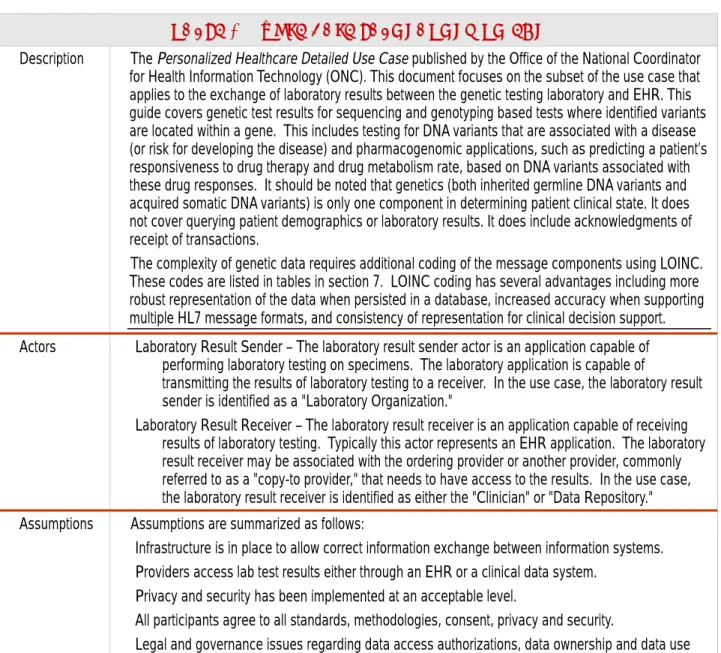
Description The Personalized Healthcare Detailed Use Case published by the Office of the National Coordinator for Health Information Technology (ONC). This document focuses on the subset of the use case that applies to the exchange of laboratory results between the genetic testing laboratory and EHR. This guide covers genetic test results for sequencing and genotyping based tests where identified variants are located within a gene. This includes testing for DNA variants that are associated with a disease (or risk for developing the disease) and pharmacogenomic applications, such as predicting a patient’s responsiveness to drug therapy and drug metabolism rate, based on DNA variants associated with these drug responses. It should be noted that genetics (both inherited germline DNA variants and acquired somatic DNA variants) is only one component in determining patient clinical state. It does not cover querying patient demographics or laboratory results. It does include acknowledgments of receipt of transactions.
The complexity of genetic data requires additional coding of the message components using LOINC. These codes are listed in tables in section 7. LOINC coding has several advantages including more robust representation of the data when persisted in a database, increased accuracy when supporting multiple HL7 message formats, and consistency of representation for clinical decision support. Actors Laboratory Result Sender – The laboratory result sender actor is an application capable of
performing laboratory testing on specimens. The laboratory application is capable of
transmitting the results of laboratory testing to a receiver. In the use case, the laboratory result sender is identified as a "Laboratory Organization."
Laboratory Result Receiver – The laboratory result receiver is an application capable of receiving results of laboratory testing. Typically this actor represents an EHR application. The laboratory result receiver may be associated with the ordering provider or another provider, commonly referred to as a "copy-to provider," that needs to have access to the results. In the use case, the laboratory result receiver is identified as either the "Clinician" or "Data Repository." Assumptions Assumptions are summarized as follows:
Infrastructure is in place to allow correct information exchange between information systems. Providers access lab test results either through an EHR or a clinical data system.
Privacy and security has been implemented at an acceptable level.
All participants agree to all standards, methodologies, consent, privacy and security.
Chapter 3: Message Profile – Laboratory to EHR
U.S. Realm - Interoperability Specification: Genetic Test Result Message to EHR Page 7-40 Copyright 2007-2008 © Health Level Seven, Inc. All Rights Reserved.
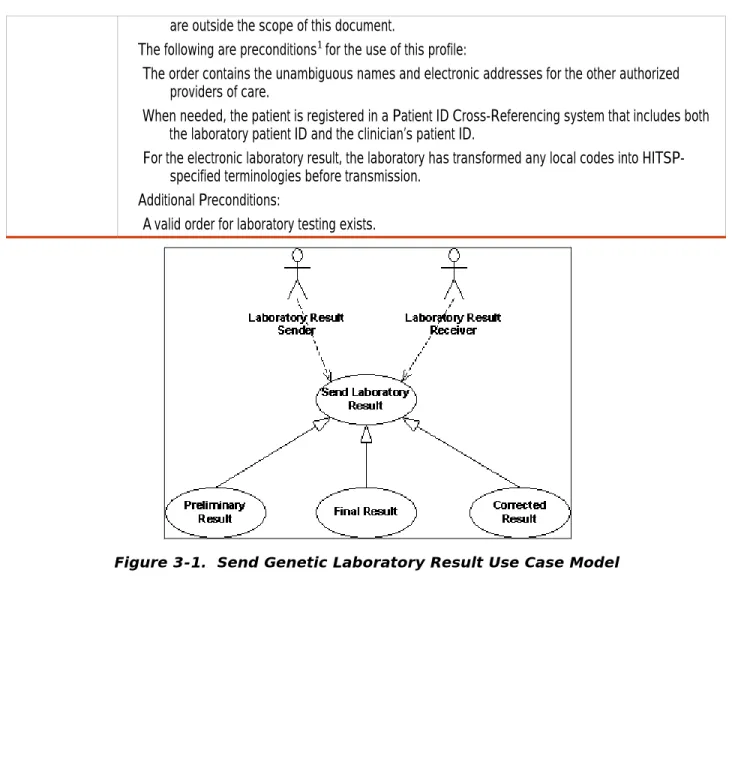
are outside the scope of this document.
The following are preconditions1 for the use of this profile:
The order contains the unambiguous names and electronic addresses for the other authorized providers of care.
When needed, the patient is registered in a Patient ID Cross-Referencing system that includes both the laboratory patient ID and the clinician’s patient ID.
For the electronic laboratory result, the laboratory has transformed any local codes into HITSP-specified terminologies before transmission.
Additional Preconditions:
A valid order for laboratory testing exists.
Figure 3-1. Send Genetic Laboratory Result Use Case Model
1
From HITSP Interoperability Specification: Send Laboratory Result Message to Ordering Clinician and Providers of Care Transaction Package, dated
Chapter 3: Message Profile – Laboratory to EHR
U.S. Realm - Interoperability Specification: Genetic Test Result Message to EHR Page 8-40 Copyright 2007-2008 © Health Level Seven, Inc. All Rights Reserved.
3.2 DYNAMIC INTERACTION MODEL
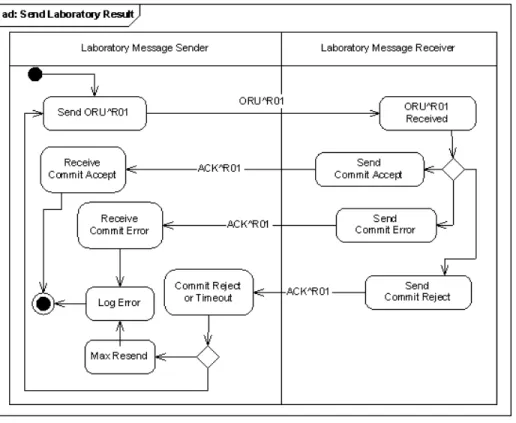
Figure 3-2. Activity Diagram for Send Genetic Laboratory Result Use Case
3.3 DYNAMIC DEFINITION
Table 3-2. Dynamic Definition T
TAABBLLEE33--22––DDYYNNAAMMIICCDDEEFFIINNIITTIIOONN
Item Value
Profile ID USLabReport
HL7 Version 2.5.1
Accept Acknowledgement AL – Always
Application Acknowledgement For valid values, refer to HL7 Table 0155 – Accept/Application Acknowledgment conditions in section 5.2.1 in HL7 VERSION 2.5.1 IMPLEMENTATION GUIDE:
ORDERS AND OBSERVATIONS; INTEROPERABLE LABORATORY RESULT REPORTING TO EHR (US REALM), RELEASE 1 , ORU^R01 , HL7 Version 2.5.1 , November, 2007. The guide can be found at
http://www.hl7.org/Memonly/downloads/Standards_Messaging_V251/InteroperabilitySpecificationLab ResultMessage_v251.zip (HL7 membership required). .
Acknowledgement Mode Immediate
Profile Type Realm Constrainable Profile
Message Types ORU^R01^ORU_R01, ACK^R01^ACK
Encoding ER7 (required)
Chapter 3: Message Profile – Laboratory to EHR
U.S. Realm - Interoperability Specification: Genetic Test Result Message to EHR Page 9-40 Copyright 2007-2008 © Health Level Seven, Inc. All Rights Reserved.
3.4 INTERACTIONS
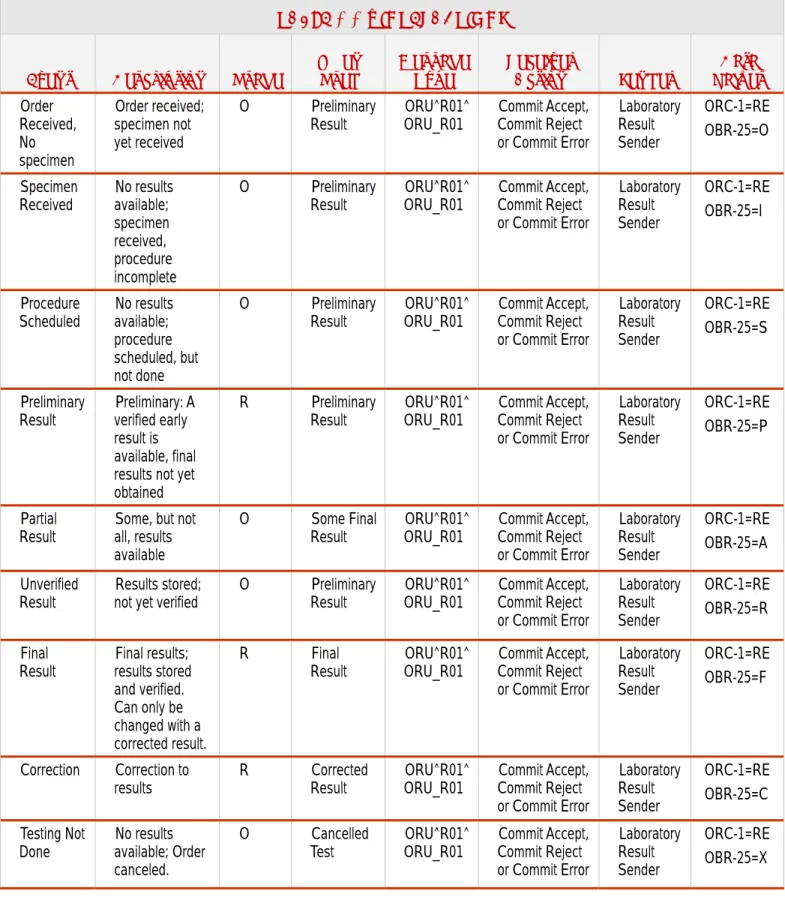
Table 3-3. Interactions T
TAABBLLEE33--33––IINNTTEERRAACCTTIIOONNSS
Event Description Usage When Used Message Type Receiver Action Sender Values Data Order Received, No specimen Order received; specimen not yet received O Preliminary
Result ORU_R01 ORU^R01^ Commit Reject Commit Accept, or Commit Error Laboratory Result Sender ORC-1=RE OBR-25=O Specimen
Received available; No results specimen received, procedure incomplete
O Preliminary
Result ORU_R01 ORU^R01^ Commit Reject Commit Accept, or Commit Error Laboratory Result Sender ORC-1=RE OBR-25=I Procedure
Scheduled available; No results procedure scheduled, but not done
O Preliminary
Result ORU_R01 ORU^R01^ Commit Reject Commit Accept, or Commit Error Laboratory Result Sender ORC-1=RE OBR-25=S Preliminary
Result verified early Preliminary: A result is available, final results not yet obtained
R Preliminary
Result ORU_R01 ORU^R01^ Commit Reject Commit Accept, or Commit Error Laboratory Result Sender ORC-1=RE OBR-25=P Partial
Result all, results Some, but not available
O Some Final
Result ORU_R01 ORU^R01^ Commit Reject Commit Accept, or Commit Error Laboratory Result Sender ORC-1=RE OBR-25=A Unverified Result Results stored; not yet verified
O Preliminary Result ORU^R01^ ORU_R01 Commit Accept, Commit Reject or Commit Error Laboratory Result Sender ORC-1=RE OBR-25=R Final Result Final results; results stored and verified. Can only be changed with a corrected result. R Final Result ORU^R01^ ORU_R01 Commit Accept, Commit Reject or Commit Error Laboratory Result Sender ORC-1=RE OBR-25=F Correction Correction to
results R Corrected Result ORU_R01 ORU^R01^ Commit Reject Commit Accept, or Commit Error Laboratory Result Sender ORC-1=RE OBR-25=C Testing Not
Done available; Order No results canceled.
O Cancelled
Test ORU_R01 ORU^R01^ Commit Reject Commit Accept, or Commit Error Laboratory Result Sender ORC-1=RE OBR-25=X
Chapter 3: Message Profile – Laboratory to EHR
U.S. Realm - Interoperability Specification: Genetic Test Result Message to EHR Page 10-40 T
TAABBLLEE33--33––IINNTTEERRAACCTTIIOONNSS
Event Description Usage When Used Message Type Receiver Action Sender Values Data
No Order No order on
record for this test. (Used only on queries) X - varies NA Laboratory Result Sender ORC-1=RE OBR-25=Y No Patient
Record patient. (Used No record of this only on queries) X - varies NA Laboratory Result Sender ORC-1=RE OBR-25=Z Commit Accept Enhanced mode: Accept acknowledgment : Commit Accept
R All Cases ACK^R01^
ACK None Laboratory Result Receiver MSA-1=CA Commit
Error mode: Accept Enhanced acknowledgment : Commit Error
R All Cases ACK^R01^
ACK None Laboratory Result
Receiver
MSA-1=CE
Commit
Reject mode: Accept Enhanced acknowledgment : Commit Reject
R All Cases ACK^R01^
ACK None Laboratory Result
Receiver
MSA-1=CR
Chapter 4: Messages
U.S. Realm - Interoperability Specification: Genetic Test Result Message to EHR
4.Messages
The V2 Genetic Variation model uses the same messages as described in Chapter 4, Page 29 of the parent implementation guide entitled HL7 VERSION 2.5.1 IMPLEMENTATION GUIDE: ORDERS AND OBSERVATIONS; INTEROPERABLE LABORATORY RESULT REPORTING TO EHR (US REALM), RELEASE 1 , ORU^R01 , HL7 Version 2.5.1 , November, 2007. The guide can be found at
http://www.hl7.org/Memonly/downloads/Standards_Messaging_V251/InteroperabilitySpecificationLabResultMessage _v251.zip (HL7 membership required).
Chapter 5: Segment and Field Descriptions
U.S. Realm - Interoperability Specification: Genetic Test Result Message to EHR
5.Segment and Field Descriptions
The V2 Genetic Variation model uses the same segment and field descriptions as described in Chapter 5, Page 35 of the parent implementation guide entitled HL7 VERSION 2.5.1 IMPLEMENTATION GUIDE: ORDERS ANDOBSERVATIONS; INTEROPERABLE LABORATORY RESULT REPORTING TO EHR (US REALM), RELEASE 1 , ORU^R01 , HL7 Version 2.5.1 , November, 2007. The guide can be found at
http://www.hl7.org/Memonly/downloads/Standards_Messaging_V251/InteroperabilitySpecificationLabResultMessage _v251.zip (HL7 membership required).
Chapter 6: Nomenclatures, Code Systems, and Value Sets
U.S. Realm - Interoperability Specification: Genetic Test Result Message to EHR Copyright 2007-2008 © Health Level Seven, Inc. All Rights Reserved.
6. Nomenclatures, Code
Systems and Value Sets
6.1 VOCABULARY CONSTRAINTS
6.1.1 Genetic Tests, Testing Context, Interpretation Code, and Genetic Data
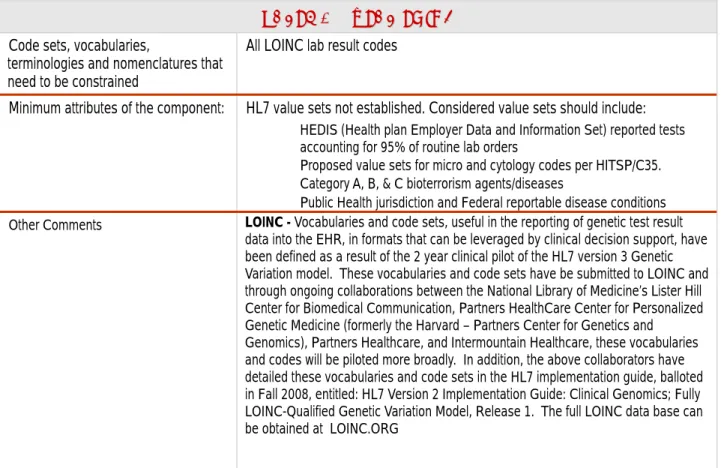
6.1.1.0 LOINC
Table 6.1.1–1. Lab LOINC T
TAABBLLEE66--11––LLAABBLLOOIINNCC Code sets, vocabularies,
terminologies and nomenclatures that need to be constrained
All LOINC lab result codes
Minimum attributes of the component: HL7 value sets not established. Considered value sets should include:
• HEDIS (Health plan Employer Data and Information Set) reported tests accounting for 95% of routine lab orders
• Proposed value sets for micro and cytology codes per HITSP/C35.
• Category A, B, & C bioterrorism agents/diseases
• Public Health jurisdiction and Federal reportable disease conditions
Other Comments LOINC - Vocabularies and code sets, useful in the reporting of genetic test result
data into the EHR, in formats that can be leveraged by clinical decision support, have been defined as a result of the 2 year clinical pilot of the HL7 version 3 Genetic Variation model. These vocabularies and code sets have be submitted to LOINC and through ongoing collaborations between the National Library of Medicine’s Lister Hill Center for Biomedical Communication, Partners HealthCare Center for Personalized Genetic Medicine (formerly the Harvard – Partners Center for Genetics and Genomics), Partners Healthcare, and Intermountain Healthcare, these vocabularies and codes will be piloted more broadly. In addition, the above collaborators have detailed these vocabularies and code sets in the HL7 implementation guide, balloted in Fall 2008, entitled: HL7 Version 2 Implementation Guide: Clinical Genomics; Fully LOINC-Qualified Genetic Variation Model, Release 1. The full LOINC data base can be obtained at LOINC.ORG
Chapter 6: Nomenclatures, Code Systems, and Value Sets
U.S. Realm - Interoperability Specification: Genetic Test Result Message to EHR Copyright 2007-2008 © Health Level Seven, Inc. All Rights Reserved.
6.1.2 Associated Disease and/or Drug
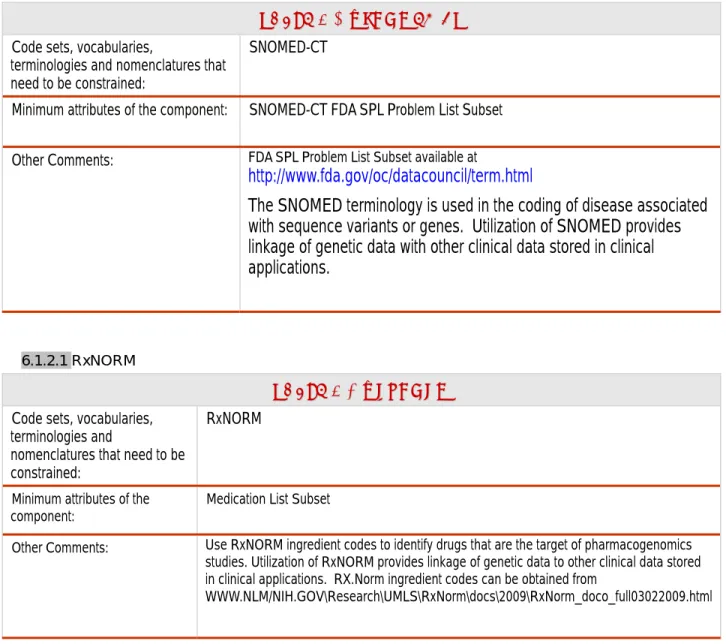
6.1.2.0 SNOMED-CT
Table 6.1.2-2. SNOMED-CT T
TAABBLLEE66--22––SSNNOOMMEEDD--CCTT Code sets, vocabularies,
terminologies and nomenclatures that need to be constrained:
SNOMED-CT
Minimum attributes of the component: SNOMED-CT FDA SPL Problem List Subset
Other Comments: FDA SPL Problem List Subset available at
http://www.fda.gov/oc/datacouncil/term.html
The SNOMED terminology is used in the coding of disease associated
with sequence variants or genes. Utilization of SNOMED provides
linkage of genetic data with other clinical data stored in clinical
applications.
6.1.2.1 RxNORM
T
TAABBLLEE66--33––RRXXNNOORRMM Code sets, vocabularies,
terminologies and
nomenclatures that need to be constrained:
RxNORM
Minimum attributes of the
component: Medication List Subset
Other Comments: Use RxNORM ingredient codes to identify drugs that are the target of pharmacogenomics studies. Utilization of RxNORM provides linkage of genetic data to other clinical data stored in clinical applications. RX.Norm ingredient codes can be obtained from
WWW.NLM/NIH.GOV\Research\UMLS\RxNorm\docs\2009\RxNorm_doco_full03022009.html
6.1.3 Genes
6.1.3.0 HGNC gene symbols (required) T
TAABBLLEE66--33––HHGGNNCC Code sets, vocabularies, terminologies
and nomenclatures that need to be constrained:
HGNC
Chapter 6: Nomenclatures, Code Systems, and Value Sets
U.S. Realm - Interoperability Specification: Genetic Test Result Message to EHR Copyright 2007-2008 © Health Level Seven, Inc. All Rights Reserved.
Other Comments: Human Gene Nomenclature Committee (HGNC) maintains a database of gene
names and symbols. They are a non-profit body which is jointly funded by the US National Human Genome Research Institute (NHGRI) and the Wellcome Trust (UK). They operate under the auspices of Human Genome Organization. The database can be found at: http://www.genenames.org/ Accessed: July 13, 2008.
6.1.4 Sequence Variations
6.1.4.0 HGVS (required)T
TAABBLLEE66--33––HHGGVVSS Code sets, vocabularies, terminologies
and nomenclatures that need to be constrained:
HGVS
Minimum attributes of the component: Sequence variation
Other Comments: Human Genome Variation Society (HGVS) Nomenclature standards for the
description of sequence variations are maintained at:
http://www.hgvs.org/mutnomen/recs.html#general. Accessed: July 13, 2008. This standard is well accepted by the clinical genetic community and is extended on an ongoing basis to support genetic findings.
6.1.4.1 dbSNP (optional)
T
TAABBLLEE66--33--DDBBSSNNPP Code sets, vocabularies, terminologies
and nomenclatures that need to be constrained:
dbSNP
Minimum attributes of the component: Rs number and nucleotide change
Other Comments: The Single Nucleotide Polymorphism database (dbSNP). National Center for
Biotechnology Communication. Available at:
http://www.ncbi.nlm.nih.gov/projects/SNP/ Accessed: March 10, 2008
Databases and knowledgebases defining sequence variants will be increasingly important. Although sequencing based tests which can result in the identification of novel variants require HGVS nomenclature standards for complete results reporting, genotyping tests which probe for the existence of known variants can additionally report results using an ‘RS number’ (i.e. identifier in dbSNP) and the associated nucleotide change. (Within the clinical environment results reporting using HGVS nomenclature is required with an option to additionally specify the RS number.)
Chapter 6: Nomenclatures, Code Systems, and Value Sets
U.S. Realm - Interoperability Specification: Genetic Test Result Message to EHR Copyright 2007-2008 © Health Level Seven, Inc. All Rights Reserved.
6.1.5 Reference Sequences (required)
Reference sequences are the baseline from which variation is reported. For example, sequence variants are identified in a patient by comparing the patient’s DNA sequence to a reference sequence standard, used in the laboratory. Typically, differences between the patient and reference sequence are called sequence variation and are cataloged, interpreted and reported. Documentation of the reference sequence used is becoming increasingly important for normalization of results between laboratories. To meet this need NCBI is cataloging reference sequences used in clinical testing in the Core Nucleotide Database and can be referred to through the RefSeq identifiers. In collaboration with NCBI, the European BioInformatics Institute (EBI) is also developing a database of reference sequences called Locus
Reference Genomic Sequences (LRG). The standard is still in draft status. Importantly, NCBI’s RefSeq and EBI’s LRG will contain the same reference sequences, annotations and cross references to each other.
6.1.6 RefSeq
T
TAABBLLEE66--33--RREEFFSSEEQQ Code sets, vocabularies, terminologies
and nomenclatures that need to be constrained:
RefSeq
Minimum attributes of the component: RefSeq ID
Other Comments: National Center for Biotechnology Information (NCBI) Reference Sequences
contained in Core Nucleotide database. Available at:
http://www.ncbi.nlm.nih.gov/sites/entrez?db=nuccore. Accessed: March 6, 2008.
T
TAABBLLEE66--33--LLRRGG Code sets, vocabularies, terminologies
and nomenclatures that need to be constrained:
LRG
Minimum attributes of the component: LRG ID
Other Comments: Locus Reference Genomic Sequences an emerging standard led by the European
Chapter 7: Logical Message Types
U.S. Realm - Interoperability Specification: Laboratory Result Message to EHR Page 17-40 Copyright 2007-2008 © Health Level Seven, Inc. All Rights Reserved.
7.Logical Message Types
7.1 INTRODUCTION AND STRATEGY
The Genetic Test Result Reporting message is defined by a set of four nested LOINC panels, which serve as templates for the messages. In general LOINC panel definitions include one LOINC code to identify the whole panel and a set of LOINC codes for each child element of that panel. A child element can also be a LOINC panel, and such panels can repeat, to provide a structure that can accommodate many reporting patterns. For each such child element, the panel definition also includes its data type, units of measure, optionality and answer list, as applicable. The definitional information for the four panels used to report Genetics Test result Reports is included in this guide. It can also be obtained in electronic form from the LOINC web site.
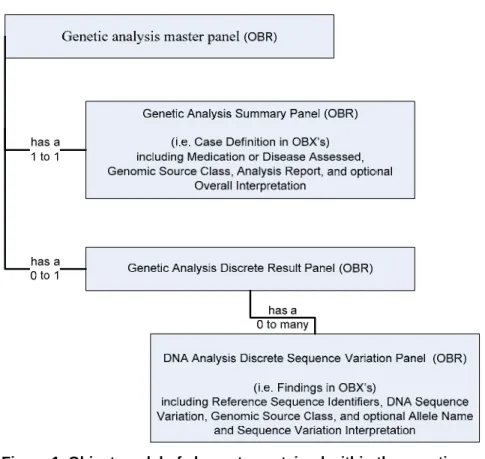
In a message, each new panel of observations begins with an OBR segment that carries the LOINC ID for that panel and is followed by a series of OBX’s each of which carry caries the LOINC ID (OBX-3), and the value (OBX-5) of a particular observation. In a message, the first panel is the master panel for the reporting of genetic analysis. The first child panel delivers an overall summary of the study results and includes options for reporting the traditional narrative report the overall study impression and a few other items. Depending on the study being reported, the summary panel may contain variables required to summarize a pharmacogenomics study, or those required to summarize the genetic findings associated with a disease or the risk of a disease (see table 7-2). Next comes the Discrete results panel (table 7-3), which contains the detailed results pay load in a series of one or more “DNA sequence analysis discrete sequence variation panels” (see table 7-4). This last panel repeats as many times as needed to report all of the variations of interest.
Chapter 7: Logical Message Types
U.S. Realm - Interoperability Specification: Laboratory Result Message to EHR Page 18-40 Copyright 2007-2008 © Health Level Seven, Inc. All Rights Reserved.
Figure 1. Object model of elements contained within the genetic results message. The master OBR (Genetic Analysis Master Panel) contains a child OBR, the Genetic Analysis Summary Panel. If DNA sequence variations are identified, then the Genetic Analysis Master Panel will have another child OBR, the Genetic Analysis Discrete Result Panel. This second child OBR (the Genetic Analysis Discrete Result Panel) itself has one or more child OBR’s, the DNA Analysis Discrete Sequence Variation Pane, which are used to report genetic findings (sequence variations and gene alleles).
7.2 MESSAGE DEFINITIONS
The complexity of genetic data requires additional coding of the message components using LOINC. These codes are listed in tables 7.1 to 7.5. LOINC coding has several advantages including more robust representation of the data when persisted in a database, increased accuracy when supporting multiple HL7 message formats, and consistency for clinical decision support, and applicability to many complex reporting requirements.
7.3 MESSAGE COMPONENTS
PLEASE NOTE:The following tables 7-1 through 7-4 are NOT segment definitions. They specify the content of LOINC panels.
7.3.1 Test Interpretation
7.3.1.0 Genetic Analysis Master Panel
The Genetic Analysis Master Panel is an OBR which will contain a child OBR with summary information of the genetic analysis (i.e. Genetic Analysis Summary Panel). In addition, if genetic biomarkers where identified (e.g. a DNA Sequence Variant), then the Genetic Analysis Master Panel will have a second child
Chapter 7: Logical Message Types
U.S. Realm - Interoperability Specification: Laboratory Result Message to EHR Page 19-40 Copyright 2007-2008 © Health Level Seven, Inc. All Rights Reserved.
OBR, the Genetic Analysis Discrete Result Panel (which in itself will have child OBR’s for the Sequence Variants). T TAABBLLEE77--11––GGEENNEETTIICCAANNAALLYYSSIISSMMAASSTTEERRPPAANNEELL OBR/ OBX DT Usag e Card-inality
Value Set LOINC Code LOINC Element Name Description/Comments OBR R 1..n 55233-1 Genetic Analysis Master Panel
This is the parent OBR for the panel holding the summary of genetic analysis (i.e. Genetic Analysis Summary Panel).
7.3.1.1 Genetic Analysis Summary Panel
The Genetic Analysis Summary Panel is used to report the summary of the genetic analysis. This will fall into several categories: including disease risk/diagnosis, carrier testing, drug metabolism, and drug efficacy and includes the genetic report, appropriate overall interpretation answer list, disease or drug assessed, and genomic source class.
T TAABBLLEE77--22––GGEENNEETTIICCAANNAALLYYSSIISSSSUUMMMMAARRYYPPAANNEELL OBR/ OBX DT Usag e Card-inality Value Set LOINC Code LOINC Element Name Description/Comments OBR R 1..n 55232-3 Genetic Analysis Summary Panel
The summary panel for a genetic analysis for one or more laboratory tests (e.g. analysis for disease risk, diagnosis or pharmacogenetics) on a single accession.
OBX CWE C1* SNOMED 51967-8 Genetic disease assessed
A coded disease (recommend SNOMED) which is associated with the region of DNA covered by the genetic test
OBX CWE C1* RxNORM 51963-7 Medication Assessed
A coded medication accessed in a pharmacogenic test
(recommend RxNorm).
OBX CWE R 48002-0 Genomic
Source Class
The genomic class of the specimen being analyzed: Germline for inherited genome, somatic for cancer genome (e.g. DNA from tumor cells), and prenatal for fetal genome. LOINC Answer List values can be seen in table 7.5
If the study is intended to assess disease risk or diagnosis based on genetic findings, then the Genetic Disease Analysis Overall Interpretation is used (see below).
OBX CWE C2 53038-6 Genetic
Disease
Interpretation of all identified DNA Sequence Variations
Chapter 7: Logical Message Types
U.S. Realm - Interoperability Specification: Laboratory Result Message to EHR Page 20-40 Copyright 2007-2008 © Health Level Seven, Inc. All Rights Reserved.
Analysis Overall Interpretation
along with any known clinical information for the benefit of aiding clinicians in
understanding the results overall in either the context of diagnosis or increased risk of disease. LOINC Answer List values can be seen in table 7.5 If reporting a genetic test specifically performed for carrier testing, then the Genetic Disease Analysis Overall Carrier Interpretation (below) should replace the Genetic Disease Analysis Overall Interpretation.
OBX CWE C 53039-4 Genetic
Disease Analysis Overall Carrier Interpretation Carrier Identification
interpretation of all identified DNA Sequence Variations along with any known clinical information for the benefit of aiding clinicians in
understanding the results overall. LOINC Answer List values can be seen in table 7.5
If the study is intended to assess drug efficacy, include the following LOINC term in the report.
OBX CWE C2 51964-5 Drug
Efficacy Analysis Overall Interpretation
Overall predicted phenotype for drug efficacy for all
Sequence Variations identified in a single case. LOINC Answer List values can be seen in table 7.5
If the study is intended to assess the effect on metabolism, include the following LOINC term in the report.
OBX CWE C2 51971-0 Drug
metabolism analysis overall interpretation
Overall predicted phenotype for drug metabolism for all Sequence Variations identified in a single case. LOINC Answer List values can be seen in table 7.5 OBX FT O 0..1 51969-4 Genetic analysis summary report Narrative pharmacogenetic report in a pharmacogenetic-based format
OBX FT O 53577-3 Reason for
Study Additional Note
Descriptive text to further annotate the coded Reason for Study associated with an ordered test.
Chapter 7: Logical Message Types
U.S. Realm - Interoperability Specification: Laboratory Result Message to EHR Page 21-40 Copyright 2007-2008 © Health Level Seven, Inc. All Rights Reserved.
7.3.2 Findings
7.3.2.0 Genetic Analysis Discrete Result Panel
The Genetic Analysis Discrete Result Panel is a child OBR of the Genetic Analysis Master Panel, and will contain child OBR’s defining the discrete findings. Currently, these are DNA sequence variants (in DNA Analysis Discrete Sequence Variant Panel), but will expand in future releases of the guide to include other types of genetic biomarkers, as mentioned in Chapter 9.
T TAABBLLEE77--33––GGEENNEETTIICCAANNAALLYYSSIISSDDIISSCCRREETTEERREESSUULLTTPPAANNEELL OBR/ OBX DT Usage Card-inality
Value Set LOINC
Code LOINC Element Name Description/Comments OBR R 0..1 n/a 55208-3 Genetic Analysis Discrete Result Panel
This is the parent OBR for genetic panels of genetic findings (e.g. DNA Analysis Discrete Sequence Variant Panel)
7.3.2.1 DNA Analysis Discrete Sequence Variation Panel
The DNA Analysis Discrete Sequence Variant Panel corresponds to the Genetic Variation model SequenceVariation class. It describes the characteristics of an identified SequenceVariation - either of clinical relevance, or as a benign difference from the reference sequence, and reported for completeness.
T TAABBLLEE77--44––DDNNAAAANNAALLYYSSIISSDDIISSCCRREETTEESSEEQQUUEENNCCEEVVAARRIIAATTIIOONNPPAANNEELL OBR/ OBX DT Usage Card-inality
Value Set LOINC
Code LOINC Element Name Description/Comments OBR R 1..n N/A 55207-5 DNA Analysis Discrete Sequence Variant Panel
The set of observations representing all identified DNA Sequence Variations (variants and wild type) for all of the genetic assays performed for a single accession.
OBX CWE O HGNC 48018-6 Gene Identifier HGNC gene Identifier set by the Human Genome Organization Nomenclature Committee.
Chapter 7: Logical Message Types
U.S. Realm - Interoperability Specification: Laboratory Result Message to EHR Page 22-40 Copyright 2007-2008 © Health Level Seven, Inc. All Rights Reserved.
OBX CWE C NCBI 48013-7 Genomic
Reference Sequence Identifier
This field carries the ID for the genomic reference sequence. The genomic reference
sequence is a contiguous stretch of chromosome DNA that spans all of the exons of the gene and includes transcribed and non transcribed stretches. For this ID use either the NCBI genomic nucleotide RefSeq IDs with their version number (see:
NCBI.NLM.NIH.Gov/RefSeq), or use the LRG identifiers without transcript (t or p) extensions when they become available. (See- Report sponsored by GEN2PHEN at the European Bioinformatics Institute at Hinxton UK April 24-25, 2008).
OBX CWE C NCBI 51958-7 Transcript
Reference Sequence Identifier
This field carries the ID for the transcribed reference sequence that part of the genetic reference sequence that is converted to Messenger RNA. For this ID use either the NCBI nucleotide RefSeq IDs for transcribed DNA, plus the version number
(NCBI.NLM.NIH.Gov/RefSeq), or use the LRG identifiers with transcript (t or p) extensions when they become available. (Report sponsored by GEN2PHEN at the European Bioinformatics Institute at Hinxton UK April 24-25, 2008). The NCI RefSeq transcripts IDs have a prefix of “NM” for genes from the nuclear chromosomes. NCBI does not currently provide a transcript RefSeq for
mitochondrial genes. The LRG transcripts Identifiers have a prefix of “LRG_” plus a t extension. Mitochondrial genes are out of scope of LRG.
OBX CWE O 48008-7 Allele Name The published and commonly
used name for a gene allele is recommended - if it exists.
OBX CWE O NCBI 48003-8 DNA Sequence
Variation Identifier
A DNA Sequence Variation identifier conveys a universal or standard repository identifier for definitive characteristics of a DNA Sequence Variation. (If available, recommend using NCBI dbSNP ids - RS#)
Chapter 7: Logical Message Types
U.S. Realm - Interoperability Specification: Laboratory Result Message to EHR Page 23-40 Copyright 2007-2008 © Health Level Seven, Inc. All Rights Reserved.
OBX CWE C HGVS 48004-6 DNA Sequence
Variation
Human Genome Variation Society (HGVS) nomenclature for a single or set of DNA Sequence Variation(s) identified in testing. The use of the nomenclature is also used to describe non-variations (aka. wild types). Either the DNA Sequence Variation is required or the Amino Acid Change. NOTE: If NCBI’s dbSNP IDs (RS#) is used, then the DNA Sequence Variation is required to uniquely define the Variant, as the number is unique to the nucleotide location and requires the details of nucleotide change.
OBX CWE O HGVS 48019-4 DNA Sequence
Variation Type
Codified type for associated DNA Sequence Variation. DNA Sequence Variations use the HGVS notation which implies the DNA Sequence Variation Type, but the concurrent use of this code will allow a standard and explicit type for technical and display convenience. LOINC Answer List values can be seen in table 7.5
OBX CWE C HGVS 48005-3 Amino Acid
Change
Human Genome Variation Society (HGVS) nomenclature for an amino acid change. This value is derivable from the DNA Sequence Variation value if available. It is provided for convenience. The use of the nomenclature is also used to describe non-variations (aka. wild types). Either the DNA Sequence Variation is required or the Amino Acid Change.
OBX CWE O HGVS 48006-1 Amino Acid
Change Type
Codified type for associated Amino Acid Change. Amino Acid Change's use the HGVS notation which implies the Amino Acid Change Type, but the concurrent use of this code will allow a standard and explicit type for technical and display convenience. LOINC Answer List values can be seen in table 7.5
OBX CWE O 47999-8 DNA Region
Name
A human readable name for the region of interest. Typically Exon #, Intron # or other. NOTE: This is not standardized and is mainly for convenience and display purposes.
Chapter 7: Logical Message Types
U.S. Realm - Interoperability Specification: Laboratory Result Message to EHR Page 24-40 Copyright 2007-2008 © Health Level Seven, Inc. All Rights Reserved.
OBX CWE O 53034-5 Allelic State The level of occurrence of a single DNA Sequence Variation within a set of chromosomes. Heterozygous indicates the DNA Sequence Variation is only present in one of the two genes contained in homologous chromosomes. Homozygous indicates the DNA Sequence Variation is present in both genes contained in homologous chromosomes. Hemizygous indicates the DNA Sequence Variation exists in the only single copy of a gene in a
non-homologous chromosome (the male X and Y chromosome are non-homologous). Hemiplasmic indicates that the DNA
Sequence Variation is present in some but not all of the copies of mitochondrial DNA.
Homoplasmic indicates that the DNA Sequence Variation is present in all of the copies of mitochondrial DNA. LOINC Answer List values can be seen in table 7.5
OBX CWE O 48002-0 Genomic
Source Class
The genomic class of the specimen being analyzed: germline for inherited genome, somatic for cancer genome, and prenatal for fetal genome. LOINC Answer List values can be seen in table 7.5
OBX ST O 47998-0 DNA Sequence
Variation Display Name
Thumbnail "textual display" convention of a DNA Sequence Variation and its interpretation.
If reporting a genetic test specifically performed for identification of DNA Sequence Variations associated with disease, then the Genetic Disease Sequence Variation Interpretation should be used for coding interpretations at the DNA Sequence Variation level.
OBX CWE C 53037-8 Genetic
Disease Sequence Variation Interpretation
Interpretation of the pathogenicity of the DNA Sequence Variation in the context of the assessed genetic disease. LOINC Answer List values can be seen in table 7.5
If reporting a genetic test specifically performed for identification of DNA Sequence Variations associated with drug metabolism, then the Drug Metabolism Sequence Variation Interpretation should be used for coding interpretations at the DNA Sequence Variation level.
OBX CWE C 53040-2 Drug
Metabolism Sequence Variation
Predicted phenotype for drug efficacy. A sequence variation interpretation value known to allow (responsive) or prevent
Chapter 7: Logical Message Types
U.S. Realm - Interoperability Specification: Laboratory Result Message to EHR Page 25-40 Copyright 2007-2008 © Health Level Seven, Inc. All Rights Reserved.
Interpretation (resistant) the drug to perform. LOINC Answer List values can be seen in table 7.5
If reporting a genetic test specifically performed for identification of DNA Sequence Variations associated with drug efficacy, then the Drug Efficacy Sequence Variation Interpretation should be used for coding interpretations at the DNA Sequence Variation level.
OBX CWE C 51961-1 Drug Efficacy
Sequence Variation Interpretation
Predicted phenotype for ability of drug to bind to intended site in order to deliver intended affect. A Sequence Variation
interpretation value known to allow (responsive) or prevent (resistant) the drug to perform. LOINC Answer List values can be seen in table 7.5
7.4 LOINC CODES
T
TAABBLLEE77--55––LLOOIINNCCCCOODDEESS
LOINC # Component Property Time System Scale Method
47998-0 DNA Sequence Variation display name Txt Pt Bld/Tiss Nar Molgen 47999-8 DNA region name ID Pt Bld/Tiss Nom Molgen
48002-0
Genomic source class
(LOINC Answer List values can be seen in table 7.5)
Type Pt Bld/Tiss Nom Molgen
48003-8 DNA Sequence Variation identifier ID Pt Bld/Tiss Nom Molgen 48004-6 DNA Sequence Variation Find Pt Bld/Tiss Nom Molgen 48005-3 Amino acid change Find Pt Bld/Tiss Nom Molgen
48006-1
Amino acid change type
(LOINC Answer List values can be seen in table 7.5)
Type Pt Bld/Tiss Nom Molgen
48008-7 Allele name ID Pt Bld/Tiss Nom Molgen
48013-7 Genomic reference sequence identifier ID Pt Bld/Tiss Nom Molgen
48018-6 Gene identifier ID Pt Bld/Tiss Nom Molgen
48019-4
DNA Sequence Variation type
(LOINC Answer List values can be seen in table 7.5)
Type Pt Bld/Tiss Nom Molgen
51958-7 Transcript reference sequence identifier ID Pt Bld/Tiss Nom Molgen 51959-5 DNA region of interest Prod Pt Bld/Tiss Nom Molgen
Chapter 7: Logical Message Types
U.S. Realm - Interoperability Specification: Laboratory Result Message to EHR Page 26-40 Copyright 2007-2008 © Health Level Seven, Inc. All Rights Reserved.
T
TAABBLLEE77--55––LLOOIINNCCCCOODDEESS
LOINC # Component Property Time System Scale Method
51961-1
Drug efficacy sequence variation interpretation
(LOINC Answer List values can be seen in table 7.5)
Imp Pt Bld/Tiss Ord Molgen
51963-7 Medication assessed Prid Pt Bld/Tiss Nom Molgen
51964-5
Drug efficacy analysis overall interpretation
(LOINC Answer List values can be seen in table 7.5)
Imp Pt Bld/Tiss Nom Molgen
51967-8 Genetic disease assessed ID Pt Bld/Tiss Nom Molgen
51968-6
Genetic Disease Analysis Overall Interpretation
(LOINC Answer List values can be seen in table 7.5)
Imp Pt Bld/Tiss Nom Molgen
51969-4 Genetic analysis summary report Find Pt Bld/Tiss Doc Molgen
51971-0
Drug metabolism analysis overall interpretation
(LOINC Answer List values can be seen in table 7.5)
Imp Pt Bld/Tiss Nom MolGen
53034-5 Allelic state Find Pt Bld/Tiss Nom Molgen
53037-8
Genetic disease sequence variation interpretation
(LOINC Answer List values can be seen in table 7.5)
Imp Pt Bld/Tiss Nom Molgen
53039-4
Genetic disease analysis overall carrier interpretation
(LOINC Answer List values can be seen in table 7.5)
Type Pt Bld/Tiss Nom Molgen
53040-2
Drug metabolism sequence variation interpretation
(LOINC Answer List values can be seen in table 7.5)
Imp Pt Bld/Tiss Nom Molgen
53045-1 Reference sequence alteration Prid Pt Bld/Tiss Nom Molgen 53577-3 Reason for study additional note Txt Pt Bld/Tiss Nar Molgen 55207-5 DNA Analysis Discrete Sequence
Variation Panel - Pt Bld/Tiss - Molgen
55208-3 Genetic Analysis Discrete Result Panel - Pt Bld/Tiss - Molgen 55233-1 Genetic analysis master panel - Pt Bld/Tiss - Molgen 55232-3 Genetic analysis summary panel - Pt Bld/Tiss - Molgen
Chapter 7: Logical Message Types
U.S. Realm - Interoperability Specification: Laboratory Result Message to EHR Page 27-40 Copyright 2007-2008 © Health Level Seven, Inc. All Rights Reserved.
7.5 LOINC ANSWER LISTS
TTAABBLLEE77--66––LLOOIINNCCAANNSSWWEERRLLIISSTTSS
LOINC code
LOINC component Sequence Answer text LOINC answer code 1 Heteroplasmic LA6703-8 2 Homoplasmic LA6704-6 3 Homozygous LA6705-3 4 Heterozygous LA6706-1 53034-5 Allelic state 5 Hemizygous LA6707-9
1 Wild type LA9658-1
2 Deletion LA6692-3
3 Duplication LA6686-5
4 Frameshift LA6694-9
5 Initiating Methionine LA6695-6
6 Insertion LA6687-3
7 Insertion and Deletion LA9659-9
8 Missense LA6698-0
9 Nonsense LA6699-8
10 Silent LA6700-4
48006-1 Amino acid change type
11 Stop Codon Mutation LA6701-2
1 Wild type LA9658-1
2 Deletion LA6692-3
3 Duplication LA6686-5
4 Insertion LA6687-3
5 Insertion/Deletion LA6688-1
6 Inversion LA6689-9
48019-4 DNA sequence variation type 7 Substitution LA6690-7 1 Responsive LA6677-4 2 Resistant LA6676-6 3 Negative LA6577-6 4 Inconclusive LA9663-1
51964-5 Drug efficacy analysis overall interpretation
5 Failure LA9664-9
1 Resistant LA6676-6
2 Responsive LA6677-4
3 Presumed resistant LA9660-7
4 Presumed responsive LA9661-5
5 Unknown Significance LA6682-4
6 Benign LA6675-8
7 Presumed Benign LA6674-1
51961-1 Drug efficacy sequence variation interpretation
8 Presumed non-responsive LA9662-3
1 Ultrarapid metabolizer LA10315-2
2 Extensive metabolizer LA10316-0
3 Intermediate metabolizer LA10317-8 51971-0 Drug metabolism analysis
overall interpretation
4 Poor metabolizer LA9657-3
1 Ultrarapid metabolizer LA10315-2
2 Extensive metabolizer LA10316-0
3 Intermediate metabolizer LA10317-8 53040-2 Drug metabolism
sequence variation interpretation
4 Poor metabolizer LA9657-3
1 Carrier LA10314-5
2 Negative LA6577-6
3 Inconclusive LA9663-1
53039-4 Genetic disease analysis overall carrier
interpretation
4 Failure LA9664-9
Chapter 7: Logical Message Types
U.S. Realm - Interoperability Specification: Laboratory Result Message to EHR Page 28-40 Copyright 2007-2008 © Health Level Seven, Inc. All Rights Reserved.
T
TAABBLLEE77--66––LLOOIINNCCAANNSSWWEERRLLIISSTTSS
LOINC code
LOINC component Sequence Answer text LOINC answer code 2 Negative LA6577-6 3 Inconclusive LA9663-1 overall interpretation 4 Failure LA9664-9 1 Pathogenic LA6668-3
2 Presumed pathogenic LA6669-1
3 Unknown significance LA6682-4
4 Benign LA6675-8
53037-8 Genetic disease sequence variation interpretation
5 Presumed benign LA6674-1
1 Germline LA6683-2
2 Somatic LA6684-0
48002-0 Genomic source class
3 Deletion LA6685-7
7.6 SPECIAL SYNTAX
Expressions used to describe SNP locations. Nomenclature for the description of sequence variations c.-32_129+10^^HGVS
Discussions regarding the uniform and unequivocal description of sequence variants in DNA and protein sequences (mutations, polymorphisms) were initiated by two papers published in 1993; Beaudet AL & Tsui LC and Beutler E. The original suggestions presented were widely discussed, modified, extended and ultimately resulted in nomenclature recommendations that have been largely accepted and are applied world-wide.
The most important rule is that all variants should be described at the most basic level, i.e. the DNA level. Descriptions should always be in relation to a reference sequence, either a genomic or a coding DNA reference sequence. Discussions on which type of reference sequence to prefer, genomic or coding DNA, have been very lively. Although theoretically a genomic reference sequence seems best, in practice a coding DNA reference sequence is preferred (see Reference Sequence discussions).
Chapter 8: Example Genetic Test Laboratory Messages
U.S. Realm - Interoperability Specification: Laboratory Result Message to EHR Page 29-40 Copyright 2007-2008 © Health Level Seven, Inc. All Rights Reserved.
8.Example Genetic Test
Laboratory Messages
Note: This chapter is based on Chapter 7 (Example Laboratory Result Messages) of the parent implementation guide entitled HL7 VERSION 2.5.1 IMPLEMENTATION GUIDE: ORDERS AND OBSERVATIONS; INTEROPERABLE LABORATORY RESULT REPORTING TO EHR (US REALM), RELEASE 1 , ORU^R01 , HL7 Version 2.5.1 , November, 2007. The guide can be found at
http://www.hl7.org/Memonly/downloads/Standards_Messaging_V251/InteroperabilitySpecificationLabRes ultMessage_v251.zip (HL7 membership required).
The examples in this section adhere to HL7 publishing requirements in that all persons and facilities are fictitious. They are taken from the HL7 Version 3 Publishing Facilitator’s Guide, Appendix D, Storyboard Names.
Note: Genetic specific vocabularies are in the process of being registered with HL7. As the process is not yet complete at the time of balloting, the example messages append ‘99’ to the system coding system identifier. This is temporary and should be removed, when the registration process is completed. Emphasis has also been placed on demonstrating the use of standardized vocabularies together with local terminology.
8.1 MINIMAL MESSAGE WITH ACKNOWLEDGEMENT
For Information on ‘Minimal Message with Acknowledgement’ see Chapter 7 (Example Laboratory Result Messages) of the parent implementation guide entitled HL7 VERSION 2.5.1 IMPLEMENTATION GUIDE: ORDERS AND OBSERVATIONS; INTEROPERABLE LABORATORY RESULT REPORTING TO EHR (US REALM), RELEASE 1 , ORU^R01 , HL7 Version 2.5.1 , November, 2007. The guide can be found at
http://www.hl7.org/Memonly/downloads/Standards_Messaging_V251/InteroperabilitySpecificationLabRes ultMessage_v251.zip (HL7 membership required). This includes Successful Receipt Message, Error on Receipt Message, and Reject Receipt Message.
8.2 HYPERTROPHIC CARDIOMYOPATHY GENETIC TEST RESULT
MESSAGE
This test is used to identify sequence variations in genes associated with Dilated Cardiomyopathy. In this example, one pathogenic sequence variant and one benign sequence variant were identified. Therefore, the Genetic Disease Analysis Overall Diagnostic Interpretation is ‘Positive’ for the SNOMED coded disease of Dilated Cardiomyopathy (in the Genetic Disease Assessed value field).
Note: Genetic specific vocabularies are in the process of being registered with HL7. As the process is not yet complete at the time of balloting, the example messages append ‘99’ to the system coding system identifier. This is temporary and should be removed, when the registration process is completed.
8.2.1 Example: Genetic Disease Analysis (e.g. Dilated Cardiomyopathy)
MSH-->As according to HL7 VERSION 2.5.1 IMPLEMENTATION GUIDE: ORDERS ANDOBSERVATIONS; INTEROPERABLE LABORATORY RESULT REPORTING TO EHR (US REALM), RELEASE 1 , ORU^R01 , HL7 Version 2.5.1 , November, 2007.
Chapter 8: Example Genetic Test Laboratory Messages
U.S. Realm - Interoperability Specification: Laboratory Result Message to EHR Page 30-40 Copyright 2007-2008 © Health Level Seven, Inc. All Rights Reserved.
PID-->As according to HL7 VERSION 2.5.1 IMPLEMENTATION GUIDE: ORDERS AND
OBSERVATIONS; INTEROPERABLE LABORATORY RESULT REPORTING TO EHR (US REALM), RELEASE 1 , ORU^R01 , HL7 Version 2.5.1 , November, 2007.
OBR|1||PM-08-J00094^HPCGG-LMM^2.16.840.1.113883.3.167.1^ISO|lm_DCM-pnlB_L^Dilated Cardiomyopathy Panel B (5
genes)^99LMM-ORDER-TEST-ID||20080702100909|||||||20080702000000|119273009&Peripheral blood&SNM3&&&&0707Intl&&Blood,
Peripheral|234567891^Pump^Patrick^^^^^^NPI^L|||||||||F||||||00000009^Cardiovascular^99HPCGG-GVIE-INDICATION^^^^^^Clinical Diagnosis and Family History of
DCM|&Geneticist&Gene&&&&&NPI^^^^^^^HPCGG-LMM&2.16.840.1.113883.3.167.1&ISO|||||||||||||||55233-1^Genetic analysis master panel ^LN OBR|2||PM-08-J00094-1^HPCGG-LMM^2.16.840.1.113883.3.167.1^ISO|55232-3^Genetic analysis
summary panel^LN|||||||||||||||||||||||||^PM-08-J00094&HPCGG-LMM&2.16.840.1.113883.3.167.1&ISO OBX|1|CWE|51967-8^Genetic disease assessed^LN||399020009^DCM-Dilated
Cardiomyopathy^SNM3^^^0707Intl||||||F|20080702100909|||||||||||Laboratory for Molecular Medicine^L^22D1005307^^^CLIA&2.16.840.1.113883.4.7&ISO|1000 Laboratory Lane^Ste. 123^Cambridge^MA^99999^USA^B
OBX|2|CWE|48002-0^Genomic source
class^LN||LA6683-2^Germline^LN||||||F|20080702100909|||||||||||Laboratory for Molecular
Medicine^L^22D1005307^^^CLIA&2.16.840.1.113883.4.7&ISO|1000 Laboratory Lane^Ste. 123^Cambridge^MA^99999^USA^B
OBX|3|CWE|51968-6^Genetic disease analysis overall interpretation^LN||LA6576-8^Positive^LN||||||F|20080702100909|||||||||||Laboratory for Molecular
Medicine^L^22D1005307^^^CLIA&2.16.840.1.113883.4.7&ISO|1000 Laboratory Lane^Ste. 123^Cambridge^MA^99999^USA^B
OBX|4|FT|51969-4^Genetic analysis summary report^LN ||\H\CASE\N\ -
PM-08-J00094\.br\\.br\\H\PATIENT\N\ - Eve Everywoman\.br\\.br\\H\TEST PERFORMED\N\ - DCM-pnlB \.br\\.br\\H\TEST DESCRIPTION\N\ - Dilated Cardiomyopathy Panel B (5
genes)\.br\\.br\\H\INDICATION FOR TEST\N\ - Clinical Diagnosis and Family History of DCM\.br\\.br\\H\RESULTS\N\\.br\\.br\\.in+3\\H\DNA VARIANTS:\N\\.br\Heterozygous 1129C>T (R377C), Exon 6, LMNA, Presumed Pathogenic\.br\\.br\\H\
INTERPRETATION:\N\\.br\\H\Positive\N\. DNA sequencing of the coding regions and splice sites of the ACTC, LDB3, LMNA, PLN and TAZ genes revealed a heterozygous R377C variant in exon 6 of the LMNA gene (NM_170707.1). The R377C variant has been reported in the literature (Muchir 2000, Ki 2002, Kubben 2006, van Tintelen 2007). As such, this variant is highly likely to be pathogenic and therefore causative for DCM. Genetic testing of this patient's biological parents and other family members, particularly those who are affected, may help to confirm the
significance of this variant. Please note that the laboratory can attempt testing on tissue
specimens from deceased family members. It should be noted that the expression of DCM is the product not only of a DCM gene variant, but also of other modifier genes and environmental factors. The significance of a variant should always be interpreted in the context of the patient's clinical manifestations.\.br\\.br\\H\ RECOMMENDATION:\N\\.br\If you would like more information about the clinical manifestations of DCM variants we recommend you visit a cardiology center with expertise in the management of dilated cardiomyopathy such as the BWH Cardiovascular Genetics Center at 617-732-4837
(www.brighamandwomens.org/cvcenter/Services/genetics.asp). DCM caused by LMNA variants is inherited in an autosomal dominant manner where each first-degree relative of an individual with a DCM causing mutation has a 50% (or 1 in 2) chance of inheriting the mutation. Genetic testing is available for at-risk family members if desired. Genetic counseling is recommended for this patient and his family. For assistance in locating nearby genetic counseling services please call the laboratory at 617-768-8500 or email at [email protected].\.br\\.br\\H\
COMMENTS:\N\\.br\Common sequence variants of unlikely clinical significance are not included in this report but are available upon request.\.br\\.br\\.in-3\\H\ TEST INFORMATION\N\\.br\\.br\\H\
Chapter 8: Example Genetic Test Laboratory Messages
U.S. Realm - Interoperability Specification: Laboratory Result Message to EHR Page 31-40 Copyright 2007-2008 © Health Level Seven, Inc. All Rights Reserved.
BACKGROUND:\N\\.br\Dilated cardiomyopathy (DCM) is characterized by ventricular chamber enlargement and systolic dysfunction with normal left ventricular wall thickness. The estimated prevalence of DCM is 1/2,500 and about 20-35% of cases have a family history showing a predominantly autosomal mode of inheritance. Mutations in more than 20 genes have been shown to cause DCM, several of which (including MYH7, MYBPC3, TNNT2, TNNI3, TPM1 and ACTC), are also known to cause hypertrophic cardiomyopathy. Mutations in some genes cause additional abnormalities: Lamin A/C (LMNA) mutations are frequently found in DCM that occurs with progressive conduction system disease. Mutations in the Tafazzin (TAZ) gene cause Barth syndrome, an X-linked cardioskeletal myopathy in infants. In addition, mutations in several genes (including LMNA, DES, SGCD and EMD) can cause DCM in conjunction with skeletal myopathy. Genetic testing can confirm the diagnosis of DCM in patients with disease as well as identify at risk family members prior to the onset of symptoms.\.br\\.br\\H\ METHODOLOGY:\N\\.br\This test is performed by direct DNA sequencing of the coding regions and splice sites of the ACTC (NM_005159), LDB3 (NM_007078.2: Exons 5, 6 and 9 NM_001080116.1), PLN (NM_002667.2), LMNA (NM_170707.1) and TAZ (NM_000116.2) genes. This test does not detect large deletions or mutations in non-coding regions that could affect gene expression. This method is over 99.9% accurate. This test was developed and its performance characteristics determined by the
Laboratory for Molecular Medicine, Harvard Partners Center for Genetics and Genomics. It has not been cleared or approved by the U.S. Food and Drug Administration (FDA). The FDA has determined that such clearance or approval is not necessary.\.br\\.br\\H\
REFERENCES:\N\\.br\\.br\\H\ PRINIPAL INTERPRETER\N\ - Gene Geneticist created on 2008/07/02\.br\||||||F|20080702100909
OBX|5|ST|53577-3^Reason for study additional note^LN||Clinical Diagnosis and Family History of DCM||||||F|20080702100909|||||||||||Laboratory for Molecular
Medicine^L^22D1005307^^^CLIA&2.16.840.1.113883.4.7&ISO|1000 Laboratory Lane^Ste. 123^Cambridge^MA^99999^USA^B
OBR|3||PM-08-J00094-2^HPCGG-LMM^2.16.840.1.113883.3.167.1^ISO|55207-5^Genetic analysis discrete result
panel^LN|||||||||||||||||||||||||^PM-08-J00094&HPCGG-LMM&2.16.840.1.113883.3.167.1&ISO
OBR|4||PM-08-J00094-3^HPCGG-LMM^2.16.840.1.113883.3.167.1^ISO|55208-3^DNA analysis discrete sequence variation
panel^LN|||||||||||||||||||||||||^PM-08-J00094-2&HPCGG-LMM&2.16.840.1.113883.3.167.1&ISO OBX|1|CWE|48018-6^Gene
identifier^LN||6636^LMNA^99HGNC||||||F|20080702100909|||||||||||Laboratory for Molecular Medicine^L^22D1005307^^^CLIA&2.16.840.1.113883.4.7&ISO|1000 Laboratory Lane^Ste. 123^Cambridge^MA^99999^USA^B
OBX|2|CWE|48013-7^Genomic reference sequence identifier^LN||NC_000001.9^^99NCBI-NUCLEOTIDE||||||F|20080702100909|||||||||||Laboratory for Molecular
Medicine^L^22D1005307^^^CLIA&2.16.840.1.113883.4.7&ISO|1000 Laboratory Lane^Ste. 123^Cambridge^MA^99999^USA^B
OBX|3|CWE|51958-7^Transcript reference sequence identifier^LN||NM_170707.1^^99NCBI-NUCLEOTIDE||||||F|20080702100909|||||||||||Laboratory for Molecular
Medicine^L^22D1005307^^^CLIA&2.16.840.1.113883.4.7&ISO|1000 Laboratory Lane^Ste. 123^Cambridge^MA^99999^USA^B
OBX|4|CWE|48004-6^DNA sequence
variation^LN||c.1129C>T^^99HGVS||||||F|20080702100909|||||||||||Laboratory for Molecular Medicine^L^22D1005307^^^CLIA&2.16.840.1.113883.4.7&ISO|1000 Laboratory Lane^Ste. 123^Cambridge^MA^99999^USA^B
OBX|5|CWE|48019-4^DNA sequence variation
type^LN||LA6690-7^Substitution^LN||||||F|20080702100909|||||||||||Laboratory for Molecular
Medicine^L^22D1005307^^^CLIA&2.16.840.1.113883.4.7&ISO|1000 Laboratory Lane^Ste. 123^Cambridge^MA^99999^USA^B