Volume 29, Issue 2
Purchasing power par
ı
ty with multiple structural breaks: evidence from Turkey
Nilgün Çil Yavuz
Istanbul University
Abstract
This paper aims to test the validity of the purchasing power parity hypothesis by analyzing the stochastic behavior of Turkey`s real exchange rate for the period 1990–2006. For this purpose, the minimum LM unit root test with two structural breaks is applied to real exchange rate data, which consists of monthly series of CPI-based real exchange rate index. The test results indicate that real exchange rate is trend-stationary. Following Papell and Prodan (2006), the trend-stationary real exchange rate can be interpreted as evidence that supports the validity of the Trend Qualified PPP (TQPPP) for Turkey. This result also suggests that shocks do not have any permanent effect on the real exchange rate in Turkey.
Citation: Nilgün Çil Yavuz, (2009) ''Purchasing power parıty with multiple structural breaks: evidence from Turkey'', Economics Bulletin, Vol. 29 no.2 pp. 1201-1210.
Submitted: Sep 12 2008. Published: June 01, 2009.
1. Introduction
A number of researchers have analyzed the stochastic behavior of real exchange rates to test the validity of purchasing power parity (PPP), which is the cornerstone of studies related with international economics. From a statistical point of view, the validity of the PPP hypothesis can be tested on the basis of unit root tests in the real exchange rate. Froot and Rogoff (1995) have stated that if the unit root null hypothesis can be rejected in favor of an alternative hypothesis of level stationary in a model without a time trend, this is evidence of long-run mean reversion in the exchange rate consistent with the PPP hypothesis. Sarno (2000) indicates that a necessary condition for PPP to hold in the long run is that the real exchange rate be covariance stationary, and not driven by permanent shocks. In other words, a finding that the real exchange rate follows a stationary process supports the validity of the PPP, implying that shocks to the real exchange rate must have only transitory effects.
On the econometric front, most studies employing univariate unit root tests— typically either the Augmented Dickey-Fuller (ADF) or Phillips–Perron unit root tests—fail to reject the unit root hypothesis of the real exchange rate. The omission of some structural breaks is a possible cause of the traditional unit root tests failing to reject the unit root null for real exchange rate. Perron (1989) argued that if there is a structural break, the power to reject a unit root decreases when the stationary alternative is true and the structural break is ignored. Meanwhile, structural changes present in the data generating process, but have been neglected, sway the analysis toward accepting the null hypothesis of a unit root. Exchange rates that might be affected by internal and external shocks generated by structural changes may be subject to considerable short-run variation. It is important to know whether or not the real exchange rate has any tendency to settle down to a long-run equilibrium level, because PPP hypothesis requires that real exchange rate evolves around a constant or a time trend. If real exchange rate is found stationary by using unit root test with structural break(s), the effects of shocks such as real and monetary shocks that cause deviations around a mean value or deterministic trend are only temporary. Then, PPP is valid in the long run. However, if shocks affecting the real exchange rates change the mean and the trend of real exchange rate, it does not return to a constant mean and trend and long-run PPP does not hold. In this sense, empirical evidences of the PPP have focused on weaker versions that allow for short-run deviations of the real exchange rate away from equilibrium. Mercela et al. (2003), Narayan (2005), Narayan and Prasad (2005), and Narayan (2006) provide evidence that, when structural breaks are included for individual countries, real exchange rate is stationary, implying support for purchasing power parity.
However, the definition of new concepts of PPP that are compatible with the presence of structural breaks has been put forward in the last few decades. Dornbusch and Vogelsang (1991) argue the presence of one structural break affecting the level of the real exchange rate and have called the term “Quasi PPP”(QPPP) to cover cases in which real exchange rate is stationary around a changing mean. They also interpret this situation as evidence in favor of the Balassa– Samuelson hypothesis. Hegwood and Papell (1998) formalize and generalize their idea in the presence of multiple structural changes that are determined endogenously.
They have referred to Quasi PPP with the rejection of unit root null hypothesis in favor of an alternative hypothesis of level stationary after allowing for one or two changes in the intercept. Papell and Prodan (2006) briefly describe different concepts of PPP, and make a distinction between Trend PPP(TPPP) and Trend Qualified PPP(TQPPP)*. They have referred to TPPP as the rejection of unit root null in favor of a trend stationary alternative in a model that includes a time trend. They have referred to TQPPP as the rejection of unit root null hypothesis in favor of an alternative hypothesis of regime-wise trend-stationarity after allowing for one or two changes in the intercept. This terminology is adopted throughout the rest of this paper. But, it is very important that evidence in favor of QPPP or TQPPP does not imply PPP since PPP requires reversion toward a constant mean or a constant trend in the long run as mentioned above. Therefore, in the presence of structural breaks, QPPP or TQPPP is necessary but is not a sufficient condition for the PPP to hold.
Another issue pointed out by Lothian and Taylor (1996, 1997) is that low power in conventional unit root tests, especially with short-span data, may cause researchers to incorrectly conclude that the real exchange rate is non-stationary. Therefore, researchers have turned to panel methods that allow for cross-section variation. Panel data unit root tests with or without structural breaks have been widely applied to examine the stationarity of real exchange rate (Wu 1996, Papell and Theodoridis 2001, Taylor and Sarno 1998, Wu and Wu 2001, Kalyoncu and Kalyoncu 2008; Narayan 2008, etc.).
The purpose of this study is to reexamine whether or not Turkey’s real exchange rate is stationary by taking into account the effects of possible structural breaks and to test the validity of PPP in this sense. In the last few decades, the Turkish economy experienced several structural breaks that indicated important political and economic events. These events might have caused shifts in the equilibrium of RER contrary to the mean reversion to a stable mean postulated by the PPP theory.
The nominal exchange rate policy had been the major underlying reason of economic crises. In terms of decreasing the risk of fragility to crisis, the preferred optimum exchange rate is of crucial importance, especially in emerging market economies. Policy changes in Turkey's exchange rate have not been planned, and crisis occurred as a result of applied exchange rate regime caused by regime switching. Several exchange rate policies have been adopted since the Turkish economy stabilization program in 1980. In this sense, Turkey provides an interesting case study.
In the present analysis, we use the minimum Lagrange multiplier (LM) unit root test, developed by Lee and Strazicich (2003) to test stationarity of RER in the presence of possible structural breaks in the intercept and the trend. This is because the critical values of the ADF-type endogenous break unit root tests (Zivot and Andrews 1992, Lumsdaine and Papel 1997) are derived on the assumption of no break(s) under the null. The minimum LM unit root test allows for two structural breaks in level and trend and determines the break points endogenously from the
*
data. Thus, we can determine the number of structural changes and dates of their occurrence for RER by using minimum LM unit root test.
The rest of the paper is organized as follows: section II briefly describes the econometric methodology of the study. Section III analyzes the empirical findings from the two-break LM unit root test. Finally, the concluding section summarizes the major findings with implications for policy purposes.
2. Theoretical Background
The methodology of the two-break LM unit root test can be summarized as follows.
1 ,
t t t t t t
y =δ′Z +e e =βe− +ε (1)
where yt is real exchange rate, Ztis a vector of exogenous variables defined by the data generating process and εt ~ iid N
(
0,σ2)
is an error term. Model A allows for two shifts in the level and is described by Zt =[
1, ,t D D1t, 2t]
′ where Dj t=1 fort≥TB j+1, j=1,2 and 0 otherwise. TB j represents the break date. While model A allows for two structural breaks in the level, model C permits two changes in both level and trend and is described by Zt=[
1, ,t D D1t, 2t, DT ,DT1t 2t]
′, where DTj t = −t TB j for t≥TB j+1, j=1,2 and 0 otherwise. The term Dj t is an indicator dummy variable for a mean shift occurring at time TB, and DTj t is the corresponding trend shift variable. Hypothesis for model C is as follows:Null: yt =µ0+d B1 1t+d B2 2t+yt−1+v1t,
Alternative: yt =µ1+γt+d D1 1t+d D2 2t+ω1DT1t+ω2DT2t+v2t,
wherev1t andv2t are stationary error terms, Bj t =1 for t=TB j+1, j=1,2 and 0 otherwise. Lee and Strazicich (2003) use the following regression to obtain the LM unit root statistic:
1 ,
t t t i t i t
y δ′ Z φS− γ S− u
∆ = ∆ + % +
∑
∆% + (2)whereS%t is a de-trended series, S%t= yt− Ψ −% Ztδ%, t=2,...,T; δ% are coefficients in the regression of ∆yt on∆Zt; Ψ% is given by y1−Z1δ%; and y1 and Z1 represent, respectively, the first observations of yt and Zt. ∆S%t i− , i=1,….,k, terms are included as necessary to correct for serial correlation. LM unit root test allows for structural breaks under the null and alternative hypotheses. The unit root null hypothesis is described by φ=0 and the LM test statistic is defined by:
To endogenously determine the location of two breaks (λj=TB j T j, =1, 2.), the minimum LM unit root test uses a grid search as follows:
( )
LMτ inf ,
λ τ λ
= % (3)
The break points are determined where the t-test statistic is at a minimum. The critical values for model C are tabulated in Lee and Strazicich (2003), which depend somewhat on the location of the breaks. Since the critical values depend on the location of breaks (λ), critical values are employed corresponding to the estimated break points.
3. Data and Empirical Results
The trade-weighted real exchange rate data calculated by Togan and Berument (2007)1 based on consumer price index (CPI) are used in this empirical analysis for the period 1990:1-2006:12 (204 observations). Before undertaking the empirical analysis, the data are transformed into logarithmic form. We chose to start sampling in 1990, the start of a new period for the Turkish economy. As is well known, the Turkish economy completed financial liberalization in 1989 and adopted a convertibility policy for Turkish Lira in 1990.
For empirical implementation, the first step is to determine the number of augmentation terms∆S%t i− , i=1,....,k that are included in testing Eq. (2) . The optimal value of k for each combination of break points is determined by following the “general to specific” procedure suggested in Ng and Perron (1995). Beginning with a maximum number of lagged terms (max k=12) for monthly data, the last augmented term is examined to understand whether or not it is significantly different from zero at the 10% significance level (the asymptotically normal critical value is 1.645). This procedure continues for determining the optimal k until the maximum lagged term is found, or k=0, at which point the procedure stops. After determining the optimal k at each combination of break points, the optimal break locations λ =
(
λ λ1, 2)
′ are searched using Eq. (3) over the time interval[
0.15 ,0.85T T]
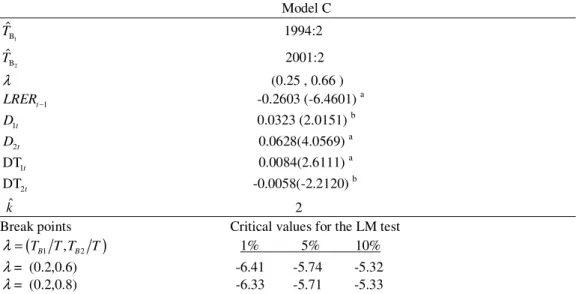
, where T is the sample size. Then, we can determine the breaks where the endogenous two-break LM test statistic is at a minimum. The two-break minimum LM unit root test results are shown in the Table 1.Table I. Two-break minimum LM unit root test, sample period 1990:1-2006:12 Model C 1 B ˆ T 1994:2 2 B ˆ T 2001:2 λ (0.25 , 0.66 ) 1 t LRER− -0.2603 (-6.4601) a 1t D 0.0323 (2.0151) b 2t D 0.0628(4.0569) a 1 DTt 0.0084(2.6111) a 2 DTt -0.0058(-2.2120) b ˆ k 2
Break points Critical values for the LM test
(
TB1 T T, B2 T)
λ = 1% 5% 10%
λ= (0.2,0.6) -6.41 -5.74 -5.32
λ= (0.2,0.8) -6.33 -5.71 -5.33
Notes: kˆ denotes the estimated optimal number of first-differenced lagged terms included to correct for serial correlation.
1 B ˆ T and 2 B ˆ
T denote the break dates. LRERt−1 is the coefficient on the unit root
parameter. The figures in parenthesis are t-statistics. Critical values for the coefficient on the dummy variables follow the standard normal distribution. a,b denotes statistical significance at 1% and 5%, respectively. The critical values depend on the location of the breaks and come from Lee and Strazicich (2003).
Table 1 gives two break LM unit root test results and estimated coefficients in testing regression. As can be seen from the results, both structural breaks in the trend and in the intercept are statistically significant. The two estimated break points are February 1994 and February 2001. These empirical results are consistent with economic development that occurred in Turkey.
The break point in February 1994 coincides with the financial crisis during the same year. After the liberalization of the International Capital Movement, a high real interest rate policy was implemented by the monetary authority to finance the budget deficit. This caused a rapid increase in short-term capital inflows. While the annual inflation rate was 60%, exchange rate increased around 50% during the period 1989-1993, causing the Turkish lira to be overvalued. The government’s expansionary fiscal policy and the overvaluation of the Turkish lira led to a severe financial crisis in 1994. The Central Bank of Turkey (CBRT) abandoned the exchange rate policy and devalued the nominal exchange rate by 14%. The devaluation of the currency continued until April 1994, with the total for this period reaching 173% in nominal terms. To stabilize the value of Turkish lira and to overcome the financial crises, the stabilization program, which resulted in the further deterioration of the Turkish economy, was launched in April 1994.
The worsening fiscal situation eventually culminated in another major economic crisis in 2001. In February 2001, after a relatively minor crisis with the sudden capital outflow in November 2000, political instability further contributed to a deterioration of economic conditions: overnight inter-bank rates rose to above 4,000%, and the Turkish lira depreciated by 40% in a day against the U.S. dollar. The Turkish financial system plunged into a critical crisis period. The nominal exchange
rate depreciated 94% in May 2001 and continued its downtrend until September 2001. The adjustable fixed rate regime was abandoned after the financial crisis, and a new policy aiming at price stability was accepted according to the economic program applied in 2001, and was then switched to flexible exchange rate regime. Figure 1 is a graphical representation of our findings.
2.15 2.20 2.25 2.30 2.35 2.40 2.45 2.50 1990 1992 1994 1996 1998 2000 2002 2004 2006 FITTE D LRE R
Fig.1. Plots fitted and actual values of logaritmic real exchange rate
The minimum LM test statistic (-6.4601) rejects the null of nonstationarity, with breaks at the %1 significance level. Our empirical evidence for the period between 1990 and 2007 indicates that real exchange rate is trend-stationary for Turkey, mean of real exchange rate is a linear function of time, and shocks are transitory since deviations from the trend are temporary effects. Therefore, we can only find limited evidence in favor of a weaker version of PPP.As mentioned earlier, following Papell and Prodon (2006), the results found in this studycan be interpreted as evidenceinfavor of the Trend Qualified PPP for Turkey.
4. Conclusions and Policy Implications
The empirical findings indicate that the real exchange rate of Turkey was subject to structural changes in February 1994 and February 2001. The exchange rate policy applied and the overvaluation of the Turkish lira have been among the indicators of crisis in the Turkish economy in 1994 and 2001. The Turkish Lira depreciated, and the exchange rate policy was necessarily changed after both crises caused monetary and real shocks. The real exchange rate of Turkey follows a trend-stationary process; in other words, deviations from parity are temporary. It can therefore be concluded from these statistical evidences that the Trend Qualified PPP adopting the name proposed in Papell and Prodon (2006) is valid for Turkey. Thus,
we can also conclude that the effects of the economic crisis in 1994 and 2001 on the real exchange rate do not persist.
1
Togan and Berument (2007) calculated the CPI based on real exchange rate index (1970=100). They used the approach developed by Zanella and Desruelle (1997) in order to determine the weights for 30 countries including Belgium-Luxembourg, Brazil, Canada, China, Czech Republic, Egypt, France, Germany, Greece, Hungary, Indonesia, Iran, Italy, Japan, Korea, Malaysia, Mexico, Morocco, the Netherlands, Poland, Portugal, Russia, Spain, Switzerland, Syria, Taiwan, Thailand, Tunisia, the UK, and the USA.
2
An earlier version of this paper was presented as a poster at the 4th Annual Conference of the Turkish American Scientists and Scholars Association (TASSA), April, 2008, Boston, USA.
Acknowledgements
I would like to thank Sübidey Togan for providing the data used in this study and Junsoo Lee for kindly providing the Gauss codes. I acknowledge the helpful comments of an anonymous referee. Any errors or omissions, however, are my own doing.
References
Dornbusch, R. and Vogelsang, T.(1991) “Real exchange rates and purchasing power parity, In: de Melo, J., Sapir, A. (Eds.)” Trade Theory and Economic Reform: Nourth, South, and East, Essays in Honor of Bela Balassa, Cambridge, MA: Basil Blackwell, 3-24.
Froot and Rogoff(1995) “Perspectives on PPP and long-run real exchange rates, In: Grossman, G. Rogoff, K. (Eds.)” Handbook of International Economics, Vol.3. Notth-Holland, Amsterdam, 1647-1688.
Hegwood, N.D. and Papell. D.H.(1998) “Quasi Purchasing Power Parity” International Journal of Finance and Economics 3 ,279-289.
Kalyoncu, H. and Kalyoncu, K. (2008) “Purchasing power parity in OECD countries: Evidence from panel unit root” Economic Modelling, 25, 440-445.
Lee, J. and Strazicich, M.C. (2003) “Minimum Lagrange Multiplier unit root test with two structural breaks” The Review of Economics and Statistics, 85,1082-89. Lothian, J.R. and Taylor, M.P. (1996) “Real exchange rate behavior: the recent float from the perspective of the past two centries”, Journal of Political Economy, 104, 488-510.
Lothian, J.R. and Taylor, M.P. (1997)” Real exchange rate behavior:; the problem of power and sample size” Journal of International Money and Finance, 16, 945-954.
Lumsdaine , R. and Papel, D.,(1997) “Multiple trend breaks and the unit root hypothesis” Review of Economics and Statistics, 79,212-218.
Marcela, S., Gadea, M.D. and Serrano, J.M. (2003) “PPP and structural breaks The peseta-sterling rate, 50 years of floating rejime” Journal of International Money and Finance, 22, 613-627.
Narayan , P.K., (2005) “New evidence on purchasing power parity from 17 OECD Countries” Applied Economics,37, 1063-1071.
Narayan, P.K., (2006) “Are bilateral real Exchange rates stationary? Evidence from Lagrange multiplier unit root tetss for India” Applied Economics, 38, 63-70.
Narayan, P.K., (2008) “The Purchasing power parity revisited: New evidence for OECD countries from panel unit root tests with structural breaks” Int. Fin. Markets, Inst and Money, 18, 137-146.
Narayan, P.K., and Prasad, B.C., (2005) “The validity of purchasing power parity hypothesis for eleven middle eastern countries” Review of Middle East Economics and Finance 3, 2, 135-149.
Ng, S., and Perron, P.(1995) “Unit root tests in ARMA Models with data dependent methods for the selection of the truncation lag” Journal of the American Statistical Association 90, 268-281.
Papell, D. and Theodoridis, H. (2001) “The choice of numeraire currency in panel tets of purchasing power parity” Journal of Money,Credit, and Banking,33, 790-803. Papell, D.H. and Prodan, R.(2006) “Additioanal evidence of long-run purchasing power parity with restricted structural change” Journal of Money, Credit, and Banking, 38 , 5, 1329-1349.
Perron, P.(1989) “The great crash, the oil price shock, and the unit root hypothesis” Economietrica,57, 1361-401.
Sarno L. (2000) “Real Exchange rate behavior in high inflation countries:empirical evidence from Turkey, 1980-1997”, Applied Economics Letters,5 ,7, 285-291. Taylor, M. and Sarno, L.(1998) “The behaviour of real exchanges during the post-bretton woods period” Journal of International Economics,46, 281-312.
Togan, S. and Berument, H. (2007) “The Turkısh current account, real Exchange rate and sustainability: a methodological framework” The Journal of International Trade and Diplomacy,1, 155-192.
Wu, J.L. and Wu, S. (2001) “Are purchasing power parity overvalued” Journal of Money, Credit and Banking,33, 804-812.
Wu, Y. (1996) “Are real Exchange rates nonstationary? Evidence from a panel –data test” Journal of Money, Credit and Banking , 28(1), 54-63.
Zivot, E. and Andrews, O.W.K. (1992) “Further evidence on the great crash, the oil shock and the unit root hypothesis” Journal of Business and Ecınomic Statistics,10, 251-70.