T
HE REGULARITY METHOD IN DIRECTED
GRAPHS AND HYPERGRAPHS
by
R
ICHARD
MYCROFT
A thesis submitted to The University of Birmingham
for the degree of
DOCTOR OFPHILOSOPHY
School of Mathematics
The University of Birmingham May 2010
University of Birmingham Research Archive
e-theses repository
This unpublished thesis/dissertation is copyright of the author and/or third parties. The intellectual property rights of the author or third parties in respect of this work are as defined by The Copyright Designs and Patents Act 1988 or as modified by any successor legislation.
Any use made of information contained in this thesis/dissertation must be in accordance with that legislation and must be properly acknowledged. Further distribution or reproduction in any format is prohibited without the permission of the copyright holder.
ABSTRACT
In recent years the regularity method has been used to tackle many embedding problems in extremal graph theory. This thesis demonstrates and develops three different techniques which can be used in conjunction with the regularity method to solve such problems. These methods enable us to prove an approximate version of the well-known Sumner’s universal tournament conjecture, first posed in 1971, which states that any tournamentGon2n−2vertices contains a copy of any directed treeT onnvertices. An analysis of the extremal cases then proves that Sumner’s universal tournament conjecture holds for any sufficiently largen.
Our methods are also applied to the problem of obtaining hypergraph analogues of Dirac’s theorem. Indeed, we show that for any k > 3 and any 1 6 ` 6 k − 1 with k −` - k, any k-uniform hypergraph on n vertices with minimum degree at least dk/(k−n`)e(k−`) +o(n)
contains a Hamilton`-cycle. This result confirms a conjecture of H`an and Schacht, and is best possible up to theo(n)error term. Together with results of R¨odl, Ruci´nski and Szemer´edi, this result asymptotically determines the minimum degree which forces an `-cycle for any` with
ACKNOWLEDGEMENTS
I would like to thank my supervisors Daniela K¨uhn and Deryk Osthus for their support and guidance in the writing of this thesis and throughout the course of my studies. In particular I acknowledge their coauthorship of the main results given in this thesis. Peter Keevash was also a coauthor of the work presented in Chapter 4, and Conjecture 1.7 was proposed in conjunction with Peter Allen and Olly Cooley. The work presented in Chapters 2, 3, 4 and 5 roughly corresponds to that presented in [29], [30], [24] and [28] respectively.
C
ONTENTS
1 Introduction 1
1.1 Trees in tournaments . . . 2
1.2 Hamilton cycles in hypergraphs . . . 6
1.3 An introduction to the regularity method . . . 10
1.4 A word on notation . . . 13
2 Embedding trees in tournaments 15 2.1 Outline of the proof of Theorem 1.5 . . . 16
2.2 Definitions and preliminary results . . . 19
2.2.1 Graphs . . . 19
2.2.2 Directed graphs . . . 19
2.2.3 Trees . . . 20
2.2.4 Probabilistic estimates . . . 25
2.2.5 Regularity and robust outexpanders . . . 27
2.3 Embedding trees of bounded maximum degree in a robust outexpander . . . 35
2.3.2 Allocating the vertices ofT . . . 37
2.3.3 Embedding the vertices ofT . . . 41
2.4 Embedding trees of unbounded maximum degree in a robust outexpander . . . 49
2.4.1 Introduction . . . 49
2.4.2 The core tree . . . 50
2.4.3 Leading paths . . . 54
2.4.4 The extended tree . . . 56
2.4.5 Embedding trees of bounded maximum degree with restrictions . . . . 58
2.4.6 Proof of Lemma 2.18 . . . 67
2.5 Embedding trees in an almost-transitive tournament . . . 72
2.6 Proof of Theorem 1.5 . . . 76
2.6.1 Partitioning the vertices ofGandT . . . 77
2.6.2 EmbeddingT inG . . . 80
3 A proof of Sumner’s universal tournament conjecture for largen 84 3.1 Outline of the proof of Theorem 1.1 . . . 84
3.2 Preliminary results . . . 88
3.2.1 Almost-regular tournaments . . . 88
3.2.2 Some embedding results . . . 89
3.3 Embedding trees whose core tree is a single vertex . . . 94
3.5 Embedding trees whose core tree is small . . . 111
3.6 Proof of Theorem 1.1 . . . 128
4 Loose Hamilton cycles in uniform hypergraphs 137 4.1 Extremal examples . . . 137
4.2 Outline of the proof of Theorem 1.10 . . . 139
4.2.1 Imposing structure onH . . . 140
4.2.2 The linking strategy . . . 140
4.2.3 Controlling divisibility . . . 141
4.3 Regularity and the blow-up lemma . . . 142
4.3.1 Graphs and complexes . . . 142
4.3.2 Regular complexes . . . 144
4.3.3 Robustly universal complexes . . . 147
4.4 Preliminary results . . . 149
4.4.1 Loose paths in complete graphs . . . 149
4.4.2 Walks and connectedness ink-graphs . . . 152
4.4.3 Random splitting . . . 152
4.4.4 Decomposition ofGinto copies ofAk . . . 154
4.5 Proof of Theorem 1.10 . . . 156
4.5.1 Imposing structure onH . . . 156
4.5.3 Constructing the loose Hamilton cycle . . . 170
5 Hamilton`-cycles in uniform hypergraphs 174 5.1 Outline of the proof of Theorem 1.11 . . . 174
5.2 Definitions and a preliminary result . . . 177
5.3 The regularity lemma fork-graphs . . . 180
5.3.1 Regular complexes . . . 180
5.3.2 Statement of the regularity lemma . . . 182
5.3.3 The reducedk-graph . . . 185
5.3.4 The embedding and extension lemmas . . . 186
5.4 The diameter lemma . . . 189
5.5 The absorbing path lemma . . . 196
5.6 The path cover lemma . . . 202
5.7 Proof of Theorem 1.11 . . . 206
C
HAPTER
1
I
NTRODUCTION
The problem of finding a fixed substructure within a given structure is a major area of extremal combinatorics. Early examples of such results include Dirac’s Theorem [10], which states that any graphG onn > 3vertices with minimum degree at least n/2contains a Hamilton cycle, and Tutte’s Theorem, which completely characterises those graphsG which contain a perfect matching (a set of disjoint edges of G containing every vertex of G). More recently, much progress has been made on similar problems through the use of regularity.
In this thesis we demonstrate and develop three different techniques by which the regularity method may be applied to solve embedding problems in directed graphs and hypergraphs. Namely, we demonstrate and develop the uses of the ‘hypergraph blow-up lemma’, an ‘ab-sorbing’ structure, and a randomised embedding algorithm. Each method is used to obtain significant new results. Indeed, our application of a randomised embedding algorithm to em-bed directed graphs culminates in the proof for largen of the well-known Sumner’s universal tournament conjecture, first posed in 1971, which states that any tournament on2n−2vertices contains any directed tree on n vertices. Next we use the ‘blow-up lemma’ and an ‘absorb-ing’ structure to obtain analogues of Dirac’s theorem for hypergraphs, giving asymptotically
for any k and ` the minimum degree threshold required to guarantee that a k-uniform hyper-graph contains a Hamilton`-cycle (for any1 6` 6 k−1, an`-cycle in ak-graph is a natural generalisation of a cycle in a graph).
The reader should note that whilst we apply the randomised embedding algorithm to directed graphs, and the ‘blow-up lemma’ and the ‘absorbing’ method to hypergraphs, these methods are not specific to these cases. Indeed, each method can be used to solve embedding problems in simple graphs, directed graphs or hypergraphs. Also, to keep this introduction relatively short and easy-going, we defer the definitions of many terms used to the relevant later chapters of this thesis.
1.1
Trees in tournaments
A directed graph G, or digraph, consists of a set of verticesV(G)and a set of edges E(G), where each edge ofGis an ordered pair of vertices ofG. So we think of an edge(u, v)as being
directed fromutov. A tournament is a digraph formed by orienting each edge of a complete (undirected) graph. A tournament need not contain any directed cycles, so we cannot guarantee the presence of any digraph containing such a cycle in an arbitrary tournament, no matter how large. Instead, we might ask how large a tournament G must be to ensure thatG contains a copy of a directed treeT onnvertices (where a directed tree is formed by orienting each edge of an undirected tree). The well-known Sumner’s universal tournament conjecture, first posed in 1971 (see e.g. [38, 46]), states that any tournament on2n−2vertices contains a copy of any directed treeT onnvertices. We prove that this conjecture holds for all largen.
Theorem 1.1 There existsn0 such that the following holds. LetT be a directed tree onn >n0
0 0 1 1 00 00 11 11 00 00 00 11 11 11 0 0 0 1 1 1 00 00 11 11 0 0 1 1 00 00 00 11 11 11 00 00 00 11 11 11 0 0 0 1 1 1 0 0 0 0 0 0 0 0 0 0 0 0 1 1 1 1 1 1 1 1 1 1 1 1 000 000 000 000 000 000 000 000 000 000 111 111 111 111 111 111 111 111 111 111 000 000 000 000 000 000 000 000 000 000 111 111 111 111 111 111 111 111 111 111 0000000 0000000 0000000 0000000 0000000 0000000 0000000 0000000 1111111 1111111 1111111 1111111 1111111 1111111 1111111 1111111 000000 000000 000000 000000 000000 000000 000000 000000 111111 111111 111111 111111 111111 111111 111111 111111 00 00 00 00 00 00 00 00 00 00 00 00 11 11 11 11 11 11 11 11 11 11 11 11 000 000 000 000 000 000 000 000 000 000 000 000 111 111 111 111 111 111 111 111 111 111 111 111 0000000000 0000000000 0000000000 0000000000 0000000000 0000000000 0000000000 0000000000 0000000000 0000000000 0000000000 0000000000 1111111111 1111111111 1111111111 1111111111 1111111111 1111111111 1111111111 1111111111 1111111111 1111111111 1111111111 1111111111 0000 0000 0000 0000 0000 0000 0000 0000 0000 0000 0000 0000 0000 0000 0000 0000 0000 0000 0000 0000 1111 1111 1111 1111 1111 1111 1111 1111 1111 1111 1111 1111 1111 1111 1111 1111 1111 1111 1111 1111 00000 00000 00000 00000 00000 00000 00000 00000 00000 00000 00000 00000 00000 00000 00000 00000 00000 00000 00000 00000 11111 11111 11111 11111 11111 11111 11111 11111 11111 11111 11111 11111 11111 11111 11111 11111 11111 11111 11111 11111 0000000000 0000000000 0000000000 0000000000 0000000000 0000000000 0000000000 0000000000 0000000000 0000000000 0000000000 0000000000 1111111111 1111111111 1111111111 1111111111 1111111111 1111111111 1111111111 1111111111 1111111111 1111111111 1111111111 1111111111 000000000000 111111111111
G
T
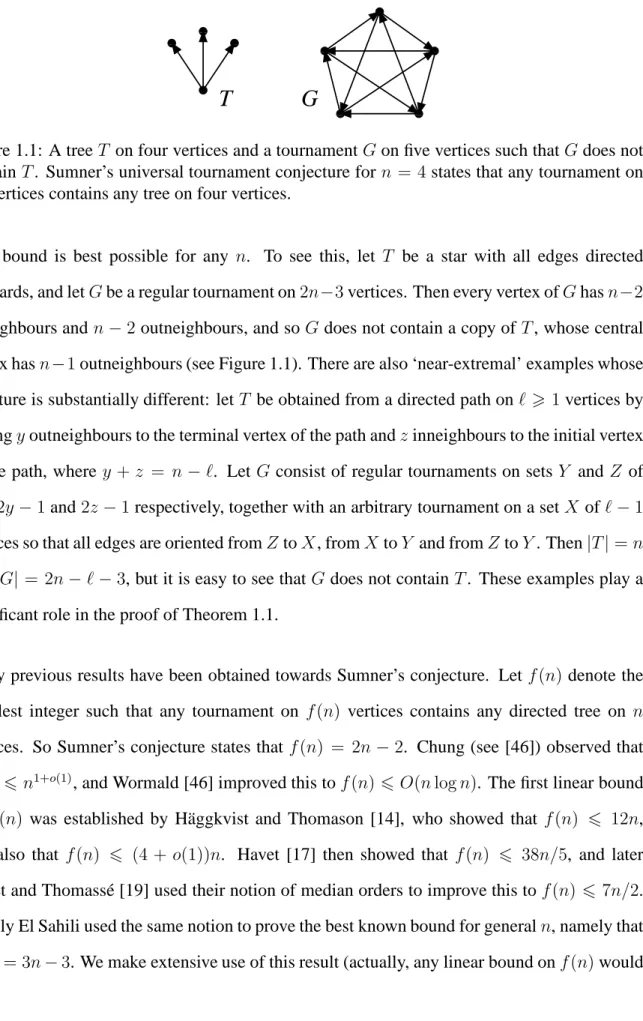
Figure 1.1: A treeT on four vertices and a tournamentGon five vertices such thatGdoes not containT. Sumner’s universal tournament conjecture forn = 4states that any tournament on six vertices contains any tree on four vertices.
This bound is best possible for any n. To see this, let T be a star with all edges directed outwards, and letGbe a regular tournament on2n−3vertices. Then every vertex ofGhasn−2
inneighbours andn−2 outneighbours, and soGdoes not contain a copy ofT, whose central vertex hasn−1outneighbours (see Figure 1.1). There are also ‘near-extremal’ examples whose structure is substantially different: letT be obtained from a directed path on ` > 1vertices by addingyoutneighbours to the terminal vertex of the path andzinneighbours to the initial vertex of the path, where y+z = n−`. LetG consist of regular tournaments on setsY and Z of size2y−1and2z−1respectively, together with an arbitrary tournament on a setX of`−1
vertices so that all edges are oriented fromZtoX, fromXtoY and fromZtoY. Then|T|=n
and|G| = 2n−`−3, but it is easy to see thatGdoes not containT. These examples play a significant role in the proof of Theorem 1.1.
Many previous results have been obtained towards Sumner’s conjecture. Let f(n)denote the smallest integer such that any tournament on f(n) vertices contains any directed tree on n
vertices. So Sumner’s conjecture states that f(n) = 2n−2. Chung (see [46]) observed that
f(n)6 n1+o(1), and Wormald [46] improved this tof(n)6 O(nlogn). The first linear bound on f(n) was established by H¨aggkvist and Thomason [14], who showed that f(n) 6 12n, and also that f(n) 6 (4 +o(1))n. Havet [17] then showed that f(n) 6 38n/5, and later Havet and Thomass´e [19] used their notion of median orders to improve this to f(n) 6 7n/2. Finally El Sahili used the same notion to prove the best known bound for generaln, namely that
suffice for our purposes; the factor of 3 is not essential).
Theorem 1.2 (El Sahili [11]) LetT be a directed tree onnvertices, and letGbe a tournament on3n−3vertices. ThenGcontains a copy ofT.
Sumner’s conjecture is also known to hold for some special classes of directed trees. In partic-ular, Havet and Thomass´e [19] proved it for ‘outbranchings’, again using median orders. Here an outbranching is a directed treeT in which we may choose a root vertext∈T so that for any vertext0 ∈ T, the path betweent andt0 inT is directed from t tot0. (Outbranchings are also
known as arborescences.)
Theorem 1.3 (Havet and Thomass´e [19]) Let T be an outbranching onn vertices, and letG
be a tournament on2n−2vertices. ThenGcontains a copy ofT.
For many types of directed trees, Sumner’s conjecture holds with room to spare. A classical result of this type is Redei’s theorem.
Theorem 1.4 (Redei [37]) Any tournament contains a spanning directed path.
Havet and Thomass´e [20] proved a much stronger result, namely that every tournament on
n > 8 vertices contains every orientation of the path on n vertices (this was a conjecture of Rosenfeld). Reid and Wormald [38] also proved Sumner’s conjecture for other (very restricted) classes of directed trees.
In Chapter 2, we use the regularity method, combined with a randomised embedding algorithm, to prove an approximate version of Sumner’s universal tournament conjecture. This is (1) of the following theorem. In the process we also prove (2), a stronger result for directed trees of bounded maximum degree, which is of independent interest.
(1) There existsn0such that for anyn >n0, any tournamentGon at least2(1 +α)nvertices
contains any directed treeT onnvertices.
(2) Let ∆be any positive integer. Then there exists n0 such that for anyn > n0, any
tour-nament Gon at least (1 +α)n vertices contains any directed tree T onn vertices with
∆(T)6∆.
In Chapter 3 we consider the extremal cases of the previous theorem. Indeed, we use both meth-ods and results of the previous chapter to show that Sumner’s universal tournament conjecture holds for large n whenever the directed tree T is not ‘close’ to one of the extremal examples to the conjecture given earlier. By a careful consideration of these extremal examples, we can show that the conjecture holds in these cases too, completing the proof of Theorem 1.1. In particular we use both parts of Theorem 1.5 extensively, and so Theorem 1.5(1) and its proof are not made redundant by the stronger Theorem 1.1.
There are several directions in which our results can be extended. For example, the error term in Theorem 1.5(2) cannot be completely omitted (to see this, consider the ‘near-extremal’ example discussed after the statement of Theorem 1.1 with x > 2and y = z = ∆−1). It would be interesting to know whether the termαncan be reduced to a constant depending only on∆. Another class of directed trees where Sumner’s conjecture can be strengthened is that of trees with few leaves. The first result in this direction was proved by H¨aggkvist and Thomason [14]. Havet and Thomass´e (see [18]) then proposed the following generalisation of Sumner’s conjec-ture.
Conjecture 1.6 (Havet and Thomass´e [18]) Let T be a directed tree on n vertices with k
C´eroi and Havet [7] proved that this conjecture holds fork 63, from which they deduced that Sumner’s conjecture holds for all directed trees with at most four leaves.
However, Conjecture 1.6 is still far from optimal for many directed treesT, such as a binary tree. Preliminary investigations have suggested the following stronger conjecture.
Conjecture 1.7 LetT be a directed tree onn vertices which is not an instar or an outstar, and let∆p(T) := max{d−(x) +d+(y)}, where the maximum is over allx, y ∈T such that there is
a directed path inT fromxtoy. Then any tournamentGonn+ ∆p(T)−2vertices contains a
copy ofT.
The ‘near-extremal’ examples discussed after the statement of Theorem 1.1 show that this would be best possible, in the sense that the −2 cannot be replaced by −3. It would be interesting to know if the methods of this thesis can be extended to prove these conjectures (for largen). Finally, the following far-reaching generalisation of Sumner’s conjecture was made by Burr [6].
Conjecture 1.8 (Burr [6]) Any (2n −2)-chromatic digraph contains any directed tree on n
vertices.
Burr verified the corresponding statement with (n− 1)2 in place of 2n −2. More recently, El Sahili [12] proved that anyn-chromatic digraph contains the path formed byn−1forward edges followed by one backwards edge, but to our knowledge, no further progress has been made.
1.2
Hamilton cycles in hypergraphs
Recall that Dirac’s theorem [10] states that any graph G on n > 3 vertices with minimum degree at leastn/2contains a Hamilton cycle (i.e. there is a cyclic ordering of allnvertices of
00 00 11 11 00 00 11 11 00 00 11 11 00 00 11 11 00 00 11 11 00 00 11 11 0 0 1 1 0 0 1 1 0 0 1 1 0 0 1 1 0 0 1 1 00 00 11 11 00 00 11 11 00 00 11 11 00 00 11 11 00 00 11 11 00 00 11 11 0 0 0 1 1 1 0 0 0 1 1 1 0 0 0 1 1 1 0 0 0 1 1 1 0 0 0 1 1 1 00 00 11 11 00 00 11 11 00 00 11 11 00 00 11 11 00 00 11 11 00 00 11 11 0 0 0 1 1 1 0 0 0 1 1 1 0 0 0 1 1 1 0 0 0 1 1 1 0 0 0 1 1 1
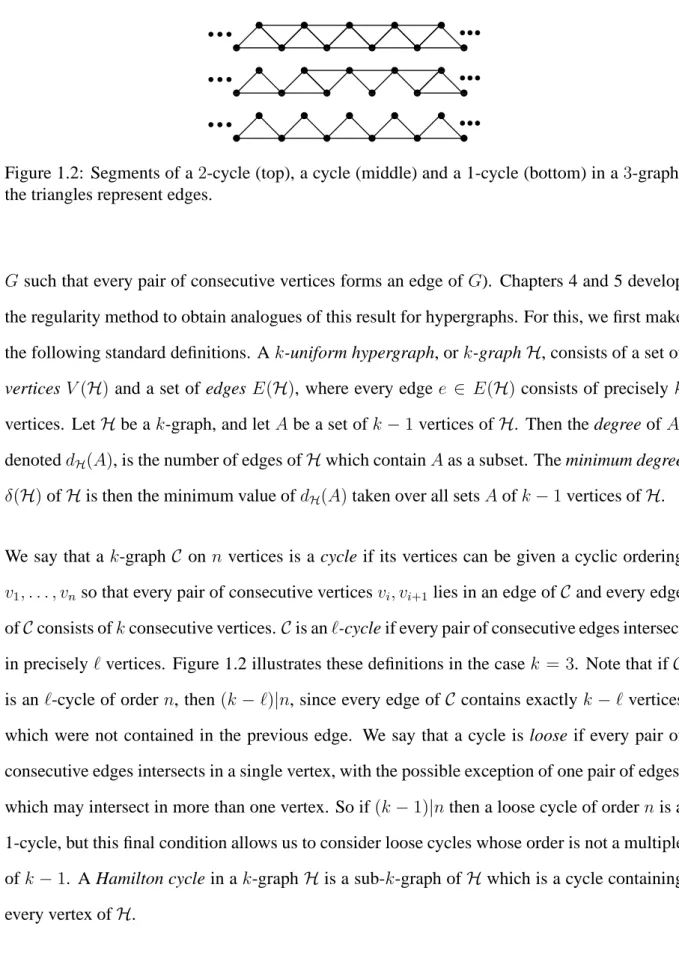
Figure 1.2: Segments of a2-cycle (top), a cycle (middle) and a 1-cycle (bottom) in a3-graph; the triangles represent edges.
Gsuch that every pair of consecutive vertices forms an edge ofG). Chapters 4 and 5 develop the regularity method to obtain analogues of this result for hypergraphs. For this, we first make the following standard definitions. Ak-uniform hypergraph, ork-graphH, consists of a set of
vertices V(H)and a set of edges E(H), where every edge e ∈ E(H) consists of preciselyk
vertices. LetHbe ak-graph, and letAbe a set ofk−1vertices ofH. Then the degree ofA, denoteddH(A), is the number of edges ofHwhich containAas a subset. The minimum degree
δ(H)ofHis then the minimum value ofdH(A)taken over all setsAofk−1vertices ofH.
We say that a k-graph C on n vertices is a cycle if its vertices can be given a cyclic ordering
v1, . . . , vnso that every pair of consecutive verticesvi, vi+1lies in an edge ofC and every edge ofCconsists ofkconsecutive vertices.Cis an`-cycle if every pair of consecutive edges intersect
in precisely`vertices. Figure 1.2 illustrates these definitions in the case k = 3. Note that ifC is an `-cycle of order n, then(k−`)|n, since every edge ofC contains exactlyk −` vertices which were not contained in the previous edge. We say that a cycle is loose if every pair of consecutive edges intersects in a single vertex, with the possible exception of one pair of edges, which may intersect in more than one vertex. So if(k−1)|nthen a loose cycle of ordernis a 1-cycle, but this final condition allows us to consider loose cycles whose order is not a multiple ofk−1. A Hamilton cycle in ak-graphHis a sub-k-graph ofHwhich is a cycle containing every vertex ofH.
the other cases follow, since if(k−`)|nthen any(k−1)-cycle of orderncontains an`-cycle on the same vertices.
Theorem 1.9 (R¨odl, Ruci ´nski and Szemer´edi [39, 40]) For all k > 3, 1 6 ` 6 k −1 and anyη >0there existsn0so that ifn>n0and(k−`)|nthen anyk-graphHonnvertices with
δ(H)> 12 +ηncontains a Hamilton`-cycle.
This proved a conjecture of Katona and Kierstead [22]. A simple well-known construction (see Proposition 4.1) shows that Theorem 1.9 is best possible up to the error termηnif(k−`)|k. It is therefore natural to ask what minimum degree condition on H guarantees a Hamilton ` -cycle for the remaining values ofkand`. K¨uhn and Osthus [31] showed that any 3-graphHon
nvertices withδ(H)>(14 +o(1))ncontains a loose Hamilton cycle. In Chapter 4, we use the regularity method, combined with the recent ‘hypergraph blow-up lemma’ due to Keevash [23] to extend this result to any k > 3, proving Theorem 1.10. If (k −`)|n then Theorem 1.10 is a special case of Theorem 1.11, which we prove later by other means. However, the proof of Theorem 1.10 has independent interest; we believe that this is the first application of the hypergraph blow-up lemma to find a spanning structure within a general hypergraph, a method with many further potential applications.
Theorem 1.10 For allk > 3and anyη >0there existsn0so that if n >n0then anyk-graph
Honnvertices withδ(H)>( 1
2(k−1) +η)ncontains a loose Hamilton cycle.
Another simple well-known example (see Proposition 4.2) shows that this result is best possible up to the error termηn. In fact, Proposition 4.2 actually tells us more than this, namely that up to the error term, this minimum degree condition is best possible to ensure the existence of any (not necessarily loose) Hamilton cycle in H. So by combining Theorem 1.10 and Proposition 4.2 we obtain a hypergraph analogue of Dirac’s theorem, namely that the minimum degree needed to find a Hamilton cycle in ak-graph of ordernis asymptotically 2(kn−1) +o(n).
Theorem 1.10 was also proved simultaneously and independently by H`an and Schacht [16], who used an ‘absorbing’ method. In fact, they proved the more general result that if1 6 ` < k/2, then any k-graph H on n vertices with (k − `)|n and δ(H) > ( 1
2(k−`) +o(1))n contains a Hamilton `-cycle. They raised the question of determining the correct minimum degree for those values of k and ` not covered by their result or by Theorem 1.9. In Chapter 5, we use the regularity method, combined with a development of the ‘absorbing method’ of H`an and Schacht, to answer this question with the following theorem.
Theorem 1.11 For allk >3,16` 6k−1such that(k−`)-kand anyη >0there existsn0so
that ifn >n0and(k−`)|nthen anyk-graphHonnvertices withδ(H)>
1 d k k−`e(k−`) +η n
contains a Hamilton`-cycle.
Proposition 4.2 also shows that this result is best possible up to the error termηn. Thus Theo-rem 1.9 and TheoTheo-rem 1.11 together give asymptotically, for anyk and`, the minimum degree required to guarantee that ak-graph onnvertices contains a Hamilton`-cycle.
The difference in the minimum degree threshold between the cases(k−`)| kand(k−`)- k
is perhaps surprising. For example, ifk = 9then the minimum degree threshold for an 8-cycle or a 6-cycle is asymptoticallyn/2, whereas for a 7-cycle it is insteadn/10. This difference is essentially a consequence of the fact that in the(k−`)|kcase every Hamilton`-cycle contains a perfect matching. The minimum degree threshold for the latter is known to be close to n/2
(see Proposition 4.1).
One natural extension of the work presented here would be to consider other notions of degree. Let H be a k-graph on n vertices; then the degree of a set Aof vertices of H, denoted d(A)
is defined to be the number of edges containingA. For1 6 r 6 k−1, letδr(H)denote the minimumr-degree ofH, i.e. the minimum ofd(A)taken over all setsAofrvertices ofH. Then the notion of degree defined earlier is the(k−1)-degree. Until recently, very little was known
regarding the minimumr-degree thresholds which force spanning subgraphs for r < k −1. However, recently Pikhurko [36] showed that for k/2 6 r 6 k −1 the minimum r-degree threshold which forces a perfect matching in ak-graphHonn vertices is asymptoticallyn/2. Particular interest is devoted to the 1-degree, also known as the vertex degree. H`an, Person and Schacht [15] recently showed that the 1-degree threshold needed to guarantee a perfect matching in a 3-graph is asymptotically 59 n2. In light of the close connections between the problem of finding a perfect matching in ak-graph and the problem of finding a Hamilton cycle in ak-graph, it would be interesting to know whether the results and methods of Pikhurko and of H`an, Person and Schacht can be used to prove similar results for Hamilton cycles in these cases.
Other (less restrictive) notions of hypergraph cycles have also been considered. For example, a Berge-cycle [4] is defined to consist of a sequence of vertices where each pair of consecutive vertices is contained in a common edge.
1.3
An introduction to the regularity method
In this section we give a brief outline of the use of the regularity method in tackling embedding problems. For simplicity we present the method as it applies to simple graphs, but for directed graphs and hypergraphs the ideas are similar.
LetGbe a bipartite graph with vertex classesU andV of sizem. Also letdbe the density of
G. Then we say thatGisε-regular if for any subsetsU0 ⊆ U andV0 ⊆ V of size at leastεm
we haved0 = d±ε, where d0 is the density ofG(U0, V0). The notion ofε-regularity is very
useful for embedding problems, as in many waysGbehaves like a random bipartite graph on vertex classesU and V withdm2 edges chosen uniformly at random, in the sense that many properties ofGare shared by this random graph with high probability. In particular, ifH is a
V
2V
1V
3V
4V
5G
2 3 5 4 1R
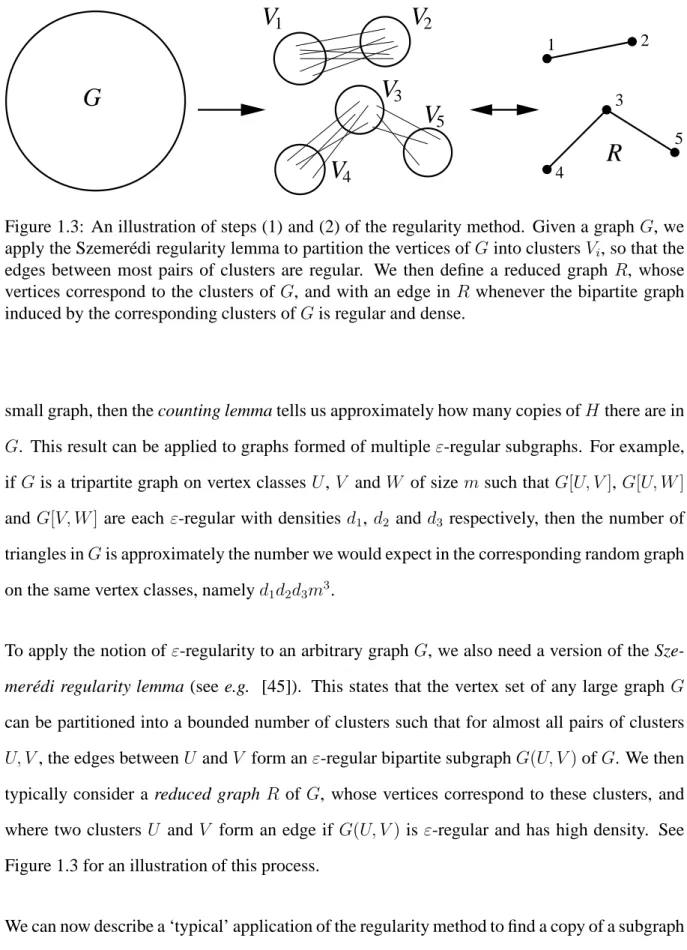
Figure 1.3: An illustration of steps (1) and (2) of the regularity method. Given a graphG, we apply the Szemer´edi regularity lemma to partition the vertices ofGinto clusters Vi, so that the edges between most pairs of clusters are regular. We then define a reduced graph R, whose vertices correspond to the clusters of G, and with an edge inR whenever the bipartite graph induced by the corresponding clusters ofGis regular and dense.
small graph, then the counting lemma tells us approximately how many copies ofHthere are in
G. This result can be applied to graphs formed of multipleε-regular subgraphs. For example, if Gis a tripartite graph on vertex classesU, V andW of size msuch that G[U, V], G[U, W]
and G[V, W]are each ε-regular with densities d1, d2 andd3 respectively, then the number of triangles inGis approximately the number we would expect in the corresponding random graph on the same vertex classes, namelyd1d2d3m3.
To apply the notion ofε-regularity to an arbitrary graph G, we also need a version of the
Sze-mer´edi regularity lemma (see e.g. [45]). This states that the vertex set of any large graph G
can be partitioned into a bounded number of clusters such that for almost all pairs of clusters
U, V, the edges betweenU andV form anε-regular bipartite subgraphG(U, V)ofG. We then typically consider a reduced graph R of G, whose vertices correspond to these clusters, and where two clusters U and V form an edge if G(U, V) is ε-regular and has high density. See Figure 1.3 for an illustration of this process.
We can now describe a ‘typical’ application of the regularity method to find a copy of a subgraph
1. Apply the Szemer´edi regularity lemma toGto partition the vertices ofGinto clusters. 2. Form the reduced graphRas described above.
3. Find a ‘useful’ subgraphR0 ofR, for example a perfect matching or a Hamilton cycle. 4. Use the fact that every edgeeofR0 corresponds to anε-regular and dense bipartite
sub-graph ofGto find a copy ofHinG.
At steps 3 and 4 there are a wide variety of possible approaches, three of which are illustrated in this thesis. However, in each case the advantage conferred by using the regularity method is that the subgraph R0 of the reduced graph R is simpler (and hence easier to find) than the
subgraphHwhich we wish to find inG.
For example, in Chapter 2, we wish to find a directed treeT of bounded degree in a tournament
G. To do this, we first apply a version of the Szemer´edi regularity lemma for directed graphs to partitionGinto clusters. We then show that (at least for certain well-behaved tournaments) the reduced directed graphRcontains a directed Hamilton cycleR0. Next a randomised embedding
algorithm allocates each vertex ofT to a vertex of this cycle (which corresponds to a cluster of
G). Finally, by analysing this algorithm we show that with high probability it is possible to use the regularity indicated by each edge ofR0 to embed each vertex of T within the cluster ofG
to which it was allocated so as to form a copy ofT inG. So by the regularity lemma we have reduced the problem of finding a complex subgraphT inGto the problem of finding a simple subgraphR0 inRplus the problem of using the existence ofR0to embedT inG.
In Chapter 4 we instead wish to find a loose Hamilton cycle within a k-graph. This is also achieved using the regularity method as described above (using ak-graph version of the Sze-mer´edi regularity lemma and defining a reducedk-graphR). Here Step 3 is to find a collection of disjoint copies of a small k-graphAk,1 in R whose union includes almost every vertex of
R, whilst for Step 4 we apply the blow-up lemma to find spanning paths within the clusters corresponding to each copy ofAk,1inR. This method is explained in more detail in Chapter 4. Finally in Chapter 5 we apply the regularity method in the proof of each of three lemmas used in the proof of Theorem 1.11.
1.4
A word on notation
Throughout Chapters 1, 2, 3 and 5 of this thesis we employ notational conventions consistently. For example, we refer to graphs with upper-case letters in italic font (e.g. G, H), whereas we use calligraphic characters (such as G and H) to denote hypergraphs. However, in Chapter 4 the hypergraph blow-up lemma due to Keevash [23] and other results from the same paper play an extensive role. These results are very technical, and so employing different notational conventions in Chapter 4 to those used by Keevash [23] would cause the reader substantial difficulties. Instead we have opted for the lesser of two evils, namely to use the notational conventions used by Keevash [23] in Chapter 4. All differences in notation are appropriately introduced in Chapter 4.
The following notation is used consistently throughout this thesis. The set of integers from 1
tor is denoted by[r]. For a setA, we use Akto denote the collection of subsets ofA of size
k, and similarly 6Akto denote the collection of non-empty subsets ofAof size at mostk. We writex=y±z to denote thaty−z 6x6y+z, and useo(1)to denote a function which tends to zero asntends to infinity, holding all other variables involved constant. Also, we write e.g.
0 < a1 a2 a3 a4 61to mean that we can choose the constantsa1, . . . , a4 from right to left. More precisely, there are increasing functions f1, f2, f3 such that, given a4, whenever we choose some a3 6 f3(a4), a2 6 f2(a3) and a1 6 f1(a2), all calculations needed in the following argument are valid. Hierarchies with more constants are defined similarly. Also, we sometimes write ‘letx y’ whenyhas an already fixed positive value; by this we mean that
there exists somex0 > 0 such that for any0 < x < x0 the subsequent statements hold. We omit floors and ceilings throughout this thesis whenever they do not affect the argument.
C
HAPTER
2
E
MBEDDING TREES IN TOURNAMENTS
In this chapter we use the regularity method combined with a randomised embedding algorithm to prove an approximate version of Sumner’s universal tournament conjecture, as well as a stronger result for directed trees of bounded degree. This is Theorem 1.5, which is restated below.
Theorem 1.5 Letα >0. Then the following properties hold.
(1) There existsn0such that for anyn >n0, any tournamentGon at least2(1 +α)nvertices
contains any directed treeT onnvertices.
(2) Let∆ be any positive integer. Then there existsn0 such that for anyn > n0, any
tour-namentG on at least(1 +α)nvertices contains any directed treeT on nvertices with
2.1
Outline of the proof of Theorem 1.5
The notion of a robust outexpander (which was introduced for dense graphs in [33]) is crucial to the proof of Theorem 1.5. Informally, a digraph G is a robust outexpander if for any set
S ⊆V(G)which is not too large or too small, the number of vertices with many inneighbours inS is substantially bigger than|S|. K¨uhn, Osthus and Treglown [33] showed that any robust outexpanderGof linear minimum semidegree contains a Hamilton cycle. (Here the minimum semidegree is the minimum of the minimum indegree and the minimum outdegree.) By apply-ing this result to the ‘reduced digraph’ obtained from the Szemer´edi regularity lemma, we may split most of the vertices ofGinto setsV1, V2, . . . , Vkso that the set of edges fromVitoVi+1for eachi(addition of the indices taken modulok) forms a regular and dense bipartite graph. This structure is very useful for embedding directed trees. On the other hand, it is easy to show that if a tournamentGis not a robust outexpander of linear minimum semidegree, then the vertices of Gcan be split into two parts so that almost all of the edges between the two parts are di-rected the same way (see Lemma 2.11). By iterating this split, we either obtain a part which is a robust outexpander of linear minimum semidegree, or find thatGis close to being a transitive tournament, a case which we consider separately.
To begin, in Section 2.2 we define the concepts we use, and prove various useful lemmas. Then in Sections 2.3 and 2.4 we use the regularity method to show that Theorem 1.11 holds with the added condition thatGis a robust outexpander of linear minimum semidegree. Indeed, in Section 2.3, we consider the case where the tournament G is a robust outexpander of linear minimum semidegree on(1 +α)nvertices, and T is a directed tree onn vertices of bounded maximum degree. Here we apply the Szemer´edi regularity lemma to partition the vertices ofG
into clusters V1, V2, . . . , Vk, and form the ‘reduced digraph’R as outlined in the introduction. As described above, we apply the result of K¨uhn, Osthus and Treglown [33] to find a Hamilton cycleR0 in the reduced digraphR. This implies that we can relabel the clusters ofGso that the
set of edges fromVitoVi+1is regular and dense for eachi; it is this structure onGwhich we use to embedT inG. One attempt to do so would be to embed each vertext∈T in the cluster either preceding or succeeding the cluster containing the parent t0 oft, according to the direction of
the edge betweentandt0. However, for many directed trees (such as an anti-directed path) this
method fails to give an approximately uniform allocation of vertices of T to the clusters ofG, which we require for the embedding to be successful. Instead, we modify this method so that each vertex is embedded as above with probability 1/2 and is embedded in the same cluster as its parent with probability 1/2. We show that with high probability this randomised algorithm indeed gives an approximately uniform allocation of vertices of T to the clusters ofG, and so (using the regularity of edges directed fromVitoVi+1) successfully embedsT inG.
In Section 2.4 we begin by strengthening the result from Section 2.3, showing that if T is a directed tree on n vertices of bounded maximum degree, andGis a tournament on (1 +α)n
vertices whose reduced graph defined on the clustersV1, . . . , Vkcontains a Hamilton cycle, then we can embedT inGso that the vertices of a chosen small setH ⊆V(T)are embedded within a specified set U ⊆ V(G). To do this, we embed all vertices ‘far’ from H by the method described above, which ensures that the vertices of T are allocated approximately uniformly amongst the clusters of G. The remaining vertices of T are instead embedded to ensure that every vertex of H is embedded within U. This result allows us to embed directed trees T of unbounded maximum degree. Indeed, we define for any tree T a ‘core tree’ T∆, which has the properties thatT∆has bounded maximum degree, but each component ofT −T∆is small. Given a tournamentGwhich is a robust outexpander of linear minimum semidegree on(2+α)n
vertices, we again split most of the vertices ofGinto clustersV1, V2, . . . , Vkas described above. We then choose subsetsV0
i ⊆Viat random so that|
S
iVi0|is roughly equal to|T∆|, and embed
T∆ into these subsets (actually we first extend T∆ to an ‘extended tree’ Text and embed Text into these subsets), using the strengthened result for directed trees of bounded degree to restrict certain vertices ofT∆to vertices ofGwith many inneighbours and outneighbours inG−SiVi0.
Since each component ofT −T∆is small, this allows us to embed the components ofT −T∆ one by one among the unoccupied vertices ofGto complete the embedding ofT inG.
It is a simple exercise to demonstrate that any transitive tournament onnvertices contains any directed tree onn vertices. In Section 2.5, we prove an analogue of this for almost-transitive tournamentsG. This means that the vertices ofGcan be ordered so that almost all of the edges ofGare directed towards the endvertex which is greater in this order. We show that ifGis an almost-transitive tournament on(1 +α)nvertices andT is a directed tree onnvertices thenG
containsT.
Finally, in Section 2.6, we use the robust outexpander dichotomy to prove Theorem 1.5. Here we describe the proof of the first statement; the proof of the second is very similar. So letGbe a tournament on2(1 +α)n vertices and letT be a directed tree onn vertices. IfGis a robust outexpander of linear minimum semidegree, then our results of Sections 2.3 and 2.4 show that
GcontainsT, as desired. On the other hand, ifGis not a robust outexpander of linear minimum semidegree then we may split Ginto two parts as described above. By iterating this split, we must either obtain a part which is a robust outexpander of linear minimum semidegree or find thatGis almost-transitive. In the latter case we may embedT inGby the results of Section 2.5. So we may suppose that the splitting process yields a part which is a robust outexpander of linear minimum semidegree. Then we divideT into parts to be embedded amongst the parts ofG, so that each part ofG receives a part of T approximately proportional to its size. However, the robust outexpander part ofGactually receives slightly more vertices of T than it would from a proportional split. The results from Sections 2.3 and 2.4 guarantee that this part of T can still be embedded into the corresponding part of G. Since the other parts of G then receive slightly fewer vertices ofT than they would from a proportional split it is possible to embed the remainder ofT.
2.2
Definitions and preliminary results
2.2.1
Graphs
For a (simple) graphG, we writeV(G)for the vertex set ofG, and|G|for the number of vertices of G. E(G) denotes the set of edges ofG, ande(G) := |E(G)|. Similarly for sets X, Y ⊆ V(G), e(X, Y) denotes the number of edges betweenX andY. We sometimes write v ∈ G
to mean v ∈ V(G), and often denote an edge between xandyby xy. The degree of a vertex
v ∈G, denotedd(v), is the number of edgese∈E(G)incident tov. We denote the minimum and maximum degree (taken over all vertices of G) by δ(G), and ∆(G) respectively. The
distanced(u, v)between verticesu, v ∈ Gis the length of the shortest path inGconnectingu
andv.
2.2.2
Directed graphs
Recall that a directed graphG, or digraph, consists of a vertex setV(G)and an edge setE(G), where each edge e ∈ E is an ordered pair (u, v) of vertices of G. Again we write |G| for
|V(G)|, andv ∈ Gto meanv ∈ V(G). For verticesu, v ∈ V(G)we writeu → v or v ← u
to denote that(u, v) ∈ E(G). Ifu → v then we say thatv is an outneighbour of u, thatu is an inneighbour of v, and that the edge (u, v)is directed from u to v. Sometimes we use the term neighbour of v to mean a vertex which is either an inneighbour or an outneighbour ofv. For any vertexv ∈G, we denote the set of all outneighbours ofv byNG+(v), or simplyN+(v) whenGis clear from the context. Similarly we writeNG−(v)orN−(v)to denote the set of all
inneighbours of v. Then the outdegree ofv, denoted d+G(v), is defined by d+G(v) := |NG+(v)|. Similarly the indegree of v, denoted d−G(v), is defined by dG−(v) := |NG−(v)|. Again we may writed+(v)ord−(v)whenGis clear from the context. We define the minimum outdegree of
G, denotedδ+(G), to be the minimum ofd+(v)taken over all verticesv ∈G, and the minimum indegree, denotedδ−(G), to be the minimum ofd−(v)taken over all verticesv ∈ G. Then the
minimum semidegree ofG, denotedδ0(G), is the minimum ofδ−(G)andδ+(G). For disjoint setsU, V ⊆V(G)we writeG[U →V]to denote the bipartite subgraph ofGformed by edges directed fromU toV.
We say that a directed graphGis an oriented graph if for anyu, v ∈ Gat most one ofu → v
andu← v holds. So an oriented graph may be obtained by assigning a direction to each edge of an undirected graph. We call this undirected graph the underlying graph, and denote it by
Gunder. Recall that a tournament is an orientation of a complete graph, so the underlying graph of a tournament is a complete graph. Equivalently, G is a tournament if and only if for any distinctu, v ∈V(G)precisely one ofu→v andu←vholds.
2.2.3
Trees
A tree is a connected graph which does not contain any cycles. We often use the fact that for any subtreeT0of a treeT and any vertexx∈T there is a unique vertexy∈T0which minimises
d(x, y)over ally ∈ T0. LetT be a tree onn vertices; thenT hasn−1edges. For any vertex
x∈ T and edgee∈ E(T)incident tox, the weight ofefromx, denotedwe(x), is the number of verticesy 6=xofT for whicheis the first edge of the path fromxtoy. Equivalently,we(x) is the order of the component of T −e which does not contain x. Each vertex y 6= x of T
contributes to the weight fromxof precisely one edge incident tox, so the sum of the weights fromxover all edges incident toxisn−1. Also, ifxyis an edge ofT, thenwe(x) +we(y) =n. A vertex of a tree is a leaf if it has degree one.
A rooted tree is a tree with a specified vertexras a root. In a rooted tree every vertexxother than the root has a parent; this is defined to be the unique neighbouryofxwithd(y, r)< d(x, r). If
yis the parent ofxthen we say thatxis a child ofy. An ancestral ordering of the vertices of a rooted tree is a linear order in which the root appears first and every other vertex appears after its parent.
Recall that a directed treeT is a digraph formed by orienting each edge of an (undirected) tree. Equivalently, the underlying graphTunder ofT is a tree and at most one ofx → yandx ← y holds for any pair of verticesxandyofT. Given a specified vertexras a root, we define parents and children of vertices of the directed treeT exactly as in the underlying treeTunder. Similarly
∆(T) = ∆(Tunder), and the weightwe(x)of an edgee incident to a vertexxis defined as in
Tunder. We say that a vertex of a directed tree is a sink vertex if it has no outneighbours, and a
source vertex if it has no inneighbours. Since a directed tree onnvertices hasn−1edges, any directed tree must contain at least one sink vertex and at least one source vertex.
Let T be a directed tree, and letx be a vertex of T. We say that a component of T −xis an
incomponent ofxif the unique edge betweenxand this component is directed towardsx, and an outcomponent ofxif this edge is directed away fromx. The inweight ofx, denotedw−(x),
is then the number of vertices in incomponents of x, and the outweight of x, denoted w+(x), is the number of vertices in outcomponents ofx. Equivalently, the inweight ofxis the sum of
we(x)taken over all edgeseincident to xwhich are directed towardsx, and the outweight can be defined similarly. In the same way we define incomponents and outcomponents for a subtree
Tc ofT. Indeed, for any componentT0 ofT −Tc there is precisely one edge betweenT0 and
Tc. If this edge is directed towards a vertex ofT0then we say thatT0 is an outcomponent ofTc, whereas if this edge is directed towardsTc we say thatT0is an incomponent ofTc. As whenTc is a single vertex we define the inweight ofTc, denotedw−(Tc), to be the number of vertices in incomponents ofTc, and the outweight ofTc, denotedw+(Tc), to be the number of vertices in outcomponents ofTc. Again these inweights and outweights can equivalently be defined as the sum of the weights of the appropriate edges ofT.
We now prove three lemmas relating to trees. The first two of these enable us to split a tree into several pieces with properties that are useful for the analysis of the randomised embedding algorithm used in Section 2.3.
Lemma 2.1 LetT be a tree onn > 3vertices. Then there exist subtreesT0 andT00 ofT such
thatT0andT00intersect in precisely one vertex ofT, every edge ofT lies in precisely one ofT0
andT00, ande(T0), e(T00)>e(T)/3.
Proof. We begin by showing thatT must contain a vertexv such that every edgeeincident to
v haswe(v) 6 n/2. Recall that if e = uv, thenwe(u) +we(v) = n, and so at most one of
we(u)> n/2andwe(v)> n/2can hold. SinceT containsnvertices andn−1edges, by the pigeonhole principleT contains a vertexvso that no edgeeincident tov haswe(v)> n/2. Now, choose such a vertexv ∈T, and letv1, . . . , vrbe the neighbours ofv ∈T. For eachi, let
Sibe the set of verticesxofT such thatvilies on the path fromv tox. Then every vertex ofT other thanvlies in precisely one setSi. Now, for eachi, letTibe the treeT[Si∪{v}]. Then each
Ti is a subtree ofT and every edge ofT is contained in precisely oneTi. So{e(Ti) :i∈[r]}is a set of positive integers, none greater than2(n−1)/3, which sum ton−1. Thus there exists
A⊆[r]such that the sum of elements of{e(Ti) :i∈A}lies between(n−1)/3and2(n−1)/3. Then if we takeT0 = Si∈ATi andT00 =
S
i /∈ATi thenT0 andT00 satisfy the conditions of the
lemma (in particular,V(T0)∩V(T00) ={v}).
Lemma 2.2 Suppose that1/n1/∆, ε,1/k. LetT be a tree onnvertices satisfying∆(T)6
∆and rooted att1. Then there exist pairwise disjoint subsetsF1, . . . , FrofV(T), and vertices
v1, . . . , vr(not necessarily distinct) ofT such that:
(1) |Si∈[r]Fi|>(1−ε)n.
(3) For any i ∈ [r], letx ∈ {t1} ∪
S
j<iFj, and lety ∈ Fi. Then the path fromxtoy inT
includes the vertexvi.
(4) For anyy ∈Fiwe havedT(vi, y)>k3.
Proof. We begin by splittingT into a familyF of subtrees ofT by repeated use of Lemma 2.1. So initially letF ={T}, and then repeat the following step. LetTlargebe the largest member ofF. Use Lemma 2.1 to splitTlarge into subtreesT0 andT00 which intersect in a single vertex, partition the edges of Tlarge, and satisfye(T0), e(T00) > e(Tlarge)/3. Then removeTlarge from
F, and replace it by the two smaller treesT0 and T00. Since in each step we split the largest
member of F, at any stage we have |T1| 6 3|T2| for any T1, T2 ∈ F. So after at most 3n1/3 steps we must have that|T∗|6n2/3 for everyT∗ ∈ F; at this point we terminate the process.
Observe that ifT0, T00 ∈ F, thenT0andT00intersect in at most one vertex. Now, form a graph
GF with vertex setF and with an edge between T0, T00 ∈ F if and only ifT0 and T00 have a
common vertex. ThenGF is connected, and so contains a spanning treeTF. ChooseT0 to be a member ofF containing the roott1 ofT, and letT0, T1, . . . , Trbe an ancestral ordering of the members of F (thought of as vertices of the tree TF). Now, for each1 6 i 6 r letvi be the common vertex ofTi and its parent inTF. Then defineFifor eachi∈[r]by
Fi =V(Ti)\ {x∈T :dT(vi, x)< k3}.
It remains to show thatF1, . . . , Fr and v1, . . . , vr satisfy the required properties. (4) is imme-diate from the definition ofFi, and (2) holds since eachTicontained at mostn2/3 vertices. For (1), observe that every vertex ofT was contained in at least one of the subtreesTi, and that in forming the setsFi, we deleted at most∆k
3
vertices from each of the at most3n1/3setsV(T i), so in total at most3n1/3∆k3
6εnvertices ofT are not contained in any of the setsFi.
v /∈ T20. Letv0 ∈ T10 ∩T20 and let v00 ∈ T20 ∩T30. Then v0 6= v00, as otherwiseT10 andT30 would have a common vertex other thanv. So there is a path fromv0 tov00inT which does not contain
v, soT contains a cycle, giving a contradiction. Similarly it follows that for any pathTi1. . . Tij inTF, ifTi1 andTij have a common vertexv, thenvlies in each ofTi1, . . . , Tij, and so ifTij−1
is the parent ofTij inTF thenv =vij. Now, for any i∈[r], ifx ∈ {t1} ∪
S
j<iFj andy ∈Fi, thenx ∈ Tj for some 0 6 j < i andy ∈ Ti. Let TjT10. . . Ts0Ti be the path fromTj to Ti in
TF, thenTs0 is the parent ofTi inTF. This means thatviis the common vertex ofTs0 andTi, so
Tj∪T10∪ · · · ∪Ts0contains a pathP1fromxtoviandTicontains a pathP2fromvitoy. But the property we have proved before implies thatP1 andP2 only intersect invi. ThusP1∪P2 is the path inT fromxtoy, andvi ∈P1∪P2, as required. It also follows that the setsFiare pairwise
disjoint.
Recall that in Section 2.3, we describe a randomised algorithm for embedding the vertices of a directed treeT in a digraphG. Whenever this algorithm embeds a vertextofT inG, it reserves a set of vertices ofGin which to embed the children oft. No other vertices may be embedded in this set until all the children oft have been embedded. For this to work, we need to ensure that there are not too many of these reserved sets at any point. This motivates the following definition. If T is a rooted tree on n vertices, then we say that an ancestral ordering of the vertices of T is tidy if it has the property that for any initial segment I of the order, at most
log2nvertices inIhave a child not inI. The following lemma shows that such an order exists for any treeT.
Lemma 2.3 Let T be a tree on n vertices rooted at some t0 ∈ T. Then there exists a tidy
ancestral ordering of the vertices ofT.
Proof. We prove that for any r, the vertices of any rooted tree T on fewer than 2r vertices can be given an ancestral ordering so that fewer thanr vertices in any initial segmentI have neighbours outsideI. Indeed, suppose that this statement is false, and let T rooted at t0 be a
counterexample of minimal order, say of ordern. Letrbe minimal such thatn <2r. Then let
T1, . . . , Ts be the components ofT −t0, ordered in increasing size, and lettibe the neighbour oft0inTi. We think ofti as the root of the treeTi. Then|Ti|<2r−1fori6s−1, andTs <2r. So sinceT was a minimal counterexample, we can find an ancestral ordering of the vertices of eachTi so that for anyi6 s−1, any initial segment of the order of the vertices ofTi contains fewer thanr−1vertices with children outside the initial segment, and any initial segment of the order of the vertices of Ts contains fewer than r vertices with children outside the initial segment. Now, we order the vertices of T as follows. Begin with t0, then add the vertices of
T1 in their order. Next, add the vertices ofT2 in their order, and continue in this fashion. Since the order of the vertices of eachTi was ancestral, this order is also ancestral. Also, any initial segmentIof this order contains fewer thanrvertices with children outsideI, contradicting the
choice ofT.
2.2.4
Probabilistic estimates
The next lemma, relating to binomial distributions, is used to show that in the randomised algorithm we use in Section 2.3, the cluster to which a vertex is allocated is almost independent of the cluster to which a vertex far away is allocated. We useB(n, p)to denote the binomial distribution with parametersnandp, i.e. the number of successes innindependent trials, each of which has probabilitypof success. SoE(B(n, p)) =np.
Lemma 2.4 Suppose that1/k p,(1−p), ε, thatn >k3/6, and thatX =B(n, p). Then for
anyr ∈[k],
P(X ≡r mod k) = (1±ε)
k .
Proof. For eachx∈ {0, . . . , n}letpxdenoteP(X =x), sopx = nx
px(1−p)n−x. Letµ=np, soE(X) =µ, and letpµ = max{pbµc, pdµe}, sopx 6 pµfor anyx. Moreover, ifx6y 6µor
µ6y6xthenpx 6py. So for anyr, i∈[k], P(X ≡r modk) = X 06x6µ−k x≡r modk px+ X µ−k<x6µ+k x≡r modk px+ X µ+k<x6n x≡r modk px 6 X 06x6µ−k x≡r modk px+i+ 2pµ+ X µ+k<x6n x≡r modk px−k+i 6P(X ≡r+i mod k) + 2pµ.
SoP(X ≡r modk) = 1/k±2pµ = (1±ε)/kfor anyr ∈[k], using a standard result (e.g. [5], Section 1.2) on the binomial distribution which states thatpµ=O(n−1/2) =O(k−3/2). The following two results give useful tail estimates for random variables. The first is an Azuma-type inequality which bounds the sum of many small and almost independent random variables. This is derived in [44] from a result in [34]. ([44] uses a random walk to embed trees in sparse undirected graphs.) The second gives standard Chernoff-type bounds for the binomial and hypergeometric distributions. The hypergeometric random variable X with parameters
(n, m, k)is defined as follows. LetN be a set of sizen, and fix a setS ⊆ N of size|S| =m. Now choose a setT ⊆N of size|T| =kuniformly at random. ThenX =|T ∩S|. Note that
EX =km/n.
Lemma 2.5 ([44], Proposition 1.1) LetX1, . . . , Xnbe random variables taking values in[0,1]
such that for eachk ∈[n],
E[Xk |X1, . . . , Xk−1]6ak.
Letµ>Pni=1ai. Then for any0< δ <1,
P[ n X i=1 Xi >(1 +δ)µ]6e− δ2µ 3 .
Proposition 2.6 ([21], Corollary 2.3 and Theorem 2.10) Suppose X has binomial or hyper-geometric distribution and0< a < 3/2. ThenP(|X−EX|>aEX)62e−a2
3 EX.
2.2.5
Regularity and robust outexpanders
To prove Theorem 1.5 we make use of a directed version of Szemer´edi’s Regularity lemma. For this, we make the following definitions. IfGis an undirected bipartite graph with vertex classes
X andY, then the density ofGis defined as
d(X, Y) := e(X, Y)
|X||Y| .
Now, for anyε >0, we say thatGisε-regular if for anyX0 ⊆XandY0 ⊆Y with|X0| >ε|X|
and|Y0|>ε|Y|we have|d(X0, Y0)−d(X, Y)|< ε.
Recall that for disjoint setsX and Y of vertices of a digraphG, we useG[X → Y]to denote the edges ofGdirected fromXtoY. We sayG[X →Y]isε-regular if the underlying bipartite
graph of G[X → Y] is ε-regular. The density of G[X → Y] is similarly defined to be the density of the underlying bipartite graph. Next we state the degree form of the regularity lemma for digraphs. A regularity lemma for digraphs was proven by Alon and Shapira [2]. The degree form follows from this in the same way as the undirected version (see [32] for a sketch of the latter).
Lemma 2.7 (Regularity Lemma for digraphs) For anyε, M0there existM, n
0such that ifG
is a digraph on n > n0 vertices and d ∈ [0,1], then there exists a partition of V(G) into
V0, . . . , Vkand a spanning subgraphG0 ofGsuch that
(1) M0 6k 6M,
(3) |V1|=· · ·=|Vk|,
(4) d+G0(x)> d
+
G(x)−(d+ε)nfor all verticesx∈V(G),
(5) d−G0(x)> d−G(x)−(d+ε)nfor all verticesx∈V(G), (6) for alli∈[k]the digraphG0[V
i]is empty,
(7) for all1 6i, j 6 kwithi 6=j the pairG0[V
i →Vj]isε-regular and either has density 0
or density at leastd.
We refer toV1, . . . , Vkas clusters. Given a graphGonnvertices, we form the reduced digraph
RofGwith parametersε, dandM0 by applying the regularity lemma with these parameters to
obtainV0, . . . , Vk. Ris then the digraph on vertex set {1, . . . , k}, withi→j an edge precisely whenG0[Vi →Vj]isε-regular with density at leastd.
One particular regular structure appears frequently in Section 2.3 and Section 2.4. We say that a digraphGis anε-regulard-dense cycle of cluster tournaments ifV(G) =V1∪ · · · ∪Vk, where the sets Vi are pairwise disjoint and of equal size, and for each i, G[Vi] is a tournament and
G[Vi →Vi+1]isε-regular with density at leastd(where addition and subtraction on the indices of clusters should be taken modulok). We often refer to the setsVi as clusters, as we obtain them by an application of the regularity lemma.
Now, let V1, . . . , Vk be disjoint sets of m vertices, and let G be a digraph on vertex set V1 ∪
· · · ∪Vk. Let S be a subset of some cluster Vi. Then we say that S is (c, γ)-good if for any
V0
i−1 ⊆ Vi−1 andVi0+1 ⊆ Vi+1 with |Vi0−1| > cm and|Vi0+1| > cm, S contains at least γ
√
m
vertices which each have at leastγm inneighbours inV0
i−1 and at least γm outneighbours in
V0
i+1. Our main tool in the use of regularity in this chapter is the next lemma, which states that ifG is a regular and dense cycle of cluster tournaments, then any subset Vi0 of any clusterVi with|Vi0|>γm/2contains a(c, γ)-good subsetS of size at most
√
Lemma 2.8 Suppose that 1/m ε γ c, d. Let G be an ε-regulard-dense cycle of cluster tournaments on clustersV1, . . . , Vk, each of sizem. Then for anyiand for anyVi0 ⊆Vi
of size|V0
i|=γm/2, there exists a(c, γ)-good setS⊆Vi0with|S|6
√
m.
Proof. GivenV0
i ⊆Vi of size|Vi0|=γm/2, chooseS⊆Vi0at random by including each vertex ofVi0 inSwith probability1/γ√m, independently of the outcome for each other vertex. Then by Proposition 2.6, with probability1−o(1),|S|6√m.
Now, G[Vi−1 → Vi0]and G[Vi0 → Vi+1] are each(2ε/γ)-regular with density at leastd/2. So all but at most2εm/γverticesvi−1 ∈ Vi−1 have at leastγdm/5outneighbours inVi0. Fix any such vi−1 ∈ Vi−1. Then G[Vi0 ∩N+(vi−1) → Vi+1] is (5ε/γd)-regular with density at least
d/2. So all but at most5εm/γd verticesvi+1 ∈ Vi+1 have at least γd2m/20inneighbours in
Vi0 ∩N+(v
i−1). We therefore conclude that all but at most 7εm2/γd pairs (vi−1, vi+1) with
vi−1 ∈Vi−1,vi+1 ∈Vi+1have at leastγd2m/20common neighbours inVi0.
By Proposition 2.6, for each such pair (vi−1, vi+1) the probability that (vi−1, vi+1) has fewer than d2√m/25 common neighbours in S decreases exponentially withm, whilst the number of such pairs is quadratic in m. Thus with probability 1−o(1) our randomly selectedS has the property that all but at most7εm2/γdpairs(v
i−1, vi+1)withvi−1 ∈ Vi−1, vi+1 ∈Vi+1have at leastd2√m/25common neighbours inS. We may therefore fix an outcome of our random choice ofSsuch that both of these events of probability1−o(1)occur.
So if |V0
i−1| > cm and |Vi0+1| > cm, then we know that at least c2m2/2 pairs (vi−1, vi+1) with vi−1 ∈ Vi0−1, vi+1 ∈ Vi0+1 have at least d2
√
m/25 common neighbours s ∈ S. Thus there are at leastc2d2m5/2/50triples of such vertices(v
i−1, s, vi+1), so at leastc2d2√m/100 >
γ√m vertices inS must lie in the common neighbourhood of at leastc2d2m2/100such pairs
(vi−1, vi+1). Each of these vertices therefore has at leastc2d2m/100 >γm neighbours in each
We also make use of the following well known observation, which says that if G is a regu-lar and dense cycle of cluster tournaments on clustersV1, . . . , Vk, and we select subsetsU1 ⊆
V1, . . . , Uk ⊆ Vk uniformly at random, then with high probability the restriction ofGto these subsets is also regular and dense. This follows from a lemma of Alon et al. [1] showing that
ε-regularity is equivalent to almost all vertices having the expected degree and almost all pairs of vertices having the expected common neighbourhood size. We include the proof for com-pleteness.
Lemma 2.9 Suppose that1/m k ε ε0 dand that m1/3 6 m0 6 m. Let Gbe an
ε-regulard-dense cycle of cluster tournaments on clustersV1, . . . , Vk, each of sizem. For each
i∈[k], chooseUi ⊆Vi of sizem0 uniformly at random, and independently of all other choices.
Then with probability1−o(1), G[U1 ∪ · · · ∪Uk] is an ε0-regulard/2-dense cycle of cluster
tournaments.
Proof. We need to show that with high probability,G[Ui → Ui+1]isε0-regular with density at leastd/2for each i. So fix somei ∈ [k], and letdi > dbe the density ofG[Vi → Vi+1]. Also, letBi be the set of verticesv ∈Vi for which|N+(v)∩Vi+1| 6= (di±ε)m, and letDibe the set of pairsv1 6=v2of vertices ofVifor which|N+(v1)∩N+(v2)∩Vi+1| 6= (d2i±3ε)m. Then since
G[Vi →Vi+1]isε-regular,|Bi|62εm. Also, there are at most2εm2 pairs inDi which contain a vertex ofBi, and each v ∈ Vi \Bi lies in at most 2εmpairs in Di, so|Di| 6 4εm2. So let
B0
i =Bi ∩Ui and similarly letDi0 consist of the pairs inDi for which both vertices of the pair are inUi. Then by Proposition 2.6, the probability that either|Bi0| > 4εm0 or|Di0| > 8ε(m0)2 declines exponentially withm.
Now, for each of the at most m0 verticesv ∈ U
i \Bi, by Proposition 2.6 the probability that
|N+(v)∩U
i+1| 6= (di±2ε)m0decreases exponentially withm. Also, for each of the at most m
0
2
pairsv1 6=v2withv1, v2 ∈Ui\Di, the probability that|N+(v1)∩N+(v2)∩Ui+1| 6= (d2i±4ε)m0 decreases exponentially withm. So with probability1−o(1), for eachinone of these events
of exponentially declining probability hold.
Fix such an outcome of our random choices. Then for each i at least (1− 4ε)m0 vertices
v ∈ Ui have |N+(v1)∩Ui+1| = (di ±2ε)m0 and at least m
0 2 −8ε(m0)2 pairs v 1, v2 ∈ Ui have|N+(v
1)∩N+(v2)∩Ui+1|= (d2i ±4ε)m0. It then immediately follows from Lemma 3.2 of [1] that for each i, G[Ui → Ui+1] isε0-regular (and it is clear that this has density at least
di/2>d/2), as desired.
We now turn to the concept of a robust outexpander. Letµ >0, letGbe a digraph onnvertices, and letS ⊆V(G). Then the robustµ-outneighbourhood ofS, denotedRN+
µ(S), is defined to be the set of vertices of Gwith at leastµn inneighbours inS. For constants 0 < µ 6 ν < 1, we say that a digraphGonnvertices is a robust(µ, ν)-outexpander if |RN+
µ(S)| >|S|+µn for all S ⊆ V(G)withνn < |S| < (1−ν)n. A recent result from [33] (which in turn relies on results from [26, 25]) states that every robust outexpander with linear minimum semidegree contains a Hamilton cycle. We make use of this to prove the next lemma, which states that any robust outexpander tournamentGcontains a regular and dense cycle of cluster tournaments which includes almost all of the vertices ofG. We use this structure when we embed a directed treeT in a tournamentGwhich is a robust outexpander. Note that this lemma includes the first three steps of the regularity method as described in the introduction. Indeed, given a tournament
Gwhich is a robust outexpander of linear minimum semidegree, the effect of this lemma is to apply the Szemer´edi regularity lemma to G, to form the reduced graph R of G, and to find a Hamilton cycleR0 inR, which corresponds to a regular and dense cycle of cluster tournaments
inG.
Lemma 2.10 Suppose that1/n 1/M 1/M0 ε d µν η. LetGbe a
tour-nament onnvertices which is a robust(µ, ν)-outexpander withδ0(G)> ηn. ThenGcontains
an ε-regulard-dense cycle of cluster tournaments on clustersV1, . . . , Vk, where |
Sk
i=1Vi| >