Chapter 1
Assisted Mashup Development:
On the Discovery and Recommendation of
Mashup Composition Knowledge
Carlos Rodr´ıguez, Soudip Roy Chowdhury, Florian Daniel, Hamid R. Motahari Nezhad and Fabio Casati
Abstract Over the past few years, mashup development has been made more ac-cessible with tools such as Yahoo! Pipes that help in making the development task simpler through simplifying technologies. However, mashup development is still a difficult task that requires knowledge about the functionality of web APIs, param-eter settings, data mappings, among other development efforts. In this work, we aim at assisting users in the mashup process by recommending development knowl-edge that comes in the form ofreusable composition knowledge. This composition knowledge is harvested from a repository of existing mashup models by mining a set ofcomposition patterns, which are then used for interactively providing com-position recommendations while developing the mashup. When the user accepts a recommendation, it is automatically woven into the partial mashup model by apply-ing modelapply-ing actions as if they were performed by the user. In order to demonstrate our approach we have implementedBaya, a Firefox plugin for Yahoo! Pipes that shows that it is indeed possible to harvest useful composition patterns from existing mashups, and that we are able to provide complex recommendations that can be automatically woven inside Yahoo! Pipes’ web-based mashup editor.
1.1 Introduction
Mashup tools, such as Yahoo! Pipes (http://pipes.yahoo.com/pipes/) or JackBe Presto Wires (http://www.jackbe.com), generally promise easy development tools and lightweight runtime environments, both typically running inside the client browser. By now, mashup tools undoubtedly simplified some
com-Carlos Rodr´ıguez, Soudip Roy Chowdhury, Florian Daniel and Fabio Casati
University of Trento, Via Sommarive 5, 38123, Povo (TN), Italy, e-mail: {crodriguez,
rchowdhury,daniel,casati}@disi.unitn.it
Hamid R. Motahari Nezhad
Hewlett Packard Labs, Palo Alto (CA), USA, e-mail:[email protected]
plex composition tasks, such as the integration of web services or user interfaces. Yet, despite these advances in simplifying technology, mashup development is still acomplex taskthat can only be managed by skilled developers.
People without the necessary programming experience may not be able to prof-itably use mashup tools like Pipes — to their dissatisfaction. For instance, we think oftech-savvy people, who like exploring software features, authoring and sharing own content on the Web, that would like to mash up other contents in new ways, but that don’t have programming skills. They might lack appropriate awareness of which composable elements a tool provides, of their specific functionality, of how to combine them, of how to propagate data, and so on. In short, these are people that do not have software development knowledge. The problem is analogous in the context of web service composition (e.g., with BPEL) or business process model-ing (e.g., with BPMN), where modelers are typically more skilled, but still may not know all the features or typical modeling patterns of their tools.
What people (also programmers) typically do when they don’t know how to solve a tricky modeling problem is searching forhelp, e.g., by asking more skilled friends or by querying the Web for solutions to analogous problems. In this latter case, ex-amples of ready mashup models are one of the most effective pieces of information – provided that suitable examples can be found, i.e., examples that have an analogy with the modeling situation faced by the modeler. Yet, searching for help does not always lead to success, and retrieved information is only seldom immediately usable as is, since the retrieved pieces of information are not contextual, i.e., immediately applicable to the given modeling problem.
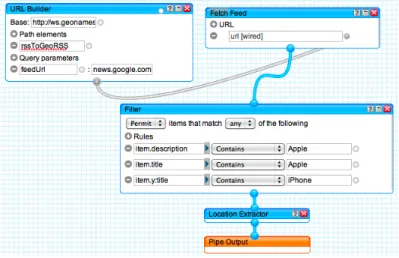
Fig. 1.1 A typical pattern in Yahoo! Pipes
For instance, Figure 1.1 illustrates a Yahoo! Pipes model that encodes how to plot news items on a map. Besides showing how to connect components and fill pa-rameters, the key lesson that can be learned from this pipe is that plotting news onto a map requires first enriching the news feed with geo-coordinates, then fetching the
actual news items, and only then handing the items over to the map. Understanding this logic is neither trivial nor intuitive.
Driven by a user study on how end users imagine assistance during mashup devel-opment [4], we aim to automatically offer them help pro-actively and interactively. Specifically, we are working toward theinteractive, contextual recommendation of reusable composition knowledge, in order to assist the modeler in each step of his development task, e.g., by suggesting a candidate next component or a whole chain of tasks. The knowledge we want to recommend is re-usablecomposition patterns, i.e., model fragments that bear knowledge about how to compose mashups, such as the pattern in Figure 1.1. Such knowledge may come from a variety of possible sources. In this work, we specifically focus on community composition knowledge and mine recurrent model fragments from a repository of given mashup models.
Thevisionis that of enabling the development of assisted, web-based mashup en-vironments that deliver composition knowledge much like Google’s Instant feature delivers search results already while still typing keywords into the search field.
In this chapter, we approach two corechallengesof this vision, i.e., thediscovery of reusable composition knowledge from a repository of ready mashup models and thereuseof such knowledge inside mashup tools, a feature that we callweaving. Together with the ability to search and retrieve composition patterns contextually when modeling a new mashup, a problem we approached in [10] and that we sum-marize in this chapter, these two features represent the key enablers of the vision of assisted development. We specifically provide the followingcontributions: • We describe acanonical mashup modelthat is able to represent in a single
mod-eling formalism a variety of data flow mashup languages. The goal is to mine composition knowledge from multiple source languages by implementing the necessary algorithms only once.
• Based on our canonical mashup model, we define a set ofmashup pattern types that resemble the modeling actions of typical mashup environments.
• We describe anarchitectureof our knowledge recommender that can be used to equip any mashup environment with interactive assistance for its developers. • We develop a set ofdata mining algorithmsthat discover composition knowledge
in the form of reusable mashup patterns from a repository of mashup models. • We present our pattern recommendation andpattern weavingalgorithms. The
former aims at recommending composition patterns based on the user actions on the design canvas. The later aims at automatically appying patterns to mashup models, allowing the developer to progress in his development task.
In the next section, we start by introducing the canonical mashup model, which will help us to formulate our problem statement, define mashup pattern types and describe our pattern mining algorithms. Section 1.3 is where we describe the types of mashup patterns we are interested in and the architecture of our recommendation platform. In Sections 1.4, 1.5 and 1.6 we, respectively, describe in details the mining, recommendation, and weaving algorithms. Section 1.7 presents the details of the implementation of our approach. In Section 1.8 we overview related work. Then, with Section 1.9, we conclude the chapter.
1.2 Preliminaries and Problem
The development of a data mining algorithm strongly depends on the data to be mined. The data in our case are the mashup models. Since in our work we do not only aim at the reuse of knowledge but also at the reuse of our algorithms across different platforms, we strive for the development of algorithms that are able to ac-commodate different mashup models in input. Next, we therefore describe a canon-ical mashup modelthat allows us to concisely express multiple data mashup mod-els and to implement mining algorithms that intrinsically support multiple mashup platforms. The canonical model is not meant to be executed; it rather serves as de-scription format.
As a first step toward generic modeling environments, in this chapter we focus on data flow based mashup models. Although relatively simple, they are the basis of a significant number of mashup environments, and the approach can easily be extended toward other mashup environments.
1.2.1 A Canonical Mashup Model
LetCTbe a set ofcomponent typesof the formctype=htype,IP,IN,OP,OU T,is embeddingi, wheretypeidentifies the type of component (e.g., RSS feed, filter, or similar),IPis the set of input ports of the component type (for the specification of data flows),INis the set of input parameters of the component type,OPis the set of output ports,OU T is the set of output attributes1, andis embedding∈ {yes,no} tells whether the component type allows the embedding of components or not (e.g., to model a loop). We distinguish three types of components:
• Sourcecomponents fetch data from the web (e.g., from an RSS feed) or the local machine (e.g., from a spreadsheet), or they collect user inputs at runtime. They don’t have input ports, i.e.,IP=/0.
• Data processingcomponents consume data in input and produce processed data in output. Therefore:IP,OP6= /0. Filter components, operators, and data trans-formers are examples of data processing components.
• Sink components publish the output of a mashup, e.g., by printing it onto the screen (e.g., a pie chart) or providing an API toward it, such as an RSS or REST-ful resource. Sinks don’t have outputs, i.e.,OP=/0.
Given a set of component types, we are able to instantiate components in a
modeling canvas and to compose mashups. We express the respective
canoni-cal mashup model as a tuplem=hname,id,src,C,GP,DF,RESi, wherename is the name of the mashup in the canonical representation, id a unique identifier, src∈ {“Pipes”,“Wires”,“myCocktail”, ...}keeps track of the source platform of
1We use the termattributeto denote data attributes produced as output by a component or flowing
the mashup,Cis the set of components,GPis a set of global parameters,DF is a set of data flow connectors propagating data among components, andRESis a set of result parameters of the mashup. Specifically:
• GP={gpi|gpi=hnamei,valueii} is a set of global parameters that can be consumed by components, namei is the name of a given parameter, valuei ∈
(ST R∪NU M∪ {null})is its value, withST RandNU M representing the sets of possible string or numeric values, respectively. The use of global parameters inside data flow languages is not very common, yet tools like Presto Wires or myCocktail (http://www.ict-romulus.eu/web/mycocktail) sup-port the design-time definition of globally reusable variables.
• DF={d fj|d fj=hsrccidj,srcopj,tgtcidj,tgtipji}is a set ofdata flow connec-torsthat, each, assign the output portsrcopj of a source component with iden-tifiersrccidjto an input porttgtipj of a target component identified bytgtcidj, such that srccid6=tgtcid. Source components don’t have connectors in input; sink components don’t have connectors in output.
• C={ck|ck=hnamek,idk,typek,IPk,INk,DMk,VAk,
OPk,OU Tk,Eki}is the set ofcomponents, such thatck=instanceO f( ctype)2, ctype∈CT andname
k is the name of the component in the mashup (e.g., its label),idkuniquely identifies the component,typek=ctype.type3,IPk= ctype.IP,INk=ctype.IN,OPk=ctype.OP,OU Tk=ctype.OU T, and:
– DMk⊆INk×(Sip∈IPkip.source.OU T)is the set ofdata mappingsthat map attributes of the input data flows ofckto input parameters ofck.
– VAk⊆INk×(ST R∪NU M∪GP)is the set ofvalue assignmentsfor the in-put parameters ofck; values are either filled manually or taken from global parameters.
– Ek={cidkl}is the set of identifiers of theembedded components. If the com-ponent does not support embedded comcom-ponents,Ek=/0.
• RES⊆S
c∈Cc.OU Tis the set ofmashup outputscomputed by the mashup. Without loss of generality, throughout this chapter we exemplify our ideas and solutions in the context of Yahoo! Pipes, which is well known and comes with a large body of readily available mashup models that we can analyze. Pipes is very similar to our canonical mashup model, with two key differences: it does not have global parameters, and the outputs of the mashup are specified by using a dedicatedPipe Outputcomponent (see Figure 1.1). Hence,GP,RES=/0 and a pipe corresponds to a restricted canonical mashup of the formm=hname,id,“Pipes”,C,/0,DF,/0iwith the attributes as specified above. In general, we refer to the generic canonical model; we explicitly state where instead we use the restricted Pipes model.
2To keep models and algorithms simple, we opt for aself-describinginstance model for
compo-nents, which presents both type and instance properties.
3We use adot notationto refer to sub-elements of structured elements;ctype.typetherefore refers
1.2.2 Problem Statement
Given the above canonical mashup model, the problem we want to address in this chapter is understanding (i) which kind of knowledgecan be extracted from the canonical mashup model so as to automatically assist users in developing their mashups, (ii) whatalgorithmswe need to develop in order to be able to discover such knowledge from existing mashup models, (iii) how to interactively recom-menddiscovered patterns inside mashup tools in order to guide users with the next modeling step/s and (iv) how to automatically apply (weave) the selected recom-mendation inside the current mashup design.
1.3 Approach
The current trend in modeling environments in general, and in mashup tools in par-ticular, is toward intuitive, web-based solutions. The key principles of our work are therefore to conceive solutions that resemble the modeling paradigmof graphical modeling tools, to develop them so that they canrun inside the client browser, and to specificallytune their performanceso that they do not annoy the developer while modeling. These principles affect the nature of the knowledge we are interested in and the architecture and implementation of the respective recommendation infras-tructure.
1.3.1 Composition Knowledge Patterns
Starting from the canonical mashup model, we define composition knowledge as reusablecomposition patterns for mashups of typem, i.e., model fragments that provide insight into how to solve specific modeling problems, such as the one il-lustrated in Figure 1.1. In general, we are in the presence of a set of composition pattern typesPT, where each pattern type is of the formptype=hC,GP,DF,RESi, whereC,GP,DF,RESare as defined form.
The size of a pattern may vary from a single component with a value assignment for one input parameter to an entire, executable mashup. The mostbasic patterns
are those that represent a co-occurrence of two elements out ofC,GP,DForRES. For instance, two components that recur often together form a basic pattern; given one of the components, we are able to recommend the other component. Similarly, an input parameter plus its value form a basic pattern, given the parameter, we can recommend a possible value for it. As such, the most basic patterns are similar to association rules, which, given one piece of information, are able to suggest another piece of information.
Aiming, however, to help a developer refine his mashup model step by step with as less own effort as possible, we are able to identify a set of pattern types that
al-low the developer to obtain more practical and meaningful composition knowledge. Such knowledge is represented by sensible combinations of basic patterns, i.e., by
composite patterns.
Considering the typical modeling steps performed by a developer (e.g., filling input fields, connecting components, copying/pasting model fragments), we specif-ically identify the following setPT ofpattern types:
Parameter value pattern.The parameter value pattern represents a set of recurrent value assignmentsVAfor the input fieldsINof a componentc:
ptypepar=h{c},GP,/0,/0i;
c=hname,0,type,/0,IN,/0,/0,VA,/0,/0i4;
GP6=/0 ifVAalso assigns global parameters toIN; GP=/0 ifVAassigns only strings or numeric constants.
This pattern helps filling input fields of a component that require explicit user input.
Connector pattern. The connector pattern represents a recurrent connector d fxy, given two componentscxandcy, along with the respective data mappingDMyof the output attributesOU Txto the input parametersINy:
ptypecon=h{cx,cy},/0,{d fxy},/0i;
cx=hnamex,0,typex,/0,/0,/0,/0,{opx},OU Tx,/0i; cy=hnamey,1,typey,{ipy},INy,DMy,/0,/0,/0,/0i.
This pattern helps connecting a newly placed component to the partial mashup model in the canvas.
Connector co-occurrence pattern.The connector co-occurrence pattern captures which connectorsd fxyandd fyzoccur together, also including their data mappings:
ptypecoo=h{cx,cy,cz},/0,{d fxy,d fyz},/0i; cx=hnamex,0,typex,/0,/0,/0,/0,{opx},OU Tx,/0i; cy=hnamey,1,typey,{ipy},INy,DMy,/0,{opy}, OU Ty,/0i
cz=hnamez,2,typez,{ipz},INz,DMz,/0,/0,/0,/0i.
This pattern helps connecting components. It is particularly valuable in those cases where people, rather than developing their mashup model in an incremen-tal but connected fashion, proceed by first selecting the desired functionalities (the components) and only then by connecting them.
Component co-occurrence pattern.Similarly, the component co-occurrence pattern captures couples of components that occur together. It comes with two components cxandcyas well as with their connector, global parameters, parameter values, and cy’s data mapping logic:
4The identifierc.id=0 does not represent recurrent information. Identifiers in patterns rather
rep-resent internal, system-generated information that is necessary to correctly maintain the structure of patterns. When mining patterns, the actual identifiers are lost; when weaving patterns, they need to be re-generated in the target mashup model.
ptypecom=h{cx,cy},GP,{d fxy},/0i;
cx=hnamex,0,typex,/0,INx,{opx},OU Tx,VAx,/0,/0i; cy=hnamey,1,typey,{ipy},INy,DMy,VAy,/0,/0,/0i.
This pattern helps developing a mashup model incrementally, producing at each step a connected mashup model.
Component embedding pattern.The component embedding pattern captures which componentczis typically embedded into a componentcypreceded by a component cx. The pattern has three components, in that both the embedded and the embedding component have access to the outputs of the preceding component. How these out-puts are jointly used is valuable information. The pattern, hence, contains the three components with their connectors, data mappings, global parameters, and parameter values: ptypeemb=h{cx,cy,cz},GP,{d fxy,d fxz,d fzy},/0i; cx=hnamex,0,typex,/0,/0,{opx},OU Tx,/0,/0,/0i; cy=hnamey,1,typey,{ipy},INy,DMy,VAy,/0,/0,/0i; cz=hnamez,2,typez,{ipz},INz,DMz,VAz,{opz}, OU Tz,/0i.
This pattern helps, for instance, modeling cycles, a task that is usually not trivial to non-experts.
Multi-component pattern.The multi-component pattern represents recurrent model fragments that are generically composed of multiple components. It represents more complex patterns, such as the one in Figure 1.1, that are not yet captured by the other pattern types alone. It allows us to obtain a full model fragment, given any of its sub-elements, typically, a set of components or connectors:
ptypemul=hC,GP,DF,RESi; C={ci|ci.id=i;i=0,1,2, ...}.
Besides providing significant modeling support, this pattern helps understanding domain knowledge and best practices as well as keeping agreed-upon modeling conventions.
This list of pattern types is extensible, and what actually matters is the way we specify and process them. However, this set of pattern types, at the same time, lever-ages on the interactive modeling paradigm of the mashup tools (the patterns repre-sent modeling actions that could also be performed by the developer) and provides as much information as possible (we do not only tell simple associations of con-structs, but also show how these are used together in terms of connectors, parameter values, and data mappings).
Given a set of pattern types, an actual pattern can therefore be seen as aninstance
of any of these types. We model a composition pattern ascp=instanceO f(ptype), ptype∈PT, where cp=htype,src,C,GP,DF,RES,usage,datei, type∈ {“Par”,
“Con”,“Coo”,“Com”,“Emb”,“Mul”}, src ∈ {“Pipes”,“Wires”,“myCockail”, ...} specifies the target platform of the pattern,C,GP,DF,RES,srcare as defined for the pattern’s ptype,usagecounts how many times the pattern has been used (e.g., to compute rankings), anddateis the creation date of the pattern.
Interactive modeling environment in client browser Recom-menda- tions R HTML rendering window Modeling canvas R e co me n d a tio n p a n e l C o mp o n e n t to o l b a r
Partial mashup model
Recommendation server Pattern miner Model adapter (native to canonical) Native models <mashup> ... </mashup> Canonical models <mashup> ... </mashup> Persistent KB Data Meta data Model adapter (canonical to native) Canonical patterns <mashup> ... </mashup> Recommendation engine KB access API Object-action-recommend. mapping Similarity metrics Ranking algos Partial mashup model pm Query q Patterns {cpi} Pattern weaver KB access API Pa tt e rn c p Details Event bus Selection <cp,intent> Instruction instr Modeling action
<object,action> Modeling action <object,action>
Instruction instr Selection <cp,intent> C o mp o si ti o n p a tt e rn KB Pa tt e rn u sa g e st a tist ics KB loader KB access API query Patterns {cpi} Patterns {cpi}
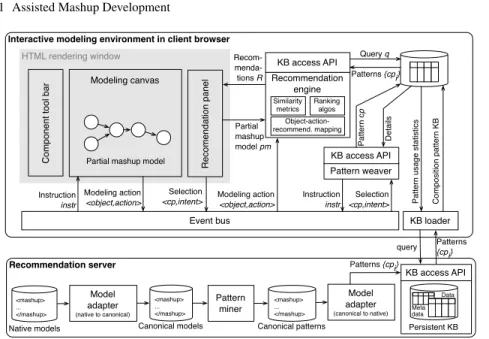
Fig. 1.2 Functional architecture of the composition knowledge discovery and recommendation approach
1.3.2 Architecture
Figure 1.2 details the internals of our knowledge discovery and recommendation prototype. We distinguish between client and server side, where the discovery logic is located in the server and the recommendation and weaving logic resides in the client. In therecommendation server, amodel adapterimports the native mashup models into the canonical format. Thepattern miner then extracts reusable com-position knowledge in the form of comcom-position patterns, which is then handed to a secondmodel adapterto convert the canonical patterns into native patterns and load them into a knowledge base (KB). This KB is structured to maximize the perfor-mance of pattern retrieval at runtime.
In the client, we have theinteractive modeling environment, in which the de-veloper can visually compose components (in themodeling canvas) taken from the component tool bar. It is here where patterns are queried for and delivered in re-sponse to modeling actions performed by the modeler in the modeling canvas. In vi-sual modeling environments, we typically haveaction∈ {“select”,“drag”,“drop”,
“connect”,“delete”,“f ill”,“map”, ...}, where theactionis performed on a mod-eling construct in the canvas; we call this construct theob ject of the action. For instance, we candropa component onto the canvas, or we canselecta parameter to fill it with a value, we canconnecta data flow with a target component, or we can selecta set of components and connectors. Upon each interaction, theactionand its ob ject are published on a browser-internalevent bus, which forwards them to the recommendation engine. Given a modelingaction, theob ject it has been applied to, and the partial mashup modelpm, the engine queries theclient-side pattern KB via the KB access API for recommendations (pattern representations). An
object-action-recommendation mapping(OAR) tells the engine which types of recommen-dations are to be retrieved for each modeling action on a given object (for example, when selecting an input field, only recommending possible values makes sense). The client-side KB is filled at startup by theKB loader, which loads the available patterns into the client environment, decoupling the knowledge recommender from the server side.
The list of patterns retrieved from the KB (either via regular queries or by apply-ing dedicated similarity criteria) are then ranked by the engine and rendered in the recommendation panel, which renders the recommendations to the developer for inspection. Selecting a recommendation enacts thepattern weaver, which queries the KB for the usage details of the pattern (data mappings and value assignments) and generates a set of modeling instructions that emulate user interactions inside the modeling canvas and thereby weave the pattern into the partial mashup model.
1.4 Discovering Patterns
The first step in the information flow described in the above architecture is the dis-covery of mashup patterns from canonical mashup models. To this end, we look into the details of each individual pattern and implement dedicated mining algorithms for each of them, which allow us to fine-tune each mashup-specific characteristic (e.g., to treat threshold values for parameter value assignments and data mappings dif-ferently). The pattern mining algorithms make use of standard statistics as well as frequent itemset and subgraph mining algorithms [13].
1.4.1 Mining algorithms
For each of the pattern types identified in Section 1.3.1, we have implemented a re-spective pattern mining algorithm, the details of which we provide in the following.
Parameter value pattern.In the case of the parameter value pattern, we are inter-ested in finding suitable values for the input fields in a given component. Most of the components in mashup compositions contain more than one parameter and more often than not the values of these parameters are related to one another and there-fore we need take into account the co-occurrence of parameter values. In order to discover such co-occurrences, we map this problem to the well-known problem of itemset mining [13]. Algorithm 1 outlines the approach for finding parameter value patterns. Here, we first get all component instances from the mashups in the mashup repository (line 2) and group them together by their type (line 5-6) and then perform the parameter value pattern mining by component type (line 7). Finally, we construct the actual set of patterns that consists in tupleshct,VAi, wherectrepresents a com-ponent type andVArepresents the value assignment for its parameters.
Algorithm 1:mineParameterValues
Data: repository of mashup compositionsMand minimun support (minsupppar) for the frequent itemset mining
Result: set of parameter value patternshct,VAi.
1 Patterns= set();
2 C= set of component instances inM;
3 CT= array();
4 Patterns= set();
5 foreachtype of component ct in Cdo
6 CT[ct]=cx.VAwithcx∈Csuch thatcx.type=ct; // get all the parameter value
assignments of component instances of type ct
7 FI= mineFrequentItemsets(CT[ct],minsupppar);
8 foreachVA∈FIdo
9 Patterns=Patterns∪ {hct,VAi};
10 returnPatterns;
Connector pattern.A connector pattern is composed of two components, the source componentcxand the target componentcy, their data flow connectord fxy, and the data mappingDMyof the target component. Given a repository of mashup models M={mi}and the minimum support levels for the data flow connectors and data mappings, the pseudo-code in Algorithm 2 shows how we mine connector patterns. We start the mining task by getting the list of all recurrent connectors inM(line 1). The respective functiongetRecurrentConnectorsis explained in Algorithm 3; in essence, it computes a recurrence distribution for all connectors and returns only those that exceed the thresholdminsuppd f. The function returns a set of connector types without repetitions and without information about the instances that generated them. Given this set, we construct a database of concrete instances of each connector type (using thegetConnectorInstancesfunction in line 5 and described in Algorithm 4) and, for each connector type, derive a database of the data mappings for the con-nectors’ target componentcy(lines 7-9). We feed the so constructed database into a standardmineFrequentItemsetsfunction [13], in order to obtain a set of recurrent data mappings for each connector type. Finally, for each identified data mapping DMy, we construct a tuplehd fxy,DMyi(lines 11-12), which concisely represents the connector pattern structure introduced in Section 1.3.1; the rest of the pattern comes from the component definitions.
Connector co-occurrence pattern. The connector pattern introduced previously
is about how pairs of components are connected together. The connector
co-occurrence pattern goes a step further: it tells how connectors between different pairs of components co-occur together in compositions and how data mappings are defined for them. Algorithm 5 presents the logic for computingconnector co-occurrence patterns. The main difference with respect to Algorithm 2 is that, in-stead of computing the frequency of individual dataflow connectors between pairs of components, we compute frequent itemsets of dataflow connectors (lines 2-4).
Component co-occurrence pattern.The component co-occurrence pattern is an ex-tension of the connector pattern; in addition to the connectors and data mappings, it also contains the parameter value assignments of the two components involved in the connector. As shown in Algorithm 6, the respective mining logic is similar to
Algorithm 2:mineConnectors
Data: repository of mashup modelsM, minimum support of data flow connectors (minsuppd f) and data
mappings (minsuppdm)
Result: set of connectors with their corresponding data mappings{hd fxy,i,DMy,ii}
1 Fd f= getRecurrentConnectors(M,minsuppd f);
2 DB= array(); // database of recurrent connector instances
3 Patterns= set(); // set of connector patterns
4 foreachd fxy∈Fd fdo
5 DB[d fxy]= getConnectorInstances(M,d fxy);
// create database for frequent itemset mining
6 DBDMy= array():
7 foreachd f ixy∈DB[d fxy]do
8 cy= target component ofd f ixy;
9 append(DBDMy,cy.DM);
10 FIdy= mineFrequentItemsets(DBDMy,minsuppdm);
// construct the connector patterns
11 foreachDMy∈FIdydo
12 Patterns=Patterns∪ {hd fxy,DMyi};
13 returnPatterns;
Algorithm 3:getRecurrentConnectors
Data: repository of mashup modelsM, minimum support of data flow connectors (minsuppd f)
Result: set of recurrent connectorsFd f
1 DBd f= array(); // database of data flow connector instances
2 foreachmi∈Mdo
3 append(DBd f,mi.DF) ; // fill with instances
4 Fd f= set(); // set of recurrent data flow connectors
5 foreachd fxy∈DBd fdo
6 ifcomputeSupport(d fxy,DBd f)≥minsuppd fthen
7 Fd f=Fd f∪ {d fxy};
8 returnFd f;
Algorithm 4:getConnectorInstances
Data: repository of mashup modelsM, reference connectord fxy
Result: array of connector instancesDBxy
1 DBxy= array(); // database of data flow connector instances
2 foreachmi∈Mdo
3 append(DBxy],mi.DF∩ {d fxy}) ; // fill with instances of the reference
connector type
4 returnDBxy;
the one of the connector pattern, with two major differences: in lines 6-17 we also mine the recurrent parameter value assignments ofcxandcy, and in lines 18-21 we consider only those combinations ofVAx,VAyandDMy that co-occur in mashup instances for the given connector. Notice that, for the purpose of explaining this al-gorithm, we perform a cartesian product ofVAx,,VAyandDMyin line 22. Doing this can be computational expensive if implemented as-is. In practice, the implementa-tion of this algorithm is performed in such a way that we do not have to explore
Algorithm 5:mineConnectorCooccurrences
Data: repository of mashup compositionsM, minimun support for dataflow connectors (minsuppd f) and data
mappings (minsuppdm)
Result: list of connector patterns with their corresponding data mappingshDFxy,DMyi
// find the co-occurrence of dataflow connectors
1 DBd f= array(); 2 foreachmi∈Mdo 3 append(DBd f,mi.DF); 4 Fd f= mineFrequentItemsets(DBd f,minsuppd f); 5 DBci= array(); 6 foreachmi∈Mdo 7 foreachDFxy∈Fd fdo 8 ifDFxy∩mi.DF=DFxythen 9 foreachd f ixy∈DFxydo 10 append(DBci[DFxy], getConnectorInstances({mi},d f ixy);
// find data mappings for the frequent dataflow connectors obtained above
11 DBDMy= array(); 12 foreachDFxy∈DBcido 13 foreachd f ixy∈DFxydo 14 cy= target component ofd f ixy; 15 append(DBDMy,cy.DM); 16 FIdy= mineFrequentItemsets(DBDMy,minsuppdm);
// construct the connector patterns
17 Patterns= set();
18 foreachDMy∈FIdydo
19 Patterns=Patterns∪ {hDFxy,DMyi};
20 returnPatterns;
the whole search space. This comment also applies to the rest of the algorithms presented in this section.
Component embedding pattern.Mashup composition tools typically allow for the embedding of components inside other components. However, not all components present this capability. A common example is theloopcomponent: it takes as input a set of data items and then loops over them executing the operations provided by the embedded component (e.g., afiltercomponent). Embedding one component into another is not a trivial task, as there may be complex dataflow connectors and data mappings between the outer and inner component as well as between the last two and the component that proceeds the outer component in the composition flow. Algorithm 7 shows the logic for mining component embedding patterns. First, we get the instances of component embeddings from the mashup repository and then we keep only those that have a support greater or equal tominsuppem(lines 2-10). Using thesefrequent embeddings, we look forfrequent dataflowsthat involve these embeddings (lines 11 to 17). For these patterns, we are also interested in finding data mapping and parameter value patterns and thus we proceed as in the previous algorithms to mine them (lines 18-31). In the last part of the algorithm (lines 32-37), we proceed with building the actual patterns with tuplesh{cx,cy,cz},DF,DM,VAi that include information about the components involved in the pattern as well as the dataflow connectors, data mappings and parameter value assignments.
Algorithm 6:mineComponentCooccurrences
Data: repository of mashup modelsM, minimum support of data flow connectors (minsuppd f), data mappings
(minsuppdm), parameter value assignments (minsuppva) and pattern co-occurrence (minsupppc).
Result: set of component co-occurrence patterns with their corresponding dataflow connectors, data mappings and parameter values{hd fxy,i,VAx,i,VAy,i,DMy,ii}
1 Fd f= getRecurrentConnectors(M,minsuppd f);
2 DB= array(); // database of recurrent connector instances
3 Patterns= set(); // set of component co-occurrence patterns
4 foreachd fxy∈Fd fdo
5 DB[d fxy]= getConnectorInstances(M,d fxy);
// create databases for frequent itemset mining
6 DBVAx= array(); 7 DBVAy= array(); 8 DBDMy= array(); 9 foreachd f ixyin DB[d fxy]do 10 cx= source component ofd f ixy; 11 cy= target component ofd f ixy; 12 append(DBVAx,cx.VA); 13 append(DBVAy,cy.VA); 14 append(DBDMy,cy.DM);
15 FIvx= mineFrequentItemsets(DBVAx,minsupppar);
16 FIvy= mineFrequentItemsets(DBVAy,minsupppar);
17 FIdy= mineFrequentItemsets(DBDMy,minsuppdm);
// keep only those combinations of value assignments and data mappings that occur together in mashup instances
18 Coo= set();
19 foreachhVAx,VAy,DMyi ∈FIvx×FIvy×FIdydo
20 ifcomputeSupport(hVAx,VAy,DMyi,DB[d fxy])≥minsupppcthen
21 Coo=Coo∪ {hVAx,VAy,DMyi};
// construct the component co-occurrence patterns
22 foreachhVAx,VAy,DMyi ∈Coodo
23 Patterns=Patterns∪ {hd fxy,VAx,VAy,DMyi};
24 returnPatterns;
Multi-component pattern.The multi-component pattern represents recurrent model fragments that are composed of multiple components. It represents more complex patterns, which are not yet captured by the other pattern types alone. This pattern helps understanding domain knowledge and best practices as well as keeping model-ing conventions. Multi-component patterns consists in a combination of the patterns we have introduced before. Algorithm 8 provides the details of the mining algo-rithm. We start by obtaining the graph representation of the mashups in the repos-itory and mining frequent sub-graphs out of them (lines 2-5). For the sub-graph mining we can choose among the state of the art sub-graph mining algorithms [13]. Then, we get from the mashup repository the list of mashup fragments that match the frequent sub-graphs mined in the previous step (lines 6-11). We do this, so that next we can mine both the parameter value and data mapping patterns using again standard itemset mining algorithms (lines 13-21). Finally, we build the actual multi-component patterns by going through the mashup repository and keeping only those combinations of patterns that co-occur in the mashup instances (lines 22-25).
Algorithm 7:mineComponentEmbeddings
Data: repository of mashup compositionsM, minimum supports for component embeddings (minsuppem), data
flows (minsuppd f), data mappings (minsuppdm), parameter value (minsupppar) and pattern co-occurrence
(minsupppc)
Result: list of component embedding patterns with their corresponding components, dataflow connectors, data mappings and parameter value assignmentsh{cx,cy,cz},DF,DM,VAi
// get the list of component embeddings
1 DBem= array();
2 foreachmi∈Mdo
3 foreachhcx,cy,czi ∈mi.C×mi.Cdo
4 if(cxpreceeds cy) and (cyembeds cz)then
5 emxyz=hcx,cy,czi;
6 append(DBem,emxyz);
// find the frequent component embeddings
7 Fem= set();
8 foreachemxyz∈DBemdo
9 ifcomputeSupport(emxyz,DBem)≥minsuppemthen
10 append(Fem,emxyz);
// get dataflows involving the frequent component embeddings
11 DBd f= array(); 12 Fd f= array(); 13 foreachmi∈Mdo 14 foreachemxyz∈Femdo 15 ifemxyz∈mithen 16 append(DBd f[emxyz],hmi.d fxy,mi.d fxz,mi.d fyzi); 17 Fd f= mineFrequentItemsets(DBd f,minsuppd f);
// get parameter value and data mapping instances and compute the corresponding frequent itemsets
18 DBva= array();DBdm= array();
19 foreachmi∈Mdo
20 foreachhd fxy,d fxz,d fyzi ∈Fd fdo
21 if hd fxy,d fxz,d fyzi ∈mithen
22 cx= component instancecx∈micorresponding tod fxy;
23 cy= component instancecy∈micorresponding tod fxy;
24 cz= component instancecz∈micorresponding tod fyz;
25 VAx=cx.VA;DMx=cx.DM;
26 VAy=cy.VA;DMy=cy.DM;
27 VAz=cz.VA;DMz=cz.DM;
28 append(DBva,VAx∪VAy∪VAz);
29 append(DBdm,DMx∪DMy∪DMz);
30 Fva= mineFrequentItemsets(DBva,minsupppar);
31 Fdm= mineFrequentItemsets(DBdm,minsuppdm);
// construct the component embedding pattern
32 Patterns= set();
33 foreachhEM,DF,DM,VAi ∈Fem×Fd f×Fdm×Fvado
34 if computeSupport(hEM,DF,DM,VAi,M)≥minsupppcthen
35 cx,cy,cz= components corresponding to the dataflowsd f∈DF;
36 Patterns=Patterns∪ {h{cx,cy,cz},DF,DM,VAi};
37 returnPatterns;
1.5 Recommending Patterns
Recommending patterns is non-trivial, in that the size of the knowledge base may be large, and the search for composition patterns may be complex; yet,
recommen-Algorithm 8:mineMulticomponentPatterns
Data: repository of mashup compositionsMand minimun support for multi-components (minsuppmc),
parameter value (minsupppar) and data mapping (minsuppdm) patterns.
Result: set of multi-component patternshm f.C,m f.DF,VA,DMi.
1 DBg= array() ; // database of graph representations of mashups
2 foreachmi∈Mdo
// get a graph representation of mashup mi where the nodes represent
components and arcs represent dataflows; here, the arcs are labeled with the output and input ports involved in the dataflow
3 gi= getGraphRepresentation(mi); 4 append(DBg,gi); 5 FG= mineFrequentSubraphs(DBg,minsuppmc); 6 DBmc= array(); 7 foreachmi∈Mdo 8 foreachf gi∈FGdo
9 ifgetGraphRepresentation(mi) contains f githen
// get the fragment m f from mashup instance mi that matches f gi;
notice that m f is represented as a canonical mashup model
10 m f= getSubgraphInstance(mi,f gi);
11 append(DBmc[f gi],m f)
12 Patterns= set();
13 foreachMC∈DBmcdo
// get parameter values and data mappings and compute the corresponding frequent itemsets 14 DBVA= array(); 15 DBDM= array(); 16 foreachm f∈MCdo 17 foreachcx∈m f.Cdo 18 append(DBVA,cx.VA); 19 append(DBDM,cx.DM);
20 FIva= mineFrequentItemsets(DBVA,minsupppar);
21 FIdm= mineFrequentItemsets(DBDM,minsuppdm);
// construct the multi-component pattern
22 foreachhVA,DMi ∈FIva×FIdmdo
23 foreachm f∈MCdo
24 ifhVA,DMi ∈m fthen
25 Patterns=Patterns∪ {hm f.C,m f.DF,VA,DMi}; // using m f, build the
patterns with its components (m f.C), dataflows (m f.DF),
value assignments (m f.VA) and data mappings (m f.DM)
26 returnPatterns;
dations are to be delivered at high speed, without slowing down the modeler’s com-position pace. Recommending patterns is platform-specific. The following explana-tions therefore refer to the specific case of Pipes-like mashup models. In [10], we show all the details of our approach; in the following we summarize its key aspects.
1.5.1 Pattern Knowledge Base
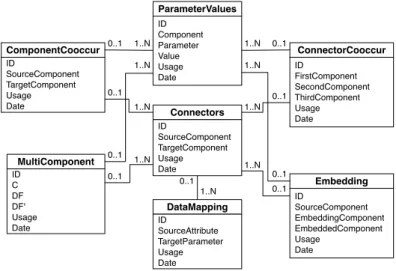
The core of the interactive recommender is the pattern KB. In order to enable the incremental and fast recommendation of patterns, we decompose them into their
constituent parts and focus only on those aspects that are necessary to convey the meaning of a pattern. That is, we leverage on the observation that, in order to convey the structure of a pattern, already its components and connectors enable the devel-oper to choose in an informed fashion. Data mappings and value assignments, unless explicitly requested by the developer, are then delivered only during the weaving phase upon the selection of a specific pattern by the developer.
This strategy leads us to the KBillustrated in Figure 1.3, whose structure en-ables the retrieval of each of the patterns introduced in Section 1.3.1 with a one-shot query over a single table. For instance, let’s focus on the component co-occurrence pattern: to retrieve its representation, it is enough to query the Compo-nentCooccurentity for theSourceComponentand theTargetComponentattributes. The query is assembled automatically upon interactions in the modeling canvas and is of the formq=hob ject,action,pmi. Only weaving the pattern into the mashup
model requires queryingComponentCooccur./Connectors./DataMappingand
ComponentCooccur./ParameterValues. 1..N DataMapping ID SourceAttribute TargetParameter Usage Date Connectors ID SourceComponent TargetComponent Usage Date 0..1 ParameterValues ID Component Parameter Value Usage Date MultiComponent ID C DF DF' Usage Date ComponentCooccur ID SourceComponent TargetComponent Usage Date ConnectorCooccur ID FirstComponent SecondComponent ThirdComponent Usage Date Embedding ID SourceComponent EmbeddingComponent EmbeddedComponent Usage Date 0..1 1..N 0..1 1..N 1..N 1..N 0..1 0..1 1..N 0..1 0..1 1..N 1..N 1..N 0..1 0..1
Fig. 1.3 KB structure optimized for Pipes
1.5.2 Exact and Approximate Pattern Matching
The described KB supports both exact queries for the patterns with pre-defined structure andapproximate matchingfor multi-component patterns whose structure is not known a priori. Patterns are queried for or matched against theob jectof the query, i.e., the last modeling construct manipulated by the developer. Conceptually, all recommendations could be retrieved via similarity search, but for performance reasons we apply it only when strictly necessary.
Algorithm 9 details thisstrategyand summarizes the logic implemented by the recommendation engine. In line 3, we retrieve the types of recommendations that
Algorithm 9:getRecommendations
Data: queryq=hob ject,action,pmi, knowledge baseKB, object-action-recommendation mappingOAR, component similarity matrixCompSim, similarity thresholdTsim, ranking thresholdTrank, numbernof
recommendations per recommendation type Result: recommendationsR= [hcpi,rankii]
1 R= array();
2 Patterns= set();
3 recTypeToBeGiven= getRecTypes(ob ject,action,OAR);
4 foreachrecType∈recTypeToBeGivendo
5 ifrecType6=“Mul”then
6 Patterns=Patterns∪queryPatterns(ob ject,KB,recType) ; // exact query
7 else
8 Patterns=Patterns∪getSimilarPatterns(ob ject,
KB,CompSim,Tsim) ; // similarity search
9 foreachpat∈Patternsdo
10 ifrank(pat.cp,pat.sim,pm)≥Trankthen
11 append(R,hpat.cp,rank(pat.cp,pat.sim,pm)i) ; // rank, threshold, remember
12 orderByRank(R);
13 groupByType(R);
14 truncateByGroup(R,n);
15 returnR;
can be given (getSuitableRecTypesfunction), given anob ject-actioncombination. Then, for each recommendation type, we either query for patterns (the queryPat-ternsfunction can be seen like a traditional SQL query) or we do a similarity search (getSimilarPatternsfunction). For each retrieved pattern, we compute a rank, e.g., based on the pattern description (e.g., containing usageanddate), the computed similarity, and the usefulness of the pattern inside the partial mashup, order and group the recommendations by type, and filter out the bestnpatterns for each rec-ommendation type.
As for the retrieval of similar patterns, we give preference to exact matches of components and connectors inob ject and allow candidate patterns to differ for the insertion, deletion, or substitution of at most one component in a given path in ob ject. Among the non-matching components, we give preference to functionally similar components (e.g., it may be reasonable to allow a Yahoo! Map instead of a Google Map); we track this similarity in a dedicatedCompSimmatrix. For the detailed explanation of the approximate matching logic we refer the reader to [10].
1.6 Weaving Patterns
Weaving a given composition pattern cp into a partial mashup model pm is not straightforward and requires a thorough analysis of both cp and pm, in order to understand how to connect the pattern to the constructs already present in pm. In essence, weaving a pattern means emulating developer interactions inside the mod-eling canvas, so as to connect a pattern to the partial mashup. The problem is not as simple as just copying and pasting the pattern, in that new identifiers of all
con-structs ofcpneed to be generated, connectors must be rewritten based on the new identifiers, and connections with existing constructs may be required.
We approach the problem of pattern weaving by first defining abasic weaving strategythat is independent ofpmand then deriving acontextual weaving strategy that instead takes into account the structure ofpm.
1.6.1 Basic Weaving Strategy
Given anob ject and a patterncp of a recommendation, thebasic weaving strat-egyBSprovides the sequence of mashup operations that are necessary to weavecp into theob ject. The basic weaving strategy does not usepm; it tells how to expand ob ject into cp (ob ject being a part of cp). This basic strategy is static for each pattern type and it consists a set of mashup operations that resemble the opera-tions a developer can typically perform manually in the modeling canvas. Typical examples of mashup operations are addComponent that corresponds to adding a new component topm,addConnectorthat corresponds to adding a connector be-tween two selected components inpm,assignValuesthat corresponds to assigning values to configuration parameters of a component, and similar. Mashup operations are applied on the partial mashup pmand result in an updatedpm0. All operations assume that the pm is globally accessible. The internal logic of these operations are highly platform-specific, in that they need to operate inside the target modeling environment.
For instance, the basic weaving strategy for a component co-occurrence pat-tern of type ptypecompis as follows (we assumeob ject=compwithcomp.type=
cx.type,cxbeing one of the components of the pattern): 1$newcid5=addComponent(c
y.type);
2addConnector(hcomp.id,cx.op,$newcid,cy.ipi); 3assignDataMapping($newcid,cy.DM);
4assignValues(comp.id,cx.VA); 5assignValues($newcid,cy.VA);
That is, given a componentcx, we add the other componentcy(line 1) as men-tioned in the selected pattern to thepm, connectcxandcytogether (line 2) and then apply the respective data mappings (line 3) and value assignments (line 4 and line 5). Note that, the basic strategy is not yet applied to pm; it represents an array of basic modeling operations to be further processed before being able to weave the pattern.
5We highlight identifier place holders (variables) that can only be resolved when executing the
Algorithm 10:getWeavingStrategy
Data: partial mashup modelpm, composition patterncp, objectob jectthat triggered the recommendation Result: weaving strategyW S, i.e., a sequence of abstract mashup operations; updated mashup modelpm0
1 W S= array();
2 BS= getBasicStrategy(cp,ob ject);
3 foreachinstr∈BSdo
4 CtxInstr= resolveConflict(pm,instr);
5 pm= apply(pm,CtxInstr);
6 append(W S,CtxInstr);
7 returnhW S,pmi;
1.6.2 Contextual Weaving Strategy
Given an objectob ject, a patterncp, and a partial mashuppm, thecontextual weav-ing strategyW Sis derived by applying the mashup operations in thebasic weaving strategyto the current partial mashup model and thus by weaving the selectedcp into pm. TheW Sisdynamicallybuilt at runtime by taking into consideration the structure of the partial mashup (the context).
Applying the mashup operations in the basic weaving strategy may require the resolution of possibleconflicts among the constructs of pm and those ofcp. For instance, if we want to add a new component of typectypetopmbut pmalready contains an instance of typectype, saycomp, we are in the presence of a conflict: either we decide that we reusecomp, which is already there, or we decide to create a new instance ofctype. In the former case, we say we apply asoftconflict resolution policy, in the latter case ahardpolicy:
Soft: substitute(“$var=addComponent(ctype)”) with “$var=comp.id”
Hard: substitute(“$var=addComponent(ctype)”) with “$var=addComponent(ctype)” Formally, the conflict resolution policy corresponds to a function resolveCon-flict(pm,instr)→CtxInstr, whereinstr is the mashup operation to be applied to pmandCtxInstris the set of instructions that replaceinstr. Only in the case of a conflict,instris replaced; otherwise the function returnsinstragain.
In Algorithm 10 we describe the logic of our pattern weaver. First, it derives a basic strategyBSfor the given composition patterncpand theob jectfrompm(line 2). Then, for each of the mashup operations instrin the basic strategy, it checks for possible conflicts with the current modeling context pm (line 4). In case of a conflict, the function resolveConflict(pm,instr) derives the corresponding contex-tual weaving instructionsCtxInstr replacing the conflicting, basic operationinstr. CtxInstr is then applied to the current pmto compute the updated mashup model pm0 (line 5), which is then used as basis for weaving the next instr of BS. The contextual weaving structureW Sis constructed as concatenation of all conflict-free instructionsCtxInstr.
Note that Algorithm 10 returns both the list of contextual weaving instructions W Sand the final updated mashup modelpm0. The former can be used to interactively weavecpinto pm, the latter to convertpm0into native formats.
1.7 Implementation and Evaluation
We have implemented our prototype system,Baya[11], as Mozilla Firefox (http: //mozilla.com/firefox) extension for Yahoo! Pipes to demonstrate the vi-ability of our interactive recommendation approach. Thedesign goalsbehind Baya can be summarized as follows: We didn’t want to developyet anothermashup envi-ronment; so we opted for an extension of existing and working solutions (so far, we focused on Yahoo! Pipes; other tools will follow). Modelers should not be required toaskfor help; we therefore pro-actively and interactively recommend contextual composition patterns. We did not want thereuseto be limited to simple copy/paste of patterns, but knowledge should beactionable, and therefore, Baya automatically weaves patterns.
In Baya we have implemented themodel adapters(see Figure 1.2) in Java (1.6), which are able to convert Yahoo! Pipes’s JSON representation into our canoni-cal mashup model and back. All the mining algorithms are also implemented in Java. For the frequent itemset mining we used the tool Carpenter (http://www. borgelt.net/carpenter.html), while for graph mining we used the tool MoSS (http://www.borgelt.net/moss.html). The resulting patterns are expressed in terms of canonical mashup models, which are then converted to native models (in this case, Yahoo! Pipes JSON representations) by our canonical-to-native model adapter and loaded into the pattern KB.
For testing our mining algorithms, we used a dataset of 970 pipes definitions from Yahoo! Pipes that were retrieved using YQL Console (http://developer. yahoo.com/yql/console/). We selected pipes from the list of “most pop-ular” pipes, as popular pipes are more likely to be functioning and useful. The aver-age numbers of components, connectors and input parameters are 11.1, 11.0 and 4.1, respectively, which is an indication that we are dealing with fairly complex pipes.
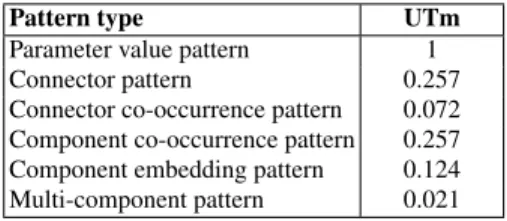
The results obtained from running our algorithms on the selected dataset show that we are able to discover recurrent practices for building mashups. Table 1.1 re-ports on the list of pattern types and their Upper Threshold forminsupp(UTm). The UTm tells us what is the upper threshold for theminsuppvalues at which we start finding patterns of a given type and for a given dataset. In the cases where we use more than one type ofminsupp(such as in the component co-occurrence pattern where we useminsuppd f,minsuppdm andminsupppar), theminsuppwe consider is the one corresponding to the pattern that is first computed in the algorithm. For our dataset, in Table 1.1 we can see that we are always able to find parameter value patterns for some component types. For example, this is the case of Yahoo! Pipes’ componentYQLthat has the parameterrawwith a default valueResults onlythat is always kept as-is by the users. From the table we can also notice that the connector and component co-occurrence patterns have the same UTm value. This is because in both cases their corresponding algorithms compute first the frequent dataflow connectors and thus the reference minimum support for the UTm isminsuppd f. Fi-nally, for the Multi-component pattern we have a UTm of 0.021, a relatively low value, when we consider patterns with at least 4 components. However, considering that here we are talking about complex patterns with at least 4 components that,
furthermore, include dataflow connectors, data mappings and parameter value as-signments, we can say that, even with a relatively low support value, these patterns still captures recurrent modeling practices for fairly complex settings.
Pattern type UTm
Parameter value pattern 1
Connector pattern 0.257
Connector co-occurrence pattern 0.072
Component co-occurrence pattern 0.257
Component embedding pattern 0.124
Multi-component pattern 0.021
Table 1.1 Summary of pattern types with their corresponding UTm.
The discovered patterns are transformed and stored in a knowledge base that is optimized for fast pattern retrieval at runtime. The implementation of the persistent pattern KB at server side, is based on MySQL (http://www.mysql.com/). Via a dedicated Java RESTful API, at startup of the recommendation panel the KB loader synchronizes the server-side KB with the client-side KB, which instead is based on SQLite (http://www.sqlite.org). The pattern matching and re-trieval algorithms are implemented in JavaScript and triggered by events generated by the event listeners monitoring the DOM changes related to the mashup model.
The weaving algorithms are also implemented in JavaScript. Upon the selection of a recommendation from the panel, they derive the contextual weaving strategy that is necessary to weave the respective pattern into the partial mashup model. Each of the instructions in the weaving strategy refers to a modeling action, where mod-eling actions are implemented as JavaScript manipulations of the mashup model’s JSON represenation. Both the weaving strategies (basic and contextual) are encoded as JSON arrays, which enables us to use the nativeeval()command for fast and easy parsing of the weaving logic.
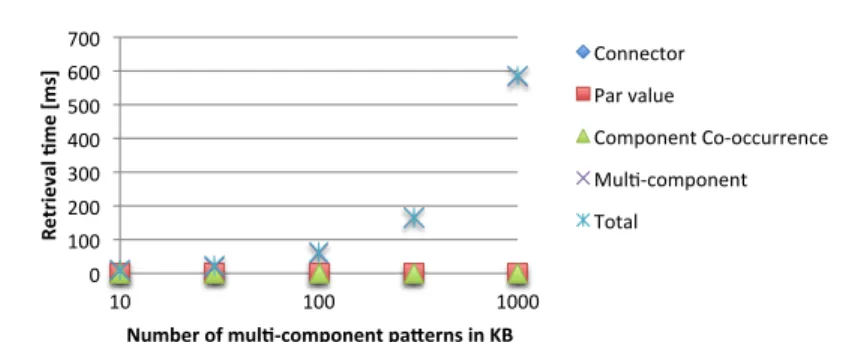
Figure 1.4 illustrates the performance of the interactive recommendation algo-rithm of Baya as described in Algoalgo-rithm 9 in response to the user placing a new component into the canvas, a typical modeling situation. Based on the object-action-recommendation mapping, the algorithm retrieves parameter value, connector, com-ponent co-occurrence, and multi-comcom-ponent patterns. As expected, the response times of the simple queries can be neglected compared to the one of the similarity search for multi-component patterns, which basically dominates the whole recom-mendation performance. During the performance evaluation for Baya, we have also observed that the time required for weaving a pattern is negligible with respect to the total time required for the pattern recommendation and weaving.
1.8 Related work
Traditionally,recommender systemsfocus on the retrieval of information of likely interest to a given user, e.g., newspaper articles or books. The likelihood of interest
1 Assisted Mashup Development 23 0" 100" 200" 300" 400" 500" 600" 700" 10" 100" 1000" Re tr ie va l)* m e) [m s] ) Number)of)complex)pa7erns)in)KB) (a))Similarity)search)*mes)for)varying)KB)and) object)sizes) |obj.C|=1" |obj.C|=2" |obj.C|=3" |obj.C|=4" |obj.C|=5" |obj.C|=6" |obj.C|=7" Average" 500" 520" 540" 560" 580" 600" 620" 640" 660" 0" 1" 2" 3" 4" 5" 6" 7" 8" Re tr ie va l)* m e) [m s] ) Number)of)components)in)object' (b))Retrieval)*mes)of)complex)pa7erns)for)varying) object)sizes)for)1000)complex)pa7erns)in)KB) 0" 100" 200" 300" 400" 500" 600" 700" 10" 100" 1000" Re tr ie va l)* m e) [m s] ) Number)of)mul*Fcomponent)pa7erns)in)KB) (c))Total)recommenda*on)*mes)in)case)the)modeler)adds)a) new)component)to)the)mashup) Connector" Par"value" Component"Co@occurrence" MulB@component" Total"
Fig. 1.4 Recommendation types and times in response to a new component added to the canvas
is typically computed based on auser profilecontaining the user’s areas of interest, and retrieved results may be further refined with collaborative filtering techniques. In our work, as for now we focus less on the user and more on the partial mashup under development (we will take user preferences into account in a later stage), that is, recommendations must match the partial mashup model and the object the user is focusing on, not his interests. The approach is related to the one followed by research onautomatic service selection, e.g., in the context of QoS- or reputation-aware service selection, or adaptive or self-healing service compositions. Yet, while these techniques typically approach the problem of selecting a concrete service for an abstract activity at runtime, we aim at interactively assisting developers at design time with domain knowledge in the form of modeling patterns.
In the context ofweb mashups, Carlson et al. [2], for instance, react to a user’s selection of a component with a recommendation for the next component to be used; the approach is based on semantic annotations of component descriptors and makes use of WordNet for disambiguation. Greenshpan et al. [6] propose an auto-completion approach that recommends components and connectors (so-called glue patterns) in response to the user providing a set of desired components; the ap-proach computes top-k recommendations out of a graph-structured knowledge base containing components and glue patterns (the nodes) and their relationships (the arcs). While in this approach the actual structure (the graph) of the knowledge base is hidden to the user, Chen et al. [3] allow the user to mashup components by nav-igating a graph of components and connectors; the graph is generated in response to the user’s query in form of descriptive keywords. Riabov et al. [9] also follow a keyword-based approach to express user goals, which they use to feed an automated planner that derives candidate mashups; according to the authors, obtaining a plan may require several seconds. Elmeleegy et al. [5] propose MashupAdvisor, a system that, starting from a component placed by the user, recommends a set of related com-ponents (based on conditional co-occurrence probabilities and semantic matching); upon selection of a component, MashupAdvisor uses automatic planning to derive how to connect the selected component with the partial mashup, a process that may also take more than one minute. Beauche and Poizat [1] use automatic planning in
service composition. The planner generates a candidate composition starting from a user task and a set of user-specified services.
Thebusiness process management(BPM) community more strongly focuses on patterns as a means of knowledge reuse. For instance, Smirnov et al. [12] provide so-called co-occurrence action patterns in response to action/task specifications by the user; recommendations are provided based on label similarity, and also come with the necessary control flow logic to connect the suggested action. Hornung et al. [8] provide users with a keyword search facility that allows them to retrieve process models whose labels are related to the provided keywords; the algorithm applies the traditional TF-IDF technique from information retrieval to process mod-els, turning the repository of process models into a keyword vector space. Gschwind et al. [7] allow users to use the control flow patterns introduced by Van der Aalst et al. [14], just like other modeling elements. The system does not provide interactive recommendations and rather focuses on the correct insertion of patterns.
In summary, assisted mashup and service composition approaches either focus on single components or connectors, or they aim to auto-complete compositions starting from user goals by using AI Planning techniques. The BPM approaches do focus on patterns, but most of the times pattern similarity is based on label/text sim-ilarity, not on structural compatibility. In our work, we consider that if components have been used together successfully multiple times, very likely their joint use is both syntactically and semantically meaningful. Hence, there is no need to further model complex ontologies or composition rules. Another key difference is that we leverage on theinteractive recommendationof composition patterns to assists users step-by-step based on their actions on the design canvas. We do not only tell users which patterns may be applied to progress in the mashup composition process, but we alsoautomatically weaverecommended patterns on behalf of the users.
1.9 Conclusions
With this work, we aim to pave the road for assisted development in web-based composition environments. We representreusable knowledge as patterns, explain how to automaticallydiscoverpatterns from existing mashup models, describe how torecommendpatterns fast, and how toweavethem into partial mashup models. We therefore provide thebasic technologyfor assisted development, demonstrating that the solutions proposed indeed work in practice.
As for the discovery of patterns, it is important to note that even patterns with very low support carry valuable information. Of course, they do not represent gen-erally valid solutions or complex best practices in a given domain, but still they show howits constructs have been used in the past. This property is a positive side-effect of the sensible, a-priori design of the pattern structures we are looking for. Without that, discovered patterns would require much higher support values, so as to provide evidence that also their pattern structure is meaningful. Our analysis of the patterns discovered by our algorithms shows that, in order to get the best out them, domain knowledge inside the mashup models is crucial. Domain-specific mashups, in which composition elements and constructs have specific domain semantics, are a thread of
research we are already following. As a next step, we will also extend the canonical model toward more generic mashup languages, e.g., including UI synchronization.
The results of our tests of the pattern recommendation approach even outperform our own expectations, also for large numbers of patterns. In practice, however, the number of really meaningful patterns in a given modeling domain will only unlikely grow beyond several dozens. The described recommending approach will therefore work well also in the context of other browser-based modeling tools, e.g., business process or service composition instruments (which are also model-based and of sim-ilar complexity), while very likely it will perform even better in desktop-based mod-eling tools like the various Eclipse-based visual editors. Recommendation retrieval times of fractions of seconds and negligible pattern weaving times will definitely allow us – and others – to develop more sophisticated, assisted composition envi-ronments. This is, of course, our goal for the future – next to going back to the users of our initial study and testing the effectiveness of assisted development in practice.
Acknowledgment.This work was supported by the European Commission (project OMELETTE, contract 257635).
References
1. S. Beauche and P. Poizat. Automated service composition with adaptive planning. In
IC-SOC’08, pages 530–537. Springer-Verlag, 2008.
2. M. P. Carlson, A. H. Ngu, R. Podorozhny, and L. Zeng. Automatic mash up of composite
applications. InICSOC’08, pages 317–330. Springer, 2008.
3. H. Chen, B. Lu, Y. Ni, G. Xie, C. Zhou, J. Mi, and Z. Wu. Mashup by surfing a web of data
apis.VLDB’09, 2:1602–1605, August 2009.
4. A. De Angeli, A. Battocchi, S. Roy Chowdhury, C. Rodr´ıguez, F. Daniel, and F. Casati.
End-user requirements for wisdom-aware eud. InIS-EUD’11. Springer, 2011.
5. H. Elmeleegy, A. Ivan, R. Akkiraju, and R. Goodwin. Mashup advisor: A recommendation
tool for mashup development. InICWS’08, pages 337–344. IEEE Computer Society, 2008.
6. O. Greenshpan, T. Milo, and N. Polyzotis. Autocompletion for mashups. VLDB’09, 2:538–
549, August 2009.
7. T. Gschwind, J. Koehler, and J. Wong. Applying patterns during business process modeling. InBPM’08, pages 4–19. Springer, 2008.
8. T. Hornung, A. Koschmider, and G. Lausen. Recommendation based process modeling
sup-port: Method and user experience. InER’08, pages 265–278. Springer, 2008.
9. A. V. Riabov, E. Boillet, M. D. Feblowitz, Z. Liu, and A. Ranganathan. Wishful search:
interactive composition of data mashups. InWWW’08, pages 775–784. ACM, 2008.
10. S. Roy Chowdhury, F. Daniel, and F. Casati. Efficient, Interactive Recommendation of Mashup
Composition Knowledge. InICSOC’11, pages 374–388. Springer, 2011.
11. S. Roy Chowdhury, C. Rodr´ıguez, F. Daniel, and F. Casati. Baya: Assisted Mashup
Develop-ment as a Service. InWWW’12, 2012.
12. S. Smirnov, M. Weidlich, J. Mendling, and M. Weske. Action patterns in business process
models. InICSOC-ServiceWave’09, pages 115–129. Springer-Verlag, 2009.
13. P. Tan, S. M, and K. V.Introduction to Data Mining. Addison-Wesley, 2005.
14. W. M. P. Van Der Aalst, A. H. M. Ter Hofstede, B. Kiepuszewski, and A. P. Barros. Workflow