Cyrus 2D Simulation Team
Description Paper 2016
Supervisor: Dr. Reza Javidan [email protected]
Nader Zare3, Ashkan Keshavarzi2, Seyed Ehsan Beheshtian1, Hadi Mowla1, Aryan Akbarpour4, Hossein Jafari1, Keyvan Arab Baraghi1,
Mohammad Amin Zarifi1, Hossein Jafari1 1 Shiraz University of Technology
[email protected], [email protected], [email protected],[email protected]
2 Tehran University [email protected]
3 Khajeh Nasir Toosi University of Technology [email protected]
4 Atomic Energy High School [email protected]
Abstract. This description includes some explanation about algorithms and also algorithms that are being implemented by Cyrus team members. The objectives of this description is to express a brief explanation about shoot, block, mark and defensive decision will be given. It also explained about the parts that has been implemented. The base code that Cyrus used is agent 3.11.
1 Introduction
Cyrus robotic team members founded this team five years ago with the goal of student scientific improvement in Artificial Intelligence and multi agent field. At first members of this team were bachelors of Information Technology school of Shiraz University of Technology and presently two of them are studding master degree in Tehran University and Khajeh Nasir University. This team has got permission to participate in world competition years 2013 to 2015 and could get 8th, 5th and 9th rank sequentially Also in 2014 achieved First place of Iran Open competition, First place in Kordestan 2013 and First place in Fazasazan 2012. This team has also participated in Iran Open 2013, Iran Open 2012, Sharif Cup 2012, Iran Open 2011, Sama RoboCup 2011 and etc.
Presently Cyrus team members are trying to improve team source code with Artificial Intelligence and multi agent algorithms. In this description shoot behavior which is implemented by rough neural networks algorithm is explained and also by using a simulation software developed with centralized processing of different
defensive decision algorithm are being tested. We selected an optimized method of defensive decision and explained it which isn’t implemented yet.
2. Shoot
The most important behavior in soccer offensive mode is scoring. For achieving this goal, we need to use suitable algorithm in shoot behavior. In the Cyrus team shoot algorithm is implemented with rough neural networks and will explained more in next sections.
2.1. Background
In paper [1] implement the shoot behavior with use neural network have one hidden layer. Briefly, at first in this method goal area will divide to 28 points with equidistant. Then for creating dataset of agent’s opponent positions, use ball position as input and best target of 28 points as output of neural network will be used, also use the best target in each run to learn weights of neural network. Best target due to the location of the ball and the opponent will calculate in this way that first, the path of the ball towards the specific goal is simulated and determines whether it is possible that the ball takeover by the opponent in this path or not. To clarify this point, location of the ball in each cycle calculated according to the initial speed of the ball toward the goal and ground friction. If before the ball crossing the goal line, in none of the point opponent can’t reach that point then shoot reach the target. Otherwise shoot can’t reach the target. After determining the status of all targets, the longest period of consecutive targets that are caused the ball reach the goal area is chosen as the best period for shooting and the center of this period is chosen as the best target for shooting. The number of target to be selected as the main output of intended state. This issue is shown in Figure1.
Figure 1 Target of shoots in paper [3] method
As mentioned previously, for learning neural network the status which consist of opponent’s location and location of the ball, to be considered as the input and number of the best target to be considered as the output of intended neural network.
1. This approach finds the best target if only one player would have existed. 2. The goal is obtained may not be the best goal in the dataset.
3. The opponent’s action isn’t affected the algorithm, when this opponent has not seen yet
In the next section, the algorithm to find the best target is described. 2.2. Cyrus shoot algorithm
In the shoot algorithm implementation in Cyrus team, in the first step the opponents’ position and also ball position evaluation will be calculated for each shoot to specific target. Then the shoot with highest evaluation number is chosen as the best possible shoot to achieve the goal.
In this algorithm, the first ball movement to the specified target is simulated, then opponent player’s movement based on the ball path will be simulate and time that need to opponent reach this path will be calculate to find best shoot base on evaluations.
World model of soccer 2D simulation has uncertain and in observable environment. So we cannot tell for sure that shot is going to be scored or not. At first we will evaluate the targets with some parameters like: position of the opponent agents, opponent agent’s type, ball position and the maximum initial velocity of the ball. For evaluating the targets of the shoot we will use the above parameters and simulate the ball path to the target position as way ball position in each cycle to be clear. Then in this algorithm, the time is opponent need to reach the ball will be calculated.
Figure 2 shoots can be reach the targets and opponent reach time In first step as described in previous sections, this algorithm is scoring all point of the path from ball to the target and output of this algorithm is shown in figure 2. 2.3. Using neural networks
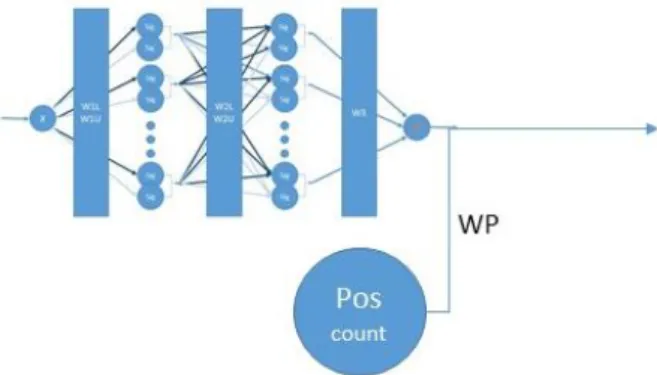
The goal of using neural networks in the Cyrus shoot algorithm is to obtain evaluation of each shoot to goal based on one player. In the Cyrus team because of calculation
time in the soccer 2D simulation environment to simulate opponent reach time to the shoot path is much expensive and we use neural network. Presently we used opponent player’s positions, target position and ball position as input of our neural networks, and also first ball speed is considered 3.0 but in future before world competition we want to add body angle, opponent player’s first speed and shoot speed to learn neural networks.
Also in soccer 2D environment, poscount has direct impact on shoot behavior and other behaviors in the soccer 2D simulation environments. To optimize neural networks output with use of poscount, multiplied with a certain factor and add to output of neural networks. Also this factor will be calculated by reinforcement learning in huge of games dataset.
Figure 3 add poscount to neural network output
2.4. Comparison
In next sections and figure 7 a compare between shoot implemented in agent2D [2] version 3.1.1, paper [1] and Cyrus implemented shoot is shown:
Table 1 compare shoot implementation
Algorithm Agent2D Paper [1] Cyrus NN
48.6% 55.3% 59.2%
2.5. Optimization using pattern recognition
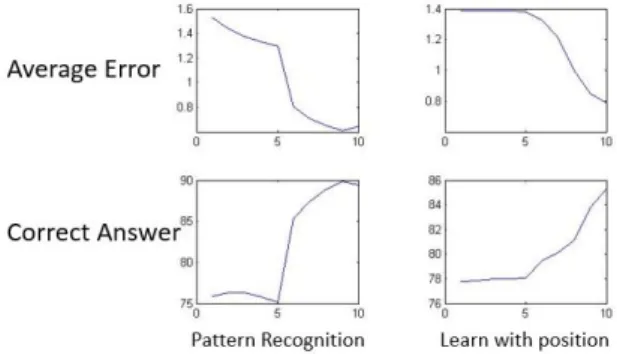
For optimizing data from previous method first we turn our data into patterns and then we use our new data set as our neural networks inputs. In this method our previous data consisting of ball position, opponent players and target position are turned into ball to target distance, ball to opponent distance and the angle between ball-target and ball-opponent vectors. In this method symmetry property of neural networks is kept and better results are obtained. In figure 8 we will see errors has been obtained by learning our two sets of data.
Figure 4 errors obtained by learning our two sets of data
3 Future
Cyrus team wants to use rough deep neural networks for offensive decision making. In this method we want to use Helios [4], WrightEagle [5], Gliders [6] and Oxsy [7] binaries to use player positions as input and player’s behavior as output of neural networks. After learning the neural networks, we want to use reinforcement algorithm to optimize this neural networks. For optimizing deep neural networks by reinforcement algorithm we want to divide field into different parts and according to ball reaching to those places based on the dangerous and importance of each region we will reward each player and then with help of these rewards we will update weights of our neural networks. This method can be used in three different ways:
• Learning other teams’ offensive behavior and using it for defensive decisions. • Each of our players can predict its teammate’s behavior
• We can improve our team’s offensive decisions by Re-Enforcement Learning. We also want to use generalized kalman filter’s algorithm online to predict team-mate and opponent positions. In this algorithm we use player position in each cycle as input of our neural networks and get its next position and by observing its next real position. We will compare our prediction to reality and learn our neural networks while running. In the live game we want to reduce poscount impact by using this method and also in offensive time by using chain-action we can improve the ball holder’s future vision.
References
1. Training a Simulated Soccer Agent how to Shoot Using Artificial Neural Network. M. Dezfoulian, N. Kaviani, A. Nikanjam, M. Rafaee, 13th Multi-disciplinary Iranian Researchers Conference in Europe (IRCE), Leeds, UK, 2005.
2. “Agent 2D-3.1.0 RoboCup tools - OSDN.” [Online]. Available: http://en.osdn.jp/projects/rctools/downloads/51943/agent2d-3.1.0.tar.gz/. [Accessed: 22-Jan-2016].
3. Teshneh Lab, Mohammad, and Pouria Jafari. Neural Networks and Advanced Neuro-Controlers, A Rough Neural Network Approach. Khajeh Nasir University of Technology, 2015.
4. H. Akiyama, T. Nakashima, and S. Mifune, “HELIOS2015 Team Description Paper,” pp. 1–6, 2015.
5. H. Zhang, M. Jiang, H. Dai, A. Bai, and X. Chen, “WrightEagle 2D Soccer Simulation Team Description 2015,” Wrighteagle.Org, pp. 3–8, 2015.
6. M. Prokopenko, P. Wang, and O. Obst, “Gliders2015 : Opponent avoidance with bio-inspired flocking behaviour,” pp. 1–5, 2015.
7. S. Marian, D. Luca, B. Sarac, and O. Cotarlea, “OXSY 2015 Team Description,” 2015. 8. Akiyama, H., Noda, I.: Multi-agent positioning mechanism in the dynamic
environment . In: Visser, U., Ribeiro,F., Ohashi, T., Dellaert, F., eds.: RoboCup 2007: Robot Soccer World Cup XI, Lecture Notes in Artificial Intelligence. Volume 5001., Springer (2008) 377-C384.
9. Slotine, Jean-Jacques E., and Weiping Li. Applied nonlinear control. Vol. 60. Englewood Cliffs, NJ: Prentice-Hall, 1991.
10. Haykin S., "Neural Networks: A Comprehensive Foundation (2 ed.)", Prentice Hall, 1998.
11. N.Zare, M.Karimi, A.Keshavarzi, E.Asali, H.Alipour, A.Aminian, E.Beheshtian, H.Mowla, H.Jafari, M.J.Khademian, “CYRUS 2D Simulation Team Description Paper 2015”, The 19th annual RoboCup International Symposium, China, Hefei, 2015.
12. R.Khayami, N.Zare, M.karimi, P.Mahor, F.Tekara, E.Asali, A.Keshavarzi, A.Afshar, M.Asadi, M.Najafi, “CYRUS 2D Simulation Team Description Paper 2014”, The 18th annual RoboCup International Symposium, Brazil, Joao Pessoa, 2014.
![Figure 1 Target of shoots in paper [3] method](https://thumb-us.123doks.com/thumbv2/123dok_us/9043651.2802167/2.892.283.618.736.923/figure-target-shoots-paper-method.webp)