Enhancing Pipeline Network Performance Using Dual
Interleaving Cluster Head Routing Protocol
Siva Kumar Subramaniam
1, Rajagopal Nilavalan
3,
Wamadeva Balachandran
4Shariq Mahmood Khan
2Department of Electronic & Computer Eng., Department of Computer Science & IT, College of Engineering, Design & Physical Sciences,
Brunel University London, United Kingdom NED University of Engineering & Technology, Pakistan
[email protected] [email protected]
Abstract – Remote monitoring of oil and gas pipelines has been
the most prevalent application of static wireless sensor network (WSN). WSN has a great potential in facilitating real-time data transfer between sensor nodes and a centralise monitoring station. For pipeline WSN, network performance is critical among sensor nodes in a linear chain topology. Expanding the communication range by increasing number of nodes in a linear architecture compromises the performance of WSN. Thus, WSN results in a severe impact on low throughput, high latency, poor delivery ratio, high energy consumption and network inequality. In this paper, we proposed Dual Interleaving Cluster Head Linear Static Routing Protocol (DICH-LSRP), a routing protocol for cluster-based topology. DICH-LSRP in a pipeline simulation environment were evaluated with compliance to IEEE 802.11 standard on impending factors of WSN performance. The simulation results help to better understand some key areas of WSN performance metrics and the implementation of DICH-LSRP in a multi-hop linear topology.
Keywords - Linear topology, pipeline network, static routing, TCP performance, static wireless sensor network
I. INTRODUCTION TO PIPELINE NETWORK
Pipelines are considered economical and a safer medium of transportation in oil and gas industry, although many studies have indicated a series of failures which leads towards hazardous accidents [1, 2]. In the recent years, deployment of wireless sensor network (WSN) has been a popular solution on oil and gas pipeline remote monitoring. Changes in the sensing behaviour on pipelines are relayed to a centralised monitoring station using WSN. In a linear pipeline network, end nodes (multiple source nodes) gather information from sensing points and communicates it through wireless links to a destination node (receiver).
The network of sensors is organised on a linear architecture with a geographical layout of an oil and gas pipeline. By far, the most common WSN implementations are flat linear topology and cluster-based linear topology. A flat linear topology is the simplest WSN in which one tier communication is established among sensors in the network. In a cluster-based topology, the source nodes communicate to a dedicated cluster head which then rely data packets through a multi-hop network towards a destination node [3, 4]. Depending on the wireless routing
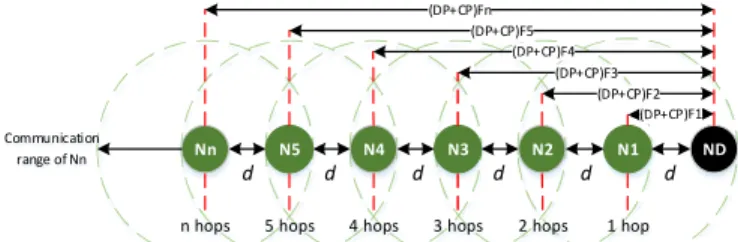
architecture, the data packets are forwarded to a destination node (receiver) through multiple intermediate nodes which also function as a source node. For a linear WSN, the key factor of implementation requires great reliability and scalability of the network. Theoretically, a linear WSN can be categorised as unreliable network with a single point failure. In a multi-hop linear WSN as shown in Fig. 1, the communication range is depended to its neighbouring nodes to achieve chain-like links to a centralised monitoring station.
N4 N3 N2 N1 ND N5
Nn
d d d d d d
3 hops 2 hops 1 hop n hops 5 hops 4 hops
(DP+CP)F2 (DP+CP)F3 (DP+CP)F5 (DP+CP)Fn Communication range of Nn
Fig. 1:Multi-hop linear topology with Nn number of source/intermediate nodes and ND is a single sink point (receiver)
Obviously, in any radio based communication devices, obstacle free line of sight is a highly desirable for optimum wireless network performance. The most common drawback of a multi-hop linear WSN is the management of high data traffic between sensing points and a receiver where the overall network performance is compromised [5].
II.FACTORS IN LINEAR TOPOLOGY AND RELATED WORKS
In a linear topology, a source (sender) node can be considered as a sensing point or as an intermediate node between a sender and a receiver [6, 7]. A linear multi-hop WSN with high data traffic can lead towards a bottleneck state at a certain node in the network. Both data and control packets in multiple flows of Fn share a common route between a sensing to a destination point as described in Fig. 1. A simple data accumulation factor is as depicted in (1) where sharing of a common route towards a destination node.
Where NTP is the total packets for n number of nodes, DPi is
the total data packets, CPiis the total control packets at node i and IfQlen are queue size in the network. In general, there are some key factors which influence the overall performance of a linear wireless topology compared to other known wireless topologies especially based on IEEE 802.11 standard [8]. Measurable factors such as the carrier sensing range, communication range, queue length, network power consumption and bandwidth are often related to underperforming of such wireless network. Many research work has contributed to these factors with improved routing algorithm and controlling important network parameters to improve overall network performance [9].
The most important and a fundamental process in a routing protocol is to identify an optimum route for a generated data packet to a designated destination. A route will be generated based on the implemented characteristic of a routing protocol prior to data transmission from a source node to a destination node. An optimum route is generated based on a route discovering process and a constant update is required to keep track of any changes in the network. An efficient and a reliable routing protocol will enhance the overall network performance in a linear wireless topology. By far, the two most common routing method are proactive routing protocol (table-driven) and reactive routing protocol (on demand) [10, 11].
A table-driven routing protocol requires constant updates on from nodes in the network for real-time changes of route. The Destination-Sequence Distance-Vector routing (DSDV) [10-12] identify and updates all available route by periodical routing messages in a wireless network. Hence, the frequent updates of routing table entries consume heavy usage of energy and utilise a portion of bandwidth even at idle state. On-demand search for a valid route between a source and destination node is the characteristic of Ad hoc On-Demand Distance Vector (AODV) [10-13]. Newest route and routing table updates are accomplished using a sequence number at a destination node. Both DSDV and AODV has the capacity to reduce route cost with an option to bypass an intermediate (more than two) node within a communication range to its destination node.
The authors in [14, 15] introduced a multi-tier linear hierarchical topology with sectioning nodes as basic sensor nodes, data relay nodes and data dissemination nodes with a corresponding purpose at each node level. The Multi-Hop Low-Energy Adaptive Clustering Hierarchy (Multi-Hop LEACH) [16] was introduced to enable multi-hop among cluster heads in a wireless network when a designated destination node is a distance away. Source nodes transmit a data packet to a specific cluster head which is usually located at a single-hop between them. Once the cluster head receives data from its source node, it will aggregate and relay the data packets thru its neighbouring cluster head towards a destination node. A hierarchical or cluster-based
topology and data merging technique prior to sending to a receiver node [9] encourage a multi-hop wireless communication thru a designated cluster head. Thus, data merging technique would reduce network cost over sending of individual data packets. The Advanced Low-Energy Adaptive Clustering Hierarchy (Ad-LEACH) [17] is a static cluster wireless sensor network for heterogeneous routing protocol which incorporated from LEACH [18] and (DEEC) protocol [19]. The network characteristic of Ad-LEACH has the ability to reduce its broadcast packets by limiting the sensor nodes in many small clusters groups with limited communication range only for each clustering groups. In each group, Ad-LEACH assigns a cluster head which will be the point of communication to the destination node. The authors in [20] introduced flat data collection algorithm which responses and forward a real-time data to the neighbouring wireless nodes by reduced waiting time in each stage.
In general, the performance of a routing protocol is measured in terms of link stability in a wireless network. In the event of breaking and restoration of links are reconsidered as a crucial network activity which results in high data lost rate. To retain an active link between nodes in a network, broadcast messages are generated in a timely interval among neighbouring nodes within the communication range. These messages are used to identify the active nodes and to pre-established new routes whenever is required. Such a crucial process is a vital component in a routing protocol in updating routing table as well as to establish data transfer between a sender and a receiver node in a network.
III.DUAL INTERLEAVING CLUSTER HEAD LINEAR STATIC
ROUTING PROTOCOL (DICH-LSRP)
The Dual Interleaving Cluster Head Linear Static Routing Protocol (DICH-LSRP) is proposed to enhance overall network performance in a multi-hop linear cluster-based topology. Wireless nodes are statically positioned in a fixed infrastructure of an oil and gas pipeline to form a communication chain in a network [7, 14]. The deployed sensors on a pipeline communicate data thru a dedicated cluster head and also as intermediate nodes which are arranged in series with a uniform interval. Unlike a flat one-tier topology, the DICH-LSRP is a reliable and efficient routing protocol where route to the destination node are predefined at initialization of the simulation. The routes between all source nodes (sender) to a single destination node (centralised monitoring station) are predefined based on odd and even numbered cluster head with two interleaving route as shown in Fig. 2. Node placement in a linear topology often influences the behaviour 0f a multi-hop WSN particularly on link stability between a source and a destination node. Link instability results in increasing passive nodes (nodes with zero data transfer) therefore data transfer from that point onwards will be terminated. Hence to minimise issues with passive nodes in DICH-LSRP, sensing nodes as shown in Fig.2 are arranged in d distance and
the respective cluster head is arranged in d1 distance within a maximum transmission range of two d1.
En On E1 O1 ND
d1 d1 d1 d1
Predefined path for Odd numbered cluster head
1 hop 1 hop N11 N12 d d N10 d N9 d N8 d N7 d N6 d N5 d N4 d N3 d N2 d N1 n hops n hops
Fig. 2: DICH-LSRP with On/En number of cluster head and ND as destination node evenly distributed at d1
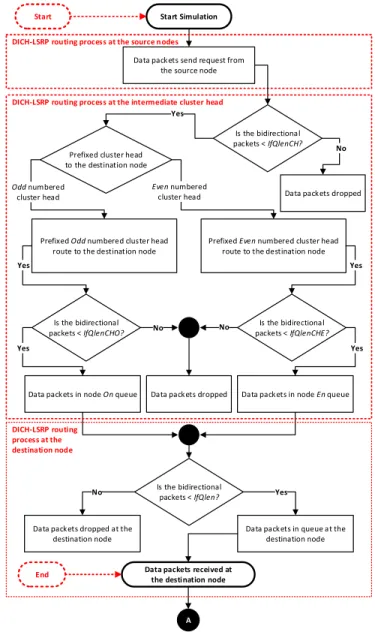
Generally, a routing protocol generates or updates its routing table based on the availability of nodes in a specific transmission range at start time t or t + 1 when there are route changes among nodes. Whereby for a linear topology, a routing table is generated or updated between a sender and a destination node thru a single routing chain sequence which will be fully/partially stored by the nodes in a network. The characteristic of a generated or an updated routing table process differs between types of routing protocol used for an application. The process of generating and updating a routing table using DICH-LSRP are in contrast to any standard practices since the routes are predefined in two sets of routing table as described in the flowchart shown in Fig. 3. The routing table is generated based on odd and even sequence of cluster head in the network.
The cluster head sequence in DICH-LSRP is designed as a direct point of communication for the sensing nodes (located under each cluster head) to transfer data packets thru a specific route to a single destination node at the end of a network. Referring to Fig. 3, two routing tables are generated at start time t from a sequence of odd and even numbered cluster head with n number of sensing nodes (member nodes under each cluster head) forming two individual bidirectional paths in a wireless network. There is a zero buffer time between the start state to generating a routing table prior to data packet transmission in DICH-LSRP as shown in the flowchart in Fig. 3. The predefined conditions during a routing table generating process requires neither broadcast or hello packets which are considered as an important component in generating a routing table for most routing protocols. The eliminated broadcast and hello packets would further help in reducing traffic in a typical linear architecture. Unlike in a mobile network, minimum routing messages and updates for path changes are required in a static wireless network for a normal operation especially when in an idle condition. Hence, the communication link between nodes remain unchanged and doesn’t require frequent updates for the application in a static wireless network.
The restraint start process used in DICH-LSRP has an advantage over the application of an oil and gas pipelines since nodes are permanently located with always in a ready state on a static infrastructure at all time. The cluster head and sensing nodes are distributed in odd and even routing table with the ability to transmit and receive data packets along with the required control packets only in a predefine path without path crossing possibilities during the network active period. The predefined routing path with dual interleaving cluster head eliminates aggressive broadcast packets to maintain the routing table during the network active period.
Data packets send request from the source node
A
Is the bidirectional packets < IfQlenCHE? Is the bidirectional
packets < IfQlenCHO?
Data packets dropped
No No
Data packets in node On queue Yes
Data packets in node En queue Yes Start Simulation
Is the bidirectional packets < IfQlen? Data packets dropped at the
destination node Data packets in queue at the destination node
No Yes
Data packets received at the destination node Yes
Prefixed Even numbered cluster head route to the destination node
Yes DICH-LSRP routing process at the source nodes
DICH-LSRP routing process at the destination node
Start
End
Prefixed cluster head to the destination node
Prefixed Odd numbered cluster head route to the destination node
Is the bidirectional packets < IfQlenCH? Yes
Data packets dropped No
Even numbered cluster head Odd numbered
cluster head
DICH-LSRP routing process at the intermediate cluster head
Fig. 3: Overview of the data packet flow process in DICH-LSRP
In a large network, queue limitation is set as a standard mechanism for controlling and managing bidirectional packets
among nodes in a wireless network. The queue limitation is a crucial factor in eliminating passive nodes and bottle neck in a single route wireless network. The queue limitation also increases the dropped packet rate especially when the route is not identified yet in a standard routing protocol. With the implementation of DICH-LSRP, this factor could be minimised and further increase the rate of data packet transfer with the proposed dual path method. Splitting the single route as in a conventional routing protocol into two paths, further, reduces the routing overhead by half hence allocates better proportion for data packets in both routes as described in (2) and (3). The data accumulation factor for odd and even numbered cluster head are shown in (2) and (3) between a sensing and a destination node.
TPCHO = ∑ + ≤ (2)
Where TPCHO is the total packets for n number of nodes (odd
numbered cluster head), DPi is the total data packets and CPi is
the total control packets for n number of nodes (odd numbered cluster head) with IfQlenCHO as the queue size in the network.
TPCHE = ∑ + ≤ (3)
Where TPCHE is the total packets for n number of nodes (even
numbered cluster head), DPi is the total data packets and CPi is
the total control packets for n number of nodes (even numbered cluster head) with IfQlenCHE as the queue size in the network.
Any data packets arriving at an intermediate (neighbouring) cluster head with queue length > IfQlenCHO/IfQlenCHE will be
dropped from moving forward towards the destination node due to queue overflow. A sink point or a destination node is located at the end of each interleaving route with an integration point for both odd and even numbered cluster head as indicated in the flowchart in Fig. 3. The relationship of the queue with both data packets arriving from odd and even numbered cluster head is as described in (4).
NTP= TPCHO +TPCHE ≤ IfQlen (4)
Where NTP is the network total packets at the destination for n number of nodes and the value of TPCHO/TPCHE is from (2/3).
Wise use of available resources such as bandwidth allocation, buffer time in route discovery and queue overhead results in better network performance. The restricted control packets in DICH-LSRP can produce a significant proportion of data rate compared to selected routing protocols as discussed in the next section of this paper in a linear topology.
IV.NETWORK PERFORMANCE AND ANALYSIS
In this section, the overall network performance for the proposed DICH-LSRP is illustrated from various simulation
environment created in Network Simulator 2 (Version 2.35) [13, 21]. The basic setting for the simulation environment is as tabulated in Table I. In all simulated environment, the proposed DICH-LSRP is compared with Dual Interleaving Linear Static Routing Protocol (DI-LSRP) in a flat one-tier topology, a reactive (AODV) [10, 11] and proactive (DSDV) [11, 12] routing algorithm in a two-tier cluster topology for performance comparison in Network Simulator 2. Each simulation environment is an average value of five independent runs using a seed function over a simulation duration of 500 seconds. The data rate of one packet/sec were assigned to all source nodes with other corresponding parameters as given in Table I.
TABLE I
NS2 BASIC SIMULATION PARAMETERS
Parameters Value
Channel type Wireless channel Radio propagation model Two Ray Ground
MAC type 802.11
Interface queue type Drop Tail / PriQueue Cluster head 8, 16, 24, 32, 40 Source nodes 24, 48, 72, 96, 120 Max packet in ifqlen 50 (packets)
Agent type Transmission control protocol (TCP) Traffic type Constant bit rate (CBR) RX Thresh/CS Thresh 300 meters/350 meters
Packet size 512 bytes
The simulation environment was created to test the efficiency and robustness of the proposed routing algorithm in a near real-time application where the selection of non-chronological sending order and start time for source nodes was randomly chosen for each simulation cycle. The data packet transmission is assigned randomly between 0 – 2 seconds at the beginning of the simulation. All nodes mentioned in the simulation are statically placed during the simulation duration with only one destination node. DICH-LSRP and the other routing algorithm were tested and evaluated in the simulation on the following metrics: A. Delivery ratio: A percentage of receiving packets over send packets in a network [11-13] is an essential performance indicator for the reliability of a certain wireless network. Referring to Fig. 4, the delivery ratio of DICH-LSRP is at a moderate rate when compared with the other outperformed routing protocol from a small network size of 24 source nodes to a large network size of 120 source nodes. Referring to Fig. 4, the delivery ratio in percentage (%) merely indicates an overview of the percentage of successful packets delivered rather than the total number of received packets which contributes significantly in terms of performance. The unappealing rate of the delivery ratio in
DICH-LSRP is due to a higher data transfer rate which can be further corrected with network fairness.
Fig. 4: Graph on delivery ratio (%) over number of source nodes
B. Throughput: Throughput over all flows in a network can be calculated as in [13, 22]. A network with higher throughput within the available network resources is the desired performance metric. Referring to Fig. 5, Throughput (Kbps) in a network with DICH-LSRP outperforms all the other routing protocol from a small network size of 24 source nodes to a large network size of 120 source nodes. With the implementation of dual interleaving cluster head splits the routing over head into two paths, therefore a significant throughput value between 25 Kbps – 45 Kbps can be achieved at all time. In a multi-hop linear topology, DICH-LSRP has the capacity to achieve higher throughput within the available network resources.
Fig. 5: Graph on throughput (Kbps) over number of source nodes
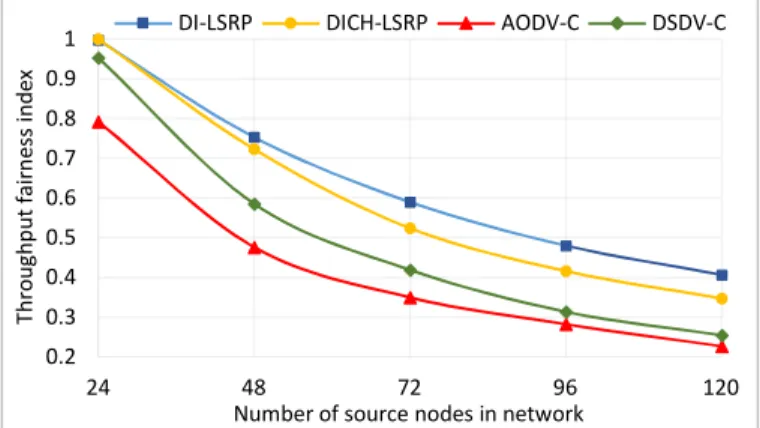
C. Throughput fairness index: Network fairness or equality within a network is the scalar measurement of resources (data packets) and allocation discrimination among all source nodes as mentioned by the authors in [22]. Network imbalance is a crucial factor in a linear wireless network with any routing protocol. Throughput fairness in a network with DICH-LSRP outperforms
all the other routing protocol from a small network size of 24 source nodes to a large network size of 120 source nodes. Referring to Fig. 6, a small throughput fairness variation between DICH-LSRP and DI-LSRP is clearly visible between 0.03 – 0.07 in the tested environment. The higher throughput value as shown in Fig. 5 has a corresponding effect towards the variation in throughput fairness index of DICH-LSRP below DI-LSRP. Based on the other routing protocol, the throughput fairness index of DICH-LSRP has outperformed when compared to handling higher data rate with a great throughput equality in a certain network condition.
Fig. 6: Graph on throughput fairness index over number of source nodes
D. End to end delay: Wireless network latency is described as a time taken for a single data packet to travel from a sender to a designated node over all flows in the network [11, 13]. Referring to Fig. 7, the end to end delay of DICH-LSRP had outperformed the other routing protocol from a small network size of 24 source nodes to a large network size of 120 source nodes. The value of throughput from Fig. 5 and the value of fairness index from Fig. 6 has a corresponding effect of end to end delay of DICH-LSRP.
Fig. 7: Graph on end to end delay (ms) over number of source nodes
Even though AODV-C has a lower end to end delay, but this has a corresponding effect on the low throughput produced as in Fig.
65 70 75 80 85 90 95 24 48 72 96 120 De liv er y ra tio (% )
Number of source nodes in network
DI-LSRP DICH-LSRP AODV-C DSDV-C
75 85 95 105 115 125 135 24 48 72 96 120 Th ro ug hp ut (K bp s)
Number of source nodes in network
DI-LSRP DICH-LSRP AODV-C DSDV-C
0.2 0.3 0.4 0.5 0.6 0.7 0.8 0.9 1 24 48 72 96 120 Th ro ug hp ut fa irn es s in de x
Number of source nodes in network
DI-LSRP DICH-LSRP AODV-C DSDV-C
0 0.2 0.4 0.6 0.8 1 1.2 1.4 1.6 24 48 72 96 120 En d to e nd d el ay (m s)
Number of source nodes in network
5 and poor fairness index as in Fig. 6 hence, DICH-LSRP has comparatively better end to end delay when compared. Higher data rate has direct implication in terms of overall delay typically due to the total data packet received and the fairness factor among source nodes. The end to end delay of DSDV-C and DI-LSRP id higher compared to DICH-LSRP with much lower throughput. This shows that each routing protocol has a unique characteristic in each and every measured parameter in a wireless network.
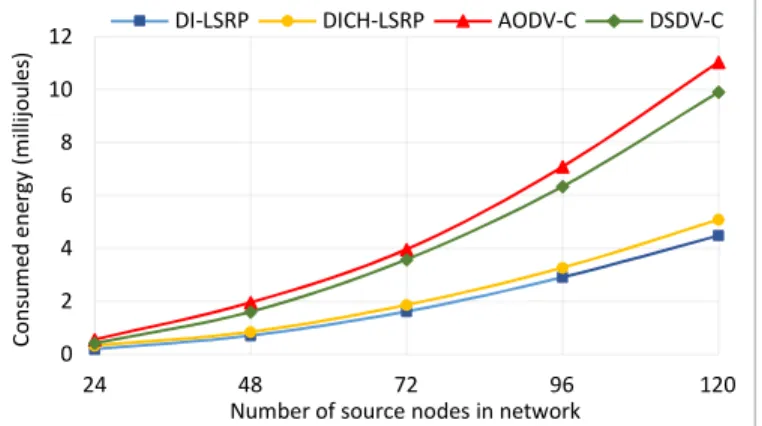
E. Energy consumption: Energy consumption in a network can be define as the total used energy over total received data packet in a network[13, 23]. Energy usage in a wireless linear topology is an important parameter since a single node failure can create a discontinuity in the communication link. Energy consumption per-packet in a network with DICH-LSRP outperforms all the other routing protocol from a small network size of 24 source nodes to a large network size of 120 source nodes. Referring to Fig. 8, a small variation in consumed energy per-packet between DICH-LSRP and DI-LSRP is clearly visible in the tested environment. The consumed energy per-packet in DICH-LSRP is slightly higher then DI-LSRP is due to higher rate of transmitted data packets which is comparative to the control packets used in the network. The other routeing protocol consumed higher energy per-packet with relatedly low data rate compared to both DICH-LSRP and DI-LSRP in the tested environment. Energy efficient routing protocol ensures a sustainability factor in a typical linear wireless network, particularly when the nodes are battery power dependent.
Fig. 8: Graph on consumed energy (millijoules) over number of source nodes
F. Passive nodes: Passive nodes are considered nodes with zero data transfer to the destination node in a network. Passive nodes create communication breakdown from a certain point in a network due to a single point failure factor in a linear topology. A certain network with a higher number of passive nodes will be a waste of available resources, especially when working in a network of high traffic and limited energy source. Passive nodes are results of poor equality management in a network particularly is a crucial factor in a linear topology. The greatest advantage of
both DICH-LSRP and DI-LSRP over the other routing protocol is that, there are no passive nodes in the tested environment as shown in Table II.
TABLE II
NUMBER OF PASSIVE NODE BASED ON ROUTING PROTOCOLS OVER NUMBER OF
SOURCE NODES IN NETWORK
Number of source nodes
Number of passive nodes
DI-LSRP DICH-LSRP AODV-C DSDV-C
24 0 0 2.5 0
48 0 0 1.25 0
72 0 0 0.83 0
96 0 0 1.09 0.78
120 0 0 3.75 8.13
In general, a passive node influences the fairness index [22] as well as the network performance on a linear topology. Passive nodes can be eliminated by controlling generated data packets per-node with a TCP acknowledgement method or by data scheduling at the sender node. Such a mechanism would add a great improvement factor to the overall network performance.
IV.CONCLUSION
There are many interrelating factors influencing overall network performance in a multi-hop pipeline network. The proposed DICH-LSRP is a reliable and efficient routing protocol with low route maintenance required in a static linear topology. The reduced routing traffic with predefined dual routing path enhances the overall network performance in a multi-hop pipeline network. Further implementation of DICH-LSRP has a significant effect on core network parameters such as reliability, latency, responsiveness and energy efficiency for optimum network performance. Dealing with passive nodes creates communication link stability and sustainability of a multi-hop pipeline network. The implementation of DICH-LSRP in the simulated environment would be a great benefit for static linear application, particularly with a single route. The analysis and findings from simulation have functional implications particularly in reliability rate, higher throughput and network fairness issues at this state of research. Hence, further analysis will be carried out next on optimisation of the proposed performance metric.
ACKNOWLEDGMENT
The authors would like to thank Ministry of Education Malaysia and University Teknikal Malaysia Melaka for their financial support and assistance for the research conducted in Brunel University London.
0 2 4 6 8 10 12 24 48 72 96 120 Co ns um ed e ne rg y (m ill ijo ul es )
Number of source nodes in network
REFERENCES
[1] H. Devold, Oil and gas production handbook: an introduction to oil and gas production, Lulu. com, 2013.
[2] Kenneth P. Green and Taylor Jackson, "Safety in the Transportation of Oil and Gas: Pipelines or Rail?" Fraser Research Bulletin, pp. 1 - 14, August 2015. [3] A.C. Azubogu, V.E. Idigo, S.U. Nnebe, O.S. Oguejiofor and E. Simon,
"Wireless Sensor Networks for Long Distance Pipeline Monitoring," in Proceedings of World Academy of Science, Engineering and Technology, pp. 86, 2013.
[4] M.R. Akhondi, A. Talevski, S. Carlsen and S. Petersen, "The role of wireless sensor networks (WSNs) in industrial oil and gas condition monitoring," in Digital Ecosystems and Technologies (DEST), 2010 4th IEEE International Conference on, pp. 618-623, 2010.
[5] S. Ali, S.B. Qaisar, H. Saeed, M.F. Khan, M. Naeem and A. Anpalagan, "Network Challenges for Cyber Physical Systems with Tiny Wireless Devices: A Case Study on Reliable Pipeline Condition Monitoring," Sensors, vol. 15, pp. 7172-7205, 2015.
[6] I. Jawhar, N. Mohamed and D.P. Agrawal, "Linear wireless sensor networks: Classification and applications," Journal of Network and Computer Applications, vol. 34, pp. 1671-1682, 2011.
[7] M. Hadjila, H. Guyennet and M. Feham, "A chain-based routing protocol to maximize the lifetime of wireless sensor networks," Wireless Sensor Network, vol. 5, pp. 116, 2013.
[8] P. Radmand, A. Talevski, S. Petersen and S. Carlsen, "Comparison of industrial WSN standards," in 2010 4th IEEE International Conference on Digital Ecosystems and Technologies (DEST), IEEE, Dubai, United Arab Emirates, pp. 632-637, 2010.
[9] Z. Wang, X. Zha and X. Qian, "The application and issuse of linear wireless sensor networks," in System Science, Engineering Design and Manufacturing Informatization (ICSEM), 2011 International Conference on, pp. 9-12, 2011. [10] S.M. Khan, R. Nilavalan and A.F. Sallama, "A Novel Approach for Reliable Route Discovery in Mobile Ad-Hoc Network," Wireless Personal Communications, vol. 83, pp. 1519-1529, 2015.
[11] B. Paul, K.A. Bhuiyan, K. Fatema and P.P. Das, "Analysis of AOMDV, AODV, DSR, and DSDV Routing Protocols for Wireless Sensor Network," in Computational Intelligence and Communication Networks (CICN), 2014 International Conference on, pp. 364-369, 2014.
[12] G.R. Pathak, S.H. Patil, A. Rana and Y. Suralkar, "Mathematical model for routing protocol performance in NS2: Comparing DSR, AODV and DSDV as example," in Wireless Computing and Networking (GCWCN), 2014 IEEE Global Conference on, pp. 184-188, 2014.
[13] T. Issariyakul and E. Hossain, Introduction to network simulator NS2, Springer Science & Business Media, 2011, .
[14] I. Jawhar, N. Mohamed, M.M. Mohamed and J. Aziz, "A routing protocol and addressing scheme for oil, gas, and water pipeline monitoring using wireless sensor networks," in Wireless and Optical Communications Networks, 2008. WOCN'08. 5th IFIP International Conference on, pp. 1-5, 2008.
[15] I. Jawhar, N. Mohamed, K. Shuaib and N. Kesserwan, "An Efficient Framework and Networking Protocol for Linear Wireless Sensor Networks." Ad Hoc & Sensor Wireless Networks, vol. 7, pp. 3-21, 2009.
[16] M. Aslam, N. Javaid, A. Rahim, U. Nazir, A. Bibi and Z. Khan, "Survey of extended LEACH-Based clustering routing protocols for wireless sensor networks," in High Performance Computing and Communication & 2012 IEEE 9th International Conference on Embedded Software and Systems (HPCC-ICESS), 2012 IEEE 14th International Conference on, pp. 1232-1238, 2012.
[17] A. Iqbal, M. Akbar, N. Javaid, S.H. Bouk, M. Ilahi and R. Khan, "Advanced LEACH: A static clustering-based heteroneous routing protocol for WSNs," arXiv Preprint arXiv:1306.1146, 2013.
[18] D. Goyal and M.R. Tripathy, "Routing protocols in wireless sensor networks: a survey," in 2012 Second International Conference on Advanced Computing & Communication Technologies, pp. 474-480, 2012.
[19] B. Elbhiri, R. Saadane and D. Aboutajdine, "Developed Distributed Energy-Efficient Clustering (DDEEC) for heterogeneous wireless sensor networks," in I/V Communications and Mobile Network (ISVC), 2010 5th International Symposium on, pp. 1-4, 2010.
[20] H. Yu and M. Guo, "An efficient oil and gas pipeline monitoring systems based on wireless sensor networks," in Information Security and Intelligence Control (ISIC), 2012 International Conference on, pp. 178-181, 2012. [21] B. Li and X. Zhang, "Rsearch of development in wireless sensor network
routing protocols based on NS2," in Electronic and Mechanical Engineering and Information Technology (EMEIT), 2011 International Conference on, pp. 1913-1916, 2011.
[22] T. Hou, C. Hsu and C. Wu, "A delay‐based transport layer mechanism for fair TCP throughput over 802.11 multihop wireless mesh networks," International Journal of Communication Systems, vol. 24, pp. 1015-1032, 2011.
[23] M. Zimmerling, "An Energy-Efficient Routing Protocol for Linear Wireless Sensor Networks." in Informatiktage, pp. 239-242, 2008.