Meaning Representation and Deep Learning
Anupiya Nugaliyadde
This thesis is presented for the Degree of Doctor of Philosophy
Murdoch University
Declaration
I declare that this thesis is my own account of my research and contains as its main
content work which has not previously been submitted for a degree at any tertiary
education institute.
Abstract
Natural Language Understanding (NLU) is one of the complex tasks in artificial intelligence. Machine learning was introduced to address the complex and dynamic nature of natural language. Deep learning gained popularity within the NLU community due to its capability of learning features directly from data, as well as learning from the dynamic nature of natural language. Furthermore, deep learning has shown to be able to learn the hidden feature(s) automatically and outperform most of the other machine learning approaches for NLU. Deep learning models require natural language inputs to be converted to vectors (word embedding). Word2Vec and GloVe are word embeddings which are designed to capture the analogy context-based statistics and provide lexical relations on words. Using the context-context-based statistical approach does not capture the prior knowledge required to understand language combined with words. Although a deep learning model receives word embedding, language understanding requires Reasoning, Attention and Memory (RAM). RAM are key factors in understanding language. Current deep learning models focus either on reasoning, attention or memory. In order to properly understand a language however, all three factors of RAM should be considered. Also, a language normally has a long sequence. This long sequence creates dependencies which are required in order to understand a language. However, current deep learning models, which are developed to hold longer sequences, either forget or get affected by the vanishing or exploding gradient descent. In this thesis, these three main areas are of focus. A word embedding technique, which integrates analogy context-based statistical and semantic relationships, as well as extracts from a knowledge base to hold enhanced meaning representation, is introduced. Also, a Long Short-Term Reinforced Memory (LSTRM) network is introduced. This addresses RAM and is validated by testing on question answering data sets which require RAM. Finally, a Long Term Memory Network (LTM) is introduced to address language modelling. Good language modelling requires learning from long sequences. Therefore, this thesis demonstrates that integrating semantic knowledge and a knowledge base generates enhanced meaning and deep learning models that are capable of achieving RAM and long-term dependencies so as to improve the capability of NLU.
ACKNOWLEDGEMENTS
It is with immense gratitude that I acknowledge the assistance, theoretical and moral support of my Principal Supervisor, Associate Professor Kevin Wong, who paved the way to compile this dissertation of mine, in fulfilling the requirements for a Doctor of Philosophy in Information Technology at Murdoch University. I am equally indebted to my Co-Supervisors, Associate Professor Ferdous Sohel and Dr Hong Xie for the invaluable knowledge shared and encouragement given to upgrade my academic forte to undertake this challenging study on “Enhancing Natural Language Understanding using Meaning Representation and Deep Learning”. I am grateful to Dr Mohd Fairuz Shiratuddin, Advisory Chair, for the friendly academic environment provided so that I could utilise my time productively. Above all, I wish to express my utmost gratitude to all my academic supervisors for extending their time and energy in assisting the advancement of my academic career, which enabled me to serve the science of Information Technology.
I am indebted to Murdoch University, for granting me a full-time candidature for the Murdoch International Postgraduate Scholarship (MIPS), to undertake a PhD in Information Technology at the beginning of the 2016 academic year.
My student life at the Department of Information Technology, Murdoch, like all my dear friends, has been filled with great memories, in spite of the time demanding and stressful academic work. Special thanks to my friends for the wonderful memories and time spent over the last 42 months at Murdoch.
I am grateful to my parents, my darling wife, sisters, brothers-in-law, uncles and aunts for the moral support given when I felt an urge for consolation. I extend my heartfelt praise to my dearest family for their patience, sacrifice and understanding; for being together to help me through this challenging time.
Ariya, my darling daughter - the glittering star of my life, I dedicate my academic work to you, for always being with me and for sacrificing the comforts during your toddler years.
List of Publication Related to the Thesis
Journal Articles
J1.
A. Nugaliyadde, K.W. Wong, F. Sohel, H. Xie, “Long Short-Term Reinforced
Memory Network, Question Answering”, Transactions of the Association for
Computer Linguistics. (TACL)
(Submitted)
Conference Proceedings
P1.
A. Nugaliyadde, K.W. Wong, F. Sohel and H. Xie, “Language Modelling through
Long-Term Memory Networks” presented at The International Joint Conference on
Neural Networks, Hungary, 2019.
P2.
A. Nugaliyadde, K. W. Wong, F. Sohel, and H. Xie, "Reinforced Memory Networks
for Question Answering," presented at The 24th International Conference On
Neural Information Processing Guangzhou, China, 2017, pp. 482-490.
P3.
A. Nugaliyadde, K. W. Wong, F. Sohel, and H. Xie, "Multi-level Search of a
Knowledgebase for Semantic Parsing," in International Workshop on
Multi-disciplinary Trends in Artificial Intelligence, 2017, pp. 44-53.
P4.
A. Nugaliyadde, K. W. Wong, F. Sohel, and H. Xie, "Enhancing semantic word
representations by embedding deep word relationships," in Proceedings of the 2019
11th International Conference on Computer and Automation Engineering, 2019, pp.
82-87.
Summary of Contributions in the Thesis
Chapter
Contribution
Publications
Introduction
Chapter 2:
Background
This Chapter presents a comprehensive
literature review regarding Natural
Language Understanding (NLU) and a
theoretical background to
understanding the problems addressed
in Chapters 3 to 5.
J1, P1, P2, P3,
P4
Chapter 3:
Enhancing Semantic
Word Representations
by Embedding and
Semantic
Parsing
using
Deep
Word
Relationships
1.
Proposed the use of multi-level
search for semantic parsing using
Conceptnet
2.
Integrating Word2Vec and
Conceptnet to create a deeper word
embedding
P3, P4
Chapter 4:
Reasoning, Attention
and Memory for
Question Answering
Proposed a deep learning model which
is capable of addressing reasoning,
attention and memory
J1, P2
Chapter 5:
Long Term Memory
Network for Language
Modelling
Proposed a deep learning model to hold
a longer memory for NLU
P1
Contents
... 1
1.1
Problems in Natural Language Understanding ... 3
1.2
Aims and Objectives ... 4
1.3
Contribution ... 5
1.4
Thesis Organization... 6
... 7
2.1
Natural Language Understanding... 7
2.2
Applications in NLU ... 8
2.3
Models Enhancing NLU... 9
2.3.1
Semantic parsing ... 9
2.3.2
Word embedding ... 10
2.3.3
Question Answering... 10
2.3.4
Language modelling... 11
2.4
Problems in NLU ... 11
2.4.1
The Problem of using only Context-based Knowledge for NLU ... 12
2.4.2
The Problem of Reasoning, Attention and Memory ... 12
2.4.3
The Problem of Long Term Memory... 13
... 14
3.1
Semantic Parsing Approaches ... 15
3.2
Semantic Parsing using Knowledgebase ... 16
3.3
Proposed Knowledge-based Semantic Parsing ... 17
3.3.1
Lexical Phase ... 18
3.3.2
Approach 1 ... 20
3.3.3
Approach 2 ... 20
3.3.4
Semantic Phase ... 21
3.4
Comparing Semantic Parsing Models and Analysis ... 21
3.5
Semantic Word Embedding and Need of Enhanced Word Relationships ... 25
3.6
Word Representation Models ... 26
3.7
Enhanced Relationship based Word Embedding Model ... 27
3.7.1
Semantic Word Embedding ... 28
3.7.2
Embedding Similarity and Association ... 29
3.8
Word Embedding Results Comparison ... 31
3.9
Summary ... 33
... 35
4.1
Question Answering for Natural Language Understanding ... 36
4.2
Overview of Models for RAM ... 39
4.3
Proposed Long Short-Term Reinforced Memory Network ... 42
4.3.1
Overview ... 42
4.3.3
LSTRM’s RAM Architecture ... 44
4.4
Dataset ... 46
4.4.1
bAbI 1K Dataset ... 46
4.4.2
TriviaQA Dataset ... 48
4.4.3
Quasar Dataset ... 48
4.5
LSTRM’s Results and Discussion ... 49
4.5.1
Generating Results from LSTRM ... 49
4.5.2
Results for 1K bAbI Dataset ... 50
4.5.3
Results for TriviaQA Dataset ... 51
4.5.4
Results for Quasars Dataset ... 53
4.6
Summary ... 55
... 56
5.1
Long-Term Memory ... 56
5.2
Problems in Long-Term Memory ... 58
5.3
Long-Term Memory Network ... 60
5.3.1
Input state ... 60
5.3.2
Cell state... 61
5.3.3
Output State ... 62
5.4
Experimentation on Long-Term Memory Network ... 62
5.5
Results for Language Modelling on Long-Term Memory Network ... 63
5.6
Discussion on Long-Term Memory Network ... 65
5.7
Summary ... 67
... 68
List of Figures
FIGURE 3.1:THE MAIN STEPS IN THE PROPOSED APPROACHES.THIS SHOWS THE PRE-PROCESSING STEPS, THE RELATIONSHIP IDENTIFICATION, AND THE SEMANTIC PARSING. ... 17 FIGURE 3.2:EXAMPLE SEARCH OF THE LEVEL STRUCTURE GENERATED.THIS SHOWS A SAMPLE SET OF DATA EXTRACTED FROM CONCEPTNET 5, MOVING FROM LEVEL TO LEVEL. ... 19 FIGURE 3.3:APPROACH 1BLOCK DIAGRAM, SHOWS THE DATA FLOW FROM ONE STEP TO THE OTHER.... 20 FIGURE 3.4:APPROACH 2BLOCK DIAGRAM, SHOWS THE DATAFLOW FROM ONE STEP TO THE OTHER. ... 20 FIGURE 3.5:OVERALL METHODOLOGY AND DATA FLOW FOR THE WORD EMBEDDING.THE WORD
w
IS PASSED ON TO CONCEPTNET AND WORD2VEC.WORD2VEC CREATES THE WORD EMBEDDING 𝒗.THE WORDS EXTRACTED FROM CONCEPTNET 𝑾𝒄𝒏ARE PASSED ON TO A PRE-TRAINED WORD2VEC TO GENERATE 𝒗𝒄𝒏 AND COMBINE WITH 𝒗 USING𝒊 = 𝟏𝒏𝒗𝒄𝒊. 𝒗, TO GENERATE 𝒗𝒄𝒎.𝒗𝒄𝒎IS RESHAPED TO A 2D MATRIX.THE 2D MATRIX IS PASSED TO A SOM AND THE GENERATED MATRIX IS THEN PASSED ON TO PCA FOR DIMENSIONAL REDUCTION AND TRANSFORMED TO THE FINAL VECTOR𝒗𝒇. ... 28FIGURE 3.6:PROPOSED WORD EMBEDDING 3D REPRESENTATION FOR THE WORDS –“DOG, MOUSE, CHAIR, TABLE, CAR, BUS, MAN, QUEEN, WOMAN, KING”. ... 29 FIGURE 3.7:WORD2VEC WORD EMBEDDING 3D REPRESENTATION FOR THE WORDS –“DOG, MOUSE, CHAIR,
TABLE, CAR, BUS, MAN, QUEEN, WOMAN, KING”. ... 29 FIGURE 3.8:CONCEPTNET WORD EMBEDDING 3D REPRESENTATION FOR THE WORDS – “DOG, MOUSE,
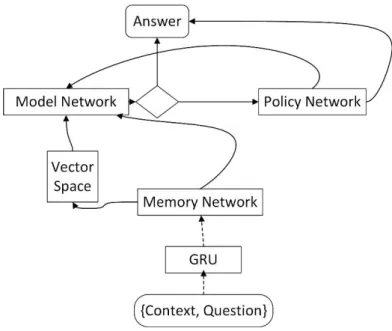
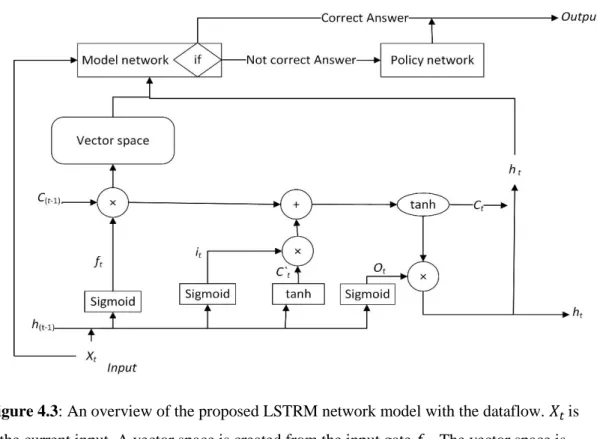
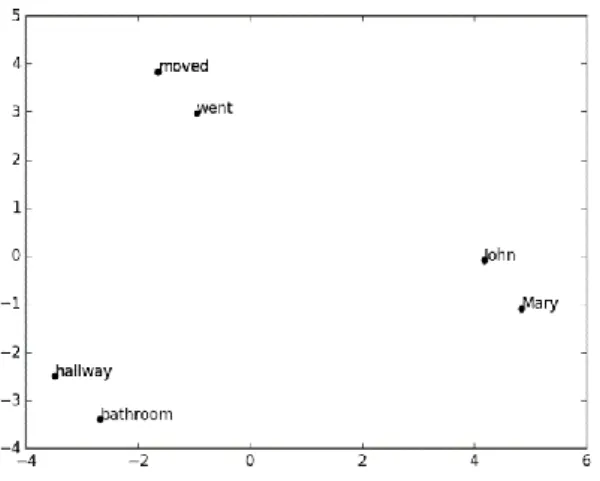
CHAIR, TABLE, CAR, BUS, MAN, QUEEN, WOMAN, KING”. ... 29 FIGURE 3.9:THE PROPOSED WORD REPRESENTATION FOR THE CONTEXT AND THE QUESTION –“MARY MOVED TO THE BATHROOM.JOHN WENT TO THE HALLWAY.WHERE IS MARY?” ... 31 FIGURE 3.10:WORD2VEC REPRESENTATION FOR THE CONTEXT AND QUESTION –“MARY MOVED TO THE BATHROOM.JOHN WENT TO THE HALLWAY.WHERE IS MARY?” ... 31 FIGURE 3.11:THE WORD REPRESENTATION IS DYNAMIC, AS SEEN IN “CAT RAN FAST.CAT HAS LEGS.CAT JUMPS HIGH”.SENTENCES ARE ADDED ONE SENTENCE AT A TIME.THERE IS THE CAPABILITY OF ACHIEVING SIMILARITY AND ASSOCIATION BASED ON THE SEMANTICS OF THE SENTENCES. WORD2VEC CAPTURES THE SEMANTIC REPRESENTATION, WHILE CONCEPTNET GENERALIZES VECTOR REPRESENTATIONS IN ORDER TO ENHANCE IT. ALSO, FROM (A) TO (C), THE VECTOR REPRESENTATION CHANGES WITH THE NEW CONTEXT. IN THE FINAL REPRESENTATION (C), THE SEPARATION OF WORDS IN EACH AXIS IS ACCORDING TO THE RELATIONSHIP. ... 33 FIGURE 4.1: THE PICTORIAL REPRESENTATION OF RL-LSTM, EXTRACTED FROM BAKKER [75]. THE ARROWS ARE FULLY CONNECTED WEIGHTS. RL-LSTM WAS DEVELOPED TO HANDLE NON -MARKOVIAN TASKS SUCH AS T-MAZE AND POLE BALANCING.MEMORY CELLS WOULD REMEMBER PAST INFORMATION AND PASS IT TO RL IN ORDER TO GENERATE THE FINAL OUTPUT. ... 37 FIGURE 4.2:THIS PRESENTS THE LSTRM NETWORK.THE ARROWS INDICATE THE DATA FLOW FROM ONE UNIT TO ANOTHER.{CONTEXT, QUESTION} IS THE INPUT AND ANSWER IS THE OUTPUT OF THE LSTRM NETWORK. ... 38 FIGURE 4.3:AN OVERVIEW OF THE PROPOSED LSTRM NETWORK MODEL WITH THE DATAFLOW.𝑋𝑡IS THE CURRENT INPUT.A VECTOR SPACE IS CREATED FROM THE INPUT GATE 𝑓𝑡.THE VECTOR SPACE IS USED AS THE ENVIRONMENT FOR RL. ℎ𝑡OUTPUT IS VALIDATED BY THE MODEL NETWORK USING THE VECTOR SPACE ENVIRONMENT.IF THE MODEL NETWORK DECIDES THIS ANSWER IS CORRECT, THE OUTPUT IS PASSED OUT. OTHERWISE, THE POLICY NETWORK, WHICH IS BASED ON MDP, WILL CORRECT THE OUTPUT. ... 42 FIGURE 4.4:THE STATES REPRESENTATION OF “MARY MOVED TO THE BATHROOM.JOHN WENT TO THE HALLWAY.”THE WORDS ARE THE STATES, AND THE VECTOR SPACE IS THE ENVIRONMENT.THE RL WOULD CHANGE FROM THE STATES IN THE VECTOR SPACE TO ACHIEVE THE GOAL STATE. ... 43
FIGURE 4.5:THE MODEL NETWORK INTERACTS AND LEARNS FROM THE REAL ENVIRONMENT (VECTOR SPACE).RL INTERACTS WITH THE MODEL AND GENERATES THE RESULTS TO THE REAL WORLD.THE DIRECT ARROWS INDICATE CONTINUOUS DATA TRANSFER AND THE DASHED ARROW INDICATES OCCASIONAL INTERACTIONS. THE POLICY NETWORK INTERACTS WITH THE REAL WORLD WHEN GENERATING OUTPUT. ... 45 FIGURE 4.6:THE POSSIBLE STEPS OF LSTRM IN GENERATING THE FINAL ANSWER FOR THE QUESTION.THE THICKER BOUNDARIES INDICATE THE RESULTS EACH STEP GENERATED. A. SHOWS THE RESULTS THAT ARE KEPT IN MEMORY IN THE MEMORY NETWORK (THIS HAS FORGOTTEN THE UNIMPORTANT WORDS). B. SHOWS THE FINAL RESULT (KITCHEN) GENERATED BY THE MEMORY NETWORK.SINCE THE ANSWER IS NOT CORRECT, THE MODEL NETWORK WOULD PASS IT ON TO THE POLICY NETWORK. C.THE POLICY NETWORK WOULD MOVE FROM STATE (WORD) TO STATE (WORD). D.THE POLICY NETWORK MOVES THE PREDICTED ANSWER TO OTHER STATES (WORDS) UNTIL IT REACHES THE CORRECT ANSWER. E. THE POLICY NETWORK MOVES TO THE FINAL ANSWER AND THIS ANSWER IS PASSED AS THE FINAL OUTPUT OF LSTRM. ... 47 FIGURE 4.7:OVERALL ACCURACY OF THE BABI1K DATASET INTRODUCING LSTRM, RESPECTIVE TO THE TRAINING DATA SIZE ... 50 FIGURE 4.8:LSTRM OUTPERFORMS RRN AND DMN AT TRAINING DATA SIZE 450 ... 50 FIGURE 4.9:LSTRM’S EM VALUES WITH INCREASING TRIVIA_QA TRAINING DATASET SIZES ... 51 FIGURE 4.10:EM RESULTS FOR THE QUASARS DATASET WITH REFERENCE TO THE TRAINING DATASET SIZE ... 53 FIGURE 5.1:LONG-TERM MEMORY CELL.THE ARROWS SHOW THE DATA FLOW FROM WITHIN THE CELL.
“.” INDICATES THE DOT PRODUCT BETWEEN THE TWO VECTORS AND + INDICATES THE SUM OF THE TWO VECTORS. ... 60 FIGURE 5.2:LONG-TERM MEMORY CELLS CONNECTED.THE FIGURE ALSO ILLUSTRATES THE DATA PASSED ON IN THE CELL STATE AND HOW THE OUTPUT IS PASSED ON FROM ONE LTM CELL TO ANOTHER... 62 FIGURE 5.3:GENERAL CELL OF A LONG SHORT-TERM MEMORY NETWORK.THE FIGURE ILLUSTRATES A GENERAL LONG SHORT-TERM MEMORY NETWORK CELL TAKEN FROM THE TIME ( TIME STAMP INPUTT). ... 67
List of Tables
TABLE 3.1: TESTED RESULTS ON THE STANFORD SENTIMENT DATASET USING CONCEPTNET 5 ... 23 TABLE 3.2: RESULTS COMPARISON USING CONCEPTNET 3, FOR THE STANFORD SENTIMENT DATASET ... 24 TABLE 3.3: ACCURACIES FOR FREE917 AND WEBQ DATASETS, WITH THE COMPARISON WITH BERANT’S
MODEL [26],APPROACH 1 AND APPROACH 2. ... 24 TABLE 3.4: PERFORMANCE ON SIMLEXC-999.THE PROPOSED WORD EMBEDDING IS CREATED USING
WIKIPEDIA DATA.THE PROPOSED WORD EMBEDDING AND [11] USE ≈1000M,[63] USES ≈990M AND [64] USES≈852M TOKENS. ... 31 TABLE 4.1:COMPARISON OF RAM WITH CURRENT DEEP NEURAL NETWORKS.X REPRESENTS THE MODELS
ACHIEVED THE TASK AND _ INDICATES THE MODEL HAS NOT ACHIEVED THE TASK. ... 41 TABLE 4.2: BABI1 K RESULTS FOR EACH TASKS COMPARED WITH LSTRM,RRN AND DMN.RAM
SHOWS WHICH CATEGORY THE TASKS FALL UNDER:R=REASON,A=ATTENTION AND M=
MEMORY... 49 TABLE 4.3:COMPARISON OF TRIVIAQA’S EM AND F1 SCORES BETWEEN LSTRM AND BIDAF,MEMEN
MNEMONIC READER AND HUMANS.‘-’ INDICATES THAT TESTS WERE NOT CARRIED OUT. ... 52 TABLE 4.4:QUASARS EM AND F1 SCORES FOR OVERALL EM AND F1 SCORES COMPARED TO BIDAF,
EXPERT HUMAN AND NON-EXPERT HUMAN AND LSTRM. ... 54 TABLE 4.5:QUASARS-T AND QUASARS-SEM AND F1 SCORES AGAINST REINFORCED RANKER-READER,
FULL RANKER, HUMAN PERFORMANCE AND LSTRM.‘_’ INDICATES THE MODELS HAVE NOT BEEN TESTED ON THE DATASET CATEGORY. ... 54 TABLE 5.1:PENNTREEBANK VALIDATE AND TEST PERPLEXITY ... 64 TABLE 5.2:TEXT8VALIDATE AND TEST PERPLEXITY... 64 TABLE 5.3:INCREASING THE NUMBER OF HIDDEN LAYERS FOR THE VALIDATION AND TEST PERPLEXITIES
List of Abbreviation
NLU
Natural Language Understanding
LSTM
Long Short Term Memory Network
RNN
Recurrent Neural Network
LTM
Long Term Memory Network
LSTRM
Long Short Term Reinforced Memory Network
RAM
Reasoning, Attention and Memory
RL-LSTM
Reinforcement Learning Long Short Term Memory Network
NLP
Natural Language Processing
QA
Question Answering
AI
Artificial Intelligence
DMN
Dynamic Memory Network
Introduction
Natural Language Processing (NLP) is the method of processing text data. The NLP methods are manifested in various applications, e.g. Chabot’s, sentiment analysis, and text summarization. However, natural language understanding is a subcategory on NLP. Natural Language Understanding (NLU) is focused on making a computer comprehend language. NLU is focused on understanding complex language. NLU uses computational techniques to learn and understand human language [1]. This began around the 1950s. However, the complex structure and dynamic nature of natural language make NLU, an Artificial Intelligence, a difficult issue (AI hard) [2]. NLU has been prominently improved in the past decade [1]. Improvements in NLU have mainly been due to machine learning algorithms [3]. Machine learning gained interest because it was capable of learning through the available data.
Earlier, NLU used statistical methods. These methods showed highly accurate results [4]. However, statistical methods were unable to make proper generalization since the patterns were too large and complex to be mapped and coded. Machine Learning (ML) was thus introduced to overcome this issue. ML algorithms such as Support Vector Machines (SVM) and Conditional Random Fields (CRF) have shown promising results. These ML algorithms have failed in proper generalization and identification of complex patterns. On the other hand, Artificial Neural Networks (ANN) have been shown to produce better results than the SVM and CRF algorithms. ANN was unable to identify complex patterns which were visible in NLU. A model had to be used to identify the complex hidden patterns.
Inspired by humans understanding natural language, natural language understanding models focus on deep neural network/ deep learning models. The deep neural networks have a similar structure to neurons in the brains. Deep neural networks have a large number of neurons combined together, to act similar to a set of neurons. Deep learning techniques are one of the most widely used algorithms in ML due to its ability to identify complex hidden patterns and the availability of data. The increase of computational power and a large amount of available
data enable deep learning to be applied for NLU [5]. The capability of the features to learn automatically from the available data has also made deep learning a popular technique for NLU [5]. This dramatic improvement in NLU through deep learning has enabled new deep learning models to be introduced. However, before processing the text, it should be converted either into a logical or numerical format. There are two main approaches in converting the text suitable for processing via deep learning. One approach is to convert the text into the semantic parser, which is to create a parsed text, while the other approach is to convert the text into a numerical format. Computational language understanding requires the conversion of text to computationally understandable structures [6]. Semantic parsing converts a natural language utterance into a logical form, which can be used to produce denotations [4]. The semantic parsed text holds the logical meaning of a given text [7]. In order to avoid complexity, the most common approach for text parsing is to parse sentence by sentence [8]. Most recent research on semantic parsing focuses on machine learning [3] [9], which requires supervision and training. Various techniques have been introduced to improve semantic parsing by reducing supervision.
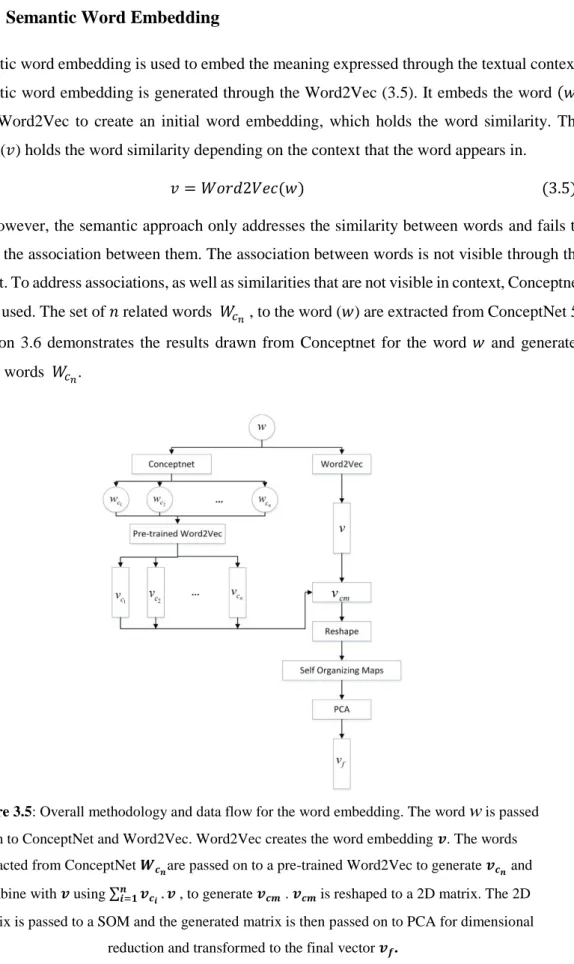
The other approach is to convert the text into numeric data. These deep learning models require text data to be converted as numerical data in order to process and learn the features [10]. The conversion of text to numerical data requires the conversion to hold all the information presented in the context [10] [11]. Textual information is converted into vectors. These vectors are created for the words in a given context and are generally called word embeddings/ word representation. As holding a logical representation or numerical data on text is not sufficient to address NLU, the data needs to be processed/ analysed [12] [13].
Deep learning models are designed in order to address certain tasks, from image analysis [14] to learning sequential data patterns [15]. During the past decade, many deep learning models have been introduced for NLU, e.g. Dynamic Memory Network [13], Recurrent Relational Network [16] and Active Long Term memory Network [17]. However, in order to achieve NLU, a deep learning model requires to address Reasoning, Attention and Memory (RAM) [12]. A deep neural network should be capable of learning to memorise context, give attention to important factors in the context and reason through a given context, in order to properly understand the context. Therefore, ultra-specific deep learning models, which achieved either reasoning, attention or memory, e.g. reasoning network [18], attention-based network [19], and MEMEN (Memory based network) [20] have been introduced. Furthermore, language is sequential and these sequences are long. The sequential information in natural language holds the relationship with each of the words [21]. NLU depends highly on the sequence of text and prior information is required in gathering knowledge of the content. Memory networks are used
to hold sequential memory. In order to hold a sequence in memory, many types of memory networks are developed. The Long Short-Term Memory Network (LSTM) is created to carry the past inputs through the use of cell state and logic gates [15]. This prevents the LSTM from facing the exploding and vanishing gradient problem, similar to the Recurrent Neural Network (RNN). The LSTM will allow access to the older inputs so as to improve the output. The LSTM will also reduce the computational operational time and learn from the sequence. Some models were introduced to combine sequentially placed LSTMs to address long term memory [22].
1.1
Problems in Natural Language Understanding
Although NLU has gained momentum in the past decade, there are still gaps in the research. This thesis focuses on three issues still existing in many NLU applications.
1. Semantic Parsing and Word Embedding
Current NLU approaches focus on semantic knowledge (context knowledge), which is not sufficient to understand language. Semantic parsing uses the context to create a logical form for a given sentence and word embedding uses the context to create a vector representation for a given word. Word representations are inputs for the learning models in NLU tasks. However, to understand language, knowing only the context is not sufficient. Reading between the lines is a key component of NLU. Embedding word relationships, which are not represented in the context, enhance the word representation.
2. Reasoning, Attention and Memory (RAM)
Context-based question answering (QA) tasks require Reasoning, Attention, and Memory (together RAM) and QA tasks are one of the common methods normally used to validate NLU capability. Deep neural networks are capable of understanding non-linear hidden patterns in text. Recent research has used these capabilities of deep neural networks to support the learning of RAM. Currently, most developed deep neural networks do not focus on all three factors in RAM in one model. Deep neural networks would either focus on reasoning, attention, or memory (but not three) for the QA tasks.
3. Handling Longer Sequences
RNN, LSTM and other memory networks which contain memory are popularly used to learn the patterns in sequential data. Sequential data have long sequences that hold relationships. RNN can handle long sequences but suffer from the vanishing and exploding gradient problems. While the LSTM and other memory networks address this problem, they are not capable of handling
long sequences (50 or more data points long sequence patterns). Language modelling requiring learning from longer sequences are affected by the need for more relevant information in memory.
1.2
Aims and Objectives
A key factor in NLU is holding context-based knowledge and general knowledge in order to understand any given language. Capturing context-based knowledge and general knowledge and using that knowledge to improve NLU by enhancing meaning representation and reasoning, attention and longer sequential memory.
A word and sentence representation are required by the machine learning models as an input for machine learning models to properly understand the text. Given the word and sentence representations, machine learning models should use reasoning, attention and memory to understand the text. However, in order to properly understand language long sequences are required by a machine learning model. In order to show a proper flow, and to address the problems outlined above, the following are the aims and objectives investigated in this thesis.
1. Improving sentence and word representation by enhancing meaning representation
In order to understand a language, context and prior knowledge of the context is required. Therefore, in order to enhance sentence and word representations, an integration of context-based knowledge and meanings extracted from a knowledge base is investigated and introduced.
2. Addressing RAM in one model
RAM is a key factor in understanding language. A model should be able to learn to reason from the context, give attention and hold the context in memory. A model must hold the capability of learning to achieve all factors in RAM, so as to properly understand a given language. Therefore, one model to achieve reasoning, attention and memory is investigated and introduced.
Language has long sequences which hold dependencies in the sequence. Thus, learning the sequence and holding the sequence in memory is a key aspect in language understanding. Therefore, it is necessary to investigate and develop a model which is able to hold a longer memory in order to understand language.
1.3
Contribution
1. Integrating semantic knowledge and a knowledge base to create an enhanced meaning representation for sentence parsing and word embedding
This study presents a model to cover the gap in providing enhanced meaning representations, which combine semantic knowledge and knowledge graph extracted knowledge for a given word to create word representations. The resulting word representation contains more relationships and knowledge than semantic models. A higher weight is given to the semantic word representation to avoid an over-generalization of the final word representation.
2. Addressing reasoning, attention and memory for natural language understanding with an improved deep learning model
This study will address the problem of having a model that can address RAM at the same time for QA tasks. The contribution is on proposing a novel deep neural network, named as LSTRM (Long Short-Term Reinforced Memory), which explores all three factors in RAM for context-based question answering tasks. In LSTRM, an adaptation of the Long Short-Term Memory Network (LSTM) is used to create a memory. Reinforcement Learning (RL) is used to enhance attention and reasoning. LSTRM is capable of reasoning and dynamic question-fact interaction (attention) on the memory it holds.
3. A learning model which has the capability to better learn longer sequences for NLU
In NLU, using the relevant information in a long sequence is important. As such, this part of the study proposes a Long Term Memory network (LTM), which can tackle the exploding and vanishing gradient problems and handle long sequences without forgetting. The LTM
is designed to scale the data in the memory and give a higher weight to the input in the sequence.
1.4
Thesis Organization
The thesis consists of 6 Chapters and is organized as follows.
Chapter 1 provides a description of the current state of Natural Language Understanding (NLU) and the problems it faces. This Chapter describes the motivation for the proposed approaches in order to address the problems in NLU. The Chapter concludes by pointing out the contributions made in this thesis towards NLU.
Chapter 2 covers existing NLU techniques and provides an overview of the gaps in the research in this field.
Chapter 3 contributes to the enhancement of the meanings for word and sentence representation. In this Chapter, an approach to integrate both the knowledge acquired from semantics (context-based knowledge) and knowledge acquired from a knowledge base is presented. This Chapter demonstrates a semantic parser which extracts knowledge from Conceptnet in two stages, in order to generate enhanced meaning representations to support semantic parsing. In this Chapter, an enhanced word embedding, which integrates semantics and knowledgebase (ConceptNet) knowledge is introduced. The integration between the semantics and knowledge base generates an embedding which enhances the meaning representation. Chapter 3 focuses on enhancing the meaning representation to develop a semantic parsing and word embedding.
Chapter 4 contributes to RAM for question answering. In this Chapter, the Long Short-Term Reinforced Memory Network (LSTRM) is introduced. This Chapter discusses how LSTRM uses concepts of memory networks and reinforcement learning to address RAM. This chapter demonstrates the performance of QA tasks which require RAM.
Chapter 5 focuses on long term memory. This chapter introduces the Long Term Memory (LTM) network. It describes the LTM architecture and demonstrates its performance on language modelling. Through language modelling, the LTM network shows it is capable of learning long sequences.
Chapter 6 gives the conclusion and summary of the thesis. It also discusses the future work that would be conducted as a result of this research.
Background
This chapter reviews the literature on NLU using deep learning to provide a foundation for the thesis. Section 2.1 discusses what NLU is, its branches and applications. Section 2.2 discusses the use of deep learning in NLU and its models. Section 2.3 discusses the problems in the current approaches in NLU. Finally, Section 2.4 summarizes Chapter 2.
2.1
Natural Language Understanding
Natural language is the language which humans use to communicate with each other. Natural language can be expressed in both spoken and text forms. Natural Language Understanding (NLU) is the practice of using computational models and techniques to learn and understand human language [1]. NLU is a subfield in Artificial Intelligence (AI) because it provides the capability of learning and understanding natural language similar to humans [2]. In order to address NLU through computational models, NLU is divided into 5 main steps. These sections are directly based on the Natural Language Processing (NLP) approaches. The main steps of NLU are lexical analysis, syntactic analysis, semantic analysis, discourse integration and pragmatic analysis [3] [23].
Lexical analysis is conducted in order to analyse the structure of words, phrases or a collection of words in any language. This is used to identify and separate text into meaningful sections. The syntactic analysis uses grammar in sentences, which arranges words in order to show the word relationships. The semantic analysis draws the contextual-based meaning of the sentences through the use of syntactic structure. Discourse integration analyses sentences with the use of past sentences. The knowledge of past sentences is carried forward to analyse the new sentence. Finally, pragmatic analysis is based on re-interpreting the context in order to understand the actual meaning of the sentences [3] . NLU models are based on addressing these main steps. However, the overall main contribution to NLU is through syntactic analysis, semantic analysis, discourse integration and pragmatic analysis. Pragmatic analysis requires
cognitive science and phycology [24]. In this thesis, only syntactic analysis, semantic analysis and discourse integration are considered for NLU, because they are the main contributors of NLU, as compared to the various steps described above. These steps can be validated through different applications in NLU.
2.2
Applications in NLU
There are many applications that use NLU [3]. Some of these applications are used in order to validate the steps in NLU. The main applications can be divided into two main categories, namely pre-processing for: NLU and NLU models respectively. The main pre-processing applications include: Parts of Speech (POS) tagging [24], Name Entity Recognition (NER) [25], semantic parsing [26] and word embedding [10]. The pre-processed information would be transferred to NLU models in order to understand the language. NLU models are Machine Translation (MT) [27], dialog systems [28], Question Answering (QA) systems [12] and language modelling [29]. The pre-processing models are based on lexical analysis, syntactic analysis and semantic analysis. Here, the NLU models are based on semantic analysis and discourse integration. Also, pragmatic analysis will not be discussed as it is beyond the scope of the thesis.
POS tagging involves tagging a token to words in sentences based on its context (adjectives, nouns or verbs). POS tagging is mostly done through rule bases. Tagging sentences support NLU, as it provides the NLU model with more details to process the sentence [24]. NER models tag words which are names and entities [25]. This is used in order to identify which words require attention, compared to the other words in a given sentence or paragraph. Tagging identifies key elements in a context but does not give a proper representation of the context. Semantic parsing is converting a given sentence into a logical format [26]. The logical format represents the meaning of the sentence. The logical format created through semantic parsing is used in NLU models in order to understand sentences clearly. Word embedding is the conversion of words into numerical representation (a vector) [10]. Word embedding holds knowledge about the word and its relationships. Therefore, word embedding holds meaning representations of the words. The most common word embeddings use semantic relationships to create the vector. Therefore, word embeddings hold semantic knowledge about the words in a given sentence.
The pre-processed output is passed on to the NLU models for the processing and generating of meaning or understanding. MT translates a text/ speech from one language to another [27].
The best MT model should be able to translate from one language to another without affecting the grammatical structure of the language. Another NLU model, dialogue systems, is a model which can carry out a conversation with a human by using natural language [28]. Therefore, dialogue systems are developed to understand the conversations that humans carry out and thereby respond accordingly. However, QA requires a model to understand a context and question in order to derive the answer [12]. Therefore, QA systems have a high dependency on understanding a given text. Finally, language modelling is the task of predicting the last word in a given sequence of words [29]. In order to predict the last word, the NLU model should capture the sequence and understand the context. Without holding the sequence and understanding the sequence, the NLU model is not capable of predicting the last given word in the sequence.
This thesis focuses on 4 main applications in NLU. Under pre-processing, semantic parsing and word embedding are focused upon. Under NLU models, QA and language modelling are the focal points. Semantic parsing and word embedding are pre-processing models which derive meaning using the context. Unlike other pre-processing models, rather than filtering words, these pre-processing models are context and meaning dependent. These models can directly influence language understanding. Therefore, semantic parsing and word embedding’s meaningful representations for NLU is a key factor. QA is a challenging and complex task which requires complex NLU [12]. QA models require understanding through many aspects of NLU. Furthermore, language modelling requires a level of sequential understanding in order to predict the next word in the sequence. Language modelling should learn from the sequence and context [30]. Therefore, a good language model should be able to learn from the long sequence and understand it in order to predict the last word in the sequence. In order to address these NLU applications, models are developed using various techniques.
2.3
Models Enhancing NLU
Each of the 4 applications are discussed separately in this section.
2.3.1
Semantic parsing
Semantic parsing is the conversion of a given text into a logical format with meaning representation. Semantic parsing is developed in three different approaches: Logic-based, which converts the text into a first-order logic; Graph-based, in which the nodes are entities and Programming Language Conversion, which converts the text directly into a programming
language [31]. Similar to every AI technique, the early semantic parsing models first used a rule-based approach, which later changed to a statistical approach and finally, a supervised approach [31]. A different approach of supervision uses the knowledge base to create the semantic parser [8]. The use of the knowledge base allows the semantic parser to use knowledge, which is not available in the context, to identify the relationships and create an in-depth logical relationship between the words to create the semantic parse result [32]. Using context alone is insufficient to identify relationships between the words because the relationships are only based on the available context [33]. Therefore, a model based on the relationships between words to create a logical representation is more robust with the use of a knowledge base, as compared to using only the context.
2.3.2
Word embedding
Word embedding is the conversion of words in a context into the numerical format. Earlier models such as one-hot-vector used vectors to create identify words in a context. Although this vector representation holds value for a given word, it does not represent any other information of a given word. As such, such vectors are insufficient for NLU models to understand the context [34]. Therefore, the capturing of context-based information and the embedding of it in a vector for processing is crucial for NLU models [13]. The more information the word embedding process holds, the better it can support any NLU model [11]. Therefore, it is important that a word embedding model captures all the knowledge on a given word in order to support the NLU models.
These pre-processing models are key elements in NLU models which process the language and generate an output. The pre-processed input is then passed on to be processed, and the NLU model is thus created.
2.3.3
Question Answering
QA models require a good understanding of language. A QA model should be capable of going through a given context and understanding the context and question in order to answer it. Early adaptations of QA models used rule-based approaches and statistical models which focused on following a given probabilistic model or rule set in order to answer a given question [35]. However, with the introduction of large data sets, the rule-based and statistical models were not capable of performing well due to the dynamic and complex nature of natural language.
Therefore, machine learning models which learnt from examples were capable of capturing the dynamic nature of the language [1]. With the increase in computational power, deep learning has been used in natural language. These deep learning models have shown to outperform the other approaches used for NLU [36]. Therefore, many deep learning algorithms have been introduced to achieve QA [37] [16]. These deep learning models are structured in order to achieve specific tasks which support QA. Deep learning models in QA have shown to address most of the problems faced in understanding context and questions to generate an answer. Moreover, QA is not the only NLU application that has been highly improved through the use of deep learning.
2.3.4
Language modelling
Language modelling is the prediction of the last word(s) in a given sequence [30]. This sequence can be a sentence, a paragraph, a Chapter or a book. In order to predict the last words in a sequence, a deep learning model should capture the sequence and understand the context. Therefore, language modelling requires deep learning models to hold the sequences. Memory networks are the models that are capable of holding sequences and using them for processing. The most popular networks that have been used for language modelling are the Recurrent Neural Network (RNN) [30] and the Long Short-Term Memory Network (LSTM) [15]. LSTM and RNN use the past outputs as current inputs. Therefore, the current output is influenced by past output. Therefore, the sequential information is carried on through time. Because language is sequential and the relationships between words are key to understanding language, carrying forward past information has been a crucial element to achieving NLU.
2.4
Problems in NLU
Although NLU has shown tremendous improvements throughout the past decade due to the introduction of a large linguistic dataset, an increase in computational power and successful machine learning models [1], there are still many gaps left to be addressed. In this section, three main gaps in NLU (through the aspects of NLU applications) are pointed out.
2.4.1
The Problem of using only Context-based Knowledge for NLU
In order to understand language, most of the current models use only the available context [10]. However, only using the available context would not suffice. Similar to humans, in order to understand language, it requires the holding of knowledge which is not available in the context. Therefore, additional information, which is not available in the context, must be added on in order to address NLU [33]. Holding contextual knowledge can be used in order to understand a context from a broad perspective. Current pre-processing approaches process using only the available context and pass it onto the NLU models. Thus, these NLU models are only capable of learning from the available context and are consequently limited to the given context. As compared to context-based models, pre-processing models can be influenced to generate better results through additional information [8]. In particular, sentence-based pre-processing models (semantic parsing) and word-based pre-processing models (word embedding) can directly influence the results, by holding additional information, as compared to only holding context-based information. Therefore, in order to achieve proper NLU, it is essential to use pre-processing models to hold enhanced meaning representation (knowledge which is extracted apart from the contextual knowledge).
2.4.2
The Problem of Reasoning, Attention and Memory
Enhanced knowledge of sentences or words through pre-processing is not sufficient to address NLU. Reasoning, Attention and Memory (RAM) are the three factors that the NLU model should be capable of addressing in order to understand language [12]. An NLU model can be validated on RAM based on the model’s capability of handling QA [13] [16]. In order to answer a given question from a context, an NLU model should be able to use its memory, focus its attention on important facts, reason through the context and question in order to generate the answer. Therefore, an NLU model should be able to address all aspects of RAM in order to properly answer a given question. However, current NLU models are capable of addressing only one or two factors in RAM. In particular, the Recurrent Relational Network focuses mainly on attention and reasoning [16], while the Dynamic Memory Network focuses mainly on attention and memory [13]. Models which focus on one or two factors in RAM will thus compromise on the other factor(s). Therefore, there is a need for a model which is capable of addressing all the factors in RAM.
2.4.3
The Problem of Long Term Memory
Language is sequential. This sequence is long-ranging; from sentences, paragraphs, as well as Chapters to books. These sequences hold dependencies within each of them. Therefore, in order to understand the language from the sequences, a model should be capable of holding long sequences [21]. The most common models which are capable of holding sequential data are the RNN and LSTM (commonly known as memory networks). Most of the other memory networks are based on the concepts of the LSTM. However, the LSTM controls its memory and is not capable of holding long sequences. The LSTM uses the forget gate to forget the past sequence if the network decides that it is irrelevant. Therefore, the LSTM limits its memory [15] and does not hold long sequences. Given a long sequence, the same condition is applied for many memory networks. However, the RNN does not limit its memory. Instead, when presented with long sequences, the RNN suffers from the vanishing or exploding gradient problem [38]. Therefore, the RNN fails at training when presented with long sequences. Long term memory can be validated through language modelling, in which a model should be able to learn the long sequence in order to predict the last word in that sequence. Current memory networks do not perform well in language modelling since they either forget the past sequence or get affected by the vanishing or exploding gradient. Therefore, a model which can learn long sequences, without being affected by the vanishing or exploding gradient, is required.
Improving Semantic Word Representations by
Embedding and Semantic Parsing using Enhanced
Word Relationships
In this Chapter, the purpose is to enhance meaning representation at the sentence and word levels. At the sentence level, the objective is to improve the way semantic parsing is used, while at the word level, word embedding is key to enhance the words embedded by adding meanings. The main focus is the impact on NLU by using the knowledge base and integrating semantic information and the knowledge graph to improve NLU. In order to support NLU, knowledge from the context, as well as pre-conserved knowledge from the knowledge base, are integrated. This demonstrates the use of enhanced word relationships in order to address semantic parsing and word embedding. This Chapter is divided into two main sections. For the first half (from Sections 3.1 to 3.4), it focuses on the study of sentence-level meaning enhancement, whilst the second half (from Sections 3.5 to 3.8) focuses on enhancing word-level meaning representations.
This chapter is organized as follows. Section 3.1 discusses the knowledge base used for semantic parsing. Section 3.2 describes the models that are introduced for semantic parsing. Section 3.3 proposes two models for semantic parsing using knowledge bases. Section 3.4 compares the proposed models to the other knowledge-based semantic parsing models. Section 3.5 describes semantic word embedding and the need for enhanced word relationships. Section 3.6 describes the word embedding model integrating a semantic word vector and a knowledge graph. Section 3.7 describes the novel word embedding model. Section 3.8 describes the results compared to the other word embedding models. Section 3.9 concludes with the introduced semantic parsing models and the word embedding model.
3.1
Semantic Parsing Approaches
Computational language understanding requires the conversion of text to computationally understandable structures [2]. Semantic parsing converts natural language utterance into a logical form, which can be used to produce denotations [26]. These denotations are used for many natural language understanding tasks such as semantic role labelling, Word Sense Disambiguation (WSD), query processing, Information Extraction (IE) and Question Answering (QA) [39]. Most recent research on semantic parsing focuses on machine learning [40, 41], which requires supervision and training. Various techniques have been introduced to improve semantic parsing by reducing supervision [26]. In order to achieve this, it uses a knowledge base, ConceptNet [42], to fully remove supervision. ConceptNet is a knowledge-base contains words and its relationships. ConceptNet can be used to extract related words to given words through the various relationship connections [42].
Semantic parsing requires a combination of natural language with logic in order to construct the best results [41]. In order to construct a set of a proper logical predicate, a knowledge base is required. A knowledgebase is used to paraphrase and semantically parse a sentence [41]. Knowledge bases have the potential to achieve complex semantic parsing. ConceptNet 3 is utilised to manually extract concepts for the semantic parsing of sentences [8]. Even though ConceptNet contains an imperative set of concepts for semantic parsing and uses these concepts to remove supervision, two novel Approaches are further introduced. These two Approaches are explored as one method focuses more on concepts, whereas in the other, basic filtering take place depending on the relationships. The proposed techniques use ConceptNet 5 [42] as it is the updated version from ConceptNet 3. Furthermore, concepts are extracted from ConceptNet using two levels: i) the concepts are first extracted via the input sentence words (Level 1); ii) the extracted concepts are passed on to ConceptNet 5 and the concepts are then extracted for the second time (Level 2). These two levels of search create a multi-level search. The extracted concepts are matched with each other to generate a semantic parsed output. Also, the two Approaches are different as Approach 2 filters concepts at Level 1 (based on relationships) and do the concept extraction at Level 2. However, for Approach 1, the concepts are extracted and finalised in one Level. The aim is to use the concepts to create a logical format. As an example, for the search, “when was the United Nations founded?”, the proposed Approach focused on producing: nations) en.united_ : fb unded on.date_fo organizati : fb (! (3.1)
The idea’s novelty is based on using a multi-level search on ConceptNet, with automatic extractions of concepts from ConceptNet 5. The proposed Approaches hold information-rich semantic parsing results.
3.2
Semantic Parsing using Knowledgebase
Many semantic parsing approaches have been introduced in recent years. Most research has focused on machine learning approaches. Machine learning approaches such as deep neural networks [26] and SVM [32] have been used. Learning approaches for semantic parsing requires the learning of a pattern to extract information in order to create the semantic parser. Even though learning methods are capable of learning complex patterns and extracting information for a semantic parser, they are not capable of generating unavailable information in the text. NLU requires information available in the context, and knowledge which is not available but related to the context. The related information provides an insight into the context. Therefore, there should be a method of extracting unavailable information. A knowledgebase has the capability of providing the unavailable information through the input text.
Wordnet [43] is a knowledge base which holds lexical information. The lexical information held in Wordnet has the capability of providing the unavailable information [44]. Therefore, information-rich results are generated through the use of a knowledge base. ConceptNet 5 [42] is a complex knowledge base which holds a number of concepts for each word. ConceptNet 5 holds pre-existing lexical and semantic features for words and phrases. This also provides unseen information that cannot be extracted from the context. These concepts from ConceptNet hold more information which could be used to enhance semantic parsing [8], while dependency parsing is used to get the semantic relationships between the words. Conceptual information is gathered using the ConceptNet ontology. The concepts from the text are sent to ConceptNet and the semantics are then retrieved. This focuses on identifying concepts from the inputs and passing the concept to ConceptNet to find the relationships. ConceptNet is used in order to give the machine a better understanding of the sentence.
Through paraphrasing [41], ConceptNet allows the parser to identify more complex concepts to support semantic parsing. Through the use of paraphrasing, machine learning approaches require less training and supervision in semantic parsing as it provides insight by utilising more information to support the semantic parser. [26]. Therefore, the Approach aims to achieve a semantic parser which uses ConceptNet to remove supervision and training.
3.3
Proposed Knowledge-based Semantic Parsing
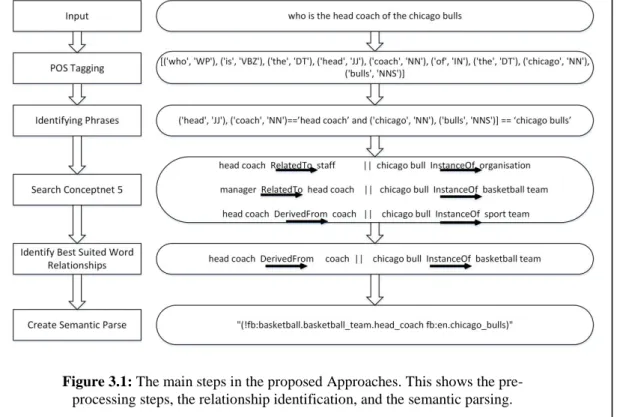
This research focuses on creating a semantic parser with the use of ConceptNet 5 using a multi-level search. The basic steps of the method are shown in Figure 3.1. The left panel shows the steps, while the right panel shows how an example is parsed. The first step is Part Of Speech (POS) tagging of the inputs. Using the tagged sentences, the phrases will be identified. The phrases and words are then searched in ConceptNet 5. The extracted concepts are validated and used for semantic parsing.
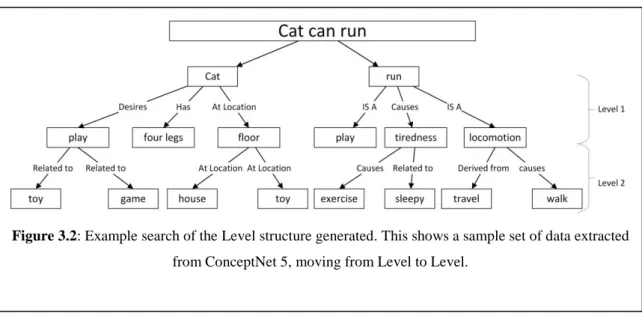
ConceptNet 5 is used to map words with the knowledge to support semantic parsing. Using the pre-existing knowledge of ConceptNet 5 for each word and word phrase, a knowledge structure (as shown in Figure 3.2) is generated. Furthermore, as shown in Figure 3.2, initially, the words and word phrases are searched from ConceptNet 5, which creates level 1 search results. The level 1 results are then searched in ConceptNet 5 in order to generate level 2 results. The results in level 2 are then used for the parser.
The methodology can be divided into two phases: generating the lexical representation and semantic representation generation. POS tagging is used to identify and process the information so as to create the lexical representation. The lexical representation is thereafter used to create
Figure 3.1: The main steps in the proposed Approaches. This shows the pre-processing steps, the relationship identification, and the semantic parsing.
the semantic representation through ConceptNet 5. The two Approaches presented in this Chapter differ in the final phase of generating semantic representation.
3.3.1
Lexical Phase
The main task in the lexical phase is POS, which is shown in Figure 3.1. This step is important as the tags for the words are used to identify the phrases from the words. A given query is tagged using the NLTK POS tagger since this method is a simple tagging method without the use of any learning method. The tagged query is used in order to create phrases. The initial step is used in order to combine words which should be searched together. In ConceptNet 5, as an example, if the words, “prostate” and “cancer” were searched separately for “what causes prostate cancer?”, it would generate irrelevant results for the given query. When tagged using the NLTK POS tagger, it will generate:
)] NN' ' , cancer' (' ), NN' ' , prostate' (' ), VBZ' ' , causes' (' ), WP' ' , what' [(' (3.2)
The tags are used to create the phrase. The following seven rules are used, which are a subset of the rules used in [8] for creating the multi-word expressions/ phrases that will be searched from ConceptNet 5.
Rule 1: Names which fall together, such as “Barack Obama”, are combined together to create a phrase.
NP = NN + NN
Rule 2: Nouns which fall together, such as “farmer’s market”, are combined together to create a phrase.
NP = NN ’s + NN
Rule 3: Nouns which follow the pattern of a noun followed by the plural of another noun [‘NN’, ‘NNS’], such as “city officials”, are combined together to create a phrase.
NP = NN + NNS
Rule 4: Names such as “Alice in Wonderland”, which follow the pattern of [‘NNP’, ‘IN’, ‘NNP’] are combined together to create a phrase.
NP = NNP + IN + NNP
Rule 5: A numeric value before a noun or set of nouns is combined together to create a phrase. Example: “2003 cricket world cup” should be considered a phrase.
NP = NUM + NN+NN+NN
Rule 6: A noun followed by a numeric value and a noun, similar to “Apollo 12 mission” is considered a phrase.
Rule 7: A worded numeric value followed by a noun or nouns, as shown in the example “second grade”, is combined as a phrase.
NP = NUM + NN
After the phrases are generated, stop words such as “a, an, is, at, be, by, for, is, in, were and was” are removed from the query. These stop words have little effect on the semantically parsed results. Since the stop words are removed after the phrases are identified, the stop words in the phrases are not affected. This is with reference to the stop words in word phrases such as “Alice in Wonderland”. This is the identifying phrase (Figure 3.1), which combines the words to create noun phrases.
The generated phrases and words are searched automatically in ConceptNet 5. In order to search ConceptNet 5, the words and phrases are passed to the ConceptNet 5 API. This generates related words and their relationships (concepts) to the searched word/ phrase. ConceptNet 5 is searched on two levels. The levels are described as shown in Figure 3.2 for the example of “cat can run”. The two levels created in the methods are based on the two stages of information extraction. The initial concept extraction for the information creates the first level, while the next concept extraction creates the second level. These Approaches do not use any handwritten rules in extracting the concepts as well as for semantically parsing the query. Two approaches are used to improve semantic parsing.
The step, “search in ConceptNet 5” (as shown in Figure 3.1), is achieved using these two Approaches. They are described as follows. The next sections explain identifying best-suited word relationships.
Figure 3.2: Example search of the Level structure generated. This shows a sample set of data extracted from ConceptNet 5, moving from Level to Level.
3.3.2
Approach 1
Figure 3.3 shows the steps in Approach 1. The search mentioned in Figure 3.3 is based on the extraction of concepts from ConceptNet 5. All the concepts extracted at Level 1 are searched again in ConceptNet 5. The concepts drawn from Level 2 are used to semantically parse the query. The relationships and related words are mapped with each other in order to generate the logical format. The logical format is based on the lambda format. The lambda expression predicate is created using these extracted concepts. The lambda expression variable is extracted from the query itself. The related words at Level 2 and their relationships are further used to enhance the semantic logical format to be generated. The relationships are identified by matching the words in the concepts extracted. As shown in Figure 3.2, “cat” and “run” both have “play” in common. With that information, it can be stated that the words have a semantic similarity.
In this Approach, the words from the query are not eliminated although they do not show any relationships at Level 1 of the ConceptNet 5 search. There are a larger set of concepts in Conceptnet 5 compared to the earlier versions. These extracted concepts can be used to improve on the semantic parsing, as well as further elaborate a sentence.
3.3.3
Approach 2
As shown in Figure 3.4, the initial search for Approach 2 is similar to Approach 1, where Level 1 search results are extracted from ConceptNet 5 for each word or phrase in the query. The results generated from Level 1 for each word and phrase are then compared. The relationships with each word and phrase are identified, and the rest of the words are dropped. The identified related words and phrases are then passed to ConceptNet 5 to further extract the concepts. The generated concepts in Level 2 are used in order to create the semantic parser. The extracted
Figure 3.3: Approach 1 Block Diagram, shows the data flow from one step to the other.
concepts are used in developing the parser using the words and their relationships in Level 2. The filter applied to the Level 1 results reduces the Level 2 search in ConceptNet 5. This reduces a substantial amount of search in ConceptNet 5 at Level 2, thereby reducing the computational intensity in generating the final semantic parse logical format.
3.3.4
Semantic Phase
The proposed Approaches use ConceptNet 5 without any filter, similar to [8]; therefore, it is information-rich. ConceptNet 5 provides words and their relationships to develop the logical format for semantic parsing. The logical format is created using the lambda format. The predicate of the lambda expression is used for the concepts extraction from ConceptNet 5 and pass the variable from the query. This can be explained further through the use of the example query, “what is serge made out of?”, where the target lambda expression is:
en.serge) : fb r xtile.fibe fashion.te : fb (! (3.3)
The predicate “fashion.textile.fiber” is generated using the concepts drawn using ConceptNet 5 and “serge” is directly extracted from the query. Hence, this can be considered an improvisation of the calculations for semantic parsing. This also provides more information which is not revealed in the given query. Therefore, that information is not missed out when parsing the query.
3.4
Comparing Semantic Parsing Models and Analysis
The proposed Approach was tested on the Stanford Sentiment and Freebase datasets. These datasets comprise of 11 855 and 917 open domain queries, respectively. The queries are similar to queries which are passed to a question answering system or search engine. The two Approaches were tested using all the data in the Stanford Sentiment dataset, which includes both the training and testing datasets.
The queries in the datasets were converted into a lambda format. The lambda format supports a direct search from a corpus. The lambda format generates a logical format. Given the example, “when was starry night painted?”, it generates the related words and their relationships from ConceptNet 5. The proposed Approaches will generate:
paint Related To art
starry night InstanceOf artwork
based on the above relationships and generated words (3.4), which shows the logical format: night) en.starry : fb ted ate_comple .artwork.d visual_art : fb (! (3.4)
For each query, the proposed Approach generated more than one logical expression, depending on the relationships. The semantic parsed results are not limited to be one-on-one, but instead, generate as many results as possible for each query.
The results generated in the experiments are shown in Table 3.1. In Approach 1, the results generated in Levels 1 and 2 are used separately for semantic parsing. This enables us to identify and observe the improvement in providing more concepts in order to achieve semantic parsing. The following equations were used:
True Positive = TP
False Positive = FP
False Negative = FN
Total Number of Queries = TNQ
Precision = TP/ (TP+ FP)
Recall = TP/ (TP+FN)
Accuracy = TP/ TNQ
Overall, the results in Approach 2 achieved a high recall rate of 94.39% due to the high level of concepts available. The concepts were not omitted; therefore, rich information is used for semantic parsing. Validating the concepts from the first level to the next reduces the false negative results. An improvement of 1.33% of the recall rate is visible from Approach 1 to Approach 2. The reduction of false negative can be stated to be important for tasks similar to question and answering query optimization, as it reduces the missing important information.
The results generated in Approach 1 show that when moving from Level 1 to 2, the recall improves from 91.96 to 93.29%. This validates the hypothesis that when provided with more concepts, the results will improve.
Although a high recall is shown, precision is reduced due to the high number of false positive results created in Approach 1. The issue is addressed by applying a filtration method in Approach 2. Following that, as shown in the results, recall and precision improve. Therefore, the use of a filter after the Level 1 search seems to generate better results.
Approach 2 can be compared with Approach 1 in the aspect of computational intensity. Approach 2 reduces the searches in Level 2 due to the relationship filter. Both Approaches have a computational complexity of O(nc), where

![Figure 4.1: The pictorial representation of RL-LSTM, extracted from Bakker [75]. The arrows are fully connected weights](https://thumb-us.123doks.com/thumbv2/123dok_us/9060130.2804136/50.892.300.684.655.846/figure-pictorial-representation-extracted-bakker-arrows-connected-weights.webp)