Modeling the Interface between
Morphology and Syntax
in Data-Driven Dependency Parsing
Von der Fakultät Informatik, Elektrotechnik und Informationstechnik der Universität Stuttgart zur Erlangung der Würde eines Doktors der
Philosophie (Dr. phil.) genehmigte Abhandlung
vorgelegt von
Wolfgang Burkhard Werner Seeker
aus JenaHauptberichter: Prof. Dr. Jonas Kuhn
1. Mitberichter: Prof. Dr. Dr. Joakim Nivre
2. Mitberichter: Prof. Dr. Sebastian Padó
Tag der mündlichen Prüfung: 18. Dezember 2015
Institut für Maschinelle Sprachverarbeitung der Universität Stuttgart
2016
iii
I hereby declare that I have created this work completely on my own and used no other sources or tools than the ones listed, and that I have marked any citations accordingly. Hiermit versichere ich, dass ich die vorliegende Arbeit selbst¨andig verfasst und keine anderen als die angegebenen Quellen und Hilfsmittel benutzt sowie Zitate kenntlich gemacht habe.
Stuttgart, Oktober2015
v
Contents
Abstract xiii ¨ Uberblick xv Acknowledgements xvii 1 Introduction 1 1.1 Parsing . . . 41.2 Claim and Contributions . . . 5
1.3 Publications . . . 7
2 Background 9 2.1 Dependency Grammar and Dependency Trees . . . 9
2.1.1 Projectivity . . . 11
2.1.2 Treebanks . . . 12
2.2 Dependency Parsing . . . 14
2.2.1 Transition-based Parsing . . . 14
2.2.2 Graph-based Parsing . . . 17
The Chu-Liu-Edmonds Algorithm . . . 18
Arc-factored Model and Higher-order Factors . . . 19
Parsing as an Integer Linear Program . . . 23
Lagrangian Relaxation and Dual Decomposition . . . 25
2.2.3 Transition-based or Graph-based Parsing? . . . 28
2.3 Training the Statistical Models . . . 28
3 Motivation 33 3.1 Morphology and Syntax . . . 33
3.2 Syncretism . . . 35
3.2.1 Disambiguation in Context . . . 36
3.3 Ambiguity in Word Segmentation . . . 39
3.4 Modeling Choices . . . 42
3.4.1 Sequence Models for Morphological Analysis . . . 44
3.4.2 Error Propagation and Jackknifing . . . 45
vi Contents
4 Error Propagation between Morphology and Syntax 49
4.1 Experimental Setup . . . 50
4.1.1 Data . . . 51
4.1.2 The Parser . . . 53
4.1.3 Evaluation . . . 54
4.2 Quality of the Morphological Information . . . 55
4.3 Error Propagation . . . 57
4.3.1 Overall Parsing Quality . . . 58
4.3.2 Quality of Grammatical Functions . . . 59
4.3.3 Analysis of Confusion Errors . . . 61
4.4 Discussion . . . 65
5 Morphology Prediction with Structural Context 69 5.1 Experimental Design . . . 71
5.1.1 Data Sets . . . 73
5.1.2 System Description . . . 73
5.1.3 Feature Sets . . . 74
5.2 Experiments . . . 76
5.2.1 The Effect of Syntactic Features on Morphology Prediction . . . 76
5.2.2 Including Information from Lexicons . . . 78
5.3 Analysis . . . 81
5.3.1 Agreement . . . 82
5.3.2 Featurama with Features from the Dependency Tree . . . 84
5.3.3 Can the Improved Morphology Help the Parser? . . . 85
5.3.4 Minimum Parsing Quality . . . 86
5.4 Discussion . . . 88
5.5 Automatic Prediction of Morphological Features . . . 90
6 Morphosyntax with Symbolic Constraints 91 6.1 Parsing with Morphosyntactic Constraints . . . 93
6.1.1 Dependency Trees as Indicator Vectors . . . 93
6.1.2 The Basic Architecture . . . 94
Second-order Parsing . . . 98
Inference, Learning, and Feature Model . . . 100
6.1.3 Morphosyntactic Constraints . . . 100 Case Licensing . . . 102 Agreement . . . 102 Uniqueness . . . 103 Other Constraints . . . 104 Constraint Interaction . . . 104 6.2 Experiment . . . 105 6.2.1 Results . . . 106
Contents vii
6.3 Discussion . . . 107
7 Graph-based Lattice Dependency Parsing 111 7.1 Lattice Parsing . . . 114
7.1.1 A Graph-based Lattice Dependency Parser . . . 116
7.1.2 Inference . . . 120 7.1.3 Second-Order Parsing . . . 121 7.1.4 Learning . . . 123 Feature Model . . . 124 Fractional Solutions . . . 126 7.1.5 Pruning . . . 126
Excluding Arcs between Competing Paths . . . 127
Excluding Arcs Based on the Annotation Scheme . . . 128
Arc Pruning . . . 128
Path Pruning . . . 129
7.2 Evaluation . . . 130
7.2.1 Precision and Recall . . . 130
7.2.2 Evaluating Turkish . . . 132
7.2.3 TedEval . . . 133
7.2.4 Evaluating the Path . . . 135
7.3 Experiments . . . 136 7.3.1 Data Sets . . . 136 7.3.2 Experimental Setup . . . 137 7.3.3 Baselines . . . 138 7.3.4 Evaluation Metrics . . . 139 7.3.5 Results . . . 140 Path Selection . . . 141
Performance on Gold-standard Segmentation . . . 142
Evaluating the Full Task . . . 143
Evaluating the Syntax . . . 145
7.3.6 Conclusion . . . 147
7.4 Discussion . . . 148
7.4.1 Joint Constituency Parsers . . . 148
7.4.2 Joint Models for Transition-based Dependency Parsers . . . 150
7.4.3 Joint Models for Graph-based Dependency Parsers . . . 152
7.4.4 Comparison . . . 153 Architecture . . . 153 Lattices . . . 154 Features . . . 156 7.4.5 Evaluation . . . 157 8 Conclusion 159
viii Contents
B Full Feature Set of the Lattice Parser 167
B.1 Path Features . . . 167 B.2 First-order Features . . . 168 B.3 Turkish-specific Features . . . 168 B.4 Second-order Features . . . 169 Bibliography 175 Curriculum Vitae 195
ix
List of Figures
1.1 Changing word order in English changes meaning. . . 2
1.2 Syntactic structure visualized as dependency trees. . . 4
2.1 The first sentence in the TiGer treebank. . . 10
2.2 Non-projective structures to represent extraposed relative clauses. . . 11
2.3 Conversion by head percolation rules. . . 13
2.4 The Arc-Standard transition system. . . 15
2.5 The Chu-Liu-Edmonds algorithm in five steps. . . 20
2.6 Second-order dependencies. . . 21
2.7 Second-order factors. . . 22
3.1 English syntactic structure is mostly expressed through word order. . . 34
3.2 Syntactic structure in Warlpiri. . . 34
3.3 Government and Agreement examples in German. . . 37
3.4 Verb valence for morphological disambiguation. . . 39
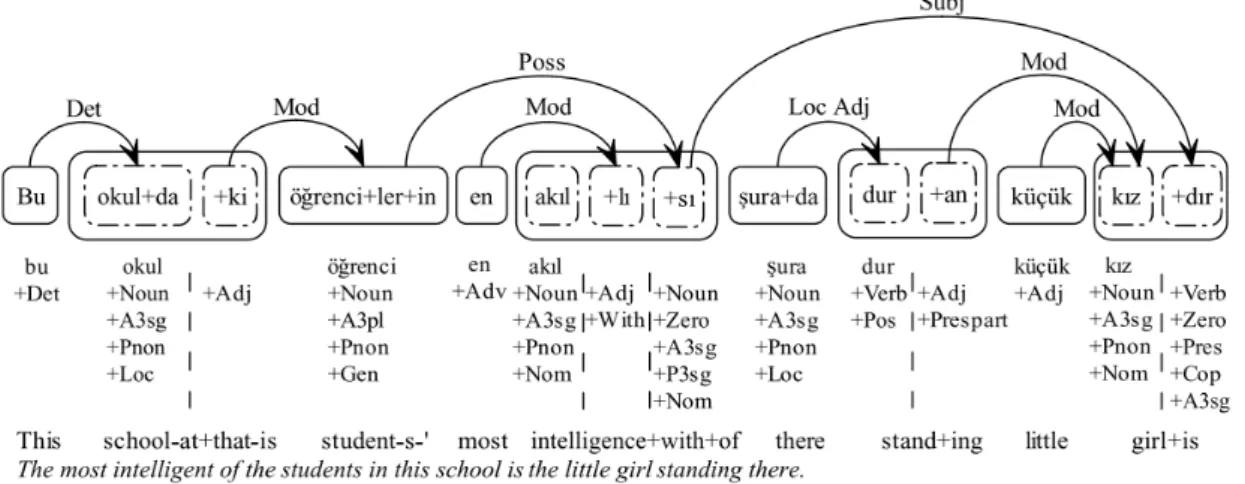
3.5 A sentence of the Turkish Dependency Treebank. . . 40
3.6 Syntactic context for segmentation disambiguation. . . 41
3.7 The pipeline model for syntactic parsing. . . 43
3.8 A long German noun phrase. . . 45
5.1 Experimental setup. . . 71
5.2 The contribution of structural and lexicon features. . . 81
5.3 Morphological quality in relation to training data. . . 87
6.1 Encoding graph structures as binary indicator vectors. . . 94
6.2 Schema of how flow constraints prevent cycles. . . 97
6.3 Constraint interaction. . . 105
7.1 A lattice representation of morphological ambiguity. . . 112
7.2 Lattice representations of ambiguous words. . . 114
7.3 A sentence lattice for a Turkish sentence. . . 115
7.4 Partitioning of tokens by the submodels. . . 119
7.5 Pruning arcs by lattice structure. . . 127
7.6 Pruning arcs according to the Turkish treebank. . . 128
xi
List of Tables
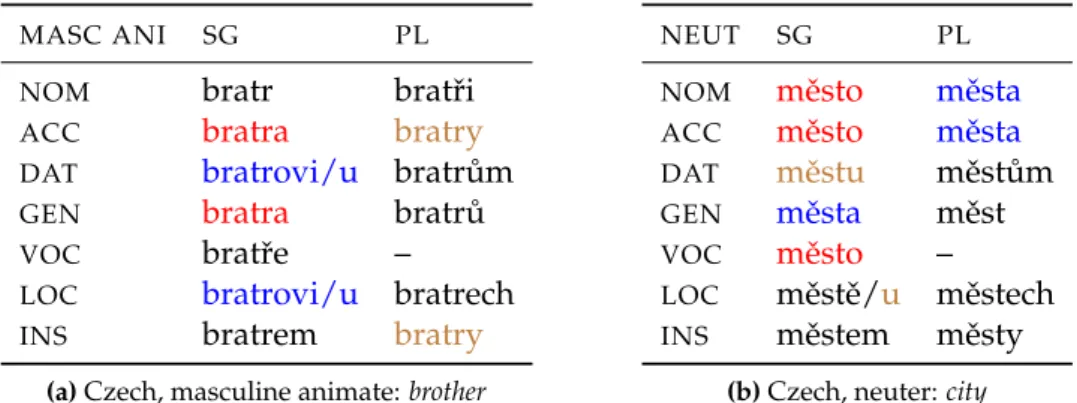
3.1 Syncretism in Czech nominal inflection. . . 36
3.2 Syncretism in German nominal inflection. . . 38
4.1 Data set sizes for the three treebanks. . . 52
4.2 Core argument functions in different treebanks. . . 53
4.3 Annotation quality of case, number, and gender. . . 56
4.4 Overall performance with different morphological information. . . 58
4.5 Performance for core grammatical functions. . . 60
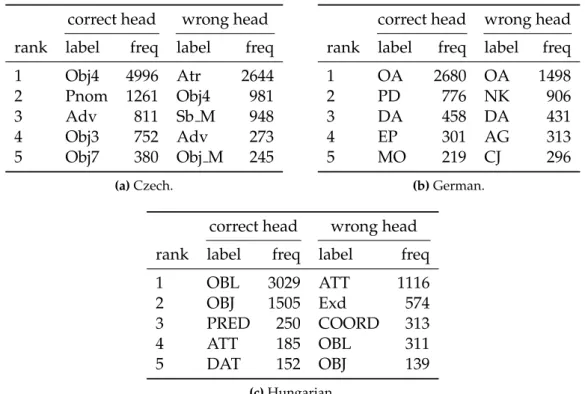
4.6 Top 5 confusion errors with subjects using no morphology. . . 62
4.7 Top 5 confusion errors with subject using gold morphology. . . 64
4.8 Top 5 confusion errors with accusative objects. . . 66
5.1 Baseline feature set. . . 75
5.2 Structural features. . . 76
5.3 The effect of full structural context. . . 77
5.4 The effect of structural context using lexicons. . . 80
5.5 Agreement accuracies. . . 83
5.6 Structural features for featurama (Czech). . . 85
5.7 Impact of improved morphology. . . 86
5.8 Simple parser vs full parser – syntactic quality. . . 87
5.9 Simple parser vs full parser – morphological quality. . . 88
6.1 Counts of doubly-annotated grammatical functions. . . 104
6.2 Overall performance of mate parser and the ILP parser. . . 106
6.3 Parsing results for grammatical functions. . . 107
7.1 Data split sizes. . . 137
7.2 Path selection quality for Turkish. . . 141
7.3 Path selection quality for Hebrew. . . 142
7.4 Parsing results using gold segmentation. . . 143
7.5 Parsing results for Turkish. . . 144
7.6 Parsing results for Hebrew. . . 145
7.7 Parsing results for Turkish using IGeval. . . 146
xii List of Tables
A.1 Arc features. . . 164
A.2 Second-order features. . . 165
B.1 Path features. . . 169
B.2 First-order context features. . . 170
B.3 First-order features to capture Turkish morphology. . . 170
B.4 First-order arc features. . . 171
B.5 Sibling features. . . 172
xiii
Abstract
When people formulate sentences in a language, they follow a set of rules specific to that language that defines how words must be put together in order to express the intended meaning. These rules are called the grammar of the language. Languages have essentially two ways of encoding grammatical information: word order or word form. English uses primarily word order to encode different meanings, but many other languages change the form of the words themselves to express their grammatical function in the sentence. These languages are commonly subsumed under the termmorphologically rich languages. Parsing is the automatic process for predicting the grammatical structure of a sentence. Since grammatical structure guides the way we understand sentences, parsing is a key component in computer programs that try to automatically understand what people say and write.
This dissertation is about parsing and specifically about parsing languages with a rich morphology, which encode grammatical information in the form of words. Today’s parsing models for automatic parsing were developed for English and achieve good results on this language. However, when applied to other languages, a significant drop in performance is usually observed.
The standard model for parsing is a pipeline model that separates the parsing process into different steps, in particular it separates the morphological analysis, i.e. the analysis of word forms, from the actual parsing step. This dissertation argues that this separation is one of the reasons for the performance drop of standard parsers when applied to other languages than English. An analysis is presented that exposes the connection between the morphological system of a language and the errors of a standard parsing model. In a
xiv Abstract
second series of experiments, we show that knowledge about the syntactic structure of sentence can support the prediction of morphological information. We then argue for an alternative approach that models morphological analysis and syntactic analysis jointly instead of separating them. We support this argumentation with empirical evidence by implementing two parsers that model the relationship between morphology and syntax in two different but complementary ways.
xv
¨
Uberblick
Wenn Menschen S¨atze in ihrer Sprache bilden, dann folgen sie einem sprachspezifischen Satz an Regeln, in dem festgelegt ist, auf welche Weise W ¨orter miteinander kombiniert werden m ¨ussen, um eine gew ¨unschte Bedeutung auszudr ¨ucken. Diese Regeln nennt man die Grammatik einer Sprache. Nat ¨urliche Sprachen haben im Wesentlichen zwei M ¨oglichkeiten, grammatische Information zu kodieren: entweder durch die Reihenfolge der W ¨orter oder in der Form der W ¨orter. Englisch verwendet haupts¨achlich die Reihen-folge von W ¨ortern um unterschiedliche Bedeutungen zu kodieren. Viele andere Sprachen markieren jedoch die grammatische Funktion von W ¨ortern in ihrer Form. Diese Sprachen werden gemeinhin unter dem Begriffmorphologisch reiche Sprachenzusammengefaßt.
Parsingnennt man das automatische Verfahren zur Vorhersage der grammatischen Struk-tur von S¨atzen. Die grammatische StrukStruk-tur eines Satzes bestimmt, wie man den Satz versteht. Aus diesem Grund ist Parsing ein wichtiger Bestandteil von Programmen, die versuchen, die Bedeutung von dem, was Menschen sagen und schreiben, automatisch zu verstehen.
Diese Dissertation besch¨aftigt sich mit Parsing, insbesondere mit dem Parsing von Sprachen mit einer reichen Morphologie. Die aktuellen Modelle f ¨ur Parsing wurden f ¨ur die englische Sprache entwickelt und erzielen gute Ergebnisse f ¨ur Englisch. Wenn man diese Modelle aber auf andere Sprachen anwendet, sind die Ergebnisse ¨uberlicherweise deutlich schlechter.
Das Standardmodell f ¨ur Parsing ist ein sogenanntes Pipeline-Modell, welches den Parsing-prozess in verschiedene Schritte aufteilt, insbesondere trennt es die morphologische Analyse, d.h. die Analyse der Wortformen, von der syntaktischen Analyse, also dem
xvi Uberblick¨
eigentlichen Parsing. Diese Dissertation stellt die Hypothese auf, daß diese Trennung von morphologischer und syntaktischer Analyse einer der Gr ¨unde f ¨ur die schlechteren Ergebnisse ist, die auf anderen Sprachen als Englisch erzielt werden. Wir zeigen in einer ersten Analyse den kausalen Zusammenhang zwischen bestimmten Eigenschaften des morphologischen System einer Sprache und den Fehlern, die das Standardmodell f ¨ur Parsing begeht. In einer zweiten Reihe von Experimenten zeigen wir dann, daß Zugang zu der vollen syntaktischen Struktur eines Satzes die automatische Vorhersage von morphologischer Information verbessert. Wir diskutieren anschließend ein alternatives Parsingmodell, in dem morphologische und syntaktische Analyse gemeinsam modelliert werden. Wir belegen die Vorteile eines solchen Modells empirisch, indem wir zwei Parser entwickeln, die die Beziehung zwischen Morphologie und Syntax auf verschiedene aber komplement¨are Weise nachbilden.
xvii
Acknowledgements
During the time that I worked on this thesis I had the pleasure and the honor to meet and work with some wonderful people. Learning from them and thinking together with them did not just teach me a lot about language, computer science, and science in general but made me grow as a person as well.
I am most grateful to my supervisor and Doktorvater, Jonas Kuhn. I can’t remember a single time that I didn’t feel motivated and full of new ideas after talking to him. He taught me to pursue my own ideas rather than waiting for someone else to tell me the next steps and he has the admirable ability to always find the positive aspects of anything. He is also someone who understands the difference between Computational Linguistics and Natural Language Processing and I have enjoyed our many small and long discussions of language phenomena very much.
I would like to thank my examiners, Joakim Nivre and Sebastian Pad `o, for sharing and discussing with me their thoughts on this thesis and the problems therein. It is this kind of discussion that inspires and motivates me to work on a problem and I have enjoyed this very much.
I had the honor and fortune to share my office and a lot of time with Anders Bj ¨orkelund. I still sometimes have the urge to turn to the right expecting him to sit there so I can discuss some problem with him (or show him something completely unrelated to what I and he are actually supposed to do). Bouncing ideas off of him always made them come back better and more useful. I have learned many things from him but the one I am most grateful for is that one should always go to the very bottom of a question. He never stops until he knows all the answers, may it be the workings of a statistical model or the
xviii Acknowledgements
administrative organization of a German federal state. Thanks for teaching me.
Without the dedication and passion of ¨Ozlem C¸ etino ˘glu, some parts of this thesis wouldn’t have been possible. Discussing examples in a foreign language is much more fun when it isn’t foreign to the other person, and I have had a lot of fun working on Turkish with her. We missed each other in Dublin by less than a month and I am very glad that we got a second chance in Stuttgart.
While I was working with Hungarian data, I was very lucky to get help from Rich´ard Farkas and Veronika Vincze from Szeged University who combine linguistic expertise with the intuition of native speakers.
A lot of people have made my time at IMS unforgettable: my former Prolog tutor and Potsdam connection, Sina Zarrieß, the most awesome intern (and much more) Agnieszka Fale ´nska, my writing group Kerstin Eckart and Boris Haselbach, and all my other colleages, teachers, and friends: Kyle Richardson, Andr´e Blessing, Fabienne Braune, Alessandra Zarcone, Bernd Bohnet, Thomas M ¨uller, Xiang Yu, Arndt Riester, Nils Reiter, Wiltrud Kessler, Christian Scheible, Gregor Thiele, Markus G¨artner, Nina Seemann, Daniel Quern-heim, Antje and Kati Schweitzer, Michael Walsh, Ulrich Heid, Hans Kamp, and Antje Roßdeutscher. You are awesome!
I want to thank my friends and family-by-choice Marko and Janine Drotschmann, for not just the most awesome summer vacations but also our weekly retreat to another world. Thanks for coming and listening to everything I had to say.
I have to thank my parents for always being there for me even from far away and not even once asking me when I would come back. And finally, thank you, Anett, for always finding the right balance between comfort, punschrullar, and a kick in the butt.
This thesis was very generously sponsored by the Deutsche Forschungsgemeinschaft (DFG) via Sonderforschungsbereich 732Incremental Specification in Context, projects D8 and B3.
1
Chapter 1
Introduction
In natural language, speakers express complex meaning that goes beyond the meaning of single words by combining words into phrases and sentences. The rules that specify how words must be combined in order to create well-formed sentences are defined in the grammar of the language that is used. The grammatical structure of a sentence relates the individual words to each other and thus defines how the meaning of the words must be combined to derive the meaning of the sentence. When a sentence violates rules of the grammar it may sound strange, mean something that was not intended, or become entirely uninterpretable depending on the rule that is being violated.
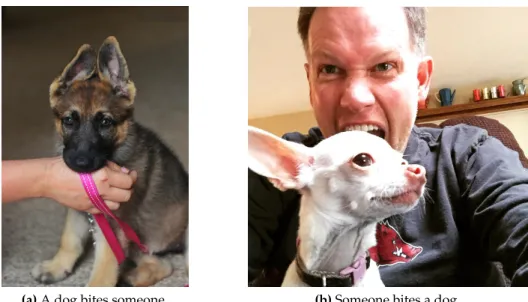
Language has two1major means for encoding the grammatical structure of a sentence: it can encode it in the order of the words or in the word forms. The grammar of English, for example, encodes grammatical structure mostly through word order. A possible sentence to express the situation in Figure 1.1a is the sentencea dog bites someone. The order of the words in this sentence is important for its meaning, which becomes apparent when we change it. The sentencesomeone bites a dogdescribes a different situation (Figure 1.1b) than the first sentence even though the sentence uses exactly the same words. Other word orders, e.g., the sentencebites someone dog a, may even mean nothing at all.
Other languages do not make use of word order like English but instead encode the
1This is of course a simplification. Spoken language, for example, can use intonation for this purpose.
2 1 Introduction
(a)A dog bites someone. (b)Someone bites a dog.
Figure 1.1:Changing word order in English changes meaning. Sources: (a) “Duchess and Marina” by David Burke, license CC BY-NC-ND 2.0, (b) “Man bites dog” by Jeff Noble, license CC BY 2.0.
information about the grammatical structure in the form of the words. Examples 1.1 and 1.2 show two sentences in Czech that both meana dog bites a man. Changing the word order as in English does not change the meaning of the sentence. In fact, all possible orders of the three words result in a well-formed Czech sentence and basically have the same meaning (barring potential stylistic differences or differences due to what is being emphasized). (1.1) pes NOM dog kouˇse bites ˇclovˇeka ACC man A dog bites a man.
(1.2) ˇclovˇeka ACC man kouˇse bites pes NOM dog A dog bites a man.
In the English sentencea dog bites someone,a dogis called the grammatical subject. In the canonical case, the subject corresponds to the acting party in a situation, here it is the biter in a biting event. In English, subjects are marked by placing them in front of the verb. Similarly, the party that is being acted upon is called the object of the sentence, in the example sentence it is the one being bitten (someone). The object of a sentence is marked in English by placing it after the verb. It is because subject and object are defined by their
3
position relative to the verb that the meaning changes when the word order is reversed. The Czech sentences also have a subject and an object, namelypesandˇclovˇeka, respectively. However, it is not their position that encodes this information but it is their form. The word
pesstands in nominative case (marked asNOMin the examples) whereas the wordˇclovˇeka
stands in accusative case (marked asacc). Nominative case is used to mark subjects in Czech whereas objects can be marked with accusative case (and others, but not nominative case). Changing the word order in the Czech sentence does not change the meaning because the word forms are the same regardless of their order. If we wanted to change the meaning of the sentence to something close to Figure 1.1b, we need to change the forms of the words rather than their order (Example 1.3).
(1.3) psa ACC dog kouˇse bites ˇclovˇek NOM man A man bites a dog.
The simple example illustrates how languages make use of word order and word forms to encode grammatical structure. Traditionally, the part of grammar that deals with word order rules is calledsyntaxand the part that deals with the form of words is called morphol-ogy. Morphology can be further divided into the two subfields ofderivation/composition
andinflection. The morphological rules for derivation and composition define how new words can be formed from existing ones, whereas the rules for inflection define how a word changes its form to signal grammatically relevant information. The Czech examples show instantiations of inflection because the change in the form, i.e., changing the case feature of the words, changes the grammatical structure. All languages in the world make use of syntactic and morphological means to encode grammatical structure but they do so to different extents. Some languages like English rely heavily on word order whereas languages like Czech rely more on word forms.
4 1 Introduction
1.1
Parsing
This dissertation is about models for automatically predicting the grammatical structure of sentences, in particular for languages like Czech, which encode grammatical structure by morphological means. A program that is used to predict such structures is called a
parserand the process is calledparsing. Since the grammatical structure defines the way we construct the meaning of sentences from the meaning of its words, predicting such structures automatically is an important component in systems that try to automatically understand what people say and write. And since people speak and write in many languages, the ultimate goal is to develop parsing models that can correctly predict the grammatical structure for any sentence from any language.
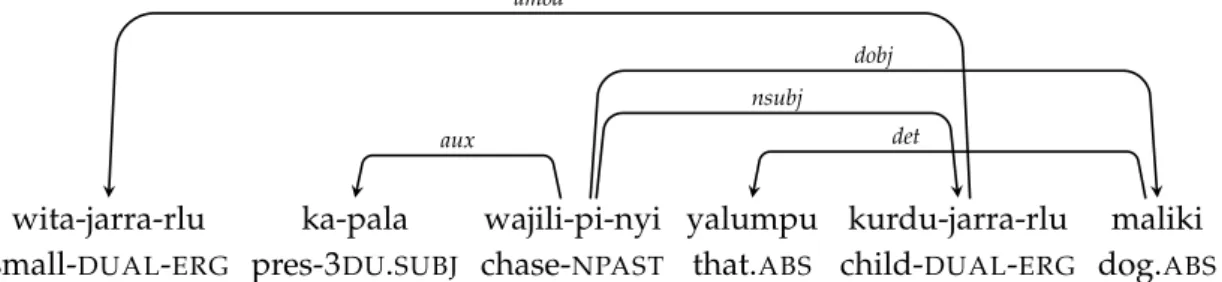
The representation of grammar that we work with in this dissertation is calleddependency grammar. Dependency grammar represents the syntactic structure of sentences as directed trees calleddependency trees. Examples of such trees for the sentences discussed above are shown in Figure 1.2. Dependency grammars are well suited to represent phenomena typical for languages with rich morphology and free word order.
the dog bites someone
subject object
(a)Syntactic structure of an English sentence.
psa kouˇse ˇclovˇek
ACC NOM
object subject
(b) Syntactic Structure of a Czech sentence.
Figure 1.2:Syntactic structure visualized as dependency trees.
The models that we will use are alldata-drivenmodels. Data-driven models do not use rules that were hand-crafted by humans but instead learn a function for mapping input to output by looking at large amounts of input-output examples. For example, data-driven parsers are trained on treebanks, which are large collections of sentences for which humans have manually annotated the correct syntactic structure. The model thus learns to associate certain structures with certain patterns in the sentences and generalizes this knowledge to predict new structures for sentences that it has not seen before.
1.2 Claim and Contributions 5
1.2
Claim and Contributions
The standard architecture in dependency parsing uses a pipeline setup, in which the pars-ing process is separated into (at least) three steps: tokenization, morphological analysis, and the actual parsing. During tokenization, a continuous input string is separated into individual tokens, which roughly correspond to words. During morphological analysis, the part-of-speech (and for other languages the morphological features) of each word are predicted. During the parsing step, words are related to each other to form the syntactic structure of the sentence. The output of each step forms the input to the next one and the output of the parsing step is the final output of the system. This architecture is very efficient because it breaks the task down into smaller ones that can be handled efficiently on their own.
Note that we will use the term parsing ambiguously to refer to the actual parsing step as well as the whole pipeline system. This is because parsing cannot reasonably be done without tokenization and at least part-of-speech tags. We therefore consider the whole process to constitute the task of parsing rather than just the last step in which words are related to each other.
The pipeline model was developed for English and state-of-the-art parsing systems achieve very good results for predicting the syntactic structure of English sentences (at least for newspaper text). However, when these parsers are applied to other languages, a significant drop in performance can be observed. It has been hypothesized that one of the main reasons for this drop is the fact that other languages make use of morphological means to encode grammatical structure and that the models that were developed for English are not suited to parse languages with rich morphology (Tsarfaty et al. 2010).
In the introductory example, we have shown that languages like Czech encode the gram-matical information in word forms rather than the word order. Specifically, we have shown that particular forms are used to mark the grammatical function of a word. One could think now that one simply needs to note down for each of these forms what function they mark and parsing should work well also for these languages. However, language is much more complicated. In many languages, the same word form can be ambiguous between different interpretations and often a single interpretation is often used for more than one function in the sentence. As we said before, most languages make use of both
6 1 Introduction
syntactic and morphological means to encode grammatical information. Because of this, there are intricate interactions between syntax and morphology in many languages. The claim that this dissertation starts from is that the separation of tokenization, mor-phological analysis and syntactic analysis in the pipeline model is one reason why the standard model does not perform as well for other languages as it does for English be-cause the interaction between morphology and syntax cannot be modeled. We argue for an alternative model in which tokenization, morphology, and syntactic structure are predicted jointly. To this end, we . . .
(I) . . . conduct analyses and experiments that show that certain properties of the grammar of languages with rich morphology violate the independence assumption that underlies the separation of processing steps in the pipeline model. The experiments also highlight differences between languages that all have rich morphology.
(II) . . . develop a simple model for integrating structural context into a model for predicting morphological information and use it to show that access to the full structural context is important for predicting morphology for languages with free word order. An additional comparison shows that the contribution of structural context is complementary to the information from large-scale lexicons.
(III) . . . formulate a set of constraints that model morphosyntactic rules for three morpho-logically rich languages. We show that using these models to restrict the search space of a dependency parser leads to better prediction of argument structure.
(IV) . . . present an efficient decoder for non-projective graph-based lattice dependency parsing and show how word segmentation, morphological analysis, and syntactic analysis can be modeled jointly. The parser is tested on Turkish and Hebrew and outperforms two state-of-the-art baseline systems based on pipeline architectures. The results on Turkish are the first published results for Turkish lattice parsing.
1.3 Publications 7
1.3
Publications
The contents of this dissertation have been previously reported in the following publica-tions:
Seeker, W. and Kuhn, J. (2011). On the Role of Explicit Morphological Feature Representa-tion in Syntactic Dependency Parsing for German. InProceedings of the 12th International Conference on Parsing Technologies, pages 58–62, Dublin, Ireland. Association for Computa-tional Linguistics
Seeker, W. and Kuhn, J. (2013a). Morphological and Syntactic Case in Statistical Depen-dency Parsing.Computational Linguistics, 39(1):23–55
Seeker, W. and Kuhn, J. (2013b). The Effects of Syntactic Features in Automatic Prediction of Morphology. InProceedings of the 2013 Conference on Empirical Methods in Natural Lan-guage Processing, pages 333–344, Seattle, Washington, USA. Association for Computational Linguistics
Seeker, W. and C¸ etino ˘glu, O. (2015). A Graph-based Lattice Dependency Parser for Joint Morphological Segmentation and Syntactic Analysis. Transactions of the Association for Computational Linguistics, 3:359–373
9
Chapter 2
Background
The purpose of this chapter is to provide the general background on the topics that this dissertation takes as given. We introduce dependency structures and dependency parsing as well as the methods that we use for training our statistical models. The intention is to give a brief overview and introduce the most important concepts. We provide pointers whenever possible to other work that describes the discussed content in more detail. Readers that are familiar with the concepts in this chapter can safely move on to the next.
2.1
Dependency Grammar and Dependency Trees
Dependency grammar is a grammar formalism that focuses on the nature of the relation between two words within their sentential context. Each word in a sentence stands in an asymmetric relation with another word, but unlike in constituency grammar no phrasal nodes are postulated, i.e., the words in the sentence are the only nodes in the structure. In a dependency relation, the word that influences the properties of the other word is called the head (or governor) and the word that is influenced by the other is called the dependent (or modifier, or governee). The dependent is said to depend linguistically1 on the head, hence the name dependency grammar. Complex structures emerge through
1Modern dependency grammar formalisms strive for a description of all linguistic aspects of natural
10 2 Background
recursive application of dependency. The nature of the relation between two words is typically classified into a set of predefined relations, e.g., for syntactic structure it would contain relations like subject or adjunct. The invention of modern dependency grammar is credited to Lucien Tesni`ere (Tesni`ere 1959, Tesni`ere et al. 2015) and several formalisms have been introduced since then, e.g., Functional Generative Description (Sgall et al. 1986), Meaning Text Theory (Mel’ˇcuk 1988), and Word Grammar (Hudson 1984).
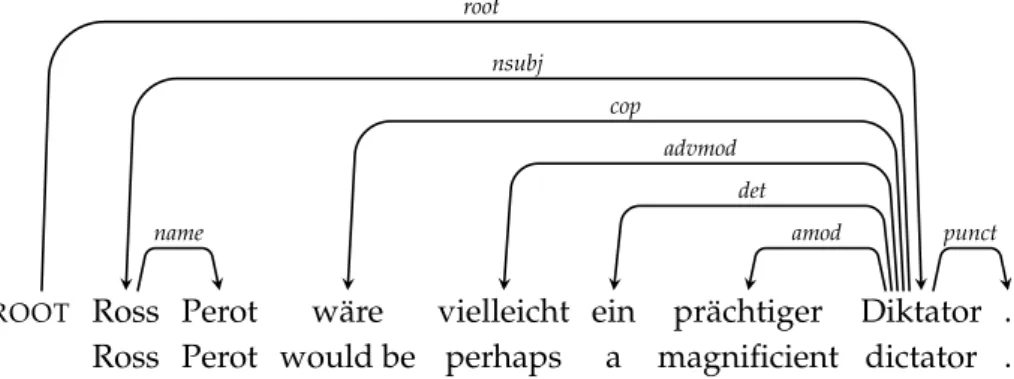
In parsing literature, a dependency structure almost always corresponds to the syntactic structure of a sentence. Figure 2.1 gives an example sentence with its syntactic structure annotated according to the Universal Dependency Grammar (Nivre 2015). By convention, we draw the dependency arcs such that the arrow points from the head to the dependent. The type of a dependency relation is indicated by a label on the arc.
ROOT Ross Perot w¨are vielleicht ein pr¨achtiger Diktator . Ross Perot would be perhaps a magnificient dictator .
root name nsubj cop advmod det amod punct
Figure 2.1:The syntactic structure of the first sentence in the TiGer treebank (Brants et al. 2002).
A well-formed (syntactic) dependency tree must fulfill three conditions:
1. There is one word that does not have a head (the root). 2. Each other word has exactly one head.
3. The tree does not contain cycles.
The formal graph structure that fulfills all three conditions is a directed rooted tree. Rootedness is ensured by introducing an artificial node (ROOT) that acts as the root of the
tree.
We will denote dependency arcs formally as tripleshh, d, liwithhbeing the head word, dbeing the dependent word, andlbeing the arc label denoting the dependency relation
2.1 Dependency Grammar and Dependency Trees 11
betweenhandd. When we use indices, we index the artificial root node with 0 and all real words starting from 1 in the order they appear in the sentence. Furthermore, we will use the termtokento refer to the smallest unit of parsing, which in this chapter will usually coincide with the intuitive meaning of a word in a sentence.
2.1.1 Projectivity
One recurrent problem in multilingual dependency parsing are non-projective arcs. An arc in a dependency tree is said to be non-projective if there is at least one word in the span of words covered by the arc that is not a direct or indirect descendant of the head of the arc. Figure 2.2 gives an example for a non-projective arc. The arc (acl:relcl) covers the span fromKandidatentoraucht. It is non-projective becausegesehenis not a direct or indirect descendant of the headKandidaten.
ROOT Sie hat den Kandidaten gesehen , der raucht .
She has the candidate seen , who smokes .
root det acl:relcl nsubj aux dobj punct punct nsubj
She saw the candidate who smokes.
Figure 2.2:Extraposed relative clauses in German can be represented with non-projective struc-tures. The non-projective arc is bold-faced.
Formally, let→be the direct dominance relation defined by a dependency tree and let
→∗be the transitive closure of→.h→dthen denotes a dependency arc in the tree and
h→∗ ddenotes a path fromhtodalong the arcs of the tree. A dependency arch→dwith h≺d(the head precedes the dependent in the sentence) is defined as projective iff
∀k h→∗k forh≺k≺d (2.1)
otherwise it is non-projective. The case ford≺hworks analogously. A dependency tree is called non-projective if it has at least one non-projective arc. Otherwise, it is called projective. There are considerably more possible non-projective trees for a given sentence
12 2 Background
than projective trees, which significantly increases the space of possible solutions that a parser needs to search through and thus the complexity of the parsing problem. While English has only few cases that are commonly analyzed with non-projective structures (e.g., wh-extraction), other languages show many such phenomena, especially languages with unrestricted word order. Parsing such languages requires parsing algorithms that can deal with non-projective edges.
Non-projectivity has also been studied with the aim to identify subclasses of non-projective structures that can be parsed efficiently. Several such classes were identified and it turns out that most of the structures (up to 99%) in today’s treebanks fall into one of these subclasses (Havelka 2007, G ´omez-Rodr´ıguez et al. 2011, Kuhlmann 2013). Subsequently, parsing algorithms were developed that derive restricted sets of non-projective structures (see Section 2.2).
Most treebanks used in this dissertation contain non-projective structures since rich morphology and free word order often go hand in hand. The parsers that we develop as well as the baseline parsers therefore all derive non-projective structures either directly or via additional processing.
2.1.2 Treebanks
Treebanks are collections of natural language utterances (usually sentences) that have been annotated manually with their syntactic structure. The nature of the syntactic structure thereby depends on the linguistic theory that underlies the annotation guidelines. One of the oldest and perhaps the most influential treebank is the Penn Treebank (Marcus et al. 1993), which is annotated with constituency structures. With the creation of the Penn Treebank, it was possible to learn statistical models for predicting the syntactic structures of English sentences that are not in the treebank. This sparked extensive research on statistical parsing for natural language and it also led to the creation of treebanks for many other languages.
Some of the treebanks for other languages, e.g., the Prague Dependency Treebank Hajiˇc et al. (2006), use dependency grammar as their underlying formalism. Training statistical dependency parsers on these treebanks is straight-forward. However, for many languages,
2.1 Dependency Grammar and Dependency Trees 13
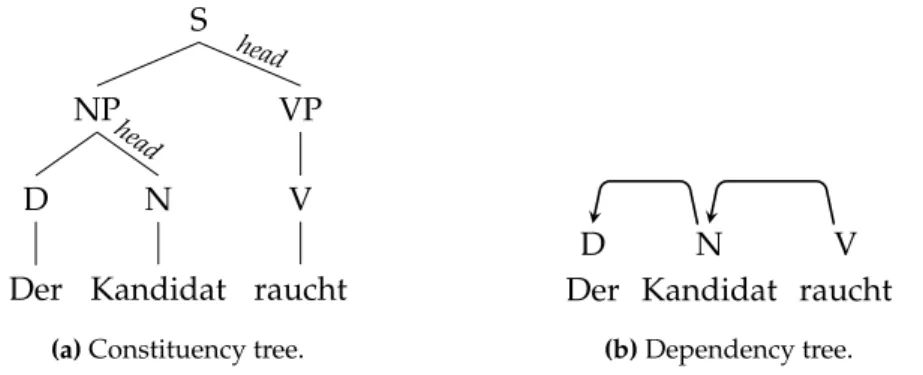
the treebanks are annotated with constituency structures and are thus not directly usable for dependency parsing. However, for these languages it is common to convert the constituency structures to dependency structures in order to have training data in the right format. This is done with head percolation rules (Magerman 1995, Collins 2003), which define for each constituent which one of their child nodes should be the head. For example, the right-most noun in a noun phrase is the head of that noun phrase. All other constituents are then attached as dependents to the selected head. The process is applied recursively until all constituents are converted. Figure 2.3 illustrates the process.
nak S VP V raucht NP N Kandidat D Der head head
(a)Constituency tree.
D N V
Der Kandidat raucht (b)Dependency tree.
Figure 2.3:Conversion by head percolation rules. For each constituent, the head is selected among its children.
There exist several automatic dependency conversions of the Penn Treebank (Yamada and Matsumoto 2003, de Marneffe et al. 2006, Johansson and Nugues 2007a, Choi and Palmer 2010). Although the automatic conversion can make mistakes, the quality of the conversion is very high and the converted treebanks are the accepted gold standard for training dependency parsers for English. Conversion procedures like this exist for many languages. In some cases, additional effort was spent to correct conversion errors by manually checking the resulting dependency structures (see for example the Hungarian dependency treebank (Vincze et al. 2010)).
In this dissertation, experiments on German are conducted on our own conversion of the TiGer Treebank (Brants et al. 2002). The conversion is performed semi-automatically by defining the head percolation rules such that they can fail (Seeker and Kuhn 2012). Failures were then inspected manually, which either led to more refined rules or to a correction of the original treebank. In a few cases, the heads were selected manually in order to treat exceptional cases that do not warrant their own rule and are not due to annotation errors in the original treebank.
14 2 Background
Currently, there is an effort to create a unified dependency annotation for many lan-guages. The Universal Dependency Treebank (Nivre 2015) aims at providing a common dependency analysis for many different languages in order to facilitate multi- and cross-lingual research. The example dependency trees shown in this dissertation are annotated according to these guidelines.
2.2
Dependency Parsing
Dependency parsing is the task of predicting a dependency tree for a given sentence. Sta-tistical dependency parsers usually consist of three components. The first one is a parsing algorithm or decoder, which is a search algorithm that derives the dependency tree for a given sentence. The second component is a feature model that maps the input sentence along with potential parsing actions or dependency structures into a high-dimensional vector space. The third component is a statistical model that is trained on a treebank and uses the learned weights to score the high-dimensional vector representations.
There are currently two major paradigms in dependency parsing, transition-based parsing and graph-based parsing. The two paradigms approach the problem of dependency parsing from two different sides. Transition-based parsers uses rich feature representations but approximate search algorithms to find the best dependency tree, while graph-based parsers restrict their feature space to be able to efficiently perform global search thus having a guarantee to find the optimal structure. We discuss both of them in turn.
2.2.1 Transition-based Parsing
Transition-based parsers build the syntactic structure of a sentence incrementally by starting from an initial configuration and then repeatedly transitioning into different configurations by performing one of a set of predefined operations. The parsing process is finished when the parser ends in a defined final configuration. The sequence of operations (thetransition sequence) that the parser performs to transition from the initial configuration to the final configuration encodes the syntactic structure of the input sentence.
2.2 Dependency Parsing 15
As an example, Figure 2.4 shows the Arc-Standard transition system as formalized by Nivre (Yamada and Matsumoto 2003, Nivre 2004). A configuration in this system consists of three components:
1. β, an input buffer that holds the words of the input sentence, indexed from 0 ton with 0 representing the artificial root node
2. σ, a stack that serves as a memory and stores unfinished substructures 3. A, the set of arcs that form the output structure
The parser starts with the root node on the stack, all other tokens stored in the buffer, and an empty arc set. It then applies one of the three operations shown in Figure 2.4 to transition into a new state and repeats the procedure until it ends in the final configuration. The final configuration is reached when the buffer is empty and the only symbol on the stack is the artificial root node. At this point, the arc set holds all arcs that the parser has introduced between the words of the sentence.
Left-Arclintroduces an arc between the front of the buffer and the top of the stack with
the front of the buffer being the head. The token on top of the stack is then discarded. Right-Arclintroduces an arc between the same items but makes the top of the stack the
head. The token in front of the buffer is discarded and the top of the stack is put back onto the buffer. The third operation, Shift, simply pushes the token in front of the buffer onto the stack. Left-Arcland Right-Arclare additionally parameterized for the label that they
introduce on the arc.
Transition Precondition
Left-Arcl (σ|wi, wj|β, A)⇒(σ, wj|β, A∪ {hwj, wi, li}) i6= 0
Right-Arcl (σ|wi, wj|β, A)⇒(σ, wi|β, A∪ {hwi, wj, li})
Shift (σ, wi|β, A)⇒(σ|wi, β, A)
Figure 2.4:The Arc-Standard transition system adapted from K ¨ubler et al. (2009: fig. 3.1).
A statistical multiclass classifier is used to decide at each step, given the current config-uration, which of the three operations the parser should apply. The classifier is trained on oracle transition sequences. Oracle transition sequences are derived from manually annotated treebanks by running the transition system on a sentence such that it derives
16 2 Background
the treebank tree for this sentence. It is possible that there is more than one oracle tran-sition sequence for a given sentence. A canonical sequence can be defined by ranking the operations in the transition system, preferring higher-ranked ones in case multiple are allowed. Ranking the operations as in Figure 2.4 (Left-Arc>Right-Arc>Shift), the canonical oracle transition sequence for the example sentence in Figure 2.1 would be Shift, Right-Arcname, Shift, Shift, Shift, Shift, Shift, Left-Arcamod, Left-Arcdet, Left-Arcadvmod,
Left-Arccop, Left-Arcnsubj, Shift, Right-Arcpunct, Right-Arcroot, Shift.
In order to predict the next transition, the parser extracts features from its current con-figuration. These features include information about the next items in the buffer and the partially processed items on the stack. By accessing the stack, the feature model has access to the entire structure that has been build so far. As the parser advances, more structure is build and becomes available to the feature model.
There are several different flavors of transition-based parsers, all of which have in common that they build the output structure incrementally at each step predicting the next one based on the current configuration. Nivre (2008) makes a distinction between stack-based and list-based algorithms. Stack-based algorithms are e.g., the Arc-Standard algorithm shown above (Yamada and Matsumoto 2003, Nivre 2004) and the Arc-Eager algorithm (Nivre 2003). List-based algorithms are proposed in Covington (2001). Instead of a stack, they use one or more lists to store partially processed tokens. Non-directional parsers (Shen and Joshi 2008, Goldberg and Elhadad 2010b) abandon the strict left-to-right processing and instead allow introducing arcs between neighbouring tokens anywhere in the sentence. The statistical models guiding these parsers not only learn which tokens to connect but also which tokens should be processed before others.
Most of the transition-based algorithms derive projective trees only (with the exception of some of the list-based algorithms in Covington (2001) and the parser in Shen and Joshi (2008)). Modifications in different directions have been proposed to deal with non-projectivity: Nivre and Nilsson (2005) propose a preprocessing step that projectivizes trees prior to parsing and reintroduces non-projective edges afterwards. Nivre (2009), Nivre et al. (2009) add a swap operation to the transition-system that reorders tokens during parsing in order to create a projective parsing order. The swap operation was applied in non-directional parsing by Tratz and Hovy (2011). With the swap operation transition-based algorithms are able to derive any possible non-projective structure for a given sentence, but it comes with an increased time complexity. Other approaches
2.2 Dependency Parsing 17
avoid the increase in complexity by restricting the set of non-projective structures that can be derived (Attardi 2006, G ´omez-Rodr´ıguez and Nivre 2010, Pitler and McDonald 2015). These subsets can be parsed efficiently and are shown to include almost all of the non-projective arcs that can be found in the treebanks.
Transition-based parsers are fast due to their low time complexity. The stack-based variants find a tree in linear time with respect to the length of the input sentence and the list-based algorithms have quadratic complexity (for proofs, see e.g. Nivre 2008). The complexity of non-directional parser by Goldberg and Elhadad (2010b) isO(nlog(n)). Introducing the swap operation increases the complexity of the stack-based parsers toO(n2).
Another aspect that makes transition-based parsers fast and efficient is that they search for the best tree greedily, i.e., they always go with the locally best decision under the assumption that this will usually also lead to the globally best output. This is one of the fundamental differences to graph-based parsers, which perform global optimization to find the best tree. However, greedy search suffers from error propagation because once the parser has made an incorrect attachment it cannot correct it anymore. For this reason, transition-based parsers used to perform worse than graph-based parsers in terms of parsing accuracy. Since then, techniques like beam-search (Johansson and Nugues 2007b, Zhang and Clark 2008a) and dynamic programming (Huang and Sagae 2010), which allow the parser to pursue several derivations in parallel, closed that gap while increasing runtime by a constant factor only. At the same time, error propagation in greedy parsers has been mitigated with the help of dynamic oracles, which allow the parser to learn how to recover from past mistakes (Goldberg and Nivre 2012, 2013).
2.2.2 Graph-based Parsing
In contrast to transition-based parsers, graph-based parsers do not build dependency trees incrementally. Given a statistical model that assigns scores to dependency trees, graph-based parsers search through the space of all possible dependency trees for a sentence returning the one to which the statistical model assigns the highest score. This approach guarantees that the returned tree is indeed the optimal given the statistical model. However, since there are exponentially many trees for a given sentence, one cannot simply look at each possible tree individually and compare their scores. Instead,
18 2 Background
algorithms were developed that efficiently search through the space without having to create every single tree.
Eisner (1997, 2000) develops a dynamic programming algorithm that finds the optimal dependency tree for a given sentence in cubic time, but is restricted to projective trees. The algorithm works like the chart parsers known from constituency parsing and uses the fact that subtrees of a dependency tree are also dependency trees. Alternatively, McDonald et al. (2005) propose to use spanning tree algorithms to find the optimal dependency tree for a given sentence. The particular algorithm used in McDonald et al. (2005) is the Chu-Liu-Edmonds algorithm. It is not restricted to projective trees and with clever implementation it runs in quadratic time with respect to the length of the input sentence.
The Chu-Liu-Edmonds Algorithm
The Chu-Liu-Edmonds algorithm (Chu and Liu 1965, Edmonds 1967) is a maximum spanning tree algorithm. Given a graph with arc weights, it searches for the spanning tree that connects all vertices in the graph and has the maximum sum of arc scores. We make use of this algorithm in several places in this dissertation, e.g., to enforce tree properties (Chapter 7). For this reason, we present the algorithm in this section, following the description in K ¨ubler et al. (2009: 48). We demonstrate the algorithm by using an example. Proper pseudocode and a longer discussion can be found in McDonald et al. (2005) and K ¨ubler et al. (2009: 47).
Figure 2.5 shows an example run of the algorithm on a small graph with four nodes. The nodes represent the sentencehROOTJohn saw Maryi. The algorithm starts from a fully connected graph (Figure 2.5a) whose arcs are weighted, e.g., by a statistical parsing model. The first step is to make a greedy selection by choosing the highest-scoring incoming arc for each word (Figure 2.5b). The algorithm would stop at this point if the resulting structure is a proper tree since this tree would be the maximum spanning tree over the original graph. However, greedy selection can create cycles as shown in the example between Johnand saw. In such a case, the algorithm contracts the cycle into a single node and recomputes the arc scores for each arc that enters or leaves the contracted cycle (Figure 2.5c). The new arc scores are computed depending on the score of the cycle and the scores of the incoming/outgoing arcs (see K ¨ubler et al. 2009: 47 for the exact procedure).
2.2 Dependency Parsing 19
Once the cycle is contracted and the new arc scores are computed, the algorithm calls itself recursively on the new smaller graph starting again with a greedy selection. If another cycle is found, the contraction procedure starts again and the recursion continues. Since each recursive call reduces the number of nodes in the graph due to the contraction, the algorithm eventually finds a tree structure without a cycle. This is shown in Figure 2.5d. From there, the contractions are resolved until an acyclic tree structure is obtained for the original graph (Figure 2.5e).
Arc-factored Model and Higher-order Factors
Eisner’s algorithm and the Chu-Liu-Edmonds algorithm both rest on the assumption that the individual arcs in the tree are independent of each other. The underlying statistical model assigns a score to each arc and the score of a tree is the sum of all arc scores. The score of an arc is thereby independent of any other arc in the tree, i.e., it does not change if the other arcs in the tree change. This model is called the arc-factored model, since the parameters of the model factor over single arcs.
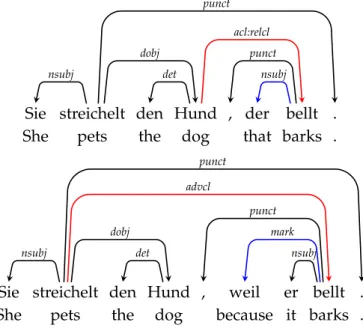
Arc-factorization makes the search for the best dependency tree tractable but it is an unrealistic model from a linguistic point of view. To see its limitations, consider the two German sentences in Figure 2.6. Both sentences contain a dependent clause, the upper one contains a relative clause, the lower one contains a subordinate clause expressing a clausal relationship. The crucial difference here is that the relative clause depends on the object of the matrix clause whereas the subordinate clause depends on the verb (red arcs in both trees). The head of both dependent clauses is the same verbbellt. An arc-factored model now has to decide the attachment of this word without knowing any of the other arcs in the tree. In particular it does not know the arcs marked in blue. In the upper sentence, the blue arc attaches the relative pronoun tobellt, in the lower sentence, it attaches the subordinating conjunction. Linguistically, this information makes the attachment decision trivial, but the arc-factored model cannot access it. In short sentences like the examples in Figure 2.6, this information can be approximated by looking at the surrounding words. The relative pronoun in the upper sentence is the immediate left neighbor ofbellt. However, German syntax allows for any number of other words to occur betweenbellt and the relative pronoun/subordinating conjunction, which makes surrounding context a rather unreliable source of information for this purpose.
20 2 Background root saw John Mary 9 10 9 20 3 30 30 11 0
(a)Start from a fully connected graph.
root saw John Mary 9 10 9 20 3 30 30 11 0
(b)Select greedily the highest-scoring in-coming arc for each node.
root saw John Mary 9+20 10+30 9 20 3 30 30 11+20 0+30 tc
(c)Contract cycles and recompute scores.
root saw John Mary 9+20 10+30 9 20 3 30 30 11+20 0+30 tc
(d)Run Chu-Liu-Edmonds on the contracted graph. root saw John Mary 10 30 30 9 9 20 3 11+20 0
(e)Resolve contractions.
2.2 Dependency Parsing 21
Sie streichelt den Hund , der bellt .
She pets the dog that barks .
nsubj dobj punct det acl:relcl punct nsubj
Sie streichelt den Hund , weil er bellt .
She pets the dog because it barks .
nsubj dobj advcl punct det punct mark nsubj
Figure 2.6:Attachment of dependent clauses to illustrate second-order dependencies.
Figure 2.6 shows that modeling dependencies between arcs opens access to relevant information that is hidden from the arc-factored model. Unfortunately, higher-order models2come with increased complexity. Full non-projective parsing with more than first-order models was proven to be NP-hard (for the proof, see McDonald and Pereira 2006), but Eisner’s algorithm, which derives projective trees only, can be extended to higher order models while keeping its polynomial complexity. McDonald and Pereira (2006) propose a variant of Eisner’s algorithm that uses factors of consecutive siblings (Figure 2.7a), to which Carreras (2007) adds factors over grandchildren (Figure 2.7b). While the variant with consecutive siblings retains its cubic time complexity, Carrera’s decoder already runs withO(n4)withnbeing the length of the input sentence. Koo and Collins (2010) go one more step and introduce third-order features while at the same time keeping the runtime atO(n4). Zhang and McDonald (2012) generalize Eisner’s decoder to
any-order models, reporting a time complexity ofO(n3+2x)wherexis the number of free variables in their parsing rules.
2Models that consider dependencies between two arcs are called second-order models. If they model
dependencies between three arcs they are called third-order models. The arc-factored model is hence called a first-order model.
22 2 Background
A B C D E
(a)Consecutive siblings.
A B C D E
(b)Grandchildren.
A B C D E
(c)Arbitrary siblings.
Figure 2.7:Second-order factors. Solid lines show one factor.
Factorization restricts the type of features that the feature model has access to. In the arc-factored case, features can only be extracted from single arcs, in higher-order models, sibling or grandchild features can be added. However, structural features can never go beyond the information retained in a factor. This is one of the fundamental differences between graph-based and transition-based parsers as the latter have access to their entire parse history, can extract structural features of any complexity, and are restricted only be the fact that some structure may not have been built yet.
Eisner’s algorithm allows for efficient higher-order models, but (and because) it can derive projective trees only. In order to derive non-projective trees, different modifications have been proposed. McDonald and Pereira (2006) propose a hill-climbing algorithm for postprocessing that starts from the highest-scoring projective tree and reattaches edges until the overall score does not increase anymore. Pitler (2014) extends Eisner’s algorithm to directly derive 1-Endpoint-Crossing trees,3 a subset of all possible non-projective structures (see also Pitler et al. 2013).
While clever factorization keeps the parsing algorithms tractable, they are still rather slow, especially compared to greedy transition-based parsers. Many graph-based parsers therefore run a pruning step first that uses a simple method for cutting of arcs that are unlikely to be chosen by the parser. For example, a sentence with 100 words requires the parser to consider 99 heads for each word (in the non-projective case). Cutting this number down to 10 heads per word makes the combinatory problem considerably smaller and leads to faster parsing time. Of course, if the pruning step cuts off a correct arc, it cannot be recovered by the parser. A popular method to decide which arcs to keep is to
2.2 Dependency Parsing 23
use the marginals of a probabilistic arc-factored model (McDonald and Satta 2007, Smith and Smith 2007, Koo et al. 2007). Rush and Petrov (2012) use cascades of models with increasing complexity so that the simpler models narrow down the search space for the more complex models. Zhang and McDonald (2012) show how any kind of higher-order model can be kept tractable by using cube pruning to restrict the number of arcs that are considered between two words.
Parsing as an Integer Linear Program
Parallel to the effort of extending Eisner’s decoder, other methods of finding the optimal tree were investigated, for example dependency parsing as solving an integer linear program. Integer linear programming is a mathematical tool to describe constrained optimization problems. It consists of an objective function that is being optimized and a set of constraints over the variables in the objective function that need to hold in the optimal solution.
The general idea is the following: each possible arc between the tokens of a given sentence is represented by a binary variable that marks the presence or absence of this arc in the output tree (recall the representation of dependency trees as indicator vectors from above). Each of these binary variables is weighted by an arc score from a statistical model. The objective function of the integer linear program is then to optimize the overall score of the tree by finding the combination of binary variables whose weights sum up to the highest score.
Without any constraints, the solution to this optimization problem is to set all variables to 1 that have a positive arc weight. However, this will most likely not result in a well-formed dependency tree. Therefore, some constraints are added to the integer linear program that only allow solutions which are well-formed dependency trees. The conditions that need to be met are listed in the beginning of this section (root has no head, one head for each token, no cycles). Riedel and Clarke (2006), who proposed the first parser based on integer linear programming, defined constraints for the first two conditions, but had to resort to an iterative method to enforce acyclicity. They first compute a solution, and if the solution contains a cycle, they add a constraint that explicitly excludes this particular cycle. They then run the solving process again, possibly ending up with another cycle, until finally
24 2 Background
an acyclic solution is found. Obviously, this iterative process makes the approach very inefficient. Martins et al. (2009) find a concise formulation that directly enforces acyclicity without the need for an iterative process (see also Martins et al. 2010b). Their parser ensures cycle-freeness by employing a single-commodity flow formulation (Magnanti and Wolsey 1995). It models a flow from the root to each of the tokens in the sentence along the arcs of the tree. Together with the single-head constraint, only acyclic trees can fulfill this constraint.
Solving the integer linear program with the described constraints outputs a well-formed dependency tree that is optimal with respect to the scoring function. Any general-purpose constraint solver for (integer) linear programs can be used to find the optimal solution. This parser is attractive from a modeling point of view, because any kind of other constraints can be added to the formulation. We make use of this property in this dissertation to model dependencies between morphology and syntax. A formal definition of the parser is therefore deferred to Chapter 6. Higher-order features can be added through the definition of additional variables that are linked to the arc variables via constraints. The higher-order dependencies are scored by the statistical model and their corresponding variables are included into the objective function. Martins et al. (2009) propose several second-order features, e.g., the already mentioned consecutive siblings, grandchildren, or arbitrary siblings Figure 2.7c.
As with all graph-based parsers, the disadvantage of integer linear programming parsers is their complexity. Dropping the integer constraint, i.e., allowing for the variables to take any real value, creates a linear program, for which solvers exist that run in polynomial time. However, relaxing the problem in this way forfeits the guarantee to get a well-formed dependency tree since some of the variables in the solution may end up with fractional values. Martins et al. (2009) postprocess such fractional solutions by projecting them to the nearest integer solution. This is done by running the Chu-Liu-Edmonds algorithm on the first-order output graph with the fractional assignments as arc weights. However, they find that in the vast majority of cases the projection is unnecessary since the original solution already only contains integers.
2.2 Dependency Parsing 25
Lagrangian Relaxation and Dual Decomposition
Lagrangian relaxation is another method for solving constrained optimization problems that trades the guarantee for an exact solution for more efficient decoding. Rush et al. (2010) introduced this method to perform efficient inference in complex models for natural language processing. The idea of Lagrangian relaxation is to solve a hard constrained optimization problem by moving some or all of the constraints into the objective function and then searching for the solution that maximizes the original function while at the same time violating the constraints as little as possible. The following part is based on Rush and Collins (2012).
Assume that we have a problem where we wish to maximize a set of variablesxgiven a set of parametersθ. Additionally, we have a set of constraints on the values ofx.
arg max
x
x·θ (2.2)
subject to Ax=b
We assume now that we can solve the unconstrained problem efficiently, but with the constraints it is very difficult to do so. The idea of Lagrangian relaxation is to circumvent the constraints that make the problem difficult to solve by moving them into the objective function together with a set of Lagrangian multipliers (λ).
L(λ,x) =x·θ+λ·(Ax−b) (2.3)
The dual objective of the original problem is still to find the maximum values ofx
L(λ) = arg max
x
L(λ,x) (2.4)
and the dual problem is to minimize the value of the Lagrangian multipliers
arg min
λ
L(λ) (2.5)
26 2 Background
by minimizing the dual problem, the upper bound is moved closer to the optimal solution. Rush and Collins (2012) show how to use subgradient descent for the optimization. The solution that is output in the end is not guaranteed to be identical to the optimal solution of the original problem. However, if at any point in the optimization the constraints are not violated, i.e.,Ax−b=0, then the upper bound and the optimal solution coincide and thexat this point is guaranteed to be optimal.
Dual Decomposition is a special case of Lagrangian relaxation in which the constrained op-timization problem can be decomposed into two or more sub-problems and the constraints connect the sub-problems in some way. As before, it is assumed that the sub-problems can be solved efficiently when the constraints are ignored.
Let the original problem be
arg max
x,z
=x·θ1+z·θ2 (2.6)
subject to Ax+Bz=c
wherexandzare the variables for the two sub-problems andθ1 andθ2 are the corre-sponding sets of parameters.A,B, andcdefine the constraints overxandz.
The constraints are integrated into the objective function as before
L(λ,x,z) =x·θ1+z·θ2+λ·(Ax+Bz−c) (2.7) and the dual objective is to maximizexandz.
L(λ) = arg max
x,z
L(λ,x,z) (2.8)
The dual problem is as before to minimize the value of the Lagrangian multipliers.
arg min
λ
L(λ) (2.9)
Rush et al. (2010) illustrate the use of dual decomposition with two problems. In the first, they show a model for joint phrase-structure parsing and part-of-speech tagging, in the second they combine a phrase-structure parser with a dependency parser. They
2.2 Dependency Parsing 27
derive simple subgradient algorithms to optimize the complex models. In the case of joint phrase-structure parsing and part-of-speech tagging, the complex problem is decomposed into two problems, namely phrase-structure parsing and part-of-speech tagging. Both tasks alone are well-studied and can be solved efficiently with known algorithms. The difficult problem of the joint task is to enforce the equality constraints that postulate that the part-of-speech tags assigned by the parser should be the same as the ones assigned by the tagger. They can solve this problem efficiently with the described dual decomposition approach.
Rush et al. (2010) show that their algorithms solve a linear programming relaxation of the joint problem, making the method equivalent to the relaxed version of the parser based on integer linear programming described in the previous section. The same method can also be used not to solve a joint problem but rather to keep a complex problem tractable. Koo et al. (2010) develop a dependency parser that models second-order features with head automata. The head automata are used to model the right and left dependent of each individual word in the input sentence. However, since all head automata are optimized independently of each other, it is likely that different automata contradict each other and thus their union will not lead to a well-formed dependency tree. To make the automata agree on a common dependency tree, Koo et al. (2010) use a dual decomposition algorithm that alternatingly optimizes the head automata and the Chu-Liu-Edmonds algorithm. The purpose of the latter is to enforce a tree structure since it always outputs a spanning tree over the input sentence.
We make use of head automata in Chapter 7 to model second order features in our lattice parsing model. The lattice parser uses dual decomposition to find the optimal tree and segmentation for a given morphological lattice. However, we do not use a subgradient algorithm like Rush et al. (2010) to find the optimal solution. Instead, we use Alternating Directions Dual Decomposition or AD3 (Martins et al. 2010a, 2011a,b, 2015). AD3 is a form of augmented Lagrangian relaxation, where a regularization term is added to each subproblem in order to facilitate faster convergence to a common solution. In essence, this method does the same as the subgradient algorithms of Rush et al. (2010) only more efficiently. It is, however, also better suited to deal with situations where there are many sub-problems. For example, we use multiple logic constraints in Chapter 7 to enforce well-formed output structures.These logic constraints are treated as additional sub-problems in the problem formulation increasing the number of sub-problems considerably.