A Time Flexible Kernel Framework for Video-Based
Activity Recognition
Mario Rodrigueza,∗, Carlos Orritea, Carlos Medranob,a, Dimitrios Makrisc
aCVLab, I3A, Zaragoza University, c/Mariano Esquillor s/n 50018, Zaragoza, Spain bEduQTech, E.U. Politecnica, Zaragoza University, c/Ciudad Escolar s/n, 44003, Teruel,
Spain
cDigital Imaging Research Centre, Kingston University, Penrhyn Road Kingston upon
Thames Surrey KT1 2EE,UK
Abstract
This work deals with the challenging task of activity recognition in
uncon-strained videos. Standard methods are based on video encoding of low-level
features using Fisher Vectors or Bag of Features. However, these approaches
model every sequence into a single vector with fixed dimensionality that lacks
any long-term temporal information, which may be important for recognition,
especially of complex activities. This work proposes a novel framework with
two main technical novelties: First, a video encoding method that maintains
the temporal structure of sequences and second a Time Flexible Kernel that
allows comparison of sequences of different lengths and random alignment. Re-sults on challenging benchmarks and comparison to previous work demonstrate
the applicability and value of our framework.
Keywords: Activity Recognition, Soft-assignment, Kernel Methods, Support Vector Machine
∗Corresponding author
Email addresses: [email protected](Mario Rodriguez),[email protected](Carlos Orrite),[email protected](Carlos Medrano),[email protected](Dimitrios Makris)
Abbreviations:
Time Flexible Kernel (TFK), Improved Dense Trajectories (IDT), Motion Interchange Pat-terns (MIP), Probability Product Kernel (PPK)
1. Introduction
Significant research effort has been invested in video-based activity
recogni-tion during the last few years, supported by the widespread availability of video
cameras, as it may benefit many applications such as video indexing,
surveil-lance or entertainment. 5
A video is a sequence of frames that can be viewed as a 3-dimensional matrix
of pixels, two dimensions provide the space localization and the third one is
related to time. When displayed in a screen, as a sequence of images, humans are able to easily distinguish among activities, but the same task is extremely
challenging for a computational method. The machine learning community 10
has suggested several approaches with their advantages and disadvantages, but
results in unconstrained recordings are still far from what humans may achieve.
The design of sophisticated low-level descriptors [1] [2] [3] has been central
in recent advances for this research challenge. Specifically, space-time feature
codification has been present in the state-of-the-art approaches where video se-15
quences are represented by a Bag of Features (BoF) or a Fisher Vector (FV),
encoding the extracted features. The recognition process is carried out
after-wards by applying a multi-class Support Vector Machine (SVM) [4], which takes advantage of the kernel trick. Despite the promising performance of these
ap-proaches there are two drawbacks due to the characteristics of the descriptors: 20
(i) using image or short-term descriptors, the lack of explicit temporal
informa-tion withhold them from reliable recogniinforma-tion of activities [5], and (ii) mid-term
descriptors may describe better the activities [6] but still lack of information
of the whole temporal structure making them unreliable for complex activities
where the order of sub-actions describes the activity. 25
On the other hand, some state space models such as Hidden Markov Models
(HMM) [7] or more recent Conditional Random Fields [8], codify the long term
temporal information of the sequences. Although they have provided satisfac-tory results in human activities they usually work in constrained scenarios such
as ones implied by the datasets KTH, Weizmann or UT-Tower, where there 30
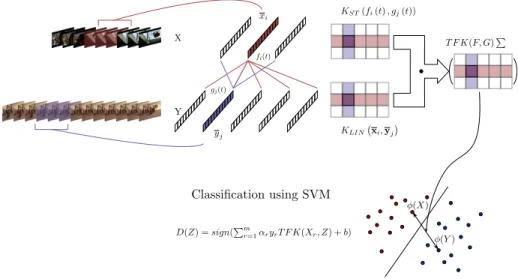
Figure 1: Graphical Abstract: (i) sliding frame-windows in the clip frames are used to encode the low-level descriptors information obtaining a sequence of vectors, (ii) two different kernels between sequence elements are computed using video and structure information and (iii) a multiple kernel learning is calculated in order to recognize using a SVM.
is no camera motion and the point of view is fixed [9] [10] [11]. Thanks to these restrictions it is possible to train states encompassing common
charac-teristics among the videos and thus to achieve high accuracy. However, new
databases, such as HMDB51, UCF50, OlympicSports and Virat Release 2.0
have been produced aiming at challenging tasks, such as indexing events in 35
unconstrained videos in the internet or surveillance in uncontrolled scenarios
performing a scene-independent learning and recognition. These datasets were
recorded in unconstrained environments with random viewpoints, camera
move-ments and/or dynamic changes in the background.
Some of the best results in these challenging benchmark datasets have been 40
obtained with variations of the mentioned SVM approach [12] [4] [6], which has been proven to be a convenient method in spite of the lack of long-term dynamic
information. Nevertheless, the long-term temporal information is important in
the description of complex activities and thus, we propose the recognition
frame-work depicted in Figure 1 where such information is maintained. Both BoF and 45
FV create a codebook, the former using k-means clustering of the training
de-scriptors and the latter using an EM-GMM algorithm. Following the application
of sliding frame-windows, each video is modelled as a sequence of BoFs or FVs. The use of a window with few frames produces sparse data so we minimize its
effect by using a soft-assignment approach when using BoFs. These sequences 50
preserve the long-term dynamic information needed for the recognition of
com-plex activities. However, as the sequences length and the pace of actions are
variable, standard kernels obtained between vectors of same length are not
ap-plicable and novel approaches, like Spatio-Temporal Pyramid Matching (STPM)
[13], keep the long-term information, but they rely on perfect alignment of the 55
sequences with regular pace of actions. Nevertheless, it is worth noting the
im-provement achieved using several encoding scales, proposed in STPM, that we
also apply into our work. So, our contribution in this paper includes the design of a novel kernel formulation between arbitrary length sequences that allows the
use of the long-term dynamic information in a SVM with matching flexibility, 60
named Time Flexible Kernel (TFK). In order to validate our contribution we
have carried out several experiments in four challenging datasets: HMDB51,
UCF50, OlympicSports and Virat Release 2.0.
The rest of the paper is divided as follows. Section 2 reviews some related
works. Section 3 explains the proposed framework, focusing on our two main 65
technical contributions: a novel encoding scheme and the Time Flexible
Ker-nel, as well as its application for activity recognition. Section 4 presents our
experimental validation and section 5 concludes the work.
2. Related Work
Feature extraction is a key element in recognition systems thus a signifi-70
cant number of methods have been proposed. Descriptors can be divided into
global and local or low-level features, however, the former group is sensitive to noise, occlusions and viewpoint variations that can be experienced in
2.0. Therefore, researchers have mainly focused on local descriptors that can be 75
roughly categorised as: (i) image descriptors like SIFT, HOG, Harris, which lack
any kind of time information or (ii) space-time descriptors like their extensions 3D-SIFT [2], HOG3D [3] and spatio-temporal Harris interest points [1]. Some
descriptors of the latter group are designed so to capture directly the video
in-formation as Motion Interchange Patterns (MIP) [5], HOG-HOF [14] or SCISA 80
[15] do. Most of the approaches use holistic encoding based on BoF or FV to
derive a vector for each video sequence. Then, SVM is used for multi-class
clas-sification, either using a one-against-one approach or a one-against-all approach
for multi-class recognition. Until recently, BoF has been the standard approach
in video encoding, quantizing the feature vectors into a predefined codebook. 85
However, recent works [6] [4] have adopted the strategy of encoding the
fea-ture information into a FV which keeps second-order information in relation to an estimated Gaussian Mixture Model (GMM). Alternatively to the above
framework, [16] modifies the SVM strategy to a ranking problem obtaining
en-couraging results. Finally, Dense Trajectories [17] [18] and the actual state of 90
the art in many benchmarks Improved Dense Trajectories (IDT)[6] are based
on short trajectories of local descriptors within a sliding temporal window.
The activity encoding methods such as BoF and FV require a “visual word”
dictionary. Usually, such a dictionary is created using clustering of the extracted
features in the training examples. In the case of BoF every feature is roughly 95
assigned to a word of the dictionary. However, quantization errors are caused,
when only a small amount of samples are used, as in the case of the use of a narrow temporal window. Soft-assignment approaches have been proposed to
deal with this problem [19] [20] [21]. Alternatively, FV models the codebook
as a GMM and the encoding produces a vector ofK(2d+ 1) dimensions,K is 100
the number of Gaussians and dis the dimension of descriptors, where second
order information of the GMM is used [4] [6]. However, the main drawback of
both approaches is that the long-term temporal information is lost since the
encodings are obtained from an unordered collection of local descriptors.
Many approaches have been designed to account complex temporal struc-105
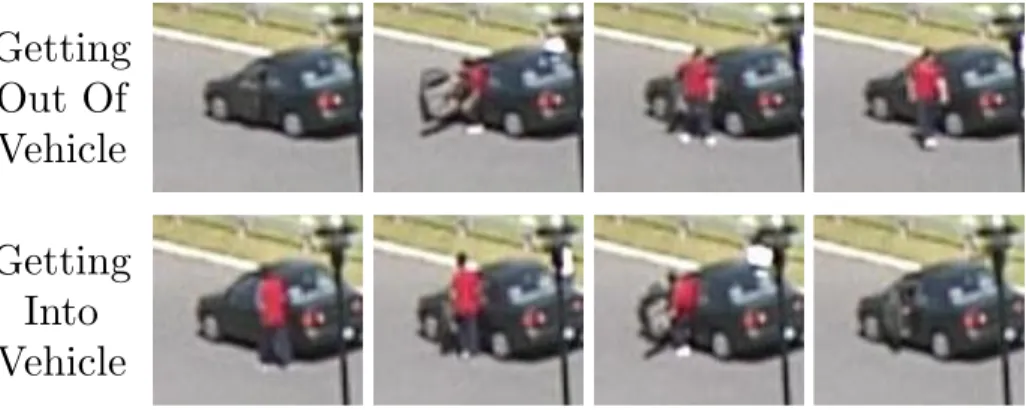
Figure 2: Two “opposite” activities from Virat Release 2.0 dataset with different sub-actions order. First row: person opens car door, goes out of the vehicle, closes door and walks. Second row: person walks, opens car door, gets into the vehicle and closes door.
tures recognizing complex human activities defined as composite multimedia
semantics (e.g., birthday party, wedding ceremony) where orderless sub-actions
appear in the video. These approaches consider the order of sub-actions as a
distracter (not a discriminant) and hence they perform an alignment of
simi-lar sub-scenes disregarding their order. For instanceXu et al. [22] divide the 110
clips into sub-clips which later are matched with other sequence using the earth
movers distance (EMD). Cao et al. [23] have designed a kernel that makes
a pooling of the frames into a fixed number of scenes called Scene Alignment
Pooling (SAP). In [24] a detection of sub-scenes categories and a global scene
category are combined in a Multiple Kernel Latent SVM where several features 115
are used. In the work ofLi et al. [25] the proposed method identifies the most
representative segments of the actions using a dynamic pooling with a latent
variable.
As opposed to the previously explained works, the temporal order of the
sub-actions performed in an activity is considered essential in this paper, as the 120
objective is to distinguish between complex activities that can be composed of
same sub-actions but in different order, even opposite as for instance “Getting
Out of Vehicle” and “Getting Into Vehicle” in Virat dataset, Figure 2.
differ-ent from the original one where samples may be linear-separable. The standard 125
kernel methods assume a fixed lengthD-dimensional vector per sample which is
projected into a different space where the inner product is performed. However, this is not straightforward in activity recognition videos where the long-term
activity dynamic information remains in the encoding because lengths of
se-quences may be arbitrary. Two solutions have been proposed in the literature: 130
(i) obtaining some sort of inner product by aligning the sequences lengths of the
patterns, as Dynamic Time-Alignment Kernel [26] or Fast Global Alignment
Kernel [27] do and (ii) training a HMM with a single sequence and posterior
obtaining a Probability Product Kernel (PPK) [28] like in [29]. Both solutions
have been used in sequence clustering tasks [30] [29] [31]. Sequence alignment 135
enforces a common start and end in the sequences which is not always the case.
On the other hand, the PPK of HMMs implies that each HMM is trained with only one sequence which does not offer sufficient information to train properly
the parameters of a complex model. Moreover, the optimization process in the
HMM training is performed with the Baun-Welch algorithm which only assures 140
a local optimum.
The long-term temporal information has been used in some other methods.
A recent one is the extension of the work of Spatial Pyramid Matching (SPM)
[32] called Spatio-Temporal Pyramid Matching (STPM) [13]. The method
sug-gests dividing the videos into equal number of spatio-temporal volumes at sev-145
eral scales, called pyramids, computing in each volume a BoF, and finally
ob-taining a similarity between two video clips by comparing the corresponding volumes. Fixing the number of divisions and comparing volumes one-to-one
constrain the method to regular paced actions losing flexibility. In [33] they
encode each video into a 3D histogram with spatio-temporal information and 150
design a specific kernel for the 3D histogram, but their pairwise feature
com-parison is not suitable for dense features extraction which recently have provide
the state-of-the-art results. Using HMM, the authors of [34] propose to learn
the temporal structure, including latent variables that determine the expected
time to stay in a state. [35] keeps the long-term information using graph models 155
of the video foreground and with a Kronecker product constructs a Kronecker
graph model per action class used in the classification. In [36] the sequences
length is not constrained and the authors use a framework where appearance and temporal position of motion segments is included, however, due to high
computational load, their learning process finds a local optimum. 160
As pace of actions is unknown and the alignment performed by the
segmen-tation can introduce some errors, our approach improves the previous methods
by introducing some flexibility in the kernel framework that compensates in
some degree these errors. The framework allows arbitrary length vectors in the
kernel, and as the SVM training is a convex optimization problem it finds a 165
global optimum.
3. Activity Recognition Framework using a Time Flexible Kernel (TFK)
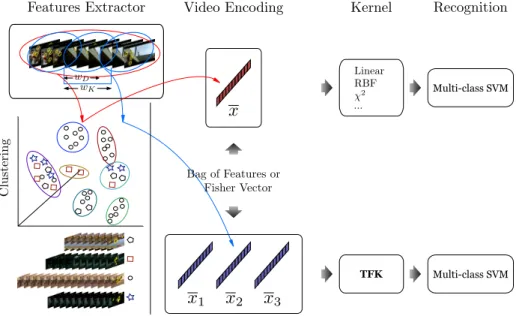
Figure 3 summarises our proposed framework for activity recognition and
compares it to the standard approach. Specifically, it assumes a pipeline of 170
feature extraction and clustering, video encoding using BoF or FV, applying
kernel and finally using multi-class SVM. The contribution of our framework is twofold: First, the video encoding method that produces multiple encodings
that preserve temporal information, as described in section 3.1. Second, the
Time Flexible Kernel that allows comparison of vectors of different lengths, 175
as described in section 3.2. Section 3.3 discusses the application of the novel
framework on activity recognition.
3.1. Video Encoding
We have designed an encoding that maintains the temporal information of
sequences. In Figure 3 we can compare the standard approach (up) and our 180
encoding method (down). There is a common stage of features extraction and
codebook generation by clustering, but the video is represented differently. Our
Multi-class SVM
TFK Multi-class SVM
Figure 3: Standard (up) and proposed (down) approaches: The features extraction and the clustering stages are common. The standard approach encodes a video into a single BoF using hard-assignment to clusters or a single FV. Our novel approach encodes the video splitting it into sliding frame-windows (window duration,wK frames, and window stride,wDframes) obtaining a BoF using soft-assignment or a FV in each window. The new encoding needs a specific kernel (TFK) instead of standard kernels, such as linear, RBF, etc. Finally a multi-class SVM performs the recognition.
frame-windows on the video. The width of the window iswK frames and it is
displacedwD frames each time. 185
A limitation may be introduced because of the width of the window, as the narrower the window the sparser the data used for encoding. In the case of
BoF a descriptor is commonly assigned to the closest cluster which is a rough
assignation because much of the spatial information in the descriptors space
is lost. FV, on the other side, keeps information related to the mean and 190
variance of each cluster which addresses this limitation. Soft-assignment has
been proven a good improvement representing continuous data with a codebook
model [19] and then in order to cope with the BoF limitation a soft-assignment
is proposed. Specifically, first the relative distance between a descriptorS and
a cluster centroidci in relation to the nearest cluster centroid is obtained. 195 ˜ d(S, ci) = d(S, ci) minj(d(S, cj)) (1)
But, instead of performing a hard-assignment (one for the closest cluster and
zero for the rest), a soft-assignment is applied as follows:
˜ s(S, ci) = 1 ˜ d(S, ci) β (2)
We assure that maximum value of ˜s(S, ci) = 1 is for the closest cluster while
smaller values are assigned for more distant centroids. Also, high values of β
approximate to the hard-assignment, which is achieved whenβ→ ∞. 200
Finally, we obtain a sequenceX={x1, . . . ,xN}, beingxi a D-dimensional vector. In the case of BoFDis the number of clusters in the codebook, while in
the case of FV, where soft-assignment is not used,D=K(2d+ 1), as discussed
in section 2.
3.2. Time-Flexible Kernel (TFK) 205
In the standard approach we have a fixed sizeD-dimensional vector per video
so only standard kernels (linear, polynomial, RBF,χ2, ...) may be applied before
sequences of vectors and therefore our novel formulation of a kernel between
sequences of different length is applied. 210
Having two sequencesX ={x1, . . . ,xN} and Y={y1, . . . ,yM} we define the function space Γ :R−→RDwhere F, G∈Γ:
F(t) = N X i=1 fi(t)xi (3) G(t) = M X j=1 gj(t)yj (4)
with xi,yj ∈ RD. We link each vector element with a specific function fi, gj:R−→Rused to introduce the temporal position of each element. These
functions weigh each sequence element according to variablet. 215
The TFK is then defined as:
T F K(F, G) = Z
t
F(t)TG(t)dt (5)
With the aim of demonstrating that TFK is indeed a kernel we reorder the
equation: T F K(F, G) = Z t N X i=1 fi(t)xTi M X j=1 gj(t)yj dt= N X i=1 M X j=1 Z t (fi(t)) (gj(t))dt xTi yj = N X i=1 M X j=1 KST(fi(t), gj(t))KLIN xi,yj (6)
To prove that Equation 6 represents a kernel, we follow several steps. First
we check whetherKST andKLIN inside the summation are indeed kernels. The 220
linear kernel,KLIN, is well known. On the other hand, to assure that the
struc-tural kernel,KST, is a kernel we impose the following initial conditions on fi
andgj: First, they should be square integrable, so R t(fi(t)) 2 dtandRt(gj(t)) 2 dt
are well defined (not infinity). Second,fi(t), gj(t)≥0,∀t. Thus,fi(t) andgj(t) belong to the Hilber-spaceL2, hence the kernel is semi-positive definite [28].
225
We still need to prove that the summation of these kernels is a kernel. In this regard, we proceed with the following steps: First, we extend the vector
representing the shortest sequence with zeros. Without loss of generality, let’s
assume thatN > M, so we extendyj in such a way thatyj=0forj > M and
we can use any functiongj(t) for j > M that fulfil the initial conditions. We 230
also denotexpi thep−th component of the xi vector, and the N-dimensional vector ˆxp= (xpi, i= 1· · ·N). Then, we develop the scalar product in Equation 6 as: N X i=1 N X j=1 X p K(fi(t), gj(t)) (xpi)(y p j) = X p ((ˆxp))TK(ˆyp) (7)
where K is a N ×N matrix Ki,j = K(fi(t), gj(t)). The matrix K is a positive semidefinite matrix, since it corresponds to a kernel in the space of 235
functions. Thus, each of the addends in Equation 7 is a kernel in a subspace,
and the sum of kernels in all the subspaces is also a kernel in the global space
[37].
As xi,yj are vectors in an arbitrary RD space, we can consider any
pro-jection of them in a different RS space obtaining φ(x
i), φ yj
. Then, we 240
can consider any kernel K xi,yj
as a linear kernel in the projected space
KLIN φ(xi), φ yj
so, in the previous proof, the linear kernel can be
substi-tuted by any arbitrary kernel.
3.3. Application of TFK in Activity Recognition
In a real world application there are video sequences with variable lengths, 245
and the recording or segmentation of same event classes are not perfect and
then they might start and end in different positions. This implies that when
comparing two repetitions of the same activity class it is possible that only a
portion of the sequence coincides. We can see this fact in Figure 4 where two
sequences of the same activity class (somersault), extracted from the HMDB51 250
Figure 4: Activity correspondence: Two videos of somersault from HMDB51 where only the final portions of the sequences coincide.
Thanks to TFK we are able to compare sequences of different lengths and
by selecting the appropriate associated function we can deal with non perfect
alignment. In this regard we design the following framework.
Let X={x1, . . . ,xN} and Y ={y1, . . . ,yM} be two sequences of vectors 255
representing two different activity executions (same or different class). These
sequences are obtained with the process explained in Section 3.1 so each vector
of the sequence is a BoF or a FV. On the other hand, the proper alignment
between two sequences is unknown and the computation of an algorithm
seek-ing for this alignment can increase notably the computational cost. Moreover, 260
a proper segmentation is assumed in advance so the core of the activity is most
probably located in the middle of the sequences. Therefore, without an
align-ment process and simply ensuring that centres of both sequences coincide, the
proposed method uses the structural kernel of TFK to provide the desired
de-gree of flexibility in compression and stretching of the activity representation. 265
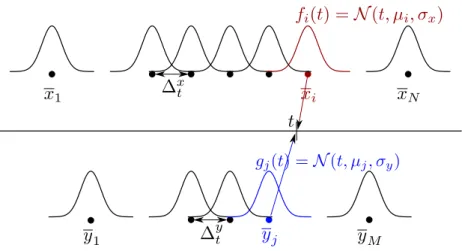
As depicted in Figure 5, we center both sequences and assign a Gaussian
distri-bution to each element of the sequences constrained to fixed temporal positions,
beingfi(t) andgj(t) the probability density functions ofNiandNjrespectively, fi(t) = σ 1 x √ 2πe −(t−µi)2 2σ2 x andgj(t) = 1 σy √ 2πe −(t−2σµj2)2 y beingµ i= (i−N+12 )∆xt and µj= (j−M2+1)∆ y t. 270
The associated Gaussians weigh the inner product between sequence
ele-ments in relation to their temporal position, obtaining a maximum when their
Figure 5: Kernel structure: Two centred sequences. Every vector of both sequences have a normal distribution associated. All the vector elements are compared in t weighted with their respective Gaussian function.
the elements, allowing an irregular expansion or narrowing of the sequences as
well as a displacement. In order to define the functions fi(t) and gj(t) it is 275
possible to fix the vector spacing ∆t and then only the standard deviation of
the Gaussianσ modifies the precision of the sequence position. The smaller is
σ, the narrower are the Gaussians and then the lesser is the degree of temporal flexibility. Moreover, as the number of elements in a sequence is variable and
each element has a Gaussian associated, it is possible to normalize the functions 280
so that the length of the sequence does not influence the kernel value using the
normalized Gaussians: fi0(t) = N1fi(t) andg0j(t) =
1
Mgj(t).
Taking into account all previous concerns, we use the following kernel:
T F K(F, G) = N X i=1 M X j=1 KGAU SSρ f 0 i(t), g0j(t) KLIN xi,yj (8)
We use the kernel between Gaussians that was proposed in [28] asKST in Equation 6, which in our one-dimensional case is simplified as:
285 KGAU SSρ f 0 i(t), gj0(t) = (2πσxσy) (1−2ρ)/2 N M√2ρ e −kµi−µjk2 4σxσy /ρ (9)
Inspired by the idea exposed in STPM [13], we explore the addition of two
levels of granularity in the sequence division. Therefore, using a simple linear
combination of kernels, that keeps the kernel property [38], we combine the TFK previously explained with a linear kernel between the vectors obtained from the 290
feature extraction of the whole video. In Figure 3 this would mean to combine
the two pipelines of the diagram in the following kernel.
CombK(v1, v2) =T F K(F, G) +KLIN(x,y) (10)
If the means and variances of the functionsfi(t) andgj(t) are only dependant
on the length of the sequences it is possible to precompute in advance the
KGAU SSρ f
0
i(t), gj0(t)
values for most of the possibles combinations ofN and 295
M, so the computational cost is only influenced by the kernel between the
vectors. Considering the computational cost ofK xi,yj
beO(D), the increase is linear with the increase of one of the sequences lengthO(N M(D+ 1)).
4. Validation 4.1. Datasets 300
We test the performance of our framework in four challenging
Activity-Recognition benchmarks (HMDB51, UCF50, OlympicSports, Virat Release 2.0),
against other published methods.
HMDB51[39] is one of the most challenging datasets nowadays. It contains
a collection of videos obtained from a variety of sources ranging from digitized 305
movies to YouTube videos. The total of 6766 video clips contains 51 distinct
activity categories each one represented by at least 101 examples. The dataset
is divided by the authors into 3 splits, each one containing 70 training clips and
30 testing clips in order to display a representative variability of the recording
sources. The dataset includes a stabilized version of the videos that is not used 310
in our experiments. We follow the protocol proposed by the authors.
UCF50 [40] is obtained from YouTube videos. It contains 6681 video clips
one, so it is important to follow the authors’ protocol. The authors suggest a
division into 25 groups in order to apply a leave-one-group-out cross-validation 315
strategy that we follow.
OlympicSprots[36] contains 783 videos of athletes practising 16 different
sports. All video sequences were obtained from YouTube and have been
anno-tated with the help of Amazon Mechanical Turk. The authors suggest a split
for training and testing the recognition system. 320
Virat Release 2.0 [41] has been recorded in 11 different scenes of video
surveillance, captured by stationary HD cameras (1080p or 720p). There are
11 different classes of activities annotated where persons and vehicles appear
(Loading, Unloading, Opening Trunk, Closing Trunk, Getting Into Vehicle,
Get-ting out of Vehicle, Entering Facility, ExiGet-ting Facility, Gesturing, Carrying and 325
Running). We follow the scene-independent learning and recognition mode of evaluation suggested by the authors. In the experiments we specifically focus
in the actions with “opposite” counterpart, all the actions except Gesturing,
Carrying and Running.
4.2. Parameter Identification 330
The framework performance is tested using two different descriptors. First,
as representative low-level descriptor with short-term information we have used
the MIP descriptor [5], which performs better than other common short-term
descriptors like SIFT or HOG-HOF. Second, as state-of-the-art descriptor, and
with longer temporal information captured we have selected the IDT descriptor. 335
In order to understand the utility of the proposed framework we have conducted
more exhaustive experiments with this descriptor. In both cases a parameter
analysis is explained in this subsection.
The MIP descriptor is extracted with the original specifications proposed by
the authors. The video is encoded with a BoF approach creating a codebook 340
of 5000 codewords per channel obtaining a (8×5000)-dimensional vector. Our proposed video encoding depends on three parameters: β (in Equation 2)
(c) accu racy (b) accu racy (a) accu racy
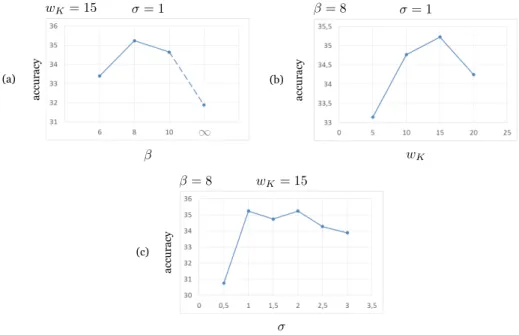
Figure 6: Parameters performance using MIP descriptors: Performance of the system eval-uated in the first split of HMDB51 in relation to three parameters: (a)β, (b)wK, and (c)
σ.
the sliding frame-windows. Fixing the temporal spacing ∆t= 1 we letσas the
free parameter of the Gaussian functions. 345
We firstly perform experiments for multiple combinations of the parameter
β, the window width wD, the window displacement wK and the the standard deviation σ of the Gaussian function of the kernel, using the first split of the
HMDB51 dataset.
From initial experiments we have found that a sliding frame-window without 350
overlapping provides best results, therefore we fix wD = wK and then only 2
parameters of the video encoding are analysed: wKandβ. We show in Figure 6
the results obtained by fixing two of the three analysed parameters to the values
finally selected, so the graphs represent the performance of the remaining one.
We can observe the importance of using the soft-assignment approximation 355
in Figure 6(a) where different values of β are evaluated. If we use a
in relation to a proper soft-assignment, which can be explained by the lack of
sufficient data in a window. On the other hand, any of the three analysed values
ofβ (6, 8 and 10) gives better results than the hard-assignment, what implies 360
that the use of a soft-assignment is an adequate optimization in a wide range of
values.
The width of the windowwK, Figure 6(b), does not impose significant
vari-ations in the system performance either, although the valuewK = 15 seems to
be optimal. 365
Figure 6(c), depicts the performance of the system while varying the
stan-dard deviationσof the kernel Gaussian functions. The bigger it is the wider are
the Gaussians which means that the sequences are more flexible to
asymmet-rically expand or shrink but also that the temporal position is less influential.
Very small values ofσ lead to low accuracy, but then the variation in perfor-370
mance is minor and we find the optimum betweenσ= 1 andσ= 2.
We extend the parameters influence experiments to the IDT descriptor. In
this case the encoding is performed with FV using a mixture model of 256
Gaussians. Hence, the study is performed over wK and wD for the sliding
frame-window andσfor the temporal structure. We perform the analysis using 375
the training examples of the OlympicSports dataset, dividing it into two groups
randomly selected: 70% for training and 30% for validation. In Figure 7 we
show three graphs fixing two of the parameters to the final value selected and
varying the remaining one.
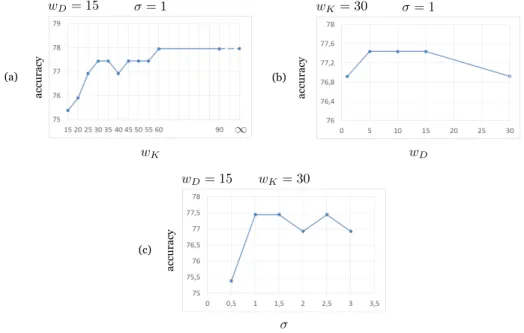
Figure 7 (a) shows low variation in the performance of the system for varying 380
wK except with short windows close to the IDT length, once reachedwK= 25
the accuracy variation is produced only by two examples recognition, slightly
tending to the maximum when increasing the size until reaching the whole video
represented in the axes as wK → ∞. The case where wK → ∞ corresponds to the use of a single FV per video, which is the standard approach of IDT 385
presented in [6]. Therefore, in order to compare our framework with the original
approach we carry out the experiments usingwK = 30. The value ofwD has
(c) accu racy (b) accu racy (a) accu racy
Figure 7: Parameters performance using IDT descriptors: Performance of the system evalu-ated in the OlympicSports dataset in relation to three parameters: (a)wK, (b)wD and (c)
σ.
betweenwD= 5 andwD= 15, it makes little difference in the final result. The
parameterσhas a similar behaviour to the one in the MIP analysis, although 390
we can consider that the optimum value extends from σ = 1 to at least the
maximum analysedσ= 3 because the accuracy decreases only in one incorrectly
recognized example.
4.3. Framework Validation
Our proposed framework is advantageous in two scenarios: (i) when using 395
short time descriptors, as it allows including longer temporal information in
the classifier and (ii) recognizing complex activities where the order of actions
may be crucial for correct recognition. In the latter scenario, our framework
can benefit even cases where longer time descriptors are used, as it encodes all
the temporal information of the activity. However, when dividing the videos in 400
small sub-clips the information can be scarce and produce unstable encoding
not fulfilled. This problem is overcome by combining the two granularities of
the video division proposed in Equation 10.
Our first experiment analysed the proposed framework performance using 405
short-term descriptors. It is carried out using the MIP descriptor and the BoF
encoding over the datasets HMDB51 and UCF50. In the previous section, we
have seen that the performance of the framework is not significantly influenced
when parameters are chosen within acceptable ranges. For the following
exper-iments we selectβ= 8, in case of soft-assignment, the widthwK = 15 and the 410
displacement of sliding frame-windows wD = 15, so they are not overlapped,
and the standard deviation of the Gaussian functions of the structural kernel
σ= 1. We divided both datasets according to the authors’ recommendations:
3 splits in HMDB51 and 25 groups in UCF50. We have used publicly available
code for MIP 1 and SVM2, using the default parameters. The randomness of 415
initialisation of the k-means algorithm justifies why our results do not exactly
coincide with those given in the MIP original paper. To ensure fair comparison
between the standard method and our proposed framework, clustering and
fea-tures extraction, as well as the one-against-all SVM classification, coincide in
both pipelines. The difference lays in the middle stages. The standard method 420
encodes the video with a single BoF obtained with a hard-assignment and
ap-plies a linear kernel between BoFs (BoF + LinK) as suggested by the authors
for best results [5]. The proposed framework encodes each video in a sequence of
BoFs (SeqBoF) using soft-assignment and applies the proposed TFK (SeqBoF
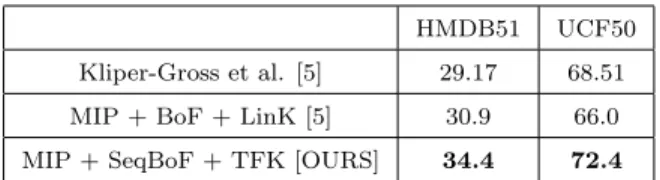
+ TFK). In Table 1 we can see how the inclusion of long-term temporal infor-425
mation using TFK clearly improves the results in both datasets which validates
our first assumption regarding short-term descriptors. However, clearly better
results have been obtained in the state-of-the-art using mid-term descriptors
and specifically with IDT.
1MIP descriptor code can be downloaded in
http://www.openu.ac.il/home/hassner/projects/MIP/MIPcode.zip
HMDB51 UCF50 Kliper-Gross et al. [5] 29.17 68.51 MIP + BoF + LinK [5] 30.9 66.0 MIP + SeqBoF + TFK [OURS] 34.4 72.4
Table 1: Average accuracy (in %) in the HMDB51 and UCF50 datasets using the splits suggested by the authors. First row: results provided in [5]. Second row: own implementation of [5]. Third row: novel framework using TFK.
The second battery of experiments has been performed using the state-of-430
the-art descriptor, IDT3, and comparing the novel framework against the orig-inal work in [6] and other related works in Activity Recognition. The sliding frame-windows vary form the MIP experiments as wK = 30 and wD = 15.
We compute the experiments in all the evaluated datasets: OlympicSports,
HMDB51, UCF50 and Virat Release 2. In all the experiments we follow the 435
authors’ recommendations: one division for training and testing in
Olympic-Sports, 3 splits in HMDB51, leave-one-group-out from 25 groups in UCF50 and
leave-one-scene-out with 11 scenes in Virat Release 2.0. As in the literature we
find mainly results of Accuracy (acc) or Mean Average Precision (mAP), we
compute both in the different approaches evaluated. Table 2 shows the results 440
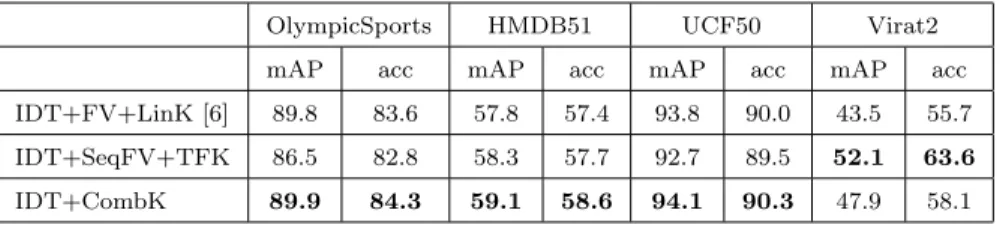
obtained with the original IDT as well as our proposed frameworks. To assure
fair comparison we perform all the experiments using the same IDT extraction and GMM estimation. First, we obtain an unique FV per Video and apply
a linear kernel for a SVM classification (IDT+FV+LinK), obtaining our own
implementation of the approach in [6]. Following, we use the extracted IDT fea-445
tures to obtain a sequence of FV (SeqFV) that are used in our TFK approach
(IDT+SeqFV+TFK). Finally, we combine both approaches in the CombK
ker-nel (IDT+CombK).
The TFK approach is suitable in complex activities where the order of
sub-3IDT descriptor code can be downloaded in
OlympicSports HMDB51 UCF50 Virat2
mAP acc mAP acc mAP acc mAP acc
IDT+FV+LinK [6] 89.8 83.6 57.8 57.4 93.8 90.0 43.5 55.7 IDT+SeqFV+TFK 86.5 82.8 58.3 57.7 92.7 89.5 52.1 63.6
IDT+CombK 89.9 84.3 59.1 58.6 94.1 90.3 47.9 58.1
Table 2: Mean Average Precision (mAP) and average accuracy (acc) (in %) results in the OlympicSports, HMDB51, UCF50 and Virat Release 2 datasets using the Improved Dense Trajectories. First row: own implementation of [6]. Second row: novel framework using TFK. Third row: novel framework using the combination of TFK with [6].
actions determines the class. This can be confirmed with the results in Virat 450
dataset where there are 4 activities with their respective “opposites”, depicted
in the second row, two last columns of Table 2. However, TFK also have some
drawbacks, as can be observed in the other three datasets where it performs
sim-ilarly to the original IDT method. TFK relies in the extracted features in each window, and if they are scarce, the computed FV can be less robust to clutter. 455
These datasets have complex activities, but not all of them depend on the
or-der of sub-actions, therefore, although some activities are better classified with
TFK, others are worse. The solution for this lack of robustness against clutter
is the linear combination of both kernels. As we can see in the last row, this
approach improves the results in all datasets but Virat where, even improving 460
the original approach, the result is worse than the direct use of TFK because all
the activities but 3 have “opposite” counterparts and the combination of kernels
lowers the importance of order.
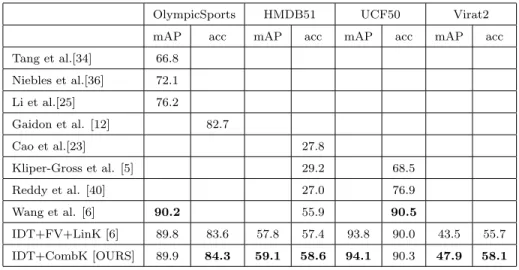
In Table 3 we observe a comparison of the proposed approach against some of the best results in the literature. It is worth to note that there are two rows 465
representing the original approach with IDT [6], the third-to-last and the
second-to-last. In the third-to-last row we show the results provided in the original
paper, but a direct comparison between this results and our approach is not
fair as several stages have some randomness and slightly alter the final results.
On the other hand, the second-to-last row shows our own implementation of 470
OlympicSports HMDB51 UCF50 Virat2
mAP acc mAP acc mAP acc mAP acc
Tang et al.[34] 66.8 Niebles et al.[36] 72.1 Li et al.[25] 76.2 Gaidon et al. [12] 82.7 Cao et al.[23] 27.8 Kliper-Gross et al. [5] 29.2 68.5 Reddy et al. [40] 27.0 76.9 Wang et al. [6] 90.2 55.9 90.5 IDT+FV+LinK [6] 89.8 83.6 57.8 57.4 93.8 90.0 43.5 55.7 IDT+CombK [OURS] 89.9 84.3 59.1 58.6 94.1 90.3 47.9 58.1
Table 3: Mean Average Precision (mAP) and average accuracy (acc) (in %) results in the OlympicSports, HMDB51, UCF50 and Virat Release 2 datasets. Comparison of the proposed framework (last row) with several state-of-the-art approaches.
[6] which share the features extraction and the clustering with the TFK so
the comparison is fair. We can see how our novel approach overtakes all the
compared methods in the “fair” comparison. To our knowledge there is no
method with better results for all the datasets.
The results on Virat Release 2.0 are further analysed using only the activities 475
with “opposites”, (Loading, Unloading, Opening Trunk, Closing Trunk, Getting
Into Vehicle, Getting out of Vehicle, Entering Facility and Exiting Facility). The
Confusion Matrices of the (IDT+FV+LinK) and (IDT+SeqFV+TFK) methods
are depicted in 8. In addition to the improvement obtained with the proposed
framework, these matrices confirm our premise that the TFK is suitable for 480
better learning of complex activities defined with the sub-actions order. The
improvement achieved by the proposed framework is clear as every element of
the diagonal is greater or equal. But the improvement do not restrict to this
as in addition of a general improvement, the wrong classified activities are now confused with activities with similar temporal structure. For instance, the two 485
Loading Unloading OpeningT runk ClosingT runk GettingInt oVehicle GettingOut ofVehicle
EnteringFacility ExitingF acility Loading Unloading OpeningT runk ClosingT runk GettingInt oVehicle GettingOut ofVehicle EnteringFacility ExitingF acility 1.70 10 23.80 37.30 7.10 12.20 10.80 8.30 1.90 0.80 4.80 40.50 2.40 0.90 2.10 0.60 3.40 24.40 1.80 2.10 33.30 28.80 21.40 34.10 640 43.80 38.10 28.80 310 26.80 20.70 42.70 0.60 0.90 67.90 28.60 0.90 28.80 70.70 Loading Unloading OpeningT runk ClosingT runk GettingInt oVehicle GettingOut ofVehicle
EnteringFacility ExitingF acility Loading Unloading OpeningT runk ClosingT runk GettingInt oVehicle GettingOut ofVehicle EnteringFacility ExitingF acility 28.60 52.50 9.50 26.80 0.90 8.30 3.20 0.80 40.50 2.40 24.40 52.40 220 23.80 19.50 86.50 36.50 0.60 190 25.40 23.80 29.30 10.80 55.20 0.90 750 28.60 0.90 21.20 70.70
Figure 8: Confusion Matrices in Virat Release 2.0 using activities with “opposites”: First the Confusion Matrix using IDT + FV + LinK approach, second using IDT + SeqFV + TFK.
Figure 9: Confusion Matrices in Virat Release 2.0 using two classes (IN and OUT): First the Confusion Matrix using IDT + FV + LinK approach, second using IDT + SeqFV + TFK.
Into Vehicle’ and ‘Getting Out of Vehicle’). If we observe the Confusion Ma-trix of the (IDT + FV + LinK) method, the confusion is more or less random,
but using TFK we can see how the structure is learned and then “loading” is
mainly confused with “getting into vehicle” and “unloading” is mainly confused 490
with “getting out of vehicle”. We achieve a clearer representation of this idea
by gathering all the activities with similar temporal structure into one class
so, activities (Loading, Opening Trunk, Getting Into Vehicle and Entering
Fa-cility) with structure (approaching and opening-closing) are grouped in class
IN and activities (Unloading, Closing Trunk, Getting out of Vehicle and Exit-495
ing Facility) with structure (opening-closing and moving away) are grouped in
class OUT. Figure 9 depicts the Confusion Matrices of these two classes. Here it is clear how the TFK approach keeps better the temporal structure of the
activities.
Finally, we introduce one more experiment in order to compare our frame-500
work with the STPM approach which also preserves the temporal structure of
the activities. In [13],Choi et al. have designed an experiment calledQuality of
binary decisionwhere one example is compared to other two, one with the same
class and other with a different class. Whenever the example of the same class
is more similar to the initial example than the other one, the binary decision is 505
correct. With this experimentation the authors obtains a maximum of 95.3% of
Precision. In order to get a similar process we select single-class SVM to provide binary decisions between two randomly selected examples (one form the same
has a greater note than the other one, the binary decision is correct. Using this 510
experimentation we obtain a 99.3% of Precision.
5. Conclusion
We have introduced a new framework that improves accuracy in human
ac-tivity classification taking into account the long-term information. The
frame-work can be used with a wide variety of low-level feature descriptors, such as 515
MIP and IDT, and video encoding methods, such as BoF and FV. The specific technical novelties of our work is a video encoding method that preserves the
temporal information and the Time Flexible Kernel that is able to compare
sequences of different lengths and random alignment.
Our experiments demonstrated the value of the novel framework in two cases: 520
First, low-level descriptors with short-term information lose the long-term
tem-poral information of the sequences. Our framework is able to consider such
temporal information and therefore can improve the performance in activity
recognition. Second, although modern state-of-the-art descriptors like IDT
in-clude some temporal information for recognizing several activities in spite of the 525
unordered encoding of BoF or FV, they fail in case of complex activities that are defined by the order of the same short events. Again, our framework is able
to preserve such complex temporal structure and distinguish between activities
that consist of similar events but in different order.
The novel formulation of TFK is not restricted to activity sequences but 530
it can be applied in any comparison between two sets that their structure of
information can be defined using the functions fi and gj. For instance, an
interesting extension for future research will be its application in image-based
recognition, where the spacial structure is an important source of information.
Finally, the TFK approach can introduce some noisy results if the number 535
of low-level extracted features is small in some windows. Using several levels of granularity in window width reduces this effect.
6. Acknowledgements
This work was partially supported by Spanish Grant TIN2013-45312-R (MINECO)
and FEDER. Mario Rodriguez was sponsored by Spanish FPI Grant BES-2011-540
043752 and EEBB-I-14-08410.
References
[1] I. Laptev, On space-time interest points, International Journal of Computer
Vision (IJCV) 64 (2005) 107–123. doi:10.1007/s11263-005-1838-7.
[2] P. Scovanner, S. Ali, M. Shah, A 3-dimensional sift descriptor and its ap-545
plication to action recognition, in: Proceedings of the 15th international
conference on Multimedia, 2007, pp. 357–360. doi:10.1145/1291233.
1291311.
[3] A. Kl¨aser, M. Marsza lek, C. Schmid, A spatio-temporal descriptor based
on 3d-gradients, in: British Machine Vision Conference (BMVC), 2008, pp. 550
995–1004. doi:10.5244/C.22.99.
[4] D. Oneata, J. Verbeek, C. Schmid, Action and event recognition with fisher
vectors on a compact feature set, in: IEEE Intenational Conference on
Computer Vision (ICCV), 2013, pp. 1817–1824. doi:10.1109/ICCV.2013.
228. 555
[5] O. Kliper-Gross, Y. Gurovich, T. Hassner, L. Wolf, Motion inter-change patterns for action recognition in unconstrained videos, in:
Eu-ropean Conference on Computer Vision (ECCV), 2012. doi:10.1007/
978-3-642-33783-3_19.
[6] H. Wang, C. Schmid, Action recognition with improved trajectories, in: 560
IEEE Intenational Conference on Computer Vision (ICCV), 2013. doi:
[7] J. Yamato, J. Ohya, K. Ishii, Recognizing human action in time-sequential
images using hidden markov model, in: IEEE Conference on Computer
Vision and Pattern Recognition (CVPR), 1992. doi:10.1109/CVPR.1992.
565
223161.
[8] J. Wang, P. Liu, M. F. She, H. Liu, Human action categorization using
conditional random field, in: Robotic Intelligence In Informationally
Struc-tured Space (RiiSS), 2011. doi:10.1109/RIISS.2011.5945793.
[9] Y.-M. Liang, S.-W. Shih, A. C.-C. Shih, H.-Y. M. Liao, C.-C. Lin, Learning 570
atomic human actions using variable-length markov models, Transactions
on Systems, Man and Cybernetics. Part B 39 (2009) 268–280. doi:10.
1109/TSMCB.2008.2005643.
[10] R. Vezzani, D. Baltieri, R. Cucchiara, HMM based action recognition with
projection histogram features, in: Recognizing Patterns in Signals, Speech, 575
Images and Videos, Springer Berlin Heidelberg, 2010, pp. 286–293. doi:
10.1007/978-3-642-17711-8_29.
[11] A. Antonucci, R. D. Rosa, A. Giusti, Action recognition by imprecise
hid-den markov models, in: International Conference on Image Processing,
Computer Vision and Pattern Recognition (IPCV), 2011. 580
[12] A. Gaidon, Z. Harchaoui, C. Schmid, Recognizing activities with cluster-trees of tracklets, in: British Machine Vision Conference (BMVC), 2012,
pp. 30.1–30.13. doi:10.5244/C.26.30.
[13] J. Choi, Z. Wang, S.-C. Lee, W. J. Jeon, A spatio-temporal pyramid
match-ing for video retrieval, Computer Vision and Image Understandmatch-ing 117 (6) 585
(2013) 660 – 669. doi:http://dx.doi.org/10.1016/j.cviu.2013.02.
003.
[14] I. Laptev, M. Marsza lek, C. Schmid, B. Rozenfeld, Learning realistic human
actions from movies, in: IEEE Conference on Computer Vision and Pattern
Recognition (CVPR), 2008. doi:10.1109/CVPR.2008.4587756. 590
[15] Q. V. Le, W. Y. Zou, S. Y. Yeung, A. Y. Ng, Learning hierarchical
in-variant spatio-temporal features for action recognition with independent
subspace analysis, in: IEEE Conference on Computer Vision and Pat-tern Recognition (CVPR), Washington, DC, USA, 2011, pp. 3361–3368.
doi:10.1109/CVPR.2011.5995496. 595
[16] E. F. Can, R. Manmatha, Formulating action recognition as a ranking
problem, in: International workshop on Action Similarity in Unconstrained
Videos, 2013. doi:10.1109/CVPRW.2013.44.
[17] Y.-G. Jiang, Q. Dai, X. Xue, W. Liu, C.-W. Ngo, Trajectory-based
modeling of human actions with motion reference points., in: Euro-600
pean Conference on Computer Vision (ECCV), 2012. doi:10.1007/
978-3-642-33715-4_31.
[18] H. Wang, A. Kl¨aser, C. Schmid, C.-L. Liu, Dense trajectories and motion
boundary descriptors for action recognition, International Journal of
Com-puter Vision (IJCV) 103 (2013) 60–79.doi:10.1007/s11263-012-0594-8. 605
[19] J. C. van Gemert, C. J. Veenman, A. W. M. Smeulders, J. M. Geusebroek,
Visual word ambiguity, IEEE Transactions on Pattern Analysis and
Ma-chine Intelligence 32 (7) (2010) 1271–1283.doi:10.1109/TPAMI.2009.132.
[20] Y. Zhu, X. Zhao, Y. Fu, Y. Liu, Sparse coding on local spatial-temporal volumes for human action recognition, in: Asian Conference on Computer 610
Vision (ACCV), 2011. doi:10.1007/978-3-642-19309-5_51.
[21] M. Rodriguez, C. Medrano, E. Herrero, C. Orrite, Transfer learning of
human poses for action recognition, in: Human Behavior Unterstanding,
2013. doi:10.1007/978-3-319-02714-2_8.
[22] D. Xu, S.-F. Chang, Video event recognition using kernel methods with 615
multilevel temporal alignment, IEEE Transactions on Pattern Analysis and
Machine Intelligence 30 (11) (2008) 1985–1997.doi:10.1109/TPAMI.2008.
[23] L. Cao, Y. Mu, A. Natsev, S.-F. Chang, G. Hua, J. Smith, Scene aligned
pooling for complex video recognition, in: European Conference on Com-620
puter Vision (ECCV), 2012. doi:10.1007/978-3-642-33709-3_49.
[24] A. Vahdat, K. Cannons, G. Mori, S. Oh, I. Kim, Compositional models for
video event detection: A multiple kernel learning latent variable approach,
in: IEEE Intenational Conference on Computer Vision (ICCV), 2013.
[25] W. Li, Q. Yu, A. Divakaran, N. Vasconcelos, Dynamic pooling for complex 625
event recognition, in: IEEE International Conference on Computer Vision
(ICCV), 2013. doi:10.1109/ICCV.2013.339.
[26] H. Shimodaira, K. ichi Noma, M. Nakai, S. Sagayama, Dynamic
time-alignment kernel in support vector machine, in: Advances in Neural
Infor-mation Processing Systems (NIPS), 2002. 630
[27] M. Cuturi, Fast global alignment kernels, in: International Conference on
Machine Learning (ICML), 2011.
URLhttp://www.icml-2011.org/papers/489_icmlpaper.pdf
[28] T. Jebara, R. Kondor, A. Howard, Probability product kernels, Journal of
Machine Learning Research 5 (2004) 819–844. 635
URLhttp://dl.acm.org/citation.cfm?id=1005332.1016786
[29] T. Jebara, Y. Song, K. Thadani, Spectral clustering and embedding with
hidden markov models, in: European Conference on Machine Learning (ECML), 2007. doi:10.1007/978-3-540-74958-5_18.
[30] F. Zhou, F. De la Torre Frade, J. K. Hodgins, Hierarchical aligned cluster 640
analysis for temporal clustering of human motion, IEEE Transactions on
Pattern Analysis and Machine Intelligence 35 (2013) 582–596. doi:10.
1109/TPAMI.2012.137.
[31] J. A. Rodriguez-Serrano, S. Singh, Trajectory clustering in CCTV
traf-fic videos using probability product kernels with hidden markov mod-645
els., Pattern Analysis & Applications 15 (2012) 415–426. doi:10.1007/
s10044-012-0269-7.
[32] S. Lazebnik, C. Schmid, J. Ponce, Beyond bags of features: Spatial pyramid matching for recognizing natural scene categories, in: Computer Vision and
Pattern Recognition, 2006 IEEE Computer Society Conference on, Vol. 2, 650
2006, pp. 2169–2178. doi:10.1109/CVPR.2006.68.
[33] M. Ryoo, J. Aggarwal, Spatio-temporal relationship match: Video
struc-ture comparison for recognition of complex human activities, in: IEEE
In-tenational Conference on Computer Vision (ICCV), 2009, pp. 1593–1600.
doi:10.1109/ICCV.2009.5459361. 655
[34] K. Tang, L. Fei-Fei, D. Koller, Learning latent temporal structure for
complex event detection, in: Computer Vision and Pattern Recognition (CVPR), 2012 IEEE Conference on, 2012, pp. 1250–1257. doi:10.1109/
CVPR.2012.6247808.
[35] S. Todorovic, Human activities as stochastic kronecker graphs, in: Eu-660
ropean Conference on Computer Vision (ECCV), 2012. doi:10.1007/
978-3-642-33709-3_10.
[36] J. C. Niebles, C.-W. Chen, L. Fei-Fei, Modeling temporal structure of
de-composable motion segments for activity classification, in: European
Con-ference on Computer Vision (ECCV), 2010, pp. 392–405. doi:10.1007/
665
978-3-642-15552-9_29.
[37] C. M. Bishop, Pattern Recognition and Machine Learning (Information
Sci-ence and Statistics), Springer-Verlag New York, Inc., Secaucus, NJ, USA,
2006.
[38] M. G¨onen, E. Alpaydın, Multiple kernel learning algorithms, Journal of 670
Machine Learning Research 12 (2011) 2211–2268.
[39] H. Kuehne, H. Jhuang, E. Garrote, T. Poggio, T. Serre, HMDB: a large
video database for human motion recognition, in: IEEE Intenational
Con-ference on Computer Vision (ICCV), 2011. doi:10.1109/ICCV.2011.
675
6126543.
[40] K. K. Reddy, M. Shah, Recognizing 50 human action categories of web
videos, Machine Vision and Applications 24 (5) (2013) 971–981. doi:10.
1007/s00138-012-0450-4.
[41] S. Oh, A. Hoogs, A. Perera, N. Cuntoor, C.-C. Chen, J. T. Lee, S. Mukher-680
jee, J. K. Aggarwal, H. Lee, L. Davis, E. Swears, X. Wang, Q. Ji, K. Reddy,
M. Shah, C. Vondrick, H. Pirsiavash, D. Ramanan, J. Yuen, A. Torralba,
B. Song, A. Fong, A. Roy-Chowdhury, M. Desai, A large-scale benchmark
dataset for event recognition in surveillance video, in: IEEE Conference on Computer Vision and Pattern Recognition (CVPR), Washington, DC, 685