Caribbean
Environment
Programme
United Nations Environment Programme
Proceedings of the Workshop on Adopting, Applying and
Operating Environmentally Sound Technologies for
Domestic and Industrial Wastewater Treatment for the
Wider Caribbean Region
CEP Technical Report No. 43
Note: The designations employed and the presentation of the material in this document do not imply the expression of any opinion whatsoever on the part of UNEP concerning the legal status of any State, Territory, city or area, or its authorities, or concerning the delimitation of their frontiers or boundaries.
For bibliographic purposes the printed version of this document may be cited as:
UNEP: Proceedings of the Workshop on Adopting, Applying and Operating Environmentally Sound Technologies for Domestic and Industrial Wastewater Treatment for the Wider Caribbean Region.
Household Systems for Wastewater Treatment:
Household Systems for Wastewater Treatment
Goen E Ho and Kuruvilla MathewRemote Area Developments Group, Institute for Environmental Science, Murdoch University, Murdoch, Western Australia 6150
Associate Professor Goen Ho
Tel: (61-8) 9360-2167, Fax: (61-8) 9310-4997, Email: [email protected]
Dr Kuruvilla Mathew
Tel: (61-8) 9360-2896, Fax: (61-8) 9310-4997, Email: [email protected]
Introduction
Isolated dwellings present their own problems of sewage disposal. The septic tank has conventionally been used to treat the sewage. It usually consists of one or two tanks for settling of solids with the overflow disposed via subsurface soil percolation. Depending on soil permeability a soak well is used in very permeable soil, whereas a trench is used where the soil is less permeable allowing for more infiltration area. Settled solids in the tank(s) undergo some anaerobic decomposition, but have to be emptied on a regular basis. Properly designed a septic tank may perform satisfactorily in unobtrusively conveying wastewater away from a dwelling. It can, however, pose health hazards in rocky or tight clay soils resulting in ponding of untreated sewage. More generally septic tanks contaminate groundwater with human pathogens, nutrients (nitrogen and phosphorus) and other pollutants disposed with domestic wastewater. The problems are accentuated where groundwater is close to the surface, or withdrawn for water supply for the isolated dwelling.
There are now a variety of options for wastewater treatment, disposal and reuse for isolated dwellings. Such systems can produce an effluent quality equal to or better than a conventional treatment plant. They may also be more cost effective than reticulated sewerage in rural and semi-rural areas besides isolated dwellings of remote areas, because extensive piping and pumping is avoided. There are also questions from the point of view of a local community particularly in developing countries besides the affordability of the chosen system for them, such as control over technologies that have the potential to influence the dynamics, form and autonomy of the community into which they are introduced. In addition there are now growing environmental and social pressures to consider reusing wastes and to begin introducing systems which are sustainable in the long term.
This section will discus the criteria to be considered in general in the process of selection of a particular technology for isolated dwellings and then describe a few technologies which are approved to be used in Australia to illustrate technologies that can be applied in other parts of the
world. Use of local materials, modified design to suit local conditions and preference of a community should be taken into account when determining what is best for a particular case.
Criteria for Selection
During the selection process each option must be considered in terms of its ability to satisfy the following criteria. But in addition the extent of treatment necessary, the soil type or the site requirements and personal or community attitudes and preference should also be considered.
Reuse of Resources
Wastewater is often considered a source of public health problems to be disposed of and not as a resource. The choice of disposal and treatment system is usually governed by the disposal strategy. Reasons for reuse and options of reuse are well documented (Odendaal, 1992, Mathew & Ho, 1993). It is possible to use the treated wastewater and the sludge if proper treatment procedure is adopted while at the same time satisfying the guidelines for reuse (NHMRC, 1987; ANZECC, 1992).
Protect the Environment
Protection of public health is of the reason for treatment of sewage. Protection of the environment should also be considered. The conventional system of on-site disposal of wastewater is the septic tank and soil absorption system. The effluent from septic tank after soil treatment does not usually meet the criteria for maintenance of groundwater quality and hence needs further treatment (UWRAA/AWRC, 1992). Nutrient removal may become necessary in many situations where nutrients can cause pollution either directly by, for example, nitrate in the treated wastewater or through euthrophication of the receiving water.
Simplicity of Operation
A system sophisticated in its technology and control may tend to be complicated in operation. Frequent servicing and regular checking may become inevitable in operating an on-site treatment plant. While aiming for the best performance possible a system with minimum operational requirements and relatively easy and simple to maintain should be preferred.
Minimum Use of Chemicals
Chemicals have been used for phosphorus removal and disinfection. Biological phosphorus removal is to be preferred to chemical removal process. Disinfection by ultraviolet radiation should be considered in place of chlorination. Sub-surface micro-irrigation, for example, may not demand disinfection to the level it is necessary at present.
Other general aspects such as installation cost, maintenance expenses, aesthetic considerations, durability of the equipment and low energy consumption should also be considered in the selection of a system.
Systems Designed for Low Water Usage
Domestic sewage generally consists of wastes produced from the toilet, kitchen sink, bath and shower, wash basin and laundry. Toilet waste, generally referred to as black water, makes up to 25-30% of the total flow, while the other wastes comprise 70-75% of the flow is collectively referred to as grey water. The design of low water use systems attempts to reduce the amount of water, and black water may, for example, be reduced significantly producing only sludge. The black water contains the major portion of biochemical oxygen demand (BOD), suspended solids (SS), bacteria and nutrients. So if the black water is treated separately then treatment of grey water alone becomes easier and less complicated. The potential of pollutants being transported by the water in the black water is simultaneously significantly reduced, because water is generally the conveying medium for the pollutants.
V.I.P. Toilet
The Ventilated Improved Pit (VIP) toilet is a product of the Centre for Appropriate Technology (CAT), Alice Springs, Australia. Even though this is a pit toilet, its special construction ensures minimum odour and fly problems. It is possible for a family of five people to use the same unit for 10 years (Walker, 1985). In Australia this has been found to be suitable for camping places in national parks, main roads department highway rest sites, and remote communities.
Composting Toilet
Composting systems do not require any water connection, periodical pumping out, chemical dosing or on-going maintenance. It converts the waste with the nutrients in it into garden compost. It can be installed for single dwellings or community ablutions irrespective of the soil type of the area and should not create any environmental pollution. Three composting toilets approved by the Health Department of Western Australia are described below.
Clivus Multrum
The Clivus Multrum consists of a sloping, fibreglass compost tank which has been divided into an upper section for the treatment of fresh wastes and a lower section for the treatment of mature compost. The toilet seat is placed on the top of the tank. A vent pipe fitted with a fan to force the flow of air to the outside of the toilet is connected to the tank to keep the room odour free. There is a liquid drain which removes the excess liquid to keep the waste dry enough for composting. There are two inspection doors to provide access to both chambers. This can have multiple toilets and urinals with a capacity for up to 40 - 120 people. The pile should be inspected weekly to
ensure adequate moisture levels and to add a bulking agent if necessary. It is suggested to level the pile quarterly and remove the compost from the lower chambers annually (Clivus Multrum, 1990). Vent-screens and pest strips may be used for pest control with a possibility of using a biodegradable pesticide in extreme circumstances.
Rota-Loo
Rota-Loo is designed for use by 6 - 8 people and hence is small and compact. It consists of four separate composting chambers in a circular container. Two of the chambers can be used simultaneously providing the opportunity of having two toilets using one housing unit. An air vent with a fan is connected to the main chamber to make sure continuous air flow is maintained. There is a heating element at the bottom of the chamber which keeps the temperature suitable for composting irrespective of the outside temperature. When one chamber is full the container is rotated thus providing the opportunity for maturing the compost. It is suggested to remove the compost annually and adjust its use to ensure enough time for composting (Rota-Loo, 1991).
Dowmus
The toilet seat of the Dowmus system is connected to a circular composting chamber of about 4.3 m3 which is of a sufficient volume for a family of five. It has a ventilation pipe with a fan to exhaust air from the bottom of the tank providing air flow through the compost. The compost can be extracted using an auger provided at the top of the tank towards one side. The Dowmus is partially filled with active compost at the time of installation and inoculated with beneficial soil organisms in particular tiger and red composting worms (Dowmus, 1993). There is no heating element and the system is not intended to operate above 350C, to protect the worms. The process depends more on soil organisms and worms rather than on the thermophilic microorganisms for composting. It can also take other household organic matters provided they are cut into small pieces. A family of five people can use this system for a few years without having to remove the compost.
Vermi-processing Toilet
BERI (Bhawalkar Earthworm Research Institute) vermi-processing toilet (BVT) has been field tested for 8 years in India and found to be a novel low water-use toilet for safe processing of human excreta without odour and fly problem. The toilet pan is directly connected to a tank of 1m x 1m x 1m which has a removable cover slab with ventilation holes. This can serve a family for about three years. BVT is started off by putting 5 kg of vermicastings in the pit (Bhawalkar and Bhawalkar, 1991). The operation of the toilet employing the pit is very simple and hygienic as the human excreta will be completely converted to vermi castings - a resource much needed for soil.
Aerobic Treatment Units
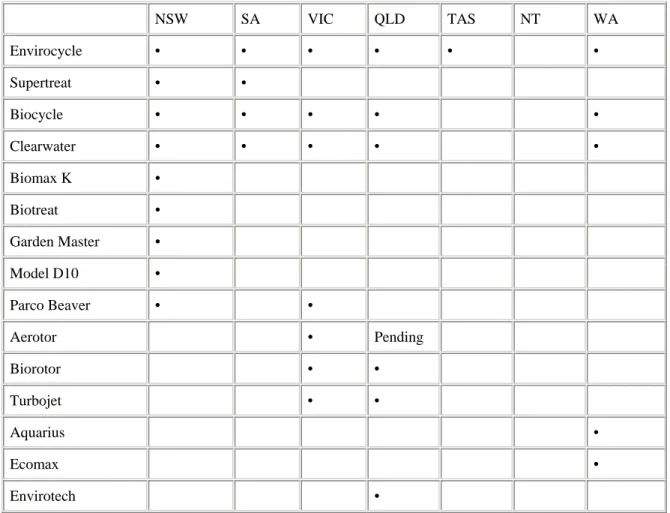
The common practice is to treat black and grey water together. Even when the black water is treated separately the grey water has to be treated by a system which satisfies the selection criteria described above. A number of such systems now available are listed in Table 1.
TABLE 1: Approved Household Aerobic Treatment Units in various States in Australia
NSW SA VIC QLD TAS NT WA Envirocycle • • • • • • Supertreat • • Biocycle • • • • • Clearwater • • • • • Biomax K • Biotreat • Garden Master • Model D10 • Parco Beaver • • Aerotor • Pending Biorotor • • Turbojet • • Aquarius • Ecomax • Envirotech •
NSW = New South Wale ; SA = South Australia; VIC = Victoria; QLD = Queensland; TAS = Tasmania, NT = Northern Territory; s WA = Western Australia.
These systems have a pre-treatment module similar to a septic tank which is for primary sedimentation and anaerobic decomposition. The recommended volume of 3 days storage for a septic tank (HCV, 1979) is followed by most of the systems. Domestic on-site systems receive wastewater usually as slug flows rather than as a constant flow. So the volume of the septic tank should be large enough to prevent the displacement of settled solids to the next chamber.
The most significant unit is the aerobic treatment chamber where the biological treatment process takes place to provide water quality to the secondary effluent standard. This is due to the effective contact between the incoming waste and bacteria in the aeration tank. Due to the slug flow in the small treatment units it is possible that the inflow may not achieve sufficient contact with treatment bacteria. So most of the systems operate with bacteria growing on fixed media
which provide a longer contact time and less chance of bacteria washout, thus providing greater opportunity for removal of organic materials from the liquid. In a trickling filter or biofilter especially with new types of filter media with high availability of oxygen high removal rate is achieved within a shorter time. On the other hand in activated sludge system to achieve satisfactory level of treatment the wastewater has to be kept in the tank for several hours. Both processes are applied in different aerobic treatment units.
A secondary settling tank removes the suspended matter producing effluent with a secondary effluent water quality. The wastewater at this stage will normally have over a hundred thousand coliform bacteria per 100 ml which should be reduced to 10 per 100 ml. Most aerobic treatment units use chorination for disinfection.
The sludge produced in the secondary sedimentation tank is recycled to the septic tank for further treatment and storage. Desludging of the tank is required regularly, either small amounts quarterly or substantially every 3 to 4 years.
Nutrient removal is optional for aerobic treatment units at present. There are units available which remove the nutrients with many organisations being involved in further research in this area in Australia.
Five treatment systems approved by the Health Department of Western Australia are described here as representatives of the available systems. These systems incorporate state of the art treatment techniques available at present.
Envirocycle
Envirocycle in an aerobic treatment unit designed to treat sewage produced in a household of five people. This system has multiple treatment chambers based on the activated sludge process (Envirocycle, 1993). This is a circular unit with two primary settling chambers, two aerobic chambers, a clarification chamber, a chamber for chlorination and storage to provide enough contact time, and a chamber for storage and pumping for final disposal. The final effluent after secondary clarification and chlorination is used for spray or trickle irrigation.
Biocycle
Biocycle is an aerobic treatment system which provides a secondary level of treatment to produce an effluent which meets the 20 mg/L BOD and 30 mg/L SS effluent quality standard. This is available in two sizes. The domestic model is designed for 10 people and the commercial model is for offices, restaurants or other public institutions (Biocycle, 1990). The Biocycle treatment system consists of a circular tank which is divided into four compartments (1) primary settling and anaerobic digestion chamber, (2) aerobic chamber with fixed media and bubble aeration facility, (3) secondary sedimentation chamber with the settled sludge pumped back to the septic chamber, (4) chlorination and storage chambers. Chlorination is by tablet chlorinator
and the final effluent is pumped for irrigation when the volume reaches a pre-set level. The soil at the irrigation area can be amended with neutralised bauxite residue for phophate removal.
Clearwater System
This is an aerobic treatment system which has two separate tanks. The first one is a circular tank of 1.7 m dia and 1.6 m height which functions as a sedimentation and septic tank. The second tank is a rectangular tank with three compartments, an aeration tank of 3.5 m3, a final clarifier of 1.0 m3 and a chlorination and storage tank of 1.7 m3 (Clearwater, 1990). The aeration tank has panels for attached bacterial growth. The irrigation system is very similar to other systems such as Biocycle.
Aquarius
Aquarius has five chambers (1) primary sedimentation and anaerobic digestion (2) anoxic chamber for denitrification and chemical phosphorus removal (3) aerobic biological oxidation including nitrification in subsurface biofilter and dentrification in submerged filter (4) secondary clarifier and sludge recycle to the anoxic chamber (5) chlorination and storage for irrigation. In addition to the required effluent standard Aquarius claims to achieve nitrogen and phosphorus removal to below 1 mg/l. Aquarius is available in a variety of sizes starting from a domestic unit for 10 people to units for industrial use or for small communities of up to 120 population equivalent (Aquarius, 1993).
Ecomax
Ecomax consists of a conventional septic tank and dual leach drain or soakwell modified by the addition of a filter bed of amended soil with a plastic lining. The filter bed contains neutralised bauxite residue which has the capacity to adsorb phosphate, ammonium and heavy metals. The filter bed is also a good bacterial filter. The treated effluent can be disposed of by soil percolation or surface irrigation (Bowman and Bishaw, 1991). The system is designed to serve 4 - 6 people for approximately 20 years, after which the filter bed needs to be replaced. It is possible to increase the capacity of the system to serve more people or for an extended life span. This is a passive system with no requirement for power, chemicals or periodical servicing, except for the normal desludging requirements of the septic tank.
Comparison of Systems
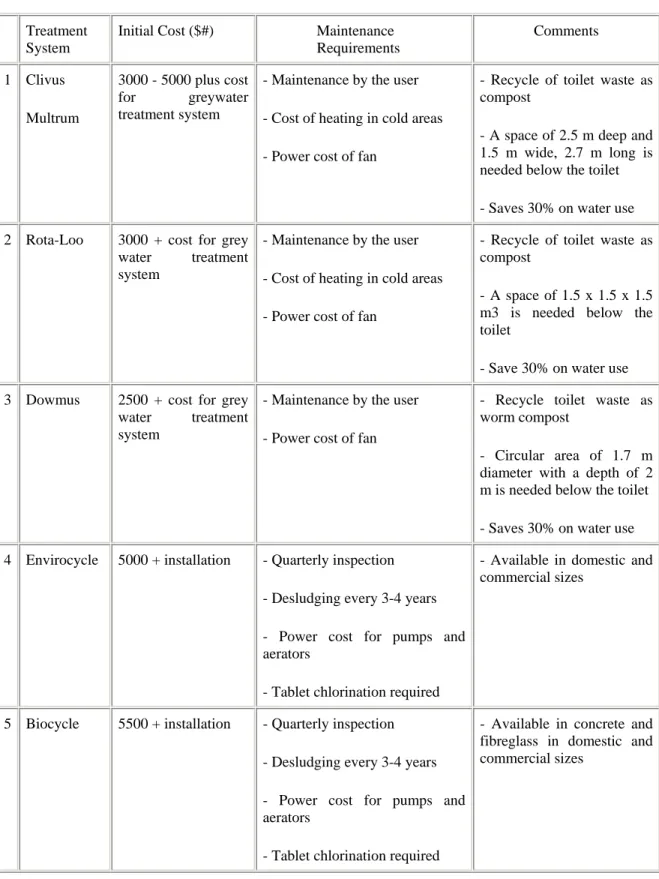
Only systems approved by the Health Department of Western Australia are compared. As they all meet the requirements for effluent and public health standards, only special features will be discussed. All systems use a septic tank or equivalent and hence desludging will be necessary. A septic tank and leach drain requires desludging on the average approximately every 3 years. If the final effluent is used for irrigation no leach drain and its desludging is necessary. Table 2
summarizes similarities and differences amongst the systems, including initial costs and maintenance requirements.
Conclusion
Municipal reticulated sewerage and treatment systems are generally the most desirable treatment option because of the high degree of control which can be achieved and maintained over the quality and disposal of treated effluent and sludge. But when the population density is not high and if on-site disposal is possible it will be cheaper and allow better reuse options. At present more and more on-site systems are becoming available which offer similar facilities to the larger municipal treatment systems. On-site treatment systems can provide a higher degree of protection for the aquatic environment due to the use of land disposal techniques which provide additional level of treatment due to soil percolation before the treated wastewater entering the water bodies. On-site irrigation allows use of the water for evaporation and plant evapotranspiration and should not cause any pollution.
For a remote and isolated place a VIP toilet will be ideal. Composting toilets provide the ultimate answer for water conservation and complete reuse of toilet waste if maintained properly. The larger capacity of Clivus Multrum makes this system more suitable for large families or industrial application. Rota-Loo being smaller with lesser maintenance demand will be more suitable for small families. Dowmus produces a compost containing worm castings with a higher fertilizer value. It is cheaper to install and cheaper to operate as it does not require heating. Most of the treatment units are similar and produce effluent of similar quality. Clearwater system has a separate septic tank and it is claimed that it needs to be desludged only every 10 - 15 years against a normal period of 3 - 4 years. Aquarius produces a low nutrient effluent but installation cost is higher; chemical use and yearly desludging operation also means higher operating cost. But this is available in a variety of sizes serving up to 120 people. Ecomax is a passive system which produces a low nutrient effluent but the filter media needs replacing every 15 to 20 years. Where municipal systems are not available or costly due to low density of population on-site systems provide a variety of options. A composting system for black water and an aerobic system for grey water will assure complete reuse, conservation of water, desludging only infrequently and reduction in potential nutrient pollution.
TABLE 2: Comparison of Systems Approved by the Health Department of Western Australia
Treatment System
Initial Cost ($#) Maintenance Requirements Comments 1 Clivus Multrum 3000 - 5000 plus cost for greywater treatment system
- Maintenance by the user - Cost of heating in cold areas - Power cost of fan
- Recycle of toilet waste as compost
- A space of 2.5 m deep and 1.5 m wide, 2.7 m long is needed below the toilet - Saves 30% on water use 2 Rota-Loo 3000 + cost for grey
water treatment system
- Maintenance by the user - Cost of heating in cold areas - Power cost of fan
- Recycle of toilet waste as compost
- A space of 1.5 x 1.5 x 1.5 m3 is needed below the toilet
- Save 30% on water use 3 Dowmus 2500 + cost for grey
water treatment system
- Maintenance by the user - Power cost of fan
- Recycle toilet waste as worm compost
- Circular area of 1.7 m diameter with a depth of 2 m is needed below the toilet - Saves 30% on water use 4 Envirocycle 5000 + installation - Quarterly inspection
- Desludging every 3-4 years - Power cost for pumps and aerators
- Tablet chlorination required
- Available in domestic and commercial sizes
5 Biocycle 5500 + installation - Quarterly inspection - Desludging every 3-4 years - Power cost for pumps and aerators
- Tablet chlorination required
- Available in concrete and fibreglass in domestic and commercial sizes
6 Clearwater 5500 + installation - Quarterly inspection
- Desludging every 10-15 years - Power cost for pumps and aerators
- Tablet chlorination required
- Available in concrete
7 Aquarius 8000 + installation - Quarterly inspection - Desludging every year - Power cost of pumps
- Tablet chlorination and chemical for phosphorus removal
- Available in fibreglass and stainless steel in many sizes - Removes nutrients
8 Ecomax 5500 - Desludging every 3-4 years - Replacement of redmud filter every 15-20 years
- Removes nutrients
# Cost figures are in 1993 Australian $; 1 Australian $ is approximately 0.75 US $; Use of local materials may reduce costs.
References
Aquarius (1993). "The Aquarius Micro Purifyer 600 SA Series". Western Wastewater Treatments Pty. Ltd., 10 Rollings Crescent, Kwinana, WA 6167, Australia.
Australian and New Zealand Environment and Conservation Council (ANZECC) (1992). "Australian Water Quality Guidelines for Fresh and Marine Waters" in National Water Quality Management Strategy, Melbourne, Victoria, Australia.
Bhawalkar, V. and Bhawalkar U. (1991). "Vermiculture Biotechnology for Environmental Protection, Sustainable Agriculture Wasteland Development" Bhawalkar Earthworm Research Institute, A/3 Kalyani, Pune-satara Road, Pune, 411037, India.
Biocycle (1990). The Biocycle Systems. "General Information and Operation's Manual", Biocycle Pty. Ltd., Suite 1/231 Balcatta Road, Balcatta, WA 6021, Australia.
Bowman, M. and Bishaw, M. (1991). "Ecomax Septic System. Explanatory Information. Ecomax
Waste Management Systems", Bowman, Bishaw Gorham Pty. Ltd., Subiaco, WA 6008,
Clearwater (1990). "Clearwater 90 The Ultimate in Reclaimed Water" Clearwater Pty. Ltd., Unit 2/56 Carney Rd., Welshpool, WA 6106, Australia.
Clivus Multrum (1990). "Clivus Solution, through Waste Technology" Handbook and Practical Manual, Clivus Multrum Pty. Ltd., 31 Mandalay St., Fig Tree Pocket QLD 4069, Australia. Dowmus (1993). "Common Questions Regarding the Dowmus Composting Toilet" Dowmus Pty. Ltd., PO Box 51, Mapleton, QLD 4560, Australia.
Envirocycle (1993). "Envirocycle, Wastewater Treatment System" Envirocycle Pty. Ltd. 37 Tramore Place, Killarney Heights, NSW 2087, Australia.
Health Commission of Victoria (HCV) (1979) "Code of Practice Septic Tanks" HCV, 555 Collins St, Melbourne, VIC 3000.
Mathew, K. and Ho. G. E. (1993). "Reuse of Wastewater at Aboriginal Communities". Remote Area Developments Group, Institute of Environmental Science, Murdoch University, Murdoch, WA 6150, Australia..
National Health and Medical Research Council (NHMRC) and Australian Water Resources Council (AWRC) (1987). "Guidelines for Use of Reclaimed Water in Australia". Australian Government Publishing Service, Canberra, Australia.
Odendaal, P. E. (1992) "Water Reuse International Trend" Australian Water and Wastewater Association Victorian Branch Conference on Wastewater Reduction and Recycling, Deakin University, Geelong Victoria, Australia.
Rota-Loo (1991). "Rota-Loo the Waterless Composting Toilet". Environment Equipment Pty. Ltd., 1/32 Jarrah Drive, Braeside, VIC 3195, Australia.
Urban Water Research Association of Australia and Australia Water Resources Council
(UWRAA/AWRC, 1992). "Affordable Water Supply and Sewerage for Small Communities
Investigation", Design and Management Handbook (Draft report).
Walker, B. (1985). "The Introduction of VIP latrines to Aboriginal Communities in Central Australia" Proceedings of Workshop on Science and Technology for Aboriginal Development. Alice Springs, Australia, October 1985, paper 3 - 1.8.