Low-Overhead Distributed
Transaction Coordination
by
James Cowling
S.M., Massachusetts Institute of Technology (
2007
)
B.C.S.T. (Adv.) H
1
M, The University of Sydney (
2004
)
Submitted to the Department of
Electrical Engineering and Computer Science
in partial fulfillment of the requirements for the degree of
Doctor of Philosophy in Computer Science and Engineering
at the
M A S S A C H U S E T T S I N S T I T U T E O F T E C H N O L O G Y
June
2012
© Massachusetts Institute of Technology
2012
. All rights reserved.
Author . . . .
Department of Electrical Engineering and Computer Science
May
23
,
2012
Certified by . . . .
Barbara H. Liskov
Institute Professor
Thesis Supervisor
Accepted by . . . .
Professor Leslie A. Kolodziejski
Chair, Department Committee on Graduate Theses
Low-Overhead Distributed Transaction Coordination
by
James Cowling
Submitted to the Department of
Electrical Engineering and Computer Science on May23,2012, in partial fulfillment of the
requirements for the degree of
Doctor of Philosophy in Computer Science and Engineering
a b s t r a c t
This thesis presents Granola, a transaction coordination infrastructure for building reliable distributed storage applications. Granola provides a strong consistency model, while significantly reducing transaction coordination overhead. Granola supports general atomic operations, enabling it to be used as a platform on which to build various storage systems, e.g., databases or object stores.
We introduce specific support for independent transactions, a new type of distributed transaction, that we can serialize with no locking overhead and no aborts due to write conflicts. Granola uses a novel timestamp-based coordination mechanism to serialize distributed transactions, offering lower latency and higher throughput than previous systems that offer strong consistency.
Our experiments show that Granola has low overhead, is scalable and has high throughput. We used Granola to deploy an existing single-node database application, creating a distributed database application with min-imal code modifications. We run the TPC-C benchmark on this platform, and achieve 3×the throughput of existing lock-based approaches.
Thesis Supervisor: Barbara H. Liskov Title: Institute Professor
a c k n o w l e d g m e n t s
I’d like to thank Evan Jones for the many engaging technical discussions, and for providing the sourcecode that was used as the basis of our TPC-C implementation. I’d like to also thank the original H-Store authors, including Dan Abadi, for their contributions to this codebase.
I’d like to thank my thesis committee members, Sam Madden and Robert Morris, for their feedback on my work. I’d also like to thank the many anonymous reviewers along the way, who invested their time in giving constructive feedback on my thesis work, and also on my other projects throughout grad school.
I’ve greatly enjoyed working with a number of co-authors on various research projects, and have benefited significantly from their technical perspective. I’d also like to thank the members of the Programming Method-ology Group at MIT, for technical discussions, feedback on my work, and their presence in the lab.
I’ve been fortunate to make many really wonderful friends while at MIT and I feel that the people I’ve met here have been at least as important as the work that I’ve done. I’d like to thank them for enriching my life, and am looking forward to many good times together after grad school.
I’d like to thank my fellow members of the EECS REFS program, and the many members of the MIT, EECS and CSAIL administrations that have taken an active interest in student support. I owe a special thanks to Dan Ports, for providing a great deal of support on both a technical and personal level. Dan always knew the right time to share his enthusiasm for my work, or to convince me that whatever “fundamental problem” I was struggling with wasn’t so fundamental after all. It was extremely valuable to have someone there to offer continual encouragement.
My family have been tremendously supportive throughout my time at MIT, and I owe them a great deal of thanks. It hasn’t always been easy living on the other side of the world, but they’ve always endeavored to bridge the gap between these two continents. I’d also like to thank my friends back in Australia, who’ve made a continual effort to keep in touch and remain an
I’d like to give a special thanks to Kim for the huge amount of support she’s given me, and for being a tremendous positive influence in my life. I’d especially like to thank her for putting up with me being in the lab almost constantly. Having her spend time in the office with me, and be there during my downtime, has been invaluable.
I’d finally like to thank my advisor, Barbara Liskov, for her support, technical discussions, feedback, editing and hard work throughout my time at MIT. Barbara has helped shape the way I think about problems, and I’d like to thank her for instilling in her students a principled approach to systems design and research in general.
C O N T E N T S
1 Introduction 15 1.1 Granola . . . 17 1.2 Contributions . . . 20 1.3 Outline . . . 20 2 Transaction Model 23 2.1 One-Round Transactions . . . 23 2.2 Independent Transactions . . . 252.2.1 Applicability of Independent Model . . . 26
2.2.2 Motivation for Avoiding Locking . . . 29
3 Architecture and Assumptions 33 3.1 Architecture . . . 33 3.2 System Interfaces . . . 35 3.2.1 Client API . . . 35 3.2.2 Server API . . . 37 3.3 Assumptions . . . 39 4 Granola Protocol 41 4.1 Timestamp Overview . . . 42 4.2 Client Protocol . . . 43 4.2.1 Client State . . . 43 4.2.2 Transaction Invocation . . . 43 4.3 Repository Protocol . . . 47
. . Single-Repository Transactions . . . .
4.3.4 Independent Transactions . . . 50
4.3.5 Locking Mode . . . 53
4.3.6 Transitioning Between Modes . . . 58
4.4 Consistency . . . 60 4.4.1 Locking Support . . . 60 4.4.2 Serializability . . . 60 4.4.3 External Consistency . . . 64 4.5 Concurrency . . . 66 4.5.1 Clients . . . 66 4.5.2 Repositories . . . 67
5 Failures and Recovery 69 5.1 Replication . . . 69
5.2 Individual Failures . . . 71
5.2.1 Repository Recovery . . . 71
5.2.2 Client Recovery . . . 76
5.3 Correlated Failure . . . 78
5.3.1 Recovery from Timestamp Mode . . . 79
5.4 Retries and Duplicate Detection . . . 87
6 Evaluation 89 6.1 Implementation . . . 89 6.1.1 Workloads . . . 90 6.1.2 Sinfonia . . . 90 6.1.3 Experimental Setup . . . 92 6.2 Base Performance . . . 93 6.2.1 Single-Repository Transactions . . . 93 6.2.2 Distributed Transactions . . . 94 6.3 Scalability . . . 96
6.4 Distributed Transaction Tolerance . . . 99
6.5.1 Lock Management . . . 101
6.5.2 Lock Contention . . . 102
6.6 Transitioning Between Modes . . . 104
6.6.1 Transitioning to Locking Mode . . . 104
6.6.2 Transitioning to Timestamp Mode . . . 108
6.7 Transaction Processing Benchmark . . . 111
6.7.1 Scalability . . . 112
6.7.2 Distributed Transaction Tolerance . . . 113
6.7.3 Latency Trade-off . . . 116
7 Extensions and Optimizations 119 7.1 Naming and Reconfiguration . . . 119
7.1.1 Overview . . . 120 7.1.2 Naming . . . 121 7.1.3 Name Service . . . 121 7.1.4 Reconfiguration . . . 122 7.2 Non-Primary Reads . . . 123 7.3 Caches . . . 125 7.4 Implicit Votes . . . 126 7.5 Interactive Transactions . . . 128 8 Related Work 131 8.1 Consistency Models . . . 131 8.1.1 Relaxed Consistency . . . 132 8.1.2 Per-Row Consistency . . . 132 8.1.3 Strong Consistency . . . 133
8.2 Deterministic Transaction Ordering . . . 135
9 Conclusions and Future Work 139 9.1 Future Work . . . 139
9.1.1 Protocol Improvements . . . 139
9.1.2 Transaction Models . . . 141
9.1.3 Dynamic Reconfiguration . . . 143
A.1.1 Request . . . 147
A.1.2 Vote . . . 148
A.1.3 Reply . . . 148
A.2 Protocol Buffers Definitions . . . 149
B Releasing Locks for Independent Transactions 153 C Master Nodes 159 C.1 Protocol Overview . . . 160
C.2 Downsides of Masters . . . 161
L I S T O F F I G U R E S
2.1 Traditional two-phase commit protocol . . . 30
2.2 CPU cycle breakdown on the Shore DBMS . . . 31
3.1 Granola system topology . . . 34
3.2 Logical structure of Granola client and server modules . . . . 34
3.3 Client API . . . 36
3.4 Server Interface . . . 38
4.1 Independent Transaction Client API . . . 44
4.2 Coordinated Transaction Client API . . . 44
4.4 Independent Transaction Server Interface . . . 49
4.5 Protocol timeline for single-repository transactions . . . 49
4.6 Protocol timeline for independent transactions . . . 51
4.7 Coordinated Transaction Server Interface . . . 54
4.8 Protocol timeline for coordinated transactions. . . 55
4.9 Example of a serializable execution . . . 62
5.1 Viewstamped Replication protocol . . . 71
5.2 Log recorded at each non-primary replica . . . 73
5.3 Queue of logged transactions at a stalled repository . . . 80
5.4 Simple funds-transfer operation . . . 83
5.5 Recovery Interface . . . 85
6.1 Protocol timeline for distributed transactions in Sinfonia . . . 91
6.2 Single-repository throughput with increasing client load . . . 94
6.6 Throughput scalability . . . 97
6.7 Normalized throughput scalability . . . 98
6.8 Throughput for a given fraction of distributed transactions . . 99
6.9 Throughput impact as a function of lock management cost . . 101
6.10 Throughput impact as a function of lock conflict rate . . . 103
6.11 Locking-mode transition delay as a function of lock conflict rate106 6.12 Locking-mode transition delay as a function of network delay 107 6.13 Expected time spent in locking mode . . . 109
6.14 Fraction of transactions processed in locking mode . . . 110
6.15 TPC-C throughput scalability . . . 113
6.16 Per-transaction latency for distributed transactions in TPC-C 114 6.17 TPC-C throughput as a function of the percentage of dis-tributed transactions . . . 115
6.18 TPC-C congestion collapse . . . 117
7.1 Object identifier format for a database application . . . 121
A.1 Basic message definitions in Protocol Buffers format . . . 150
B.1 Number of transactions processed in locking mode . . . 155
B.2 Throughput as a function of the fraction of independent transactions . . . 156
C.1 Granola system topology with master nodes . . . 160
C.2 Topology used in bifurcation experiments . . . 163
C.3 Impact on throughput by avoiding timestamp blocking in a master-based protocol . . . 164
C.4 Impact on throughput by avoiding transaction aborts in a master-based protocol . . . 165
L I S T O F TA B L E S
1.1 Properties of each transaction class . . . 19 4.3 Summary of concurrency control modes . . . 47 7.2 Proposed timestamps for series of independent transactions . 127
1
I N T R O D U C T I O N
Distributed storage systems spread data and computation across multiple servers, and provide these resources to client applications. These systems typically partition their state among many nodes to provide fast access to data and to provide sufficient storage space for large numbers of clients.
There is a long history of research in distributed storage, but the past five years has been marked by explosive growth in the popularity of large-scale distributed storage systems [2–5,7,10, 12,19,20,23, 26,41,49]. This has
been motivated by the growing demands of cloud computing and modern large-scale web services.
Cloud computing platforms are typically designed to support large numbers of clients with diverse application requirements. Ideally these systems would satisfy the following base requirements:
Large Scale: An immense amount of information is being stored online, and demand for online storage systems is growing. Supporting these levels of storage requires a distributed architecture, which must be able to scale across large numbers of clients and a large number of storage nodes.
Fault Tolerance: Information entrusted to the system should not be lost, and should be accessible when needed. These reliability guarantees must be provided with very high probability.
High Performance: Reads and writes should execute with low latency and per-server throughput should be high.
Consistency: Clients should be provided the abstraction of one-copy serial-izability [14] so that client applications are not complicated by
ill-defined consistency semantics. Operations on the storage state should execute atomically, and reads should always be guaranteed to observe a state at least as recent as the previous operation from the client.
The consistency requirement is of particular interest, since it is the re-quirement most often neglected in modern distributed storage systems. It is highly desirable to run operations as atomic transactions, since this greatly simplifies the reasoning that application developers must do. Transactions allow users to ignore concurrency, since all operations appear to run se-quentially in some serial order. Users also do not need to worry that failures will leave operations incomplete.
Strong consistency is often considered prohibitively expensive, however, particularly for operations that involve data on multiple servers. Serializable distributed transactions are traditionally provided through the use of two-phase commit [28,36] and strong two-phase locking [25]. This approach has
several downsides, however. Latency is increased due to multiple message delays in the protocol, along with multiple forced-stable log writes required to allow recoverability from failures. Throughput can also suffer due to the overhead of locking, which can be computationally expensive and limit concurrency; we discuss the costs of locking in more detail in Section 2.2.
Most distributed storage systems do not provide serializable transactions, because of concerns about performance and partition tolerance. Instead, they provide weaker semantics, e.g., eventual consistency [23] or
causal-ity [41]. These weaker consistency models pose a challenge to application
development, and limit the types of applications that can be built using the storage system.
1.1. GRANOLA
1
.
1
g r a n o l a
This thesis presents Granola,1
an infrastructure for building distributed storage applications where data resides at multiple storage nodes. Granola provides strong consistency for distributed transactions, without the over-head of lock-based concurrency control. Granola provides scalability, fault tolerance and high performance, withoutsacrificing consistency.
Granola is atransaction coordination mechanism: it provides transaction ordering, atomicity and reliability on behalf of storage applications that run on the platform. Applications specify their own operations, and Granola does not interpret transaction contents. Granola can thus be used to support a wide variety of storage applications, such as file systems, databases, and object stores.
Granola implements atomic one-round transactions. These execute in one round of communication between a user and the storage system, and are used extensively in online transaction processing workloads to avoid the cost of user stalls [10, 32, 50]; we discuss one-round transactions in
more detail in Section2.1. Granola supports three different classes of
one-round transactions: single-repository transactions, coordinated distributed transactions, andindependentdistributed transactions.
Single-Repository Transactions: These transactions execute to completion at a single storage node, and do not involve distributed transaction coordination. We expect the majority of transactions to be in this class, since data is likely to be well-partitioned.
Coordinated Transactions: These transactions execute atomically across multiple storage nodes, but require transaction participants tovote on whether to commit or abort the transaction, and will commit only if all participants vote to commit. These transactions are equivalent to what is provided by traditional two-phase commit.
1
Granola derives its name from its role in guaranteeing a consistentserial(cereal) order for distributed transactions. The author apologizes for the bad pun.
Independent Transactions: This is a new class of transaction that we intro-duce in Granola to support lock-free distributed transactions. Indep-endent transactions commit atomically across a set of transaction participants, but do not require agreement, since each participant will independently come to the same commit decision. Examples include an operation to give everyone a 10% raise, an atomic update of a repli-cated table, or a read-only query that obtains a snapshot of distributed tables.
There is evidence that a large number of typical workloads are comprised primarily of independent transactions [50,53], such as the industry-standard
TPC-C benchmark [8]. We discuss the use of independent transactions in
Section2.2.
One of Granola’s key contributions is its use of a timestamp-based coor-dination mechanism to provide serializability for independent transactions
without locking. Granola is able to achieve this by assigning each trans-action a timestamp, and executing transtrans-actions in timestamp order. Each distributed transaction is assigned the same timestamp at all transaction participants, ensuring consistency between storage nodes. Granola adopts a distributed timestamp voting protocol to determine the timestamp for a given transaction, and utilizes clients to propagate timestamp ordering constraints between storage nodes.
Granola’s timestamp-based coordination mechanism provides a substan-tial reduction in overhead from locking, log management and aborts, along with a corresponding increase in throughput. Granola provides this lock-free coordination protocol while handling single-repository transactions and independent transactions, and adopts a lock-based protocol when also handling coordinated transactions. Granola’s throughput is similar to exist-ing state-of-the-art approaches when operatexist-ing under the lockexist-ing protocol, but significantly higher when it is not.
Granola also uses transaction coordination protocols that provide lower latency than previous work that uses dedicated transaction coordinators, for all transaction classes. Unlike systems that use a single centralized
1.1. GRANOLA
Transaction Class Message Delays
Forced
Log Writes Locking
Single-Repository 2 1 False
Independent 3 1 False
Coordinated 3 1 True
Table 1.1: Properties of each transaction class. The number message
de-lays includes communication with the client, but does not include dede-lays required for using replication to provide forced log writes.
coordinator [31,53], or a dedicated set of coordinator nodes [10,54], Granola
uses a fully-distributed transaction coordination protocol, with no need for centralized coordination. Granola’s use of a decentralized coordination protocol reduces latency for distributed transactions, which no longer incur a round-trip to the coordinator.
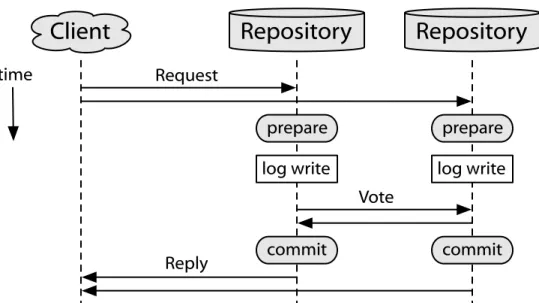
Granola runs single-repository transactions with two one-way message delays plus a stable log write, and both types of distributed transactions usually run with only three one-way message delays plus a stable log write. This is a significant improvement on traditional two-phase commit mechanisms, which require at least two stable log writes, and improves even on modern systems such as Sinfonia [10], which requires at least four
one-way message delays (for a remote client) and one stable log write. The performance characteristics of Granola’s three transaction classes are summarized in Table1.1.
Since Granola provides strong consistency, there may be cases where servers have to stall due to the failure of a transaction participant [16]; this
is an unavoidable reality in distributed systems design [27]. Granola uses
replication to minimize the likelihood that a participant will be unavailable. In the case of a correlated failure that leads to unavailability of an entire replicated node, Granola provides recovery techniques to enable progress for transactions that do not depend on the failed participant.
1
.
2
c o n t r i b u t i o n s
The main contributions of this thesis are as follows:
• Identifying an independent transaction model for distributed trans-actions that can be executed atomically without communicating com-mit or abort decisions between nodes. These transactions are appli-cable to a variety of workloads and allow a significant reduction in transaction coordination overhead.
• Developing a transaction coordination platform that handles the de-tails of reliability and consistency on behalf of distributed storage applications built on the platform. This platform provides support for atomic one-round transactions and supports general operations without interpreting the contents of individual transactions.
• Designing and implementing a timestamp voting and propagation protocol to serialize independent transactions without locking and with no centralized transaction coordinator. This system is able to provide lower latency, higher throughput and lower overhead than existing lock-based approaches.
We implemented and tested Granola on a set of synthetic benchmarks, as well as the common TPC-C transaction processing benchmark [8]. These
experiments exhibit a significant benefit from running with independent transactions, and lead to a 3× increase in throughput on TPC-C, as com-pared with existing lock-based approaches.
1
.
3
o u t l i n e
This thesis discusses the design and implementation of the Granola platform, including the core protocol for distributed transaction coordination, along with the infrastructure for building distributed storage applications.
Chapter 2 describes our one-round transaction model in more detail,
1.3. OUTLINE
transactions. Chapter3 then describes Granola’s architecture, application
interface, and assumptions.
We describe the core Granola protocol in Chapter 4 and discuss its
consistency properties. Chapter 5then discusses the protocols for handling
failures, including network partitions and long-term failure of transaction participants.
We present an experimental evaluation of Granola’s performance in Chapter6 on a set of microbenchmarks, along with an evaluation of
Gra-nola’s performance on a more real-world workload, using the TPC-C trans-action processing benchmark. We also present a theoretical analysis of some key aspects of the protocol.
Chapter7 presents additional extensions and optimizations to the
Gra-nola protocol, both to assist in building practical applications on the plat-form and for improving perplat-formance.
We present a discussion of related work in Chapter 8, along with an
overview of future work and our conclusions in Chapter9.
We follow these chapters with a number of appendices: Appendix A provides a listing of the message formats used in Granola; Appendix B analyzes different methods for switching between transaction processing modes; and Appendix C discusses our original protocol for running Granola with centralized coordinator nodes.
2
T R A N S A C T I O N M O D E L
This chapter discusses Granola’s transaction model in more detail. We first describe our one-round transaction model. We follow this with a descrip-tion of the types of applicadescrip-tions for which independent transacdescrip-tions are applicable and a discussion of the motivation for supporting independent transactions, in terms of reducing locking overhead.
2
.
1
o n e
-
r o u n d t r a n s a c t i o n s
Granola adopts a particular style of transactions, which we callone-round transactions. These transactions are expressed in a single round of commu-nication between the client and a set of storage nodes. We refer to these storage nodes throughout this thesis as storage repositories, and refer to the set of repositories involved in a given transaction as the transaction
participants. We also use the term transactionthroughout this thesis to refer to the one-round transactions used in Granola.
Each transaction is comprised of an application-specific operation to be run at the server application at each participant, which we refer to as an
operationorop. The client specifies an operation to run at each participant as part of the transaction, and Granola ensures that these operations are executed atomically at all participants. Operations are described in more detail in Section3.2.
One-round transactions are distinct from more general database trans-actions in two key ways:
1. One-round transactions do not allow for interaction with the client,
where the client can issue multiple sub-statements before issuing a transaction commit. Granola instead requires transactions to be specified by the client application as a single set of operations.
2. One-round transactions execute to completion at each participant,
with no communication with other repositories, apart from a possible commit/abort vote. Granola does not support remote nested trans-actions being issued by a transaction participant, or sub-queries being sent to other nodes.
Despite these restrictions, one-round transactions are still a powerful primitive. They are used extensively in online transaction processing work-loads to avoid the cost of user stalls [10, 32, 50], and map closely to the
use of stored procedures in a relational DBMS. One-round transactions in Granola are similar tominitransactionsin Sinfonia [10], but can can be used
to execute general operations at each repository, whereas Sinfonia enforces a more restrictive read/write interface with pre-defined locksets. One-round transactions are also similar toone-shot transactionsin H-Store [50], although
one-round transactions allow commit decisions to be communicated be-tween participants.
Granola uses one-round transactions as its basic transaction primitive, and we expect that applications that are built on the platform will implement the majority of their transactions using this one-round model. Granola can also be used to implement interactive transactions, however, where each transaction consists of multiple communication phases between the client and repositories; we discuss how interactive transactions can be supported in Section7.5.
2.2. INDEPENDENT TRANSACTIONS
2
.
2
i n d e p e n d e n t t r a n s a c t i o n s
Granola’s protocol design and our support for independent transactions was motivated by the desire to provide distributed transactionswithout locking, while minimizing communication and message delays in the coordination protocol. Locking is typically used to ensure that once a server sends a “yes” vote for a transaction, it is guaranteed to be able to commit that transaction if all other participants vote to commit. Locking thus ensures that no other transaction can modify state that was used to determine a vote.
A key insight in this thesis is that, for many transactions, locking is not actually required in determining whether to commit or abort a transaction. In particular, if all participants are guaranteed to commit the transaction, then two-phase commit or two-phase locking are not required. We must instead just ensure that all participants execute their portion of the trans-action in the same global serial order, guaranteeing serializability without the cost of locking or the possibility of conflicts.
Granola exploits lock-free transactions through the use of the indep-endent transaction class. Instead of pre-executing the transaction to de-termine the commit vote, and then releasing locks at the commit point, independent transactions are executed atomically in a single shot once the transaction has committed. This new model of transactions allows us not only to avoid locking, but also to rethink the transaction coordination protocol, reducing the number of message delays and forced log writes.
Our approach was influenced by the H-Store project [50], which
iden-tified a large class of operations in real-world applications, deemed as
one-shotand strongly two-phase, that fit our independent transaction model. However, that work did not provide a functional protocol for coordinating independent transactions in a distributed setting [31]. To our knowledge,
no previous system provides explicit support for independent transactions. We first describe the scenarios under which independent transactions can be used. We follow this with a discussion of our motivations for using independent transactions and the costs of using a lock-based alternative.
2
.
2
.
1
a p p l i c a b i l i t y o f i n d e p e n d e n t m o d e l
The independent transaction class can be used for any one-round distributed transaction where all participants will make the same local decision about whether to commit or abort. The relevance of this model for typical online transaction processing workloads is argued in the H-Store project, for trans-actions that fit within H-Store’sone-shot andstrongly two-phase transaction classes [50]. Recent work on deterministic transaction ordering also argues
for the relevance of transactions that can execute independently at each storage node [53, 54].
Any read-only one-round distributed transaction can be represented as an independent transaction, since each repository can independently return its portion of the transaction result, without affecting the state at other participants. These can comprise a significant fraction of transactions in typ-ical read-heavy workloads. Examples of distributed read-only transactions include a transaction to read the total balance for a set of bank accounts distributed across multiple repositories, or any distributed snapshot read in general.
Any read-write one-round distributed transaction can also be expressed as an independent transaction if the commit decision is a deterministic function of state available at all participants. We discuss this case in more detail as follows.
In systems composed of multiple storage nodes, data is typically spread across nodes in two ways:
Replicated Data: Individual data items are stored on multiple servers, to provide higher transaction throughput for multiple simultaneous clients, or to allow local access to the data at multiple repositories, or to locate data geographically close to clients.1
Partitioned Data: Data is split among multiple servers to provide increased storage capacity and greater aggregate transaction throughput. 1
Data is also typically replicated for the purposes of reliability; Granola internally replicates system state to provide durability and availability.
2.2. INDEPENDENT TRANSACTIONS
Updates to replicated data must be executed atomically, and can be performed using an independent transaction at all partitions that store a copy of the data. Application developers also commonly replicate tables when partitioning data, to ensure that the majority of transactions are issued to a single partition [32,50]. Any transaction where the commit decision
depends only on replicated data can be represented as an independent transaction, since each participant will have the same replicated data avail-able to it, and hence will come to the same commit decision. One example of a transaction predicated on replicated data is a delivery order that will only commit if the client provides a valid zip code, where each participant has a local copy of the zip code table.
Transactions that modify partitioned data, but always commit, can be implemented using independent transactions. Many typical distributed transactions fit within this model, such as a transaction to atomically up-date a set of employee records to change their assigned supervisor, or to atomically give each employee a 10% raise. A transaction that records the winner of an online auction can be issued as an independent transaction that atomically updates the auction page on one partition and the user’s bid history on another partition.
Transactions that update partitioned data do not all fall within the indep-endent transaction class. In particular, a distributed transaction where the commit decision depends on data that is available only to a single repos-itory may need to be implemented with a coordinated transaction, using lock-based concurrency control. However, a careful partitioning of applica-tion state can be used to convert many such transacapplica-tions into independent transactions.
Escrow transactions [44] can be used to express many coordinated
trans-actions as a single-repository transaction that first puts a quantity into
escrow, followed by an independent transaction used to complete the trans-action. One example of an escrow transaction is a bank transfer that first authorizes and reserves sufficient funds for the transfer in an escrow ac-count, followed by an independent transaction which transfers the funds from the escrow account to the destination.
Demarcation [13] can be used to express some other coordinated
trans-actions as single-repository transtrans-actions. Demarcation allows an invariant to be maintained across multiple partitions by setting demarcation limits at each partition, and only allowing a single-repository transaction to proceed if it does not violate these limits. One example is a hospital that is split across two branches on two repositories, and needs to have a minimum of 10 doctors in total on-call at all times. A demarcation limit of 5 doctors can initially be set at each branch. A doctor may be taken off-call at one branch without checking with the other branch, provided the number of doctors at the branch does not fall below this demarcation limit. If there are only 5 doctors left on call, a doctor cannot be taken off-call until a coordinated transaction is run to update the demarcation limits to 4 doctors at one branch and 6 at the other.
We discuss escrow transactions and demarcation in Section 9.1.2.
Case Study: TPC-C
The industry-standard TPC-C benchmark [8], which is designed to be
representative of typical online transaction processing applications and represents a rather sophisticated database workload, can be implemented entirely using independent transactions. The H-Store position paper [50]
describes a partitioning strategy used to express each TPC-C transaction as a one-round transaction.
There are five different transactions in the TPC-C benchmark, but only two of these are distributed transactions, given the H-Store partitioning: the paymenttransaction and thenew_order transaction.
The payment transaction updates a customer’s balance and the ware-house/district sales fields. Since this transaction never needs to abort, it can be implemented as an independent transaction where each repository updates the customer balance and sales fields independently.
Thenew_order transaction may need to abort if the transaction request contains an invalid item number. The Item table is read-only in the TPC-C workload, and can be replicated at each repository. Since each repository has
2.2. INDEPENDENT TRANSACTIONS
local access to the Item table, each participant can independently determine whether to commit or abort anew_order transaction, and can thus execute it as an independent transaction.
If we extended the TPC-C benchmark such that the Item table was not read-only and occasionally needed to be updated, these updates could also be implemented using independent transactions.
2
.
2
.
2
m o t i vat i o n f o r av o i d i n g l o c k i n g
Providing strong consistency for atomic transactions is a significant chal-lenge in most distributed systems. Strong consistency, namelyserializability, requires that the execution order of transactions at each server matches a single global serial order. This global order allows client applications to interact with the distributed system using the familiar abstraction of a single correct server, rather than a large collection of disparate nodes.
The challenge for providing serializability lies in respecting ordering dependencies between individual servers. For example, if a client executes an atomic transaction T1 at serversS1 and S2, the system must guarantee
that no client is able to observeT1’s effects atS1then execute a transaction at
S2 that modifies data used byT1, beforeS2 has executedT1. An anomalous
sequence of operations like this could violate the global serial ordering, and hence violate the abstraction of a single correct server.
Lock-based Concurrency Control
Serializable atomic distributed transactions are traditionally provided by the use of two-phase commit [28,36], in conjunction with strict two-phase
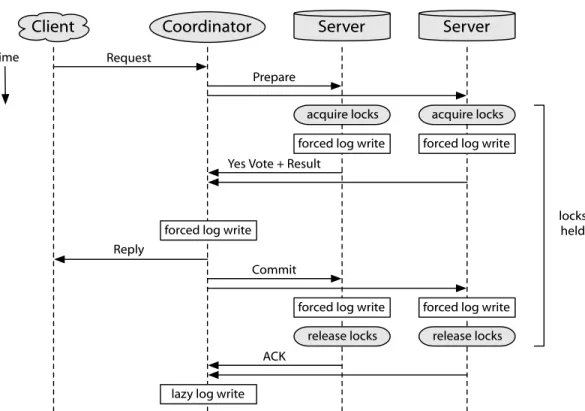
locking [25]. We illustrate this process in Figure2.1, for a one-round
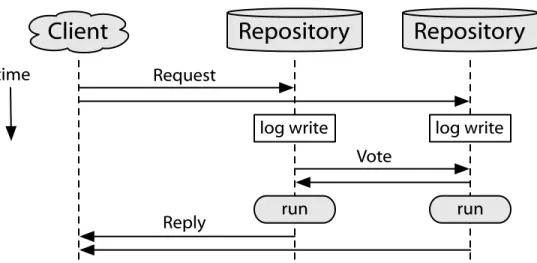
trans-action model. When a server receives a transtrans-action it acquires any locks that may be required by the transaction, and records this information using a stable log write so that it will not be lost in case of a failure. The server then decides whether to commit or abort the transaction, and sends its vote to a coordinator. The coordinator collects votes from each participant, records this information using a stable log write, then sends out a commit
Prepare time
Reply
Yes Vote + Result Request
Client Server Server
release locks release locks forced log write forced log write
acquire locks acquire locks Coordinator
Commit
forced log write forced log write ACK
locks held forced log write
lazy log write
Figure 2.1: Traditional two-phase commit protocol, as applied to a
one-round transaction model. Locks must be acquired for the duration of the transaction, and multiple forced log writes must be written on both the participants and the coordinator.
decision. Each server is only able to commit the transaction and release its locks once it receives this final commit decision. Of particular note here is the extended duration that locks must be held, which is exacerbated by the multiple forced log writes in the protocol.
Locking Costs
The use of two-phase commit with strict two-phase locking provides serial-izability [25], but has two significant downsides related to the cost of locking.
The first downside is that locking is computationally expensive. Each lock-ing step requires computlock-ing the lockset for the transaction, acquirlock-ing these locks, and recording an undo log in stable storage in case an abort decision is received. This locking overhead can comprise a significant fraction of CPU time, particularly for transactions that involve relatively low execution
2.2. INDEPENDENT TRANSACTIONS
!"#$%&
"'#(%&
!)#"%&
!*#+%&
"!#)%&
*#!%&
!"#$%%&'%()
*+,,-.,
*+/0-.,
*12/3-.,
!45%$&6++7
8997-/1:+.
;+./4$$%./(
/+.2$+7
<&=>"?>@
Figure 4-1: CPU cycle breakdown while executing TPC-C New Order transactions on
Shore [46]
In this chapter, we propose a new form of concurrency control, called
Speculative
Con-currency Control, which is designed for these “imperfectly partitionable” applications.
These workloads are composed mostly of single-partition transactions, but also include
some multi-partition transactions that impose network stalls. The goal is to allow a
pro-cessor to do something useful during a network stall, while not significantly hurting the
performance of single-partition transactions.
Most applications we have examined are imperfectly partitionable. For example, the
TPC-C transaction processing benchmark, even when carefully partitioned, is composed
of 89% single-partition transactions. The remaining 11% touch multiple partitions. Other
applications follow similar patterns. They can be carefully partitioned so the common
op-erations access a single partition, but other less common opop-erations still need to access
multiple partitions. Many-to-many relationships cause this kind of partitioning. The
re-lationship can be partitioned so that accessing the rere-lationship in one direction accesses a
single partition. For example, consider users who can belong to multiple groups. If the data
is partitioned by group, then accessing a group and all of its users accesses a single
parti-tion. However, when this is done, accessing the relationship in the other direction will need
to access all partitions. In the users and groups example, if we wish to access all the groups
that a specific user belongs to, we will need to query all partitions. Thus, many-to-many
relationships that are partitioned so the common operations are single-partition accesses
tend to require a small fraction of the workload to access multiple partitions.
In the remainder of this chapter, we describe how Dtxn performs concurrency control
for a naive blocking scheme, speculative concurrency control, and a traditional two-phase
locking approach. Since Dtxn separates concurrency control from the storage engine, we
present experiments comparing the performance of these schemes.
Figure2.2: CPU cycle breakdown while executing TPC-Cnew_order
trans-actions [8] on the Shore DBMS [6]. This figure appeared in Fault-Tolerant Distributed Transactions for Partitioned OLTP Databases [31] and is based on
an earlier study [30].
cost, as is common in typical online transaction processing workloads [50].
Figure2.2shows the breakdown in execution time for transactions in the
Shore database management system (DBMS) [6]. This figure shows a
sig-nificant fraction of time devoted solely to locking, latching and logging. Studies of typical transaction processing workloads have estimated locking overhead to be 30–40% of total CPU load [30, 31], in addition to the logging
required for durability.
The second downside is that locking can lead tolock conflicts, which limit concurrency and result in transactions being blocked or aborted. Locks must be held for the duration of a transaction, which can be a significant period of time for distributed transactions; as seen in Figure 2.1, the lock duration
includes the time taken to execute the forced stable log writes, as well as the time taken to communicate with the coordinator. If a workload involves frequent access to commonly-used data, lock conflicts can significantly reduce system throughput.
These two downsides typically also apply to transactions that execute solely on a single server, since locking is required for all transactions if there are any concurrent distributed transactions.
3
A R C H I T E C T U R E A N D A S S U M P T I O N S
This chapter describes Granola’s architecture and system model, and defines the terminology used throughout this thesis. We also describe the Granola application interface and discuss the assumptions made in our design.
3
.
1
a r c h i t e c t u r e
Granola contains two types of nodes:clientsandrepositories. Repositories are the server machines that store data and execute transactions, while clients interact with the repositories to issue transaction requests. Repositories communicate among themselves to coordinate transactions, whereas clients typically interact only with the repositories. This topology is illustrated in Figure3.1.
Granola is ageneralplatform for transaction coordination, and may be used to support a large variety of client and server applications. Appli-cations link against the Granola library, which provides functionality for correctly ordering transactions and delivering them reliably to each server application.
Applications are layered atop the Granola client and repository code, as shown in Figure3.2. The client application provides the desired
Clients Repositories
Replicas
Figure 3.1: Granola system topology. This figure shows the clients and
repositories, as well as the individual replicas that make up each repository.
ClientProxy User Code Repository Server Application (extends GranolaApplication) Client Application
Figure3.2: Logical structure of Granola client and server modules.
to issue requests. The client application is responsible for interpreting user operations, determining which repositories are involved in a given transaction, and choosing which transaction class to use.
The server application implements the GranolaApplication interface in order to execute transactions on behalf of each repository. The server application runs in isolation at each repository, and does not need to com-municate with other repositories, since this functionality is provided by the Granola repository code. The client and server interfaces are described in more detail in Section3.2.
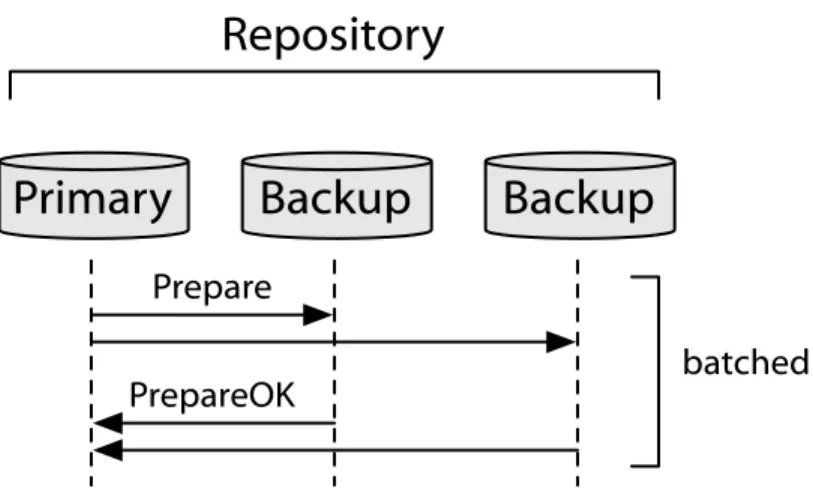
Each repository is actually comprised of a number of replica nodes that are used to provide reliability. Replication is handled internally by the Granola protocol, on behalf of the application. This allows each server application to be soft-state, and eliminates the overhead for managing
3.2. SYSTEM INTERFACES
durability on the application level. Granola presents the abstraction of individual reliable repository nodes to the client application, and the client application does not need to be aware of the replicated repository structure. We discuss replication in more detail in Section 5.1.
3
.
2
s y s t e m i n t e r f a c e s
Granola is designed to support arbitrary storage applications built atop the platform, and communicates with applications using a well-defined interface. Granola does not interpret the contents of operations, and treats them as arbitrary byte strings. We discuss the client and server interfaces below.
3
.
2
.
1
c l i e n t a p i
Client applications make function calls to theClientProxylibrary to issue transaction requests. Figure 3.3shows the interface provided by this library.
The client application must determine which transaction class to use for the request, and call the corresponding invocation function; the decision of which transaction class to use for a given transaction is thus the responsibil-ity of the application developer. The client application is also responsible for specifying which repositories will receive the transaction. Each repository is identified by a unique repository identifier, known as anRID. The mapping from application-level names to RIDs is managed by a name service that stores this mapping on behalf of clients, as described in Section7.1.3.
Transaction participants provide a result response if the transaction commits; the client proxy will write this response into the buffer provided by the client application. Granola also allows a result response to be returned for aborted transactions, when using the coordinated transaction interface, to allow for application specific abort information to be communicated to the client application, e.g., an abort code or status message. Granola only returns an aborted result from one repository to the client application, to avoid waiting to hear from all repositories.
/*
* Independent Interface */
// issue trans to given repository with read-only flag // writes result into provided buffer
void invokeSingle(int rid, ByteBuffer op, boolean ro, ByteBuffer result);
// issue trans to set of repositories
void invokeIndep(List<Integer> rids, List<ByteBuffer> ops, boolean ro, List<ByteBuffer> results);
/*
* Coordinated Interface */
// issue trans to set of repositories
// returns application commit/abort status. // only one result returned if abort received, // the rest are set to length 0
boolean invokeCoord(List<Integer> rids, List<ByteBuffer> ops, List<ByteBuffer> results);
Figure 3.3: Client API. Clients invoke transactions by calling this API. We
provide additional specialized interfaces for distributed transactions where all participants receive the same request.
3.2. SYSTEM INTERFACES
The client may specify whether a single-repository transaction or an independent transaction is read-only. Coordinated transactions are never read-only, since a read-only coordinated transaction can always be imple-mented using the independent transaction class.
The Granola ClientProxyinterface provides blocking function calls for transaction invocation. The interface can easily be extended, however, to support non-blocking invocation. Our current implementation supports multiple concurrent invocation requests from individual client application threads. The final serial order of concurrent requests is determined by Granola.
3
.
2
.
2
s e r v e r a p i
Server applications extend theGranolaApplicationinterface, to process operations on behalf of the Granola repository code. This interface is shown in Figure 3.4.
We refer to function calls to the server application asupcalls, to signify that the code is being executed within the server application and not the Granola repository code. The repository adopts a single-threaded execution model, where one upcall is issued at a time to the server application. This allows the server application to avoid concurrency control overhead, and achieve significantly higher transaction throughput [50]. Our execution
model achieves best performance when transaction execution does not involve significant stalls within the application, as discussed in Section3.3.
Single-repository transactions and independent transactions are executed atomically using a single runupcall. The repository uses this upcall to pass the operation to the server application as a byte buffer, and receives a byte buffer result.
Upcalls for coordinated transaction follow a two-phase process: first the repository issues aprepareupcall to prepare the transaction, followed by a commitorabortupcall once the final commit decision has been determined. Each transaction is identified by a uniquetransaction identifier (TID), which is provided by the client proxy in each request. Theprepareupcall is used
/*
* Independent Interface */
// executes transaction to completion
// returns false if blocked by coord trans, true otherwise boolean run(ByteBuffer op, ByteBuffer result);
/*
* Coordinated Interface */
// runs to commit point and acquires locks
// returns COMMIT if voting commit, CONFLICT if aborting // due to a lock conflict, and ABORT if aborting due to // application logic
// result is non-empty only if returning ABORT
Status prepare(ByteBuffer op, long tid, ByteBuffer result); // commits trans with given TID, releases locks
void commit(long tid, ByteBuffer result); // aborts trans with given TID, releases locks void abort(long tid);
/*
* Recovery Interface */
// acquires any locks that could be required if preparing // the trans at any point in the serial order
// acquires additional handle on locks if there's a conflict // returns true if no conflict, but acquires locks regardess boolean forcePrepare(ByteBuffer request, long tid);
Figure 3.4: Server Interface. Applications extend this interface to handle
3.3. ASSUMPTIONS
to determine thevote for the transaction at the repository. Each participant decides whether to vote commit or abort, as in traditional two-phase commit. If the application votes to commit the transaction, the repository will issue a subsequentcommit upcall if all other participants vote commit, or anabort upcall otherwise.
The contract with the server application is that if it votes to commit a transaction, then it must be able to commit or abort that transaction when the corresponding upcall is subsequently received, while providing isolation from any concurrent transactions. Typically this guarantee will be provided by using strict two-phase locking [25] within the application:
when aprepare upcall is received, the application executes the transaction to completion, and acquires locks on any pages touched by the transaction. The application also records an undo record, to roll back execution if the transaction is aborted.
The application can abort a transaction in one of two different ways. If it encounters a lock conflict during the prepare phase, it rolls back execution and returns aCONFLICTresponse. The client proxy will retry this transaction after a random backoff period, to wait for any conflicting locks to be released. If the application decides to abort the transaction due to an application-specific predicate, however, such as there being insufficient funds in a bank account, then it rolls back execution and returns anABORTresponse. If the client proxy receives an ABORTresponse it will return this directly to the client application, and will not retry the transaction.
The recovery interface is used to make progress when a transaction participant has failed. This interface is described in more detail in Section5.3.
The application is not required to maintain any stable state, since this functionality is provided by replication within the Granola protocol.
3
.
3
a s s u m p t i o n s
Granola assumes a mostly-partitionable in-memory workload, as is com-mon in most large-scale transaction processing applications [50]. A
of repositories; Granola is designed to provide high performance for dis-tributed transactions, but no scalability benefit can be realized if every transaction is executed on a large fraction of the participants.
An in-memory workload is desirable as it avoids costly disk stalls and reduces the potential execution time for a transaction. We assume that transactions have relatively short duration, since our execution model is-sues upcalls one at a time; the assumption of short transaction duration is also typical in most large-scale online transaction processing workloads. Our model of serial transactions execution matches the execution model advocated in the H-Store project, which saves considerable overhead over the cost of application-level latching and concurrency control for short-lived transactions [50]. Note while each repository only executes one transaction
at a time, it can coordinate the ordering of many transactions in parallel. Multiple repositories may be colocated on a single machine to take ad-vantage of multiple compute cores, and Granola can also be extended to support multithreaded execution, as outlined in Section9.1.1.
Granola tolerates crash failures. Our replication protocol depends on replicas having loosely synchronized clockrates[38]. We depend on
reposi-tories having loosely synchronizedclock valuesfor performance, but not for correctness.
Since we are providing strong consistency, there may be cases where we have to stall because of failure [16]. Our use of replication minimizes the
likelihood that a repository will be unavailable. In the case of a correlated failure that leads to unavailability of an entire repository, some transactions may stall but others will continue to run. Section5.3describes the system
behavior during periods of long-term failures or network partitions, and specifies protocols to allow progress during these periods.
4
G R A N O L A P R O T O C O L
This chapter describes the core Granola protocol. We first discuss the time-stamps used to provide serializability in the absence of locking. We then discuss the two concurrency control modes that determine whether or not locking is used, and our protocols for the three transaction classes.
In the following sections we note where astable log writeis required. This step is analogous to a forced disk write in a traditional database, however we instead use replication to ensure that the log write is stable. Stable log writes involve the primary replica executing state machine replication, as described in Section 5.2.1. Replication is only required where explicitly
denoted in the protocol as a stable log write. Communication between repositories occurs solely between the primary replicas at each repository; if a request is received by a non-primary replica, it forwards the request to the primary.
This chapter assumes there are no failures. We discuss failure and recovery in Chapter5and the protocols for retries and duplicate detection
are discussed in Section 5.4. A full listing of the message formats used in
4
.
1
t i m e s ta m p ov e r v i e w
Granola uses timestampsto define the commit order of transactions. Unlike systems based on traditional two-phase commit [1,10,12,28,36,42], the use
of timestamps allows Granola to order single-repository transactions and independent distributed transactions with no locking, conflicts or deadlock. Each transaction is assigned a timestamp that defines its position in the global serial order. We use a distributed timestamp voting mechanism to ensure that a distributed transaction is given the same timestamp at all participants, as described in Section 4.3.4.
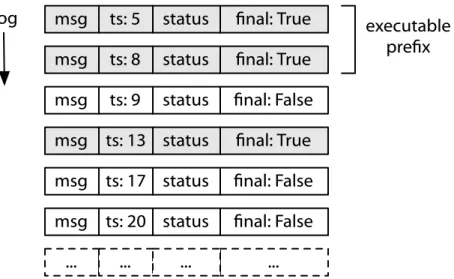
A transaction is ordered before any other transaction with a higher time-stamp. Two transactions may end up being assigned the same timestamp, since the final timestamps depend on votes from other participants. In this case the TID is used to break the tie when ordering transactions, i.e., the transaction with the lowest TID is ordered first. Since timestamps define a
total orderingof transactions, and we execute transactions in this timestamp order, our protocol guarantees serializability.
Repositories choose timestamps by reading their local system clock. Transaction participants exchange timestamps before committing a given transaction, to ensure that they all assign it the same timestamp. Granola timestamps are similar to Lamport Clocks [34]: Each transaction result
sent to the client contains the timestamp for that transaction, and each request from the client contains the latest timestamp observed by the client. Repositories postpone execution of a client request until they are up-to-date with respect to highest transaction observed by the client, ensuring that they are in sync.
Wall-clock time values are used as the basis for timestamps to ensure that repositories choose similar timestamps for a given distributed transaction, before voting to decide on the final timestamp. This is used purely as a performance optimization, since the correctness of the protocol is already guaranteed by clients propagating timestamps in subsequent requests. We explain the use of timestamps in the following sections.
4.2. CLIENT PROTOCOL
4
.
2
c l i e n t p r o t o c o l
This section discusses the protocol used by the Granola client proxy, which is code provided by the Granola library. The client proxy receives transaction requests from the client application and issues them to the repositories, as shown in Figure3.2. The client proxy exports the interface provided in
Figure 3.3. We will refer to the client proxy in the following discussion as
the “client.”
4
.
2
.
1
c l i e n t s tat e
Each client maintains the following state:
cid: The globally-unique ID assigned to the client.
seqno: The sequence number for the current transaction. Each transaction has a unique sequence number at a given client.
highTS: The highest timestamp the client has observed in any previous reply from a repository.
The client identifies each transaction by a globally-unique TID (trans-action identifier). The TID is generated by concatenating the globally-unique cidwith theseqnofor the transaction.
Persistence of this state across failures is discussed in Section5.2.2.
4
.
2
.
2
t r a n s a c t i o n i n v o c at i o n
The client application issues transaction invocation requests to the client proxy using the Granola client API, as discussed in Section3.2.1. The
inter-face for issuing single-repository transactions and independent distributed transactions is shown in Figure4.1. The interface for coordinated distributed
transactions is shown in Figure 4.2.
Each invocation upcall to the client proxy specifies the following param-eters:
// issue trans to given repository with read-only flag // writes result into provided buffer
void invokeSingle(int rid, ByteBuffer op, boolean ro, ByteBuffer result);
// issue trans to set of repositories
void invokeIndep(List<Integer> rids, List<ByteBuffer> ops, boolean ro, List<ByteBuffer> results);
Figure 4.1: Independent Transaction Client API. Clients invoke
single-repository transactions and independent transactions by calling this API.
// issue trans to set of repositories // returns application commit/abort status //
// only one result returned if abort received, // the rest are set to length 0
boolean invokeCoord(List<Integer> rids, List<ByteBuffer> ops, List<ByteBuffer> results);
Figure4.2: Coordinated Transaction Client API. Clients invoke coordinated
4.2. CLIENT PROTOCOL
rids: The repository IDs (RIDs) for the set of repositories involved in the transaction. Only one ID is provided for single-repository transactions.
ops: The transaction operation to execute at each repository in theridsset, expressed as an uninterpreted byte string.
ro: A flag specifying whether the request is read-only. This flag is implicitly set to false for coordinated transactions, since read-only transactions can always be implemented using independent transactions.
results: A set of buffers that the transaction results will be written into, one for each repository inrids.
The client first increments its seqno, and then sends a hRequest, tid, highTS,rids,ops,ro,indepi message to the set of repositories specified in rids. The indepflag specifies whether the transaction is independent, which is true for invokeSingle and invokeIndep upcalls and false for invokeCoordupcalls.
Each repository responds with a hReply,tid, rid, ts, status, resulti
message, including the TID for the transaction, the repository’s RID, the timestamp (ts) assigned to the transaction, and the result from executing the op. Astatus value of COMMIT means that the transaction committed, which we refer to as a committed response. If status isCONFLICTor ABORT then the transaction was aborted, and we refer to it asaborted response. We discuss each case in the following sections.
Committed Response
If a client receives a committed Reply message, it waits to receive a Reply
from all the repositories in rids. These will all be committed responses, since all repositories make a consistent decision about whether to commit a given transaction.
Once the client receives all responses, it first sets its highTSvalue to be thetsin the Replymessages. It then aggregates theresultfrom each
repos-itory and returns these to the client application in the provided results buffer.
If the transaction was invoked using a invokeCoordupcall, the return value will be set to true, otherwise the return value is void. The client appli-cation will always observe a single-repository transaction or independent transaction to commit. If the server application wishes to communicate an application-level abort for these transactions, it can encapsulate this in the transactionresult.
Aborted Response
If the transaction aborted, thestatuswill be set to eitherABORTorCONFLICT. These responses correspond to the two reasons a transaction may abort: either the server application ran theop and decided to abort it based on application logic; or the transaction aborted due to a lock conflict or other failure. We describe these two cases as follows:
Logical Abort AnABORTstatus signifies that at least one of the participants voted abort for the transaction, based on application-level predicates. This is considered the end of the transaction, and the client updates highTSas discussed for committed responses.
Logical aborts are returned only for coordinated transactions, since these are the only transactions that allow voting on the commit decision. The client writes theresultfrom the first abort response to the buffer provided by the client application, and returns false in response to theinvokeCoord upcall. The result response is included to allow the server application to communicate any additional information about the abort to the client application.
Conflict Abort ACONFLICTstatus signifies that there was a lock conflict or failure when attempting to execute the transaction, and that the transaction should be retried. Unlike logical aborts, the client does not updatehighTS, since the transaction has not yet completed. The client instead increments itsseqnobefore retrying, to signify that it is a new transaction attempt. The client first waits a random binary exponential backoff period, then reissues the transaction with the new TID.
4.3. REPOSITORY PROTOCOL
Mode Supported Transactions
Timestamp Single-Repository, Independent
Locking Single-Repository, Independent, Coordinated
Table 4.3: Summary of concurrency control modes. A repository is in only
one mode at a time.
The circumstances whereby transactions may abort are discussed in the following sections.
4
.
3
r e p o s i t o r y p r o t o c o l
This section describes the protocols for processing transactions at each repository. We first describe Granola’s two concurrency control modes, which dictate which protocol is used for transaction coordination.
4
.
3
.
1
c o n c u r r e n c y c o n t r o l m o d e s
Each repository in Granola operates in one of two distinct concurrency con-trolmodes. When the repository is currently handling only single-repository transactions or independent transactions, it operates intimestamp mode. This is the primary concurrency control mode in Granola, and the mode dur-ing which no lockdur-ing is required. If a repository is currently handldur-ing a coordinated transaction, it dynamically switches tolocking mode. Locking is required for all transactions at the repository when it is in locking mode; this avoids conflicts with active coordinated transactions. These modes are summarized in Table4.3.
Each repository is in only one mode at a time. The decision to be in a particular mode is made locally at a given repository, and is not a global property. A repository in timestamp mode can safely be a participant in an independent transaction with other participants that are in timestamp mode. The application must keep track of whether it is in timestamp mode or locking mode, based on whether there are any currently-outstanding
transactions that were issued aprepare upcall but not yet been issued a commit orabort.
Serializability is provided using timestamps when in timestamp mode, whereas locking is used in locking mode to provide compatibility with coordinated transactions. Sections4.3.3and4.3.4describe the protocols for
single-repository and distributed transactions as they work in timestamp mode. Section 4.3.5 describes how the system runs in locking mode and
how it transitions between modes.
4
.
3
.
2
r e p o s i t o r y s tat e
Each repository maintains the following state:
rid: The globally-unique ID assigned to the repository.
mode: The concurrency control mode the repository is currently in, either TIMESTAMP orLOCKING.
lastExecTS: The timestamp of the most recently executed transaction at the repository.
In addition to the state listed above, the repository must also maintain various internal buffers to keep track of individual transaction state. The management of this state is described in the following sections.
4
.
3
.
3
s i n g l e
-
r e p o s i t o r y t r a n s a c t i o n s
The basic protocol for single-repository transactions is straightforward, and has much in common with how existing single-node storage systems work. The key difference in Granola is the use of timestamps to ensure serializability in the presence of independent transactions.
The server application at each repository executes transactions in re-sponse torunupcalls from the repository code, as described in Section 3.2.2.
The application interface required to support execution of single-repository transactions is shown in Figure 4.4.
4.3. REPOSITORY PROTOCOL
// executes transaction to completion
// returns false if blocked by coord trans, true otherwise boolean run(ByteBuffer op, ByteBuffer result);
Figure4.4: Independent Transaction Server Interface. Applications extend
this interface to handle upcalls from Granola for single-repository trans-actions or independent distributed transtrans-actions.
time Reply Request
Client
Repository
run log writeFigure4.5: Protocol timeline for single-repository transactions. Read-Write Transactions
We first describe the protocol for read-write transactions, which can arbi-trarily read and modify the service state. The protocol for processing a
hRequest,tid,highTS,rids,ops,ro,indepi message, where the size of ridsis 1 andro is false, is described as follows. The protocol timeline for single-repository transactions is shown in Figure4.5.
1. The repository first selects a timestamp ts for the transaction. ts
must be greater than lastExecTS at the repository and the highTS provided in the Request.
2. The repository performs a stable log write to record both the Request
andts, so that this information will persist across failures.
3. The transaction is now ready to be executed. Transactions are executed
in timestamp order, and are queued after any transactions with lower timestamps. The repository first sets itslastExecTS value tots. The transaction is then executed by issuing arun(op, result)upcall to
![Figure 4-1: CPU cycle breakdown while executing TPC-C New Order transactions on Shore [46]](https://thumb-us.123doks.com/thumbv2/123dok_us/9920388.2485015/31.918.284.635.171.468/figure-cpu-cycle-breakdown-executing-order-transactions-shore.webp)