General rights
Copyright and moral rights for the publications made accessible in the public portal are retained by the authors and/or other copyright owners and it is a condition of accessing publications that users recognise and abide by the legal requirements associated with these rights.
•Users may download and print one copy of any publication from the public portal for the purpose of private study or research. •You may not further distribute the material or use it for any profit-making activity or commercial gain
•You may freely distribute the URL identifying the publication in the public portal ?
If you believe that this document breaches copyright please contact us providing details, and we will remove access to the work immediately and investigate your claim.
The institutionalization of benchmarking in the Danish construction industry
Rasmussen, Grane Mikael Gregaard; Jørgensen, Kirsten; Gottlieb, Stefan Christoffer; Hesdorf, Peter; Bonke, Sten
Publication date:
2013
Document Version
Publisher final version (usually the publisher pdf) Link to publication
Citation (APA):
Rasmussen, G. M. G., Jørgensen, K., Gottlieb, S. C., Hesdorf, P., & Bonke, S. (2013). The institutionalization of benchmarking in the Danish construction industry. Department of Management Engineering, Technical
T
HE
T
E INSTIT
THE
GRA
TECHNIC
Departm
TUTION
D
ANIS
ANE MIK
CAL
UNIV
ment of M
NALIZA
H CONS
KAEL G
VERSITY
Managemen
ATION O
STRUCT
GREGAA
Y
OF
DENM
nt Enginee
OF BENC
TION IN
ARD RAS
MARK
ering
CHMAR
NDUSTR
SMUSSE
RKING
RY
EN
IN
Th
he instit
Gran
tutiona
Danish
TECHNIe Mikael G
alizatio
h const
ICAL UNIVGregaard
on of b
tructio
VERSITY ORasmusse
enchm
n indu
OF DENMAen
marking
ustry
ARKg in the
e
i
P
REFACEThe project has been completed with financing from Realdania and the Danish Agency for Science Technology and Innovation as an industrial PhD in collaboration between the Benchmark Centre for the Danish Construction Sector (Byggeriets Evaluerings Center, BEC) and the Technical University of Denmark (DTU). The PhD started in August 2009 and finished in December 2012.
My background as a civil engineer has provided me with the ability to rationalize on complex issues and analyze and/or test a hypothesis through applied science with the overall aim of concluding with some technical recommendations of improvements, changes, technical solutions, etc. As this PhD study progressed, I realized that my engineering disciplines were not sufficient for meeting the demands of conducting this PhD study.
Accordingly, I primarily attended courses that were distant from my engineering background. Qualitative research techniques, discourse analysis, qualitative methods and methodology, and philosophy of science are just parts of my self-imposed “up-qualifications” as researcher. This journey has not been pain-free, and I must admit that my first encounter with social science was somewhat confusing and frustrating to me. But over time, and as social science revealed its possibilities and justifications for my study, I learned to appreciate this research area.
I would like to thank a number of people, who in different ways have made it possible for me to finish this project. My supervisors, Kirsten Jørgensen, Stefan Christoffer Gottlieb, Peter Hesdorf, and Sten Bonke, deserve special mentioning: Kirsten for letting me pursue my academic interests and venture into new theoretical fields and research designs. Your caring support throughout the entire process has helped me to keep on the track, and without your always reliable support and encouragement when the tasks seemed most chaotic and unmanageable, I question whether this thesis would have been a reality. Stefan for being a good friend and providing me supervision far beyond what could be expected. I cannot thank you enough for always embracing me and my thesis in your busy schedule. Your critical feedback has been essential during my PhD process and for this end product. Peter for first of all inviting
ii
me into the daily life at BEC. This study has been conducted for BEC, and without Peter, it would not have been a reality. I thank you especially for your encouragement to pursue my interests and define my study in ways I found to be most contributing to the work and interests of BEC. I hope that with this study I have done so. Sten for helping me along the way and for always giving support when needed.
Beside from my supervisors, I would like to thank my colleagues at DTU Management Engineering. Especially, Jens Stissing Jensen I would like to thank for introducing me to institutional theory. I further thank you for always being willing to discuss my problems and find solutions to my frustrations.
Finally, I thank my dear family for their support and encouragements—especially during the last hard time of the study. I particularly would like to thank my loving wife, Juliane, for managing everything at home and still encouraging me to always prioritize my PhD even though it meant spending most of my evenings at the office. Your ability to disregard your own needs and ability to take care of the home and our little son, Sigge, has amazed me. You are exceptional.
iii
T
ABLE OF CONTENTS DANSK RESUMÉ ... 1 ABSTRACT ... 3 1 INTRODUCTION ... 5 1.1 BACKGROUND AND MOTIVATIONS FOR THE THESIS ... 6 1.2 OBJECTIVES ... 10 1.3 EXCLUSIONS ... 11 1.4 UNFOLDING OF THE TITLE AND RESEARCH QUESTIONS ... 11 2 THEORY ... 14 2.1 INSTITUTIONAL THEORY ... 15 2.2 INSTITUTIONALIZATION ... 162.3 INSTITUTIONALISM – RATIONALISM, ISOMORPHISM, AND ROLE OF ACTORS... 17
2.4 ORGANIZATIONAL FIELDS AND INSTITUTIONAL CHANGE ... 21
2.5 INSTITUTIONAL LOGICS – COPING WITH INSTITUTIONAL CHANGE ... 23
2.6 ACTORS BECOMING SUBJECTS IN INSTITUTIONAL CHANGE ... 27
2.6.1 The social construction of actors and institutional entrepreneurship ... 28
2.6.2 The paradox of embedded agency ... 29
2.6.3 Institutional contradictions as impetus that drives, enables, and constrains institutional change .. 30
2.6.4 Institutional entrepreneurship ... 32
2.6.5 Practice, mutual negotiation, and power ... 33
3 METHODOLOGY ... 35
3.1 RESEARCH STRATEGY FOR STUDYING INSTITUTIONALIZATION ... 36
3.1.1 The three pillars of institutions – a model for understanding the prerequisites for institutions ... 39
3.1.2 Institutional contradictions as an analytical approach to understanding political struggles ... 41
3.1.3 Framings – actors’ social construction of new structures ... 42
3.1.4 Methodological considerations ... 44 3.2 DATA COLLECTION METHODS ... 45 3.2.1 Case Studies ... 46 3.2.2 Texts ... 48 3.2.3 Interviews ... 50 3.3 ANALYTICAL STRUCTURE ... 53 4 ANALYSIS ... 55
iv
4.1 THE ESTABLISHMENT OF NEW CONSTRUCTION POLITICAL FOCUS AREAS FOR THE DANISH CONSTRUCTION INDUSTRY ... 57
4.1.1 The construction political climate in the period from the 1960s to 1990s ... 59
4.1.2 Reconfiguring the construction policy ... 62
4.2 INTRODUCING BENCHMARKING AS A RESPONSE TO POLITICAL FOCUS AREAS ... 72
4.2.1 Project House ... 73
4.2.2 The construction political task force ... 75
4.2.3 Implementing the Task Force propositions in Project House ... 80
4.3 THE ESTABLISHMENT OF THE EVALUATION CENTRE ... 89
4.3.1 The Evaluation Centre as political area of interest ... 90
4.3.2 Private actors engage in establishing “Byggeriets Evaluerings Center” ... 91
4.3.3 BEC as political arena ... 95
4.3.4 Appointing the managing director ... 97
4.3.5 The closure of Ministry of Housing ... 99
4.4 CONCRETIZING THE PROGNOSTIC FRAMING OF BENCHMARKING ... 104
4.4.1 Establishing the benchmarking system ... 105
4.4.2 The government engages in the benchmarking initiative ... 112
4.4.3 Adjusting the benchmarking system to the executive orders ... 116
4.5 BENCHMARKING BECOMING AN INFLUENTIAL ACTOR IN THE POLITICAL DEBATE ... 125
4.5.1 Benchmarking social housing building projects ... 127
4.5.2 Contractors respond to benchmarking ... 135
4.5.3 Constructing a benchmarking system for consulting engineers and architects ... 149
4.5.4 The construction industry rejects benchmarking ... 154
4.6 RE‐ORIENTATING THE INSTITUTIONALIZATION ... 158
4.6.1 Legitimizing benchmarking through a reorganization of BEC ... 160
4.6.2 Reorganizing the management in BEC ... 163
4.6.3 Transformations of the benchmarking systems ... 166
4.6.4 Competition – Bülow Management ... 171
4.6.5 Byggeriets Nøgletal aps ... 178
4.6.6 BEC as an impartial benchmarking operator in a competitive market ... 179
4.6.7 Competition entails implications for producing coherent framings ... 182
4.7 INTERPRETATIONS OF BENCHMARKING AMONG PRACTITIONERS ... 187
4.7.1 Contracting companies ... 189
4.7.2 Consulting engineering companies ... 200
4.7.3 Clients ... 205
4.7.4 The institutionalization of benchmarking among practitioners ... 210
TABLE OF CONTENTS v 5.1 HOW AND FOR WHAT PURPOSES HAS BENCHMARKING ORIGINALLY BEEN INTRODUCED AS A SOLUTION TO POLITICAL ISSUES IN THE DANISH CONSTRUCTION INDUSTRY? ... 213 5.2 HOW HAVE POLITICAL STRUGGLES AND NEGOTIATIONS AFFECTED THE INSTITUTIONALIZATION OF BENCHMARKING? ... 215 5.3 HOW HAS THE STUDY CONTRIBUTED WITH RECOMMENDATIONS ON HOW TO INSTITUTIONALIZE NEW STRUCTURES IN THE DANISH CONSTRUCTION INDUSTRY?... 228 6 LIST OF REFERENCES ... 237 7 APPENDIXES ... 248 7.1 APPENDIX A ... 249 7.2 APPENDIX B ... 251 7.3 APPENDIX C ... 254 7.4 APPENDIX D ... 284 7.5 APPENDIX E ... 290
1
D
ANSK RESUMÉDenne afhandling tager et teoretisk udgangspunkt i institutionel teori og omhandler institutionaliseringen af benchmarking i den danske byggebranche. Ved besvarelse af følgende tre forskningsspørgsmål, afdækker denne afhandling et studie af institutionaliseringen af benchmarking:
- Hvordan og til hvilke formål er benchmarking blevet introduceret som løsning til
politiske problemstillinger i den danske byggebranche?
- Hvordan har politiske kampe og forhandlinger haft indflydelse på institutionaliseringen af benchmarking?
- Hvordan har dette studie bidraget med anbefalinger til, hvordan nye strukturer kan institutionaliseres i den danske byggebranche?
I metodekapitlet udfolder jeg, hvordan institutionel teori muliggør nye og vigtige undersøgelser til forståelse af institutionalisering af benchmarking. Jeg redegør for, hvordan teorivalget påvirker min analytiske tilgang til studiet, og yderligere hvordan institutionel teori kan bidrage med vigtig indsigter i forhold til dette studie. I metodekapitlet præsenteres tre modeller som anvendes i denne afhandling: “Three Pillars of Institutions,” “contradictions,” og “framings.” Yderligere vil kapitlet redegøre for de anvendte metoder til dataindsamlingen og de valg, som er foretaget i forhold til at analysere institutionaliseringsprocesser.
Analysen folder sig ud over syv kapitler, startende med en redegørelse for det politiske grundlag, der var årsag til at benchmarking blev et politisk forslag til en fremtidig institution i den danske byggebranche. Det andet kapitel demonstrerer, hvordan benchmarking blev introduceret i slutningen af 1990’erne som en teknologi, der kunne adressere politiske fokusområder fra to udviklingsprogrammer fra slut-halvfemserne. I det tredje kapitel demonstreres, hvordan private aktører fra byggeriet forsøgte at tage kontrol over institutionalisering af benchmarking ved at etablere Byggeriets Evaluerings Center (BEC), som skulle udvikle og udbrede benchmarking til byggeriet. Det fjerde kapitel redegør for, hvordan benchmarking blev konkretiseret i form af et benchmarkingsystem og formuleret til at adressere flere politiske fokusområder i byggeriet. På denne måde blev BEC til en politisk arena, hvor mange lokale perspektiver og strategiske interesser skulle håndteres. Det femte kapitel
DANSK RESUMÉ
2
omhandler operationalisering af benchmarking, og viser hvordan konkretiseringen og implementering af benchmarking gav anledning til reaktioner fra aktører med forskellige og divergerende interesser i benchmarkinginitiativet. Politiske kampe opstod i takt med, at aktører udtrykte forskellige politiske interesser i institutionaliseringen af benchmarking. De politiske kampe, der bliver redegjort for i kapitel fem, konstituerede et stærkt politisk pres og påkrævede transformationer af institutionaliseringen, for at benchmarking kunne bevare institutionel legitimitet. Det politiske pres resulterede i radikale transformationer af institutionaliseringen af benchmarking. Denne transformation bliver der redegjort for i kapitel seks. Som resultat af transformationen fik private virksomheder i byggeriet forøget mulighed for at få indflydelse på den fremtidige institutionalisering. Derudover, og relateret til virksomhedernes indflydelse på institutionaliseringen, kom der konkurrenter til BEC på markedet. Denne konkurrence resulterede i implikationer i forhold til at forstå de instrumentelle formål og overordnede ambitioner for benchmarking. Det sidste analysekapitel afdækker, hvordan benchmarking bliver forstået og fortolket blandt praktikerne i byggeriet, der var blevet centrale aktører i institutionaliseringen. Dette kapitel viser, hvordan benchmarking som institution bliver integreret i praktikernes oplevede virkelighed og demonstrerer det samspil og fortolkninger, som benchmarking giver anledning til.
Med udgangspunkt i de tre forskningsspørgsmål, diskuterer og konkluderer det sidste kapitel af afhandlingen på analysen. I kapitlet fremføres en forståelse af institutionaliseringsprocesser som værende højpolitiske og afhængig af aktørers politiske motivationer for at transformere de fremvoksende institutioner. Baseret på resultaterne fra analysen, konkludere jeg afhandlingen med anbefalinger til, hvordan man kan bygge og understøtte nye institutioner i den danske byggebranche.
3
A
BSTRACTWith a theoretical point of origin in contemporary institutional theory, this thesis is about the institutionalization of benchmarking in the Danish construction industry. By answering the following three research questions, the thesis embraces over an enquiry of the institutionalization of benchmarking:
‐ How and for what purposes has benchmarking originally been introduced as a solution to political issues in the Danish construction industry?
‐ How have political struggles and negotiations affected the institutionalization of benchmarking?
‐ How has the study contributed with recommendations on how to institutionalize new structures in the Danish construction industry?
In the methodology chapter, I outline how institutional theory facilitates new and important inquiries into understanding institutionalization of benchmarking. I account for how the choice of theory is influencing my analytical approach to conduct this study and how institutional theory is providing important insight in this study of benchmarking. In the methodology chapter, I present three analytical models that are applied in the study; “Three Pillars of Institutions,” “contradictions,” and “framings.” Further, the chapter accounts for the data collection methods used to conduct the empirical data collection and the appertaining choices that are made, based on the account for analyzing institutionalization processes.
The analysis unfolds over seven chapters, starting with an exposition of the political foundation from which benchmarking originally arose as a political proposal for a future institution in the Danish construction industry. The second chapter demonstrates how benchmarking was introduced in the late 1990s as a technology addressing political focus areas from two development programs in the late 1990s. In the third chapter, it is demonstrated how private actors from the construction industry attempted to take control over the institutionalization of benchmarking by establishing an Evaluation Centre (Byggeriets Evaluerings Center, BEC) from which benchmarking was to be developed and disseminated to the construction industry. The fourth chapter demonstrates how benchmarking was concretized into a benchmarking
ABSTRACT
4
system and articulated to address several political focus areas for the construction industry. BEC accordingly became a political arena where many local perspectives and strategic interests had to be managed. The fifth chapter is about the operationalization of benchmarking and demonstrates how the concretizing and implementation of benchmarking gave rise to reactions from different actors with different and diverse interests in the benchmarking initiative. Political struggles emerged as actors expressed diverse political interests in the institutionalization of benchmarking. The political struggles accounted for in chapter five constituted a powerful political pressure and called for transformations of the institutionalization in order for benchmarking to attain institutional legitimacy. The political pressures ended up radically transforming the institutionalization of benchmarking. This transformation is accounted for in chapter six. As a result of the transformation, private construction companies were provided an opportunity to influence the future institutionalization. Additionally, and related to the construction companies’ influence on the institutionalization, competitors to BEC emerged. This competition entailed implications for how to perceive the instrumental purposes and overall objectives for benchmarking. Having the construction companies as important carriers of the institutionalization, the final chapter of the analysis uncovers how benchmarking is understood and interpreted among the practitioners in the construction industry. The chapter reveals how the benchmarking institution is incorporated in their experienced reality and demonstrates the interplay between and different interpretations among practitioners benchmarking gives rise to.
With a point of departure in the three research questions, the final chapter discusses and concludes on the analysis. Here I advance an understanding of institutionalization processes as being highly political and reliant on actors’ political motivations to transform the rising institution. Based on the finding from the analysis, I conclude the thesis with recommendations for how to construct and carry institutions in the Danish construction industry.
5
1
I
NTRODUCTIONThe research topic for this thesis is the development of a benchmarking initiative for the Danish construction industry and unfolds how benchmarking has been transforming since it was first introduced as a suggestion to improve productivity and quality in the Danish construction industry in a construction political Task Force in 2000.
This chapter outlines the background from which this thesis rests and my motivations for conducting this PhD study. Further, I account for how my PhD journey has gone from having a managerial focus with an ambition to study the local organizational effects of benchmarking towards having a sectorial focus on the role of actors in the development and transformation of a benchmarking initiative for the Danish construction industry. I argue that in order to engage in studies of managerial aspects that are mostly concerned with the organizational effects and local practices that derive from benchmarking, it is a prerequisite to understand the context from which benchmarking unfolds and how its attains managerial legitimacy.
Based on this focus for the study, I account for my aims and objectives and conclude the chapter with a short unfolding of the title and my research questions.
INTRODUCTION
6
1.1
B
ACKGROUND AND MOTIVATIONS FOR THE THESISThe Danish construction industry has been accused of being conservative and very traditional (By- og Boligministeriet, Erhvervsfremmestyrelsen, 2000; Thuesen, 2007). Lacking productivity development compared to other industries has over time led to a heavy political interest in constructing a construction policy that addressed these productivity issues. The societal economical loss caused by failures and defects in the construction industry has been assessed to make up 8–10% of the overall production costs (Apelgren et al., 2005), making failures and defect a central issue in the construction policy. With very different research objectives, these industrial disorders of the Danish construction industry have been a point of departure for many PhD studies over time (e.g., Simonsen, 2007; Gottlieb, 2010; Jensen, 2011), addressing different development initiatives that have been launched with the purpose of addressing the lacking productivity and quality. Likewise I started my industrial PhD study with an empirical point of departure in one of the political development initiatives that originated from these commonly accepted disorders of the construction industry. It was natural that due to my employment in Byggeriets Evaluerings Center (the Benchmark Centre for the Danish Construction Sector), who operated a benchmarking system that had been derived from political ambitions of increasing productivity and quality of the construction industry, that I was to have the benchmarking initiative as empirical field of research in some way.
The benchmarking concept was introduced in 2000 as an element in a political task force report to increase quality and productivity in the Danish construction industry. It was clear that benchmarking was going to be a central part of the construction policy (Byggepolitisk Task Force, 2000). As a result of these initial political ambitions, benchmarking gained a foothold in the Danish construction industry throughout the past decade (Rasmussen, 2011).
As described, I started my PhD study with the ambition of revealing the effects of the benchmarking initiative in a local context where benchmarking is used to derive organizational improvements. In the beginning of my PhD study, I read through historical documents and newspaper articles about the benchmarking initiative, and it became more and more evident that benchmarking was surrounded by many purposes and perceptions for how to achieve improvements. Further, it became obvious that the initiative had been radically transformed from its original design. As I read through the historical documents, it became obvious that the development of benchmarking had been influenced by both private and public actors and that
7
their interests in and interpretations of the initiative were not corresponding. This was not surprising, as construction political activities for several years had been developed in collaboration between public and private actors (Kristiansen et al., 2004; Gottlieb, 2010; Jensen, 2011). It did, however, lead me to reconsider my ambitions of studying benchmarking from a managerial perspective, as the changes during the development and implementation of benchmarking entailed that the normative expectations to the organizational effects and practices of benchmarking did not seem to be unambiguous. This made it difficult for me to extract a uniform interpretation of how benchmarking was considered to generate organizational improvements and which improvements were considered to derive from the benchmarking initiative. One of the central premises to pursuing my original ambitions of studying the effects of benchmarking through a managerial focus was thus being challenged, as one critical question arose:
How could I study the organizational effects and practices of benchmarking in the Danish construction industry if the instrumental purposes and overall objectives for benchmarking are both changing and ambiguous?
I recognized that benchmarking had been operating on a foundation of incoherent interpretations of its instrumental purposes and overall objectives, and I understood that a prerequisite for understanding how benchmarking was thought to generate improvements in the Danish construction industry was an unfolding of the development of benchmarking and the consequences of incoherent interpretations of the initiative. This caused me to disregard my original ambitions for the study, as the inevitable question of whether benchmarking “works” became secondary compared to an understanding of the prerequisites for and interpretations of how benchmarking is considered to generate organizational improvements.
The historical insight in the development of the benchmarking initiative accordingly drove me to the following conclusion: Studies of benchmarking are not (or ought not to be) isolated to a managerial focus if the instrumental purposes and overall objectives are not uniform but are in fact being politically negotiated between actors with an interest in the determinations of these purposes and objectives. I searched for theoretical and methodological approaches in the benchmarking research to conduct a study of how benchmarking initiatives are shaped and politically negotiated over time but found that such issues were not addressed. This was paradoxical, as the literature acknowledged that the instrumental purposes and overall
INTRODUCTION
8
objectives of benchmarking are prerequisites to get a hold on in order to assess the effects and practices of benchmarking in organizational contexts. In the following, I will account for how the prevalent benchmarking literature did not cope with inconsistencies of the instrumental purposes and overall objectives of benchmarking, as the literature appeared to be mainly based on normative expectations of how organizational improvements derived from benchmarking. One of the first benchmarking gurus was Robert C. Camp, who introduced benchmarking in 1989 (Camp, 1989). Since 1989 the concept has been widely accepted as deriving organizational strategies leading to improvement of processes, higher productivity, and thus stronger market positions (Chen, 2005; Dawkins et al., 2007).
The concept also gained a foothold in the construction industry, as several benchmarking initiatives rose in construction industries in different countries (e.g., The Benchmark Center for the Danish Construction Sector, Constructing Excellence, Construction Industry Institute Benchmarking and Metrics, EIB International Comparisons of Construction, Chile National Benchmarking System, Comparison of house-building productivity in Scandinavia). When I got an overview of these initiatives, I soon found that they reproduced the same above accepted perceptions of benchmarking as a technology to derive organizational improvements and did not address the theoretical or methodological discussions of how these improvements were derived in practice, nor did the initiatives reflect critical considerations of how to cope with political negotiations and changes of the instrumental purposes and overall objectives of benchmarking. This was not exclusive for the construction research community, as the general benchmarking literature was also reconstituting these normative expectations to benchmarking, mainly by contributing to the benchmarking literature with applications, case studies, and models showing these benefits of benchmarking (Rasmussen, 2011). This led me to my first conclusion: Studies of how benchmarking initiatives are developed and how they produce improvements in organizational contexts have been widely overlooked. (Luckily) I was not alone with this perception, as other researchers found that the research topics and definitions of benchmarking “are predominantly outcome orientated: they address the purpose of benchmarking, not in terms of its essence, but in terms of its potential contribution to organizational success” (Moriarty & Smallman, 2009: 488). Scrutinizing the benchmarking literature, I further found that benchmarking was not unambiguous, as the literature revealed
9
very different benchmarking approaches that were fundamentally different in their design and purposes (Rasmussen, 2010).
The predominant benchmarking research are on a managerial focus with a stable and uniform interpretation of the instrumental purposes and overall objectives of benchmarking and do not consider or address the political dimension of benchmarking as sectorial development initiatives, where the core issue is to determine the instrumental purposes and overall objectives for benchmarking. There are significant differences between studies of benchmarking in a managerial perspective and studies of benchmarking that are developed to embrace an entire industrial sector as the field of research shifts from an organizational level, where benchmarking is understood as generating effects and practices through a rather stable rationale of its instrumental purposes and overall objectives, to a sectorial level, where benchmarking is understood as a having different instrumental purposes and overall objectives that are encompassing the interests of several actors and are being negotiated over time.
I accordingly found the benchmarking research to be insufficient, as the organizational effects and practices of benchmarking are highly reliant of the preceding political negotiations between actors who have had a role in the development of the benchmarking initiative for the Danish construction industry. These political preconditions of the benchmarking initiative constitute the political negotiations as an empirical area of research to be far more relevant and legitimate than an organizational study on the effects and practices of a benchmarking initiative that is surrounded by inconsistent interpretations of its instrumental purposes and overall objectives. A thorough understanding of the Danish benchmarking initiative calls for a political dimension, where the study is about how the benchmarking initiative is politically negotiated and shaped, as it is these negotiations and shapings that constitute the foundation from which managerial studies of benchmarking find their empirical outset. To study benchmarking on a sectorial level require a political focus, where the shaping of the instrumental purposes and overall objectives of benchmarking are considered to be less stable and in the risk of transformations, as benchmarking is continuously being modified and is not necessarily unambiguously translated into uniform managerial strategies to derive organizational improvements. In organizations, managements can determine and pursue a managerial ambition for benchmarking, but when studying benchmarking as a sectorial development initiative for the Danish construction industry, it becomes less explicit for what purposes benchmarking is conducted. It might be a
INTRODUCTION
10
political ambition that benchmarking is to be facilitated in an organizational level, but it is not a given outcome that a benchmarking initiative implemented in an entire industry will derive organizational improvements in local contexts and even less a given that the organizational practices and effects of benchmarking have a base in a common recognition of the instrumental purposes and overall objectives of benchmarking.
Given that the benchmarking initiative is not uniform in its instrumental purposes and overall objectives for generating organizational improvements, the organizational effects and practices become of less importance than the political conditions under which benchmarking is negotiated and shaped. To understand and study benchmarking as a sectorial development initiative makes it relevant to consider benchmarking as something that is politically negotiated between different actors and central to understanding the game of politics that entails transformations of the instrumental purposes and overall objectives for benchmarking.
1.2
O
BJECTIVESWith the above interest of orientating the thesis towards an unfolding of the development of benchmarking and the consequences of incoherent interpretations of the initiative, I designed my study in a way that could 1) account for how benchmarking has transformed from a politically constructed response to the lack of quality and productivity in the Danish construction industry to something that is radically different from the original design, 2) elucidate how and with what interests actors have engaged in the development of benchmarking and caused transformations of benchmarking that have influenced the prevalent objectives and interpretations of how benchmarking was intended to generate improvements of quality and productivity, and 3) account for how to navigate in a political environment where several actors are provided contributory influence in the development and implementation of construction political initiatives.
In this way, this study embraces an exposition of how and why transformations of benchmarking have occurred over time in order to understand the premises for how the initiative became a legitimate development activity from which improvements of quality and productivity of the Danish construction industry could derive.
11
1.3
E
XCLUSIONSThe scope of the study does not extend to a study of whether benchmarking has actually had effects on the productivity and quality of the Danish construction industry. Nor does it go into an inquiry of the technicalities of benchmarking, these being statistical calculations, measures, etc.
My empirical field of research is accordingly delimited to those topics that are relevant in revealing how benchmarking has been articulated and presented as a legitimate development initiative addressing the lack of quality and productivity in the Danish construction industry, topics that reflect how benchmarking has changed over time, and topics that reveal how actors attempt to attain influence on the development and implementation of benchmarking in the Danish construction industry. This delimitation of my study has facilitated a thorough analysis and exposition of how and why benchmarking has been changed due to political negotiations and due to an inclusion of private actors in the development and implementation of construction political initiatives.
1.4
U
NFOLDING OF THE TITLE AND RESEARCH QUESTIONSAs a consequence of my objectives, I needed a theoretical framework that could help me elucidate how and why benchmarking originally occurred as a politically suggested development initiative and, additionally, the conditions that caused transformations of benchmarking. My theoretical inspiration was found in institutional theory, which provided opportunities to study how new structures (including schemas, rules, norms, routines, values, and beliefs) become established as authoritative guidelines for actors. My main motivation for choosing institutional theory is based on the high emphasis the theory places on actors and agency in the implementation of new structures. In this way, institutionalization became a central concept in my study, and very simplified it can be understood as “the process from which new structures attain legitimacy in an institutionalized field.” With the concept of institutionalization I was provided a theoretical basis for unfolding how development initiatives like benchmarking could be transformed or even rejected by actors in the quest for attaining institutional legitimacy.
INTRODUCTION
12
The title “The institutionalization of benchmarking in the Danish construction industry” reflects my choice of theory and, simultaneously, my main objective of unfolding the institutionalization of the benchmarking initiative.
Based on my aims and objectives I find the following research questions adequate for an overall ambition of conducting an enquiry of the institutionalization of benchmarking:
‐ How and for what purposes has benchmarking originally been introduced as a solution to political issues in the Danish construction industry?
‐ How have political struggles and negotiations affected the institutionalization of benchmarking?
‐ How has the study contributed with recommendations on how to institutionalize new structures in the Danish construction industry?
This first research question seeks to cover the institutional context from which benchmarking originated and how benchmarking was considered to be a legitimate construction political initiative in the Danish construction industry. The research question accordingly addresses how the institutional environment of the construction policy provided a foundation from which benchmarking should find institutional legitimacy.
The second research question is about how the historical development of benchmarking has been influenced by actors’ engagement in political struggles and negotiations and their political interest in the institutionalization of benchmarking.
The third research question is of a more perspectival nature and outlines how the institutionalization of benchmarking can contribute with general insight in how construction political development initiatives are shaped in negotiations between actors with contributory influence in the development of the construction industry. In this way, this research question discusses how the means-end relationships of rising institutions are transforming as a consequence of the interplay between institutionalization processes and politically motivated actors in the Danish construction industry.
In this way, the three research questions have a high degree of overlap since the first question introduces the political premises for introducing benchmarking as a political development initiative for the Danish construction industry. The second question reveals how the
13
benchmarking initiative has been transformed as a consequence of the contemporary setup for developing and executing construction political activities. The third question illuminates the insights from the answers to the two other questions to facilitate a discussion of how benchmarking and other construction political initiatives can be constructed in ways that both take political ambitions and the inclusion of multiple actors in the development and implementation of political initiatives into account.
14
2
T
HEORYThe objective of this chapter is to present the basis used to theoretically address and understand the development of benchmarking in the Danish construction industry.
The choice of theory that derives from the field of “institutionalism” has been chosen for this study due to its ability to 1) explain the processes by which structures, including schemas, rules, norms, routines, values, and beliefs, become established as authoritative guidelines for social behavior; 2) contribute with an understanding of how new structures emerge and are adopted; and 3) explain how existing institutions and new structures are being shaped within a field through actors’ ability to influence their institutional environment.
15
2.1
I
NSTITUTIONAL THEORYA brief and general review of the development of institutional theory is provided in order to illuminate how the more contemporary work applied to this study deviates from the earlier work on institutionalism.
The study of institutions and their functioning and influences on society has a long history in organizational analysis since it is a recognized perception that organizations exist in an environment of institutions and that these institutions exert some degree of pressure on them. Although, far from all organizations are institutions and not all institutions are organizations; according to the below table, organizations are crucial in institutional theory since they have the quality to carry or challenge the institutions that constitute the institutional environments, “characterized by the elaboration of rules and requirements to which individual organizations must conform if they are to receive support and legitimacy” (Scott, 2001:132).
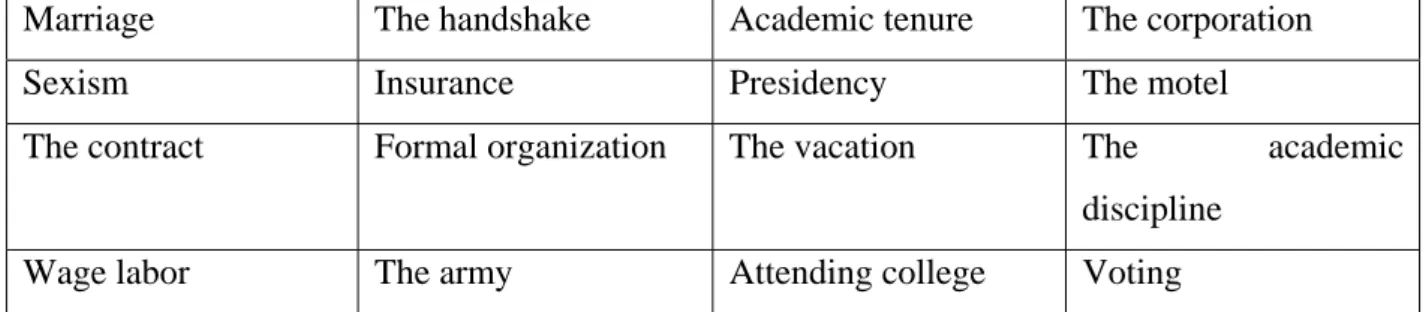
Prior to a continuation of the review of institutionalism, a broader conceptualization of institutions and institutionalization seems beneficial. Jepperson (1991) presented the following as representations of institutions.
Institutions
Marriage The handshake Academic tenure The corporation
Sexism Insurance Presidency The motel
The contract Formal organization The vacation The academic
discipline
Wage labor The army Attending college Voting
Table 1: Examples of institutions. From Jepperson, 1991:144
Even though these institutions seem very different, they share the commonalities of being “production systems,” “enabling sources,” “social programs,” or “performance scripts.” Jepperson (1991) provides an even more unifying conceptualization of institutions:
“Institutions represent a social order or pattern that has attained a certain state or property; institutionalization denotes the process of such attainment. By order or pattern
I refer, as is conventional, to standardized interaction sequences. An institution is then a social pattern that reveals a particular reproduction process… Put in another way:
THEORY
16
institutions are those social patterns that, when chronically reproduced, owe their survival to relatively self-activating social processes” (Jepperson, 1991:145).
Institutions embody the shared meanings that are considered as natural and taken for granted within an organizational field. Commonly, institutions are described as any structures of social order which function as templates for the way we perceive our environment and how we act:
“Institutions are the humanly devised schemas, norms, and regulations that enable and constrain the behavior of social actors and make social life predictable and meaningful (North, 1990; Powell & DiMaggio, 1991; Scott, 2001).” (Hargrave and Van de Ven, 2006:866)
Institutions specify and justify behaviors and can thus be viewed as performance scripts reflecting social structures and accepted interpretations of social life and, to some extent, structuring and repeating practices, deviations from which are counteracted by sanctions or are costly in some manner (Jepperson, 1991), thus institutions come across as natural and taken for granted—creating a mutually perceived reality.
An often raised critique of institutional theory is that the theory is inherently static, but it seeks to explain institutions as political constructions, which on the other hand are very dynamic processes. Institutional theory is in this way criticized for attempting to explain differences among institutions, more that it attempts to explain the development of institutions. The contemporary institutional theory, however, addresses the dynamics of constructing new institutions and highly considers the political processes that occur as new structures are presented and implemented in organizational fields in attempts to generate changes. This process of structures becoming institutions is termed institutionalization.
2.2
I
NSTITUTIONALIZATIONThe process by which behavior becomes institutionalized patterns of actions is central in understanding institutional change since the term refers to the process of embedding humanly devised structures: when they become taken for granted as a “natural” feature of social life and are constituent and of actors’ perceived rationality as well as explanatory to their behavior. For something to be institutionalized is thus to be regarded the ultimate achievement for actors with an interest in anchoring new behavior within a field.
17
Berger and Luckmann (1966) introduce institutionalization as the processes by which humanly devised structures transcend their regulative function of socially ordering a field but even manifesting themselves as habituated natural activities among actors in the same institutional environment. When actors no longer consider their behavior as being partly controlled by an institution, because the institution becomes so taken for granted that acting in accordance with it is being regarded as rational behavior by those sharing the institution, the institution can be considered to be successfully institutionalized within the institutional environment. Actors are no longer experiencing the introduced institution as objective processes or structures. Rather it has become a meaning system, inscribed in a larger cultural framework.
Regardless, a unifying acceptance among institutional theorists that institutions are phenomena that influence human behavior and social processes, and that they have pivotal influence on societal economic, political, and social developments, the historical development of institutionalism has resulted in a heterogeneously overall perception of institutional theory. In his review, Scott (2001) states:
“The concepts of institution and institutionalization have been defined in diverse ways, with substantial variation among approaches. Thus, the beginning of wisdom in approaching institutional theory is to recognize that there is not one but several variants. Some versions are much more carefully defined and explicit about their definitions and referents, while others are less clear in conceptualization. Although there seems to be an underlying similarity in the various approaches, there is little agreement on specifics” (Scott, 1987: 493).
Researchers of institutions have, however, not always addressed institutionalization as institutional theory originally had a rather normative conception of the interplay between institutions and actors. In the following, I will account for how institutional theory has transformed from rationalism towards aspects of cognitive and cultural explanations of institutions and their functions in order to understand how actors play a significant role in the forming of new institutions.
2.3
I
NSTITUTIONALISM–
RATIONALISM,
ISOMORPHISM,
AND ROLE OF ACTORSInitially, beginning from the late 1940s, institutional theory focused mainly on how institutions function to integrate organizations with other organizations in society and on explaining how
THEORY
18
institutionalized structures affected organizations. Having a rationalist approach, this original “old” institutionalism perspective draws in the normative assumption of organizations as constrained and obligated by the norms and rules of institutions. In this perspective, individuals are acting independent of one another, and collective actions can be understood as the sum of individuals’ actions (DiMaggio and Powell, 1991); institutions are considered to be limiting organizational behavior (Powell, 2007). The theoretical interest is on the influences institutions have on organizations in conforming their behavior, and the study of interest is phenomena such as universalistic rules, contracts, and authority (Thornton and Ocasio, 2008); adoption of socially approved templates; and the organizational resilience of institutional prescriptions (Greenwood and Suddaby, 2006).
In the 1970s a different approach to institutional analysis emerged, caused by an increasing necessity among scholars to develop a sociological approach to cope with the challenges in understanding and addressing institutions from a theoretical perspective (DiMaggio and Powell, 1991) and to understand how institutions affect society. More and more studies observed complexities and variety of organizational responses to institutional pressures and the important role of internal organizational practices in understanding institutions. It highlighted the necessity for institutionalists to rethink the notion of organizations as acting in a relatively homogeneous way on a common set of pressures (Powell, 2007), thus it prompted an introduction of the role of culture and cognition in institutional analysis from a micro perspective Zucker (1977), an emphasis on the taken for granted nature of institutions, and the role of cultural persistence as a measure of institutionalization. From a macro perspective, the notion of “isomorphism” became established as a conceptualization of the process occurring when organizations become uniform, viewed from a societal level, caused by their conforming of formal structures in respect to external pressures or requirements for attaining legitimacy (Mayer and Rowan, 1977). The theory of isomorphism was developed by DiMaggio and Powell (1983) and provides a theoretical understanding of why “organizations are becoming more homogeneous, and that elites often get their way, while at the same time enabling us to understand the irrationality, the frustration of power, and the lack of innovation that are so commonplace in organizational life” (DiMaggio and Powell, 1983:157). With their mimetic sources of isomorphism, DiMaggio and Powell brought focus to what was so far regarded as mindless behavior in response to cultural rationalization (Thornton and Ocasio, 2008). The theoretical approach and conceptualization of organizational conformity led to a movement in
19
bringing the study of interest from the societal level to the level of organizational fields, and proponents acknowledged that formal organizational structures were to be understood as reflections of the prevailing rationality. The new institutionalism breaks with the existing perceptions by rejecting rationality as an explanation for organizational structure and emphasizes that the success and survival of organizations are to be found in organizations’ quest for achieving legitimacy rather than efficiency (Tolbert and Zucker, 1983). Institutional theorists recognized that when studying stability, consensus and conformity of institutions was not sufficient in understanding the processes of how institutions are created, diffused, adopted, and adapted.
“(…) [G]radually, the language began to shift from discussions of institutional “effects” to institutional “processes”; and theorists began to craft recursive models, recognizing “bottom-up” modes of influence, to supplement or replace prevailing top-down models (Scott 1995; 2001). (Scott, 2004)
Where “old” institutionalism perceives institutions as the formal rules of behavior and treats them in correlation with the behavior of rational actors, the challenging theory loosens the concept of institutions as well as how they should be understood in relation to organizations and the behavior of individuals.
“Institutions do not merely reflect the preferences and power of the units constituting them; the institutions themselves shape these preferences and that power. Institutions are therefore constitutive of actors as well as vice versa. It is therefore not sufficient in this view to treat the preferences of individuals as given exogenously: they are affected by institutional arrangements, by prevailing norms, and by historically contingent discourse among people seeking to pursue their purposes and solve their self-defined problems” (Keohane 1988:382).
The change of the conceptualization of institutions has led to an absent single agreed definition of what constitutes an institution. Scott (2001) perceives institutions as follows:
“Institutions are social structures that have attained a high degree of resilience. [They] are composed of cultural-cognitive, normative, and regulative elements that, together with associated activities and resources, provide stability and meaning to social life […]
THEORY
20
Institutions by definition connote stability but are subject to change processes, both incremental and discontinuous” (Scott, 2001:48).
The concept of institutions is thus very wide, and practically any kind of behavioral pattern can be termed “institution,” thus suggesting that organizational structures and practices
“[…] are often reflections or responses to the rules, beliefs, and conventions built into the wider environment” (Powell, 2007:1).
Hence, institutions are the organizational structures and practices that are constituted by the formal as well as the informal conditions that frame and support individual and collective actions. Institutions do not just constrain actors’ behavior; they also establish the very criteria by which actors discover their preferences. Thus, scholars of the new institutionalism pay much more attention to the internal influences and the heterogeneity of organizational responses to institutional pressures, hence increasing the academic focus on the role of “agency” in institutionalization and acknowledging that institutionalization is a political process where success and final form depend on the relative power of the actors who strive to steer it (DiMaggio, 1988):
“[W]hile recognizing that actors are institutionally constructed, it is essential to affirm their (varying) potential for reconstructing the rules, norms and beliefs that guide—but do not determine—their actions” (Scott, 2004:12)e.
The rising awareness of the interrelations between actors and institutions has resulted in alternative theorizations of how to cope with institutional change. The focus is turned towards aspects of cognitive and cultural explanations of institutions and their functions in order to understand how changes in rules, normative systems, and cognitive beliefs reshape organizational fields and how these social structures are changing caused by the power exercised by “subjects.” In order to understand why some institutions persist and others erode or fall into disuse, institutionalists have found it vital to pay attention to the correlations between institutional change and intra-organizational dynamics within a field that emerge when shaping existing or creating new institutions.
21
2.4
O
RGANIZATIONAL FIELDS AND INSTITUTIONAL CHANGEThe development of institutional theory has led to the following problematization of institutional change:
“If institutions are, by definition, firmly rooted in taken-for-granted rules, norms, and routines, and if those institutions are so powerful that organizations and individuals are apt to automatically conform to them, then how are new institutions created or existing ones changed over time?” (Seo and Creed, 2002:222)
In understanding the dynamics and the strategic activities associated with institutional change, it is relevant to introduce the concept of organizational fields. This concept is central to institutional theory since it is a theoretical precondition that organizations are located within fields (Kondra and Hinings, 1998). Fields represent the intermediate level between organizations and society and are considered to be instrumental to processes by which socially constructed expectations and practices become disseminated and reproduced (Scott, 2001). The concept of fields has been developed in order for institutional theorists to cope with and account for the tensions and contradictions that emerge in the maintenance of existing or rising of new institutions within a specific group of organizations that share an interest in the institutional conditions.
Powell describe how “[a]n organizational field is a community of disparate organizations, including producers, consumers, overseers, and advisors, that engage in common activities, subject to similar reputational and regulatory pressures” (Powell, 2007:3). “Field” expresses those conditions under which the institutional environment shapes actors and their behavior (Zucker, 1988) and is constituted by organizations and professions that share common understandings of social orders or activities:
“The notion of field connotes the existence of a community of organizations that partakes of common meaning system, and whose participants interact more frequently and fatefully with one another than with actors outside the field” (Scott, 1994:207-8).
In its capacity to embrace and represent differentiated, interdependent actors and institutions, fields are considered to reveal a recognized social structure and social life (DiMaggio and
THEORY
22
Powell, 1983), and it is a theoretical conviction among institutionalists that it is within this intermediate level that the sources for institutional change are to be found.
Early work on organizational fields concentrates attention on field level development and institutional change by mainly considering fields as domination systems that confine behavior, thus highly neglecting the role of actors and agency. Within this field perspective, studies at the field level consider institutions as being reflections of the prevailing field boundaries. But concurrently with the growing acknowledgement that actors and agency play vital roles in making up institutions and creating institutional change, a different field perspective has emerged. Observing that actors have power and interest in producing strategic activities that affect the process of institutional change, it has become increasingly interesting for scholars to consider micro processes as reflections of the field boundaries. Fields are to be considered as contested centers of debate, “where competing interests negotiate the interpretation of what they each consider as key issues” (Powell, 2007:3), thus allowing strategic activities to emerge in the tensions and contradiction of the field itself.
Powell (1991) provides the following characteristics of institutional change:
“When change does occur […] it is likely to be episodic, highlighted by a brief period of crisis or critical intervention, and followed by a longer period of stability or path-dependent development. Periods of deregulation, for example, are likely to be followed by an era of consolidation. Major changes often occur when legal or other rule-maintaining boundaries are relaxed” (Powell, 1991:197).
Institutional change is the focal point in contemporary institutional literature, and institutional contradictions are appointed as the driving forces of institutional change, resulting in the questioning of taken for granted elements of social structure and a replacement of other elements that previously were considered illegitimate, unthinkable, or impossible. This points out a central element in studying institutional change and simultaneously enhances the necessity to study institutionalization as a political process: The anchoring of new institutions requires that one or more previously taken for granted, “natural” features of social life are being altered, abandoned, and replaced by another. This has enhanced the academic interest in a so far underdeveloped phenomenon, deinstitutionalization, “the processes by which institutions weaken and disappear” (Scott, 2001:182). In a change perspective, deinstitutionalization finds
23
its legitimacy because “it is useful to place studies of deinstitutionalization in a broader context of institutional change, since the weakening and disappearance of one set of beliefs and practices is likely to be associated with the arrival of new beliefs and practices” (Scott, 2001:184).
The notion that institutional fields are centers of debate and consist of several, sometimes mutually, competing interests (Seo and Creed, 2002) that can be contested as actors interpreting beliefs from different perspectives, can result in an ascription of different meanings and perceptions of the institutions within the field. This entails the deconstruction of institutions as an important element in the study and understanding of institutional change since “institutionalization bears, if not the seeds of its own destruction, at least openings for substantial change” (DiMaggio 1991:287). But, these openings will not automatically lead to a breakdown in institutional norms since they require a response and interpretation by actors in order to provide the pressure needed to initiate institutional change. In order for new institutions to rise and take on the required degree of legitimacy, existing institutions must undergo a process of deconstruction and delegitimation by new or existing actors, providing the justification of introducing new norms and practices as an alternative to the existing institution. The contemporary notion of the interrelations between fields, actors, and change not only signifies that institutional change is a complex phenomenon inseparable from the cognitive and cultural aspects of institution but stresses the importance for scholars to study the existence and emergence of competing interests among actors, thus the conflicts and contradictions leading to institutional change. Accordingly, when studying institutions, it is important to realize that while institutions constrain action, they also provide opportunity for agency and change.
2.5
I
NSTITUTIONAL LOGICS–
COPING WITH INSTITUTIONAL CHANGEThe contemporary perspectives on institutional change have prompted the concept of “institutional logics,” originally introduced by Alford and Friedland (1985) for the purpose of describing the rationales behind ostensibly contradictory practices and beliefs inherent in institutions. They contend:
“Each of the most important institutional orders of contemporary Western societies has a central logic—a set of material practices and symbolic constructions—which constitutes its organizing principles and which is available to organizations and individuals to
THEORY
24
elaborate […] These institutional logics are symbolically grounded, organizationally structured, politically defended, and technically and materially constrained, and hence have specific historical limits” (Friedland and Alford, 1991:248-249).
According to Friedland and Alford (1991), each institutional order can be considered to have an appertaining logic that contributes to individuals’ identity creation and that constrains both the means and ends of individual behavior and are constitutive of individuals, organizations, and society. They view institutional logics as embodied in practices, sustained and reproduced by cultural assumptions and political struggles, which constitute an institutional order of organizing principles that subsequently are adopted, adjusted, and elaborated by the field actors (Friedland and Alford, 1991). Accordingly, institutional logics define the order of a given field since they “define the norms, values and beliefs that structure the cognition of actors in organizations and provide a collective understanding of how strategic interests and decisions are formulated” (Thornton, 2002), thus establishing the foundation for what is considered as rational behavior within a given institutional logic. In this perspective, actors always organize in compliance with the given institutional logic they are embedded, albeit the accepted practices and symbols available are subjects to elaboration and adjustment, triggered by actors’ self-interest.
Thornton and Ocasio (1999) defined institutional logics as “the socially constructed, historical patterns of material practices, assumptions, values, beliefs, and rules by which individuals produce and reproduce their material subsistence, organize time and space, and provide meaning to their social reality” (804).
“Institutions constrain not only the ends to which their behavior should be directed, but the means by which those ends are achieved. They provide individuals with vocabularies of motives and with a sense of self. They generate not only that which is valued, but the rules by which it is calibrated and distributed. Institutions set the limits on the very nature of rationality and, by implications, of individuality. Nonetheless, individuals, groups, and organizations try to use institutional orders to their own advantage” (Friedland and Alford, 1991:251).
By addressing the interrelationships between individuals, organizations, and society, the institutional logic approach links the perspectives of institutions in a societal level (macro
25
level)—focusing on socially constructed institutional practices and rule structures—and those on a level of organizational fields (micro level)—focusing on individual agency and cognition, and socially constructed institutional practices and rule structures (Friedland and Alford, 1991). The approach heightens how cultural dimensions of institutions both enable and constrain social actions and can be regarded as a response to the problematic issue that actors often are subject to co-existing and sometime competing logics, which encourages different practices and beliefs that ultimately shape and elucidate the interest and behavior within a field, thus actors’ strategic activities and involvement in the political struggles of institutionalization.
The concept of institutional logic has been particularly useful in helping researchers identify and explain both institutional continuity and change since logics provide the organizing principals of specific categories, beliefs, and motives that affect how actors conduct themselves and their environment (Friedland and Alford, 1991). Also,
“[t]he notion of logics is immensely appealing. First, it proposes that external rituals and stimuli interact with internal mental structures to generate routine behavior. Second, it is consistent with the view that culture is fragmented among potentially inconsistent elements, without surrendering the notion of limited coherence, which thematization of clusters of rituals and schemata around institutions provides. Third, it provides a vocabulary for discussing cultural conflict as confrontation between inconsistent logics of action” (DiMaggio, 1997:277).
The institutional logic approach influences the way to perceive and study institutional change. Firstly, since there are always several competing institutional logics with different rationalities in a field (Friedland and Alford, 1991), the emergence of conflicts and contradictions is intrinsic since change often originates from the conflicts and contradictions between different institutional logics. These contradictions can potentially achieve the capacity to challenge prevailing interpretations of rational behavior, caused by the reflexive interpretation by those who operate in them. Institutional logics are thus not only defining structures within a field but also revealing the potential for institutional change, as institutional logics structure the cognition of actors and provide a collective understanding of how strategic interests and decisions are formulated. Thus, it necessitates an understanding of how competing logics function in generating a less constrained institutional environment, thus openings for new or
THEORY
26
previously institutional constrained actors to introduce new schemas, rules, or norms that potentially become institutionalized.
Secondly, but inseparably linked to the abovementioned, since any identity within a field is a socially constructed product of the prevailing different (sometimes mutually incompatible) institutional logics they are exposed to, an appertaining consequence of actors’ elaboration and adjustment of institutional logics is an always impending risk that social identities within an organizational field become contested and unstable. In this way, actors become central in the study of institutional change due to their ability to carry out strategic activities by actively exploiting and initiating the incompatibilities and contradictions between the institutional logics of their field, and hereby producing “[…] new truths, new models by which they understand themselves and their societies, as well as new forms of behavior and material practices” (Friedland and Alford 1991:251). But is also produces a paradox since the actions of actors must be understood as located in an institutional context that both regulates behavior and simultaneously provides opportunity for agency and change.
The heightened academic interest in the actors’ important and decisive roles in institutional change processes has approached institutional theory from the perspective of change and has been a driver in understanding institutional change differently. Holm (1995) states that
“[…] neither underlying power structures nor overarching ideologies are the primary explanations. The core institutional insight is that of interaction between practices, interests, and ideas” (Holm, 1995:416).
The focus of institutionalism on continuity, stability, and persistence of institutions has been replaced with a predominant interest in understanding institutional change by studying the field dynamics that call forth the creations, maintenances, transformations, or disruptions of institutions. The new focus on change has sprouted a necessity among scholars in understanding fields as political arenas where power relations are maintained or transformed (Clemens and Cook, 1999; Seo and Creed, 2002), directing an emphasis on studying processes of conflict and struggle within institutional fields in order to understand the role of actors.