University of the Witwatersrand
SCHOOL OF HUMAN AND COMMUNITY DEVELOPMENT Department of Psychology
The effects of a reading intervention on first and second
language English medium learners
A research project submitted in partial fulfilment of the requirements for the degree of M.Ed by coursework and research report in the field of Educational Psychology in the Faculty of
Humanities, University of the Witwatersrand, Johannesburg, October 2010. Student: Kirsty Carter, 457565
M.Ed Educational Psychology: Research Report
Surname : Carter
First name/s : Kirsty Student number : 457565
Supervisor : Dr. Yvonne Broom
Research Report due date : October 2010 Total word count : 19673
(excl. Reference List)
Declaration
I, Kirsty Carter, know and accept that plagiarism (i.e., to use another‟s work and to pretend that it is one‟s own) is wrong. Consequently, I declare that:
The following research report is my own work.
I have correctly acknowledged all direct quotationsand paraphrased ideas/ content. In addition, I have provided a complete, alphabetized reference list, as required by the APA method of referencing.
I have not allowed, and will not allow, anyone to copy my work with the intention of passing it off as his or her own work.
I understand that the University of the Witwatersrand may take disciplinary action against me if there is a belief that this is not my own unaided work, or that I failed to acknowledge the source of the ideas or words in my writing.
The word count (excluding the Reference List) given above is correct.
I understand that, as a postgraduate student, the University will not tolerate any infringements or dishonesty in my referencing practice.
Signed: _________________________
Date: _________________________
(N.B. Research reports which do not include this cover page with the duly signed declaration will not be accepted.)
Acknowledgements
I wish to acknowledge the following people for their support and assistance in this study:
I would like to extend my sincere gratitude to my supervisor, Dr Yvonne Broom for her guidance and encouragement, as well as for all she has taught me about becoming a better writer and researcher. My experienced gained working with Yvonne has been invaluable.
Dr Gillian Finchilescu and Jarrod Payne for their assistance with the statistical analysis.
Joseph Seabi for his endless support.
All the learners, parents and teachers who participated and cooperated in this study, without you the study would not have been possible.
Table of Contents
Chapter 1 Literature Review ...1
1.1. Introduction ...1
1.2. The South African Education Context ...2
1.3. Reading in South Africa ...5
1.4. A Theoretical Basis ...8
o The Immersion Debate ...8
o Cummins‟ Theory ...9
o The Threshold Hypothesis of Language Proficiency ...12
o Comprehension and Vocabulary ...14
1.5. The difference between L1 and L2 learners ...16
1.6. Rationale ...21
1.7. Research Question and Hypotheses ...23
Chapter 2 Methodology ...25
2.1. Research Design ...25
2.2. Sample ...26
2.3. The Implemented Intervention ...28
2.4 Instruments and Materials ...28
2.5. Data Gathering Procedure ...28
2.6. Ethical Considerations ...29
Chapter 3 Results ...31
3.1. Vocabulary ...32
o Descriptive Statistics ...32
o Inferential Statistical Analysis ...32
3.2. Comprehension ...35
o Inferential Statistical Analysis ...35
Chapter 4 Discussion
...38
Limitations and Recommendations ...48
Implications for the South African learning context ...51
Conclusion ...54
References ...56
Appendices
Appendix A: Principal Information Sheet Appendix B: Principal Permission Form Appendix C: Parental Information Sheet Appendix D: Parental Consent Form (Guardian) Appendix E: Participant Information Sheet Appendix F: Participant Consent Form Appendix G: Biographical Questionnaire Appendix H: Department of Education Research Approval Appendix I: Human Research Ethics Clearance CertificateTables and Figures
Table 2.1:Control and Experimental Groups; L1 and L2 Participants ...27Table 2.2: Control and Experimental Group; L1 and L2 Learners ...27
Table 3.1: Descriptive Statistics for scores on the SDRT: Brown Level Vocabulary subtest at Time 1 (Grade 8) and Time 2 (Grade 10) ...32
Table 3.2: Descriptive Statistics for scores on the SDRT: Brown Level Comprehension subtest at Time 1 (Grade 8) and Time 2 (Grade 10) ...35
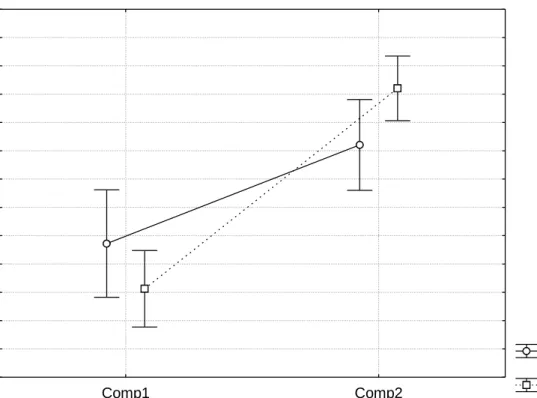
Figure 3.1: Differences between Control and Experimental groups on a measure of Vocabulary (mean scores) over time ...33
Figure 3.2: Differences between L1 and L2 learners on a measure of Vocabulary (mean scores) over time ...34
Figure 3.3: Differences between Control and Experimental groups on a measure of
_________________________________________________________________________________
* For the purpose of this study, first and second language English speakers will be referred to as L1 and L2 respectively. For the purpose of this study L2 learners are defined as those learners who have a black African home language but have been educated in English for a minimum of five years.
Chapter 1
Literature Review
1.1. Introduction:
This research will contribute to the knowledge of how to best educate South African learners given our unique schooling conditions. Teachers need to understand the extent of the disadvantage involved in second language learning and the proposed research ai ms to equip teachers to better deal with, or avoid the resultant deficits. Such knowledge will be gained by taking a closer look at the evident gap in reading ability between first and second language English medium learners*. Understanding the underlying causes of the discrepancy as well as evaluating efforts to narrow the gap, will equip the current body of research with a necessary springboard for future educational practices.
Prior to 1994 the language policy in South Africa allowed English and Afrikaans a dominant advantage even though the majority of South Africans at the time, and today, speak an African language as their home language. Although the policy today allows learners the right to be educated in their language of choice, this has proved impractical (Barry, 1999). Research by Winnett (2008) revealed a constant significant gap in both vocabulary ability and comprehension ability between first language and second language English medium learners when tested during their Grade 8, Grade 9 and Grade 10 years. Thus the implications of a post-apartheid era are still evident in South African schools (Barry, 1999).
The study aims to investigate this gap in reading ability across language backgrounds by testing comprehension and vocabulary ability in a South African sample of high school learners. The study is a longitudinal repeated measures design and statistical analysis focuses on the effects of implemented efforts to narrow this gap and the implications thereof. These efforts to narrow the gap in reading ability refer to a school initiated half-an-hour reading period aimed at improving the comprehension and vocabulary abilities of learners. During this period groups of learners numbering thirty-five to forty, and consisting of learners from
2 across grades 8 to 11, gathered in a classroom in order to practice reading under supervision (Karolia, 2008).
Shared reading or supervised oral reading is a form of modelling, allowing the entire class or paired individuals to follow the same text as each takes a turn to read aloud. Consequently the differences in fluency and pronunciation are highlighted when listening to, and following a text simultaneously. Coupled with immediate correction from the teacher or more proficient reader, in order to avoid the acquisition of incorrect vocabulary, correct reading skills are modelled and learnt. Hence the critical nature of adult-child interaction during the early stages of childhood literacy development (Begeny & Martens, 2006; Hay & Fielding-Barnsley, 2007; Malloy, Gilbertson & Maxfield, 2007; Rasinski, 1990; Stinnett, 2010). The notion of repetition is essential to the learning process. Practice results in familiarity and easier memory retrieval. When skills and behaviours are repeated the newly developed neural pathways are strengthened and become more engrained, allowing such a skill or behaviour to be internalised as a habit. Thus, automaticity is accomplished. In line with theory, research indicates that reading interventions based on repetition are likely to yield the greatest gains over time (Begeny & Martens, 2006; Malloy et al., 2007; Manset-Williamson & Nelson, 2005; National Institute for Literacy, 2000; Rasinski, 1990; Stinnett, 2010) and are thus relevant to this study. Investigating various methods for reading improvement is pertinent to expanding the current knowledge base pertaining to South African education as „reading is not simply an additional tool that students need at tertiary level - it constitutes the very process whereby learning occurs‟ (Pretorius, 2002a, p.169).
1.2. The South African Education Context
Prior to 1994, learners attended separate schools segregating black and white education. Furthermore, these schools adopted differing strategies when implementing a medium of instruction. The 1976 uprisings of the Soweto Rebellion of students were a result of resistance to black education „mother- tongue‟ language policy and led to the decision that neither Afrikaans nor black African languages could be implemented as the langua ge of instruction in black schools. The amendments made to the 1953 Bantu Education Act in 1979 entailed the limitation of mother tongue instruction to the first four years of school. The aim became to decrease bilingualism in black schools (de Wet & Wolhuter, 2009; Mahlalela-Thusi & Heugh, 2002).
3 After 1994, eleven languages of South Africa gained official status and educational rights in order to enhance the nature of newly founded democracy. According to de Wet and Wolhuter (2009), a case of “deep-seated distrust and fear that home-language education would lead to impoverishment, social and political isolation, and disempowerment” (p. 359) resulted in the majority of South African learners indicating a preference for English as the language of primary instruction instead of their native tongue (de Wet & Wolhuter, 2009).
The White Paper on Education and Training (Department of Education (DoE), 1995) expresses a specific mandate for “Transforming the Legacy of The Past” (Ch. 3) wherein, although gross inequalities in educational opportunity are acknowledged, equity attainment is of paramount importance. Aspirations toward equal opportunity are evidenced in the paper‟s indication of the parental right to choose the language, culture and religious basis of a child‟s education (Ch. 4). However, in chapter 2 of the 1996 Bill of rights, the right of everyone to be educated in the official language of their choice is accompanied by necessary clauses regarding practicability, the consideration of the resultant impact of past racially discriminatory laws, and the exploration of all reasonable alternatives, including single medium instruction. These practical hindrances stand in opposition to the recognition of the White Paper on Education and Training (DoE, 1995, Ch. 4) that „education and training are basic human rights‟ and that „the state has an obligation to protect and advance these rights, so that all citizens irrespective of race, class, gender, creed or age, have the opportunity to develop their capacities and potential, and make their full contribution to the society‟.
Fifteen years later, and 20 years after the release of Nelson Rolihlahla Mandela from prison in 1990, the 11th of February 2010 saw President Jacob Zuma deliver his second State of the Nation Address in which he firmly indicated the position of education and skills development at the centre of government policy. New „to be implemented‟ procedures include literacy and numeracy testing in schools as well as the provision of workbooks in all 11 official languages. Government aspires to elevate pass rates on tests of literacy and numeracy from the current average of 35-40% to a minimum of 60% by 2014. In his statement, President Jacob Zuma indicated the government‟s desire „to improve the ability of [South Africa‟s] children to read, write and count in the foundation years‟. He acknowledged that unless this task is successfully carried out, the quality of education in South Africa will not improve.
4 In spite of such efforts to promote language equity, concerning the majority of South Africans, English is selected as the preferred language of learning and teaching (LoLT) after the first four years of schooling (Die Burger, 12 September 2000: 9 as cited in de Wet, 2002). de Wet (2002) investigated the reasoning behind this preference by addressing two factors associated with choice of LoLT; firstly the number of speakers, and secondly the perceptions of the role and functions of language in particular areas of life. The stu dy specifically explores the perceptions of educators and student educators on the significance of language in education, politics, science and technology, trade and industry, and cultural activities. The respondents to the study indicated their understanding of English as most paramount to practices of education, politics, science and technology, and trade and industry. Furthermore the multilingual (belonging to five South African language groups), multicultural group of respondents acknowledged the significance of one‟s home language in the activity of culture. A large portion (78.9%) of the respondents indicated that they use language or code switching to enhance their teaching methods, thus confirming the majority opinion that home language usage aids the education process (de Wet, 2002).
In spite of notions that education in one‟s native tongue is more successful than bilingual or second language medium of instruction (Heugh, 2002), in South African schools English is the dominant medium of instruction (De Klerk, 2002; de Wet, 2002). Furthermore, the South African National Curriculum Statement (DoE, 2002) indicates that one should attain proficiency in the selected language of teaching and learning (LoLT) at a level fundamental for successful learning of the curriculum. Howie, Scherman and Venter (2008) conducted research investigating the “gap” between advantaged and disadvantaged students in science achievement in South African secondary schools. Their rationale for conducting the study included the opinion that „South Africa‟s education system is still deep in the throes of reform under its third Minister of Education since 1994‟ (p. 29). Furthermore the authors acknowledge that poorer, rural South African communities are carrying the majority burden resulting from past inequalities. The category of students labelled as „disadvantaged‟ was characterised by an Africa language as their home language which differed from the language of school instruction, primarily English. In addition these students were more likely to have come from rural areas, to have less books or possessions within their homes and to be of an older than mean age per grade. These disadvantaged students achieved the lowest scores for achievement on a science test administered in English as well as on the English proficiency tests. Furthermore South African students performed well below the international average for
5 science achievement (Howie, Scherman & Venter, 2008). Factors analysed for variance in science test scores revealed that English test scores had a strong effect on science achievement. Twenty-three percent of the variance in English test scores among the disadvantaged group could be explained by location of the school, age, language spoken at home, aspirations of the students and books in the home. The results from this study are not unexpected and it is problematic that poor comprehension and communication skills are limiting South African student‟s access to not only science knowledge but possibly conceptual understanding relating to a variety of subjects (Howie, Scherman & Venter, 2008). The concerns highlighted in the study conducted by Howie, Scherman and Venter (2008) are echoed in Mallozzi and Malloy‟s (2007) research into second language issues in South Africa. Mallozzi and Malloy (2007) stress the importance of learning English as a second language for those South Africans who speak an African home language, as the English language dominates the workforce as well as school instruction. However, it is noted that for those whose first language differs from the LoLT, English is not offered as a distinct second language subject. Furthermore the vast cultural and socio-economic differences within the South African learning environment impose difficulties on the development of an appropriate literacy education program.
1.3. Reading in South Africa
Pretorius (2002a) describes the reading situation in South Africa as a „national educational crisis‟ (p. 170) and deliberately expresses a call for decisive action. Pretorius and Naude (2002) comment on the fact that a large majority of South African children, specifically those born in Township areas, are ill prepared for formal education and in spite of their lack of school readiness are still expected to cope with the current school system. In a sense, they are lagging behind before they even begin. Their studies revealed poor sentence construction and use of syntax, poor literacy skill, and inadequate sound development, among other concerns, prior to beginning formal education.
It is suggested that the problem of reading in South Africa is indicative of a people still reaping the detrimental effects of apartheid regime. A history of education deprivation as well as emphasis on the English language as the only means for success and power has left a legacy of disadvantage (Rasinski, 1990). The South African educational context is tainted by disadvantage and poverty and inhibited by insufficient resources or school supplies, as well as the problem of too many students and too few adequately qualified teachers (Pretorius,
6 2002b). Pretorius and Mampuru (2007) in their study examining the relationships between L1 (Northern Sotho) and L2 (English) proficiency as well as between L1 and L2 reading in Grade 7 learners at a high-poverty South African primary school during the year that a reading intervention was being implemented at the school, attribute many of their findings to the long term consequences of negative „Matthew effects‟ on reading.
Within the domain of education „Matthew effects‟ refer to the observed phenomenon that early success in learning to read accumulates, resulting in more reading and greater success in reading later in life. Within sociology and economics this would be described as „the rich getting richer‟; those students attending well resourced schools with well trained teachers are able to learn to read and then have opportunity to accumulate their knowledge, reading ability and achievement. On the other hand, those students who are not provided with the opportunity to learn to read within the first three or four years of schooling are likely to experience long term difficulties in learning as they tend to fall behind in the beginning stages of schooling, resulting in their reading less and accumulating less knowledge. As time passes the gap increases between those who have been left behind and those who have learnt to read from an early age. Eventually these students experience significant difficulty passing other subjects and school dropout rates increase. It can be said that „the poor get poorer‟. (Wikipedia, n.d./2010)
To quote Keith Stanovich, a psychologist whom adopted the term Matthew effect within the realm of reading and education; “Slow reading acquisition has cognitive, behavioural, and motivational consequences that slow the development of other cognitive skills and inhibit performance on many academic tasks. In short, as reading develops, other cognitive processes linked to it track the level of reading skill. Knowledge bases that are in reciprocal relationships with reading are also inhibited from further development. The longer this developmental sequence is allowed to continue, the more generalized the deficits will become, seeping into more and more areas of cognition and behaviour. Or to put it more simply -- and sadly -- in the words of a tearful nine-year-old, already falling frustratingly behind his peers in reading progress, „Reading affects everything you do‟” (Adams, 1990, pp. 59-60).
In addition, Pretorius and Mampuru (2007) found that during the pre-test phase of their study, 30% of the tested grade 7 learners were not even able to read at 20% level of comprehension and some had even struggled with L1 grade 2 and 3 texts. At an individual level, the weaker
7 students were found to have poor word recognition skills and inadequate knowledge of letter -sound relationships; indicative of inadequate learning of phonics at the foundation phase. Furthermore, the class sizes were large, availability of reading material was very limited and many of the learners were over-aged for their grade level. An overarching concern was the teachers‟ inability to address the problem of reading at the school as well as the lack of parental involvement in reading related activities. Pretorius and Mampuru (2007) further suspect that within high poverty schools, such as the school utilized in their research, severe reading disabilities are not recognized and attended to in earlier grades thus leading to failure at later grade levels. Conditions such as these are unsupportive and often inhibitory in terms of taking remedial action (Pretorius & Mampuru, 2007).
It is also relevant to this study to note that when the grade 7 learners were segregated according to their academic scholastic achievement; all of the learners belonging to the Not Achieved category, having obtained between 0 and 39%, had Northern Sotho as their home language. All of the learners falling in the Achieved category, having obtained between 50 and 69%, were from a non-Northern Sotho home background. An intervention was implemented in an attempt to rectify the school‟s reading environment, being characteristic of high poverty education environments. A library was established, teacher training and awareness was raised as well as the implementation of a forum for parental involvement and an opportunity for so many illiterate parents to cease feeling isolated from their children‟s learning context - as was discovered to be the case. Post-testing was conducted seven months later and results revealed that those who passed grade 7 (Achieved and Outstanding categories) showed improvements in both their L1 and L2 reading ability. These results further confirm the consequences of the above mentioned Matthew effects. Furthermore, Pretorius and Mampuru (2007) highlight the necessity of available printed text and subsequent reading practice in order for reading levels to be improved. Pretorius and Mampuru (2007) liken the lack of reading resources in the literacy learning environments of South Africa to the ludicrous notion of learning to play soccer without a ball.
Furthermore, in understanding the causes underlying the reading deficits that characterise so many of South Africa‟s children the educational conditions as well as the extent of inequitable opportunity are highlighted. According to Statistics South Africa Census @ School Project in collaboration with the Department of Education, in 2001 less than 50% of schools across Southern Africa had access to running water. Only 52.7% of schools had
8 electricity, 52% had available toilet facilities and less than 25% of schools had access to a computer, internet, email and library facilities. In 2001 only 64% of schools had a Maths teacher (Statistics South Africa, 2001). Pretorius (2002b) echoes the statistics in commenting on the unique context at hand; a large portion of South African schools are operating under inadequate conditions, without electricity, running water, telephones or sanitation.
Similarly, specific challenges facing English second language education appears to be not only a severity in lack of available resources as well as the socio-emotional difficulties of learners, but notably a lack of parental support and parental involvement in their child‟s education is highlighted, and possibly attributed to language usage (Mji & Makgato, 2006; O‟Connor & Geiger, 2009). In a similar vein, the fact that language is acknowledged to be culturally imbedded implicates a differential linguistic environment for L2 learners. Such learners are deprived of English written material in their homes, such as newspapers and magazines, as well as English radio and Television. They lack the background of an upbringing characterised by fables, proverbs, nursery rhymes, songs and games. Such heritage is a significant part of English culture and as a result is often referred to in the classroom. In addition, a strong correlation between literacy levels and the quality, access and range of school reading resources puts black South African learners at a significant disadvantage in terms of the lack of library resources in rural schools as well as the deficit in reading material and parental support available at home. This fact, coupled with the knowledge that literacy correlates highly with academic achievement, already predicts academic shortfalls in South African L2 learner populations (Barry, 1999).
1.4. A Theoretical Basis
The Immersion Debate. As is often the case in South African schools, an English-only classroom can have unfortunate academic effects on scholars with limited English language proficiency. Additionally, total immersion in the English language during school hours may serve to alienate scholars from their native tongue and culture causing disruptions in parent-child communication and family relationships (Shaffer, 2002). A distinction is made between additive bilingualism and subtractive bilingualism (Cummins, 1994 as cited in Shoebottom, 2007). Subtractive bilingualism refers to an emphasis that is placed on a second language, causing one‟s first language and culture to be devalued by society in general, but additive bilingualism results in a second language taking on a merely additional capacity while one‟s first language and culture maintains value and growth.
9 Although additive bilingualism has many appealing facets, Morrow, Jordaan and Fridjhon (2005) established another perspective as a result of their research into the effects of educational context on the understanding of linguistic concepts in English and isiZulu by Grade 7 learners. Their results indicated that, compared to learners based in Soweto and Kwa-Zulu-Natal, Johannesburg based learners tend to become more proficient in English and as a result lose their home language as a means for learning and higher order thinking. The Soweto learners, having been submersed in a truly „additive‟ bilingual environment seemed to develop an equal proficiency, however, a lack of competence in both English and their mother tongue language. Such a context, wherein both L1 and L2 are made use of within educational practices, may in fact be a hindrance to academic achievement as learners have no language adequate for the establishment of the cognitive processes involved in academic learning. The necessity for the development of one language sufficient for schooling is highlighted (Morrow et al., 2005). The KZN learners - having been educated in their mother tongue during their first three to four years of schooling prior to being shifted to English tuition - demonstrated adequate competence in their mother tongue but poor proficiency in English. In this case the researchers have suggested that it would be more productive and beneficial at this stage for the KZN learners to be educated in their mother tongue and to study English as an additional subject. This suggestion was made in light of the fact that education in a language in which one is poorly proficient may have adverse implications for school competence and cognition (Bialystok, 2001 as cited in Morrow et al., 2005). Morrow et al. (2005) concluded their studies by making note of the widely held misconception that English language instruction will benefit learners both economically and educationally, while it is in fact possible to attain high levels of English proficiency when English is taught as a second language (Kapp, 2000 as cited in Marrow et al., 2005). However, as previously mentioned, although it is imperative for those South Africans who speak an African home language to learn English as a second language - due to the fact that the English language dominates the South African workforce - it is noted that for those whose first language differs from the LoLT, English is not offered as a distinct second language subject. Furthermore, the vast cultural and socio-economic differences within the South African learning environment impose difficulties on the development of an appropriate literacy education program (Mallozzi and Malloy, 2007).
10 Cummins’ Theory. Research on bilingual learners has indicated that all the participants use their L1 to some extent when writing in their L2 (English) (van Weijen, van den Bergh, Rijlaarsdam & Sanders, 2009). Similarly, research indicates a transfer of skills used to master a first language, to the development of reading in a second language (Mumtaz & Humphreys, 2001). There is evidence suggesting that a fluent bilingual reader makes use of primarily overlapping brain circuits for both L1 and L2 (Pugh, Sandak, Frost, Moore & Mencl, 2005). Cummins (1996) proposes two opposing models of bilingual proficiency. The Separate Underlying Proficiency (SUP) Model argues that acquisition and eventual proficiency of a first language (L1) is separate from that of a second language (L2). Thus, it is implied that knowledge content as well as skills learnt in one language cannot transfer to the other language. However, evidence of substantial skills and metalinguistic knowledge transfer between languages supports the Common Underlying Proficiency (CUP) Model claiming that the elements of literacy in both L1 and L2 proficiency are interdependent in that they overlap cognitively. It is thus theorised that exposure to either L1 or L2 will enhance proficiency in the cognitive aspects underlying both languages. As Cummins (2000 as cited in Shoebottom, 2007) states, "Conceptual knowledge developed in one language helps to make input in the other language comprehensible." A child that has grasped the concepts of "justice" or "honesty" in his/her L1 must merely obtain the label for these notions in English. A child having to learn both the label and the concept in his/her L2 has a far greater task at hand (Shoebottom, 2007). However, adequate exposure to L2, for example, as well as motivation to become more proficient in L2 is necessary for experience-related L1 proficiency to transfer to L2. Furthermore, although this principle of linguistic interdependence encourages the continuation of native language development, Cummins (1996) states that transfer is more likely to occur from the majority language to the minority language due to likely immersion and social expectations.
Thus, to ensure transfer from L1 to L2, immersion in a predominantly L2 environment is optimal. Cummins (1996) indicates that an L2 deficient individual can attain age-appropriate basic interpersonal communication skills (BICS), and thus the capacity to function socially within the L2 environment, within two years of total L2 immersion. Furthermore, cognitive academic language (L2) proficiency necessary for executing abstractions as well as academic success in an L2 learning environment will take between five and seven years to develop. Cummins (1996) further argued that it is essential for English second language lear ners to
11 develop the ability to accomplish tasks of a context reduced, cognitively demanding nature in order to succeed academically in English medium schooling.
Marinova-Todd, Marshall and Snow (2000) aimed to debunk the myth of age as primary determinant for success in learning a second language. In their research, Marinova-Todd et al. (2000) postulate that although adults are far less likely than children to become proficient in an L2, these differences are in fact more a result of differing contexts tha n ages, stating that „age differences reflect differences in the situation of learning rather than in the capacity to learn‟ (p. 9). There is thus the suggestion that there are no developmental limitations for adults to become highly proficient and fluent in their L2 and although psycholinguists agree on a critical period for L1 acquisition, there exists no formal age-defined critical period for L2 language acquisition (Marinova-Todd et al., 2000). Marinova-Todd et al. (2000) argue that the rare instances in which children have been deprived of an L1 and the cases of L2 learners encountering difficulties with high-level academic performance are completely different and that the critical period setting limitations on the first group does not serve to justify the deficiencies of the second group. Explanations are rather attributed to such factors as environment and motivation. For example reference is made to the ability of adult L2 learners to gain „nativelike pronunciation‟ (p. 25) in their L2 after undergoing a silent period during which the learners listened to spoken L2 without speaking the language themselves. This simulation of childhood language learning circumstances further defends the importance of environment and learning conditions within which one attempts to acquire an L2.
In accordance with an emphasis on contextual learning, Asfaha, Beckman, Kurvers and Kroon (2009) reiterate the question of whether second language reading ability is a problem of language proficiency or of reading ability. Their studies are of particular relevance to this research because according to their sample population, a non-western African context is intentionally investigated. It was revealed that second language reading could be significantly predicted by both second language proficiency and first language reading comprehension. In response, research indicates promising improvements associated with second language learning in informal settings such as socialising, sports, relationship building, dialogue and those activities based on voluntary participation and not usually associated with the classroom environment (Feuer, 2009). This kind of learning is difficult to attain given that the South African context is unique in that the majority of the population are black African language speakers and are thus able to enjoy the comfort of reverting back to their L1 when
12 outside of the classroom. According to a previous study investigating L1 and L2 reading ability conducted by Winnett (2008), the L2 learners attending an ex-model C South African high school indicated that they spoke a black African first language; had less exposure to the English language both at school and within their home environments; and they had a tendency to communicate with their peers in their first language during school time. This tendency limits the L2 learners‟ exposure to, and time spent immersed in an English language environment and is thus likely to limit their potential improvement in L2 proficiency (Cummins, 1996).
The Threshold Hypothesis of Language Proficiency. The threshold hypothesis of language proficiency is described by Taillefer (1996) as a short- circuit. The idea is that the acquired ability to read in L1 is short circuited to assist in L2 reading processes. In her research exploring the contribution of both L1 reading ability and L2 language proficiency to L2 reading ability it was evident that both L1 reading ability and L2 proficiency have a significant impact on L2 reading comprehension however, to varying extents in different reading tasks. Confirming the threshold hypothesis, Taillefer (1996) found that when L1 reading ability is high, those who are proficient in their L2 score higher on tasks of L2 reading comprehension than those who have a lower L2 proficiency. However, it was interesting to discover that on simpler cognitive reading tasks (involving scanning a text for key-words as opposed to reading a text to understand the author‟s point of view), the threshold hypothesis no longer held. In this specific study the task of scanning was adopted in order to glean an indication of the factors affecting less complex reading tasks. It was evident that when performing the simpler task of scanning an L2 text, one is more reliant on one‟s L1 reading ability than on L2 proficiency. Thus skilled L1 readers performed at similar levels on tasks of scanning regardless of their level of L2 proficiency. It was therefore proposed that the extent of influence of L1 reading ability on L2 reading shifts from high to low as the complexity of the reading task increases. In addition, as the complexity of the task increases, as in high school learning environments, so the extent of influence of L2 proficiency on L2 reading increases (Taillefer, 1996).
In the same vein, a study investigating the impact of maintaining L1 reading skills, on L2 reading skills, again confirmed the threshold hypothesis of language proficiency keeping that there needs to be some particular threshold of L2 proficiency in order for there to be effective transfer of reading skills across languages (Pichette, Segalowits & Connors, 2003). The study
13 yielded significant correlations between L2 reading ability and both L1 reading ability and L2 knowledge; further confirming the joint contribution of these two factors to L2 reading ability. Fifty-two adult participants were tested for factors affecting L2 reading ability at a time ranging from 7 to 21 months after having been fully immersed in their L2. They were tested again one year later after having had an additional 12 months of immersion in their L2, so an improvement in L2 knowledge was anticipated. Comparisons of the results from each occasion of testing indicated that at Time 1 only L2 knowledge, and not L1 reading ability, was a significant predictor of L2 reading. At Time 2 both L1 reading ability and L2 knowledge significantly predicted L2 reading with L1 reading ability being the sole significant predictor when L2 knowledge tested as high. When there was sufficient L2 knowledge a transfer of L1 reading skills could take place and as a result L2 reading ability can be predicted by L1 reading ability (Pichette et al., 2003). In addition, Pichette et al. (2003) discovered that although maintenance of L1 reading skills lead to greater improvement in L2 reading skills and enhanced the effectiveness of the transfer of reading skills, active L1 reading practice was not necessary for the transfer of reading skills to take place.
A different perspective by Walter (2007) proposed that the issue of L2 reading skill was not one of transference but of access. Walter (2007) examined Gernsbacher‟s Structure Building Framework (SBF) and its predictability of L2 reading performance. The three processes of SBF in terms of reading comprehension are: firstly, laying a foundation for a mental structure; secondly, mapping new information onto the developing mental structure; and thirdly, shifting to build a new substructure. The basic idea is that readers form mental hierarchical representations of a text. These structures are networked and substructures are added as new information is comprehended. Skilled comprehension is characterised by a mental structure made up of fewer substructures while poor comprehension involves „bulky‟ structures as the reader has experienced difficulty suppressing irrelevant information. The simpler and more cohesive structures of skilled comprehension facilitate information accessibility and memory recall (Gernsbacher, 1990 as cited in Walter, 2007).
The study consisted of participants equally proficient in their L1 and divided into two groups, namely lower-intermediate and upper-intermediate, regarding their L2 proficiency. The participants were tested for their ability to detect anomalies (a later statement in a text contradicting an earlier one) in stories written in both their L1 and L2. A well formed mental
14 representation will allow a reader to recognise when new information contradicts information already in the structure. The results confirmed that lower-intermediate L2 learners were unable to access the already possessed skill utilised when reading in their L1 that allowed them to build mental structures facilitative of comprehension. Walter (2007) acknowledged the involvement of working memory in L1 reading comprehension and continued to propose the notion that the difficulty experienced by L2 readers in utilising structure building comprehension skills might be explained by limited L2-based verbal working memory. For lower-intermediate L2 readers, verbal working memory is exhausted by sentence processing tasks and little capacity remains for structure building tasks. This hypothesis, as previously postulated and supported by Walter (2004), was confirmed in the resulting lower L2 -based verbal working memory scale scores for the lower-intermediate group and the correspondence of individual working memory scores with structure building within this group. It is suggested that for the lower-intermediate L2 learners, sentence processing may not yet be fully automatised in order that there may be capacity for higher -order comprehension to occur (Walter, 2007). This study claims to have implications for second language instruction. If it is true that L2 learners already possess L1 comprehension skills then teachers need not waste time teaching L2 comprehension skills. A shifted emphasis of classroom time and intervention focus to that of reading practice in order to sufficiently automatize sentence processing skills may allow L2 learners to more freely utilise their working memory capacity for structure building comprehension tasks when reading in their L2 (Walter, 2007).
Comprehension and Vocabulary. Text comprehension is described as “the reason for reading” (NIFL, 2000, p. 41). A reader engages in a complicated process of combing his/her knowledge and experience of the world; vocabulary base and practice gained using reading strategies in order to gain understanding from a text. Furthermore, the process of comprehending allows the text to accomplish its initial purpose, whether it is to provide education, pleasure, news or the like (NIFL, 2000; NRP, 2000). Vocabulary, on the other hand, is understood to be the words recognised and used when listening and speaking (oral vocabulary), and when reading and writing (reading vocabulary), in order to communicate or portray meaning and gain understanding effectively. Vocabulary and comprehension are inextricably linked. A reader will have difficulty reading and understanding a text that is comprised mostly of words that are not already part of his/ her oral vocabulary. The majority of one‟s vocabulary is learned indirectly through everyday interactions involving spoken and
15 written language (NIFL, 2000 & NRP, 2000). Adequate vocabulary is essential for fluent reading and expected content comprehension due to the reader‟s mental storage of sight words as well as the reader‟s knowledge of the meaning of these words. Furthermore, equal opportunity for students to use their receptive vocabulary - words they hear and read - and their expressive vocabulary - words they voluntarily use to express themselves - is beneficial when memorising and expanding vocabulary (Joshi, 2005; Nel, Dreyer, & Kopper, 2004).
Wise, Sevcik, Morris, Lovett & Wolf (2007) examined causal relationships between differing linguistic subsystems and reading achievement. The subjects were 279 grade 2 and 3 learners with reading disabilities. They found a significant relationship between pre-reading skills and receptive and expressive vocabulary knowledge, with receptive vocabulary knowledge being more strongly related to pre-reading skills, and thus more influential in the development of these skills than expressive vocabulary knowledge. Furthermore, the study revealed that listening comprehension and expressive vocabulary both significantly predict and facilitate word identification. It can be concluded that there is a significant relationship between oral language skills and reading achievement, which supports the argument that language proficiency rather than reading ability, is a better predictor of L2 reading ability. Holding that the participants demonstrated poor reading ability, much like many South African readers, results indicated no significant relationships between reading comprehension and any other measure of linguistic skill. It is hypothesised that this finding is a result of the participant s‟ poor reading skills as their pre-reading and word identification skills were not yet automatized to allow for the fluent reading necessary for comprehension. Furthermore, Wise et al., 2007 concluded that the relationship between word identification skills and pre-reading skills is bidirectional. As learners engage with text material they gain exposure to sound and print correspondences which cultivates improved pre-reading skills. In turn, these skills develop better fluency and more automatized reading skills.
Mumtaz and Humphreys (2001) argue that, as languages differ in orthographic depth (the degree to which the relationship between spelling and sound is obvious), an orthographically shallow first language (all the words have the same spelling- to- sound correspondence) may cause an individual to read more phonologically. Whereas a language with great orthographical depth may cause an individual to rely more heavily on visual reading processes. Thus it is necessary to consider the implications of an African first language,
16 which is orthographically shallow and has phonologically-reliant „clicks‟, on the acquisition of second language English reading ability.
Trudell and Shroeder (2007) emphasise the psycholinguistic and social nature of learning to read. The aim of their article is to highlight the mistake in borrowing teaching methodologies from other linguistic environments when teaching reading in sub-Saharan Africa. The claim is that these westernised methodologies disadvantage Africans who attempt to use them for mother-tongue literacy learning. Trudell and Shroeder (2007) further argue that European languages such as French and English differ from African languages on the grounds of certain orthographic and linguistic differences namely; phonological and morphological distinctives; as well as differing economic and social language contexts. These differences are likely to impact the South African learning environment where home language often differs linguistically from the LoLT and thus learning to read in one‟s mother tongue is a qualitatively better learning experience (Trudell & Shroeder, 2007). Furthermore, a multilingual, multicultural group of educators acknowledged the significance of one‟s home language in the activity of culture. A large portion (78.9%) of the respondents indicated that they use language or code switching to enhance their teaching methods, thus confirming the majority opinion that home language usage aids the education process (de Wet, 2002).
However, as has already been established, adequate exposure to L2 is necessary for experience-related L1 proficiency to transfer to L2. Although the principle of linguistic interdependence, whereby exposure to either L1 or L2 enhances cognitive processes facilitating the use of both, lends itself to the encouragement of the continuation of native language development, Cummins (1996) cautions that transfer is more likely to occur from the majority language to the minority language due to likely immersion and social expectations. Thus it is argued that in order to ensure transfer from L1 to L2, immersion in a predominantly L2 environment is optimal.
1.5. The difference between L1 and L2 learners
Second language English learners‟ scores on a task of academic language proficiency fell consistently marginally below those of English first language learners, exemplifying Jooste‟s (2003 as cited in van Rooyen & Jordaan, 2009) concept of the “moving target” for second-language learners. As second second-language learners are developing their skills, so are first
17 language learners, in effect generating a „fluid goal‟, which often appears unattainable to second language learners. Winnett (2008) analysed the gap in reading ability between first language and second language English medium learners over a period of three years. Although both the first and second language English medium learners showed steady improvement in comprehension and vocabulary ability, the second language learners consistently fell significantly below the first language learners throughout grade 8, 9 and 10. However, results indicated that the size of significance was lessened over the years and thus the gap in ability was in fact narrowing with time, specifically with regard to comprehension ability. This finding is consistent with Cummin‟s (1996) theory that the attainment of basic interpersonal communication skills (BICS) requires approximately two years of immersion in the particular second language, in this case English, while attainment of the requisite cognitive academic language proficiency (CALP) takes five to seven years of second language immersion. Thus, the gap in reading ability is proposed to narrow with time and thus educators need to be cautious not to attribute discrepancies in achievement between first and second language English medium learners to special educational needs (Shoebottom, 2007).
Although such disparity may not necessarily indicate cognitive deficiency, academic achievement is strongly correlated with reading ability (Chard, Ketterlin-Geller, Baker, Doabler, & Apichatabutra, 2009), and thus the question becomes one of not „if‟ but „where‟ to focus remedial action (Uys, van der Walt, van den Berg, Botha, 2007). A richly diverse South African sample of 464 first and second English language adolescents attendi ng a previously Model C, English medium, government school were tested in order to establish the effects of second language instruction on one‟s ability to use language for learning purposes. A test of complex sentence comprehension was administered as a task demonstrating academic language proficiency. Results from the study indicated that junior phase English second language males attained the lowest scores. Discussion concluded that English second language learners can take as long as eight to nine years to develop the level of English language proficiency required for „reading to learn‟ (van Rooyen & Jordaan, 2009). However, continued analysis of this particular study highlights the fact that although English second language learners‟ scores fell consistently below those of the English first language learners, the majority of learners attained results that fell within the normative range. Additionally, it is interesting to note that the teachers at this particular school are a combination of both first and second language English speakers (van Rooyen & Jordaan,
18 2009). Such a fact may have proven to be both pertinent and detrimental to the study as, as previously mentioned, likely incidents of code switching (switching between languages to aid comprehension) would have possible positive implications for the results of second language learners (Han Chung, 2006).
van Rooyen and Jordaan‟s (2009) study is relevant to this research as it aimed to investigate L1 and L2 reading ability within an ex-Model C South African high school, pertaining to learners who have been educated in English for a minimum of five years as a result of the majority of feeder primary schools in the area having adopted English as the primary language of instruction. Thus, much like van Rooyen and Jordaan‟s (2009) study, this research included the potential effects of Cummin‟s (1996) theory of academic language proficiency (CALP) and aimed to analyse such an effect within the South African context. In the current study, aimed at comparing L1 and L2 English language reading ability, confounding variables defined by a lack of L2 learners‟ previous exposure to the English language learning environment are eliminated. However, differing from van Rooyen and Jordaan‟s (2009) study, this research was conducted within a high school consisting of educators holding appropriate teaching qualifications and who were predominantly monolingual English speakers. Thus, unlike the previous research, the potential for code-switching and mother tongue education to have an effect on the comprehension and learning ability of the L2 learners is an unlikely confounding variable in this study.
Pretorius and Ribbens (2005) examined the reading ability of grade 8 second language English medium learners as they entered high school education. The grade 8 learners ranged from age 12 to 19, spoke mainly Venda, Tsonga and Northern Sotho, and had attended either a local township primary school or a primary school in rural Mpumalanga and Limpopo province. Such a sample is highly indicative of the situation of South African learners. The grade 8 results on tests of reading ability were compared to a younger grade 7 class at a former Model C English medium school, 75% of the class consisted of African first language speakers. The grade 8 group performed very poorly and slowly in comparison to the grade 7 learners. In particular the grade 8 learners, while some demonstrated adequate decoding ability, primarily struggled with the meaning construction processes of vocabulary and comprehension (Pretorius & Ribbens, 2005). In light of the findings from this research, the current study aimed to eliminate the potential for underperformance by the L2 learner population due to lack of prior English language exposure.
19 In addition, Pretorius and Mampuru (2007) make an important point in their reasoning that current theories in reading such at the linguistic threshold hypothesis make assumptions about learners‟ access to books as well as a learning context that may not be fully obtainable within a developing country such as South Africa. The legacy of apartheid has had detrimental effects on many of the previously black schools of South Africa. Commonly termed „the breakdown of the culture of learning and teaching‟; these schools, located in poor communities previously subjected to apartheid regimes, suffer in terms of unmotivated staff, disorganisation, insufficient school facilities and a lack of respect for schooling - characterised by significantly poor school attendance by pupils, substance abuse, vandalism, violence and rape (Christie, 1998). Pretorius (2002b) further comments on the dire circumstances at hand; a large portion of South African schools are operating under inadequate conditions, without electricity, running water, telephones or sanitation. Christie (1998) states that the reasons for the breakdown of black education can be traced back to apartheid legislation.
As previously highlighted, numerous factors including race; culture; poverty; lack of exposure to the English language; and previous deprivation of the right to English medium school instruction, account for the apparent differences in reading ability between L1 and L2 English language learners. This research aims to further eliminate the variables of extreme poverty, deprivation, illiterate parental support, and lack of access to English language printed text, that have confounded previous research (Pretorius & Mampuru, 2007). Furthermore, Pretorius and Mampuru (2007), in their research investigating reading ability within high poverty South African schools, concluded that the inadequately resourced learning environments and large class sizes characteristic of poverty stricken schools are not conducive to reading remediation efforts. The current research pertained to a learning environment consisting of class sizes of approximately 37 to 40 learners in Grade 8 with class sizes dropping after subject choices were made at the Grade 9 level. The school also provided sufficient access to a well resourced library for both staff and learners and English teaching resources were made available to the staff. These factors were considered so as to better understand L2 reading ability and the potential for L2 reading ability remediation within the South African context provided sufficient and appropriate resources, tuition, support and environmental necessities are provided.
20 Pretorius and Mampuru (2007) conducted a study aimed at raising reading awareness, encouraging learners to read, as well as furthering research into cross-linguistic reading in educational settings. Their study examined the relationships between L1 (Northern Sotho) and L2 (English) proficiency as well as between L1 and L2 reading in Grade 7 learners at a high-poverty South African primary school during the year that a reading intervention was being implemented at the school. The pre-test results revealed large differences in performance on the reading tests and the language proficiency tests with reading performance being much lower. These results, characteristic of high-poverty schooling wherein children receive little reading experience and text exposure, are indicative of the fact that language proficiency, particularly in L1, does not solely guarantee reading ability (Pretorius & Mampuru, 2007). As a result of changes in the reading agenda at the school (including reading within the daily agenda) and in the print environment (access to books) the post-test results, at the end of the year, showed improvements in both L1 and L2 reading ability while L1 language proficiency remained constant and L2 language proficiency increased only slightly. These results are described as „encouraging‟ (p. 53) in that they evidence the possibility of rising above the disadvantageous effects of poverty on learning. Relevant to this study, these results are indicative of the potential for improvement regarding L1 and L2 high school learners‟ English language reading ability and evidence the lucrative nature of additional learning experiences.
It is assumed that reading difficulties exist primarily in the processes of comprehension rather than decoding and it is assumed that decoding skills are already well developed by ages 13 to 14 (Pretorius and Ribbens, 2005). It was thus the focus of this study to analyse reading ability as a function of comprehension ability and vocabulary knowledge. Of specific relevance to the current study is the research conducted Barry (1999) investigating the differential performance of L1 and L2 learners in South African schools. Results from the study found that L2 learners specifically experienced difficulty when required to process figurative non-literal language, predict outcomes, make inferences and distinguish between opinions and facts. It is likely that the differing cultural backgrounds between L1 and L2 learners are partially responsible for the differences regarding text interpretation. Text material and teaching themes are often centred on concepts and topics that are remote from the life experience and cultural backgrounds of L2 learners (Barry, 1999).
21 Similarly, in light of the post-apartheid struggles; the plea for South African learners to be educated in English; and the resultant multilingual, multicultural classroom environment; a study conducted by Broom (2004) investigated the effects of these changes in education environments as learners whose home language is a black African language were granted permission to move to schools where English is the LOLT in order to make an earlier transition to English medium schooling. The English reading proficiency of Grade 3 learners attending 20 government schools in Gauteng was measured. Results indicated that L2 English learners fell significantly below L1 English learners in their performance on the tasks of reading ability having not developed levels of CALP equal to that of the L1 learners in spite of their having been immersed within an English learning environment for approximately 3 years. Broom (2004) suggested that the fact that the class teachers had English as their L1 and possessed little knowledge of the learners‟ African home languages, may have hindered the L2 English learners‟ attainment of CALP as the teachers were unequipped to recognise cultural factors having potential implications on the interpretation of texts as well as being unable to provide explanations in the L2 learners‟ home languages. Relevant to the current study, these results indicate the necessity for an additional learning experience for L2 learners. If the „regular‟ school environment is not adequately facilitating the development of CALP in L2 learners then it was the hope of this study that the additional implementation of a reading intervention would serve to narrow the gap between L1 and L2 learners on measures of reading ability. Furthermore, this study aimed to contribute to the current body of knowledge regarding the most appropriate and best methods for English reading intervention and remediation within the South African learning environment.
1.6. Rationale
Post-apartheid efforts have been made toward the attainment of equal opportunity among learners, allowing parents to choose the language of learning for their children, however the practicability of these rights are uncertain (DoE, 1995). Furthermore, beliefs regarding the economic and social dominance of the English language have resulted in English being the most frequently selected language of learning and teaching (LoLT) (de Wet, 2002). Barry (n.d.) suggests that Language-in-Education policy and other additive bilingual initiatives have been unsuccessful in their attempts to address educational inequity in South African schools. Barry (n.d., p.105) proposes that „this policy essentially remains a symbolic gesture‟ in spite of government decisions to move towards an implemented policy of multiculturalism through an additive approach to bilingualism in education.
22 L2 English language learners in South African schools are not only lagging behind their L1 English language learner peers on measures of reading ability, but due to their failure to attain sufficient levels of cognitive academic language proficiency (CALP) their performance in other academic school subjects is also falling significantly below the rest (Broom, 2004; Howie, Scherman & Venter, 2008; van Rooyen & Jordaan, 2009; Winnet, 2008). Skilled readers are able to gain the utmost benefit from „reading to learn‟ and thus limited reading ability is a significant hindrance to reaching academic potential (Pretorius, 2002a).
Previous studies analysed the differences between L1 and L2 reading ability within the course of „normal‟ schooling (Barry, 1999; Broom, 2004; Mumtaz & Humphreys, 2001; Pretorius & Ribbens, 2005; van Rooyen & Jordaan, 2009; Winnett, 2008), but this study aimed to investigate whether or not the gap in reading ability between L1 and L2 learners, as measured in Grade 8 and in Grade 10, would narrow as a result of a school implemented reading intervention. The intervention aimed to provide additional exposure to the English language and reading environment necessary for an improvement of English language proficiency and a transfer of L1 reading ability to L2 reading ability for those learner s for whom English is a second language (Cummins, 1996, Taillefer, 1996).
Consideration was taken in eliminating the variables of poverty and insufficient prior English exposure that confounded previous studies (Mampuru, 2007; Pretorius & Mampuru, 2007; Pretorius & Ribbens, 2005). The measured improvements of L1 and L2 reading ability for those high school learners who were exposed to a reading intervention over a two year period (experimental group) were compared with those who did not have the additional experience of a reading intervention (control group). The scores were analysed with the aim of looking at whether the reading intervention was effective in not only causing reading ability to improve at a faster rate but in also causing the gap between L1 and L2 reading ability to narrow significantly.
Specifically the vocabulary and comprehension subtests of the Stanford Diagnostic Reading Test (SDRT): Brown level, were used as a measurement of reading ability in this study. Comprehension is described as “the reason for reading” (NIFL, 2000, p. 41). A reader combines his/her knowledge and experience of the world; vocabulary base and practice gained using reading strategies in order to gain understanding from a text. Furthermore, the
23 process of comprehending allows the text to accomplish its initial purpose, which in this case is to educate (NIFL, 2000; NRP, 2000).
1.7. Research Question and Hypotheses
Research Question: Is there a significant difference in improvement of learners‟ ability (vocabulary and comprehension) between grade 8 and grade 10 when comparing those learners who participated in the intervention and those that did not?
Vocabulary
1a) Is there a significant difference between the control and experimental groups‟ vocabulary ability at Time 1 (Grade 8)?
1b) Is there a significant difference between the control and experimental groups‟ vocabulary ability at Time 2 (Grade 10)?
Hypothesis 1: The additional experience of a school implemented reading intervention will cause a significant difference between the control and experimental groups‟ vocabulary ability.
2a) Is there a significant difference between L1 and L2 learners‟ vocabulary ability at Time 1 (Grade 8)?
2b) Is there a significant difference between L1 and L2 learners‟ vocabulary ability at Time 2 (Grade 10)?
Hypothesis 2: The additional experience of a school implemented reading intervention will cause the gap between L1 and L2 learners‟ vocabulary ability to no longer be significant.
Comprehension
3a) Is there a significant difference between the control and experimental groups‟ comprehension ability at time 1 (Grade 8)?
3b) Is there a significant difference between the control and experimental groups‟ comprehension ability at Time 2 (Grade 10)?
24 Hypothesis 3: The additional experience of a school implemented reading intervention will cause a significant difference between the control and experimental groups‟ comprehension ability.
4a) Is there a significant difference between L1 and L2 learners‟ comprehension ability at Time 1 (Grade 8)?
4b) Is there a significant difference between L1 and L2 learners‟ comprehension ability at Time 2 (Grade 10)?
Hypothesis 4: The additional experience of a school implemented reading intervention will cause the gap between L1 and L2 learners‟ comprehension ability to no longer be significant.