Volume 6 | Issue 2 Article 5
Published online: 8-8-2012
A Pilot Study to Evaluate the Introduction of an
Interprofessional Problem-based Learning Module
Tara Cusack
Grainne O’Donoghue
Marie-Louise Butler
Catherine Blake
Cliona O’Sullivan
See next page for additional authorsIJPBL is Published in Open Access Format through the Generous Support of theTeaching Academy at Purdue University, theSchool of Education at Indiana University, and theJeannine Rainbolt College of Education at the University of Oklahoma.
This document has been made available through Purdue e-Pubs, a service of the Purdue University Libraries. Please contact [email protected] for additional information.
Recommended Citation
Cusack, T. , O’Donoghue, G. , Butler, M. , Blake, C. , O’Sullivan, C. , Smith, K. , Sheridan, A. , & O’Neill, G. (2012). A Pilot Study to Evaluate the Introduction of an Interprofessional Problem-based Learning Module.Interdisciplinary Journal of Problem-Based Learning, 6(2).
Authors
Tara Cusack, Grainne O’Donoghue, Marie-Louise Butler, Catherine Blake, Cliona O’Sullivan, Kathryn Smith, Ann Sheridan, and Geraldine O’Neill
The Interdisciplinary Journal of Problem-based Learning • volume 6, no. 2 (Fall 2012)
Interprofessional Problem-based Learning Module
Tara Cusack, Grainne O’Donoghue, Marie-Louise Butler, Catherine Blake,
Cliona O’Sullivan, Kathryn Smith, Ann Sheridan, and Geraldine O’Neill
Abstract
Patient care is complex and demands that health professionals work together effectively. Interprofessional education (IPE) encourages collaboration by educating students from different professions together. This study examined the effectiveness of IPE in terms of changing students’ perceptions of teamwork, professional identity, role, competency and autonomy, and the need for interdisciplinary co-operation. Two multidisciplinary cohorts of health science students (n=51 and n=48) elected to participate in a problem-based learning module (PBL). The module included problems addressing areas of professional identity and cases requiring a multidisciplinary team approach. Evaluation was undertaken using the Readiness for Interprofessional Learning Scale (RIPLS) and the Interdisciplinary Education Perception Scale (IPES). Regarding the RIPLS, both cohorts reported significant (p<0.05) improvements in their perceptions of teamwork, collaboration, and positive pro-fessional identity. Regarding the IEPS students’ perceptions of propro-fessional competency and autonomy improved significantly (p<0.05) in both cohorts. An IPE module delivered using PBL appears valuable for professional development.
Keywords: interprofessional education (IPE),problem-based learning (PBL), Readiness for Interprofessional Learning Scale, Interprofessional Learning Scale.
Background
Interprofessional education (IPE) can be defined as “occasions when two or more profes-sions learn from and about each other to improve collaboration and quality of care” (Centre for the Advancement of Interprofessional Education [CAIPE], 2011). IPE strives to diminish the development of early stereotypes and positively influence the development of more positive professional attitudes. IPE is perceived as important for the development of mu-tual professional respect and trust (Pullon, 2008). Becoming a member of an interprofes-sional team is an experiential process requiring an interactive approach to learning. These approaches should draw upon real-life clinical problems to stimulate interprofessional problem-solving and should incorporate small group, experiential methods of learning (Curran, Sharpe, Flynn, & Button, 2010).
The development of improved interprofessional communication is topical in Ireland with the recent establishment of primary care facilities. Health and social services are cur-rently being and will in the future be provided in primary care facilities in communities throughout Ireland. These services are being delivered by multidisciplinary primary care teams who work closely together to meet the individual’s needs by providing a single point of contact to the health system. An individual’s care is overseen by a key case worker, one of the health professionals within the primary care team, hence the requirement for each health care professional within the team to be familiar with the role of the other professions. The multidisciplinary nature of these facilities will necessitate health care profes-sionals working together in a more integrated way than previously. In order to improve interdisciplinary communication, it is important to introduce cross discipline interaction during the undergraduate education years. IPE aims to facilitate effective team working, inform communication and understanding between professions and promote continuity of care. The challenge faced in the Irish health care system is about providing integrated and seamless care that is perceived as effective by the patient and is an acceptable part of the working practice of all professionals involved in their care (Hammick, 1998).
Problem-based learning (PBL) was chosen as an appropriate educational approach for the introduction of the IPE module (Hughes & Lucas,1997). PBL is “learning that re-sults from the process of working towards the understanding or resolution of a problem” (Menahem & Paget, 1990, p.57). The core principal of PBL is that the scenario/problem is presented before any theory is learned and that the students build their knowledge base using the problem with which they have been presented rather than by learning the theory in advance (Barrows & Tamblyn, 1980). Learning is student-centered and focuses on development of problem-solving skills and the reasoning used by clinicians (Barrows & Tamblyn, 1980). PBL is based on four insights on learning: constructive, self-directed, collaborative, and contextual learning (Dolmans, De Grave, Wolfhagen, & Van der Vleuten, 2005). PBL facilitates the development of a number of key skills essential for good
pro-fessional practice, including team work, cooperation, developing respect for colleagues’ views, while also encouraging self-directed learning (Wood, 2003).
The problems have to represent authentic situations in which health professionals might find themselves while offering individuals the scope to explore prior knowledge in relation to a particular topic. Individuals have to have adequate space and time in which they can reflect on their prior knowledge while constructing new knowledge through informing themselves with appropriate resources. Constructivist learning theory under-pins both IPE (Curran et al., 2010) and PBL (Savin-Baden, 2003). In PBL construction of new learning occurs through a dialogical process whereby students through discussion and debate share problems or tasks which further develops their understanding (Merriam, Caffarella, & Baumgartner, 2007).
Small group learning methods such as PBL, have been identified as key mechanisms for facilitating IPE (D’Eon, 2005; Oandasan & Reeves, 2005). According to D’Eon (2005), learners must be able to transfer what they have learned to the real-world, and the use of problems is beneficial in terms of establishing a real-world context in which the new learning is to be used. In a collaborative planning activity that was undertaken in a multi-professional daycare center, the health care multi-professionals that participated emphasized three major outcomes. Firstly, mutual conversations and problem solving had become more frequent; secondly a shared language had developed and the participation and commitment of personnel within the working team had increased (Nummenmaa & Karila, 2006). If improved interdisciplinary communication and an ethos of shared learning could be fostered at an earlier stage of professional development, it may potentially lead to bet-ter cohesion and teamwork in the future which may in turn improve health care delivery.
Professional bodies associated with the medicine (Medical Council), nursing (An Bord Altranais), radiography (Society of Radiographers) and physical therapy (Health Professions Council) professions have identified the development of communication, problem-solving, team-working, and clinical reasoning skills as essential graduate attributes. Having regard for the changing face of health care in Ireland with its emphasis on multi-disciplinary teams in primary care, it became apparent that the introduction of an a more integrated approach to learning namely IPE is important in order to improve collaboration and the attitudes which health care professionals develop towards their fellow professionals. The aim of IPE is to transform traditional individual professional knowledge into collaborative knowledge, which may ultimately lead to the provision of good patient-centered health care. The value of IPE lies in its potential to offer multiple perspectives on clinical issues and through these opportunities for enhancing collaborative care (Hammick, 1998). Interprofessional education attempts to expose students to the role of other health care professionals, and by combining it with PBL, it offers them the opportunity to do so.
Methods
Participants and Context
Interdisciplinary meetings were organized with participants being invited from the aca-demic staff in nursing, physical therapy, radiography, and medicine. Initial discussions involved exploring our own concepts of interdisciplinary working since in the majority of incidences the individuals involved in the planning group had had a traditional single disciplinary undergraduate education and had not experienced IPE. Through this interdisci-plinary discussion group, the module learning outcomes were established. An educational developer advised that a student-centered, collaborative approach to learning could be achieved by adopting a PBL approach.
The IPE module was designed as an elective module aimed at Year One students from across the health science disciplines (i.e., nursing, physiotherapy, radiography, and medicine). Fifty elective places were offered in the module, resulting in five groups of 10 students, each of whom had a staff facilitator. Facilitators were drawn from all disciplines that participated in the module. All facilitators were required to attend education in relation to PBL and facilitation of PBL tutorials in advance of the commencement of the module.
Module Design
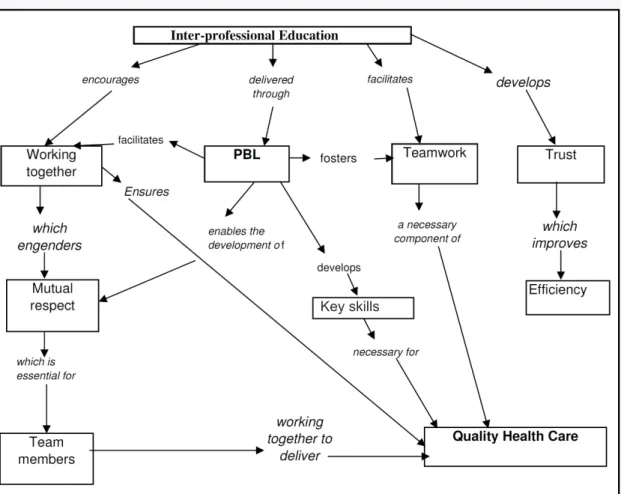
An interdisciplinary group, consisting of academic and clinical, nurses, physical therapists, radiographers, and doctors designed the problems for this module. Students from each profession were also involved, as were a number of librarians, the process was guided by an educational developer (Azer, 2007). The concepts underpinning the development of the IPE module through PBL are presented in a concept map illustrated in Figure 1 (Novak & Canas, 2006 ). The problem design group was initially given a brief introduction in rela-tion to the requirements of good problems by the education developer (Barrett & Moore, 2011). The module learning outcomes were used as the basis for problem development. The problem developers were encouraged to be as creative as possible. A matrix was de-veloped that illustrated where each of the module learning outcomes would be addressed by the problems designed for inclusion in the module thus ensuring on completion of the module that each of the module learning outcomes were achieved.
The module included five problems which addressed the following areas: personal professional identity; professional identity of each member of the multidisciplinary team (MDT); specific cases where the team members would have to work together (e.g., respira-tory, obesity); and communication of the role of team members to individuals outside the MDT. A student manual was developed outlining learning outcomes, the problem matrix by which the outcomes would be achieved, an outline of the roles of individuals in the PBL group, and the timetable for the module. A facilitator manual was developed with
identical content to the student guide together with the problems and guidelines for the tutors in relation to guiding students towards the module learning outcomes.
Module Evaluation
IPE was evaluated using two scales: (a) the Readiness for Interprofessional Learning Scale (RIPLS) ( McFadyen, Webster, Strachan, Figgins, Brown, & Kenchnie, 2005; Parsell & Bligh, 1999) and (b) the Interdisciplinary Education Perception Scale (IEPS) (Luecht, Madsen, Taugher, & Petterson, 1990; McFadyen, Maclaren, & Webster, 2007). The RIPLS is a 19 item scale where students identify their degree of agreement with statements using a five-point Likert scale ranging from “Strongly Agree” to “Strongly Disagree.” The responses are scored (strongly agree=5, agree=4, neutral=3, disagree=2, strongly disagree=1) and combined into the following subscales: Teamwork and Collaboration (items 1-9), Negative Professional Identity (items 10-12), Positive Professional Identity (items 13-16), and Roles (items 17-19). The IEPS was developed to gauge professionally orientated perceptions and related affective domains for participants in an interdisciplinary education program.
Figure 1. This concept map illustrates the ideology that underpinned the development of the IPE module through PBL.
The IEPS scale consists of twelve components whereby students identify their agreement with statements on a six-point Likert scale ranging from “Strongly Agree” to “Strongly Disagree.” The responses are scored (strongly agree=6, agree=5, somewhat agree=4, somewhat disagree=3, disagree=2, strongly disagree=1) and are combined in a prescribed manner to form the following concepts: Competency and Autonomy (items 1,3,5,7,8), Perceived Need for Cooperation (items 4 and 6), and Perception of Actual Cooperation (items 2,9,10,11,12). The validity and reliability of the RIPLS scale has been established (McFadyen et al., 2005) as has the validity and reliability of the IEPS (McFadyen et al., 2007). As this study involved evaluation of standard educational practices and the responses yielded were anonymous, it was exempt from ethical review in the institution in which the study was being undertaken.
Data Analysis
PASW version 18 (IBM, Chicago, IL 60606) was used to perform the statistical analysis. Since the data derived from the RIPLS and the IEPS are ordinal in nature, that is, students rank order their perceptions on a scale, it was considered appropriate to use nonparametric analysis and more meaningful therefore to present the medians and ranges of the data (Hicks, 2005). Initial descriptive analysis was undertaken to examine the median and range of the data. The median is the mid-score in a set of results whereby 50% of the scores lie below it and 50% above (Hicks, 2005). The Wilcoxon Signed Rank Test was used for analysis as it is designed for use with repeated measures data, as in this case, where students’ per-ceptions were measured on more than one occasion (Pallant, 2007). The Wilcoxon Signed Rank Test is the nonparametric equivalent to the repeated measures t-test, but instead of comparing means, it compares medians. During the Wilcoxon Signed Rank Test the data are converted to ranks and are compared pre and post intervention (Pallant, 2007).
Results
In total, 51 students elected to undertake the collaborative education for health profes-sionals module in the first academic session and 45 in the second. Twenty-eight students from the first cohort and 33 students from the second cohort returned completed pre and post module questionnaires.
Interprofessional Education Evaluation
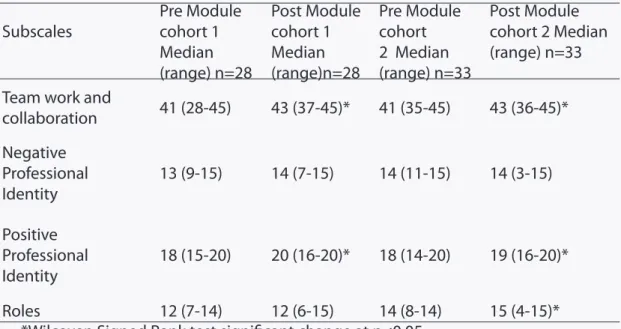
The students’ attitudes pertaining to readiness for interprofessional learning as measured by the RIPLS scores are summarized in Table 1. The Wilcoxen Signed Rank Test was used, where paired data were available for both pre and post module scores for the same in-dividual (n=28 cohort 1) and (n=33 cohort 2). In relation to the RIPLS scale the range of
potential scores in each subscale are as follows: Teamwork and Collaboration 9-45; Negative Professional Identity 3-15; Positive Professional Identity 4-20; Roles 3-15. The first subscale teamwork and collaboration, which examines students’ willingness to learn with and about other professions, improved significantly in each cohort (cohort 1: Z score=-2.67, p=0.008, r=0.52; cohort 2: Z score=-2.73, p=0.006, r=0.47). The positive professional identity sub-scale, which examines whether students have a positive predisposition toward sharing their learning with other professions, also improved significantly in each cohort (cohort 1: Z score=-2.23, p=0.027, r=0.52; cohort 2: Z score=-2.90, p=0.004, r=0.51). The second student cohort reported a significant improvement in their understanding of their own and others’ roles within the health care team (cohort 2: Z score=-3.16, p=0.002, r=0.56). While the differences observed following the module were small, they were shown to be statistically significant.The negative professional identity subscale, which examines students’ negative perceptions of interdisciplinary learning, did not change significantly in either cohort.
The student attitudes pertaining to interprofessional collaboration as measured with the IEPS are presented in Table 2. In relation to the IEPS the range of potential scores in each subscale are as follows: Competency and Autonomy 5-30; Perceived Need for Cooperation 2-12; Perception of Actual Cooperation 5-30. The first subscale pertains to the competency and autonomy of individuals in their own professions and the respect that they are shown by other professionals. Students in both cohorts reported significant improvements in their perceptions of competency and autonomy on completion of the module (cohort 1:
Table 1. The results of the Readiness for Interprofessional Learning Scale (RIPLS)
questionnaire administered prior to and following the Collaborative Education for Health Professionals module.
Subscales Pre Module cohort 1 Median (range) n=28 Post Module cohort 1 Median (range)n=28 Pre Module cohort 2 Median (range) n=33 Post Module cohort 2 Median (range) n=33 Team work and
collaboration 41 (28-45) 43 (37-45)* 41 (35-45) 43 (36-45)* Negative Professional Identity 13 (9-15) 14 (7-15) 14 (11-15) 14 (3-15) Positive Professional Identity 18 (15-20) 20 (16-20)* 18 (14-20) 19 (16-20)* Roles 12 (7-14) 12 (6-15) 14 (8-14) 15 (4-15)*
Z score=-2.17, p=0.030, r=0.42; cohort 2: Z score=-2.91, p=0.004, r=0.51). Again while the differences observed between pre and post module values were small, they were shown to be statistically significant.The third subscale examines students’ perceptions of actual interdisciplinary cooperation, and this improved significantly in the second student cohort (cohort 2: Z score=-3.12, p=0.002, r=0.55) but not in the first student cohort. Students’ perceived need for cooperation did not change significantly in either cohort.
Discussion
The results of this study establish that the baseline level of commitment and readiness for IPE was high in each student cohort at the commencement of this module. Health science students, who elected to undertake this interdisciplinary module, demonstrated significant improvements in terms of their perception of team work and collaboration and their positive professional identity. Students in the second cohort also demonstrated an improved perception in terms of their professional roles. Lindqvist et al. (2005) found that students in interdisciplinary groups developed more positive attitudes towards the different health professions than students in single discipline education. There is favorable evidence for IPE within PBL settings in terms of improving attitudes towards other profes-sional groups (Thompson, 2010). Students also demonstrated significant improvements in relation to the perceptions of autonomy and competency with students in the second cohort demonstrating improved understanding in terms of their perceptions of actual professional cooperation. Goelen, De Clercq, Huyghens, and Kerckhofs (2006) used the IEPS scale to examine change in attitudes in health care students participating in a single IPE
Table 2. The results of the Interdisciplinary Education Perception Scale (IEPS) questionnaire administered prior to and following the Collaborative Education for Health Professionals module.
Subscales Pre Module cohort 1 Median (range) n=28 Post Module cohort 1 Median (range) n=28 Pre Module cohort 2 Median (range) n=33 Post Module cohort 2 Median (range) n=33 Competency and Autonomy 25 (22-30) 27 (20-30)* 25 (20-30) 26 (20-30)*
Perceived Need for
Co-operation 11 (5-12) 11 (7-12) 10 (7-12) 11 (7-12)
Perception of Actual
Co-operation 26 (21-30) 26 (22-30) 24 (18-30) 26 (19-30)*
module, and they, too, found statistically significant improvements in students’ attitudes pertaining to the competence and autonomy of their own profession.
When considering the results of this study, it could be suggested that PBL nurtured the development of the students’ positive perceptions of teamwork and collaboration. Professional identity, too, may have increased through the small group experience, which allowed students to understand their role within the health care team more fully through discussion and independent research undertaken as part of the learning process. In a direct comparison study of IPE delivered to students from across professions the authors reported that students preferred case or PBL learning to other forms of IPE (Curran, Sharpe, Forristall, & Flynn, 2008). As a PBL tutor for the module being examined in this study, it was evident that at times, it was difficult to encourage students to believe that what they already knew was valuable and worth sharing with their colleagues (Newton & Wood, 2009). Experience of this module, however, demonstrated that group dynamics improved as the module progressed. As a facilitator, it could be observed that the PBL tutorial group itself under went a process of group formation as identified by Tuckman (2009) (i.e. forming, storming, norming, and performing) before the learning process was optimal. As Hughes and Lucas (1997) commented, the PBL process cannot just be viewed as a method of delivering curriculum. A major factor in the success of this process is that students learn the group dynamics of working together.
This IPE module may have facilitated the development of a positive professional identity by virtue of the student-centered nature of PBL. In some respects, the success of student-centered learning as a concept may be explained by self-determination theory (Lonsdale, Hodge, & Rose 2009). A central tenet of this theory is that humans have three basic psychological needs that must be satisfied if they are to experience optimal psycho-logical well-being and long-term motivation. These needs are autonomy, competence, and relatedness. Student-centered learning and in turn PBL offer control, and hence autonomy, to students in terms of determining what, when, and how they learn. Profes-sional student-centered IPE modules should stimulate the development of autonomy, responsibility, decisiveness, prioritization, competence, and relatedness as students engage in the process. Professional programs would benefit from a greater emphasis on student-centered learning within their curriculum, since it facilitates a smoother transition from student to graduate. Indeed, a more student-centered approach could bridge the theory-practice divide with which many professional programs struggle. Many of the skills fostered by engaging in student-centered learning are required by individuals in their pro-fessional lives. Nieweg (2004) commented that a competence is basically a developmental concept that demands a student-centered curriculum. Since fundamentally professional accrediting bodies are seeking the attainment of competencies, it would seem intuitive that student-centered learning is essential in a professional program.
This module appeared to encourage students to engage in independent learning outside the PBL tutorial, a skill necessary for continuing professional development. Encour-aging students to become self-directed learners who develop the skills to engage with resources is challenging. However, being a PBL facilitator relinquishing control and allow-ing students to take ownership of their learnallow-ing was initially challengallow-ing but ultimately empowering for both the student and facilitator. The participation in the PBL tutorials and the obvious advancement evidenced in terms of progression of students’ writing skills and information literacy illustrated that IPE delivered through PBL has benefits.
While it is important to examine the outcomes of this module in terms of change in students’ perceptions, it is also useful to examine what we learned in terms of developing and planning a module such as this. One positive aspect of this module was the collabo-ration that was necessary between the staff and students from different disciplines and indeed from different schools. The ultimate success of this innovation was due mainly to the generosity and positive disposition of the staff and students involved. Collaboration between the staff had to be meaningful as a tangible deliverable was required. Engaging the stakeholders in the planning process for this module was essential to its success. As Oandasan and Reeves (2005) commented, when designing a collaborative initiative, a col-laborative planning process is required whereby all stakeholders are involved. Inclusion of the librarian at each stage of the design, planning, and teaching and learning process was essential.
From a negative perspective, organization of IPE is a difficult task to achieve with numerous administrative or logistical obstacles that need to be overcome (Oandasan & Reeves, 2005). Logistically, the development of this module was difficult. Identifying suit-able timetsuit-able slots where all professional programs have a two hour slot free during the week proved challenging. A compromise was reached whereby two one hour slots per week, both of which were at lunch time, were identified. Engaging with the administrative staff responsible for timetabling each of the professional programs early in the process was important.
In terms of future planning, it is intended that the specific library skills sessions cur-rently in place will be replaced by facilitator education in relation to information literacy skills. Despite the fact that the current library skill sessions are hands-on and directly applied to the problems in the module, students continue to have problems translating the learning in these sessions into action in terms of sourcing information. By educating facilitators, it may mean that information literacy skills will be more seamlessly introduced during the module in a more appropriate, meaningful and applied manner. Issues in rela-tion to problems accessing and sourcing informarela-tion could then be easily revisited with the facilitator who is on hand.
ule elected to do so as it was not a mandatory requirement for their core programs. As students had selected the module themselves, it is safe to assume they were aware of the nature of the module as it is clearly defined in the module descriptor, which is easily ac-cessible online. If this module were to be run as a core module and therefore be a required element of a number of programs, the findings might potentially be different. However, it can be seen that even students who elected to undertake a module and were aware of the interdisciplinary nature of that module increased their readiness for IPE and their perception of interdisciplinary education. Secondly, the response to the questionnaires was poor particularly in the first student cohort. This may in part be due to the elective nature of the module that permits students to change their elective choice up to two weeks into the semester. Therefore, there may have been students present at the beginning of the module or at the end who did not complete either the initial or the final questionnaire.
While PBL is well supported in the literature, there is a body of literature that main-tains that there is no convincing evidence that PBL improves knowledge base and clinical performance (e.g. Colliver, 2000). Having undertaken a review of controlled evaluation trials of PBL in entry level therapy education it was concluded that there is currently no convincing evidence that PBL is more effective than traditional didactic education for entry level therapy professions (O’Donoghue, McMahon, Doody, Smith, & Cusack, 2011). However, there is favorable evidence that IPE within PBL can improve attitudes towards other professional groups (Thompson, 2010) but whether this will lead to improved care delivery in the future has yet to be determined. Authors of a Cochrane review, Reeves et al. (2008) concluded that due to the poor quality of the studies identified, it was difficult to ascertain the effect of IPE and to understand the key features of IPE to train health and social care professional to work together effectively. They recommended that more rigorous research strategies (i.e. randomized controlled trials) should be employed in the future in order to provide more robust evidence.
The current situation in relation to this IPE module delivered in a PBL setting is that it continues to be undertaken by a number of key enthusiasts. However, if this initiative is to be sustainable in the long term, a commitment from senior management within the Health Science Schools and the College of Health Sciences will be important. In the United Kingdom, the National Health Service (NHS), the funder of health education, strongly supports the development of multidisciplinary education, hence its rapid development within third level health science education in the UK. Perhaps a commitment to IPE by the Health Service Executive and the Department of Health and Children in Ireland will be necessary in order to incentivize the process. Otherwise, it will remain the preserve of those that have an interest but will diminish once they leave.
References
An Bord Altranais. (2005). Requirements and standards for nurse registration education
pro-grammes (3rd ed.). Retrieved December 22, 2011, from http://www.nursingboard.ie/
en/education.aspx
Azer, S. A. (2007). Twelve tips for creating trigger images for problem-based learning cases.
Medical Teacher,29(2-3), 93-97. http://dx.doi.org/10.1080/01421590701291444
Barrett, T., Cashman, D., & Moore, S. (2011). Designing problems and triggers in different media. In T. Barrett, & S. Moore, Eds., New approaches to problem-based learning revitalising your
practice in higher education (pp. 18-35). New York: Routledge.
Barrows, H. S., & Tamblyn, R. M. (1980). Problem-based learning: An approach to medical
educa-tion. New York: Springer.
Centre for the Advancement of Interprofessional Education [CAIPE]. (2011). The definition and
principles of interprofessional education. Retrieved August 9, 2011, from http://www.caipe.
org.uk/about-us/the-definition-and-principles-of-interprofessional-education/
Colliver, J. (2000). Effectiveness of problem-based learning curricula: Research and theory.
Aca-demic Medicine,75(3), 259-266. http://dx.doi.org/10.1097/00001888-200003000-00017
Curran, V. R., Sharpe, D., Flynn, K., & Button, P. (2010). A longitudinal study of the effect of an interprofessional education curriculum on student satisfaction and attitudes towards interprofessional teamwork and education. Journal of Interprofessional Care, 24(1), 41-52.
http://dx.doi.org/10.3109/13561820903011927
Curran, V. R., Sharpe, D., Forristall, J., & Flynn, K. (2008). Student satisfaction and perceptions of small group process in case-based interprofessional learning. Medical Teacher, 30(4), 431-433. http://dx.doi.org/10.1080/01421590802047323
D’Eon, M. (2005). A blueprint for interprofessional learning. Journal of Interprofessional Care, 19(1), 49-59. http://dx.doi.org/10.1080/13561820512331350227
Dolmans, H. J. M., De Grave, W., Wolfhagen, I. H. A. P., & Van der Vleuten, C. P. M. (2005). Problem-based learning: Future challenges for educational practice and research, Medical Educa-tion, 39(7), 732-741. http://dx.doi.org/10.1111/j.1365-2929.2005.02205.x
Goelen, G., De Clercq, G., Huyghens, L., & Kerckhofs, E. (2006). Measuring the effect of interpro-fessional problem-based learning on the attitudes of undergraduate health care students.
Medical Education,40(6), 555-561. http://dx.doi.org/10.1111/j.1365-2929.2006.02478.x
Hammick, M. (1998). Interprofessional education: Concept, theory and application. Journal
of Interprofessional Care,12(3), 323-332. http://dx.doi.org/10.3109/13561829809014123
Health Professions Council. (2007). Standards of proficiency: Physiotherapists. Retrieved January, 9, 2012, from http://www.hpc-uk.org/assets/documents/10000DBCStandards_of_Profi-ciency_Physiotherapists.pdf
Hicks, C. (2005). Research methods for clinical therapists. London: Churchill Livingstone. Hughes, L., & Lucas, J. (1997). An evaluation of problem based learning in the multiprofessional
education curriculum for the health professions. Journal of Interprofessional Care,11(1), 77-88. http://dx.doi.org/10.3109/13561829709040246
Lindqvist, S., Duncan, A., Shepstone, L., Watts, F., & Pearce, S. (2005). Case-based learning in cross-professional groups – the development of a pre-registration interprofessional learning programme. Journal of Interprofessional Care, 19(5), 509-520. http://dx.doi. org/10.1080/13561820500126854
Lonsdale, C., Hodge, K., & Rose, E. (2009). Athlete burnout in elite sport: A self-deter-mination perspective. Journal of Sports Sciences, 27(8), 785-795. http://dx.doi. org/10.1080/02640410902929366
Luecht, R., Madsen, M. K., Taugher, M. P., & Petterson, B. J., (1990) Assessing professional percep-tions: Design and validation of an interdisciplinary education perception scale. Journal
of Allied Health,19(2), 181-191.
McFadyen, A. K., Maclaren, W. M., & Webster V. S. (2007) The Interdisciplinary Education Percep-tion Scale (IEPS): An alternative remodelled sub-scale structure and its reliability. Journal
of Interprofessional Care,21(4), 433-443. http://dx.doi.org/10.1080/13561820701352531
McFadyen, A. K., Webster, V., Strachan, K., Figgins, E., Brown, H., & McKenchnie, J. (2005). The readiness for interprofessional learning scale: A possible more stable sub-scale model for the original version of RIPLS. Journal of Interprofessional Care,16(6), 595-603. http:// dx.doi.org/10.1080/13561820500430157
Medical Council. Good professional practice. Retrieved January, 9, 2012, from http://www. medicalcouncil.ie/Information-for-Doctors/Good-Professional-Practice
Menahem, S., & Paget, N. (1990). Role play for the clinical tutor: Towards problem-based learn-ing. Medical Teacher, 12(1), 57-61. http://dx.doi.org/10.3109/01421599009010562
Merriam, S. B., Caffarella, R. S., & Baumgartner, L. M., (2007) Learning in adulthood: A
compre-hensive guide (3rd Ed.). San Francisco: Jossey-Bass.
Newton , C., & Wood, V. (2009) Reflections on facilitating an interprofessional problem-based learning module. Journal of Interprofessional Care,23(6), 672-675. http://dx.doi. org/10.3109/13561820802634852
Nieweg, M. R. (2004). Case study: Innovative assessment and curriculum design.
Assessment and Evaluation in Higher Education, 29(2), 203-214. http://dx.doi.
org/10.1080/0260293042000188474
Novak, J. D., & Canas, A. J. (2006). The theory underlying concept maps and how to construct and
use them (Florida Institute for Human and Machine Cognition Technical Report No.
2006-01). Retrieved August 11, 2011, from http://cmap.ihmc.us/publications/researchpapers/ theorycmaps/theoryunderlyingconceptmaps.htm
Nummenmaa, A. R., & Karila, K. (2006). Collaborative planning in a multi-professional day care centre. In E. Poikela & A. R. Nummenmaa (Ed.), Understanding problem-based learning (pp. 209-223). Tampere, Finland: Tampere University Press.
Oandasan, I., & Reeves, S. (2005). Key elements of interprofessional education. Part 2: Factors, processes and outcomes. Journal of Interprofessional Care, 19(Supplement 1), 39-48.
http://dx.doi.org/10.1080/13561820500081703
O’Donoghue, G., McMahon, S., Doody, C., Smith, K., & Cusack, T. (2011) Problem-based learning in professional entry-level therapy education: A review of controlled evaluation studies.
Pallant, J. (2007). SPSS survival manual: A step-by-step guide to data analysis using SPSS for Win-dows (3rd ed.). New York: McGraw Hill.
Parsell, G., & Bligh, J. (1999). The development of a questionnaire to assess the readiness of health care students for interprofessional learning (RIPLS). Medical Education,33(2), 95-100. http://dx.doi.org/10.1046/j.1365-2923.1999.00298.x
Pullon, S. (2008). Competence, respect and trust: Key features of successful interprofessional nurse-doctor relationships Journal of Interprofessional Care, 22(2), 133-147. http://dx.doi. org/10.1080/13561820701795069
Reeves, S., Zwarenstein, M., Goldman. J., Barr, H., Freeth, D., Hammick, M., & Koppel, I. (2008). Interprofessional education: effects on professional practice and health care outcomes. Cochrane Database of Systematic Reviews, Issue 1. http://dx.doi.org/10.1002/14651858. CD002213.pub2
Savin-Baden, M. (2003). Facilitating problem-based learning illuminating perspectives. London: Open University Press.
Society of Radiographers. (2009). Education accreditation. Retrieved on January 9, 2012 from http://www.sor.org/learning/education-accreditation
Thompson, C. (2010) Curriculum: Do interprofessional education and problem-based learn-ing work together? The Clinical Teacher, 7(3), 197-201. http://dx.doi.org/10.1111/j.1743-498X.2010.00381.x
Tuckman, B. (2009). Forming storming norming performing model.
Retrieved August 12, 2011, from http://www.businessballs.com/tuckmanformingstorming-normingperforming.htm
Wood, D. F. (2003). ABC of learning and teaching in medicine: Problem based learning. BMJ,
326, 328-331. http://dx.doi.org/10.1136/bmj.326.7384.328
Tara Cusack is a physiotherapist and lecturer in Physiotherapy in the Department of Physiotherapy,
UCD School of Public Health, Physiotherapy & Population Science, University College Dublin, Ireland. Correspondence concerning this article should be addressed to Tara Cusack, UCD School of Public Health, Physiotherapy and Population Science, Health Sciences Centre, University College Dublin, Belfield, Dublin 4, Ireland; E-mail: [email protected].
Grainne O’Donoghue is a physiotherapist and research associate in the Department of Physiotherapy,
UCD School of Public Health, Physiotherapy & Population Science, University College Dublin, Ireland.
Marie-Louise Butler is a radiographer and lecturer in Diagnostic Imaging in the Department of
Diag-nostic Imaging, UCD School of Medicine & Medical Science, University College Dublin, Ireland.
Catherine Blake is a physiotherapist and a senior lecturerin Physiotherapy in the Department of
Physiotherapy, UCD School of Public Health, Physiotherapy & Population Science, University College Dublin, Ireland.
Cliona O’Sullivan is a physiotherapist and lecturer in Physiotherapy in the Department of Physiotherapy, UCD School of Public Health, Physiotherapy & Population Science, University College Dublin, Ireland.
Kathryn Smith is deputy head of Library Academic Services, UCD Library, University College Dublin,
Ireland.
Ann Sheridan is a nurse and a lecturer in Nursing in the UCD School of Nursing, Midwifery & Health Systems, University College Dublin, Ireland.
Geraldine O’Neill is an occupational therapist and senior lecturer in Educational Development, UCD