Public Access Theses and Dissertations from
the College of Education and Human Sciences Education and Human Sciences, College of (CEHS) Fall 10-4-2019
The Protective Influence of Self-Compassion Against Internalized
The Protective Influence of Self-Compassion Against Internalized
Racism Among African Americans
Racism Among African Americans
Alexandra EmeryUniversity of Nebraska - Lincoln, [email protected]
Follow this and additional works at: https://digitalcommons.unl.edu/cehsdiss
Part of the Counseling Psychology Commons, Education Commons, and the Race and Ethnicity Commons
Emery, Alexandra, "The Protective Influence of Self-Compassion Against Internalized Racism Among African Americans" (2019). Public Access Theses and Dissertations from the College of Education and Human Sciences. 359.
https://digitalcommons.unl.edu/cehsdiss/359
This Article is brought to you for free and open access by the Education and Human Sciences, College of (CEHS) at DigitalCommons@University of Nebraska - Lincoln. It has been accepted for inclusion in Public Access Theses and Dissertations from the College of Education and Human Sciences by an authorized administrator of
THE PROTECTIVE INFLUENCE OF SELF-COMPASSION AGAINST INTERNALIZED RACISM AMONG AFRICAN AMERICANS
by
Alexandra D. Emery
A DISSERTATION
Presented to the Faculty of
The Graduate College at the University of Nebraska In Partial Fulfillment of Requirements
For the Degree of Doctor of Philosophy
Major: Psychological Studies in Education
(Counseling Psychology)
Under the Supervision of Professor Michael J. Scheel
Lincoln, Nebraska October, 2019
THE PROTECTIVE INFLUENCE OF SELF-COMPASSION AGAINST INTERNALIZED RACISM AMONG AFRICAN AMERICANS
Alexandra Kristine Dahl Emery, Ph.D. University of Nebraska, 2020 Advisor: Michael J. Scheel
Racist experiences and internalized racism may lead to poorer mental health outcomes for African Americans born and socialized in the United States (Graham, West, Martinez & Roemer, 2016; Mouzon & McLean, 2017). Self-compassion has been shown to protect against poor mental health outcomes, but limited research exists with respect to African Americans specifically (Lockard, Hayes, Neff and Locke, 2014). The present study explored whether self-compassion could serve as a protective factor between the relations of internalized racism and racist experiences, and the negative mental health outcomes of anxiety, depression, and stress among (N = 230) African American adults. To examine these relations, structural equation modeling was utilized to determine the best fit for the data. Though both internalized racism and racist experiences negatively predicted self-compassion, racist experiences failed to predict anxiety, depression, and stress, while internalized racism did positively predict these mental health outcomes. Self-compassion also was found to negatively predict anxiety, depression, and stress. Further analysis of fit statistics suggested that the model excluding racist experiences demonstrated best model fit. Ultimately, it was found self-compassion moderated the relation between internalized racism, and anxiety, depression and stress.
ACKNOWLEDGEMENTS
As I reflect on my six years as a graduate student at the University of Nebraska-Lincoln, I would like to begin with thanking my entire UNL Counseling Psychology faculty and community, who have each in their own way shaped who I have become as a person, researcher, and practitioner. I am in awe of the dedication it takes to be a well-informed, compassionate, incredibly hardworking counseling psychologists and
psychologists–in-training. I consider myself fortunate to have such an amazing group of respected colleagues and friends in my corner.
To my advisor, Dr. Michael J. Scheel for your unwavering support and
encouragement. Thank you for seeing and believing in me far before I believed in myself. You reflected my strengths back to me in ways that allowed me to develop the belief that I really could do this. I cannot thank you enough for your mentorship, wisdom, and care.
Thank you to my dissertation committee, Dr. Neeta Kantamneni, Dr. Eric Buhs and Dr. Gilbert Parra, I so appreciate your guidance, insight and encouragement. To my peers, Kendal Cassidy, Jamie Porter, Wesley Kobashigawa, Shantel Gassman, Lequisha Sims, Madeline Hunsicker, and my Health Center family, Kirsten Licht and Jamie Porter, you have provided so much camaraderie, joy, and comfort along the way. My past
supervisors and current mentors and friends, Dr. Lindsey Sherd, Dr. Tina Hoffman, and Dr. Jennifer Peter, I cherish all you have taught me. To Kendal Cassidy and Matthew Miller, I feel so incredibly fortunate to have found family in Nebraska, and that we get to realize our dream in Washington!
Thank you to my amazing community of family and friends outside of Nebraska. My dear childhood friends, Ashley Long and Amanda Houser, your understanding,
encouragement, and love has meant the world. My college friends, Nick Andrews (and family), and Scott and Lori Splett, you have brought much needed laughter and reprieve. To my Chelan family, with special acknowledgement to Kristin Abraham who served as my much appreciated editor. To my incredible internship cohort, Megan Martinez and Kendal Cassidy, who are equally impressive as people as they are future psychologists.
A huge thank you to my family, and the many loved ones I am grateful to be surrounded. My parents, Christina, Michael, Keith and Julie, who have laid the
groundwork and safety for me to explore who I was meant to be. To my siblings, Tate, Jackson, and Kayla, I cherish the irreplaceable relationships we each hold. To my aunts who have been there since the very beginning, Ginger and Lynette, and my cousins who feel so much more like sisters, Allissa and Alexis, and every person that has filled our ever-expanding family since, thank you for all that you are, and all you have pushed me to be. To my grandparents, Chery, Bob, Karin, Edgar, Judy and Dale, for always cheering me on. To my great Aunt Linda, who never lets me forget how amazing I am in her eyes, which only further solidifies how amazing she is in mine. To my Emery family, who have provided an abundance of love, reinforcement, and family jokes, since I was a sophomore in college, Amy, George and Celine.
Thank you to Finn and Zooey, who have brought both comfort and chaos to my years in graduate education. Finally, I would like to especially thank my incredible partner in life, Kolton. You continuously see the best in me, and encourage me to see the best in myself. I cannot count the number of times you helped me to keep going even when I really did not think I could. Your support, reassurance, care, and love have been truly unparalleled. I most certainly would not have accomplished this if it were not for you.
Table of Contents
Chapter 1: Introduction 5
Racism Toward African Americans 5
African Americans, Racism and Mental Health 6
Tripartite Model of Racism 7
African Americans and Internalized Racism 8
Self-Compassion 9
A Note on Terminology 12
The Study 12
Chapter 2: Literature Review 17
Racism Toward African Americans 17
African Americans, Racism and Mental Health 21 Tripartite Model of Racism Theory 24 African Americans and Internalized Racism 26
Self-Compassion 37
Self-Compassion and Mental Health 41 Self-Compassion, Mental Health and Group Differences 44 Self-Compassion, Mental Health and African Americans 47 Self-Compassion and Internalized Racism 49
Chapter 3: Methodology 51
Procedures 53
Measures 55
Analyses 59
Chapter 4: Results 65 Data Analysis 65 Measurement Model 66 Moderation Model 69 Hypotheses 71 Conclusion 73 Chapter 5: Discussion 76 Overview of Results 76 Measurement Model 77
Structural Model and Moderation Effects 77
Implications for Practice 83
Implications for Research 85
Limitations and Future Directions in Research 87
Conclusion 92
References 87
Chapter 1: Introduction
Racism and its damaging consequences on the physical and mental health of the oppressed has been a longstanding topic of research interest (Paradies, 2006). In the United States, African Americans experience racism (e.g., discrimination; prejudice; marginalization) more than any other racial group (Pieterse, Todd, Neville & Carter, 2012). Thus, the impacts of racism may be especially damaging to African Americans, specifically with respect to the enduring mistreatment of African Americans within the United States, beginning with the transatlantic slave trade and permeating into current policy, access to resources, and general treatment (Hill, 2002). These experiences may infiltrate an individual’s sense of self, which may lead to developing beliefs about the self that are derogatory and destructive, therefore creating a sense of internalized racism (Pyke, 2010).
Racism Toward African Americans
While about half of white Americans endorse the belief that racism is an issue of the past, or at least only occurs in extreme cases (Pew Research Center, 2017b), research on racism contradicts these viewpoints. Many Americans still believe that African Americans are unintelligent, prefer to live off of welfare support, are lazy, and are inclined toward violence (Williams & Williams-Morris, 2000). When defending the assertion that racial issues are issues of the past, some may point to the election of President Barack Obama as an indication of how much views toward race have changed (Schmidt & Axt, 2016). Research on this topic demonstrates while many Americans do have positive views toward President Obama, views toward African Americans have not changed in light of his presidency. (Schmidt & Axt, 2016) Conversely, these views have
actually gotten worse, with negative beliefs toward African Americans increasing at the end of his presidency compared to the beginning (Schmidt & Axt, 2016). This
discrepancy may be indicative of the tendency of many Americans to disassociate President Obama from the Black community, as he does not fit the negative stereotypes perpetuated about Black people, as opposed to shifting those negative views to positive views of Black Americans as a whole (Schmidt & Axt, 2016). Since the 2016 presidential election, racist messaging, threats, and hate crimes have increased dramatically,
suggesting that racism toward minority groups is once again becoming more overt and emboldened (Reilly, 2016).
African Americans, Racism and Mental Health
There is evidence to support that African Americans experience more significant amounts of racism than any other minority group (Pieterse et al., 2012). Experiencing racism has been associated with negative physical and mental health consequences across a large body of research on African American populations (Paradies, 2006). These
negative health issues include cardiovascular disease (Pascoe & Smart Richman, 2009), elevated blood pressure and hypertension (Brondolo, Love, Rencille, Schoenthaler & Ogedegbe, 2011), poor birth outcomes (Giscome & Lobel, 2005), and heart strain (Hoggard, Hill, Gray & Sellers, 2015) as well as substance abuse, depression, anxiety, and stress (Paradies, 2006). African Americans subjected to racism more frequently have been found to experience increased severity in mental illness such as anxiety and
depression, suggesting a cumulative effect of racism on mental health (Pieterse et al., 2012; Wheaton, Thomas, Roman & Abdou, 2017).
Tripartite Model of Racism
Jones (2000) put forth a theory that describes how racism causes damage at three different levels. First, institutionalized racism occurs when systems of oppression
disallow individuals from accessing the same resources available to those of the dominant race. These resources include access to housing, education, medical treatment, and
gainful employment. Additionally, institutionalized racism also impacts power, as it limits the oppressed from gaining power through suppressing voting rights, fair
representation in the media, and access to an accurate account of history. The oppressor in this type of racism is the government, and other regulating bodies. A salient example of institutionalized racism is the U.S. prison system, where African Americans are incarcerated at five times the rate of white individuals, and receive harsher sentences for the same crime (NAACP, 2018). Namely, though African Americans and white
Americans use illicit drugs similarly, African Americans are imprisoned at a rate of six times more than white Americans for illicit drug use (NAACP, 2018). Having been incarcerated also serves to impact access to power and subsequent quality of life after the sentence has been served, through prohibiting voting rights and access to gainful
employment (NAACP, 2018). The second type of racism in Jones’ theory is personally mediated racism, which is what individuals usually think of when they hear the term “racism.” Personally mediated racism occurs when minority groups are subjected to discriminatory comments or behaviors from members of the dominant group. Finally, internalized racism is the last, and as Jones argues, the least understood level of this model. Internalized racism occurs when individuals begin to accept and thus internalize the prejudicial beliefs and biases about themselves that have been perpetuated by the
majority. As internalized racism includes beliefs about one’s own worth, especially in comparison to the dominant culture (e.g., whiteness), individuals may tend to experience self-devaluation as a mechanism of internalized racism (Jones, 2000). Jones provides an intriguing analogy of a garden when detailing her proposed three-part model to racism, which will be explored in further detail in Chapter 2.
African Americans and Internalized Racism
Internalized racism is a topic that has gained attention through theory
development, but research on this topic is still in its infancy (Jones, 2000; Pyke; 2010). Preliminary research has found that Black individuals living in the United States may experience internalized racism at greater intensity than Black individuals who do not live in the United States, and as consequence, may experience more negative mental health outcomes, such as anxiety and depression (Mouzon & McLean, 2017). Some researchers even found evidence to support that internalized racism may be one of the underlying mechanisms contributing to anxiety, depression and overall psychological distress among African Americans (Graham et al., 2016). Theorists have called for counseling
psychologists in research and practice to dedicate more attention to internalized racism in Black Americans, especially with respect to mitigating these negative consequences (Speight, 2007).
Previous researchers have attempted to better understand factors that contribute to internalized racism (Bailey, Chung, Williams, Singh & Terrell, 2011). Most theories about internalized racism include the internalization of white stereotypes about Black people and self-hatred as the two main underlying mechanisms (Bailey et al., 2011). While these two mechanisms have repeatedly been demonstrated to contribute to
experiences of internalized racism, some researchers have put forth, and found support for the additional mechanisms of accepting a biased representation of one’s own history, and the alteration of physical appearance and hair (Bailey et al., 2011). To date, these mechanisms taken together provide the most complete picture of internalized racism (Bailey et al., 2011).
Self-Compassion
Self-compassion is a three-part strategy designed to help individuals to cope with life’s inevitable hardships, failures, and sufferings (Neff, 2003b). Self-compassion promotes the notion that all individuals face struggles, regardless of why those struggles occur (e.g., intrapersonal issues, interpersonal issues, environmental issues). While it is the tendency of many to self-blame and ruminate on life’s struggles, self-compassion entails treating oneself with kindness, especially in times of difficulty. There is evidence that self-compassion is more effective at alleviating mental health issues such as anxiety and depression, and promoting greater satisfaction with life, over and above many popular theories or practices in psychology. For example, research supports that compassion provides greater mental health benefits than esteem (Neff, 2003b), self-evaluation (Neff et al., 2008), self-worth gained through external validation or religious sources (Zhang et al., 2018), support groups (Johnson et al., 2017), and using
mindfulness alone (Van Dam, Seppard, Forsyth & Earleywine, 2011).
The three components of self-compassion include self-kindness, mindfulness, and common humanity. This model designates the three components that lead to
self-compassion, as well as components indicating lack of self-compassion. Self-kindness involves accepting shortcomings and struggle as a part of the human condition, as
opposed to the opposite of self-kindness, self-judgment, which involves using self-critical and demeaning talk in response to difficulty. Mindfulness is the practice of
non-judgmentally experiencing and acknowledging emotions as they occur and accepting those emotions as they are, as opposed to over-identifying with negative emotions or ruminating on challenging events as indicators of one’s own worth. Finally, common humanity refers to the practice of reaching out to others and seeking connection in times of struggle, as opposed to self-isolating or turning away from supportive others due to feelings of shame or worthlessness (Neff, 2003b).
Self-compassion has been promoted within counseling psychology literature and practice as an adaptive way to regard the self (Neff, 2003; Neff, 2011). The use of self-compassion has been demonstrated to improve satisfaction with life and overall reports of well-being, and decrease mental health issues such as anxiety and depression (Bluth & Blanton, 2013; Hope, Koestner & Milyavskaya, 2014; Smeets, Neff, Alberts & Peters, 2014). While the research on self-compassion with respect to minority identities is limited, especially with African Americans, initial studies among other racial minority identities boast promising outcomes (Birkett, 2013; Edwards, Adams, Waldo, Hadfield & Biegel, 2014), highlighting the need for future research (Lockard et al., 2014).
Within the last year, research has begun to explore self-compassion as a tool to alleviate symptoms of psychopathology for African Americans. In a 2018 study, Zhang et al. found that self-compassion mediated the relations between shame and depressive symptoms, suggesting that self-compassion could help to mitigate this relationship. Zhang et al. (2018) maintain that as shame is oftentimes a consequence of oppression, self-compassion may be uniquely able to help African Americans experience less mental
health issues that have developed as a result of their oppressive experiences. In an intervention-based study, African Americans participating in a compassion-based six-week group reported greater reductions in self-criticism and depression than those who participated in a six-week support group (Johnson et al., 2017). These studies provide promising support for the notion that the use of self-compassion can help to alleviate psychological issues amongst African Americans (Johnson et al., 2017; Zhang et al., 2018).
As African Americans have been subjected to intense racism and hatred by the dominant majority, theorists have argued that these messages about race may become internalized, through accepting negative beliefs, prejudicial attitudes and stereotypical tropes into their own sense of self (Pyke, 2010). The internalization of these beliefs may lead to individuals to experience self-criticism, self-doubt, and disgust (Pyke, 2010). As self-compassion and internalized racism are both theories pertaining to how individuals regard themselves, self-compassion, a positive self-attitude, may serve to combat or replace internalized racism, a negative attitude. Within the framework of compassion, theories of internalized racism mimic many indicators of lack of self-compassion. Self-critical judgment about one’s own worth due to negative racial stereotypes (Pyke, 2010) fits within the notion that lack of self-kindness (self-criticism) contributes toward mental illness (Neff, 2011). Additionally, African Americans may over-identify with negative beliefs about themselves, leading to internalization (Pyke, 2010), which fits within the second indicator of lack self-compassion, over-identification as opposed to practicing mindfulness (Neff, 2011). Finally, those experiencing
strategy to distance themselves from negative stereotypes (Pyke, 2010), which is similar to the self-compassion concept engaging in self-isolation rather than seeking common humanity with others (Neff, 2011).
A Note on Terminology
For the purpose of this research, the terms “Black” and “African American” will be used interchangeably to refer to individuals of African descent. The reasons for using these terms interchangeably are two-fold. Primarily, in an effort to maintain the diction that the respective study used in reference to individuals of African descent when citing literature. Additionally, they are used interchangeably in an effort to represent all individuals who may fall into these categories, and their preferences. In a 2005 study, Sigelman, Tuch and Martin found that individuals were divided almost exactly equally in terms of their preference for the term Black versus the term African American to describe their racial identity. Therefore, both terms will be used in this study.
The Study
As internalized racism and self-compassion both serve as ways that an individual regards themselves in relation to their environment, compassion may act as a self-regarding strategy to replace internalized racism. Specifically, while internalized racism can lead to self-criticism, over-identification with negative stereotypes, and distancing the self from other members of the same race as a strategy to alleviate the pain caused by experiencing racism (Pyke, 2010), self-compassion seeks to alleviate struggle and hurt through promoting the use of self-kindness, mindfulness over feelings experienced, and common-humanity or connection with others (Neff, 2011). Theories such as Jones (2000) posit that internalized racism occurs, at least in part, as a function of devaluing the self.
Pyke (2010) further argues that internalized racism occurs as a function of self-devaluation, as well as identification with negative beliefs and distancing self from others. As self-compassion serves as a strategy for increasing self-kindness, mindfulness, and common humanity (Neff, 2003b), it may be uniquely able to challenge some of the internalization that occurs as a product of racism.
Moreover, self-compassion has been demonstrated as a tool to alleviate mental illnesses such as anxiety and depression (Bluth & Blanton, 2013; Hope et al., 2014; Smeets et al., 2014). In contrast, internalized racism has been demonstrated to contribute toward anxiety and depression (Graham et al., 2016; Mouzon & McLean, 2017). Thus, self-compassion may be a strategy that African Americans could use in order to reduce internalized racism, and thus experience the protective mental health benefits of self-compassion through the reduction of mental health issues (e.g., anxiety and depression). The following research serves to explore current issues in racism, internalized racism, and self-compassion, and whether self-compassion can buffer the relations between racist experiences, internalized racism and negative mental health outcomes (e.g., anxiety, depression, and stress) in African American adults through utilizing a positive self-attitude (self-compassion) instead of a negative self-self-attitude (internalized racism).
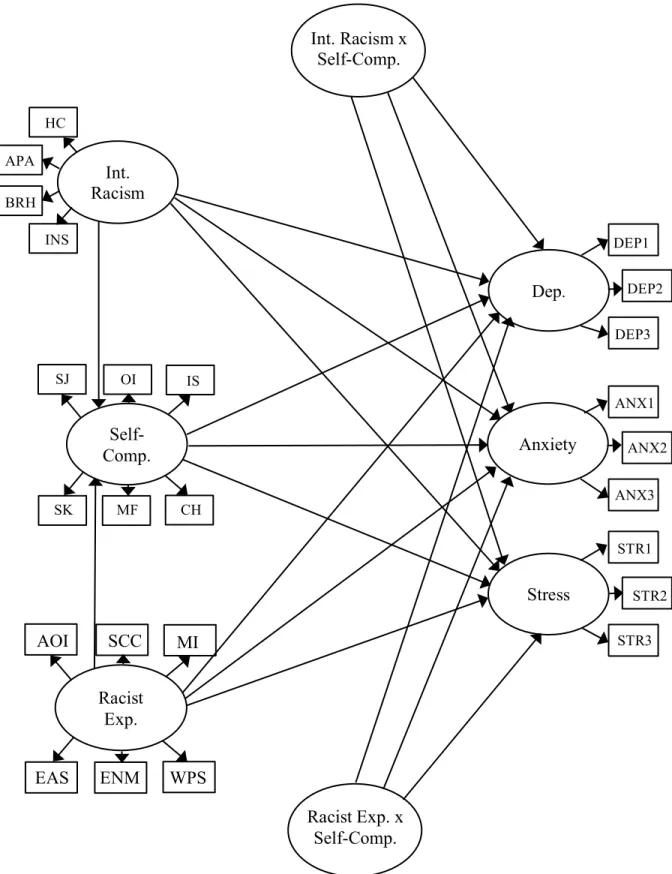
Structural equation modeling was utilized to explore these relations as well as an overall fit of the model. The following research questions will function as guides to this work: (a) Does experiencing racism and internalized racism predict self-compassion among African Americans? (b) Does self-compassion provide protection (reduction in symptoms) against the anxiety, depression, and stress triggered by racist experiences and
internalized racism among African Americans? A detailed description of the model, hypotheses and analyses will be provided in Chapter 3.
15
Figure 1. Structural equation model hypothesized path relations.
Anxiety HC APA BRH INS Int. Racism Stress Dep. DEP1 DEP2 DEP3 ANX1 ANX2 ANX3 STR3 STR2 STR1 Self- Comp. SJ OI IS SK MF CH Int. Racism x Self-Comp. Racist Exp. AOI SCC MI N EAS ENM WPS Racist Exp. x Self-Comp.
This study may address several gaps in the current literature. First, as several researchers (Jones, 2000; Pyke; 2010; Speight, 2007), have noted a lack of literature exploring the detrimental effects of internalized racism for African Americans, and this research serves to add to this body of literature by measuring how internalized racism is related to anxiety, depression, and stress. Additionally, there has been a lack of self-compassion research with respect to its use among minority populations in the United States, especially African Americans (Zhang et al., 2018), and this research will explore if self-compassion provides useful benefits to African Americans. Finally, it is the goal of this research to provide support for a free, time-efficient, and easily accessible strategy (Neff, 2011) to aid in the protection against mental health issues due to the lasting impacts of racism, through the use of self-compassion.
This chapter provided a brief overview of the research problem and issues related to this problem that will be explored in this study. Chapter 2 will serve as a detailed review of the relevant literature with respect to African Americans, theories of racism, internalized racism, self-compassion, and mental health outcomes such as anxiety and depression. Chapter 3 will detail issues related to conducting the study, including
hypotheses, methods, participants, and procedures. After data collection and analysis are completed, Chapter 4 will consist of results found in the study. Finally, Chapter 5 will serve as a discussion of these results, as well as potential implications, limitations, and recommendations for future research.
Chapter 2: Literature Review Racism Toward African Americans
The term racism refers to a systemic and organized sociopolitical structure that privileges and oppresses individuals depending on the color of their skin (Williams & Williams-Morris, 2000). Skin color has been categorized in ways that has systematically ranked some groups of individuals as lesser than others. In the United States, white Americans have experienced privilege in this system, while people of color have
experienced oppression (Williams & Williams-Morris, 2000). Subsequently, members of oppressed racial groups are likely to experience discrimination, or differential treatment both individually and institutionally (Williams & Williams-Morris, 2000). Additionally, people of color are likely to be subject to prejudicial beliefs about them or their abilities due solely to the color of their skin (Williams & Williams-Morris, 2000). The negative consequences of discrimination, prejudice, and oppression are devastating to all who experience them, but are uniquely devastating for Black or African Americans. (Williams & Williams-Morris, 2000).
In a critical work, Winant (2015) discusses how race and racism were
institutionalized, perpetuated, and maintained in the United States. Winant asserts that the concept of race grew out of the social and political desire to achieve power through enslaving and obtaining property (2015). During the transatlantic slave trade, property was considered to be both land and people, through enslaving Africans, and bringing them to the United States for sale. He further argues that this system ultimately created a complex “colorblind” divide between free people and the enslaved, the oppressor and the oppressed. In order to maintain or perhaps to rationalize this divide, theories about
biological differences between races rose out of what was once understood to be a social construct. Many renowned scientists and theorists (e.g., Galton) even joined the
rationalization of slavery and oppression, through generating theories that the racial system was that of “commonsense” as it mimicked the natural order, with slavery and conquest being viewed as more advanced and rational systems, as opposed to other, less hierarchical societies. Although many believe that issues of race and racism are issues of the past, Winant (2015) argues that issues such as race and racism are very much present within modern society, and this presence can be seen through the institutionalization of policies and procedures that further perpetuate the notion that it is commonsense to function within a political system that now claims a colorblind approach to race. Winant (2015) concludes that due to the convoluted and devastating ways that race was
constructed in the United States, ignoring issues of race using a colorblind, non-racial or post-racial approach will not work toward the goal of undoing the horrors the United States has inflicted upon those it has actively oppressed.
As evidence of how these beliefs perpetuate with respect to Black Americans, Williams and Williams-Morris (2000) report that in a 1990 General Social Survey (GGS), 29% of white Americans viewed Black Americans as unintelligent, 44%
endorsed beliefs that Black Americans are lazy, 56% believed Black Americans preferred living off of welfare support, and 51% reported Black Americans are inclined toward violence. When reviewing these statistics, it may be arguable that while some white Americans endorse these negative stereotypes, most white Americans believe the
opposite to be true (e.g., if 29% view Black Americans as unintelligent, 71% view Black Americans as intelligent). However, these reports were not so dichotomous, as only 20%
of white Americans viewed Black Americans as intelligent, 17% reported Black
Americans as hardworking, 13% endorsed beliefs that Black Americans prefer to support themselves financially, and 15% reported most Black Americans were not inclined toward violence. These findings seem to indicate that even when the majority of white Americans do not explicitly express negative beliefs, positive attributions toward Black Americans are also not readily endorsed (Williams & Williams-Morris, 2000).
To further this point, when comparing how white Americans view themselves in relation to Black Americans, white Americans were five times more likely to endorse the belief that Black Americans were unintelligent, nine times more likely to report Black Americans were lazy, 15 times more likely to report Black Americans prefer living off of the welfare system, and three times more likely to state Black Americans are inclined toward violent acts. Also important to note is that in comparison to other racial minority groups (e.g., Asian, Hispanic) African Americans were regarded the most negatively (Williams & Williams-Morris, 2000).
In the current sociopolitical climate, many may argue that attitudes toward
African Americans have greatly shifted, as evidenced by the election of President Barack Obama. While the “that was then, and this is now” rhetoric may seem enticing, research on racial attitudes does not support this assertion. In a large-scale study asking
participants to complete an Implicit Association Task on race and complete a survey about their explicit attitudes toward race, (N = 2,289,776) and another Implicit
Association Task on presidents (N = 219,170), researchers found an overall preference for white Americans to African Americans on both implicit and explicit measures (Schmidt & Axt, 2016). Researchers found that this tendency to prefer white Americans
to African Americans remained consistent throughout Barack Obama’s presidency, as data was collected from January 2009 to December 2015, capturing nearly seven years of his presidency (Schmidt & Axt, 2016). Negative attitudes toward black Americans were found to actually have increased over time, and were consistent despite race or political affiliation of the participant (Schmidt & Axt, 2016). Interestingly, both Black and white participants showed preference for President Obama as compared to other presidents, with Black participants demonstrating a strong preference, and white participants indicating a slight preference (Schmidt & Axt, 2016). Additionally, positive attitudes toward Barack Obama were only weakly associated to positive attitudes toward Black people universally (Schmidt & Axt, 2016). Schmidt and Axt (2016) posit that perhaps Barack Obama’s presidency did not alter negative racial attitudes toward Black
Americans because the general population may not view Barack Obama as representative of Black Americans as a whole. For example, some Americans may view Barack Obama as an exemplar, distancing him from their more negative beliefs about Black individuals. Alternatively, some Americans may not even view Barack Obama as African American at all, labeling him as “mixed race” as opposed to Black or African American (Pew Research Center, 2010). Finally, Schmidt and Axt (2016) argue that the while implicit and explicit biases are changeable, the U.S. population as a whole may not yet reflect those changes with respect to race.
Since the 2016 presidential election, racial issues in the United States have once again become more overt (Pettigrew, 2017). Now President Donald Trump campaigned off of opposing nearly everything former President Barack Obama instituted (Pettigrew, 2017). Those in support of President Trump have been found to hold strong racist
attitudes (Van Assche & Pettigrew, 2016). There is even evidence to suggest that pre-election reporting that minority voters were going to vote for opposing democratic candidate Hillary Clinton encouraged more voters in support of President Trump to go out and vote (Pettigrew, 2017). Following the election of Donald Trump, racist
messaging (e.g., graffiti), threats, and hate crimes have risen abruptly (Reilly, 2016). In sum, in the current sociopolitical climate, race tensions are high, and racist-related events are on the rise.
In spite of compelling research, major events, and personal accounts that state otherwise, the notion that Black Americans do not experience unjust prejudice or
discrimination persists. Recent research suggests that 81% of Black Americans report the belief that Black Americans experience racism in the United States, while only 52% of white Americans endorse this belief (Pew Research Center, 2017b). Furthermore, a poll on racial discrimination elucidated that 49% of Americans believe that Black Americans cannot “get ahead” in the United States are mainly responsible for their own situation (Pew Research Center, 2017a). While 84% of Black Americans believe that people do not see discrimination where it exists, only 49% of white Americans espouse this view (Pew Research Center, 2017a). This research suggests that incongruencies persist between the ways that Black Americans experience racism or discrimination, and the tendency of white Americans to endorse this experience as legitimate.
African Americans, Racism and Mental Health
Experiencing racism can have devastating impacts on mental and physical health. In a meta-analysis of 138 quantitative studies with respect to racism and health, Paradies (2006) found that subjective racist experiences were positively associated with negative
mental health outcomes (e.g., depression, emotional distress, stress) and negative health-related behaviors (e.g., substance abuse). Of note, 69% of the participants in these studies were African American, suggesting that when studying the impacts of racism, African Americans are often a target population (Paradies, 2006).
When racism is experienced continuously throughout the lifespan, the negative consequences of such oppression can take a cumulative effect. Wheaton, Thomas, Roman and Abdou (2017) found that African American men (N = 296) were more likely to report greatest depressive symptomology when they endorsed experiencing everyday
discrimination such as being followed around a store, being neglected at a restaurant or other service-related venue, or being the recipient of slights and insulting remarks, and major discrimination, such as reduced access to opportunities in employment, housing, the criminal justice system, and other access to resources. Researchers found that while the type of discrimination did impact depressive symptomology dependent on the age of the participant, everyday discrimination more strongly predicted depression across the lifespan (Wheaton et al., 2017). These findings seem to suggest that discrimination that is experienced on a personal-level through everyday racist experiences, may be experienced differently than discrimination experienced from systemic avenues, and thus more greatly impact the likelihood of experiencing depressive symptoms (Wheaton et al., 2017).
Given both the historical mistreatment of African Americans and the current sociopolitical climate in the United States, effective prevention and intervention strategies are needed to address the negative consequences that result from racist experiences among African American individuals and communities. In a meta-analytic review of racism and mental health, Pieterse et al. (2012) found that across 66 studies
with Black American participants, experiences of perceived racism were positively associated with psychological distress (e.g., anxiety or depression). Pieterse and colleagues also highlight that Black Americans report experiencing higher amounts of racism than any other racial minority group in the United States (2012). Furthermore, researchers found that individuals who reported higher racist experiences in both rate of exposure and stress of the exposure, were more likely to report psychological distress. Authors also found a stronger effect for these experiences of psychological distress (through the reporting of psychiatric symptoms), and experiences of overall stress than those effects of factors such as life satisfaction or self-esteem. These findings provide evidence for both the pervasiveness and devastating effects of racist experiences on mental health, especially for Black Americans (Pieterse et al., 2012).
As mental health and physical health are interconnected, it is also important to understand the vast toll experiencing racism takes on physical health. A large body of literature has demonstrated that for African Americans, experiencing racism has been associated with risk for cardiovascular disease (Pascoe & Smart Richman, 2009), elevated blood pressure and hypertension (Brondolo, Love, Rencille, Schoenthaler & Ogedegbe, 2011) and poor birth outcomes (Giscome & Lobel, 2005). There is even evidence that experiencing racial discrimination can trigger lasting strain on the heart. Hoggard, Hill, Gray and Sellers (2015) found that when African American individuals were subjected to racial discrimination by a white antagonist, they experienced greater heart rate and decreased heart rate variability both at the time of the discrimination, and one day later. These findings suggest that experiencing racial discrimination can
Tripartite Model of Racism Theory
Jones (2000) maintains that instead of a biological paradigm that describes innate differences between individuals, race is a social paradigm that acutely portrays the impacts of racism. Unlike some other minority identities, race is readily assessed by others, as skin color is visible and directly observable (Jones, 2000). The impacts of racism have far reaching negative consequences, especially when considering how health disparities occur due to racism, as race and racism impact and individual’s
socioeconomic status, access to resources, access to opportunities (Jones, 2000). Jones (2000) proposes a three-part model for understanding how racism impacts an individual, including institutionalized racism, personally mediated racism, and internalized racism. Institutionalized racism refers to systems of oppression that prohibit individuals from accessing material means such as fair housing, access to education, medical treatment, job opportunities and a safe environment, as well as access to power, such as through access to information about one’s own history, voting rights, and fair representation in the media or government. Personally mediated racism includes experiences of prejudicial thoughts or judgments, and discriminatory actions. Jones highlights that personally mediated racism is what most individuals think of when they hear the word “racism.” Finally, internalized racism refers to the acceptance of the biases and stigmas that have been associated with one’s own racial group, especially pertaining to damaging messages about one’s own ability or worth. In the United States, this may include accepting whiteness as the standard, and self-devaluation when failing to fit that standard (Jones, 2000).
Jones (2000) compares these three types of racism in an analogy to a gardener tending to her flowers. Jones tells of a gardener, who has two different types of soil, one that is rich, lush, and new, and one that is old, rocky, and of poor quality (2000). She asks readers to suppose that a gardener prefers red to pink flowers, and thus plants the red flower seeds in the rich soil, and pink flower seeds in the poor soil. Subsequently, the red flowers bloom beautifully, with even the weakest among them growing at least to a mid-ranging height, while the pink flowers struggle, with only the strongest among them growing to a mid-ranging height, with most not growing at all (Jones, 2000). In the years that follow, this pattern continues, and the gardener feels confirmed in her choice to prefer red over pink flowers, as the red flowers have thrived, and the pink flowers have floundered. In this scenario, and especially as the years have passed, the gardener begins to attribute the red flowers’ success to its abilities, attributes, or other characteristics, and seems to forget that the gardener had given the red flowers more opportunities from the beginning, by planting them in richer soil (Jones, 2000). Ultimately, the pink flowers begin to reject pollen from bees, in the belief that they are truly inferior to red flowers (Jones, 2000). In this tale, the gardener serves as the U.S. government, in that the gardener wields all of the power, and has provided unfair, systematic advantages to flowers only differentiable by color (Jones, 2000). The gardener, and other observers who notice the red flower’s beauty and vitality, serve as examples of personally mediated racism (Jones, 2000). Internalized racism can be seen in the way that the pink flowers begin to believe their own inferiority, due to the larger system in which they live
continuously affirming their inferiority (Jones, 2000). This story highlights how all three of these levels interact in order to affirm and perpetuate racism, and was created in the
hope to inspire readers to continue conversations about potential ways to address institutionalized, personally-mediated, and internalized racism (Jones, 2000). African Americans and Internalized Racism
Speight (2007) maintains that researchers focusing on only the systemic or personally mediated aspects of racism miss a key component of the damage that racism does to the individual through neglecting the impacts of internalized racism. Speight states that because racism is pervasive, and permeates generations, individuals, time and place, racism is so much more than the act of one person onto another (2007). She argues that the psychological damage that racism inflicts is not confined to the counting of discriminatory acts or racist experiences. Instead, internalized racism is the cumulative effect of accepting the self as lesser than those who more closely resemble the dominant culture.
Speight (2007) states that in some ways, internalized racism is an adaptive and strategic devaluation of the self in order to better fit within the societally constructed measure of “good” or “acceptable.” She notes that other theorists such as Watts-Jones (2002) have proposed that internalized racism is perpetuated by the shame associated with one’s own African-ness perpetuated by systems of oppression, and the shame that is caused through the experiences of being shamed by greater society. Ultimately, Speight (2007) calls for further investigation of the mechanisms that contribute toward
internalized racism, ways to protect against internalized racism, and importantly, the harmful psychological impacts of internalized racism. Speight concludes by stating,
“To fully appreciate the traumatic injury caused by racism, counseling psychologists will need to understand not only the influence of specific
encounters, acts, or racial incidents but also the detrimental psychological effects of one more piece of the puzzle – internalized racism.” (p. 133)
Research on internalized racism supports Speight’s suggestion that internalized racism may be developed as a coping strategy, in an attempt to protect oneself from the harms of racism. Carr, Szymanski, Taha, West, and Kaslow (2014) found that in a sample of low-income African American women (N = 144), coping with racist events or
experiences through internalization mediated the relations between these events and symptoms of depression. In other words, when African American women attribute responsibility for the oppression and mistreatment they experience to themselves as opposed to outside forces, they are more likely to experience depression as a result (Carr et al., 2014). Notably, researchers in this study also measured whether experiencing sexual objectification and gendered racism also contributed toward depression in African American women, and found that while all three experiences of oppression were related to greater symptoms of depression, only racist events significantly predicted depressive symptoms through internalization (Carr et al., 2014). Researchers suggest that finding this effect of racist events over and above the other two forms of oppression (sexual objectification and gendered racism) elucidates just how malevolently racist events impacts African American women’s lives (Carr et al., 2014). As internalizing racism seems to serve as a negative coping strategy that adversely impacts mental health, mental health providers should help African American women to develop more positive coping strategies (e.g., connecting with others, examining one’s own experiences of oppression, engaging in community, etc.) to mitigate some of the harmful impacts of experiencing racism (Carr et al., 2014).
Mouzon and McLean (2017) delineate that while negative images of Black Americans permeate popular American culture, there is currently little research with respect to internalized racism and health outcomes. In their study examining the health outcomes of Black Americans and Caribbean Blacks living in the United States, researchers found that Black Americans endorsed higher levels of internalized racism than Caribbean Blacks. Authors argue that this finding gives support to theory that Black individuals born in countries that have a history of racial stratification such as the United States, experience a very different experience of Blackness than those born in the African diaspora. Additionally, researchers found that Black Americans, who reported higher levels of internalized racism, were also more likely to endorse more negative mental health outcomes, such as symptoms of anxiety and depression (Mouzon & McLean, 2017). Taken together, these results seem to suggest that internalized racism among Black Americans is an important topic when considering ways to protect against negative mental health outcomes.
Graham, West, Martinez and Roemer (2016) maintain that understanding the mechanisms that contribute toward anxiety disorders in multicultural populations may be an essential factor in treating anxiety disorders within these groups. Researchers
theorized that one of these essential factors underlying the prevalence of anxiety among Black Americans is internalized racism (Graham et al., 2016). Graham et al. (2016) found that racist experiences were positively related to both anxiety and symptomology of stress, indicating that racism contributes to psychological distress. Furthermore, researchers found that internalized racism mediated the relationship among racist
Researchers denote that these findings may suggest that internalized racism is the underlying mechanism that relates racist experiences to psychological distress such as anxiety and stress (Graham et al., 2016). Consequently, internalized racism may serve as an important point of intervention when considering treatment of anxiety disorders in Black American individuals (Graham et al., 2016).
In previous literature, internalized racism has been conceptualized and measured through the lens of self-hatred, and the internalization of how white individuals
stereotype Black people (Bailey, Chung, Williams, Singh & Terrell, 2011). In the majority of studies examining internalized racism among Black Americans, two
subscales of the Cross Racial Identity Scale (CRIS; Vandiver, Cross, Worrell & Fhagen-Smith, 2002) are used to measure self-hatred. These two subscales include the Pre-Encounter subscale of the Racial Identity Attitude Scale (RIAS), and the Pre-Pre-Encounter Miseducation and Pre-encounter Self-Hatred subscales (Bailey et al., 2011). To measure internalization of white stereotypes about Black people, the Nadanolitization Scale (NAD; Taylor & Grundy, 1996) is often used.
In a 2002 study examining the relations between self-hatred and internalization of white Stereotypes toward Black individuals, Cokley found that many of the components in each scale (e.g., miseducation and self-hatred from the CRIS and beliefs about mental and genetic deficiencies in Black individuals from the NAD) were positively correlated. These findings provide support for the connection between these two concepts as they relate to generating a shared conceptualization of internalized racism (Bailey et al., 2011). However, Cokley (2002) also found attitudes of Afrocentricity were positively related to a general belief in the natural abilities of Black people, suggesting that Black
individuals who view African culture as preeminent may also believe that Black
individuals hold unique capabilities of Black individuals. Cokley advocates that further work is needed regarding internalized racism, as the word Afrocentric was never defined in Cross’ scale, therefore the term Afrocentric could hold different meanings depending on the person completing the scale (2002).
While the constructs of self-hatred and internalization of stereotypes may add to the understanding of internalized racism, they may not provide a full picture (Bailey et al., 2011). Internalized racism may be more nuanced and complex than simply
understanding how negative stereotypes perpetuated by white people are internalized and contribute toward self-hatred (Bailey et al., 2011). Additional constructs to consider when examining internalized racism include accepting a biased representation of one’s own (Black) history, intentionally manipulating physical appearance to look less Black, changing or styling hair to look less Black, and internalizing negative stereotypes about Black people (Bailey et al., 2011). Thus, Bailey et al. (2011) sought to create a new measure for internalized racism, utilizing previous research about self-hatred and internalized stereotypes, and adding these constructs relating to altering physical appearance and hair, and accepting a biased representation of history (Bailey et al., 2011). Researchers found a good fit for a model of internalized racism that included internalized negative stereotypes about Black people, accepting a biased representation of history as truth, altering physical appearance, and altering hair (Bailey et al., 2011). The addition of the components of internalized racism that overtly focus on how changing one’s own appearance in order to fit more European standards of beauty contribute to the current conceptualization of internalized racism (Bailey et al., 2011). Understanding how
beauty standards and practices impact internalized racism may be especially important for Black women, as they often experience the most intense scrutiny with respect to physical appearance, which may ultimately be internalized (Bailey et al., 2011; Bryant 2013; Hill, 2002).
Colorism. In a groundbreaking 1939 study, Clark and Clark demonstrated the impacts of living in a society which values white as attractive and good, and Black as unattractive and bad. Often referred to as the “doll test”, Clark and Clark found that when introducing two dolls to Black children, one white and one Black, Black children tended to point toward the white doll when asked to identify the doll with the “nice color”, or the “nice” doll. Not only did Black children identify the white doll with typically positive characteristics, but when asked to identify the doll that “looks bad”, the Black children tended to identify the Black doll. When asked which doll they would like to play with, 67% of the children requested to play with the white doll (Clark & Clark, 1939). This study was one of the first to elucidate how Black children internalized messages sent to them about their worth and their appearance by a society that privileges whiteness.
Colorism, or the proclivity for prejudice based on the lightness or darkness of one’s skin tone, commonly occurring within one’s own racial group is another issue affecting the lives of Black individuals (Hill, 2002). Colorism was created out of the history of slavery, where White supremacy reigned and Black people (and people of color in general) were deemed inferior. Through this process, all aspects relating to European whiteness became considered to represent what was civilized, attractive, and good. In contrast, all aspects of Black identity became considered unsophisticated, unattractive, and aberrant. Through a constant oppression and degradation of all aspects of Black
personhood, an internalized sense of racism developed for many Black individuals (Hill, 2002). Within this framework, failure to meet the Eurocentric beauty standards may have harmful consequences with respect to sense of self, or self-worth, but the effects may be acutely devastating for Black individuals. Hill (2002) found that for both Black men and women, Black women were deemed more physically attractive if their skin color was lighter, and less attractive if darker. These findings replicate and reinforce the oppressive construction that the closer a person is to the white Eurocentric ideal; the more attractive they are considered to be.
While how an African American individual regards their own skin color may depend on a variety of factors (e.g., racial identity, social environment, self-worth, racist experiences, etc.), there may be a direct link between skin color satisfaction and
internalized racism (Maxwell, Brevard, Abrams & Belgrave, 2015). Maxwell et al. (2015) found that among a sample of African American college students (N = 191) individuals higher in skin color satisfaction also experienced more positive regard for their racial group. With respect to internalized racism, higher internalized racism significantly predicted degree of skin color satisfaction an individual experienced (Maxwell et al., 2015). Put differently, individuals who experienced higher degrees of internalized racism were less satisfied with their skin color (Maxwell et al., 2015). Authors assert that these findings may lend even more credibility to the importance of understanding the multitude of ways internalized racism may impact an individual’s sense of self (Maxwell et al., 2015).
Alteration of physical appearance. Bryant (2013) argues that Black women, especially Black women with darker skin, experience discrimination in multiple life
domains compared to both lighter skinned Black women and White women. Bryant (2013) maintains that Black women are subjected to relentless messages about what it means to be beautiful through a Eurocentric lens, which is perpetuated by family, peers, partners, media and society in general. These racist experiences, especially in terms of what it means to be beautiful, become engrained in Black women’s self-concept, and these women suffer poorer mental health outcomes because of it (Bryant, 2013). Bryant eloquently summarizes Hall’s 1995 research on what it may often be like for Black women living in a Eurocentric society:
Because Black women, especially dark-skinned Black women, deviate furthest from European beauty standards, they are more likely to experience self-hate, distorted body image, depression, and eating disorders. They are also likely to suffer feelings of inadequacy and report emotions of anger, pain and confusion toward traits such as skin color and hair. Many Black women carry this internalized shame and self-hatred of their appearance from adolescence into adulthood. Ultimately, these internalized feelings can be significant risk factors for depression in Black women. (p. 85-86) In order to achieve this Eurocentric view of attractiveness, Black Americans may purchase products, or undergo procedures in order to achieve the attractive ideal. Similar to previous research on attractiveness, Rudman and McLean (2016) found that white Americans tend to show far more reverence for their own racial group than Black Americans do (2016). Moreover, Black Americans were found to implicitly associate white Americans over Black Americans with attractiveness (Rudman & McLean, 2016). With respect to altering physical appearance, Black Americans also demonstrated preference for Black women who had chemically treated their hair (Rudman & McLean,
2016). Additionally, Black Americans regarded products that were meant to lighten skin (skin whiteners, skin bleaching, etc.) and change physical appearance (hair relaxing agents, cosmetic surgery) as valuable and important products to have (Rudman & McLean, 2016). Researchers underscore that in sum, these findings help to uncover how the societal preference for the white aesthetic in the United States may lead to some Black Americans spending time, money and other resources in order to more closely embody that aesthetic (Rudman & McLean, 2016).
Biased representation of history. Misrepresenting African Americans in history, literature, and mass media serves to keep them oppressed (Morris, 2011). Just as media once represented slaves to be content, childlike, and subservient in their roles in order to ease the white American’s conscious, African Americans, and especially African
American men are represented as aggressive, violent, and hyper-sexualized as a means to justify violence toward them (Morris, 2011). Both African Americans and the general American public alike have been given limited accounts of the full history, which ultimately limits their understanding of themselves within the context of this history. (Morris, 2011).
Loewen (2008) criticizes the American public education system when discussing the ways that African Americans have been represented in history textbooks and courses. He argues that many of the most frequently used textbooks represent slavery with a “progress as usual” narrative, portraying it as only a small blemish among a long history of fairness and democracy. In doing this, these textbooks fail to account for the fact that the United States has had slavery longer than it has not, that slavery was largely prevalent in the northern states and not solely a north versus south issue, and downplay the actual
horrors and lasting injuries of slavery (Loewen, 2008). In order to give a full account of history, these textbooks would have to explain the etiology of slavery, detailing to complicated socioeconomic system that it is (Loewen, 2008). These textbooks would need to discuss white people’s involvement for creating and maintaining slavery in the United States, as opposed to representing slavery as act without an actor (Loewen, 2008). Furthermore, these textbooks would need to expose the ways that racism has extended beyond the end of slavery, instead of the current tendency to bookend the discussion of racial oppression with the end of the civil rights movement (Loewen, 2008).
Internalization of negative stereotypes. The ever-growing body of research on
stereotype threat may provide the most complete picture of how internalization of negative stereotypes about race adversely impacts African Americans. Stereotypes about African Americans have long been used in the United States to justify both individual and institutional acts of racism and oppression (Johnson-Ahorlu, 2013). In educational
settings, African Americans have been stereotyped as unintelligent, incapable, and lazy (Steele, 1997). Such beliefs have prohibited African Americans from obtaining access to educational opportunities that ultimately impact educational attainment (Steele, 1997). Stereotype threat occurs when an individual, especially in an academic study, experiences stress, alarm or anxiety that they will confirm a stereotype made about a group they belong to (Steele & Aronson, 1995). This stress can take up working memory capacity, which is required in many academic tasks, therefore decreasing the individual’s ability to perform well in these tasks (Beilock, Rydell & McConnell, 2007). An internalization process can occur when an individual consciously or subconsciously integrates this stereotype into their beliefs about their own abilities (Steele, 1997).
With respect to African Americans, individuals may experience stereotype threat that they are incapable or lazy in academic-related pursuits (Johnson-Ahorlu, 2013; Steele, 1997). In a qualitative study utilizing focus groups, Johnson-Ahorlu found that African American college students often reported that stereotypes and stereotype threats as major barriers to their academic attainment (2013). Common themes regarding stereotypes among these focus groups included; the belief that African Americans are unable to complete university-level work, African Americans are unworthy of university admission, feeling closely monitored by others with concerns that African American students could not manage the amount or intensity of the coursework, and noticing others’ surprise to see them in difficult courses. Regarding stereotype threat, common themes included; experiencing anxiety that was distracting from their educational goals when experiencing stereotypes about intelligence or merit, feeling burdened to put in extra effort to disconfirm stereotypes and questioning own abilities as a result of these stereotypes (Johnson-Ahorlu, 2013).
While it is undoubtedly important to understand how stereotype threat impedes academic performance, there is also ample evidence that stereotype threat extends well beyond the classroom. Studies have demonstrated how stereotype threat has been
associated with issues such as high blood pressure (Blascovich, Spencer, Quinn & Steele, 2001), standardized testing (Good, Aronson & Inzlicht, 2003), athletic performance (Stone, Lynch, Sjomeling & Darley, 1999), anxiety in seeking medical care (Abdou & Fingerhut, 2017), and career advancement (Boulton, 2016) in African American populations. These studies serve to illustrate the breadth and the depth of the impact experiencing stereotype threat can have on African Americans.
Negative stereotypes about African Americans have a far reaching history in the United States. Littlefield (2008) describes how African American women have long experienced stereotypes about their sexuality, often being deemed as sexual predators, lustful and insatiable. These stereotypes were used as justification for the objectification and assault of African American women’s bodies blatantly throughout slavery, and more covertly now through their media representation in venues such as music videos
(Littlefield, 2008). Both African American men and women currently experience stereotypes that they are lethargic, unintelligent, threatening, abusive of government programs, and hypersexual, and these negative stereotypes are used to further justify their oppression (Littlefield, 2008). Research on media portrayals of African Americans demonstrates that many Americans believe that the portrayals of African Americans mimic real life (Punyanunt-Carter, 2008). These portrayals show African Americans working in lower-income, blue-collar jobs (e.g., server, cook), obtaining money illegally (e.g., con-artist, drug dealer) and having moral character that is deceitful, disrespectful, violent, greedy, defiant, and desperate (Punyanunt-Carter, 2008). Importantly, the way that media perpetuates these stereotypes can be extremely influential in guiding how African Americans believe others view them, and ultimately, how they view themselves (Littlefield, 2008).
Self-Compassion
Self-compassion is a three-part theoretical model designed to help individuals practice more self-kindness during times of struggle (Neff, 2003b). The three intersecting components of self-compassion include self-kindness, mindfulness, and common
to the ability to use self-talk that is encouraging and generous, as if talking to a friend (Neff, 2003b). Self-kindness includes the acceptance of shortcomings or difficulties, and seeks to approach these struggles with warmth, kindness, and tolerance (Neff &
Davidson, 2016). Practicing common humanity includes connecting with others, or seeking out companionship when experiencing difficulty, as opposed to self-isolating and suffering alone in struggles (Neff, 2003b). Individuals engaging in negative self-talk or harsh self-judgment tend to feel completely removed from others around them, believing that they are alone in their suffering and shortcomings (Neff & Davidson, 2016).
Common humanity reinforces that all individuals experience suffering and all are imperfect, and thus leaning into this shared human experience helps individuals to feel more connected, and less alone or uniquely unworthy (Neff & Davidson, 2016). Finally, mindfulness refers to the ability to non-judgmentally acknowledge the emotions
experienced instead of over-identifying with problems or negative experiences (Neff, 2003b). When experiencing emotional difficulty, individuals tend to over-identify with, fixate on, or exaggerate on negative thoughts or emotions about the self. These negative thoughts become internalized into the individual’s self-concept, shaping the lens through which the self is evaluated. Practicing mindfulness over these thoughts and emotions help individuals to create a more balanced view of the self, through treating thoughts as solely thoughts as opposed to absolute truths, and thus avoiding these negative internalizations (Neff & Davison, 2016)
Self-compassion has been advocated as an adaptive approach to regarding the self, often referred to as a “positive-self attitude” (Neff, 2011). In practice, self-compassion includes striving to recognize rather than avoid faults or negative
experiences, seeking behavioral change or acceptance for what has occurred, and
fostering connection with others, all without globalizing negative experiences to the self or to one’s worthiness as a person (Neff, 2011). In theory, using self-compassion helps individuals to experience a greater sense of well-being, cope with setbacks, and move toward life goals in a productive and meaningful way (Neff, 2003b).
A full exploration of self-compassion also includes a discussion of self-esteem, another positive-self attitude (Neff, 2011). Although concepts such as self-esteem have often been regarded as popular and socially-acceptable ways of regarding the self, self-esteem also often includes negative evaluation of the self, especially with respect to attempts to meeting societal standards of success (Neff, 2003b). Additionally, the use of self-esteem to measure self-worth can lead to an unstable view of the self, and a view that is contingent upon the comparison of self to others (Neff, 2003b). For example, an
individual may experience an increase in self-esteem when they view themselves as better or more capable than another individual or group (e.g., “I received the best grade in the class on this exam, I must be the smartest person I know”). However, when
comparing the self to an individual or group that has more positive qualities, skills or assets, self-esteem plummets (e.g., “I did not receive the best grade on this exam, I must be the dumbest person I know”). This type of comparison not only results in an insecure, and often negative view of the self, but also drives disconnection with others through the act of social comparison and judgment (Neff, 2003b). Additionally, as the worth of self and others is a subjective judgment, many individuals with already low self-esteem may consistently evaluate themselves negatively in comparison to their peers, resulting in
even lower esteem, and an onslaught of negative emotions associated with low self-esteem, such as depression, anxiety, and decreased life satisfaction (Neff, 2003b).
Interestingly, although compassion for others is often touted as an important virtue in Western cultures, individuals often voice skepticism of turning that compassion inward, and are oftentimes much kinder and compassionate to others than to themselves (Neff, 2003b). At first glance, self-compassion may be seen as a way to engage in
qualities discouraged in Western society, such as self-pity, self-indulgence, and an excuse to act carelessly or aimlessly. In contrast, self-compassion is the opposite of these
qualities, instead advocating that individuals engage in practices celebrated by Western cultures (Neff & Knox, 2017). For example, the use of self-compassion allows the individual to strive toward goals, and hold oneself accountable for the pursuit of those goals (Neff, 2011). However, just as that individual may treat a friend during life’s inevitable hardships and failings, self-compassion includes encouraging the self to continue to pursue goals despite these failings, and to avoid engaging in the belief that one failing or hardship is evidence that the self is unworthy, incapable, or simply no good. Self-compassion advocates that individuals view the self as a part of a valuable and connected member of society, and strive to accept life’s difficulties as a function of actively participating in this life (Neff, 2011). Theoretically, when treating the self with kindness and compassion, an individual is better able to view the self as connected to others, creating the space for this individual hold an identity as an individual who is valuable, cared-for, worthy, and secure (Neff, 2011).