A NATURAL LANGUAGE PROCESSOR
FOR
QUERYING
CINDI
NICULAE STRATICA
A THESIS
IN
THE DEPARTMENT
OF
COMPUTER SCIENCE
PRESENTED IN PARTIAL FULFILLMENT OF THE REQUIREMENTS
FOR THE DEGREE OF MASTER OF COMPUTER SCIENCE
CONCORDIA UNIVERSITY
MONTREAL, QUEBEC, CANADA
CONCORDIA UNIVERSITY
School of Graduate Studies
This is to certify that the thesis prepared
By: Niculae Stratica
Entitled: A Natural Language Processor For Querying Cindi
and submitted in partial fulfillment for the degree of
Master of Computer Science
complies with the regulations of the University and meets the accepted standards with respect to originality and quality.
Signed by the final examining committee:
______________________________________________________________ Examiner Dr. Sabine Bergler ______________________________________________________________ Examiner Dr. Gösta Grahne ______________________________________________________________ Supervisor Dr. Bipin C.Desai ______________________________________________________________ Supervisor Dr. Leila Kosseim Approved __________________________________________________________________________ Chair of Department or Graduate Program Director
_____________ 2002 _______________________________________________________________
Dean Dr. Nabil Esmail
Abstract
A Natural Language Processor for Querying Cindi
In this thesis we present our work in designing and implementing a Natural Language Processor for querying Cindi, the Concordia Virtual Library System. The Natural Language Processor, named NLPQC, semantically parses natural language questions and builds corresponding SQL queries for the database. This makes the NLPQC system a Natural Language interface to relational databases. Our contribution to the field of the Natural Language interfaces is done through the reuse of WordNet and of the Link Parser, which are two proven tools from the Open Source domain, and through the introduction of a pre-processor that generates rules and templates for the semantic parsing. The NLPQC system is designed to be platform independent and can accept any database schema.
Acknowledgments
There are many people, both personal friends and professionals from academia, to whom I owe this thesis. I would like to take this opportunity to show my appreciation to them.
First and foremost I would like to thank my supervisor, Prof. Dr. Desai for his guidance and for his encouragement throughout the many phases of this thesis. The various challenges during the elaboration of the work have been overcome with his constant support.
I am also grateful to Prof. Dr. Leila Kosseim for the support in the Natural Language Processing area. Without the help I received from Dr. Kosseim, based on the extensive knowledge of the domain and on previous projects in the Natural Language processing area, the present thesis would not have been as advanced.
I would like to express my sincere recognition to Concordia University, whose excellence in academic teaching has attracted some of the finest professors from academia. Concordia provided me with excellent training.
I hope that in the future I will find more opportunities to work with people that helped me earn the Master degree in Computer Science.
Contents
Abstract ... iii
Acknowledgments... iv
Acronyms ... vii
List of figures ... ix
List of tables... x
1. Introduction... 1
1.1 The Cindi library system ... 4
1.2 The foundation of the NLPQC system ... 6
1.3 A parallel between QA systems and NL interfaces ... 7
2. Previous work in Natural Language processing ... 9
2.1 Literature review... 9
2.2 Question Answering systems... 18
2.2.1 The START system... 18
2.2.2 The QUANTUM System ... 19
2.2.3 The Webclopedia factoid system and WordNet... 20
2.2.4 The QA-LaSIE system ... 21
2.2.5 Use of WordNet Hypernyms for Answering What-Is Questions... 21
2.2.6 The Falcon system... 22
2.3 NL Interfaces to Databases... 22
2.3.1 The SQ-HAL system... 23
2.3.2 The English Language Front system... 24
2.3.3 The English Query for SQL 7.x ... 26
2.3.4 The NLBean System ... 27
2.3.5 The EasyAsk System... 28
2.3.6 Conclusions ... 29
3. The architecture of the NLPQC system ... 32
3.1 The NLPQC challenges and how they are addressed... 32
3.2 The Semantic sets ... 33
3.3 Rules related to the database schema ... 34
3.5 The rationale behind the NLPQC templates... 39
3.6 The <attribute>-of-<table> template ... 39
3.7 The <attribute>-of-<table1>-of-<table2> template... 41
3.8 The action template <table1><action_verb><table2> ... 42
3.9 The NLPQC detailed system architecture ... 45
3.10 The NLPQC preprocessor details ... 46
3.11 Using WordNet... 47
3.12 An example of run ... 49
4. The NLPQC implementation ... 53
4.1 The integration of WordNet ... 53
4.2 The integration of the Link Parser in the NLPQC system... 54
4.3 The development environment ... 56
4.4 The build process... 57
4.5 The run time environment ... 57
5. Experimental Results ... 59
5.1 Examples ... 59
5.2 Summary... 64
6. Conclusions and plans for future development... 67
Appendix A – WordNet ... 69
Appendix B – The Link Parser ... 71
Appendix C – The schema of the database ... 80
Appendix D – Relational Databases ... 82
Appendix E – The NLPQC C++ classes... 84
Acronyms
ADO ActiveX Data Object
ASCII American Standard Code for Information Interchange ASF Apache Software Foundation
ASP Active Server Pages
ATN Augmented Transition Network CGI Common Gateway Interface COM Common Object Model
DARPA Defence Advanced Research Projects Agency DBMS Database Management System
DCL SQL Data control language DDL SQL Data definition language DML SQL Data manipulation language
DB Database
DBMS Database Management System ELF English Language Front End System FTP File Transfer Protocol
GUI Graphical User Interface
HTTP Hyper Text Transfer Protocol (World Wide Web protocol) IR Information Retrieval
JAVA A platform independent language developed by Sun Microsystems JDBC Java Database Connectivity
MFC Microsoft Foundation Classes
ML Machine Learning
MRR Mean Reciprocal Rank
MSDEV Microsoft Development Environment MSVC Microsoft Visual C compiler and linker NIST National Institute of Standards & Technology
NL Natural Language
NLP NL Processor or Processing
NLPQC Natural Language Processor for Querying Cindi ODBC Open Database Connectivity
OLAP Online Analytical Processing
OO Object Oriented
ODBC Open Database Connectivity RDBMS Relational DBMS
SH Semantic Header
SHDB Semantic Header Database SQL Structured Query Language
SSGRR Scuola Superiori G. Reiss Romoli in l’Aquila, Italy TREC Text Retrieval Conference
WSA World Site Atlas WWW World Wide Web
List of figures
Figure 1. The scope of the NLPQC system ... 1
Figure 2. The architecture of the Cindi system... 5
Figure 3. The Cindi system with the NLPQC interface... 5
Figure 4. The architecture of the NLPQC system... 7
Figure 5. Comparison between QA systems and NL interface architectures ... 8
Figure 6. Example of a parse tree in a semantic grammar... 11
Figure 7. The geographical concept hierarchy... 12
Figure 8. An actual screen output from the START system... 18
Figure 9. The Architecture of the START system ... 19
Figure 10. The architecture of the SQ-HAL system ... 23
Figure 11. Comparing three NL interfaces ... 25
Figure 12. An actual screen output from the ELF system. ... 26
Figure 13. An actual screen output from the NLBean system ... 27
Figure 14. A comparison between QA and NLPQC... 29
Figure 15. Generating semantically related words with WordNet ... 33
Figure 16. The table representation of the Cindi schema ... 34
Figure 17. Action verbs and many-to-many relations ... 35
Figure 18. The schema rules ... 37
Figure 19. Action related tables ... 38
Figure 20. The <attribute>-of-<table> template ... 40
Figure 21. The attribute-of-table-of-table template ... 41
Figure 22. The action template ... 42
Figure 23. The flow chart for the 3 elementary templates ... 45
Figure 24. NLPQC detailed architecture ... 46
Figure 25. WordNet process flow... 48
Figure 26. The Link Parser output ... 55
Figure 27. The Link Parser output after correction... 56
Figure 29. Example 1:
book
... 59
Figure 30. Example 2:
show books
... 60
Figure 31. Example 3:
show all books
... 60
Figure 32. Example 4:
What books?
... 61
Figure 33. Example 6:
Books by Mark Twain.
... 61
Figure 34. Example 7:
List books written by author Mark Twain.
... 62
Figure 35. Example 8:
What is the language of the book Algorithms?
... 63
Figure 36. Example 9:
Who wrote Algorithms?
... 63
Figure 37. The three supported templates... 66
Figure 38. Composed template ... 66
Figure 39. LinkParser example ... 71
Figure 40. Another Link Parser example showing the link costs for two parse trees... 73
Figure 41. Tables and attributes... 82
Figure 42. A three-table example in Cindi database... 83
List of tables
Table 1. Pattern-matching examples... 9
Table 2. Some QA and NL systems used in the NLPQC architecture ... 15
Table 3. Examples for the question template used by NLPQC ... 20
Table 4. Examples for the action template used by NLPQC ... 20
Table 5. Rules related to the database schema... 35
Table 6. The default attributes ... 36
Table 7. The semantic set for tables
resource
and
author
... 36
Table 8. Two NLPQC templates: <attribute-of-table> and < attribute-of-table-of-table>39
Table 9. Tables and action verbs... 43
1. Introduction
The scope of this thesis is to design and implement a Natural Language Processor named NLPQC, for querying a relational database. The system has been implemented for use with the Cindi library system [Desai, 1999] but it is designed to work with any database. NLPQC works on Windows and has been designed to run on Unix as well. Figure 1 shows the scope of the NLPQC system.
The scope of the thesis User input (HTTP page, PHP) Apache HTTP server Internet NLPQC ODBC Interface Generated SQL queries Data
Send query to the RDBMS
Result Set User
input
Figure 1. The scope of the NLPQC system
NLPQC is designed to eventually accept the user input in English language through a HTTP page and the ASF Apache1 server. It generates a SQL query for a relational database engine. The database engine returns the result set to the user through the Apache server. The thesis focuses on parsing the user input and generating the SQL query. The integration with the database base and with the Apache server will be done in future work. Presently, we limit the work to accepting the query through a command line interface and generating the resulting SQL query.
1 The Apache Software Foundation (ASF) is a non-profit corporation, incorporated in Delaware, USA, in June of 1999. The ASF is a natural outgrowth of The Apache Group, a group of individuals that was initially formed in 1995 to develop the Apache HTTP Server.
The system is composed of two parts: the pre-processor and the run time module (NLP). The pre-processor reads the schema of the database and uses WordNet [Miller, 1995] to generate a set of rules and SQL templates that are later used by NLP. By using WordNet, NLPQC takes advantage of an already proven English dictionary. The rules relate each table to its default attribute, and to other tables. For example, assume that in a database the table author has the default attribute name and it relates to the table resource through the action verb writes. The associated SQL template will be:
SELECT <attribute_list> FROM author,resource,resource_author
WHERE <condition_list>
AND author.author_id=resource_author.author_id
AND resource.resource_id=resource_author.resource_id
WordNet is used to create semantic sets for each table and attribute name in the schema. A semantic set is the set of all synonyms, hypernyms and hyponyms for a given word. The administrator can edit the semantic sets, the rules and the templates, if she is not satisfied with the ones generated by the NLPQC. The manual editing effort associated with this operation depends of the size of the database. The pre-processor is run only once in the beginning before any query is requested. If the system administrator decides to change the data base schema, the pre-processor must be run again. After the pre-processor has finished, the administrator rebuilds the NLP by including the rules and templates generated by the pre-processor.
The end-user runs NLP and types in an English sentence. For example the input might be Who wrote the Old man and the sea? NLP uses the Link Parser [Sleator, 1991] to do the syntactic parsing of the input. The Link Parser returns a set of parse trees and the associated cost evaluations2. NLP retains the lowest cost link, and uses the rules and the SQL templates generated by the pre-processors to do the semantic parsing. The system tries to identify for each word in the input sentence a corresponding table name. If the word is in the semantic set of a table, the table name is included in the table list. After the table list has been built, NLP tries to match the input with one of the three templates: <attribute>of<table>, <attribute>of<table_1>of<table_2> and <table1><action verb><table_2>. If the user input cannot be matched to one of the three templates, the system fails to produce a valid SQL query. Examples of valid inputs are:
Who wrote3 The old man and the sea? (<table1><action verb><table_2>)4 What is the address of author Mark Twain? (<attribute>of<table>)
2 The link cost is a measure of the correctness of the parse tree. It is computed by the Link Parser as it will be shown in the section 3.12.
3
The underlined word matches one element of the template 4
The italicized template element does not occur in the input sentence. However NLPQC is able to retrieve the missing default table and attribute names.
Show me all the books in the library. (<attribute>of<table>)
Who borrowed the book Algorithms? (<table1><action verb><table_2>)
And here are examples that are not correctly processed by the NLPQC system:
What is the address of Mark Twain? (Missing attribute determiner, i.e. table author) What books wrote author Mark Twain after 1870? (Missing template, no date processing) How many books are in the library? (Missing template)
Starting back in the fifties, researchers from the field of Artificial Intelligence have tried to model the language processing capabilities of the human brain [McCarthy, 1959, 1960], [Herbert, 2002]. One of the goals of their work was to create a semantic representation of the sentence. A common technique to solve this task was to use predefined templates. If the template matched the sentence, a corresponding semantic frame was associated with it. Table 1 in section 2.1 shows two template-matching examples. This technique is simple and works well as a first approach. However, due to the many possible input sentences and to the inherent ambiguities of the NL to analyze any form of sentence from any domain, this implementation needs a very high number of templates. The NLPQC system works on a closed domain captured by the content of the database. The number of acceptable input sentences and their possible interpretations is drastically reduced by the limited answering capability of the database. This means that because of the small size of the database schema, the domain of expertise of the NLPQC system is limited to the exiting tables in the database. This limitation is established at the pre-processing time. This is why we chose to use templates as our main approach. Using templates has the advantage of being simple as compared to the more sophisticated approach of the semantic grammars5. In our system the semantic interpretation is done depending on the content of the database. By changing the database, the NLPQC could deal with a new discourse domain.
As we will see in Chapter 3, three templates have been developed through an iterative process. We wanted to increase the versatility of the system by increasing the number of templates and their complexity. However we soon noticed that the precision of the system went down rapidly. This was due to the increased risk of matching the user input with the wrong template. To reduce the risk, the templates have been greatly reduced in number and size. The conclusion was that there must be a low number of elementary templates that can be combined for greater flexibility. The present system uses three elementary templates, but it does not combine them yet. This issue should be addressed in the future.
If the input does not match any of the templates, the system returns a failure message to the user. If not, an SQL query is built. This does not mean that the SQL query is correct. For example, the system can build a
syntactically correct query for the database, but the returned result set might not match user’s expectation. For example, the user may ask Show me the address of Mark Twain and the system wrongly matches author with table user and build the apparently correct query:
SELECT address FROM user WHERE user.name=”Mark Twain”
The database engine accepts the query, but the query is not the SQL equivalent of the NL question. This kind of error is caused by an ambiguity in the table name resolution. To address this issue, the NLPQC does not rely on attributes to build the missing table name. In the example above, both author and user table have the attribute address and the system cannot decide which table to use.
The example above shows the following limitation of the system: the user always has to qualify the attribute with the table name. The correct input is Show me the address of author Mark Twain. For the time being it was decided that the system should return an error message to the user if the table names cannot be resolved without ambiguity.
NLPQC can produce SQL queries that involve one, two or three tables. It cannot resolve date and place information, and it cannot use more than two attributes per table. This limitation should be addressed in the future by introducing more elementary templates and combinations of them.
The NLPQC design is intended to work with any database schema. The present implementation was done for Cindi, the Concordia automated library system, which is presented in section 1.1.
1.1 The Cindi library system
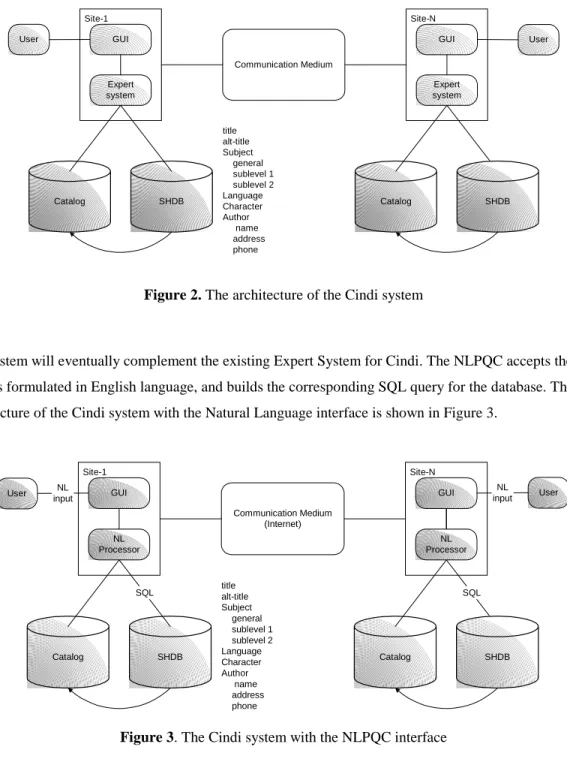
The Concordia Digital Library System named Cindi [Desai, 1997; Desai, Shinghal, Shyan, Zhou, 1999] has been implemented through the use of Semantic Headers [Desai, Haddad, Ali, 2000]. Semantic Headers are used to facilitate the bibliographic search. The Semantic Header stores useful information, such as author’s name and title of the bibliographic references stored in the database. As can be seen in Figure 2, behind the Semantic Headers, there is an expert system, which guides the user in the tasks at hand. The system helps the user ask meaningful questions.
After the user input is processed, the Cindi system uses the Semantic Headers database to retrieve the information from the resource catalog. The focus of the thesis is to design and implement a Natural Language interface for the Cindi system.
Site-1 GUI Expert system Catalog SHDB Communication Medium Site-N GUI Expert system Catalog SHDB title alt-title Subject general sublevel 1 sublevel 2 Language Character Author name address phone User User
Figure 2. The architecture of the Cindi system
The system will eventually complement the existing Expert System for Cindi. The NLPQC accepts the user queries formulated in English language, and builds the corresponding SQL query for the database. The architecture of the Cindi system with the Natural Language interface is shown in Figure 3.
Site-1 GUI NL Processor Catalog SHDB SQL Communication Medium (Internet) Site-N Catalog SQL SHDB NL input title alt-title Subject general sublevel 1 sublevel 2 Language Character Author name address phone GUI NL Processor NL input User User
Figure 3. The Cindi system with the NLPQC interface
The NLPQC accepts the user input in the form of a question, such as Who is the author of the book The Old Man and the Sea? The system parses the question semantically and builds the following SQL query for the SHDB:
SELECT author.name FROM author, resource, resource_author WHERE resource.title=’The Old Man and the Sea’
AND author.author_id=resource_author.author_id AND resource.resource_id= resource_author.resource_id
The author, resource and resource_author are three tables in the SHDB for Cindi. The example shown above uses the tables described in Appendix C.
The NLPQC also accepts requests, such as Show the books written by Mark Twain. The corresponding SQL query is:
SELECT resource.title FROM author,resource,resource_author WHERE author_name=’Mark Twain’
AND author.author_id=resource_author.author_id AND resource.resource_id=resource_author.resource_id
The SQL could be sent to the database engine, and the returned result set is displayed for the user.
1.2 The foundation of the NLPQC system
The NLPQC is built on top of WordNet [Miller, 1995] and the Link Parser [Sleator, 1991], [Grinberg, 1995] which are two proven tools from the natural language area. The development of the NLPQC system is based on the following requirements:
1. The NLPQC is composed of two modules: a pre-processor and a run time processor. Figure 4 shows the overall architecture of the system.
2. The NLPQC pre-processor reads the schema of the database, and uses WordNet to create semantic sets for each table and attribute name. Example: for the table resource from the database schema, the pre-processor uses WordNet to find all synonyms, hypernyms and hyponyms. Then it builds the semantic set for resource (book, volume, record, script). The pre-processor also creates the rules and the SQL templates that can be edited by the system administrator. The schema is described in Appendix C.
3. The NLPQC run-time processor is integrated with the Link Parser to do the syntactic parsing of the input. The processor accepts English sentences related to Cindi and uses the rules created by the pre-processor to analyze the input and generate the SQL query. Here are three examples of accepted inputs: List all books written by author Mark Twain, What is the phone number of author Leiserson?, Who is the author of the book General Astronomy?.
4. The NLPQC system is written in C/C++ for the Windows platform. However, the system has been designed to run on Unix as well once the Unix version of the components used is available. 5. The NLPQC system is designed to accept any relational database schema.
The run time processor Syntactic parsing and phrase chunking Semantic analysis Build SQL query Link Parser Cindi Database Preprocessor Rules Templates WordNet Dicionary Schema User input Result set
Return result set to the user
English sentence User
Figure 4. The architecture of the NLPQC system
The requirements implementation is described in detail in Chapter 3. Requirement 4 is true for the NLPQC code only, because the authors of the Link Parser have yet to release the source code for the Unix platform.
1.3 A parallel between QA systems and NL interfaces
The NLPQC system is a Natural Language interface to databases. Some of the tools and ideas it uses have been borrowed from Question Answering systems. In a more general context, Natural Language interfaces and Question Answering systems share common techniques for the semantic parsing.
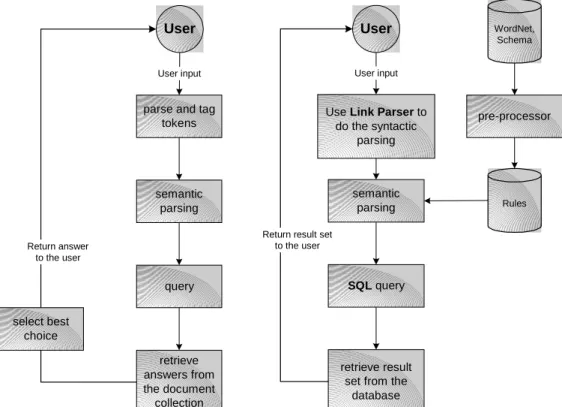
As shown in Figure 5 both QA systems and NL interfaces do some kind of syntactic & semantic analysis of the English sentence, by using a common set of tools. QA systems build a query for the document collection and then they select the best answer from the result set. NL interfaces build the SQL query for the database, and the result of this query is then sent to the user. A NL interface currently works on a relational database but it does not yet have a mechanism for selecting the most probable answer from the result set, as in a QA system. This is so because the selection is done when the SQL query is built. The SQL query is sent to the database engine, and the returned result set is considered to contain only valid answers of the SQL query which is considered to be correctly built.
Due to their similarities, a literature survey has been done in both Question Answering (QA) and Natural Language (NL) interface fields. Our literature review in the Natural Language Interfaces field is presented in Chapter 2. The most relevant systems have been analyzed. As a result of the survey, the most useful techniques and tools have been selected and incorporated into the NLPQC system. During this step, we ensured that the present work has been done by using and integrating the results obtained by other contributors in the field. A new bottom-up approach has been developed in order to increase the precision of the semantic parsing of the user input. This is our contribution to the NL semantic parsing domain, and it is described in Chapter 3. This approach has been presented in July 2002 at the SSGRR conference in l’Aquila, Italia [Stratica, Kosseim, Desai, 2002].
Natural language input
Process question
Build query for the document collection Document Collection Semantically parsed question Answer Set User
Select the best answer Answer
Natural language input
Process question
Build the SQL for the data base Semantically parsed question Result Set User
Relational Data Base Simillar
techniques
Figure 5. Comparison between QA systems and NL interface architectures
Chapter 4 shows the implementation details of the NLPQC system. Some of results are listed in Chapter 5 and the conclusions are given in Chapter 6.
2. Previous work in Natural Language processing
Question Answering and Natural Language interfaces share many techniques used for sentence parsing, such as part-of-speech tagging, phrase chunking and the use of templates for semantic interpretation. However, QA focuses on finding answers from general knowledge stored in a collection of documents, while NL interfaces are specialized and restricted to the particular database system they access. Our system, tries to reduce this limitation by first pre-processing the target database to adapt to a new discourse domain. In order to acquire this kind of flexibility and implement the most efficient techniques for sentence parsing, several QA systems and NL interface architectures have been analyzed and compared.
The evolution of the NL interface systems and the most relevant academic ideas are presented in the section 2.1. In the remaining sections, several working systems have been analyzed and the solutions most adapted to our project have been used in the architecture of the NLPQC system.
2.1 Literature review
The early efforts in the NL interfaces area started back in fifties [McCarthy, 1959]. Prototype systems had appeared in the late sixties and early seventies. Many of the systems relied on pattern matching to directly map the input to the database [Abrahams, 1966]. Table 1 shows two pattern-matching examples from Formal LIst Processor or FLIP, an early language for pattern-matching on LISP structures [Teitelman, 1966]. If the input matches one of the patterns, the system is able to build a query for the database.
Table 1. Pattern-matching examples
User input Matching Pattern
What is the capital of Spain? “capital”…<country> What is the capital of each country? “capital”…”country”
The system implementation and the database details were inter-mixed into the code. Because of that the coverage of the pattern-matching systems was limited to the specific database they were coded for and to the number and complexity of the patterns.
Later systems introduced syntax-based techniques. The user input is parsed and then it is mapped to a query for the database. The best-known NL interface of that period is Lunar [Woods, 1972], a natural language interface to a database containing chemical analyses of moon rocks. Lunar, like the other early natural language interfaces, was built for a specific database, and thus it could not be easily modified to be used
with different databases. The system used an ATN syntax parser coupled with a rule-driven semantic interpretation procedure to translate the user input into a database query. Here is an example processed by the Lunar system which shows the user input and the resulted query for the database:
LUNAR (Woods 1971)
Natural language system based on ATNs.
Request: (DO ANY SAMPLES HAVE GREATER THAN 13 PERCENT ALUMINUM) Parsed into query language:
(TEST (FOR SOME X1 / (SEQ SAMPLES) : T ; (CONTAIN X1 (NPR* X2 / 'AL203) (GREATERTHAN 13 PCT)))) Response: YES
In contrast to the Lunar system, NLPQC uses a syntax-based tree parser (Link Parser) and a semantic interpreter based on rules and templates.
The next evolutionary step has been taken by the semantic grammar systems. By the late seventies several more NL interfaces had appeared [Hendrix, 1977], [Codd, Limbie, 1974]. The user input is parsed and then mapped to the database query. This time though the grammar categories do not have to correspond to syntactic concepts. The semantic information about the knowledge based is hard-coded in the semantic grammar, and thus the systems based on this approach are strongly coupled with the database they have been developed for. Gary Hendrix et al. [Hendrix, 1977] presented a NL interface to large databases named LADDER that is based on a three-layered architecture and is representative of the NL interfaces built in the seventies. The three layers operate in series to convert natural language queries into calls to DBMS’s to remote sites. LADDER can be used with large databases, and it can be configured to interface to different underlying database management systems. LADDER uses semantic grammars, a technique that interleaves syntactic and semantic processing. The question answering is done by parsing the input and mapping the parse tree to a database query. The grammar's categories, i.e. the non-leaf nodes that will appear in the parse tree do not necessarily correspond to syntactic concepts. Figure 6 shows an example of a semantic parse tree.
LADDER does spelling correction and can process incomplete inputs. The first layer is the Natural Language system. It accepts questions in a restricted subset of Natural Language and produces a query to the database. For example the question What is the length of the Mississippi? is translated into the query ((NAM EQ MISSISSIPPI)(?LENGTH)) where LENGTH is the name of the length field, NAM is the name of the river field, and MISSISSIPPI is the value of the NAME field. The other two layers are not relevant to us because they deal with database details. The system has been implemented in the LISP programming language and can process a database which is the equivalent of a relational database with 14 tables and 100
attributes. At that time the database systems were not relational. The Natural Language layer uses a fragmented approach. This means that although the system cannot process any input, it accepts major fragments of language pertinent to particular application area.
Which author
Specification
Question
Information
wrote The old man
and the sea?
Title
Figure 6. Example of a parse tree in a semantic grammar.
This approach is extremely important because it uses the basic idea of divide and conquer to a then new domain. The authors acknowledge that the open-domain Natural Language processing is too complex for computers and decided to specialize the application to a specific domain. This strategy goes in line with the limited answering capability of a database. Our own system adopted a similar strategy. However, NLPQC addresses the limitation issue through the database independent implementation.
LADDER uses Augmented Transitions Networks (ATN) and templates to do the parsing of the user input. For example WHAT IS THE <ATTRIBUTTE> OF <TABLE> is a simple template that is a natural language representation of the <table, attribute> pair. The system also uses more general patterns such as <NOUN-PHRASE><VERB-PHRASE>. Our system uses templates too, for the reasons explained at the beginning of Chapter 1. LADDER groups together all the attributes related to the same table. This idea will be reused by NLPQC in the future, to allow the creation of complex SQL queries.
Another concept introduced by LADDER is the generalization. The system tries to match the input words to general classes, in order to take into account the semantics. For example, if the database contains a table named resource, and the user types the words book and article, the system maps book and article to the table resource, through generalization. NLPQC implements a similar generalization mechanism through the semantic sets, as shown in Chapter 3.
LADDER is limited to a finite set of sentences and it does not deal with syntactic ambiguities. In the example NAME THE SHIPS FROM AMERICAN HOME PORTS THAT ARE WITHIN 500 MILES OF NORFOLK the system favors shallow parsing and associates distance with SHIPS. Although LADDER was
revolutionary in the ways presented above, it lacked portability. Like many other system at that time, it inter-mixed data structure and procedures thus making the system dependent on the specific database that it was implemented for.
Other systems used semantic grammars as well. CHAT-80 [Warren, 1982] is one of the reference systems of the eighties and was the basis for systems in other languages, such as PRATT-89 [Teigen, 1988]. CHAT-80 transforms English questions in Prolog expressions, which are evaluated against a Prolog database. CHAT-80 was developed for a geographical database and could answer questions like these:
Does America contain New_York?
Does Mexico border the United_States?
Is the population of China greater than 200 million?
Does the population of China exceed 1000 million?
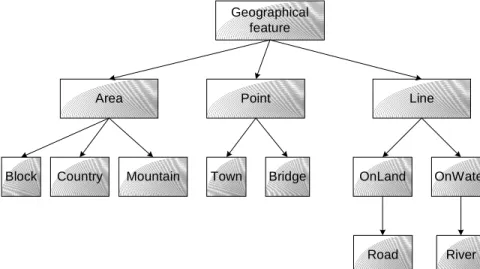
Figure 7 shows the hierarchy of geographical concepts used by the CHAT-80 to do the semantic interpretation of the user input and to map it to the database fields.
Block Area Geographical feature Point Town Bridge Line
Country Mountain OnLand
Road
OnWater
River
Figure 7. The geographical concept hierarchy
A major inconvenience of the system was that the implementation was heavily related to the specific database application. The next generation of NL interfaces was based on an intermediate representation language. The natural language question is transformed into a logical representation, which is independent of the database structure. The logical representation is then transformed into a query for the database. Grosz
[Grosz et al., 1983] implemented the TEAM system as a transportable Natural Language interface to databases. Grosz’s vision was ahead of her time. Grosz realized that the Natural Interface must be isolated from the implementation details of the database. Today this idea might look like as an obvious choice, due to the existence of the SQL, but at that time it was not. TEAM was innovative also because it introduced concepts that are today known under the generic name of object-oriented approach. NLPQC, which also has an object-oriented architecture, inherited from TEAM the idea of database independence. This has been implemented through the introduction of the NLPQC pre-processor, which can accept any schema.
At the time TEAM was implemented, there was no standard data description language or DDL to describe the database schema. Because of that, the authors had to talk to the database management personnel to obtain the information required for the adaptation of the system to a new database.
TEAM is based on a three-domain approach. It separates information about language, about the domain and about the database. The system uses a lexicon of words, much like the semantic sets produced by NLPQC. TEAM stores information about possible relations between words. These would be the equivalent to the pre-defined NLPQC templates. TEAM translates the user input into a logical form, based on syntactic parsing, semantic parsing and basic pragmatic rules. The rules are domain and database independent.
Another novelty introduced by TEAM is the concept of logical schema. The system takes the user input and builds the logical schema. This is composed of generic classes, such as student. If the user types in sophomore, the logical schema will refer to the word student, which is more general than sophomore. This approach has been adopted by NLPQC too, by using hyponyms of WordNet..
The TEAM system can distinguish between three different kinds of fields: arithmetic, boolean and symbolic. They are used in matching the logical schema to the database schema. The system is limited to a small range of databases and accepts questions having transitive verbs only.
Although some of the NL interface systems developed in the eighties showed impressive characteristics in specialized areas, they did not gain wide acceptance. NL interfaces were regarded more like experimental systems due to the fact that some other options were offered to the database end users, such as graphical and form-based interfaces. Another negative factor in the development of the NL interfaces was the limited linguistic coverage. The early systems faced numerous problems, such as modifier ambiguity resolution (all cars made by GM near Montreal), quantifier scooping (all, one, few, many), conjunctions-disjunctions (and, or), noun composition (research book, sport facility). The NL systems developed in the nineties tried to overcome some of these issues. The JANUS system [Hinrichs, 1990] has an interface to multiple underlying systems and it is one of the few systems to support temporal questions. JANUS addresses the limited database capability by allowing the user to access more than one database.
As we saw in the examples presented above, the NL interfaces went through an evolutionary process. As we will see later on in this chapter, today’s systems use various techniques and integrated tools to do the syntactic and the semantic parsing of the English query. Some of these techniques are also used in the QA domain.
Our system is based on a series of QA systems and NL interfaces that are presented in the following sections. NLPQC adopted the intermediate representation approach through the use of semantic sets, schema rules and semantic templates. Our system uses syntactic parsing techniques that have been borrowed from the QA field.
QA systems use various techniques to interpret the user input, build a query for the document collection and extract the most probable answers from a set of candidate answers. There are two classes of QA systems: linguistic and statistic. The linguistic approach consists of syntactically and semantically parsing of the user input in order to obtain a query for the knowledge base. A linguistic system focuses on the semantic of the sentence.
A statistic system processes the input text in order to determine a list of phrases that occur with reasonable frequency in the collection of documents forming the knowledge base.
A typical QA system uses a collection of documents from which it extracts the set of answers. Then it chooses the most probable one, based on the implementation of specific algorithms.
A NL interface uses a database as knowledge base. The NL interfaces use some of the parsing techniques used by the QA systems, but they are more limited due to the nature of the database knowledge as compared to the document set for QA. On one hand this restriction allows for little flexibility in interpreting the user input, but on the other hand, there is an advantage to it. The NL interfaces can successfully use templates for the semantic parsing, as explained in the beginning of the Chapter 1.
Another difference between NL interfaces and QA systems is that the NL interfaces do not select the most probable good answer from the answer set. This is due to the fact that the goal of a typical NL interface is to build a good SQL query for the database engine. Once the query is successfully built, the system's job is over.
The NLPQC system is a linguistic NL interface to the databases. However, its architecture is based on ideas borrowed from both QA linguistic and statistic systems, and from some NL interfaces, such as:
• Code reuse (WordNet6, LinkParser7)
• Tool integration (Webclopedia8, Prager9, Falcon10) • Use of templates (START11, QUANTUM12, QA-LaSIE13) • Use of pre-processed knowledge (ELF14)
• The generation of the SQL query (SQ-HAL15, NLBean16) • Use of relationships based on verbs (English Query17) • Use of table rules (EasyAsk18)
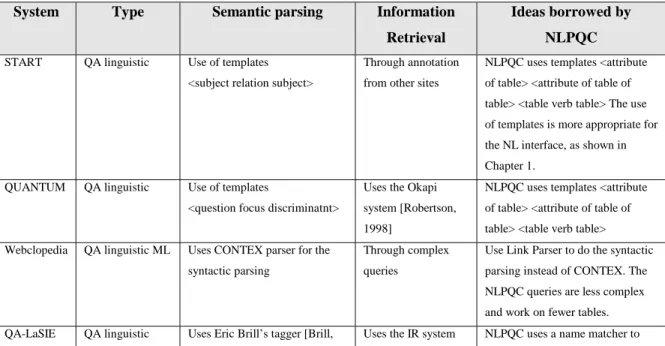
Table 2 shows the main attributes of the systems mentioned above that have been considered for the NLPQC architecture. They are not compared against each other. Instead, the main features that inspired the NLPQC system are highlighted.
Table 2. Some QA and NL systems used in the NLPQC architecture
System Type Semantic parsing Information Retrieval
Ideas borrowed by NLPQC START QA linguistic Use of templates
<subject relation subject>
Through annotation from other sites
NLPQC uses templates <attribute of table> <attribute of table of table> <table verb table> The use of templates is more appropriate for the NL interface, as shown in Chapter 1.
QUANTUM QA linguistic Use of templates
<question focus discriminatnt>
Uses the Okapi system [Robertson, 1998]
NLPQC uses templates <attribute of table> <attribute of table of table> <table verb table> Webclopedia QA linguistic ML Uses CONTEX parser for the
syntactic parsing
Through complex queries
Use Link Parser to do the syntactic parsing instead of CONTEX. The NLPQC queries are less complex and work on fewer tables. QA-LaSIE QA linguistic Uses Eric Brill’s tagger [Brill, Uses the IR system NLPQC uses a name matcher to
6 Appendix A 7 Appendix B 8 Section 2.2.3 9 Section 2.2.5 10 Section 2.2.6 11 Section 2.2.1 12 Section 2.2.2 13 Section 2.2.4 14 Section 2.3.2 15 Section 2.3.1 16 Section 2.3.4 17 Section 2.3.3 18 Section 2.3.5
1995], a name matcher and a discourse interpreter
from the University of Massachusets.
link the words in the sentence with table names.
Prager QA statistic No parsing Passage-based search
with help from WordNet
NLPQC does not do any statistical operation, but uses WordNet to do name matching19.
Falcon QA linguistic Semantic parsing with help from WordNet
It stores results for later re-use
NLPQC uses WordNet and will store questions and SQL queries in the future.
SQ-HAL NL linguistic Poor syntactic and semantic parsing, but it is open source. It uses name matching.
Produces SQL queries for the database
NLPQC uses name matching with help from WordNet, and thus gives better semantic coverage. ELF NL linguistic (?)20 Apparently uses a pre-processor
for the database schema.
Produces SQL queries for the database
NLPQC uses a pre-processor. Unfortunately, there is no independent evaluation of ELF on the WWW, and it cannot be compared against other systems, NLPQC included.
NLBean NL linguistic Poor syntactic and semantic parsing, but it is open source. It offers a simple mechanism to produce SQL queries. Can be deployed over the WWW.
Produces SQL queries for the database
The NLPQC prototype has been developed on top of the NLBean. The prototype tested the SQL generation techniques and had only limited parsing capabilities. EasyAsk NL linguistic (?) It has its own parser and spell
check capability, uses WordNet. It has a two-way dialog with the user to correct the ambiguous words. Uses table rules extracted from the schema.
Produces SQL queries for the database
NLPQC uses table rules as well. It does not do the spell check, but it allows the system administrator to correct the pre-processor errors. EasyAsk goes a step further and allows the user to correct the ambiguous input words.
After analyzing numerous QA systems and NL interfaces, it appears that a good NL interface must work on both ends: the user input and the schema of the database. The user input is semantically parsed. The resulting parse tree must then be matched with table and attribute names from the schema.
SQ-HAL and NLBean try to match the words from the input sentence to the table and attribute names. If they are not meaningful English words, the match fails. Prager and the authors of Falcon improved this phase by using WordNet. NLPQC also uses WordNet to build the semantic set of the schema elements, i.e. table and attribute names. The ELF system claims a very high success rate, which is probably due to the fact that it prepares in advance the information related to the schema, and it uses it at run time to do the semantic parsing. On the other hand, ELF and other commercial systems do not publish details about the architecture and design used, and thus cannot be fully evaluated. In the NL interfaces domain there is a
19
The system matches the input tokens to the semantic sets of the table and attributes names.
need for standard test sets such as in the TREC conferences for QA [TREC-9, 2000], [TREC-X, 2001]. Until then, the only way to understand and build on top of the existing commercial systems is to use them intensively and compare them against academic systems such as SQ-HAL and NLBean.
In contrast to the QA domain, we have noticed that the NL interfaces are poorly represented on the WWW. This is due to the fact they have very practical and immediate application in the WWW commerce, and thus the creators are not willing to publish the architecture of their systems. Instead, they publish test results, often compared against other systems. Because of this situation, we found few open source interfaces, and retained only two of them: SQ-HAL and NLBean. They might not be as advanced as ELF, English Query or EasyAsk, but at least one gets the source code and can start to think to do something better. As a matter of fact, the NLPQC system has been built on this idea.
Another valuable idea is the use of templates. QUANTUM, START and other systems use templates for the semantic parsing. As already mentioned in Chapter 1, the best results with templates are obtained by the NL interfaces. Despite this, the SQ-HAL and NLBean systems do not use templates for the semantic parsing. However, NLBean uses SQL templates to build the SQL query, and it gives better results than SQ-HAL. NLPQC uses templates for the semantic parsing and for the SQL query generation, thus it takes the best ideas for the reviewed systems.
One feature that is under-represented in the QA and NL interface domains is the learning mechanism. Falcon addresses this problem through storing the user input and the resulted query for later reuse. Webclopedia goes even further down the road and implements a learning mechanism at the semantic parsing level, through dynamic template generation. NLPQC does not have learning nor memorizing mechanisms. The issue should be addressed in future work to implement a Falcon-like approach.
We have noted that the flexibility and the precision of a system are contradictory requirements. If the number of templates for the semantic parsing increases, the precision goes down due to failure in the ambiguity resolution. If the ambiguity is resolved through the use of a limited number of elementary templates, the system coverage is greatly reduced, and many input sentences will be dropped. From our experience it resulted that there is a need for a minimal number of elementary templates to reduce the ambiguities. The elementary templates must be further combined for more flexibility. This process is similar to dividing a complex sentence into elementary phrases and then using the elementary templates on them. This step has not been implemented in the NLPQC and it is part of future plans. For the time being, the system uses three templates. This number has been found through trial and error in an effort to get acceptable precision and good coverage. However, the system can deal with a relatively small schema of up to 20 tables and 20 attributes per table and cannot build complex queries involving more than 3 tables and two attributes per table. These limitations should be re-worked in the future.
In the following sections we present the systems that have been studied and used in the development of the NLPQC architecture.
2.2 Question Answering systems
In the following sections, we present the systems that inspired us in the development of the NLPQC system. The focus is on the architecture and the implementation of each system.
2.2.1 The START system
The START server [Katz, 1997] is a QA system that answers questions in English about the MIT AI Laboratory, geography and other topics.
Figure 8. An actual screen output from the START system
The Server is based on the START natural language system developed by Boris Katz. START has been available to World Wide Web users since December 1993. The system can answer simple questions such as Show me a map of Quebec. START finds the answer on the World Sites Atlas site [WSA, 2002] and returns it to the user as shown in Figure 8. The architecture of the START system is shown in Figure 9.
The World Wide Web Natural Language (NL) Question NL semantic parser Build Knowledge base Information Source 1 Information Source 2 Information Source n Connect to information sources Build the answer
Figure 9. The Architecture of the START system
The Natural Language sentence is semantically parsed. Based on the result of the parsing, the system decides where to look for the answer.
The START system uses T-expressions for the semantic parsing, where T stands for Template. The system uses the pattern <subject relation object>. This approach has the advantage of being intuitive but has a limitation. Sentences with different syntax and close meaning are not considered similar by the system. For example, the phrase ‘The student surprised the teacher with his answer’ is parsed into <student surprises teacher> while the phrase ‘The student’s answer surprised the teacher’ is parsed into <answer surprises teacher>, which is a different interpretation of the input sentence.
The NLPQC system uses 2 and 3 element templates. The NLPQC pattern <table1 action table2> resembles the START’s <subject relation object> pattern. This pattern is used in phrases such as ‘List the books written by author Mark Twain’ Written is the action verb that relates Book and Author in the Cindi library system. One difference between START and NLPQC is that our system uses more than one pattern for the semantic parsing. The NLPQC templates are detailed in Chapter 3.
2.2.2 The QUANTUM System
The QUANTUM system [Plamondon, Kosseim, 2002] tries to find the answer to a natural language question in a large collection of documents. QUANTUM relies on computational linguistics as well as information retrieval techniques. The system analyzes questions and then selects the appropriate answer extraction function. In the parsing phase, QUANTUM decomposes the question in three parts: a question
word, a focus, and a discriminant. The NLPQC system borrowed the idea of having the question split in two or three part templates. Table 3 shows examples of the question decomposition in the NLPQC system.
Table 3. Examples for the question template used by NLPQC
Input Question
word
Focus Discriminant
Who is the author of the book ‘The old man and the sea’?
Who is author of the book ‘The old man and the sea’?
What is the phone number of author Ernest Hemingway?
What is phone number of author Ernest Hemingway?
The NLPQC system uses the three elementary templates to decompose the question, as shown in Table 2. For the first row, NLPQC uses the template <word1><action><word2> and the rule (author, write, book) to build the SQL query, as we will see in Chapter 3. The second row is resolved with the <attribute>of<object> template. In addition to handling questions, the NLPQC system handles imperative sentences. Table 4 shows examples of such sentences that are parsed through the action template <word1><action><word2>.
Table 4. Examples for the action template used by NLPQC
Input Word1 Action Word2
Show all books written by author Mark Twain books written author List all annotations written by user Thomas Edge annotations written user
The NLPQ system uses question and action templates to do the semantic parsing. It uses schema rules to relate the focus and the discriminants to tables and attributes. The rules are built by the NLPQC pre-processor and used at run time, as described in Chapter 3.
2.2.3 The Webclopedia factoid system and WordNet
The Webclopedia factoid QA system [Hovy E. et al., 2001], makes use of syntactic and semantic world knowledge to improve the accuracy of its results. The system processes the question with the CONTEX parser [Hermjakob, Mooney, 1997], [Hermjakob, 2000]. The idea of reusing the already existing and proven tools, inspired by Webclopedia, has been incorporated in the NLPQC system architecture. Our system uses the Link Parser in the early stages of sentence processing.
Another tool used by Webclopedia for query expansion is WordNet. The system extracts words used in the term definitions before searching for definitions in the collection of documents. The NLPQC system also uses WordNet to expand the query and the schema of the database.
Another characteristic of the Webclopedia system that has been used in the NLPQC system is learning capability. Webclopedia uses the CONTEX parser to execute the syntactic-semantic analysis of the sentence. CONTEXT is made up of two modules, a grammar learner and a parser. The grammar learner uses machine-learning techniques to produce a grammar represented as parsing actions, from a set of training examples. We borrowed this idea for our system. The NLPQC gets trained by the pre-processor, which generates the rules and templates that are used at run time by the semantic parser.
Finally, the Webclopedia forms complex queries by combining simple queries through Boolean operators. The NLPQC system builds complex SQL queries by using Boolean operators, as it is described in Chapter 3.
2.2.4 The QA-LaSIE system
QA-LaSIE [Scott, Gaizauskas, 2001] finds answers to questions against large collections of documents. The system passes the question to an information retrieval system (IR) that uses it as a query to do passage retrieval from the text collection. The top ranked passages from the IR system are then passed to a modified information extraction system. Partial syntactic and semantic analysis of these passages, along with the question, is carried out to score potential answers in each of the retrieved passages. The system processes the question by using the following steps: question tokenizing, single and multi-word identifying, sentence boundaries finding, tagging, phrase parsing and name matching. QA-LaSIE uses Eric Brill’s tagger to assign one of the 48 Penn TreeBank part-of-speech tags to each token in the text [Brill, 1995].
The NLPQC system reuses the idea of integrating the existing tools in the new developments. While QA-LaSIE builds on top of Eric Brill’s tagger, our system integrates the Link Parser for the syntax parsing.
2.2.5 Use of WordNet Hypernyms for Answering What-Is Questions
Based on the fact that 26% of the questions are of type ‘What is…?’ in the TREC-9 competition [TREC-9, 2000], John Prager [Prager et al, 2001] implemented a passage-based search process that looks for both the question term and any of its hypernyms found with WordNet. The lookup algorithm counts the number of occurrences of the question term with each of its WordNet hypernyms in the document collection and
divides this number by the number of “is-a” links between the two. The terms with the best score are selected as the answer. With this strategy, Prager claims a precision of 0.83 on the TREC-9 corpus.
The basic idea that NLPQC system borrowed from Prager’s work, is the use of WordNet as a knowledge base in the generalization process. In other words, our system uses WordNet to find semantically related terms that are connected to the schema of the database. For example, as shown in Figure 15, book and volume are synonyms from the perspective of the Cindi database.
2.2.6 The Falcon system
Falcon [Harabagiu, 2001] is an answer engine that semantically analyses a question and builds the expected answer type. Then it uses an information retrieval system and does the answer identification. Falcon also uses WordNet to help create the expected answer patterns. The system provides a feedback mechanism for query reformulation if the question processing fails, which increases the precision of the system. It also has a mechanism to restore the previously formulated question for faster response time. This is based on storing the questions and their associated queries in a database for further use.
As mentioned before, the NLPQC system also uses WordNet to build the semantic sets of the words which are related to the database schema.
2.3 NL Interfaces to Databases
After the semantic parsing of the input sentence, a NL interface builds the SQL query that is then passed to the RDBMS engine. The RDBMS engine returns the answer set to the user. As opposed to a QA system, a typical NL interface has no mechanism of discriminating among the entries in the answer set. The precision of the system relies exclusively on the correctness of the SQL query. In the ideal case, the NL interface returns one result set, or none if the answer is not found in the database. This problem has been addressed in the NLPQC system, in the case when the zero result set is due to the limited knowledge stored in the database. The system administrator has the possibility of changing the current database, and switch the system from one domain to another.
In the following sections, we describe several NL interfaces, both academic and commercial. These systems have inspired us in the architecture and design of the NLPQC system.
2.3.1 The SQ-HAL system
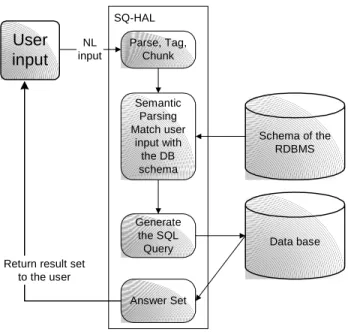
SQ-HAL [Ruwanpura, 2000] is a NL interface that translates questions into SQL queries. It executes the SQL statements to retrieve data from the database and displays the answers to the user. The system is designed to be database and platform independent with multi-user support.
SQ-HAL Parse, Tag, Chunk Semantic Parsing Match user input with the DB schema Schema of the RDBMS NL input Generate the SQL
Query Data base
Answer Set
User
input
Return result set to the user
Figure 10. The architecture of the SQ-HAL system
Because the input is in NL, users with no knowledge of SQL are able to address the database through SQ-HAL. The system has the ability to learn a new grammar. The architecture of SQ-HAL is presented in Figure 10. The design can be broken down into three sections: database functionality, natural language translation and user interface. Currently SQ-HAL can translate natural language queries into simple, single and two tables joined SQL statements with or without a simple condition. These statements are then executed in the selected database to retrieve information and display it to the user, thus simplifying the data retrieval process. Also the user has the choice of modifying these SQL statements or creating its own.
SQ-HAL has some limitations and problems. The database table names and column names have to be valid English words. Multiple word names, such as telephoneNo, are treated as single words and do not produce the expected results. This is because the keyword telephoneNo is not in the English dictionary and it is unlikely that the user will use it as input. SQ-HAL cannot determine synonyms for table names and column names and therefore the user has to manually enter these words in the dictionary. The NLPQC system presented in this thesis solves this problem by using WordNet to create semantic sets of the related terms and allows for the user to edit them. Our system accepts any table and attribute names, regardless
whether or not they are in the English dictionary. SQ-HAL is not capable of determining the relationships between tables, and user assistance is expected to solve this problem.
The NLPQC system uses a mechanism for generating the SQL query, which is similar to the one the SQ-HAL system uses. Our system has a pre-defined library of SQL patterns that contain generic table and attribute names. The names are filled in at run time, based on the rules generated by the pre-processor. After identifying the tables and the attributes that are used in the SQL query, the NLPQC system uses the remainder of the sentence as the value of the default attribute of the last table in the table list. For example, in the question What is the address of the author Mark Twain? NLPQC identifies address as being an attribute of the table author. The default attribute of the table author is name. The system associates the remainder of the sentence, i.e. Mark Twain to the author.name. The SQL query is:
SELECT address FROM author WHERE name=’Mark Twain’
2.3.2 The English Language Front system
The ELF system [Elf, 2002] is the closest to our own approach. Like many other commercial system, the ELF system claims a rather good performance, although how that performance is achieved is not disseminated. The system reads the schema of the database and then creates a set of rules that are used during semantic parsing, when the natural language input is converted into SQL query for the relational database system. The ELF company offers a comparative study between ELF, English Wizard from Linguistic Technology and English Query from Microsoft. English Wizard is described in section 2.3.5
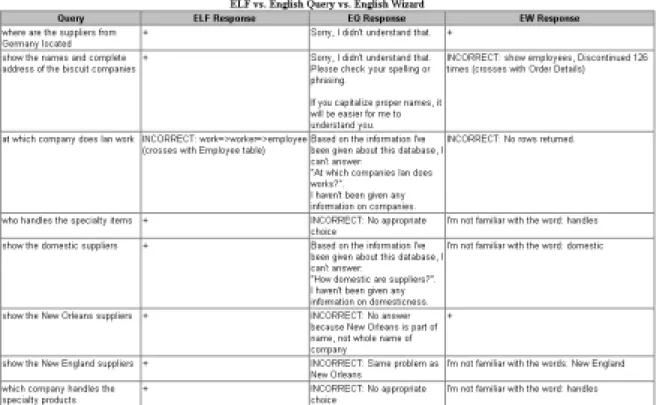
The test, whose results are presented in Figure 11, was performed by the ELF company using the Northwind database sample included with SQL Server 7.0 [Microsoft Corporation, 2000]. The standard eight tables were selected, plus the Order Subtotals query. The questions were selected randomly from the ELF regression test suite. Automatic builds were used for the ELF sample and the English Wizard sample; for English Query, the pre-built sample interface that Microsoft ships with English Query was used. The results shown in Figure 11 [ELF, 2002] illustrate the claimed superiority of the ELF natural language database query system over its rivals. A ‘+’ mark indicates a correct response. This condensed view of the results shows the error messages generated by the system, or a comment explaining why the SQL generated was wrong.
Total results: 16 correct answers for English Wizard, 17 correct answers for English Query [Microsoft, 1998] and 91 correct answers for ELF. If the 7 queries that were answered correctly by all 3 systems are
discounted, then on the remaining questions, English Wizard scored 0.096, English Query scored 0.107, and ELF scored 0.903.
The system has not been tested against other sets of questions, partially because in the NL interfaces area there is no standard requirements, such as the QA systems have in the TREC conferences [TREC-8, 2000]. The owner company has conducted the test, thus it cannot be considered reliable or objective. However, we present this system here because of its revolutionary approach of using a pre-processing mechanism for the schema of the database.
Figure 11. Comparing three NL interfaces
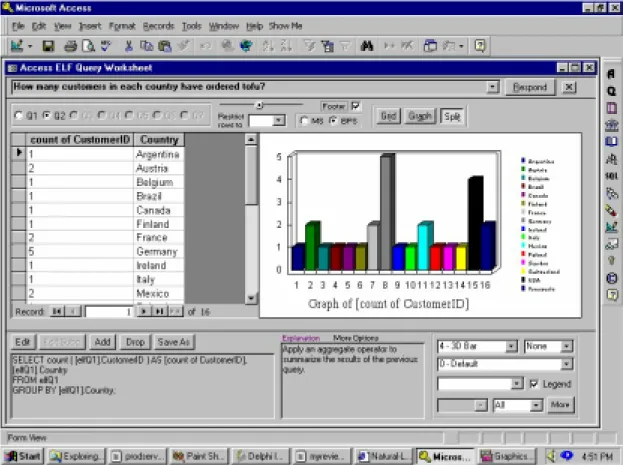
Figure 12 [ELF, 2002] shows an actual screen shot from the ELF system. Our NLPQC system has many similarities with ELF. NLPQC uses a similar approach, in a sense that it pre-processes the schema of the database and it generates a set of rules and templates that are used at run time for the semantic parsing. However, the authors of ELF did not publish the details of their research work, and therefore we cannot compare the two architectures.
Figure 12. An actual screen output from the ELF system.
2.3.3 The English Query for SQL 7.x
The English Query [Microsoft Corporation, 1998, 2000] was designed and implemented by Microsoft Corporation as part of the SQL server. It consists of two components: a run-time engine to convert English questions to SQL and an authorizing tool for the initial setup of the database.
Before proceeding with English questions, the database administrator uses the authorizing tool to initialize the database structure, create entities, define relationships between entities and create verb phrasing for relationships. All these steps have been implemented in the NLPQC system. Once the database is setup, English Query can translate English questions to SQL with the capability of searching multiple tables and multiple fields. However, we cannot compare the two architectures, due to the lack of information on English Query’s design. The following example demonstrates one of the SQL statements translated by English Query. The generated SQL query references three different table and five attributes. The question "What hotels in Hawaii have scuba?" is translated into this:
SELECT DISTINCT dbo.HotelProperty.HotelName AS "Hotel Name",
dbo.HotelProperty.USReservationPhone AS "Phone", dbo.HotelProperty.StreetAddress1 AS "Street Address",
dbo.HotelProperty.CityName AS "City", dbo.HotelProperty.StateRegionName
AS "State or Region" from dbo.HotelProperty, AmenityNames, Amenities WHERE dbo.HotelProperty.StateRegionName='Hawaii'
AND AmenityNames.Amenity='Scuba'
AND AmenityNames.AmenityID=Amenities.AmenityID AND dbo.HotelProperty.HotelID=Amenities.Hotelid
The run-time engine of the English Query can be integrated with Common Object Model modules, supporting environment such as Visual C++, Visual Basic and Active Server Pages. This enables the English Query to be embedded in custom built software as well as for ASP supported web sites.
English Query however is available only for Win32 platforms and supports only data sources that have OLE Database services such as Oracle and Microsoft Access. Our system is now available on Windows and it will run on Unix as soon as the authors of the Link Parser tool release the source code.
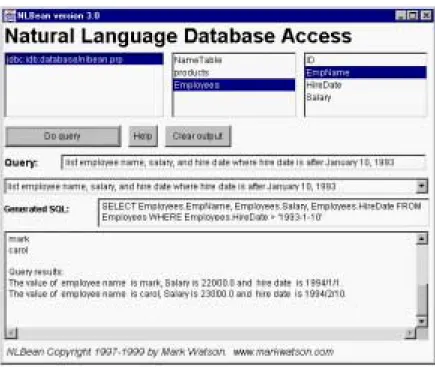
2.3.4 The NLBean System
The NLBean System was developed by Mark Watson [Watson, 1997]. His system is an example of how far an individual can get into the complex area of the NL interfaces to the database systems.