Journal homepage: http://ojs.univ-tlemcen.dz/index.php/GABJ
Original Research Paper
Salih R.R.M
1, Aradaib I. E.T.
2, Karrar A.E
3, Gibreel H. H.
41, 2, 3 Department of Clinical Medicine, Faculty of Veterinary Medicine, University of Khartoum, Khartoum, Sudan.
4 Department of Silviculture, Faculty of Forestry, University of Khartoum, Khartoum, Sudan.
Corresponding Author: Reem Rabie Mohammed Salih, Department of Clinical Medicine, Faculty of Veterinary Medicine, University of Khartoum, Khartoum, Sudan.[email protected]
Article history; Received: 7 July 2019; Revised: 28 August 2019; Accepted: 21 October 2019
Abstract
Loop-mediated isothermal amplification (LAMP) assay was introduced in the year 2000 by Notomi, as a highly sensitive, specific and cost-effective technique for microbial identification. In contrast to the polymerase chain reaction (PCR) technology in which the reaction is carried out with a series of alternating temperature steps or cycles, isothermal amplification is carried out at a constant temperature and does not require a thermal cycler. LAMP, a simple DNA amplification technique, with its field amenable nature has been used to detect a variety of pathogens including viruses, fungi, bacteria and parasites and in most of the cases it surpasses polymerase chain reaction. In this study the authors investigated the Loop mediated isothermal amplification technique (LAMP) which is a novel nucleic acid amplification technique. They tried to apply LAMP technique to detection of mitochondrial cytochrome b gene in dorcas gazelles. They designed LAMP specific primers for targeted gene and have verified the LAMP sensitivity up to 4 particles. The authors suggested that LAMP technique could be an appropriate replacement for PCR and may be useful in low resource or field settings where conventional DNA or RNA extraction prior.
Keywords: loop mediated isothermal amplification; mitochondrial cytochrome b gene, dorcas gazelle
Introduction
The mitochondrial cytochrome b gene is one of the best known proteins that make up complex III of the mitochondrial oxidative phosphorylation system Hatefi (1985) and is the only one encoded by the mitochondrial genome. Cytochrome- b is a transmembrane protein consisting of eight α-helices and it is believed to contain both redox centers Qo and Qi. Hatefi (1985). All eukaryotic organisms require this class of redox enzymes, and consequently cytochrome- b, for energy conservation Trumpower (1990). The mitochondrial genome contains genetic information which permits scientists to determine the relationships between related species and the history of a species. As a consequence, it is possible to use certain mitochondrial sequences as markers for the identification of populations (Doukakis et al., 1999, 2005; Ferguson et al.,1993). Loop Mediated Isothermal Amplification is relatively new novel technique; it is one of the very simple gene amplification methods which were performed under isothermal condition. In contrary with its simplicity it has high specificity and sensitivity with obviating the need for using thermal cycler (Notomi et al., 2000; Mori and Notomi, 2009). Loop mediated isothermal amplification is an outstanding gene amplification procedure, in which the reaction can be processed at a constant temperature by one type of enzyme, and its rapid and simple features make it clearly different from the existing genetic
Loop Mediated Isothermal Amplification Technique (LAMP): A rapid Tool
For Detection Of mitochondrial Cytochrome b Gene Of Dorcas gazelle
tests (Notomi et al., 2000). The LAMP method is able to amplify a few copies of DNA to a tremendous amount in less than an hour with no special reagents required (Tomita et al., 2008). The advantages of LAMP is characterized by the use of 4 - 6 different primers specifically designed to recognize 6-8 distinct regions on the target gene; the reaction process proceeds at a constant temperature (60 - 65 °C) and is completed within 60 min using the strand displacement reaction (Notomi et al., 2000; Nagamine et al., 2002). Furthermore, in a LAMP assay, all steps from amplification to detection are conducted within one reaction tube under isothermal conditions. These advantages can be used to prevent contamination, which can occur in PCR during the transfer of samples containing amplicons from tubes to gels for electrophoresis confirmation and preclude the need for complicated temperature control, as required for PCR (Okamura et al., 2008). Therefore, LAMP assay does not require well-equipped laboratories to be performed, and the procedure may be easily standardized among different laboratories (Okamura et al., 2008). Currently, many studies have used the LAMP technique with the aim of recognizing infectious agents, such as HIV-1 virus (Curtis et al., 2009) and Monkey pox virus (Iizuka et al., 2009) and detection of bacteria and parasites like
Mycobacterium tuberculosis (Iwamoto et al., 2003), M. pneumoniae (Saito et al., 2005), Cryptosporidium Oocysts (Karanis et al., 2007), Enterococcus faecalis (Kato et al., 2007), Actinobacillus Actinomycetes comitans (Osawa et al., 2007), Trypanosoma brucei rhodesiense (Njiru et al., 2008 a, b), Filarial parasites (Aonuma et al., 2009) and Leptospira (Lin et al., 2009). The LAMP technique also was used in DNA quantification as real-time detection and particularly in development of g-POCT devices (Parida et al., 2008).Also it was use to detect the mitochondrial cytochrome b gene in human (Eric etal., 2010) and ostrich (Amin etal., 2014) more than using PCR technique because it is simple and more efficient than the last one.
Materials and Methods
Loop Mediated Isothermal Amplification primers design:
LAMP primers were designed on the basis of the published sequence of related species for dorcas gazelle from GenBank. Four specific primers named: (F3, B3, FIP and BIP) for mitochondrial cytochrome b gene were derived from the sequence of the unique gene from GenBank compared with other sequences of dorcas gazelle outside Sudan. LAMP primers (F3, B3, FIP and BIP) were designed using the Primer Explorer V4 program (http://primerexplorer.jp/e/), while loop primers (LF and LB) were designed manually. The primers were synthesized by Macrogen Company (Seoul - Korea).
LAMP reaction
The reaction was performed in a final volume of 25µl which contained 12.5 µl 2x LAMP reaction buffer [20 mm Tris–base (pH 8.8), 10 mm KCl, 10 mm (NH4)2SO4, 8 mm MgS4 and 0.2% Tween 20], 0.8 m betaine (Sigma-Aldrich Chemie, Munich, Germany), 1 µl of the Bst DNA polymerase (New England Biolabs, Frankfurt am Main, Germany), 40 pmol each FIP and BIP primers, 5 pmol each F3 and B3 primers, 2 µl of target DNA and 0.5 µl from SYBR green . The mixture was incubated at 63 ºC for 60 minutes using a thermal cycler apparatus. The product was subjected to electrophoresis on a 1.5% agarose gel in a Tris-acetic acid-EDTA (TAE) buffer for 1 hour, then visualized under UltraViolet light (U.V).
Results
The ability of LAMP to detect just a single part of nucleotides suggests the applicability of this method for forensic cases with extremely low molecules. Complicating their detection at the other nucleotides of other microbes if the gazelle was infected with the any bacteria or DNA viruses but the LAMP technique is more sensitive in detection the specific gene in low molecule. Furthermore, sequencing of LAMP products showed
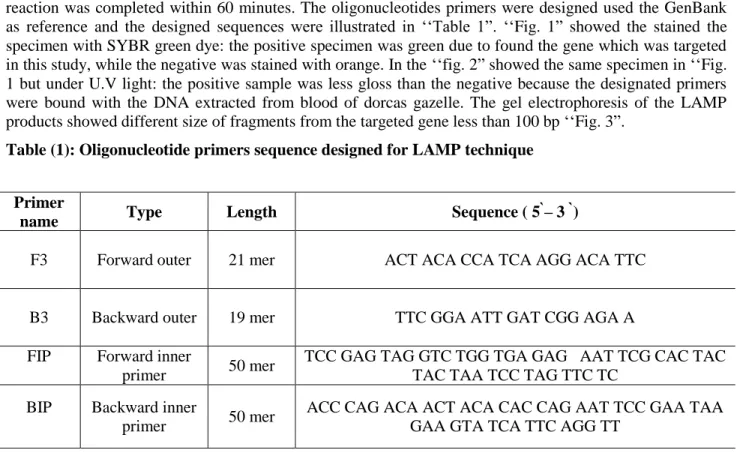
specific amplification of DNA of dorcas gazelle, indicating the high specificity of this method and the reaction was completed within 60 minutes. The oligonucleotides primers were designed used the GenBank as reference and the designed sequences were illustrated in ‘‘Table 1”. ‘‘Fig. 1” showed the stained the specimen with SYBR green dye: the positive specimen was green due to found the gene which was targeted in this study, while the negative was stained with orange. In the ‘‘fig. 2” showed the same specimen in ‘‘Fig. 1 but under U.V light: the positive sample was less gloss than the negative because the designated primers were bound with the DNA extracted from blood of dorcas gazelle. The gel electrophoresis of the LAMP products showed different size of fragments from the targeted gene less than 100 bp ‘‘Fig. 3”.
Table (1): Oligonucleotide primers sequence designed for LAMP technique
1 2
Figure 1: Targeted gene with negative sample stained with SYBR green dye Positive sample (1) stained with green colour while negative (2) stained with orange colour
Primer
name Type Length Sequence ( 5 ̀– 3 ̀)
F3 Forward outer 21 mer ACT ACA CCA TCA AGG ACA TTC
B3 Backward outer 19 mer TTC GGA ATT GAT CGG AGA A FIP Forward inner
primer 50 mer
TCC GAG TAG GTC TGG TGA GAG AAT TCG CAC TAC TAC TAA TCC TAG TTC TC
BIP Backward inner
primer 50 mer
ACC CAG ACA ACT ACA CAC CAG AAT TCC GAA TAA GAA GTA TCA TTC AGG TT
1 2
Figure (2)LAMP reaction under U.V light. 1: positive reaction (darker due to finding the targeted gene. 2:
negative sample was more shinning.
MW 1
Figure (3) LAMP product under U.V light
MW: molecular weight marker 100 bp. Lane 1: LAMP product. Amplification of DNA of dorcas gazelle by LAMP technique targeting the mitochondrial cytochrome b gene. Showed different bands due to differences in molecular weight of the nucleotides.
Discussion and Conclusion
The LAMP method was both highly specific and highly efficient and since it uses 4 primers that recognize 6 distinct sequences on the target DNA, its specificity is extremely high (Notomi et al., 2000) and it is an accurate method for identifying DNA of different animals species and used in forensic science cases. Among recently available molecular detection methods, LAMP is one of the most widely researched ones and has been well-characterized, offering significant support during the development process. The publication of diagnostic assays in different fields using LAMP increased from one publication in the year 2000 to 210 in 2013, according to the PubMed, National Center for Biotechnology Information NCBI . Jan (2014). This method has appeared to be an alternative to the PCR-based methods in food safety testing and other application fields of diagnostically assays. To our knowledge, there are no published reports on the use of the LAMP assay for the species identification of mitochondrial cytochrome b gene in dorcas gazelle. Up to now the identification of this gene has been based on PCR analysis (D'Amato et al., 2013) used a PCR and
sequencing method which was based on cytochrome b region, together with the cytochrome c oxidase subunit I (COI) region. However, this method is expensive and labor-intensive. In the present study, the development of the LAMP technique for targeting the mitochondrial cytochrome b gene in dorcas gazelles.
The specificity of LAMP was confirmed by restriction enzyme analysis and PCR amplification of a product of the expected size. With respect to our result, LAMP can be stated an effective technique despite its simplicity since it does not need complex instruments and has greater sensitivity than PCR. Therefore, LAMP could be an adequate substitute for PCR in many contexts. Our successful detection of targeted gene in this study and demonstrated the applicability of LAMP in the detection of parts of gene in different species of using not only a laboratory model but also field samples. Due to its isothermal reaction conditions and simple diagnostic output, LAMP can be easily combined with typical field collections of blood to detect the DNA. Though we used mitochondrial cytochrome b gene of other species of gazelle outside of Sudan
from GenBank as a model, our method is also applicable to detect the meat of dorcas gazelle and this will
help in forensic and black marketing trade. With these features this method offers great promise to achieve a useful and rapid technique for detect the gene in human and other animals’ species in Sudan.
Acknowledgement
Our thanks for the Molecular Biology Laboratory at the Department of Clinical Medicine, Faculty of Veterinary Medicine, University of Khartoum for helped us to complete the research by preparing the lab. and fund the study.
Authors′ contribution
All authors in this study were worked together for collection of blood samples, preparing the DNA and applying the LAMP technique.
References
Amin A. Nils G. Svenja F. Sophie K. Helga N. Guenter K. 2014. Development of Loop- Mediated Isothermal Amplification (LAMP) Assay for Rapid and Sensitive Identification of Ostrich Meat. Plos one journal.
Aonuma H. Yoshimura A. Perera N. Shinzawa N. Bando H. Oshiro S. Nelson B 2009. Loop-mediated
isothermal amplification applied to filarial parasites detection in the mosquito vectors: Dirofilaria immitis
as a study model Parasit Vectors, 2: 15.
Curtis K. Rudolph D. Owen MS. 2009. Sequence-Specific Detection Method for Reverse Transcription, Loop-Mediated Isothermal Amplification of HIV-1 J. Med. Virol, 81 (966–972).
D'Amato ME. Alechine E. Cloete KW. Davison S. Corach D 2013. Where is the game? Wild meat products authentication in South Africa: a case study. Investig Genet, 4: 6. doi: 10.1186/2041-2223-4-6 Doukakis P. Birstein VJ. Ruban GI. DeSalle R 1999. Molecular genetic analysis among subspecies of two
Eurasian sturgeon species, Acipenser baerii and Acipenser stellatus, Molecular Ecology,8, 1 (117-127).
Eric C. Nathinee P. Wansika K 2010. IDENTIFICATION OF HUMAN DNA BY LOOP-MEDIATED
ISOTHERMAL AMPLIFICATION (LAMP) METHOD. Forensic Science Program, Department of Plant Science, CENTEX Shrimp, Faculty of Science, Mahidol University, Bangkok, Thailand.
Ferguson MM. Bernatchez L. Gatt M. Konkle BR. Lee S. Malott ML. McKinley RS 1993. Distribution of mitochondrial DNA variation in lake sturgeon (Acipenser flvescens) from the Moose River basin, Ontario Canada, J. Fish. Biol, 43 (91 -101).
Hatefi Y 1985. The mitochondrial electron transport and oxidative phosphorylation system. Annu Rev Biochem, 54.
Iwamoto T. Sonobe T. Hayashi K. 2003. Loop-Mediated Isothermal Amplification for Direct Detection of Mycobacterium tuberculosis Complex, M. avium and M. intracellulare in Sputum Samples. J. Clin. Microbiol, (2616–2622).
Karanis P. Thekisoe O. Kiouptsi K. Ongerth J. Igarashi I. Inoue N 2007. Development and Preliminary Evaluation of a Loop-Mediated Isothermal Amplification Procedure for Sensitive Detection of
Cryptosporidium Oocysts in Fecal and Water Samples Appl. Environ. Microbiol. September, 73: 17
(5660–5662).
Kato H. Yoshida A. Ansai T. Watari H. Notomi T. Takehara T 2007. Loop-mediated isothermal amplification method for the rapid detection of Enterococcus faecalis in infected root canals. Oral Microbiol. Immunol, 22 (131–135).
Lin X. Chen Y. Lu Y. Yan J. Yan J 2009. Application of a loop-mediated isothermal amplification method for the detection of pathogenic Leptospira. Diagn. Microbiol. Infect. Dis, 63 (237–242).
Iizuka I. Saijo M. Shiota T. Ami Y. Suzaki Y. Nagata N. Hasegawa H 2009. Loop-Mediated Isothermal Amplification-Based Diagnos-tic Assay for Monkeypox Virus Infections J. Med. Virol, 81 (1102–1108). Mori Y. Notomi T 2009. Loop-mediated isothermal amplification (LAMP): a rapid, accurate, and
cost-effective diagnostic method for infectious diseases. J. Infect. Chemother, 15 (62– 69).
Nagamine K. Hase T. Notomi T 2002. Accelerated reaction by Loop mediated isothermal amplification using loop primers. MolCell Probes, 16 (223-229).
Njiru ZK. Mikosza ASJ. Matovu E. Enyaru JCK. Ouma JO. Kibona SN 2008a. Thompson RCA. African trypanosomiasis: Sensitive and rapid detection of the sub-genus Trypanozoon by loop-mediated isothermal amplification (LAMP) of parasite DNA .Int. J. Parasitol, 38 (589–599).
Njiru ZK. Mikosza ASJ. Armstrong T. Enyaru JC. Ndung’u JM 2008b. Loop-Mediated Isothermal Amplification (LAMP) Method for Rapid Detection of Trypanosoma brucei rhodesiense. PLoS Negl. Trop. Dis, 2(2) p: 147.
Notomi T. Okayama H. Masubuchi H. Yonekawa T. Watanabe K. Amino N. Hase T 2000. Loop-mediated isothermal amplification of DNA, Nucleic Acids Res, 28 (12) pp: 63.
Osawa R. Yoshida A. Masakiyo Y. Nagashima S. Ansai T. Watari H. Notomi T. Takehara T 2007. Rapid detection of Actinobacillus actinomycetemcomitans using a loop-mediated isothermal amplification method. Oral Microbiol. Immunol, 22 (252–259).
Okamura M. Ohba Y. Kikuchi S. Suzuki A. Tachizaki H. Takehara K. Ikedo M. Kojima T. Nakamura M 2008. Loop-mediated isothermal amplification for the rapid, sensitive, and specific detection of the O9 group of Salmonella in chickens. Veterinary Microbiology, 132 (197–204).
Parida M, Sannarangaiah S, Kumar Dash P, Rao PVL, Morita K 2008. Loop mediated isothermal amplification (LAMP): a new generation of innovative gene amplification technique; perspectives in clinical diagnosis of infectious diseases .Rev. Med. Virol, 18: 407–421.
Saito R. Misawa Y. Moriya K. Koike K. Ubukata K. Okamura N 2005. Development and evaluation of a loop-mediated isothermal amplification assay for rapid detection of Mycoplasma pneumoniae, J. Med. Microbiol, 54 (1037-1041).
Tomita N, Mori Y, Kanda H, Notomi T 2008. Loop-mediated isothermal amplification (LAMP) of gene sequences and simple visual detection of products. Nature protocols. 3: 877-882.