Washington University in St. Louis
Washington University Open Scholarship
Brown School Faculty Publications Brown School
9-5-2014
The effectiveness of community-based
rehabilitation programmes: an impact evaluation of
quasi-randomised trial
Mauro Vincnzo
Department of Economics, University of Florence
Mario Biggeri
Department of Economics, University of Florence
Sunil Deepak
AIFO Associazione Italiana Amici di Raoul Follereau, Bologna, Italy
Jean-Francois Trani
Washington University in St. Louis, George Waren Brown School, [email protected]
Follow this and additional works at:https://openscholarship.wustl.edu/brown_facpubs Part of theSocial Work Commons
This Journal Article is brought to you for free and open access by the Brown School at Washington University Open Scholarship. It has been accepted for inclusion in Brown School Faculty Publications by an authorized administrator of Washington University Open Scholarship. For more information, please [email protected].
Recommended Citation
Vincnzo, Mauro; Biggeri, Mario; Deepak, Sunil; and Trani, Jean-Francois, "The effectiveness of community-based rehabilitation programmes: an impact evaluation of quasi-randomised trial" (2014).Brown School Faculty Publications. 43.
1
The Effectiveness of Community based rehabilitation programs: An impact
evaluation of a quasi-randomised trial
Abstract
Background Community based rehabilitation (CBR) programs have been described as highly
effective means of promoting the rights and opportunities of persons with disabilities (PwD). Although CBR are often the main way in which PwDs in low and middle income countries access rehabilitation services, there is little literature providing rigorous evaluation of their impact on people’s well-being.
Methods Data was collected in the Mandya and Ramanagara Districts of Karnataka state, India,
between December 2009 and May 2010. 2,540 PwD were identified and interviewed using stratified random sampling: 1,919 CBR beneficiaries (who joined the program between 1997 and 2009) and 621 persons who were living in villages not covered by the program. We controlled for the systematic differences between people joining and not joining the program using the propensity score matching (PSM) method. We assumed that all covariates that influence both the outcome and probability of participating in the CBR were observed. We evaluated the impact after four and seven years of joining the CBR.
Results We observed a positive and significant impact of the program on access to services, rights
and opportunities of PwDs. The results indicate that compared to the control group access to pensions and allowances, aid appliances and paid jobs increased by 29.7%, 9.4% and 12.3% respectively after seven years. Secondary results show an increase in personal-practical autonomy of 36.2%.
Conclusions The CBR program analysed has a positive impact on access to services and the
3
Introduction
As defined in the 2004 position paper adopted by World health Organisation (WHO), International Labour Organisation (ILO) and the United Nations Educational, Scientific and Cultural Organization (UNESCO), Community based Rehabilitation (CBR) is
a strategy within general community development for the rehabilitation, equalization of opportunities and social inclusion of all people with disabilities. CBR is implemented through the combined efforts of people with disabilities themselves, their families, organizations and communities, and the relevant governmental and non-governmental health, education, vocational, social and other services. [1].
The new CBR guidelines [2], are based on the principles of the UN Convention on the Rights of Persons with Disabilities (CRPD) [3], as well as on empowerment, self-advocacy and sustainability.
Issues relating to CBR feature twice among the top ten most relevant and challenging priorities (out of 83) for future research on disability [4]. However, although CBR is considered the most cost-effective approach for improving the wellbeing of persons with disabilities [2-5], and for fostering their participation in the community and society at large [6, 7], there is little literature providing evaluations of the impact of CBR programs [8, 9]. Moreover, the “lack of reliable research hinders the development and implementation of effective rehabilitation policies and programmes.” [10-12]
Our research contributes to filling this gap by measuring the impact of CBR programs across five core dimensions. The field study is built on a potential outcomes framework [13, 14] using a large scale household case-control study.
Our theoretical framework and the outcomes of the research are based on the CBR guidelines [2], the CRPD [3], and the capability approach [15, 16]. “CBR is implemented through the combined efforts of people with disabilities themselves, their families, organizations and communities, and the relevant governmental and non-governmental health, education, vocational, social and other services” [2, p.2]. This strategy “promotes the rights of people with disabilities to live as equal citizens within the community, to enjoy health and well-being, to participate fully in educational, social, cultural, religious, economic and political activities” [2, p.4].
The CBR matrix consists of five components: health, education, work, empowerment and social participation. Each component includes five elements [2], although each CBR program is not expected to have an impact on all of them. Instead the matrix has been designed to allow program to select options which best meet the local needs, priorities and resources available.
Methods
Study location and population
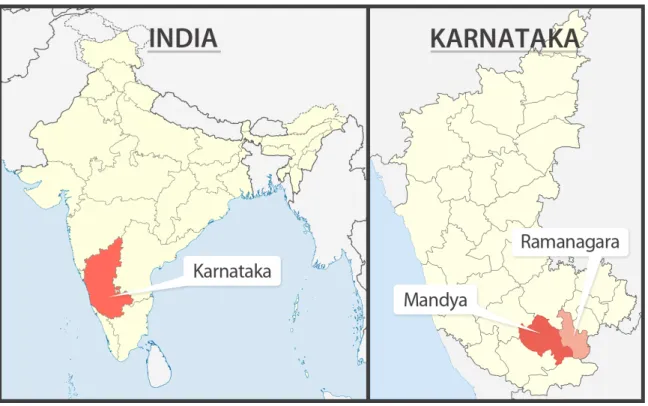
The case study analysed is a CBR program that has been implemented in the Mandya and Ramanagara districts of Karnataka State, India, since 1997 (figure 1). We undertook a large quasi-randomised trial in 265 villages situated in these two districts.
5
Figure 1. Map of the districts under research
Managed by two non-governmental organisations (MOB, Maria Olivia Bonaldo and SRMAB, Sri Raman Maharishi Academy for Blind) the CBR program reached and directly benefited PwD from different age groups and with different types of disabilities both in rural, semi urban and urban areas. The two NGOs have adopted similar methodologies based on CBR guidelines and the CBR Matrix [2] working through trained community CBR workers supported by a supervisor and a project coordinator with a high involvement of PwD through Self-Help Groups (SHGs). We tested for caste, gender, level of disability, type of disability, and wealth and found that these characteristics did not significantly influence participation in the program (data not shown).
Randomisation
We measured the impact of CBR by comparing PwD in three neighbouring districts - Mandya and Ramnagara covered the intervention, while the third housed, Mysore the control sample. In the intervention area the CBR program reached a total of 2,045 villages, including more than 22,000 PwD from 1997 onwards. In intervention areas, a one-stage cluster sample design was drawn in
order to gather the data on PwD, using the villages as first-stage units. Three variables were chosen to stratify the first stage units: the geographical area, the total size of the village and the year the CBR program began. Relying on the results of power analysis based on the expected values for the main outcomes of the study, we set a varying sample fraction ranking from 9% to 50% in different villages, yielding a final sample of 2,352 PwD in CBR areas and 450 PwD in areas not yet covered by the program. In control areas where screening of disability was based on 9 questions [17], the final number of PwD identified through village census was higher than the number obtained from an initial list made by local officers.
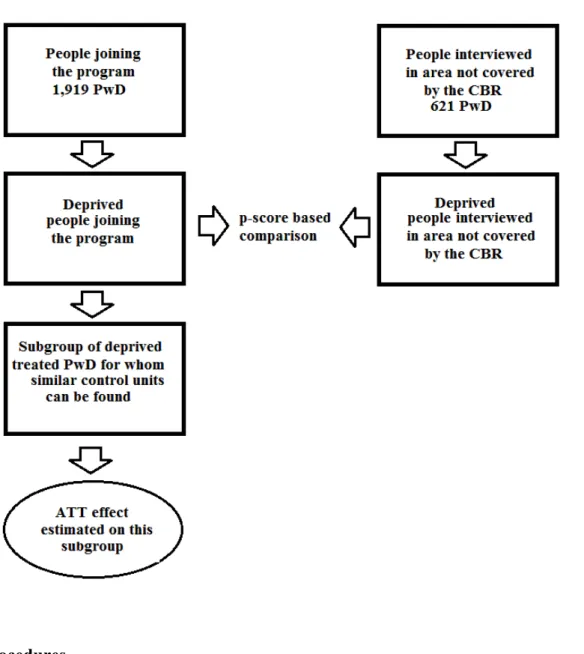
Our final dataset consists of 2,540 respondents including 1,919 beneficiaries (i.e. PwD who joined the CBR program between 1997 and 2009) and 621 controls (i.e. PwD living in villages not yet covered by the program). The average response rate was 91.8%. A comparison between the sampled units and the non-respondents showed no significant differences with respect to the available characteristics. We therefore assumed that unobserved data are missing completely at random [18]. As a result, the estimated effects can be considered unbiased, although a little less efficient because of the reduction of the sample size. The propensity score methodology utilised for data analysis corroborates this assumption, as the results remain unbiased under the less restrictive hypothesis that missingness and the unit’s characteristics are conditionally independent given a set of variables.
7
Figure 2. Randomisation process
Procedures
The present trial is the first component of a larger study composed by: (i) emancipatory research focusing on the mapping of barriers faced by PwD in the communities, their strategies for overcoming these barriers and the role played by the CBR program; and (ii) participatory research to provide in-depth understandings of the key issues to emerge from the first two phases which can be used to adjust CBR activities. Therefore, this research program is compliant with article 30 of the CRPD. The first international meeting of the Advisory and Scientific committee (composed of academics, PwD drawn from Disabled Peoples Organizations in Mandya and Ramanagara, experts from AIFO, local NGOs and social worker representatives) was held in Bangalore in April 2009
following eight months of desk research, several in depth interviews and various focus group discussions. The theoretical framework and tools including various checks were subsequently developed and the supervisor’s manual was prepared. Ethical clearances were obtained from both UCL and AIFO.
A two week training programme covering theoretical, practical and ethical issues, including a brief pilot survey, began in November 2009 for a team of 5 supervisors and 35 enumerators. The surveys were administered in three districts between December 2009 and May 2010. Data entry took place between January and May 2010, followed by database management and elaboration.
Variables
The CBR guidelines mention specific outcomes that can be used for impact assessment. In our study, we selected in collaboration with the scientific advisory committee the outcomes that measure the specific CBR activities offered in Mandya.[2] In the present study we focus on three objective outcomes (i.e., access to pension and allowances, access to mobility and assistive device, and access to paid job) and one subjective outcome based on self perceived personal practical autonomy. These outcomes reflect two of the CBR matrix components: livelihoods, and health and rehabilitation.
A disabled person has specific needs and therefore requires additional resources in order to avoid a life of poverty and deprivation. Such disparities in personal characteristics and circumstances do not merely represent exceptional cases but are widespread: personal circumstances (i.e. gender, age or proneness to illnesses) as well as social and environmental factors such as the surrounding epidemiologic environment can directly or indirectly influence the conversion of personal resources into the freedom to leading lives without unacceptable deprivations.[19]
9
The outcomes we selected have important implications for the quality of life of CBR participants. The opportunity to have a paid job is central to PwD as it provides financial autonomy as well as better recognition within the family and the community, enhancing social inclusion and self-esteem. [11, 20] Access to pensions and allowances similarly advances autonomy and to a lesser extent provides social recognition. Access to aid appliances is central to increase autonomy for people with mobility restriction. The perceived impact of the CBR on individual autonomy is a good indicator of self-esteem and well-being.[11]
Statistical analysis
The framework to identify causal effects is based on potential outcomes. This framework is rooted in the statistical work on randomized experiments by Fisher [21] and Neyman [22], which has been extended by Rubin [14] and others in order to apply it to quasi-randomized studies and other forms of inference. This approach is known as “Rubin’s Causal Model” because it considers causal inference as a problem of missing data, with explicit mathematical modelling of the assignment mechanism as a process for revealing the observed data. [23] The research setting can only be considered experimental if all the PwD in villages reached by the program joined the CBR, and the assignment mechanism of the villages was not correlated to the outcomes of interest. While the latter assumption may be realistic, the former is not, and a straight comparison between units potentially introduces selection bias.[24-26] Propensity score matching was used to address this bias, comparing only PwD in the treatment and control groups who would have had the same estimated value of the outcome variable had they been assigned to the same treatment condition.[13]
The impacts on all variables are calculated over two periods of time, after 4 and 7 years of treatment respectively, in order to capture both short and medium-term effects of the program. The covariates included in the models estimating the propensity score are at both the individual and village level. There are six individual covariates: age, gender, household size, type of disability, level of disability and level of wealth. Since caste and religion often play a significant role in determining access to different services in India, we have included them in our analysis but with a limitation because of their sensitive nature. Limited access to these variables, for treated people only, was possible through the project records of the CBR program. For ethical reasons, and to avoid non response bias, the scientific advisory committee decided not to request this information from the control sample. In order to perform a sensitivity analysis, caste and religion were introduced as covariates in a comparison among PwD joining the program at different times, measuring a two-year effect of the CBR. These results are not affected by the introduction of these covariates, suggesting no caste or religion-based discrimination in accessing CBR programs.
There are five village level covariates: the population size of the village, the presence of a hospital, the presence of a middle school, distance from a main road, and the quality/type of the road that leads to the village.
In order to reduce bias in personal perception in self-report measures (such as personal practical autonomy), we have added a new covariate to the analysis based on a personal score on a vignette [27]
A Kernel-based approach was chosen to match the units. The counterfactual outcome of each unit treated is calculated via a kernel-weighted average of the outcome of all non-treated units, using the distance between units to estimate the weights. This method has been found to produce more robust results compared to one-to-one methods, especially when the number of potential controls is lower than the number of treated unit, as in our study.[28] In order to test the sensitivity of the results to
11
the matching algorithm, the results were recalculated via a nearest-neighbour method, obtaining the same estimated effects and higher standard errors due to the reduced sample size. The nearest-neighbour method can be seen as a particular case of the kernel matching, when all the weight is assigned to the closest propensity.[28]
Results
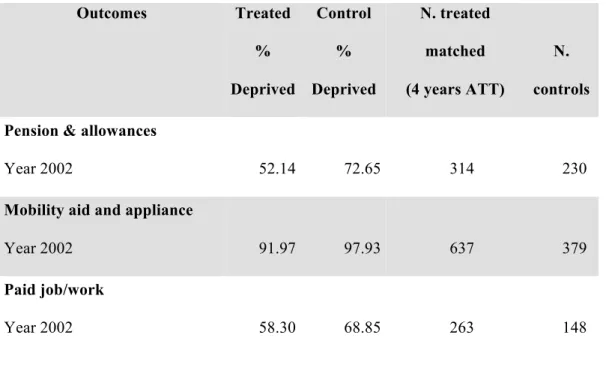
The effect of the CBR program on the quality of life of PwD can be separated into two main components: the effect on non-deprived PwD and the effect on deprived PwD. In this paper we focus on the latter, with table 1 reporting the percentage of deprived PwD for each of the dimensions selected for both the treated group and control sample. For each variable, the effect is estimated for a subgroup of the original sample, since the effect reported in table 2 can be considered an average treatment effect (ATT) on PwD who joined the program and were experiencing a deficit in that specific variable during 2002.
Table 1. Randomisation process
Outcomes Treated % Deprived Control % Deprived N. treated matched (4 years ATT) N. controls Pension & allowances
Year 2002 52.14 72.65 314 230
Mobility aid and appliance
Year 2002 91.97 97.93 637 379
Paid job/work
Personal/practical autonomy
Year 2002 39.88 38.08 265 115
Table 2. Impact evaluation: access to selected dimensions (approximately here)
Outcomes Treated % Improv. Control % Improv. N. treated N. controls Effect % Confidence Interval 95% St. dev t
Pension & allowances
After 4 years 42.80 10.33 314 230 35.2 26.8 - 43.6 0.035 10.102
After 7 years 67.15 38.38 314 230 29.7 22.8 - 36.5 0.046 6.428
Mobility aid and appliance
After 4 years 6.81 1.85 635 379 4.9 2.3 - 7.5 0.012 4.221 After 7 years 9.43 5.80 637 379 4.2 1.4 - 7.1 0.015 2.895 Paid job/work After 4 years 9.15 0.00 261 148 10.7 6.8 - 14.6 0.018 5.878 After 7 years 14.34 1.43 263 148 12.3 7.8 – 16.7 0.019 6.474 Personal/practical autonomy After 4 years 40.29 7.83 264 115 35.4 27.1 –43.6 0.041 8.718 After 7 years 43.40 11.30 265 115 36.2 27.9 - 44.5 0.043 8.453
Kernel Matching method
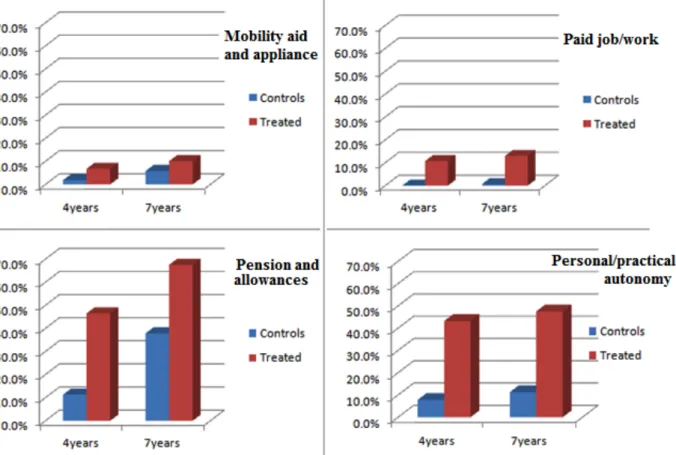
We examined the impact of the CBR program on four outcomes (access to pension and allowances, access to mobility and aid appliances, access to paid job, and personal practical autonomy) at different points in time: at time 0 (before the CBR started) and after 4 and 7 years (Figure 3).
13
In order to obtain meaningful results, we decided to focus on deprived PwD only, excluding those who had already achieved reasonable levels of functioning in a given dimension at time 0. As a result, the causal effects reported in the tables refer to treated PwD experiencing disadvantages in the variable analysed. Although the data in Figure 3 represents estimates of a counterfactual scenario in which deprived PwD did not receive treatment, the CBR program can also have significant impacts on those performing well in one or more of the analysed variables (e.g. by preventing them from worsening their situation).
For variable pension and allowances, the effect of the CBR program is already significant after 4 years, and remains robust after 7 years. People in the control areas seem to need more time to obtain any pension or allowance.
The impact of a paid job is less, but still significant after 4 and 7 years. The effect keeps increasing, suggesting that the impact of jobs is significant over time and long lasting.
The third variable analyses the presence of mobility and aid appliances. Many PwD depend on disability equipment such as wheelchairs and ramps to enable them to participate in daily life and contribute to productive activities.[2] The impact effect on this variable is significant, although small. This is probably due to the difficulty of focusing on those PwD who require specific aid [packages]. The effect decreases slightly after 7 years, which is the point at which control PwD are more likely to obtain their own equipment and appliances.
The final variable is subjective: perceptions of individual autonomy in daily activities (the ability to keep oneself clean and tidy). The results reported in table 1 show that treated PwD who initially lacked personal autonomy benefited from an increased probability of being able to look after themselves of 35%.
Discussion
Our study is the first attempt to evaluate the impact of CBR programs using a quasi-randomised trial. The results show that low-cost community driven CBR programs can improve various aspects of the livelihoods and well-being of PwD by having a positive impact on access to public pension schemes and allowances, paid jobs, mobility aid and appliances, and perceived levels of autonomy in daily life activities. We have also seen that the magnitude of CBR impacts increase with exposure, as the results after 7 years are generally more significant than after 4 years.
15
Our study shares limitations of the propensity score matching approach. This includes the assumption of unconfoundedness according to which the characteristics of the control group are similar to those of pre-treatment participants and the difference in outcomes of this control group can be attributed to the CBR[13].
What is already known
In other CBR studies the focus has been on accessibility, importance of the program, identification of needs and specific outcome (see box). [6, 7, 32] Most of these evaluations are exclusively descriptive, participatory or based on qualitative interviews of a small sample of PwD [7, 29]. Box: CBR in low-income countries
What this study adds
The present research appraises community involvement, assesses coverage of the needs of PwD, and considers economic and social inclusion using WHO’s guidelines and the Capability approach. The range of circumstances in which CBR has successfully improved the quality of life of PwD indicates that CBR workers posses a range of skills and expertise beyond medical proficiency. The most significant impact involved an increase in individual autonomy (independence in daily living) which is the primary tenet of CBR and participation within the households and the community. This contributes to reducing stigmatising attitudes towards PwD and promoting empowerment. Similar findings apply to Botswana, Ghana, the Philippines, Zimbabwe, South Africa and Vietnam [29-32]. Another major impact has been promoting access to employment, which is an essential aspect of social integration and changing attitudes towards PwD, particularly those with mental disabilities. [33].
Policy implication
There are several policy implications. First, our low-cost study, inclusive of all types of disability, and using validated instruments can be applied in other low-income settings to measure the impact of CBR programs in various domains – health, livelihoods, employment, education, social
participation and empowerment. Second, results show that CBR programmes are particularly effective when they complement rather than substitute public policies. Finally, CBR can set in motion virtuous interactions in the communities through social empowerment, fostering new opportunities and lobbing for persons with disabilities’ rights.
17
References
1. ILO, UNESCO, and WHO, CBR: A Strategy for Rehabilitation, Equalization of Opportunities, Poverty Reduction and Social Inclusion of People with Disabilities. Joint Position Paper, 2004, United Nations: Geneva.
2. WHO, et al., based Rehabilitation: CBR Guidelines, Towards
Community-based Inclusive Development, 2010, WHO: Geneva.
3. United Nations, Convention on the rights of persons with disabilities, 2006, United Nations: New York.
4. Tomlinson, M., et al., Research priorities for health of people with disabilities: an expert opinion exercise. Lancet, 2009. 374(9704): p. 1857-1862.
5. Mitchell, R., The research base of community-based rehabilitation. Disability & rehabilitation, 1999. 21(10&11): p. 459-468.
6. Cornielje, H., The Role and Position of Disabled People’s Organisations in Community Based Rehabilitation: Balancing Between Dividing Lines. Asia Pacific Disability Rehabilitation Journal, 2009. 20(1): p. 3-14.
7. Sharma, S., Community participation in community-based rehabilitation programmes. Asia Pacific Disability Rehabilitation Journal, 2007. 18(2): p. 146-157.
8. Finkenflügel, H., H. Cornielje, and J. Velema, The use of classification models in the evaluation of CBR programmes. Disability and Rehabilitation, 2008. 30(5): p. 348-354.
9. Alavi, Y. and H. Kuper, Evaluating the impact of rehabilitation in the lives of people with disabilities and their families in low and middle income countries. A review of tools, 2010, London School of Hygiene and Tropical Medicine and CBM: London.
10. Johnston, S., S. Mendis, and C.D. Mathers, Global variation in stroke burden and mortality: Estimates from monitoring, surveillance, and modelling. The Lancet Neurology, 2009. 8(4):
11. World Health Organization and World Bank, World report on disability, 2011, World Health Organization: Geneva. p. 325.
12. Groah, S.L., et al., Beyond the evidence-based practice paradigm to achieve best practice in rehabilitation medicine: a clinical review. PM & R : the journal of injury, function, and rehabilitation, 2009. 1(10): p. 941-50.
13. Rosenbaum, P.R. and D.B. Rubin, The central role of the propensity score in observational studies for causal effects. Biometrika, 1983. 70(1): p. 41-55.
14. Rubin, D.B., ESTIMATING CAUSAL EFFECTS OF TREATMENTS IN RANDOMIZED AND NONRANDOMIZED STUDIES. Journal of Educational Psychology, 1974. 66(5): p.
688-701.
15. Sen, A.K., Development as Freedom1999, Oxford: Oxford University Press.
16. Trani, J., et al., Disabilities through the Capability Approach lens: Implications for public policies. European Journal of Disability Research, 2011. 5(3): p. 143-157.
17. WHO, International Classification of Functioning, Disability and Health, 2001, World Health Organization: Geneva.
18. Little, R.J.A. and D.B. Rubin, eds. Statistical analysis with missing data. 2002, Wiley: New York.
19. Burchardt, T., Capabilities and disability: the capabilities framework and the social model of disability, 2004, Routledge. p. 735-751.
20. Loeb, M.E., A.H. Eide, and D. Mont, Approaching the measurement of disability prevalence: the case of Zambia. ALTER Revue européenne de recherche sur le handicap, 2008. 2(1): p. 32-43.
21. Fisher, R.A., The causes of human variability. The Eugenics review, 1919. 10(4): p. 213-20.
22. Neyman, J., On the application of probability theory to agricultural experiments: essay on principles. Translated in Statistical Science in 1990, 1923. 1993(5): p. 465-480.
19
23. Holland, P.W., Statistics and causal inference. Journal of the American Statistical Association, 1986. 81(396): p. 945-960.
24. Robins, J.M. and S. Greenland, Adjusting for differential rates of prophylaxis therapy for pcp in high-dose versus low-dose azt treatment arms in an aids randomized trial. Journal of the American Statistical Association, 1994. 89(427): p. 737-749.
25. Sheiner, L.B. and D.B. Rubin, Intention-to-treat analysis and the goals of clinical-trials.
Clinical Pharmacology & Therapeutics, 1995. 57(1): p. 6-15.
26. Barnard, J., et al., A broader template for analyzing broken randomized experiments.
Sociological Methods & Research, 1998. 27(2): p. 285-317.
27. Salomon, J.A., A. Tandon, and C.J.L. Murray, Comparability of Self-Rated Health: Cross Sectional Multi-Country Survey Using Anchoring Vignettes. British Medical Journal, 2004.
328: p. 258-261.
28. Berg, G.D., An application of kernel-based versus one-to-one propensity score matching for a nonexperimental causal study: example from a disease management program evaluation.
Applied Economics Letters, 2011. 18(5): p. 439-447.
29. Kuyini, A.B., A.-R.K. Alhassan, and F.K. Mahama, The ghana community-based rehabilitation program for people with disabilities: what happened at the end of donor support? Journal of Social Work in Disability & Rehabilitation, 2011. 10(4): p. 247-67.
30. Chappell, P. and C. Johannsmeier, The impact of community based rehabilitation as implemented by community rehabilitation facilitators on people with disabilities, their families and communities within South Africa. Disability and Rehabilitation, 2009. 31(1): p.
7-13.
31. Lundgren-Lindquist, B. and L. Nordholm, Community-based rehabilitation-a survey of disabled in a village in Botswana. Disability and Rehabilitation 1993. 15(2): p. 83-89.
32. Sharma, M. and S. Deepak, A participatory evaluation of community-based rehabilitation programme in North Central Vietnam. Disability and Rehabilitation, 2001. 23(8): p.
352-358.
33. Drew, N., et al., Global Mental Health 6 Human rights violations of people with mental and psychosocial disabilities: an unresolved global crisis. Lancet, 2011. 378(9803): p.