WebInEssence: A Personalized Web-Based Multi-Document
Summarization and Recommendation System
Dragomir R. Radev†‡
and
Weiguo Fan§
and
Zhu Zhang†
†School of Information
‡Department of Electrical Engineering and Computer Science
§Business School
University of Michigan
Ann Arbor, MI 48103
radev,wfan,[email protected]
Abstract
In this paper, we present our recent work on the development of a scalable personalized web-based multi-document summarization and recommenda-tion system: WebInEssence. WebInEssence is de-signed to help end users effectively search for useful information and automatically summarize selected documents based on the users’ personal profiles. We address some of the design issues to improve the scal-ability and readscal-ability of our multi-document sum-marizer included in WebInEssence. Some evalua-tion results with different configuraevalua-tions are also pre-sented.
1
Introduction
These days, people are overwhelmed by the large amount of information on the Web. The informa-tion overload problem is worsening at an unprece-dented speed. Take the size of the Internet as an example. The number of web pages on the Internet was 320 million pages in Dec. 1997 as reported by (Lawrence and Giles, 1998), 800 million in Feb. 1999 (Lawrence and Giles, 1999), and more than 1.2 bil-lion in March, 2000 (Censorware, 2000). The num-ber of pages available on the Internet almost dou-bles every year. Similar observations can be made on non-digital media. A recent study (Lyman et al., 2000) showed that the world’s annual output of con-tent is roughly 1.5 million terabytes.
To help alleviate the information overload prob-lem and help users find the information they need, many search engines have emerged (e.g. Google, Fast, AltaVista, etc.). These search engines com-monly build a very large centralized database to in-dex a portion of the Internet: ranging from 50 mil-lion to more than 1.2 bilmil-lion web pages1. Search en-gines do help reduce the information overload prob-lem by allowing a user to do a centralized search, but they also bring up another problem: too many web pages are returned for a single query. To find out which documents are useful, users often have to sift through hundreds of pages to find out that only a few of them are relevant. Research results have
1According to http://www.searchenginewatch.com
shown that search engine users often give up their search in the first try, examining no more than 10 documents, which is what most search engines out-put on the first page (Jansen et al. 2000). We will introduce an effective search engine to summarize clusters of related web pages which provide more contextual and summary information to help users explore the retrieval result more efficiently.
We describe in this paper a system, WebI-nEssence, which blends the traditional informa-tion retrieval technology with advanced document clustering, document recommendation, and multi-document summarization technology in an inte-grated framework.
Text summarization is the process of selecting the most salient information in one or more tex-tual documents. When the input consists of more than one document, we talk about multi-document summarization. Summarization relies on the prin-ciples of text redundancy and unevenly distributed information content to extract highly informative snippets (often keywords or sentences) from a doc-ument which can be read by the userin lieu of the original document(s). In WebInEssence, we have adopted an approach to summarization of multi-ple documents called centroid-based summarization (Radev et al., 2000). Centroid-based summarization of multi-document clusters puts special emphasis on portions of these documents that are most central to the topic of the entire cluster. WebInEssence. Its goal is to provide the user with the essence or gist of what is on the Web without overwhelming them with unnecessary detail. NewsInEssence combines multi-ple strategies to deal with the information overload: search, summarization, clustering, and recommen-dation. We will describe these in the rest of the paper.
1.1 Design Goals
The goal of the system is to provide users every op-portunity to reduce the information overload and do simplified yet effective search and navigation. The system is designed to possess the following features:
• Easy to customize and personalize • High quality search
• Scalable to handle multiple users
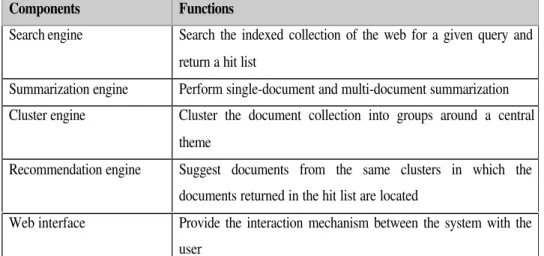
In this paper we will discuss how we achieve the above goals. We also discuss in detail the different components of our system, presented briefly in the following Table.
WebInEssence is highly flexible and can be used in at least four major modes of operation, as shown below.
Generic Search
The system can be used like other search en-gines to support generic search. After the user enters a query, the system will return a hit list of documents that match the query.
Generic Search + Summarization
The system can also enable users to hand se-lect the documents (URLs) that they are inter-ested in and perform single-document or multi-document summarization. This feature allows users to quickly appreciate the contents with-out the further endeavor to browse through each document.
Generic Search + Clustering (+ Recommendation) + Summarization
Besides mode 2, this system also gives a user more flexibility to navigate the hit list. If the user feels that a hit list for a given query is too long and he/she is interested in seeing only a few of them more interesting to him/her, the user can request the system to perform a clus-tering operation on the hit list. The number of items on the hit list will be grouped according to its coherent semantics and the user should be able to quickly identify the interesting clusters he/she may want to look at in more detail. In addition, WebInEssence produces cluster-based summaries of all clusters, and uses the contents of each of the clusters to recommend additional documents to the user.
Personalized Mode
The above three modes give users ample control on the search and browse process. However, users still need to change the parameters ev-ery time for different search sessions. The per-sonalized mode, besides having all the features of the above three modes, enables users to do search, clustering, and summarization just one click away. All of the parameters for the three processes have been stored in a user’s personal profile. Once the user logs in to the system, he/she is right ready to go.
2
Related Work
Our work is related to researches on clustering and summarizing of web search results. We briefly de-scribe some of the related works in this section. Ta-ble 2 summarizes the overall features of their sys-tems. The list is by no means exhaustive, although it highlights the strengths of WebInEssence.
Weiss et al. presented their research on a frame-work for the design of a hierarchical netframe-work search engine that exploits content-link hypertext cluster-ing (Weiss et al., 1996). Their engine can cluster hypertext based on the semantic information embed-ded in hyperlink structures and document contents and group these hypertexts into hierarchies. Their engine also provides an abstraction function that can summarize cluster contents to support scalable query processing. However, the summaries produced by their system are simply in the form of salient key-words/terms for a cluster with the goal of reducing the network engine storage space, not a set of natu-ral language sentences as we have in our system.
Zamir described his experience in developing a dy-namic clustering interface (called Grouper) to web search results (Zamir, 1999), which is essentially a web-based text categorization system. His work shares similar idea with the recent meta-search en-gine Viv´ısimo, although may differ in the implemen-tation details. He utilized a fast clustering algorithm called STC to dynamically cluster post retrieval re-sults from a meta-search engine into clusters labeled by phrases extracted from the search result. The evaluation based on the query log demonstrated that there is a substantial difference in the number of doc-uments followed and in the amount of time and effort expended by users accessing search results between the grouper clustered interface and traditional un-clustered interface. No summarization is provided, except some key phrases are provided for the display of clusters. Our system supports both pre-computed clusters and post retrieval clustering.
Chen, Hearst et al. described a web-based search system called “Cha-Cha” for an Intranet environ-ment (Chen et al., 1999) . It organizes web search results in hierarchies so as to reflect the underlying structure of the Intranet. An “outline” or “table of contents” is created by first recording the short-est paths in hyperlinks from root pages to every page within the web intranet. After the user is-sues a query, these shortest paths are dynamically combined to form a hierarchical outline of the con-text in which the search results occur. Cha-Cha can also provide the page summary for each URL. The summary is basically a keyword-in-context (KWIC) summary, which consists of a sentence from the be-ginning of the document and three sentences con-taining the query terms. KWIC has been shown to be very helpful to provide the contextual
informa-Components Functions
Search engine Search the indexed collection of the web for a given query and return a hit list
Summarization engine Perform single-document and multi-document summarization Cluster engine Cluster the document collection into groups around a central
theme
Recommendation engine Suggest documents from the same clusters in which the documents returned in the hit list are located
Web interface Provide the interaction mechanism between the system with the user
Table 1: System components and their functions
Clustering of
documents Summarization System
Before
retrieval Afterretrieval Single-document Multi-document
Persona-lization Recommen-dation of documents
eSseNSe (our work)
Yes Yes Yes Yes Yes Yes Hypersuit (Weiss et al. 1996) Yes No Keywords No No No Grouper (Zamir 1999) No Yes Keywords No No No Vivísimo3 No Yes Yes No No No
Cha-Cha (Chen et al. 1999) No No Yes No No No InCommonSen se (Amitay, 2000) No No Yes No No No Neto (Neto et al. 2000) Yes No Yes No No No Extractor4 No No Yes No No No 3 http://www.vivisimo.com 4 http://extractor.iit.nrc.ca
Table 2: System feature comparison
tion. No clustering is done in the system. Multi-document summarization is also not supported by their system.
Amitay comes up with a different idea in terms of presenting the search results. Instead of using sentences or text from the original document as the summary, he uses the human annotations collected from the web as the summary for a particular URL. In other words, for a given URL in the search hit list, the links which point to this URL are down-loaded and analyzed following some patterns and rules that have been identified a prior. Some of the human annotations that related to this URL are ex-tracted and filtered. The best one is selected and used as the summary for this URL. A prototype
sys-tem called InCommonSense is implemented to illus-trate his idea (Amitay, 2000). The summary gener-ation process is very unique. But it suffered from the fact that many URLs may not have any human annotations. No clustering is done in his prototype system.
Neto et al. describes a text mining tool that per-forms document clustering and text summarization. They used the Autoclass algorithm to perform doc-ument clustering and used TF*ISF (an adaptation of TF*IDF) to perform sentence ranking and gen-erate the summarization output (Neto et al., 2000). Our work is different from theirs in that we perform personalized summarization based on the retrieval result from a generic personalized web-based search
engine. A more complicated sentence ranking func-tion is employed to boost the ranking performance. The compression ratio for the summary is customiz-able by a user. Both single-document summariza-tion for a single URL and multiple-document sum-marization for a cluster of URLs are supported in our system.
More related work can be found on the Extrac-tor web site2. They use MetaCrawler to perform
web-based search and automatically generate sum-maries for each URL retrieved. They only support single document summarization in their engine and the compression rate of the summarizer is also non-customizable. We not only support both single and multiple document summarization, but also allow the user to specify the summarization compression ratio as well as to get per-cluster summaries of auto-matically generated clusters, which, we believe, are more valuable to online users and give them more flexibility and control of the summarization results.
3
WebInEssence System
Architecture
3.1 Overall architecture
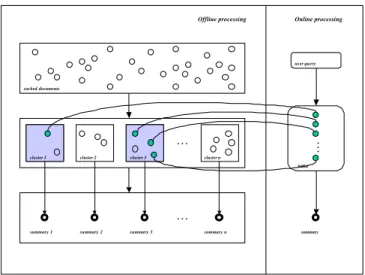
The overall structure of WebInEssence can be seen in Figure 1. The two main stages of operation are shown on the left and right hand side of the figure, respectively. During the offline stage, the system be-haves as a Web-based spider that collects URLs from the Web. These URLs are represented by hollow cir-cles. The clustering component groups these URLs into clusters of lexically related documents (Radev et al., 1999). From each of the clusters, a query-independent multi-document summary in the form of a sentence extract is produced using the MEAD centroid-based algorithm (Radev et al., 2000). Dur-ing the online stage, a user query produces a hit list consisting of documents related to the query. In a dynamic fashion, all pre-computed clusters in which hits (solid circles) appear are extracted and shown to the user along with the rest of the documents from these clusters. In addition to these documents, WebInEssence displays the summaries of each of the pre-computed clusters plus a dynamically-produced summary of the documents selected by the user from the hit list. The shaded square boxes indicate which pre-computed clusters contain hits from the search engine’s results. All URLs in these clusters that are not returned by the search engine are shown to the user as recommendations.
3.2 Search engine
The search component of WebInEssence is a person-alized search engine called MySearch. MySearch uti-lizes a centralized relational database to store all the
2http://extractor.iit.nrc.ca/
URL indexes and other related URL information. Spiders are used to fetch URLs from the Internet. Currently, we query multiple search engines such as Google, AltaVista, and Yahoo for URLs related to “electronic commerce”, “data mining”, “text min-ing”, “search engine”, “online banking” and other internet related keywords. As a result, we have col-lected, indexed, and clustered 22,988 URLs.
The contents of URLs are indexed based on the locations of the keywords: Anchor, Title, and Body. This allows weighted retrieval based on different word positions. For example, a user can specify that he’d like to give a weight 5 for the keyword appear-ing in the title, 4 for anchor, and 2 for body. This information can be saved in his personal profile and used for later weighted ranking.
Besides the weighted search, MySearch also sup-ports Boolean search and Vector Space search. For the vector space model, TF*IDF is used for ranking purpose. We used a modified version of TF*IDF: log(tf+0.5)*log(N/df),where tf means the number of times a term appeared in the content of a URL,N
is the total number of documents in the text collec-tion, and df stands for the number of unique URLs in which a term appears in the entire collection.
A user can choose which search method he wants to use. He/she can also combine Boolean search with Vector Space search. These options are pro-vided to give users more flexibility to control the retrieval results as past research indicated that dif-ferent ranking functions give difdif-ferent performances (Salton, 1989).
3.3 Clustering
WebInEssence uses two types of clustered input – ei-ther the set of hits that the user has selected or the output of our own clustering engine – CIDR (Radev et al., 1999). It uses an iterative algorithm that creates as a side product the so-called “document centroids”. The centroids contain the most highly relevant words to the entire cluster. We use these words to find the most salient “themes” in the clus-ter of documents.
3.4 Finding themes within clusters
One of the underlying assumptions behind WebI-nEssence is that when a user selects a set of hits after reading the single-document summaries from the hit list retrieved by the system, he or she per-forms a cognitive activity whereby he or she picks documents which appear to be related to one or more common themes. The multi-document summariza-tion algorithm attempts to identify these themes and to identify the most salient passages from the se-lected documents using a cluster centroid which is computed automatically from the entire list of hits selected by the user.
…
Offline processing Online processing
…
cluster 1 cluster 2 cluster 3 cluster n
summary 1 summary 2 summary 3 summary n cached documents
hitlist
…
user query
summary
Figure 1: Overall WebInEssence architecture
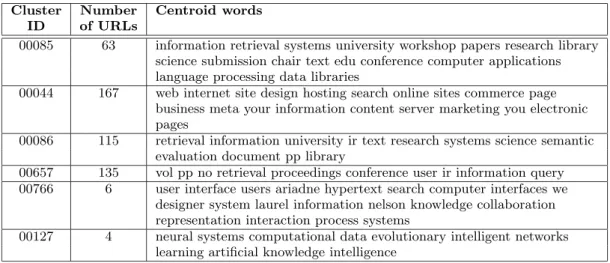
Figure 2 shows the top 6 clusters (and their cen-troids), associated with the query “intelligent & agents”. Each word in a centroid is associated with a salience score. As an illustration, the salience scores for Cluster 00766 are as follows: user (140.53), inter-face (123.89), users (52.71), ariadne (51.41), hyper-text (36.19), search (32.34), computer (28.60), etc.
3.5 Recommendations
The recommendation heuristic that we use is based on the observation that certain documents that are related to the user’s query may not be ranked high by the search engine for lack of appropriate keywords. Instead, such hits may be lexically related to the documents retrieved by the search engine. As a result, for each of the documents retrieved on a given page by the search engine, we display all other documents that are included in the same pre-computed cluster as the hits themselves. The following table illustrates this component of the system. To illustrate the recom-mendation process, suppose that the user’s query is “Linguistics”. Some important documents about Linguistics such as http://www.acm.org/sigir and http://www.departments.bucknell.edu/russian/lan-guage don’t contain the word “linguistics” but, being in the same cluster as documents containing these keywords, are recommended as relevant.
If we use “Linguistics” as the query, and try out different values for the number of hits returned, we notice that the number of clusters increases slowly with the size of the hit list. For example, when the top 40 hits from the search engine are considered, the recommendation system extracts 9 of the pre-computed clusters. These clusters contain a total of 323 documents, of which 40 are already in the hit list. The remaining 283 are sorted and suggested to
the user. Clusters which contain a larger number of documents that are also on the current hit list are shown first.
Number Number Number of URLs
of hits of clusters in clusters
10 3 180 20 5 194 30 6 197 40 9 323 50 11 332 60 13 335 70 15 640 80 18 779 90 22 1092 100 23 1094 · · · · 397 (all hits) 87 3841
Table 3: Recommended URLs as a function of hit list size
3.6 Summarization
The main technique that we use for summarization is centroid-based sentence extraction. We score in-dividually each sentence within a cluster and output those that score the highest. A more detailed de-scription of the summarizer can be found in (Radev et al., 2000). The input to the summarization com-ponent is a cluster of documents. These documents can be either the result of a user query or the output of CIDR or a pre-computed cluster.
The summarizer takes as input a cluster ofd doc-uments with a total ofn sentences as well as a com-pression ratio parameterr which indicates how much of the original cluster to preserve. The output con-sists of a sequence of [n * r] sentences from the
orig-Cluster Number Centroid words ID of URLs
00085 63 information retrieval systems university workshop papers research library science submission chair text edu conference computer applications language processing data libraries
00044 167 web internet site design hosting search online sites commerce page business meta your information content server marketing you electronic pages
00086 115 retrieval information university ir text research systems science semantic evaluation document pp library
00657 135 vol pp no retrieval proceedings conference user ir information query 00766 6 user interface users ariadne hypertext search computer interfaces we
designer system laurel information nelson knowledge collaboration representation interaction process systems
00127 4 neural systems computational data evolutionary intelligent networks learning artificial knowledge intelligence
Figure 2: Sample centroids inal documents in the same order as the input
doc-uments. The highest-ranking sentences are included according to the scoring formula below:
Si=wcCi+wpPi+wfFi
In the formula,wc,wp,wf are weights. Ci is the
centroid score of the sentence, Pi is the positional
score of the sentence, andFi is the score of the
sen-tence according to the overlap with the first sensen-tence of the document.
3.7 Centroid value
The centroid value Ci for sentence Si is computed
as the sum of the centroid values Cw of all words in
the sentencei. For example, the phrase “hypertext
user interface” gets a score of 300.61 which is the sum of the individual centroid values of the words (hypertext = 36.19, user = 140.53, and interface = 123.89).
Ci =P
wcw
3.8 Positional value
The positional value is computed as follows: the first
sentence in a document gets the same score Cmax
as the highest-ranking sentence in the document ac-cording to the centroid value. The score for all sen-tences within a document is computed according to the following formula:
Pi = (n−i+1)
n ∗maxi(Ci)
3.8.1 First-sentence overlap
The overlap value is computed as the inner prod-uct of the sentence vectors for the current sentence
i and the first sentence of the document. The
sen-tence vectors are the n-dimensional representations of the words in each sentence whereby the value at
positioni of a sentence vector indicates the number
of occurrences of that word in the sentence.
Fi=S~1S~i
3.8.2 Combining the three parameters
A discussion of the ways to combine the different parameters is included in (Radev and Fan, 2000).
4
User Interface
We describe in this section the interface design is-sues. A sample search query “intelligent & agents” will be used to illustrate the overall search, cluster-ing and summarization process.
The search process begins with the user’s formu-lation of information need (request) as a query. The search result is displayed in order of decreasing rel-evance to the original query. Since the search result interface means to provide a user with more contex-tual information about the relevancy information for the hit list, the following information is provided by WebInEssence to accomplish this:
• The number of URLs found to be potentially
relevant
• The number of URLs shown on each page
• The relevance score for each URL in the hit list
• The contextual information (keywords,
ab-stract, summary) for each URL
• The choice of different ranking criteria
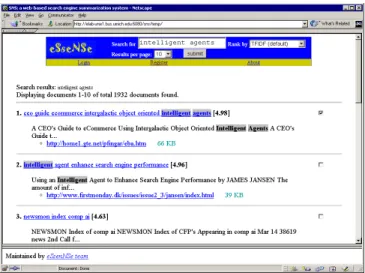
A sample user query and search result is shown in Figure 3.
After the user gets back the search hit list, he/she may find some of the URLs very interesting and would like to know further about the central theme for these URLs. The user could click on each of the URLs and go through them individually. But this
process will be very time-consuming when the num-ber of interesting URLs is large. For the above situa-tion, the summarization engine comes into play. Af-ter a user selects the documents that are of inAf-terest to him/her, he/she can submit his/her summariza-tion request, the URLs selected by a user for sum-marization will be highlighted in a separate table. Meanwhile, our system also provides more control options for users to choose in terms of the summa-rization process:
• Summary length: the percentage of the size of the original URLs.
• Suppress repeated information: sentences from the same or different documents that are too close lexically are shown only once.
• Different order scheme: the sentences used for the produce of summary can be ordered by dif-ferent schemes, such as, position, time sequence, relevance to the query, etc.
The final summary generated by the summariza-tion system preserves the contextual informasummariza-tion, e.g., the URLs for which the summary is generated for. Similarly as in the search process, it should also give the user more detailed information about the summarization process. Such information includes:
• How many sentences are contained in the URLs selected
• The summary length
• The relevance or ordering score for each sen-tence
Summarization is very helpful for users to absorb large quantities information. But it may still con-tain too much information (too many URLs) or few relevant URLs (they expect more similar relevant URLs). Take the “intelligent & agents” query as an example. There are total 369 results returned. It’s very tedious for a user to navigate page by page to go through each of the URLs and select those for summarization. Instead, he/she may like to group these URLs into disjoint groups according to their semantics. This could not only reduce the informa-tion navigainforma-tion space, but also bring up more se-mantically related URLs. The clustering engine is deigned to address this issue. Two options, for the moment, are provided for the user to control the clustering process:
• Cluster only the current page
• Cluster the entire search result
The first option is designed for those users who have time constraints to go through the entire search result but still want more relevant URLs similar to ones in the current page. The number of clusters
returned for this option is normally very low, vary-ing from 1 to 4 clusters for a result set of 10 URLs. For the rest of the users, option 2 is provided to dramatically reduce the navigation space for the en-tire search result. For example, the total number of clusters generated for those 369 URLs for the query “intelligent & agents” is only 73, much smaller than the total number of 369.
To help users quickly identify clusters that are more relevant to them, various contextual informa-tion is provided for each cluster as shown in Figure 4. These information include:
• Keywords: the keywords are extracted from the centroid of each cluster as described in Sec-tion 3.4. These are the first-tier context infor-mation to help judge the relevance.
• Summary: multi-document summarization is automatically applied to each cluster to gener-ate the summary. These are the second-tier con-text information for relevance judgment. Note that the number of the sentences for each sum-mary may be large, only the top three sentences are displayed for each cluster. The user can click on “full summary” to view the full contents of the summary.
• URLs within a cluster: the top 5 URLs from each cluster is shown for the user. Some of them are also shown in the original hit list, these URLs are marked as “original from search hit list”. Others that are not in the original hit list are marked as “new from cluster”. These new URLs serve as recommendations from the cluster engine and may help users to find more relevant information from within a cluster. The user can click on “more from this cluster” to ex-amine the full list of the URLs within a cluster.
• Cluster score
In order to help users quickly glimpse the size of each cluster, we also provide a cluster score (third-tier context information) for each cluster. This is defined as
The number of URLs in a cluster that are also in the original search hit list
The total number of URLs in a cluster For example, a cluster score “19/63 = 0.30” means that there are total 63 URLs in this clus-ter, among which 19 are also in the original search hit list. That is 30 percent of the URLs in the cluster are in the original hit list. This may help users to decide which cluster is more worthwhile to examine further.
One of the unique features of WebInEssence is in the personalization. Most of the control parameters
can be stored in a user’s personal profile and are reusable throughout the search and summarization process.
5
Discussion
5.1 Statistics on the different components
of the system
From the entire collection of 22,998 documents, we extracted 6,113 clusters ranging from 1 to 676 doc-uments. For each cluster, we computed a 5% multi-document summary. These summaries range from 1 to 13 sentences in length.
5.2 Sample summary produced by the
system
To illustrate the types of summaries produced by WebInEssence, we enclose the first four sentences of the summary for cluster 00018. The sentences in the summary are sorted according to the order in which they appear in the input documents, that is, they are not sorted by decreasing score. Clus-ter 00018 contains 122 documents and its centroid contains the following words: mining (84.54), data (64.13), knowledge (14.25), discovery (11.98), adver-tised (11.20), databases (9.69), information (6.98), research (6.96), analysis (6.95), text (6.05), patterns (5.30), algorithms (4.39).
5.3 Scalability
To improve the scalability of the search engine, we have taken several measures to make it more scalable to handle realistic multiple user access.
• Caching documents
All documents retrieved and indexed by WebI-nEssence are cached locally and the local copies are used in the summarization process unless these documents have changed on the Web.
• Multithreading
WebInEssence employs a fast multi-threading web server to handle multiple user simultaneous access. We monitored the memory consumption of server thread and optimized the total num-ber of server threading processes based on the current constraints of our hardware. Depends on the system load, and traffic of our website, server replication scheme may also be employed to boost the performance.
• Caching query results
For each search query submitted to the search engine, the search result is automatically cached. When a new query comes in, we first check the cache for the availability of the search result. This works for our current system sta-tus where the document collection is relatively
static. New schemes must be designed, like re-ducing the caching time to 24 hours, to deal with the dynamic document collection.
• Compressed data representation
We employed compressed data representation similar to the implementation of Google (Brin and Page, 1998) to store the inverted index in-formation. For the 22,988 documents for a to-tal size of 320MB that we downloaded, we used only 70 MB for the inverted indexing. The auxiliary information about the URLs is about 67MB.
• Caching clustering results
Although we give the user an option to clus-ter selected URLs on the fly, we pre-compute all clusters from the entire collection of indexed URLs. As a result, if the user chooses one of the options “cluster all hits” or “cluster the cur-rent page”, we can also provide the subsets of the precomputed clusters that correspond to the current hit list.
• Caching summaries
All summaries of the pre-computed clusters are similarly pre-computed and stored. They are retrieved as cluster summaries after the re-trieval stage.
5.4 Improving Readability
Several measures were taken to improve the read-ability of the search result:
• Keyword in context
The keyword used for the query is automati-cally highlighted on all the contextual informa-tion: URLs, abstract. This will help the user to quickly decide the possibility of the relevancy of each URL.
• Different color schemes for different types of in-formation
Different colors were used for display of various types of information. For example, the file size is shown in light green, hyperlinks are shown in blue.
5.5 Improving Usability by Personalization
Personalization is employed throughout the system to improve the usability of our system. A personal profile is created for each user only after the user chooses to register. The registered user will have more flexibility to control their entire information seeking process.
For example, a user can specify his own criteria of weighted information retrieval. Recall that in weighted information retrieval, different weights are assigned for different types of tags: <title> <anchor> <body>. A weight of 5 for title, 2 for anchor, 1
Figure 3: Sample user query and resulting hit list
Figure 4: Clustering output
for body means that the keywords appeared in the title is 4 times more important than those in the body. Similarly, the keywords appeared in the an-chor is 1 times more important than those in the body. As shown in the previous experiment results section, different ranking function gives totally dif-ferent search results. The personal profile enables a user to store his/her preference into the profile and enjoy more accurate search results tailored to his/her own need.
6
Future work and Conclusion
6.1 Future work
The main limitations in our system will be addressed in a future release of WebInEssence. These include the personalization of the multi-document summa-rization component to take into account the user
query and the uniformization of the user interfaces used by the different components.
6.2 Conclusion
In this paper, we presented what we believe is the first multi-document summarization and document recommendation system (called WebInEssence) de-ployed on the Web. We discussed how clusters of related Web pages are produced and summarized as a group. We concluded with an empirical evaluation of our system.
References
E. Amitay. 2000. Incommonsense - rethinking web search results. In Proceedings of IEEE In-ternational Conference on Multimedia and Expo
Text Mining is a new and exciting research area that tries to 183.73 solve the information overload problem by using techniques from
data mining machine learning information retrieval natural-language understanding case-based reasoning statistics and knowledge management to help people gain insight into large quantities of semi-structured
or unstructured text
Current Projects - Aims The Data Mining Program has 156.56 two projects: DMITL - Data Mining in the Large Conducting
practical case studies for clients involving the analysis of large and complex data sets ParAlg – Parallel Algorithms The main computing facility for these projects consists of a secure multiprocessor Sun E4000
The DMITL project aims to develop knowledge and techniques relevant 163.78 to the data mining of large and complex datasets using high performance
computers
Megaputer develops software and solutions for data mining text 188.96 analysis and knowledge discovery in databases
Figure 5: Sample summary produced WebInEssence.
http://www.ics.mq.edu.au/ einat/publications/-ieee multimedia2000.pdf.
S. Brin and L. Page. 1998. The anatomy of a large-scale hypertextual web search engine. In Proceedings of the WWW7 conference, Aus-tralia. http://www7.scu.edu.au/programme/full-papers/1921/com1921.htm.
Censorware. 2000. http://www.censorware.org/web size. M. Chen, M. Hearst, J. Hong, and J. Lin. 1999.
Cha-cha: A system for organizing intranet search results. InProceedings of the 2nd USENIX Sym-posium on Internet Technologies and SYSTEMS (USITS), Boulder, CO, October 11-14.
S. Lawrence and C. L. Giles. 1998. Searching the world wide web. Science, 280(3):98–100.
S. Lawrence and C. L. Giles. 1999. Accessibility of information on the web. Nature, 400:107–109. P. Lyman, H. R. Varian, J. Dunn, A. Strygin, and
K. Swearingen. 2000. How much information. http://www.sims.berkeley.edu/how-much-info/. J. L. Neto, A. D. Santos, C. A. A. Kaestner, and
A. A.Freitas. 2000. Document clustering and text summarization. InProceedings of 4th Int. Confer-ence on Practical Applications of Knowledge Dis-covery and Data Mining (PADD-2000), pages 41– 55. London: The Practical Application Company. Dragomir Radev and Weiguo Fan. 2000. Automatic summarization of search engine hit lists. In Pro-ceedings, ACL Workshop on Recent Advances in NLP and IR, Hong Kong, October.
Dragomir R. Radev, Vasileios Hatzivassiloglou, and Kathleen R. McKeown. 1999. A description of the CIDR system as used for TDT-2. InDARPA Broadcast News Workshop, Herndon, VA, Febru-ary.
Dragomir R. Radev, Hongyan Jing, and
Malgo-rzata Budzikowska. 2000. Summarization of mul-tiple documents: clustering, sentence extraction, and evaluation. In ANLP/NAACL Workshop on Summarization, Seattle, WA, April.
R. Weiss, B. Velez, M. A .Sheldon, C. Man-prempre, P. Szilagyi, A. Duda, and D. K. Gif-ford. 1996. Hypursuit: A hierarchical net-work search engine that exploits content-link hy-pertext clustering. In Proceedings of the Sev-enth ACM Conference on Hypertext, Washington, DC. http://www.psrg.lcs.mit.edu/publications/-Papers/hypertabs.htm.
O. E. Zamir. 1999. Clustering Web Documents: A Phrase-Based Method for Grouping Search Engine Results. Ph.D. thesis, University of Washington, http://www.cs.washington.edu/homes/zamir/.