R E S E A R C H
Open Access
Time domain averaging and correlation-based
improved spectrum sensing method for
cognitive radio
Shenghong Li
1*and Guoan Bi
2Abstract
Based on the combination of time domain averaging and correlation, we propose an effective time domain averaging and correlation-based spectrum sensing (TDA-C-SS) method used in very low signal-to-noise ratio (SNR)
environments. With the assumption that the received signals from the primary users are deterministic, the proposed TDA-C-SS method processes the received samples by a time averaging operation to improve the SNR. Correlation operation is then performed with a correlation matrix to determine the existence of the primary signal in the received samples. The TDA-C-SS method does not need any prior information on the received samples and the associated noise power to achieve improved sensing performance. Simulation results are presented to show the effectiveness of the proposed TDA-C-SS method.
Keywords: Cognitive radio; Spectrum sensing; Time domain averaging; Correlation
1 Introduction
Cognitive radio (CR) networks allow unlicensed (or sec-ondary) users to opportunistically exploit the underuti-lized spectrum bandwidth of the licensed (or primary) users. Spectrum sensing is a key operation performed by the CR networks to determine the spectrum holes of the spectrum allocated to a primary user. In the literature, several kinds of typical spectrum sensing methods have been reported, including energy detection methods [1,2], matched filter detection methods [3,4], and cyclostation-arity feature detection methods [5]. The energy detection methods need the prior knowledge of noise power and are vulnerable to the noise uncertainty. The matched fil-ter detection methods need to know the waveform of the primary user in advance. The methods of cyclostationar-ity feature detection require the information on the cyclic frequencies of the primary user. The prior knowledge requirements of these methods often limit their realis-tic applicability. To avoid these undesirable requirements,
*Correspondence: [email protected]
1Department of Electronic Engineering, Shanghai Jiao Tong University, Dongchuan Road, Shanghai 200240, China
Full list of author information is available at the end of the article
some new statistical covariance-based methods for spec-trum sensing in additive i.i.d white noise environments have been proposed [6-8]. These reported methods do not need the prior information about the signal and the noise power to achieve a sensing performance in a low signal-to-noise ratio (SNR) environment of -22 dB. How-ever, these methods assume that the primary user’s signal is a stationary random process and that all the received data samples contain the primary user’s signal if it exists. In fact, most existing spectrum sensing methods require the last assumption. In fact, it is very possible that only a part of the received samples in practice contain the sig-nal from the primary user or a part of or all the received samples are from some signals that are not stationary. For example, the initial transient signal, known as fingerprint of a wireless device [6], from the primary user is not sta-tionary. If such samples are used, the methods reported in [7-9] will lose the supporting prerequisite and become unusable. Even in the cases that these required assump-tions are valid, it is difficult for the methods in [7-9] to obtain the theoretical sensing performance in lower SNR environments when the number of the received samples available is limited.
To overcome these problems and support more effective sensing in low SNR environments, we propose an effec-tive time domain averaging and correlation-based spec-trum sensing (TDA-C-SS) method based on time domain averaging and correlation for spectrum sensing in addi-tive i.i.d white noise environments. Similar to the meth-ods reported in [7-9], the proposed TDA-C-SS method does not need any aforementioned prior information and achieve desirable sensing performance in very low SNR environments. The TDA-C-SS method assumes the sig-nal from the primary user to be deterministic. By making use of time domain averaging, the SNR of the received samples is increased. Then, the task of spectrum sensing is obtained by performing the correlation operation. Sim-ulation results from various environments are presented to show the effectiveness of the proposed TDA-C-SS method.
The rest of this paper is organized as follows. Section 2 describes the system model and sampling operations to obtain the input sample sequence. Section 3 gives the pro-posed TDA-C-SS spectrum sensing method. Simulation results and discussions are presented in Section 4. Finally, conclusion is drawn in Section 5.
2 System model and sampling description
In a duration, [t1,t2], of spectrum sensing, letz(t)be the continuous-time signal received by the secondary user. The process of the spectrum sensing is regarded as a two-hypotheses-test problem at a time duration, [t1,t2], i.e., H0: the primary signal is absent and H1: the primary signal is present, described by
zc(t)= the i.i.d white noise with a zero mean and a variance represented byδ2.
Let us be interested in the frequency band with central frequencyf0and a narrow bandwidthW. The signalzc(t) defined in (1) is sampled at a frequencyfs ≤ Lmul(f0+ W/2), where,Lmulis a large constant, for example,Lmul=
100. The choice of such values offsandLmulis for the pur-pose of time domain averaging in our propur-posed method, which is to be described in Section 3. The two hypotheses in (1) are then expressed as
z(n)= difficult to implement the sampling process because the available high speed samplers can support up to several tens of GHz [10-12]. Therefore, we should suitably select the value off0+W/2 to allow an appropriate large value of Lmul possible. It is also possible to use down conver-sion process [12] to generate the received samples when the value off0+W/2 is very high.
3 The proposed spectrum sensing method
The proposed TDA-C-SS method treats the samples of the primary users to be deterministic. It firstly averages the received data samples in the time domain to increase SNR (or reduce the noise) then obtains the spectrum sensing by means of correlation operations.
3.1 Sample time domain averaging
Time domain averaging is an effective method to decrease noise power for periodic signal detection [13] (and therein [13]). For the obtained data sample sequence z(n),n∈[ 1,N0] , the time average operation is defined by
e(n)=
M
j=−Mz(n·Lmul+j)
2M+1 n=1,. . .,N (3) whereMis a small positive integer, for example, M=5, and N=[N0/Lmul].
If the samples from the primary users are treated as deterministic ones,fsisLmultimes off0+W/2 andMis easily obtain the following from (2):
whereω(n)can be considered as the samples of the i.i.d denotes the variance of a random variable. It can be eas-ily proved that the SNR of the sequence produced by the time averaging process is increased by 10lg(2M+1)dB. If M=5, for example, the SNR of the time averaged output is increased by about 10 dB. This gain in SNR is very valu-able for effective spectrum sensing in the environment of strong noise.
3.2 Correlation operation and sensing decision
Similar to the method in [7], let us perform the correla-tion operacorrela-tion on the input samples and make a decision on the signal presence of the primary user based on a con-structed correlation matrix. Being different from that in [7], however, the correlation used here is to be discussed from the view point of deterministic signal samples.
Let us consider the correlation defined by re(i) = N1
It is noted that the samples from the i.i.d white noise, ωc(t) , which has a zero mean and a variance of δ
2
2M+1, the product of s(nLmul)ω(n − i) are the samples from mutually independent random variables with a zero mean and a variance of s2(nLmul)δ2
2M+1 . Therefore, based on the central limit theorem, it is concluded that the term
1
N
N
n=1s(nLmul)ω(n − i) in (6) can be treated as a sample sequence of a Gaussian random variable g ∼ N(0,(2M+δ21)N2 according to statistics theory, it is also noted that when N→ ∞, (5) or the last term in (6) satisfies
where E[·] is the expectation operation. Finally, the first term in (6), i.e. N1 Nn=1s(nLmul)s((n − i)Lmul), i = 1, 2, 3,. . .are usually not identically zero whens(n) is a deterministic sample sequence.
Let us construct anL×Lcorrelation matrix in the same form as that in [6], i.e.,
Note that we have tested Pd versus L by experiments, and the experiment results show that whenL ≥ 10, Pd is not affected greatly by L, as a result, we choose the integer L = 10 for the purpose of lower computation complexity. Based on the previous analysis ofre(i)values, apparently, the sensing test statistics and decision poli-cies of the computer-assisted videodensitometry (CAV) method and the GCBA method in [7] are still applicable for our method. For the sake of simplicity, here, we use the test statistics and decision policy of the CAV method in [7], i.e., the test statistics is defined by [7]
T =
wherernmis the element located in the nth row and mth column of the matrixRe. With a positive threshold value
λ, the sensing decision for the primary signal is made by
T > λ Present T ≤λ Absent 3.3 The TDA-C-SS Method
Based on the discussion above, we propose the an improved spectrum sensing method as follows.
Step 1: sample the received signal at frequencyfsto obtain the discrete samplesz(n),n=1, 2,. . .,N0.
Step 2: for a given value ofM, calculate e(n),n=1, 2,. . .,Nby (3).
Step 3: for a given value ofL, calculate
re(i),i=0, 1,. . .,L−1, and construct the matrixRe in (7).
Step 4: calculateT in (8), and properly choose the value ofλfor the sensing decision.
ofT in (8), the threshold value,λ, is selected to meet the requirement ofPf.
3.4 Performance analysis of the proposed TDA-C-SS From the description above, it is seen that the proposed TDA-C-SS method does not need any prior information about the waveform and the cyclic frequencies of the primary user’s signal and the noise power, which is sim-ilar to those methods in [7-9]. In contrast, our proposed method is also valid when only part of the received sample sequence contain the primary user’s signal, which is the main different from those in [7-9] that assume that the pri-mary user’s signal is a stationary random process and that all the received samples must contain the primary user’s signal. Therefore, the proposed method is more general and flexible.
By the averaging operation in the time domain, the proposed TDA-C-SS method is able to achieve an SNR improvement by 10lg(2M + 1) dB compared with the CAV method in [7] for the same values of N and L. Therefore, the proposed one is expected to improve the sensing performance substantially particularly in low SNR environments.
4 Simulations
In this section, simulation results are reported for the fol-lowing three signal settings in the AWGN environments to verify the effectiveness of the proposed method.
Case I: the signal from the primary user is stationary. During spectrum sensing, all the received samples contain the signal of the primary user.
Case II: the signal from the primary user is stationary. During spectrum sensing, only a part of the received samples contain the signal of the primary user. Case III: the signal from the primary user is not stationary.
For comparison, we also present the simulation results of the CAV method [6] applicable for case I. For all the simulations, the values of thresholdλare chosen by the computer simulation approach described previously, and 1,000 Monte Carlo runs are carried out to estimate the value ofλ.
4.1 Simulation for case I
We use a wireless microphone signal generated by the method in [14] with the following parameters: central fre-quencyf0=100 MHz, bandwidthW =36.8 KHz. Based on the discussion in Section 2, the sampling frequencies used for the proposed TDA-C-SS method and the CAV method are fs = 10.3 GHz ≥ Lmul(f0 +W/2), where, Lmul=100, andfs=103 MHz≥f0+W/2, respectively.
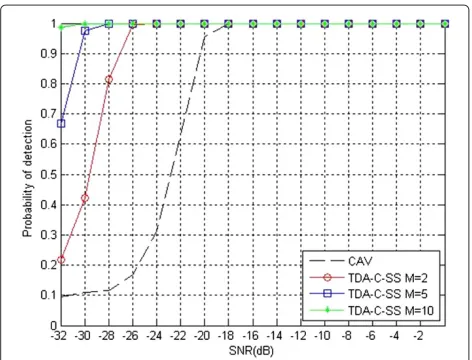
Figure 1 illustrates the detection probabilityPd versus SNRs with Pf = 0.1,L = 10,N = 50, 000. Figure 2 presents the detection probability Pd versus the false
Figure 1Pdcurves versus SNR for case I.
alarm probability,Pf, with SNR = −30 dB,L = 10,N = 50, 000, for the proposed TDA-C-SS method, with dif-ferent values ofM, and the CAV method. From Figures 1 and 2, it is seen that under the same conditions, the detection performance of the proposed method is better than that of the CAV and can be improved further with increase ofM. In addition, Figure 1 shows that, compared with the CAV method, the TDA-C-SS method achieves the improvement on the sensing performance by about 10lg(2M+1)dB in SNR. To achievePd=0.985, the values of the SNR needed by the CAV method and the TDA-C-SS withM=2, 5, and 10 are−18.5,−26,−29.3, and 32.2 dB, respectively.
4.2 Simulation for case II and case III
In case II, the received sample sequence is 45, 000 zero-valued signal samples followed by 5,000 wireless microphone signal samples that are generated in case I.
The segment of zero-valued signal samples is included for the frequently observed situation in which the pri-mary user begins to occupy its channel after the secondary user has monitored the channel for certain period of time. The sampling frequency for the TDA-C-SS method is fs = 10.3 GHz. For case III, we use a fingerprint sig-nal, which is generated by using the unit-step response of a second-order RLC parallel circuit described by a differential equation:
d2il(t) dt2 +2σ
dil(t) dt +w
2 0il(t)=
1 LfCf
is(t)
withLf = 10−8,Cf = 10−10,R = 0.08,σ = R/2Lf = 4, 000, 000,w0 = 1/LfCf = 109. The fingerprint sig-nal has the central frequency f0 = 160 MHz and the bandwidthW = 8 MHz. The sampling frequency for the TDA-C-SS method isfs = 16.4 GHz ≥ Lmul(f0+W/2), where,Lmul=100.
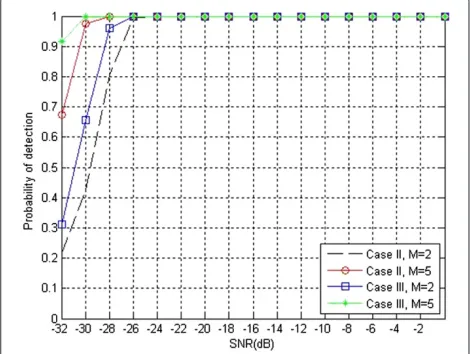
It is not reasonable to use the CAV method because the signals used in case II and case III are not stationary. Therefore, we only verify the effectiveness of the proposed TDA-C-SS method. Figures 3 and 4 give, respectively, detection probability versus SNRs for the two cases with Pf = 0.1,L = 10,N = 50, 000, and the detection probabilityPd versus the false alarm probabilityPf with SNR= −30 dB,L=10,N=50, 000. From these figures, it is seen that the TDA-C-SS method is still effective because this method does not consider the properties of the received signal. Similarly, the detection performance can be improved further with the increased value ofM.
5 Conclusion
In this paper, an improved spectrum sensing method, TDA-C-SS, based on time domain averaging and correlation
Figure 3Pdversus SNR obtained by the TDA-C-SS method for case II and case III.
Figure 4Pdcurves versusPfof the TDA-C-SS for case II and case III.
has been proposed. The time domain averaging process has been typically used to decrease the noise effects, and correlation matrix has been constructed to decide the existence of the primary user’s signal. In comparing with other reported method, such as CAV method, the pro-posed one can sense a primary user’s signal in the white noise environment in very low SNR environments with-out requiring any prior knowledge abwith-out the signal and noise power. In particular, the proposed method is flexible to effectively sense the signals that are not stationary. Our simulation results have shown the desirable advantages of the proposed methods.
Competing interests
The authors declare that they have no competing interests.
Acknowledgements
This work is funded by the National Science Foundation of China (61271316, 61071152), 973 Program (2010CB731403, 2010CB731406, 2013CB329605) of China, Chinese National ‘Twelfth Five-Year’ Plan for Science & Technology Support (2012BAH38 B04), Key Laboratory for Shanghai Integrated Information Security Management Technology Research, and Chinese National
Engineering Laboratory for Information Content Analysis Technology.
Author details
1Department of Electronic Engineering, Shanghai Jiao Tong University,
Dongchuan Road, Shanghai 200240, China.2Information Engineering School of EEE, Nanyang Technological University, 50 Nanyang Ave, Singapore 639798, Singapore.
Received: 20 November 2013 Accepted: 16 January 2014 Published: 4 April 2014
References
1. D Cabric, SM Mishra, RW Brodersen, Implementation issues in spectrum sensing for cognitive radios, inProc. Asilomar Conf. Signals, Syst. Computers (Pacific Grove, CA, USA, 2004), pp. 772–776
2. A Sahai, D Cabric, Spectrum sensing: fundamental limits and practical challenges, inIEEE Int. Symp. New Frontiers DySPAN(Baltmore, Maryland, USA, 2005), pp. 1–90
4. HS Chen, W Gao, DG Daut, Signature based spectrum sensing algorithms for IEEE 802.22 WRAN, inProc. IEEE Int. Conf. Communications (ICC) (Glasgow, Scotland, UK, 2007), pp. 6487–6492
5. N Han, SH Shon, JO Joo, JM Kim, Spectral correlation based signal detection method for spectrum sensing in IEEE 802.22 WRAN systems, in Proc. Intern. Conf. Advanced Commun. Technology(Phoenix Park, South Korea, 2006), pp. 1765–1770
6. JY Xu, HS Zhang, Detection to primary user based on radio frequency fingerprint in cognitive radio, inProc. Intern. Cong. Image and Signal Processing (CISP)(Tianjin, China, 2009)
7. Y Zeng, YC Liang, Spectrum-sensing algorithms for cognitive radio based on statistical covariance. IEEE Trans. Veh. Technol.58(4), 1804–1815 (2009) 8. Y Zeng, YC Liang, Eigenvalue-based spectrum sensing algorithms for
cognitive radio. IEEE Trans. Commun.57(6), 1784–1793 (2009) 9. Y Zeng, YC Liang, R Zhang, Blindly combined energy detection for
spectrum sensing in cognitive radio. IEEE Signal Process. Lett. 15, 649–652 (2008)
10. T Lecklider, Raising the B/W bar to 32 GHz. Eval. Eng.49(6), 34 (2010) 11. YJ Zhao, YH Hu, HJ Wang, Enhanced random equivalent sampling based
on compressed sensing. IEEE Trans. on Instrum. Meas.61(3), 579–586 (2012)
12. R Lopez-Valcarce, G Vazquez-Vilar, Wideband spectrum sensing in cognitive radio: joint estimation of noise variance and multiple signal levels, inIEEE International Workshop on Signal Processing Advances for Wireless Communications (SPAWC 2009)(Perugia, Italy, 2009), pp. 96–100 13. M Pini, DM Akos, Exploiting GNSS signal structure to enhance
observability. IEEE Trans. Aerospace Electron. Sys.43(4), 1553–1565 (2007) 14. Y Zeng, YC Liang, Performance of eigenvalue based sensing algorithms
for detection of DTV and wireless microphone signals, inIEEE 802.22-06/186r0(Phoenix Park, South Korea, 2006)
doi:10.1186/1687-6180-2014-46
Cite this article as:Li and Bi:Time domain averaging and correlation-based
improved spectrum sensing method for cognitive radio.EURASIP Journal on Advances in Signal Processing20142014:46.
Submit your manuscript to a
journal and benefi t from:
7Convenient online submission 7 Rigorous peer review
7Immediate publication on acceptance 7 Open access: articles freely available online 7High visibility within the fi eld
7 Retaining the copyright to your article