_____________________________________________________________________________________________________
*Corresponding author: E-mail: [email protected], [email protected];
The Effectiveness of
Pistia stratiotes
as
Phytoremediation Agents in Reducing Lead (Pb)
Levels in Batik Household Industrial Wastewater in
Bakaran Village, Central Java-Indonesia
Khabibatulloh Dewi Kaswari Ratna
1and Isworo Slamet
1*1
Environmental Health Study Program, Faculty of Health, Dian Nuswantoro University Semarang, Central Java, Indonesia.
Authors’ contributions
This work was carried out in collaboration between both authors. This research was conducted at the Laboratory for health and testing of medical devices, Central Java and the health laboratory, Dian Nusantara University in collaboration between authors KDKR and IS. Author KDKR conducted the research design, analyzed the results of the study and wrote the initial draft script. Author IS administered the research analysis and administered the literature search and administered corrections to the draft final research report. Both authors read and approved the final draft of this article.
Article Information DOI: 10.9734/AJOB/2020/v10i430126 Editor(s): (1)Dr. Farjana Sultana, International University of Business Agriculture and Technology (IUBAT), Bangladesh.
Reviewers: (1)Alexandre Ricardo Pereira Schuler, Universidade Federal de Pernambuco, Brazil. (2)Luciano Silva Sena, Universidade Federal do Piauí, Brazil. Complete Peer review History:http://www.sdiarticle4.com/review-history/64057
Received 15 September 2020 Accepted 28 December 2020
Published 11 January 2021
ABSTRACT
Background and Objectives: The Bakaran Batik industry is engaged in domestic textiles in Juwana district, Indonesia. The wastewater produced by the burnt batik is discharged into the environment without going through any prior treatment. Therefore, an effective and easy-to-implement processing technology is needed by the community. Phytoremediation technology is an effort to treat waste that is proven to be effective and easy to implement. This study aims to determine the effectiveness of the Pistia stratiotes in reducing Lead (Pb) levels in batik wastewater.
Methodology: The method used in this research is the type of experimental research. The
research method is True Experimental with Post-test Only Control Group Design. The statistical test used is One Way Anova and linear regression test to determine the rate of degradation.
Results: showed that the Pistia stratiotes was effective in reducing lead levels of Lead (Pb) from an initial concentration of 0.042 ppm to 0.022 on a day for 48 hours, the speed of degradation was based on the linear equation - 0.0108x + 0.048, R² = 0.8526 in the treatment with Pistia stratiotes 50 grams, whereas in the 75 grams and 90 grams the Lead (Pb) concentration was not detected.
Conclusions: Phytoremediation with the biological agent Pistia stratiotes is quite effective in degrading Lead (Pb) -containing batik waste.
Keywords: Phytoremediation; Pistia stratiotes; lead (Pb); degradation; batik liquid waste.
1. INTRODUCTION
Batik cloth is a legacy of the Indonesian nation and the wealth of the Indonesian nation. Batik is used as an identity and national identity which is the embodiment of cultural diversity which has unique symbolic values and has high aesthetic value for all Indonesian people [1].
The batik industry in Bakaran Juwana village has become the largest center for written batik craftsmen in Pati Regency so that it is a special attraction for the economy of the people of Pati Regency, especially the Juwana community, but the increasing demand for batik production can also have a negative impact on environmental issues [2]. The batik industry is also an industry that uses a lot of water in its production, which results in looking for waste at the end of the production process. Batik industrial waste is a series of waste products that are no longer used, especially in the washing process. Liquid waste in the batik production process contains heavy metals such as Pb, Cr, Cu and others. The use of water in the household batik-making process is estimated at an average of 25 - 50 m3 per meter of batik cloth [3].
Lead or Plumbum (Pb) is a heavy blackish metal that is used as a constituent in industry, paint, batteries, and is currently widely used in the manufacture of gasoline. Heavy metal Lead (Pb) can also cause acute poisoning of the human nervous system through the intake of Lead (Pb) which is contaminated in food [4]. Contamination by heavy metal Lead (Pb) cannot be broken down through natural processes and very difficult to decompose (presistent). therefore an effective way to reduce the heavy metal content of Lead (Pb) is by means of phytoremediation technology [5]. Phytoremediation is an effort to restore polluted environmental conditions by utilizing biological agents (plants). Utilization of plants that have hypercumulator properties in specific
heavy metals which can be used for the phytoremediation of wastewater [6]. Pistia stratiotes is a hyperaccumulator plant to absorb heavy metal Pb. Pollutants that are remediated include heavy metals, in this case Lead (Pb). The
Pistia stratiotes is a plant that belongs to water weeds, and can be used as a
phytoremediation plant to absorb and stabilize toxins, such as heavy metals found in batik liquid waste [7].
This research is a case study of phytoremediation by utilizing Pistia stratiotes as a biological agent in reducing the concentration of Lead (Pb) in household batik waste in Bakaran Village, Central Java.
2. RESEARCH METHODS
This research was conducted from September to October 2020. The instrument used for the phytoremediation study of Lead (Pb) levels was Atomic absorption spectrometer (AAS) AMT 3800 series [8]. The examination was carried out at the Laboratory for Health and Medical Device Testing, Semarang. The material used in this study is the household batik industrial waste water in the Bakaran Kulon Juwana village. The Pistia stratiotes samples were obtained from a pond owned by the residents of Sidoarum village. Then the acclimatization process is carried out, which is a process of adjusting or adapting the plants to be used in the new planting medium, and the surrounding conditions, the acclimatization process for three days. Before the acclimatization stage, the Pistia stratiot was first cleaned of dirt and then the acclimatization stage was carried out. After the acclimatization process was carried out for 3 days, the Pistia stratiot was weighed with a weight of 50 gr, 70 gr, and 90 g for the variety of research needs. The Pistia stratiote is weighed then transferred to a container that already contains batik liquid waste. The Pb level test in the batik waste
sample was carried out on the second, fourth, and sixth day and then tested in the laboratory. This study used a completely randomized design with a true experimental method with post-test only control group design [9].
3. RESULTS AND DISCUSSION
Most of the batik industry in Bakaran Kulon Village does not have sewage treatment plants due to limited space and costs, so the batik wastewater is discharged into open waterways. This causes ecological isturbances to the surrounding environment, especially pollutant lead (Pb) pollution which is quite dangerous because it is bioaccumulated and biomagnified.
Therefore it is necessary to reduce the lead pollutant (Pb) contained in the batik industry wastewater through phytoremediation technology.
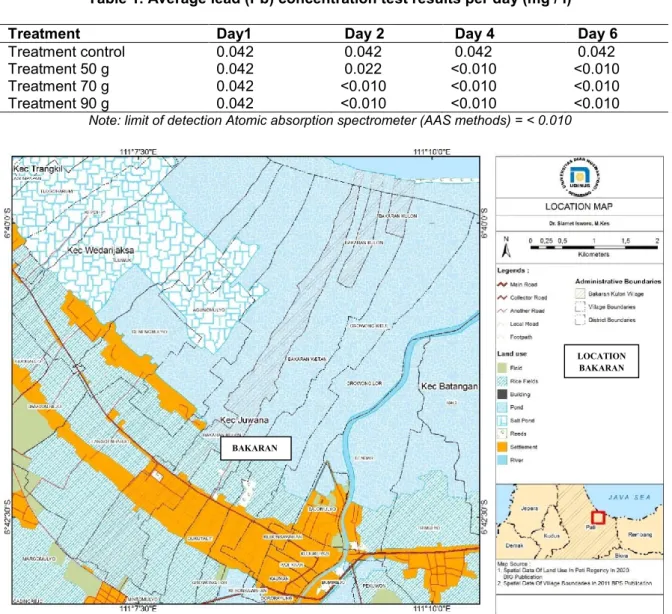
Phytoremediation research on Lead (Pb) levels was carried out on batik liquid waste as a control (before processing) and after processing it by giving weight variations on the Pistia stratiot. Table 1 shows the results of the lead content analysis lead (Pb) , as follows:
Fig. 1 shows a graph of the degradation of Lead (Pb) concentrations and a linear equation model based on the rate of reduction in Lead (Pb) concentration by Pistia stratiotes based on each treatment
Table 1. Average lead (Pb) concentration test results per day (mg / l) Treatment Day1 Day 2 Day 4 Day 6
Treatment control 0.042 0.042 0.042 0.042 Treatment 50 g 0.042 0.022 <0.010 <0.010 Treatment 70 g 0.042 <0.010 <0.010 <0.010 Treatment 90 g 0.042 <0.010 <0.010 <0.010
Note: limit of detection Atomic absorption spectrometer (AAS methods) = < 0.010
Fig. 1. Location of Bakaran village
BAKARAN
LOCATION BAKARAN
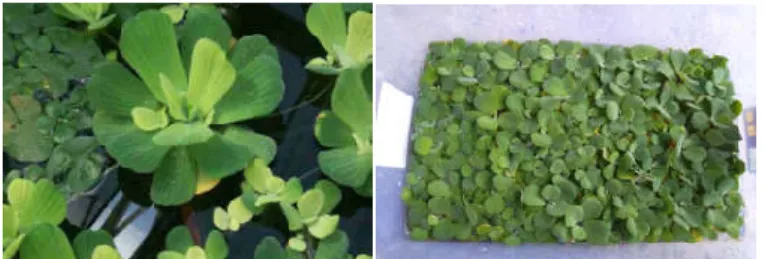
The picture 2 is Pistia stratiotes used in phytoremediation research, as follows: (research documentation)
Based on Table 1. In all treatments, namely treatment 50 g, treatment 70 g and treatment 90 g showed a decrease in the concentration of Lead (Pb), it was shown that all equations had a negative value. (y= -0.02 x + 0,062/ 50 gr, -0,032 x + 0,074 / 70 gram and -0,032 x + 0,074 / 90 gram). However, only treatment with a sample weight of 50 grams can be detected by the atomic absorption spectrometer, namely a decrease in the concentration of Lead (Pb) on the 2nd day from a concentration of 0.042 mg/l t o 0.022 mg/l, while on the 4th day and the concentration of Lead (Pb) not detected. (exceed detection limit). In the 70 gram and 90 gram treatments, the lead concentration (Pb) was not detected. The possibility of concentration resulting from phytoremediation is so small that the detection limit of the atomic absorption spectrometer cannot be reached.
This shows that the Lead (Pb)concentration has been completely degraded, with the linear equation model y = 0.02 x + 0.62. In the 3rd and 4th treatments with sample weights of 70 and 90 grams, it was shown that on day 2 the Lead (Pb) concentration was not detected (exceeding the
detection limit), this shows that the Lead (Pb) concentration has been degraded by the linear equation model y = - 0.32 x + 0.074. The linear equation shows that the rate of Lead (Pb) degradation is better at 70 gram and 90 gram treatments. The more or the weight of the Pistia stratiot as a remediator agent, the faster the lead pollutant (Pb) degradation process will be [10].
The result of the effectiveness test shows that the weight (number) of Pistia stratiot as a remediator agent affects the phytoremediation process. Table 2,as follow:
Table 2. Degradation efficiency of Pistia stratiotes
No Treatment Lead (Pb) (%)
1. 50 gram 95.40%
2. 70 gram 100 %
3. 90 gram 100 %
Analysis of Table 2 shows that the greater the number or weight of Pistia stratiotes plants, the faster the phytoremediation process. More and more metabolic processes in plants will cause the speed of degradation of pollutants by plants to be faster [11].
Fig. 2. Result of measurement of lead (Pb) (mg/lt)
y = 0.042 y = -0,02x + 0,062 y = -0,032x + 0,074 y = -0,032x + 0,074 -0.005 0.010 0.015 0.020 0.025 0.030 0.035 0.040 0.045
Day 1 Day 2 Day 4 Day 6
Result of measurement of Lead/Pb (mg/l)
Series1 Series2 Series3 Series4
Fig. 3. Pistia stratiotes
Fig. 4. Chlorosis in Pistia stratiotes
The absorption mechanism of Lead (Pb)in batik liquid waste is carried out by the root tips of the Pistia stratiotes. Substances that are absorbed by the roots will enter the stem through the xylem vessels, which are then passed to the stems and then the leaves through the photosynthetic mechanism [12].
Metabolism in the test plant will be disrupted if the pollutant (Lead (Pb)) is absorbed excessively and will cause chlorosis [13]. Pistia stratiotes that have absorbed Lead (Pb) will try to prevent poisoning by accumulating these toxins in certain organs, such as roots, which will be translocated into the tissues and enter the xylem, but if the load of Lead (Pb)is very high it disrupts metabolism and can cause plant death. The leaves will change color gradually, the color change on the leaves turns yellowish and brownish, this is called a symptom of chlorosis [14]. Symptoms of chlorosis in plants are caused by exposure to high Lead (Pb) for a long time, thus inhibiting the action of enzymes that catalyze chlorophyll synthesis [15]. his can be seen from the leaves in the test sample which are yellow and brownish.
4. CONCLUSION
The Pistia stratiotes is effective in reducing the Lead (Pb) content in the wastewater of batik. And the weight difference in the Pistia stratiotes affects the reduction of the lead (Pb) content in the batik wastewater.
DISCLAIMER
The products used for this research are commonly and predominantly use products in our area of research and country. There is absolutely no conflict of interest between the authors and producers of the products because we do not intend to use these products as an avenue for any litigation but for the advancement of knowledge. Also, the research was not funded by the producing company rather it was funded by personal efforts of the authors.
AVAILABILITY OF DATA
All datasets generated or analyzed during this study are included in the manuscript.
ACKNOWLEDGEMENTS
Researchers would like to thank the Laboratory for health and testing of medical devices, Central Java and the health laboratory, Dian Nusantara University.
COMPETING INTERESTS
Authors have declared that no competing interests exist.
REFERENCES
1. Aprianto AC. The patterns and philosophy of batik bakaran in Bakaran village,
Juwana, Central Java. Unika Soegijapranata Semarang; 2017.
2. Sanders J. Awareness of environmental impacts of batik industry. A Case Study of Central Java, Indonesia; 2020.
3. Jayanti TB, Surya R. Early studies on potencies of sub-district administration of juwana, district pati, Central Java. In: The 3rd International Conference On Engineering Of Tarumanagara (Icet) 2017 “Smart Engineering For Future Cities”.2018;395.
4. Lin CH, Hsu YT, Yen CC, Chen HH, Tseng CJ, Lo YK, et al. Association between heavy metal levels and acute ischemic stroke. J Biomed Sci. 2018;25(1):49.
5. Gul I, Manzoor M, Kallerhoff J, Arshad M. Enhanced phytoremediation of lead by soil applied organic and inorganic amendments: Pb phytoavailability, accumulation and metal recovery. Chemosphere. 2020;258:127405.
6. Hosman ME, El-Feky SS, Elshahawy MI, Shaker EM. Mechanism of phytoremediation potential of flax (Linum usitatissimum L.) to Pb, Cd and Zn. Asian J Plant Sci Res. 2017;7(4):30–40.
7. Chandra S, Gusain YS, Bhatt A. Metal hyperaccumulator plants and environmental pollution. In: Microbial Biotechnology in Environmental Monitoring and Cleanup. IGI Global; 2018;305–17.
8. Premarathne H, Udagedara T, Young SM. AAS ctrophotometer; 2019.
9. Muhdhar MHI Al, Sari MS, Indriyanti DP, Sueb, Rahmansyah MS. Phytoremediation
liquid waste krebet sugar factory using water spinach (Ipomoea aquatica) to decrease BOD and COD levels. In: AIP Conference Proceedings. AIP Publishing LLC. 2020;40037.
10. Abatenh E, Gizaw B, Tsegaye Z, Wassie M. The role of microorganisms in bioremediation-A review. Open J Environ Biol. 2017;2(1):30–46.
11. Rahayu FR. Efektifitas tumbuhan jeruju (acanthus ilicifolius) dalam mengabsorbsi zat pencemar LAS (Linier Alkylbenzene Sulfonate) dengan adanya logam berat (Pb dan Cd). UIN Sunan Ampel Surabaya; 2020.
12. Nur F, Slamet I. The phytoremediation of Echinodorus palaefolius (Water Jasmine) in reducing BOD and COD of liquid waste-Batik Industry" X" in Pekalongan. GSC Biol Pharm Sci. 2020;12(3):215–22. 13. Mhiret WN. Association and variation on
boll and seed morphology among hybrids between linseed (Linum usitatissimum L.) and Linum bienne Mill. and their parents. African J Plant Sci. 2019;13(6):138–52. 14. Egendorf SP, Groffman P, Moore G,
Cheng Z. Pistia stratiotes that have absorbed Pb will try to prevent poisoning by accumulating these toxins in certain organs, such as roots, which will be translocated into the tissues and enter the xylem, but if the load of Pb is very high it disrupts metabolism. Int J Phytoremediation. 2020;22(9):916–30. 15. Nas FS, Ali M. The effect of lead on plants
in terms of growing and biochemical parameters: A review. MOJ Eco Env Sci. 2018;3(4):265–8.
_________________________________________________________________________________
© 2020 Ratna and Slamet; This is an Open Access article distributed under the terms of the Creative Commons Attribution License (http://creativecommons.org/licenses/by/4.0), which permits unrestricted use, distribution, and reproduction in any medium, provided the original work is properly cited.
Peer-review history:
The peer review history for this paper can be accessed here: http://www.sdiarticle4.com/review-history/64057