July 1, 2015◆Volume 92, Number 1 www.aafp.org/afp American Family Physician 35 GEORGE G.A. PUJALTE, MD, Mayo Clinic Health System, Waycross, Georgia
SHIRLEY A. ALBANO-ALUQUIN, MD, Pennsylvania State University College of Medicine, Hershey, Pennsylvania
W
hen a patient presents with pain in multiple joints, the pain can originate from the joint (true arthritis); the adjacent structures, such as bone, tendon, or bursa; or from psychogenic/metabolic factors, such as depression or hypothyroid-ism. Once arthritis is suspected, physicians should distinguish between noninflamma-tory and inflammanoninflamma-tory forms of arthritis while recognizing potentially disabling and life-threatening problems.Conditions with polyarthritis are often accompanied by synovitis. On the other hand, conditions that cause pain outside of the joints are considered when there is no apparent joint inflammation. Nearly 50% of patients with polyarticular pain will have unclassifiable conditions; these patients may not need medications and may go into remis-sion within one year.1 However, patients with unclassifiable conditions may benefit from medications for symptomatic relief.
Patient History
The first step in the diagnosis is to determine the onset and timing (acute vs. chronic) of symptoms. Acute symptoms last from hours to two weeks, whereas symptoms are
considered chronic after two weeks. The pattern of chronic symptoms should be classified as intermittent or constant (fluctu-ating from mild, moderate, or severe) to help identify the behavior of the inflammatory process, possible triggers, and concurrent problems.
The pattern of joint involvement is pro-filed by assessing symmetry, and number and types of joints involved. A symmet-ric pattern affects both sides of the body as opposed to an asymmetric pattern, which has a spotty distribution. Possible condi-tions are classified based on number of joints affected: pauciarticular pattern (two to four joints) vs. polyarticular pattern (five or more joints). The spondyloarthropathies are classically pauciarticular, whereas rheu-matoid arthritis (RA) is usually polyarticu-lar. However, spondyloarthropathies, such as psoriatic arthritis, may also present in a polyarticular manner, whereas RA may ini-tially affect just a few joints.
The size and kind of joints involved also provide major diagnostic clues. For instance, spondyloarthropathies often involve the spine, including sacroiliac joints and medium/large joints, such as the shoul-ders, hips, knees, and ankles. Smaller joint Polyarticular arthritis is commonly encountered in clinical settings and has multiple etiologies. The first step is to distinguish between true articular pain and nonarticular or periarticular conditions by recognizing clinical patterns through the history and physical examination. Once pain within a joint or joints is confirmed, the next step is to clas-sify the pain as noninflammatory or inflammatory in origin. Noninflammatory arthritis, which is mostly related to osteoarthritis, has a variable onset and severity and does not have inflammatory features, such as warm or swollen joints. Osteoarthritis usually presents with less than one hour of morning stiffness and pain that is aggravated by activity and improves with rest. A review of systems is usually negative for rashes, oral ulcers, or other internal organ involvement. In contrast, inflammatory arthritis generally causes warm, swollen joints; prolonged morning stiffness; and positive findings on a review of systems. Once inflammatory arthritis is suspected, possible diagnoses are sorted by the pattern of joint involvement, which includes number and type of joints involved, symmetry, and onset. The suspicion for inflammatory arthritis should be confirmed by the appropriate serologic/tissue and/or imaging studies in the clinical setting or in consultation with a subspecialist. (Am Fam Physician. 2015;92(1):35-41. Copyright © 2015 American Academy of Family Physicians.)
CME This clinical content conforms to AAFP criteria for continuing medical education (CME). See CME Quiz Questions on page 16.
Author disclosure: No rel-evant financial affiliations.
Downloaded from the American Family Physician website at www.aafp.org/afp. Copyright © 2015 American Academy of Family Physicians. For the private, noncom-mercial use of one individual user of the website. All other rights reserved. Contact [email protected] for copyright questions and/or permission requests.
36 American Family Physician www.aafp.org/afp Volume 92, Number 1 ◆July 1, 2015
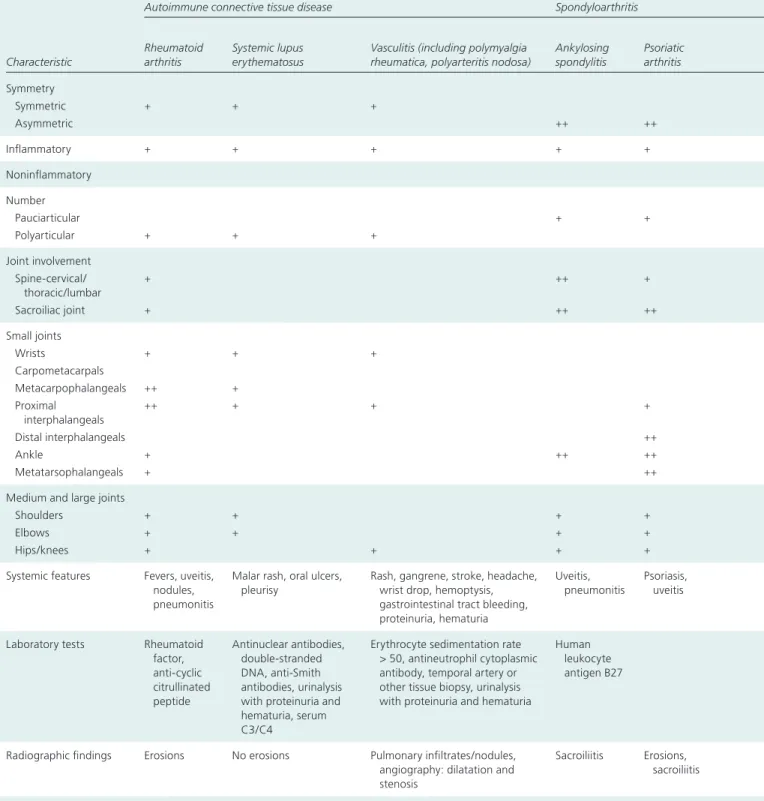
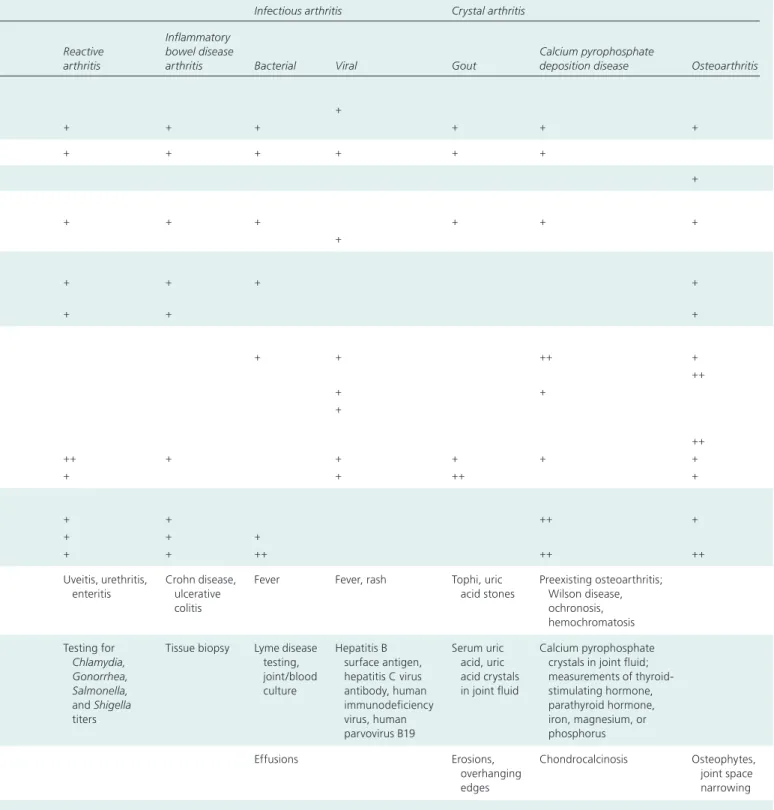
involvement, such as the wrists, fingers, and toes, is more consistent with RA and lupus. Table 1 summarizes clini-cal patterns that are helpful in the diagnosis of polyar-ticular arthritis.2-6
INFLAMMATORY AND NONINFLAMMATORY ARTHRITIS Arthritis can be divided into two broad categories: inflammatory and noninflammatory (degenerative arthritis). The presence of joint swelling, erythema, prolonged morning stiffness (more than one hour), and symmetric pain even at rest is suggestive of inflamma-tory conditions.3-6 On the other hand, weight bearing and movement worsens the pain of noninflammatory arthritis conditions, such as osteoarthritis. Noninflam-matory arthritis typically causes less than one hour of morning stiffness. Weight-bearing joints in the lower extremities are likewise more commonly involved in an asymmetric pattern. A symmetric presentation suggests an underlying inflammatory arthritis condition.2
Signs of systemic inflammation include rashes (e.g., psoriasis, photosensitivity), oral and genital ulcerations, Raynaud phenomenon, serositis with pleurisy and peri-carditis, sicca symptoms of dry eyes and dry mouth, eye inflammation, bowel inflammation, neurologic symptoms, and ischemic symptoms (including stroke). These signs are integral in correctly diagnosing systemic inflammatory arthropathy.
OTHER CAUSES OF JOINT PAIN
Neurologic causes of pain may be determined by char-acterization; apart from numbness and burning pain, the pain is unlikely to worsen with joint movement and is likely to worsen at night. Combinations of causes might make characterization of pain difficult. For example,
a neurologic cause of pain might be combined with a rheumatologic cause, leading to mixed characteristics.
Extra-articular symptoms can help narrow the diag-nostic options. For example, weakness may be a sign of neuromuscular disease, whereas dry mouth, dry eyes, Raynaud phenomenon, pleuritic chest pain, nasal ulcers, oral ulcers, alopecia, adenopathy, or rash might suggest systemic inflammatory rheumatologic conditions. Con-stitutional symptoms such as weight loss, night sweats, fever, and fatigue are also more common with systemic illnesses.
Patient history, including social history, can provide further insight into the patient’s physiologic state. This includes identifying comorbid conditions that might increase the pain burden, such as diabetes mellitus with complications of neuropathy; depression; polypharmacy and use of medications that can cause arthritis, such as in drug-induced lupus arthritis; exposure to ticks that can cause Lyme disease in an endemic area; or exposure to hepatitis C, parvovirus, or human immunodeficiency virus, which can lead to viral arthritis.3 The history should also include surgical procedures, fractures, and trauma. The patient’s exercise capabilities or ability to perform activities of daily living should be assessed. EMERGENT CONDITIONS
In general, emergent conditions involving the joints present acutely and should be recognized promptly. Septic arthritis typically involves a large joint such as the knee,3 but can affect several joints and is accompa-nied by malaise, weight loss, fever, and swollen and/or warm joints.3 Other conditions include neuropathies, radiculopathies, or myelopathies, which cause numb-ness or a burning pain, (e.g., cauda equina syndrome); SORT: KEY RECOMMENDATIONS FOR PRACTICE
Clinical recommendation
Evidence
rating References
Joint swelling, erythema, prolonged morning stiffness (more than one hour), and symmetric pain even at rest are suggestive of inflammatory conditions.
C 3-6
Noninflammatory and inflammatory conditions can be differentiated with C-reactive protein and erythrocyte sedimentation rate tests; however, in the acute phase, erythrocyte sedimentation rate is less reliable than C-reactive protein.
C 7, 8
In the diagnosis of gout, a high serum uric acid level has little diagnostic value. The standard of diagnosis is the presence of intracellular monosodium urate crystals on polarized microscopy.
C 14, 15
Osteoarthritis is noninflammatory; is typically pauciarticular; and often involves the spine and weight-bearing joints, such as the hips and knees.
C 3-6
A = consistent, good-quality patient-oriented evidence; B = inconsistent or limited-quality patient-oriented evidence; C = consensus, disease-oriented evidence, usual practice, expert opinion, or case series. For information about the SORT evidence rating system, go to http://www.aafp.org/afpsort.
July 1, 2015◆Volume 92, Number 1 www.aafp.org/afp American Family Physician 37
compartment syndrome, with joint pain exceeding what would be expected based on physical examination find-ings; and sepsis or infection.
Physical Examination
The presence of the cardinal signs of inflammation on physical examination, such as erythema, warmth, swell-ing, and tenderness, confirms inflammatory arthritis.3,4 Noninflammatory arthritis may also present with swell-ing and tenderness, but does not cause erythema or warmth. Periarthritis in the contiguous structures, such as the tendons, ligaments, and bursa, should also be dif-ferentiated using physical examination findings. Nonar-ticular conditions, such as muscular injuries, tendinitis, or bursitis, present with a normal passive range of motion and reduced active range of motion, with the latter usu-ally caused by pain. On the other hand, joint abnormali-ties, synovitis, and soft tissue contractures (e.g., frozen shoulder) present with reduced passive and active range of motion. Increased pain with active or resisted range of motion also suggests processes that involve the mus-cles, tendons, and bursa. During evaluation of range of motion, crepitation without warmth or erythema sug-gests a degenerative process, such as osteoarthritis.
Systemic autoimmune diseases are associated with organ system involvement in addition to arthritis. For instance, fine inspiratory rales suggest interstitial lung disease, a complication of RA; pleuropericardial friction rubs occur with lupus; and parotid gland enlargement accompanies Sjögren syndrome.3 Mucocutaneous dis-orders, sarcoidosis, cancer, pseudogout, gout, podagra, systemic lupus erythematosus (SLE), vasculitis, Still dis-ease, post–enteric infection reactive arthritis, and infec-tious arthritis may all present with fever.3
Once the history and physical examination are com-plete, the clinician can usually establish whether the pain is truly articular and whether the condition is inflam-matory or noninflaminflam-matory. Further management should be directed toward refining the specific arthritis diagnosis, instituting therapy, and possibly facilitating subspecialty consultations (i.e., orthopedic surgery, reha-bilitation, neurology, or rheumatology). Rheumatology consultation may be appropriate even for nonclassifiable conditions because seronegative inflammatory arthritis is fairly common, and identifying these conditions in the primary care setting may be challenging.
Laboratory Tests
ANTINUCLEAR ANTIBODY
SLE without antinuclear antibodies comprises less than 2% of cases; therefore, SLE is unlikely in a patient with
polyarthritis who tests negative for the antibodies. Conversely, many rheumatic conditions can be associ-ated with antinuclear antibodies; therefore, a positive test result does not always correlate with SLE, especially in a patient who lacks other specific clinical criteria.2,3 The higher the titer of antinuclear antibodies, the greater the chance of autoimmune disease. A diagnosis of SLE becomes more likely when a high ANA titer is accom-panied by more specific autoantibodies for lupus, such as anti–double-stranded DNA and anti-Smith antibod-ies. Sjögren syndrome may be present with any autoim-mune illness, or it may be the primary diagnosis with dry eyes, dry mouth, and titers positive for anti–Sjögren syndrome A and B antibodies.3
ERYTHROCYTE SEDIMENTATION RATE AND C-REACTIVE PROTEIN
Noninflammatory and inflammatory conditions can be differentiated using C-reactive protein and erythrocyte sedimentation rate (ESR) tests, which are nonspecific for inflammation.7 Rheumatic, malignant, and infectious conditions, and allergic reactions might cause these lev-els to be elevated; therefore, these tests are not diagnos-tic.7 Because abnormal red cells might affect the ESR, it is less reliable in the acute phase than the C-reactive pro-tein test.8,9 Other noninflammatory conditions, includ-ing dysproteinemia, hyperlipoproteinemia, diabetes, and kidney problems, can lead to an elevated ESR and should be considered.7 The ESR level varies between men and women, and increases with age. The normal upper limit for ESR is calculated as age plus 10 divided by two for women, and age divided by two for men.
A normal ESR also does not preclude rheumatic dis-ease. In one series, 3% of patients with RA had normal ESR findings.10 However, when clinical presentation and physical examination findings point to a specific diagno-sis, an ESR result that is compatible with that diagnosis may help support an inflammatory diagnosis. For exam-ple, a markedly increased ESR in an older individual with shoulder and hip pain might lead to a diagnosis of poly-myalgia rheumatica; however, the diagnosis should not be discounted entirely if the ESR is within normal limits. RHEUMATOID FACTOR AND ANTI–CITRULLINATED PEPTIDE ANTIBODIES
Anti–citrullinated peptide antibody levels are more spe-cific for RA and correlate with erosive disease. Rheuma-toid factor is a nonspecific immunoglobulin that is also detected in chronic infections, such as hepatitis C, tuber-culosis, and infective endocarditis, and in autoimmune disorders such as paraproteinemias, vasculitis, or SLE
Table 1. Clinical Patterns of Polyarticular Arthritis
Characteristic
Autoimmune connective tissue disease Spondyloarthritis Infectious arthritis Crystal arthritis
Rheumatoid arthritis
Systemic lupus erythematosus
Vasculitis (including polymyalgia rheumatica, polyarteritis nodosa)
Ankylosing spondylitis Psoriatic arthritis Reactive arthritis Inflammatory bowel disease
arthritis Bacterial Viral Gout
Calcium pyrophosphate
deposition disease Osteoarthritis
Symmetry Symmetric + + + + Asymmetric ++ ++ + + + + + + Inflammatory + + + + + + + + + + + Noninflammatory + Number Pauciarticular + + + + + + + + Polyarticular + + + + Joint involvement Spine-cervical/ thoracic/lumbar + ++ + + + + + Sacroiliac joint + ++ ++ + + + Small joints Wrists + + + + + ++ + Carpometacarpals ++ Metacarpophalangeals ++ + + + Proximal interphalangeals ++ + + + + Distal interphalangeals ++ ++ Ankle + ++ ++ ++ + + + + + Metatarsophalangeals + ++ + + ++ +
Medium and large joints
Shoulders + + + + + + ++ +
Elbows + + + + + + +
Hips/knees + + + + + + ++ ++ ++
Systemic features Fevers, uveitis, nodules, pneumonitis
Malar rash, oral ulcers, pleurisy
Rash, gangrene, stroke, headache, wrist drop, hemoptysis, gastrointestinal tract bleeding, proteinuria, hematuria Uveitis, pneumonitis Psoriasis, uveitis Uveitis, urethritis, enteritis Crohn disease, ulcerative colitis
Fever Fever, rash Tophi, uric
acid stones
Preexisting osteoarthritis; Wilson disease, ochronosis, hemochromatosis Laboratory tests Rheumatoid
factor, anti-cyclic citrullinated peptide Antinuclear antibodies, double-stranded DNA, anti-Smith antibodies, urinalysis with proteinuria and hematuria, serum C3/C4
Erythrocyte sedimentation rate > 50, antineutrophil cytoplasmic antibody, temporal artery or other tissue biopsy, urinalysis with proteinuria and hematuria
Human leukocyte antigen B27 Testing for Chlamydia, Gonorrhea, Salmonella, and Shigella titers
Tissue biopsy Lyme disease testing, joint/blood culture Hepatitis B surface antigen, hepatitis C virus antibody, human immunodeficiency virus, human parvovirus B19 Serum uric acid, uric acid crystals in joint fluid Calcium pyrophosphate crystals in joint fluid; measurements of thyroid-stimulating hormone, parathyroid hormone, iron, magnesium, or phosphorus Radiographic findings Erosions No erosions Pulmonary infiltrates/nodules,
angiography: dilatation and stenosis Sacroiliitis Erosions, sacroiliitis Effusions Erosions, overhanging edges Chondrocalcinosis Osteophytes, joint space narrowing NOTE: Classical patterns of joint involvement, systemic features, and laboratory and radiographic findings can differentiate among main groups of
polyarthritis and serve as a useful tool for clinicians. + = possibly present; ++ = usually present; blank = none. Information from references 2 through 6.
Table 1. Clinical Patterns of Polyarticular Arthritis
Characteristic
Autoimmune connective tissue disease Spondyloarthritis Infectious arthritis Crystal arthritis
Rheumatoid arthritis
Systemic lupus erythematosus
Vasculitis (including polymyalgia rheumatica, polyarteritis nodosa)
Ankylosing spondylitis Psoriatic arthritis Reactive arthritis Inflammatory bowel disease
arthritis Bacterial Viral Gout
Calcium pyrophosphate
deposition disease Osteoarthritis
Symmetry Symmetric + + + + Asymmetric ++ ++ + + + + + + Inflammatory + + + + + + + + + + + Noninflammatory + Number Pauciarticular + + + + + + + + Polyarticular + + + + Joint involvement Spine-cervical/ thoracic/lumbar + ++ + + + + + Sacroiliac joint + ++ ++ + + + Small joints Wrists + + + + + ++ + Carpometacarpals ++ Metacarpophalangeals ++ + + + Proximal interphalangeals ++ + + + + Distal interphalangeals ++ ++ Ankle + ++ ++ ++ + + + + + Metatarsophalangeals + ++ + + ++ +
Medium and large joints
Shoulders + + + + + + ++ +
Elbows + + + + + + +
Hips/knees + + + + + + ++ ++ ++
Systemic features Fevers, uveitis, nodules, pneumonitis
Malar rash, oral ulcers, pleurisy
Rash, gangrene, stroke, headache, wrist drop, hemoptysis, gastrointestinal tract bleeding, proteinuria, hematuria Uveitis, pneumonitis Psoriasis, uveitis Uveitis, urethritis, enteritis Crohn disease, ulcerative colitis
Fever Fever, rash Tophi, uric
acid stones
Preexisting osteoarthritis; Wilson disease, ochronosis, hemochromatosis Laboratory tests Rheumatoid
factor, anti-cyclic citrullinated peptide Antinuclear antibodies, double-stranded DNA, anti-Smith antibodies, urinalysis with proteinuria and hematuria, serum C3/C4
Erythrocyte sedimentation rate > 50, antineutrophil cytoplasmic antibody, temporal artery or other tissue biopsy, urinalysis with proteinuria and hematuria
Human leukocyte antigen B27 Testing for Chlamydia, Gonorrhea, Salmonella, and Shigella titers
Tissue biopsy Lyme disease testing, joint/blood culture Hepatitis B surface antigen, hepatitis C virus antibody, human immunodeficiency virus, human parvovirus B19 Serum uric acid, uric acid crystals in joint fluid Calcium pyrophosphate crystals in joint fluid; measurements of thyroid-stimulating hormone, parathyroid hormone, iron, magnesium, or phosphorus Radiographic findings Erosions No erosions Pulmonary infiltrates/nodules,
angiography: dilatation and stenosis Sacroiliitis Erosions, sacroiliitis Effusions Erosions, overhanging edges Chondrocalcinosis Osteophytes, joint space narrowing NOTE: Classical patterns of joint involvement, systemic features, and laboratory and radiographic findings can differentiate among main groups of
polyarthritis and serve as a useful tool for clinicians. + = possibly present; ++ = usually present; blank = none. Information from references 2 through 6.
40 American Family Physician www.aafp.org/afp Volume 92, Number 1 ◆July 1, 2015
and should prompt consideration for these entities in the absence of a typical RA joint pattern.11,12 The diagnostic value of rheuma-toid factor testing may be limited by its spec-ificity; however, it should be used when signs and symptoms of inflammatory arthritis are present. In the clinical setting of symmetric polyarthritis, a high rheumatoid factor titer is associated with poor outcomes and high predictive value for diagnosing RA.13
SERUM URIC ACID
A high serum uric acid level is commonly seen in the general population and is not diagnostic of gout.14 Gout is diagnosed by aspiration of joint fluid and demonstration
of intracellular monosodium urate crystals on polarized microscopy. In most patients with gout, serum uric acid levels are elevated in the intercurrent period.15 During a gout attack, the serum uric acid level may be normal or even low, and is best measured during the intercur-rent period and every three to six months to monitor response to uric acid–lowering therapy with a goal of keeping levels below 6 mg per dL (357 µmol per L).14,15
SYNOVIAL FLUID TESTS
Crystal-induced synovitis and bacterial infections should be confirmed by joint aspiration and synovial fluid tests for Gram stain and culture, cell count, and crystals. Febrile patients with a joint effusion should be treated for septic arthritis until it can be ruled out.3,16 Superimposed septic arthritis should be ruled out in patients with known arthritis who present with fever. Synovial fluid is consid-ered noninflammatory if the white blood cell count is less than 2,000 per mm3 (2.0 × 10⁹ per L), typically with less than 75% polymorphonuclear leukocytes. Infection is confirmed and best treated with a positive Gram stain with confirmed growth of bacteria or other pathogen on culture. Gout is confirmed by findings of intracellular negatively birefringent crystals on polarized microscopy, whereas pseudogout or calcium deposition disease is con-firmed with positively birefringent crystals.17
TESTS FOR INFECTION
Testing for the presence of Borrelia burgdorferi, hepatitis B, hepatitis C, or parvovirus antibodies can lead to the diagnosis and specific treatment. It must be noted that parvovirus immunoglobulin M (IgM) must be present to indicate acute infection; IgG indicates past exposure. However, these tests should be ordered only when there is clinical suspicion and not routinely. These
tests are expensive, are unnecessary unless clinically indicated, and can result in high false-positive rates.18 Imaging
Polyarticular arthropathies require imaging if the cli-nician is looking for concurrent fracture, erosions, osteoarthritis, or osteomyelitis. The best approach is to evaluate the joints that are commonly affected by spe-cific conditions. For example, radiographs of the feet, hands/wrists, and cervical spine will provide changes most useful for the diagnosis of RA by demonstrating erosions in the metatarsophalangeal, wrist, and meta-carpal joints, or C1-C2 articulations suggestive of atlan-toaxial instability.19
In new-onset bursitis, tendinitis, gout, SLE, or RA, radiography may not be helpful because of limited diag-nostic specificity. In seronegative spondyloarthropathy, such as ankylosing spondylitis, sacroiliac joint radio-graphs can show early abnormalities best confirmed by magnetic resonance imaging.19,20
Small erosions are more visible on ultrasonography or magnetic resonance imaging.19 Erosions associated with RA do not have the overhanging edge caused by repair changes that may be seen on imaging in chronic gout.3 When calcified, tophaceous deposits are easily visible on radiographs. If not, an arc of crystals on the cartilagi-nous surface may be seen more easily on ultrasonogra-phy.21 Paget disease, infection, malignancy, and disease involving the sacroiliac and hip joints are sometimes diagnosed more easily through imaging with specific procedures or radionuclide scans.2
Biopsy
Tissue biopsies are essential for diagnosing giant cell arteritis (temporal artery biopsy), cutaneous lupus or BEST PRACTICES IN RHEUMATOLOGY:
RECOMMENDATIONS FROM THE CHOOSING WISELY CAMPAIGN
Recommendation
Sponsoring organization
Do not test antinuclear antibody subserologies without a positive antinuclear antibody test result and clinical suspicion of immune-mediated disease.
American College of Rheumatology Do not test for Lyme disease as a cause of
musculoskeletal symptoms without an exposure history and appropriate examination findings.
American College of Rheumatology
Source: For more information on the Choosing Wisely Campaign, see http:// www.choosingwisely.org. For supporting citations and to search Choosing Wisely recommendations relevant to primary care, see http://www.aafp.org/afp/ recommendations/search.htm.
July 1, 2015◆Volume 92, Number 1 www.aafp.org/afp American Family Physician 41
skin vasculitis (skin biopsy), glomerulonephritis (kid-ney biopsy), and pulmonary vasculitis (lung biopsy). A synovial biopsy may help in elusive cases, such as granu-lomatous diseases (e.g., sarcoidosis, fungal infection, tuberculosis), hemochromatosis, Whipple disease, and rheumatoid nodules.2
Data Sources: A PubMed search was completed in Clinical Queries. using the key terms polyarticular, arthritis, polyarthritis, joint pain, and joint inflammation. The search included meta-analyses, randomized controlled trials, clinical trials, and reviews. Also searched were the Cochrane database, Essential Evidence Plus, UpToDate, and DynaMed. Search dates: December 2013 through March 2014.
The Authors
GEORGE G.A. PUJALTE, MD, is a sports medicine physician in the Pri-mary Care and Orthopedics Divisions of the Mayo Clinic Health System in Waycross, Ga. He is also part of the sports medicine team at the Mayo Clinic and is an assistant professor of family medicine at the Mayo Medical School in Jacksonville, Fla.
SHIRLEY A. ALBANO-ALUQUIN, MD, is an assistant professor of medicine at Pennsylvania State University College of Medicine in Hershey, and a rheumatologist at Pennsylvania State Hershey Medical Center.
Address correspondence to George G.A. Pujalte, MD, 1921 Alice St., Mayo Clinic Health System, Waycross, GA 31501 (e-mail: pujalte. [email protected]). Reprints are not available from the authors. REFERENCES
1. Pinals RS. Polyarthritis and fever. N Engl J Med. 1994;330(11):769-774. 2. Shmerling RH. Evaluation of the adult with polyarticular pain. UpTo-Date. http://www.uptodate.com/contents/evaluation-of-the-adult-with-polyarticular-pain (subscription required). Accessed February 25, 2014. 3. American College of Rheumatology Ad Hoc Committee on Clinical
Guidelines. Guidelines for the initial evaluation of the adult patient with acute musculoskeletal symptoms. Arthritis Rheum. 1996;39(1):1-8. 4. El-Gabalawy HS, Duray P, Goldbach-Mansky R. Evaluating patients with
arthritis of recent onset. JAMA. 2000;284(18):2368-2373.
5. Mies Richie A, Francis ML. Diagnostic approach to polyarticular joint pain [published corrections appear in Am Fam Physician. 2006; 73(7):1153, and Am Fam Physician. 2006;73(5):776]. Am Fam Physician. 2003;68(6):1151-1160.
6. West S. Musculoskeletal signs and symptoms B. Polyarticular joint dis-ease. In: Klippel JH, et al., eds. Primer on the Rheumatic Diseases. 13th ed. New York, NY: Springer; 2008:47-57.
7. Sox HC Jr, Liang MH. The erythrocyte sedimentation rate. Guidelines for rational use. Ann Intern Med. 1986;104(4):515-523.
8. Kushner I. C-reactive protein in rheumatology. Arthritis Rheum. 1991; 34(8):1065-1068.
9. Miller A, Green M, Robinson D. Simple rule for calculating normal eryth-rocyte sedimentation rate. Br Med J (Clin Res Ed). 1983;286(6361):266. 10. Pinals RS. Rheumatoid arthritis with a normal erythrocyte
sedimenta-tion rate. J Rheumatol. 1978;5(3):272-274.
11. Nishimura K, Sugiyama D, Kogata Y, et al. Meta-analysis: diagnostic accuracy of anti-cyclic citrullinated peptide antibody and rheumatoid factor for rheumatoid arthritis. Ann Intern Med. 2007;146(11):797-808. 12. Whiting PF, Smidt N, Sterne JA, et al. Systematic review: accuracy of
anti-citrullinated peptide antibodies for diagnosing rheumatoid arthri-tis. Ann Intern Med. 2010;152(7):456-464, W155-66.
13. Shmerling RH, Delbanco TL. How useful is the rheumatoid factor? Arch
Intern Med. 1992;152(12):2417-2420.
14. Hadler NM, Franck WA, Bress NM, Robinson DR. Acute polyarticular gout. Am J Med. 1974;56(5):715-719.
15. Schlesinger N, Norquist JM, Watson DJ. Serum urate during acute gout [published correction appears in J Rheumatol. 2009;36(8):1851].
J Rheumatol. 2009;36(6):1287-1289.
16. Shmerling RH, Delbanco TL, Tosteson AN, Trentham DE. Synovial fluid tests. What should be ordered? JAMA. 1990;264(8):1009-1014. 17. Klippel JH, et al., eds. Primer on the Rheumatic Diseases. 13th ed. New
York, NY: Springer; 2008:241, 249-57.
18. Juby A, Johnston C, Davis P. Specificity, sensitivity and diagnostic pre-dictive value of selected laboratory generated autoantibody profiles in patients with connective tissue diseases. J Rheumatol. 1991;18(3): 354-358.
19. Baillet A, Gaujoux-Viala C, Mouterde G, et al. Comparison of the effi-cacy of sonography, magnetic resonance imaging and conventional radiography for the detection of bone erosions in rheumatoid arthritis patients. Rheumatology (Oxford). 2011;50(6):1137-1147.
20. Mandl P, Navarro-Compán V, Terslev L, et al. EULAR recommenda-tions for the use of imaging in the diagnosis and management of spondyloarthritis in clinical practice [published ahead of print April 2, 2015]. Ann Rheum Dis. http://ard.bmj.com/content/early/2015/04/02/ annrheumdis-2014-206971.long. Accessed April 24, 2015.
21. Howard RG, Pillinger MH, Gyftopoulos S, et al. Reproducibility of mus-culoskeletal ultrasound for determining monosodium urate deposition.