Research Article
Incremental Density-Based Link Clustering Algorithm for
Community Detection in Dynamic Networks
Fanrong Meng,
1Feng Zhang,
1Mu Zhu,
1,2Yan Xing,
1Zhixiao Wang,
1and Jihong Shi
1,3 1School of Computer Science and Technology, China University of Mining and Technology, Xuzhou 221116, China2State Key Laboratory of NBC Protection for Civilian, Research Institute of Chemical Defense, Beijing 102205, China 3Zhengzhou Coal Industry (Group) Limited Liability Company, Zhengzhou 450000, China
Correspondence should be addressed to Feng Zhang; [email protected]
Received 24 September 2015; Revised 16 December 2015; Accepted 20 December 2015 Academic Editor: Juan A. Almendral
Copyright © 2016 Fanrong Meng et al. This is an open access article distributed under the Creative Commons Attribution License, which permits unrestricted use, distribution, and reproduction in any medium, provided the original work is properly cited. Community detection in complex networks has become a research hotspot in recent years. However, most of the existing community detection algorithms are designed for the static networks; namely, the connections between the nodes are invariable. In this paper, we propose an incremental density-based link clustering algorithm for community detection in dynamic networks, iDBLINK. This algorithm is an extended version of DBLINK which is proposed in our previous work. It can update the local link community structure in the current moment through the change of similarity between the edges at the adjacent moments, which includes the creation, growth, merging, deletion, contraction, and division of link communities. Extensive experimental results demonstrate that iDBLINK not only has a great time efficiency, but also maintains a high quality community detection performance when the network topology is changing.
1. Introduction
In the real world, many systems can be abstracted as a network, such as the Internet, interpersonal relationship networks, disease transmission networks, and scientist coop-eration networks. A large number of studies have shown that community structure exists in complex networks. Nodes are connected closely within the community, while the connections between the communities are relatively sparse. Community structure plays an increasing important role in the complex networks. It can help us understand the function of the complex networks, find the potential law, and predict the behavior of complex networks [1]. For example, community structure represents the group with the same interests and hobbies in the social networks; in the field of Web, Web pages have more links within the same community; in the literature network, literatures within the same community have related research topic. In a word, it has important theoretical significance and practical value to study the community structure of complex networks.
At present, great progress has been achieved in the research on community detection of complex networks and
many representative algorithms have been put forward. Hierarchy centered algorithms use the idea of hierarchical clustering, so that the original complex networks are built into a hierarchical community structure. These algorithms include clustering and classification methods, whose rep-resentative algorithms are GN [2] and P-SNCD [3]. Node centered algorithms make strict demands on every node of the complex networks to carry on community detection which is represented by CPM [4] algorithm. Link centered algorithms include LINK [5] and DBLINK [6]; DBLINK algorithm is proposed in our previous work. The framework in [7] gives the basis for multidimensional network analysis, and the method in [8] also uses a partition of the links of a network in order to uncover its community structure. Group centered algorithms define a community of network and find all the communities which meet this definition in the network. There are many typical algorithms, such as LFM [9], DOCA [10], and OSLOM [11]. Network centered algorithms use certain standard (such as modularity [12]) to divide the entire network, and, by finding the best partition to represent the community structure, CNM [13] and AdClust [14] are good examples. Other algorithms include label propagation
Volume 2016, Article ID 1873504, 11 pages http://dx.doi.org/10.1155/2016/1873504
algorithms [15, 16], algorithms based on information dissem-ination [17, 18], and so on.
Most existing community detection algorithms are aimed at static networks; namely, the connections between the nodes in the network are invariable. However, networks are not the case in many practical applications which are dynamic. Taking an example of microblog and other social networks, from a macro perspective, the number of users will continue to grow, making the network scale increase. And from the microscopic point of view the users can add new friends or delete existing good friend relation-ship. These changes will result in changes of the entire network community structure, such as the formation of new communities, the disappearance of old communities, and the merger or division of communities, as well as the larger or smaller community size. Although LabelRankT [19], QCA [20], DENGRAPH [21], AFOCS [22], and other incremental community algorithms have been proposed in succession, community detection in dynamic networks still faces enormous challenges due to the rapid and unpredictable changes.
This paper proposes an incremental density-based link clustering algorithm for community detection in dynamic networks, iDBLINK, which in essence is an extension of DBLINK algorithm. It can update the current affected local community structure according to different network topol-ogy changes. The advantages of iDBLINK mainly embody in the following aspects:
(1) iDBLINK can update the link community structure in the current network quickly and efficiently through the intensity changes of similarity relation between the edges and link community structure a moment before.
(2) iDBLINK has inherited the advantage of DBLINK algorithm which can effectively identify overlapping community structure. It only needs to consider the changes of the disjoint link communities, while the overlapping node communities can be naturally reflected according to the link communities.
(3) Experimental results in the simulative and real net-works show that DBLINK can find overlapping community structure with higher quality compared with some other representative community detection algorithms, while iDBLINK algorithm can be better applied to the dynamic network environment.
2. Static Network Community
Detection DBLINK
Usually, a complex network can be shown by a graph𝐺 =
(𝑉, 𝐸), where 𝑉 = {V1,V2, . . . ,V𝑛} represents node set and
𝐸 = {𝑒1, 𝑒2, . . . , 𝑒𝑚}represents edge set;𝑛and𝑚, respectively, are the number of nodes and edges in a network. Any edge
𝑒 = (𝑢,V) means the two nodes connecting 𝑒 are 𝑢 and
V.
Definition 1. If two edges share a common node, then there
is similarity between them. The similarity between Edge𝑒 =
(𝑢,V)and edge𝑙 = (𝑢, 𝑤)is defined as
𝑆 (𝑒, 𝑙) = ||Γ (Γ (VV) ∩ Γ (𝑤)|) ∪ Γ (𝑤)|. (1)
Γ(V)is the node set consisting of the nodeVitself and all
its neighbor nodes, soΓ(V) = {𝑥 | (V, 𝑥) ∈ 𝐸} ∪ {V}.
Definition 2. 𝑁(𝑒)is the neighbor of𝑒 = (𝑢,V)which refers to a collection of edges, respectively, connected with the node
𝑢orVwhile not including edge𝑒:
𝑁 (𝑒) = {𝑙 = (V, 𝑖) ∈ 𝐸 | 𝑖 ∈ 𝑁 (V)}
∪ {𝑙 = (𝑢, 𝑗) ∈ 𝐸 | 𝑗 ∈ 𝑁 (𝑢)} − {𝑒} , (2)
wherein 𝑁(V)and 𝑁(𝑢) denote the neighbor node sets of
nodeVand node𝑢.
Definition 3. Given threshold𝜀,𝑁𝜀(𝑒)is the𝜀neighborhood
of𝑒and it means the edge set in which the similarity between
𝑒and any edge of𝑁(𝑒)is greater than or equal to𝜀; namely,
𝑁𝜀(𝑒) = {𝑙 ∈ 𝑁 (𝑒) | 𝑠 (𝑙, 𝑒) ≥ 𝜀} . (3)
Definition 4. Given parameters𝜀and𝜇,𝑒will be called core
edge only if the number of𝜀neighborhood of𝑒is greater than
or equal to𝜇, so
𝑒.Core=true⇐⇒
𝑁𝜀(𝑒) ≥ 𝜇.
(4)
Definition 5. Edge𝑒 will be known as a boundary when it does not meet the conditions of core edge but can reach a core
edge directly (existing in the𝜀neighborhood of a core edge);
thus we can get
𝑒.Border=true⇐⇒
𝑒.Core=false∧ ∃ 𝑙 (𝑙 ∈ 𝑁 (𝑒)) :
𝑙.Core=ture∧ 𝑒 ∈ 𝑁𝜀(𝑙) .
(5)
Definition 6. Edge𝑒is called a noise edge if it does not meet the conditions of a core edge, or does not have any connected edge, or is not directly accessible to all connected edges:
𝑒.Noise=true⇐⇒
𝑁 (𝑒) = ⌀ ∨ ∀𝑙 (𝑙 ∈ 𝑁 (𝑒)) :
Direach(𝑒, 𝑙) =false.
(6)
Definition 7. Given parameters𝜀and𝜇, when edge𝑒is a core
edge and𝑙belongs to𝜀neighborhood of𝑒, it can be said that
𝑙is directly density reachable to𝑒; namely,
DirReach(𝑒, 𝑙) ⇐⇒ 𝑒.Core=true∧ 𝑙 ∈ 𝑁𝜀(𝑒) . (7)
Direct density reach is a kind of asymmetric relationship and only when the two edges are both core edges, it meets the symmetrical relationship.
Definition 8. Given parameters𝜀and 𝜇, if there is an edge
chain𝑒𝑖, 𝑒𝑖+1, . . . , 𝑒𝑗, 𝑒 = 𝑒𝑖, 𝑙 = 𝑒𝑗, and any𝑒𝑖+1 is directly
density reachable to𝑒𝑖 (𝑖 < 𝑗),𝑙is density reachable to𝑒:
Reach(𝑒, 𝑙) ⇐⇒ ∃𝑒𝑖, 𝑒𝑖+1, . . . , 𝑒𝑗 ∈ 𝐸 :
𝑒 = 𝑒𝑖∧ 𝑙
= 𝑒𝑗∧ ∀𝑖 (𝑖 < 𝑗) :DirReach(𝑒𝑖, 𝑒𝑖+1) . (8)
Density reach has transitivity and its essence is a transitive closure of direct density reach. However, if one of the two edges is not core edge, density reach has no asymmetric relationship.
Definition 9. Given parameters 𝜀 and 𝜇, edge 𝑒 density
connects to edge 𝑙 only when edges 𝑒 and 𝑙 are density
reachable to𝑡, which means
Connect(𝑒, 𝑙) ⇐⇒ ∃𝑡 ∈ 𝐸 :
Reach(𝑡, 𝑒) ∧Reach(𝑡, 𝑙) . (9)
Density connection has symmetry. If edges 𝑒 and 𝑙are
density connected, so are edges𝑙and𝑒.
Definition 10. Given parameters𝜀and𝜇, link community LC refers to a nonempty edge subset which satisfies the following two conditions:
(1) connection: any two edges are connected in LC; that is,∀𝑒, 𝑙 ∈LC: Connect(𝑒, 𝑙);
(2) maximum:∀𝑒, 𝑙 ∈ 𝐸:𝑒 ∈LC∧Reach(𝑒, 𝑙) ⇒ 𝑙 ∈LC.
According to Definition 10, the first step of DBLINK algorithm is to find all the link communities in a network meeting connection and maximum. If one edge does not belong to any link community, the edge is called an isolated edge. Any two edges within the link community are density connected, and meet the symmetrical relationship; therefore,
given parameters𝜀and𝜇, DBLINK can start from any edge
when detecting link communities and the result is uniquely determined.
Definition 11. Node community𝐶means all nodes connected by edges in the corresponding link community LC:
∀𝑒 = (𝑢,V) ∈LC⇒
𝑢 ∈ 𝐶 ∧V∈ 𝐶. (10)
Definition 12. If there are two edges connecting the same
nodeV, respectively, belonging to different link communities,
then nodeVis called overlapping node, so
Overlap(V)
⇐⇒ ∃𝑢1, 𝑢2,LC1,LC2(𝑢1 ̸= 𝑢2∧LC1 ̸=LC2) :
𝑒 = (V, 𝑢1) ∈LC1∧ 𝑒 = (V, 𝑢2) ∈LC2.
(11)
The second step of DBLINK algorithm is to convert the link community set LCS to the corresponding node community set CS based on Definitions 11 and 12.
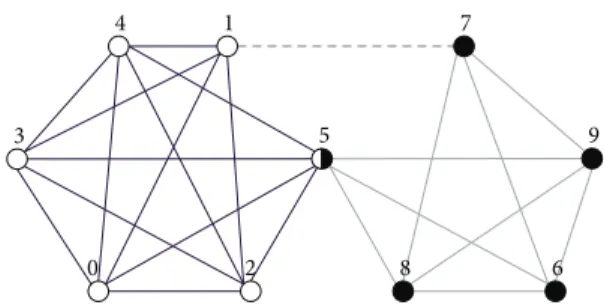
9 2 4 1 5 8 6 7 0 3
Figure 1: Demonstration of link communities.
As shown in Figure 1, we can get two link communities
given parameters𝜀 = 0.5and 𝜇 = 4, and also edge (1, 7) is an
isolated edge which do not belong to any link community. As
a result, the final node communities are{0, 1, 2, 3, 4, 5}and
{5, 6, 7, 8, 9}, where node 5 is an overlapping node. We have done a lot of experiments in the literature [6] and proved that the DBLINK algorithm not only gives consideration to the time efficiency, but also finds the overlapping community structure with high quality in the network.
3. Dynamic Community Detection iDBLINK
An incremental density-based link clustering algorithm iDBLINK for community detection in dynamic networks has been proposed in order to effectively track and analyze the community structure of temporal dynamic network. This algorithm is an extended version of DBLINK which can effectively update the current community structure according to the change of the community structure and network topology a moment before.
3.1. Problem Description. It can be assumed that a complex network is described by an undirected and unweighted graph
𝐺 = (𝑉, 𝐸), where𝑉represents node set and𝐸is edge set.
𝐶 = {𝐶1, 𝐶2, . . . , 𝐶𝑘}means the community structure of the
networks and∀𝐶𝑖∈ 𝐶is a nonempty subset of𝑉.
𝐺0 = (𝑉0, 𝐸0) represents the original network, 𝐺𝑡 =
(𝑉𝑡, 𝐸𝑡)denotes the network snapshot at time𝑡,Δ𝑉𝑡andΔ𝐸𝑡,
respectively, refer to the set of nodes and edges joined or
deleted at time𝑡, andΔ𝐺𝑡 = (Δ𝑉𝑡, Δ𝐸𝑡)means the change
of the whole network. The network snapshot at time𝑡 + 1
is 𝐺𝑡+1 = 𝐺𝑡 ∪ Δ𝐺𝑡. A dynamic network model g is a
sequence of the network snapshots at different time; thus g= {𝐺0, 𝐺1, 𝐺2, . . .}.
Given a set of dynamic network modelg = {𝐺0, 𝐺1, 𝐺2,
. . . , 𝐺𝑠},𝐺0represents the original network and𝐺1, 𝐺2, . . . , 𝐺𝑠
is the network snapshots according to Δ𝐺1, Δ𝐺2, . . . , Δ𝐺𝑠.
Incremental community detection intends to design an adap-tive algorithm to effecadap-tively update the current network com-munity structure according to the previous moment network snapshots and the changes and also track the evolution of the network, just as shown in Figure 2.
The mission in the first phase of incremental community
detection is to cluster the original network𝐺0, so as to find the
community structure and lay the foundation for community updating of the network snapshots. We select DBLINK as the
Gt ΔGt Gt+1
C(Gt) 𝒜 C(Gt+1)
ℊ:
𝒞:
Figure 2: Incremental community detection model.
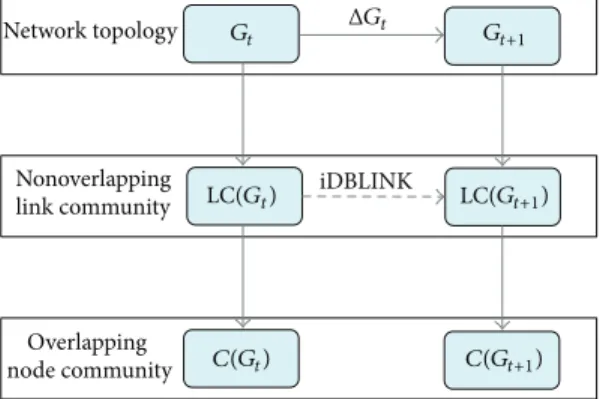
Nonoverlapping link community Overlapping node community Network topology Gt LC(Gt) C(Gt) C(Gt+1) LC(Gt+1) Gt+1 ΔGt iDBLINK
Figure 3: Framework of iDBLINK.
community detection algorithm during the initial stage. This algorithm has advantages of high time efficiency, as well as the ability to find high quality overlapping community structure. We will prove it in the experiments.
3.2. Algorithm Framework. Figure 3 shows the iDBLINK algorithm framework and it can be seen that iDBLINK focuses on the change of link communities. This has two advantages: first, it reduces the factors needed to be consid-ered because link communities are nonoverlapping; second, it naturally updates changes of overlapping node community according to the variation of nonoverlapping link commu-nity.
3.3. Network Topology Changes. iDBLINK is an extension of DBLINK in essence and the deciding factor of link commu-nity structure is the similarity between edges; therefore, we need to further translate the changes of network topology into the changes of similarity. For instance, the enhancement of similarity relation between the two edges may make
one edge enter into the𝜀neighborhood of another edge
and make it become a core edge, resulting in the growth of link communities or the consolidation of multiple link communities.
Assuming that edge𝑒 = (𝑢,V)is a change of the network
topology, namely, edge𝑒needs to be added or deleted, then
the changes of the similarity between the network edges
caused by edge 𝑒 are divided into the following several
situations:
(1) The similarity between edge𝑒itself and its neighbors
will change. When edge𝑒is the new added edge, the
similarity between itself and its neighbors starts from
scratch; when edge𝑒is to be deleted, the similarity
between them is just the opposite.
(2) If edge 𝑒1 = (𝑢,V1) is connected to node 𝑢 and
edge𝑒2 = (V1,V2) is linked to edge 𝑒1 (V2 ̸= 𝑢),
the similarity between 𝑒1 and 𝑒2 will change. Node
V added to Γ(V1) is bound to cause the change of
|Γ(𝑢) ∪ Γ(V2)|and|Γ(𝑢) ∩ Γ(V2)|also may change.
(3) If edge𝑒1 = (𝑢,V1)and edge𝑒2 = (𝑢,V2)are the two
edges, respectively, connected to node𝑢, similarity
between𝑒1 and 𝑒2 will not change. This is because
Γ(V1)andΓ(V2)which are determinants of similarity
between𝑒1 and 𝑒2 have no changes, and the value
of𝑆(𝑒1, 𝑒2) = |Γ(V1) ∩ Γ(V2)|/|Γ(V1) ∪ Γ(V2)| keeps
invariant. The two edges connected to nodeVappear
at the same situation.
(4) If two edges do not connect to each of node𝑢orV,
namely,𝑒1= (𝑤,V1),𝑒2= (𝑤,V2), and𝑢 ∉ {𝑤,V1,V2}∧
V∉ {𝑤,V1,V2}, the similarity between edge𝑒1and𝑒2
has no changes also because of the unchangedΓ(V1)
andΓ(V2).
In conclusion, if edge𝑒is a new adding edge or is already
removed, edge 𝑒 needs to create or cancel the similarity
with its neighbors. Assume that edge𝑙is the edge which is
connected to node𝑢orV. The similarity between edge𝑙and
the edges associated with 𝑙will also change. In the actual
calculation, some unnecessary repeated computation can be avoided considering the symmetry of similarity.
We first intuitively analyze the effects of link community structure by the change of similarity between two edges in the following network. Assume that the similarity of two edges
𝑒 and 𝑙is 𝑠(𝑡)(𝑒, 𝑙) < 𝜀 at𝑡 moment and their connection
strengthens at 𝑡 + 1moment, just as 𝑠(𝑡)(𝑒, 𝑙) < 𝑠(𝑡+1)(𝑒, 𝑙).
If 𝑠(𝑡+1)(𝑒, 𝑙) ≥ 𝜀, one or two of edges 𝑒 and 𝑙 may be
the core edge and 𝜀 neighborhood will also be changed:
(1) increasing an existing community; (2) forming a new
community; (3)building bridges between the two existing
nonoverlapping communities and merging them. On the contrary, if the similarity between the two edges becomes
smaller as 𝑠(𝑡)(𝑒, 𝑙) > 𝑠(𝑡+1)(𝑒, 𝑙) and 𝑠(𝑡+1)(𝑒, 𝑙) < 𝜀, 𝜀
neighborhood of the two edges will be contracted. The two edges may not be density connected which will cause the division or disappearance of communities.
We will divide the changes of link communities into positive changes and negative changes. Positive changes mean the growth, merge, or creation of link communities; negative changes are the division, recession, or disappearance of link communities.
3.4. Update Positive Changes. We assume that during the two
adjacent moments𝑡and𝑡+1, the similarity of edge𝑒and edge
𝑙is𝑠(𝑡)(𝑒, 𝑙) < 𝜀, and𝑠(𝑡+1)(𝑒, 𝑙) ≥ 𝜀; namely, the similarity
between edges𝑒and𝑙gets strengthened. This will probably
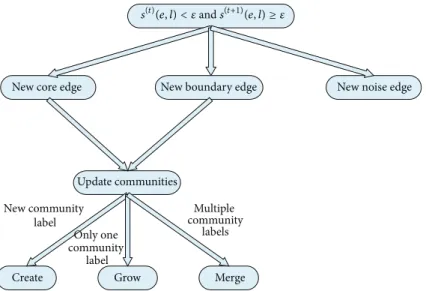
cause the several circumstances in Figure 4.
(1) New Core Edge. At least one of edge𝑒 and edge 𝑙 is core edge. iDBLINK constructs a new neighborhood relation
New core edge
Update communities
Create Grow Merge
New boundary edge New noise edge
New community label Only one community label Multiple community labels
s(t)(e, l) < 𝜀ands(t+1)(e, l) ≥ 𝜀
Figure 4: Update link communities for positive changes.
𝑙) and updates accordingly by examining whether edge𝑒or𝑙
has been assigned a community label.
(2) New Boundary Edge.An original noise edge𝑒becomes a
boundary edge, namely, direct density reach to a core edge𝑙;
iDBLINK will assign edge𝑒to the community of edge𝑙.
(3) New Noise Edge.The addition of a new edge does not meet the above two cases; then the link community structure remains unchanged.
From Figure 4, we can see that only when producing new core edge or new boundary edge, it updates the corre-sponding link communities. The following is mainly about the creation, growth, and merging of communities.
(1) Creation of New Link Communities.When a noise edge (not belonging to any existing link communities) turns into the core status, a new link community will come into being and iDBLINK will assign a new community label to this core
edge and its corresponding𝜀neighborhood.
(2) Growth of Link Communities.If edge𝑒contains a new𝜀
neighborhood at𝑡 + 1moment and has been allocated a link
community label at𝑡moment, then𝜀neighborhood of edge
𝑒will be absorbed by the link community of this label, so that
link communities will get growing.
(3) Merging of Link Communities.Suppose edge 𝑒becomes
a core edge at 𝑡 + 1 moment and the edges in the field
of𝜀neighborhood belong to different link communities.
iDBLINK incorporates these different link communities and assigns them a new community label. It is worth mentioning that the generation of a new core edge can only cause the
merge of𝜇 link communities at most.
3.5. Update Negative Changes. We assume that during the two
adjacent moments𝑡and 𝑡 + 1, the similarity of edge 𝑒and
edge𝑙is𝑠(𝑡)(𝑒, 𝑙) ≥ 𝜀, and𝑠(𝑡+1)(𝑒, 𝑙) < 𝜀; namely, the similarity
between edges𝑒and𝑙gets weakened. This will probably cause
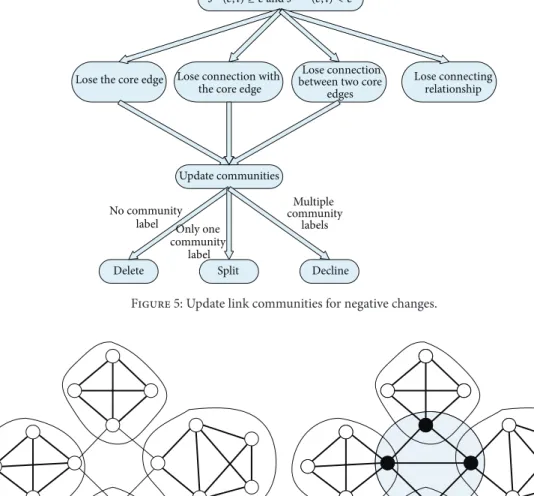
the several circumstances in Figure 5.
(1) Losing the Core Edge.Edge𝑒is a core edge at𝑡moment,
while at𝑡 + 1moment it loses the core attribute because of its
lower similarity with edge𝑙; namely,|𝑁𝜀(𝑒)| < 𝜇.
(2) Losing Connection with the Core Edge. Edge 𝑒 is the
boundary of edge𝑙at𝑡moment, but it loses relationship of
density direct reach with𝑙at𝑡 + 1moment.
(3) Losing Connection between Two Core Edges.Edge𝑒and
edge𝑙are all core edges at𝑡and𝑡 + 1moment, and also they
are density connecting at𝑡moment, while losing it at𝑡 + 1
moment.
(4) Losing Connecting Relationship.Two connected edges 𝑒
and𝑙are not core edges at𝑡moment, and they lose connection
at 𝑡 + 1 moment. At this time link communities have no change.
For the above four conditions except for the last one,
iDBLINK will calculate the𝜀neighborhood of affected core
edges again, and detect the distribution of link communities
within𝜀neighborhood. There are three types of the
corre-sponding operations as follows.
(1) Deletion of Link Communities. Assuming that edge 𝑒 is an edge losing core attributes, there is no other core
edges existing in𝜀 neighborhood; then the original link
community where edge𝑒is in will be deleted. The original
members in the link community set the status as noise or boundary according to the specific situation.
(2) Contraction of Link Communities.Suppose edge𝑢is in
the𝜀neighborhood of core edge 𝑙 at 𝑡 moment; it loses
connection with edge𝑙at𝑡+1moment, but it has not changed
the core attribute of edge 𝑙. If so, edge 𝑒 will be deleted
from the link community of edge𝑙, and link community size
becomes smaller, just as link community contraction.
(3) Division of Link Communities.Assume that edge𝑒 and
Lose the core edge
Update communities
Delete Split Decline
Lose connection with the core edge
Lose connecting relationship
No community label
Lose connection between two core
edges Only one community label Multiple community labels
s(t)(e, l) ≥ 𝜀ands(t+1)(e, l) < 𝜀
Figure 5: Update link communities for negative changes.
(a) Community structure at𝑡 − 1moment (b) Community structure attmoment
Figure 6: Demonstration of overlapping node community formation.
connected at𝑡moment. However, they lose this relationship
at𝑡 + 1moment, so link communities will be split at this time.
3.6. Node Community Update. Although iDBLINK only cares about updating link communities in dynamic network, and link community structure is nonoverlapping, the corre-sponding overlapping node communities can be naturally reflected according to link communities. All nodes con-nected by edges within the same link communities belong to the same node communities, while intersection nodes that belong to different link communities are overlapping nodes. As shown in Figure 6, (a) embodies the link
com-munities and node comcom-munities in the network at 𝑡 − 1
moment. At moment 𝑡, an edge is added which makes
the formation of new link communities, and naturally four yellow nodes become overlapping nodes connecting two communities.
4. Experimental Results
This section is to verify the performance of the iDBLINK algorithm. We will, respectively, compare iDBLINK with static community detection algorithms DBLINK, FOCS, and DENGRAPH and dynamic community detection algorithms AFOCS and DENGRAPH-IO. The experimental environ-ment was as follows: processor Inter(R) Core(TM)2 Duo 2.8 GHz PC, internal storage 2 G, operating system Windows 7, and programming language C#.Net.
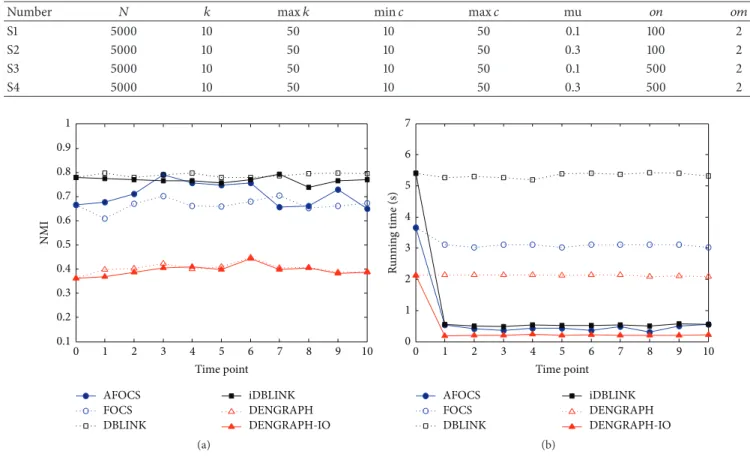
4.1. Experiment Settings. We plan to verify the performance of iDBLINK algorithm with four groups of LFR simulation networks and two real networks. The simulation network configurations of each group are shown in Table 1.
𝑁is the number of nodes.𝑘is the average degree of nodes
in the network and max𝑘represents the maximum degree.
0.1 0.2 0.3 0.4 0.5 0.6 0.7 0.8 0.9 1 NMI 1 0 2 3 4 5 6 7 8 9 10 Time point AFOCS FOCS DBLINK iDBLINK DENGRAPH DENGRAPH-IO (a) 1 2 0 3 4 5 6 7 8 9 10 Time point 0 1 2 3 4 5 6 7 R unnin g time (s) AFOCS FOCS DBLINK iDBLINK DENGRAPH DENGRAPH-IO (b) Figure 7: Results on S1.
and max𝑐 is the number of nodes in the maximum
com-munity. Mixing parameter mu represents the probability of nodes connected with external community. The greater the value of mu is, the more difficult the community detection will become. The community structure of LFR benchmark network is already known, so we can evaluate the quality of the community finding by different algorithms.
We selected Amazon and DBLP [23] as real networks, which are large complex networks with true value of com-munity structure.
DBLP is a scientist cooperation network that widely applied. Scientists are as nodes in the network and if two scientists at least cooperate to publish one article, then they establish an edge between them. The network contains 317080 nodes and 104986 edges.
Amazon is goods connecting network, where goods are regarded as the nodes and if two products are frequently bought at the same time, they establish a link between the two nodes. The network has 334863 nodes and 925872 edges. Both LFR benchmark networks and real networks and their dynamic networks are generated as follows: for each network, we first select 90% of the edges as the original
network 𝐺0, and, in addition to the original network, we
generate ten networks 𝐺1, . . . , 𝐺10 to make up dynamic
networks. Then every network removes 5% of the entire network edges and adds the same amount of new edges, which means dynamic networks always keep the number of edges invariant.
4.2. Evaluation Standards. For the LFR benchmark networks, we adopt the normalized mutual information (NMI) given in [24] as the evaluation standard to compare all kinds of algorithms, since the true value of community structure is known.
We suppose that the real community set in the network
is𝐶; community affiliation of node𝑖can be represented as
binary vector𝑥𝑖whose length is|𝐶|. The fact that the value of
(𝑥𝑖)𝑘is one or zero indicates whether node𝑖belongs to the𝑘th
community. The𝑘th element can be considered as random
variable𝑋𝑘, and its probability distribution is𝑃(𝑋𝑘 = 1) =
𝑛𝑘/𝑛,𝑃(𝑋𝑘 = 0) = 1 − 𝑛𝑘/𝑛where𝑛𝑘 means the number
of nodes in the𝑘th community and𝑛represents the number
of all nodes in the network. Also, in the community set𝐶
found by the algorithm,𝑌𝑙is used to represent the probability
distribution of nodes in the𝑙th community.𝐻(𝑋𝑘 | 𝑌𝑙) =
𝐻(𝑋𝑘, 𝑌𝑙) − 𝐻(𝑌𝑙)is defined as the conditional entropy of𝑋𝑘
in𝑌𝑙, and, according to𝐻(𝑋𝑘 | 𝑌𝑙), the conditional entropy
𝐻(𝑋𝑘| 𝑌)of𝑋𝑘in𝑌(collection composed by𝑌𝑙) is
𝐻 (𝑋𝑘| 𝑌) = min
𝑙∈{1,2,...,|𝐶|}𝐻 (𝑋𝑘| 𝑌𝑙) . (12)
Standardization of conditional entropy of𝑋(collection
composed by𝑋𝑘) in𝑌is
𝐻 (𝑋 | 𝑌) =|𝐶|1 ∑ 𝑘
𝐻 (𝑋𝑘| 𝑌)
𝐻 (𝑋𝑘) . (13)
Similarly, we can calculate the standardization
condi-tional entropy𝐻(𝑌 | 𝑋)of𝑌in𝑋. According to formula
(14), we can calculate the normalized mutual information NMI(𝑋 | 𝑌)of two community sets:
NMI(𝑋 | 𝑌) = 1 − [𝐻 (𝑋 | 𝑌) + 𝐻 (𝑌 | 𝑋)]
2 . (14)
4.3. Experimental Results of Simulative Network. Figures 7– 10 show the comparison of six algorithms. The abscissa represents the network at each moment, zero coordinates refer to the original network, and ordinate, respectively, shows the community detection quality NMI (a) and the algorithm running time (b).
We first compare the two static algorithms DBLINK and
Table 1: LFR benchmark network information.
Number 𝑁 𝑘 max𝑘 min𝑐 max𝑐 mu 𝑜𝑛 𝑜𝑚
S1 5000 10 50 10 50 0.1 100 2 S2 5000 10 50 10 50 0.3 100 2 S3 5000 10 50 10 50 0.1 500 2 S4 5000 10 50 10 50 0.3 500 2 0.1 0.2 0.3 0.4 0.5 0.6 0.7 0.8 0.9 1 NMI 10 7 8 9 5 6 4 2 3 1 0 Time point AFOCS FOCS DBLINK iDBLINK DENGRAPH DENGRAPH-IO (a) 0 1 2 3 4 5 6 7 R unnin g time (s) 1 2 3 4 5 6 0 7 8 9 10 Time point AFOCS FOCS DBLINK iDBLINK DENGRAPH DENGRAPH-IO (b) Figure 8: Results on S2.
findings of four simulative networks show that the quality of the community which DBLINK finds is better than FOCS; especially on the two lower overlap networks, advantages are more obvious. However, the time efficiency of DBLINK algorithm is slightly lower than FOCS.
Next, we focus on the comparison of each algorithm for dynamic network in time efficiency and quality of community detection. FOCS and DBLINK, respectively, conduct com-munity detection at every moment on the whole network, and iDBLINK, AFOCS are all incremental community detection algorithms.
(1) In terms of the algorithm efficiency, DBLINK and FOCS all run algorithm on the entire network, so its program running time is substantially consistent with the running time on the network at time
𝑡 = 0. Nevertheless, since iDBLINK and AFOCS
quickly update local community structure according to changes of the network topology (10% of edges added or deleted), their running time is significantly less than that of the corresponding static network community detection algorithms. Moreover, the time efficiency of DBLINK algorithm is slightly lower than FOCS. On the contrary, we believe iDBLINK relative to DBLINK in the increase of time efficiency is greater than AFOCS to FOCS.
(2) In terms of the community detection quality, we can see that the community detection results of AFOCS
and FOCS do not always coincide; even the NMI values of AFOCS appear to be greater than FOCS, while iDBLINK is almost the same as DBLINK at NMI values of community structure found at every moment on the network. It shows that iDBLINK is indeed the effective incremental community detec-tion version of DBLINK. In most cases, especially on the two lower overlap networks, quality of community structure detected by iDBLINK algorithm is superior to that of AFOCS.
In conclusion, the iDBLINK algorithm proposed in this paper not only keeps the high quality community structure detection performance of DBLINK algorithm, but also has a very good time efficiency on the dynamic networks.
4.4. Experimental Results of Real Networks. We have further validated the performance of iDBLINK on the two real networks DBLP and Amazon. These two networks are all very large complex networks. AFOCS and FOCS fail at first step due to the insufficient memory, so, as shown in Figures 11 and 12, we can only get the results of DENGRAPH-IO and iDBLINK. It is obvious that the result of iDBLINK is better comparing with DENGRAPH-IO and is very close to the community detection quality of DBLINK algorithms. However, its time efficiency is far superior to DBLINK algo-rithm, which explains that iDBLINK is indeed the effective
0.1 0.2 0.3 0.4 0.5 0.6 0.7 0.8 0.9 1 NMI 1 2 3 4 5 6 7 8 9 10 0 Time point AFOCS FOCS DBLINK iDBLINK DENGRAPH DENGRAPH-IO (a) 0 1 2 3 4 5 6 7 R unnin g t ime (s) 1 2 3 4 5 6 7 8 9 10 0 Time point AFOCS FOCS DBLINK iDBLINK DENGRAPH DENGRAPH-IO (b) Figure 9: Results on S3. 0.1 0.2 0.3 0.4 0.5 0.6 0.7 0.8 0.9 1 NMI 0 1 2 3 4 5 6 7 8 9 10 Time point AFOCS FOCS DBLINK iDBLINK DENGRAPH DENGRAPH-IO (a) 1 0 2 3 4 5 6 7 8 9 10 Time point 0 1 2 3 4 5 6 7 R unnin g time (s) AFOCS FOCS DBLINK iDBLINK DENGRAPH DENGRAPH-IO (b) Figure 10: Results on S4.
incremental version of DBLINK and can be very effectively used in the community detection on dynamic networks.
5. Conclusion
This paper proposes an incremental density-based link clustering algorithm for community detection in dynamic networks iDBLINK. This algorithm can update the cor-responding community structure quickly and efficiently according to changes of network topology. It decomposes the change of the network into four cases: adding and deleting nodes and adding and deleting edges. Furthermore, this algorithm adjusts the link density in each network for
each case, and, based on the connectedness of density-based algorithm, it updates the current community struc-ture quickly and efficiently according to the community structure at previous moment. iDBLINK just updates the current community structure in view of the network topology changes, so iDBLINK can be effectively applied to community detection in the dynamic network. In addition, iDBLINK has kept the advantages of DBLINK algorithm, that is, to find overlapping community structure with high quality. Experimental results show that iDBLINK not only has a great time efficiency, but also maintains a high quality commu-nity detection performance while the network topology is changing.
0 0.05 0.1 0.15 0.2 0.25 0.3 0.35 0.4 0.45 0.5 NMI 1 0 2 3 4 5 6 7 8 9 10 Time point DBLINK DENGRAPH iDBLINK DENGRAPH-IO 1 2 3 4 5 6 7 8 9 10 0 Time point 0 100 200 300 400 500 600 700 R unnin g time (s) DBLINK DENGRAPH iDBLINK DENGRAPH-IO Figure 11: Results on DBLP. DBLINK DENGRAPH iDBLINK DENGRAPH-IO 1 2 3 4 5 6 7 8 9 10 0 Time point 0 0.05 0.1 0.15 0.2 0.25 0.3 0.35 0.4 0.45 0.5 NMI 8 7 9 10 5 6 4 2 1 3 0 Time point 0 50 100 150 R unnin g time (s) DBLINK DENGRAPH iDBLINK DENGRAPH-IO
Figure 12: Results on Amazon.
Conflict of Interests
The authors declare that there is no conflict of interests regarding the publication of this paper.
Acknowledgments
This work was supported by the National High Technology Research and Development Program of China (Grant no. 2012AA0622022 and Grant no. 2012AA011004), the Doc-toral Fund of Ministry of Education of China (Grant no. 20100095110003 and Grant no. 20110095110010), the Funda-mental Research Funds for the Central Universities (under Grant no. 2013XK10), the National Natural Science Foun-dation of China (Grant no. 61402482), China Postdoctoral Science Foundation (no. 2015T80555), and Jiangsu Planned Projects for Postdoctoral Research Funds (no. 1501012A).
References
[1] M. Coscia, F. Giannotti, and D. Pedreschi, “A classification for
community discovery methods in complex networks,”
Statisti-cal Analysis and Data Mining, vol. 4, no. 5, pp. 512–546, 2011. [2] M. Girvan and M. E. J. Newman, “Community structure in
social and biological networks,” Proceedings of the National
Academy of Sciences of the United States of America, vol. 99, no. 12, pp. 7821–7826, 2002.
[3] W. Lin, F. Lu, and Z. Ding, “Parallel computing hierachical
community approach based on weighted-graph,” Journal of
Software, vol. 23, no. 6, pp. 1517–1530, 2012.
[4] G. Palla, I. Der´enyi, I. Farkas, and T. Vicsek, “Uncovering the overlapping community structure of complex networks in
nature and society,”Nature, vol. 435, no. 7043, pp. 814–818, 2005.
[5] Y.-Y. Ahn, J. P. Bagrow, and S. Lehmann, “Link communities
reveal multiscale complexity in networks,”Nature, vol. 466, no.
[6] M. Zhu, F. Meng, and Y. Zhou, “Density based link clustering
algorithm for overlapping community detection,” Journal of
Computer Research and Development, vol. 50, no. 12, pp. 2520– 2530, 2013.
[7] T. S. Evans and R. Lambiotte, “Line graphs, link partitions, and
overlapping communities,” Physical Review E, vol. 80, no. 1,
Article ID 016105, pp. 145–148, 2009.
[8] M. Berlingerio, M. Coscia, F. Giannotti, A. Monreale, and D. Pedreschi, “Multidimensional networks: foundations of
struc-tural analysis,”World Wide Web, vol. 16, no. 5, pp. 567–593, 2013.
[9] A. Lancichinetti, S. Fortunato, and J. Kert´esz, “Detecting the overlapping and hierarchical community structure in complex
networks,” New Journal of Physics, vol. 11, no. 3, Article ID
033015, 2009.
[10] N. P. Nguyen, T. N. Dinh, D. T. Nguyen et al., “Overlapping community structures and their detection on social networks,” in Proceedings of the IEEE 3rd International Conference on Privacy, Security, Risk and Trust (PASSAT ’11), and IEEE 3rd International Conference on Social Computing (SocialCom ’11), pp. 35–40, IEEE, Boston, Mass, USA, October 2011.
[11] A. Lancichinetti, F. Radicchi, J. J. Ramasco, and S. Fortunato, “Finding statistically significant communities in networks,”
PLoS ONE, vol. 6, no. 4, Article ID e18961, 2011.
[12] M. E. J. Newman and M. Girvan, “Finding and evaluating
community structure in networks,”Physical Review E, vol. 69,
no. 2, Article ID 026113, 2004.
[13] A. Clauset, M. E. J. Newman, and C. Moore, “Finding
commu-nity structure in very large networks,”Physical Review E, vol. 70,
no. 6, Article ID 066111, 2004.
[14] Z. Ye, S. Hu, and J. Yu, “Adaptive clustering algorithm for
community detection in complex networks,”Physical Review E,
vol. 78, no. 4, Article ID 046115, 2008.
[15] U. N. Raghavan, R. Albert, and S. Kumara, “Near linear time algorithm to detect community structures in large-scale
networks,”Physical Review E, vol. 76, no. 3, Article ID 036106,
2007.
[16] J. Xie and B. K. Szymanski, “LabelRank: a stabilized label propagation algorithm for community detection in networks,” inProceedings of the IEEE 2nd Network Science Workshop (NSW
’13), pp. 138–143, IEEE, West Point, NY, USA, May 2013.
[17] M. Rosvall and C. T. Bergstrom, “Maps of random walks on
complex networks reveal community structure,”Proceedings of
the National Academy of Sciences of the United States of America, vol. 105, no. 4, pp. 1118–1123, 2008.
[18] J. Xie, B. K. Szymanski, and X. Liu, “SLPA: uncovering over-lapping communities in social networks via a speaker-listener
interaction dynamic process,” inProceedings of the 11th IEEE
International Conference on Data Mining Workshops (ICDMW
’11), pp. 344–349, IEEE, Vancouver, Canada, December 2011.
[19] J. Xie, M. Chen, and B. K. Szymanski, “LabelRankT: incremental community detection in dynamic networks via label
propa-gation,” inProceedings of the Workshop on Dynamic Networks
Management and Mining (DyNetMM ’13), pp. 25–32, ACM, New York, NY, USA, June 2013.
[20] N. P. Nguyen, T. N. Dinh, Y. Xuan, and M. T. Thai, “Adaptive algorithms for detecting community structure in dynamic
social networks,” in Proceedings of the IEEE Conference on
Computer Communications (INFOCOM ’11), pp. 2282–2290, Shanghai, China, April 2011.
[21] T. Falkowski, A. Barth, and M. Spiliopoulou, “Dengraph: a
density-based community detection algorithm,” inProceedings
of the IEEE/WIC/ACM International Conference on Web Intelli-gence, pp. 112–115, IEEE, November 2007.
[22] N. P. Nguyen, T. N. Dinh, S. Tokala, and M. T. Thai, “Over-lapping communities in dynamic networks: their detection
and mobile applications,” inProceedings of the 17th Annual
International Conference on Mobile Computing and Networking, pp. 85–95, ACM, September 2011.
[23] J. Yang and J. Leskovec, “Defining and evaluating network
communities based on ground-truth,” in Proceedings of the
ACM SIGKDD Workshop on Mining Data Semantics (MDS ’12), article 3, Beijing, China, August 2012.
[24] I. S. Dhillon, Y. Guan, and B. Kulis, “Kernel k-means: spectral
clustering and normalized cuts,” inProceedings of the 10th ACM
SIGKDD International Conference on Knowledge Discovery and Data Mining, pp. 551–556, ACM, Blacksburg, Va, USA, August 2004.
Submit your manuscripts at
http://www.hindawi.com
Hindawi Publishing Corporation
http://www.hindawi.com Volume 2014
Mathematics
Journal ofHindawi Publishing Corporation
http://www.hindawi.com Volume 2014 Mathematical Problems in Engineering
Hindawi Publishing Corporation http://www.hindawi.com
Differential Equations
International Journal of Volume 2014 Hindawi Publishing Corporation
http://www.hindawi.com Volume 2014 Hindawi Publishing Corporationhttp://www.hindawi.com Volume 2014
Hindawi Publishing Corporation
http://www.hindawi.com Volume 2014
Mathematical PhysicsAdvances in
Complex Analysis
Journal ofHindawi Publishing Corporation
http://www.hindawi.com Volume 2014
Optimization
Journal ofHindawi Publishing Corporation
http://www.hindawi.com Volume 2014
Combinatorics
Hindawi Publishing Corporation
http://www.hindawi.com Volume 2014
International Journal of
Hindawi Publishing Corporation
http://www.hindawi.com Volume 2014
Journal of
Hindawi Publishing Corporation
http://www.hindawi.com Volume 2014
Function Spaces
Abstract and Applied Analysis Hindawi Publishing Corporation
http://www.hindawi.com Volume 2014 International Journal of Mathematics and Mathematical Sciences
Hindawi Publishing Corporation http://www.hindawi.com Volume 2014
The Scientific
World Journal
Hindawi Publishing Corporation
http://www.hindawi.com Volume 2014
Hindawi Publishing Corporation
http://www.hindawi.com Volume 2014
Discrete Dynamics in Nature and Society
Hindawi Publishing Corporation
http://www.hindawi.com Volume 2014
Hindawi Publishing Corporation
http://www.hindawi.com Volume 2014
Discrete Mathematics
Journal ofHindawi Publishing Corporation
http://www.hindawi.com Volume 2014 Hindawi Publishing Corporationhttp://www.hindawi.com Volume 2014