COLAB: Social Context and User Experience in
Collaborative Multiplayer Games
MSc Dissertation
Marcel Terblanche
[email protected]
Supervisor: Professor Edwin Blake
[email protected]
Department of Computer Science
University of Cape Town
1
Acknowledgements
I would like to give thanks, first and foremost, to my supervisor Professor Edwin Blake, whose guidance, insight, and commitment to the project have gotten me to the finish line. Edwin helped me refine and shape my ideas into a workable and interesting Master's project. Over the last two years, he has made himself available during regular supervision meetings, and his detailed feedback on my writing and research has made both more rigorous. This research project would simply not have come to fruition were it not for him. My deepest thanks also go to my fellow Master's students in the field of user experience in games: Bryan Davies, who took me under his wing and provided me with invaluable resources, reading material and ideas along the way, and Jacob Clarkson, who helped me navigate the statistical analysis required for this thesis and reminded me of the importance of the ambiguity-slaying Oxford comma. Bryan and Jacob, your constant camaraderie and support have enriched this project. Finally, to my partner and editor Daniela Joffe: thank you.
2
Abstract
Recent studies have shown that the social context in which people play digital multiplayer games has an effect on their experience. Whether co-players are in the same location (―co-located‖) or in different locations (―mediated‖) changes how they interact with the game and with one another. We set out to explore how these complex psychological dynamics played out in a collaborative multiplayer game, since most of the research to date has been focused on competitive gameplay scenarios. To this end, we designed a two-player puzzle-based gaming apparatus called COLAB, implementing specific features that have been proven to foster collaboration and preclude competition between players. The independent variable was player location; the dependent variable was game experience, as measured by the Social Presence in Gaming Questionnaire and the Game Experience Questionnaire, two comprehensive self-report instruments. We found a significant difference in the game experiences of players collaborating in the same location versus players collaborating in different locations. Specifically, co-located players of the collaborative game experienced significantly higher scores for negative experience than mediated players did, while mediated players experienced significantly higher levels of three key game-experience measures: positive affect, immersion, and flow.
3
Contents
1 Introduction ... 5
1.1. Research Questions and Hypotheses ... 6
2 Literature Review ... 8
2.1. Social Gaming ... 8
2.1.1. Social Presence ... 10
2.1.2. Social Presence in Gaming Questionnaire (SPGQ) ... 12
2.1.3. Presence and Co-presence ... 13
2.1.4. User Experience in Games ... 14
2.1.5. Flow ... 15
2.1.6. Immersion ... 16
2.1.7. Affect ... 19
2.1.8. Game Experience Questionnaire (GEQ) ... 21
2.2. Collaboration and Co-operation in Games ... 23
2.2.1. Designing Games for Collaboration ... 24
2.2.2. Communication in Collaborative Games ... 28
2.2.3. Player–Avatar Relationships ... 29 2.3. Summary ... 32 3 Method ... 34 3.1. Apparatus ... 34 3.2. Participants ... 38 3.3. Self-report Measures ... 39
3.3.1. Game Experience Questionnaire (GEQ) ... 39
3.3.2. Social Presence in Gaming Questionnaire (SPGQ) ... 39
3.4. Experimental Design ... 40
3.5. Procedure ... 41
4 Results ... 44
4.1. GEQ: Core Module Scores ... 46
4.2. SPGQ Module Scores ... 47
4.3. GEQ: Post-game Module Scores ... 50
4.4. Correlations ... 51 4.4.1. Co-located Correlations ... 53 4.4.2. Mediated Correlations ... 53 4.5. Observational Excerpts ... 55 4.6. Summary ... 57 5 Discussion ... 59
4
5.2. Enter the Correlation Matrix ... 62
5.3. Computer-Mediated Collaboration ... 63
5.4. Limitations and Possible Confounds ... 66
6 Conclusions ... 67
6.1. Implications ... 69
6.2. Further Research ... 70
References ... 73
Appendix A: Questionnaires (GEQ & SPGQ) ... 83
Appendix B: COLAB Game Design Document ... 90
Appendix C: Consent Form ... 111
Appendix D: Gameplay Instructions... 112
5
1
Introduction
In recent years, digital gaming has become a hugely popular leisure activity for millions of people around the world. More and more people are spending their time playing digital games (henceforth referred to as games) (Lenhart, Madden & Hitlin, 2005). As a result of this burgeoning consumer appetite, the games industry has grown rapidly, and game developers continue to innovate new experiences for gamers. One early development involved multiplayer games that allowed for collaborative, co-operative, and/or competitive play. Multiplayer games introduced a new social aspect to gaming. Initially, people could only play multiplayer games in a co-located context: players had to be physically present in the same room. More recently, with the development of online games and the widespread adoption of the Internet, it has become common for multiplayer games to be played in a mediated (i.e., non-co-located) context. In a mediated context, players use virtual avatars to interact and communicate in virtual environments, without having to be physically present in the same room (Weibel et al., 2008).
For many gamers, socialising is the primary motivation for playing games (Jansz & Martens, 2005). The rise in popularity of Massively Multiplayer Online Games (MMOGs) and their associated virtual communities makes multiplayer gaming an increasingly relevant social activity, and highlights the importance of the social experience underlying multiplayer gameplay (de Kort, IJsselsteijn & Poels, 2007). Although historically overlooked in the literature, the social aspects of gaming are now gaining traction as an area of research. Yet the existing research on social gameplay tends to focus on user experience in a competitive social context (see, for example, Weibel et al., 2008; Gajadhar, de Kort & IJsselsteijn, 2008; Ravaja et al., 2006; Martin, 2010). User experience in a collaborative social context has received far less attention. In a collaborative game, players are required to work as a team towards a shared outcome, whereas in a competitive game the goals and objectives of players are diametrically opposed (Zagal, Rick & Hsi, 2006). Naturally, the social interaction resulting from these vastly different contexts varies significantly. Competing players barely need to communicate with one another in order to achieve victory over their opponent. On the other hand, collaborative players rely on social interaction and communication in order to succeed.
Ranging from extremely competitive Multiplayer Online Battle Arenas (MOBAs) like League of Legends (Riot Games, 2009) to independent collaborative puzzle games like LittleBigPlanet (Media Molecule, 2008), games offer a multitude of experiences for players (Ivory, 2015). The social context in which these games are played also has a significant influence on players‘ game experience (de Kort et al., 2007). The study presented here aimed to contribute to the literature by investigating how collaborative game experience in particular differs in co-located versus mediated social contexts.
6
1.1.
Research Questions and Hypotheses
While multiple studies have addressed social context and game experience under competitive circumstances (Weibel et al., 2008; Gajadhar, de Kort & IJsselsteijn, 2008; Ravaja et al., 2006; Martin, 2010), little work has been done to empirically investigate other types of games. We aimed to fill this research gap by investigating how different social contexts influence social interaction, communication and associated game experience in a purely collaborative multiplayer setting. Thus, we asked:
RQ1: Do variations in social context (i.e., co-located play versus mediated play) influence players‘ experience of collaborative multiplayer games?
The specific social contexts we investigated took the form of two common multiplayer gameplay configurations. In the first configuration, users collaborated with co-located others: players in the same physical location socialised directly via face-to-face interaction. In the second configuration, users collaborated with mediated others: non-co-located players socialised over long distances via a computer network. In order to highlight the social aspects of gaming and advance our understanding of how common variations in social contexts affect user experience during collaborative multiplayer gameplay, we approached games as a social presence (see Section 2.1.1) technology, which led us to pose the question:
RQ2: Do variations in social context during collaborative play result in changes in co-players‘ subjective feelings of social presence?
We therefore focused on the social aspects of the collaborative gaming experience, using a similar approach to that of de Kort et al. (2007), who developed the Social Presence in Gaming Questionnaire (SPGQ) (see Section 2.1.2) to measure social presence between co-players during multiplayer gameplay. In order to address RQ1 and RQ2, we took a multi-disciplinary, psychologically structured approach to game experience. Specifically, we investigated the effects of changes in social context and social presence on psychological indicators of experience, both during and after collaborative play. Building on work by IJsselsteijn, Poels and de Kort (2008), who developed the Game Experience Questionnaire (GEQ) (see Section 2.1.8), we analysed players‘ experience of the following factors during gameplay: flow (Section 2.1.5); immersion (Section 2.1.6); positive and negative affect (Section 2.1.7); challenge; competence; and tension/annoyance. In addition, players‘ positive and negative experience, tiredness, and difficulty in returning to reality were self-reported after they had stopped playing. This multi-layered approach allowed for an in-depth investigation of the differences between co-located and mediated collaborative gameplay experience. We were furthermore interested in determining whether there were correlations between any of the factors of experience measured by the GEQ and SPGQ under the co-located or mediated conditions. We therefore asked:
7
RQ3: Do correlations exist between any of the experience factors measured by the GEQ and SPGQ during collaborative gameplay in the co-located and/or mediated social contexts? Various studies have shown that the type of social context in place will significantly influence players‘ game experience (Bracken et al., 2005; Ravaja et al., 2006; de Kort et al., 2007; Gajadhar et al., 2008). Owing to the differences in social affordances and communication channels offered by co-located technology compared to mediated social-gameplay technology, we predicted:
H1: Collaborative players‘ game experience (as measured by the GEQ) will differ with variations in social context.
Gajadhar et al. (2008) found that, during competitive multiplayer gameplay, social presence was higher during co-located compared to mediated play. We therefore predicted:
H2: Co-located players will experience higher levels of social presence during collaborative gameplay than mediated players.
The presence of co-located players or bystanders during gameplay has been shown to interrupt players‘ focus and attention, breaking their engagement with the virtual environment of the game (Sweetser & Wyeth, 2005). These kinds of interruptions can have a negative impact on flow (Csikszentmihalyi, 1991; Chen, 2007) and immersion (Sweetser & Wyeth, 2005; Jennett et al., 2008), which led us to predict:
H3: Mediated players will experience higher levels of flow and immersion during collaborative gameplay than co-located players.
To address our hypotheses we designed and developed a collaborative game, entitled COLAB. In order to determine the collaborative gameplay mechanisms that would encourage social interaction and preclude competition between co-players, we posed the question:
RQ4: Which gameplay mechanisms facilitate collaboration and social interaction between co-players while precluding any form of competition?
In this paper we document the empirical investigation undertaken to answer our research questions. In Chapter Two, we conduct a review of the literature related to social gameplay experience, collaborative gameplay mechanisms, and communication channels in multiplayer games. Next, Chapter Three describes the methodology, experimental design, and measures employed in this study. In Chapter Four we present our results and analyse the data gained from our experiments. Chapter Five offers a discussion of our results in relation to our research questions and hypotheses. Finally, our conclusions and the implications of our research are presented in Chapter Six.
8
2
Literature Review
The following chapter is divided into two distinct sub-sections. Section 2.1 explores the discourse surrounding the social aspects of games and user experience in relation to games. We outline key findings and identify the gaps within the literature that this study aims to address. The information gathered in Section 2.1 assisted in the design and development of an appropriate methodology for investigating our research questions.
In Section 2.2, we review the current body of literature in relation to collaborative and co-operative gameplay mechanisms. We present an overview on communication channels in multiplayer games, and investigate player-avatar relationship dynamics. Section 2.2 aids our understanding of how players interact and communicate during collaborative gameplay and informed the design and development of the collaborative multiplayer game, COLAB, employed as the apparatus in this study.
2.1.
Social Gaming
Digital gaming has been a social activity since its introduction into the mainstream in the 1970s. One of the earliest commercially successful digital games, Pong (Atari, 1972), was a multiplayer game (Ivory, 2015). Pong is a rudimentary tennis simulator where two players compete for the highest score by knocking a ball (represented by a dot) past their opponent‘s bat (represented by a rectangle). While Pong was mostly enjoyed by players in a co-located context, it did not take long for game developers to introduce networked (or mediated) multiplayer gaming. Multi-user text-based games, commonly referred to as Multi-User Dungeons (MUDs), were originally played over TelNet and date back to 1979 (Bartle, 2004). Players of early MUDs interacted with one another in text-based virtual worlds where they would participate in quests and go on fantasy-themed adventures together (Sanchez, 2009). More recent Massively Multiplayer Online Games (MMOGs) like World of Warcraft (Blizzard, 2004) and League of Legends (Riot Games, 2009) boast millions of active players who socialise with each other over the Internet on a daily basis.
Crucially, people who play games are often typecast by the media as isolated, introverted individuals, possessing negligible social ability (Bryce & Rutter, 2003). While the belief in the association between online gameplay, social ineptitude and social isolation remains widespread (Cole & Griffiths, 2007), a recent wave of research argues that multiplayer games provide ideal spaces for social learning and offer easily accessible social outlets for players (Ducheneaut & Moore, 2005; Kowert et al., 2014; Kowert & Oldmeadow, 2015). Durkin and Barber (2002) describe how co-located multiplayer gaming is an activity that encourages social interaction between friends and family, and liken this kind of social interaction to playing traditional board games. Studies of gamers in their home environment have shown that, even while playing games designed specifically for solo play, players often participate in co-operative play and social interaction (de Kort et al., 2007). Outside of the home environment, early research illustrated how arcade gaming functioned as a
9
popular pastime among youth, providing a space where friendships were formed and developed (Selnow, 1984). More recently, research into the effects of gaming on the social lives of children has shown that children who play games spend more time socialising with friends outside of school hours (Colwell, Grady & Rhaiti, 1995) and have more social contact with other children (Bonnafont, 1992) compared to non-gamers.
The ubiquity of modern computers and mobile devices, coupled with affordable and accessible Internet connectivity, has changed the way games are being played (Kowert & Quandt, 2015). Strangers and friends play together via the Internet, socialising through games over long distances. This kind of mediated social interaction between people has given rise to a class of meaningful relationships that exist exclusively online, in the virtual world of the gamer (de Kort et al., 2007). Indeed, the social aspect of gameplay is often the most popular feature of online games among adolescents and adults (Griffiths et al., 2004), and online gaming has facilitated new kinds of relationships and online friendships (Bryce & Rutter, 2003). Naturally, these online relationships may translate into face-to-face social interaction. Players who meet online often meet up in the so-called real world, playing games face-to-face at local area network (LAN) events. Jansz and Martens (2005) found that, for most gamers, the primary motivation for attending LAN events was for social interaction with other gamers. Current market research also confirms that gaming has become an increasingly social experience. A recent report by consumer researchers at Nielsen Interactive Entertainment (Nielsen, 2005), commissioned by the Interactive Software Federation of Europe (ISFE), shows that two-thirds of gamers (N = 2000, equally sampled from Germany, Spain, the UK, Italy and France) play games with other people for at least one hour per week. In addition, 60% of the gamers interviewed stated that their primary motivation for playing games was ―being able to play with friends‖.
Despite these various indicators, the social aspect of digital gaming is often absent from researchers‘ models and theories of player experience, and digital gaming is not adequately acknowledged as a social platform that brings people together (Ermi & Mäyrä, 2005; Klimmt, 2003). A handful of researchers are attempting to address this gap in the research. Weibel et al. (2008) conducted a study that examined whether playing a competitive game against other mediated (i.e., non-co-located) people was different from playing against computer-controlled opponents, in terms of user experience. They found that people who played against a mediated human-controlled opponent experienced higher levels of presence (see Section 2.1.3) and flow (see Section 2.1.5)than those who played against a computer-controlled opponent. Ravaja et al. (2006) found that playing against another human, be it a friend or a stranger, resulted in higher engagement and spatial presence and more positive emotional responses when compared to playing against the computer. Furthermore, they found that these factors were amplified when participants played against a friend instead of a stranger.
10
Focusing on the emotional aspects of game experience, Lazzaro found that an increase in players‘ emotional intensity resulted in a higher level of involvement in the game. Lazzaro also explains that the social aspect of gameplay, or ―the people factor‖, is a key element of player motivation and player enjoyment of games. Through teamwork, rivalry and competition, social gaming influences player emotions like amusement and schadenfreude (malicious delight) immensely, and is thus central to shaping the gaming experience (Lazzaro, 2004).
While the above-mentioned studies focused primarily on competition between co-players, Mandryk and Inkpen (2004) sought to investigate co-located collaborative player experience, and employed physiological measures of emotions to do so. They found that, when collaborating with a co-located friend rather than a computer, players experienced higher levels of physiological arousal in the form of galvanic skin responses, respiratory measures and electromyography. While there has been a long history of researchers using physiological data to identify emotional states, theoretical difficulties arise when it comes to classifying emotions (Cacioppo & Tassinary, 1990) and inferring significance (Picard & Picard, 1997). Gajadhar (2010) took a more psychologically structured approach to player experience. He used the Game Experience Questionnaire (GEQ) and the Social Presence in Gaming Questionnaire (SPGQ) to measure the influence of social cues on player experience during networked multiplayer gameplay. By systematically varying the availability of social cues, such as audio and video communication between co-players, Gajadhar (2010) found that the ability to use vocal sounds significantly increased player engagement and enjoyment during collaborative gameplay. Interestingly, the addition of video communication had no significant impact on collaborative or competitive gameplay, while the addition of audio communication—that is, the ability for mediated players to speak, laugh and cheer—had no significant impact on competitive gameplay. While Mandryk and Inkpen (2004) and Gajadhar (2010) have investigated the influence of social factors on physiological and psychological measures of collaborative player experience, little work has been done to investigate the influence of co-located versus mediated social interaction on psychological indicators of player experience, in collaborative gameplay specifically.
2.1.1.
Social Presence
While the relevance of the social factors of gaming has been acknowledged by scholars (Ravaja et al., 2006; Weibel et al., 2008; Mandryk & Inkpen, 2004), few researchers explicitly incorporate social processes into their psychological theories and models of player experience. De Kort, IJsselsteijn and Poels (2007, p. 2) argue that games researchers need to include a larger situational perspective, ―tapping in on [sic] the social-contextual contingencies that powerfully influence game interactions and associated experiences‖. Consequently, the diverse interactive experiences linked to playing games can only be fully understood when games are conceptualised as more than just the software or hardware tools that players interact with. To emphasise the significance of social interaction in games, Gajadhar, de Kort and IJsselsteijn (2008) approach digital games as a social-presence technology. For
11
the purpose of this study, social presence is referred to as the sense of involvement with, and awareness of, the co-presence of another human being or intelligence (Biocca & Nowak, 2001).
There are three common configurations of social gameplay, in which co-players experience social presence to varying degrees. In the first configuration, users interact with co-located others: players are in the same physical location. In the second configuration, users interact with mediated others: non-co-located players socialise over long distances via a computer network. The third configuration is a single-player game: players interact with non-player (computer-controlled) characters, or play completely solo (Gajadhar et al., 2008). Gajadhar et al. (2008) tested social presence as a determinant of player experience in these three social contexts. By manipulating the level of co-presence between players in each social gameplay configuration, they found that subjective feelings of social presence had a significant effect on player experience. It is important to emphasise that the three forms of gameplay interaction tested by Gajadhar et al. (2008) were competitive: participants played against one another or against the computer.
In the case of both mediated and co-located interaction, social presence is more than simply the sense of being present with another person. The following social factors provoke subtle differences in how players experience social presence: sensory awareness of how the body is represented (both in the real world and in the virtual environment); behavioural engagement through interaction between co-players; and psychological involvement with another intelligence (Biocca, Harms & Burgoon, 2003). De Kort and IJsselsteijn (2008) build on work from Biocca et al. (2003), arguing that the role of sociality characteristics (Figure 1) beyond the direct realm of a game have a significant influence on co-located as well as mediated game experience. Sociality characteristics are contextual factors that shape the way in which players interact and communicate during play. In addition to the social affordances offered by the virtual world of the game itself (e.g., personalised avatars), de Kort and IJsselsteijn (2008) outline different sociality characteristics that result from the degree of co-presence between players. During mediated play, players experience mediated co-presence. In this scenario, available communication channels largely shape the social affordances between players. These communication channels can take the form of text, emoticons, voice chat, and the social richness of in-game animations during interaction among players‘ avatars. During co-located play, players experience local co-presence. In addition to the sociality characteristics that come with mediated play, co-located social interaction is also influenced by the characteristics of the physical play environment. Interpersonal distance, seating positions and viewing arrangements all affect co-located communication, even though a player‘s attention will naturally be focused on the game, the controller and co-player(s). Moreover, face-to-face communication involves gestures, body language, gaze direction and social cues (Argyle & Dean, 1965; Hall, 1959), factors not present in the mediated context. Single-player games also offer a sense of social presence through virtual co-presence, which results from the interactions between the player and non-player characters. In this way, social context significantly influences a player‘s sense of social presence, and shapes the
12
psychological impact that social presence will have on that player‘s game experience (de Kort & IJsselsteijn, 2008).
2.1.2.
Social Presence in Gaming Questionnaire (SPGQ)
In order to better understand the relationship between social interaction and the game experience, de Kort, IJsselsteijn and Poels (2007) developed and validated a self-report measure named the Social Presence in Gaming Questionnaire (SPGQ). The SPGQ was developed to probe gamers‘ involvement with, and awareness of, their co-players and was inspired by the Networked Minds Measure of Social Presence (NMMSP) (Biocca, Harms & Gregg, 2001). The NMMSP was developed for measuring experiences in social-presence technologies such as mobile and wireless telecommunication, collaborative work environments, and teleconferencing interfaces (Biocca et al., 2003). Due to significant differences between these communication technologies and digital games, de Kort et al. (2007) adapted the content of the NMMSP for use in games, conducting focus-group interviews with both casual and avid gamers to facilitate the process. The resulting SPGQ investigates the psychological and behavioural involvement of the player with other social entities in the game: co-located players, mediated players, or virtual (i.e., non-player) characters. Furthermore, the SPGQ measures social presence on three subscales: psychological involvement—empathy (PI—empathy), psychological involvement—negative feelings (PI—negative feelings), and behavioural involvement. The PI—empathy scale measures players‘ ability to understand and share feelings with each other. The PI—negative feelings scale measures players‘ negative emotions towards each other (e.g., guilt, Figure 1: The sociality characteristics of the play environment shape co-players‘ social affordances and can alter their sense of co-presence and social presence. Co-located players experience local co-presence, while mediated players experience mediated co-presence (de Kort & IJsselsteijn, 2008).
Sociality characteristics Game and game
interface
(e.g., personalised avatars, embodied
controllers) Psychological impact of
social context on
player experience Local co-presence
e.g., interpersonal distance, body orientation, viewing
lines, and sound level
Mediated co-presence
e.g., audio/video connection, chat, emoticons, biofeedback,
and player representations
Virtual co-presence
e.g., availability, representation, and AI of agent as virtual co-player
Social affordances monitoring, awareness, mimicry, immediacy, reinforcement, (non)verbal communication Sense of social presence
13
anger, loneliness, jealousy, envy). The behavioural engagement scale measures players‘ interdependency and attention towards each other. See Appendix A for the full version of the SPGQ, which forms one of the modules of the Game Experience Questionnaire (see Section 2.1.8).
Various questionnaires have been developed to measure the psychological impact of player experience. For example, Witmer and Singer (1998) developed a questionnaire for measuring players‘ presence and immersion in virtual environments, while Brockmyer et al. (2009) developed a questionnaire to measure players‘ levels of engagement with a virtual environment during gameplay. However, the SPGQ is the only self-report measure that explicitly measures players‘ subjective feelings of social presence. The development and validation of the SPGQ as a consistent measure of social presence is therefore unique. It allows for the study of the impact of social context on other psychological impacts of game experience: for example, flow (see Section 2.1.5), immersion (see Section 2.1.6),and positive and negative affect (see Section 2.1.7). As discussed in Section 3.3.2, the SPGQ was particularly useful in our study since it allowed for us to observe whether manipulations in the levels of co-presence between players were sufficient for producing significant differences in participants‘ subjective feelings of social presence.
2.1.3.
Presence and Co-presence
It is important to note that, although related, presence and social presence are two separate concepts. While social presence refers to the sense of being with another (Biocca et al., 2003), presence stems from the idea of telepresence. Introduced by Minsky (1980), the term telepresence describes a state of consciousness rooted in the impression of being physically present in a virtual environment. Steuer (1992), describes (tele)presence as the extent to which one feels present in the virtual environment as opposed to one‘s immediate physical surroundings. Similarly, Slater and Wilbur (1997, p. 4) define presence as a ―state of consciousness, the (psychological) sense of being in the virtual environment‖, while Sadowski and Stanney (2002, p. 791) describe presence as ―a sense of belief that one has left the real world and is now ‗present‘ in the virtual environment‖. Lombard and Ditton (1997, p. 9) explain that presence is a ―perceptual illusion of non-mediation‖. This concept of illusion has been further explored by IJsselsteijn, Freeman and de Ridder (2001), who subdivided presence into three components:
Spatial presence: the illusion of being present in a virtual environment. Social presence: the sense of being present with another person. Co-presence: the combination of both spatial and social presence.
For the purposes of this study, we took the approach outlined by IJsselsteijn et al. (2001), whereby the traditional definition of presence is more clearly defined as spatial presence. Co-presence refers to the combination of both spatial and social presence, whereby co-players experience the illusion of being spatially present in the virtual world of the game and feel socially present with one another.
Co-14
presence also implies a mutual awareness between co-players (Wolbert et al., 2014), whether they are
co-located or mediated.
2.1.4.
User Experience in Games
Various approaches to describing, measuring and evaluating user experience in games have been adopted. Some scholars focus on the physiological measures of emotion as a way to understand user experience in games (Mandryk & Inkpen, 2004; Ravaja, 2009; Mandryk & Atkins, 2007). As mentioned, physiological measures, in the form of galvanic skin responses, respiratory measures and electromyography, can indicate various levels of arousal in players, but do little to explain the psychological implications related to the experience of games. Physiological measures need to be interpreted via a careful understanding of both the context and situation in which they are taken. Simply stated, there is ―no simple relation to physiological measures and emotional or evaluative states‖ (Bernhaupt, 2010, p. xi).
Other scholars focus on psychological indicators of user experience in games (de Kort et al., 2007; Chen, 2007; Weibel et al., 2008). Researchers and gamers agree that enjoyment is one of the core experience-dimensions of playing games (Vorderer et al., 2004, 2006). However, game enjoyment is not an easy term to define. Klimmt (2003) presents the notion that game enjoyment is based on three experiential factors: the experience of effectance (i.e., immediate feedback to the player as a causal agent); cyclic feelings of suspense and relief; and the fascination of being drawn into a virtual environment or alternative reality. Subsequent studies have demonstrated the following: the experience of effectance is an important factor of game enjoyment (Klimmt at al., 2007); suspense is a driver of game enjoyment (Klimmt et al., 2009); and the quest for control is a big part of the challenge of a game, which can make playing it enjoyable (Klimmt et al., 2009). The phenomenon of being drawn into a virtual environment or an alternative reality is often referred to as immersion (Calleja, 2011). Although immersion plays a vital role in game experience, its presence does not necessarily imply that players have fulfilling or optimal experiences (Jennett et al., 2008). By contrast, a psychological construct that does indicate an optimal experience is flow (Csikszentmihalyi, 1988). Stemming from the field of positive psychology, flow has been widely applied to the experience of games (Keller & Bless, 2008; Sherry, 2004), because games, by their nature, match closely with the activities that Csikszentmihalyi (1988) identified as being typically conducive to a state of flow. Other psychological constructs—for example, tension, challenge, competence, positive affect and negative affect—have also been applied to the field of user experience in games, to better understand the emotional responses of players (IJsselsteijn, Poels & de Kort, 2008).
This study implemented a multi-dimensional, psychologically structured approach to studying game experience. In an attempt to integrate gamers‘ descriptions of their social, collaborative gaming experience with theoretical constructs regarding human experience, we investigated the following
15
psychological constructs in relation to game experience: flow, immersion, tension, challenge, competence, positive affect, and negative affect.
2.1.5.
Flow
Flow represents the feeling of ―complete and energised focus in an activity‖ (Debold, 2002). It is characterised by an intense level of intrinsically motivated engagement that maximises performance, fulfilment and enjoyment in an activity. Accordingly, flow is frequently described as the ―optimal experience‖ or as being ―in the zone‖, and is often associated with professional athletes and artists. Introduced by Csikszentmihalyi in the 1970s, the concept of flow has become fundamental to the field of positive psychology (Chen, 2007, p. 31). Csikszentmihalyi defines flow as an operative mental state in which one is completely immersed in an activity and links it to intrinsically rewarding experiences, feelings of total involvement, energised focus and success in the process of the activity (Csikszentmihalyi, 1988). Csikszentmihalyi identifies eight major components of the flow experience:
A challenging activity requiring skill; A merging of action and awareness; Clear goals;
Direct, immediate feedback; Concentration on the task at hand; A sense of control;
A loss of self-consciousness; and An altered sense of time.
However, not all eight components are required simultaneously for an activity or technology to give users the experience of flow (Csikszentmihalyi, 1991). Furthermore, flow can emerge from any kind of activity, and has naturally been applied to research in human–computer interaction, user experience, and more specifically user experience in games. Descriptions of flow experience tend to converge with players‘ reported experience when they are deeply engaged in a game: for example, an altered sense of time, a loss of self-consciousness, and a sense of control and concentration on the task at hand. As a result, almost all modern video games deliberately include and capitalise on Csikszentmihalyi‘s eight components of flow (Chen, 2007).
Whether or not a player is transported to the flow ―zone‖ in digital games (and other forms of interactive experience) depends on the duration of the flow experience (Chen, 2007). In order to sustain a player‘s flow experience, the activity must balance its challenge with the player‘s ability to overcome that challenge (Figure 2). If the challenge is beyond the ability of the player, the activity becomes overwhelming and generates anxiety in the player. Conversely, if the challenge is too easy to accomplish, player engagement drops rapidly and interest in the activity is lost (Chen, 2007).
16
Due to the inherent relationship between challenge and ability, any interactive experience (especially gaming) involves keeping people in the flow (Chen, 2007). But no two people experience the same thing in exactly the same way. For example, gamers of different experience and skill level expect different challenges, and therefore experience different flow zones. In order for an interactive experience to appeal to a broader audience, the experience cannot be the same for all people. Any such experience must offer multiple choices that adapt to different users‘ personal flow zones. Too many choices can overwhelm players, however. If people can‘t decide what to choose, they feel at a loss; being required to make frequent choices can be frustrating and can break a player‘s concentration and sense of control, further interrupting flow. To avoid these counterproductive situations, while still offering adaptive choices that allow players to enjoy flow in their own way, Chen (2007) argues that players‘ choices should be embedded in the core activities of the interactive experience.
Another important factor that has been shown to impede the experience of flow in a game is the presence of other people, both as observers and as co-players (Sweetser & Wyeth, 2005). The presence of other people has also been shown to impede immersion in games (Sweetser & Wyeth, 2005). For these reasons, flow and immersion were of particular interest to this study, since we expected mediated co-players to experience higher levels of both flow and immersion compared to co-located players, during collaborative gameplay.
2.1.6.
Immersion
Researchers, developers and players commonly use the term ―immersion‖ to describe the experience of being deeply involved or ―lost‖ in a game (Martin, 2010). Although players consider immersion to be fundamental to a good gaming experience, immersion is a complex phenomenon, and there is a lack of consistency within the academic community regarding what being ―immersed‖ in a game Figure 2: People enter the flow ―zone‖ when their abilities are in balance with the challenge presented by an activity. If the activity is too challenging, people become overwhelmed and increasingly anxious. On the other hand, if an activity is not challenging enough, people become bored and lose interest (Chen, 2007).
17
actually denotes (Jennett, et al., 2008). Due to this lack of consistency, Brown and Cairns (2004) carried out a qualitative study regarding players‘ use of the term immersion. They found that the term was typically used to ―describe the degree of involvement with a game‖, with involvement experienced at three increasing levels: engagement, engrossment, and total immersion (Brown & Cairns, 2004, p. 1298). Players had to enter the first level of involvement (engagement) before they could progress to higher levels, and each level of involvement could only be experienced if the ―barriers‖ to that level were removed.
According to Brown and Cairns (2004), the first barrier to the engagement level of immersion is player access. Access entails personal preference as well as gameplay controls. If a player does not like a certain genre or style of game, he or she will not even attempt to engage with it. Similarly, the control system and feedback of a game need to cohere in such a way that the player is able to become easily comfortable with the game‘s mechanics. The second barrier to engagement is investment. Players must invest concentration, effort and time into a game and become familiar with the control scheme in order to become engaged. Once players are engaged, they are able to move to the second level of involvement: engrossment. The main barrier to engrossment is the construction of the game itself. The design of the game and its features need to combine in such a way that players‘ emotions become affected by the game. When players are emotionally invested in the game, they are motivated to keep playing: all their attention is directed at the game; they become less self-aware and feel detached from their physical surroundings. ―Everything else is irrelevant, you know it‘s there but it‘s irrelevant‖, as one participant put it (Brown & Cairns, 2004, p. 1299).
After reaching the engrossment level, players who traverse the barriers of atmosphere and empathy are able to reach the highest level of immersion: total immersion. If a player is able to empathise with the game, and believe in the game‘s atmospheric credibility, he or she can become so far detached from reality that the game is the only thing that impacts the player‘s thoughts and feelings. ―You feel like you‘re there‖, was how one player described this state (Brown & Cairns, 2004, p. 1299). Brown and Cairns (2004) describe total immersion as a fleeting experience, whereas engagement and engrossment are much more commonly achieved during digital gameplay. Furthermore, the authors conflate the feeling of total immersion with the feeling of presence, arguing that the two are different sides of the same experiential coin.
We disagree with Brown and Cairn‘s (2004) assertion that the terms total immersion and presence are analogous. Instead, we view immersion and presence as distinct concepts. Slater (2003, p. 2) argues that presence is a ―human reaction to immersion‖. Given the same immersive system, then, different people might experience different levels of presence. Similarly, different immersive systems might give rise to the same levels of presence in different people. Presence and immersion are therefore logically separable and should not be conflated (Slater, 2003).Similarly, Jennett et al. (2008, p. 643) argue that presence is only a small factor in gaming experience, and that immersion differs from presence in that immersion is an ―experience in time‖ whereas presence is a ―state of mind‖.
18
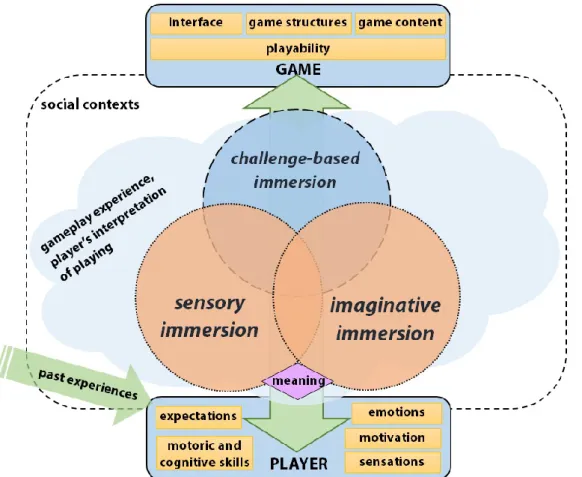
Although Brown and Cairns‘ (2004) model of immersion is useful in pointing out how involvement in a gaming activity can fluctuate, their approach fails to adequately address the qualitative differences between various modes of involvement (Ermi & Mäyrä, 2005). Ermi and Mäyrä (2005) emphasise the fact that immersion is a multi-faceted phenomenon with distinct aspects that can manifest differently, depending on the specific combination of players and games. In an attempt to illuminate the complex dynamics that are involved in the interaction between a player and a game, Ermi and Mäyrä (2005) developed the SCI model of immersion (Figure 3). The SCI model identifies the three key dimensions of immersion that play a role in the formation of game experience. The first dimension is sensory immersion, which relates to the audio-visual impact of digital games. Digital games have grown into visually sophisticated, often highly realistic three-dimensional worlds with formidable sound production. As a result, sensory information coming from the real world is easily overpowered, and players become entirely focused on the stimuli of the game world. Given the fundamentally interactive quality of games, the second dimension is challenge-based immersion. This is the aspect of immersion that comes into effect when the player is able to achieve a gratifying balance of challenge and ability. Challenges usually involve a combination of motor skills and mental skills, such as logical problem-solving or strategic thinking. In this way, players frequently encounter physical and mental challenges that keep them playing. Story elements, characters and the visual aesthetic have become central to contemporary games, too, and the third dimension consequently involves players‘ imaginative immersion. This is the aspect of games that offers players the opportunity to use their imagination, become absorbed in the story, empathise with in-game characters, and simply enjoy the fantasy experience of the game.
These three dimensions of immersion usually overlap in various ways, and social context plays a decisive role in influencing immersion (Ermi & Mäyrä, 2005). In this study, we adopted the approach taken by IJsselsteijn et al. (2008), de Kort et al. (2007), Gajadhar et al. (2008) and Gajadhar (2010), who used the Game Experience Questionnaire (GEQ) to measure players‘ experience of sensory and imaginative immersion (Ermi & Mäyrä, 2005) during gameplay. Specifically, we were interested in how changes in social context influenced players‘ experience of sensory and imaginative immersion during collaborative multiplayer gameplay.
19
2.1.7.
Affect
Affect is often described by psychologists as the experience and expression of feeling or emotion (Russell, 1980). Many researchers argue that affective states—for example, excitement, anger, elation, sadness and distress—fluctuate independently of each other (Borgatta, 1961; Clyde, 1963; Nowlis, 1965) and that each affective state should be treated as a separate dimension. However, other researchers argue that affective states are related to each other in a highly systematic fashion. Schlosberg (1952) illustrates this notion by proposing that emotions are cognitively organised in a circular arrangement and that each affective state can therefore be adequately represented by two bipolar dimensions. Similarly, Russell (1980, p. 1162) stipulates that ―affective states are, in fact, best represented as a circle in a two-dimensional bipolar space‖, and presents the circumplex model of affect (Figure 4) as a set of interrelated, bipolar cognitive categories for interpreting and expressing emotional experience.
Figure 3: The SCI model identifies the three key dimensions of immersion: sensory immersion, challenge-based immersion, and imaginative immersion (Ermi & Mäyrä, 2005). These three dimensions of immersion overlap in various ways, and social context plays a decisive role influencing immersion. Adopting the approach taken by IJsselsteijn et al. (2008), we focus on sensory immersion (related to the audio-visual impact of games) and imaginative immersion (related to the story elements, characters, and visual aesthetics of games).
20
The circumplex model of affect is analogous to a compass, with eight variables falling on a circle in two-dimensional space. Each variable has a polar opposite, and together these polar opposites represent the positive and negative dimensions of an affective state. The vertical (north–south) dimension in Russell‘s (1980) circumplex model is the arousal–sleep dimension. The horizontal (east– west) dimension is the pleasure–displeasure dimension. The remaining four variables help to define quadrants in space and form bipolar dimensions of their own. For example, excitement (northeast) is a combination of high pleasure and high arousal. Excitement‘s bipolar opposite is depression (southeast), while distress (northwest) forms a bipolar dimension with contentment (southeast). These bipolar dimensions of affect form the basis for an established cross-cultural affect structure that broadly divides into negative affect (NA) and positive affect (PA) (Russell, 1983; Almagor & Ben-Porath, 1989).
Although NA and PA are often perceived as opposite poles in a continuum, empirical evidence suggests that NA and PA are uncorrelated and can be conceptualised as relatively discrete dimensions of affect (Thompson, 2007). Whether PA and NA are correlated or orthogonal is, to this day, a contentious topic of scholarly debate (Schmukle, Egloff & Burns, 2002). In this study, we adopted the approach presented by Watson et al. (1988), viewing PA and NA as broadly independent dimensions of affect. Watson et al. (1988) found that PA and NA are highly distinctive, orthogonal dimensions of affect. They define PA as ―the extent to which a person feels enthusiastic, active and alert‖, with high PA associated with a state of ―high energy, full concentration, and pleasurable engagement‖ (Watson et al., 1988). Conversely, NA is defined as ―a general dimension of subjective Figure 4: Russell‘s (1980) circumplex model summarises the properties of the cognitive representation of affect. Eight affective states are arranged in a circular order in two-dimensional bipolar space. Each variable has a polar opposite: for example, arousal‘s polar opposite is sleepiness (north–south) and excitement‘s polar opposite is depression (northeast–southwest).
21
distress and unpleasurable engagement that subsumes a variety of aversive mood states, including anger, contempt, disgust, guilt, fear, and nervousness‖ (Watson et al., 1988). The intensity of positive and negative dimensions of affect can vary dramatically, with low PA ―characterised by sadness and lethargy‖ (Watson et al., 1988) and low NA characterised by ―calmness and serenity‖ (Watson et al., 1988).
Cognitive categorisation of the positive and negative dimensions of affective states allows people to interpret and anticipate the moods of others, and even to influence others‘ emotional responses. Not only does this complex cognitive structure help in decoding both verbal and non-verbal signs of emotion—for example, tone of voice, facial expressions and blushing—but it also plays a major role in conceptualising and conveying one‘s own emotional state (Russell, 1980). In our research, we were particularly interested in the interplay between the conceptualisation of one‘s own emotional states and the conceptualisation of the emotional states of others during collaborative multiplayer gameplay, under different social contexts. Social activity has been shown to be related to PA (Beiser, 1974;Watson, 1988), andit is generally agreed that PA is related to enjoyment of games (de Kort et al., 2007). Similarly, negative emotions and experiences undeniably contribute to the challenge of a game (Gilleade & Dix, 2004), and NA has been shown to be related to stress and poor coping (Wills, 1986; Clark & Watson, 1986).We expected that the ways in which people were able to convey their mood, feelings and emotions under different social contexts would influence collaborative players‘ experience of both the positive and negative dimensions of affect. For example, we expected that co-located players‘ ability to convey subtle non-verbal signals of emotion, such as body language and facial expressions, would result in differences in self-reported affective states, as compared to mediated players, who would be limited to verbal and in-game signals of emotion only.
2.1.8.
Game Experience Questionnaire (GEQ)
Measuring and describing game experience is extremely important for designing, evaluating and testing games. The process is by no means straightforward, though. The application of user-testing and user-centred design approaches to traditional software tools—for example, word processors and spread sheets—focuses primarily on user experience in terms of productivity, user satisfaction, the time taken to perform tasks, ease of use, and error reduction (Norman, 2013). Measuring game experience, on the other hand, presents a vastly different challenge. Games thrive on variety and the element of surprise, while work applications are designed to be predictable and consistent. Furthermore, the motivation for playing a game is intrinsic; it is not linked to material gain, vocational duty, or other external influences. In order to accurately measure and describe player experience, then, a broad spectrum of psychological and subjective feelings on the part of the player must be considered and assessed (IJsselsteijn et al., 2008). Accordingly, a number of psychometric instruments have been developed to measure various aspects of players‘ experience, engagement and skills during gameplay, on the one hand, and of games‘ playability and attractiveness to players, on the other (Norman, 2013).
22
One such instrument, the Game Engagement Questionnaire, was developed as a measure of engagement for particularly violent games (Brockmyer et al., 2009). Brockmyer et al. (2009) focus on the issue of violence in games, and point out that violent games are increasingly popular among children (Funk, 2008). They argue that playing violent games can result in desensitisation to violence (Carnagey, Anderson & Bushman, 2007) and increased aggression in players (Anderson, Gentile & Buckley, 2007). Rather than an assessment of the game itself, the Game Engagement Questionnaire probes children‘s tendency to become involved in, and engaged with, a violent video game. Although the Game Engagement Questionnaire measures numerous factors of game experience, including flow, immersion, and presence, Brockmyer et al. (2009) focus on a one-dimensional continuum, which they aptly describe as ―engagement‖. They imply that increasing levels of engagement are associated with different experiential constructs, with immersion representing the lowest level of engagement, presence low to medium engagement, flow medium to high engagement, and absorption the highest level of engagement. However, these associations are tenuous at best, and Brockmyer et al. (2009) provide no empirical evidence to support the relationship between engagement and the psychological dimensions of experience (Norman, 2013).
Unlike Brockmyer et al. (2009), IJsselsteijn et al. (2008) underscore the value of a faceted approach when measuring a broad spectrum of player experience. To assess the multi-dimensional psychological impact of games, IJsselsteijn et al. (2008) developed the Game Experience Questionnaire (GEQ). The GEQ enables game researchers to empirically test and explore a wide range of experiential constructs, and a variety of games, in a comprehensive and quantitative manner. The recently validated GEQ was based on focus-group investigations (Poels, de Kort & IJsselsteijn, 2007) and two subsequent large-scale survey investigations among frequent gamers (IJsselsteijn et al., 2008). The GEQ is divided into three parts: the core module; the Social Presence in Gaming Questionnaire (SPGQ) (see Section 2.1.2); and the post-game module. The GEQ‘s core questionnaire is used to assess game experience during game play and measures experience via scores for the following seven psychological components: sensory and imaginative immersion, flow, tension, challenge, competence, positive affect, and negative affect. For a more robust measurement, six items per component are included in the questionnaire.
The GEQ‘s post-game module is used to assess how players feel after they have stopped playing. The post-game module consists of the following four components: positive experience, negative experience, tiredness, and returning to reality. Assessment of positive and negative affect in the GEQ‘s core module should not be confused with the post-game module‘s assessment of positive and negative experience. Positive and negative affect as measured by the core module refers to the extent to which people feel positive or negative emotions during gameplay (see Section 2.1.7). By contrast, positive and negative experience as measured by the post-game module refers to the extent to which players feel they had a positive or negative experience, looking back on the gameplay session as a whole. For example, positive experience is measured by items like ―I felt proud‖, ―I felt
23
energised‖, and ―I felt satisfied‖. Similarly, negative experience is measured by items like ―I felt bad‖, ―I felt guilty‖, and ―I found it a waste of time‖. It should be noted that the post-game module‘s returning to reality scale refers to players‘ difficulty in returning to reality after having stopped playing, which is measured by items like ―I found it hard to get back to reality‖ and ―I had a sense that I had returned from a journey‖.
Due to the highly social, collaborative, non-violent and anti-competitive nature of our study and our apparatus, the GEQ was chosen as the ideal tool for measuring participants‘ experience of collaborative gameplay. The GEQ was pivotal for the validity of our study, enabling analysis of the influence of changes in social context (i.e., co-located play versus mediated play) on players‘ subjective feelings of social presence, as well as a wide range of associated game experiences, including flow, immersion, positive affect, and negative affect. See Appendix A for the full version of the GEQ, consisting of the core, SPGQ, and post-game modules.
In order to deepen our understanding of how people interact and socialise during collaborative games, the following section (2.2) presents a review of the current body of literature surrounding collaborative and co-operative games and gameplay mechanisms. We investigate communication channels in multiplayer games, and explore player-avatar relationship dynamics. These collaborative concepts and mechanisms helped inform the design of our study and our apparatus, entitled COLAB.
2.2.
Collaboration and Co-operation in Games
Collaborative and co-operative mechanisms have become an important feature of many modern computer games. The gaming industry realises this, and some of the most popular AAA titles today include collaborative and co-operative gameplay. Games like World of Warcraft (Blizzard Entertainment, 2001), League of Legends (Riot Games, 2009), Portal 2 (Valve, 2011), Diablo 3 (Blizzard Entertainment, 2012), Destiny (Bungie, 2014) and Overwatch (Blizzard Entertainment, 2016) continue to boast active player communities years after release and stand out as some of the most lucrative games ever developed. These kinds of games offer social spaces where players can connect and communicate with friends from the comfort of their own home. Most importantly, they encourage players to work together and collaborate as they progress towards common goals.
Kim (2013) describes the increasing success of collaborative games as the ―co-op revolution‖. In particular, she describes three disruptive trends that are re-shaping the gaming industry and influencing the broader digital landscape. Firstly, ubiquitous connected devices are disrupting the dominance of consoles in the games industry. In 2014, PC games revenue surpassed that of console games, and growth in the video games sector is predicted to be concentrated in the mobile and online gaming markets (Figure 5).
24
Secondly, gaming has gone mainstream and is appealing to a much wider audience of all ages, genders and cultures. Gaming is no longer a ―boys club‖, and has become an increasingly social experience. According to a recent survey, 93% of children ages 8–13 play games online in the USA (M2 Research, 2014). Thirdly, user-generated content is disrupting the way game developers approach gameplay. Minecraft (Mojang, 2011), one of the most successful games in recent history, focuses on allowing players to collaboratively build virtual spaces together, one building block at a time. Minecraft players generate their own content, and in doing so they entertain, inspire and communicate through an active and thriving social community centred on collaboration and co-operation.
2.2.1.
Designing Games for Collaboration
Due to an uptick in games that provide co-operative mechanisms without necessarily fostering collaboration between players, Zagal, Rick and Hsi (2006) investigated those co-operative mechanisms that encourage collaboration among players. They posed the question: ―How can electronic games be designed so that collaboration is a worthwhile, interesting, and attractive option?‖ (Zagal et al., 2006, p. 25). The authors argue that, owing to the complexity of existing collaborative electronic games, it is difficult to extract design principles from them. Consequently, they focus on collaborative board games, which are simpler and easier to understand. In traditional (i.e., non-digital) game research, games are considered innately multiplayer activities that can be divided into two basic Figure 5: Games revenue share and predicted growth by sector (Digi-Capital, 2016). The mobile and Mass Multiplayer Online (MMO)/Mass Online Battle Arena (MOBA) gaming markets are predicted to continue growing year-on-year, and make up the most lucrative sectors of the market. The console gaming market is shrinking rapidly, while the popularity of Virtual Reality (VR) games and Augmented Reality (AR) games is expected to grow significantly by the year 2020.
25
categories: co-operative or competitive. In a competitive game, players are required to form strategies that conflict directly with other players in the game. The goals and objectives of competing players are diametrically opposed (Zagal et al., 2006). Many popular traditional board games like chess, checkers and go fall into the competitive category (Jones, 2000). On the other hand, a co-operative game presents a scenario where two or more people have interests that are ―neither completely opposed nor completely coincident‖ (Nash, 2002). In a co-operative game, players have the opportunity to work together to obtain a win–win condition. The word ―opportunity‖ is important here, since it is not guaranteed that co-operating players will benefit equally or even at all. Although it was not originally recognised by game theorists, a third category of game exists: collaborative (Zagal et al., 2006). In a collaborative game, players are required to work as a team towards a shared outcome. If the team wins, everyone wins. If the team loses, everyone loses. Marschak and Radner (1972) define a team as an organisation in which the interests and beliefs of each individual are the same, while the type of information each person possesses can differ. Co-operation among individuals differs from collaboration as a team in that collaborative players have only one objective and share the consequences or rewards of their decisions. ―The challenge for players in a collaborative game‖, write Zagal et al. (2006, p. 26), ―is working together to maximise a team‘s utility.‖ Conversely, co-operative players can have different goals and may reap rewards individually.
In short, competitive games exclude collaboration. Collaborative games require collaboration between players. Co-operative games lie between competitive and collaborative games by allowing operating players to participate in anti-collaborative practices. Behaving competitively in a co-operative environment precludes collaboration, but might guarantee a player‘s success. Thus, one of the key components in designing collaborative games is that of navigating the ―competitiveness that players bring to the table‖ (Zagal et al., 2006, p. 26). Collaborative games require mechanisms that force collaboration while inhibiting competitive or anti-collaborative practices.
More recent work by Rocha, Mascarenhas and Prada (2008) overlaps significantly with the findings presented by Zagal et al. (2006). Based on an analysis of popular collaborative and cooperative electronic games, Rocha et al. (2008) investigated the cooperative game mechanics that promote collaboration while precluding competition. A game mechanism refers to a ―physical artefact, rule or type of interaction that implements an action in the game‖ (Zagal et al., 2006, p. 27). Based on their findings, Rocha et al. (2008) describe six design patterns for developing collaborative game mechanics:
Complementarity: Players have unique character roles or information that complement each other‘s activities within the game.
Synergies between abilities: Players have different abilities (often based on their unique character roles) that can assist or change another character‘s abilities.
26
Abilities that can only be used on another player: Players have abilities that are only usable on team members. For example, a medic in Team Fortress 2 (Valve Corporation, 2007) has a weapon that can only be used to heal fellow team members.
Shared goals: A group of players have one non-exclusive goal that can only be accomplished by working together as a team. All players in the team depend on one another, and they either win together or lose together.
Synergies between goals: When players have different tasks to accomplish, some sort of synergy or dependency between each of the player‘s tasks encourages collaboration.
Special rules for players of the same team: Rules are used to enforce collaboration between players in the same team; for example, preventing team members from being able to damage each other while allowing them to damage players on the opposing team.
Rocha et al. (2008) further explored how the in-game challenges defined by Rollings and Adams (2003) are used to encourage collaboration among players in current cooperative games. They found that challenges can be divided into two primary categories: pure challenges and applied challenges. Pure challenges involve real-life physical effort, coordination, reflexes and spatial-awareness. Physical effort can be used to promote collaborative play if the effort required to accomplish a task is configured in such a way that it is too much for a single player handle. Collaboration is also encouraged in a team of players who have to coordinate movements and strategies, be spatially aware of their surroundings, and use their reflexes to react to challenges that arise during the attainment of shared goals.
Applied challenges are different to pure challenges in that they apply directly to the content and mechanics of the game in question. Examples of applied challenges that encourage collaboration include race conditions, exploration, and economics. Race conditions (or timed events) force players to complete certain tasks in unison before a timer expires, and the additional time pressure causes players to focus better and work more cohesively. Exploration requires players to collaborate so they can progress to other areas by, for example, opening locked doors via simultaneous switches or working together to disable or avoid traps and dangerous objects. In games centred on resource management, economic necessity can be used to encourage players to collaborate closely, with players having to trade with each other and manage and allocate their shared resources in order to succeed.
Seif El-Nasr et al. (2010) continued the work begun by Zagal et al. (2006) and Rocha et al. (2008). Based on an in-depth analysis of fourteen popular and current cooperative games, Seif El-Nasr et al. (2010) extended the findings of Rocha et al. (2008) and proposed an additional seven design patterns for developing collaborative game mechanics:
Camera settings: Camera setup emerged as an important design component in collaborative games, especially in situations where people play together on a shared screen. The following