Competency Based Assessment (CBA) of Engineering Students’ Product
Development via Project-Based Learning (PjBL) Process
Md. Baharuddin Bin Haji Abdul Rahman
Mechanical Department, Politeknik Kota Bharu, Km 24 Pangkal Kalong, Ketereh, Kelantan, Malaysia.
Tel :+6019-9021484 Email: [email protected]
Hairul Nizam Ismail
Pusat Pengajian Ilmu Pendidikan 11800 USM, Pulau Pinang, Malaysia. Tel: +6012-4122539 Email: [email protected]
Khairul Azhar Mat Daud
Mechanical Department, Politeknik Kota Bharu, Km 24 Pangkal Kalong, Ketereh, Kelantan, Malaysia. Tel: +6013-9333919 Email: [email protected]
Mohd Fadzil Jaafar
Mechanical Department, Politeknik Kota Bharu, Km 24 Pangkal Kalong, Ketereh, Kelantan, Malaysia.
Tel: +6019-9391802 Email: [email protected]
Abstract
This article is written to explain an innovative engineering pedagogy related with Project Based Learning (PjBL) concept via Compentency Based Assessment (CBA) in product development for subject J3102 . This concept aims to improve the self-regulation rules development of engineering students in Mechanical Department at Politeknik Kota Bharu , Kelantan. This study was includes both experimental instruments test and qualitative in nature. The data was analyzed using PjBL module and Competency Based Assessment (CBA). A total of four (4) groups among twelve (12) persons of SKM4A students from Mechanical Engineering Department were selected as respondents. This study finds that the students results of product development was increase, otherwise thier self-regulation become improve after using PjBL:CBA instruments. The result of an interview and observation on the usage of PjBL and CBA show’s the positive effect of self regulation among engineering students and produce high quality standard of the product one (1) and two (2) making parts. It is hoped that these PjBL:CBA concepts can be further developed and implemented among engineering lab and workshop at college community and polytechnics in Malaysia.
Keywords: Project Based Learning (PjBL), Compentency Based Assessment (CBA), Engineering Product Development and Engineering Student Self-Regulation.
1.0 Introduction
This article is written to explain the concept of project based learning (PjBL) by utilizing the Competency Based Assessemnt (CBA) focusing on engineering students product development for subject J3012 (machining). This PjBL concept aims to improve the self-regulationof Mechanical Engineering Students in Kota Bharu Polytechnic, Kelantan when used Project based learning process in product development that special touch with competency based assessement in measurement and evaluation engineering knowledge and soft skills (Pintrich, P. R., 2000). Otherwise this PjBL-CBA concept will generate a collaborative learning in product development and evaluation among engineering students at Machaning Lab (2), Mechanical Department, Politeknik Kota Bharu (Md. Baharuddin et al., 2009).
1.1 Research objectives
This action research was implemented to find the best solution for 21 century learning style that match with the globalization needs (Kamaruzaman Jusoff et al., 2010). It’s also to find out the best solution in new learning methods that can replace the traditional learning process in product development at machining section (workshop/lab). This pilot study was implemented to full fill the quality of engineering learning process includes ; monitoring , evaluation and product producing for subject J3012 (machining section) match with PjBL and CBA caterias at Mechanical Department, PKB.
1.2 Problem statements
The convensional process of product development become unecpetable in product evaluation by using traditional method, it look lack of proccess monitoring and data collection (Abd. Rahim Abd. Rashid., 2007).
While proccess is runing, whole proceess not stuctured as well need, otherwise the report come at the end of process become parallel submition note and data’s (Boekaerts et.al., 2000). This summartive data procude with convensional concept not support the quality needs (Abdul Ghafar Md Din., 2003). Some report look similiar with others. So, this research was carry over to produce the process that can evaluate in wright setuations when process is runing (Thomas, J., 2000). The formmative assessement produce with PjBL concept become easly to supervisor and engineering students evaluate themselve in weekly progress (Yang, H., 2001). The way of formative assessment touch with PjBL:CBA concept become easily for supervisor to evaluate match with engineering standard needs (Md. Baharuddin et. al., 2009).
2.0 Literature View
The change of vision and mobilization in industrial of humanization at Malaysia become new challenging aspects to cover socialization at developing country. The government philosophy to producing high technical skilled and global player of Malaysian community to gain the world challenging (Abdul Ghafar Md Din, 2003). The new education technical and high technical pedagogy full fill of 21 century learning will be the one can solve that philosophy (Abd. Rahim Abd Rashid, 2007). PjBL concept looks can help the country to fill up what the government need and expectation immediately. Schools and technical institutions need to recover the need of future learning concept to producing manpower that fulfill the needs of industrials and become ‘global player’ (Grant and Michael, M. 2002). The vision of Ministry of Higher Education Malaysia (KPTM) to generate knowledgeble and high technical skilled workers (soft-skills) to gain the 21 century and international globalization (Nik Aziz Nik Pa, 1997). Its need a good instrumen and learning method to be catalysized for full fill the product and developt Malaysian country (Jeyagobi, et al, 2007). Theachers or local learning pedagogy developer sholud full fill the scope that will match with goverment philosopy. PjBl concet is a part of instrument that can generate humanity to changing the technical manpower as singnificannly with Malaysia vision (Noor Azean Atan et al. 2006).
2.1 The Concept of “PjBL” and “CBA”
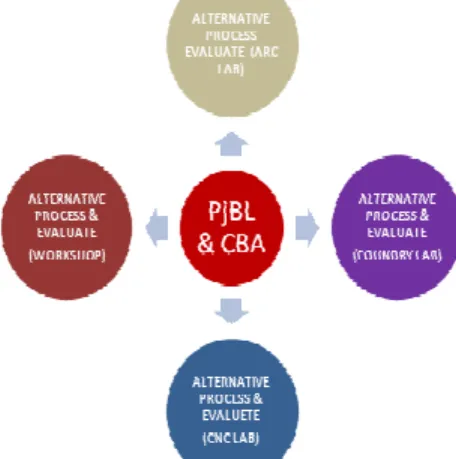
The first procedure will come up with model,theory and data survey for PjBL and Competence Based Assessment (CBA) instruments development (Md. Baharuddin et al., 2009). The dual combination of process (PjBL) and evaluation (CBA) of used as per figure below:-
Above concept figure shown the combination of two instruments (PjBL and CBA) and become workshop learning manual/lab sheet of subject J3012 (machining). This figure is written to explain the concept of Project Based Learning (PjBL) by utilizing the evaluation of product focusing on Competency Based Assessement (CBA) cross over engineering disciplines and workshop (Kamaruzaman Jusoff et al., 2010).This concept aims to improve students self-regulationin lab/workshop habits (Boekaert et. al., 2000). For the pilot process of PjBL and CBA will carry on at Machning lab and workshop Department of Mechanical Engineering. The pilot test will carries over after all instruments completed.The result will come out after it’s been used, this alternative PnP of PjBL and CBA become special instruments to works as catalyzed in students project development (Brandi Allen., 2006). This project looks able to full fill the needs in engineering knowledge development match with KPTM philosophy (Nik Aziz Nik Pa., 1997).
2.2 The Special Use of PjBL & CBA as Learning Process
Above figure shown the over view of collaborative communications among four lab/workshops at Mechanical Department,Kota Bharu Polytechnics. This PjBL ad CBA create students centered of learning, discussion and data evaluate of knowledge collection by using ths concepts (Synteta, P., 2001, 2002, 2003).This valuable concept of PjBL and CBA will support the engineering learning methods for future 21 century learning (Kurubacak, Gulsun., 2007). The full utilizing of the students learning management via PjBL:CBA match with KPTM philosophy that significantly matches with global learning(Brandi Allen., 2006). The PjBL and CBA focusing on students project development (machining) centered by working as project making lab sheet and evaluation without limitation of knowlegde full in (Jeyagobi, R. Subramaniam, S., 2007).
This concept aims to improve the self-regulationof Mechanical Engineering Students Politeknik Kota Bahru when used this dual combination instrument that special touch with the needs in engineering knowledge, otherwise this product will generate no limitation of time in measurement and evaluation (students and products) (Morsund, David., 2002).
2.3 The 21st Century Learning & Assessement Skills
Figure 1: enGauge 21st Century Skills Source: www.ncrel.org/engauge/skills
Figure 2: The Partnership for 21st Century Skills Source: www.21stcenturyskills.org
3.0 The methods of PjBL: CBA implementation
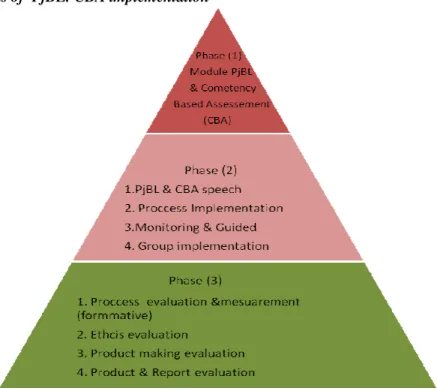
Figure 1: The 3 phase of PjBL & CBA Action Research for subject J3012
The table above showed the three (3) phase’s process of PjBL & CBA implementation where; Phase 1 is the module PjBL and CBA development and selection. Then phase 2 is the process of PjBL:CBA implementation where it’s includes a) The PjBL:CBA speech, b) The PjBL:CBA proccess implementation, c) PjBL:CBA monitoring and guiding, and d) Group implementation. For the phase (3) is the PjBL:CBA evaluation and mesurement, that includes Pilot Test and Survey for ethics, product making, product quality and report evaluation (Kurubacak, Gulsun., 2007). This combination concept works to inter cross discipline of used, proccess implementation where its works as collaborative engineering soft skill learning, and lastly its will be used at all lab/workshop at PKB (Noor Azean Atan et al., 2006).
3.1 The photos’ and datas’ while PjBL & CBA implementation
Phase1: PjBL: Briefing on CBA to Students
Phase 2 : PjBL Procces Implementation
Phase 3: PjBL: CBA Assessment (Formative Measurement and Evaluation)
Phase 4: CBA mesurament and evaluation
Phase 5: PjBL: Product 1 and 2
Phase 5 : Project 1 and 2 Evaluation (Results)
4.0 Results and Data’s Collection of PjBL:CBA Implementation
The value point given of highest marks (5 marks) of each weekly progress where for this pilot test taken 8 week to complete 2 projects. The overaal marks includes competencay based evaluation, report mesurement, project 1 & 2 evaluation and report summary. Highest point might be given for all members work collaberatively with follow all PjBL guide & CBA assessement cetarias. The respondents includes 12 engineering students that devided into two groups (A) and (B).each group contains 6 students within each person should completed 2 project with scheduled time given (4 weeks). The overall (4 weeks) data’s as given below:- 0 5 10 15 20 25 30 35 40 week1 week2 week3 week4 project1 project2 report
Data collection shown that the overall marks for 4 weeks above 15 marks and the product quality and marks above 30 marks. For final report shows that overall report marks above 15 marks. Data collection shown that the overall data collection of Compentency based assessement wtihin weekly proccess imlementation. Below the table shows the value of 5 impericals choosen :-
Item 1 : value point for attendence Item 2 : ethics and competences evaluation
Item 3 : procedure and product making Item 4 : Quality of product ( project 1 and 2) Item 5 : Machining & parts cleaning and arragemen
Below the data’s collection taken for 1st week (week1):-
Data collection shown that the overall value of attandence and machining & parts cleaning for 12 students at higher points (5 marks),for value of ethics,product making and product quality are at gap between ( 3 – 4 marks),while for value of 3 items are at score more then 3 marks. Total marks each students carry more then 15 marks, two of them carry marks for week1 at above 20 marks.
Table 1a: Case Processing Summary data’s of 12 Respondents of 5 impericals evaluation (week1)
Above data’s analysis shown the case of processing summary of 12 respondents to evaluate of overall marks (maximum 25 marks) details on first week.
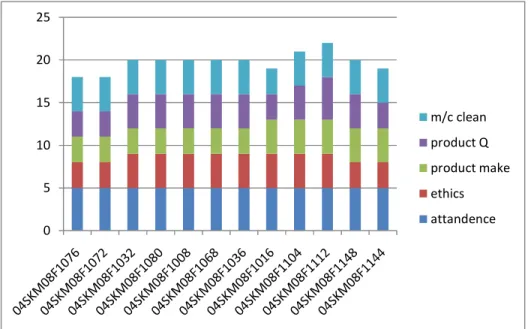
Below the data’s collection taken for 2nd week (week2):-
Data collection shown that the overall value of attandence and machining & parts cleaning for 12 students at higher points (5 marks),for value of ethics,product making and product quality are at gap between ( 3 – 4 marks),while for value of 3 items are at score more then 3 marks. Total marks each students carry more then 15 marks, two of them carry marks for week1 at above 20 marks.
0 5 10 15 20 25 m/c clean product Q product make ethics attandence
Table 1b: Case Processing Summary data’s of 12 Respondents of 5 impericals evaluation (week2) 0 5 10 15 20 25 m/c clean product Q product make ethics attendance
Above data’s analysis shown the case of processing summary of 12 respondents to evaluate of overall marks (maximum 25 marks) details on second week. Data’s analysis at table 1b shown the overall marks at value point (above 15 marks), and 6 f respondents et rich to value ponit f 20 marks,and 2 more goes above 20 marks.
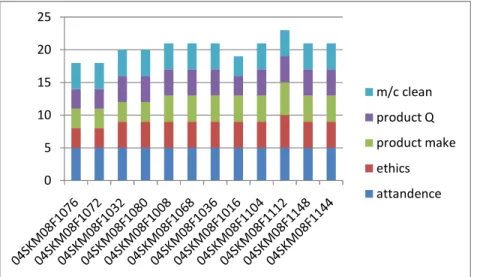
Below the data’s collection taken for 3rd week (week3):-
Data collection shown that the overall value of attandence and machining & parts cleaning for 12 students at higher points (5 marks),for value of ethics,product making and product quality are at gap between ( 3 – 4 marks),while for value of 3 items are at score more then 3 marks. Total marks each students carry more then 15 marks, seven of them carry marks for week3 at above 20 marks.
0 5 10 15 20 25 m/c clean product Q product make ethics attandence
Table1c: Case Processing Summary data’s of 12 Respondents of 5 impericals evaluation (week3)
Above data’s analysis shown the case of processing summary of 12 respondents to evaluate of overall marks (maximum 25 marks) details on third week. Data’s analysis at table 1c shown the overall marks at value point (above 15 marks), and 72 of respondents rich to value point of 20 marks,and 7 more goes above 20 marks. This data’s shown the increasing of respondents quality in result while seven (7) rich the maks above 20 marks. But the point for machine cleaning become reduce might be effct of product concentration. This overall data of week 3 shown the deffirence of ethics, product make and quality of product while proccess on going. The multi-impact of impericals chosen look the repondents wave of marksnot constant and but under guide and objective aspectations.
Below the data’s collection taken for 4th week (week4): Data collection shown that the overall value of attandence and machining & parts cleaning for 12 students at higher points (5 marks),for value of ethics,product making and product quality are at gap between ( 3 – 4 marks),while for value of 3 items are at score more then 3 marks.
Table 1d: Case Processing Summary data’s of 12 Respondents of 5 impericals evaluation (week4) 0 5 10 15 20 25 m/c clean product Q product make ethics attendance
Total marks each students carry more then 15 marks, two of them carry marks for week1 at above 20 marks Above data’s analysis shown the case of processing summary of 12 respondents to evaluate of overall marks (maximum 25 marks) details on fourth week.
5.0 Conclusions
This proccess of PjBL make smooth operation of project 1 and 2 development and achive multi results by using CBA evaluation. Its also carry on to assess the product quality refer to students’ result achivement of using PjBL concept and CBA. After PjBL and CBA completed testing, its will piloting among engineering students to access self-regulation when PjBL:CBA was introduced as new alternative engineering pedagogy in lab or workshop at Mechanical Department, Politeknik Kota Bharu. Though it is difficult to generalize the results due to the limited number of self-reported data and the absence of observational data, the exploratory study provides evidence and support for the adoption of CBA match with overall imperacials aspectations for polytechnic produce high expectation of engineering students. The overall findings in this exploratory study suggest that the PjBL module was beneficial in developing self-regulatory skills of students in a project-based learning experience. It is however recommended that this study should be replicated with a larger sample size and examine in greater detail the two major constructs, i) meta-cognition (consisting of awareness, planning/goal-setting and self-checking/monitoring) and ii) management and control of effort.
Refferences
Abd. Rahim Abd. Rashid (2007). Profesionalisme Keguruan: Prospek dan Cabaran, Kuala Lumpur, Dewan
Bahasa dan Pustaka.
Abdul Ghafar Md Din (2003). Prinsip dan Amalan Pengajaran. Utusan Publications and Distributors Sdn.
Bhd. Kuala Lumpur.
Boekaerts, M., Pintrich, P. R., & Zeidner, M. (Eds.). (2000). Handbook of Self-regulation. San Diego: Academic Press.
Brandi Allen (2006). Self-Directed Learning for Middle School Students, Johnston Middle School. http://hti.math.uh.edu/curriculum/units/2006/03/06.03.01.php
Grant, Micheal M. (2002). Getting A Grip On PBL: Theory, Cases and Recommendations. Meridian : A
Middle School Computer Technologies Journal a service of NC State University, Raleigh, NC. Volume 5, Issue 1, 2002. Retrieved January 6, 2008 URL:
http://www.ncsu.edu/meridian/win2002.514/2.html
Jeyagobi, R. Subramaniam, S. (2007). Pembestarian Proses Pengajaran dan Pembelajaran. Mahir
Holdings Sdn. Bhd. Shah Alam .
Kamaruzaman Jusoff, Baharuddin Haji Abdul Rahman, Khairul Azhar Mat Daud and Nik Azida Abd Ghani (2010). “Motivating Students Using Project Based Learning (PjBL) via e-SOLMS Technology”, World Applied Science Journal 8(9): 1086-1092, IDOSI Publications, 2010.
Kurubacak, Gulsun., (2007). Promoting Self-Motivated Learning through Project Based Online Learning. ERIC online submission. abstract and pdf
Morsund, David (2002). Project –based learning: Usinag Information Technology, 2nd edition , ISTE.
ISBN 1-56484-196-0
Md. Baharuddin Abdul Rahman, Khairul Azhar Mat Daud, Kamaruzaman Jusoff, Nik Azida Abd. Ghani.
(2009). Project based learning (PjBL) pratices at Politeknik Kota Bharu, Malaysia. International Education Studies.
2 (4), 140-148
Nik Aziz Nik Pa (1997). Konsep Tentang Realiti dan Prospek Pendidikan di Abad ke-21. Jurnal
Kebangsaan Pengetua-Pengetua Sekolah Menengah Malaysia .Jilid 2 ms 37–52.
Noor Azean Atan, Norah Md. Noor dan Mohd Fadzli Ali (2006). Penerapan Kemahiran Generik Melalui
Pembelajaran Aktif. Prosiding Konvensyen Teknologi Pendidikan ke-19 Reka Bentuk Pembangunan, Penggunaan
dan Penilaian Teknologi Instruksional Jilid I, 9-11 September 2006. Awana Porto Malai, Langkawi, Kedah.
Pintrich, P. R. (2000). The Role of Goal Orientation in Self-regulated Learning. In Monique Boekaerts, Paul R. Pintrich and Moshe Zeidner (Ed.) Handbook of Self-regulation (pp. 452-502). San Diego: Academic Press.
Synteta, P (2001). EVA-pm: Design and Development of a Scaffolding Environment For Students Projects. Unpublished Master thesis, University of Geneva, Geneva, Switzerland. PDF
Synteta, P. (2002). Project-Based e-Learning: The model and the method, the practice and the portal. Unpublished PhD proposal (Accepted oct, 2002), University of Geneva, Geneva, Switzerland.
Synteta, P. (2003). Project-Based e-Learning n higher education: The model and the method, the practice and the portal. Studies in Communication, New Media in Education. Pp. 263-269.
Thomas, J. (2000). A review of research on project-based learning. Retrieved July 29, 2004 from http://www.bie.org/tmp/research/researchreviewPBL.pdf.
Yang, H. (2001). Mission possible: Project-based learning preparing graduate students for technology. Retrieved August 29, 2004 . http://www.msu.edu.