Query Answering in Probabilistic Data and
Knowledge Bases
Dissertation
zur Erlangung des akademischen Grades Doctor rerum naturalium (Dr. rer. nat.)
vorgelegt an der
Technischen Universität Dresden Fakultät Informatik
eingereicht von
İsmail İlkan Ceylan, M.Sc.
geboren am 6. Januar 1986 in Tefenni, Türkei
verteidigt am 29.11.2017
Gutachter: Gutachter: Fachreferentin:
Prof. Franz Baader Prof. Georg Gottlob Prof. Christel Baier
Technische Universität Dresden University of Oxford Technische Universität Dresden
Abstract
Probabilistic data and knowledge bases are becoming increasingly important in academia and industry. They are continuously extended with new data, powered by modern information extraction tools that associate probabilities with knowledge base facts. The state of the art to store and process such data is founded on probabilistic database systems, which are widely and successfully employed. Beyond all the success stories, however, such systems still lack the fundamental machinery to convey some of the valuable knowledge hidden in them to the end user, which limits their potential applications in practice. In particular, in their classical form, such systems are typically based on strong, unrealistic limitations, such as the closed-world assumption, theclosed-domain assumption, thetuple-independence assumption, and the lack of commonsense knowledge. These limitations do not only lead to unwanted consequences, but also put such systems on weak footing in important tasks, querying answering being a very central one. In this thesis, we enhance probabilistic data and knowledge bases with more realistic data models, thereby allowing for better means for querying them. Building on the long endeavor of unifying logic and probability, we develop different rigorous semantics for probabilistic data and knowledge bases, analyze their computational properties and identify sources of (in)tractability and design practical scalable query answering algorithms whenever possible. To achieve this, the current work brings together some recent paradigms from logics, probabilistic inference, and database theory.
Acknowledgments
I would first like to express my deepest gratitude to my supervisor Franz Baader for being supportive at all stages of my doctoral studies. Thomas Lukasiewicz, from the University of Oxford, was continuously advising me and I am very much indebted to him. My deepest gratitudes extend to Adnan Darwiche and Guy Van den Broeck, whom I had the chance to work with, during a research visit to University of California, Los Angeles. I am extremely thankful to Rafael Peñaloza, for his guidance during the early phases of my doctoral work, and to Stefan Borgwardt, for his excellent support during the later phases of my doctoral work. I am very thankful to Georg Gottlob, who kindly accepted, on a rather short notice, to act as an external reviewer of this dissertation.
This work was financially supported by the Deutsche Forschungsgemeinschaft (DFG) in the Research Training Group GRK 1907 (RoSI), and afterwards in the Collaborative Research Center 912 (HAEC). It was the exceptional financial framework of RoSI, which made the long-term research visits possible, in the first place. I am pleased to be offered such an opportunity, and am thankful to all who contributed to such a framework. On the administrative side, our chair is surely the luckiest one: Many thanks to Kerstin, our secretary, who was not only dealing with very intricate bureaucratic work, but also pursuing this in the most cheerful way possible.
Special thanks to the colleagues/friends from the Chair for Automata Theory; Stephan Böhme, Andreas Ecke, Oliver Fernández Gil, Patrick Koopmann, Pavlos Marantidis, Maximilian Pensel, Veronika Thost, Anni-Yasmin Turhan and Benjamin Zarrieß; and old members/visitors of the chair; Jieying Chen, Yue Ma, Theofilos Mailis and Julian Mendez. Almost all of them had to continuously deal, and have done so very well, with a person who would walk into their office at random, and even worse, with accompanying random subjects. The colleagues from other chairs were not exempt from this; in particular, David Carral, Irina Dragoste, and Lukas Schweizer were among those, who suffered, and I owe them many thanks for their kindness.
I have always been encouraged, and motivated by my friends Ahmad Ahmadov, Kerem Kaynar, Andrey Rivkin, Umut H. Toprak, İsmail Yüksel, and Murat Zabcı, to write my thesis, and their support was, as always, very much appreciated. Finally, I was thrilled by the continuous support of my parents Anakadın Ceylan and Osman Ceylan; and, of my brother Ramazan Volkan Ceylan. To them, I owe the most: “Her şey için teşekkür ederim; iyi ki varsınız!”
Contents
List of Figures xi
List of Symbols xv
I Overview and Foundations 1
1 Introduction 3
1.1 Logic and Probability . . . 3
1.2 Probabilistic Data and Knowledge Bases . . . 5
1.2.1 Probabilistic Databases . . . 6
1.2.2 Ontological Knowledge and Probabilistic Knowledge Bases . . . 8
1.3 Structure of the Thesis . . . 10
2 Foundations 13 2.1 First-Order Logic . . . 13 2.2 Probability Theory . . . 17 2.3 Complexity Theory . . . 21 2.3.1 Turing Machines . . . 22 2.3.2 Boolean Circuits . . . 28 II Probabilistic Databases 31 3 Preliminaries, First Results and State of the Art 33 3.1 Database Theory . . . 33
3.1.1 The Model-Theoretic View on Databases . . . 33
3.1.2 On The Complexity of Query Evaluation in Databases . . . 36
3.2 Probabilistic Databases . . . 37
3.2.1 Tuple-Independent Probabilistic Databases . . . 37
3.2.2 On the Complexity of Inference in Probabilistic Databases . . . . 39
3.2.3 Relations to Weighted Model Counting . . . 48
3.3 State of the Art in Probabilistic Databases . . . 50
4 Open-World Probabilistic Databases 53 4.1 Problems in Probabilistic Databases . . . 53
4.1.1 Distinguishing Queries . . . 54
4.1.2 An Unfounded Learning Loop . . . 55
4.1.3 Knowledge Base Completion, Mining and Evaluation . . . 56
4.1.4 Truncating and Space Blow-up . . . 57
4.2.3 Data Complexity Results . . . 69
4.2.4 Combined Complexity Results . . . 78
4.2.5 Overview of the Results, Outlook and Related Work . . . 79
5 Maximal Posterior Computations for Probabilistic Databases 83 5.1 Probabilistic Graphical Models . . . 83
5.1.1 Bayesian Networks . . . 84
5.1.2 Maximal Posterior Computations in Bayesian Networks . . . 85
5.2 Explanations for Probabilistic Database Queries . . . 86
5.2.1 The Most Probable Database Problem . . . 87
5.2.2 The Most Probable Hypothesis Problem . . . 95
5.3 Related Work and Outlook . . . 103
III Logic and Probabilistic Knowledge Bases 105 6 Ontology Languages and Query Answering 107 6.1 Ontology Languages . . . 108
6.1.1 Datalog± . . . 108
6.1.2 Description Logics . . . 110
6.2 Ontology-Mediated Query Answering . . . 114
6.2.1 Ontology-Mediated Query Answering in Datalog± . . . 115
6.2.2 Ontology-Mediated Query Answering in Description Logics . . . 117
7 Probabilistic Data Access with Datalog± 119 7.1 Ontology-Mediated Queries for Probabilistic Databases . . . 120
7.1.1 Complexity Results . . . 121
7.1.2 Overview of the Results . . . 125
7.2 Ontology-Mediated Queries for Open-World Probabilistic Databases . . 126
7.2.1 Complexity Results . . . 128
7.2.2 Overview of the Results . . . 133
7.3 Most Probable Explanations for Ontology-Mediated Queries . . . 134
7.3.1 The Most Probable Database Problem for Ontological Queries . 135 7.3.2 The Most Probable Hypothesis Problem for Ontological Queries 140 7.4 Related Work and Outlook . . . 147
8 Probabilistic Data Access with Description Logics 151 8.1 Bayesian Ontology Languages . . . 151
8.1.1 Query Evaluation in Bayesian Ontology Languages . . . 154
8.1.2 Incorporating Evidence to Ontological Queries . . . 164
8.1.3 Most Likely Contexts for Ontological Queries . . . 165
8.2 Dynamic Bayesian Ontology Languages . . . 170
8.2.1 Dynamic Bayesian Networks . . . 171
8.2.2 Syntax and Semantics of Dynamic Bayesian Ontology Languages 173 8.2.3 Ontological Monitoring . . . 174
IV Conclusions 181
9 Conclusions 183
9.1 Summary and Outlook . . . 183 9.2 Future Research . . . 185
List of Figures
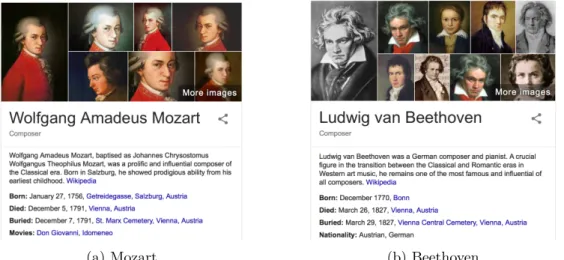
1.1 Information boxes for the Google search (a) Mozart and (b) Beethoven. The information boxes are linked to the underlying knowledge base that provides basic information about the search entities. . . 6 1.2 Inability to perform high-level queries on large knowledge base
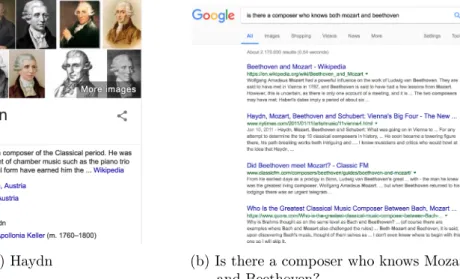
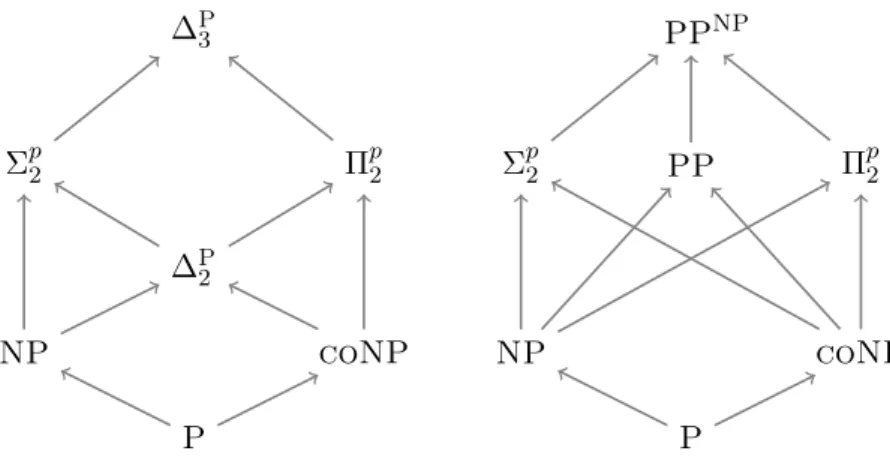
sys-tems. Even though Mozart (Figure 1.1a), Beethoven (Figure 1.1b), and Haydn (Figure 1.2a) are all entities known by the probabilistic knowledge base, the question whether there is a composer who knows both Mozart and Beethoven (Figure 1.2b) cannot be answered by this system. . . 7 2.1 A portion of the polynomial time hierarchy is shown on the left-hand side
where arrows denote inclusion relationship. On the right-hand side, the relationship of PP and PPNP to the first level of thePH is depicted. . . 26 3.1 Venn diagram for the queriesQNH (non-hierarchical) and QH (hierarchical). 41
3.2 Decomposition tree of a safe query for the grounding [x/a, y/b] (left
branch) and[x/b, y/a](right branch). Different branches of the tree do
not share an atom, which ensures independence. . . 42 3.3 Decomposition tree of an unsafe query for the grounding [x/a, y/b](left
branch) and[x/b, y/a](right branch). Different branches of the tree share
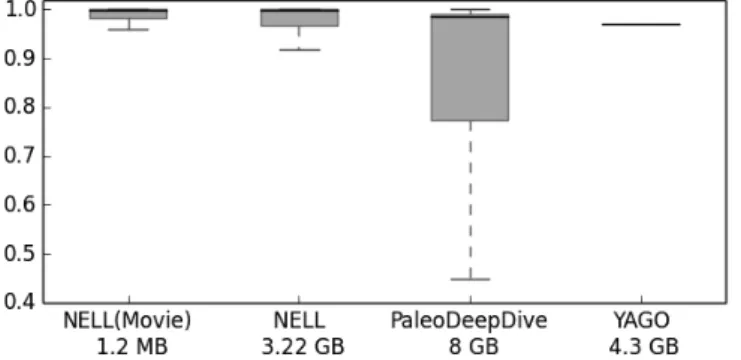
D-atoms, which makes them dependent. . . 43 4.1 Box plot of probabilistic knowledge base probabilities with 2nd to 3rd
quartile in gray. YAGO only provides an estimate of the mean probability per relation. . . 56 4.2 Complexity map for the data complexity results in OpenPDBs in
compar-ison to PDBs . . . 77 5.1 The BNBh over the variables Vh ={F,S,C}, where conditional
probabili-ties are depicted using tables. Following notational conventions, we write xin place of X= 1 and¬x in place ofX= 0 to denote elementary events. 84
6.1 Inclusion relationships and data complexity of ontology-mediated query answering for Datalog± languages . . . 116 8.1 The BNBh over the variablesVh ={F,S,C}(repeated from Figure 5.1). 153
8.2 The DBN Dh = (B1,B→), consisting of (a) a BN B1 (= Bh ) over
V = {F,S,C}, which compactly represents a joint probability
distri-bution, and (b) a two-slice BNB→ over V, which defines the transition probabilities between two time slicesVt and Vt+1. . . 172
PD(xt|y1:t); smoothing andprediction are the past (PD(xt−l|y1:t)) and
future (PD(xt+h |y1:t)) analogs of filtering, respectively; and
classifica-tion is a special case of filtering, which amounts to computingPD(y1:t).
Decoding corresponds to computing arg maxx
List of Tables
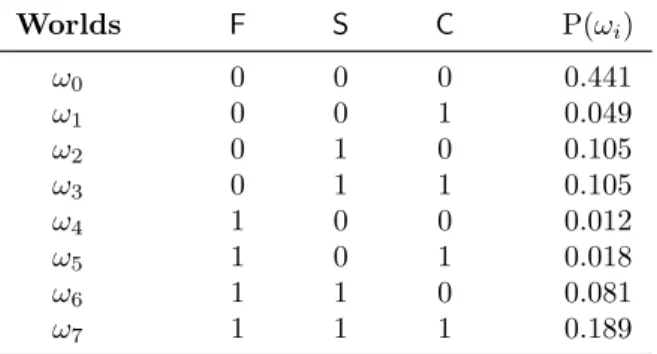
2.1 Worlds over the random variables Vh={F,S,C}. P specifies a joint
probability distribution overVh, as shown on the right-most column. . . 18
3.1 A databaseDm represented in terms of relational database tables. . . . 35
3.2 The probabilistic databasePm represented in terms of database tables.
Each row is interpreted as a probabilistic atomht:pi, wheretis a (ground) atom and p represents its probability. . . 38 3.3 Data, bounded-arity and combined complexity results for probabilistic
query evaluation in PDBs. The data complexity dichotomy is by Dalvi and Suciu and holds under polynomial time Turing reductions. All the remaining results are original contributions and hold under polynomial time many-one reductions. . . 48 4.1 The probabilistic databasePc represented in terms of database tables. 54
4.2 The OpenPDB Gc = (Pc,0.5) induces an infinite set of PDBs. Rows
depicted in orange color represent open tuples that can take on any rational probability value from the default probability interval [0,0.5]. . 58
4.3 Data, bounded-arity and combined complexity results for upper and lower (without parenthesis) probabilistic query evaluation in OpenPDBs. 80 5.1 The joint probability distribution induced by the BNBh. . . 85
5.2 The probabilistic databasePv encodes dietary regimes of some individuals,
and the friendship relation among those individuals. . . 86 5.3 The most probable database for the queryQfr over the PDB Pv. . . 88
5.4 The most probable database for the queryQvf over the PDB Pv. . . 89
5.5 Data, bounded-arity and combined complexity results forMPDfor database queries. Results with ‘≤’ denote membership; all the rest are completeness
results. . . 94 5.6 The most probable hypothesis for the queryQvf over Pv. . . 95
5.7 Data, bounded-arity combined, combined complexity results for MPHfor database queries. Result with ‘≤’ denotes membership; all the rest are
completeness results. . . 103 6.1 Syntax and semantics of DL concept and role constructors, TBox axioms,
and ABox assertions. The (dual) constructors bottom (⊥), disjunction (t),
value restriction (∀), and at-least restrictions (≥) are omitted from the
table. As usual, we useA, B to denote concept names andC, Dto denote (complex) concepts. . . 111
6.3 Complexity of ontology-mediated query answering in Datalog±. . . 115 6.4 Complexity of ontology-mediated (instance) query answering in different
DLs. All results without ≤and ≥denote completeness results. We note
that no elementary upper bound is known for ontology-mediated query answering in SHOIQ. . . 117
7.1 A probabilistic databasePa which consists of the unary relationsWriter,
Novel and the binary relation AuthorOf. . . 121 7.2 Complexity of probabilistic OMQ evaluation for PDBs. All first-order
rewritable languages admit a data complexity dichotomy between P and PP under poynomial time Turing reductions. . . 126 7.3 Complexity of upper probabilistic OMQ evaluation for OpenPDBs.
Com-bined complexity is excluded from the analysis. Lower probabilistic OMQ evaluation for OpenPDBs coincides with the case of PDBs; see Table 7.2. 134 7.5 Complexity results forMPDfor ontology-mediated queries: Note that the
result for∀FOqueries in PDBs has been strengthened towards the weaker
representationNC. . . 140 7.6 Complexity results for MPH for ontology-mediated queries. Results
marked with ∗ hold under poynomial time Turing reductions; all the remaining results are shown under standard many-one reductions. . . . 147 8.1 Complexity results forlower BQErelative to different DLs. . . 162 8.2 Complexity results for upper BQErelative to different DLs. Notice that
the upper probability is always 1 for the BOLs based on languages EL, ELH andELI since they can not express negative information. EL⊥,ELH⊥ and ELI⊥ denote the DLs that extend these languages with⊥. . . 163 8.3 Complexity results for most likely world. . . 169 8.4 Complexity results for most likely context. . . 170
List of Symbols
First-Order Logic
σ Relational vocabulary . . . 13
R Set of predicate names . . . 13
C Set of constant names . . . 13
V Set of variable names . . . 13
¬,∧,∨ Logical connectives . . . 14
∃,∀ Logical quantifiers . . . 14
T Logical theory . . . 14
Φ,Ψ Formulas of first-order logic . . . 14
FO Class of first-order logic formulas . . . 14
∃FO Existential fragment of first-order logic . . . 14
∀FO Universal fragment of first-order logic . . . 14
CNF Class of formulas in conjunctive normal form . . . 14
DNF Class of formulas in disjunctive normal form . . . 14
∃CNF Class of formulas in existential conjunctive normal form . . . 14
∀CNF Class of formulas in universal conjunctive normal form . . . 14
∃DNF Class of formulas in existential disjunctive normal form . . . 14
∀DNF Class of formulas in universal disjunctive normal form . . . 14
I First-order interpretation . . . 15 ∆I Interpretation domain . . . 15 ν Variable assignment . . . 15 |= Entailment relation . . . 15 ϕ,ψ Propositional formulas . . . 17 Probability Theory V Set of random variables . . . 18
Ω Sample space . . . 18 A Event space . . . 18 ω Possible world . . . 18 P Probability distribution . . . 19 θ Event . . . 19 Databases D Database . . . 33
UCQ Unions of Conjunctive Queries . . . 35
Ontologies Σ Datalog± program (=ontology) . . . 109
T TBox (=ontology) . . . 112
A ABox . . . 112
K Knowledge Base . . . 112
(Q,T) Ontology-mediated query . . . 114
PP(Q) Probability of Qin the PDB P . . . 39
PQE(Q) Probabilistic Query Evaluation . . . 39
λ A threshold value . . . 57
G Open-World Probabilistic Database . . . 57
KG (Credal) set of distributions . . . 57
PG(Q) Lower probability ofQin the OpenPDBG . . . 58
PG(Q) Upper probability ofQin the OpenPDBG . . . 58
PQE(Q) Lower Probabilistic Query Evaluation . . . 60
PQE(Q) Upper Probabilistic Query Evaluation . . . 60
B Bayesian Network . . . 84
MPE Most Probable Explanation . . . 85
MAP Maximum a Posteriori Probability . . . 86
MPD(Q) Most Probable Database . . . 89
MPH(Q) Most Probable Hypothesis . . . 96
Probabilistic Knowledge Bases PP(Q,Σ) Probability of the OMQ(Q,Σ)in the PDBP . . . 120
PQE(Q,L) Probabilistic Query Evaluation for OMQs . . . 121
PQE(Q,L) Lower Probabilistic Query Evaluation for OMQs . . . 128
PQE(Q,L) Upper Probabilistic Query Evaluation for OMQs . . . 128
MPD(Q,L) Most Probable Database for OMQs . . . 136
MPH(Q,L) Most Hypothesis Database for OMQs . . . 141
Bayesian Ontology Languages PK(Q) Lower probability ofQw.r.t. K . . . 154
PK(Q) Upper probability ofQw.r.t. K. . . 154
BQE(Q,L) Lower Bayesian Query Evaluation . . . 154
BQE(Q,L) Upper Bayesian Query Evaluation . . . 154
MLC(Q,L) Most Likely Context . . . 166
MLW(Q,L) Most Likely Context . . . 166
B→ Two-slice Bayesian Network . . . 171
D Dynamic Bayesian Network . . . 171
Part I
Chapter 1
Introduction
1.1 Logic and Probability
Logic is known as the science ofmodelingandreasoning. Inmathematical logics, reasoning is performed over statements, which have a (potential) truth value, such as being true orfalse. Such statements are of a certain form and have a precise meaning, where the former refers to the syntax, and the latter to the semantics of the logical language. Reasoning is then the task of entailing implicit consequences from an explicitly given set of sentences using a sound procedure.
Despite its deeply theoretical nature, logic has beenunusually effective in computer science, as noted in (J. Halpern, Harper, Immerman, Kolaitis, Vardi, and Vianu 2001), with applications to artificial intelligence (AI), knowledge representation and reasoning, finite model theory, databases, model checking, computational complexity, program verification, planning and software modeling, among others. Despite its effectiveness, traditionally, logical reasoning takes place in a deterministic universe, where any statement is eithertrueorfalse, with no intermediate truth value. However, for a variety of reasons, which we will elaborate later, in artificial intelligence, it is often desirable to have a rigorous framework, in which one can form uncertain statements.
Probability theory is the most widely adopted mathematical framework to formally capture the concept of uncertainty. First axiomatized by (Kolmogorov 1933), probability theory is now the universally accepted model of uncertainty. Essentially, probability theory provides the foundations for modeling probabilistic events; that is, events, or statements, which can be true or false with some degree of probability. Pearl’s develop-ment of Bayesian Networks (BNs), a type of probabilistic graphical model, was a key step in AI (Pearl 1988). The intuition behind their success is the capacity of compactly representing ajoint probability distribution over an event space. Important to note is that advances in probabilistic graphical models have led to the field of statistical, or probabilistic AI, which separated itself from classical approaches to AI.
The motivation behind marrying logic and probability is to combine the capacity of probability theory to handle pervasive uncertainty with the capacity of mathematical logic to exploit the structure of formal argument. We will take a first glance at some proposals to provide a historical background and discuss some milestones in the area. Unifying Logical and Probabilistic Approaches
Unifying logic and probability has been a very old endeavor, dating back to scientists such as Leibniz, Boole and Carnap; for a detailed historical background on the subject, we refer the reader to (Hailperin 1984). In the context of AI, perhaps the most ambitious work
was Nilsson’s probabilistic logic (Nilsson 1986), which is an extension of propositional logic, in that it allows linear inequalities representing probability bounds for propositions. Nilsson’s logic is later supported by an axiomatization in (Fagin, J. Y. Halpern, and Megiddo 1990). It is also extended to incorporate conditional probabilities and a deductive calculus is given in (Frisch and Haddawy 1994). Halpern proposes and expressive first-order probabilistic logic (J. Y. Halpern 1990) and makes a distinction between subjective and statistical interpretation of probabilities. There is a vast literature on combining logic and probability; see especially (J. Y. Halpern 2003) and (Bacchus 1990) and the references therein. Importantly, many of these expressive formalisms turned out to be computationally very demanding, if at all decidable.
Given the undesirable computational properties of expressive models, most of the subsequent approaches were based on probabilistic graphical models, which have a rather simple logical structure. Arguably, one of the most recent milestones in combining logic and probability was the notion of weighted model counting. It is with the help of this elegant notion, that logical models (as for traditional AI) and probabilistic graphical models (as for probabilistic AI) are considered to be essentially tightly connected (Chavira and Darwiche 2008). As the name suggests, (propositional) model countingis the task of counting the number of satisfying assignments of a given propositional formula, which is a natural extension of satisfiability (SAT) of propositional formulas. Weighted model count-ing additionally incorporates a weight function over the set of all possible assignments. Unsurprisingly, it has been noted that probabilistic inference in Bayesian networks can be reduced to performing weighted model counting over weighted propositional theories (Chavira and Darwiche 2008). Thus, weighted model counting, being a purely logical notion, serves as the common ground among many different formalisms. As a consequence, logical and probabilistic models are becoming closer and analogously to SAT solvers (of the automated reasoning community), recent years witness significant effort in building solvers that can do model counting and beyond.
Another major milestone was through the shift from propositional probabilistic models to relational probabilistic models in AI. In propositional logic, one is concerned with propositions and their interrelationships, which does not provide adequate means for modeling relational domains, which are very common in real life. In other words, as opposed to first-order languages, propositional logic can not express logical relationships andproperties that involve theparts of a statement smaller than the elementary state-ments making it up. As a very simple example, consider the propositions“tim is a finch”, “tim likes seed” and“there is a finch that likes seed”. By simple common sense reasoning, one can exploit that the proposition“there is a finch that likes seed” is actually already a consequence of the previous propositions. On the other hand, it is not possible to make such a deduction in propositional logic unless this is explicitly modeled in this way, since logical relationships and properties that involve parts of elementary propositions such as their subjects and predicates are not taken into consideration. The expressive power of BNs and similar models is essentially propositional. As Russell points out, the world isuncertainand it has things in it (Russell 2015), which identifies the need for the combination of probabilistic models with first-order representations. Thus, recent work focuses on statistical and relational AI (Getoor and Taskar 2007; Raedt, Kersting, and Natarajan 2016), which are relational representations of probabilistic graphical models. Statistical relational models build on ideas from probability theory and logic while
1.2 Probabilistic Data and Knowledge Bases
incorporating tools from databases and programming languages to represent structure. These models typically employ simplifying assumptions on the logical language as well as on the probabilistic model to keep the resulting formalism simple and can thus also be viewed as modest versions of more elaborate models such as (J. Y. Halpern 2003) and (Bacchus 1990).
We take these desiderata further in taking into consideration the shift to Big Data oriented models. Unfortunately, most of the simplifying assumptions underlying common probabilistic data models turn out to be inadequate for many application domains. The striving research question is: Is it possible to develop morerealistic data models to marry logic and probability in the context of probabilistic Big Data? This question brings us to the core ideas underlying the thesis.
1.2 Probabilistic Data and Knowledge Bases
In recent years, there has been a strong interest in building large-scale probabilistic knowledge bases from data in an automated way, which has resulted in a number of systems, such as DeepDive (Shin et al. 2015), NELL (Mitchell et al. 2015), Reverb (Fader, Soderland, and Etzioni 2011), Yago (Hoffart, Suchanek, Berberich, and Weikum 2013), Microsoft’s Probase (Wu, Li, Wang, and Zhu 2012), IBM’s Watson (D. A. Ferrucci 2012), and Google’s Knowledge Vault (Dong et al. 2014). These systems continuously crawl the Web and extractstructured information, and thus populate their databases with millions of entities and billions of tuples. The research centered around large-scale knowledge bases serves as a new era in unifying logic and probability.
To what extent can these search and extraction systems help with real-world use cases? This turns out to be an open-ended question. While being at their infancy, systems such as DeepDive are now routinely used to build knowledge bases for domains such as paleontology,geology,medical genetics, andhuman movement; see e.g. (Ku, Hicks, Hastie, Leskovec, Ré, and Delp 2015) and (Peters, Zhang, Livny, and Ré 2014); it also serves as an important tool for the fight against human trafficking (Greenemeier 2015). IBM’s Watson is revolutionizing health-care systems (D. Ferrucci, Levas, Bagchi, Gondek, and Mueller 2013) and many other application domains oflife sciences. Google’s Knowledge Vault has compiled more than a billion facts from the Web and is primarily used to improve the quality of search results on the Web. Currently, it can even estimate the trustworthiness of more than 119M sources (Dong et al.) using the extensive knowledge stored (Marsden 2015).
From a broader perspective, the quest for building large knowledge bases serves as a new dawn for AI research. Fields such as information extraction, natural language processing (e.g., question answering),relational and deep learning,knowledge representation and reasoning, anddatabases are taking initiative towards a common goal. Querying large-scale probabilistic knowledge bases is commonly regarded to be at the heart of these efforts. Perhaps the most visible application of these probabilistic knowledge bases is in search engines. Nowadays, the standard list of relevant web pages is often augmented with a table of structured data that pertains to the search query. For instance, the search for Mozart (Figure 1.1a) or Beethoven (Figure 1.1b) shows a box identifying
(a) Mozart (b) Beethoven
Figure 1.1: Information boxes for the Google search (a) Mozart and (b) Beethoven. The information boxes are linked to the underlying knowledge base that provides basic information about the search entities.
their children, spouse, students, place of birth, et cetera, which is clearly linked to the underlying knowledge base.
Beyond all the success stories, however, probabilistic knowledge bases still lack the fundamental machinery to convey some of the valuable knowledge hidden in them to the end user (Weikum, Hoffart, and Suchanek 2016), which seriously limits their potential applications in practice. For instance, the information shown next to search results in Google search is highly curated, only showing facts that the search engine provider is absolutely certain about. Other, more uncertain information is hidden from the user. Moreover, there is no support for asking higher-level queries on top of these databases. Even asking for a simple join query, “is there a composer who knows both Mozart and Beethoven”, is currently beyond the scope of these systems (Dong, Gabrilovich, Heitz, Horn, Lao, Murphy, Strohmann, Sun, and Zhang 2014), despite the fact that a potential answer, Haydn, is an entity known by the probabilistic knowledge base (Figure 1.2a). What makes this simple join query so hard to process and why can this knowledge not be transmitted to the user? These questions constitute our global motivation and the answers are linked to deep theoretical problems as well as to technical limitations, as we outline next.
1.2.1 Probabilistic Databases
Most importantly, many large-scale knowledge bases are essentially probabilistic. To go from the raw text to structured data, information extraction systems employ a sequence of statistical machine learning techniques, from part-of-speech tagging until relation extraction (Mintz, Bills, Snow, and Jurafsky 2009). For knowledge-base completion – the task of deriving new facts from existing knowledge – statistical relational learning algorithms make use of embeddings (Bordes, Weston, Collobert, and Bengio 2011; Socher, Chen, Manning, and Ng 2013) or probabilistic rules (De Raedt, Dries, Thon, Van den
1.2 Probabilistic Data and Knowledge Bases
(a) Haydn (b) Is there a composer who knows Mozart and Beethoven?
Figure 1.2: Inability to perform high-level queries on large knowledge base systems. Even though Mozart (Figure 1.1a), Beethoven (Figure 1.1b), and Haydn (Fig-ure 1.2a) are all entities known by the probabilistic knowledge base, the ques-tion whether there is a composer who knows both Mozart and Beethoven (Fig-ure 1.2b) cannot be answered by this system.
Broeck, and Verbeke 2015; Wang, Mazaitis, and Cohen 2013). In both settings, the output is a predicted fact with its probability. It is therefore common to interpret such knowledge through a probabilistic semantics.
The most basic model is that oftuple-independent probabilistic databases (PDBs) (Su-ciu, Olteanu, Ré, and Koch 2011), which indeed underlies many of these systems (Dong, Gabrilovich, Heitz, et al. 2014; Shin, Wu, Wang, De Sa, Zhang, and Ré 2015). According to the PDB semantics, each database tuple is an independent Bernoulli random vari-able, and all other tuples have probability zero, enforcing a closed-world assumption (CWA) (Reiter 1978).
Probabilistic databases typically lack a suitable handling of incompleteness in practice. In particular, each of the above systems encodes only a portion of the real-world, and this description is necessarilyincomplete. For example, according to YAGO, the average number of children per person is 0.02 (Galárraga, Razniewski, Amarilli, and Suchanek 2017). However, when it comes to querying, most of these systems employ the CWA, i.e., any fact that is not present in the knowledge base is assigned the probability 0, and
thus assumed to be impossible, although it actually has some unknown probability in
[0,1]. As a closely related problem, it is common practice to view every extracted fact as
an independent Bernoulli variable, i.e., any two facts are probabilistically independent. Example 1.1 We illustrate the above serious deficiencies on the following very simple tuple-independent PDB, which assigns the probability0.5to several self-explaining facts:
hComposer(haydn) : 0.5i,hTeacherOf(haydn,beethoven) : 0.5i,
Under the CWA, all the missing facts have the probability0, i.e., they are false.
Conse-quently, the following two queries both evaluate to the probability 0 over the PDB:
Q1 :=∃x(TeacherOf(x,beethoven)∧BornIn(x,austria)),
Q2 :=∃x(Person(x)∧ ¬Person(x)).
In particular, the fact BornIn(haydn,austria) is assumed to have the probability0 (i.e.,
to be false); however, this assumption may be incorrect. Indeed, BornIn(haydn,austria)
may even have the probability1(i.e., may be true), which would result in Q1 having the probability 0.5.
On the other hand,Q2 is unsatisfiable and should always have the probability0, no matter how incomplete the PDB is. That is, the CWA forces a very flat representation, which makes it impossible to even distinguish a satisfiable query from an unsatisfiable one. Furthermore, under tuple-independence, the query
Q3 :=∃x(TeacherOf(x,beethoven)∧Knows(x,beethoven))
evaluates to the probability 0.5·0.5 =0.25. But Haydn being a teacher of Beethoven
already implies him knowing Beethoven; so, the probability for Q3 should actually be
0.5, instead. ♦
These observations become more dramatic once combined with another limitation of these systems; namely, the lack ofcommonsense knowledge, which brings us to ontological knowledge bases.
1.2.2 Ontological Knowledge and Probabilistic Knowledge Bases
The lack of commonsense knowledge is one of the main reasons why some obvious answers can not be retrieved from the PDBs. This shows up in real-world applications of PDBs: especially, in the context of Web search, where the structured information results are linked to the underlying knowledge base.
Example 1.2 A simple join query asking whether there is a composer who knows both Mozart and Beethoven,
Q4 :=∃x(Composer(x)∧Knows(x,beethoven)∧Knows(x,mozart)),
is evaluated to the probability 0 and thus cannot be evaluated correctly by these
systems (Dong, Gabrilovich, Heitz, et al. 2014). The answer to this query is actually in the knowledge base: it is known that Haydn is (i) a composer, (ii) a friend of Mozart,
and (iii) one of the teachers of Beethoven. ♦
In fact, both queries “friend of Mozart”, and “teacher of Beethoven”, retrieve the correct information pointing to Haydn, a composer known by the knowledge base. However, explicit information about Knows(haydn,mozart) is missing, and hence this
fact is evaluated to the probability 0 by the CWA.
It is hard to process this simple join query, because current PDBs lack commonsense knowledge: Human beings know that two persons who are friends know each other. Reasoning exploits such basic knowledge to deduce implicit consequences from data,
1.2 Probabilistic Data and Knowledge Bases
and this kind of knowledge is essential for querying large-scale PDBs in an uncontrolled environment, i.e., the internet. Therefore, incorporating commonsense knowledge is very important, which is inherently connected to giving up the above completeness assumptions of standard PDBs (CWA and probabilistic independence of facts).
The crucial need to relax the independence assumption has already been recognized in several recent approaches, which are based on Markov logic networks (MLNs) (Gribkoff and Suciu 2016a). All these approaches have in common that they also allow for modeling logical knowledge. However, since they are based ongroundingprobabilistically independent factors of the MLN with known constants, they essentially only allow for encoding propositional logical knowledge, and not fully fledged first-order knowledge, as it already occurs in (rather restricted) ontology languages that are used to formulate commonsense knowledge. That is, MLNs cannot express unknown individuals (also called nulls), as illustrated by the following example.
Example 1.3 Consider the constraint “everyone has a parent”. Unless the parent of an individuala is explicitly mentioned in the PDB, in an MLN this constraint means thatamust be assigned a “parent” from the known individuals; that is, a completely random person mentioned in the database. This is due to the semantics of MLNs and databases, which employ the closed-domain assumption. Even more dramatically, as the number of objects in the database is fixed, this semantics forces the parent of relation to be cyclic, i.e., some individuals will be marked as bothancestor anddescendant of some
other individuals, which is clearly absurd. ♦
Theclosed-domain assumption, the assumption that fixes the domain of discourse to a finiteset ofknownconstants, is incorporated as ade facto standardin almost all statistical relational models; well-known examples are MLNs (Richardson and Domingos 2006), relational Bayesian networks (Jaeger 1997), and function-free variants of probabilistic logic programs such as ProbLog (De Raedt, Kimmig, and Toivonen 2007). Unfortunately, operating over a closed domain has strong consequences as illustrated in the example.
Ontologies, on the other side, are first-order theories that formalize domain-specific knowledge, thereby allowing for automated reasoning. The most prominent ontology languages in the literature are based on Datalog± (Calì, Gottlob, and Kifer 2013; Calì, Gottlob, and Lukasiewicz 2012; Calì, Gottlob, and Pieris 2012), also studied under the name of existential rules, and on Description Logics (DLs) (Baader, Calvanese, McGuinness, Nardi, and Patel-Schneider 2007). Interpreting databases under com-monsense knowledge in the form of ontologies is closely related to ontology-based data access (OBDA) (Poggi, Lembo, Calvanese, De Giacomo, Lenzerini, and 2008), which has been widely studied in the context of classical databases, and also addresses the need for open-world querying. In an OBDA scenario, a database query is mediated by a logical interface to make implicit commonsense knowledge explicit: allowing for open-world querying, this results in more complete set of answers for the query.
In this dissertation, we enhance large-scale PDBs with more realistic data models, thereby allowing for better means for querying. We develop different rigorous semantics for probabilistic data and knowledge bases, analyse their computational properties and identify sources of in/tractability and design practical scalable query answering algorithms whenever possible. To achieve this, the current work brings together some
recent paradigms from database theory and logic for probabilistic query evaluation and related inference tasks.
1.3 Structure of the Thesis
The thesis is organized in four parts. Part I gives an overview of the work, provides the motivational desiderata and settles the foundational background. Part II focuses on probabilistic databases and on common database query languages. Part III combines probabilistic databases with logical theories, which we refer to as probabilistic knowledge bases. Part IV includes conclusions and an outlook.
Part I: Overview and Foundations. This part is dedicated to provide a general moti-vation of the work and to give an overview of the foundations of the respective fields that are relevant to the thesis.
Chapter 1. This chapter provides a general introduction and illustrates the main observations that motivated this work. We start with a rather high-level motivation, which is followed by more concrete desiderata illustrated on simple, concrete examples. Chapter 2. This chapter introduces the main notions used in the thesis. The first section gives an overview on first-order logic. Subsequently, a small introduction to probability theory is given. This chapter also contains basics of the theory of computation and a short introduction to computational complexity theory. We finally note that this part also settles some notation used in this work, which is used throughout the thesis. Part II: Probabilistic Databases. This part presents the results on Probabilistic Databases and is organized in three chapters. This part also serves as the basis for the results presented in Part III.
Chapter 3. This chapter provides an introduction to databases from a model-theoretic perspective, and contains a review of known results from database theory as well as an overview of existing results on probabilistic query evaluation in PDBs. The connection between probabilistic query evaluation and weighted model counting is also summarized. This chapter also contains the first results presented in the thesis which mainly extend from the results from (Ceylan, Darwiche, and Van den Broeck 2016) and from (Borgwardt, Ceylan, and Lukasiewicz 2017). At the end, this chapter contains an extensive review of the state of the art in PDBs. Importantly, since this work covers a wide spectrum ranging from PDBs to much more sophisticated models including ontologies, some of the related work is deferred to the relevant chapters to allow for a more incremental presentation.
Chapter 4. This chapter introducesopen-world probabilistic databases, which is proposed as a new data model for probabilistic databases. The main difference between PDBs and open-world probabilistic databases is that the latter does not employ the CWA. We provide a deep discussion of the semantic differences between these models and
1.3 Structure of the Thesis
compare them with respect to the goals identified in this work. Apart from the semantic results, this chapter also contains a thorough complexity analysis with respect to a wide range of database queries. This analysis includes a data complexity dichotomy result and an efficient lifted inference algorithm. The main results presented here have been previously published in (Ceylan, Darwiche, and Van den Broeck 2016), which was awarded theMarco Cadoli Best Student Paper Prizein the 15th International Conference on Principles of Knowledge Representation and Reasoning, 2016. An abridged version of this paper has also appeared as an invited publication in (Ceylan, Darwiche, and Van den Broeck 2017). We significantly extend these results with a detailed treatment of different query languages as well as with new results that go beyond the data complexity. Chapter 5. In this chapter, two alternative inference tasks for probabilistic databases; namely finding the most probable database and the most probable hypothesis for a given query are studied. Both of these problems are inspired by the maximal posterior probabilitycomputations of Probabilistic Graphical Models. These inference tasks can be helpful to exploit the full potential of probabilistic databases. A very detailed complexity analysis is provided for both problems. Most of the results presented in this chapter are based on the previous publication (Ceylan, Borgwardt, and Lukasiewicz 2017). In this work, we additionally close some open problems identified in earlier work, while also paving the way for new open problems.
Part III: Logic and Probabilistic Knowledge Bases. This part extends the results from Part II to also incorporate commonsense knowledge in the form of ontologies. In this setting, database queries are additionally equipped with the expressive power of the ontologies. Following a common naming convention in the field, we refer to such queries asontology-mediated queries. The presentation is organized in three chapters.
Chapter 6. This chapter is dedicated to provide an overview of the prominent ontology languages in the literature. More precisely, we cover Description Logics and Datalog± programs, each of which represents a family of knowledge representation formalisms. In particular, we focus on the paradigm of ontology-mediated query answering in these formalisms and recall the computational complexity of this task in the respective languages. This chapter concludes with a discussion regarding the connection between ontology-mediated query answering and (probabilistic) databases.
Chapter 7. In this chapter, the problems introduced in Part II are extended to the case of ontology-mediated queries based on Datalog±. As a result, this chapter is organized in three main sections in correspondence with Chapters 3, 4 and 5, respectively. First, we extend our results from Chapter 3 and study probabilistic ontology-mediated query evaluation for PDBs. Afterwards, we study probabilistic ontology-mediated query evaluation for open-world probabilistic databases; thus, extend our results from Chapter 4. The study in these sections builds on the previous publication (Borgwardt, Ceylan, and Lukasiewicz 2017) and is also related to (Ceylan, Lukasiewicz, and Peñaloza 2016). Finally, we revisit the most probable database and most probable hypothesis problems from Chapter 5 in the context of ontology-mediated queries based on earlier work (Ceylan,
Borgwardt, and Lukasiewicz 2017). In each of these sections, we provide a thorough complexity analysis. This chapter concludes with an overview of the related work and possible directions for future research.
Chapter 8. In this chapter, Bayesian ontology languages are investigated. These languages extend classical Description Logics with the capability of representing and reasoning over uncertain domains. First, we study ontology-mediated query evaluation in Bayesian ontology languages together with two other reasoning problems, called most likely context andmost likely world. Afterwards, we propose a novel monitoring approach that combines the power of ontology languages with dynamic BNs. The resulting formalism is then called dynamic Bayesian ontology languages and allows to make projections about the future states of a system. Bayesian ontology language were first proposed in (Ceylan and Peñaloza 2014b) (see also the related workshop paper (Ceylan and Peñaloza 2014a)), and further studied in (Ceylan and Peñaloza 2014c); afterwards, combined in a journal a paper (Ceylan and Peñaloza 2017) as part of a special issue. This thesis includes a rather minor part of these early results as they are based on standard reasoning tasks (and some of these results were obtained earlier than the thesis work). Our focus is on query answering and our results significantly extend on early work previously presented in (Ceylan and Peñaloza 2015b) by a treatment of arbitrary ontology languages, and many more details. A proof-of-concept implementation for reasoning in Bayesian ontology languages was described in (Ceylan, Mendez, and Peñaloza 2015). Dynamic Bayesian ontology languages were first proposed in (Ceylan and Peñaloza 2015a). There are less closely related publications, which are excluded from the thesis, such as (Ceylan, Lukasiewicz, Peñaloza, and Tifrea-Marciuska 2017). Part IV: Conclusions. This part consists of only Chapter 9, which summarizes the current work and provides possible directions for future work.
Remark. I served as the main author in the publications listed above and I was always supported by exceptional co-authors, namely Stefan Borgwardt, Adnan Darwiche, Thomas Lukasiewicz, Rafael Peñaloza, and Guy Van den Broeck. The work (Ceylan, Darwiche, and Van den Broeck 2016) is an outcome of a research visit to University of California, Los Angeles (Automated Reasoning Lab, led by Prof. Adnan Darwiche). I also did benefit from the oppurtunity of conducting several short-term visits to University of Oxford, which resulted in a long-term collaboration with Prof. Thomas Lukasiewicz.
Chapter 2
Foundations
This chapter introduces some of the main notions used in this thesis. In order to allow for a more incremental presentation, some of the preliminaries are deferred to later chapters as they only become relevant after those chapters. The first section gives an overview on first-order logic. Subsequently, a small introduction to probability theory is given to an extend that is relevant for the current work. At the end, this chapter contains the very basics of the theory of computation and a short introduction to computational complexity theory.
2.1 First-Order Logic
Logic is known as the science ofreasoning. Inmathematical logics, reasoning is performed over declarative sentences (or statements), which have a (potential) truth value, such as being true orfalse. Such sentences are of a certain form and have a precise meaning, where the former refers to the syntax, and the latter to the semantics of the logical language. Reasoning is then the task of entailing implicit consequences from an explicitly given set of sentences using a sound procedure.
There are a plethora of logical languages with different types of reasoning tasks in the literature and we assume familiarity with propositional and quantified Boolean logic. We only recall first-order logic as most of the languages that happen to appear in this work, are essentially fragments of first-order logic. We only give a brief overview, whereby we also settle some basic notation; for a broader introduction to mathematical logic, we refer to standard texts from the literature (Ebbinghaus, Flum, and Thomas 1994; Enderton 2001; Fitting 1996; Van Dalen 2004).
We focus on thefunction-free fragment of first-order logic (FOL). First, we introduce some basic notions (syntax and semantics of FOL); then, we recall some of the classi-cal results (i.e., soundness and completeness), and finally we discuss some restricting assumptions (i.e., finite, fixed domain assumptions) of first-order logic, all of which are crucial ingredients of this work.
Definition 2.1 (vocabulary, terms, atoms) A relational vocabulary, denoted byσ, consists of sets R ofpredicate,Cofconstant, and V ofvariable (names). The function
ar : R 7→ N associates a natural number to each predicate P ∈ R that defines the
(unique) arity ofP. Aterm is either a constant or a variable. An atom is of the form P(s1, . . . , sn), whereP is ann-ary predicate, and s1, . . . , sn are terms. Aground atom is
an atom without variables. ♦
For ease of presentation and to avoid ambiguity (in operator precedence), it is customary to use some auxiliary symbols such as“,”,“(”, and “)”as part of the vocabulary. We
will make use of such symbols to increase readability without further notice. We will often not mention the vocabulary explicitly if it is clear from the context.
Definition 2.2 (logical connectives, quantifiers) Thelogical connectives are nega-tion (¬), conjunction (∧) and disjunction (∨). The logical quantifiers in FOL are
existential quantifier (∃) and universal quantifier (∀). ♦
First-order formulas are inductively built from atomic formulas, i.e., atoms, using the logical constructors and quantifiers, as defined next.
Definition 2.3 (formula, sentence) Given a relational vocabulary σ, a first-order
formula is defined by the syntax rule
Φ := P(s1, . . . , sn) | ¬Φ | Φ∧Φ | ∃x.Φ,
where P is an n-ary predicate, s1, . . . , sn are terms, and x is a variable. A literal is
either an atom or its negation. A quantifier-freeformula is a formula that does not use a quantifier. A variable xin a formulaΦis quantified, orbound if it is in the scope of a
quantifier; otherwise, it is free. A (first-order) sentence is a first-order formula without any free variables, also called aclosed formula, orBoolean formula. A(first-order) theory
is a set of first-order sentences. ♦
We use the standard shorthand notation and writeΦ∨Ψ in place of ¬(¬Φ∧ ¬Ψ); Φ→Ψ in place of¬Φ∨Ψ;Φ↔Ψin place of(Φ→Ψ)∧(Ψ→Φ). We also abbreviate
the existentially quantified formulas of the form ¬∃x.¬Φwith ∀x.Φ. Finally, the truth
symbols > and ⊥ are used to abbreviate formulas of the form Φ∨ ¬Φ, and Φ∧ ¬Φ,
respectively.
We use a vector notation to denote a sequence of variablesx1, . . . , xn by~x. The set
of free variables in Φ is denoted by FV(Φ), and we write Φ(~x) whereFV(Φ) ={~x}. It
is often very useful to consider syntactic fragments of first-order logic formulas, as we define next.
Definition 2.4 (FO-fragments) Let FObe the class of first-order formulas. The class of existential first-order formulas (∃FO) consists of first-order formulas of the form ∃~x.Φ(~x), whereΦis any Boolean combination of atoms. The class ofuniversal first-order
formulas (∀FO) consists of first-order formulas of the form ∀~x.Φ(~x), where Φ is any
Boolean combination of atoms.
A disjunctive clause is a finite disjunction of literals. A conjunctive clause is a finite conjunction of literals. The class of formulas in existential conjunctive normal form (∃CNF) consists of first-order formulas of the form ∃~x.Φ(~x); the class of formulas
in universal conjunctive normal form (∀CNF) consists of first-order formulas of the form ∀~x.Φ(~x), whereΦ is a conjunction of disjunctive clauses.
The class of formulas inexistential disjunctive normal form(∃DNF) consists of formulas
of the form∃~x.Φ(~x); the class of formulas inuniversal disjunctive normal form (∀DNF)
consists of formulas of the form ∀~x.Φ(~x), where Φis a disjunction of conjunctive clauses.
The class of formulas inconjunctive normal form (CNF) consists of ∃CNF and ∀CNF
formulas. The class of formulas indisjunctive normal form (DNF) consists of ∃DNFand ∀DNF formulas. A formula ispositive if it contains only positive literals. We also write
kCNF, orkDNFto denote the class of formulas, where k denotes the maximal number
2.1 First-Order Logic
So far, we purely focused on the syntax and have not yet associated any meaning to these syntactic entities. We shall set up a correspondence between a first-order formula and its meaning in the outside world. The semantics of FOL is given by first-order interpretations, which we define next.
Definition 2.5 (semantics) Given a relational vocabulary σ, a first-order
interpreta-tion is a pairI = (∆I,·I), where∆I is a non-empty domain, and·I is an interpretation function that maps every constant nameato an element aI ∈∆I of the domain, and
every predicate nameP with arityn to a subsetPI ⊆(∆I)n of the domain. Avariable
assignment is a function ν :V7→∆I that maps variables to domain elements. Given
an element e ∈ ∆I and a variable x ∈ V, we write ν[x 7→ e] to denote the variable
assignment that maps x to e, and that agrees with ν on all other variables. For an interpretationI and a variable assignmentν, we define
– aI,ν=aI for all constant names a∈C,
– xI,ν =ν(x) for all variable namesx∈V,
– PI,ν =PI for all predicate names P∈R.
Given an interpretationI and a variable assignmentν, the satisfaction relation (|=) is
inductively defined as
– I, ν |=P(s1, . . . , sn) if(sI1,ν, . . . , sIn,ν)∈PI,ν,
– I, ν |=¬Φ(~x) ifI, ν 6|= Φ(~x),
– I, ν |= Φ(~x)∧Ψ(~y) ifI, ν |= Φ(~x)and I, ν |= Ψ(~y),
– I, ν |=∃x.Φ(~y) if there existse∈∆I such thatI, ν[x7→e]|= Φ(~y),
The truth value of sentences does not depend on any variable assignment; thus, assign-ments are omitted in this case. An interpretation I is amodel of a theoryT, denoted
I |=T, ifI satisfies all sentences ofT. ♦
The distinction between a theory and a sentence in first-order logic is a more conceptual one if we focus on finite theories. In fact, semantically, a finite first-order theory T is
equivalent to a sentence V
α∈T α, which we denote assen(T).
Definition 2.6 (validity, consistency) A sentence α is valid if it is satisfied by all interpretations and invalid, otherwise. A theory T is valid if all sentences of T are
valid. A theory T is consistent (or satisfiable) if it has a model and inconsistent (or
unsatisfiable), otherwise. ♦
We now define different types of reasoning services that are of interest. In a broad sense, reasoning is about entailing implicit consequences from a given set of facts, and it is therefore crucial to understand the notion oflogical consequence.
Definition 2.7 (entailment, consequence) Let T,T0 be first-order theories. Then,
T entails T0, writtenT |=T0, if for all modelsI ofT it holds that I |=T0. In this case,
T0 is aconsequence ofT. ♦
With a slight abuse of notation, we write T |= α instead of T |= {α}, where {α}
denotes a singleton theory containing the sentence α. Classical reasoning problems are formulated as decision problems, i.e., problems that have a yes/no answer. Formulated
as a decision problem; the entailment problem is to decide whether T |=T0 for a given theoryT and T0 of first-order logic. Analogously, for a given theory T, theconsistency
problem is to decide whether the theoryT is consistent; the validity problemis to decide
whether the theory is valid. Non-entailment (complement of entailment), inconsistency and invalidity checking are then the dual problems, respectively.
In essence, these reasoning problems are all tightly connected. A theoryT is
incon-sistent if and only if T |=⊥. Conversely, the entailment T |=T0 holds if and only if
the theory {¬sen(T)} ∪ T0 is inconsistent. A theoryT is valid if and only it is entailed by the empty theory, denoted {} |= T, or |= T, in short. Due to such well-known
correspondences, we will mainly focus on the entailment problem in the sequel.
Concepts such as satisfiability and validity are purely semantic features, and so is the entailment relation. This, however, is not the only possible point of view. In the end, formulas are syntactic objects, and it is possible and desirable to define a calculus for deriving conclusions from the given premises that is purely syntactic, in order to allow forautomated reasoning. These are known as proof procedures for first-order logic; among these, semantic tableux (Smullyan 1968), resolution (Robinson 1965), natural deduction (Gentzen 1935; Stanisław 1934) and Hilbert-style proof systems (Hilbert 1923) are well-known. In a (Hilbert-style) deductive system (or proof system), deduction is a finite sequence of formulas, in which each formula is either an axiom in the theory or is obtained from previous formulas by a rule of inference. It is beyond the scope of this work to provide details on these calculi; for an in-depth analysis of these methods, we refer the reader to (Fitting 1996). On the other hand, no matter which proof procedure is considered, there are certain properties that are highly desired to hold. Most importantly, the proof procedure should match the semantics of the logic, which is characterized by soundness and completeness properties of the proof calculi.
Definition 2.8 (soundness, completeness) LetT,T0 be first-order theories and `
denote a deduction system for first-order logic. Then, the deduction system `is sound
if T ` T0 implies T |=T0. Conversely, the deduction` is complete ifT |= T0 implies
T ` T0 ♦
Intuitively, for a proof procedure, soundness means that all the proofs are also semantic consequences, and completeness means that all semantic consequences have proofs. Verification of soundness is rather easy as compared to completeness of a proof system for first-order logic, and the first completeness result is given in (Gödel 1929). Theorem 2.9 (soundness and completeness of FOL) There exists a sound and complete deduction system for first-order logic. More formally, let T, T0 be first-order theories. Then, there exists a deduction system `such that
T |=T0 if and only if T ` T0.
Although first-order logic admits a sound and complete calculus, it is well known that any sound and complete calculi for first-order logic may require an infinite amount of time, in general. Thus, such a procedure may not terminate as we discuss in more depth in Section 2.3. This has motivated the study of fragments of first-order logic, of which, there are a plethora.
2.2 Probability Theory
Fragments of First-Order Logic
In this thesis, we are concerned with several fragments of first-order logic; most of which result from i) syntactic, ii) semantic, or iii) domain-specific restrictions. We have already identified some well-known syntactic fragments of the class of first-order logic formulas in Definition 2.4. The precise correspondence between the formalisms studied in the thesis and first-order logic is to be presented in the remaining chapters in detail.
Informally, databases can be viewed as first-order interpretations over a fixed, finite domain operating under the closed-world assumption. On the other hand, ontology languages typically employ the open-world assumption and do not pose any restrictions on the domain, while being mostly syntactic fragments of order logic. Thus, first-order logic serves as a general unifier for the understanding of the different notions presented in the thesis.
We note, however, that fragments of first-order logic can differ significantly from each other. Especially, first-order logic restricted to finite structures (Libkin 2004), as in database theory, can make a significant difference. Many key classical theorems and techniques break down when restricted to finite structures. Conversely, a great many results, which are native to finite model theory have no classical counterpart.
We assumed familiarity withpropositional logicandquantified Boolean logic. Never-theless, each of these formalisms are essentially very restricted cases of first-order logic. Propositional logic is a special case, where the set of predicates consists of only 0-arity
predicates (called propositions) and no logical quantifier is allowed. To distinguish from first-order representations, we denote propositions in lower case letters such as x, y. Similarly, we use small case Greek letters such as ϕ and ψ to refer to propositional formulas. Quantified Boolean logic, on the other hand, is an extension of propositional logic that also allows logical quantification over propositions with the usual semantics.
2.2 Probability Theory
Traditionally, logical reasoning takes place in a deterministic universe, where any given variable is assigned a certain value, and any statement is eithertrue orfalse, with no intermediate truth value. However, for a variety of reasons, both within mathematics and logics, it is often desirable to have a rigorous framework, in which one can form uncertain statements; that is, statements, which are not true or false with definite certainty, but hold only with an intermediate degree.
Probability theory is the most widely adopted mathematical framework to formally capture the concept of uncertainty (Kolmogorov 1933). The basic intuition behind the probability theory is the notion of randomness. Imagine, for instance, an exper-iment, that can possibly produce a number of outcomes, while the precise outcome can not be determined with certainty. In probability theory, such randomness can be captured through random variables (allowing assignments to variables at random) and events (statements which can be true or false with some degree).
At a purely formal level, probability theory can be seen as a branch of measure theory. Following a measure-theoretic perspective, it is possible to define a sample space, that is, the set of outcomes of an experiment, and then model events as measurable subsets of this sample space, and random variables as measurable functions on this sample space.
Table 2.1: Worlds over the random variablesVh ={F,S,C}. Pspecifies a joint probability
distribution overVh, as shown on the right-most column.
Worlds F S C P(ωi) ω0 0 0 0 0.441 ω1 0 0 1 0.049 ω2 0 1 0 0.105 ω3 0 1 1 0.105 ω4 1 0 0 0.012 ω5 1 0 1 0.018 ω6 1 1 0 0.081 ω7 1 1 1 0.189
In this way, it is possible to obtain a probability distribution over the set of outcomes (of an experiment), which, in turn, allows us to reason over uncertain situations.
In this work, we purely focus on spaces that are finite and are thus completely characterized through a finite set of random variables. Given these assumptions on the space, we are able to provide the basics of probability theory relevant to our purpose without the need for giving a detailed overview on measure theory; for a broader introduction to probability theory, we refer to the standard literature in the field (Durrett 2010).
We only focus on discrete random variables; in particular, on Bernoulli random variables. It is worth noting, however, that the restriction to Bernoulli random variables, is mainly for ease of presentation, and it can easily be relaxed to capture any discrete random variable. In the following, we will deliberately use the term random variable in place of Bernoulli random variable without further notice.
Definition 2.10 (world, sample space, event space) LetV be a finite set of ran-dom variables. A possible world ω over V is a valuation over V, which maps every random variable to a single truth value. The sample space Ω over V is the set of all worlds overV. The event space A overV is the powerset of the sample spaceΩ. ♦
Intuitively the sample space describes all the possible outcomes, or possible worlds, of all the sources of randomness and an event is simply a set of outcomes. From a broader perspective, one is typically interested only inmeasurable event spaces defined over some sample space. Nevertheless, it is easy to see that the sample and event space, as they are defined here, trivially form a measurable space since they are finite.
Example 2.11 Consider a set of random variablesVh={F,S,C}, where, the random
variablesF,S, andCare designated to model measurements offever,systolic pressure, and cholesterol, respectively. More precisely, for some patient,F = 1, denotes having
high fever,S= 1, denotes having high systolic pressure, and C= 1 denotes having high
cholesterol. The worlds overVh are then as shown in Table 2.1. Using set notation, we
can alternatively represent worlds as follows
2.2 Probability Theory
The sample and event space is then given as
Ωex = [
0≤i≤7
{ωi} , Aex= 2Ωex,
respectively. For instance, the set{ω6, ω7} ∈Aex defines an event, which is satisfied by the worldsω6 and ω7. In more concrete terms, this event encodes the worlds where the events high fever (F= 1) and high systolic pressure (S= 1) are observed, or realized.♦
A probability measure is a function, which maps each event in a measurable event space to a value in [0,1], while at the same time, satisfying certain properties.
Definition 2.12 (probability measure) Let A be a non-empty set. A probabil-ity measure is a functionP :A 7→[0,1]such that:
– P(∅) = 0,
– P(A) = 1,
– P(S
iεi) =PiP(εi)for countable disjoint εi ∈A. (countably additive) ♦
We introduced the notions of sample and event space, which are completely charac-terized by random variables, and defined the concept of probability measure over such spaces. Putting all together, we are speaking of probability spaces.
Definition 2.13 (probability space) Let Ω be the sample space, andA the event
space defined over a finite set of random variables V. Then, the triple(Ω,A,P), where P is a probability measure overA, forms a probability space. ♦
We specify the probability space of interest with the help of a finite set of random variables and view events as sets of worlds. As there can be exponentially many worlds in the number of the random variables, in order to write an event of interest, one has to enumerate all worlds that define this event. This is certainly not the best possible representation for events. An alternative is to form an event language to be able to compactly represent sets of worlds. We, therefore, view events as propositional formulas, built inductively from elementary events, using logical connectives.
Definition 2.14 (event language) LetV be a set of random variables, anelementary
event overV is either of the formX = 1, or of the formX = 0, whereX∈V. Anevent θ is then inductively defined by the grammar rule
θ := e | ¬θ | θ∧θ ,
wheree is an elementary event overV. ♦
As usual, disjunction(∨)and implication(→)are used as syntactic sugar in the language.
Sometimes, we write “,”in place of“∧”, if there is no danger of ambiguity.
In essence, events are propositional formulas defined over a set of random variables. As a consequence of this, we can identify a world that an event encodes through the (propositional) entailment relation: a world ω satisfies an eventθ, if and only if ω|=θ. The probability spaces defined with the help of a finite set of discrete random variables, are essentially discrete. Therefore, the probability measure P induces a joint discrete


![Figure 3.2: Decomposition tree of a safe query for the grounding [x/a, y/b] (left branch) and [x/b, y/a] (right branch)](https://thumb-us.123doks.com/thumbv2/123dok_us/9327619.2811252/58.892.277.597.154.296/figure-decomposition-tree-query-grounding-branch-right-branch.webp)
![Figure 3.3: Decomposition tree of an unsafe query for the grounding [x/a, y/b] (left branch) and [x/b, y/a] (right branch)](https://thumb-us.123doks.com/thumbv2/123dok_us/9327619.2811252/59.892.296.619.153.309/figure-decomposition-unsafe-query-grounding-branch-right-branch.webp)