S
ecurity risk assessments should identify, quantify, andprioritize information
security risks against defined criteria for risk acceptance and objectives relevant to
the organization1. The results should
guide and determine the appropriate management action and priorities for managing information security risks and for implementing controls selected to protect against these risks. Assessing risks and selecting controls may need to be performed repeatedly across different
parts of the organization and
information systems, and to respond to
changes. The process should
systematically estimate the magnitude of risks (risk analysis) and compare risks against risk criteria to determine their significance (risk evaluation).
The integrated security risk assessment and audit approach attempts to strike a balance between business and IT risks and controls within the various layers and infrastructure implemented within a university, i.e. financial reporting, business process, application, database, platform and network. This newsletter will describe process, methodology, impact and approach to address limitations for carrying out security risk
assessment activities1,2.
While security risk assessment provides the means to identify and address potential risk factors, failure to perform assessments effectively can lead to missed opportunities, both to avoid and
capitalize on risk events. Common
business challenges include the
following.
1. Cost, especially unbudgeted costs.
Regardless, business and even IT units do not want to spend money on security controls unless they are absolutely necessary and usually tied to regulatory compliance or an audit citation. The business unit will minimize the privacy or security risk to avoid spending the money.
2. Unplanned activity, Any unplanned activity, whether it is part of a project or part of a yearly operating plan, will generate, at minimum, tension or push back. Project teams and management in general are inherently averse to doing any tasks they did not plan for.
3. Miscommunication: Many times, security managers communicate in terms of missing control risks or a policy non-compliance risk, not in terms of the operations or educational risk. As a result, it’s hard to achieve consensus to mitigate the risk(s), regardless of what control should be implemented.
4. User or customer impact: Any security control that changes the
user experience will create
resistance. Even if it’s as benign such
as increasing the length of
passwords, it creates anxieties for business managers. Therefore, they will likely overstate implementation
costs and try to delay
implementation.
Common
Challenges
Security
Risk
Assessment
Technical
Point
‐
of
‐
View
“Successful businesses
understand the value of
timely, accurate
information, good
communications and
secrecy. Information
security is as much about
exploiting the
opportunities of our
interconnected world as
it is about risk
management”
‐ ISO27001:2013
15. Incorrect estimating the costs of security controls. Sometimes the business or IT unit is uncertain about the implementation cost, and will incorrectly estimate the cost of the security controls.
6. Improperly relying on mitigating controls that do not effectively address the risk. A good example might be to rely on a manual review of system event logs instead of implementing an event monitoring system.
Universities need to understand and appreciate the importance of security controls. The vast majority of the controls outlined in the generally accepted security standards bodies, (e.g. COBIT, ISO, etc) are required in some shape or form in universities that manages IT infrastructure, even if it is
outsourced2.
Universities have many reasons for taking a proactive and repetitive approach to addressing information security concerns. Legal and regulatory requirements aimed at protecting sensitive or personal data, as well as general public security requirements, create an expectation for companies of all sizes to devote the utmost attention and priority to information security risks. Security risk assessment takes on many names and can vary greatly in terms of method, rigor and scope, but the core goal remains the same: identify and quantify the risks to the universities’ information assets. This information is used to determine how best to mitigate those risks and effectively preserve the
universities’ mission4,5.
The security risk assessment and security risk management processes comprise the heart of the information security framework. These are the processes that establish the rules and guidelines of the security policy while transforming the objectives of an information security framework into specific plans for the implementation of key controls and mechanisms that minimize threats and vulnerabilities.
The assessment approach or
methodology analyzes the relationships among assets, threats, vulnerabilities and other elements. There are numerous methodologies, but in general they can be classified into two main types: quantitative and qualitative analysis. The methodology chosen should be able to produce a quantitative statement about the impact of the risk and the effect of the security issues, together with some qualitative statements describing the significance and the appropriate security measures for minimizing these risks. By default, all relevant information should be considered, irrespective of storage format. Typical information that will be collected for assessment include:
• Security requirements and objectives
• System or network architecture and
infrastructure, such as a network diagram showing how assets are configured and interconnected
• Information available to the public or
accessible from the universities’ web site
• Physical assets, such as hardware,
including those in the data centre,
network, and communication
Performing
Security
Risk
Assessment
Assessment
Process
Methodologies
“In an assessment, the
assessor should have the
full cooperation of the
organization being
assessed. The
organization grants
access to its facilities,
provides network access,
outlines detailed
information about the
network, etc. All
parties acknowledge
that the goal is to study
security and identify
improvements
to secure the systems. An
assessment is potentially
the most useful of all
security
tests, but it is also the
hardest to define”
components and peripherals (e.g., desktop, laptop, smartphone even BYOD)
• Operating systems, such as PC and
server operating systems, and
network management systems
• Data repositories, such as database
management systems and files
• Security systems in use, such as
access control mechanisms, change control, antivirus, spam control and network monitoring
• Governance and compliance
pertaining to minimum security control requirements
The project scope and objectives can influence the style of analysis and types of deliverables of the security risk assessment. The scope may cover the connection of the internal network with the Internet, the security protection for a computer center, a specific department’s use of the IT infrastructure or the IT security of the entire organization. The security requirements should be based on business needs, which are typically driven by senior management, to identify the desired level of security protection. A key component of any risk assessment should be the relevant regulatory requirements such as ISO/IEC 27001:2013 and the Personal Data Privacy Ordinance.
The following are common tasks that should be performed during security risk assessment:
• Identify business needs and changes
to requirements that may affect overall IT and security direction.
• Review adequacy of existing security
policies, standards, guidelines and procedures.
• Analyze assets, threats and
vulnerabilities, including their
impacts and likelihood.
• Assess physical protection applied to
computing equipment and other network components.
• Conduct technical and procedural
review and analysis of the network
architecture, protocols and
components to ensure that they are
implemented according to the
security policies.
• Review and check the configuration,
implementation and usage of remote access systems, servers, firewalls and
external network connections,
including the client Internet
connection.
• Review logical access and other
authentication mechanisms.
• Review current level of security
awareness and commitment of staff within the organization.
• Review agreements involving services
or products from vendors and contractors.
• Develop practical technical
recommendations to address the vulnerabilities identified, and reduce the level of security risk.
Mapping threats to assets and
vulnerabilities can help identify their possible combinations. Each threat can
be associated with a specific
vulnerability, or even multiple
vulnerabilities. Unless a threat can exploit vulnerability, it is not a risk to an asset.
The range of all possible combinations should be reduced prior to performing a risk analysis. Some combinations may not make sense or are not feasible. This interrelationship of assets, threats and vulnerabilities is critical to the analysis of security risks, but factors such as project scope, budget and constraints may also affect the levels and magnitude
of mappings12.
“To help understand
threats and their impact
on assets, a mapping of
threats with impact
is necessary. The
following four impact
categories lists threats,
both direct and indirect,
and indicates areas
where a given threat
may have an impact.”
Once the assets, threats and vulnerabilities are identified, impact and likelihood of security risks should be determined.
An impact assessment (also known as
impact analysis or consequence
assessment) estimates the degree of overall harm or loss that could occur as a result of the exploitation of security vulnerability. Quantifiable elements of impact are those on revenues, profits, cost, service levels, regulations and reputation. It is necessary to consider the level of risk that can be tolerated and how, what and when assets could be affected by such risks. The more severe the consequences of a threat, the higher the risk. For example, if the research IP are compromised, the cost to the university would be a plagiarism from the original research work and the loss of intellectual property work.
A likelihood assessment estimates the probability of a threat occurring. In this type of assessment, it is necessary to determine the circumstances that will affect the likelihood of the risk occurring. Normally, the likelihood of a threat increases with the number of authorized users. The likelihood can be expressed in terms of the frequency of occurrence, such as once in a day, once in a month or once in a year. The greater the likelihood of a threat occurring, the higher is the risk. It can be difficult to reasonably quantify likelihood for many parameters; therefore, to simplify relative like hood would be wise using High / Medium / Low as measurement.
A systems example is the high likelihood of an attempt to exploit a new vulnerability to an installed operating system as soon as the vulnerability is
published. If the system affected is classified as critical, the impact is also high. As a result, the risk of this threat is high.
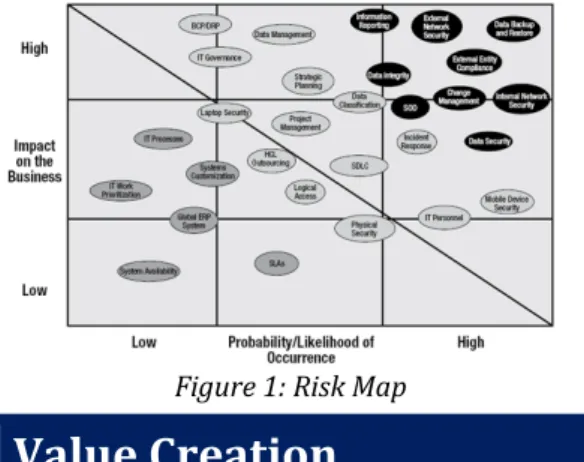
For each identified risk, its impact and likelihood must be determined to give an
overall estimated level of risk.
Assumptions should be clearly defined when making the estimation. This two-dimensional measurement of risk makes for an easy visual representation of the conclusions of the assessment. See figure 1 for an example risk map.
Figure1:RiskMap
Institutionalizing a practical risk
assessment program is important to supporting an education institution
activities and provides several benefits10:
1. Security risk assessments programs
help ensure that the greatest risks to the IT department are identified and addressed on a continuing basis. Such programs help ensure that the expertise and best judgments of personnel, both in IT and the larger organization, are tapped to develop reasonable steps for preventing or mitigating situations that could interfere with accomplishing the universities’ mission.
2. Security risk assessments help
personnel throughout the
organization better understand risks
Impact
Assessment
Likelihood
Assessment
Value
Creation
“When considering the
impact of a successful
attack, it's important to
realize that there are
two kinds of impacts.
The first is the
"technical impact" on
the application, the data
it uses, and the functions
it provides. The other is
the "business impact" on
the business and
company operating the
application.”
to institutional operations. They also teach them how to avoid risky
practices, such as disclosing
passwords or other sensitive
information, and recognize
suspicious events. This
understanding grows, in part, from improved communication among senior management, system support staff and security specialists.
3. Security risk assessments provide a
mechanism for reaching a consensus as to which risks are the greatest and what steps are appropriate for mitigating them. The processes used encourage discussion and generally require that disagreements be resolved. This, in turn, makes it more likely that senior management will understand the need for agreed-upon controls, feel that the controls are aligned with the universities’ goals and support their effective implementation.
4. A formal security risk assessment
program provides an efficient means
for communicating assessment
findings and recommending actions to senior management. Standard report formats and the periodic nature of the assessments provide universities a means of readily understanding reported information and comparing results between units over time.
Ultimately, security risk assessments performed with measurably appropriate care are an indispensable part of prioritizing security concerns. Carrying out such assessments informally can be a valuable addition to a security issue
tracking process, and formal
assessments are of critical importance when determining time and budget allocations in large universities.
In contrast, taking a haphazard approach to security concern prioritization can lead to disaster, particularly if a problem falls into a high-risk category and then ends up neglected. IT-specific benefits of performing security risk assessment include:
• Providing an objective approach for
IT security expenditure budgeting and cost estimation
• Enabling a strategic approach to IT
security management by providing alternative solutions for decision making and consideration
• Providing a basis for future
comparisons of changes made in IT security measures
An information security framework is important because it provides a road map for the implementation, evaluation
and improvement of information
security practices. As a university implements its framework, it will be able to articulate goals and drive ownership of them, evaluate the security of information over time, and determine the need for additional measures.
A common element in most security best practices is the need for the support of senior management, but few documents clarify how that support is to be given. This may represent the biggest challenge for the universities’ ongoing security initiatives, as it addresses or prioritizes its risks.
Specifically, security risk assessment is intended to be suitable for the following, which could be specific to any university:
• A way to ensure that security risks
are managed in a cost-effective manner
Conclusion
CaseStudy:
“AtNotreDameUniversity,. Theexecutivevicepresident created—andpersonally chairs—agroupknownasthe InstitutionalRiskand
ComplianceCommittee.This groupiscomposedofsenior membersofmanagement, includingfunctionalroleslike finance,ITandresearch,and coverseachofthemajor businessareasofthe university.Itisadiverse groupwithabigimpact. Whatmakesthegroup differentfrommany
managementteamsishowit looksatrisks,andhowit reactstorisks.Thisdiverse grouphascreatedasimple processofyearlyassessments conductedbyeachmajor businessareainthe university.Risksmustaffect theuniversityasawhole,and they’recategorizedona simplehigh,mediumandlow scaleforprobabilityand impact,andcolouredred, yelloworgreen.Eachoneis thenratedonitscurrent status:un‐handledandneeds aplan;inprogresswitha plan;orhandledaswellasit canbehandled.Again,each riskisred,yelloworgreen basedonitsstatus—a separateratingfromits probabilityandimpact.A quickglanceatacharttells thegroupwhatneeds attentionorastatuscheck. Redriskswitharedstatus ratinggetattentionquickly!”
- SecurityTech Target11
• A process framework for the implementation and management of controls to ensure that the specific security objectives of an university are met
• A definition of new information
security management processes
• Use by management to determine the
status of information security
management activities
• Use by internal and external auditors
to determine the degree of
compliance with the policies,
directives and standards adopted by the university
• For implementation of
business-enabling information security
To provide relevant information
about information security to customer
Overall, universities must have a solid base for its information security framework. The risks and vulnerabilities of universities will change over time; however, if universities continue to follow their frameworks, they will be in good position to address any new risks and/or vulnerabilities that arise.
References
1. "ISO/IEC 27001:2013, Information Technology – Security Techniques – Information Security Management Systems,
2nd Edition" 25 SEPT 2013, WEB, 13 February 2015
2. "ISO/IEC 27002:2013, Information Technology – Security Techniques – Code of Practice for Information Security
Management, 1st Edition" 13 OCT 2013, PDF, 13 February 2015.
3. "NISTIR 7328, Security Assessment Provider Requirements and Customer Responsibilities: Building a Security
Assessment" SEPT 2007, PDF, 13 February 2015.
4. "NIST Special Publication 800-53A, Guide for Assessing the Security Controls in Federal Information Systems:
Building Effective Security Assessment Plans" JUN 2010, PDF, 13 February 2015.
5. "Technical Guide to Information Security Testing and Assessment" SEPT 2008, PDF, 13 February 2015.
6. "Implementing a Successful Security Assessment Process" AUG 2001, PDF, 13 February 2015.
7. "Prioritizing Information Security Risk with Threat Agent Risk Assessment" DEC 2009, PDF, 13 February 2015.
8. "Critical Security Controls: From Adoption to Implementation" SEPT 2014, PDF, 13 February 2015.
9. "Security Assessment" WEB, 13 February 2015
10."The transformation of IT Risk Management" PDF, 13 February 2015
11.“Security-Risk-Assessment-Process-a-Team-Effort-at-Notre-Dame” WEB, 13 February 2015
12.“A Perspective on Threats in the Risk Analysis Process” PDF, 13 February 2015
13.“Using Risk Assessment To Prioritize Security Tasks And Processes” WEB, 13 February 2015
CopyrightStatement
All material in this document is, unless otherwise stated, the property of the Joint Universities Computer Centre (“JUCC”). Copyright and other intellectual property laws protect these materials. Reproduction or retransmission of the materials, in whole or in part, in any manner, without the prior written consent of the copyright holder, is a violation of copyright law.
A single copy of the materials available through this document may be made, solely for personal, non-commercial use. Individuals must preserve any copyright or other notices contained in or associated with them. Users may not distribute such copies to others, whether or not in electronic form, whether or not for a charge or other consideration, without prior written consent of the copyright holder of the materials. Contact information for requests for permission to reproduce or distribute materials available through this document are listed below:
Joint Universities Computer Centre Limited (JUCC) c/o Information Technology Services
The University of Hong Kong Pokfulam Road, Hong Kong