Determinants of ERP implementation knowledge transfer
Qing Xu, Qingguo Ma
*
Department of Management Science and Engineering, School of Management, Zhejiang University, PR China
1. Introduction
The worldwide market of ERP packages has been estimated as growing at an annual growth rate of 4.8% and exceeding $21 billion in 2010[1]. According to the editorial in Information & Manage-ment[12], IS usage and resource management issues were most heavily investigating in the past decade, and knowledge manage-ment is an upcoming area.
Knowledge and the capability to create and utilize knowledge are important sources of a firm’s sustainable competitive advantage. Globalization, M&A and strategic alliances have made effective knowledge transfer central to a firm’s success. ERP implementation requires a wide range of knowledge. Without external help, hardly any organization can implement ERP successfully; external support is usually available from the software vendor. The benefits of ERP depend on the client’s operation, maintenance, and upgrading skills and knowledge, which can be learned, acquired and transferred from a consultant. Based on prior studies, Dong-Gil et al. [11] developed and examined an integrated theoretical model of knowledge transfer (from consultant to client) in the context of ERP implementation.
Adopting a ‘‘source-recipient’’ model, they proposed that knowl-edge transfer was influenced by three types of factors: knowlknowl-edge, communication, and motivational. However, they explored knowl-edge flow only from consultant to client, but knowlknowl-edge flows in both directions. Gupta and Govindarajan [14]examined knowl-edge flows into and out of the subsidiaries of multi-national corporations (MNCs). Therefore, we developed and tested an integrated model to explore knowledge transfer between imple-mentation consultants (ICs) and key users (KUs). There are two parts in the model: part one describes the ERP knowledge transfer from ICs to KUs, and the other the business knowledge from KUs to ICs. The knowledge exists at four levels: individual, group, organizational, and inter-organizational. We explored ERP knowl-edge transfer across organizations at the individual level. 2. Previous work
2.1. ERP implementation
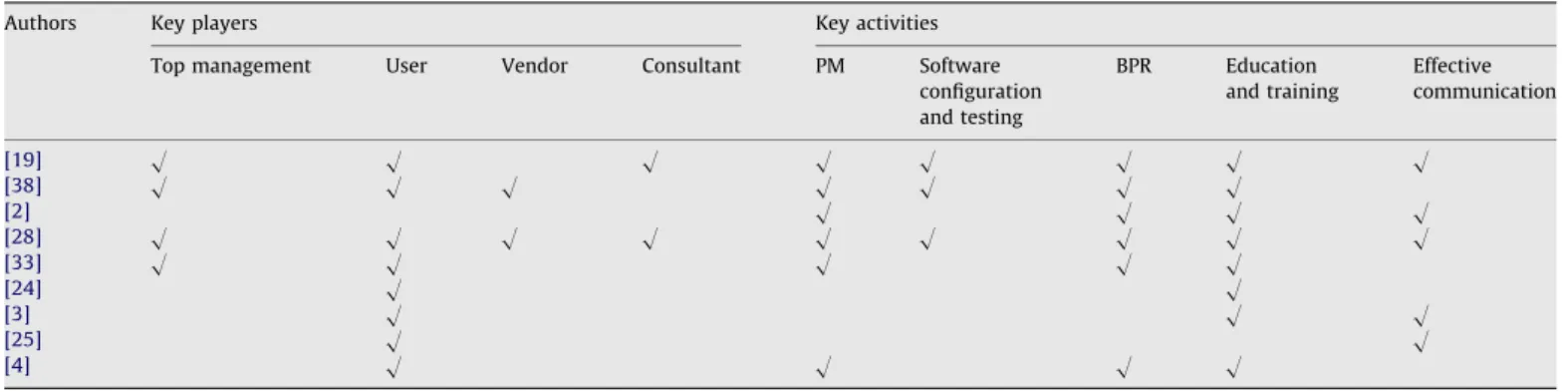
Factor analysis and the process approach are two methodol-ogies that have been used to explore ERP implementation[23]. The process approach attempts to explain how outcomes develop over time. Markus and Tanis [17] posited a four-phase framework: initial decision making, implementation, early use, and extended use. Nah et al. [19]identified 11 CSFs in ERP implementation. Somers and Nelson [28] also analyzed the key players and
A R T I C L E I N F O
Article history:
Received 8 September 2006 Received in revised form 17 July 2008 Accepted 5 August 2008
Available online 25 October 2008
Keywords: ERP Knowledge transfer Absorptive capacity Transfer activities Transfer context
Bidirectional knowledge transfer
A B S T R A C T
Our study examined the determinants of ERP knowledge transfer from implementation consultants (ICs) to key users (KUs), andvice versa. An integrated model was developed, positing that knowledge transfer was influenced by the knowledge-, source-, recipient-, and transfer context-related aspects. Data to test this model were collected from 85 ERP-implementation projects of firms that were mainly located in Zhejiang province, China. The results of the analysis demonstrated that all four aspects had a significant influence on ERP knowledge transfer. Furthermore, the results revealed the mediator role of the transfer activities and arduous relationship between ICs and KUs. The influence on knowledge transfer from the source’s willingness to transfer and the recipient’s willingness to accept knowledge was fully mediated by transfer activities, whereas the influence on knowledge transfer from the recipient’s ability to absorb knowledge was only partially mediated by transfer activities. The influence on knowledge transfer from the communication capability (including encoding and decoding competence) was fully mediated by arduous relationship.
ß2008 Elsevier B.V. All rights reserved.
* Corresponding author. Tel.: +86 571 81612089; fax: +86 571 87995372.
E-mail addresses:[email protected], [email protected](Q. Ma).
Contents lists available atScienceDirect
Information & Management
j o u r n a l h o m e p a g e : w w w . e l s e v i e r . c o m / l o c a t e / i m
0378-7206/$ – see front matterß2008 Elsevier B.V. All rights reserved. doi:10.1016/j.im.2008.08.004
activities.Table 1gives a summary. We explored the determinants of knowledge transfer between the two of the key players: the key user and the implementation consultant.
2.2. ERP knowledge
ERP is a configurable wide package that integrates processes within the organization in a shared database. Its success relies on the client’s skills and knowledge of the ES.
ERP implementation requires knowledge of activities asso-ciated with configuring and testing ERP modules, installing software, and training employees in preparation for ongoing operation, maintenance, and support of a vendor-supplied system that is somewhat customized[10]. As a fulltime financial KU in an ERP implementation project, the first author took in-depth interviews with ICs and KUs and obtained deep insight into the knowledge needed for successful ERP implementation. We learned that a consultant who possessed experience in ES implementation could effectively support clients with necessary knowledge in ERP, project management and implementation methods while the client possessed the detailed knowledge of the firm’s business processes, organizational context, and competitive situation. The knowledge from both sides could then be integrated into the implementation.
Table 2shows the structure of ERP implementation knowledge. 2.3. Knowledge transfer
As knowledge exists at many levels in organizations, its transfer transcends the individual level to groups, departments, and divisions. Knowledge transfer becomes the process through which one unit is affected by the experience of another[5]. Thus we defined it as communication from a source so that it is learned and used by a recipient. In the initiation of a project, the ICs possess ERP knowledge and KUs business process knowl-edge. Effective implementation requires ICs to absorb business process knowledge from KUs and KUs learn ERP knowledge from ICs.
3. Conceptual model and theoretical hypotheses 3.1. An integrated model of ERP knowledge transfer
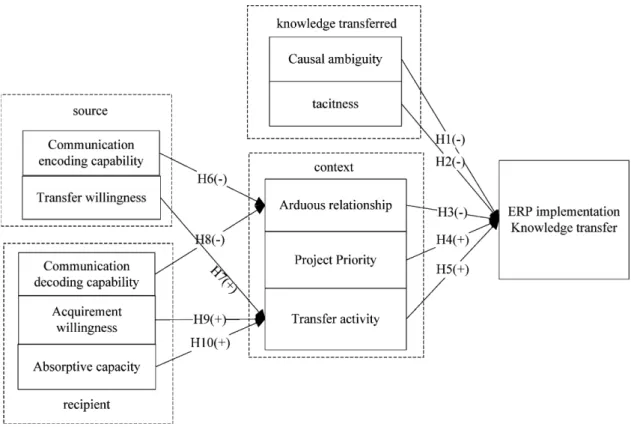
Most knowledge transfer studies have focused on the source (its motivation, trust, and communication ability), recipient (its absorptive capacity, motivation, and communication ability), context (the transfer factors, such as project priority and maturity of the relationship), and knowledge nature (tacitness, articul-ability, specificity, complexity, teacharticul-ability, and causal ambiguity). From semi-structure interviews, we proposed an overarching theoretical framework (see Fig. 1). Ten antecedents were hypothesized as predicting successful ERP implementation knowl-edge transfer.
3.2. Hypotheses
3.2.1. The characteristics of knowledge to be transferred
3.2.1.1. Causal ambiguity. Causal ambiguity concerns the lack of understanding of the logical linkages between actions and outcomes, inputs and outputs, and causes and effects. Simonin [26] highlighted the full-mediator role of ambiguity between knowledge transfer and factors such as tacitness, prior experience, complexity, and cultural and organizational distance. In a study of best practice transfer in firms, Szulanski [30] explored the relationship between causal ambiguity and unproven knowledge and found that causal ambiguity was one of the most important origins of stickiness (viz. impediments to knowledge transfer); it had a negative effect on knowledge transfer. Timbrell et al.[32] explored the stickiness origins of ES best practice transfer. In their study, causal ambiguity did not rank within the top 4 factors in any transfer phase. Consistent with prior studies, we posited that causal ambiguity reduced knowledge transfer:
H1a: Causal ambiguity has a negative effect on ERP knowledge transfer.
H1b: Causal ambiguity has a negative effect on business process knowledge transfer.
3.2.1.2. Tacitness. Polanyi [21] classified knowledge into two categories: explicit and tacit. Reed and DeFillippi [22] defined tacitnessas the implicit and noncodifiable accumulation of skills that results from learning-by-doing. Using teachability, complex-ity, and codifiability to measure the tacitness of knowledge, Kogut and Zander[37]found that it increased the costs and decreased the speed of knowledge transfer. Unlike prior research, Cummings and Teng [9]highlighted the negative relationship between articul-ability (the extent to which knowledge could be verbalized,
Table 1
Key players and key activities of ERP implementation
Authors Key players Key activities
Top management User Vendor Consultant PM Software
configuration and testing BPR Education and training Effective communication [19] H H H H H H H H [38] H H H H H H H [2] H H H H [28] H H H H H H H H H [33] H H H H H [24] H H [3] H H H [25] H H [4] H H H H Table 2
ERP implementation knowledge
Players Knowledge Description
KUs Business process As-is business process
ICs Theory of ERP management Process-orient, information integration Methodology knowledge Implementation methodology and tools,
problem solution
Technical knowledge Know-how programming, operating, configuring and testing knowledge
written, or otherwise recorded) and transfer success in their study of new product development between R&D partners in more than 15 industries. Tacitness was therefore expected to be a determi-nant of knowledge transfer.
H2a: Tacitness has a negative effect on ERP knowledge transfer. H2b: Tacitness has a negative effect on business process
knowl-edge transfer.
3.2.2. The characteristics of transfer context
3.2.2.1. Arduous relationship. Szulanski argued that arduous rela-tionships are emotionally laborious and distant. They are therefore a significant factor in knowledge transfer. In order to compare our results with others, we labeled the relationship between source and recipient as arduous and this has proved to be a barrier to knowledge transfer. Thus,
H3a: An arduous relationship has a negative effect on ERP knowledge transfer.
H3b: An arduous relationship has a negative effect on business process knowledge transfer.
3.2.2.2. Project priority. Top management support is, as usual, assumed to be important in any major implementation. Project priority is a good indicator of such support. We included it as part of the transfer context and supposed it was positively related to knowledge transfer.
H4a: Project priority has a positive effect on ERP knowledge transfer.
H4b: Project priority has a positive effect on business process knowledge transfer.
3.2.2.3. Transfer activities. Knowledge can be transferred by moving a knowledge reservoir from one unit to another [6].
Operational activities, such as a site visit or education and training, provide direct interaction, enabling transfer of tacit knowledge. Therefore,
H5a: Transfer activities have a positive effect on ERP knowledge transfer.
H5b: Transfer activities have a positive effect on business process knowledge transfer.
3.2.3. Characteristics of the source
3.2.3.1. Communication encoding competence. Communication between individuals allows sharing of tacit knowledge. Commu-nication encoding competence refers to one’s ability to express ideas clearly, have a good command of language, and be easily understood[29]. Traditionally it has been believed that with it, a high quality relationship can be forged with others. Therefore, we hypothesized that the arduous relationship between KUs and ICs decreases as source communication encoding competence increases.
H6a: Communication encoding competence has a negative effect on arduous relationship in ERP knowledge transfer. H6b: Communication encoding competence has a negative effect
on arduous relationship in business process knowledge transfer.
3.2.3.2. Transfer willingness. A knowledge source may be reluctant to share knowledge because it can result in a loss of control or ownership[31]. Osterloh and Frey[20]considered that extrinsic and intrinsic motivation affected explicit and tacit knowledge transfer. We focused on source motivation to share or protect knowledge, therefore,
H7a: Transfer willingness has a positive effect on transfer activities in ERP knowledge transfer.
H7b: Transfer willingness has a positive effect on transfer activities in business process knowledge transfer.
3.2.4. Characteristics of the recipient
3.2.4.1. Communication decoding competence. This competence refers to the recipient’s ability to listen, be attentive, and respond quickly. Dong-Gil et al. found evidence of the influence of recipient’s communication decoding competence on knowledge transfer, mediated by the arduous relationship. Therefore, we postulated:
H8a: Communication decoding competence has a negative effect on arduous relationship in ERP knowledge transfer. H8b: Communication decoding competence has a negative effect
on arduous relationship in business process knowledge transfer.
3.2.4.2. Acquisition willingness. Lacking motivation, recipients may be passively involved but feign acceptance or reject new knowl-edge. Practitioners typically consider interdivisional jealousy, lack of incentives, lack of confidence, and turf protection as barriers to knowledge inflow. With high acquisition willingness, a recipient will attempt to master and use new knowledge. Therefore, H9a: Acquirement willingness has a positive effect on transfer
activities in ERP knowledge transfer.
H9b: Acquirement willingness has a positive effect on transfer activities in business process knowledge transfer.
3.2.4.3. Absorptive capacity. Optimal learning can be achieved when the objective is related to what is already known. Absorptive capacity is the ability to recognize the value of new information, assimilate and apply it[8]. Prior studies suggested that absorptive capacity is positively related to knowledge transfer. Therefore, H10a: Absorptive capacity has a positive effect on transfer
activities in ERP knowledge transfer.
H10b: Absorptive capacity has a positive effect on transfer activities in business process knowledge transfer.
Besides these direct-effects, there is a major mediating-effect: communication-related competence. Therefore,
H11a: Arduous relationship mediates the source’s communication encoding competence and knowledge transfer.
H11b: Arduous relationship mediates the recipient’s communica-tion decoding competence and knowledge transfer. Transfer activities are the mechanisms through which knowl-edge transfers. We further believed that transfer activities were a mediator of willingness and absorptive capacity on knowledge transfer.
H12a: Transfer activities mediate the source’s transfer willingness and knowledge transfer.
H12b: Transfer activities mediate the recipient’s acquisition will-ingness and knowledge transfer.
H12c: Transfer activities mediate the recipient’s absorptive capacity and knowledge transfer.
The four characteristic aspects (constructs), 10 independent variables (factors) and the corresponding literature basis are summarized inTable 3.
4. Methodology 4.1. Measurements
Items selected as dependent variable and the 10 factors to be measured were primarily those found and validated in prior studies. Multi-item scales were developed for each variable; most used seven-point Likert-type interval scales ranging from ‘to very little extent’ to ‘to very large extent’.
4.1.1. Measurement of ERP knowledge transfer (dependent variable) In our study, ERP Implementation Knowledge consisted of Business Process and ERP Knowledge; the ERP Knowledge included theory of ERP management, methodology, and technical knowl-edge. By performing in-depth interviews of ICs, project manager and experts, we obtained a rule of thumb: ERP knowledge consists of theory of ERP management (20%), methodology knowledge (30%) and technical knowledge (50%). Technical knowledge was scaled by items adopted from Dong-Gil et al. Other factors of ERP knowledge transfer were developed to measure directly the change in the recipient’s knowledge base.
4.1.2. Measurement of factors in the constructs of source and recipient In our study, motivation was willingness to share or learn knowledge. Six items were developed for measuring transfer and acquisition willingness. Six items were adapted from Dong-Gil et al. to measure communication competence; five items from Dong-Gil et al. and Szulanski were used to measure absorptive capacity. 4.1.3. Measurement of factors in the construct of context
The five items for arduous relationship were adapted from Szulanski and Dong-Gil et al. The six items for transfer activities and the item for project priority were derived from Cummings and Teng.
4.1.4. Measurement of factors in the construct of knowledge nature The four items for Causal Ambiguity were adapted from Szulanski, and Simonin. The four items for Tacitness were adapted from Simonin, and Cummings and Teng.
4.1.5. Measurement of control variables
To control for the specific effects of firm and industry, three control variables were introduced: project size, client’s industry type, and performance of the consulting firm. We used the total number of participant FTEs (consultant plus client FTEs) as a proxy for project size. Industry type of the client was the criteria of SAP usage. Consulting companies were one of three groups, depending on performance.
Table 3
Summarization of constructs, variables and literature basis
Constructs Variables Literature basis
The characteristics of knowledge to be transferred
Tacitness [7,9,16,26,35] Causal ambiguity [26,30,32] The characteristics of transfer
context
Arduous relationship [11,15,30,32] Project priority [9] Transfer activities [9,13] The characteristics of source Transfer willingness [14,30,32,36]
Communication encoding competence
[11,27]
The characteristics of recipient Communication decoding competence
[11] Acquisition willingness [14,30,34] Absorptive capacity [14,18,30,32,35]
4.2. Data collection procedure
4.2.1. Data was collected by questionnaire surveys in two parts Aimed at client firms, the first way began with a telephone contact to ask for participation The Yangtze River Delta Zone is the most rapidly growing industrial area in China today. As its southern wing, Zhejiang province has developed rapidly. Its 52 industrial sectors occupy a domestic market share of 30% with 14 sectors taking a 10% market share worldwide.1 We interviewed client firms mainly located in Hangzhou, Ningbo, and Shaoxing in Zhejiang province. A total of 37 interviews were conducted with ERP project managers, directors, KUs, and other key participants from 14 corporations (see Table 4 in the Appendix). After an interview, we left questionnaires for KUs and ICs (if possible) with a request that they be returned within 1 month.
Aimed at consultant corporations, the second way began by using various contacts with ICs, such as telephone, MSN, and BBS, to ask them to participate in this study. With the rapid development of ERP in China, ICs have become the scarcest human resource and are always busy with projects. Thus the number of ICs who agreed to participate was limited.
All the ERP projects and respondents had to meet two criteria. First, the project must have entered its last implementation stage; this ensured that all significant knowledge transfer had already been executed. Second, the respondents had to be either a KU or IC. It took 3 months for us to collect data from 119 KUs and 68 ICs from 85 ERP implementation projects. However, due to missing data, only 172 observations could be used in data analysis (107 KUs and 65 ICs).
Sample descriptions of the respondents and companies are shown in Table 5. Among them, 32 (37.6%) of the 85 ERP implementation clients were manufacturers and 10 (11.8%) from the chemical industry. Consulting firms were divided into groups according to their performance: high- (international, such as Accenture, IBM, Bearing Point Co., CapGemini, or HP), median-(promising local consulting corporations, such as Hand Enterprise Solutions Co., Han Consulting, Neusoft Group Co., Tsinghua Unisplendour Co.), and low-performance (unknown local con-sultants). The distribution of the three groups was 23:31:30. The mean of the project size was 29.9 persons, and the standard derivation was 22.6. Most of the projects (94.1%) employed an international ERP software package, such as SAP or Oracle. Many local ERP vendors, such as Yongyou, Kingdee and NEWGRAND, provided only a few technicians (four or less) to help in
implementing the system. In contrast, international ERP vendors had many implementation partners (consultants) to help their clients. Therefore we were able to explore knowledge transfer between ICs and KUs.
5. Results
5.1. Measurement model
The reliability and validity of measurement for each construct was tested by using exploratory and confirmatory factor analysis based on the 107 samples collected from KUs.
5.1.1. Exploratory factor analysis
A principal component analysis with varimax rotation was used to examine measures. Factors with eigenvalue above 1.0 were extracted in each construct; these cumulatively explained over 71% of total variance (seeTable 6). Items with low loadings on the intended factor or high cross-loadings on other factors were removed. The resulting scales were then evaluated for reliability using Cronbach’s
a
. All but one had acceptable reliability (a
>0.70).5.1.2. Confirmatory factor analysis
Confirmatory factor analysis was performed with AMOS 5.0. The fit of the overall measurement model was estimated by various indices (see Table 7). The ratio of
x
2 to degrees-of-freedom was 1.37, which was within the recommended value of 3. RMSEA showed the discrepancy between the proposed model and the population covariance matrix, to be 0.059, which was lower than the recommended cut-off of 0.08. All other indices (CFI, IFI, TLI) exceeded the commonly acceptance levels (0.90), demonstrating that the measurement model exhibited a good fit with the data.5.2. Structural model 5.2.1. Mediating effects
Based on the TRA, we believed that transfer activities acted as a mediator between knowledge transfer and factors like transfer willingness, acquisition willingness, and absorptive capacity; also that arduous relationship was a mediator between communication capability and knowledge transfer. Data collected from KUs were used to test the mediating hypotheses using AMOS 5.0.
As can be seen inFig. 2, the relationship of absorptive capacity and knowledge transfer is divided into direct path (path coefficient = 0.271, p= 0.077) and indirect one through transfer
Table 4
Interview profile
Corporation Industry Implementation period Titles
Sunshing Chemical November 2004–April 2005 1 ERP project managera
, 1 Finance manager, 1 Finance KU Wolong Manufacture October 2004–April 2005 1 ERP director, 1 ERP executor, 1 Finance KU
Sanhua Manufacture May 2003–November 2005 1 ERP project manager
Zongshen Motor Manufacture September 2004–August 2005 1 ERP project manager, 1 Logistics KU
Beilun Power Plant Utility 1998–2004 1 ERP project manager, 1 KU
Haitian Manufacture 2003–2004 1 ERP project manager, 1 KU
Hangzhou Steer Mill products December 2002–February 2004 1 ERP director, 1 KU, 1 Project assistant YangShengTang Consumer products July 2003–March 2004 1 ERP director, 1 ERP project manager, 1 KU
Eastcom Telecomm August 2002–May 2003 1 ERP director
Zhejiang Power Utility June 1998–July 1999 1 KU
Sinopec ZRCC Oil and gas October 2001–October 2002 1 ERP director, 2 Finance KU
Juhua Chemical 2002–2004 1 ERP project manager, 1 ERP director, 1 KU
Wahaha Consumer products February 2004–September 2004 1 ERP director, 1 KU
Wufeng Consumer products June 2003–February 2004 1 Finance KU, 1 Sales KU, 1 Produce KU, 1 Office worker aEach interview lasted between 30 and 90 min, with an average of approximately 60 min.
1
activity (path coefficient = 0.244,p= 0.084). Thus, transfer activ-ities were semi-mediators of absorptive capacity on knowledge transfer. In the full model, there was no significant direct effect between acquirement willingness and knowledge transfer (path coefficient = 0.194,p= 0.152). However, the indirect effect through transfer activities was significant (path coefficient = 0.403, p= 0.000). Therefore, transfer activities were full-mediator of acquirement willingness on knowledge transfer providing partially support for Hypothesis H12mc. With a similar analysis procedure, transfer activity was found to be a mediator of transfer willingness on knowledge transfer, and arduous relationship was a mediator of communication capability (including encoding and decoding competence) on knowledge transfer. Therefore, Hypotheses 11a, 11b, 12a, and 12b were supported. The research model was modified (seeFig. 3) by adding the hypotheses:
H13a: Absorptive capacity was positively related to ERP knowl-edge transfer.
H13b: Absorptive capacity was positively related to business process knowledge transfer.
Table 6
Statistical attributes of the scales used
Constructs Scale Number
of items Reliability Cumulative % of total variance Source EC 3 0.792 76.8 TW 3 Recipient DC 3 0.806 71.7 AW 3 AC 4 Transfer context TA 6 0.601 77.0 AR 5 ERP knowledge TC 3 0.886 78.3 CA 3
ERP knowledge transfer K1 3 0.854 71.3
K2 3 K3 3 Business process knowledge K1 3 0.726 73.5 Business process knowledge transfer K 3 0.733 65.4 Table 5 Sample description Variable Frequency (valid percent) Industry Manufacturing 32 (37.6%) Chemicals 10 (11.8%) Telecommunications 8 (9.4%)
Oil and gas 7 (8.2%)
Consumer products 7 (8.2%)
Electricity 5 (5.9%)
High tech 5 (5.9%)
Mill products 3 (3.5%)
Machinery and components 2 (2.4%)
Life science 2 (2.4%)
Insurance 2 (2.4%)
Higher education and research 1 (1.2%)
Others 1 (1.2%) Total 85 Client ownership State 39 (45.9%) Private 26 (30.6%) Collective 10 (11.8%) Joint venture 10 (11.8%) Total 85 Consulting company High performance 23 (27.1%) Median performance 31 (36.5%) Low performance 30 (35.3%) Missing 1 (1.2%) Total 85 ERP package SAP 73 (85.9%) ORACLE 7 (8.2%) YongYou 2 (2.4%) Others 3 (3.5%) Total 85 Variable Frequency (valid percent) Consulting Client Gender Female 16 (25%) 34 (33%) Male 48 (75%) 68 (67%) Missing 1 5 (4.7%) Age 22–25 11 (18%) 15 (14.4%) 26–30 38 (62.3%) 39 (37.5%) 31–35 11 (18%) 38 (36.5%) 36–40 1 (1.6%) 9 (8.7%) 41–45 0 (0%) 2 (1.9%) >45 0 1 (1%) Missing 4 3 Degree Under college 0 (0%) 2 (1.9%) College 2 (3.3%) 21 (20%) Bachelor 45 (73.8%) 73 (69.5%) Master 12 (19.7%) 9 (8.6%) Doctor 2 (3.3%) 0 (0%) Missing 5 2 Total 65 107
Working in this firm Mean = 2.35 Mean = 5.84
S.D. = 2.03 S.D. = 5.13
Table 5 (Continued)
Variable Frequency
(valid percent)
Consulting Client
Working in this industry Mean = 3.43 Mean = 4.54 S.D. = 1.93 S.D. = 3.69
Project size Mean = 27.8 Mean = 28.8
S.D. = 19 S.D. = 20.2
Table 7
Fit indices for measurement and structural models Fit indices Recommended
value Measurement model Structure model x2 /d.f. 3 1.37 1.38 RMSEA 0.08 0.059 0.060 CFI 0.90 0.916 0.913 IFI 0.90 0.919 0.915 TLI 0.90 0.904 0.904
5.2.2. ERP knowledge transfer
A similar set of fit indices was used to examine the structural model (seeTable 7) of ERP knowledge transfer. All provided evidence of a good model fit (
x
2/d.f. = 1.380; RMSEA = 0.060; CFI = 0.913; IFI = 0.915; TLI = 0.904). Thus, we could proceed to examine the path coefficients of the structural model. This involved estimating the
path coefficients and R2 value. Path coefficients indicated the strengths of the relationships between the independent and dependent variables, whereas theR2value was a measure of the predictive power of a model for the dependent variables. The overall results of the analysis are shown inFig. 2. As hypothesized, ERP knowledge transfer was significantly associated with tacitness
Fig. 2.Results of AMOS analysis.
(path coefficient =0.190, p= 0.027), arduous relationship (path coefficient =0.263,p= 0.014) and transfer activity (path coeffi-cient = 0.209, p= 0.039), and marginally significantly associated with project priority (path coefficient = 0.111, p= 0.063) and absorptive capacity (path coefficient = 0.271,p= 0.077). It explained 64.2% of the dependent variable’s variance. All five paths had significant or marginal significant effects. Hypotheses 2a, 3a, 4a, 5a, and 13a were supported. However, causal ambiguity had no significant effect on ERP knowledge transfer (path coefficient =
0.08,p= 0.323). Thus Hypotheses 1a was not supported. As shown inFig. 2, Communication encoding competence (path coefficient =0.575, p= 0.000) and decoding competence (path coefficient =0.257, p= 0.013) significantly influence arduous relationship, accounting for 53% of the variance and providing support for Hypotheses 6a and 8a. Transfer willingness (path coefficient = 0.323,p= 0.012) and acquirement willingness (path coefficient = 0.403, p= 0.000) significantly influenced transfer
activities. Absorptive capacity (path coefficient = 0.244,p= 0.084) had marginally significant influence on transfer activities; it accounted for 56% of variance and provided support for Hypotheses 7a, 9a, and 10a.
Table 8provides a detailed summary of all the hypothesis test results.
5.2.3. Business process knowledge transfer
The multiple-regression was performed to test the hypotheses of business process knowledge transferred from KUs to ICs because the sample size in this transfer direction (from KUs to ICs) was 65 which was too small to analyze with SEM. The results of regression analysis are shown inTable 9. As hypothesized, business process knowledge transfer was significantly associated with tacitness (
b
=0.299, p= 0.020) and transfer activities (b
= 0.397,p= 0.010), and margin-ally with arduous relationship (b
=0.227, p= 0.056), which together explain 35.5% of the dependent’s variance on an adjustedTable 8
Tests of hypotheses (implementation consultants!key users)
+p<0.1, *p<0.05, **p<0.01 and ***p<0.001 (two-tailed significance).R2for transfer activity = 0.557;R2for arduous relationship = 0.529;R2for knowledge transfer = 0.642. aHindicates hypothesis is supported,
_indicates hypothesis is partially supported, andindicates hypothesis is not supported. b
Total effect = Direct effect + Indirect effect.
Table 9
Results of regression (key users!implementation consultants)
Variables H/a
H Std.b p
Dependent variable: arduous relationship (R2
= 0.305; adjustedR2 = 0.283)
Communication encoding competence H H6b 0.553 0.000***
Communication decoding competence H8b 0.033 0.756
Dependent variable: transfer activities (R2
= 0.157; adjustedR2 = 0.107)
Transfer willingness H H7b 0.262 0.047*
Acquisition willingness H9b 0.196 0.172
Absorptive capacity H10b 0.158 0.270
Dependent variable: business process knowledge transfer (R2
= 0.463; adjustedR2 = 0.355) Causal ambiguity H1b 0.020 0.878 Tacitness H H2b 0.299 0.020* Arduous relationship H H3b 0.227 0.056+ Project priority H4b 0.130 0.304 Transfer activities H H5b 0.397 0.010* Absorptive capacity H13b 0.081 0.532 Project size 0.127 0.305 Client industry 0.079 0.562 Consultant firm performance 0.055 0.681 *** p<0.001,** p<0.01,* p<0.05 and+ p<0.1. aHindicates hypothesis is supported and
basis (adjusted R2= 0.355). Hypotheses 2b, 3b, and 5b were supported. However, causal ambiguity (
b
=0.020, p= 0.878), project priority (b
= 0.130, p= 0.304), and absorptive capacity (b
= 0.081,p= 0.532) had no significant effect on business process knowledge transfer. Thus, Hypotheses 1b, 4b, and 13b were not supported.Contrary to expectations, communication decoding compe-tence (
b
=0.033,p= 0.756) did not have a significant impact on arduous relationship: Hypothesis 8b was not supported. Commu-nication encoding competence (b
=0.553,p= 0.000) significantly influenced arduous relationship, accounting for 28% of the variance (R2= 0.283) and providing support for Hypotheses 6b. Transfer willingness (b
= 0.262, p= 0.047) had a significant influence on transfer activities, accounting for 16% of the variance (R2= 0.157) and supporting Hypothesis 7b. But acquirement willingness (b
= 0.196, p= 0.172) and absorptive capacity (b
= 0.158, p= 0.270) did not significantly affect transfer activities. Thus, Hypotheses 9b and 10b were not supported.5.2.4. Robustness analysis
To examine whether our results still held under different conditions, three control variables were included in the model: project size, client industry and consulting company. As shown in Table 5, 37.6% of the 85 samples were manufacturing firms. Thus, the industry type of client was coded as 1 for manufacture firm, and 0 for others. The project size was measured with the total number of participant FTEs. Consulting companies were divided into three groups according to their performance: high medium, and low. None of the control variables was found to be significant in ERP implementation knowledge transfer (see Tables 8 and 9); this suggested that our results would hold under different conditions. 6. Discussion and implications
Our study revealed the determinants of ERP knowledge transfer from ICs to KUs (R2= 0.642), and the determinants of business process knowledge transfer from KUs to ICs (R2= 0.463) in ERP implementations. Transfer activities were full mediators between willingness and knowledge transfer and semi-mediators between recipient’s absorptive capacity and knowledge transfer. Arduous relationship was a full-mediator of the relation between commu-nication capability (including encoding and decoding competence) and knowledge transfer.
6.1. Contributions and implications 6.1.1. Research implications
Our study explored the bidirectional transfer of ERP imple-mentation knowledge between ICs and KUs: ERP knowledge transfer from ICs and business process knowledge from KUs. We provided evidence of bidirectional transfer.
We also hypothesized that transfer activities mediated the influence of absorptive capacity, acquisition willingness, and transfer willingness on knowledge transfer. Our data on KUs also indicated that the effects of source’s transfer and recipient’s acquirement willingness on knowledge transfer were fully mediated by transfer activities, whereas absorptive capacity was only partially mediated by the activities.
We also provided empirical support to several theories and prior studies: e.g. we found that tacitness was a significant predictor of ERP knowledge transfer. However, we found no significant effect of causal ambiguity on ERP knowledge transfer. We examined the influence of communication competence on arduous relationship between ICs and KUs. Apparently, the recipient’s communication decoding competence had a significant
influence on arduous relationship in ERP knowledge transfer from ICs to KUs (see H8a in Table 8), but not in business process knowledge transfer from KUs to ICs (see H8b inTable 9). However, source’s communication encoding competence significantly influ-enced arduous relationship in bidirectional knowledge transfer. A possible reason for this would be that source-leading was the main communication mode in China. In this mode, the communication encoding competence plays a more important role than the decoding competence.
An arduous relationship results in a knowledge transfer barrier. However, we found that an arduous relationship was less important in business process knowledge transfer from ICs to KUs (
b
=0.227,p= 0.056) than in ERP knowledge transfer from KUs to ICs (path coefficient =0.263, p= 0.014). Possibly ERP knowledge transfer gains more attention than business process transfer in ERP implementation.Project priority is a powerful indicator reflecting the support of top management. Interestingly, our data indicate that project priority had a positive influence on ERP knowledge transfer but had no significant effect on business process knowledge transfer. 6.1.2. Managerial implications
Managers of consulting corporations and client firms should increase their understanding of how to facilitate knowledge transfer across organizational boundaries. As shown inTables 8 and 9, ERP knowledge transfer is influenced by the characteristics of knowledge transferred, source, recipient, and transfer context. Tacitness is a barrier to knowledge transfer. Thus it is important to codify and articulate the knowledge. ERP technology knowledge could be coded into a formula, blueprint, or step-by-step text. Implementation methodology should be cumulated through project management using meeting memos, project planning, and tracking. Business process knowledge can be articulated by organization structure, job responsibilities and requirements.
Transfer activities play a critical role in implementation knowledge transfer. More forms and various types of activities, such as dialogue-focused meetings, document exchange, technical and management training, etc. are needed to facilitate effective knowledge transfer.
We found that high project priority is always associated with successful ERP knowledge transfer. Top managers should aid in settling disputes and achieving cooperation.
A consultant should be able to express ideas clearly, have a good command of language with general interpersonal skills, and high motivation to share knowledge. A desirable key user should have good communication ability, high motivation to acquire new knowledge and share business knowledge with the consultant. 6.2. Limitations of the study
We only measured the performance of the variable as perceived by the recipient; this may have lead to subjective bias of the recipient. Thus, statistical power could have been limited. Also, the participants included: client, vendor, and consultant. We explored only knowledge transfer between client and consultant and this may ignore some knowledge flow. Finally, 86.5% of the research sample cases used SAP in their implementation and the data transfer from ICs to KUs were collected mainly in Zhejiang province, China, limiting generalization of our findings.
7. Conclusion
Beginning with analysis of the bidirectional knowledge transfer between KUs and ICs, we explored the determinants of successful knowledge transfer in ERP implementation projects. Four sets of
factors (characteristics of knowledge to be transferred, source, recipient, and context) were shown to have different effects on ERP knowledge transferred from ICs to KUs and on business process knowledge transferred from KUs to ICs. We further revealed the full- and partial-mediator nature of transfer activities between the recipient’s absorptive capacity and the ERP implementation knowledge transfer, and the full-mediator of arduous relationship between communication encoding competence and ERP imple-mentation knowledge transfer.
Acknowledgements
We appreciate the helpful comments and suggestions of the three anonymous referees and Professor Sibley. This work was supported by grant no. 20070410410 of the Post Doctor Science Foundation of China.
Appendix A
A.1. Interviewees and corporations list
Table 6 shows the corporations contacted and interviewees conducted in our study.
A.2. Instrument items
All scale measures used seven-point Likert scales with ‘‘strongly agree’’ and ‘‘strongly disagree’’ anchors, except for project priority, which used ‘‘very high’’ and ‘‘very low’’ anchors.
A.2.1. ERP implementation knowledge
ERP implementation knowledge consisted of business process knowledge and ERP knowledge. Technical knowledge was measured by items adopted from [11]. Others were measured by newly developed items.
ERP knowledge¼theory of ERP management ð20%Þ þmethodology knowledge ð30%Þ þtechnical knowledge ð50%Þ Theory of ERP managementIC
Participated this ERP implementation project increased my understanding of the theory of ERP management.
Participated this ERP implementation project increased my understanding of process-oriented management.
Participated this ERP implementation project increased my understanding of the integration of cross-function business.
Methodology knowledgeIC
Participated this ERP implementation project increased my understanding of the step-by-step implementation stage of ERP.
Participated this ERP implementation project increased my understanding of project milestone.
Participated this ERP implementation project increased my ability to ask penetrating questions about ERP project risk.
Technical knowledgeIC
Participated this ERP implementation project increased my knowledge about setting up the configuration tables that support business process.
Participated this ERP implementation project increased my understanding of how modules integrate with each other. Participated this ERP implementation project improved my ability to develop test scripts for module.
Business process knowledgeKU
Participated this ERP implementation project increased my understanding of business process in this industry.
Participated this ERP implementation project increased my knowledge of ERP solution.
Participated this ERP implementation project increased my technical knowledge of this industry.
A.2.2. The characteristics of source
Transfer Willingnessis defined as the degree to share or protect knowledge. New items were developed.
ConsultantKU/IC key user share with me ERP materialKU/IC business transaction out of project range.
Any question about ERPKU/ICbusiness process, I can get help from consultant/key user as quickly as possible.
ConsultantKU/IC key user talks about technical knowledge of ERPKU/IC business process with me once and again until I understand thoroughly.
Communication encoding competencerefers to the ability to express one’s ideas clearly, have a good command of the language, and be easily understood. Items were derived from[11].
KU/ICI’m sensitive to others’ needs.
KU/ICI pay attention to what other people say to me. KU/ICI’m easy to talk with consultant.
A.2.3. The characteristics of recipient
Acquirement willingnessis defined as the degree to learn knowl-edge. New items were developed.
KUI value the opportunity to take part in this ERP implementa-tion project.
KUI want to pay more attention and time to learn ERP knowledge. KUI enjoy learning ERP knowledge that’s completely new to me. ICI value this project to accumulate project experience and industry knowledge.
ICI want to pay more attention and time to understand client’s business process.
IC
I enjoy learning business process knowledge that’s completely new to me.
Communication decoding competencerefers to a recipient’s ability to listen, be attentive and respond quickly. Items were derived from [11].
KUConsultant/ICkey user can deal with others effectively. KUConsultant/ICkey user expresses his/her ideas clearly. KUConsultant/ICkey user usually says the right thing at the right time.
Absorptive capacityis the ability to recognize the value of new information, assimilate it, and apply it. Items were derived from[11] and[30].
KU/ICI have a vision of what this project is trying to achieve. KU/ICI have the technical competence to absorb the ERP knowledge.
KU/ICI have a clear understanding of goals, tasks, and respon-sibilities of this project.
KU/ICI have information on the state-of-the-art of ERP. KU/ICI have the necessary knowledge to understand ERP.*
A.2.4. The characteristics of knowledge
Tacitnessis the implicit and noncodifiable accumulation of skills that results from learning by doing. Items were derived from[9]and [26].
KUERP knowledge is more tacit than explicit. KU
ERP knowledge is easily codifiable (in blueprints, instruc-tions, formulas, etc.).
KUNew personnel can easily learn ERP knowledge by studying a complete set of blueprints, documents or plans.
KUNew personnel can easily learn ERP knowledge by talking with experienced personnel.
ICBusiness process knowledge is more tacit than explicit. ICBusiness process knowledge is easily codifiable (in blueprints, instructions, formulas, etc.).
ICNew personnel can easily learn business transaction by studying a complete set of working manuals.
ICNew personnel can easily learn business transaction by talking with experienced personnel.
Cause ambiguityrefers to lack understanding of the logical linkages between actions and outcomes, inputs and outputs, and causes and effects that are related to technological or process know-how. Items were derived from[26]and[30].
KUThere’s a precise list of the skills, resources and prerequisites necessary for successful ERP implementation.
KUThe association between causes and effects, inputs and outputs, and actions and outcomes related to ERP is clear. KU
Existing work manuals and operating procedures describe precisely what people working in ERP implementation. KUWe know why a given action in ERP results in a given outcome.
ICThere’s a precise list of the skills, resources and prerequisites necessary for certain business transaction.
ICThe association between causes and effects, inputs and outputs, and actions and outcomes related to business process is clear.
ICExisting work manuals and operating procedures describe precisely what people working in business transaction. ICWe know why a given business transaction results in a given outcome.
A.2.5. Transfer context
Transfer activitiesis the means through which knowledge transfer occur, such as document exchanges, meetings, site visits, job rotations, training, joint teams and so on. Items were derived from[9].
Training and education. Regular project meetings. System configuration. System testing. Data preparation.
Problem solving meetings.
Project priorityis the priority of ERP implementation project. Items were derived from[9].
The priority of this ERP implementation project is
Arduous relationship is an emotionally laborious and distant relationship between key users and consultants. Items were derived from[11]and[30].
KU/IC
Communication between consultant and me is very easy.
Status between KU consultant/IC key user and me is very equality.
KUConsultant/ICkey user and I help each other. KUConsultant/ICkey user and I trust each other.
KUCollaboration between consultant/IC key user and me is sought after him/her.
*Based on the instrument validation process, these items were deleted.
KUResponses from key user.
ICResponses from implementation consultant.
KU/ICResponses from key user and implementation consultant.
References
[1] ARC Advisory Group, Enterprise Resource Planning (ERP) Market to Exceed $21 Billion, July 5, 2006,http://www.arcweb.com/res/erp.
[2] M. Al-Mashari, A. Al-Mudimigh, M. Zairi, Enterprise resource planning: a taxon-omy of critical factors, European Journal of Operational Research 146 (2), 2003, pp. 352–364.
[3] K. Amoako-Gyampah, A.F. Salam, An extension of the technology acceptance model in an ERP implementation environment, Information & Management 41 (6), 2004, pp. 731–745.
[4] T. Andre, B. Celine, R.D. Claude, Key lessons from the implementation of an ERP at Pratt & Whitney Canada, International Journal of Production Economics 95 (2), 2005, pp. 151–163.
[5] L. Argote, P. Ingram, Knowledge transfer: a basis for competitive advantage in firms, Organizational behavior and human decision processes 82 (1), 2000, pp. 150–169.
[6] L. Argote, P. Ingram, J.M. Levine, R.L. Moreland, Knowledge transfer in organiza-tions: learning from the experience of others, Organization Behavior Human Decision Processes 82 (1), 2000, pp. 1–8.
[7] W.B. Berta, R. Baker, Factors that impact the transfer and retention of best practices for reducing error in hospitals, Health Care Management Review 29 (2), 2004, pp. 90–97.
[8] W. Cohen, D. Levinthal, Absorptive capacity: a new perspective on learning and innovation, Administrative Science Quarterly 35 (March), 1990, pp. 128–152. [9] J.L. Cummings, B.S. Teng, Transferring R&D knowledge: the key factors affecting
knowledge transfer success, Journal of Engineering & Technology Management 20 (1/2), 2003, pp. 39–68.
[10] K. Dong-Gil, Determinants of knowledge transfer in enterprise resource planning implementation, PhD thesis, University of Pittsburgh, 2002.
[11] K. Dong-Gil, L.J. Kirsch, W.R. King, Antecedents of knowledge transfer from consultants to clients in enterprise system implementations, MIS Quarterly 29 (1), 2005, pp. 59–85.
[12] Editorial, A profile of information systems research, Information & Management, Information & Management (44) 2007, pp. 1–11.
[13] T. Guan, The Empirical Study on the Process and Factors of Knowledge Transfer in MNCs, Fudan University (in Chinese), 2005.
[14] A.K. Gupta, V. Govindarajan, Knowledge flows within multinational corporations, Strategic Management Journal 21 (4), 2000, pp. 473–496.
[15] K.D. Joshi, S. Sarker, S. Sarker, Knowledge transfer among face-to-face information systems development team members, in: Proceedings of the 37th Hawaii Inter-national Conference on System Sciences-2004, 2004, pp. 1–11.
[16] B. Kogut, U. Zander, Knowledge of the firm and the evolutionary theory of the multinational corporation, Journal of International Business Studies 24 (4), 1993, pp. 625–645.
[17] M.L. Markus, C. Tanis, The Enterprise Systems Experience: From Adoption to Success, Pinnaflex Educational Resources, Inc., Cincinnati, OH, 2000. [18] D. Minbaeva, T.T.I.C.D. Pedersen, I. Bjorkman, C.F. Fey, H.J. Park, MNC knowledge
transfer, subsidiary absorptive capacity, and HRM, Journal of International Busi-ness Studies 34 (6), 2003, pp. 586–599.
[19] F.F.H. Nah, J.L.H. Lau, J. Kuang, Critical factors for successful implementation of enterprise systems, Business Process Management Journal 7 (3), 2001, pp. 285– 296.
[20] M. Osterloh, B.S. Frey, Motivation, Knowledge transfer, and organizational forms, Organization Science 11 (5), 2000, pp. 538–550.
[21] M. Polanyi, The Tacit Dimension, Routledge and Kegan Paul, London, 1966. [22] R. Reed, R.J. Defillippi, Causal ambiguity, barriers to imitation, and sustainable
competitive advantage, Academy of Management Review 15 (1), 1990, p. 88. [23] D. Robey, J.W. Ross, M.-C. Boudreau, Learning to implement enterprise systems:
an exploratory study of the dialectics of change, Journal of Management Informa-tion Systems 19 (1), 2002, pp. 17–46.
[24] P.J. Rondeau, T.S. Ragu-Nathan, M.A. Vonderembse, How involvement, IS manage-ment effectiveness, and end-user computing impact IS performance in manu-facturing firms, Information & Management 43 (1), 2006, pp. 93–107. [25] S. Sarker, A.S. Lee, Using a case study to test the role of three key social enablers in
ERP implementation, Information & Management 40 (8), 2003, pp. 813–829. [26] B.L. Simonin, Ambiguity and the process of knowledge transfer in strategic
[27] C. Soh, S. Kien, J. Tay-Yap, Cultural fits and misfits: is ERP a universal solution, Communications of the ACM 43 (4), 2000, pp. 47–51.
[28] T.M.T. Somers, K.G. Nelson, A taxonomy of players and activities across the ERP project life cycle, Information & Management 41 (3), 2004, pp. 257–278. [29] B.H. Spitzberg, M.L. Hecht, A component model of relational competence, Human
Communication Research 10, 1984, pp. 575–599.
[30] G. Szulanski, Exploring internal stickiness: impediments to the transfer of best practice within the firm, Strategic Management Journal 17 (Summer special issue), 1996, pp. 27–43.
[31] G. Szulanski, The process of knowledge transfer: a diachronic analysis of sticki-ness, Organizational Behavior & Human Decision Processes 82 (1), 2000, pp. 9–37. [32] G.T. Timbrell, N.M. Andrevira, G.G. Gable, Impediments to inter-firm transfer of best practice in an enterprise systems context, in: Proceedings of the Seventh Americas Conference on Information Systems, Boston, 2001, pp. 1084–1090. [33] E.J. Umble, R.R. Haft, M.M. Umble, Enterprise resource planning: implementation
procedures and critical success factors, European Journal of Operational Research 146 (2), 2003, pp. 241–257.
[34] Q. Xu, Q. Ma, C. Zhang, M. Su, The mediation effect of transfer activities in ERP knowledge transfer, in: Proceedings of IAMOT’06, Beijing, 2006.
[35] P. Yong Suhk, P. Young-Ryeol, A framework of knowledge transfer in cross-border joint ventures: an empirical test of the Korean context, Management Interna-tional Review (MIR) 44 (4), 2004, pp. 417–434.
[36] S. Young, P. Lan, Technology transfer to China through foreign direct investment, Regional Studies 31 (7), 1997, pp. 669–679.
[37] U. Zander, B. Kogut, Knowledge and the speed of the transfer and imitation of organizational capabilities: an empirical test, Organization Science 6 (1), 1995, pp. 76–92.
[38] Z. Zhang, M.K.O. Lee, P. Huang, L. Zhang, X.Y. Huang, A framework of ERP systems implementation success in China: an empirical study, International Journal of Production Economics 98 (1), 2005, pp. 56–80.
Qing Xu received her Ph.D. in management science and engineering from Zhejiang University, China, and is presently a postdoctoral research fellow at the Depart-ment of Business Administration. She participated in an ERP implementation project in a chemical firm from 2004 to 2005. Her key research interests focus on ERP implementation, knowledge transfer, and technology management.
Qingguo Ma is a professor of management science and engineering at Zhejiang University, a Councilor of Management Science Section of Commission of Aca-demic Degrees of State Council of China, and the president of Chinese Society of Value Engineering. His current research interests focus on in e-government, management of IT, information system, and Neuron-management.