Sponsored by:
The Depository Trust & Clearing Corporation
processor of mutual funds and insurance transactions, automating and streamlining the communications links between mutual funds and insurance carriers and their distribution networks.
For more information on DTCC, visit www.dtcc.com
For more information about this report
Lisa Argento Director
Corporate Communications
The Depository Trust & Clearing Corporation
Tel: +1 212 855 5302 Fax: +1 212 785 9681 [email protected]
of developments for company strategy, government policy and regulatory behaviour.
For more information on Oxera, visit www.oxera.com
Luis Correia da Silva Director
Oxera
Tel: +44 (0) 1865 253 000 Fax: +44 (0) 1865 251 172 [email protected]
Oxera Consulting Ltd is registered in England No. 2589629. Registered office: Blue Boar Court, Alfred Street, Oxford OX1 4EH, UK. Although every effort has been made to ensure the accuracy of the material and the integrity of the analysis presented herein, Oxera Consulting Ltd accepts no liability for any actions taken on the basis of its contents.
Oxera Consulting Ltd is not licensed in the conduct of investment business as defined in the Financial Services and Markets Act 2000. Anyone considering a specific investment should consult their own broker or other investment adviser. Oxera Consulting Ltd accepts no liability for any specific investment decision which must be at the investor’s own risk.
Why corporate actions are important to the securities industry
Corporate action events are an integral feature of today’s capital markets. They take place whenever changes are made to the capital structure or financial position of an issuer of a security that affect any of the securities it has issued. Rights issues, tender offers, conversions, takeovers, mergers, early redemptions and dividend payments are just a few examples.
Close to 1m corporate actions take place every year worldwide.1 A single event may involve
hundreds of different market participants (including custodians, fund managers, broker/dealers and depositories), ultimately cascading down to thousands of investors. Each of these
participants faces high risk because corporate action processing is complicated, deadline-driven, not standardised, and to a large extent still manual.
In the past few years, concerns about corporate actions have been raised by, among others, the Group of Thirty, the Giovannini Group, the Committee for European Securities Regulators and the European Central Bank. These organisations have advocated bringing greater efficiency and standardisation to corporate action processes, and some industry initiatives have been launched to work towards these aims. This reflects an increasing awareness in the securities industry that corporate action processing involves significant risks, and that corporate actions are not just a ‘back-office’ issue but also have an impact on trading strategies in the front office, and the efficiency of capital markets more broadly.
To date, however, there has never been a systematic and quantitative analysis of the risks related to corporate action processing in the global securities marketplace. This Oxera study is a first step towards such an analysis.
What the Oxera study aims to contribute
The study, which seeks to inform the current debate on corporate actions, has been sponsored by The Depository Trust & Clearing Corporation (DTCC) to help measure the magnitude of risk to the industry as a whole. Oxera has undertaken this study independently, from a ‘public-interest’ perspective, and is responsible for the analysis presented. In the research process, Oxera consulted a range of data sources, referred to regulatory reports and recommendations, and conducted interviews with various brokerage, fund management and custodian firms, and other market participants.2
Part of the study—in particular, some of the risk estimates—focuses on European markets, for practical reasons. However, the participants interviewed noted that the issues surrounding corporate action risks are similar in any market, including the Americas and markets in the Asia– Pacific region, such as Japan, Hong Kong, Korea and Australia.
1
This does not include the 3m plus scheduled fixed-rate interest payments and scheduled maturities that occur every year.
2
Summary of main findings: risk estimates
The study systematically reviews the risks involved in corporate action processing and derives
some crude estimates of their impact on the various market participants.3
– The direct risks to any individual firm involved in the corporate action processing chain can
be very significant. Failure in handling a single, complex corporate action has the potential to result in a loss running into tens of millions of euros. The risk is highest for individual custodian firms because they safeguard large amounts of assets on behalf of many different investors, but fund management firms also face risks.
– Corporate action risks are not limited to the back office. Because the dissemination of
corporate action information is complicated, temporary arbitrage opportunities (and risks) arise in trading. Failure to interpret corporate action information correctly may lead to sub-optimal trading decisions by brokerage and fund management firms for clients or for
proprietary positions. The risk to firms’ front offices from sub-optimal trading decisions
is estimated to be in the region of €1.6 billion–€8 billion per year globally.
– The actual losses due to processing failures are somewhat lower, because firms in the
industry spend very large sums on failure prevention. Available data on the European
fund management industry indicates that firms in Europe incur total actual costs in the region of €65m–€140m per year. This would imply an annual cost of €300m– €700m to the fund management industry worldwide.4
– Processing failures can arise anywhere in the corporate action chain, and all market participants run the risk of failures, due to two factors:
– errors in the downstream flow of information—there is no standard way in which events are announced by issuers; there is no single securities identification system that is universally accepted; different information sources are often inconsistent; and
processing details and terminology are often specific to a particular market or financial instrument. The result is that accurate information on corporate actions is difficult to obtain. Moreover, since each party in the chain is responsible for getting the information right, considerable resources are spent on various, often duplicative, external data sources and internal data ‘scrubbing’ efforts;
– errors in the upstream flow of instructions—the sheer number of different financial intermediaries (custodians, fund managers, broker/dealers, and depositories) involved in any one event requires that many instructions be delivered for each corporate action. This complex chain of communications (with most instructions delivered via phone, fax, telex or unformatted email, and processed manually) can cause a domino effect of potential error and loss if information is misinterpreted or mishandled. The more
3
These estimates should be interpreted with care, as they are based on many extrapolations that can only be verified by additional research. Historical data on the costs of corporate action failures incurred by firms is not readily available in the public domain. On the contrary, firms involved in corporate actions usually treat this kind of information as extremely sensitive. This inevitably limits the extent to which this study, and indeed any other study, can accurately quantify the costs of corporate actions.
4
intermediaries in the chain, the tighter the deadline for the ultimate decision-maker, since each intermediary sets its own deadline to allow sufficient time to handle the instruction—this, too, increases the scope for failure.
– Compared with the above risks, the other types of cost discussed in the study—the direct
costs of late payment of mandatory corporate actions, and the costs of failure to exercise shareholder rights—are smaller. These costs cannot be ignored, however, because they have the potential to have a significant impact on individual investors and firms, and to affect the efficiency of capital markets overall.
Conclusion and next steps
Oxera greatly appreciates the cooperation of the firms that agreed to be interviewed for this study, and acknowledges DTCC for its sponsorship. We welcome any views and comments on the issues raised in this study.5
Based on the study’s findings, and given the increased focus on operational risk management in the industry worldwide, it is important to raise awareness in the securities industry that corporate actions do involve significant potential risks and costs, affecting the front office as well as the back office.
Because of limited data availability, our estimations of the orders of magnitude of risk involved are only indicative. A further in-depth research effort, with the cooperation and participation of a greater number of market participants across a more geographically diverse area, might
determine with even greater clarity the level of risks and costs related to corporate actions globally. Indeed, during our interviews, several firms expressed interest in such a
comprehensive study.
5
1.0
Introduction: objectives of the research
1
2.0
Types of corporate action and market
participants involved
4
2.1
Types of corporate action
4
2.2
Data on corporate actions worldwide
5
2.3
Market participants involved in the corporate action
chain 8
3.0
Types of risk in corporate action
processing 12
3.1
Direct risk of processing failures
12
3.2
Direct cost of late payments
15
3.3
Risk of sub-optimal trading decisions by the front
office 15
3.4
Indirect cost of ineffective corporate governance
16
3.5
Overview of types of risk and costs
17
4.0
Potential processing failure risk to all
intermediaries in the chain
19
4.1
Example 1: France Telecom rights issue
(March/April 2003)
19
4.2
Example 2: The Vodafone/Mannesmann takeover
(March 2000)
22
4.3
Conclusion 24
5.0
Estimate of actual costs incurred by fund
managers 26
5.1
The role of fund managers in the corporate action
process 26
5.2
Estimate of the costs to fund managers
27
6.0
Potential direct costs to investors resulting
from late payments
32
7.0
Potential risks of sub-optimal trading
decisions by front offices
33
7.1
Trading decisions based on corporate action
information 34
7.2
Transaction costs and risk of market movement
34
Corporate action events are an integral feature of today’s capital markets. They take place whenever changes are made to the capital structure or financial position of an issuer of a security that affect any of the securities it has issued. The processing of corporate actions involves a range of market participants—from the issuer, to intermediaries, such as custodians, fund managers and brokers, and to the final investor who is the beneficiary of the security in question. Each of these participants risks being affected by failures in corporate action
processing. The fact that the process is complicated, to a large extent still manual, and involves a chain of intermediaries, means that the risk of such failures is high.
Corporate actions fall into the category of activities often referred to as ‘post-trade processing’ or ‘asset servicing’, together with the clearing and settlement of securities trades. The risks and inefficiencies involved in clearing and settlement have received much attention in recent years from various industry groups and government institutions. This has generated various studies with policy recommendations, such as the Group of Thirty (G30) report (January 2003);6 the second Giovannini report (April 2003);7 and the consultation paper issued jointly by the
Committee for European Securities Regulators (CESR) and the European Central Bank (ECB), in July 2003.8
While these reports focus primarily on clearing and settlement, they are also of direct relevance to corporate action processing, since both activities largely use the same communications and back-office infrastructure. Indeed:
– one of the recommendations in the G30 report was to automate and standardise asset-servicing processes, including corporate actions.The report acknowledges the importance of the availability of accurate and timely information for market participants, and emphasises the role of a fully automated communication flow through the value chain in achieving this end;
– likewise, the Giovannini report stated that there are significant national differences in the rules and practices governing corporate actions within the EU. These differences may act as a barrier to efficient cross-border securities transactions. Efforts to improve consistency in the national rules governing corporate actions are therefore essential if the integration of EU equity markets is to proceed.
At present, various industry initiatives have been set in motion to achieve greater harmonisation and standardisation of corporate action processes. One example is the dedicated working group set up by the European Central Securities Depositories Association (ECSDA).9 On the other side of the Atlantic, similar efforts have been launched by both US and Canadian market bodies. The US Securities Industry Association (SIA) and the Canadian Capital Market Association (CCMA) have formed working groups to investigate the obstacles for increased automation, and the possibility of moving into t+1 corporate action processing.10 Several market participants have
6
G30 (2003), ‘Global Clearing and Settlement: A Plan of Action’, January.
7
Giovannini Group (2003), ‘Second Report on EU Clearing and Settlement Arrangements’, April.
8
CESR and ECB (2003), ‘Standards for Securities Clearing and Settlement Systems in the European Union’, consultative report, July.
9 ECSDA (2002), ‘Report of Working Group 5 on Cross-border Corporate Action and Events Processing’, November. 10
SIA t+1 Corporate Actions Subcommittee (2001), ‘White Paper’, August; CCMA (2002), ‘Corporate Actions and Other Entitlements’, White Paper, October.
been developing business solutions to improve corporate action processing (focusing on automation and efficient information processing). In the UK, a recent report by Paul Myners contained in-depth analysis and policy recommendations on one specific type of corporate action, namely shareholder voting.11
All these initiatives seem to reflect an increasing awareness in the industry that corporate action processing involves significant risks, and that this is not just a ‘back-office’ issue but also affects trading strategies in the front office, and has an impact on the efficiency of capital markets more broadly. This coincides with the greater economic uncertainty over the past few years, which has led many firms to evaluate risks more carefully and scrutinise costs more closely.
What is still missing, however, is a systematic and quantitative analysis of the risks involved in corporate action processing for the different types of market participant involved. This Oxera study represents a first step towards such an analysis. The study is mainly concerned with processing failures, rather than the costs and inefficiencies of the current corporate action processes as a whole (although these are all closely related—for example, any expenditure by firms on automation of corporate action processing may also reduce the risk of corporate action failures). The aim of this study is to inform the current debate on corporate actions, and to assist in raising awareness in the industry about the magnitude of the risks involved in corporate action processing.
The study has been sponsored by The Depository Trust & Clearing Corporation (DTCC). However, it has been undertaken independently and addresses the issue of risks in corporate actions from a ‘public-interest’ perspective. Hence, it provides an objective assessment of the risks to the various market participants and to the financial system as a whole. In the research process, Oxera has consulted a range of data sources and has held discussions with various brokerage, fund management, custodian and other firms.12
Historical data on the costs incurred by firms as a result of corporate action failures is not readily available in the public domain. On the contrary, firms involved in corporate actions usually treat this kind of information as extremely sensitive. This inevitably limits the extent to which this study, and indeed any other study, can accurately quantify the costs of corporate actions. However, for this study Oxera has been able to rely on:
– a series of interviews with firms in the UK and the USA, some of which helpfully provided Oxera with some (anecdotal) data on corporate action failures;
– a previous survey undertaken by Oxera among fund managers across the EU, which provided information on the costs of corporate action failures.
While far from representative, these data sources, together with the systematic assessment of how and where corporate action failures typically arise, are sufficient to allow the calculation of some very rough orders of magnitude of the risks involved.
Part of the study—in particular, some of the estimations of the risks—focuses on European markets, for practical reasons. However, it is Oxera’s understanding that the issues surrounding
11
Myners, P. (2004), ‘Review of the Impediments to Voting UK Shares’, report to the Shareholder Voting Work Group, January.
12
corporate action risks are similar in any market. In this respect, according to common industry perceptions, the corporate action situation in Europe is probably somewhat more problematic than in the USA—in part, because of the fragmented nature of European markets—but overall less problematic than in markets in the Asia–Pacific region, such as Japan, Korea, Hong Kong and Australia.
This study is structured as follows:
– section 2 presents a generic overview of corporate actions and the types of market
participant involved in the process. It also contains some data illustrating the significance of corporate actions globally;
– section 3 provides a systematic description of the types of risk and cost involved in corporate action processing;
– sections 4 to 7 present some crude estimates of the orders of magnitude of the most important types of risk—in particular:
– the direct risk of failure in the processing of corporate actions (section 4 quantifies the risks faced by all market participants; and section 5 presents some historical data on costs incurred by fund managers in particular);
– the direct costs of late payments (section 6); and
– the risk of sub-optimal trading decisions arising from corporate action information failures (section 7).
2.1
Types of corporate action
There is a wide range of corporate actions and various ways to categorise them. One relevant classification distinguishes between:
– compulsory(or mandatory) actions, such as cash dividend and interest payments, where no action is required by the investor or its intermediaries;
– compulsory actions with options, such as scrip dividends, where the shareholders are given the option to receive dividends in the form of further units of the security rather than in cash;
– voluntary(or optional) actions, such as subscriptions and takeovers, where a decision is required by the investor or its agents.13
A full overview of all types of corporate action is beyond the scope of this study, but some of the more common events are as follows.14
– Dividend payment—one of the most basic passive actions is the dividend payment to equity-holders in a firm. However, even this action is not as straightforward as might be assumed, since there may be the option to reinvest dividends in shares, which requires investor approval (called ‘scrip dividends’ in Europe). If this option is passed up by default (for example, through an oversight), this may be costly—for example, if there is a
substantial positive adjustment to the share price afterwards.
– Interest payment—an income payment for fixed-income securities analogous to dividends. Once again, this is a compulsory action, although, compared with dividend payments, the issue of reinvestment is less important.
– Redemption—this relates to the repayment of fixed-income securities, which is a mandatory corporate action (although optional redemptions also exist). Redemptions at maturity are repayments in full, in accordance with the terms and conditions of the issue. Partial redemptions can occur before the final maturity date, and may involve fixed or different amounts. They commonly involve a lottery in which the issuer draws a proportion of the outstanding interest-bearing securities that are to be redeemed.
– Rights issue—this is an optional action, to the extent that investors must choose whether to take up their rights to the new shares, usually at a discount.15 This also forms a corporate action with a deadline, and, as such, a failure with regard to rights issues could be
particularly damaging.
– Takeover—this is clearly an optional corporate action, in that investors have to choose whether to sell their shareholding to the potential acquirer of the company. Once again,
13
The distinction between the second and third categories may be blurred in practice. The principal characteristic of both is that some kind of decision is required from the investor.
14 For a more detailed description of the range of corporate action, see ECSDA (2002), op. cit. 15
In some countries, rights issues have a stronger mandatory component, in that the holders of the rights may receive a cash premium when the rights lapse, thus limiting the potential risk.
there is usually a deadline upon which the option to act expires. As such, failure to act for some reason (oversight or a processing failure) can again be costly, since it may imply forgoing opportunities for earnings enhancement. In addition, in a merger or takeover, shareholders may be offered cash or shares in the new entity; failure to exercise such an option may be costly to the shareholder due to subsequent share-price movements.
Takeovers can be particularly complex events, since offers may be revised at various points in time, thereby significantly altering the event, or even creating a new event. Moreover, other bidders (‘white knights’) may come into play as well, creating yet another event. – Conversion—convertible bonds may, on occasion, have conditions attached as to when
they may be converted. The corporate event in this case would be to inform the owners of the bonds of the time window for conversion, in order to allow them to make an informed decision on whether to convert.
– Proxy voting—investors appoint ‘proxies’ and submit voting instructions (usually at the annual general meeting, but sometimes on other special occasions), thereby exercising the voting rights that accompany the shares.
2.2
Data on corporate actions worldwide
Corporate actions of some kind have an impact on virtually all securities at some point during their existence. Furthermore, the majority of these shares require custody services. Therefore, to gain a deeper understanding of the orders of magnitude involved in corporate action processing, it is informative to review briefly the scale of the global custody services and the volume of corporate actions being processed. It is also of interest to highlight the proportion of cross-border assets that custodians hold—ie, securities owned by investors located in countries other than the domicile of the issuing firm. Given the more complicated procedures involved in processing corporate actions across two or more financial and legal systems, cross-border holdings are likely to carry an additional element of risk.
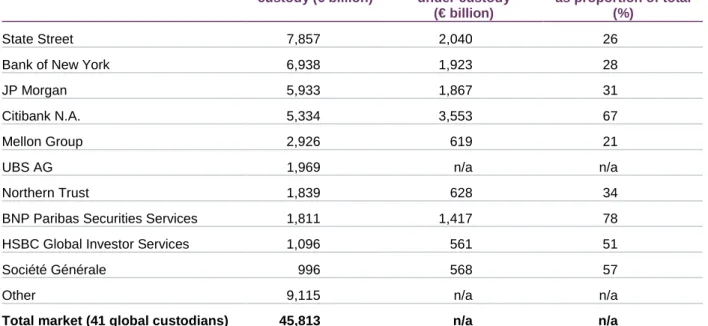
In 2003, the value of the assets under custody of the 41 largest global custodians was around €46,000 billion (see Table 2.1). Market leader, State Street, provided custody services for assets valued at €7,900 billion. All ten firms held worldwide assets close to, or exceeding, €1,000 billion. This highlights the massive scale of the custodian business, and the size of funds that are affected by corporate actions.
As would be expected, for the European firms in the top ten, the proportion of assets that represents cross-border holdings tends to be higher than for the US firms (with the exception of Citibank). This indicates that the corporate action processes affecting European custodians are likely to be more complex, and therefore also have higher risks.
Table 2.1: Assets under custody for the ten largest global custodians, 2003 Company Total assets under
custody (€ billion) Cross-border assets under custody (€ billion) Cross-border assets as proportion of total (%) State Street 7,857 2,040 26
Bank of New York 6,938 1,923 28
JP Morgan 5,933 1,867 31
Citibank N.A. 5,334 3,553 67
Mellon Group 2,926 619 21
UBS AG 1,969 n/a n/a
Northern Trust 1,839 628 34
BNP Paribas Securities Services 1,811 1,417 78
HSBC Global Investor Services 1,096 561 51
Société Générale 996 568 57
Other 9,115 n/a n/a
Total market (41 global custodians) 45,813 n/a n/a
Notes: Worldwide custody assets are divided between domestic assets—those held by investors in the home country of the issuer—and cross-border, or global, assets that are held by investors in the rest of the world. The figures were reported in US dollars, and have been converted to euros using the average 2003 exchange rate (€1 = $1.20). The exchange-rate information was taken from Thomson Datastream.
Source: www.globalcustody.net.
Tables 2.2 and 2.3 provide some insights into the number of corporate actions taking place each year across the world, with a breakdown by region and by type of corporate action. The data, provided by DTCC, covers the period from March 2003 to March 2004.
Table 2.2: Number of corporate actions taking place globally, March 2003–March 2004 Number of corporate actions (000s) % of global total
North America 624,700 66.8
Europe 203,600 21.8
Asia-Pacific 62,000 6.6
Other 44,900 4.8
World total 935,200 100
Note: Figures do not include the 3m plus scheduled fixed-rate interest payments and scheduled maturities that occur every year.
Table 2.2 shows that, in this period, the total number of corporate actions taking place globally was around 935,000. North America (mainly the USA) accounts for two-thirds of all corporate actions, followed by Europe (around 22%) and the Asia-Pacific region (6–7%).16 These figures do not include the 3m plus scheduled fixed-rate interest payments and scheduled maturities that occur every year.
Table 2.3 shows the breakdown by type of corporate action. Since the terminology and
definitions used to describe corporate actions often differ across countries, the figures should be interpreted with some care. Nonetheless, the table gives some idea of the orders of magnitude involved.
Table 2.3: Most common types of corporate action (% of total)
Type of corporate action Worldwide North America Europe Asia-Pacific
Cash dividend 26.9 27.7 23.0 33.1
Income distribution 16.4 23.8 2.6 0.0
Partial call redemption 14.6 17.7 12.6 0.1
Full call 12.5 18.1 1.7 0.3 Meeting 7.1 0.6 18.7 18.4 Dividend omitted 2.7 0.8 3.5 18.7 Return of capital 2.0 1.6 3.7 0.5 Name change 1.8 0.8 5.2 1.3 Other 16.0 8.9 29.0 27.6
All corporate actions 100.0 100.0 100.0 100.0
Note: Figures refer to March 2003–March 2004. Definitions of corporate action types tend to differ across countries.
Source: DTCC.
It can be seen that dividend payments and income distributions are the most common types of corporate action worldwide (and in the three main financial regions, with the exception of income distribution in the Asia-Pacific region). All the other corporate actions in the top eight are of the mandatory type, which, by their nature, are relatively straightforward, as described above. Voluntary corporate actions (or mandatory actions with options)—which are more complex and hence involve greater risk (see section 3)—represent only about 10–15% of all corporate actions taking place. Nevertheless, globally, this translates into approximately 90,000–140,000 of such complex actions each year.
16 North America includes all of the Caribbean islands and Central American states, although the numbers are largely driven by the
USA, and, to a lesser extent, by Canada, Bermuda and the Cayman Islands. Asia-Pacific comprises Australia, China, Hong Kong, Indonesia, Japan, South Korea, Malaysia, New Zealand, the Philippines, Singapore, Thailand and Vietnam.
2.3
Market participants involved in the corporate action chain
Any corporate action involves a range of intermediaries that operate between the issuer and the final investor. The corporate action chain is highly complex, probably because of the way in which it has been formed over time in response to market and institutional challenges.
Figure 2.1 presents a highly stylised illustration of the various participants in the corporate action chain. Figure 2.2 shows the typical corporate action information and instruction flows between these participants. These illustrations are largely based on the UK model, although the structure in other markets is not dissimilar in terms of the level of complexity and types of intermediary involved. Furthermore, the illustrations represent a ‘domestic’ corporate action chain. If the corporate action involves cross-border security holdings, the number of intermediaries, and hence level of complexity, is even greater. In particular, cross-border holdings may involve a larger number of custodians (or ‘sub-custodians’) in the chain.
Figure 2.1: Stylised illustration of the participants in the corporate action chain (based on the UK model) BROKER/DEALER Execution of trades where necessary FUND MANAGER Appointed by investor REGISTRAR/AGENT Appointed by issuer to maintain register ISSUER INVESTOR CSD
Where shares are ultimately held CUSTODIAN Appointed by investor CUSTODIAN’S NOMINEE Name on register Service-level agreement
Registers as shareholders (via nominee); notifies changes in ownership to registrar Registers as
shareholder
Ownership
Account
Service-level agreement
(or operational relationship, if both appointed by investor)
Service-level agreement Mandate/service-level agreement
Service-level agreement Account
Note: Arrows in figure show the contractual/business relationships between the participants. The corporate action information and instruction flows between the participants are shown in Figure 2.2.
Figure 2.2: Stylised illustration of the main information and instruction flows between participants in the corporate action chain
BROKER/DEALER CUSTODIAN’S
NOMINEE
FUND MANAGER Processes information and instructions; makes decision on corporate action (if part of mandate) CUSTODIAN Processes information and instructions CSD REGISTRAR/AGENT Sends information on to registered shareholders ISSUER Originator of corporate action event
INVESTOR
Instruction
Same firm
Information
Trade instruction (if triggered by corporate action information) Information Information Instruction Instruction Information Instruction (if not delegated to fund manager)
The following market participants are usually involved in the corporate action chain.
– Issuer—by definition, the issuer is where the corporate action originates.17 Company law usually requires the issuer to announce the corporate action publicly. In practice, this information dissemination normally involves two channels:
– contacting the registered shareholders directly—the issuer knows who these registered shareholders are through the appointed registrar/agent or the central securities
depository (CSD), depending on the country concerned (see below);18
– by making a public statement, either through a press release, or, as is usual for UK-listed shares, in the form of a Stock Situation Notice (a service offered by the London Stock Exchange). This information is then typically dispersed to interested parties through data vendors and other media.
17
Takeover events are an exception to this rule, since they are originated by the potential acquirer.
18
– Registrar/agent/CSD—in the UK, issuers generally appoint a registrar to maintain the register of shareholders. Changes in ownership are notified to the registrar by the CSD (CREST in the UK) after settlement. In the USA, registrars are referred to as ‘agents’, and the DTC (the CSD part of DTCC) is registered as one of the shareholders with the agent (and for some debt securities, as the only shareholder), and thus forms an important link in the chain from issuers to investors. In other jurisdictions, the structure is similar.
– Custodian—institutional investors usually appoint a custodian bank to safeguard their securities holdings. The service-level agreement between investors and custodians typically covers administrative tasks such as settlement of trades and processing of corporate
actions.19 Custodians, in turn, have an account at the CSD, where securities are ultimately held. For cross-border securities holdings, the chain may involve multiple custodians—in many non-domestic markets, custodians engage local ‘sub-custodians’, who, in turn, have an account in the domestic CSD.
Custodians are registered at the registrar/agent or CSD as the owner of the security on behalf of investors. In compliance with asset segregation rules, this is usually done through nominee companies owned by the custodian. These can be either client-specific nominee names or, more commonly, ‘omnibus’ nominee names that pool together the holdings of multiple investors under one registered name. Consequently, most issuers will only have information on the custodian nominees who are registered as their shareholders; they cannot observe directly through the registrar/agent who the ultimate beneficiary investor is. Corporate action notices from the issuer are passed on by custodians to the next
intermediary in the chain, either the next custodian or the fund manager (see below). For voluntary corporate actions and mandatory actions with options, the custodian who is registered as shareholder is responsible for responding to the corporate action in
accordance with the instructions received from the previous custodian or fund manager in the chain.
– Fund manager—fund managers are appointed by the investor to manage the investment portfolio. Through its mandate, the manager is given discretion to take investment and trading decisions.20 This often covers income collection and decisions in relation to
corporate actions. Thus, decisions relating to scrip dividends, rights issues and proxy voting are often taken by the fund manager on behalf of the investor, rather than by the investors themselves.
Fund managers therefore have an important operational relationship with custodians. This is not always in the form of a service-level agreement, since they are often both appointed separately by the investor. From the custodian’s perspective, it is the fund manager (rather than the investors themselves) to whom they have to pass on the corporate action
information, and from whom they receive instructions on how to respond.
19 Some larger institutional investors may also have accounts in CSDs directly, thus partly bypassing custodians. Hedge funds often
outsource custodian services to brokerage firms (their ‘prime’ broker), rather than to custodian firms.
20
– Broker/dealer—broker/dealers may form part of the corporate action chain if the action involves the buying and selling of shares. They also have to process corporate actions for their own proprietary positions (in which case their position in the chain is similar to that of an end investor).
Importantly, however, brokers may also become involved when the corporate action (or its initial announcement) triggers trading activity in the security concerned. It is common practice for fund managers and brokers themselves to make trading decisions based on the corporate action announcement, either on behalf of their clients or on a proprietary basis. Fund managers usually engage brokers to perform their trade execution needs.
– Investor—finally, institutional investors usually appoint both a fund manager (or various fund managers) to manage their funds and a custodian to safeguard their assets.21 Through the corresponding service-level agreements, investors normally delegate much of the
responsibility for dealing with corporate actions to the fund managers and custodians, as explained above. The larger institutional investors may keep the decision-making
responsibilities with respect to some securities to themselves (or indeed perform the fund management task in-house).
The stylised corporate action chain illustrated in Figures 2.1 and 2.2 depicts various flows of information, instructions and cash/stocks. For mandatory corporate actions, there is only a flow of information and of cash/stocks down the chain, from issuer to investor. For mandatory actions with options and for voluntary actions, there is an additional, subsequent flow of information and instructions upstream, from investor to issuer.
In addition to the complexity of the process itself, there is significant variation in the methods by which corporate action information flows along the chain. There is no current standard for corporate action communiqués—although, with the development of ISO 15022, there is the potential for more standardised forms of communication between parties. A large proportion of the current corporate action notices and instructions arrive in the form of faxes and unformatted emails, which require manual processing. The information on the corporate actions themselves usually reaches investors and their intermediaries through various channels (typically via data vendors and intermediaries immediately above them in the chain); and inconsistencies between these sources need to be cross-checked (a process known as ‘scrubbing’ of information). Many intermediary firms have large dedicated corporate action teams (sometimes with up to 20–40 staff) in charge of these manual operations.
21
Retail investors and smaller institutional funds will often delegate these tasks to only one intermediary (for example, a retail broker or a retail fund manager), who in turn has arrangements with custodians.
The processes of dealing with corporate actions give rise to operational risks which, if something does go wrong, may lead to various types of cost, affecting different market participants. Below, a broad distinction is drawn between four types of risk/cost. Some of these costs are not
necessarily linked directly to corporate action failures as such, but follow more generally from the inefficiencies in the corporate action chain, as described in section 2:
– direct risk of failure in the processing of a voluntary corporate action (or mandatory corporate action with options);
– direct costs of late payment of mandatory corporate actions;
– risk of sub-optimal trading decisions by the front office, arising from corporate action information failures; and
– indirect costs of failure to exercise shareholder rights, which may have an impact on the effectiveness of corporate governance.
Each of these is discussed below.
3.1
Direct risk of processing failures
This is the most common type of risk involved in corporate action processing. It is of relevance to voluntary corporate actions and mandatory actions with options. Processing failures can, in principle, arise anywhere in the chain illustrated in Figures 2.1 and 2.2, and this risk therefore affects all market participants involved in the chain. Failures can be due to either:
– an error in the flow of information downstream (from issuer to investor); or – an error in the return flow of instructions upstream (from investor to issuer).
Both raise separate issues, as examined below. 3.1.1 Failures in the information flow down the chain
Custodians will receive the information on the corporate action from the CSD or registrar if they are registered as the (nominee) owner of the security, or from a sub-custodian if they are not directly registered as owner. Fund managers typically receive the information both from data vendors and from the custodians who safeguard the securities in question. For any single security, a fund manager may receive notices from several different custodian firms if that same security happens to be managed on behalf of different clients who each have appointed different custodians for the safekeeping function.
Obtaining accurate information on corporate actions is difficult for various reasons22—there is no standard way in which the events are announced by issuers; there is no single securities
identification system that is universally accepted; and the processing details and terminology are often highly specific to the particular market or financial instrument.23 The precise details of an event may be altered at some stage in the process (eg, if a takeover bid is modified, as
mentioned in section 2). In addition, corporate actions are themselves multi-dimensional, so the total number of possible corporate actions is very high. This makes standardisation to enable
22 See, also, DTCC (2003), ‘Transforming Corporate Action Processing’, White Paper, June, available at www.dtcc.com. 23
For example, what is described in the UK as a one-for-one share distribution, whereby holders of a security receive one new share for each share held, is known as a ‘two-for-one’ stock distribution in the USA.
automatic information processing fundamentally complex and difficult. It is therefore not surprising that the different information sources used by firms in the chain may be inconsistent and not standardised.
In addition to the information on the corporate action itself, there can be inaccuracies in the information that custodians send to the next participant in the chain (whether another custodian or a fund manager)—ie, information on the implication of the corporate action for the stock position of that next participant. This is because the custodian may not always have fully up-to-date information on the exact stock position of that next participant because, for example: – the next participant has just engaged in trading or stock-lending activity that has not been
fully settled or notified to the custodian (in which case, the custodian is not responsible; the delay in settlement is simply an inefficiency in the system); or
– the custodian has not fully updated the positions of the different clients in its omnibus accounts for the particular security (which may reflect some inefficiency on the part of the custodian).
Current custom and practice mean that responsibility for failures in the information flow usually cannot be passed on to the direct source of the information. Typically, the contractual
relationships between links in the chain require the party providing the information to make best efforts, but the accuracy of the information passed on is not guaranteed. Third-party data vendors are normally exempt from liability for providing inaccurate information.
Registrars/agents, CSDs and custodians also do not normally accept liability for inaccuracies because they simply pass on the information as they receive it.24
Thus, ultimately, each party in the chain is responsible for getting the information right. This is why the industry spends considerable resources on various, often duplicative, external data sources and on internal data ‘scrubbing’ efforts. These resources represent an inefficiency in the system. For the purpose of this study, they are not considered as costs of corporate action risks as such, even though they may be substantial.
In addition, the need to interpret, and act upon, corporate action information may lead to reputational risks to intermediaries. Firms that set themselves up as being fully informed run a strong reputational risk if they get it wrong and subsequently have to compensate their clients. The costs attached to this risk are difficult to quantify, but, because of the potentially high visibility of errors, the reputational risk may well be greater than the economic importance of the specific corporate action where the mistake was made.
3.1.2 Failures in the instruction flow up the chain
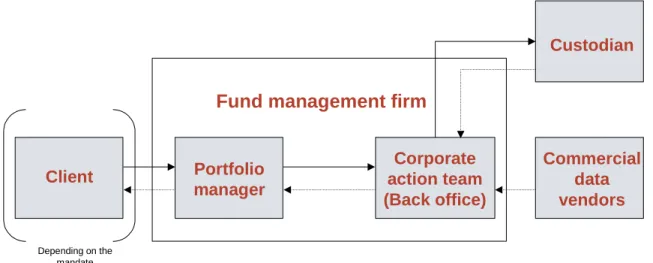
Failures can also arise in the instruction flow back up the chain, either between parties at different layers of the chain, or within a firm in the chain. For example, a certain instruction from a fund manager to a custodian may not be processed accurately, or may reach the custodian after the set deadline. Likewise, the portfolio manager within the fund management firm may not notify its decision to the corporate action team in its own back office in time.
24
There may exceptions where local sub-custodians in some countries do accept some liability for passing on inaccurate information on corporate actions to the global custodians.
There is ample scope for such failures to arise somewhere in the chain at some point in time, for various reasons:
– the sheer number of different custodians, fund managers and investors involved in any corporate action means that there is necessarily a large number of instructions for each action;
– the fact that most instructions are sent via fax, telex or unformatted email, and processed manually, means that any of these instructions has some potential for misinterpretation or mishandling;
– the more intermediaries in the chain, the tighter the deadline for the ultimate decision-maker, since each intermediary will set its own deadline to allow sufficient time to handle processing and communicate the instruction;
– fund manager decisions are sometimes changed before the deadline, and the custodian will receive a second instruction in relation to the same client, which further complicates the process. Fund manager decisions may also be left until very close to the deadline because some trading activity is undertaken in response to the announcement;
– the method by which a specific corporate action is finally acted on is not itself standardised (at least not in an electronic form). This reflects the diversity of possible actions involved and the existing restrictions applied to issuers/registrars in what constitutes a decision on which they have to act. Often, a physical paper form supplied by the registrar must be returned correctly completed and officially stamped.
In practice, the liability (and hence costs) for these processing failures is usually borne by the market participants where the failure arises. This participant will usually have to incur the cost of compensating the client for the losses incurred, or the cost of re-establishing the position in which the client would have been, had the instruction been processed correctly. For example, if, for a scrip dividend, the investor (or its portfolio manager) opts for cash, but due to an error by the fund manager or the custodian, the investor ends up with the extra shares, the cost by the party responsible for the error would basically be the loss incurred when selling the stock for cash after the event, potentially at a lower price.25
In some cases, the liability or responsibility for the mistake may be less clear-cut—for example, where the fund manager altered its original instruction to the custodian just before the deadline. In most cases, some form of settlement is reached between the parties involved. To Oxera’s knowledge, legal disputes in this field are not very common.
The above-described direct risks of failure are to some extent ‘zero-sum’—ie, the loss to one investor (or intermediary) of being in the wrong position (eg, receiving shares instead of cash for a scrip dividend) may be a gain for another investor or intermediary. However, the upside will have often been spread across a large number of market participants which each made a very small (and possibly unobservable) gain, while the downside falls upon one or a few participants
25
In this example, there is only a cost to the investor if the share price is actually lower after the event. If the share price turns out to be higher, the client is better off because of the mistake, and no compensating action may need to be taken.
and is therefore much more visible. In addition, there is a net cost to the financial system as a whole; namely, the additional transaction costs incurred in correcting the failure, which, from an economics perspective, is an inefficiently incurred cost. In other words, corporate action failures make the overall financial system less efficient.
Estimates of the direct risk of processing failures are provided in section 4. Data on the historical costs of failures incurred by European fund management firms is presented in section 5.
3.2
Direct cost of late payments
Mandatory corporate actions without options, such as dividend and interest payments, are straightforward, in that they only require a transfer of money from the bank account of the issuer to the bank account of the investor who is the ultimate beneficiary. In many domestic systems, such payments are normally made on the due (pay) date without much delay. For example, in the UK and the USA, CREST and DTC credit the accounts of the registered holders of the security in question on the due (payable) date. Most custodians who are registered as holders also tend to credit their clients’ (or their clients’ fund managers’) accounts immediately.
For income from cross-border security holdings, however, the process may operate less smoothly, and a (potentially very long) delay may occur between the due date and the time at which the cash reaches the beneficiary’s account. While the entitlement to a dividend payment does not disappear, the delay causes costs of interest forgone (there may also be currency costs). This is usually a zero-sum loss, since the interest forgone by one party will be gained by another party somewhere further up in the chain.
In addition to interest costs, such delays might also cause cash-flow problems for smaller investors. Intermediaries tend not to be affected by late payments, since they usually do not pay their clients until they receive the money. However, intermediaries may also face cash-flow problems if the delays in payment are not anticipated (eg, a security that always pays income within a certain timeframe is unexpectedly delayed), and if, in the meantime, they have taken a certain short-term cash position (eg, in a stock-borrowing operation).
It is Oxera’s understanding that, where the amount of interest forgone is reasonably high (above, for example, €1,000), fund managers would often seek to claim compensation for the delay from the custodian (who might do the same from the local custodian in the country in question). However, for smaller amounts this tends not to happen because of the relatively high administrative costs of a compensation claim.
Some estimates of the direct costs of late payments are given in section 6.
3.3
Risk of sub-optimal trading decisions by the front office
The information content of a corporate action announcement often represents new information about a specific company, and therefore its market value. The assimilation of this information by investors (or their agents) and other market intermediaries may lead to a change in the valuation of the company or the current share price (or bond price), or both. In addition, the corporate action itself may set up a future date at which the price of the shares (or bonds) will change in a
predictable way (for example, when a share goes ex-dividend), or in a less predictable way (eg, a close vote on a takeover).
Thus, corporate actions create (temporary) arbitrage opportunities for both brokerage and fund management firms trading either on behalf of their investors or on their own (proprietary) account. In this respect, trading desks within brokerage and fund management firms treat corporate action information as any other information of relevance to trading decisions.
In practice, trading desks tend not to rely on the corporate action information chain, as depicted in Figures 2.1 and 2.2. This chain is simply too slow in many cases. Rather, information on corporate actions first tends to come through the initial notice of the corporate action in question, possibly in the form of ‘rumours’, which does not yet contain the precise details on the action. This is the information acted upon by the trading desk in the first instance. Only at a later stage (often a few days later) does the more formal and detailed notice of the action come through, which is relied on by the back office to process the action.
It follows that a failure to understand correctly the corporate action can result in a misvaluation of the security by an investor or an intermediary trading on its own account. As a result, the
investor may make trading decisions based on misinformation. Two types of risk are likely to flow from this type of trading: transaction cost risk and market movement risk.
Estimates of these risks are presented in section 7.
3.4
Indirect cost of ineffective corporate governance
Shareholder proxy voting is another example of a corporate action process, albeit slightly different in nature from the more traditional corporate actions. Although the process does not have an explicit financial element, the actual procedure for collecting the votes from the
investors is parallel to that used for other corporate actions. In other words, although the nature of the action is different, the processing chain is very similar.
The UK shareholder voting processes have recently been reviewed by the Shareholder Voting Working Group.26 The conclusion arising from the report confirmed anecdotal evidence, that the voting process seems to fail with reasonable regularity. This is an interesting observation given the evidence that traditional corporate actions using very similar processes tend to fail far less often. In other words, the corporate action chain seems to be far better at processing corporate actions that have a distinct monetary value, and therefore liability, attached to them.
Efficient voting procedures are valuable to companies, although the nature of the activity makes it very difficult to quantify the costs from lost votes. As a general rule, voting can be assumed to improve corporate governance—ineffective shareholder voting may enable managers to reap private benefits from the company, resulting in a loss to the shareholders. Therefore, to the extent that good corporate governance has a beneficial impact on the company, improved voting procedures will benefit the shareholders. Substantial literature exists on the benefits of good corporate governance; for example, in a recent study, Gompers et al. (2003) document that
26
Myners, P. (2003), ‘Review of the Impediments to Voting UK Shares’, report by Paul Myners to the Shareholder Voting Working Group.
between 1991 and 1999 the shares of those companies with the highest corporate governance standards produced on average 8.5% higher returns per annum on a risk-adjusted basis, compared with companies with the lowest governance standards.27
While voting procedures represented only a very small fraction of the total corporate governance index used in the analysis, the result nevertheless highlights that voting might have an important impact on a company’s long-run performance, by inducing improved corporate governance. Another approach taken in the academic literature is to estimate directly the value of a corporate vote for an investor. This approach has used share-price information from dual-class companies (ie, companies with two classes of share that carry different voting rights). Zingales (1995) estimated an average price for a US corporate vote of 12.5% of the price of the share with the voting right.28 Megginson (1990) considered UK shares, and arrived at an average vote value of 10.6% of the share price.29 A slightly different approach was taken by Nenova (2003),30 who estimated the value of the block of votes providing the owner with full control over the company. The paper reports large cross-country differences, but highlights that, in most countries, the value of corporate votes appears significant: the highest estimated average value of the control-block votes was 48% of the firm value, in South Korea.31 The corresponding values reported for the UK and the USA were 10% and 2% respectively.
The above evidence suggests that corporate votes are valuable to investors. In practice, failures in voting procedures may often have only a very limited and indirect effect on companies’ long-run prospects. Nonetheless, occasions can be highlighted where failed voting could have had a clear impact; for example, the GlaxoSmithKline vote in May 2003, concerning the directors’ remuneration package, was rejected by a very slim majority of 50.72% to 49.28%.32 In such cases, any lost votes could prove decisive.
3.5
Overview of types of risk and costs
Table 3.1 gives a brief summary of the types of risk and costs of corporate action failures identified in this section. It highlights the types of corporate actions that may give rise to these risks and costs, which market participant bears them, and whether they are zero-sum or a net cost to the financial system as a whole. The table also indicates the sections of this study in which the order of magnitude of each type of risk is estimated.
27
Gompers, P., Ishii, J. and Metrick, A. (2003), ‘Corporate Governance and Equity Prices’, Quarterly Journal of Economics, 118, 107–55. The calculation was based on a zero-investment strategy buying a portfolio of shares with the highest governance index, and short-selling a portfolio of shares with the lowest governance index.
28
Zingales, L. (1995), ‘What Determines the Value of Corporate Votes’, Quarterly Journal of Economics, 110, 1047–73.
29
Megginson, W. (1990), ‘Restricted Voting Stock, Acquisition Premiums, and the Market Value of Corporate Control’, The Financial Review, 25, 175–98.
30
Nenova, T. (2003), ‘The Value of Corporate Voting Rights and Control: A Cross-country Analysis’, Journal of Financial Economics,
68, 325–51.
31 The corollary of this result is that, on average, the controlling shareholders in South Korean companies are able to appropriate
48% of the value of the firm.
32
Table 3.1: Overview of the types of risk and costs of corporate action processing Type of cost Type of corporate
action involved
Who bears the cost? Zero-sum or net cost to the financial system? Where quantified in the study? Direct risk of processing failures Mandatory with options; voluntary Can be anybody in the corporate action chain (eg, custodian, fund manager, or broker) Liability depends on which market participant causes the failure In part zero-sum (offsetting trading positions), but gains and losses are unevenly distributed; and extra transaction costs to unwind failures represent a cost to the system Section 4 (potential risk to all participants in the chain) Section 5 (historical costs to fund managers) Direct cost of late payments Mainly mandatory (mostly dividend and interest payments) Investors (interest forgone) Mostly zero-sum (interest forgone is gained by others) Section 6 Risk of sub-optimal trading decisions
All Brokers or fund managers involved in trade (if
proprietary) or investors (if cost passed on)
Mostly zero-sum (offsetting trading positions), but gains and losses unevenly distributed, and ‘deadweight’ loss to investors Section 7 Indirect cost of ineffective corporate governance Voluntary
(mainly proxy voting)
Issuers (in the long run), investors, the system at large
Net cost to the system
Not further quantified
As described in section 3, and given the large number of complex corporate actions that take place globally each year, the potential risks involved in corporate action processing can be very significant. These risks are borne by all intermediaries in the chain—custodians, fund managers and brokers—and are proportionate to the number and value of the assets they are looking after. Thus, the corporate action risk is probably largest for global custodians who safeguard the assets of a very large number of fund managers and institutional investors (see Table 2.1). Estimating the total value of the direct risks of processing failures is virtually impossible. However, a useful way to illustrate the orders of magnitude of such risks is to look at specific past corporate actions that were very complicated and involved relatively large investment positions. It is Oxera’s understanding that this is how some firms in the industry also assess their own potential risks. Two recent corporate events—a rights issue and a takeover—are considered below, together with an estimate of the sums potentially at risk for any of the intermediaries involved in the corporate action chain. Section 5 presents some data (for fund managers only) on costs that are incurred due to these types of failure.
4.1
Example 1: France Telecom rights issue (March/April 2003)
4.1.1 ‘Risks to intermediaries in rights issues generally
A rights issue has the typical characteristics of a voluntary corporate action event. This includes information outflow following the announcement, decisions made by the owners of the share, the instruction flow through the intermediaries following the decision, and the price impact that induces potential trading opportunities. Analysing this process illuminates many of the problems involved in all voluntary corporate actions. In 2003, around 450–500 rights issues took place in the USA and Europe combined.33 Given the large number of intermediaries and investors involved in each of these, the risk that something might go wrong somewhere in the chain is not theoretical.
In a rights issue, the issuing company gives current shareholders an opportunity to buy new shares in the company proportionate to their current ownership. The holders of the shares are given a period of time to decide whether to buy the offered shares, to sell the rights in the market, or simply let their rights lapse by taking no action. If shareholders do not subscribe to the new shares, their ownership in the company will be diluted.
Upon announcement of the rights issue, information on the terms of the offer is passed from the issuer to the owner through the chain of intermediaries described in Figures 2.1 and 2.2.
However, as the rights issue is likely to affect the company’s share price, it may also present (temporary) trading opportunities to brokers’ and fund managers’ trading desks (see also section 7). Therefore, the information concerning the announcement spreads quickly through the ‘unofficial’ information channels, including commercial data vendors.
33
Typically, the new shares have to be offered at a discount to the current share price, in order to induce the shareholders to increase their holdings.34 The required discount is determined by the way shares are offered—whether or not the offer is underwritten—and the current perception of the company’s prospects. A non-underwritten issue is likely to require a higher discount on to ensure that the offer price remains above the market price of the share. According to the evidence presented by Armitage (2000), the average discount to the market price in UK rights issues during 1987–96 was 21%.35 In essence, a rights issue therefore provides the current shareholders with an opportunity to buy the issuing company’s shares below the market price. If a fund manager or a custodian firm fails to process a client’s instruction to participate in a rights issue, it normally needs to re-establish the position the client would have been in, had the failure not occurred—ie, it needs to acquire (or sell) the appropriate number of shares from the market at the prevailing market price.36 The size of the exposure arising from such failure is dependent on the exact terms of the rights issue.
A particularly important factor from the intermediaries’ perspective is the procedure for dealing with the rights that have either not been taken up or have not been sold. The common practice, at least in Europe, tends to be for the issuer or the underwriter to tender separately any lapsed rights, and credit the proceeds to the initial holder of the right. In other words, the right-holder receives the market price for that right, regardless of whether any action is taken. However, in some cases no such auction procedure for the lapsed rights exists. If the investors fail to take action prior to the closing date of the offer, the rights lapse and the entitlement is lost.
In the absence of a separate auction process for lapsed rights, the corporate action
intermediaries are also exposed to higher risks. If they fail to execute investors’ buy instructions and have to purchase the shares from the market, the intermediary will normally lose the value of the discount on the issued shares; the shares may have to be purchased for the client at the market price, but only the offer price is received from the investor. If, however, the investors receive the market price of the rights in any case, the intermediaries’ potential liability is limited to the share-price movements between the failure and the corrective action. Although the majority of the failures are identified reasonably quickly, in some cases this time lag could be up to two or three weeks.
Given the potentially large discounts involved, the rights themselves are valuable. It is common for fund management and brokerage firms to trade with the ‘nil paid rights’ attached to their shareholdings prior to the actual issue date. Some of the fund management firms Oxera spoke to highlighted this trading activity as one factor increasing the risk of failure in processing the corporate action. Traders wish to trade right up to, and sometimes beyond, the custodian deadline, which puts pressure on the corporate action team to process the instruction correctly.
34
It is common practice to express the discount as a percentage on the pre-offer price of the share. This is somewhat misleading, however, as the discount relevant to the shareholder decision is to the share price after the issue, the ex-rights price, which will normally be lower.
35 Armitage, S. (2000), ‘Placed Shares: The Role of the Discount in UK Rights Issues and Open Offers’, University of Edinburgh
Working Paper, March.
36
4.1.2 Potential risks in the France Telecom rights issue
To gain a better feel of the potential risks, a hypothetical example is considered here, based on a real event. On March 24th 2003, France Telecom announced a 19-for-20 rights issue with an offer price of €14.50 per share, with April 4th as the latest date for acceptance. At the time of the announcement, France Telecom shares were trading at €17.30. The issue was fully subscribed and raised a total of €15,039m. On April 5th the France Telecom shares were trading at an ex-rights price of €20.60,37 so the new shares were effectively offered at a 29.4% discount on the ex-rights price, or €6.10 per share.
Table 4.1 gives a breakdown of France Telecom’s share ownership. In March 2003, 35.4% of the 1.2 billion France telecom shares outstanding were held either by France Telecom
employees or the general public. The market value of the privately held shares was therefore around €8.1 billion at the time of the rights issue, giving an indication of the funds at stake and the transaction volume arising from the issue. Although the shareholding information presented in the table does not contain any detail about the size of individual holdings, information from other sources indicates that various institutional investors had positions in France Telecom shares valued at several million euros.
Table 4.1: France Telecom shareholdings at March 31st 2003
Owner Number of shares held Percentage of outstanding shares
French state 671,786,275 56.59
Public 383,179,333 32.28
Employees 36,829,897 3.10
France Telecom (treasury stock) 95,363,219 8.03
Total 1,187,158,724 100.00
Source: France Telecom.
Table 4.2 describes in more detail the exposure for intermediaries processing the instructions for large positions of France Telecom shares. The table reports the cost that intermediaries holding large share positions would have had to incur, had they failed to carry out instructions by their clients to participate in the issue. The risks of monetary loss arise here from the share-price movements between the ex-rights date (t) and the date when the failure is corrected (t + x).38 For example, if a fund manager had to go to the market one day after the offer day, to purchase shares for a client who originally held 500,000 France Telecom shares, this would
37 For details of the issue, see France Telecom (2003), ‘20-F Report’, March 31st. The share-price information was taken from
Thomson Datastream.
38
This is assuming that France Telecom auctioned the lapsed rights, and that the original holders of the rights received the difference between the offer price and the auction price, adjusted for the fact that the 19 new shares were offered for every 20 existing shares. In other words, no losses arose through this price differential, only through the subsequent share-price movement. For simplicity, the auction price is assumed to be equal to the closing price of the France Telecom share, on the final day of the offer (€19.34). Therefore, the loss to the intermediary will be equal to the difference between the closing price at t, and the market price of the share on a subsequent trading day.