© 2012. Zhang Liang & Ren Lixiao. This is a research/review paper, distributed under the terms of the Creative Commons Attribution-Noncommercial 3.0 Unported License http://creativecommons.org/licenses/by-nc/3.0/), permitting all non-commercial use, distribution, and reproduction inany medium, provided the original work is properly cited.
Global Journal of Computer Science and Technology
Neural & Artificial Intelligence
Volume 12 Issue 10 Version 1.0 Year 2012
Type: Double Blind Peer Reviewed International Research Journal Publisher: Global Journals Inc. (USA)
Online ISSN: 0975-4172 & Print ISSN: 0975-4350
Relevance Search via Bipolar Label Diffusion on Bipartite Graphs
By Zhang Liang & Ren Lixiao
Tianjin University of Science and Technology Tianjin, China
Abstract -
The task of relevance search is to find relevant items to some given queries, which can be
viewed either as an information retrieval problem or as a semi-supervised learning problem. In order
to combine both of their advantages, we develop a new relevance search method using label
diffusion on bipartite graphs. And we propose a heat diffusion-based algorithm, namely bipartite
label diffusion (BLD). Our method yields encouraging experimental results on a number of relevance
search problems.
Keywords :
Relevance search, ranking, graph diffusion, bipartite graphs.
GJCST-E Classification:
H.3.3
Relevance Search via Bipolar Label Diffusion on Bipartite Graphs
Relevance Search via Bipolar Label Diffusion on
Bipartite Graphs
Zhang Liangα & Ren Lixiaoα
Abstract -The task of relevance search is to find relevant items to some given queries, which can be viewed either as an information retrieval problem or as a semi-supervised learning problem. In order to combine both of their advantages, we develop a new relevance search method using label diffusion on bipartite graphs. And we propose a heat diffusion-based algorithm, namely bipartite label diffusion (BLD). Our method yields encouraging experimental results on a number of relevance search problems.
Keywords : Relevance search, ranking, graph diffusion, bipartite graphs.
I. INTRODUCTION
he problem of relevance search (RS) has been recognized as an important and interesting problem in machine learning and information retrieval, which refers to finding relevant items to a small query set given by the user. Along with the ability to find a cluster of data that shares some common properties to the query, it is also a primary goal of the information retrieval (IR) systems. Typical applications of RS include the discovery of relevant words in a text corpus[1-4], answers to community questions[5,6], features in concept-learning problems[7], recommendations in collaborative filtering systems[8,9], among others.
Google Sets [10] is a well-known and successful representative of RS systems that has been widely used. It uses vast amount of web-pages to create a list of related items from a few examples, such as people, movies, words, places, etc. Most of the other RS systems are similar to Google Sets in that they perform some ranking algorithm on a large corpus of documents or web-pages. Ghahramani and Heller [11] proposed the Bayesian Sets algorithm that uses a model-based concept of clusters and performs Bayesian inference to compute the ranking scores of items. Sun et al. [12] used bipartite graphs to model the data and introduced random walks with restarts to rank the items.
The RS problem can be viewed from several angles. First, finding relevant items to the query is a standard IR task[11,13], which may be solved using classic IR algorithms, such as HITS[14], nearest neighbors, naïve Bayes and Rocchio’s algorithm. These algorithms can compute a list of items ordered by the relevance to the query. However, there is no explicit boundary between “relevant” and “irrelevant” items. Second, RS can be
Authorα: Food Safety Management and Strategy Research Center, School of Economics & Management, Tianjin University of Science and Technology Tianjin, China.
interpreted as a special case of semi-supervised learning (SSL) problem with a few positive examples given as the query[11]. It is essentially a one-class classification/clustering problem, which can be solved using one-class learning techniques like mapping-convergence [15] and OC-SVMs [16, 17]. The relevant and irrelevant items can be explicitly classified through SSL algorithms. However, most of these algorithms do not provide the rank order of items, which is of importance in IR systems.
In this paper, we propose and evaluate a new RS method called bipartite label diffusion (BLD) that can be seen as a hybrid between IR and SSL. BLD is a diffusion-based algorithm that works on bipartite graph. User queries are mapped to vertices with positive labels on the graph. BLD performs local computation at every vertex of the graph and develops a global classifier through the label diffusion process. The diffusion process is often modeled using a Markov chain on the graph. In BLD, we modified the diffusion model by adopting the “label spreading” method [18] to allow negative labels diffuse on the graph. If the word/document is relevant to the queries, the score value is positive, otherwise the value is negative. The more the item is relevant, the higher the score is. Thus BLD can be seen as a semi-supervised learning method.
The rest of this paper is organized as follows. We first model the corpus data as document-word bipartite graphs in section 2. The detail of the BLD algorithm is given in section 3. In section 4, we present empirical results to demonstrate the effectiveness of BLD on relevance search problems. Finally, some concluding remarks are given in section 5.
II.
B
IPARTITE GRAPH MODELBipartite graph models have been successfully applied in many fields such as text clustering [19-21], collaborative filtering [22, 23], and content-based image retrieval [24]. The first step of our method is to model the document-word dataset as a bipartite model. We also employ a query expansion scheme to enhance the searching capacity. Detailed description is given in this section.
Suppose we are given a set of n documents 1
{ ,...,d dn} =
D , which contain a set of m words 1
{w,...,wm} =
W , the document-word collection can be
modeled as a undirected bipartite graph G=(D∪W, )E
T
Global Journal of Computer Science and Technology Volume XII Issue X Version I
19 (DDDD ) D 2012 Year
,where E={( ,d wi j) :di∈D,wj∈W} is the set of edges between two sets of vertices D and W. In the bipartite graph G, there are no edges between words or between
documents. An edge e (i, j) exists if word wj appears in
document di. which is denoted by wj ~di. And it indicates an association between a word and a document, which may be quantitatively expressed by assigning positive weights on the edges. Assume we
are given the user’s query set of words WQ (WQ≠ ∅,WQ⊂W), or documents DQ (DQ≠ ∅,DQ⊂W), or both of them, the RS problem
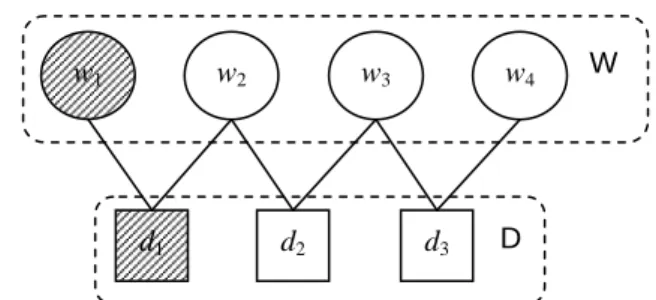
can be cast to a semi-supervised learning task where the query set contains the initial labeled examples. Fig. 1 shows a simple example of the bipartite graph model.
Figure 1: Example of a document-word bipartite graph which has 3 documents and a vocabulary of 4 words. The user’s query set is WQ={ }w1 and DQ={ }d1 . The goal of
this similar sets retrieval problem is to discover a set of words that are similar to WQ, and a set of documents
that are similar to DQ
There are many edge-weighting schemes in information retrieval research, among them we adopt the popular “tf-idf” weight:
ln#( , ) tf-idf ( , ) ln ln #( , ) { : ~ } i j i j i k j k d w n d w d w d w d = ⋅
∑
where #( ,d wi j) is the number of occurrence of word wj in document di. Words with high tf-idf values
imply a strong relationship with the document they appear in.
We can define an n m× edge weight matrix M:
{
, 0,tf-idf ( ,i jotherwise.), if edge ( ,i j) exists,
i j d w d w
M =
To interpret the edge weight matrix from the perspective of Markov chains on graph, which will be described in section 3, we define the transition probability from di to wj as:
, , 1 ,
m i j i j p i p
P =M
∑
= M (1)And the transition probability from wj to di is given by,
, , 1 ,
n j i i j p p j
Q =M
∑
= M (2)The Markov transition matrix P normalizes M such that every row sum up to 1, and Q normalizes MT
such that every row sum up to 1.
Thus the (m+ ×n) (m+n) adjacency matrix A of the bipartite graph may be written as:
= 0 Q A P 0 ,
Wherethe vertices of the graph is ordered such that the first mvertices index the words and the last n vertices index the documents.
Note that bipartite graph can also be a good model in the scenario of collaborative filtering or recommendation systems. A standard collaborative filtering problem often involves a user set U, an item set
I , and a vote set V. In a similar manner, we can build
a bipartite graph G=( , , )U I E . The normalized vote scores of V can directly serve as the weight matrix.
Moreover, the aim of collaborative filtering is to discover new items that an active user may like based on her voted items, which could be easily translated to a RS problem by finding similar items to the user’s favorite ones (items with high voting scores).
III.
L
ABELD
IFFUSION ONB
IPARTITEG
RAPHSIn general, there are two primary approaches to cluster vertices on a bipartite graph: one is to partition the graph to disjoint parts corresponding to different clusters[25,26]; the other is to compute a rank value for each vertex indicating the probability that the vertex is in a cluster[24,27]. To capture the uncertainties on data-cluster assignments, we investigate the problem from the latter angle.
a) Markov Chains on the Graph
In a bipartite graph, there are no direct relationships among the words or among the documents. However, in diffusion-based methods[18,27], the strength of the similarities among elements on the same side of the bipartite graph may be captured by a local probability evolution process, which can be integrated to obtain a global view of the data.
We define a Markov chain to describe the diffusion process over the bipartite graph. Assume there is a discrete time random walk on the bipolar graph G,
the row-normalized adjacency matrix A is the one-step transition matrix that Ai j, is the probability of moving to thejth vertex of vgiven that the current step is at theith vertex. More specifically, P is the document-word
transition matrix containing the transition probabilities of w1 d2 d3 w2 w3 w4 W D d1
Global Journal of Computer Science and Technology Volume XII Issue X Version I
20 (DDDD ) D 2012 Year
moving from a document vertex to a word vertex, and
Q is the word-document transition matrix.
Since the document-word graph is bipartite, all the paths from wi to wjmust go through vertices in D.
As is shown in [15, 18], the similarity of two words wi
and wj, is a quantity proportional to the probability of
direct transitions between them, denoted by p(wi, wj),
( i, j) ( i) ( j| i)
p w w =p w p w w , where p w( i)=deg(wi) the degree of wi, and p w( j|wi) is the conditional transition
probability from wi to wj,
, ,
( j| i) ( p| i) ( j| p) i p p j
p p
p w w =
∑
p d w p w d =∑
Q P Obviously, it is a 2-step stochastic process that first maps wi to the document set, and then maps thedocuments back to wj.
Similarly, the conditional transition probability from di to dj is given by,
, ,
( j| i) ( p| i) ( j| p) i p p j
p p
p d d =
∑
p w d p d w =∑
P QTherefore, by formulating the relationship between documents and words as Markov chains on the bipartite graph, we have the word-word transition probability matrix QP, and the document-document
transition probability matrix PQ.
b) Diffusion Process
Intuitively, our bipolar diffusion framework works as following: First, we construct a bipartite graph with two poles as is described in section 2.3. The heat pole stands for the words and documents that are most relevant to the query, while the cold pole contains the “strongest negative” words and documents. Then a certain amount of heat is injected to the graph through the heat pole, and the cold polar extracts the heat out of the system as a heat sink. And the heat diffuses through the edges of the graph. Since the system has two poles, we name the heat diffusion as the “bipolar diffusion process”.
The diffusion process may be thought of as a Markov chain on the graph. The fundamental property of a Markov chain is the Markov property, which make it possible to predict the future state of a system from its present state ignoring its past states. We denote p(t) and q(t) as the labels of documents and words at time t. The Markov process then defines a dynamic system,
( 1)t+ = ⋅Q ( )t =QP ( )t
p q p (3)
( 1)t+ = ⋅ ( )t = ( )t
P PQ
q p q (4)
This simple 2-step diffusion process captures the interaction between the two sets of vertices on the graph. It requires p(t) and q(t) be the probability distributions of Markov states with non-negative values.
However, in our bipolar graph diffusion framework, the vertices of the cold pole are labeled by negative values. In the following, we cast the diffusion process as a semi-supervised learning problem, which makes it possible to diffuse heat and cold simultaneously on the graph. First, we use an (n+2)-vector p(0) to denote the initial labels of documents, (0)
{1, 0,...0 , 1}T n
= −
p ; and an
(m+2)-vector q(0) to denote the initial labels of words,
(0)
{1, 0,...0 , 1}T m
= −
q . The virtual vertices of heat pole are labeled by positive values, which allow heat diffuses through the graph; while negative values representing “cold” are assigned to the virtual vertices of cold pole. And the vertices keep exchanging these two kinds of energy as the diffusion process proceeds.
Then we adopt the “label spreading” method[18] to allow negative labels diffuse on the graph. The iteration in Eq. (3) and Eq. (4) can be rewritten as,
( 1) (0) ( ) (1 ) t+ =α + −α ⋅ t Q p p q ( 1) (0) ( ) (1 ) t+ =β + −β ⋅ t P q q p
Where
α
andβ
are scaling parameters both in (0,1), which specify the relative amount of the heat/cold a vertex received from its neighbors and its initial labelinformation. To simplify the diffusion process, we setα β= =1 2.The iteration equations indicate that when t≥1
(5)
(6)
Where and .Since P and Q are row-normalized matrices, Eq. (5) follows that whent→ ∞, p( 1)t+ converges to,
(7) AndEq. (6) converges to,
(8)
Global Journal of Computer Science and Technology Volume XII Issue X Version I
21 (DDDD ) D ( 1) (0) ( ) (0) (0) ( 1) 1 (0) (0) (0) 0 1( ) 1 1 1 2 2 4 4 1 1 ( )( ) 2 4 t t t t i t i
Q Q QP Λ Q Λ p p q p q p p q p ( 1) (0) ( ) (0) (0) ( 1) 1 (0) (0) (0) 0 1( ) 1 1 1 2 2 4 4 1 1 ( )( ) 2 4 t t t t i t i
P P PQ Γ P Γ q q p q p q q p q 1 4 Λ QP 1 4 Γ PQ ( ) ( ) (1 1 (0) 1 (0)) 2 4 I Λ Q p p q ( ) ( ) (1 1 (0) 1 (0)) 2 4 I Γ P q q p 2012 YearIV.
E
XPERIMENTSOur proposed BLD method is applicable to discover similar items to a query set from a corpus of text data or user rating data. In this section, we experiment with our model on a set of RS problems.
The experiments are performed on two standard text datasets: Reuters-215781, and a collaborative filtering dataset: MovieLens2
Datasets
. All of the text datasets were preprocessed by removing the stopwords and stemming. And for Reuters-21578, we use a subset of the ten most frequent categories with highest number of positive examples, namely Reuters-10. The main features of the datasets are summarized in Table 1.
Table I : Datasets Summary
#
documents/uses # words/items # nonzero entries Reuters-10 9,989 5,180 373,440
MovieLens 943 1,682 100,000
We conducted two experiments on both the text dataset Reuter-10 and the movie rating dataset MovieLens to evaluate the RS ability of our method. The results and comparisons with Google Sets3, Internet movie database (IMDB)4
query: science + technology
, and Bayesian Sets are given in tables 2, 3 and 4. Concerning the application of movie recommending, the query takes the form of a set of movies. We regard movies as documents and users as words, and the rating scores are equivalent to word frequencies. Thus our algorithm can be easily adapted to collaborative filtering datasets.
Table II : Relevant Words Discovered By Google Sets and Bld Based on the Same Given Queries. Bld
Runs on Reuters-10
query: market + price Google
Sets BLD Google Sets BLD science scienc market market technology technologi price pric business univers overview money sports engineer view stock
health educat risk valu
entertainment research gains bond education comput forecasts busi
politics life war compani
travel develop Intel trade computers cultur losses economic
1 http://www.daviddlewis.com/resources/testcollections/reuters21578/ 2 http://www.grouplens.org/system/files/ml-data.tar__0.gz 3http://labs.google.com/sets 4http://www.imdb.com/
Table III : Relevant Movies Discovered By Google Sets and Bld Based on Query Full Metal Jacket. Bayesian
Sets and Bld Run on Movielens
Query: Full Metal Jacket (1987) Google
Sets IMDB Bayesian Sets BLD
Saving Private Ryan (1998) Platoon (1986) The Terminator (1984) Platoon (1986) Apocalypse Now (1979) All Quiet on the Western Front (1930) Star Wars Episode V (1980) Rambo:First Blood (1982) Platoon
(1986) Cidade Deus (2002) de Raiders of the Lost Ark (1981) Braveheart (1995) Pulp Fiction (1994) Batoru Rowaiaru (2000) Aliens (1986) Apocalypse Now (1979) Hamburger
Hill (1987) If… (1968) Die (1988) Hard Star Wars Episode V (1980)
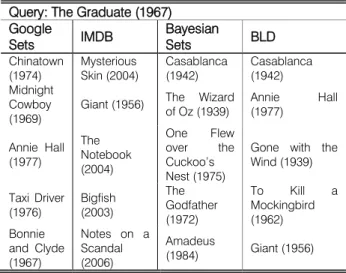
Table IV : Relevant Movies Discovered By Google Sets and Bld Based on Query the Graduate. Bayesian Sets
and Bld Run on Movielens Query: The Graduate (1967)
Sets IMDB Bayesian Sets BLD
Chinatown (1974) Mysterious Skin (2004) Casablanca (1942) Casablanca (1942) Midnight Cowboy (1969)
Giant (1956) The Wizard of Oz (1939) Annie Hall (1977) Annie Hall (1977) The Notebook (2004) One Flew over the Cuckoo’s Nest (1975)
Gone with the Wind (1939) Taxi Driver (1976) Bigfish (2003) The Godfather (1972) To Kill a Mockingbird (1962) Bonnie and Clyde (1967) Notes on a Scandal (2006) Amadeus (1984) Giant (1956)
Among the tested algorithms and systems, Google Sets is a baseline RS system that is based on vast amount of web data. Although the Google Sets algorithm is not available for us to run it on our datasets, it is still informative and worth to be compared with; IMDB provides movie recommendations by generating a list of 5 movies most related to the query, which is based on collaborative filtering technology; Bayesian Sets views RS as a Bayesian inference problem and gives the corresponding ranking algorithm. We experiment with an online Bayesian Sets recommending system on Movie Lens dataset.
From the query results of the relevant words discovery task and the movie suggestion task, we can make the following comments:
1. Table 2 shows that both Google Sets and our method can achieve to some extent similar sets to the query. There is not an objective standard to tell the exact similarity between words or movies.
Global Journal of Computer Science and Technology Volume XII Issue X Version I
22 (DDDD ) D 2012 Year
However, the words that our method retrieved are obviously more sensible than some results of Google Sets, e.g. “war” and “Intel” for the query of “market” and “price”. We think this is because Google Sets and our method have different learning mechanisms and are based on different corpuses. 2. Our method serves as a good algorithm for
recommending systems on the MovieLens dataset. The recommended movies to the query “Full Metal Jacket” are all related to war. And for “The Graduate”, most of the results are romance and drama movies. We notice that IMDB’s suggestions are often popular and new, while Bayesian Sets and our method, limited by the MovieLens dataset, tend to generate classic movies.
V.
C
ONCLUSIONIn this paper we developed a new graph diffusion algorithm for RS. We used bipartite graphs to model the relationships between documents and words. We also modeled the diffusion process using a Markov chain on the graph, and presented the corresponding label diffusion algorithm. In future work, we will extend the proposed method to other applications (e.g. social networks, question answering systems).
VI.
A
CKNOWLEDGMENTThis work is supported by MOE (Ministry of Education in China) Liberal arts and Social Sciences Foundation under Grant No. 12YJC860056, and the Program for the Liberal arts and Social Sciences Research of Higher Learning Institutions ofTianjin under grant No. 20112107.
R
eferencesr
éférencesr
eferencias1. Blondel, V. D., Gajardo, A., Heymans, M., Senellart, P. and Dooren, P. V., 2004. A measure of similarity between graph vertices: Applications to synonym extraction and web searching. Siam Review. 46, (4), 647-666.
2. Lavrenko, V., 2004. A generative theory of relevance. University of MassachusettsAmherst. 3. Lin, D., 1998. Automatic retrieval and clustering of
similar words. In: Proceedings of the 36th Annual Meeting of the Association for Computational Linguistics and 17th International Conference on Computational Linguistics (COLING/ACL-98), 768-774.
4. Wang, R. C. and Cohen, W. W., 2007. Language-independent set expansion of named entities using the web. In: Proceedings of the 17th IEEE International Conference on Data Mining, 342-350. 5. Deng, H., Lyu, M. R. and King, I., 2009. A
generalized Co-HITS algorithm and its application to bipartite graphs. In: Proceedings of the 15th ACM
SIGKDD international conference on Knowledge discovery and data mining, 239-248.
6. Wang, J., Robertson, S., Vries, A. P. and Reinders, M. J., 2008. Probabilistic relevance ranking for collaborative filtering. Inf. Retr. 11, (6), 477-497. 7. Cohen, W. W., 2000. Automatically extracting
features for concept learning from the web. In: Proceedings of the 17th International Conference on Machine Learning, 159-166.
8. Basu, C., Hirsh, H. and Cohen, W., 1998. Recommendation as classification: using social and content-based information in recommendation. In: Proceedings of the 15th national/tenth conference on Artificial intelligence/Innovative applications of artificial intelligence, 714-720.
9. Wang, H. and Hancock, E. R., 2008. Probabilistic relaxation labelling using the Fokker-Planck equation. Pattern Recogn. 41, (11), 3393-3411 10. Google, Google Sets. <http://labs.google.
com/sets>.
11. Ghahramani, Z. and Heller, K. A., 2005. Bayesian sets. In: Advances in Neural Information Processing Systems, 18,
12. Sun, J., Qu, H., Chakrabarti, D. and Faloutsos, C., 2005. Relevance search and anomaly detection in bipartite graphs. SIGKDD Explor. Newsl. 7, (2), 48-55.
13. Lafferty, J. and Zhai, C., 2002. Probabilistic relevance models based on document and query generation. In Language Modeling and Information Retrieval, Kluwer International Series on Information Retrieval.
14. Kleinberg, J. M., 1999. Authoritative sources in a hyperlinked environment. J. ACM. 46, (5), 604-632. 15. Yu, H., Han, J. and Chang, K. C.-C., 2004. PEBL:
Web Page Classification without Negative Examples. IEEE Trans. on Knowl. and Data Eng. 16, (1), 70-81.
16. Manevitz, L. M. and Yousef, M., 2002. One-class svms for document classification. J. Mach. Learn. Res. 2, 139-154.
17. Schölkopf, B., Platt, J. C., Shawe-Taylor, J. C., Smola, A. J. and Williamson, R. C., 2001. Estimating the Support of a High-Dimensional Distribution. Neural Comput. 13, (7), 1443-1471. 18. Zhou, D., Bousquet, O., Lal, T. N., Weston, J. and
Schölkopf, B., 2004. Learning with local and global consistency. In: Advances in Neural Information Processing Systems, 16, 595-602.
19. Dhillon, I. S., 2001. Co-clustering documents and words using bipartite spectral graph partitioning. In: Proceedings of the 17th ACM SIGKDD international conference on Knowledge discovery and data mining, 269-274.
20. Hu, T., Qu, C., Tan, C. L., Sung, S. Y. and Zhou, W., 2006. Preserving Patterns in Bipartite Graph Partitioning. In: Proceedings of the 18th IEEE
Global Journal of Computer Science and Technology Volume XII Issue X Version I
23 (DDDD ) D 2012 Year
International Conference on Tools with Artificial Intelligence, 489-496.
21. Sindhwani, V. and Melville, P., 2008. Document-Word Co-regularization for Semi-supervised Sentiment Analysis. In: Proceedings of the 2008 Eighth IEEE International Conference on Data Mining, 1025-1030.
22. Kunegis, J. and Lommatzsch, A., 2009. Learning spectral graph transformations for link prediction. In: Proceedings of the 26th Annual International Conference on Machine Learning, 561-568.
23. Shieh, J.-R., Yeh, Y.-T., Lin, C.-H., Lin, C.-Y. and Wu, J.-L., 2008. Collaborative knowledge semantic graph image search. In: Proceedings of the 17th international conference on World Wide Web, 1055-1056.
24. Bauckhage, C., 2007. Distance-free image retrieval based on stochastic diffusion over bipartite graphs. In: Proceedings of the 18th British Machine Vision Conference, 590-599.
25. Fern, X. Z. and Brodley, C. E., 2004. Solving cluster ensemble problems by bipartite graph partitioning. In: Proceedings of the 21st International Conference on Machine learning (ICML04), 36.
26. Rege, M., Dong, M. and Fotouhi, F., 2008. Bipartite isoperimetric graph partitioning for data co-clustering. Data Min. Knowl. Discov. 16, (3), 276-312.
27. Yu, K., Yu, S. and Tresp, V., 2005. Soft clustering on graphs. In: Advances in Neural Information Processing Systems 18.
Global Journal of Computer Science and Technology Volume XII Issue X Version I
24 (DDDD ) D 2012 Year