Lakshminarayana, Gandham and Anas, Siti Barirah Ahmad (2017)
DW-ZCC code based on SAC-OCDMA deploying multi-wavelength laser
source for wireless optical networks. Optical and Quantum Electronics,
49. ISSN 0306-8919 , http://dx.doi.org/10.1007/s11082-017-1217-y
This version is available at
https://strathprints.strath.ac.uk/62174/
Strathprints is designed to allow users to access the research output of the University of Strathclyde. Unless otherwise explicitly stated on the manuscript, Copyright © and Moral Rights for the papers on this site are retained by the individual authors and/or other copyright owners. Please check the manuscript for details of any other licences that may have been applied. You may not engage in further distribution of the material for any profitmaking activities or any commercial gain. You may freely distribute both the url (https://strathprints.strath.ac.uk/) and the content of this paper for research or private study, educational, or not-for-profit purposes without prior permission or charge.
Any correspondence concerning this service should be sent to the Strathprints administrator:
The Strathprints institutional repository (https://strathprints.strath.ac.uk) is a digital archive of University of Strathclyde research outputs. It has been developed to disseminate open access research outputs, expose data about those outputs, and enable the
(will be inserted by the editor)
DW-ZCC Code Based on SAC-OCDMA Deploying
Multi-Wavelength Laser Source for Wireless Optical
Networks
Majid Moghaddasi · Saleh Seyedzadeh · Ivan
Glesk · Gandham Lakshminarayana · Siti
Barirah Ahmad Anas
Received: date / Accepted: date
Abstract In this paper, double weight zero cross correlation (DW-ZCC) code is proposed for spectral amplitude coding optical code division multiple ac-cess (SAC-OCDMA) system. DW-ZCC takes the advantages of two previously proposed SAC-codes namely modified double weight (MDW) and zero-cross correlation (ZCC) codes, while providing optimized code length and maxi-mum cross-correlation of zero. Although the proposed code can be utilized in SAC-OCDMA system with any optical medium, this research work focuses on outdoor wireless optical networks (WON) deploying multi-wavelength laser (MWL) source, where optical bandwidth is much limited. The mathematical and simulation analysis of proposed system employing direct decoding (DD) is developed, considering the influences of turbulence and system noises includ-ing relative intensity noise, optical beat interference (OBI) and receiver noises. It is shown that employing DD detection; it is possible to completely avoid OBI which enhances system capability. The results show that SAC-OCDMA-WON system is noticeably improved using DW-ZCC in term of transmission distance by at least 200 m in comparison with MDW and conventional ZCC codes.
Keywords Spectral Amplitude Coding · Wireless optical networks · Free space optics (FSO)· Multi-wavelength laser·Optical code division multiple access (OCDMA)
M. Moghaddasi, G. Lakshminarayanaa and S.B.A Anas
Wireless and Photonic Networks Research Center of Excellence (WiPNET), Department of Computer and Communication Systems Engineering, Faculty of Engineering, Universiti Putra Malaysia, 43400 UPM Serdang, Selangor, Malaysia
E-mail: [email protected] S. Seyedzadeh and I. Glesk
1 Introduction
Optical code division multiple access (OCDMA) system is considered as a promising solution to cater the growing demand for higher capacity in optical networks. It provides benefits such as security, quality of service (QoS) provi-sion and flexibility in data rates [1–3]. Several encoding techniques have been implemented for OCDMA [4]. Spectral amplitude coding (SAC) among the encoding techniques has received great attention due to the ability to support asynchronous access, simplicity and lower costs [5,6]. In local and metropoli-tan area, wireless optical network is an attractive solution to transmit high bit rate data where installation of fiber cable is impossible (e.g. busy urban city or rural area with natural bars) [7]. Wireless optical network (WON) proposes a secure, license free and immune against electromagnetic interference trans-mission which makes it superior compared to radio frequency (RF) systems [8,9].
Incorporation of OCDMA system with WON technology provide secure transmission and robustness against atmospheric adverse effects [10]. As wire-less medium is much noisier than guided optical fiber, OCDMA system with spectral encoding scheme seems a proper choice compared to the temporal schemes [11]. Majority of SAC-OCDMA systems transmitting over optical fiber medium employ light emitting diode (LED) sources, however; they are not suitable light sources for WON transmission due to the low peak power and wide beam divergence. Hence, utilization of the multi-wavelength laser source offers better system performance for outdoor WON where there is high attenuation [12,13]. On the other hand, new developments in production of the low-cost multi-wavelength laser sources [14] and laser arrays such as high speed vertical-cavity surface-emitting laser (VCSEL) arrays, facilitate the practical utilization of multi-wavelength laser in industry [15,16].
Development of SAC-OCDMA system employing complementary subtrac-tion (CS) detecsubtrac-tion in WON was presented [17]. Generally, balanced receiver based detections such as CS are implemented for OCDMA codes with cross-correlation of one and higher where there is overlap between signals of de-sired user and other users’, hence; two additional destructive noises are gener-ated namely multiple access interference (MAI) and optical beat interference (OBI) [18] in comparision with direct decoding (DD) that only detects non-overlapping chips of desired user.
In this paper, a new code namely double weight zero cross correlation (DW-ZCC) is proposed. The proposed code offers cross correlation of zero between code-words, thereby, the performance of the proposed system implementing DD detection is derived. Mathematical and simulation models are developed to analyze the system performance of DW-ZCC code. The code is then com-pared with two well established codes namely modified double weight (MDW) [19] and zero-cross correlation (ZCC) [20]. The following sections describe the WON-OCDMA system description, code construction procedure, development of mathematical model and performance evaluation of DW-ZCC code.
2 SYSTEM DESIGN AND DESCRIPTION
The schematic diagram of SAC-OCDMA in WOC that incorporates multi-wavelength laser source is outlined in Fig.1. The utilized multi-multi-wavelength source is illustrated based on experimental setup in [21]. In this setup, one tunable laser source (TLS) and one Raman pump (RPU) is utilized. Owing to nonlinear effects of Brillion scattering (BS) and Raman scattering (RS), the setup could produce multi-wavelength BrillouinRaman fiber laser (BRFL) with more than 90 stokes and 20 GHz channel spacing in the linear cavity arrangement. Due to the adequate output uniformity over the channel spec-tra and high optical signal-to-noise ratio (OSNR), this multi-wavelength laser source can be utilized in wavelength division multiplexing (WDM) networks as well as OCDMA systems.
Fig. 1: Schematic of WON-OCDMA with SAC encoding and utilizing multi-wavelength source in [21].
At the transmitter part, specific wavelengths corresponding to each code se-quence are combined using an optical coupler and then modulated by a Mach-Zehnder modulator. On-off Keying (OOK) modulation format with non-return to zero (NRZ) is considered for evaluation. The modulated signals from all users are then combined, amplified and transmitted through wireless medium. The purpose of using pre-amplification is to overcome dramatic attenuation in-curred by air absorption and scattering. At the receiver, the combined optical signal is received using WON transceiver and then split among decoder where a DD decoder is applied exploiting a series of fiber Bragg gratings (FBGs). After forming the desired user’s code signature, a photodetector (PIN) is used to convert optical signals to electrical form for bit error rate (BER) analysis.
3 DW-ZCC CODE
3.1 Code Properties
DW-ZCC code takes the concept of two different codes MDW and ZCC and integrates the potential advantages of each. MDW code is constructed based on double weights and all chips appear in a pair, hence; the number of fil-ters and subsequently system implementation cost is reduced [19]. On the other hand, in ZCC, there is zero cross correlation between all constructed code-words which results in totally suppression of MAI and increment of the system performance. In addition, DW-ZCC same as other ZCC codes uses DD detection, thereby the need for extra filters in lower arm of balanced receivers is eliminated which leads in further cost reduction [20]. The other advantage of DW-ZCC over conventional ZCC is simplicity in code construction as ZCC of-fers a recursive model for constructing codes in which generation of codes with weight of W requires the code signature with weight ofW−1. Moreover, ZCC has restrictive condition ofK=W+ 1; otherwise the system performance will suffer from longer code length that is not even calculable by a formula. Un-like ZCC, the proposed DW-ZCC supports flexible number of users and code weights which is more desirable for WON where a limited number of users are demanded. Furthermore, DW-ZCC provide code with shorter length than the code generated by ZCC, excluding the case where the number of users is equal toW + 1 where the performance of the two codes are equal.
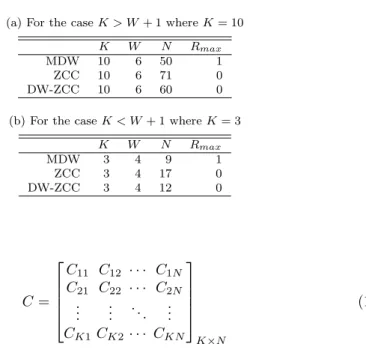
Table 1 demonstrates a comparison between MDW, ZCC and DW-ZCC codes in term of their code length (N), and maximum cross-correlation (Rmax) for generating code words with weightW = 6, hereKrepresent the number of codewords or users. The evaluation in terms of mathematical and simulation analysis will be presented in subsequent sections. From Table 1, it can be seen that the code length of DW-ZCC is noticeable shorter comparing to ZCC. And although MDW generates code with shorter length than DW-ZCC, the
Rmax of MDW is equal one that leads to formation MAI and performance degradation.
3.2 Code Construction
The proposed DW-ZCC code is designated as (N, W, λ) whereN andW are the code length and code weight, respectively, andλ=PN
i=1aibi= 0 denotes zero in-phase cross correlation between each pair of code-words, A and B. Here A={a1, a2,· · ·, aN} and B ={b1, b2,· · ·, bN} and ai and bi represent bit values. Therefore the matrix producesKcode sequences andN represents as
Table 1: COMPARISON BETWEEN MDW, ZCC & DW-ZCC
(a) For the caseK > W+ 1 whereK= 10
K W N Rmax
MDW 10 6 50 1
ZCC 10 6 71 0
DW-ZCC 10 6 60 0
(b) For the caseK < W+ 1 whereK= 3
K W N Rmax MDW 3 4 9 1 ZCC 3 4 17 0 DW-ZCC 3 4 12 0 C= C11 C12 · · · C1N C21 C22 · · · C2N .. . ... . .. ... CK1CK2· · · CKN K×N (1)
The length of generated code for K number of users with weight of W can be calculated as:
N =KW (2)
LetP(w) be the position of wth ‘1’ in the code-word wherew={1,2,· · ·, W}, then the position of each pair of neighbor chips can be shown asP′′(i) and defined as
P′′(i)) =P(i), P(i) + 1 (3) and i = 1,2,· · ·, W/2, as the number of pair chips is half of the actual weight of the desired user. Equation (3) defines how pair chips are located in proportion to each other. For each user k,ith pair is defined asPk′′(i) and can be calculated as Pk′′(i) = (k×2)−1,(k×2), i= 1 P′′ k(i−1) + [2(K−1) + 2], i >1 (4) wherek= 1,2, ..., K.
Using equation (4), theK×N code matrix (equation (1)) is constructed with empty spaced between the 1’s as chips.
The empty spaces between chips in each code-word will be filled by “0”s. The number of zeros between each pairs can be calculated as:
The construction of proposed DW-ZCC code is only based on a mathe-matical recursive equation and unlike MDW and ZCC does not require step by step procedure and programming. Knowing the number of users, it is facile to construct the specific code-word for that user. This property becomes more useful in modification of en/decoders where there is no need to have the code matrix or previous code-words.
The following example presents code construction for 3 number of DW-ZCC code-words with weight 4. The position of each pair chip is calculated by (4) for users 1 as (1,2) and (7,8), for user 2 as (3,4) and (9,10 ) and for users 3 as (5,6) and (11,12). Then the empty spaces is filled by “0s. The code length which can be obtained using (2) is 12 and there are four 0s between each pair of chips. The constructed matrix is as following
C= 1 1 0 0 0 0 1 1 0 0 0 0 0 0 1 1 0 0 0 0 1 1 0 0 0 0 0 0 1 1 0 0 0 0 1 1 (6)
4 THEORETIAL ANALYSYS WITH DIRECT DETECTION DECODING
In order to simplify the analysis, the Gaussian approximation is used. In this case, Ck(i) represents the ith element of the kth DW-ZCC code sequence. With regards to correlation at the photodetector, the code properties can be defined as: N X i=1 Ck(i)Cl(i) = Wh, k=l 0, k6=l (7)
where Whis the number of non-overlapped weights which are detected by photodetector.
To evaluate the system performance, the SNR of a back-to-back optical communication system is obtained as [17]
SN R= hIi 2 hI2i = I2 b i2 nb (8) where i2
nb is the power of noise sources which exist in the photocurrent andIbis the average desired received photocurrent at the detector and can be calculated by [17]
Ib=RbWhPr (9) whereb∈ {1,0} is the bit value which presents the transmission of ‘1’ or ‘0’ by desired user.Pr is received power per chip andR represent photodiode responsivity. Wh is the number of chips for each user which are absorbed by photodetector and its value is dependent on detection method as well as coding technique. For complementary subtraction decodingWh=W which means all
chips of a user are detected by photodetector. However in DD detection which is the used method in this research work, the value ofWh is dependent on the code type. For instance, this value isWh =w/2 for MDW code andWh= 1 for modified quadratic congruence (MQC) code.
The variance of total noise power,i2
nbfor an OCDMA system with a multi-wavelength laser source can be defined as: [17]
i2nb=i2OBIb+iRIN b2 +i2shb+i2th (10) Where i2
OBIb,i2RIN b, i2shb andi2th are the variance of noises related to op-tical beat interference (OBI), relative intensity noise (RIN), shot noise, and thermal noise, respectively. It should be noted that OBI occurs only because of beating between desired and interfering pulses as well as between interfering pulses themselves, on the same photodetector [22,23]. In DD detection, only desired pulses hit the photodetector, therefore; OBI is avoided in this technique (i2
OBIb= 0). OBI is a dominant noise in SAC-OCDMA with multi-wavelength laser source [13], and so subpressing this noise will result in significant perfor-mance improvement. Shot noise is induced by hit pulses related to desire user,
Wk, at the decoder and can be defined as
i2shb= 2E(bWhPr+xPc)Be (11) Where x is the event of the whole interfering pulses from the possible interfering users out ofK−1 that transmit bit ‘1’.Pc is the optical power of the crosstalk pulses and for DD detection is equal to 0. Then
i2shb= 2EbWhPrBe (12)
Be is electrical bandwidth andE is the electron’s charge. Assuming that the number of interfering pulses that are sending bit ‘1’ at every chips for all users are equal, the average value forxwill be [13]
x= W
2
h(K−1)
2N (13)
On the other hand, RIN occurs at transmitter of the desired signal and all other interfering users cause crosstalk with desired user signal. Therefore
Wh=W and
i2RIN b=RIN(bW Pr+xPc)2Be (14) where RIN is the noise factor with a typical value between -130 to -160 dBHz−1 [24]. Thermal noise can be attained by:
i2th=
4KBT Be
RL
(15) whereT is temperature,KBis the Boltzmann constant, andRLis the load resistor. Then the total noise power variance can be written as
i2
n=i2RIN+i2sh+i2th (16) The detection of the bits is done by comparing the total signal current with threshold currentID.
Then the BER of the optical signal transmitted in the additive white Gaus-sian noise (AWGN) channel indicated byBER0(I) and can be achieved by:
BER0(I) =1 2 Q I1−ID in1 +Q ID−I0 in0 (17) WhereI0 and I1 are the total signal current forIb (b = 0 or 1), in0 and in1are noise power of transmitting zero and one, respectively.Qfunction is
Q(x) = 1 2π Z ∞ x exp −y 2 2 dy (18)
then considering the case thatID is optimum.
ID=in0I1+in1I0
in0+in1
(19) the total probability of error can be summarized as [22]
BER0(I) =Q I 1−I0 in1+in0 (20) On the other handPr in a WON-CDMA system with SAC, can be calcu-lated by [17]
Pr= PtD
2e−ΩL
N(θL)2 (21)
here,Pt is the total transmitted power into the WON channel,D is the receiver aperture diameter,Ωis the attenuation coefficient, N is code length, andLis the transmission distance while theθrepresents the beam divergence. To evaluate the performance of the whole system, BER is calculated. Hence, the impact of the turbulence must be considered. The strength of the turbu-lence is presented by Rytov variance and for plane wave propagation is
σ2R= 1.23Cn2Kown7/6L11/6 (22) where C2
n is the refractive index structure coefficient andKown= 2π/λis the optical wave number.
Atmospheric turbulence is a stochastic phenomenon which can be analyzed by statistical methods. The reliability and behavior of the system is determined by the probability density function (PDF) of the randomly fading irradiance. Here, Gamma-Gamma distribution is chosen due to potentiality in describing behavior of weak to strong turbulences. The Gamma-Gamma PDF of the terms of normalized irradiance I is given by [25]
PG(I) = 2(αβ) (α+β) 2 Γ(α)Γ(β)I[ (α+β) 2 −1]Kα −β(2 p αβI) (23)
whereΓ(.) is the Gamma function andK(α−β)is the modified Bessel
func-tion of the second kind of orderα−β. Here αandβ are the effective number of small and large-scale eddies of scattering environment and defined as
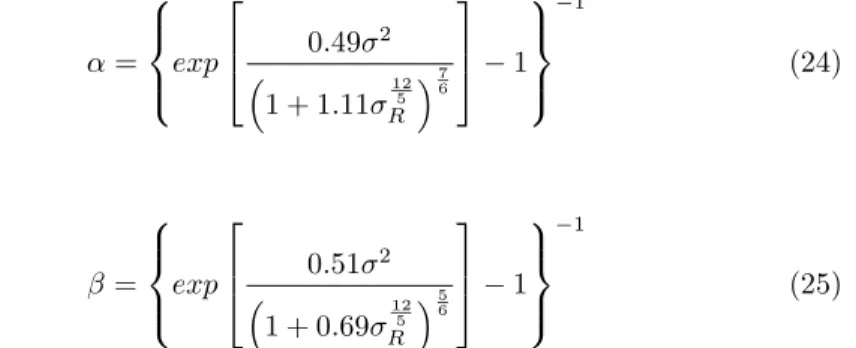
α= exp 0.49σ2 1 + 1.11σ125 R 76 −1 −1 (24) and β= exp 0.51σ2 1 + 0.69σ125 R 56 −1 −1 (25)
The BER of an optical signal which has been transmitted in the GammaGamma-distributed channel can be presented as [26]
BER=
Z ∞
0
BER0(I)PG(I)dI (26)
BER in the aforementioned equation is used to determine the performance of the proposed system.
5 SOFTWARE SIMULATION DESIGN
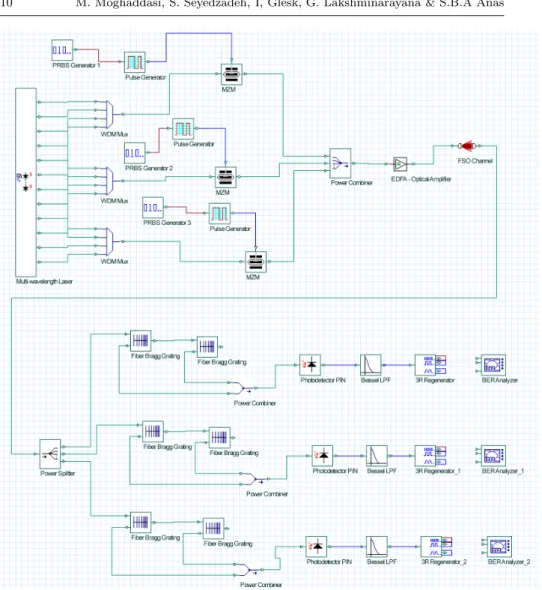
Fig. 2 shows similar system implemented using Optisystem version 10. A multi-wavelength laser module with linewidth of 20 MHz and output power of 3 dBm is used is used where the number of users is set 3 WDM MUX with insertion loss 1.5. RIN noise factor was considered 137 dB/Hz-1 for both simulation and mathematical approach. A random bit generator and electrical pulse generator is used to modulate optical signal utilizing a MZM modulator. Also a combiner with 5.4 dBm insertion loss and 0.1 dBm excess loss is used to combine all 3 users signals.
Then the superimposed signal is amplified with an EDFA with average gain up to 28 dB and noise figure of 5 dB which reinforces the input signal to 20 dBm. The EDFA is used as power booster to provide adequate input power to the free space medium before high loss is experienced.
At the receiver side, similar setup with Fig. 1 is implemented where the signal is decoded by a series of FBGs corresponding to the wavelengths encoded at transmitter. The FBGs have reflectivity of 99% and 0.5 dB loss. Finally, the optical signal is converted into electrical signal using PIN photodetector The PIN has responsivity of 1 A/W and thermal noise of 16e-024 W/Hz.Shot
Fig. 2: Simulation setup for SAC in Wireless Optical Networks.
noise value is calculated by simulator software based on other parameters values. The electrical signal is then passed from a four order low-pass Bessel filter with cut-off frequency of 1.8 GHz to recover primary data.
6 THEORETICAL AND SIMULATION RESULTS
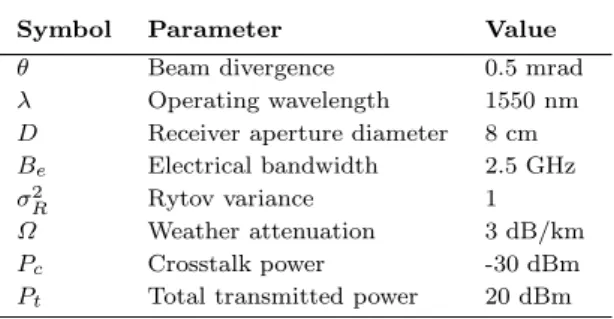
The parameters used in the analysis are chosen to provide a fair comparison with other published works and listed in Table 2. WON-OCMDA system em-ploying MDW, ZCC and DW-ZZ with 10 number of subscribers each with code
Table 2: Typical parameters used in the analysis
Symbol Parameter Value
θ Beam divergence 0.5 mrad
λ Operating wavelength 1550 nm D Receiver aperture diameter 8 cm
Be Electrical bandwidth 2.5 GHz
σ2
R Rytov variance 1
Ω Weather attenuation 3 dB/km
Pc Crosstalk power -30 dBm
Pt Total transmitted power 20 dBm
weight of 8 is investigated. The moderate turbulence condition is considered for this particular experiment and transmission distance is set to 1.7 km.
In order to calculate the BER of each configuration 10 simulations are performed and the worst case is considered as final performance. Each user operates at data rate of 2.5 Gb/s and the pseudo-random bit sequence length is set to 213−1.
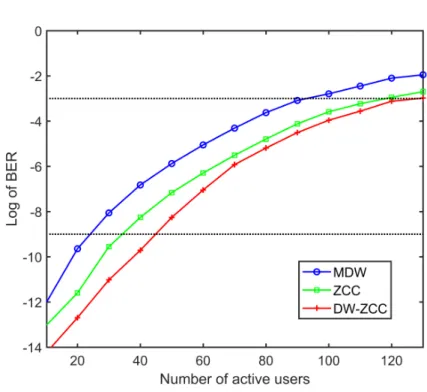
Figure 3 illustrates the effect of simultaneous number of users on the per-formance of the system. It can be seen that DW-ZCC outperform both codes supporting 11 and 21 more number of users comparing ZCC and MDW, respec-tively, reference to the BER of 10−9. MDW shows the worst performance due
to the fact that the number of overlapping chips is higher than others which results in decreased received power and subsequently SNR. The advantage of lower length of proposed DW-ZCC code over conventional ZCC is obviously indicated with this results. Reduced code length leads in receiving higherPr (refer to Eq. (21)) which eventuates increasedIb and SNR (refer to Eq. (8 & 9)).
In Fig. 4, the influence of turbulence on the system performance is evalu-ated where DW-ZCC is used for spectral coding with 10 numbers of users and weight of 6. The Rytov varianceσ2
R of 0.4, 1 and 2 represents weak, moderate and strong turbulences, respectively. Reference to BER of 10−9, the
transmis-sion distance for weak, moderate and strong turbulences is 1.95, 2.15 and 2.45 km, respectively.
In Fig. 5 performance of the system against transmission distance incre-ment for three codes, MDW, ZCC and DW-ZCC, is evaluated with number of users 3 and weight 4 using simulation and mathematical analysis. Simula-tion setup is implemented using OptiSystem software version 10 as a proof for reliability of proposed mathematical model. It can be observed that both analysis results prove that DW-ZCC is able to provide the best performance in transmission up to 3.2 km. This range is suitable for last mile access network which is a significant bottleneck for most of the service providers. As seen in Fig. 5 (a) and (b) both ZCC and DW-ZCC code outperform MDW and
Fig. 3: Log of BER vs number of simultaneous users.
DW-ZCC shows 200 m improvement in term of transmission distance over its conventional counterpart.
Fig. 6 illustrates eye diagram for MDW, ZCC and DW-ZCC for 2 km transmission distance. It can be observed that eye diagram for DW-ZCC is better than others in terms of eye height and jitter. With measurement of the jitter, the values (the length between points A and B in figure 6) were observed 0.25, 0.171 and 0.152 bit period for MDW, ZCC and DW-ZCC respectively. This means less jitter for DW-ZCC and so better performance for it.
7 Conclusion
In this paper, a new code family namely VW-ZCC was proposed for WON-OCDMA system deploying SAC technique. The nature of the proposed code is in a way to perfectly eliminate the effect of OBI which is known as the signif-icant performance degradation factor in system employing multi-wavelength lasers as optical sources, such as WON. The design and code construction of VW-ZCC was explained in detail and a mathematical model was devel-oped for performance analysis and comparison of proposed code with other well-known SAC-cods namely MDW and conventional ZCC. In developing nu-merical model, influential noises in transmitter, receiver and channel including
Fig. 4: Log of BER against transmission distance with DW-ZCC for different turbulence values.
thermal noise, shot noise, RIN, channel attenuation and also turbulence were taken into account. Results demonstrated that OCDMA system with VW-ZCC noticeably surpass both MDW in which the overlapping chips are higher than new code and conventional ZCC which offers an increased code length with same weight. The performance of VW-ZCC in different turbulence strength was presented and number of supportable users in normal situation was calcu-lated using mathematical model. In support of numerical model, a simulation setup was developed and results was discussed. Both simulation and mathe-matical results reveals that proposed VW-ZCC is a promising code and can be implemented in OCDMA based WON to provide desired performance.
References
1. A. Taiwo, M. Moghaddasi, D. Kuje, Y. Idriss, M. Mokhtar, IET Optoelectronics10(6), 227 (2016)
2. S. Seyedzadeh, G.A. Mahdiraji, R.K.Z. Sahbudin, A.F. Abas, S.B.A. Anas, Optical Fiber Technology20(5), 495 (2014)
3. Y.K. Huang, I. Glesk, C.M. Greiner, D. Iazkov, T.W. Mossberg, T. Wang, P.R. Prucnal, Optics express15(12), 7327 (2007)
4. M. Moghaddasi, S. Seyedzadeh, S.B. Ahmad Anas, in2014 IEEE REGION 10 SYMPO-SIUM (IEEE, 2014), pp. 181–184. DOI 10.1109/TENCONSpring.2014.6863021. URL http://ieeexplore.ieee.org/lpdocs/epic03/wrapper.htm?arnumber=6863021
(a)
(b)
Fig. 5: BER vs. transmission distance for (a) analytical result (b) simulation result for moderate turbulence
(a) (b)
(c)
Fig. 6: Eye diagram for (a) MDW, (b) ZCC and (c) DW-ZCC showing pro-duced jitter for each code.
5. S. Seyedzadeh, M. Moghaddasi, S.B.A. Anas, Journal of Telecommunications and In-formation Technology3, 50 (2016)
6. H. Chen, S. Xiao, L. Yi, J. Shi, P. Yang, Y. Dong, W. Hu, Photonics Technology Letters, IEEE24(5), 335 (2012)
7. N. Cvijetic, S.G. Wilson, M. Brandt-Pearce, Photonics Technology Letters, IEEE19(2), 103 (2007)
8. E. Bayaki, D.S. Michalopoulos, R. Schober, Communications, IEEE Transactions on
60(12), 3797 (2012)
9. J. Perez, S. Zvanovec, Z. Ghassemlooy, W.O. Popoola, Optics express22(3), 3208 (2014) 10. H. Yin, D.J. Richardson, chap1, 36 (2008)
11. H. Ghafouri-Shiraz, M.M. Karbassian,Optical CDMA Networks: Principles, Analysis and Applications (Wiley-IEEE Press, 2012)
12. Z. Wei, H. Shalaby, H. Ghafouri-Shiraz, Journal of Lightwave Technology 19(9), 1274 (2001)
13. M. Moghaddasi, G. Mamdoohi, A.S.M. Noor, M.A. Mahdi, S.B.A. Anas, Lasers in Engineering33(4), 247 (2016)
14. Z. Wang, H. Wu, M. Fan, Y. Li, Y. Gong, Y. Rao, Optics express21(24), 29358 (2013) 15. A. Pruijmboom, LASER FOCUS WORLD50(12), 19 (2014)
16. V. Karagodsky, B. Pesala, C. Chase, W. Hofmann, F. Koyama, C.J. Chang-Hasnain, Optics express18(2), 694 (2010)
17. M. Moghaddasi, G. Mamdoohi, A.S.M. Noor, M.A. Mahdi, S.B.A. Anas, Optics Com-munications356, 282 (2015)
18. K.J. Dexter, D.A. Reid, L.P. Barry, Photonics Technology Letters, IEEE21(22), 1662 (2009)
19. S. Aljunid, M. Ismail, A. Ramli, B. Ali, M. Abdullah, IEEE Photonics Technology Letters16(10), 2383 (2004). DOI 10.1109/LPT.2004.833859
20. M.S. Anuar, S.A. Aljunid, N.M. Saad, S.M. Hamzah, Optics Communications14(14), 2659 (2009). DOI 10.1016/j.optcom.2009.03.079
21. G. Mamdoohi, A.R. Sarmani, A.F. Abas, M.H. Yaacob, M. Mokhtar, M.A. Mahdi, Optics Express21(16), 18724 (2013)
22. N.T. Dang, A.T. Pham, Optics express18(10), 9922 (2010)
23. T.M. Bazan, D. Harle, I. Andonovic, Lightwave Technology, Journal of 24(10), 3583 (2006)
24. J.M. Senior, M.Y. Jamro,Optical fiber communications: principles and practice (Pear-son Education, 2009)
25. G.K. Rodrigues, V.G.A. Carneiro, A.R. da Cruz, M.T.M.R. Giraldi, Optics Communi-cations305, 42 (2013)
![Fig. 1: Schematic of WON-OCDMA with SAC encoding and utilizing multi- multi-wavelength source in [21].](https://thumb-us.123doks.com/thumbv2/123dok_us/9717945.2853396/4.892.108.644.404.679/schematic-ocdma-encoding-utilizing-multi-multi-wavelength-source.webp)