Supplement to “Quantile-Based Nonparametric
Inference for First-Price Auctions”
Vadim Marmer
University of British Columbia
Artyom Shneyerov
CIRANO, CIREQ, and Concordia University
August 30, 2010
Abstract
This paper contains supplemental materials for Marmer and Shneyerov (2010). We discuss here how the approach developed in the aforementioned paper can be applied to conducting inference on the optimal reserve price in first-price auctions, report additional simulations results, and provide a detailed proof of the bootstrap result in Marmer and Shneyerov (2010).
S.1
Introduction
This paper contains supplemental materials for Marmer and Shneyerov (2010), MS hereafter. Section S.2 discusses how the approach developed in MS can be applied to conducting inference on the optimal reserve price in first-price auctions. Section S.3 contains the full set of the Monte Carlo simulations results of which only a summary was reported in MS. In Section S.4, we provide a detailed proof of bootstrap Theorem 3 in MS.
S.2
Inference on the optimal reserve price
In this section, we consider a problem of conducting inference on the optimal reserve price. Several previous articles have studied that problem. Paarsch (1997) develops a parametric approach and applies his estimator to timber auctions in British Columbia. Haile and Tamer (2003) consider the problem of inference in an incomplete model of English auction, derive nonparametric bounds on the reserve price and apply them to the reserve price policy in the US Forest Service auctions. Closer to the subject of our paper, Li, Perrigne, and Vuong (2003) develop a semiparametric method to estimate the optimal reserve price. At a simplified level, their method essentially amounts to re-formulating the problem as a maximum estimator of the seller’s expected profit. Strong consistency of the estimator is shown, but its asymptotic distribution is as yet unknown.
We follow Haile and Tamer (2003) and make the following mild technical assump-tion on the distribuassump-tion of valuaassump-tions.1
Assumption S.1 Letcbe the seller’s own valuation. The function(p−c) (1−F (p|x)) is x-a.e. strictly pseudo-concave in p on (v(x),v¯(x)).
Let r∗(x) denote the optimal reserve price given the covariates value x. Under Assumption S.1 (see the discussion in Haile and Tamer (2003)), r∗(x) is found as the unique solution to the optimal monopoly pricing problem, and is given by the unique solution to the corresponding first-order condition:
r∗(x)− 1−F (r
∗(x)|x)
f(r∗(x)|x) −c= 0. (S.1)
Remark. Even in the presence of a binding reserve price r(x) in the data, the optimal reserve price r∗(x) is still identifiable provided r∗(x) > r(x), for the ratio in (S.1) remains the same if we use the truncated distribution F∗(r∗(x)|x) defined in Section 5, and the associated density f∗(r∗(x)|x), in place of F(r∗(x)|x) and
f(r∗(x)|x). See the discussion of this in Haile and Tamer (2003).
One approach to the inference on r∗(x) is to estimate it as a solution ˆr∗(x) to (S.1) using consistent estimators forf andF in place of the true unknown functions.
1This condition is implied by the standard monotone virtual valuation condition of Myerson
However, a difficulty arises because, even though our estimator ˆf(v|x) is asymptot-ically normal, it is not guaranteed to be a continuous function of v. We instead take a direct approach and construct confidens sets (CSs) that do not require a point estimate of r∗(x).
As discussed in Chapter 3.5 of Lehmann and Romano (2005), a natural CS for a parameter can be obtained by inverting a test of a series of simple hypotheses concerning the value of that parameter.2 We construct CSs for the optimal reserve price by inverting the test of the null hypothesesH0(v) :r∗(x) =v. Such hypotheses can be tested by testing the optimal reserve price restriction (S.1) atr∗(x) =v. Thus, the CSs are formed by collecting all valuesv for which the test fails to rejects the null that (S.1) holds atr∗(x) =v.
Consider H0(v) :r∗(x) = v, and the following test statistic:
T(v|x) = Lhd+31/2 v− 1−Fˆ(v|x) ˆ f(v|x) −c ! / v u u u t 1−Fˆ(v|x) 2 ˆ f4(v|x) ˆ Vf(v, x),
where ˆF is defined in (17) in MS, and ˆVf(v, x) is a consistent plug-in estimator of the
asymptotic variance of ˆf(v|x), see MS Theorem 2. By MS Theorem 2 and Lemma 1(h), T (r∗(x)|x) →d N(0,1). Furthermore, due to uniqueness of the solution to
(S.1), for anyt >0,P(|T (v|x)|> t|r∗(x)6=v)→1. A CS forr∗ with the asymptotic coverage probability 1−α is formed by collecting all v’s such that a test based on
T (v|x) fails to reject the null at the significance levelα:
CS1−α(x) =
n
v ∈Λ (ˆ x) :|T(v|x)| ≤z1−α/2
o
,
where zτ is the τ quantile of the standard normal distribution. Asymptotically
CS1−α(x) has a correct coverage probability since by construction we have that
P (r∗(x)∈CS1−α(x)) = P |T(r∗(x)|x)| ≤z1−α/2
→1−α, provided that r∗(x)∈ Λ (x) = [Q(τ1|x), Q(τ2|x)].
When the seller’s own evaluation c is unknown, one can treat a CS as a function
2CSs obtained by test inversion have been used in the econometrics literature, for example, in
the context of instrumental variable regression with weak instruments (Andrews and Stock, 2005), for constructing CSs for the date of a structural break (Elliott and M¨uller, 2007), and in the case of set identified models (Chernozhukov, Hong, and Tamer, 2007); see also the references on page 1268 of Chernozhukov, Hong, and Tamer (2007).
of cand, using the above approach, construct conditional CSs for chosen values of c.
S.3
Monte Carlo results
In this section, we evaluate the accuracy of the asymptotic normal approximation es-tablished in Theorem 2 in MS and that of the bootstrap percentile method discussed in Section 4 in MS. In particular, it is interesting to see whether the boundary effect creates substantial size distortions. We also report here additional simulations results on comparison of our estimator with the estimator of GPV. In addition to the results presented in MS, we also report the results for v = 0.2,0.3,0.7,0.8 and n = 2,4,6,7. The finite sample performance of the two estimators is compared in terms of bias, mean squared error (MSE), and median absolute deviation. The simulations frame-work is the same as in Section 6 in MS.
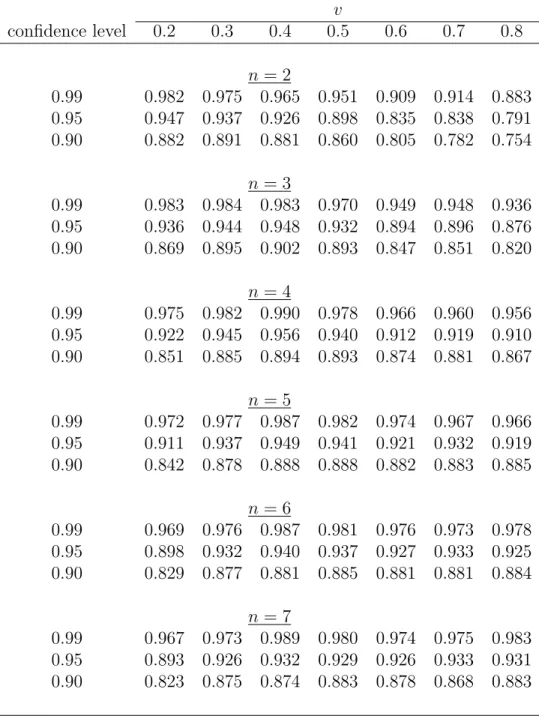
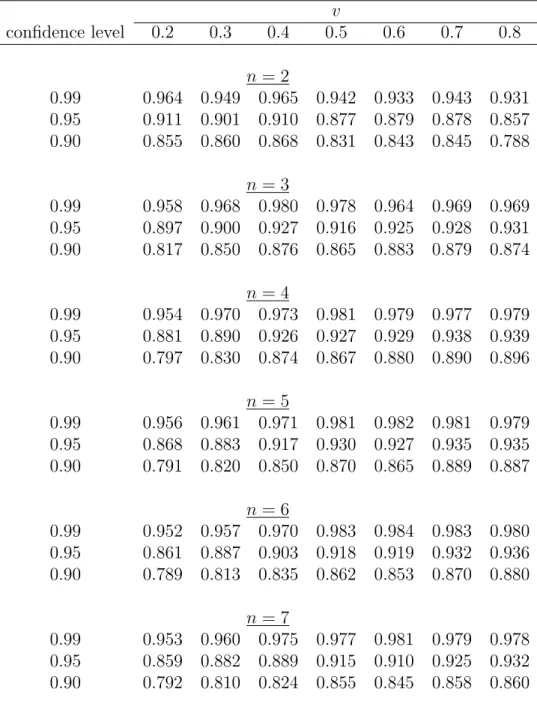
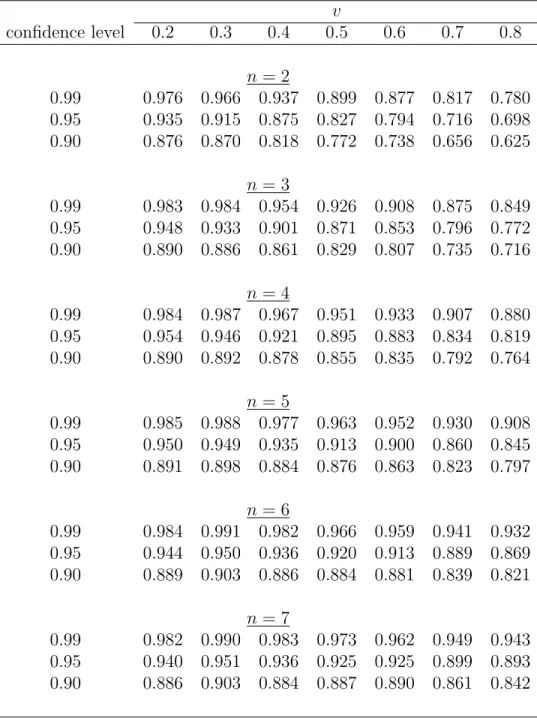
Tables S.1-S.3 report the simulated coverage probabilities for 99%, 95%, and 90% asymptotic confidence intervals (CIs) constructed as
ˆ
f(v)±z1−α/2
q
˜
Vf(v)/(Lh32),
where z1−α/2 denotes the 1−α/2 quantile of the standard normal distribution, and ˜
Vf(v) the second-order corrected estimator of the asymptotic variance of ˆf(v)
de-scribed in Section 3 in MS: ˜ Vf(v) = ˆVf (v) +h22 3 ˆf(v) ˆ gqˆFˆ(v) − 2nfˆ 2(v) (n−1) ˆg2qˆFˆ(v) 2 ˆ Vg,0 ˆ q ˆ F(v) , ˆ Vf(v) = K1Fˆ2(v) ˆf4(v) n(n−1)2gˆ5qˆFˆ(v) .
In the case of the Uniform [0,1] distribution (α = 1, Table S.1), we observe some deviation of the simulated coverage probabilities from the nominal values when the PDF is estimated near the upper boundary and the number of bidders is small (n= 2,3). There is also some deviation of the simulated coverage probabilities from the nominal values for large n and v near the lower boundary of the support. Thus, as one can expect the normal approximation may breakdown near the boundaries of the support. However, away from the boundaries, as the results in Table S.1 indicate, the
normal approximation works well and the simulated coverage probabilities are close to their nominal values.
Similar results have been observed in the case of α = 2 (Table S.2) and α= 1/2 (Table S.3). When α = 2, the boundary effect distorting coverage probabilities is somewhat more pronounced near the lower boundary of the support, and less so near the upper boundary. An opposite situation is observed for α = 1/2: we see more distortion near the upper boundary and less near the lower boundary of the support. This can be explained by the fact that the PDF is increasing in the case ofα= 2, so there is relatively more mass nearv = 1, and it is decreasing when α= 1/2, so there is relatively less mass near v = 0. We observe good coverage probabilities away from the boundaries.
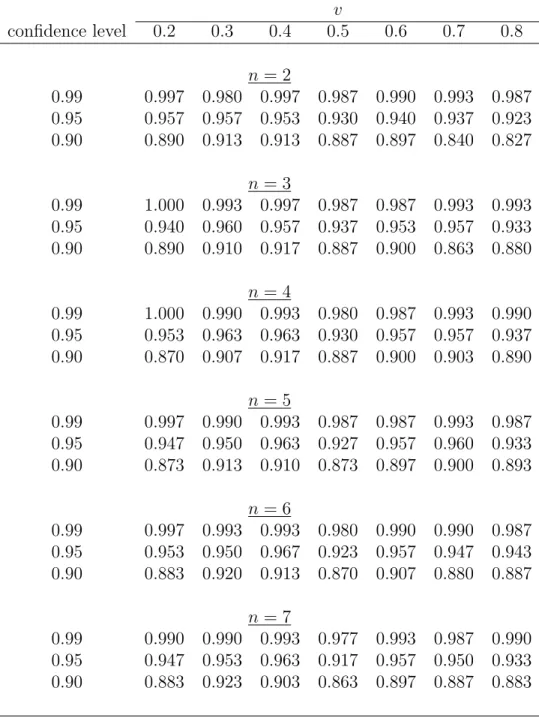
Tables S.4-S.6 report the coverage probabilities of the percentile bootstrap CIs. The bootstrap percentile confidence intervals are constructed as described in Section 4 in MS. The number of bootstrap samples used to compute φ†τ in (23) in MS is
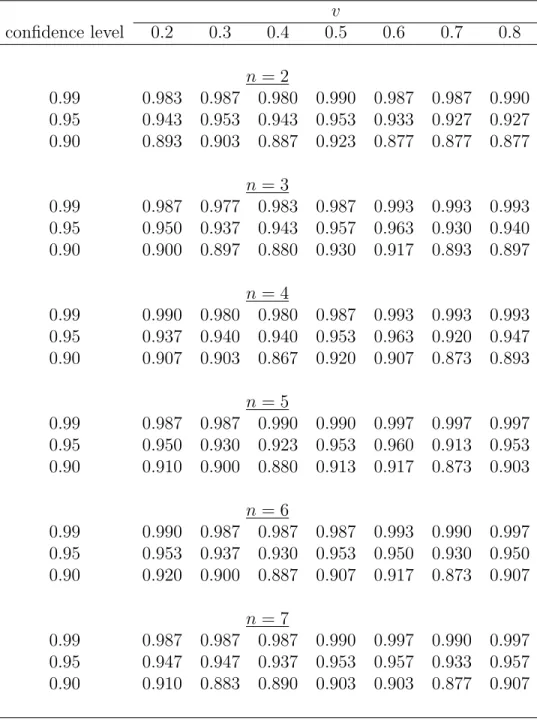
M = 199. The number of Monte Carlo replications used for the bootstrap experiments is 300.3 When α = 1, as reported in Table S.4, for the bootstrap percentile CIs we observe some size distortion only due to the right boundary effect and only for
n= 2. In all other cases, the bootstrap percentile CIs are found to be very accurate. With a few exceptions, the bootstrap percentile CIs outperform the CIs based on the traditional normal approximation.
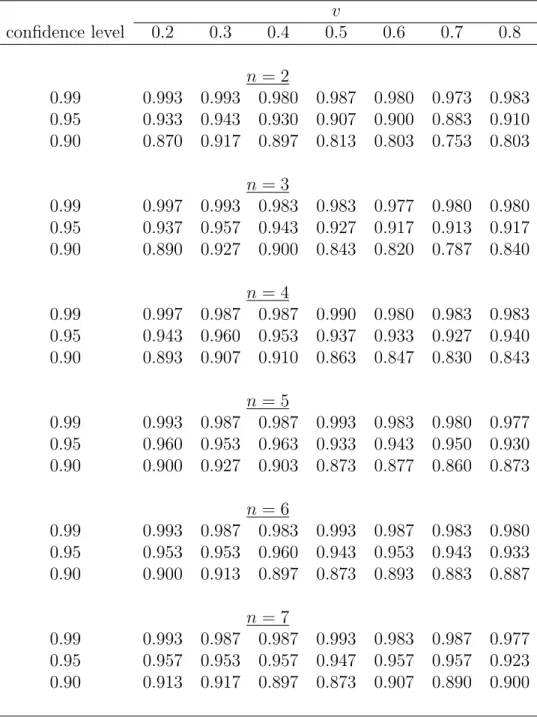
Similar results are found for α = 2 and α = 1/2, see Tables S.5 and S.6. We find that the bootstrap percentile confidence intervals (CIs) have superior accuracy comparing to the CIs based on the traditional normal approximation. Based on these findings, we recommend using the bootstrap percentile method for the inference on the PDF of auction valuations.
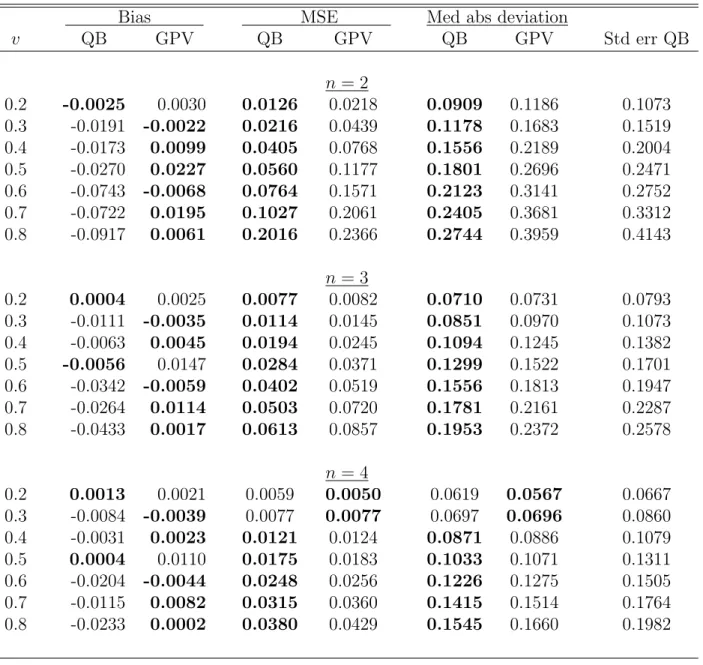
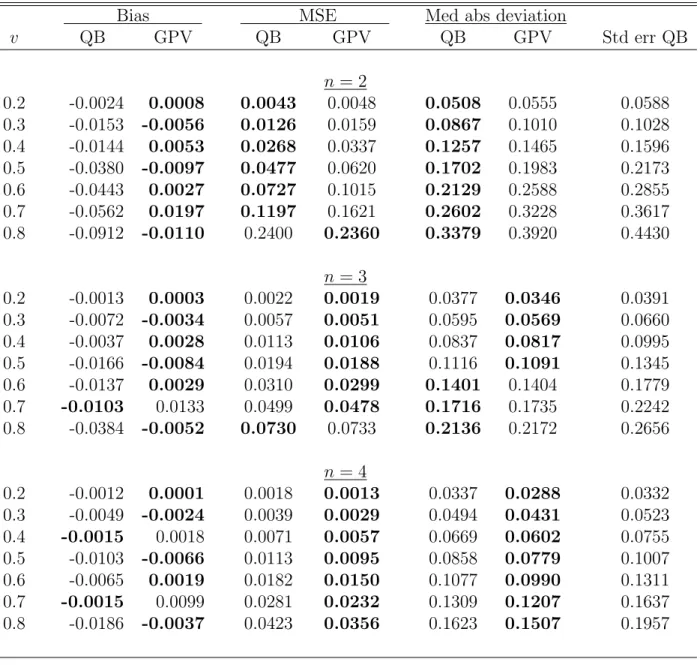
We now turn to comparison of our estimator with the GPV’s estimator. Table S.7 reports the bias, MSE, and median absolute deviation of the two estimators for
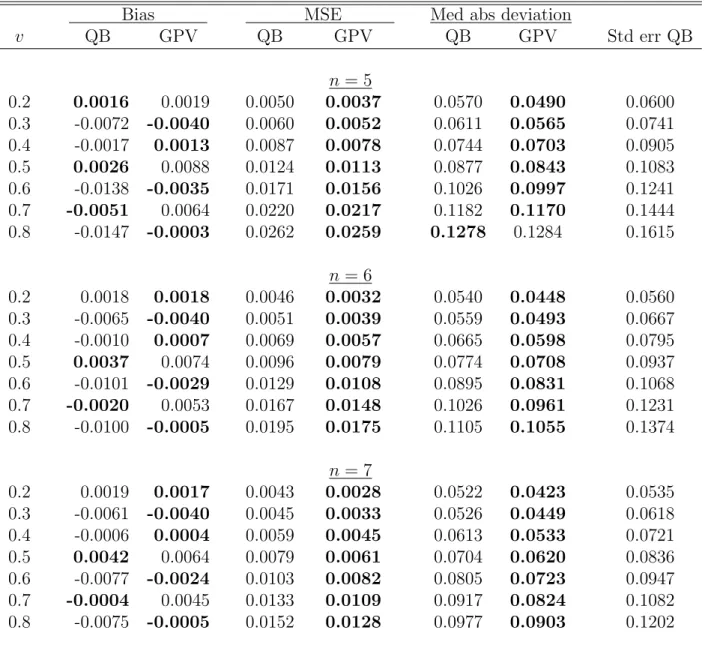
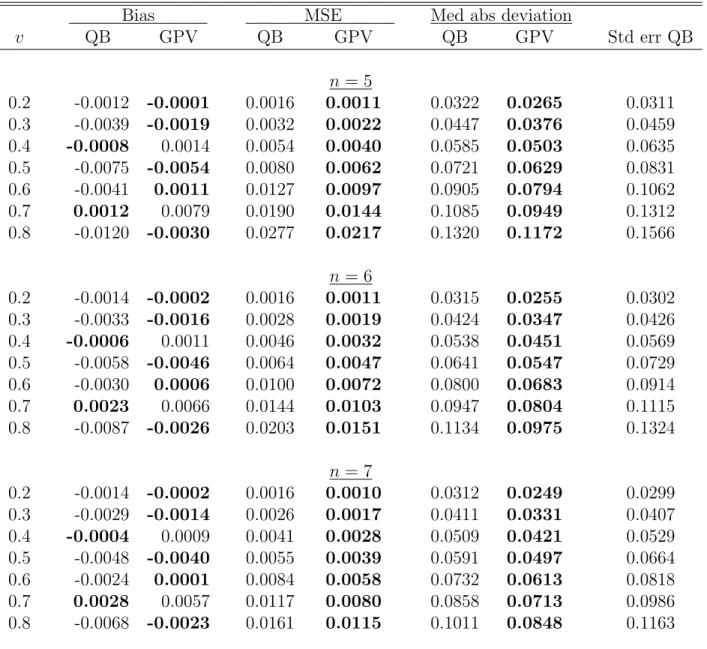
α= 1. In most cases, the GPV’s estimator shows less bias. However neither estimator dominates the other in terms of MSE or median absolute deviation: our quantile-based (QB) estimator appears to be more efficient for small numbers of bidders (n = 2,3,4), and GPV’s is more efficient when n= 5,6, and 7. The GPV’s estimator is relatively more efficient when the PDF is upward sloping (α = 2) as the results Table S.8
3We use a smaller number of replications here because the bootstrap Monte Carlo simulations
indicate. However, according to the results in Table S.9, the QB estimator dominates GPV’s in the majority of cases when the PDF is downward-sloping (α = 1/2).
Tables S.7, S.8, and S.9 also report the average (across replications) standard error for our QB estimator. The variance of the estimator increases with v, since it depends on F (v). This fact is also reflected in the MSE values that increase with v. Interestingly, one can see the same pattern for the MSE of the GPV estimator, which suggests that the GPV variance depends on v as well.
S.4
Proof of bootstrap Theorem 3 in MS
To simplify the notion, we will suppress the subscript indicating the bootstrap sample number for bootstrap objects (m). The bootstrap analogues of the original sample statistics are denoted by the superscript †.
We use Φ (·) to denote the standard normal CDF. Let P† denote probability conditional on the original sample {(b1l, . . . , bnll, nl, xl) : l = 1, . . . , L}. We say ζL =
o†p(λL) ifP†(|ζL/λL|> ε)→p 0 for allε >0 asL→ ∞. We sayζL=Op†(λL) if for all
ε >0 there is ∆ε >0 such that for allL≥Lε,P(P†(|ζL/λL| ≥∆ε)> ε)< ε. We use
E†andV ar†to denote expectation and variance underP† respectively. Letπ†denote the distribution ofn†l implied byP†, i.e. π†(n) = P†(n†l =n) = L−1PL
l=11(nl=n) = ˆ
π(n), where π(n) = P(nl = n). Lastly, for two CDFs H1 and H2, let d∞(H1, H2)
denote the sup-norm distance between H1 and H2:
d∞(H1, H2) = sup u∈R H1(u)−H2(u) .
Our proof uses the following two simple lemmas concerning the stochastic order (with respect toP†) of the bootstrap statistics. Let ˆθL be a statistic computed using
the data in the original sample, and let ˆθ†L be the bootstrap analogue of ˆθL.
Lemma S.1 (a) Suppose that θˆL = θ+op(δL) and θˆ
†
L = ˆθL+o†p(δL). Then, θˆ
†
L =
θ+o†p(δL).
(b) Suppose that θˆL=θ+Op(δL) and θˆ†L= ˆθL+Op†(δL). Then, θˆL† =θ+O†p(δL).
Proof of Lemma S.1. For part (a), since ˆθL is not random under P†,
P†δL−1 ˆ θ†L−θ > ε ≤P†δ−L1 ˆ θL−θ > ε 2 +P†δL−1 ˆ θL† −θˆL > ε 2
= 1δL−1 ˆ θL−θ > ε 2 +op(1).
For the first summand, we have that for allε, η >0,
P1δL−1 ˆ θL−θ > ε 2 > η=P δL−1 ˆ θL−θ > ε 2 →0.
The proof of part (b) is similar.
Lemma S.2 Suppose that E†(ˆθL†)2 =O
p(λ2L), then θˆ
†
L=O
†
p(λL).
Proof of Lemma S.2. Since E†(ˆθL†)2 =O
p(λ2L), for all ε > 0 there is ∆ε >0 such
that P(E†(ˆθL†)2 >∆2
ελ2L)< ε. Let ˜∆2ε = ∆2ε/ε. Then, we can write
P(E†(ˆθL†)2 >∆˜2εελ2L)< ε (S.2)
for all L large enough. By Markov’s inequality,
P† ˆ θL† λL ≥∆˜ε ! ≤ E†θˆ†L2 λ2 L∆˜2ε .
Thus, for all ε >0 there is ˜∆ε, such that for allL large enough,
P P† ˆ θ†L λL ≥∆˜ε ! > ε ! ≤P E†θˆL†2 ˜ ∆2 ελ2L > ε < ε,
where the last inequality is by (S.2). Define
Hg,L† (u) =P† Lhd+31/2
ˆ
g†(1)(b|n, x)−gˆ(1)(b|n, x)
≤u,
Note thatHg,L† (u) depends on x and b. We have the following result.
Lemma S.3 Let [b1(n, x), b2(n, x)] be as in (19) in MS. Suppose that Assumptions 1, 2, and 3 with k = 1 hold. Then, for all b ∈ [b1(n, x), b2(n, x)], x ∈ Interior(X) and n ∈ N, d∞(Hg,L† (u),Φ(u/Vg,1/12(b, n, x)))→p 0.
Proof of Lemma S.3. The result of the lemma follows from Theorem 1 in Mam-men (1992) since: (i) ˆg(1)(b|n, x) is a linear estimator; (ii) by Lemma 2(a) in MS, (Lhd+3)1/2(ˆg(1)(b|n, x)−g(1)(b|n, x)) →
d N(0, Vg,1(b, n, x)); (iii) d∞ is a metric; and
(iv) due to the under smoothing condition in Assumption 3.
Next, by the results in MS Lemma 1, Lemma S.1, and Lemma S.4 below, we have that for x∈Interior(X), n∈ N, and v ∈Λ(ˆ x),
ˆ
f†(v|n, x)−fˆ(v|x) = F (v|x)f
2(v|n, x)
(n−1)g3(q(F(v|x)|n, x)|n, x)
× gˆ†(1)(q(F (v|x)|n, x))−gˆ(1)(q(F(v|x)|n, x))+o†p Lhd+3−1/2. (S.3) Note that by Lemma S.3 and (S.3),
Hf,L† (u)→p Φ
u Vf1/2(v, n, x)
!
,
where Vf(v, n, x) is defined in Theorem 2 in MS. Furthermore, by P´olya’s Theorem,
the convergence is uniform in u. The result of the theorem for Hf,L† then follows by the triangular inequality d∞(Hf,L, H
†
f,L)≤d∞(Hf,L,Φ) +d∞(Hf,L† ,Φ)→p 0.
Lemma S.4 Suppose that MS Assumptions 1, 2, and 3 with k = 1 hold. Then, for all x∈Interior(X) and n∈ N,
(a) πˆ†(n|x) = ˆπ(n|x) +O†p Lhd−1/2. (b) ϕˆ†(x) = ˆϕ(x) +O†p Lhd−1/2. (c) supb∈[b(n,x),¯b(n,x)]|Gˆ†(b|n, x)−Gˆ(b|n, x)|=Op† Lhd logL −1/2 . (d) supτ∈[ε,1−ε]|ˆq†(τ|n, x)−q(τ|n, x)|=O†p Lhd logL −1/2 +hR , for all0< ε <1/2.
(e) supτ∈[0,1](limt↓τqˆ†(t|n, x)−qˆ†(τ|n, x)) =O†p
Lhd log(Lhd) −1 . (f ) supb∈[b1(n,x),b2(n,x)]|ˆg(k)†(b|n, x)−ˆg(k)(b|n, x)|=O† p Lhd+1+2k logL −1/2 , k = 0, . . . , R. (g) supτ∈[τ1−ε,τ2+ε]| ˆ Q†(τ|n, x)−Q(τ|x)|=Op† Lhd+1 logL −1/2 +hR , for some ε >0 such that τ1−ε >0 and τ2+ε <1.
(h) supv∈Λ(ˆ x)|Fˆ†(v|n, x)−F (v|x)|=O†p Lhd+1 logL −1/2 +hR .
Proof of Lemma S.4. We prove part (b) first. Since (Lhd)1/2( ˆϕ(x)−Eϕ(x)) is asymptotically normal by a standard result for kernel density estimators, by Theorem 1 in Mammen (1992), (Lhd)1/2 ϕˆ†(x)−ϕˆ(x) = Op†(1). The result in part (b) follows.
For part (a), write
ˆ π(n|x) = ˆπ(n, x) ˆϕ(x) , where ˆ π(n, x) = 1 L L X l=1 1 (nl=n)Kh(x−xl).
By the same argument as in the proof of part (b), (Lhd)1/2 πˆ†(n, x)−πˆ(n, x)
is asymptotically normal. By the Taylor expansion of ˆπ†(n|x), the result in part (b), and since ˆϕ(x) is bounded away from zero with probability approaching one by As-sumption 1(b), Lhd1/2 πˆ†(n|x)−πˆ(n|x)= 1 ˆ ϕ(x) Lh d1/2 ˆ π†(n, x)−πˆ(n, x) −πˆ †(n, x) ( ˆϕ(x))2 Lh d1/2 ˆ ϕ†(x)−ϕˆ(x) +o Lhd1/2 ϕˆ†(x)−ϕˆ(x) =Op†(1).
We prove part (c) next. The proof is based on the proof of Lemma B.1 in Newey (1994). For fixed x∈Interior(X) and n∈ N, write
ˆ G(bn, x) = ˆG(b|n, x) ˆπ(n|x) ˆϕ(x), so that ˆ G(b, n, x) = 1 nL L X l=1 nl X i=1 Til, with Til = 1 (bil ≤b) 1 (nl =n)K∗h(xl−x), (S.4)
and let ˆ G†(b, n, x) = 1 nL L X l=1 nl X i=1 Til†(b), Til†(b) = 1b†il ≤b1n†l =nK∗h x†l −x.
Next, for chosen n and x, let
I =
b(n, x),¯b(n, x)
, I =∪JL
k=1Ik,
where the sub-intervals Ik’s are non-overlapping and of length
sL=
logL
L . (S.5)
Denote as ck the center of Ik. Note that I, Ik, ck depend onn and x. Denote as κ(b)
the interval containing b. Since
ˆ G(b, n, x) =E†Til†(b), we can write ˆ G†(b, n, x)−Gˆ(b, n, x) =A†L(b)−BL† (b) +CL†(b) , where A†L(b) = 1 nL L X l=1 nl X i=1 Til†(b)−Til† cκ(b) , BL†(b) = 1 nL L X l=1 nl X i=1 E†Til†(b)−E†Til† cκ(b) , CL†(b) = 1 nL L X l=1 nl X i=1 Til† cκ(b) −E†Til† cκ(b) .
In the above decomposition, A†L(b) is the average of the deviations of Til†(b) from its value computed using the center of the interval containing b, and BL†(b) is the expected value under P† of A†L(b). The terms supb∈I|A†L(b)| and supb∈I|BL†(b)| are small when sL is small.
For A†L we have T † il(b)−T † il cκ(b) ≤h−d(supK)d1n†l =n 1 b†il ≤b−1b†il ≤cκ(b) ≤h−d(supK)d1n†l =n1b†il ∈Iκ(b) , (S.6) and therefore, A † L(b) ≤h −d(supK)d 1 nL L X l=1 n X i=1 1n†l =n1b†il ∈Iκ(b) . (S.7) Next, E† 1 nL L X l=1 n X i=1 1n†l =n1b†il ∈Ik −P†b†il ∈Ik|n † l =n π†(n) !2 ≤ ≤ P†b†il ∈Ik|n † l =n π†(n) nL , (S.8) and by Lemma S.2, 1 nL L X l=1 nl X i=1 1n†l =n1b†il ∈Ik =P†b†il ∈Ik|n † l =n π†(n) +Op† P† b†il ∈Ik|n†l =n π†(n) L 1/2 =P†b†il ∈Ik|n † l =n π†(n) 1 +O † p 1 P†b† il ∈Ik|n † l =n π†(n)L 1/2 . (S.9)
Now, by a similar argument,
P† b†il ∈Ik|n†l =n π†(n) = 1 nL L X l=1 nl X i=1 1 (nl =n) 1 (bil ∈Ik)
=P(bil ∈Ik|nl =n)π(n) 1 +Op 1 P (bil ∈Ik|nl=n)π(n)L 1/2! ≤ sup k=1,...,JL P (bil ∈Ik|nl=n)π(n) × 1 +Op 1 infk=1,...,JLP (bil ∈Ik|nl =n)π(n)L 1/2! . (S.10)
Furthermore, for all Ik’s
inf b∈I,x∈Xg(b|n, x) sL≤P (bil ∈Ik|nl =n)≤ sup b∈I,x∈X g(b|n, x) sL. (S.11)
Equations (S.7)-(S.11) together imply that
sup b∈I A†L(b) =Op† h−dsL 1 +Op 1 sLL 1/2!! =Op† logL Lhd , (S.12)
where the last equality is by (S.5).
By (S.6), (S.10), and (S.11), for BL† (b) we have
sup b∈I B†L(b) ≤sup b∈I E† T † il(b)−T † il cκ(b) ≤h−d(supK)dπ†(n) sup k=1,...,JL P†b†il ∈Ik|n † l =n =Op† logL Lhd . (S.13)
Note that CL†(b) depends on b only through ck’s, and therefore
sup
b∈I
|CL†(b)| ≤ max
k=1,...,JL
|CL†(ck)|. (S.14)
A Bonferroni inequality implies that for any ∆>0,
P† Lhd logL 1/2 max k=1,...,JL |CL†(ck)|>∆ ! ≤
≤ JL X k=1 P† L X l=1 nl X i=1 Til†(ck)−E†T † il(ck) >∆nL logL Lhd 1/2! . (S.15) By (S.4), |Til†(ck)| ≤h−d(supK)d and T † il(ck)−E†T † il(ck) ≤2(supK) dh−d.
Further, by (S.8)-(S.11), there is a constant 0< D1 <∞ such that
V ar†Til†(ck) ≤D1h−2dsL(1 +op(1)) =D1h−d logL/ Lhd (1 +op(1)).
We therefore can apply Bernstein’s inequality (Pollard, 1984, page 193) to obtain
P† L X l=1 nl X i=1 Til†(ck)−E†T † il(ck) >∆nL logL Lhd 1/2! ≤2 exp −1 2 ∆2n2L2 logLhLd nLD1h−d(1 +op(1))logLhdL + (2/3) ∆n(supK)dh−dL logL Lhd 1/2 ! = 2 exp −1 2 ∆2n(logL)1/2 Lhd1/2 D1(logL/(Lhd)) 1/2 (1 +op(1)) + (2/3) ∆(supK)d ! = 2 exp − ∆n (4/3) (supK)d+o p(1) (logL)1/2 Lhd1/2 , (S.16)
where the equality in the last line is due to Lhd/logL → ∞. The inequalities in (S.14)-(S.16) together with (S.5) imply that there is a constant 0 < D2 < ∞ such that P† Lhd logL 1/2 sup b∈I |CL†(b)|>∆ ! ≤2JLexp − ∆n (4/3) (supK)d+o p(1) (logL)1/2 Lhd1/2 ≤D2s−L1exp − ∆n (4/3) (supK)d+o p(1) (logL)1/2 Lhd1/2 ≤D2exp logL 1− ∆n (4/3) (supK)d+o p(1) Lhd logL 1/2!!
=op(1),
where the equality in the last line is by Lhd/logL → ∞. By a similar argument as in the proof of Lemma S.2,
sup b∈I |CL†(b)|=o†p Lhd logL −1/2 . (S.17)
The result of part (c) follows from (S.12), (S.13), and (S.17).
The proof of part (d) is similar to that of Lemma 1(d) in MS. First, by similar arguments as in the proof of Lemma 1(d), one can show that b(n, x) ≤ qˆ†(ε|n, x) ≤ ˆ
q†(1−ε|n, x)≤¯b(n, x) with probability P† approaching one (in probability). Second, one can show that uniformly overτ ∈[ε,1−ε],
ˆ G† qˆ†(τ|n, x)|n, x =τ +O†p Lhd−1 Lastly, G qˆ†(τ|n, x)|n, x −Gˆ† qˆ†(τ|n, x)|n, x =G qˆ†(τ|n, x)|n, x−τ+O†p Lhd−1 =G qˆ†(τ|n, x)|n, x−G(q(τ|n, x)|n, x) +O†p Lhd−1 =g q˜†(τ|n, x)|n, x ˆ q†(τ|n, x)−q(τ|n, x) +O†p Lhd−1 ,
where ˜q† denotes the mean value, or
ˆ q†(τ|n, x)−q(τ|n, x) = G qˆ †(τ|n, x)|n, x −Gˆ† qˆ†(τ|n, x)|n, x g(˜q†(τ|n, x)|n, x) +O † p Lh d−1 = G qˆ †(τ|n, x)|n, x −Gˆ qˆ†(τ|n, x)|n, x g(˜q†(τ|n, x)|n, x) + ˆ G qˆ†(τ|n, x)|n, x−Gˆ† qˆ†(τ|n, x)|n, x g(˜q†(τ|n, x)|n, x) +O † p Lh d−1 ,
and the desired result follows.
The proof of part (e) is similar to that of Lemma 1(e). The proof of part (f) is similar to the proof of part (c) and relies on the fact that, according to Assumption
2 in MS, the derivatives ofK are Lipschitz. The proof of parts (g) and (h) is similar to that of Lemma 1(g) and (h).
References
Andrews, D. W. K., and J. H. Stock (2005): “Inference with Weak
Instru-ments,” Cowles Foundation Discussion Paper 1530, Yale University.
Chernozhukov, V., H. Hong, and E. Tamer (2007): “Estimation and
Confi-dence Regions for Parameter Sets in Econometric Models,” Econometrica, 75(5), 1243–1284.
Elliott, G., and U. K. M¨uller (2007): “Confidence Sets For the Date of a
Single Break in Linear Time Series Regressions,”Journal of Econometrics, 141(2), 1196–1218.
Guerre, E., I. Perrigne, and Q. Vuong (2000): “Optimal Nonparametric
Es-timation of First-Price Auctions,”Econometrica, 68(3), 525–74.
Haile, P. A., and E. Tamer (2003): “Inference with an Incomplete Model of
English Auctions,” Journal of Political Economy, 111(1), 1–51.
Lehmann, E. L., and J. P. Romano (2005): Testing Statistical Hypotheses.
Springer, New York, third edn.
Li, T., I. Perrigne, and Q. Vuong (2003): “Semiparametric Estimation of the
Optimal Reserve Price in First-Price Auctions,”Journal of Business & Economic Statistics, 21(1), 53–65.
Mammen, E. (1992): “Bootstrap, Wild Bootstrap, and Asymptotic Normality,”
Probability Theory and Related Fields, 93(4), 439–455.
Marmer, V., and A. Shneyerov (2010): “Quantile-Based Nonparametric
Infer-ence For First-Price Auctions,” Working Paper, University of British Columbia.
Myerson, R. B. (1981): “Optimal Auction Design,” Mathematics of Operations
Newey, W. K.(1994): “Kernel Estimation of Partial Means and a General Variance
Estimator,”Econometric Theory, 10(2), 233–253.
Paarsch, H. J. (1997): “Deriving an estimate of the optimal reserve price: An
application to British Columbian timber sales,” Journal of Econometrics, 78(2), 333–357.
Pollard, D. (1984): Convergence of Stochastic Processes. Springer-Verlag, New
York.
Riley, J., and W. Samuelson (1981): “Optimal auctions,” American Economic
Table S.1: Simulated coverage probabilities of the normal approximation CIs for the PDF of valuations for different points of density estimation (v), numbers of bidders (n) and auctions (L), sample size nL = 4200, and the distribution parameter α=1
(Uniform [0,1] distribution) v confidence level 0.2 0.3 0.4 0.5 0.6 0.7 0.8 n= 2 0.99 0.982 0.975 0.965 0.951 0.909 0.914 0.883 0.95 0.947 0.937 0.926 0.898 0.835 0.838 0.791 0.90 0.882 0.891 0.881 0.860 0.805 0.782 0.754 n= 3 0.99 0.983 0.984 0.983 0.970 0.949 0.948 0.936 0.95 0.936 0.944 0.948 0.932 0.894 0.896 0.876 0.90 0.869 0.895 0.902 0.893 0.847 0.851 0.820 n= 4 0.99 0.975 0.982 0.990 0.978 0.966 0.960 0.956 0.95 0.922 0.945 0.956 0.940 0.912 0.919 0.910 0.90 0.851 0.885 0.894 0.893 0.874 0.881 0.867 n= 5 0.99 0.972 0.977 0.987 0.982 0.974 0.967 0.966 0.95 0.911 0.937 0.949 0.941 0.921 0.932 0.919 0.90 0.842 0.878 0.888 0.888 0.882 0.883 0.885 n= 6 0.99 0.969 0.976 0.987 0.981 0.976 0.973 0.978 0.95 0.898 0.932 0.940 0.937 0.927 0.933 0.925 0.90 0.829 0.877 0.881 0.885 0.881 0.881 0.884 n= 7 0.99 0.967 0.973 0.989 0.980 0.974 0.975 0.983 0.95 0.893 0.926 0.932 0.929 0.926 0.933 0.931 0.90 0.823 0.875 0.874 0.883 0.878 0.868 0.883
Table S.2: Simulated coverage probabilities of the normal approximation CIs for the PDF of valuations for different points of density estimation (v), numbers of bidders (n) and auctions (L), sample size nL= 4200, and the distribution parameter α=2
v confidence level 0.2 0.3 0.4 0.5 0.6 0.7 0.8 n= 2 0.99 0.964 0.949 0.965 0.942 0.933 0.943 0.931 0.95 0.911 0.901 0.910 0.877 0.879 0.878 0.857 0.90 0.855 0.860 0.868 0.831 0.843 0.845 0.788 n= 3 0.99 0.958 0.968 0.980 0.978 0.964 0.969 0.969 0.95 0.897 0.900 0.927 0.916 0.925 0.928 0.931 0.90 0.817 0.850 0.876 0.865 0.883 0.879 0.874 n= 4 0.99 0.954 0.970 0.973 0.981 0.979 0.977 0.979 0.95 0.881 0.890 0.926 0.927 0.929 0.938 0.939 0.90 0.797 0.830 0.874 0.867 0.880 0.890 0.896 n= 5 0.99 0.956 0.961 0.971 0.981 0.982 0.981 0.979 0.95 0.868 0.883 0.917 0.930 0.927 0.935 0.935 0.90 0.791 0.820 0.850 0.870 0.865 0.889 0.887 n= 6 0.99 0.952 0.957 0.970 0.983 0.984 0.983 0.980 0.95 0.861 0.887 0.903 0.918 0.919 0.932 0.936 0.90 0.789 0.813 0.835 0.862 0.853 0.870 0.880 n= 7 0.99 0.953 0.960 0.975 0.977 0.981 0.979 0.978 0.95 0.859 0.882 0.889 0.915 0.910 0.925 0.932 0.90 0.792 0.810 0.824 0.855 0.845 0.858 0.860
Table S.3: Simulated coverage probabilities of the normal approximation CIs for the PDF of valuations for different points of density estimation (v), numbers of bidders (n) and auctions (L), sample sizenL = 4200, and the distribution parameterα=1/2
v confidence level 0.2 0.3 0.4 0.5 0.6 0.7 0.8 n= 2 0.99 0.976 0.966 0.937 0.899 0.877 0.817 0.780 0.95 0.935 0.915 0.875 0.827 0.794 0.716 0.698 0.90 0.876 0.870 0.818 0.772 0.738 0.656 0.625 n= 3 0.99 0.983 0.984 0.954 0.926 0.908 0.875 0.849 0.95 0.948 0.933 0.901 0.871 0.853 0.796 0.772 0.90 0.890 0.886 0.861 0.829 0.807 0.735 0.716 n= 4 0.99 0.984 0.987 0.967 0.951 0.933 0.907 0.880 0.95 0.954 0.946 0.921 0.895 0.883 0.834 0.819 0.90 0.890 0.892 0.878 0.855 0.835 0.792 0.764 n= 5 0.99 0.985 0.988 0.977 0.963 0.952 0.930 0.908 0.95 0.950 0.949 0.935 0.913 0.900 0.860 0.845 0.90 0.891 0.898 0.884 0.876 0.863 0.823 0.797 n= 6 0.99 0.984 0.991 0.982 0.966 0.959 0.941 0.932 0.95 0.944 0.950 0.936 0.920 0.913 0.889 0.869 0.90 0.889 0.903 0.886 0.884 0.881 0.839 0.821 n= 7 0.99 0.982 0.990 0.983 0.973 0.962 0.949 0.943 0.95 0.940 0.951 0.936 0.925 0.925 0.899 0.893 0.90 0.886 0.903 0.884 0.887 0.890 0.861 0.842
Table S.4: Simulated coverage probabilities of the bootstrap percentile CIs for PDF of valuations for different points of density estimation (v), numbers of bidders (n) and auctions (L), sample size nL = 4200, and the distribution parameter α=1
(Uniform [0,1] distribution) v confidence level 0.2 0.3 0.4 0.5 0.6 0.7 0.8 n= 2 0.99 0.997 0.980 0.997 0.987 0.990 0.993 0.987 0.95 0.957 0.957 0.953 0.930 0.940 0.937 0.923 0.90 0.890 0.913 0.913 0.887 0.897 0.840 0.827 n= 3 0.99 1.000 0.993 0.997 0.987 0.987 0.993 0.993 0.95 0.940 0.960 0.957 0.937 0.953 0.957 0.933 0.90 0.890 0.910 0.917 0.887 0.900 0.863 0.880 n= 4 0.99 1.000 0.990 0.993 0.980 0.987 0.993 0.990 0.95 0.953 0.963 0.963 0.930 0.957 0.957 0.937 0.90 0.870 0.907 0.917 0.887 0.900 0.903 0.890 n= 5 0.99 0.997 0.990 0.993 0.987 0.987 0.993 0.987 0.95 0.947 0.950 0.963 0.927 0.957 0.960 0.933 0.90 0.873 0.913 0.910 0.873 0.897 0.900 0.893 n= 6 0.99 0.997 0.993 0.993 0.980 0.990 0.990 0.987 0.95 0.953 0.950 0.967 0.923 0.957 0.947 0.943 0.90 0.883 0.920 0.913 0.870 0.907 0.880 0.887 n= 7 0.99 0.990 0.990 0.993 0.977 0.993 0.987 0.990 0.95 0.947 0.953 0.963 0.917 0.957 0.950 0.933 0.90 0.883 0.923 0.903 0.863 0.897 0.887 0.883
Table S.5: Simulated coverage probabilities of the bootstrap percentile CIs for PDF of valuations for different points of density estimation (v), numbers of bidders (n) and auctions (L), sample size nL= 4200, and the distribution parameter α=2
v confidence level 0.2 0.3 0.4 0.5 0.6 0.7 0.8 n= 2 0.99 0.983 0.987 0.980 0.990 0.987 0.987 0.990 0.95 0.943 0.953 0.943 0.953 0.933 0.927 0.927 0.90 0.893 0.903 0.887 0.923 0.877 0.877 0.877 n= 3 0.99 0.987 0.977 0.983 0.987 0.993 0.993 0.993 0.95 0.950 0.937 0.943 0.957 0.963 0.930 0.940 0.90 0.900 0.897 0.880 0.930 0.917 0.893 0.897 n= 4 0.99 0.990 0.980 0.980 0.987 0.993 0.993 0.993 0.95 0.937 0.940 0.940 0.953 0.963 0.920 0.947 0.90 0.907 0.903 0.867 0.920 0.907 0.873 0.893 n= 5 0.99 0.987 0.987 0.990 0.990 0.997 0.997 0.997 0.95 0.950 0.930 0.923 0.953 0.960 0.913 0.953 0.90 0.910 0.900 0.880 0.913 0.917 0.873 0.903 n= 6 0.99 0.990 0.987 0.987 0.987 0.993 0.990 0.997 0.95 0.953 0.937 0.930 0.953 0.950 0.930 0.950 0.90 0.920 0.900 0.887 0.907 0.917 0.873 0.907 n= 7 0.99 0.987 0.987 0.987 0.990 0.997 0.990 0.997 0.95 0.947 0.947 0.937 0.953 0.957 0.933 0.957 0.90 0.910 0.883 0.890 0.903 0.903 0.877 0.907
Table S.6: Simulated coverage probabilities of the bootstrap percentile CIs for PDF of valuations for different points of density estimation (v), numbers of bidders (n) and auctions (L), sample sizenL = 4200, and the distribution parameterα=1/2
v confidence level 0.2 0.3 0.4 0.5 0.6 0.7 0.8 n= 2 0.99 0.993 0.993 0.980 0.987 0.980 0.973 0.983 0.95 0.933 0.943 0.930 0.907 0.900 0.883 0.910 0.90 0.870 0.917 0.897 0.813 0.803 0.753 0.803 n= 3 0.99 0.997 0.993 0.983 0.983 0.977 0.980 0.980 0.95 0.937 0.957 0.943 0.927 0.917 0.913 0.917 0.90 0.890 0.927 0.900 0.843 0.820 0.787 0.840 n= 4 0.99 0.997 0.987 0.987 0.990 0.980 0.983 0.983 0.95 0.943 0.960 0.953 0.937 0.933 0.927 0.940 0.90 0.893 0.907 0.910 0.863 0.847 0.830 0.843 n= 5 0.99 0.993 0.987 0.987 0.993 0.983 0.980 0.977 0.95 0.960 0.953 0.963 0.933 0.943 0.950 0.930 0.90 0.900 0.927 0.903 0.873 0.877 0.860 0.873 n= 6 0.99 0.993 0.987 0.983 0.993 0.987 0.983 0.980 0.95 0.953 0.953 0.960 0.943 0.953 0.943 0.933 0.90 0.900 0.913 0.897 0.873 0.893 0.883 0.887 n= 7 0.99 0.993 0.987 0.987 0.993 0.983 0.987 0.977 0.95 0.957 0.953 0.957 0.947 0.957 0.957 0.923 0.90 0.913 0.917 0.897 0.873 0.907 0.890 0.900
Table S.7: Bias, MSE and median absolute deviation of the quantile-based (QB) and GPV estimators, and the average standard error (second-order corrected) of the QB estimator, for different points of density estimations (v), numbers of bidders (n) and auctions (L), sample size nL = 4200, and the distribution parameterα=1 (Uniform [0,1] distribution)
Bias MSE Med abs deviation
v QB GPV QB GPV QB GPV Std err QB n = 2 0.2 -0.0025 0.0030 0.0126 0.0218 0.0909 0.1186 0.1073 0.3 -0.0191 -0.0022 0.0216 0.0439 0.1178 0.1683 0.1519 0.4 -0.0173 0.0099 0.0405 0.0768 0.1556 0.2189 0.2004 0.5 -0.0270 0.0227 0.0560 0.1177 0.1801 0.2696 0.2471 0.6 -0.0743 -0.0068 0.0764 0.1571 0.2123 0.3141 0.2752 0.7 -0.0722 0.0195 0.1027 0.2061 0.2405 0.3681 0.3312 0.8 -0.0917 0.0061 0.2016 0.2366 0.2744 0.3959 0.4143 n = 3 0.2 0.0004 0.0025 0.0077 0.0082 0.0710 0.0731 0.0793 0.3 -0.0111 -0.0035 0.0114 0.0145 0.0851 0.0970 0.1073 0.4 -0.0063 0.0045 0.0194 0.0245 0.1094 0.1245 0.1382 0.5 -0.0056 0.0147 0.0284 0.0371 0.1299 0.1522 0.1701 0.6 -0.0342 -0.0059 0.0402 0.0519 0.1556 0.1813 0.1947 0.7 -0.0264 0.0114 0.0503 0.0720 0.1781 0.2161 0.2287 0.8 -0.0433 0.0017 0.0613 0.0857 0.1953 0.2372 0.2578 n = 4 0.2 0.0013 0.0021 0.0059 0.0050 0.0619 0.0567 0.0667 0.3 -0.0084 -0.0039 0.0077 0.0077 0.0697 0.0696 0.0860 0.4 -0.0031 0.0023 0.0121 0.0124 0.0871 0.0886 0.1079 0.5 0.0004 0.0110 0.0175 0.0183 0.1033 0.1071 0.1311 0.6 -0.0204 -0.0044 0.0248 0.0256 0.1226 0.1275 0.1505 0.7 -0.0115 0.0082 0.0315 0.0360 0.1415 0.1514 0.1764 0.8 -0.0233 0.0002 0.0380 0.0429 0.1545 0.1660 0.1982
Table S.7: Continued (α=1)
Bias MSE Med abs deviation
v QB GPV QB GPV QB GPV Std err QB n = 5 0.2 0.0016 0.0019 0.0050 0.0037 0.0570 0.0490 0.0600 0.3 -0.0072 -0.0040 0.0060 0.0052 0.0611 0.0565 0.0741 0.4 -0.0017 0.0013 0.0087 0.0078 0.0744 0.0703 0.0905 0.5 0.0026 0.0088 0.0124 0.0113 0.0877 0.0843 0.1083 0.6 -0.0138 -0.0035 0.0171 0.0156 0.1026 0.0997 0.1241 0.7 -0.0051 0.0064 0.0220 0.0217 0.1182 0.1170 0.1444 0.8 -0.0147 -0.0003 0.0262 0.0259 0.1278 0.1284 0.1615 n = 6 0.2 0.0018 0.0018 0.0046 0.0032 0.0540 0.0448 0.0560 0.3 -0.0065 -0.0040 0.0051 0.0039 0.0559 0.0493 0.0667 0.4 -0.0010 0.0007 0.0069 0.0057 0.0665 0.0598 0.0795 0.5 0.0037 0.0074 0.0096 0.0079 0.0774 0.0708 0.0937 0.6 -0.0101 -0.0029 0.0129 0.0108 0.0895 0.0831 0.1068 0.7 -0.0020 0.0053 0.0167 0.0148 0.1026 0.0961 0.1231 0.8 -0.0100 -0.0005 0.0195 0.0175 0.1105 0.1055 0.1374 n = 7 0.2 0.0019 0.0017 0.0043 0.0028 0.0522 0.0423 0.0535 0.3 -0.0061 -0.0040 0.0045 0.0033 0.0526 0.0449 0.0618 0.4 -0.0006 0.0004 0.0059 0.0045 0.0613 0.0533 0.0721 0.5 0.0042 0.0064 0.0079 0.0061 0.0704 0.0620 0.0836 0.6 -0.0077 -0.0024 0.0103 0.0082 0.0805 0.0723 0.0947 0.7 -0.0004 0.0045 0.0133 0.0109 0.0917 0.0824 0.1082 0.8 -0.0075 -0.0005 0.0152 0.0128 0.0977 0.0903 0.1202
Table S.8: Bias, MSE and median absolute deviation of the quantile-based (QB) and GPV estimators, and the average standard error (second-order corrected) of the QB estimator, for different points of density estimations (v), numbers of bidders (n) and auctions (L), sample size nL = 4200, and the distribution parameterα=2
Bias MSE Med abs deviation
v QB GPV QB GPV QB GPV Std err QB n = 2 0.2 -0.0024 0.0008 0.0043 0.0048 0.0508 0.0555 0.0588 0.3 -0.0153 -0.0056 0.0126 0.0159 0.0867 0.1010 0.1028 0.4 -0.0144 0.0053 0.0268 0.0337 0.1257 0.1465 0.1596 0.5 -0.0380 -0.0097 0.0477 0.0620 0.1702 0.1983 0.2173 0.6 -0.0443 0.0027 0.0727 0.1015 0.2129 0.2588 0.2855 0.7 -0.0562 0.0197 0.1197 0.1621 0.2602 0.3228 0.3617 0.8 -0.0912 -0.0110 0.2400 0.2360 0.3379 0.3920 0.4430 n = 3 0.2 -0.0013 0.0003 0.0022 0.0019 0.0377 0.0346 0.0391 0.3 -0.0072 -0.0034 0.0057 0.0051 0.0595 0.0569 0.0660 0.4 -0.0037 0.0028 0.0113 0.0106 0.0837 0.0817 0.0995 0.5 -0.0166 -0.0084 0.0194 0.0188 0.1116 0.1091 0.1345 0.6 -0.0137 0.0029 0.0310 0.0299 0.1401 0.1404 0.1779 0.7 -0.0103 0.0133 0.0499 0.0478 0.1716 0.1735 0.2242 0.8 -0.0384 -0.0052 0.0730 0.0733 0.2136 0.2172 0.2656 n = 4 0.2 -0.0012 0.0001 0.0018 0.0013 0.0337 0.0288 0.0332 0.3 -0.0049 -0.0024 0.0039 0.0029 0.0494 0.0431 0.0523 0.4 -0.0015 0.0018 0.0071 0.0057 0.0669 0.0602 0.0755 0.5 -0.0103 -0.0066 0.0113 0.0095 0.0858 0.0779 0.1007 0.6 -0.0065 0.0019 0.0182 0.0150 0.1077 0.0990 0.1311 0.7 -0.0015 0.0099 0.0281 0.0232 0.1309 0.1207 0.1637 0.8 -0.0186 -0.0037 0.0423 0.0356 0.1623 0.1507 0.1957
Table S.8: Continued (α=2)
Bias MSE Med abs deviation
v QB GPV QB GPV QB GPV Std err QB n = 5 0.2 -0.0012 -0.0001 0.0016 0.0011 0.0322 0.0265 0.0311 0.3 -0.0039 -0.0019 0.0032 0.0022 0.0447 0.0376 0.0459 0.4 -0.0008 0.0014 0.0054 0.0040 0.0585 0.0503 0.0635 0.5 -0.0075 -0.0054 0.0080 0.0062 0.0721 0.0629 0.0831 0.6 -0.0041 0.0011 0.0127 0.0097 0.0905 0.0794 0.1062 0.7 0.0012 0.0079 0.0190 0.0144 0.1085 0.0949 0.1312 0.8 -0.0120 -0.0030 0.0277 0.0217 0.1320 0.1172 0.1566 n = 6 0.2 -0.0014 -0.0002 0.0016 0.0011 0.0315 0.0255 0.0302 0.3 -0.0033 -0.0016 0.0028 0.0019 0.0424 0.0347 0.0426 0.4 -0.0006 0.0011 0.0046 0.0032 0.0538 0.0451 0.0569 0.5 -0.0058 -0.0046 0.0064 0.0047 0.0641 0.0547 0.0729 0.6 -0.0030 0.0006 0.0100 0.0072 0.0800 0.0683 0.0914 0.7 0.0023 0.0066 0.0144 0.0103 0.0947 0.0804 0.1115 0.8 -0.0087 -0.0026 0.0203 0.0151 0.1134 0.0975 0.1324 n = 7 0.2 -0.0014 -0.0002 0.0016 0.0010 0.0312 0.0249 0.0299 0.3 -0.0029 -0.0014 0.0026 0.0017 0.0411 0.0331 0.0407 0.4 -0.0004 0.0009 0.0041 0.0028 0.0509 0.0421 0.0529 0.5 -0.0048 -0.0040 0.0055 0.0039 0.0591 0.0497 0.0664 0.6 -0.0024 0.0001 0.0084 0.0058 0.0732 0.0613 0.0818 0.7 0.0028 0.0057 0.0117 0.0080 0.0858 0.0713 0.0986 0.8 -0.0068 -0.0023 0.0161 0.0115 0.1011 0.0848 0.1163
Table S.9: Bias, MSE and median absolute deviation of the quantile-based (QB) and GPV estimators, and the average standard error (second-order corrected) of the QB estimator, for different points of density estimations (v), numbers of bidders (n) and auctions (L), sample size nL = 4200, and the distribution parameterα=1/2
Bias MSE Med abs deviation
v QB GPV QB GPV QB GPV Std err QB n= 2 0.2 -0.0186 -0.0102 0.0220 0.0576 0.1195 0.1891 0.1497 0.3 -0.0201 0.0018 0.0343 0.1059 0.1479 0.2512 0.1886 0.4 -0.0458 -0.0190 0.0706 0.1409 0.1737 0.2902 0.2269 0.5 -0.0625 0.0010 0.0548 0.1800 0.1790 0.3330 0.2486 0.6 -0.0706 -0.0137 0.5800 0.1700 0.2100 0.3238 0.7302 0.7 -0.1047 0.0020 0.0756 0.1771 0.2107 0.3397 0.2954 0.8 -0.1042 0.0107 0.2375 0.1719 0.2342 0.3332 0.5659 n= 3 0.2 -0.0124 -0.0040 0.0144 0.0241 0.0976 0.1247 0.1194 0.3 -0.0110 -0.0009 0.0213 0.0412 0.1163 0.1631 0.1463 0.4 -0.0302 -0.0110 0.0299 0.0572 0.1353 0.1892 0.1694 0.5 -0.0323 0.0030 0.0352 0.0770 0.1482 0.2242 0.1963 0.6 -0.0596 -0.0094 0.0393 0.0781 0.1518 0.2214 0.2091 0.7 -0.0763 0.0053 0.1213 0.0948 0.1771 0.2495 0.2785 0.8 -0.0742 0.0149 0.0984 0.0997 0.1841 0.2539 0.2962 n= 4 0.2 -0.0089 -0.0006 0.0109 0.0136 0.0848 0.0946 0.1017 0.3 -0.0070 -0.0004 0.0146 0.0219 0.0969 0.1193 0.1212 0.4 -0.0199 -0.0072 0.0206 0.0308 0.1140 0.1393 0.1399 0.5 -0.0146 0.0032 0.0278 0.0418 0.1287 0.1653 0.1646 0.6 -0.0393 -0.0061 0.0284 0.0432 0.1301 0.1662 0.1750 0.7 -0.0438 0.0048 0.0469 0.0565 0.1466 0.1927 0.2027 0.8 -0.0530 0.0128 0.0455 0.0627 0.1534 0.2018 0.2164
Table S.9: Continued (α=1/2)
Bias MSE Med abs deviation
v QB GPV QB GPV QB GPV Std err QB n = 5 0.2 -0.0067 0.0015 0.0089 0.0092 0.0768 0.0780 0.0903 0.3 -0.0046 0.0004 0.0110 0.0137 0.0842 0.0946 0.1048 0.4 -0.0142 -0.0053 0.0156 0.0195 0.0992 0.1106 0.1201 0.5 -0.0077 0.0035 0.0208 0.0261 0.1130 0.1304 0.1400 0.6 -0.0278 -0.0039 0.0211 0.0273 0.1136 0.1320 0.1500 0.7 -0.0299 0.0037 0.0292 0.0366 0.1277 0.1549 0.1699 0.8 -0.0363 0.0102 0.0329 0.0419 0.1353 0.1649 0.1838 n = 6 0.2 -0.0052 0.0028 0.0076 0.0069 0.0712 0.0678 0.0824 0.3 -0.0030 0.0012 0.0087 0.0096 0.0753 0.0792 0.0934 0.4 -0.0107 -0.0042 0.0124 0.0136 0.0886 0.0925 0.1059 0.5 -0.0046 0.0037 0.0162 0.0180 0.1005 0.1079 0.1221 0.6 -0.0206 -0.0026 0.0164 0.0189 0.1009 0.1097 0.1316 0.7 -0.0213 0.0029 0.0216 0.0255 0.1142 0.1291 0.1478 0.8 -0.0257 0.0084 0.0249 0.0295 0.1206 0.1383 0.1601 n = 7 0.2 -0.0041 0.0038 0.0068 0.0056 0.0672 0.0611 0.0767 0.3 -0.0019 0.0018 0.0073 0.0072 0.0689 0.0688 0.0851 0.4 -0.0086 -0.0034 0.0103 0.0101 0.0806 0.0800 0.0954 0.5 -0.0029 0.0037 0.0131 0.0132 0.0907 0.0925 0.1088 0.6 -0.0159 -0.0019 0.0132 0.0139 0.0908 0.0940 0.1176 0.7 -0.0156 0.0025 0.0171 0.0188 0.1027 0.1106 0.1313 0.8 -0.0185 0.0072 0.0202 0.0218 0.1094 0.1186 0.1427