PREFETCHING ENGINES IN CHIP
MULTIPROCESSOR ARCHITECTURES
A Dissertation
Presented to the Faculty of the Graduate School
of Cornell University
in Partial Fulfillment of the Requirements for the Degree of
Doctor of Philosophy
by
Ilya Konstantinovich Ganusov August 2007
ENGINES IN CHIP MULTIPROCESSOR ARCHITECTURES Ilya Konstantinovich Ganusov, Ph.D.
Cornell University 2007
Scaling the performance of applications with little thread-level parallelism is one of the most serious impediments to the success of multi-core architectures. At the same time, the long latency of memory accesses represents one of the largest performance bottlenecks for individual program threads. As a result, a typical microprocessor spends a significant amount of time waiting for data to be delivered from memory instead of performing useful computation.
Fortunately, it is often possible to guess which memory data will be needed by a program thread in the near future. Various hardware and software prefetching techniques have been developed to fetch critical data before they are requested by the processor. This way prefetching can eliminate processor stalls otherwise induced by the slow response from the memory system.
The main contribution of this dissertation is the development of two techniques that utilize extra cores of a chip multiprocessor (CMP) as prefetching engines to increase the performance of single program threads. The proposed approaches effectively leverage the execution capabilities of chip multiprocessors to compute data addresses that are likely to miss in the cache and prefetch them ahead of program thread load requests.
accurate simulations of a chip multiprocessor consisting of two four-way superscalar cores running the single-threaded SPEC CPU2000 benchmark suite. The proposed mechanisms provide significant performance improvements over a baseline that al-ready includes an aggressive hardware stream prefetcher. A comparison with other multi-core prefetching mechanisms from the literature shows that the techniques proposed in this dissertation provide competitive performance, incur less energy overhead, and require considerably simpler hardware support.
The author graduated from High School #1, Ivanovo, Russian Federation, with the Golden Medal for outstanding scholastic achievements in 1996. He enrolled at the Ivanovo State Power University in 1996, pursuing a double major in Electrical Engineering and English, and graduated with Electronics Engineer and Profes-sional Translator degrees with Honors in 2001. Since mid 2002, the author has been a graduate student in the Computer Systems Laboratory, which is a part of the School of Electrical and Computer Engineering of Cornell University, working under the guidance of Prof. Martin Burtscher.
First, I would like to thank my advisor, Prof. Martin Burtscher, for his con-tinuous guidance and enthusiastic support throughout the lifetime of this project. Thanks to my committee members, Profs. Rajit Manohar and Jose Martinez, for encouraging discussions and insightful comments.
I am grateful to all my friends and fellow computer engineers from the Com-puter Systems Laboratory for their help, great discussions, and a sense of humor. Special thanks to David Fang, Filipp Akopyan, Karan Singh, Vince Weaver, and Virantha Ekanayake for their assistance with all types of technical problems and challenges - at all times.
I thank Maya Haridasan, Filipp Akopyan, Nosheen Ali, Jui Bhagwat, David Fang, Carlos Tadeo Ortega Otero, Christina Peraki, Paula Petrica, Zoya Svitkina, Basit Riaz Sheikh, and Jonathan Winter for their great friendship, selfless support, and many exciting conversations.
Finally, I am forever indebted to my parents for their understanding, endless patience and encouragement when it was most needed.
Biographical Sketch . . . iii
Dedication . . . iv
Acknowledgements . . . v
Table of Contents . . . vi
List of Tables . . . viii
List of Figures . . . ix
1 Introduction 1 1.1 Problem . . . 1
1.2 Main Memory Stalls . . . 2
1.3 Data Prefetching . . . 4
1.4 Contributions . . . 6
1.5 Summary . . . 9
1.6 Organization . . . 9
2 Background 11 2.1 Conventional High-Performance Processor Architecture . . . 11
2.2 Address Prediction and Prefetching . . . 13
2.2.1 Stride Prefetching . . . 13 2.2.2 Markov Prefetching . . . 16 3 Evaluation Methodology 18 3.1 Baseline Architecture . . . 18 3.2 Benchmarks . . . 19 4 Future Execution 22 4.1 Motivation . . . 22
4.2 Implementation of Future Execution . . . 26
4.2.1 Overview of Operation . . . 26
4.2.2 Hardware Support . . . 29
4.3 Evaluation Methodology . . . 30
4.4 Experimental Results . . . 31
4.4.1 Execution Speedup . . . 31
4.4.2 Analysis of Prefetching Activity . . . 34
4.4.3 Comparison with Runahead Execution . . . 39
4.4.4 Sensitivity Analysis . . . 42
4.5 Summary . . . 46
5 Event-Driven Helper Threading 48 5.1 Motivation . . . 48
5.2 Implementation . . . 50
5.2.1 Overview of Operation . . . 51
5.2.2 Implementation and Hardware Support . . . 52 vi
5.3 Evaluation Methodology . . . 57
5.4 Experimental Results . . . 58
5.4.1 Prefetching Emulation Performance . . . 59
5.4.2 Combining Hardware and EDHT Prefetching . . . 63
5.4.3 Comparison with Other Multi-Core Prefetching Techniques . 65 5.5 Summary . . . 70
6 Improving The Energy-Efficiency of Multi-Core Prefetching 71 6.1 Motivation . . . 71
6.2 Energy-Efficiency Techniques for Future Execution . . . 73
6.3 Energy-Efficiency Techniques for Event-Driven Helper Threading . . 76
6.4 Energy-Efficiency Techniques for Dual-Core Execution . . . 80
6.5 Comparing Energy-Efficient Multi-Core Prefetching Techniques . . . 83
6.6 Leakage Energy . . . 86
6.7 Summary . . . 91
7 Analyzing the SPEC CPU2006 programs 93 7.1 Motivation . . . 93
7.2 Coverage Analysis Simulation Methodology . . . 95
7.2.1 Event-Driven Helper Threading . . . 96
7.2.2 Future Execution . . . 97
7.2.3 Runahead Execution . . . 98
7.3 Experimental Results . . . 99
7.3.1 Load Cache Miss Rates in SPEC CPU2006 Programs . . . . 99
7.3.2 Comparing Cache Miss Rates in the SPEC CPU2000 and CPU2006 benchmark suites . . . 101
7.3.3 The Potential of Event-Driven Helper Threading . . . 102
7.3.4 The Potential of Future Execution . . . 104
7.3.5 The Potential of Dual-Core Execution . . . 105
7.3.6 Comparing the Load Cache Miss Rate of the Various Pre-fetching Techniques . . . 107
7.4 Summary . . . 110
8 Related Work 112 8.1 Prefetching based on outcome prediction . . . 112
8.2 Prefetching based on operation prediction . . . 114
9 Summary and Conclusions 119
Bibliography 124
3.1 Simulated processor parameters . . . 19
3.2 Benchmark suite details (for the simulated intervals of 500M
in-structions) . . . 20
4.1 Future Execution Parameters . . . 31
5.1 EDHT threads for emulating hardware prefetching mechanisms . . 57
7.1 Value Predictors . . . 97
1.1 Execution time speedup for SPEC CPU2000 programs if all main
memory stalls are eliminated . . . 3
2.1 The pipeline of a high-performance microprocessor . . . 12
2.2 Organization of stride prefetchers . . . 14
2.3 Markov prefetching . . . 16
4.1 Execution distance measured in number of instructions between the loads that result in an L2 cache miss and the previous dynamic execution of the same static loads . . . 23
4.2 Distribution of cache miss addresses that can be correctly predicted directly by a future value predictor (fvpred) and using future exe-cution (fexec) . . . 24
4.3 Code example . . . 25
4.4 The FE architecture . . . 27
4.5 Execution speedup . . . 32
4.6 Prefetch coverage . . . 34
4.7 Distribution of cache misses that were prefetched by a stream pre-fetcher (stream), based on value predictions (vpred), and using fu-ture execution (fexec) . . . 35
4.8 Percentage of useless prefetches issued by different prefetching mech-anisms relative to the total number of prefetches issued . . . 37
4.9 Timeliness of the prefetches . . . 38
4.10 Comparison with runahead execution . . . 41
4.11 Sensitivity of future execution to the main memory latency . . . . 43
4.12 Sensitivity of future execution to the inter-core communication delay 44 4.13 Sensitivity of future execution to the inter-core communication bandwidth . . . 45
4.14 Sensitivity of future execution to the future value prediction distance 46 5.1 Code example . . . 51
5.2 System Architecture . . . 53
5.3 Performance of hardware prefetchers and their EDHT counterparts for stride prefetchers . . . 59
5.4 Performance of hardware prefetchers and their EDHT counterparts for dfcm and markov prefetchers . . . 60
5.5 Sensitivity to prefetch distance for stride prefetchers . . . 61
5.6 Sensitivity to prefetch distance for DFCM and Markov prefetchers 61 5.7 Speedup provided by different EDHT prefetching mechanisms over a baseline with hardware stride prefetching . . . 63
5.8 Prefetching coverage . . . 64
5.9 Speedup provided by different multi-core prefetching mechanisms over a baseline with stride prefetching . . . 67
5.11 Helper core occupancy . . . 68
6.1 Increase in energy consumption compared to single-core execution . 72
6.2 Energy overhead of baseline Future Execution configuration and
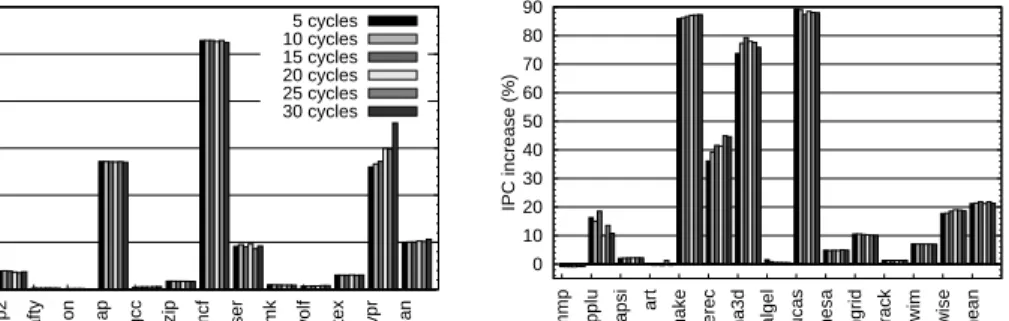
two energy-efficient configurations . . . 75
6.3 IPC increase provided by the baseline Future Execution
configura-tion and two energy-efficient configuraconfigura-tions . . . 76
6.4 Energy overhead of the baseline Markov EDHT configuration and
two energy-efficient EDHT versions . . . 78
6.5 IPC increase provided by the baseline Markov EDHT configuration
and two energy-efficient EDHT versions . . . 79
6.6 Energy overhead of the baseline Dual-Core Execution configuration
and three energy-efficient DCE configurations . . . 82
6.7 IPC increase provided by the baseline Dual-Core Execution
config-uration and three energy-efficient DCE configconfig-urations . . . 83
6.8 Energy consumption overhead of a the baseline markov EDHT
tech-nique, and energy-efficient versions of markov EDHT, future
exe-cution, and dual-core execution . . . 84
6.9 IPC increase provided by a baseline markov EDHT technique, and
energy-efficient versions of markov EDHT, future execution, and
dual-core execution . . . 85
6.10 Increase in the energy-delay product for the baseline markov EDHT technique, and energy-efficient versions of markov EDHT, future
execution, and dual-core execution . . . 85
6.11 Fraction of time the helper core is activated for the baseline mar-kov EDHT technique and the energy-efficient versions of marmar-kov
EDHT, future execution , and dual-core execution . . . 89
6.12 Increase in power consumption for the baseline markov EDHT tech-nique and the energy-efficient versions of markov EDHT, future
execution, and dual-core execution . . . 90
7.1 Load cache miss rate for the SPEC CPU2006 applications . . . 100
7.2 Sensitivity of the average load cache miss rate to the cache size . . 101
7.3 Impact of value prediction on the load cache miss rate . . . 103
7.4 Impact of future execution on the load cache miss rate . . . 105
7.5 Impact of runahead execution on the load cache miss rate . . . 106
7.6 Impact of prefetching techniques on average load cache miss rate of
integer applications in SPEC CPU2000 (left graph) and CPU2006 (right graph) suites . . . 107
7.7 Impact of prefetching techniques on average load cache miss rate
of floating-point applications in SPEC CPU2000 (left graph) and CPU2006 (right graph) suites . . . 109
INTRODUCTION
This chapter describes how scaling the performance of single-threaded applica-tions represents a serious impediment to the success of chip multiprocessor (CMP) architectures. It also discusses how the slow execution speed (the latency) of load instructions can impact the performance of individual program threads and intro-duces data prefetching, a technique to alleviate the load latency problem. Further-more, the contributions of this dissertation to the area of multi-core prefetching are presented.
1.1
Problem
Chip multiprocessors hold the promise of delivering performance scalability while significantly reducing the complexity relative to monolithic superscalar out-of-order cores. In fact, all major high-performance microprocessor manufacturers are al-ready selling chips with up to eight cores. CMPs improve the performance by integrating many cores on the same die and using them to harness thread-level parallelism (TLP). At the same time, designing simple cores and then replicating them reduces complexity.
While multiple cores are immediately beneficial in multiprogrammed environ-ments, scaling the performance of applications with little TLP is one of the most serious impediments to the success of CMP architectures. Modern automatic par-allelization tools are efficient only on a small subset of data-regular applications. Manual parallelization to extract significant TLP from general-purpose applica-tions is often a difficult, time-consuming, and therefore expensive and error prone task. Moreover, many programs exhibit limited scalability beyond a certain
ber of threads and are inherently incapable of utilizing the advantages of multiple cores. In light of these trends, architectural techniques that allow the use of addi-tional cores to speed up individual threads are becoming very attractive to CMP manufacturers [38].
This dissertation investigates simple yet efficient ways to realize this goal.
One way to achieve this objective is to utilize additional cores as helper engines for individual threads. These helper engines can accelerate program execution by alleviating some of the performance bottlenecks that prevent the program thread from fully utilizing a core’s capabilities.For example, helper engines can reduce the number of branch mispredictions or eliminate stalls associated with cache misses. The following section demonstarted that eliminating main memory stalls has high performance improvement potential and provides a very attractive problem for helper engines to attack.
1.2
Main Memory Stalls
Over the past two decades the CPU speed has been growing faster than the speed of the memory subsystem. As a consequence, memory accesses have, in relative terms, become slower over the years. The long latency of memory accesses causes modern high-end microprocessors to deliver only a fraction of their theoretical peak performance. Whenever the processor core requests data that is located in the main memory, it has to stall for many clock cycles while the request is delivered to the memory subsystem and the data is located in the main memory and transferred back to the processor.
To reduce the access time of frequently used data, most modern microprocessor systems incorporate multiple levels of fast cache memory. The first level caches
are characterized by the smallest sizes and the fastest access times. These caches store the most recent data in case it is needed again. Subsequent cache levels are generally bigger and slower. The main memory is at the end of the memory hierarchy and has the longest access time. When a load instruction is executed, the first-level cache is queried for the desired data item. If the data item is available in the first-level cache, it is fetched to the processor and the load request is satisfied very quickly. If not, the load request gets forwarded to subsequent cache levels until the requested data is found. If the data cannot be found in any cache, the data has to be retrieved from main memory. Hence, the time it takes to execute a load instruction depends on the cache level that satisfies the load request and can vary from a few clock cycles to hundreds of cycles. In comparison, reading data values from the CPU’s register file rarely takes more than a single cycle.
While caching is effective at reducing the average load latency, a wide range of applications have relatively high cache miss rates, i.e., a large fraction of load requests that is not satisfied at any level of cache hierarchy. Since load instructions
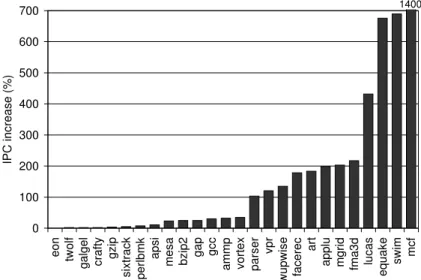
Figure 1.1: Execution time speedup for SPEC CPU2000 programs if all main memory stalls are eliminated
are the most frequently executed instructions in modern CPUs, even a small num-ber of loads that miss in the cache can severely degrade processor performance. Figure 1.1 demonstrates the theoretical speedup of SPEC CPU2000 programs run-ning on an Alpha 21264-like microprocessor core with 64KB first-level cache, 2MB second-level cache, and a main memory latency of 400 cycles when the negative effects of all second-level cache misses are eliminated (i.e., assuming all first-level cache misses are second-level cache hits). The data reveal that for half of the SPEC programs the high latency of memory accesses reduces the core efficiency by more than a factor of two even in the presence of a cache hierarchy with a significant capacity.
1.3
Data Prefetching
Fortunately, load instructions often reference predictable sequences of data ad-dresses. For example, a large fraction of the load instructions that miss in the cache occur in loops that sequentially traverse the elements of large data arrays [23]. The data addresses referenced by such loads form an easily predictable sequence of in-crementally increasing addresses. Such behavior, which has been demonstrated
explicitly on a number of architectures, is a specific case of value locality [11, 28].
The predictability of load addresses can be exploited by predicting which data will be requested by the CPU ahead of the actual load requests.
Data prefetching techniques identify load addresses that miss in the cache and try to detect such predictable address patterns. Based on the identified patterns, data prefetchers predict future load addresses and issue load requests on behalf of a CPU. The data items requested by a prefetcher are pre-loaded into a certain level of cache and, when needed, can be readily consumed by a CPU. Thus, correctly
predicted prefetches can effectively eliminate stalls associated with long memory latencies and significantly increase program execution speed.
There are multiple ways to identify instructions with predictable load addresses. First, such instructions can potentially be detected via static program analysis. In this approach, the program binary or source code is analyzed prior to program execution. The limitation of this technique is a rather large number of run-time constants, which are not known at compile time. The second class of analysis techniques involves profile-driven approaches that analyze program behavior by running a set of sample inputs. While this approach provides better knowledge of the program behavior, it does not provide accurate estimation of temporal data locality that characterizes caching effects. As a result, it might result in incorrect conclusions about which load instructions are likely to miss or hit in the cache. The third class of analysis techniques represents dynamic analysis approaches which continuously measure the behavior of programs while they execute. This dynamic approach does not suffer from the limitations of static and profile-driven tech-niques, but it can potentially incur run-time overheads or require specific hardware support.
Due to the limitations of the static and profile-driven approaches, this disser-tation focuses on developing new data prefetching algorithms utilizing dynamic techniques. As such, I propose approaches that can accelerate existing applica-tions without requiring profiling or compiler support. Moreover, I propose to take advantage of available cores in a CMP to significantly lower the implementation complexity and hardware support usually associated with dynamic data prefetch-ing techniques.
1.4
Contributions
The goal of this dissertation is to develop and evaluate novel prefetching techniques that can use available cores in multi-core microprocessors to prefetch data for computation threads running on active cores. My contributions toward this goal include the following:
• Future Execution based prefetching
The development of a novel prefetching mechanism using a simple hardware value predictor to dynamically generate prefetching threads that can compute and prefetch a significant fraction of unpredictable load addresses.
• Prefetching with event-driven helper threading
The design of a mechanism to implement prefetching algorithms based on value prediction entirely in software, improving the flexibility of prefetcher implementations and minimizing additional hardware complexity.
• Energy-efficient prefetching techniques
Several approaches to substantially decrease the energy consumption of the proposed prefetching techniques by minimizing prefetching activity for pro-gram phases with low miss rates.
• Prefetching coverage analysis
A comparative microarchitecture-independent analysis of the prefetch cov-erage provided by various prefetchers and validating the relevance of the proposed techniques in the context of future computer systems.
The results of this research have the potential to impact future generations of microprocessors in two important ways. First, they present relatively simple
ways to use extra cores of CMPs as helper engines for individual program threads. Thus, they enable multi-core architectures to accelerate applications with both little and abundant thread-level parallelism. Second, they resolve many limitations of hardware prefetching techniques previously proposed in the research literature and reduce their implementation complexity while providing competitive execution time speedups. The individual contributions are described in more detail in the following paragraphs.
A data-flow analysis of the instructions that compute load addresses revealed that many loads are caused by cache misses that execute repeatedly and whose address-generating program slices do not change (much) between consecutive ex-ecutions. Based on this observation, I proposed the Future Execution prefetching technique, which dynamically generates a prefetching thread for each active core by simply sending a copy of all committed, register-writing instructions to another core. The key innovation is that on the way to the second core, a value predictor replaces each predictable instruction in the prefetching thread with a load imme-diate instruction, where the immeimme-diate is the predicted result that the instruction
is likely to produce during its nth next dynamic execution. Experimental results
show that executing the future execution prefetching thread on an available core of a CMP can prefetch a larger fraction of cache misses than conventional stride prefetching and can deliver a significant execution time speedup on a wide range of applications.
Next, I analyzed hardware prefetching algorithms that are based on value pre-diction. I found that despite a large number of interesting proposals, their in-troduction into commercial designs was often hampered by the considerable stor-age requirements for prediction tables and/or application specificity. To alleviate
these limitations, I developed an event-driven helper threading (EDHT) frame-work, which allows using general-purpose memory for storage and a software helper thread for executing a prefetching algorithm on an available CMP core. Experi-mental results show that implementations of various prefetching techniques within the EDHT framework provide performance improvements within 5% of pure hard-ware implementations.
I investigated a hybrid prefetching approach by running event-driven helper threads on top of a baseline with a conventional hardware stride prefetcher. I found that this approach significantly outperforms a configuration that only in-cludes a hardware stride prefetcher. Furthermore, the results show that the EDHT approach provides competitive performance improvements over other approaches for muti-core helper threading while executing fewer instructions and requiring considerably less hardware support.
Next, I found that the proposed prefetching techniques considerably increase the energy consumption. Since energy consumption has recently became a high-priority concern even for high-performance microprocessors, I investigated tech-niques to reduce the energy overheads of Future Execution and Event-Driven Helper Threading. Experimental results show that the proposed techniques de-crease the average energy overhead of the prefetching techniques by more than a factor of two.
Finally, I validated the general conclusions of this dissertation in the context of the new SPEC CPU2006 benchmark suite. First, I demonstrated that the high latency of memory accesses is likely to remain an important problem for CPU2006 programs. Second, I developed analysis techniques to evaluate the prefetching potential of various prefetching techniques. Interestingly, I found little difference
between various techniques for cache sizes larger than 2MB. Therefore, the dif-ferences between the analyzed prefetching approaches are more likely to originate from prefetch timeliness rather than from coverage. This result is similar to the properties observed for the SPEC CPU2000 programs and, therefore, the general conclusions of this dissertation are likely to remain relevant in the context of the newer benchmark suite release.
1.5
Summary
Scaling the performance of applications with little thread-level parallelism is one of the most serious impediments to the success of multi-core architectures. At the same time, the long latency of memory accesses represents one of the largest performance bottlenecks for individual program threads.
In this dissertation, I developed techniques that utilize extra cores of a CMP as helper engines to increase the performance of single program threads. In particular, my work focuses on using available cores to run data prefetching algorithms to mit-igate the detrimental effects of the long memory latencies. The main contribution of this dissertation is the development and evaluation of two multi-core prefetching techniques that provide significant performance improvements for single-threaded applications running in a multi-core environment.
1.6
Organization
The remainder of this dissertation is organized as follows. Chapter 2 explains the impact of the load latency on modern superscalar CPUs and the operation of con-ventional data prefetching techniques. Chapter 3 describes the configuration of
the simulator that is used to measure the speedup numbers and discusses the ap-plication benchmark suite. Chapter 4 introduces the Future Execution technique and analyzes its impact on single-thread performance. Chapter 5 investigates the idea of Event-Driven Helper Threading and compares its performance with other dual-core helper threading techniques. Chapter 6 takes a closer look at the energy consumption of different helper threading techniques, proposes several improve-ments to make the techniques more energy-efficient, and evaluates their effective-ness. Chapter 7 presents a set of techniques for microarchitecture-independent evaluation of different helper-threading techniques based on trace-driven simula-tion and validates the general conclusions of the previous chapters in the context of the SPEC CPU2006 benchmark suite. Chapter 8 presents related work on data prefetching in uni-core and multi-core environments. Chapter 9 summarizes my work and takes a look into the future.
BACKGROUND
This chapter provides background information on the operation of contempo-rary high-performance microprocessors. Furthermore, it describes data address prediction approaches and the operation of data prefetching techniques.
2.1
Conventional High-Performance Processor Architecture
Most modern high-performance microprocessors have a superscalar architecture with hardware support for dynamic out-of-order execution [35]. Since the goal of my work is to improve the performance of high-performance microprocessors, all experimental results in this dissertation are obtained by simulating the operation of such a CPU. The list of configuration parameters of the simulated CPU can be found in Chapter 3.
The term superscalar refers to CPU organizations that can execute multiple
instructions at the same time. An out-of-order CPU is capable of dynamically
re-arranging the order in which instructions are executed. Both superscalar and out-of-order execution techniques exploit the instruction-level parallelism (ILP) of computer programs. ILP is characterized by the existence of instructions that are not dependent on the results of each other and, consequently, can be executed in any order or in parallel.
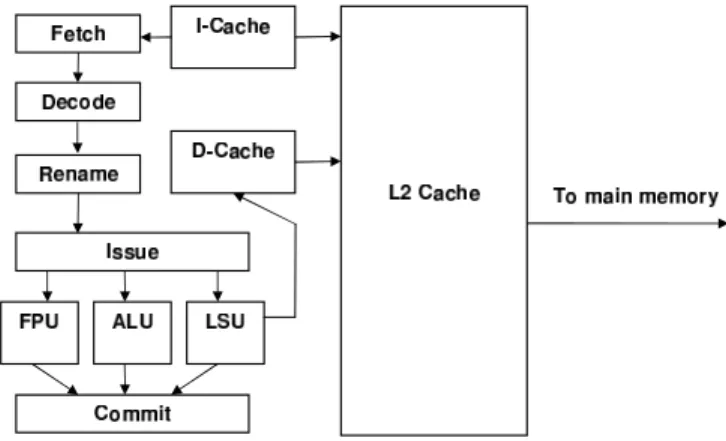
Figure 2.1 shows a conceptual pipeline organization of such a CPU. First, in-structions are fetched from the instruction cache. Then, they are decoded, re-named, and dispatched into the instruction window as long as there are buffer slots available. This dissertation assumes that these pipeline stages process instructions in program order. While there are proposals in the literature for out-of-order
plementations of these pipeline stages for increased performance [35], they incur significant hardware complexity and have yet to find their way into commercial microprocessor implementations.
After being dispatched into the instruction window, each instruction remains there until all of its source operands become available. The CPU’s issue logic continuously scans the instruction window and searches for such instructions. If a ready instruction is found, the issue logic checks the availability of a functional unit (FU) that can execute this instruction. Once a functional unit becomes available, the instruction is sent to the assigned unit for execution. As a result, instructions in the instruction window might execute out of program order since their execution is determined exclusively by the availability of data values. Executed instructions are marked as completed. The commit stage of the CPU pipeline involves scanning instructions in the program order, identifying completed instructions, and retiring them from a CPU.
Modern superscalar CPUs can operate on multiple instructions in each stage of the pipeline. As a result, they are capable of processing several instruction per cycle (IPC) as long as there is enough ILP within the internal instruction window.
Most program instructions that do not need to load data from memory have deterministic latencies (no more than a few cycles). Thus, they can always exe-cute and retire fast, maintaining a high IPC rate. However, the latency of load instruction depends on the location of the requested data in the cache hierarchy. Out-of-order execution is often able to mitigate the effects of latencies associated with accessing second-level and third-level caches. Nevertheless, main memory la-tencies in modern CPUs are on the order of hundreds of cycles. Thus, if a load instruction misses in the cache, it eventually stalls the pipeline since it is very difficult for a CPU to find enough instructions to keep itself busy for so long.
2.2
Address Prediction and Prefetching
Hardware prefetchers often rely on various kinds of address predictors to dynam-ically predict which memory addresses to prefetch. In this work, we examined stride-based address prediction and Markov address prediction. This section briefly discusses both approaches and introduces the basic algorithms that I later use in this dissertation.
2.2.1
Stride Prefetching
Stride prefetchers represent the most common form of prefetching based on out-come prediction. The stride prefetcher is usually located in the cache controller, where it monitors the stream of cache miss requests observed by the cache. Stride prefetchers identify distinct streams within the sequence of cache misses, associate strides with each of the streams, and issue memory requests for the next few ad-dresses in the stream. The simplest form of stride prefetching is next-sequential
prefetching, in which the prefetcher issues a request for cache line L+1 as soon as line L is referenced [36].
In many cases cache miss addresses are composed of several interleaved streams. A typical case of multiple streams is the traversal of several arrays within a matrix-matrix multiplication loop. Stride prefetchers employ special mechanisms to deci-pher and disambiguate interleaving streams. If the memory hierarchy propagates the program counter (PC) of the instructions that cause cache misses, the pre-fetcher can attribute misses to specific instructions and track streams on a per PC
basis [10]. We call this local stride prefetching. The conventional implementation
of a local stride prefetcher uses a table to store stride-related local history informa-tion and is shown in Figure 2.2a. The PC of the current load instrucinforma-tion indexes the table. Each table entry holds the load’s last stride and the last address. A prefetch is triggered when the load causes a cache miss and its last stride is equal to the current stride.
If PC information is not available, then a global stride prefetcher can be used.
Such stride prefetchers need to identify distinct streams within the global memory access pattern. Minimum delta prediction and memory partitioning were proposed to handle this problem. Minimum delta prediction associates a miss with the stream or prior miss that is the closest. Memory partitioning separates the physical
Last address … … Stride PC == Predicted stride Miss address … Global Miss Address History Miss address Min delta Predicted stride a) b) _
memory address space into regions and attributes all misses falling within a single region to a single stream [50]. Figure 2.2b shows the organization of a global stride prefetcher. When a cache miss occurs, the global miss history buffer is searched for the minimum difference between the previously observed addresses and the current miss address. An address stream is identified if the global miss history contains an address that differs from the current address by no more than two minimum deltas.
For each identified address stream, the prefetcher allocates a prefetch stream buffer from a limited number of available buffers. This buffer contains information about the current stream base address and the associated stride. Typically, stride prefetchers use an LRU replacement policy for stream buffers. The newly allocated stream buffer issues prefetches and then waits for the prefetched cache lines to be requested by the processor. Upon receiving such a notification, the stride prefetcher looks up its stream table to see which stream entry the consumed address belongs to. If it finds a match, it increments the corresponding stream address by the stream’s stride and issues one new prefetch to keep up with the data consumption of the processor.
Overall, majority of cache misses in a wide range of applications exhibit stride pattern behavior (See chapter 7). This universal applicability and relative sim-plicity made stride prefetchers the most popular hardware prefetching technique in commercial microprocessors. Nevertheless, a significant portion of cache misses exhibit access patterns which are not detectable by stride prefetchers. The next subsection presents prediction approaches that attempt to identify and prefetch more complicated cache miss patterns.
2.2.2
Markov Prefetching
Markov prefetching [21] is another example of outcome-based prediction. A Markov predictor assumes that the address stream of a program can be approximated by a Markov model. A Markov model is a probabilistic state machine with a set
of states and state transition probabilities. Each transition from state A to B
is assigned a weight representing the fraction of A states that are followed by B
states. Figure 2.3a presents an example of a Markov model. The states in the Markov model are determined by the set of previously seen values.
… stride 1 PC hash Predicted stride a) b) Sequence of addresses A, B, C, D, B, A, C, D, B, C Markov graph A B C D 1 1 2/3 1/3 1/2 1/2 … … stride 2 … stride 3 Last value …
Figure 2.3: Markov prefetching
Markov models are usually characterized by two parameters. The first param-eter dparam-etermines what kind of values defines a state. In case of prefetching, the most common approach is to use either the absolute addresses or the differences between consecutive addresses. The second parameter determines how many
val-ues are used to determine the state. An ordern Markov predictor associates each
state with the n previous values.
Markov prefetching techniques incrementally build an Markov model for the target application at run-time. This model is later used by a prefetching mechanism to predict future addresses. Previous work on hardware-based Markov prefetching concentrated on finding optimal parameters for an accurate Markov model that
work well for many applications and on devising efficient hardware designs to store this model. The most common hardware implementation in the literature is based on a two-level table representation. The first table contains information to determine the current state (i.e., a node in the Markov model). As in the case of stream prefetchers, there are global and a local versions of Markov prefetchers. A local Markov prefetcher, shown in Figure 2.3b, uses the load’s PC to index the first-level table, which stores a local history of the last three deltas for that load. A global Markov prefetcher uses a global history of the last three deltas (instead of a per-PC local history).
The calculated state serves as an index into the second-level table, which stores predictions (the immediate neighbors of the current node). To limit the total area required for the table, the second-level table usually contains only a limited number of unique predictions. A Markov prefetcher can prefetch the addresses predicted
by the adjacent nodes in the Markov model. We refer to this policy as width
prefetching. However, it is also possible to performdepth prefetching in which the
sequence of arcs in the Markov model is traversed with prefetching initiated at each node along the path. We use a combination of width and depth prefetching in our experiments.
Overall, Markov prefetchers can predict many non-stride memory access pat-terns. This capability, however, often requires significant amount of storage for markov graphs. In spite of a high performance potential, limited transistor budgets and implementation complexity prevented a wide-spread use of markov algorithms in the modern CPUs.
EVALUATION METHODOLOGY
This chapter describes the configuration of the baseline CPU that is used for the cycle-accurate simulations and gives information about the benchmark programs that are used for the performance evaluations.
3.1
Baseline Architecture
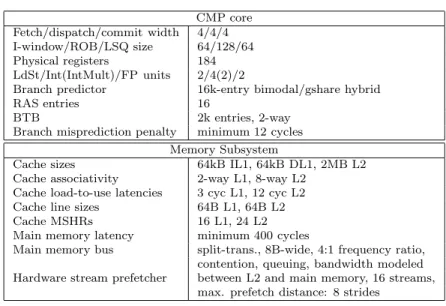
All cycle-accurate measurements in this dissertation are based on the DEC Alpha AXP architecture [7]. The various prefetching techniques are evaluated using an extended version of the SimpleScalar v4.0 simulator [27]. The simulator is con-figured to emulate a two-way high-performance CMP consisting of two identical four-wide dynamic superscalar cores that are similar to the Alpha 21264. It ac-curately models microprocessor’s internal timing behavior, resource constraints, speculative execution as well as memory hierarchy and its latencies. Bandwidth and contention on the memory bus are also fully modelled.
The modeled CPU parameters of each CMP core are shown in Table 3.1. Each simulated CMP core is four-way superscalar, supports up to 128 in-flight instruc-tions, issues instructions out-of-order from a 64-entry instruction window, has a 64-entry load/store queue, four integer and two floating-point units, a 64KB two-way set associative L1 data cache, a 64KB two-two-way set associative instruction cache, a 2048-entry branch target buffer (BTB), and a 16384-line hybrid gshare-bimodal branch predictor. A 2MB unified eight-way set associative L2 cache is shared between the two cores. All functional units are fully pipelined. Simulated cache latencies are calculated with CACTI 3.2 tool [44].
Table 3.1: Simulated processor parameters CMP core Fetch/dispatch/commit width 4/4/4 I-window/ROB/LSQ size 64/128/64 Physical registers 184 LdSt/Int(IntMult)/FP units 2/4(2)/2
Branch predictor 16k-entry bimodal/gshare hybrid RAS entries 16
BTB 2k entries, 2-way Branch misprediction penalty minimum 12 cycles
Memory Subsystem
Cache sizes 64kB IL1, 64kB DL1, 2MB L2 Cache associativity 2-way L1, 8-way L2
Cache load-to-use latencies 3 cyc L1, 12 cyc L2 Cache line sizes 64B L1, 64B L2 Cache MSHRs 16 L1, 24 L2 Main memory latency minimum 400 cycles
Main memory bus split-trans., 8B-wide, 4:1 frequency ratio, contention, queuing, bandwidth modeled Hardware stream prefetcher between L2 and main memory, 16 streams,
max. prefetch distance: 8 strides
Unless otherwise noticed, the baseline configuration includes an aggressive hardware global stride prefetcher [37] between the shared L2 cache and main mem-ory. The stream prefetcher tracks the global history of the last 16 miss addresses, detects arbitrary-sized strides, and applies a stream filtering technique by only allocating a stream after a particular stride has been observed twice. It can simul-taneously track 16 independent streams, and prefetch up to 8 strides ahead of the data consumption of the processor.
3.2
Benchmarks
This study uses all 26 integer and floating-point programs from the SPECcpu2000 benchmark suite [18]. The programs are run with the SPEC-provided reference inputs. If multiple reference inputs are given, we simulate the corresponding pro-grams with up to the first three inputs and average the results from the different
ref-Table 3.2: Benchmark suite details (for the simulated intervals of 500M instruc-tions)
App. NoPref loads L1 miss L2 miss perfect L2 IPC (M) rate (%) rate (%) speedup (%)
SPEC INT bzip2 1.56 143.94 1.47 0.70 24.55 crafty 1.92 155.85 0.82 0.07 2.10 eon 1.75 148.32 0.12 0.00 0.20 gap 1.44 127.02 0.36 1.22 24.62 gcc 1.33 180.30 2.56 1.10 30.38 gzip 1.69 113.80 3.52 1.77 3.35 mcf 0.04 209.74 23.11 48.62 1399.55 parser 0.84 125.79 2.56 2.40 103.48 perlbmk 1.77 146.69 0.30 0.09 7.42 twolf 1.29 144.63 5.04 0.05 1.84 vortex 2.09 130.30 0.75 0.39 34.55 vpr 0.54 165.19 3.10 3.29 120.41 SPEC FP ammp 1.44 132.32 3.90 1.35 31.92 applu 0.97 114.27 2.10 6.64 198.38 apsi 2.43 120.67 1.52 0.78 10.81 art 0.69 148.46 19.72 6.97 183.48 equake 0.26 234.53 7.50 24.40 675.56 facerec 1.15 123.90 2.40 4.83 178.51 fma3d 0.80 150.17 3.01 7.10 217.41 galgel 2.49 184.71 2.94 0.29 2.00 lucas 0.42 80.69 7.91 23.68 431.63 mesa 1.92 129.16 0.32 0.55 23.04 mgrid 0.91 183.09 2.42 19.02 203.19 sixtrack 2.62 96.83 0.23 0.18 4.77 swim 0.42 123.65 8.51 19.11 689.75 wupwise 1.30 114.31 1.15 3.60 134.67
erence inputs. Only one of the reference inputs is simulated (routing) because
SimpleScalar could not simulate vpr correctly with the second input (placement).
The C programs were compiled with Compaq’s C compiler V6.3-025 using “–O3 –arch ev67 –non shared” plus feedback optimization. The C++ and Fortran 77 programs were compiled with g++/g77 V3.3 using “–O3 –static”. The Fortran 90 programs were compiled with Compaq’s f90 compiler V5.3-915.
SimPoint 3.1 toolset [43] and SimpleScalar’s sim-safe simulator are used to
identify representative simulation points. Each program is simulated for 500 million instructions after fast-forwarding past the number of instructions determined by SimPoint.
Table 3.2 provides information about the benchmarks used. The first column represents the baseline IPC for each program. The second column shows the total number of load instruction in the simulated program interval. The third and fourth columns show local miss rates for L1 data cache and L2 unified cache. Finally, the fifth column represents the speedup for each application in the case where all load requests that miss in L1 cache. Thus, the last column demonstrated the maximum potential speedup achievable by data prefetching techniques.
Out of the 26 programs used in this study, four integer and two floating-point programs are not memory-bound since they obtain less than 5% speedup with a perfect L2 cache. The perfect-cache speedup for the rest of the programs varies
greatly and reaches up to 1400% for mcf. This large speedup is explained by
an exceptionally large number of L1 misses and a very high L2 cache miss rate
that reaches 48.6%. Note that for several memory-bound programs (e.g., mcf, art,
equake, and swim) the perfect L2 cache speedup cannot be obtained even with a perfect prefetching scheme because of memory bus bandwidth limitations.
FUTURE EXECUTION
This chapter presents the investigation of program properties related to cache misses and presents the idea of the Future Execution prefetching technique. Fur-thermore, it describes the implementation of Future Execution and performance results. A sensitivity analysis of future execution to several architectural parame-ters concludes this chapter.
4.1
Motivation
This section presents a quantitative analysis of the common program properties that are exploited by future execution. All results are obtained using the bench-mark suite and baseline microarchitecture described in Section 4.3.
One of the main program properties exploited by FE is that most load misses occur in “loops” with relatively short iterations. Note that we call any repetitively executed instruction a loop instruction and that FE is completely unaware about the location of loops in a program. Figure 4.1 presents the breakdown of the distance between the load instructions that cause an L2 cache miss and the previous execution of the same load instruction. The bars are broken down by distance: fewer than 100, between 100 and 1000, and between 1000 and 10000 dynamic instructions. The taller the bar, the more often that range of instruction distances occurred. The total height of the bar represents the fraction of L2 cache misses that occur in loops with less than 10000 instructions per iteration.
The data show that on average from 70% to 80% of the misses occur in loops with iterations shorter than 1000 instructions. This observation suggests a pre-fetching approach in which each load instruction triggers a prefetch of the address
0 10 20 30 40 50 60 70 80 90 100 gmean vpr vortex twolf perlbmk parser mcf gzip gcc gap eon crafty bzip2bzip2
fraction of L2 cache misses (%)
(1;100] (100;1000] (1000;10000] 0 10 20 30 40 50 60 70 80 90 100 gmean wupwise swim sixtrack mgrid mesa lucas galgel fma3d facerec equake art apsi applu ammpammp
fraction of L2 cache misses (%)
Figure 4.1: Execution distance measured in number of instructions between the loads that result in an L2 cache miss and the previous dynamic execution of the same static loads
that the same load is going to reference in the nth next iteration. Since in most
cases the time between the execution of a load instruction and its next dynamic execution is relatively short, this approach is unlikely to prefetch much too early.
Analyzing the instructions in the dataflow graphs of the problem loads, I found that while problem load addresses might be hard to predict, the inputs to their dataflow graphs often are not. Therefore, even when the miss address itself is unpredictable, it may be possible to predict the input values of the instructions leading up to the problem loads and thus to compute an accurate prediction by executing these instructions.
Figure 4.2 shows the breakdown of the load miss addresses in the SPECcpu2000 programs that can potentially be predicted and prefetched by future value predic-tion and by future execupredic-tion one iterapredic-tion ahead of the main program execupredic-tion. The lower portion of each bar represents the fraction of misses that is directly pre-dictable by a stride-two-delta (ST2D) value predictor [42]. The upper bar shows how many miss addresses that are not predictable by the ST2D predictor can be correctly obtained by predicting the inputs of the instructions in the dataflow graph of the missing loads with ST2D predictor and computing the resulting
0 10 20 30 40 50 60 70 80 90 100 mean vpr vortex twolf perlbmk parser mcf gzip gcc gap eon crafty bzip2
fraction of L2 load misses (%)
fexec fvpred 0 10 20 30 40 50 60 70 80 90 100 mean wupwise swim sixtrack mgrid mesa lucas galgel fma3d facerec equake art apsi applu ammp
fraction of L2 load misses (%)
Figure 4.2: Distribution of cache miss addresses that can be correctly predicted
directly by a future value predictor (fvpred) and using future execution (fexec)
dress. The height of the stacked bar indicates the total fraction of misses that can potentially be correctly predicted. To measure the potential prediction coverage of future execution, we reconstruct the dataflow graph of each problem load when-ever a cache miss occurs, compare it to the dataflow graph of the same static load during its previous execution, extract the part of the dataflow graph that is the same, and then check if the values provided by the future value predictor during the previous execution would have allowed to correctly compute the load address referenced by the load instruction in the current iteration. The size of analyzed dataflow graph is limited to 64 instructions. This potential study ignores the ef-fects of unpredictable loop-carried dependencies passed through memory, i.e., all load instructions with predictable addresses are assumed to fetch correct data one iteration ahead.
Figure 4.2 illustrates that while value prediction alone is quite effective for some applications, future execution can significantly improve the fraction of load miss addresses that can be correctly predicted and prefetched. Half of the SPECcpu2000 programs experience a significant (over 10%) increase in prediction coverage when future execution is employed in addition to value prediction.
Figure 4.3: Code example
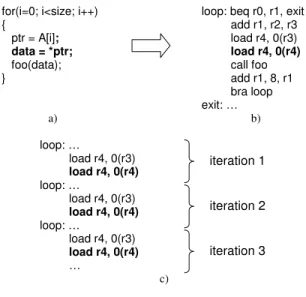
Figure 4.3a shows a code example that exhibits the program properties
dis-cussed above. An array of pointers A is traversed, each pointer is dereferenced
and the resulting data are passed to the function “foo”. Assume that the data referenced by the elements of array A are not cache-resident. Further assume that there is little or no regularity in the values of the pointers stored in A. Under these
assumptions each execution of the statement data=*ptr will cause a cache miss.
As shown in Figure 4.3b, in machine code this statement translates into a single
load instruction load r4, 0(r4)(highlighted in bold).
A conventional predictor will not be able to predict the address of the problem instruction since there is no regularity in the address stream for this instruction.
However, the address references of instruction load r4, 0(r3) are regular
be-cause each instance of this instruction loads the next consecutive element of array
A. Therefore, it is possible to use a value predictor to predict the memory
ad-dresses for this instruction, speculatively execute this instruction, and then use the speculatively loaded value to prefetch the data for the problem load instruc-tion. Since the control flow leading to the computation of the addresses of the
problem load remains the same throughout each loop iteration (Figure 4.3c), a value predictor can provide predictions for the next iterations of the loop and the addresses of the problem load will be computed correctly. Therefore, sending the two load instructions to the second core in commit order and future predicting the first instruction makes it possible to compute the addresses of the second load that will be referenced by the main program during the next iterations.
4.2
Implementation of Future Execution
The implementation of future execution is based on a conventional chip multipro-cessor. A high-level block diagram of a two-way CMP supporting FE is shown in Figure 4.4. Both microprocessors in the CMP have a superscalar execution engine with private L1 caches. The L2 cache is shared between the two cores. Conven-tional program execution is performed on the “left” core while future execution is performed on the “right” core. To support FE, a unidirectional communication link is introduced between the cores with a value predictor attached to it. Both the communication link and the predictor are not on the critical path and should not affect the performance of either core in a negative way. The following subsections describe the necessary hardware support and the operation of FE in greater detail.
4.2.1
Overview of Operation
Each register-writing instruction committed in the regular core is sent to the second core via the communication link. The data that need to be transferred to the second core include the decoded instruction, result value, and a partial PC to index the value predictor table. Stores, branches, jumps, calls, returns, privileged instructions, and system calls are not transmitted. If the communication link’s
Figure 4.4: The FE architecture
buffer is full, further committed instructions are dropped and not transmitted to the second core. Each sent instruction passes through the value predictor, updates the predictor with its current output and requests a prediction of the value it is
likely to produce in thenth next dynamic instance. Each prediction is accompanied
by a confidence estimation [28].
If the confidence of the prediction is high, the corresponding instruction is
replaced by a load immediate instruction, where the immediate is the predicted
result. If the predicted instruction is a memory load, an additional non-binding
prefetch instruction for that load’s address is generated right before theload
imme-diate instruction. This allows the future core to prefetch this data without stalling the pipeline if the memory access misses in the cache. All instructions with a low prediction confidence remain unmodified.
After that, the processed stream of committed instructions is sent to the second core, where it is injected into the dispatch stage of the pipeline. Since instructions are transmitted in decoded format, they can bypass the fetch and decode stages. Instruction dispatch proceeds as normal – each instruction is renamed and allocated a reservation station and a ROB entry if these resources are available. Whenever the input values for the instruction are ready, it executes, propagates the produced result to the dependent instructions and updates the register file. If the instruction
at the head of the ROB is a long latency load, it is forced to retire after a timeout period that equals the latency of an L2 cache hit. This approach significantly improves the performance of the FE mechanism as it avoids stalling the pipeline. Timed out instructions set the invalid bit in the corresponding result register. The execution of instructions that depend on the invalidated result is suppressed.
When entering FE mode, i.e., before the prefetching thread starts being injected into the available idle core, all registers of that core are invalidated. This flash invalidation of all registers occurs only once before the future execution thread is launched. The invalid register bits are gradually reset by the executed future
instructions that have valid inputs. For example, load immediate instructions
always make their target registers valid since they do not have input dependencies. This register invalidation policy suppresses the execution of all further instructions whose inputs cannot be predicted or computed with high confidence.
Note that the implementation of future execution in this dissertation differs from the implementation used in some of the previous studies [12, 13]. This study simplifies the implementation so that all instruction transformations take place outside the core. For example, our previous implementation required special logic in the dispatch stage of the pipeline to fill in the result field of the ROB and RS entries of FE instructions with predicted values. The implementation presented in this dissertation is more intuitive, requires no additional dispatch logic to sup-port future execution, and features a simpler way to suppress the execution of unpredictable instructions.
4.2.2
Hardware Support
Future execution requires additional hardware support to transmit decoded in-structions, their result values, and partial PCs to the value predictor between the cores. Depending on the microarchitecture, the ROB may have to be augmented to hold the necessary data until instruction retirement. In this study, the com-munication bandwidth corresponds to the commit width (4 instructions/cycle), which is a reasonable bandwidth for a unidirectional on-chip point-to-point link. Since it is rare for a microprocessor to fully utilize its commit bandwidth for a long period of time, and because not all instructions need to be transmitted to the second core, it may be possible to curtail the bandwidth without significant loss of performance. For example, Section 4.4.4 demonstrates that the communication bandwidth can be reduced to 2 instructions/cycle with little effect on the efficiency of the FE mechanism.
The value prediction module resides between the two CMP cores. The sented implementation uses a relatively simple, PC-indexed stride-two-delta pre-dictor [42] with 4,096 entries. The prepre-dictor estimates the confidence of each prediction it makes using 2-bit saturating up-down counters. The confidence is incremented by one if the predicted value was correct and decremented by one if the predicted value was wrong. The particular organization of the value predictor is not essential to our mechanism and a more powerful predictor (e.g., a DFCM predictor [14]) may lead to higher performance.
To support the execution of the future instruction stream, a multiplexer has to be added in front of the dispatch stage of the pipeline. In FE mode, the multiplexer directs instructions to be fetched from the receive buffer of the communication link. In normal mode, instructions are fetched by the processor’s front end.
The processor’s register file may have to be extended to accommodate an in-valid bit for each physical register. Only one extra bit per register is needed. Many modern microprocessors already include some form of dirty or invalid bits associated with each register that could be utilized by the FE mechanism.
Since I model a two-way CMP with private L1 caches, a mechanism is needed to keep the data in the private L1 caches of the two cores consistent. This work relies on an invalidation-based cache coherency protocol for this purpose. Therefore, whenever the main program executes a store instruction, the corresponding cache block in the private cache of the future core is invalidated. Since store instructions are not sent to the future core, future execution never incurs any invalidations.
4.3
Evaluation Methodology
Future execution is evaluated using an extended version of the SimpleScalar v4.0 simulator [27]. The baseline is a two-way CMP consisting of two identical four-wide dynamic superscalar cores that are similar to the Alpha 21264. In all modeled configurations it is assumed that one of the cores in the CMP can be used for future execution. The full description of the baseline architecture and benchmark suite is provided in Chapter 3.
Table 4.1 describes the configuration of future execution parameters. The com-munication latency between the two cores is 5 cycles and the comcom-munication band-width corresponds to the commit band-width (4 instructions/cycle). Note that FE is not very sensitive to the communication latency (see Section 4.4.4). The implementa-tion of the future execuimplementa-tion mechanism employs a stride-two-delta (ST2D) value predictor [42] that predicts values four iterations ahead. Predicting four iterations ahead does not require extra time in case of the ST2D predictor. The predictor
Table 4.1: Future Execution Parameters
Future value predictor 4k-entry ST2D, 2bc conf. estimator
Prediction distance 4 strides ahead
Inter-core communication link 5-cycle latency, 4 insns/cycle bandwidth
Communication link buffer size 64 instructions
hardware needs to be modified to add the predicted stride four times, which is achieved by a rewiring that shifts the predicted stride by two bits.
4.4
Experimental Results
In this section, I experimentally measure the effectiveness of the proposed mecha-nism. Section 4.4.1, evaluates the performance of prefetching based on future exe-cution and compares the speedups with those of stream prefetching. Section 4.4.2 takes a closer look at prefetching itself and gains additional insight by measuring the prefetching accuracy and coverage as well as the timeliness of prefetches. Sec-tion 4.4.3 compares the future execuSec-tion technique to prefetching based on several variations of runahead execution and show that the two techniques are complemen-tary to each other. Finally, Section 4.4.4 studies the sensitivity of future execution to several parameters of the baseline microprocessor, such as the minimum memory latency, the inter-core communication delay/bandwidth, and the prefetch distance.
4.4.1
Execution Speedup
This section compares the performance impact of the proposed prefetching tech-nique to a stream-based hardware prefetcher. The base machine for this experiment is described in Table 3.1. It represents an aggressive superscalar processor
0 20 40 60 80 100 120 140 160 gmean vpr vortex twolf perlbmk parser mcf gzip gcc gap eon crafty bzip2 IPC increase (%) 1.9 0.1 0.1 13.6 0.2 0.9 26.4 4.6 0.5 0.3 1.5 13.05.0 fexec stream stream+fexec 0 50 100 150 200 250 300 350 400 gmean wupwise swim sixtrack mgrid mesa lucas galgel fma3d facerec equake art apsi applu ammp IPC increase (%) -0.8 16.3 2.0 -0.1 85.9 36.1 73.7 1.5 89.3 4.9 10.5 1.3 7.1 17.7 21.2
Figure 4.5: Execution speedup
out hardware prefetching. We model three processor configurations: the baseline
with prefetching based on future execution (fexec), the baseline with an
aggres-sive hardware stream prefetcher between the shared L2 cache and main memory (stream) [37], and the baseline with stream prefetching as well as future
execu-tion (stream+fexec). Figure 4.5 presents speedups for individual programs as well
as the geometric mean over the integer and the floating-point programs (integer programs are shown in the left panel, floating-point programs in the right panel). Note that the scale of the y-axis for the SPECint and the SPECfp benchmarks is different. The percentages on top of the bars are the speedups of future execution
combined with stream prefetching (stream+fexec) over stream prefetching alone
(stream).
The results show that the hardware stream prefetcher used in this study is very effective, attaining significant speedups for the majority of the programs,
with peaks of 306% for swim and 159% for lucas. The average speedup over the
SPECint programs is 13%, while the SPECfp applications experience an average speedup of 48%. Note that the parameters of the stream prefetcher are tuned to maximize the prefetching timeliness and to minimize cache pollution on our benchmark suite.
When the model with only future execution is compared to the model with only stream prefetching, future execution outperforms stream prefetching on five pro-grams, while stream prefetching is better on nine. The remaining twelve programs achieve about the same performance with both models. As the following section will show, in many cases the stream prefetcher can prefetch fewer load misses than future execution, but it provides more timely prefetching and hence larger perfor-mance improvements. The timeliness of the prefetches issued by future execution can be improved by adjusting the prediction distance of the future value predictor, but this study uses a fixed prediction distance (except for Section 4.4.4) to make
the results comparable. Nevertheless, thefexecmodel provides significant speedup
(over 5%) for 12 programs, with an average speedup of 13% for the integer and
40% for the floating-point programs, and a maximum of 227% on swim.
The model with the best performance is the one that combines the stream prefetcher and future execution. On average, this model has a 50% higher IPC than the model with no prefetching. Moreover, this model has a 10% higher IPC than the baseline with stream prefetching. Out of the 26 programs used in our study, 12 significantly benefit (over 5% improvement) from future execution when it is added to the baseline that already includes a hardware stream prefetcher. Looking at the behavior of the integer and floating-point programs separately, adding future execution to the baseline with a stream prefetcher increases the performance of SPECint and SPECfp by 5% and 21%, respectively. This indicates that future execution and stream prefetching interact favorably and complement each other by prefetching different classes of load misses.
Overall, the results in this section demonstrate that future execution is quite effective on a wide range of programs and works well alone and in combination
0 10 20 30 40 50 60 70 80 90 100 gmean vpr vortex twolf perlbmk parser mcf gzip gcc gap eon crafty bzip2
fraction of original L2 misses (%)
fexec stream stream+fexec 0 10 20 30 40 50 60 70 80 90 100 gmean wupwise swim sixtrack mgrid mesa lucas galgel fma3d facerec equake art apsi applu ammp
fraction of original L2 misses (%)
Figure 4.6: Prefetch coverage with a stream prefetcher.
4.4.2
Analysis of Prefetching Activity
This section provides insight into the performance of prefetching based on future execution by taking a closer look at the prefetching activity. It begins by presenting the prefetch coverages obtained by different prefetching techniques. The prefetch coverage is defined as the ratio of the total number of useful prefetches (i.e., the prefetches that reduce the latency of a cache missing memory operation) to the total number of misses originally incurred by the application.
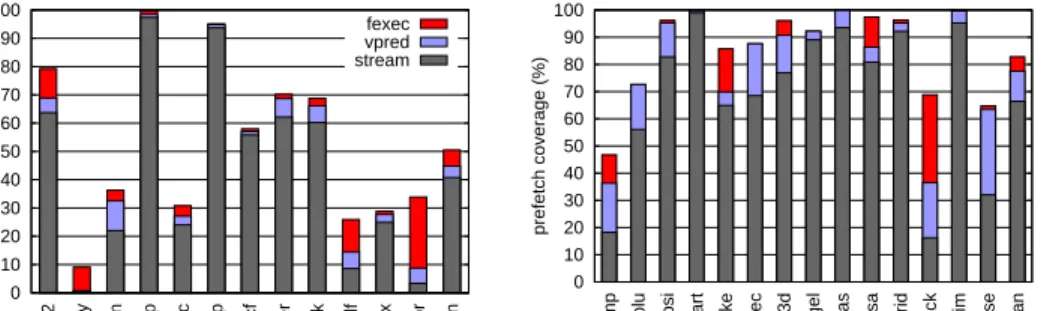
Figure 4.6 shows the prefetch coverages for different prefetch schemes, illustrat-ing significant coverage, especially for SPECfp. On roughly half of the programs the coverage achieved by future execution is higher than that achieved by the stream prefetcher. The value predictor that assists the future execution makes predictions based on the local history of values produced by a particular static instruction, while the stream prefetcher observes the global history of values. Therefore, the two techniques exploit different kinds of patterns, akin to local and global branch predictors.
0 10 20 30 40 50 60 70 80 90 100 mean vpr vortex twolf perlbmk parser mcf gzip gcc gap eon crafty bzip2 prefetch coverage (%) fexec vpred stream 0 10 20 30 40 50 60 70 80 90 100 mean wupwise swim sixtrack mgrid mesa lucas galgel fma3d facerec equake art apsi applu ammp prefetch coverage (%)
Figure 4.7: Distribution of cache misses that were prefetched by a stream prefetcher (stream), based on value predictions (vpred), and using future execution (fexec)
demonstrate significant synergy. In eleven programs (bzip2, gcc, perlbmk, ammp,
applu, apsi, equake, facerec, fma3d, lucas, and mesa) the coverage is at least 10% higher than when either technique is used alone. Overall, future execution increases the prefetching coverage from 34% to 51% on the integer and from 63% to 85% on the floating-point programs.
Figure 4.7 shows the breakdown of the prefetch coverage for the case when
stream prefetching is combined with future execution (stream+fexec configuration).
The lower segment of each bar corresponds to the prefetches initiated by the stream prefetcher. The middle portion shows how many prefetches were issued based on predictions provided by the value predictor. The upper part of each bar represents the portion of issued prefetch addresses that required the execution of instructions to compute the correct prefetch address. The height of the stacked bar indicates the total fraction of misses that were prefetched. Note that the height of the bar is sometimes slightly less than reported in Figure 4.6 because the origin of some of the prefetches could not be determined. In this study, if multiple prefetch mechanisms issued prefetches for the same memory location, the mechanism that issued the earliest prefetch is given credit for that prefetch request.
a significant coverage increase over the stream prefetcher (over 10%) for 16 out of the 26 applications used in our study. Out of these 16 applications, six programs benefit mostly from future execution, eight programs owe most of the coverage increase to future value prediction, and two programs benefit roughly equally from value prediction and future execution. Note that in seven programs the addition
of future execution makes the stream prefetcher more effective. For example, gap
gets almost all of its misses prefetched by the stream prefetcher, but the data in Figure 4.6 demonstrate that stream prefetching can prefetch less than a half of the cache misses without future execution. I suspect that this is caused by favorable interactions between the loads issued from the future core and the stream prefetcher, where future loads enable more precise and earlier identification of important streams that are then further prefetched by the stream prefetcher. On average, future execution increases the coverage provided by the stream prefetcher from 34% to 41% on the integer applications and from 63% to 66% on the floating-point programs.
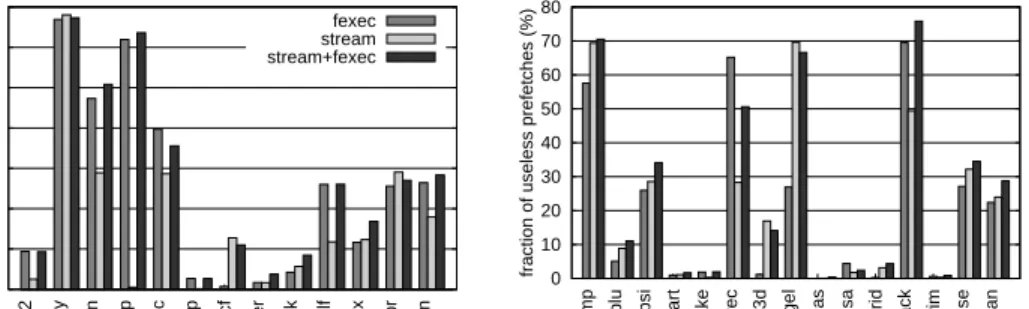
Next, I analyze the accuracy of our prefetching scheme by comparing the num-ber of useless prefetches issued by the prefetching mechanisms to the total numnum-ber of prefetches issued. A prefetch request is categorized as useless if the prefetched data is evicted from the cache before being used by the main thread. Figure 4.8 shows the percentage of useless prefetches associated with the two prefetching schemes. The results illustrate that a large majority of the prefetches issued are useful in both the SPECint and the SPECfp programs with over 70% of useful prefetches for both techniques. There are a few interesting cases where stream prefetching causes much fewer useless prefetches than future execution. They