by
David Bermingham, B.Eng
Submitted in partial fulfilment of the requirements for the Degree of Doctor of Philosophy
Dublin City University
School of School of Electronic Engineering
Supervisors: Dr. Xiaojun Wang
Prof. Lingling Sun
September 2010
my own work, that I have exercised reasonable care to ensure that the work is original, and does not to the best of my knowledge breach any law of copy-right, and has not been taken from the work of others save and to the extent that such work has been cited and acknowledged within the text of my work.
Signed:
David Bermingham (Candidate) ID:
Abstract vii
List of Figures ix
List of Tables xii
List of Acronyms xiv
List of Peer-Reviewed Publications xvi
Acknowledgements xviii
1 Introduction 1
1.1 Network Processors . . . 1
1.2 Trends Within Networks . . . 2
1.2.1 Bandwidth Growth . . . 2
1.2.2 Network Technologies . . . 3
1.2.3 Application and Service Demands . . . 3
1.3 Network Trends and Network Processors . . . 6
1.3.1 The Motivation for This Thesis . . . 7
1.4 Research Objectives . . . 9
2.2 Networks . . . 13
2.2.1 Network Protocols . . . 13
2.2.2 Network Technologies . . . 14
2.2.3 Router Architecture . . . 17
2.3 Network Processors . . . 19
2.3.1 Intel IXP-28XX Network Processor . . . 19
2.3.2 Cavium OCTEON Cn58XX . . . 20
2.3.3 State of the Art NP Architectures . . . 21
2.4 Network Processor Based Applications . . . 24
2.4.1 Packet Forwarding . . . 25
2.4.2 Quality of Service . . . 25
2.4.3 Security . . . 27
2.4.4 Payload Based Applications . . . 29
2.5 Scalability of Network Processors . . . 29
2.5.1 PE Parallelism . . . 30
2.5.2 Hardware Acceleration . . . 30
2.5.3 Technological Evolution . . . 33
2.5.4 PE Specific Techniques . . . 33
2.5.5 Summary of NP Scalability . . . 36
2.6 Micro-Architectural Considerations of PE Design . . . 37
2.6.1 Pipelining . . . 38
2.6.2 Pipelined Architecture . . . 40
2.6.3 Pipeline Hazards . . . 41
2.6.4 Control Hazards . . . 44
2.7 Techniques for Branch Prediction . . . 47
2.7.1 Static Branch Prediction . . . 47
3 Performance Evaluation Methods for Network Processors 59
3.1 Overview . . . 59
3.2 Simulation and Modelling of NP Architectures . . . 60
3.2.1 Mathematical Models . . . 61
3.2.2 Architectural Simulators . . . 64
3.3 Performance Metrics for NP Architectures . . . 68
3.3.1 Prior Benchmarks and Analysis . . . 68
3.3.2 Branch Predictor Performance Evaluation . . . 69
3.3.3 PE Area Cost . . . 71
3.3.4 Area Cost of Branch Prediction . . . 73
3.4 Conclusions . . . 73
4 A New Simulator for Network Processors 75 4.1 Overview . . . 75
4.2 SimNP Simulator . . . 76
4.2.1 Software Architecture . . . 76
4.2.2 SimNP Processing Engines . . . 78
4.2.3 SimNP Memory Hierarchy . . . 81
4.2.4 SimNP Inter-Device Communication . . . 81
4.2.5 SimNP Interface Unit . . . 82
4.2.6 SimNP Hardware Acceleration . . . 84
4.3 Comparison with Existing Solutions . . . 86
4.3.1 Simulation Time . . . 87 4.3.2 Simulation Performance . . . 88 4.3.3 Workload Validation . . . 89 4.4 Conclusions . . . 90 5 Analysis of NP Workloads 92 5.1 Introduction . . . 92
5.2.1 Network Algorithms and Applications . . . 101 5.2.2 Simulation Parameters . . . 105 5.3 Simulation Results . . . 106 5.3.1 Instruction Distribution . . . 107 5.3.2 Instruction Budget . . . 108 5.3.3 Memory Distribution . . . 113 5.3.4 Parallelisation . . . 115
5.4 Conditional Branches within NP applications . . . 119
5.4.1 Static Branch Analysis of NP Applications . . . 120
5.4.2 Dynamic Branch Analysis of NP Applications . . . 120
5.4.3 Branch Penalty per Packet . . . 122
5.5 Conclusions . . . 122
6 Branch Prediction in Process Engines 125 6.1 Introduction . . . 125
6.2 Performance Evaluation of Existing Prediction Schemes . . . 126
6.3 Gshare Predictor Performance . . . 129
6.4 Performance Limitations of Dynamic Predictors . . . 133
6.4.1 Payload Applications . . . 133
6.4.2 Header Applications . . . 135
6.4.3 Summary of Predictor Performance . . . 138
6.5 Utilising Packet Flow Information during Branch Prediction . . . 140
6.5.1 Flow Information For Payload Applications . . . 140
6.5.2 Flow Information For Header Applications . . . 143
6.5.3 Indexing Branch History . . . 144
6.5.4 Field-Based Branch Predictor . . . 147
6.6 Performance Evaluation of a Proposed Predictor . . . 150
6.6.4 Performance Evaluation . . . 153 6.7 Conclusions . . . 162
7 Conclusions & Future Work 165
7.1 Motivation for Proposed Research – A Summary . . . 165 7.2 Summary of Thesis Contributions . . . 167 7.2.1 The SimNP NP Simulator . . . 167 7.2.2 Workload Analysis and Branch Behaviour of NP Applications . . 168 7.2.3 Branch Prediction for Network Processors . . . 169 7.3 Future Work . . . 170
Originally designed to favour flexibility over packet processing performance, the future of the programmable network processor is challenged by the need to meet both increas-ing line rate as well as providincreas-ing additional processincreas-ing capabilities. To meet these re-quirements, trends within networking research has tended to focus on techniques such as offloading computation intensive tasks to dedicated hardware logic or through increased parallelism. While parallelism retains flexibility, challenges such as load-balancing limit its scope. On the other hand, hardware offloading allows complex algorithms to be imple-mented at high speed but sacrifice flexibility. To this end, the work in this thesis is focused on a more fundamental aspect of a network processor, the data-plane processing engine. Performing both system modelling and analysis of packet processing functions; the goal of this thesis is to identify and extract salient information regarding the performance of multi-processor workloads. Following on from a traditional software based analysis of programme workloads, we develop a method of modelling and analysing hardware ac-celerators when applied to network processors. Using this quantitative information, this thesis proposes an architecture which allows deeply pipelined micro-architectures to be implemented on the data-plane while reducing the branch penalty associated with these architectures.
1.1 7 Layer OSI Network Model . . . 6
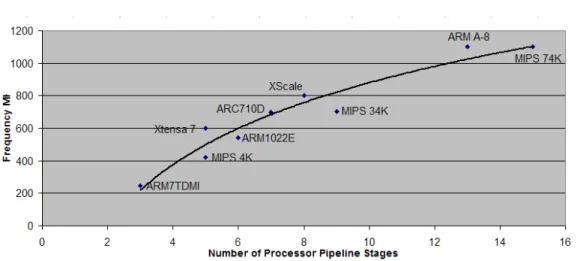
1.2 Pipeline Depth Vs. Microprocessor Performance . . . 9
2.1 Network Layer Topology . . . 16
2.2 Example Router Line Card . . . 17
2.3 Router Architecture . . . 18
2.4 The Intel IXP 2805 . . . 20
2.5 Cavium Octeon Cn58XX . . . 20
2.6 Classifying Router . . . 26
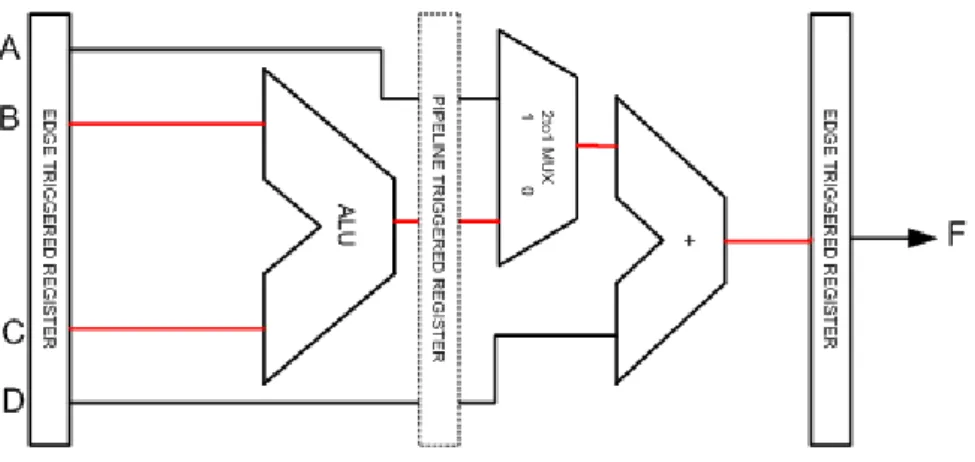
2.7 Pipelining of a Combinational Circuit . . . 39
2.8 5-Stage Integer Pipeline . . . 40
2.9 Structural Hazard Within Pipeline Processor . . . 42
2.10 Data Hazard Within Pipeline Processor . . . 43
2.11 Branch Penalty Within Pipeline Processor . . . 45
2.12 Sample 2-Bit State Transitions for Branch Predictor . . . 50
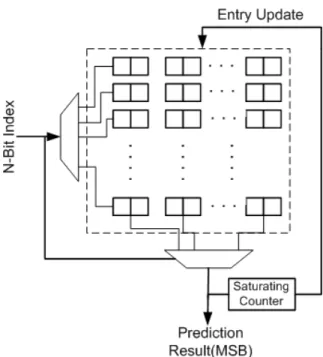
2.13 2-Bit Predictor Table in SRAM . . . 53
2.14 Global History Prediction Schemes . . . 54
2.15 Per Address Dynamic Prediction Schemes . . . 55
2.16 Gshare Predictor . . . 56
4.1 SimNP Block Diagram . . . 77
4.2 SimNP Software Architecture . . . 78
4.3 SimNP Process Engine . . . 80
4.4 SimNP Sample Memory Space . . . 82
4.5 SimNP Bus Model . . . 83
4.6 Common Switch Interface . . . 83
4.7 SimNP Simulation Time . . . 88
5.1 Execution Path For Applicationn. . . 97
5.2 Instruction Budget Vs. Microprocessor CPI . . . 100
5.3 Deficit Round Robin Load Balancing . . . 103
5.4 Instruction Distribution for NP Payload Applications . . . 107
5.5 Instruction Distribution for NP Header Applications . . . 107
5.6 Header Application Instruction Count Per Packet Distribution . . . 109
5.7 Instruction Count Vs. Payload Length . . . 112
5.8 Memory Region Distribution (Header Applications) . . . 114
5.9 Memory Region Distribution (Payload Applications) . . . 114
5.10 NP System Stall Rate . . . 116
5.11 NP Stall Cycles Per Packet . . . 117
5.12 Per-Packet Processing Rate . . . 118
5.13 Static Branch Analysis of NP Applications . . . 119
6.1 Directly Indexed Predictor Performance . . . 127
6.2 Gshare Predictor Performance for Various Network Applications . . . 130
6.3 Gshare Predictor Collisions as a Percentage of PHT Size . . . 131
6.4 Gshare Predictor Table Utilisation . . . 132
6.5 Payload Application Prediction Vs Packet Length . . . 135
6.6 Prediction Rate For DRR Algorithm . . . 139
6.10 Example Timing Diagram for Field-Based Predictor . . . 150
6.11 Field-Based Predictor Performance For Forwarding Applications . . . 154
6.12 Field-Based Predictor Performance For Classification Applications . . . . 156
6.13 Field-Based Predictor Performance For Queueing & Metering Applications156 6.14 Predictor Performance For Encryption Applications . . . 157
6.15 Predictor Performance For Authentication Applications . . . 158
6.16 Predictor Performance For Miscellaneous Applications . . . 159
2.1 Communication Technologies . . . 15
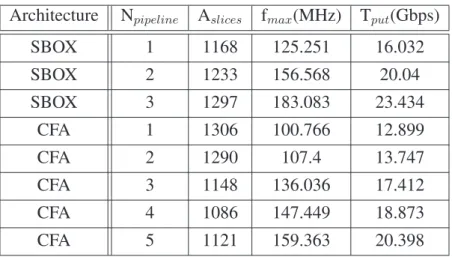
2.2 Hardware Implementations of the AES Algorithm . . . 31
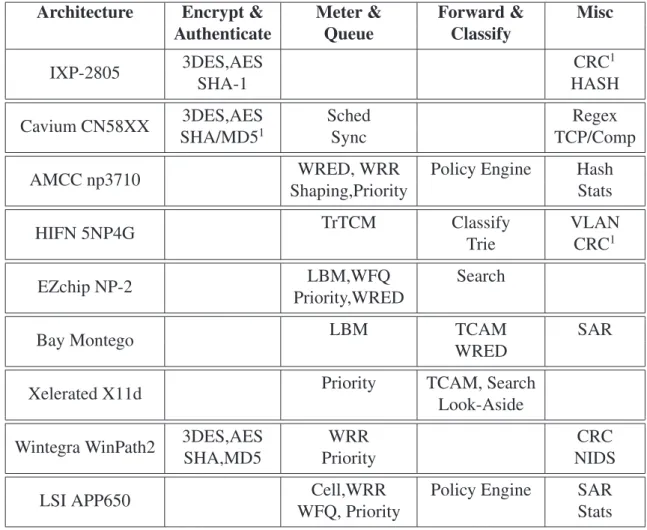
2.3 Survey of Commercial Hardware Acceleration Solutions . . . 32
2.4 Prediction Performance . . . 52
3.1 PE System Parameter . . . 72
4.1 SimNP Configurable Parameters . . . 79
4.2 NP Application Code Size . . . 79
4.3 Performance Analysis of SimNP Vs. Simplescalar/Packetbench . . . 89
4.4 Instruction Distribution for SimNP & SimpleScalar . . . 90
5.1 Optical Carrier Instruction Budget . . . 94
5.2 Summary of Applications Analysed . . . 105
5.3 Summary of Trace . . . 106
5.4 ARM9-Type Instruction Budget . . . 110
5.5 Instruction Complexity (Header Applications) . . . 110
5.6 Instruction Complexity (Payload Applications) . . . 113
5.7 Dynamic Branch Analysis of NP Applications . . . 121
5.8 Branch Penalty Per Packet . . . 123
6.4 Prediction Hit Rate For Hypercuts Classification . . . 137
6.5 Prediction Hit Rate For TCM Metering . . . 138
6.6 Detailed Packet Distribution For OC-48 Trace . . . 142
6.7 Flow-Index Search Key Extracted From Packet Header . . . 145
6.8 Percentage of Packets Predicted Via Field-Based Scheme (PSC Trace) . . 153
6.9 Prediction Rate Field-Based Scheme Vs. 2K Gshare (OC-12 AMP Trace) 162 6.10 Prediction Rate For OC-48 PSC Trace . . . 163
AES Advanced Encryption Standard
ALU Arithmetic Logic Unit
ASIC Application Specific Integrated Circuit
ATM Asynchronous Transfer Mode
CAM Content Addressable Memory
CISC Complex Instruction Set Computer
CMOS Complementary Metal Oxide Silicon
CPI Cycles Per Instruction
CPU Central Processing Unit
DPI Deep Packet Inspection
DRAM Dynamic Random Access Memory
FIFO First-In-First-Out
GHR Global History Register
IC Integrated Circuit
ILP Instruction Level Parallelism
IP Internet Protocol
IPsec Internet Protocol Security
IPTV Internet Protocol Television
ISA Instruction Set Architecture
ISP Internet Service Providers
MAC Media Access Controller
NAT Network Address Translation
NIDS Network Intrusion Detection System
NP Network Processor
OS Operating System
OSI Open Systems Interconnection
PCI Peripheral Component Interconnect
PE Process Engine
PHT Pattern History Table
POS Packet Over SONET
QoS Quality of Service
RTSP Real Time Streaming Protocol
SHA Secure Hash Algorithm
SoC System on Chip
SRAM Static Random Access Memory
SSL Secure Socket Layer
TCAM Ternary Content Addressable Memory
TCP Transmission Control Protocol
TSL Transport Layer Security
UDP User Datagram Protocol
VOIP Voice Over IP
VPN Virtual Private Network
WAN Wide Area Network
D. Bermingham, Z. Liu, X. Wang, B. Liu., “Field-Based Branch Prediction for Packet Processing Engines”,The Fifteenth International Conference on Parallel and Distributed Systems (ICPADS’09), December 2009.
D. Bermingham, Z. Liu, X. Wang and B. Liu., “Branch Prediction For Network Pro-cessors”, ICM 2008, Proceeding of the International Conference on Microelectronics, December 2008.
D. Bermingham, Z. Liu and X. Wang., “SimNP:A Flexible Simulation Framework for Network Processor Systems”, (Short Paper)ANCS ’08 : Proceedings of the 4th ACM/IEEE Symposium on Architectures for Networking and Communications Systems, November 2008.
Z. Liu, D. Bermingham and X. Wang., “Towards Fast and Flexible Simulation of Net-work Processors”,CIICT2008 : Proceeding of the IET 2008 China-Ireland International Conference on Information and Communications Technologies, August 2008.
D. Bermingham, A. Kennedy, X. Wang, B. Liu., “A Survey of Network Processor Work-loads”,CIICT2007 : Proceeding of the IET 2007 China-Ireland International Conference on Information and Communications Technologies, August 2007.
Signal Processing and Communications, December 2007.
D. Bermingham, X. Wang, and B. Liu., “Analysis of FPGA-Based AES Round Architec-tures”, ISSC 2005 : Proceeding of the 2005 IEE Irish Signals and Systems Conference, June 2006.
X. Zhang, B. Liu, W. Li, Y. Xi, D. Bermingham and X. Wang., “IPv6-oriented 4OC768 Packet Classification Scheme with Deriving-Merging Partition and Field-variable Encod-ing Algorithm”,IEEE INFOCOM2006, 23-29 April 2006.
I would like to thank the people who have helped my undertaking of this thesis. Firstly, my thesis supervisor Xiaojun Wang for all his advice, guidance and patience throughout the years I have been part of the Network Processing Group in DCU. Network processors was a new topic to both of us when I began my thesis and so I am particularly grateful to Xiao for allowing me the time to find a topic which interested me. I would also like to thank Liu Zhen, a past member of the NPG. Zhen provided invaluable help with almost all aspects of my work towards the end of my research. I would like to thank Jim Dowling who gave me the opportunity to undertake a Ph.D. in DCU.
I am extremely grateful to my family who have always provided me with endless support and encouragement, especially my mother who has always taught me to value education and my father who has a boundless optimism.
Finally, I would like to thank Jeanie for her love, patience and sacrifices throughout my time as a Ph.D student. I am not the most organised of individual at the best of times and without her ‘work ethic’ I doubt this would have ever been completed. This work is as much due to her as me.
Introduction
1.1 Network Processors
The Internet has grown to encompass the global networking system underlying modern business, research, communication and collaboration. Developments in network tech-nologies and fibre optics have allowed products and services to be developed on one con-tinent, manufactured on another and serviced on yet another. The challenge of network research is to expand these communications systems to allow more complex services at ever faster speeds. To maximise the packet processing rate it is possible to implement routing using highly tailored Application Specific Integrated Circuits (ASICs), but when application flexibility is required a programmable platform such as a Network Processor (NP) is required. Instead of utilising dedicated hardware logic for packet processing, a NP system is organised around a software-based processing array, comprised of a number of heterogeneous processors (Process Engine (PE)). With the ability to reprogram each PE, software-based routers allow new functions to be deployed on existing network hardware in order to meet changing network demands. Changes to Internet-based protocols, ser-vices and applications no longer require extensive hardware changes. For research within the network processor domain the challenge is retaining this flexibility while meeting the needs of both additional processing requirements and ever increasing bandwidth demands. This dissertation addresses some of the difficulties associated with these trends,
propos-ing methods for analyspropos-ing and improvpropos-ing the performance of the PEs within a network processor.
1.2 Trends Within Networks
In this section some of the trends within network research are outlined, before an exami-nation of the effect of these trends on the future for programmable routers.
1.2.1 Bandwidth Growth
During the 1990’s, developments within optical and switching technology, a boom in computer usage in both the home and the office and the dot com bubble resulted in band-width doubling on average every year ([1], [2] and [3]). Although growth in capacity slowed down significantly at the beginning of the century, the under-utilised network in-frastructure was quickly absorbed and the work in [4] found that between 2003 and 2008 average internet traffic increased by 50% to 60% per annum, with predictions for simi-lar growth over the next three years [5]. This capacity has been utilised by two factors. Firstly, the number of systems connected has increased substantially. Originally limited to universities, governments and large corporations, Internet access is now almost uni-versal in developed countries, with developing countries such as India and China rapidly expanding domestic coverage. For example, the number of people in China with access to the internet has increased from∼50 million users in 2002 to over 250 million users in 2008 [6] but encompasses less than 20% of China’s population.
In addition to the total number of networked terminals, both home and corporate net-work users have demanded faster connections, requiring large scale broadband netnet-works to be deployed. With an increasing amount of trade and commerce provided via electronic systems, companies have become dependent on high bandwidth permanent Internet con-nections. In countries around the world, broadband services such as Fiber-To-The-Home, Cable or Digital Subscriber Line (DSL) are widely available to both homes and offices, while wireless technologies provide broadband in more remote and mobile environments.
1.2.2 Network Technologies
With the ability to accommodate arbitrary communication systems, IP switched networks have grown from wired networks connected over existing circuit switching systems to the broad Wide Area Network (WAN) which encompasses the modern Internet. Tradi-tional circuit switched systems such as telephony networks are gradually being replaced by packet switched equivalents [7]. Similarly, technologies such as Wireless Local Area Network (WLAN), high speed broadband, mobile broadband and gigabit Ethernet have either replaced existing standards or have been designed in such a way as to be accom-modated within the existing infrastructure.
1.2.3 Application and Service Demands
Evolving from a system which provided simple services such as file transfer and email, the Internet today supports applications which were deployed decades after the standard-isation of the Internet protocols. Some of the more common applications are described below.
1.2.3.1 World Wide Web
The most transparent Internet application, web browsing has evolved from simply ren-dering text-based information to the provision of interactive services such as e-commerce and content generation. While the original Web largely followed a simple one way dis-semination technique (personal webpages), the modern Web involves more cooperative and collaborative interaction, such as social networking or Wikipedia [8]. Modern devel-opments have allowed applications to be offloaded from end terminals to more centralised systems. A hot topic of research ([9],[10],[11],[12]), this trend is commonly referred to by various terms (Virtualisation, Cloud Computing, Software-as-a-Service(SaaS)). The goal of cloud computing is to allow the design and deployment of highly scalable and highly redundant virtualised systems. Instead of end users, e.g. individuals and compa-nies deploying expensive software and hardware on a per-node basis, a centralised system is provided where the required service can be accessed remotely on-demand. For
com-mercial and academic institutions requiring complex and high performance computing resources, cloud computing allows the high capital costs associated with such systems to be replaced with a service charge for access to the external hosting network.
1.2.3.2 Digital Media
Broadband connections, as well as improvements in the technologies associated with me-dia streaming, have allowed vast amounts of digital meme-dia to be published on the Internet at little capital cost. Video and music websites have become increasingly popular, with Youtube [13] streaming over 100 million videos per day to users all over the world. Gill et al. found that video streams from Youtube accounted for almost 5% of campus wide net-work traffic [14]. In addition, interactive entertainment systems such as computer games have become increasingly networked. Entire online environments have been constructed [15], with systems such as Second Life available for entertainment, information and col-laborative purposes [16]. In addition to streaming services used to disperse content is the trend towards two way communication systems such as Voice Over IP (VOIP) or video teleconferencing. Utilising similar algorithms to streaming applications it presents a num-ber of additional challenges at a router level since latency, and therefore processing time, is the primary difficulty in maintaining such services.
1.2.3.3 Peer To Peer
The most significant application in terms of bandwidth usage, Peer-to-Peer (P2P) has evolved from small centralised systems to vast distributed networks, allowing large amounts of data to be efficiently transferred across the Internet. Today, the most common P2P sys-tem in operation is the BitTorrent protocol. Although it is difficult to characterise the amount of Internet bandwidth absorbed by P2P applications, research in [17],[18] high-lighted the sizeable resources utilised by P2P systems. For Internet Service Providers (ISPs), the large volume of data transferred across Peer-to-Peer networks presents two difficulties. Firstly, a small number of customers can monopolise large amounts of avail-able bandwidth, severely reducing the service availavail-able to other customers. Secondly,
the liability regarding the transport of copyrighted material across networks is yet to be resolved. From a network provider’s perspective, Sen et al. found that despite the large amounts of data transferred within a P2P system, the stability of P2P traffic lends itself to flow level metering and traffic shaping [18]. Shaping techniques, however, require network providers to implement packet classification as a means of detecting P2P traffic, while more finely grained systems which attempt to filter only illegal material require that routers must be both flow and content aware at a packet level.
While the future use of P2P is difficult to ascertain, a number of trends within Internet based services indicate that P2P based protocols will remain over the medium term. For open source software companies, P2P has become a major means of distributing software, with the most common Linux Operating System (OS) versions utilising BitTorrent based distribution. Secondly, for content and media generation companies, P2P networks pro-vide an efficient means of dispersing files outside of real-time demands. For example, the music service Spotify [19] utilises a P2P system to stream encrypted audio between users.
1.2.3.4 Future Demands
Extrapolating from current Internet trends it is possible to speculate on future Internet demands. Firstly, with available bandwidth continually expanding, both personal and commercial users will push additional functions onto networked systems. Ultra-high bandwidth systems deployed at home will allow television and media to be delivered via Internet Protocol (IP) networks, while commercial institutions can utilise services such as external data-centres providing hosting, backup and storage functionality. Services such as virtualisation will allow computing resources such as storage, bandwidth and pro-cessing to be viewed as a commodity, available for varying amounts of time to bidders. The separation between P2P systems and centralised media distribution is becoming in-creasingly blurred, pushing the bandwidth requirements from the company generating the content to the network providers which connect users.
Figure 1.1: 7 Layer OSI Network Model [20]
1.3 Network Trends and Network Processors
While the discussion of network trends outlined in the previous section did not focus on implementation details, the question for network researchers is how these trends affect network designs, topologies and functionality. In the case of a distributed P2P system, the trend has been to push bandwidth demands away from centralised systems to each node of the network. On the other hand, the various aspects of a real-time Internet Protocol Television (IPTV) system, such as Personal Recorders or Video on Demand, rely on a centralised distribution network. For interactive web systems, such as social networks, the data demands are small and not sensitive to security. For commercial operations, which outsource data-processing to external networked sites, the volume of traffic can be very large with security vital to communication. From a network design perspective, the challenge is how these various demands can be met.
In general, these trends have been represented at a router level by an expansion of the type of functions performed on a modern router. Mapped to the traditional Open Systems
Interconnection (OSI) stack [20], the original task of a router has expanded from sim-ple layer three routing and modification to comsim-plex application layer functions such as deep packet inspection and intrusion detection. While an Application Specific Integrated Circuit (ASIC)-based router can be developed to provide packet routing or classification functionality, it is difficult to provide a cost-effective solution with many differing de-mands. A router deployed by local Internet Service Providers (ISP) has little need for packet encryption or intrusion detection, while a router deployed at the edge of a corpo-rate network requires a mechanism for creating a secure Virtual Private Network (VPN) and packet inspection. Quality of Service (QoS) systems require routers to differentiate between ‘normal’ traffic and latency-sensitive traffic such as IPTV or VOIP. Legal re-quirements increasingly require an ISP to detect illegal P2P data traversing the network without affecting legal P2P systems.
With Internet based applications constantly evolving, it is increasingly difficult to im-plement dedicated hardware capable of meeting all demands. While the protocols which underlie the Internet are likely to remain in place for many years to come, the methods, protocols and algorithms for performing applications such as queueing, metering, classi-fication or payload inspection are constantly changing.
1.3.1 The Motivation for This Thesis
With ASIC-based routers lacking flexibility, the programmable NP architecture remains a good alternative to an application-specific router. Unfortunately a replacement NP-based architecture is not without limitations, especially when future requirements are consid-ered. While technological evolution has allowed the performance (e.g. clock frequency, transistors per chip) obtained from digital circuits to greatly increase, it has not been at the growth rate experienced by network bandwidth, creating a performance gap between the growth of bandwidth deployed and the processing capabilities available. Within micro-processor design, the performance increases have been limited by factors such as dynamic power consumption and memory access latency. Multiprocessing and cache hierarchies have allowed performance increases to be obtained through methods other than increases
in microprocessor operating frequency [21].
For an NP architecture, the performance gap between bandwidth and processing speed has commonly been met using two techniques. The first method involves implementing additional processing resources as a means of exploiting flow level parallelism. While each additional PE does allow additional performance to be extracted, it is not a ‘for-free’ solution and requires a redesign of the memory system, bus hierarchies and load balancing mechanisms. Secondly, the demands for computationally intensive functions such as packet classification, intrusion detection, encryption, etc., have generated scope for extensive research on the topic of hardware accelerators for NP architectures. Instead of implementing applications in software, algorithms are mapped to dedicated hardware blocks. Similar to ASIC based routers, hardware acceleration favours packet process-ing performance over flexibility. It remains unclear whether hardware acceleration is an efficient solution for all NP applications.
In addition to these two solutions, another method of increasing NP performance in-volves architectural improvements in the underlying PE architecture. These micro-architectural improvements involve investigating and implementing mechanisms for im-proving the performance of the PEs. Techniques such as caching, multi-threading, instruc-tion level parallelism (superscalar) or deeper pipelining represent four such mechanisms which can be used to improve PE performance. The focus of this work is primarily on the fourth of these micro-architectural techniques; namely the processor pipeline depth. As with other micro-architectural design techniques, pipelining is not without significant challenges.
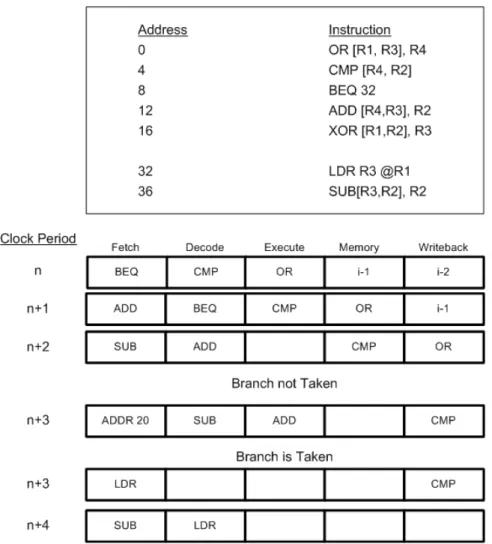
To achieve optimum performance within a pipelined design the pipeline must remain full at all times. For a microprocessor, the difficulty arises during conditional operations which attempt to modify program flow. Since the conditional evaluation cannot be known immediately, the processor must either wait while the instruction is evaluated or assume a pre-determined course (typically assuming the branch will not be taken). If the assumed path is incorrect the instructions which are misfetched must be flushed from the pipeline.
Figure 1.2: Pipeline Depth Vs. Microprocessor Performance
For highly conditional code this branch penalty can become a significant loss of processor cycles and it is possible that a deeper pipeline can actually decrease overall performance. The most common solution to mitigate this problem is to implement a prediction scheme which attempts to guess whether a conditional branch will be taken based on previous run-time history.
With NPs requiring an increasing amount of processing capabilities, it is believed that deeper pipelined processors will become one method of increasing performance. Examin-ing commercial Reduced Instruction Set Computer (RISC) processors ([22],[23],[24],[25]) in Figure 1.2, it can be seen that significant increments in operating frequency can be achieved by implementing a deeply pipelined design. For NP research, the goal is how to harness the additional performance available without incurring the penalty associated with conditional operations.
1.4 Research Objectives
The research goals of this thesis can be summarised as follows:
1. To investigate the current state of network processing modelling and simulation as a method for investigating architectural aspects of network processor design. 2. To derive a simulation framework allowing effective benchmarking and analysis of
3. To undertake a comprehensive analysis of network processor workloads, charac-terising those applications implemented completely in software, and examining the effect of conditional branch instructions in NP applications.
4. To design and implement techniques for mitigating the branch penalty within NP applications as a means of improving network processor performance.
1.5 Thesis Structure
The remainder of this thesis is structured as follows: • Chapter 2 – Technical Background
The background section introduces the two main topics discussed in this thesis, i.e., programmable network processors and branch prediction for pipelined micropro-cessors. Topics such as network architectures and applications are briefly covered, highlighting trends within NP design. The second part of this chapter presents a technical introduction to the aspects of microprocessor design which relates to branch prediction, outlining the concepts of pipelining and branch penalties as well as discussing existing methodologies for mitigating the penalty.
• Chapter 3 – Performance Evaluation Methods for Network Processors
Following on from the high level background information and state of the art survey presented in Chapter 2, Chapter 3 presents a more detailed technical background with regards to the topics of performance evaluation of NP and PE architectures. With research such as branch prediction requiring a means of modelling NP plat-forms, a survey of the methods available to model an NP environment is presented. The second part of this chapter examines the metrics and methodologies by which branch prediction schemes can be examined within an NP environment.
• Chapter 4 – A New Simulator for Network Processors
There is no existing method of efficiently evaluating NP architectures, and so a new simulation framework for NP systems is proposed. Designed to provide the high
turn-around time of a functional simulator, it includes simulation blocks for devices commonly incorporated on an NP System on Chip (SoC).
• Chapter 5 – Analysis of NP Workloads
Using common NP applications and algorithms, an examination and analysis of network tasks is presented. While previous work has focused on complex super-scalar designs, this thesis examines more fundamental design considerations, such as parallelism, memory profile and the branch behaviour of NP applications. • Chapter 6 – Branch Prediction in Process Engines
After identifying branch behaviour as a significant limitation to implementing deeply pipelined PE architectures, Chapter 6 examines branch prediction techniques within an NP environment in detail. Following on from the branch behaviour and analysis presented in Chapter 5, the performance of existing prediction techniques is eval-uated before proposing a new flow indexed branch prediction scheme specifically designed for PEs. A complete analysis is provided, with the proposed architecture compared to previous solutions in terms of cost, performance and scalability. • Chapter 7 – Conclusions & Future Work
A summary of the contributions made in the thesis and the research objectives at-tained is presented, as are plans for future work.
Technical Background
2.1 Overview
The topics discussed in this thesis span two engineering topics, network processors and computer architecture. With this in mind, chapters 2 and 3 present a technical overview of both of these topics. For network processors, this background information provides a context for the current state of the art within NP design and research. An overview of current networking topology (hierarchy, protocol and technology) is first presented before describing how NP platforms fit into the modern Internet. A summary of the current applications deployed on an NP platform is used to highlight some of the challenges to NP development and design. Various methods by which NP performance can be improved are examined in order to outline some of the strengths and disadvantages of each method. One such way by which NP performance could be improved is by increasing the performance of the individual PEs by implementing a deeper pipelined architecture. When compared to other methods of scaling PE, it is argued that implementing a deeper pipelined architecture represents a more efficient method of scaling PE performance, since neither flexibility nor cost is greatly increased.
As was highlighted in Chapter 1 however, deeper micro-processor pipelines are not without possible performance drawbacks. Despite typically increasing the operating fre-quency of the underlying architecture, the increased number of pipeline stages can
actu-ally result in lower performance if the pipeline cannot be kept full at all times. The latter half of this chapter presents an overview of the concepts of pipelined micro-processors and branch penalties, along with a survey of the existing methods of branch prediction which can be used to mitigate this branch penalty.
2.2 Networks
Within the OSI model (see Figure 1.1)1, a router has traditionally been defined as a layer
3 device. Unlike a layer 2 Media Access Controller (MAC) or network switch, a router must be aware of the underlying protocol and, for more complex functions, must be aware of higher-level application information. For example, a modern router may be used as a web-switching platform, balancing HyperText Transfer Protocol (HTTP) requests across a number of hosting systems. In general, a network such as the Internet can be divided into three components which are briefly outlined.
2.2.1 Network Protocols
The Internet is comprised of a number of heterogeneous networks communicating within a shared framework. Although many frameworks have been proposed and implemented, the Transmission Control Protocol (TCP) and IP (TCP/IP) protocol suite [26] dominate today’s computer networks. The ability to accommodate arbitrary network systems and topologies is derived from the fact that the TCP/IP suite provides no specification regard-ing hardware layers. Concerned only with transportregard-ing data, the TCP/IP suite begins at layer 3 of the OSI model. Today the bulk of traffic found on the Internet is comprised of the layer 3 IP protocol and two layer 4 transport protocols [27] [28] [29] (TCP and User Datagram Protocol (UDP)). At the base, the IP protocol provides a data-orientated connectionless means of routing packets from one network to another. As the Internet has developed a number of changes to the IP protocol have been required, with IPv6 currently
1Although the traditional Transmission Control Protocol (TCP)/IP model does not utilise a strict layered
separation such as the OSI model, the OSI model is used as a conceptual framework for the remainder of this thesis
being rolled out as a replacement to the existing IPv4 platform. At a router level, the major aspect of the change (aside from the new IP header) is the massive expansion in the number of routable addresses provided by the IP specification. Whereas IPv4 utilises a 32-bit address scheme, the newer IPv6 protocol uses 128-bit source and destination ad-dresses. Because the IP protocol does not guarantee delivery and cannot be used to mul-tiplex data from multiple network applications it is common for a higher level transport protocol to be encapsulated within an IP packet. For applications requiring a session-based connection, the TCP protocol can guarantee reliable transmission, creates unique application-based sessions and provides mechanisms for congestion avoidance. For sys-tems requiring multiplexing but without the overhead associated with a state-maintained connection like TCP, the UDP protocol can be used to encapsulate data from the appli-cation layer within an IP packet. In addition to these three protocols a number of other protocols are used within the TCP/IP stack, providing functionality such as routing table updates and secure communication.
At a router level, the dominance of IP, TCP and UDP present an advantage by limiting the complexity of the network traffic. Applications such as session-based firewalling, re-quiring 5-tuple classification (identification using Source Address, Destination Address, Source Port, Destination Port and Protocol), can be efficiently implemented using the knowledge that TCP-based data represents over 80% of the traffic [28] found on the In-ternet. At a purely engineering level, protocol improvements such as IPv6 present a chal-lenge in two ways. Firstly, routers must be able to support both protocol versions while legacy systems are replaced. Secondly, packet processing techniques such as packet for-warding and classification are optimised for 32-bit address and 32-bit architectures and may not be directly compatible as the number of unique addresses is expanded.
2.2.2 Network Technologies
Lacking any specification of the hardware or link layer details of a network, the TCP/IP suite allows arbitrary communication technologies to be incorporated within the existing
framework. In Table 2.1 some of the communication standards currently in operation are summarised. For local networks, communication can be achieved using both a wired and wireless solution. Wired network technologies such as Ethernet 100 Mbps (100BASE-T) and the state of the art Gigabit Ethernet provide a cheap method of transferring data over short distances. For greater flexibility, wireless equivalents such as IEEE 802.11x can be implemented. For bulk data transfer, optical technologies such as SONET/SDH [30][31] allow network providers to transfer large quantities of data over optical fiber.
Table 2.1: Communication Technologies
Technology Standard Bit Rate (Mbps)
Wireless IEEE 802.11b 11 IEEE 802.11g 54 IEEE 802.11n 600 Ethernet 10BASE-T 10 100BASE-T 100 1000BASE-T 1000 10000BASE-T 10000 SONET/SDH OC-1 51.84 OC-3 155.52 OC-12 622.32 OC-48 2,488 OC-192 9,953 OC-768 39,813
In Figure 2.1, we use the network layering methodology outlined in [32] to describe a sample WAN. At the access layer, residential and corporate networks use technologies such as Ethernet, Wireless LAN and PPPoE to connect users. To connect various access networks, the edge or distribution layer allows fast connection between regional networks operating inside the WAN. From a router perspective, access layer data is multiplexed before being transferred over high speed Gigabit Ethernet and OC-3/OC-12 data links. Finally, connection between distribution networks is provided via a core switching net-work. In this example, the core switching network might represent the network used to connect large metropolitan cities. As in the distribution layer, data is again multiplexed
Figure 2.1: Network Layer Topology [32]
before being transferred over high speed links such as 10 Gigabit Ethernet or OC-48/OC-192 connections.
Although a network is divided into three layers in the example outlined above, the separation of layers is not definite and can be altered to accommodate even higher level connections. For example, the TAT-14 OC-768 [33] optical link between the United States of America and Europe provides a means of connecting two large WANs.
Again, from a router design perspective this layer model allows routers to be designed which target specific network topologies. The core network provides maximal switching speed with minimal packet processing. Services provided within the core network are primarily data plane functions such as forwarding, while for routers located within the distribution network, the services provided can be argued to be both data-plane functions such as packet switching, as well as control plane tasks such as congestion avoidance, fire-wall security and load balancing (e.g. domain name resolution). Finally, routers located within the access network provide services such as web switching, metering, detection
Figure 2.2: Router Line Card [34]
and prevention of network intrusion. The difficulty with such a layered model is that the topology of the Internet is not static. Services such as QoS require routers to be able to differentiate between certain types of traffic at both the access and distribution layer.
2.2.3 Router Architecture
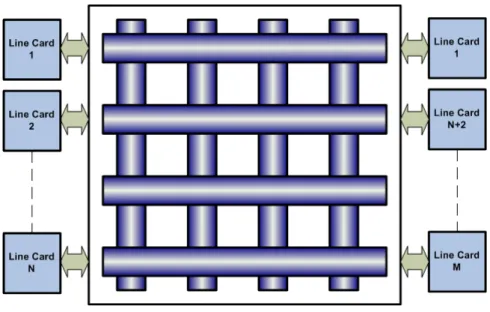
To connect various nodes on a network, packet forwarding or routing devices are needed to maintain paths between one node and another. At its most basic level, a routing node must be able to receive incoming packets, determine the next hop which must be taken and transmit the packet to the corresponding interface. For a programmable NP-based router, a generic architecture might follow the system block diagram shown in Figure 2.2. Packets arrive via a physical interface, in this case an SPI 4.2 optical interface [35]. Incoming packets are first buffered in the ingress packet memory. The ingress NP will perform ingress tasks such as verification, next hop calculation and packet classification. Once ingress packet processing is complete, the packet can either be transferred to an egress line card on another line card via the switch fabric or it can be transferred to the res-ident egress network processor. Packets buffered in the egress packet memory are queued
Figure 2.3: Router Architecture
before being processed and transmitted via the physical interface back onto the network. Typical egress processing includes functions such as metering, congestion avoidance, QoS and statistical analysis. An example of such ingress and egress processing might be for the router at the edge of a corporate network to filter unwanted attachments on incoming emails while also removing specific outbound HTTP requests to certain websites.
With a large volume of packets arriving, buffering is commonly implemented with cheap Dynamic Random Access Memory (DRAM) based technologies. To improve per-formance, faster Static Random Access Memory (SRAM) technology is used to store control information such as routing tables and classification rulesets. For control packets, routing updates and other line card maintenance routines, a control (or Host) plane proces-sor might be provided on the line card. Connection between the control plane procesproces-sor and the NP(s) is achieved with some form of external communication bus (e.g. Peripheral Component Interconnect (PCI)) or by locating the control plane processor on-chip. The line cards are then connected via the switching fabric, similar to the block diagram out-lined in Figure 2.3. The advantage of such a configuration is the scalability which can be achieved with larger switching subsystems and additional line cards.
The system outlined in Figure 2.2 represents just one possible NP line card configu-ration. Certain architectures implement the control plane within the NP die, reducing the line-card cost, while other NP designs implement an external bus connection, allowing
the customer to decide the type of control plane architecture employed. Similarly, an NP architecture can be designed to utilise a single type of memory while another design may utilise a highly segmented memory architecture.
2.3 Network Processors
While the line card outlined in the previous section represents the most common method of building a modern router, the underlying NP architecture on the line card varies greatly from one device to another. In both academic and commercial research no single NP ar-chitecture has emerged as the optimum configuration, but a number of traits have emerged which can be argued to represent the most common features found within an NP architec-ture. To highlight these features two commercial NP architectures are briefly examined in this section.
2.3.1 Intel IXP-28XX Network Processor
One of the most flexible NP architectures, the IXP-28xx [34] line of network processors incorporate a number of various architectural and technological improvements over the legacy IXP-12xx NP. Utilising 16 ultra high performance PEs (labelled Micro-Engines by Intel), each running at 1.4 GHz, the IXP-28xx platform includes a 700MHz on-chip Xscale processor. With memory and I/O access speed failing to keep pace with micropro-cessor development, a number of mechanisms have been employed to either mitigate or hide this access latency. Firstly, the memory hierarchy employs multiple channels for both control and packet memory. Secondly, each PE is hardware multi-threaded, supporting 8 threads. Connection to the external device can be achieved via three interfaces. Physical devices are connected via the Serial Peripheral Interface (SPI) 4.2 [35], while the Com-mon Switch Interface (CSIX) connects the NP to the switching fabric. Inter-process com-munication is provided via the PCI bus. While comcom-munication between arbitrary MEs remains, the IXP-28xx architecture favours either a pipeline or parallel-pipeline architec-ture, with low latency communication possible between an ME and its ‘next neighbour’.
Figure 2.4: The Intel IXP 2805 (From [34])
Figure 2.5: Cavium Octeon Cn58XX (From [36])
For network applications requiring packet security, the IXP-28xx family of devices can include on-board cryptographic blocks, allowing computational intensive encryption and authentication to be offloaded to dedicated hardware.
2.3.2 Cavium OCTEON Cn58XX
Like the IXP-28xx platform, the Cavium OCTEON Cn58xx [36] NP represents a full System on Chip (SoC) architecture. Supporting up to 10Gbps in full duplex mode, the Cn58xx architecture includes a number of hardware accelerators aimed at mitigating some of the performance loss associated with computational intensive tasks within a network
router. The NP can be interfaced to either a Reduced Gigabit Media Independent Interface (RGMII) or SPI-4.2 physical device, with packets and control information stored in either low latency second generation Reduced Latency DRAM (RLDRAM2) or higher latency Double Data Rate DRAM (DDR2-DRAM). Data plane processing is provided by between 4 and 16 cnMIPS microprocessors.
Derived from the MIPS64 [22] RISC architecture, the Cavium architecture is unique in that the data plane processing elements include a multi-level cache hierarchy. Along with the cache structure, each cnMIPS core includes hardware accelerators for functions such as encryption and authentication. Shared hardware accelerators include a TCP Unit to offload TCP maintenance functions and a data compression/decompression unit con-forming to RFC1950/51 [37]. Finally, the 32 Regular Expression engines allow parallel deep packet inspection.
2.3.3 State of the Art NP Architectures
Summarising the two architectures outlined in previous section, it can be seen that the major trade-off within NP design is how to maximise performance while maintaining flexibility. Providing a purely PE-based dataplane would maximise flexibility but certain tasks such as encryption are difficult to implement in software at the required performance levels. On the other hand, an architecture in which the PE only provides basic functional-ity in software with a large amount of hardware accelerated blocks would limit the abilfunctional-ity to update the services and algorithms implemented on the router. Both the Intel and Cav-ium architectures utilise a RISC-based PE structure with hardware blocks augmenting the programmable data plane. Examining other commercial architectures, the EZchip NP-1 [38] and Xelerated X11q [39] can be argued to represent two architectures in which design flexibility is reduced in order to maximise performance. Both utilise a strictly pipelined layout (in the case of EZchip the architecture is parallel-pipeline), with the PEs heav-ily optimised for NP applications. Each stage of the Xelerated architecture can execute only 4 instructions. Despite the large variation across commercial architectures, a num-ber of architectural techniques have evolved to become common features within network
processor design.
2.3.3.1 Multicore Processing
At both a packet and flow level, parallelism provides a method of scaling performance to meet higher bandwidth demands. Although the number of PEs in most NPs has been around the order of 4-16 ([34],[36],[40]), a number of architectures stand out as employ-ing a substantially higher degree of parallelism. Firstly, the Netronome NFP-3200 [41] and Cisco QuantumFlow [42] utilise 40 processing engines. The superscalar design em-ployed by EZchip in the NP-2 and NP-3 [43] NP also exploits large scale parallelism (the number of PEs is not available in the public domain). The Xelerated X11 NP provides neither flow nor packet level parallelism and instead uses 800 Packet Instruction Set Com-puters (PISC) engines arranged in a linear pipeline [39]. Furthermore, the Silicon Packet Processor (SPP) developed by Cisco includes 188 separate RISC engines per chip [44].
2.3.3.2 NP Interconnection
Despite NPs employing a multiprocessor architecture, there has been little research into bus topologies for NP systems. Weng and Wolf proposed a mechanism for distributing tasks across a parallel system but the underlying bus parameters were not examined [45], while Karim et. al. is, to the author’s knowledge, the only published work to examine bus topologies in NP systems [46]. For general purpose systems, communication systems between processors, memory and external devices has undergone more extensive research, with proposed and available bus systems optimised for low-cost [47], high performance when streaming data [48] or universality [49].
2.3.3.3 Integrated Networking Interface
To reduce the latency associated with packet ingress and egress operations, networking in-terfaces are integrated on-chip instead of being bridged to the network processor. Typical implementations include a means of connecting the network processor to a physical layer device such as a Gigabit Optical, Gigabit Media Independent Interface (GMII) or Packet
Over SONET (POS) SPI-4.2 interface [50]. Along with this physical device interface, some cases will include the Common Switch Interface (CSIX) to provide interconnection of the NP and a router switching fabric.
2.3.3.4 Multithread Processing
Providing a cheap method of minimising the cost associated with long latency operations, multi-threading lends itself to network processing in a number of ways. Firstly, the par-allelism outlined in Section 2.3.3.1 can be extended to include multi-threads. Secondly, applications suited to pipeline partitioning can be implemented as either a pipeline across multiple PEs or as a conceptual pipeline located on a single PE. Finally, multiple threads or contexts are reasonably cheap to implement. Requiring little interaction between the programmer and application, a context swap can be achieved by a single register swap, with only a small amount of control hardware needed to schedule each thread.
2.3.3.5 Control Plane (Host) Processing
In addition to the data-plane processing, routers also require a means of providing con-trol plane functionality. At a fundamental level, these concon-trol plane tasks include func-tions such as routing table updates, classification ruleset updates and adjustments to the scheduling functions, as well as processing non-standard packets (e.g. control information from other routers). More complex functions require implementing an operating system on the host Central Processing Unit (CPU) as a means of providing system control across the line card. While the Intel, Netronome and HIFN architectures implement an on-chip control plane processor, the remaining NPs typically provide either a specific port or a generic PCI interface between the NP(s) and a host CPU.
2.3.3.6 Integrated Memory Controller
For general purpose processing that is not sensitive to access latency, the memory subsys-tem is optimised for bandwidth rather than latency. Due to the low latency requirements of packet processing, NPs must perform fast memory operations in order to match the
minimum packet inter-arrival time [51]. Therefore, most NPs have integrated memory controllers in order to achieve lower latency. Furthermore, the low spatial locality of net-work applications also suggests that the optimisation of bandwidth for memory subsystem is not as effective in NP as in GPP architectures [52].
2.3.3.7 Hardware Accelerator
Offloading special applications that are relatively stable and suitable for hardware im-plementation has been adopted as an important method to achieve high performance. Hardware accelerators usually function as coprocessors and have the potential of being executed concurrently with other parts of the program. They can be implemented either private to or shared by the processing cores, or implemented as external devices interact-ing with the NP. Hardware acceleration is covered in more detail in section 2.5.2.
2.4 Network Processor Based Applications
Following on from an overview of NP architectures, an overview of typical NP applica-tions is presented in order to provide a context for NP development. As was mentioned in Chapter 1, the field of NP-based applications is notable for its growth from simple packet switching to the complex packet processing functions implemented today. In gen-eral, the trend has been for applications to be pushed down the network stack, with the router providing functions between layer 3 (packet forwarding) and layer 7 (web switch-ing, Deep Packet Inspection (DPI)). Although it is more common to provide services such as firewalling, classification and inspection at an access level, research within this topic has largely been targeted at providing such functionality at routers located within both the edge and core networks. For example, [53] and [54] are two works which have exam-ined implementing five-tuple packet classification and deep packet inspection at ultra-high speed OC-192 and OC-768 line rates respectively. In this section we present a detailed analysis of how the application growth outlined in Section 1.2.3 affects NP research. In general, NP applications can be divided into two basic classes. The first class comprises
those applications which use only the packet header during processing (Header Process-ing Applications). These applications include packet forwarding, packet classification and packet metering. The second class of NP applications is comprised of those applications which utilise both the header(s) of a packet and the packet payload (Payload Processing Applications).
2.4.1 Packet Forwarding
Packet forwarding remains the fundamental task of any router, but the complexity asso-ciated with packet forwarding has been increased by two trends. Firstly, global network growth will quickly exhaust the 32-bit address space provided by the IPv4 protocol, with IPv6 expanding IP address space to 128-bits. At a router level, the challenge will be how longer addresses can be traversed and stored. Current longest prefix matching algorithms have been optimised to process 32-bit network host addresses and 24-bit prefix masks, utilising 32-bit memory to store each node of the routing table.
In parallel with the development of IPv6, the number of addressable networks de-ployed has grown at a quadratic rate, with the number of Border Gateway Protocol (BGP) entries in the Internet routing table expanding from 50,000 entries in 1998 [55] to almost 300,000 entries in the current table [56].
2.4.2 Quality of Service
Fundamental to providing high priority services such as VOIP is the ability to differen-tiate various packet flows within IP traffic. A flow is defined as a sequence of packets transferred between two computers. At a coarse level, a flow may be identified using the source and destination addresses of these two nodes. With applications such as Net-work Address Translation (NAT) [57] mapping multiple terminals to the same outgoing IP address, it can be seen that such two tuple flow classification would be ineffective at correctly identifying an application flow. A more finely grained solution exploits the dominance of the TCP and UDP protocols to identify flows using both the IP addresses and port addresses. Algorithms such as [58] [59] [60] [61] [62] allow five-tuple
classifi-Figure 2.6: Classifying Router
cation to be implemented at router level. Five-tuple classification allows network service providers to implement services such as QoS, session based firewalls or metering at wire speed. Figure 2.6 describes a typical NP-based QoS system in which packets are classified before being directed to either a fast or slow processing path. While latency dependent Real Time Protocol (RTP) applications can be directed to the fast path, applications with little or no need for low latency, such as Peer-To-Peer, can be directed to the slower path. With future growth in mind, the question is whether such five-tuple solutions are scalable. A more significant challenge to both QoS and packet classification is the blurred na-ture of how new applications are implemented on an IP switched network. The popular YouTube video hosting website demonstrates this point. In the case of YouTube, videos are ‘streamed’ to the user using HTTP as opposed to a streaming specific protocol such as Real Time Streaming Protocol (RTSP) [14]. As such, a classification rule must be able to differentiate between traditional HTTP traffic on port 80 and this streamed data. The second difficulty with 5-tuple classification can be seen in an application such as Skype [63] . Although a closed source protocol, the Skype protocol uses an RTP-based applica-tion in which audio and video informaapplica-tion are encapsulated using either TCP or UDP. At runtime it is possible to configure Skype to utilise any port when communicating, making even 5-tuple classification difficult. Given the availability of an option of securing pack-ets between users, it was shown in [64] that identifying skype applications is a non-trivial task, requiring deeper packet inspection.
2.4.3 Security
In general, network security can be divided into two categories. The first aspect of net-work security involves mechanisms for securing data transported over an open netnet-work. As well as securing communication channels, network security also requires the detection and prevention of attacks or infiltration by persons located outside the specific network.
2.4.3.1 Packet Security
The movement of functions such as communication and commerce to the Internet has facilitated the need for secure channels between various networks. The channel can be either between networks in which a VPN might be available or from one user to a secure server in which personal data must be protected during transmission. Using the Inter-net Protocol Security (IPsec) security suite [65] along with transport layer protocols such as Secure Socket Layer (SSL) and Transport Layer Security (TSL) [66] it is possible to provide secure data transmission, authentication and key exchange across an unsecured network. For networks such as those employed by multi-national corporations the security trade-off can be demonstrated when examining communication between two geograph-ically separate networks. Security can be either be provided by each node within both networks, (i.e. all nodes have access to the encryption keys) or both networks can be configured with routers automatically securing data transmissions between both networks in a fashion transparent to end users. With a high volume of traffic being sent between these networks, the VPN performance provided by the routers must be significant. The IPsec protocol commonly used to provide packet security is algorithm-agnostic; listing many possible algorithms and allowing the user to select which security algorithms are used. Common algorithms used for encryption and authentication include the Advanced Encryption Standard (AES) [67] symmetric encryption algorithm and the Secure Hash Algorithm (SHA) [68] hashing function.
2.4.3.2 Network Security
Network security encompasses techniques aimed at protecting a network or computer from infiltration. The most common example of this is the network firewall. While a personal computer can be protected via a software firewall implemented on the com-puter, protecting an entire network necessitates the implementation of a high performance firewall on the edge router. Older firewalls attempted to filter unwanted traffic by apply-ing broadly based rules on the incomapply-ing packets. More intelligent firewalls attempted to retain state-based flow information when examining network data by using a 5-tuple classification algorithm, such as those outlined in Section 2.4.2, to identify packet flows before applying the matching rule. More modern firewalls have implemented deep packet inspection techniques as a more finely grained means of matching packets and rulesets.
While a standard 5-tuple packet classification scheme can be used to identify mali-cious flows, it does have some serious limitations when used to construct a layer 4 fire-wall. For example, a firewall may implement a website blacklist which blocks outgoing TCP connections to a known IP address, but techniques such as DNS misdirection, or IP spoofing, can make a 5-tuple based ruleset cumbersome to implement, easy to bypass and difficult to maintain. A more intelligent technique is to implement a payload based detection system. Commonly referred to as DPI (or Network Intrusion Detection System (NIDS)), the goal of such a system is to allow packets to be classified using both session information and payload data. An example might include a rule which attempts to filter incoming traffic containing a new virus. As in five-tuple schemes, packets arriving at the network interface are examined against a predefined ruleset, with the payload examined for a byte-string similar to the virus definition. Another use may be to detect unauthorised access to the network, for example examining the commands issued during a telnet ses-sion. This is a popular topic within current NP research and many methods and solutions have been proposed, [69], [54], [70], [71], with certain algorithms tailored to hardware implementations while others utilise a structure more suitable to software.
2.4.4 Payload Based Applications
A number of other payload-based applications have been developed which might be im-plemented at a packet level. Firstly, web or content switching provides a means of load-balancing a web site which is hosted over a number of physical servers. With busy web-sites processing millions of requests every second, the workload associated with these connections is distributed overnhosts. The task of a content or web switch is to extract important information from incoming data (HTTP Requests) as a means of balancing the demands placed on each server. For popular websites, load-balancing can be seen as a non-critical design aspect which aims to improve server utilisation while limiting access latency, whereas a payment processing site would be highly sensitive to delayed transac-tions during busy periods.
In addition to content aware switching is the possibility of implementing media transcod-ing at a network level, although only a little research has been undertaken in this area [72]. For example, with an increasing amount of video information stored on social media sites, a typical transcoding scheme might entail storing the videos in a high definition format in the database. Once requested for streaming, the video is transcoded by the outgoing network router, with the selection of the encoding bitrate dictated by network conditions.
2.5 Scalability of Network Processors
Given the growth in both NP application complexity and network demands, a fundamental question is whether the NP-based solution can be scaled with future needs in mind. In this section an outline of the current state of the art within NP research with respect to scaling NP architectures is given. Some of this research can be argued to be at a macro
level, providing additional resources (e.g. more PEs, hardware acceleration) while other methods typically focus on improving the performance on one module of the NP structure.
2.5.1 PE Parallelism
Examining any commercial architecture, the most obvious performance increment which could be investigated is to increase the number of PEs employed in the NP architecture. With packet data well suited to parallelism, increasing the number of PEs has been well exploited in both commercial and academic research. Within the commercial domain this Packet Level Parallelism (PLP) can be seen in all NP architectures except Xelerated X10 and X11 NPs which implement a massively pipelined design. While the challenges re-garding load-balancing and packet re-ordering are solved via on-board hardware acceler-ators in the Cavium NP, the IXP based architectures (Intel, Netronome) leave scheduling issues to be resolved in software via a number of ingress PEs.
In general, the amount of PLP available to a network processor designer is bounded by two factors. At a hardware level, the provision of additional PEs requires changes to the bus and memory structures. Additionally, the need to retain correct packet order requires a router to retain a reordering mechanism. Research within the topic of PLP has tended to give mixed results. In [73] it was found that multi-processor systems provide additional performance, although the simulation was limited to 8 separate PEs. In [74], Gries et al. demonstrated that a parallel architecture is both easier to programme and to scale, with IP forwarding applications suited to parallel architectures. While [75] found that PE utilisation falls off significantly as the number of PEs is increased, Thread Level Parallelism (TLP) can provide more scope for performance improvements. Research by Shi et al. [76] found that organising the PEs in a clustered format provides a mechanism for increasing parallelism but requires additional logic to handle both the load-balancing and packet reordering. The challenges involved in packet re-ordering at ultra high bitrates has been extensively studied, with numerous papers highlighting the challenge as well as proposing both hardware and software solutions (see [77], [78], [79] and [80]).
2.5.2 Hardware Acceleration
With dedicated logic able to maintain higher throughput when compared to a programmable solution, another method of scaling performance is by offloading complex and
![Figure 1.1: 7 Layer OSI Network Model [20]](https://thumb-us.123doks.com/thumbv2/123dok_us/10176093.2919928/25.892.370.605.132.603/figure-layer-osi-network-model.webp)
![Figure 2.1: Network Layer Topology [32]](https://thumb-us.123doks.com/thumbv2/123dok_us/10176093.2919928/35.892.193.786.125.606/figure-network-layer-topology.webp)
![Figure 2.2: Router Line Card [34]](https://thumb-us.123doks.com/thumbv2/123dok_us/10176093.2919928/36.892.213.764.117.550/figure-router-line-card.webp)