Quinoa—Postharvest and Commercialization
Sonia Salas Domı´nguez* CIP/CONDESAN, Lima, Peru
ABSTRACT
In 1955, the area of production of quinoa (Chenopodium quinoaWilld.) and can˜iwa (Chenopodium pallidicauleAellen) was 32,605 has and the yield was 35,995 t of grain, giving an average yield of 1104 kg/ha (Ministry of Agriculture, 1955). In 1996, 18,704 ha of quinoa and 4392 ha of canihua were sown with a yield of 860 and 680 kg/ha, respectively. In 1955, these crops were the eighth most important crops in Peru, but in 1996, they were no longer among the top 30. Studies of quinoa cultivation in Peru began in 1936, when 100 lines were evaluated, and 12 were selected as the most promising. Since 1940, two of these varieties have been cultivated extensively in Junı´n, Blanca de Junı´n, and Rosada de Junı´n. In 1951, a campaign to encourage cultivation of the two Junin varieties and Real from Bolivia was started in Puno in southern Peru.
During the last few decades, programs have been developed to improve quinoa yields. However, production and productivity have not reached the 1955 level. Undoubtedly, improper postharvest treatment has been a major cause of low yields.
POSTHARVEST
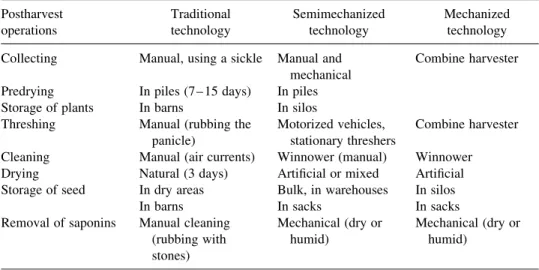
The postharvest process involves the harvesting of plants and cleaning of seeds, which consists of collection, pre-drying, storage and threshing of plants, and cleaning, drying, and storage of seeds. A comparison of different systems, using traditional, semimechanized, and mechanized technology, is given in Table 1.
191
DOI: 10.1081/FRI-120018885 8755-9129 (Print); 1525-6103 (Online)
Copyrightq2003 by Marcel Dekker, Inc. www.dekker.com
*Correspondence: Sonia Salas Domı´nguez, CIP/CONDESAN, Lima, Peru; E-mail: s.salas@ cgiar.org.
Collecting
According to Mujica (1993); Valdivia et al. (1997), the crop cycle is complete when the plants reach physiological maturity after 5 to 8 months, depending on the variety and environmental conditions. The leaves become yellow, and the seeds harden.
Predrying
After harvesting, the plants are piled with the panicles inwards, and the center elevated, so that water runs off. The plants are maintained there for 7 to 15 days. Predrying causes a reduction in the water content of the plant and protect the plants against rain or frost.
Threshing
Threshing by Hand
Panicles are hit against a hard surface or rubbed with the hand to separate the seeds from the plant. The black seeds of wild quinoa are eliminated, as they reduce product quality.
Threshing with Animals (Horses, Donkeys)
The panicles are placed in heaps, and the animals are allowed to pass over the material. A disadvantage is that the product is mixed with animal wastes, which reduces product quality.
Table 1. Quinoa postharvest systems. Postharvest operations Traditional technology Semimechanized technology Mechanized technology
Collecting Manual, using a sickle Manual and
mechanical
Combine harvester
Predrying In piles (7 – 15 days) In piles
Storage of plants In barns In silos
Threshing Manual (rubbing the
panicle)
Motorized vehicles, stationary threshers
Combine harvester
Cleaning Manual (air currents) Winnower (manual) Winnower
Drying Natural (3 days) Artificial or mixed Artificial
Storage of seed In dry areas Bulk, in warehouses In silos
In barns In sacks In sacks
Removal of saponins Manual cleaning (rubbing with stones) Mechanical (dry or humid) Mechanical (dry or humid) Salas Domı´nguez 192
MARCEL DEKKER, INC. • 270 MADISON AVENUE • NEW YORK, NY 10016
Mechanical Threshing
The plants are threshed in stationary threshers, which may be operated by a tractor or by self-propelled motors.
Cleaning of Seeds
The purpose of cleaning is to separate soil, stones, excrement, and small and broken seeds from the seed material. In the traditional winnowing, the seed material falls to the ground from the hands, or to a cloth or plastic, taking advantage of the afternoon wind currents.
Drying
The clean seeds are put on a cloth and exposed to the sun for 3 days, removing them at night to eliminate the remaining excess moisture in the grains. Drying prevents fermentation.
Storage
Appropriate storage is essential to avoid product loss from rodents and moths.
Removal of Saponins
Saponins, water-soluble soapy compounds in the seed hull with a bitter taste, are an obstacle for processing and consumption. Some quinoa varieties, such as Sajama, Cheweca, Kamiri, and Blanca de Junı´n, are sweet, requiring only a simple cleaning before use (Tapia et al., 1979).
Saponin removal can be performed as a humid or dry process, or preferentially in combination (Jacobsen et al., 2000; Mujica, 1993). The humid method is traditionally used by peasants and housewives and entails a successive washing of the grain using friction by hand or a stone to eliminate the episperm, which is the outer layer where the saponin is located. At the industrial level, the humid method has the disadvantage of the high cost of drying the seed and the formation of foam (Nieto and Fisher, 1993; Valdivia et al., 1997). The dry process is a polishing. First, the seeds are mechanically abraded against rough walls. The grain is then rubbed against sieves to separate the next layer, and the residues and saponin dust are eliminated (Mujica, 1993).
In the National Agrarian University of La Molina (UNALM), Lima, Peru, a cleaning method for quinoa was designed by applying 30 min soaking and 20 min. agitation at 708C (Torres and Minaya, 1980). This process can reduce saponins satisfactorily down to 0.04 – 0.25%. In Bolivia, a humid process for the removal of quinoa saponins was developed (Rodriguez, 1986).
Another method of saponin removal combined dry procedures with a preheating of the quinoa seed, which is then brushed. In some communities of the Salares in Bolivia, a perforated stone of about 50 cm in diameter is used, into which quinoa, preheated in a thick sand layer called “pokera,” is placed. Quinoa grain and sand are then rubbed with the feet (Tapia et al., 1979). In general, dry methods are economical, simple, and do not lead to contamination, but they are relatively inefficient, only eliminating 80% of the saponin (Mujica, 1993).
Losses
Losses include quantitative, qualitative, and economic reductions of the product, and they occur in any of the phases of the postharvest system (Table 2).
Weight Loss
Weight loss is a reduction in the quantity of the product due to animal damage or shattering.
Table 2. Causes of losses.
Causes Type of loss
Direct
Late harvest Attack by birds or other animals (weight and product)
Seed shattering
Harvest while raining Germination
Insufficient drying Development of mold, appearance of insects, change in
color and smell (quality)
Inadequate threshing Broken seeds, favoring the appearance of insects
(weight and quality)
Poor storage conditions Due to combined action of mold, insects, rodents, and other harmful animals (quality and weight)
Insufficient dehulling Quality
Inappropriate transport and packing Loss of products
Indirect
Inadequacy Capital
Technical knowledge Machinery and equipment Pesticides Packing Transport Organization Salas Domı´nguez 194
MARCEL DEKKER, INC. • 270 MADISON AVENUE • NEW YORK, NY 10016
Quality Loss
Loss of quality causes decreases in market value of the product. This includes the following:
1. Losses in physical traits—The physical characteristics usually considered in evaluating the quality are seed shape and size; moisture content; presence of foreign matter; germinated, broken, or damaged seeds; stones; dust; leaf residues; glass or metal fragments; animal hair or excrements; and level of infestation by insects or microorganisms.
2. Alteration of nutritional qualities—A reduction of vitamin, protein, or lipid content in quinoa may occur over time.
3. Losses due to reduction of germination rate—The seeds should be able to germinate at a high rate.
Postharvest losses have been estimated by De Lucia and Assennato (1993), and in total, these losses may exceed 30% (Table 3).
Several aspects may be particularly important in understanding and ultimately reducing postharvest losses:
. There is a lack of mathematical methods for modeling postharvest loss. . Considerable fluctuation of losses occurs due to climatic conditions, varieties,
and location, among others.
. Many national institutions approach the problem of postharvest losses in a superficial way, considering it a marginal problem of agricultural production. . It is difficult to establish reliable estimates about quantitative and qualitative
losses due to lack of methods, strategies, and specific standard measurements. . The lack of permanent and appropriate national institutional structures prevents
accurate measurement of postharvest losses.
Table 3. Losses in cereal postharvest (De Lucı´a and Assennato, 1993).
Loss (%)
Phase Minimum Maximum Average
Collecting 1 3 2 Transport on-farm 2 7 4.5 Threshing 2 6 4 Drying 1 5 3 Storage 2 6 4 Processing 2 10 6 Total 10 37 23.5
These losses are only quantifiable in retrospect, compared with the quality standards (humidity, color, smell, cleaning, and infestation). In Peru, technical regulation is very generic, hindering its applicability.
Technological Means for Reducing Losses
Harvest
Mechanization is only justified on farms larger than 10 ha, where combine harvesters can be used. The advantages of mechanization are that it saves land and is less costly per kg of harvested product. Contamination with soil, stones, etc., is avoided.
Threshing
There are stationary threshers and combine harvesters. For example, the simple, stationary Herrandina thresher has a capacity of 150 kg/h. The advantages are that it saves time, and yield is increased. Seeds are less mixed with soil, stones, and animal excrement. Cleaning of seeds can be done with the Winnower Herrandina at a capacity of 60 kg/h.
Removal of Saponins
In the humid process of desaponification, continuous mechanical agitation and a steam jacket of low pressure are used. For the generation of vapor, there is a boiler and an ionic exchange column to desalinate the water (water softening). Extraction begins with the soaking of seeds in hot water, followed by vigorous washing with mechanical agitation. The discharge is removed through the bottom, separating the washed seeds from the solution.
After washing, the seeds must be dried, for instance, in a tunnel oven with sieved trays. Heating originates from a heat interchanger that operates with liquified gas or from an appropriate electric resistance with a thermostat. Air circulation is perpendicular to the heat generator, with nozzles of variable air flow designed to control the recirculation percentage of air into the dryer.
With the dry treatment, a continuous dehuller with three parallel cylinders, located at different levels such that the processed seeds pass from one cylinder to another by gravity, is used. Each cylinder has eight scarifier shovels made as flat belts, and 12 transporter shovels, with a 128angle to the axis. Angular speed is 540 – 860 r.p.m. (increasing with reduced seed size). The shovels are adjustable, being able to modify the distance between the cylinder wall and the terminal border. Two cylinders have a mesh in the lower part that allows the passage of brans but not of seeds. The seed leaving the cylinder is transported to a ventilator for density classification. The upward air drags fine dust and bran, which is recovered in an expansion camera, due to their different specific weights.
The quinoa scarifier model was improved to obtain better grain separation effectiveness and by-products. A complementary innovation consists of adding a cloth filter at the final exit of the fan to catch the fine saponin dust (Zavaleta, 1983).
Salas Domı´nguez 196
MARCEL DEKKER, INC. • 270 MADISON AVENUE • NEW YORK, NY 10016
To obtain quinoa flour, desaponified seeds are used. The traditional method is to polish the seed on two stones. For commercial purposes, hammer mills and stones are used. With these methods, it is possible to obtain 30 – 70% flour.
Storage
Family-size silos are being promoted, which are excellent for storage.
Commercialization
For quinoa commercialization, various market types exist (Valdivia et al., 1997). Market fairs are public places in town where buyers and traders gather. Weekly fairs or “ccatus” are the main locations of commercialization for local products such as quinoa. Other markets are local, regional and national markets in the major cities. International markets are found in Europe, United States and Japan. In the last 20 years, export levels have been 45 (1993) to 180t (1986 and 1996) (Webb and Fernandez, 1997). Peru is the most important exporter, exceeding the volumes of Ecuador and Bolivia (Vasquez and Alza, 1996).
Channels and Agents of Commercialization
The channels for quinoa commercialization are as follows (Mujica, 1993).
Traditional Rural Channel
Traditional Rural Channels in the Area. Exchange of small volumes occurs sometimes via barter (“trueque”) at fairs. This system has sociocultural implications, and people identify it as a very important economic and social weekly activity in the community of the area.
Traditional Rural Channels Between Areas. This channel attracts longer commercial movement, as the intermediaries operate with a range of products.
Interdepartmental Channel
This flow involves commercial agents inside and outside the department, incorporating regional markets and interacting with national markets. The product flow is manipulated by agents (Table 4).
Due to the growth of the international market of quinoa, it is feasible to add an additional commercialization channel (Vasquez and Alza, 1996).The incremental costs of each step from farmer to consumer are shown in Table 5.
Table 4. Channels of commercialization (ADEX et al., 1996). Salas Domı ´nguez 198 M ARCEL D EKKER, I NC . • 270 M ADISON A VENUE • N EW Y ORK , NY 10016 © 2 0 0 3 M ar ce l D ek k er , I n c. A ll rig h ts r es er v ed . T h is m at er ia l m ay n o t b e u se d o r r ep ro d u ce d in a n y f o rm w ith o u t t h e ex p re ss w rit te n p er m is si o n o f M ar ce l D ek k er , I n c.
Table 5. Margins of intermediation (US$) from farmer to consumer (ADEX et al., 1996).
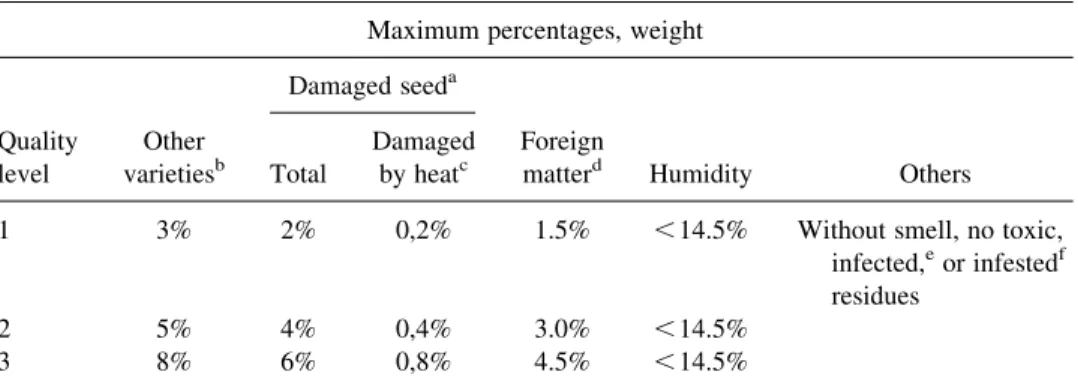
Table 6. Requirements for quinoa (ITINTEC, 1982). Maximum percentages, weight
Damaged seeda Quality level Other varietiesb Total Damaged by heatc Foreign
matterd Humidity Others
1 3% 2% 0,2% 1.5% ,14.5% Without smell, no toxic,
infected,eor infestedf residues
2 5% 4% 0,4% 3.0% ,14.5%
3 8% 6% 0,8% 4.5% ,14.5%
a
Damaged seed: seed altered in color, smell, appearance or structure, as a consequence of inadequate drying, excessive humidity, immaturity, insect attacks, fungi infections, germination, etc.
b
Other varieties: shape, form, color, size, and flavor differ from the variety.
c
Seed damaged by heat: seed that has changed color due to self-heating or inadequate drying.
dForeign matter: all material different from the seed. e
Infected seed: seed showing presence of fungi.
f
Infested grain: seed with live or dead insects in any of their biological states (egg, larva, pupae or adult).
International Channel
The international channel partly corresponds to the interdepartmental channel, because the seeds or processed products must arrive at the capital or main harbor in order to ship to other countries. This product is mainly exported to markets in Europe and the United States.
The Peruvian Technical Standards that define the required quality of the product are
shown in Tables 6 and 7.
Requirements for Export
A phytosanitary certificate is required to ensure that the material is free from insects, fungi, bacteria, and virus. Also, there are commercial restrictions for external sales, subject to international and national norms of classification, packaging, and labeling, as well as local rules of import and distribution of the product in the importing country.
CONCLUSION
The postharvest loss of quinoa is estimated to be up to 40% of the total production. Most quinoa producers are small-scale farmers. Their product is often of inferior quality due to inadequate postharvest handling, which results in low prices.
Simple equipment for harvesting and handling of the production have been developed for the small-scale Andean farmers to be distributed and considered for agricultural credits.
The development of local and national markets is important. In Lima, 7772 t quinoa/-year is offered at the moment, but the potential market is 33,792 t (ADEX et al., 1996).
REFERENCES
ADEX, ASO/COSUDE, ADEX-USAID (MSP). (1996). Quinua, Estudio de Demanda Lima, Peru´.
Jacobsen, S.-E., Dini, I., Schettino, O., Tenore, G., Dini, A. (2000). Isolation and characterization of saponins and other minor components in quinoa (Chenopodium quinoa Willd.). In: Proceedings of COST 814 Conference, Crop Development for Cool and Wet Regions of Europe, Pordenone, Italy, May 10 – 13, 2000, 537 – 540.
Table 7. Classification of quinoa by saponin content (ITINTEC, 1982).
Class Level Bitter 1 Sweet 2 Washed 3 Salas Domı´nguez 200
MARCEL DEKKER, INC. • 270 MADISON AVENUE • NEW YORK, NY 10016
De Lucia, M., Assennato, D. (1993).La Ingenierı´a en el Desarrollo-Manejo y Tratamiento de Granos poscosecha. Rome, Italy: FAO.
Mujica, A. (1993).Cultivo de Quinua. Lima, Peru´: Instituto Nacional de Investigacio´n Agraria (INIA), Direccio´n General de Investigacio´n Agraria.
Nieto, C., Fisher, V. (1993).La Quinua: un Alimento Nuestro. Quito, Ecuador: Proyecto de Desarrollo Comunitario Be´lgica-Ecuador.
Tapia, M.; Gandarillas, H.; Alandia, S.; Cardozo, A.; Mujica, A.; Ortiz, R.; Otazu, V.; Rea, J.; Zanabria, E., eds. (1979). La Quinua y la Kan˜iwa. Bogota´ Colombia: Centro Internacional de Investigaciones para el Desarrollo, Instituto Internacional de Ciencias Agrı´colas.
Valdivia, R., Paredes, S., Zegarra, A., Choquehuanca, V., Reinoso, R. (1997).Manual del Productor de Quinua., Editorial Altiplano Puno, Peru´: Centro de Investigacio´n de Recursos Naturales y Medio Ambiente.
Vasquez, V., Alza, M. (1996). Agroexportacio´n: Ana´lisis y Perspectiva Productos No Tradicionales. Lima, Peru´.
Webb, R., Fernandez, G. (1997).Cua´nto, S. A., ed.Peru´ en Nu´meros, 1997. Lima, Peru´: Amistad Editores e Impresores S.A..
Zavaleta, R. (1983).Evaluacio´n de procesos industriales para la desaponificacio´n de la quinua. Lima, Peru´: Grupo de Polı´tica Tecnolo´gica PADT-Alimentos, Junta del Acuerdo de Cartagena.