Faculty and Researcher Publications Faculty and Researcher Publications
2014
Concatenations of the Hidden Weighted
Bit Function and their Cryptographic Properties
Wang, Qichun
Advances in Mathematics of Communications, Volume 8, No. 2, 2014, pp. 153-165.
http://hdl.handle.net/10945/42533
Volume 8, No. 2, 2014, 153–165
CONCATENATIONS OF THE HIDDEN WEIGHTED BIT FUNCTION AND THEIR CRYPTOGRAPHIC PROPERTIES
Qichun Wang and Chik How Tan
Temasek Laboratories National University of Singapore
117411, Singapore
Pantelimon St˘anic˘a
Department of Applied Mathematics Naval Postgraduate School Monterey, CA 93943-5216, USA
(Communicated by Joan-Josep Climent)
Abstract. To resist Binary Decision Diagrams (BDD) based attacks, a Boolean function should have a high BDD size. The hidden weighted bit func-tion (HWBF), introduced by Bryant in 1991, seems to be the simplest funcfunc-tion with exponential BDD size. In [28], Wang et al. investigated the cryptographic properties of the HWBF and found that it is a very good candidate for being used in real ciphers. In this paper, we modify the HWBF and construct two classes of functions with very good cryptographic properties (better than the HWBF). The new functions are balanced, with almost optimum algebraic de-gree and satisfy the strict avalanche criterion. Their nonlinearity is higher than that of the HWBF. We investigate their algebraic immunity, BDD size and their resistance against fast algebraic attacks, which seem to be better than those of the HWBF too. The new functions are simple, can be implemented efficiently, have high BDD sizes and rather good cryptographic properties. Therefore, they might be excellent candidates for constructions of real-life ciphers.
1. Introduction
To resist the main known attacks, Boolean functions used in real ciphers should be balanced, with high algebraic degree, with high algebraic immunity, with high nonlinearity and with good immunity to fast algebraic attacks. It would be better if the function is non-normal and satisfies the strict avalanche criterion. Up to now, many classes of Boolean functions with high algebraic immunity have been introduced [4, 5, 6, 10, 11, 15, 16, 22, 23, 25, 26, 27, 30, 31, 32, 34]. However, none of them can gather all the necessary criteria and be implemented efficiently. Moreover, none of them took BDD-based attacks into consideration.
To resist BDD-based attacks, which were first introduced by Krause in 2002 [14], a Boolean function should have a high BDD size. It is known that an n variable symmetric Boolean function has a BDD size O(n2) [13], and therefore it is weak against BDD-based attacks. The hidden weighted bit function (HWBF), proposed by Bryant [1], looks like a symmetric function, but in fact, it has an exponential
2010Mathematics Subject Classification: 11T71.
Key words and phrases: Hidden weighted bit function, algebraic immunity, nonlinearity, strict avalanche criterion, BDD-based attack.
The first author is supported by NSFC (Grant No. 61202463).
BDD size and its VLSI implementation has low area-time complexity [1]. In [13], Knuth reproved Bryant’s theorem stating that the HWBF has a large BDD size, regardless of how one reorders its variables. Therefore, the HWBF can resist BDD-based attacks and could be implemented efficiently.
In [28], Wang et al. investigated the cryptographic properties of the HWBF and found that it has overall very good cryptographic properties: balancedness, optimum algebraic degree, strict avalanche criterion, good algebraic immunity, good nonlinearity and good behavior against fast algebraic attacks. Since the HWBF has a high BDD size and can be implemented very efficiently, it is a potential candidate for the stream cipher construction.
In this paper, we modify the HWBF and construct two classes of functions with very good cryptographic properties (better than those of the HWBF). The new functions are balanced, with almost optimum algebraic degree and satisfying the strict avalanche criterion. Their nonlinearity is higher than that of the HWBF. We investigate their algebraic immunity, BDD size and their resistance against fast algebraic attacks, which seem to be better than those of the HWBF too. The new functions are simple, can be implemented efficiently, have high BDD sizes and rather good cryptographic properties. Therefore, they might be excellent candidates for stream ciphers constructions.
The paper is organized as follows. In Section 2, the necessary background is established. We introduce a concatenation of two hidden weighted bit functions in Section3. In Section4, we give the other concatenation of four functions. We end in Section5with conclusions.
2. Preliminaries
LetFn2 be the n-dimensional vector space over the finite fieldF2. We letBn be
the set of alln-variable Boolean functions fromFn2 into F2.
Any Boolean function f ∈ Bn can be uniquely represented as a multivariate
polynomial inF2[x1, . . . , xn], called the algebraic normal form (ANF)
f(x1, . . . , xn) = X K⊆{1,2,...,n} aK Y k∈K xk.
The algebraic degree off is the number of variables in the highest order term with nonzero coefficient and is denoted by deg(f).
A Boolean function isaffineif there are no term of degree strictly greater than 1 in the ANF. The set of all affine functions is denoted byAn.
Let
1f ={x∈Fn2|f(x) = 1}, 0f ={x∈Fn2|f(x) = 0},
be the support of a Boolean functionf, and its complement functionf+ 1, respec-tively. The cardinality of 1f is called theHamming weightoff, and will be denoted
bywt(f). The Hamming distancebetween two functions f andg is the Hamming weight off+g, and will be denoted byd(f, g). We say that ann-variable Boolean functionf isbalanced ifwt(f) = 2n−1.
Letf ∈Bn. Thenonlinearityof f is the distance from the set of alln-variable
affine functions, that is,
nl(f) = min
g∈An
d(f, g).
The nonlinearity of an n-variable Boolean function is bounded above by 2n−1− 2n/2−1, and a function is said to be bent if it achieves this bound. Clearly, bent
functions exist only for even nand it is known that the algebraic degree of a bent function is bounded above by n2 [2, 9, 24]. The r-order nonlinearity, denoted by
nlr(f), is the distance from the set of alln-variable functions of algebraic degrees
at mostr.
For any f ∈ Bn, a nonzero function g ∈ Bn is called an annihilatorof f iff g
(the function defined by f g(x) = f(x)g(x)) is null, and the algebraic immunity
off, denoted byAI(f), is the minimum value ofdsuch thatf orf+ 1 admits an annihilator of degreed[19]. It is known that the algebraic immunity of ann-variable Boolean function is bounded above bydn
2e[8].
To resist algebraic attacks, a Boolean functionf should have a high algebraic im-munity, which implies that the nonlinearity off is also not very low since, according to Lobanov’s bound [17] nl(f)≥2 AI(f)−2 X i=0 n−1 i .
To resist fast algebraic attacks, a high algebraic immunity is not sufficient. If we can findg of low degree andh of algebraic degree not much larger thann/2 such that f g=h, then f is considered to be weak against fast algebraic attacks [7,12]. The higher order nonlinearities of a function with high (fast) algebraic immunity is also not very low [2,18,21,29].
TheWalsh transform of a given function f ∈Bn is the integer-valued function
overFn2 defined by Wf(ω) = X x∈Fn2 (−1)f(x)+ω·x, where ω ∈Fn
2 and ω·xis an inner product, for instance, ω·x= ω1x1+ω2x3+ · · ·+ωnxn. It is easy to see that a Boolean functionf is balanced if and only if
Wf(0) = 0. Moreover, the nonlinearity off can be determined by
nl(f) = 2n−1−1 2ωmax∈Fn2
|Wf(ω)|.
The autocorrelation function off ∈Bn is defined by
Cf(α) = X
x∈Fn2
(−1)f(x)+f(x+α).
Also,f satisfies the strict avalanche criterion ifCf(α) = 0, forwt(α) = 1 [33].
A truth table of order nis a binary string of length 2n. A bead of ordernis a
truth table β of ordernthat does not have the form ααfor any stringαof length 2n−1. The beads of a Boolean function are the subtables of its truth table that happens to be beads. The BDD size of a Boolean function f, denoted byB(f), is the number of beads thatf has. To resist BDD-based attacks, a Boolean function should have a large BDD size, regardless of how one reorders its variables.
3. Concatenation of two functions Leta, bbe integers. Define “” as follows:
ab=
n ifn|(a+b), a+b(mod n) otherwise.
Lemma 3.1. If1≤d≤nand(n, d) = 1, then the set{1(k∗d)|k= 1,2, . . . , n}= {1,2, . . . , n}.
Proof. LetG={1,2, ..., n}. Clearly, (G,) is a cyclic group of ordernwith 1 as a generator. Since (n, d) = 1,d∗1 = 11· · ·1 =dis also a generator, and the result follows.
Leth∈Bn be the hidden weighted bit function. That is,
h(x) =
0 ifx= 0, xwt(x) otherwise.
It is known that his balanced, with the optimum algebraic degree and satisfying the strict avalanche criterion [28].
Letbh(x1, . . . , xn) =h(Sbn 2c(x)) =h(xbn2c+1, . . . , xbn2c), where Sbn 2c(x) = (x1b n 2c, . . . , xnb n 2c).
Let||denote the concatenation. We consider the functionh1∈Bn+1as a concate-nation of two functions:
(1) h1(x1, . . . , xn+1) =h(x1, . . . , xn)||bh(x1, . . . , xn).
In fact, we can construct a family of functions in the form ofh(x)||h(Si(x)), where
1≤i≤n−1. These functions possess the similar cryptographic properties, and the function has the best nonlinearity wheni=bn
2c. For that reason, we only consider
h(x)||h(Sbn
2c(x)) here. Moreover, if we takeh(x) to be any balanced function with
optimum algebraic degree and some other good cryptographic properties, then some of the following theorems (e.g. Theorem3.2) still hold. In particular, we can take
h(x) to be the Carlet-Feng function. One can certainly ask about the cryptographic properties of h(x)||h(Si(x)), for other functions h, and we leave this as an open
problem.
Theorem 3.2. The function h1∈Bn+1 (n≥3)defined by (1)is balanced and deg(h1) =
n if n≡1,2,3 (mod 4),
≥n−1 ifn≡0 (mod 4).
Proof. Sincehis balanced, then the concatenation of two balanced functions is also a balanced function. Hence the first claim is proven.
Clearly,h1(x1, . . . , xn+1) =xn+1(h(x1, . . . , xn) +bh(x1, . . . , xn)) +h(x1, . . . , xn).
Therefore, deg(h1) ≥ n−1. We now prove that deg(h1) = n, for n ≡ 1,2,3 (mod 4). That is, g =h(x1, . . . , xn) +hb(x1, . . . , xn) is of degreen−1. Let 1h =
{(bi1+ 1, bi2+ 1, . . . , bin+ 1),1≤i≤2n−1}. Then the coefficient of the monomial
x1x2· · ·xk−1xk+1· · ·xn in the ANF of hequals (see e.g. [2,9])
2n−1 X i=1 bik = n X j=1 |{x|wt(x) =j, xj= 1 and xk = 0}| = n−1 X j=1 j6=k n−2 j−1 ≡2n−2− n−2 k−1 (mod 2). Case1: n≡2 (mod 4),n≥3. SinceP2n−1
i=1 bi1 = 2n−2−1≡1 (mod 2) (ifn≥3) andP 2n−1 i=1 bi,n 2+1 = 2 n−2− n−2 n 2
≡0 (mod 2), the coefficient of the monomialx1· · ·xn
2x
n
2+2· · ·xnin the ANF
ofg equals 1, and the result follows.
Since deg(h) =n−1 andhcontains the monomialx2x3· · ·xn, if deg(g)< n−1,
then bh(x1, . . . , xn) = h(Sbn
2c(x)) also contains x2x3· · ·xn, and thus h(x1, ..., xn)
contains the monomialx1· · ·xbn
2c+1xbn2c+3· · ·xn. Since (n,b
n
2c+ 1) = 1, then by Lemma 3.1, the ANF of h contains all the monomials of degree n−1. That is,
P2n−1
i=1 bij ≡1 (mod 2), for 1≤j ≤n. However, P
2n−1
i=1 bin= 2n−2 ≡0 (mod 2),
which is a contradiction and the result follows.
Lemma 3.3. Iff1, f2∈Bnsatisfy the strict avalanche criterion andf1+f2is a
bal-anced function, then the concatenationf =f1||f2 also satisfies the strict avalanche
criterion.
Proof. We need to prove thatf(x) +f(x+α) is balanced, forα= (α1, . . . , αn+1),
wt(α) = 1 andαk= 1, where 1≤k≤n+ 1.
Case1: αk = 1, for 1≤k≤n. That is, αn+1= 0.
Sincef1 andf2 satisfy the strict avalanche criterion, we have
X x∈Fn2+1 (−1)f(x)+f(x+α) = X x∈Fn2 xn+1=0 (−1)f1(x)+f1(x+αb)+ X x∈Fn2 xn+1=1 (−1)f2(x)+f2(x+bα)= 0,
whereαb= (α1, . . . , αn). Hence,f(x) +f(x+α) is balanced. Case2: αn+1= 1.
Sincef1+f2is balanced, we have
X x∈Fn2+1 (−1)f(x)+f(x+α) = X x∈Fn2 xn+1=0 (−1)f1(x)+f2(x)+ X x∈Fn2 xn+1=1 (−1)f2(x)+f1(x)= 0,
and the result follows.
Theorem 3.4. The functionh1∈Bn+1 defined by(1)satisfies the strict avalanche
criterion.
Proof. Sinceh(x) andbh(x) satisfy the strict avalanche criterion, by Lemma3.3, we
need to prove thath(x) +bh(x) is balanced. Clearly,
|0h∩0bh| = n X i=0 |{x|wt(x) =iandxi=xibn 2c= 0}|, = n−2 X i=0 n−2 i = 2n−2. Similarly, |1h∩1bh| = n X i=0 |{x|wt(x) =iandxi=xibn 2c= 1}|, = n X i=2 n−2 i−2 = 2n−2. Hence,|0h+ b h|=|0h∩0bh|+|1h∩1bh|= 2
n−1, and the result follows.
Remark 3.5. From the proof of Theorem3.4, it is easy to see thath(x) +h(Si(x))
is balanced, for 1 ≤i < n. Then by Lemma 3.3, h(x)||h(Si(x)) also satisfies the
strict avalanche criterion.
Lemma 3.6 (Lemma 1 of [28]). Let ω = (ω1, . . . , ωn), wt(ω) = 1 and ωk = 1. Then Wh(ω) = 4 n −2 k−1 .
We now show a similar result for our constructed functionh1.
Lemma 3.7. Let ω= (ω1, . . . , ωn+1)andwt(ω) = 1. Then
Wh1(ω)≤ 4 nn−−22 2 forn even, 4 nn−−12 2 + 1 forn odd which is a tight bound.
Proof. Let 1≤k≤n+ 1 and ωk = 1. Letbω= (ω1, . . . , ωn). Case1: k=n+ 1.
Sinceh(x) andbh(x) are both balanced, we have
Wh1(ω) = X x∈Fn2+1 (−1)h1(x)+xn+1 = X x∈Fn2 (−1)h(x)+ X x∈Fn2 (−1)bh(x)+1= 0. Case2: 1≤k≤n. By Lemma3.6, we have Wh1(ω) = X x∈Fn2+1 (−1)h1(x)+ω·x = X x∈Fn2 (−1)h(x)+ωb·x+ X x∈Fn2 (−1)bh(x)+ωb·x = 4 n−2 k−1 + 4 n−2 k(n− bn 2c)−1 , Ifnis even, then Wh1(ω)≤4 n−2 n−2 2 ,
and the equality can be achieved whenk=nor n
2. Ifnis odd, then Wh1(ω)≤4 n−2 n−1 2 + 1 ,
and the equality can be achieved whenk= n+12 , and the result follows.
Lemma 3.8. Let 2≤k≤nandwt(ω) =k. Then
Wh1(ω)≤ 4 nn−−22 2 forn even, 4 nn−−12 2 + 1 forn odd.
Proof. Let ω = (ω1, ω2, . . . , ωn+1) and ωi = 1 if i ∈ {s1, s2, . . . , sk}. Let ωb = (ω1, . . . , ωn). We have Wh1(ω) = X x∈Fn2+1 (−1)h1(x)+ω·x = X x∈Fn2 (−1)h(x)+bω·x+ X x∈Fn2 (−1)bh(x)+bω·x+ωn+1. Ifωn+1= 0, thenWh1(ω) =Wh(ωb) +Wbh(ωb). By [28], we have Wh(bω) = 2 n X i=1 i∈{s1,s2,...,sk} di+1 2 X j=1 (C2−C1), and W b h(ωb) = 2 n X i=1 i∈{s1bn2c,...,skbn2c} di+1 2 X j=1 (C2−C1), wheredi= 2bi−21c+ 1 and C1= k−1 2j−1 n−k+ 1 i−2j+ 1 , C2= k+ 1 2j−1 n−k−1 i−2j+ 1 . Let I1 = n i |ibn 2c ∈ {s1, s2, . . . , sk} o I2 = {s1, s2, . . . , sk} −I1 I3 = n ibn 2c |i∈I1 o I4 = n ibn 2c |i∈I2 o . Then Wh1(ω) = 2 X i∈I2∪I4 di+1 2 X j=1 (C2−C1) + 2 X i∈I1∪I3 di+1 2 X j=1 (C2−C1). For 1≤k≤n−1, let Sk = max|{ X i∈Tk di+1 2 X j=1 (C1−C2)}|,
whereTk runs over allk-element subsets of{1,2, ..., n}. We haveSk=Sn−kandSk
decreases at first and then increases. Therefore, |Wh1(ω)| achieves the maximum
value whenk= n−21 fornodd andk=n−22 forneven. Then we have
|Wh1(ω)| ≤ 4 nn−−22 2 forneven, 4 nn−−12 2 + 1 fornodd.
The proof for the caseωn+1= 1 is similar, and the result follows.
Lemma 3.9 (Lemma 3 of [28]). Letwt(ω) =n. Then Wh(ω) = 0. Lemma 3.10. Let wt(ω) =n+ 1. Then Wh1(ω) = 0.
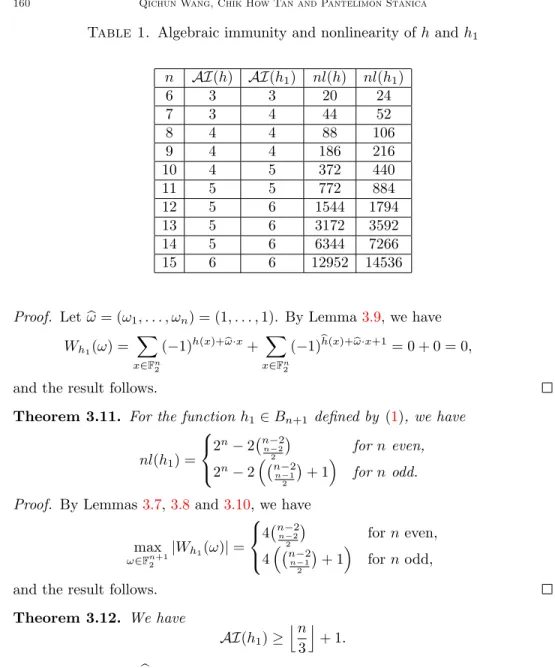
Table 1. Algebraic immunity and nonlinearity ofhandh1 n AI(h) AI(h1) nl(h) nl(h1) 6 3 3 20 24 7 3 4 44 52 8 4 4 88 106 9 4 4 186 216 10 4 5 372 440 11 5 5 772 884 12 5 6 1544 1794 13 5 6 3172 3592 14 5 6 6344 7266 15 6 6 12952 14536
Proof. Letbω= (ω1, . . . , ωn) = (1, . . . ,1). By Lemma3.9, we have
Wh1(ω) = X x∈Fn2 (−1)h(x)+bω·x+ X x∈Fn2 (−1)bh(x)+ωb·x+1 = 0 + 0 = 0,
and the result follows.
Theorem 3.11. For the functionh1∈Bn+1 defined by (1), we have
nl(h1) = 2n−2 n−2 n−2 2 forneven, 2n−2 n−2 n−1 2 + 1 fornodd. Proof. By Lemmas3.7,3.8and3.10, we have
max ω∈Fn2+1 |Wh1(ω)|= 4 nn−−22 2 forneven, 4 nn−−12 2 + 1 fornodd,
and the result follows.
Theorem 3.12. We have
AI(h1)≥jn 3
k
+ 1.
Proof. Sincehandbhare affine equivalent, they have the same algebraic immunity,
which is≥ bn
3c+ 1 by Theorem 4 of [28]. Then by Proposition 1 of [4], AI(h1)≥ bn
3c+ 1.
It seems that AI(h1)≥ AI(h) and in some cases AI(h1)>AI(h), which can be found in Table1, where h, h1∈Bn.
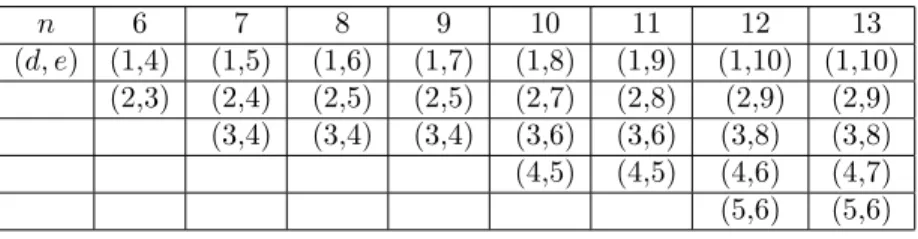
Let deg(g1) =d < AI(h1) and h1·g1 =g2. We expect that deg(g2) is as high as possible for any g1 of low degree. The optimum case for a Boolean function to resist fast algebraic attacks is that deg(g1) + deg(g2) =n+ 1 for anyg1 of degree deg(g1) ≤ AI(h1). Let deg(g2) = e. For 6 ≤ n+ 1 ≤ 13, in Table 2, we give the lowest possible values of (d, e). Compared with the HWBF, in most cases, the functionh1 has a better behavior against fast algebraic attacks.
To resist BDD-based attacks, a Boolean function should have a high BDD size. In Table3, one can find BDD size of the majority functionmaj, the hidden weighted
Table 2. Behavior of the function h1 against Fast Algebraic Attacks n 6 7 8 9 10 11 12 13 (d, e) (1,4) (1,5) (1,6) (1,7) (1,8) (1,9) (1,10) (1,10) (2,3) (2,4) (2,5) (2,5) (2,7) (2,8) (2,9) (2,9) (3,4) (3,4) (3,4) (3,6) (3,6) (3,8) (3,8) (4,5) (4,5) (4,6) (4,7) (5,6) (5,6)
Table 3. BDD size ofmaj,handh1
n B(maj) B(h) B(h1) 6 14 25 27 7 18 40 42 8 22 57 67 9 27 85 95 10 32 121 136 11 38 172 198 12 44 240 290 13 51 335 388 14 58 459 517 15 66 630 737 16 74 856 959
bit functionhand the modified functionh1, with the standard ordering of variables. Clearly, as a symmetric Boolean function, the majority function has a very small BDD size. Although the BDD size ofhis big, the BDD size of the modified function
h1is even bigger than that of h.
4. Concatenation of four functions
Leth∈Bn be the hidden weighted bit function. Leth2∈Bn+2 andh2(x1, . . . ,
xn+2) = h(x)||h(Sbn 2c(x))||h(Sb n 4c(x))||h(Sb n 4c+b n 2c(x)). Clearly, h2 is a balanced function.
Lemma 4.1. The sum of the two halves of h2, that is, eh= (h(x)||h(Sbn
2c(x))) + (h(Sbn 4c(x))||h(Sbn4c+bn2c(x)))is balanced. Proof. Clearly, eh= (h(x) +h(Sbn 4c(x)))||(h(Sb n 2c(x)) +h(Sb n 4c+b n 2c(x))). By Re-mark 1,h(x)+h(Sbn 4c(x)) andh(Sb n 2c(x))+h(Sb n 4c+b n
2c(x)) are balanced functions,
and the result follows.
By Lemmas 3.3 and 4.1, it is easy to see that h2 satisfies the strict avalanche criterion.
Lemma 4.2. Let ω= (ω1, . . . , ωn+2)andwt(ω) = 1. Then Wh2(ω) ≤ 4 max 1≤k≤n n−2 k−1 + n−2 k(n− bn 2c)−1 + n−2 k(n− bn 4c)−1 + n−2 k(n− bn 4c − b n 2c)−1 ,
which is a tight bound.
Proof. Letbω= (ω1, . . . , ωn). Considerωk = 1 for 1≤k≤n+ 2. Case1: k=n+ 1 orn+ 2. Sinceh,h(Sbn 2c),h(Sb n 4c) andh(Sb n 4c+b n
2c) are all balanced, we have Wh2(ω) = X x∈Fn2+2 (−1)h2(x)+xk = X x∈Fn2 xn+1=xn+2=0 (−1)h(x)+xk+ X x∈Fn2 xn+1+1=xn+2=0 (−1)h(Sbn 2c(x))+xk + X x∈Fn2 xn+1=xn+2+1=0 (−1)h(Sbn4c(x))+xk + X x∈Fn2 xn+1=xn+2=1 (−1)h(Sbn4c+bn2c(x))+xk = 0. Case2: 1≤k≤n. By Lemma3.6, we have Wh2(ω) = X x∈FN2 (−1)h2(x)+ω·x = X x∈Fn2 (−1)h(x)+bω·x+ X x∈Fn2 (−1)h(Sbn2c(x))+ωb·x + X x∈Fn2 (−1)h(Sbn 4c(x))+ωb·x+ X x∈Fn2 (−1)h(Sbn 4c+bn2c(x))+bω·x = 4 n−2 k−1 + 4 n−2 k(n− bn 2c)−1 + 4 n−2 k(n− bn 4c)−1 +4 n−2 k(n− bn 4c − b n 2c)−1 ,
and the result follows.
Similarly, as forh1, one can find some other cryptographic properties forh2, and we gather these in the following theorem, whose proof we omit.
Theorem 4.3. The Boolean functionh2∈Bn+2 is a balanced function, it satisfies
the strict avalanche criterion, has degreedeg(h2)≥n−1,AI(h2)≥ bn3c+ 1 and
nl(h2) = 2n+1 − 2 max 1≤k≤n n−2 k−1 + n−2 k(n− bn 2c)−1 + n−2 k(n− bn 4c)−1 + n−2 k(n− bn 4c − b n 2c)−1 .
Table 4. Algebraic immunity, nonlinearity and BDD size ofh2 n+ 2 AI(h2) nl(h2) B(h2) 10 5 448 137 11 5 896 196 12 6 1820 280 13 6 3658 383 14 6 7508 571 15 7 15018 782
Table 5. Behavior of the function h2 against Fast Algebraic Attacks
n+ 2 (d, e)
10 (1,7) (2,6) (3,5) (4,5) 11 (1,9) (2,8) (3,7) (4,6) 12 (1,10) (2,9) (3,8) (4,7) (5,6) 13 (1,11) (2,10) (3,9) (4,8) (5,6)
In Table4, one can find the algebraic immunity, nonlinearity and BDD size of
h2∈Bn+2 for 10≤n+ 2≤15. Clearly, the BDD size ofh2is better than that of
h,AI(h2)≥ AI(h1) and the nonlinearity of h2 is much higher than that ofhand
h1. In Table 5, one can find the behavior of the functionh2 against fast algebraic attacks, which is better than that ofh, as well.
We have the following well-known results.
Proposition 4.4. Let p1(x1, . . . , xl) ∈ Bl be balanced, p2(xl+1, . . . , xl+m) ∈ Bm andp=p1+p2 be the direct sum ofp1 andp2. Then we have
1)deg(p) = max{deg(p1),deg(p2)}. 2)AI(p)≥max{AI(p1),AI(p2)}.
3)nl(p) = 2mnl(p1) + 2lnl(p2)−2nl(p1)nl(p2).
Recall that the fast correlation attack has an on-line complexity proportional to 1 2 , where = 1 2 − nl(f)
2n is the so-called bias [20]. In consideration of the
implementation efficiency, we compare the 16-variable Carlet–Feng function with the 256-variable HWBF. Letfc be the 16-variable Carlet–Feng function discussed
by [26],eh=h256+x257x258+x259x260+x261x262+x263x264+x265x266+x267x268+
x269x270+x271x272,hf1=h1256+x257x258+x259x260+x261x262+x263x264+x265x266+ x267x268+x269x270+x271x272 andfh2 =h2256+x257x258+x259x260+x261x262+ x263x264+x265x266+x267x268+x269x270+x271x272. Then, the bias of fc is =
0.0036, while by Proposition 1, the bias of eh is = 0.0001, the bias of fh1 is = 0.00005 and the bias offh2is= 0.000025. Clearly, the behavior ofehandfh1against fast correlation attacks is better than that offc, andfh2has the best behavior among all of them. We haveAI(fc) = 8, while the other three functions have algebraic
immunities at least 86. The Carlet–Feng function also has an exponential BDD size. However,B(fc)<215, and it is much smaller than the BDD sizes of the other
three functions.
Example 4.5. Leth, h1, h2∈B12. Then they are all balanced and satisfy the strict avalanche criterion. deg(h) = deg(h1) = deg(h2) = 11; AI(h) = 5 and AI(h1) = AI(h2) = 6; nl(h) = 1544,nl(h1) = 1794 andnl(h2) = 1820;B(h) = 240,B(h1) = 290 and B(h2) = 280. Comparing it withh, h1 has a better behavior andh2 has the best behavior against fast algebraic attacks (it is noticed that h2 ∈ B12 has the optimum algebraic immunity and the optimum behavior against fast algebraic attacks). Clearly, all these cryptographic properties of h1 and h2 are better than those ofh.
5. Conclusion
This paper modifies the HWBF and constructs two infinite classes of functions with very good cryptographic properties (better than those of the HWBF). To summarize, the new functions are balanced, have almost optimum algebraic degree and satisfy the strict avalanche criterion. Their nonlinearity is higher than that of the HWBF. We investigate their algebraic immunity, BDD size and their resistance against fast algebraic attacks, which seem to be better than those of the HWBF, too. Since the new functions can be implemented very efficiently, they can be used with a large number of variables, which allows reaching very good cryptographic properties. The new functions could be excellent candidates for stream ciphers constructions.
Acknowledgments
We would like to thank the anonymous reviewers for their valuable suggestions and comments that improved the quality of this paper.
References
[1] R. E. Bryant, On the complexity of VLSI implementations and graph representations of Boolean functions with application to integer multiplication, IEEE Trans. Comput., 40
(1991), 205–213.
[2] C. Carlet,On the higher order nonlinearities of algebraic immune functions, inAdvances in Cryptology – CRYPTO 2006, Springer-Verlag, 2006, 584–601.
[3] C. Carlet, Boolean functions for cryptography and error correcting codes, inBoolean Models and Methods in Mathematics, Computer Science, and Engineering, Cambridge Univ. Press, 2010, 257–397.
[4] C. Carlet, D. K. Dalai, K. C. Gupta and S. Maitra,Algebraic immunity for cryptographically significant Boolean functions: analysis and construction,IEEE Trans. Inf. Theory,52(2006), 3105–3121.
[5] C. Carlet and K. Feng,An infinite class of balanced functions with optimal algebraic immunity, good immunity to fast algebraic attacks and good nonlinearity, inAdvances in Cryptology – ASIACRYPT 2008, Springer-Verlag, 2008, 425–440.
[6] C. Carlet and K. Feng,An infinite class of balanced vectorial Boolean functions with optimum algebraic immunity and good nonlinearity, inIWCC 2009, Springer-Verlag, 2009, 1–11. [7] N. Courtois, Fast algebraic attacks on stream ciphers with linear feedback, in Advances in
Cryptology – CRYPTO 2003, Springer-Verlag, 2003, 176–194.
[8] N. Courtois and W. Meier, Algebraic attacks on stream ciphers with linear feedback, in
Advances in Cryptology – EUROCRYPT 2003, Springer-Verlag, 2003, 345–359.
[9] T. W. Cusick and P. St˘anic˘a,Cryptographic Boolean Functions and Applications, Elsevier-Academic Press, New York, 2009.
[10] D. K. Dalai, K. C. Maitra and S. Maitra, Cryptographically significant Boolean functions: Construction and analysis in terms of algebraic immunity, in Proceedings of FSE 2005, Springer-Verlag, 2005, 98–111.
[11] D. K. Dalai, S. Maitra and S. Sarkar,Basic theory in construction of Boolean functions with maximum possible annihilator immunity,Des. Codes Cryptogr.,40(2006), 41–58.
[12] P. Hawkes and G. G. Rose,Rewriting variables: the complexity of fast algebraic attacks on stream ciphers, inAdvances in Cryptology – CRYPTO 2004, Springer-Verlag, 2004, 390–406. [13] D. E. Knuth, The Art of Computer Programming: Bitwise Tricks & Techniques; Binary
Decision Diagrams, Addison-Wesley Professional, Boston, 2009.
[14] M. Krause,BDD-based cryptanalysis of keystream generators, inAdvances in Cryptology – EUROCRYPT 2002, Springer-Verlag, 2002, 222–237.
[15] N. Li and W. F. Qi,Construction and analysis of Boolean functions of 2t+ 1 variables with maximum algebraic immunity, inAdvances in Cryptology – ASIACRYPT 2006, Springer-Verlag, 2006, 84–98.
[16] N. Li, L. Qu, W. Qi, G. Feng, C. Li and D. Xie,On the construction of Boolean functions with optimal algebraic immunity,IEEE Trans. Inf. Theory,54(2008), 1330–1334.
[17] M. S. Lobanov,Exact relation between nonlinearity and algebraic immunity,Discrete Math. Appl.,16(2006), 453–460.
[18] M. S. Lobanov,Exact relations between nonlinearity and algebraic immunity,J. Appl. Ind. Math.,3(2009), 367–376.
[19] W. Meier, E. Pasalic and C. Carlet,Algebraic attacks and decomposition of Boolean functions, inAdvances in Cryptology – EUROCRYPT 2004, Springer-Verlag, 2004, 474–491.
[20] W. Meier and O. Staffelbach, Fast correlation attacks on stream ciphers, in Advances in Cryptology – EUROCRYPT ’88, Springer-Verlag, 1988, 301–314.
[21] S. Mesnager,Improving the lower bound on the higher order nonlinearity of Boolean functions with prescribed algebraic immunity,IEEE Trans. Inf. Theory,54(2008), 3656–3662. [22] E. Pasalic, Almost fully optimized infinite classes of Boolean functions resistant to (fast)
algebraic cryptanalysis, inProceedings of ICISC 2008, Springer-Verlag, 2009, 399–414. [23] P. Rizomiliotis,On the resistance of Boolean functions against algebraic attacks using
uni-variate polynomial representation,IEEE Trans. Inf. Theory,56(2010), 4014–4024. [24] O. S. Rothaus, On bent functions,J. Comb. Theory Ser. A,20(1976), 300–305.
[25] C. Tan and S. Goh, Several classes of even-variable balanced Boolean functions with optimal algebraic immunity,IEICE Trans. Fund.,E94.A(2011), 165–171.
[26] D. Tang, C. Carlet and X. Tang,Highly nonlinear Boolean functions with optimal algebraic immunity and good behavior against fast algebraic attacks,IEEE Trans. Inf. Theory,59
(2013), 653–664.
[27] Z. Tu and Y. Deng,A conjecture about binary strings and its applications on constructing Boolean functions with optimal algebraic immunity,Des. Codes Cryptogr.,60(2011), 1–14. [28] Q. Wang, C. Carlet, P. St˘anic˘a and C. Tan,Cryptographic properties of the hidden weighted
bit function,Discrete Appl. Math., to appear.
[29] Q. Wang, T. Johansson and H. Kan, Some results on fast algebraic attacks and higher-order non-linearities,IET Inform. Secur.,6(2012), 41–46.
[30] Q. Wang, J. Peng, H. Kan and X. Xue,Constructions of cryptographically significant Boolean functions using primitive polynomials,IEEE Trans. Inf. Theory,56(2010), 3048–3053. [31] Q. Wang and C. H. Tan, A new method to construct Boolean functions with good
crypto-graphic properties,Inform. Proc. Lett.,113(2013), 567–571.
[32] Q. Wang and C. H. Tan,Balanced Boolean functions with optimum algebraic degree, optimum algebraic immunity and very high nonlinearity,Discrete Appl. Math.,1673(2014), 25–32. [33] A. F. Webster and S. E. Tavares, On the design of S-boxes, in Advances in Cryptology –
CRYPTO ’85, Springer-Verlag, 1985, 523–534.
[34] X. Zeng, C. Carlet, J. Shan and L. Hu,More balanced Boolean functions with optimal alge-braic immunity, and good nonlinearity and resistance to fast algealge-braic attacks,IEEE Trans. Inf. Theory,57(2011), 6310–6320.
Received January 2013; revised September 2013.
E-mail address: [email protected]
E-mail address: [email protected]
E-mail address: [email protected]