of Sorted Integers
D. Lemire
1∗, L. Boytsov
2, N. Kurz
31LICEF Research Center, TELUQ, Montreal, QC, Canada 2Carnegie Mellon University, Pittsburgh, PA USA
3Verse Communications, Orinda, CA USA
SUMMARY
Sorted lists of integers are commonly used in inverted indexes and database systems. They are often compressed in memory. We can use the SIMD instructions available in common processors to boost the speed of integer compression schemes. Our S4-BP128-D4 scheme uses as little as 0.7 CPU cycles per decoded 32-bit integer while still providing state-of-the-art compression.
However, if the subsequent processing of the integers is slow, the effort spent on optimizing decompression speed can be wasted. To show that it does not have to be so, we (1) vectorize and optimize the intersection of posting lists; (2) introduce the SIMD GALLOPINGalgorithm. We exploit the fact that one SIMD instruction can compare 4 pairs of 32-bit integers at once.
We experiment with two TREC text collections, GOV2 and ClueWeb09 (Category B), using logs from the TREC million-query track. We show that using only the SIMD instructions ubiquitous in all modern CPUs, our techniques for conjunctive queries can double the speed of a state-of-the-art approach.
KEY WORDS: performance; measurement; index compression; vector processing
1. INTRODUCTION
An inverted index maps terms to lists of document identifiers. A column index in a database might, similarly, map attribute values to row identifiers. Storing all these lists on disk can limit the performance since the latency of the fastest drives is several orders of magnitude higher than the latency of memory. Fast compression can reduce query response times [1,2].
We assume that identifiers can be represented using 32-bit integers and that they are stored in sorted order. In this context, one can achieve good compression ratios and high decompression speed, by employingdifferential coding. We exploit the fact that the lists are sorted and instead of storing the integers themselves, we store the differences between successive integers, sometimes called the deltas.
Additional improvements arise from using the single instruction, multiple data (SIMD) instructions available on practically all server and desktop processors produced in the last decade (Streaming SIMD Extensions 2 or SSE2). A SIMD instruction performs the same operation on multiple pieces of data: this is also known as vector processing. Previous research [3] showed that we can decode compressed 32-bit integers using less than 1.5 CPU cycles per integer in a realistic inverted index scenario by using SIMD instructions. We expect that this is at least twice as fast as any non-SIMD scheme.
∗Correspondence to: LICEF Research Center, TELUQ, Universit´e du Qu´ebec, 5800 Saint-Denis, Montreal (Quebec) H2S 3L5 Canada.
One downside of differential coding is that decompression requires the computation of a prefix sum to recover the original integers [4]: given the delta values δ2, δ3, . . . and an initial valuex1,
we must compute x1+δ2, x1+δ2+δ3, x1+δ2+δ3+δ4+. . .. When using earlier non-SIMD
compression techniques, the computational cost of the prefix sum might be relatively small, but when using faster SIMD compression, the prefix sum can account for up to half of the running time. Thankfully we can accelerate the computation of the prefix sum using SIMD instructions.
Our first contribution is to revisit the computation of the prefix sum. On 128-bit SIMD vectors, we introduce four variations exhibiting various speed/compression trade-offs, from the most common one, to the 4-wise approach proposed by Lemire and Boytsov [3]. In particular, we show that at the same compression ratios, vector (SIMD) decompression is much faster than scalar (non-SIMD) decompression. Maybe more importantly, we show thatintegratingthe prefix sum with the unpacking can nearly double the speed. Some of our improved schemes can decompress more than one 32-bit integer per CPU cycle. We are not aware of any similar high speed previously reported, even accounting for hardware differences.
To illustrate that SIMD instructions can significantly benefit other aspects of an inverted index (or a database system), we consider the problem of computing conjunctive queries: e.g., finding all documents that contain a given set of terms. In some search engines, such conjunctive queries are the first, and, sometimes, the most expensive, step in query processing [5,6]. Some categories of users, e.g., patent lawyers [7], prefer to use complex Boolean queries—where conjunction is an important part of query processing.
Culpepper and Moffat showed that a competitive approach (henceforth HYB+M2) was to represent the longest lists as bitmaps while continuing to compress the short lists using differential coding [5]. To compute an intersection, the short lists are first intersected and then the corresponding bits in the bitmaps are read to finish the computation. As is commonly done, the short lists are intersected two-by-two starting from the two smallest lists: this is often called a Set-vs-Set or SvS processing. These intersections are typically computed using scalar algorithms. In fact, we are not aware of any SIMD intersection algorithm proposed for such problems on CPUs. Thus as our second contribution, we introduce new SIMD-based intersection algorithms for uncompressed integers that are up to twice as fast as competitive scalar intersection algorithms. By combining both the fast SIMD decompression and fast SIMD intersection, we can double the speed of the intersections on compressed lists.
We summarize our main contributions as follows:
1. We show that by combining SIMD unpacking and the prefix sum required by differential coding, we can improve decompression speed by up to90%. We end up beating by about 30% the previous best reported decompression speeds [3].
2. We introduce a family of intersection algorithms to exploit commonly available SIMD instructions (V1, V3 and SIMD GALLOPING). They are often twice as fast as the best non-SIMD algorithms.
3. By combining our results, we nearly double the speed of a fast inverted index (HYB+M2) over realistic data and queries—on standard PC processors.
To ease reproducibility, we make all of the software and data sets publicly available, including the software to process the text collections and generate query mappings (see§7.1and§7.3).
2. RELATED WORK
For an exhaustive review of fast 32-bit integer compression techniques, we refer the reader to Lemire and Boytsov [3]. Their main finding is that schemes compressing integers in large (≈128) blocks of integers with minimal branching are faster than other approaches, especially when using SIMD instructions. They reported using fewer than 1.5 CPU cycles per 32-bit integer on a 2011-era Intel
optimized for SIMD instructions on CPUs, but they reported using at least 2.2 CPU cycles per 32-bit integer on a 2010 IntelWestmereprocessor.
Regarding the intersection of sorted integer lists, Ding and K¨onig [9] compared a wide range of algorithms in the context of a search engine and found that SvS with gallopingwas competitive: we describe galloping in§6. Their own technique (RanGroup) performed better (≈10%–30%) but it does not operate over sorted lists but rather over a specialized data structure that divides up the data randomly into small chunks. In some instances, they found that a merge (akin to the merge step in the merge sort algorithm) was faster. They also achieved good results with Lookup [10]: a technique that relies on an auxiliary data structure for skipping values [11]. Ding and K¨onig found that alternatives such as Baeza-Yates’ algorithm [12] or adaptive algorithms [13] were slower.
Barbay et al. [14] also carried out an extensive experimental evaluation. On synthetic data using a uniform distribution, they found that Baeza-Yates’ algorithm [12] was faster than SvS with galloping (by about30%). However, on real data (e.g., TREC GOV2), SvS with galloping was superior to most alternatives by a wide margin (e.g.,2×faster).
Culpepper and Moffat similarly found that SvS with galloping was the fastest [5] though their own maxalgorithm was fast as well. They found that in some specific instances (for queries containing 9 or more terms) a technique similar to galloping (interpolative search) was slightly better (by less than10%).
Kane and Tompa improved Culpepper and Moffat’sHYB+M2 by adding auxiliary data structures to skip over large blocks of compressed values (256 integers) during the computation of the intersection [15]. Their good results are in contrast with Culpepper and Moffat’s finding that skipping is counterproductive when using bitmaps [5].
Our work is focused on commodity desktop processors. Compression and intersection of integer lists using a graphics processing unit (GPU) has also received attention. Ding et al. [16] improved the intersection speed using a parallel merge find: essentially, they divide up one list into small blocks and intersect these blocks in parallel with the other array. On conjunctive queries, Ding et al. [16] found their GPU implementation to be only marginally superior to a CPU implementation (≈15% faster) despite the data was already loaded in GPU’s global memory. They do, however, get impressive speed gains (7×) on disjunctive queries.
Ao et al. [17] proposed a parallelized compression technique (Parallel PFor) and replaced conventional differential coding with an approach based on linear regression. In our work, we rely critically on differential coding, but alternative models merit consideration [18,19,20].
3. RELEVANT SIMD INSTRUCTIONS
Intel PC processors support vector instructions, but languages such as C or C++ do not directly include vectorization as part of their standard syntax. However, it is still possible to conveniently call these instructions by using intrinsics or online assembly code. Intrinsics are special functions (sometimes called built-in functions) provided as a compiler extension of C/C++ syntax.
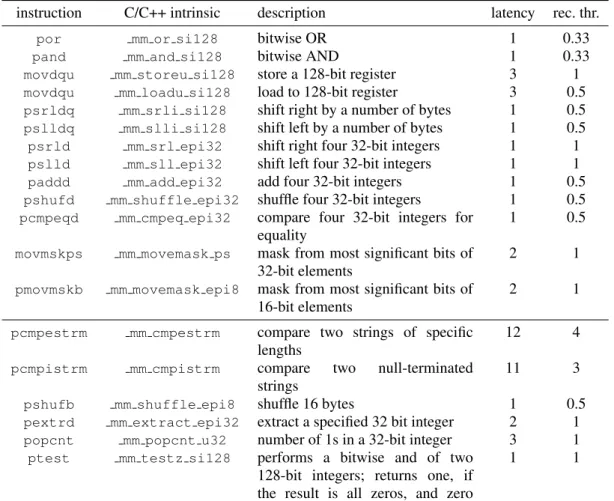
TableIpresents the various SIMD instructions we require. In addition to instruction mnemonic names, we also provide names of respective C/C++ intrinsics. In this table, there is a single intrinsic function per mnemonic except for the move instructionmovdqu, which has separate intrinsics to denote store and load operations.
Though most of the instructions are fast, some are significantly more expensive. Intel often expresses the computational cost of an instruction in terms of its latency and reciprocal throughput. The latency is the minimum number of cycles required to execute the instruction. The reciprocal throughput is one over the maximum number of instructions of the same kind that can be executed per cycle. For example, a reciprocal throughput of 0.5 indicates that up to two instructions of the same type can be executed in a cycle. We give the latency and reciprocal throughput for Intel processors with aSandy Bridgemicroarchitecture [21]. These numbers are often constant across Intel microarchitectures.
All of these instructions use 128-bit registers (called XMM registers). Many of them are straightforward. For example, por and pand compute the bitwise OR and AND between two registers.
We use themovdqu instruction to load or store a register. Loading and storing registers has a relatively high latency (3 cycles). While we can load two registers per cycle, we can only store one of them to memory.
The bit shifting instructions come in two flavors. When we need to shift entire registers by a number of bits divisible by eight (a byte), we use thepsrldqandpslldqinstructions. They have a high throughput (2 instructions per cycle) onSandy BridgeIntel processors [22].
We can also consider the 128-bit registers as a vector of four 32-bit integers. We can then shift right four 32-bit integers by a fixed number of bits using thepsrld instruction. It has reduced throughput compared to the byte-shifting instructions (1 instruction per cycle).
In the same spirit, we can add four 32-bit integers with four other 32-bit integers at once using thepadddinstruction. It is another fast operation.
Sometimes it is necessary to copy the 32-bit integers from one XMM register to another, while possibly moving or duplicating values. The pshufd instruction can serve this purpose. It takes as a parameter an input registervas well as a control maskm. The control mask is made of four 2-bit integers each representing an integer in{0,1,2,3}. We output(vm0, vm1, vm2, vm3). Thus, for example, thepshufdinstruction can copy one particular value to all positions (using a mask made of 4 identical values). It is a fast instruction with a throughput of two instructions per cycle.
We can compare the four 32-bit integers of one registervwith the four 32-bit integers of another registerv0using thepcmpeqdinstruction. It generates four 32-bit integers with value 0xFFFFFFFF or 0 depending on whether the corresponding pairs of integers are equal (e.g., ifv0=v00, then the
first component returned bypcmpeqdhas value 0xFFFFFFFF).
The pcmpeqd instruction can be used in tandem with the movmskps instruction, which generates a 4-bit mask by extracting the four most significant bits from the four 32-bit integers produced by the comparison instruction pcmpeqd. The movmskps instruction is slightly expensive, with a throughput of 1 instruction per cycle and a latency of 2 cycles. In some cases, we only need to verify if four 32-bit integers in one register are different from respective 32-bit integers in another register, i.e., we do not need to extract a mask. To check this, we use either the SSE2 instruction pmovmskbor the SSE4 instructionptest. The SSE4 instruction has smaller latency, however, replacingptestwithpmovmskbdid not substantially affect runtime.
In some particular algorithms (see§6.1), we also use two recently introduced string-comparison instructions (part of the SSE4 instruction set): pcmpestrm andpcmpistrm. They operate on 8-bit or 16-bit strings loaded in XMM registers. They take a control mask to specify their behavior. We use them for 16-bit strings. For our purposes, we ask for a 8-bit mask indicating whether any of the eight 16-bit elements of the first register are equal to any of the eight 16-bit elements of the second register. This mask is stored in a 128-bit MMX register and is extracted using thepextrd instruction.
The two string-comparison instructions differ in how they deduce the string length. The slower pcmpestrminstruction requires us to specify the string lengths (8 elements in our case). The faster pcmpistrminstruction assumes that strings are null terminated. When no null value is found, the pcmpistrm instruction processes 8 elements per register. There is no 16-bit counterpart to the pshufdinstruction, but there is an 8-bit version (pshufb) with the same latency and throughput.
4. INTEGER COMPRESSION
We consider the case where we have lists of integers stored using 32 bits, but where the magnitude of most integers requires fewer than 32-bits to express. We want to compress them while spending as few CPU cycles per integer as possible.
Table I. SIMD instructions onSandy Bridge Intel processors with latencies and reciprocal throughput in CPU cycles . All instructions are part of SSE2, exceptpcmpestrm,pcmpistrm,pextrd,popcnt,
ptestthat are SSE4 instructions, andpshufbthat is an SSSE3 instruction.
instruction C/C++ intrinsic description latency rec. thr.
por mm or si128 bitwise OR 1 0.33
pand mm and si128 bitwise AND 1 0.33
movdqu mm storeu si128 store a 128-bit register 3 1
movdqu mm loadu si128 load to 128-bit register 3 0.5
psrldq mm srli si128 shift right by a number of bytes 1 0.5
pslldq mm slli si128 shift left by a number of bytes 1 0.5
psrld mm srl epi32 shift right four 32-bit integers 1 1
pslld mm sll epi32 shift left four 32-bit integers 1 1
paddd mm add epi32 add four 32-bit integers 1 0.5
pshufd mm shuffle epi32 shuffle four 32-bit integers 1 0.5
pcmpeqd mm cmpeq epi32 compare four 32-bit integers for
equality
1 0.5
movmskps mm movemask ps mask from most significant bits of
32-bit elements
2 1
pmovmskb mm movemask epi8 mask from most significant bits of
16-bit elements
2 1
pcmpestrm mm cmpestrm compare two strings of specific
lengths
12 4
pcmpistrm mm cmpistrm compare two null-terminated
strings
11 3
pshufb mm shuffle epi8 shuffle 16 bytes 1 0.5
pextrd mm extract epi32 extract a specified 32 bit integer 2 1
popcnt mm popcnt u32 number of 1s in a 32-bit integer 3 1
ptest mm testz si128 performs a bitwise and of two
128-bit integers; returns one, if the result is all zeros, and zero otherwise.
1 1
There has been much work on the design and analysis of integer compression schemes. Out of an earlier survey [3], we choose 4 previously described fast compression schemes: VARINT, S4-BP128, FASTPFOR and S4-FASTPFOR. Both S4-BP128 and S4-FASTPFOR performed best in an exhaustive experimental comparison [3]. We review them briefly for completeness.
4.1. VARINT
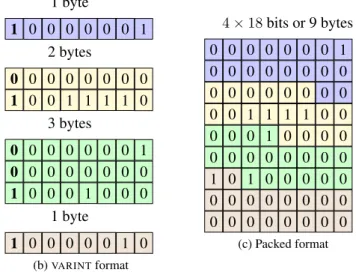
Many authors such as Culpepper and Moffat [5] use variable byte codes (henceforthVARINT) also known as escaping [10] for compressing integers. It was first described by Thiel and Heaps [23]. For example, we might code integers in [0,27) using a single byte, integers in [27,214) using two bytes and so on. As an example, consider the integers 1, 3840, 131073, and 2, and Fig. 1. In Fig. 1a, we give the usual 32-bit integer layout for these integers, it uses 16 bytes. In binary format, these numbers can be written 1, 111100000000, 100000000000000001 and 10 (writing the most significant bits first). The first integer can be written using a single byte since it is in [0,27). To indicate that the byte corresponds to a complete integer, we set the most significant bit
to 1: 10000001. The integer 3840 is in[27,214), so we represent it using two bytes. The first byte
corresponds to the first 7 bits and has 0 as its most significant bit to indicate that it does not represent a full integer (000000001). The second byte includes the remaining bits and has 1 as its most significant bit (10011110). We proceed similarly for the integers 131073 and 2 (see Fig.1b). Overall, VARINTusing 7 bytes instead of the original 16 bytes. VARINTdoes not always compress well: it
1 0 0 0 0 15
4×4bytes or 16 bytes
0 0 1 0 2 0 2 0 0 0 (a) Unsigned binary 32-bit format: for each integer, there are
four unsigned byte values (in little endian representation).
1 0 0 0 1 byte 0 0 0 1 0 0 0 0 2 bytes 0 0 0 0 1 0 0 1 1 1 1 0 0 0 0 0 3 bytes 0 0 0 1 0 0 0 0 0 0 0 0 1 0 0 0 1 0 0 0 1 0 0 0 1 byte 0 0 1 0 (b)VARINTformat 0 0 0 0 0 4×18bits or 9 bytes 0 0 1 0 0 0 0 0 0 0 0 0 0 0 0 0 0 0 0 0 0 1 1 1 1 0 0 0 0 0 1 0 0 0 0 0 0 0 0 0 0 0 0 1 0 1 0 0 0 0 0 0 0 0 0 0 0 0 0 0 0 0 0 0 0 0 0 (c) Packed format
Figure 1. The sequence of numbers 1, 3840, 131073 and 2 using 3 different data formats. We use a left to right, top to bottom representation, putting most significant bits first in each byte.
always uses at least one byte per integer. However, if most integers can be represented with a single byte, then it offers competitive decompression speed [3]. Stepanov et al. [8] reviewed VARINT -like alternatives that use SIMD instructions. Lemire and Boytsov [3] found that the fastest such alternative (varint-G8IU) was slower and did not compress as well as other SIMD-based schemes.
4.2. Bit packing and unpacking
Consider once more the integers 1, 3840, 131073, and 2, and Fig.1. The largest of them is 131073 and it can be represented using 18 bits in binary format (as 100000000000000001). Thus we could decide to write the four integers using exactly 18 bits per integer. The result in memory might look like Fig.1cand span 9 bytes. We call this processbit packing, and the reverse processbit unpacking
(see TableIIfor a summary of our terminology).
The consecutive layout of Fig.1is adequate for scalar processing: unpacking an integer can be done efficiently using shifts and bitwise logical operations. However, when using SIMD processing, we want to pack and unpack several (e.g., 4) integers at once. For this reason, we choose to interleave the packed integers as in Fig.2. In this example, the integersx1, x2, x3, x4 are packed to the first
18 bits of 4 consecutive 32-bit words. The first 14 bits of the next integersx5, x6, x7, x8are packed
to the next 14 bits of these 32-bit integers, and the remaining 18−14 = 4bits are packed to the first bits of the next four consecutive 32-bit words. See Lemire and Boytsov [3] for a more detailed discussion and a comparison with an alternative layout.
Only 4 basic operations are required for bit unpacking: bitwise or, bitwise and, logical shift right, and logical shift left. The corresponding 128-bit SSE2 instructions operating on packed 32-bit integers are por, pand, psrld, andpslld (in Intel and AMD processors). For a given bit width b, no branching is required for bit packing or bit unpacking. Thus, we can create one bit unpacking function for each bit width band select the desired one using an array of function pointers or aswitch/casestatement. In the scalar case, it is most convenient to pack and unpack integers in units of 32 integers. Given a bit width b, the unpacking procedure outputs b 32-bit integers. In the vectorized case, we pack and unpack integers in blocks of 128 integers, so that
x1 x2 x3 x4 x5 · · ·
x1 x5 x2 x6 x3 x7 x4 x8 · x9 · · ·
x5is split across two words
Figure 2. Packing 32-bit integersx1, x2, . . .(top) to 18 bits per integer (bottom) using the interleaved packed
format for SIMD processing
the unpacking procedure–corresponding to bit width b–generatesb 128-bit vectors. A generic bit unpacking procedure for a block of 128 integers is given by Algorithm1and discussed again in§5.
4.3. S4-BP128
Bit packing suggests a simple scheme: regroup the integers into blocks (e.g. 128 integers) and pack them as concisely as possible, while recording the bit width (e.g., 18 bits per integer) using an extra byte. We call this approachBINARY PACKING. Binary packing is closely related to Frame-Of-Reference (FOR) [24] and it has been called PackedBinary [25].
Binary packing can be fast. Indeed, Catena et al. [1] found that it offered the best speed in a search engine setting. Our fastest family of compression schemes is an instance of binary packing: S4-BP128. The “S4” stands for 4-integer SIMD, “BP” stands for “Binary Packing”, and “128” indicates the number of integers encoded in each block.
In the S4-BP128 format, we decompose arrays into meta-blocks of 2048 integers, each containing 16 blocks of 128 integers. Before bit packing the 16 blocks, we write 16 bit widths (b) using one byte each. For each block, the bit width is the smallest valuebsuch that all corresponding integers are smaller than2b. The valuebcan range from 0 to 32. In practice, lists of integers are rarely divisible by 2048. We handle remaining blocks of 128 integers separately. For each such block, we write a byte containing a bit widthb, followed by the corresponding 128 integers in bit packed form. Finally, we compress the remaining integers (less than 128 integers) usingVARINT.
4.4. FASTPFOR,SIMD-FASTPFOR, andS4-FASTPFOR
The downside of the S4-BP128 approach is that the largest integers in a block of 128 integers determine the compression ratio of all these integers. We could use smaller blocks (e.g., 32) to improve compression. However, a better approach for performance might bepatching[26] wherein the block is first decompressed using a smaller bit width, and then a limited number of entries requiring greater bit widths are overwritten (“patched”) using additional information. That is, instead of picking the bit width b such that all integers are smaller than 2b, we pick a different bit widthb0 that might be smaller thanb. That is, we only bit pack the least significantb0-bits from each integer. We must still encode the missing information for all integers larger than or equal to 2b0: we call each such integer an exception.
In our version of patched coding (FASTPFOR, for “fast patched frame-of-reference”), we proceed as in S4-BP128, that is we bit pack blocks of 128 integers. To complement this data, we use a
metadata byte array. For each block, we store both bit widthsb andb0, as well as the number of exceptions. Each location where an exception should be applied is also stored using one byte in the metadatabyte array. It remains to store the most significant b−b0 bits of the integers larger than or equal to2b0. We collect these exceptions over many blocks (up to 512 blocks) and then bit pack them together, into up to 32 bit packed arrays (one for each possible value ofb−b0 excluding zero). For speed, these arrays are padded up to a multiple of 32 integers. The final data format is an aggregation of the bit packed blocks (usingb0bits per integer), themetadatabyte array and the bit packed arrays corresponding to the exceptions.
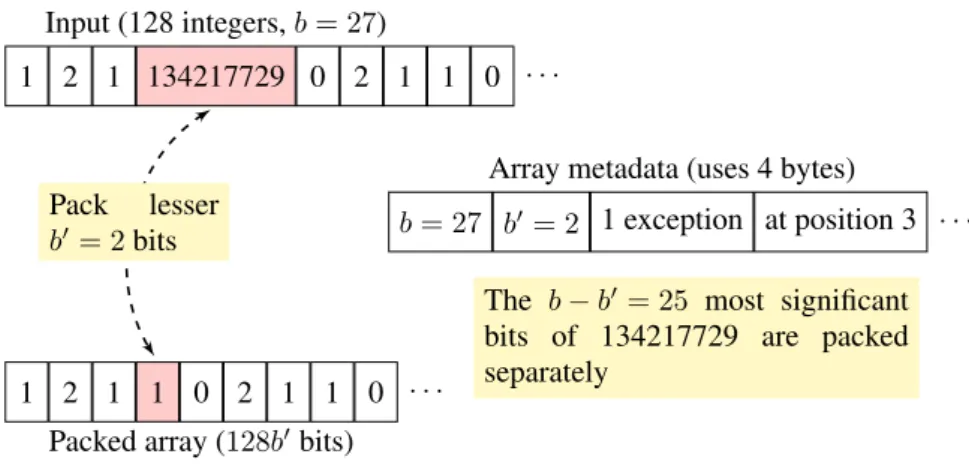
As an illustration, consider Fig.3. We consider a block of 128 integers beginning with 1,2, 1, 134217729, 0. We assume that all values in the block except for 134217729 do not exceed three and, thus, can be encooded using two bits each. In this case, we have thatb= 27and binary packing
1 2 1 134217729 0 2 1 1 0 · · · Input (128 integers,b= 27)
1 2 1 1 0 2 1 1 0 · · ·
The b−b0 = 25 most significant bits of 134217729 are packed separately
b= 27 b0 = 2 1 exception at position 3 · · ·
Array metadata (uses 4 bytes)
Packed array (128b0bits) Pack lesser
b0= 2bits
Figure 3. Example of compression using FASTPFOR (and S4-FASTPFOR). The data corresponding to a block of 128 integers is located in a packed array (usingb0 bit per integer, in a metadata byte array and,
finally, in a corresponding packed array of exceptions.
would thus require 27 bits per integer—even if most of the integers could fit in two bits. With FASTPFOR, we might setb0= 2 and pack only the least significant two bits of each integer. To allow decoding, we have to record that there is one exception at location 3 as well as the values ofb
andb0. Each of these numbers can be stored using one byte. We are left to code theb−b0= 25most significant bits of 134217729. We can store these bits in an array to be packed later. Once we have processed many blocks of 128 integers, there might be several similar exceptions that need the storage of their 25 most significant bits: they are stored and packed together. During decompression, these most significant bits can be unpacked as needed from one of 32 different arrays (one for each possible value ofb−b0excluding zero).
Decompression using FASTPFOR is similar to decompression using S4-BP128, except that, after bit unpacking the least significantb0bits for the integers of a block, we must proceed with the
patching. For this purpose, the packed arrays of exception values are unpacked as needed and we loop over the exceptions.
The integerbis determined by the data—as the number of bits required to store the largest integer in the block. However, we are free to setb0 to any integer in[0, b]. For each block, we pickb0 to minimize128×b0+c(b0)(b−b0+ 8)wherec(b0)is the number exceptions generated for a given valueb0 (e.g.,c(b) = 0). This heuristic for pickingb0 can be computed quickly if we first tabulate how many integers in the block are less than 2x for x= 0, . . . , b. For this purpose, we use the assembly instructionbsr(Bit Scan Reverse) to calculate thelog2of each integer.
We can compare FASTPFOR with other patched schemes based on Lemire and Boytsov’s results [3]: the original scheme from Zukowski et al. [26] is faster than FASTPFOR but has worse compression ratios (even worse than the bit packing method S4-BP128 that does not use patching), OptPFD [27] by Yan el al. sometimes compresses better than FASTPFOR, but can be up to two times slower, and their NewPFD [27] is typically slower and offers worse compression ratios than FASTPFOR. A format inspired by FASTPFOR (where bits from exceptions are bit packed) is a part of the search engine Apache Lucene as of version 4.5.† In contrast, Catena et al. [1] found that FASTPFOR provided no response time benefit compared to NewPFD and OptPFD when compressing document identifiers. Possibly, the discrepancy can be explained by the fact that they divided their arrays into small chunks of 1024 integers prior to compression. Indeed, FASTPFOR is most effective when it is allowed to aggregate the exceptions over many blocks of 128 integers.
Because FASTPFOR relies essentially on bit packing for compression, it is easy to vectorize it using the same SIMD-based bit packing and unpacking functions used by S4-BP128. We call the
†http://lucene.apache.org/core/4_9_0/core/org/apache/lucene/util/
Table II. Some of our terminology
Differential coding Strategy to transform lists of sorted integers into lists of small integers by computing differences between nearby, but not necessarily adjacent, integers. We consider four types of differential coding (D1, D2, DM, D4). To recover the initial array, it is necessary to compute a prefix sum or its analog.
Optionally, we can integrate differential coding in the packing and unpacking. In such a case, unpacking includes the computation of the prefix sum.
pack (unpack) To encode (resp. decode) 32-bit integers to (resp. from) data blocks where all integers use a fixed number of bits (bit width). Packing and unpacking routines are used as part of integer compression algorithms such as binary packing.
binary packing Compression scheme that packs blocks of integers (e.g., 128 integers) using as few bits as possible (e.g., the S4-BP128 family)
patched coding Compression strategy that uses binary packing to encode most of the data, while also encoding exceptions separately (e.g., the FASTPFOR scheme) to improve the compression ratio.
resulting scheme S4-FASTPFOR. In the original scheme by Lemire and Boytsov [3] (called SIMD-FASTPFOR), the bit-packed exceptions were padded up to multiples of 128 integers instead of multiples of 32 integers as in FASTPFOR. While this insured that all memory pointers were aligned on 16 bytes boundaries, it also adversely affected compression. Our S4-FASTPFOR has essentially the same data format as FASTPFOR and, thus, the same compression ratios. These changes require that we use (1) scalar bit packing/unpacking for up to 32 integers per packed array and (2) unaligned load and store SIMD instructions. Neither of these differences significantly impacts performance, and the compression ratios improve by≈5%.
5. DIFFERENTIAL CODING
Differential coding takes a sorted integer list x1, x2, . . . and replaces it with successive
differences (or deltas)δ2, δ3, . . .=x2−x1, x3−x2, . . .. If we keep the first value intact (x1), this
transformation is invertible. We can then apply various integer compression schemes on the deltas. Since the deltas are smaller than the original integers in the list, we get better compression ratios.
If the sorted lists contain no repetitions, we can further subtract one from all deltas as we know that they are greater than zero. However, this only offers a significant benefit in compression if we expect many of the deltas to be close to zero. And, in such cases, other schemes such as bit vectors might be more appropriate. Thus, we do not consider this option any further.
Computing deltas during compression is an inexpensive operation that can be easily accelerated with superscalar execution or even SIMD instructions. However, recovering the original list from the deltas when decompressing can be more time consuming because of the inherent data-dependencies: the value of each recovered integer can only be calculated after the value of the integer immediately preceding it is known. Indeed, it involves the computation of a prefix sum:xi=xi−1+δi. A naive implementation could end up using one or more CPU cycles per integer just to calculate the prefix sum. For a moderately fast scheme such asVARINT, this is not a concern, but for faster schemes, computation of the prefix sum can become a performance bottleneck. To alleviate this problem, we
can sacrifice some compressibility, by computing the deltas on a four-by-four basis (henceforth D4, because it compares index differences of 4):δi =xi−xi−4 [3]. Although fast, this approach also
generates larger deltas.
As further refinements, we consider four different forms of differential coding that offer different compression/speed trade-offs. Each form has a corresponding inverse—for simplicity, we use the term prefix sumto refer to all these inverse functions. As before, we assume 128-bit vectors and process 32-bit integers.
• The fastest is D4 which computes the deltas four-by-four: e.g.,(δ5, δ6, δ7, δ8) = (x5, x6, x7, x8)−
(x1, x2, x3, x4). We expect the deltas to be 4× larger, which degrades the compression by
approximately two bits per integer. However, a single 1-cycle-latency SIMD instruction (paddd in SSE2) can correctly calculate the prefix sum of four consecutive integers.
• The second fastest is DM. It is similar to D4 except that instead of subtracting the previously decoded vector of integers, we subtract only the largest of these integers:δ4i+j=x4i+j−x4i−1.
E.g.,
(δ5, δ6, δ7, δ8) = (x5, x6, x7, x8)−(x4, x4, x4, x4).
We expect the deltas to be2.5×larger on average. Compared to the computation of the prefix sum with D4, DM requires one extra instruction (pshufdin SSE2) to copy the last component to all components:(x1, . . . , x4)→(x4, . . . , x4). On Intel processors, thepshufdinstruction is
fast.
• The third fastest is D2:δi=xi−xi−2. E.g.,
(δ5, δ6, δ7, δ8) = (x5, x6, x7, x8)−(x3, x4, x5, x6).
The deltas should be only2×larger on average. The prefix sum for D2 can be implemented using 4 SIMD instructions.
1. Shift the delta vector by 2 integers (in SSE2 using psrldq): e.g., (δ5, δ6, δ7, δ8)→
(0,0, δ5, δ6).
2. Add the original delta vector with the shifted version: e.g.,(δ5, δ6, δ5+δ7, δ6+δ8).
3. Select from the previous vector the last two integers and copy them twice (in SSE2 using pshufd), e.g.,(x1, x2, x3, x4)→(x3, x4, x3, x4).
4. Add the results of the last two operations.
• The slowest approach is D1 which is just the regular differential coding (δi=xi−xi−1).
It generates the smallest deltas. We compute it with a well-known approach using 6 SIMD instructions.
1. The first two steps are as with D2 to generate(δ5, δ6, δ5+δ7, δ6+δ8). Then we take this
result, shift it by one integer and add it to itself. Thus, we get: (δ5, δ5+δ6, δ6+δ5+δ7, δ5+δ6+δ7+δ8).
2. We copy the last integer of the previous vector to all components of a new vector. Thus, we generate(x4, x4, x4, x4).
3. We add the last two results to get the final answer.
We summarize the different techniques (D1, D2, DM, D4) in Table III. We stress that the number of instructions is not a measure of running-time performance, if only because of superscalar execution. Our analysis is for 4-integer SIMD instructions: for wider SIMD instructions, the number of instructions per integer is smaller.
Table III. Comparison between the 4 vectorized differential coding techniques with 4-integer SIMD instructions
size of deltas instructions/int
D1 1.0× 1.5
D2 2.0× 1
DM 2.5× 0.5
D4 4.0× 0.25
Combining a compression scheme likeVARINTand differential coding is not a problem. Since we decode integers one at a time, we can easily integrate the computation of the prefix sum into the decompression function: as soon as a new integer is decoded, it is added to the previous integer.
For S4-BP128 and S4-FASTPFOR, we could integrate differential coding at the block level. That is, we could unpack 128 deltas and then calculate the prefix sum to convert these deltas back to the original integers. Though the decompression requires two passes over the same small block of integers, it is unlikely to cause many expensive cache misses.
Maybe surprisingly, we can do substantially better, at least for schemes such as S4-BP128. Instead of using two passes, we can use a single pass where we do both the bit unpacking and the computation of the prefix sum. In some cases, the one-pass approach is almost twice as fast as the two-pass approach.
Indeed, when unpacking a block of 128 integers, we store 32 SSE registers in memory. Such store operations have a limited throughput of one per cycle on recent Intel processors [21]. However, if the prefix sum computation is a separate step, we need to reload the recently unpacked data, compute the prefix sum and then store the data again. In effect, we end up having to store 64 SSE registers per block of 128 integers. Hence, we need at least 0.5 cycles to unpack an integer if the prefix sum computation is separate. These store operations can become a bottleneck. A two-step unpacking has a theoretical speed limit of 7.2 billion 32-bit integers per second on a3.60GHz processor. Yet we can nearly reach 9 billion 32-bit integers per second with a one-step unpacking (see§7.4).
Henceforth we use the term unpacking to also refer to the process where we both unpack and compute the prefix sum. Algorithm1illustrates the bit unpacking routine for a block of 128 integers. It takes as a parameter a SIMD prefix-sum function P used at lines 10 and 16: for D4, we haveP(t, v) =t+v(an element-wise addition of two vectors). Omitting lines10and16disables differential coding. In practice, we generate one such function for each bit width b and for each prefix-sum functionP. The prefix sum always starts from an initial vector (v). We setv= (0,0,0,0) initially and then, after decompressing each block of 128 integers, v is set to the last 4 integers decoded.
Beside the integration of differential coding with the bit unpacking, we have also improved over Lemire and Boytsov’s bit unpacking [3, Fig. 7] in another way: whereas each of their procedures may require several masks, our implementation uses a single mask per procedure (see line 4in Algorithm 1). Given that we only have 16 SIMD registers on our Intel processors, attempting to keep several of them occupied with constant masks can be wasteful.
Unfortunately, for S4-FASTPFOR, it is not clear how to integrate bit unpacking and computation of the prefix sum. Indeed, S4-FASTPFOR requires three separate operations in sequence: bit unpacking, patching and computing the prefix sum. Patching must happen after bit unpacking, but before the prefix sum. This makes tight integration between patching and the prefix sum difficult: we tried various approaches but they did not result in performance improvement.
6. FAST INTERSECTIONS
Consider lists of uncompressed integers. To compute the intersection between several sorted lists quickly, a competitive approach is Set-vs-Set (SvS): we sort the lists in the order of non-decreasing cardinality and intersect them two-by-two, starting with the smallest. A textbook intersection
Algorithm 1Unpacking procedure using 128-bit vectors with integrated differential coding. We writefor the bitwisezero-fillright shift,for the bitwise left shift,&for the bitwise AND, and|
for the bitwise OR. The binary functionPdepends on the type of differential coding (e.g., to disable differential coding setP(t, v) =t).
1: input: a bit widthb, a list of 32-bit integersy1, y2, . . . , yb, prefix-sum seed vectorv 2: output: list of 128 32-bit integers in[0,2b)
3: w←empty list 4: M ←(2b−1,2b−1,2b−1,2b−1){Reusable mask} 5: i←0 6: fork= 0,1, . . . , b−1do 7: whilei+b≤32do 8: t←(y1+4k i, y2+4k i, y3+4ki, y4+4ki) 9: t←t&M {Bitwise AND with mask}
10: t←P(t, v)andv←t{Prefix sum} 11: append integerst1, t2, t3, t4to listw 12: i←i+b 13: ifi <32then 14: z←(y5+4k32−i, y6+4k32−i, y7+4k32−i, y8+4k32−i) &M 15: t←(y1+4ki, y2+4k i, y3+4ki, y4+4ki)|z 16: t←P(t, v)andv←t{Prefix sum} 17: append integerst1, t2, t3, t4to listw 18: i←i+b−32
19: else 20: i←0 21: return w
algorithm between two lists (akin to the merge sort algorithm) runs in time O(m+n)where the lists have lengthmandn(henceforth we call itSCALAR). Though it is competitive whenmand
n are similar, there are better alternatives whennm. Such alternative algorithms assume that we intersect a small listrwith a large listf. They iterate over the small list: for each elementri, they seek a matchfj in the second list using some search procedure. Whether there is a match or not, they advance in the second list up to the first point where the value is at least as large as the one in the small list (fj ≥ri). The search procedure assumes that the lists are sorted so it can skip values. A popular algorithm uses galloping search [28] (also called exponential search): we pick the next available integerrifrom the small list and seek an integer at least as large in the other list, looking first at the next available value, then looking twice as far, and so on. We keep doubling the distance until we find the first integerfj≥rithat is not smaller thanri. Then, we use binary search to advance in the second list to the first value larger than or equal to ri. The binary search range is from the current position to the position of valuefj. Computing galloping intersections requires onlyO(mlogn)time which is better thanO(m+n)whennm.
6.1. Existing SIMD intersection algorithms
Though there is much related work [?], we could find only two algorithms for the computation of intersections over sorted uncompressed lists of integers using SIMD instructions.
1. Schlegel et al. [29] use a specialized data structure, where integers are partitioned into sub-arrays of integers having the same 16 most significant bits. To represent sub-array values, one needs 16 bits for each sub-array element plus 16 bits to represent the most significant bytes shared among all the integers.
To compute the intersection between two lists, Schlegel et al. iterate over all pairs of 16-bit sub-arrays (from the first and the second list, respectively) with identical 16 most significant bits. In each iteration, they compute the intersection over two 16-bit arrays. To this end, each sub-array is logically divided into blocks each containing eight 16-bit integers. For simplicity, we assume that the number of integers is a multiple of eight. In practice, lists may contain a number of integers that is not divisible by eight. However, one can terminate the computation of the intersection with the few remaining integers and process these integers using a more traditional intersection algorithm.
The intersection algorithm can be seen as a generalization of the textbook intersection algorithm (akin to the merge sort algorithm). There are two block pointers (one for each sub-array) originally pointing to the first blocks. Using SIMD instructions, it is possible to carry out an all-against-all comparison of 16-bit integers between these two blocks and extract matching integers. Schlegel et al. exploit the fact that such a comparison can quickly be done using the SSE 4.1 string-comparison instructionpcmpestrm. (See §3.) Recall that this instruction takes strings of up to eight 16-bit integers and returns an 8-bit mask indicating which 16-bit integers are present in both strings. The number of 1s in the resulting mask (computed quickly with thepopcntinstruction) indicates the number of matching integers. Schlegel et al. apply this instruction to two blocks of eight integers (one from the first list and another from the second list). To obtain matching integers, they use the shuffle SSSE3 instructionpshufb. This instruction extracts and juxtaposes matching integers so that they follow each other without gaps. This requires a lookup table to convert 8-bit masks produced bypcmpestrm(and extracted usingpextrd) to the shuffle mask forpshufb. The lookup table contains 256 128-bit shuffle masks. The matching integers are written out and the output pointer is advanced by the number of matching integers.
Afterwards, the highest values of the two blocks are compared. If the highest value in the first block is smaller than the highest value of the second block, the first block pointer is advanced. If the second block contains a smaller highest value, its pointer is advanced in a similar fashion. If the highest values are equal, the block pointers of both lists are advanced. When the blocks in one of the lists are exhausted, the intersection has been computed. We slightly improved Schlegel et al.’s implementation by replacing the pcmpestrm instruction with the similarpcmpistrminstruction. The latter is faster. Its only downside is that it assumes that the two strings of 16-bit characters are either null terminated or have a length of 8 characters. However, because the integers are sorted (even in 16-bit packed blocks), we can easily check for the presence of a zero 16-bit integer as a special case. Schlegel et al. only validated their results on the intersection of arrays that have identical lengths. In contrast, we work on arrays of 32-bit integers having differing lengths.
2. Katsov [30] proposed an approach similar to Schlegel et al. except that it works on arrays of 32-bit integers. We process the input arrays by considering blocks of four 32-bit integers. Given two blocks(a, b, c, d)and(a0, b0, c0, d0), we execute four comparisons:
• (a, b, c, d) = (a0, b0, c0, d0),
• (a, b, c, d) = (b0, c0, d0, a0),
• (a, b, c, d) = (c0, d0, a0, b0),
• (a, b, c, d) = (d0, a0, b0, c0).
For each comparison, the pcmpeqd instruction generates four integers with value 0xFFFFFFFF or 0 depending on whether the corresponding pairs of integers are equal. By computing the bitwise OR of the 4 resulting masks, we know whether each value in(a, b, c, d) matches one value in (a0, b0, c0, d0). We can extract the corresponding 4-bit mask with the movmskpsinstruction. The rest is similar to Schlegel et al.’s algorithm.
There has been extensive work to accelerate sort or search algorithms by using SIMD instructions [31,32], among others. Nevertheless, we are not aware of other algorithms practically relevant to the intersection of sorted lists of integers using SIMD instructions.
6.2. Our intersection algorithms
Both the SvS and textbook algorithms involve checking whether an element from one list is in the other list. When one list is substantially shorter than the other, we typically compare a single integer from the shorter list against several adjacent integers from the longer list. Such comparisons can be efficiently done using SIMD operations (see sample code in AppendixA) and this is the underlying idea of our intersection algorithms. Unlike the algorithms by Schlegel et al. and Katsov we do not need to process a mask to determine which integers intersect since we check only one integer at a time from the short list.
When implementing the SvS algorithm over uncompressed integers, it is convenient to be able to write out the result of the intersection directly in one of the two lists. This removes the need to allocate additional memory to save the result of the intersection. All our intersection algorithms are designed to have theoutput-to-inputproperty: it is always safe to write the result in the shorter of the two lists, because the algorithms never overwrite unprocessed data. The algorithms by Schlegel et al. and Katsov do not have this property.
Our simplest SIMD intersection algorithm is V1 (see Algorithm2): V1 stands for “first vectorized intersection algorithm”. It is essentially equivalent to a simple textbook intersection algorithm (SCALAR) except that we access the integers of the long lists in blocks ofTintegers. We advance in the short list one integer at a time. We then advance in the long list until we find a block ofTintegers such that the last one is at least as large as the integer in the short list. We compare the block of Tdifferent integers in the long list with the integer in the short list using SIMD instructions. If there is a match, that is, if one of theTintegers is equal to the integer from the short list, we append that integer to the intersection list.
For example, consider Fig. 4. In the short list r, we want to know whether the integer 23 is present in the longer list. We start by creating a vector containing T = 8 copies of the integer:
R= (23,23, . . . ,23). From the long list, we load 8 consecutive integers such that the last integer in the list is at least as large as 23. In this case, we loadF = (15,16, . . . ,29,31). Then we compare the vectorsRandF using as little as two SIMD operations. In our example, there is a match. There is no need to do much further work: we have determined that the integerrbelongs to the intersection. Algorithm 2The V1 intersection algorithm
Require: SIMD architecture withT-integer vectors 1: input: two sorted non-empty arrays of integersr, f
2: assume:length(f)is divisible byT
3: xinitially empty dynamic array (our answer) 4: j ←1 5: fori∈ {1,2, . . . ,length(r)}do 6: R←(ri, ri, . . . , ri) 7: whilefj−1+T< ri do 8: j ←j+ T 9: ifj >length(f) then 10: return x 11: F ←(fj, fj+1, . . . , fj−1+T)
12: ifRi=Fifor somei∈ {1,2, . . . ,T} then 13: appendritox
14: return x
We found it best to use the V1 algorithm withT = 8. Because SSE2 only offers 4-integer vectors, we simulate an 8-integer vector by using two 4-integer vectors (see AppendixA). To compare two vectors for possible equality between any two components, we use thepcmpeqdinstruction: given
r 1 12 23 56 71 −→ R 23 23 23 23 23 23 23 23
(a) Extract one valueri fromrand createT-integer vector filled with this one valueR= (ri, ri, . . .)(e.g., with
thepshufdSSE2 instruction)
f 15 16 20 22 23 27 29 31 32 . . . −→ F 15 16 20 22 23 27 29 31
(b) LoadT values fromf in vector F (e.g., using the movdqu SSE2
instruction) R 23 23 23 23 23 23 23 23 = F 15 16 20 22 23 27 29 31
(c) Determine whetherRi=Fifor some i (e.g., using the pcmpeqd
andmovmskpsinstructions)
Figure 4. Brief illustration of Algorithm V1 withT = 8andri= 23
4 pairs of 32-bit integers, it generates 4 integers:0xFFFFFFFFwhen the two integers are equal and 0x00000000otherwise. We can combine the result of two such tests with a bitwise OR (por). To test whether there is a match of any of the integers, we use themovmskpsinstruction.
However, the computational complexity of the V1 algorithm is still O(m+n/T)whereT is limited to small constants by the CPU architecture. Hence, a simple galloping intersection can be faster than V1 whennmas the galloping algorithm has complexityO(mlogn).
We can optimize further and add two layers of branching (henceforth V3, see Algorithm3). That is, like with V1, we first locate a block of4T integers (fj, . . . , fj−1+4T) in the larger arrayfwhere a match could be found for the current valueriselected from the small array: we incrementj by steps of4T until the last value from the current block is at least as large as the value from the small array, fj−1+4T ≥ri. However, instead of directly comparing 4T pairs of integers as the analog of Algorithm V1 would do, we use the binary search algorithm to find the one block ofT integers within the larger block of4Tintegers where a match is possible. Technically, we compare the current value from the small arrayriwith the value in the middle of the block of4T(integersfj−1+2T) and then again with either the value in the middle of the first half (fj−1+T) or in the middle of the second half (fj−1+3T). Thus, some comparisons can be skipped. We first tried a version, called V2, that added only one layer of branching to V1 but it did not prove useful in practice.
However, whenn is large, galloping is superior to both V1 and V3. Thus, we also created a SIMD-based galloping (henceforth SIMD GALLOPING, see Algorithm4). It uses the same ideas as galloping search, except that we exploit the fact that SIMD instructions can compareT pairs of integers at once. SIMD GALLOPINGhas similar complexity in terms ofmandnas scalar galloping (O(mTlogn) =O(mlogn)) so we expect good scalability.
6.2.1. SIMD Hybrid Algorithm In practice, we find that our SIMD GALLOPING is always faster than a non-SIMD galloping implementation. Nevertheless, to fully exploit the speed of SIMD instructions, we find it desirable to still use V1 and V3 when they are faster. Thus, when processing 32-bit integers, we use a combination of V1, V3, and SIMD galloping where a choice of the intersection algorithm is defined by the following heuristic:
• When length(r)≤length(f)<50×length(r), we use the V1 algorithm with 8-integer vectors (T = 8, see Algorithm2).
• When50×length(r)≤length(f)<1000×length(r), we use the V3 algorithm with 32-integer vectors (T = 32, see Algorithm3)
• When 1000×length(r)≤length(f), we use the SIMD GALLOPING algorithm with 32-integer vectors (T = 32, see Algorithm4).
Though we are most interested in 32-bit integers, V1, V3 and SIMD GALLOPINGcan also be used with arrays of 8-bit, 16-bit and 64-bit integers. Different heuristics would be needed in such cases.
6.2.2. Possible refinements Our SIMD Intersection algorithms assume that the longer array has length divisible by either T or 4T. In practice, when this is not the case, we complete the computation of the intersection with the SCALAR algorithm. We expect that the contribution of this step to the total running time is small. As a possibly faster alternative, we could pad the longer array to a desired length using a special integer value that is guaranteed not to be in the shorter array. We could also fallback on other SIMD algorithms to complete the computation of the intersection.
We could introduce other refinements. For example, our implementation of SIMD GALLOPING relies on a scalar binary search like the conventional galloping. However, recent Intel processors have introduced gather instructions (vpgatherdd) that can retrieve at once several integers from various locations [33]. Such instructions could accelerate binary search. We do not consider such possibilities further.
7. EXPERIMENTAL RESULTS
We assess experimentally the unpacking speed with integrated differential coding (§ 7.4), the decompression speed of the corresponding schemes (§ 7.5), the benefits of our SIMD-based intersection schemes (§7.6), and, SIMD-accelerated bitmap-list hybrids (§7.7) with realistic query logs and inverted indexes.
7.1. Software
All our software is freely available online‡ under the Apache Software License 2.0. The code is written in C++ using the C++11 standard. Our code builds using several compilers such as clang++3.2 and Intelicpc13. However, we useGNU GCC4.7 on a Linux PC for our tests. All code was compiled using the-O3flag. We implemented scalar schemes (FASTPFOR andVARINT) without using SIMD instructions and with the scalar equivalent of D1 differential coding.
7.2. Hardware
We ran all our experiments on an Intel Xeon CPU (E5-1620,Sandy Bridge) running at3.60GHz. This CPU also has10MB of L3 cache as well as32kB and256kB of L1 and L2 data cache per core. We have32GB of RAM (DDR3-1600) running quad-channel. We estimate that we can read from RAM at a speed of 4 billion 32-bit integers per second and from L3 cache at a speed of 8 billion 32-bit integers per second. All data is stored in RAM so that disk performance is irrelevant.
Algorithm 3The V3 intersection algorithm
Require: SIMD architecture withT-integer vectors 1: input: two sorted non-empty arrays of integersr, f
2: assume:length(f)is divisible by4T 3: xinitially empty dynamic array (our answer) 4: j ←1 5: fori∈ {1,2, . . . ,length(r)}do 6: R←(ri, ri, . . . , ri) 7: whilefj−1+4T< ri do 8: j ←j+ 4T 9: ifj >length(f) then 10: return x 11: iffj−1+2T≥rithen 12: iffj−1+T≥rithen 13: F ←(fj, fj+1, . . . , fj−1+T) 14: else 15: F ←(fj+T, fj+2+T, . . . , fj−1+2T) 16: else 17: iffj−1+3T≥rithen 18: F ←(fj+2T, fj+2+2T, . . . , fj−1+3T) 19: else 20: F ←(fj+3T, fj+2+3T, . . . , fj−1+4T) 21: ifRi=Fifor somei∈ {1,2, . . . ,T} then 22: appendritox
23: return x
Algorithm 4The SIMD GALLOPINGalgorithm Require: SIMD architecture withT-integer vectors
1: input: two non-empty sorted arrays of integersr, f
2: assume:length(f)is divisible byT
3: xinitially empty dynamic array (our answer) 4: j ←1
5: fori∈ {1,2, . . . ,length(r)}do 6: R←(ri, ri, . . . , ri)
7: find by sequential search the smallest δ such that fj+δ−1+T≥ri for δ= 0,1T,2T,4T, . . . ,length(f)−1 + T,ifnonereturnx
8: findby binary search the smallestδminin[bδ/2c, δ]divisible byTsuch thatfj+δmin−1+T≥ri 9: j ←j+δmin
10: F ←(fj, fj+1, . . . , fj−1+T)
11: ifRi=Fifor somei∈ {1,2, . . . ,T} then 12: appendritox
13: return x
7.3. Real data
To fully assess our results, we need realistic data sets. For this purpose, we use posting lists extracted from the TREC collections ClueWeb09 (Category B) and GOV2. Collections GOV2 and ClueWeb09 (Category B) contain roughly 25 and 50 million HTML documents, respectively. These documents were crawled from the web. In the case of GOV2 almost all pages were collected from websites in either the .gov or.us domains, but the ClueWeb09 crawl was not limited to any specific domain.
ClueWeb09 is a partially sorted collection: on average it has runs of 3.7 thousand documents sorted by URLs. In GOV2, the average length of the sorted run is almost one. Thus, we use two variants of GOV2: the original and a sorted one, where documents are sorted by their URLs. We did not consider other sorting strategies such as by number of terms in the document (terms-in-document) or by document size [15,34].
We first indexed collections using Lucene (version 4.6.0): the words were stopped using the default Lucene settings, but not stemmed. Then, we extracted postings corresponding to one million most frequent terms. In both GOV2 and ClueWeb09, the excluded terms represent 4% of the postings. Morever, the excluded posting lists had averages of 3.2 postings for GOV2 and 4.5 postings for ClueWeb09. The extracting software as well as the processed data is freely available online.§Uncompressed, extracted posting lists from GOV2 and ClueWeb09 use 23 GB and 59 GB, respectively. They include only document identifiers.
Our corpora represent realistic sets of documents obtained by splitting a large collection so that each part fits into the memory of a single server. In comparison, other researchers use collections of similar or smaller sizes. Culpepper and Moffat [5], Ao et al. [17], Barbay et al. [14], Ding et al. [16] and Vigna [19] used TREC GOV2 (25M documents), Ding and K¨onig [9] indexed Wikipedia (14M documents) while Transier and Sanders [10] used WT2g (250k documents).
7.3.1. Query logs In addition, we used the TREC million-query track (1MQ) logs (60 thousand queries from years 2007–2009). We randomly picked 20 thousand queries containing at least two indexed terms. These queries were converted into sequences of posting identifiers for GOV2 and ClueWeb09. Recall that postings beyond one million most frequent terms were eliminated. Therefore, we had to exclude 4.6% of queries in the case of ClueWeb09 and8.4% of queries in the case of GOV2 (which could not be converted to posting identifiers). We believe that excluding a small fraction of the queries slightly biased up processing times, but the overall effect was not substantial.
Table IV gives intersection statistics for the GOV2 and Clueweb09 collections. We give the percentage of all queries having a given number of terms, the average size of the intersection, along with the average size of the smallest posting list (term 1), the average size of the second smallest (term 2) and so on.
To insure that all our indexes fit in RAM, we index only the terms used by the given query log. When reporting compression results (in bits/int), we only consider this in-memory index.
7.4. Bit unpacking
Bit unpacking (see§4.2) is the fundamental operation we use as building blocks for our compression schemes (i.e., the families S4-BP128, FASTPFOR, S4-FASTPFOR). In our experiments, unpacking always includes differential coding, as an integrated operation or a separate step (see
§5).
To test the speed of our various bit unpacking routines, we generated random arrays of4096 32-bit integers for each 32-bit width b= 1,2, . . . ,31. We generated gaps smaller than 2b using the C randfunction as a pseudo-random number generator. Because SIMD unpacking routines operate on blocks of 128 integers (see Algorithm1), a total of4096/128 = 32calls to the same unpacking routine is required to unpack an entire array. For each bit width, we ran214sequences of packing and unpacking and report only the average.
Generally, unpacking is fastest for low bit widths and for bit widths that are powers of two. We used the Intel Architecture Code Analyzer (IACA) on our 32 SIMD unpacking routines— omitting differential coding for simplicity. IACA provides an optimistic estimation of the reciprocal throughput of these procedures: a value of 32 cycles means that if we repeatedly called the same routine, one full routine might complete every 32 cycles. Thus, in our case, we get an optimistic estimate of the number of cycles it takes to unpack 128 integers. Fig. 5provides this reciprocal
§https://github.com/searchivarius/IndexTextCollect and http://lemire.me/data/
Table IV. Statistics about the TREC Million-Query log on two corpora. We give the percentage of all queries having a given number of terms, the average size of the intersection along with the average size of the smallest posting list (term 1), the average size of the second smallest (term 2) and so on. All sizes are in
thousands. There are 50M documents in total for Clueweb09 and half as many for Gov2.
(a) Clueweb09 (matching documents in thousands) # % inter. term 1, term 2, . . .
2 19.8 93 380,2600 3 32.5 29 400,1500,5100 4 26.3 17 480,1400,3200,8100 5 13.2 12 420,1200,2600,4800,10 000 6 4.9 4 350,1000,2100,3700,6500,13 000 7 1.7 5 390,1100,2100,3400,5200,7300,13 000
(b) Gov2 (matching documents in thousands) # % inter. term 1, term 2 , . . .
2 19.6 49 160,1100 3 32.3 22 180,710,2400 4 26.4 11 210,620,1500,3700 5 13.4 7 170,520,1100,2200,4400 6 5.0 3 140,420,850,1500,2600,5100 7 1.8 9 190,440,790,1300,2200,3200,5400 0 10 20 30 40 50 60 5 10 15 20 25 30 C yc le s to u n p a ck 1 2 8 in ts Bit width
Figure 5. Estimated reciprocal throughput of the SIMD unpacking procedures according to IACA (for 128 32-bit integers and without differential coding).
throughput for all bit widths on our processor microarchitecture (Sandy Bridge). It takes between 32 to 61 cycles to execute each 128-integer unpacking procedure, and the estimated throughput depends on the bit width. IACA reports that execution port 4 is a bottleneck for bit widths 1, 2, 3, 4, 8, 16, 32: it indicates that we are limited by register stores in these cases. Indeed, 32 128-bit store operations are required to write 128 32-bit integers and we can only issue one store instruction per cycle: we therefore need 32 cycles. Otherwise, execution port 0 is a bottleneck. This port is used by shift instructions onSandy Bridge: these instructions are used more often when bit widths are large, except if the bit width is a power of two.
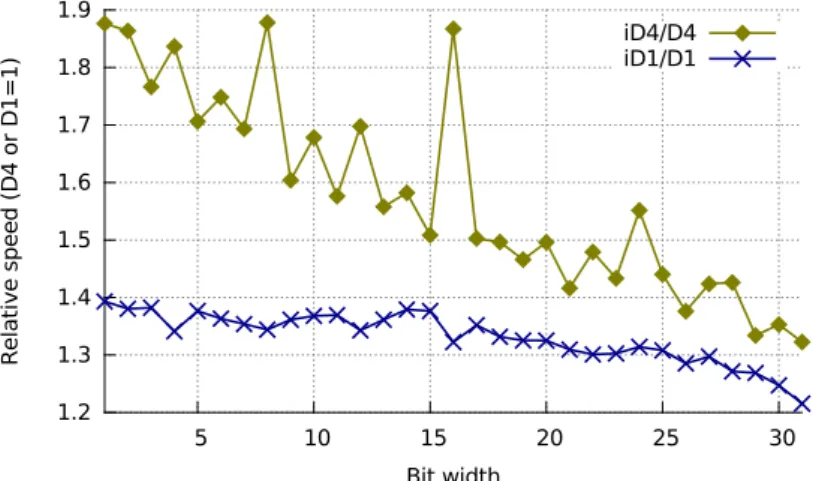
In Fig.6a, we plot the speed ratios of the integrated bit unpacking (i.e., Algorithm 1for SIMD routines), vs. the regular one where differential coding is applied separately on small blocks of 32-bit integers. To differentiate the integrated and regular differential coding we use an i prefix (iD4 vs. D4). For D4, integration improves the speed by anywhere from over30% to90%. For D1, the
1.2 1.3 1.4 1.5 1.6 1.7 1.8 1.9 5 10 15 20 25 30 R e la ti ve s p e e d ( D 4 o r D 1 = 1 ) Bit width iD4/D4 iD1/D1
(a) One-pass (integrated) vs. two-pass (block-level) prefix sum
0 1 2 3 4 5 6 7 8 9 5 10 15 20 25 30 S p e e d ( B in ts /s ) Bit width iD4 iDM iD2 iD1 iscalar scalar
(b) Several differential bit unpacking speeds
Figure 6. Unpacking speed for all bit widths (b= 1, . . . ,31). See Algorithm1. Speed is reported in billions of 32-bit integers per second. We use arrays of4096integers for these tests.
results are less impressive as the gains range from20% to40%. For D2 and DM, the result lies in-between. Moreover, the gains due to the integration are most important when the unpacking is fastest: for small bit widths or bit widths that are a power of two such as 8 and 16. This phenomenon is consistent with our analysis (see§5): the benefits of integration are mostly due to the reduction by half of the number of registers stored to memory, and these stores are more of a bottleneck for these particular bit widths.
In Fig.6b, we compare all of the integrated bit unpacking procedures (iD4, iDM, iD2, iD1). As our analysis predicted (see Table III), D4 is the fastest followed by DM, D2 and D1. For comparison, we also include the scalar bit unpacking speed. The integrated bit unpacking (iscalar curve) is sometimes twice as fast as regular bit unpacking (scalar curve). Even so, the fastest scalar unpacking routine has half the speed as our slowest SIMD unpacking routine (iD1).
7.5. Decompression speed
We consider several fast compression schemes: VARINT (see § 4.1), S4-BP128 (see § 4.3), FASTPFOR and S4-FASTPFOR (see§4.4). To test the speed of our integer compression schemes, we generated arrays using the ClusterData distribution from Anh and Moffat [25]. This distribution primarily leaves small gaps between successive integers, punctuated by occasional larger gaps. We
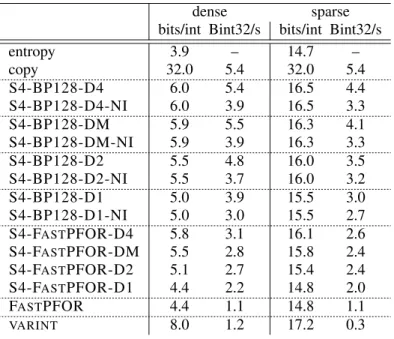
Table V. Results on ClusterData for dense (216 integers in[0,219)) and sparse (216 integers in[0,230)). We report decompression speed in billions of 32-bit integers per second (Bint32/s). Shannon entropy of the deltas is given. Our Intel CPU runs at3.6GHz. The -NI suffix (fornon-integrated) indicates that the prefix sum requires a second pass over 128-integer blocks. The standard deviation of our timings is less than5%.
dense sparse
bits/int Bint32/s bits/int Bint32/s
entropy 3.9 – 14.7 – copy 32.0 5.4 32.0 5.4 S4-BP128-D4 6.0 5.4 16.5 4.4 S4-BP128-D4-NI 6.0 3.9 16.5 3.3 S4-BP128-DM 5.9 5.5 16.3 4.1 S4-BP128-DM-NI 5.9 3.9 16.3 3.3 S4-BP128-D2 5.5 4.8 16.0 3.5 S4-BP128-D2-NI 5.5 3.7 16.0 3.2 S4-BP128-D1 5.0 3.9 15.5 3.0 S4-BP128-D1-NI 5.0 3.0 15.5 2.7 S4-FASTPFOR-D4 5.8 3.1 16.1 2.6 S4-FASTPFOR-DM 5.5 2.8 15.8 2.4 S4-FASTPFOR-D2 5.1 2.7 15.4 2.4 S4-FASTPFOR-D1 4.4 2.2 14.8 2.0 FASTPFOR 4.4 1.1 14.8 1.1 VARINT 8.0 1.2 17.2 0.3
generated arrays of 65536 32-bit integers in either [0,219)or[0,230). In each case, we give the
decompression speed of our schemes, the entropy of the deltas as well as the speed (in billions of 32-bit integers per second) of a simple copy (implemented as a call tomemcpy) in TableV. All compression schemes use differential coding. We append a suffix (-D4, -DM, -D2, and -D1) to indicate the type of differential coding used. We append the -NI suffix (for non-integrated) to S4-BP128-* schemes where the prefix sum requires a second pass. We get our best speeds with S4-BP128-D4 and S4-BP128-DM.¶ Given our 3.60GHz clock speed, they decompress 32-bit
integers using between 0.7 and 0.8 CPU cycles per integer. In contrast, the best results reported by Lemire and Boytsov [3] was 1.2 CPU cycles per 32-bit integer, using similar synthetic data with a CPU of the same family (Sandy Bridge).
S4-BP128-D1-NI is 38% faster than S4-FastPFOR but S4-FastPFOR compensates with a superior compression ratio (5%–15% better). However, with integration, S4-BP128-D1 increases the speed gap to50%–75%.
7.6. Intersections
We present several intersections algorithms between (uncompressed) lists of 32-bit integers in§6. To test these intersections, we again generate lists using the ClusterData distribution [25]: all lists contain integers in [0,226). Lists are generated in pairs. First, we set the target cardinalityn of the largest lists to 222. Then we vary the target cardinalitym of the smallest list fromndown to
n/10000. To ensure that intersections are not trivial, we first generate an “intersection” list of size
m/3(rounded to the nearest integer). The smallest list is built from the union of the intersection list with another list made of 2m/3 integers. Thus, the maximum length of this union ism. The longest list is made of the union of the intersection list with another list of cardinality n−m/3, for a total cardinality of up to n. The net result is that we have two sets with cardinalities≈m
and≈nhaving an intersection at least as large asm/3. We compute the average of 5 intersections
¶Though we report a greater speed in one instance for S4-BP128-DM (5.5) than for S4-BP128-D4 (5.4), the 3-digit values are close: 5.45 and 5.44.
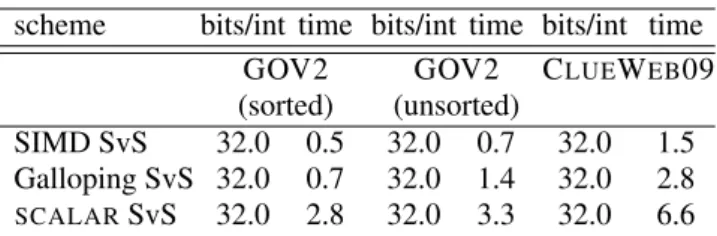
Table VI. Time required to answer queries in ms/query along with the storage requirement in bits/int, using the TREC Million-Query log sample from§7.3.1. The standard deviation of our timings is less than1%.
scheme bits/int time bits/int time bits/int time GOV2 GOV2 CLUEWEB09 (sorted) (unsorted)
SIMD SvS 32.0 0.5 32.0 0.7 32.0 1.5 Galloping SvS 32.0 0.7 32.0 1.4 32.0 2.8 SCALARSvS 32.0 2.8 32.0 3.3 32.0 6.6
(using 5 pairs of lists). This choice (m/3) is motivated by our experience with search engine queries (e.g., see TableIV) where the intersection size is often about30% of the smaller of two sets for 2-term queries. We also present the figures for the case where the intersection is much smaller (0.01m): the relative results are similar. The performance of the intersection procedures is sensitive to the data distribution however. When we replaced ClusterData with a uniform distribution, the intersection speed diminished by up to a factor of 2.5: value clustering improves branch predictions and skipping [27].
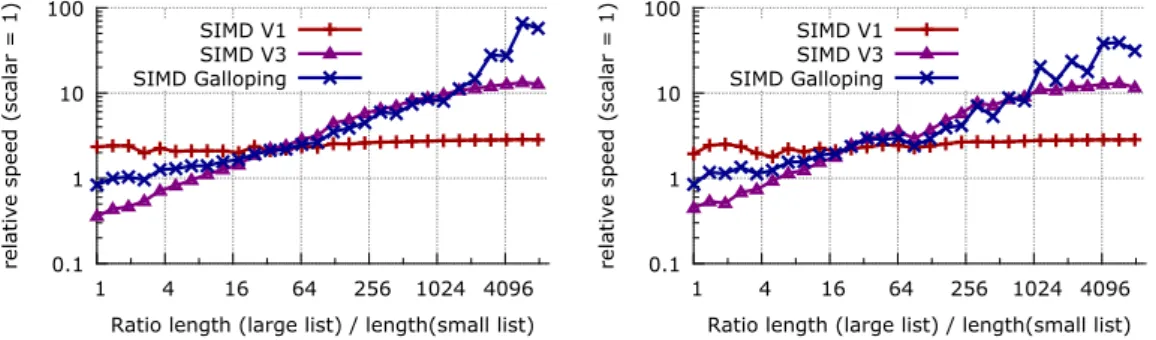
We report all speeds relative to the basicSCALARintersection. All input lists are uncompressed. In Fig. 7a, we compare the speed of our 3 SIMD intersection functions: V1, V3, and SIMD GALLOPING. We see that V1 is the fastest for ratios of up to 16:1, whereas SIMD GALLOPING is the fastest for ratios larger than 1024:1. In-between, V3 is sometimes best. This justifies our heuristic which uses V1 for ratios up to 50:1, V3 for ratios up to 1000:1, and SIMD GALLOPING for larger ratios. In Fig.7b, we compare the two non-SIMD intersections (SCALARand galloping) with our SIMD intersection procedure. We see that for a wide range of cases (up to a ratio of 64:1), our SIMD intersection procedure is clearly superior to the scalar galloping, being up to twice as fast. As the ratio increases, reflecting a greater difference in list sizes, non-SIMD galloping eventually becomes nearly as fast as our SIMD intersection. We also compare with Katsov’s algorithm (see Fig.7b). Katsov is only competitive with our algorithms when the lists have similar lengths.
We also included our versions of Schlegel et al.’s algorithm: the original and an improved version relying on thepcmpistrminstruction (see Fig.7c). In these particular tests, the 32-bit integers are first transformed into Schlegel et al.’s specialized data structure, as several arrays of 16-bit integers. We also output the answer in this format. The improved version of Schlegel et al.’s algorithm is about 15% faster, in the best case. This supports our claim that thepcmpistrminstruction is preferable to thepcmpestrminstruction. We compared Schlegel et al. with a version of V1 adapted to lists of 16-bit integers. Like the 32-bit V1, the 16-bit V1 compares blocks of 256 bits and thus compares sixteen pairs of 16-bit integers at a time (i.e.,T = 16). We find that Schlegel et al. is better than V1 as long as the ratio of lengths is less than 10. When one list is much longer than the other one, V1 becomes much faster (up to75×faster in this test). We do not use Schlegel et al.’s 16-bit format further, but our results suggest that we could combine V1 and Schlegel et al.’s algorithm for best results. That is, we could use Schlegel et al. for lists having similar lengths, and V1 otherwise.
We also evaluated our algorithms using postings lists for our three collections using our TREC 1M Query log (see TableVIand Fig.8). For this test, posting lists are uncompressed. We see that our SIMD intersection routine is nearly twice as fast as (non-SIMD) galloping. In the sorted version of Gov2, we expect most gaps between document identifiers to be small, with a few large gaps. In contrast, the unsorted version of Gov2 has a more uniform distribution of gaps. Just as we find that intersections are faster on the ClusterData distributions, we find that intersections are 1.4–2×faster on the sorted Gov2 vs. its unsorted counterpart. In the next section (§7.7), we show that a much better speed is possible if we use bitmaps to represent some posting lists.
7.7. Bitmap-list hybrids (HYB+M2)
We can also use bitmaps to accelerate intersections. Culpepper and Moffat’sHYB+M2 framework is simple but effective [5]: all lists where the average gap size is smaller or equal to B (where