,
VALIDATION OF A PREDICTOR BATTERY FOR ENGINEERING TECHNICIANS
Submitted in fulfilment of the requirements for the degree of
MASTER OF ARTS of
Rhodes University
by
JONATHAN MACLAREN TAYLOR September 1979
I wish to express my appreciation for the assistance received from the following:
Mr D.P. Steyn, for his supervisory assistance; Dr G.K. Nelson, Director of the National Institute for Personnel Research, for making the facilities of the Institute available for conducting the research;
Mr V.I. L~tti, Head of the Personnel Selection and Vocational Guidance Division of the National
Institute for Personnel Research, for his advice throughout the study.
My family and friends for their support and encouragement.
i
OPSm'IMING
Hierdie verslag beskryf In prosedure van kursussuksesvoor-spelling vir sekere eerstetermyn ingenieurstegnici. Die doel van die studie is om die hoe uitsaksyfer onder leer ling-ingenieurstegnici te reduseer
van potensiele druipelinge.
deur die vroee identifisering Die identifisering geskied deur die onderwerping van aIle kursusapplikante aan sielkudige toetsbatterye. Die verkree informasie dien as voorspelling ten opsigte van applikante se eerstetermyn kursusresultate. Daar word aanbeveel dat studentvoorligters, verbonde aan die verskeie Technikons, die voorgestelde prosedure in In plooibare beroepsvoorligtingsdiens vir ingenieurstegnici integreer. Daar moet egter in gedagte gehou word dat geen geldigheidstudie toekomssukses honderd persent akkuraat kan voorspel nie en tweedens dat die onderhawige studie spesifiek mag wees ten opsigte van die \'1i twatersrandse Technikon.
Hoofstuk 1 bevat In omskrywing van die agtergrond en doel van die studie, asook enkele algemene oorwegings ten opsigte van geldigheidstudies.
Hoofstuk 2 beskryf die ontwikkeling van ingenieurstegnici opleiding en die vraag en aanbod vir ingenieurstegnici in Suid-Afrika.
Hoofstuk 3 bevat In navorsingsoorsig ten opsigte van die
voorspelling van ingenieurssukses deur middel van verskillende voorspellingskategoriee.
Hoofstuk 4 beskryf die ingenieurstegnicisteekproef, die voorspellers en kriteria van sukses soos toegepas tydens hierdie studie.
Hoofstuk 5 bevat die resultate van vergelykings tussen die onderskeie subgroepe.
Hoofstuk 6 bevat die korrelasie- en regressie-ontledings
wat op die onderskei subgroepe uitgevoer is, as ook
Inbespreking van die praktiese implernentering van bevindinge.
Hoofstuk 7 omskryf die algernene raamwerk vir die toepassing
van bevindinge, stel
Inkeuringstrategie voor en doen
aanbevelings ten opsigte van toekomstige navorsingsgebeide.
Die Aanhangsel bevat,onder andere, norms wat aan die hand
van die eksperimentele groepe bereken is vir gebruik deur
studentevoorligters tydens die implernentering van die
bevindinge van hierdie ondersoek.
i i i
SUMMARY
This study describes a procedure for predicting course success for certain first term engineering technicians. The aim of the study is to reduce the high attrition rate of trainee engineering technicians through the early
identification of candidates who are likely to fail their first term of study. This identification is done by test-ing all applicants to the courses on a battery of
psychological tests, and from this information estimating the applicants' first term course results. It is suggested that the student counsellors attached to the various
Technikons integrate the suggested procedure into a
flexible vocational guidance service for engineering tech-nicians. It should be borne in mind that no validation study can predict future success with a hundred percent accuracy, and that the sample used in this study may be specific to the Witwatersrand Technikon.
Chapter 1 contains an outline of the background and purpose of the study and some general considerations of validation studies.
Chapter 2 describes the development of engineering tech-nician training and the supply of and demand for engineering technicians in South Africa.
Chapter 3 contains an overview of research into the pre-diction of engineering success using various categories of predictors.
Chapter 4 describes the sample of engineering technicians, the predictors and the criteria of success used in the study. Chapter 5 contains the results of the comparisons of the various sample sub groups.
Chapter 6 contains the correlation and regression analyses carried out on the various sub groups and a discussion on the practical implementation of the findings.
Chapter 7 outlines the general framework for the applic-ation of the findings, proposes a selection strategy and suggests areas for further research.
The Appendix contains, inter alia, norms calculated from experimental groups, for use by student counsellors in applying the findings of this study.
1. 1.1 1.2 1.3 1.4 2. 2.1 2.2 2.3 2.4 2.5 3. 3.1 3.2 3.3 v TABLE OF CONTENTS CIIAl'TER ONE INTRODUCTION Background
Purpose of the Present Study
Outline of the Validation Strategy
General Consideration of Validity Studies CHAPTER TWO
TilE TRAINING OF ENGINEERING TECHNICIANS AND CONCOMITANT SELECTION NEEDS
Definition of Terms
Background Information on Engineering Technician Training
The Engineering Team
Supply and Demand Considerations with regard to Human Resources in the Engineer-ing Field
Ratio of Technicians to Engineers CHAPTER THREE
BACKGROUi-ID Rl!:SEARCII IN PREDICTING ENGINEER-ING SUCCESS
Introduction
Intellectual Factors as Predictors of Engineering Success 3.2.1 3.2.2 3.2. 3 3.2. 4 3.2.5
Some landmarks in the development of intelligence testing
Correlation theories of the struct-ure of the intellect
Research in prediction of engineer-ing success usengineer-ing measures of
general intelligence
Research in prediction of engineer-ing success usengineer-ing measures of
specific abilities
Research in prediction of engineer-ing success usengineer-ing measures of
scholastic achievement
Non-Intellectual Factors as Predictors of l!:ngineering Success
3.3.1 Research in predicting engineering success using interest questionnaires
Page 1 1 2 3 4 7 7 7 11 14 No. 16 18 18 18 19 20 24 26 31 34 34
3.4 3.5 4. 4.1 4.2 4.3 4.4 5. 5.1 5.2 5.3 5.4 5.5 5.6 6. 6.1
3. 3. 2 Research in predicting engineering success using personality measures Biographical Factors as Predictors of Engin -eering Success
Summary
CHAPTER FOUR
DESCRIPTION OF THE SAMPLES, PREDICTORS AND CRITERIA
Samples
The Predictors
4.2.1 Scholastic performances
4.2.2 Tests of specific abilities and general intelligence
4.2.2.1 Description of tests used 4.2.2.2 Reliabilities of tests used 4.2.3 Interest questionnaire
4.2.4 General biographical information Criterion Information
4.3.1 The electrical engineering diploma (light current)
4.3.2 The mechanical engineering diploma 4.3. 3 The civil engineering diploma
Choice of an Academic Criterion CHAPTER FIVE
cm1PARISON OF SM1PLE SUB-GROUPS Introduction
Comparison of First (Tl) and Final (T6) Term Engineering Students
Comparison of Specialization Groups Comparison of the Three Intake Groups Comparison of English and Afrikaans First Term Students
Academic Schools compared to Technical Schools CHAPTER SIX ANALYSIS OF RESULTS Introduction Page No. 35 35 36 38 38 40 40 40 40 44 44 46 47 47 52 52 53 55 55 55 59 60 65 69 70 70
6.2 6.3 6.4 6.5 6.6 6.7 6.8 6.9
7.
7.1 7.2 7.3 7.4 8. vii Intercorrelations 6. 2. 1 6.2.2 6. 2.3 6.2.4 6.2.5First term Afrikaans students First term Afrikaans students
(intakes 2 and 3 only)
First term English students
First term English specialization groups
Intercorrelations excluding in-complete protocols
Multiple Correlations
Selection of a Predictor Battery for the English Group
Predictor ~leights for the Combined English Group
Selection of a Predictor Battery for the Afrikaans Group
Predictor weights for the Afrikaans Group Discussion of Results
Practical Implementation of Findings 6.9. 1 6.9.2 6.9,3 6.9.4 6.9.5 Introduction
Selection ratio for the English and Afrikaans applicants
Cut-off Points Norms
Summary of cut-off points CHAPTER. SEVEN
RECOMMENDATIONS AND SUGGESTIONS FOR FURTHER RESEARCH
FramevlOrk for Applying Results
Proposals Based on Findings of the Study Suggestions for Further Research
Conclusion REFERENCES 9. APPENDIX:
A. 1 to A.12 - Individual Test Norms A. 13 to A.20 Description of Courses A. 21 to A.23 - Norms of Predictor Scores A. 24 to A.34 - Correlations for Different
Groups A. 35 - Biographical Questionnaire Page No. 71 71 72 72 72 72 74 78 82 82 84 85 87 87 88 90 95 95 97 97 97 100 102 103-107 108-132 133-150. 151-167 168-178 179-184
3.1 3.2 3.3 3.4 3.5 LIST OF TABLES
I. Q.' s of Students entering Technikons Correlations of the Yale Aptitude Test Battery with First Term Engineering Results
Correlations of the Pre-Engineering Invent-ory with First Semester Results of Engineer-ing Students
Test Correlations with First Term Subjects at a Technikon
l'lul tiple Correlations of Test Combinations with First Term Engineering Subjects at a Technikon
3.6 Inter-correlation Hatrix of Various Predict-ors and First Year Engineers at Pretoria University
4.1 Breakdown of First Term Students into Spec-ialization Groups and Home Language
4.2 4.3 4.4 4.5 4.6 5.1 5.2 5.3
Test Language of all Students tested in each Intake
Size and Experimental Function of Groups Heans, Standard Deviations, Coefficients of Skewness and Kurtosis, Observed Ranges and Reliabilities of the Afrikaans Group
Heans, Standard Deviations, Coefficients of Skewness and Kurtosis, Observed Ranges and Reliabilities of the English Group
Syllabi of Electrical (L/C), Hechanical and Civil Engineering Diploma Courses
Significant Differences Between First and Final Term Students
Significant Differences between the Three Specialization Groups
Significant Differences found between the Three Intake Groups
Page No. 25 26 27 28 29 32 38 39 41 45 45 48, 49, 50 58 61 62
5.4 6.1
ix
Significant Differences found between the Two Language Groups
Correlations between Criteria and Selected Predictors for the English Specialization Groups
6.2 Abbreviations of Predictors, Groups and Criteria 6.3 6.4 6.5 6.6 6.7 6.8 6.9 6.10
Summary of Multiple Correlations for Different Groups using Various Predictor Combinations
Summary of Optimum Correlations using Common-Course-Average and Courses Passed as Criteria for the Combined English Group
Summary of Best Multiple Correlations using Course· Average and Courses Passed as Criteria for the Three English Specialization Groups Simplified Predictor lVeights for the Com-bined English Group
Summary of Best Multiple Correlations using Common-Course-Average and Courses Passed as Criteria for the Afrikaans Group (Intakes 2 and 3)
Simplified Predictor Weights for the Afrikaans Group
Actual Pass and Fail Rates of Accepted and Rejected Students in terms of the suggested Cut-Off Points
Summary of Cut-Off Points for all Groups
Page No. 67, 68 73, 74 75 76, 77 79 81 82 83 84 89 95
LIST OF FIGURES
2.1 The Engineering Team Before World War 11 2.2 Representation of the Engineering Team
During the 1950's
2.3 Representation of the Engineering Team of the 1970's in the U.S.A.
2.4 Future Job Clusters
6.1 Scatter Plot and Cut-Off Points for the Combined English Group
6.2 Scatter Plot and Cut-Off Points for the Afrikaans Group. (Including Matriculation Marks as Predictors)
6.3
7.1
Scatter Plot and Cut-Off Points for the Afrikaans Group. (Using no Matriculation Marks as Predictors)
Flow Diagram of Proposed Selection Process
Page No. 11 12 12 13 92 93 94 99
1
CHAP'rER ONE
1. INTRODUCTION
1.1 Background
The present study was motivated by a concern about the high failure and drop-out rate occurring amongst trainee engineering technicians at Technikons.
growth of the South African economy is
At present, the being retarded by its inability to obtain enough of the highly trained technicians who are essential to a very wide range of
in-dustries. Present practice suggests that the demand for
such personnel will be met largely by suitably trained
Whites. This places a heavy training burden on the shoul
d-ers of the six Technikons open to White students.
The comparatively new development of the National Diploma
and Certificate (introduced in 1957) as an alternative type
of advanced (i.e. post standard ten) education has resulted
in Techni kons having to compete with universities for a
share of matriculants who have the ability to pass the courses
offered. Unfortunately, Technikons are often regarded as
being only second training choices, since a dipl oma does not offer as high a status as a degree. These are some of the
problems affecting Technikons, and one of the manifestations
of these difficulties is the low proportion of technicians who
complete the course as against those who enrol. Campbell-Pitt
(1970) estimates that only 25% of students enrolling for the
National Diploma for Technicians actually obtain the quali
-fication.
The Witwatersrand Technikon is concerned about the problem
of unsatisfactory academic progress of its students, and
this problem was brought to the attention of the Federation
of Societies of Professional Engineers (FSPE), whose
in the engineering field. The problem should be seen against the backdrop of the following factors:
(i) The growing demand in South Africa for highly trained technicians;
ii)
iii)
The high cost of training technicians, estimated to be in the vicinity of R20
(recently 000) which is borne by the employers of trainee technicians; The waste of training facilities which are ex-pended on large numbers of unsuitable pupil technicians who do not complete the course.
The present investigation was undertaken by the author as a research project at the National Institute for Personnel Research. The NIPR was approached by the Federation of Societies of Professional Engineers to look into the p ro-blem of the high failure rate occurring amongst engineering technicians and to suggest ways of improving the nass rate. The development of a selection device is one approach to this problem.
1.2 Purpose of the Present Study
The aim of this investigation is to validate a predictor battery in order to reduce the high attrition rate of first term engineering technicians at the Witwatersrand Technikon. The purpose of the selection strategy will be to ~redict whether the applicant is likely to pass the course or not. I t is envisaged that those who are unlikely to pass will be counselled by vocational guidance officers attached to the Technikons, who will, where necessary,
students to careers better suited to their
redirect these abilities. It is felt that if the criterion of course success can be
satis-factorily predicted then the envisaged course of action will significantly reduce the high drop out and failure rate of engineering technicians and the associated wastage of human resources.
].3 Outline of the Validation Strategy
In this study, the experimental group was all first tri-mester students who enrolled for the civil, mechanical and
electrical (light current) Diploma Courses at the
Witwaters-rand Technikon between September 1975 and May 1976. These
Diploma courses were selected because of the preponderance of enrolments in them.
Biographical information was obtained from standard forms completed by all subjects and a number of ability tests and
an interest questionnaire were administered to the groups;
this provided the independent variables for the study. The dependent variables were the end of term examination marks obtained by the students.
Optimal predictions of success in the courses were obtained by multiple regression analyses. Also tested at the same time as the experimental group were all final term students
doing the same engineering courses as the experimental group.
This was done in order to see on which independent variables a "successful" (i.e. final term) sample of engineering
technicians differed from the experimental group. This could prove useful in compiling the final predictor battery. This strategy aims at providing a selection procedure which
will predict on the basis of the independent variables
whether the applicant student technician is likely to pass
his first term of study at the Technikon or not. The
nature of the exercise requires that acessible quantitat ive measures be used to predict success in order to construct an economic yet effective selection procedure.- It should, however, be borne in mind that important variables such as personality, motivation and adjustment have not been
considered in any depth in this thesis. This is because
such measures are seldom found to act as successful
predictors in mechanistic prediction formulae. Only_
trained psychologists should use such information within the context of the individual's background.
1.4 General Consideration of Validity Studies
Predictive validity is an indication of the effectiveness
of a test or battery of tests in predicting behaviour in
specified situations. The behaviour being predicted is
referred to as the criterion. The information provided
by predictive validity is most relevant to tests used for the selection and classification of personnel.
The primary concern in a predictive validity study is to obtain as high a correlation as possible between the
pre-dictors and the criterion. Such correlations are not
all-or-none properties, but are a matter of degree.
After deciding exactly how tO,measure the criterion, the
validity of a prediction function is determined by correl-ating scores on the predictor tests with scores on the
criterion variable. The size of the correlation is a
direct indication of the amount of validity.
Nunnally (1967) makes the observation that in most pre-diction problems, i t is unreasonable to expect high
corre-lations between a criterion and predictor tests. People
are too complex to permit a highly accurate estimate of their performance from any practicable collection of test materials, while no criterion or predictor measures can be
totally accurate. The target group of the present
in-vestigation is especially problematic in this regard since the criterion being predicted is academic performance, yet the average student studying at a Technikon does not have a strong academic orientation, and variables such as motivation and adjustment would no doubt play an important
part in predicting their academic performance.
However, Nunnally (1967) points out that even those tests
which have only modest correlations with their criteria (e.g. correlations of 0,30 to 0,40) are often capable of markedly improving the average performance of personnel in
5
predicting the performance of individuals, but on the average, persons scoring high on the tests perform con-siderably better than persons scoring low on the tests:
"Such differences in mean performance f re-quently are highly important in applied settings .. . . tests that have only modest correlations with their criteria can
frequently make highly important improve-ments in the average performance of groups
in educational institutions, industry,
government services, and other activities." (Nunnally, 1967, p79).
A number of factors distort validity coefficients and complicate their interpretation. One of these factors is unreliability of the predictors and of the criterion being predicted. In the measurement of performance, the actual scores obtained are a combinati on of true scores and error, therefore the correlation of actual scores is a compromise between the correlation of the underlying true scores and the 0,00 correlation that characterizes the random errors. Another factor which distorts val -idity coefficients is restrict ion of the range of ability in the group by some type of preselection. By systemati -cally reducing the spread of scores in any sample on which a validation study is being conducted, the correlation of test with cri terion will normally be reduced (Thorndike and Hagen, 1955). This consideration should be borne in mind in the present study since a precondition for en
-trance into the Faculty of Engineering at the Technikons is matriculation exemption for Mathematics and Physical Science.
Another factor to bear in mind in validating a predictor battery is the supply and demand situation of the group being selected. If there are few applicants and many vacancies, even the most valid selection test will not reduce the number of poor performers since the situat-ion will not lend itself to refusing applicants. On the
other hand, if there is a high selection ratio, even a test with a low validity will yield large practical gains. In terms of the present study, the general
shortage of engineering technicians will not be conducive to rejecting large numbers of applicants. However, the intention of this study is not to prescribe rigid,
mechanistic procedures for the rejection of engineering technicians, but rather to provide the Student Counsell-ors with test information to be used in conjunction with other relevant background and personality variables for effective vocational guidance counselling. At the same time, by institu~ing selection criteria to be met by all applicants, a different and perhaps more attractive image, may be created for the engineering diploma course which could increase the number of applicants.
7 CHAPTER TWO
2. THE TRAINING OF ENGINEERING TECHNICIANS AND CONCOMITANT
SELECTION NEEDS.
2.1 Definition of Terms
The engineering technici,m discussed in this study refers to those trainees who enter a Technikon to study for the National
Diploma for Technicians in specific engineering fields. It
has been suggested (Goode Report, 1978) that a distinction be made for registration purposes between technicians and technologists, but such a distinction is not necessary in the present study since both technicians and the proposed technologists do the same initial course, namely the NDT,
which is used as the criterion of success. The engineering
fields examined in this study include only the civil,
mech-anical and electrical (light current) specializations. Not
all engineering fields were included since the above three
attracted the majority of applicants in the Engineering
Faculty of the Witwatersrand Technikon.
The sample of students tested were ,'lhite and predominantly English and Afrikaans speaking.
2.2 Background Information on Engineering Technician
Training.
The advances made in science and Technology during the past
four decades have resulted in a reassessment of the trainirig
and utilization of manpower in this area. Greater emphasis
on scientific background and creative ability is being placed on the training of professional engineers, resulting in more of the routine tasks of production, maintenance and fault
finding being allocated to the technician group. Advances
in technology have also led to a demand for greater levels
of sophistication in technician training.
The education of the Technician is more career orientated
than that of the professional engineer. This leads to. more
emphasis falling on the study of the applicability and
application of principles, rather than on the scientific
study of principles. The aims of technician tuition and
laboratory work and where applicable"practical workshop training at a Technikon) are listed in the Goode Report
as follows.:
a) the provision of an adequate scientific basis
for the study of the technology within the particular area of interest;
b) providing a Technical education in the broad
common core of technology applicable to the
area of interest and such specialized technology as may be common to a number of employment
possibilities within such area. Education in
highly specialized technology only required by isolated employers is the responsibility of the individual employer during the period of in-service training;
c) preparing the technician so that by refresher
courses of reading and self study he can keep abreast of development in his area of interest once he has left the Technikon;
d) Education in various forms of communication,
such as written, drawing and oral.
The Goode Report pOints out that inherent in the aims of technical education lies the problem of meeting the following requirements simultaneously, namely:
i) the provision of a sound scientific foundation
for the understanding of the Technology and the ability to develop the self;
ii) the introduction of the Technology from the time
that the student commences his technical classes (Goode,1978 p.52).
A solution to this problem is sought in the use of the sand-wich system, which allows the trainee a portion of each year in which to obtain on-the-job training, and practical lab-oratory exercises during his period at the Technikon.
The practical work done by trainee engineering technicians
is of a general (off-the-job) and specific (on-the-job)
nature. The general practical work is usually done in
laboratory experiments at Technikons, while the specific on-the-job practical work is obtained working with an employer, in between theoretical blocks at the Technikon. The purpose of the practical training is to induct the trainee into the work situation, to acquaint him with the
9
widest range of engineering know-how in his particular specialization field, to assist him with the application of theoretical knowledge and scientific principles in
practical situations, and to enable him to operate success-fully on-the-job immediately after the completion of his course. Although the Goode Committee (1978) found that the education and training aspects of technicians could not be isolated from one another, this study will concern itself only with the prediction of academic results from the first part of the engineering technicians course, since i t is during this phase that a large number of students fail or drop-out of the course.
Full-time "advanced" (i.e. post high school level) technical education is relatively new in South Africa. Up until 1957, advanced technical education was offered on a part-time
basis only. This position changed after a conference called by the Department of Education, Arts and Science in 1956, which called for the initiation of full-time advanced technical education on a semester sandwich basis, leading to the National Diploma for Technicians (NOT) . A new scheme of technical education was introduced in 1972 resulting in the phasing-out of the National Technical Diploma, and the introduction of new Certificate and Diploma Courses for technicians. The N3 replaced the NTC course and the T examinations replaced the NTC 4 and 5. The present re-quirements for the Certificate course are that the Tl, T2 and T3 courses be completed over a minimum period of 3 years. Each sandwich course is made up of four subjects, and a total of 360 hours instruction is necessary. The Diploma courses are offered only at Technikons and the Tl, T2, T3 and T4 courses must be completed over a minimum time period of 4 years. Each "T" course is made up of six subjects and a total of 2160 hours tuition is required to obtain a Diploma. The pass mark stipulated for the Diploma course is 50 per cent (for the Certificate the pass mark is 40 per cent), and minimum entrance requirements for an Engineering Diploma course are Standard 10 with acceptable
passes in mathematics and physical science, or an N3
Certificate. If "pre-technician" courses are satisfactorily completed, appliCants without the necessary entrance
qualifications can gain entrance to the course.
The Goode Report (1978) found that replies to a widely distributed questionnaire indicated greatest interest in
the expansion of education at the NDT level. The Committee
has recommended that the present four year NDT be replaced by a restructured three year National Diploma course,
con-sisting of three semesters at a Technikon, with the balance
as in-service training. It proposed that this be convertible
to a NCT for students unable to pass the NDT, providing that they passed six Tl and six T2 subjects at a 50 per cent level and obtained at least 40 per cent in each of four T3 subjects. The Con~ittee recommended further that the present NDT hold-ers or students passing six T4 subjects at the 50 per cent level with the necessary in-service training be awarded .a Higher National Diploma (HND) , and that further study at a Technikon beyond the HND (T5 and T6) should be awarded the
proposed Diploma in Technology (Dip Tech) (Goode, 1978, p69).
In assessing generally the existing standard of technician training in South Africa, the Goode Report (1978) states that the technical education system in South Africa compares
favourably with those overseas:
"Features not common elsewhere are the emphasis on practical training in making NDT and NCT awards, and the integration between the specialized and narrow certificate courses and the broader diploma courses . . . . The NDT technician may be considered to be among the best prepared in the world. He is fully capable of doing a worth-while job when awarded his
diploma. He has completed a course in technical
training similar to that of the continentally trained 'engineer' but with rather more emphasis towards the industry in which he has done his practical training. The sandwich course system has enabled him to absorb an above average technical content during his tuition periods." (Goode, 1978, p13)
11
2.3 The Engineering 1eam
Up to the second World War, the members of the engineering team are described (Goode Report, 1978) as falling into three classes - scientis,ts, engineer, and artisan, while the group now called tecpnicians were either advanced
artisans, highly skilled craftsmen or foremen and controllers of operations. Such people were few in nurr~er, and not
identified as belonging to a distinct class of worker. The
members of the team are represented in Figure 2.1, with the most practically orientated being on the left side and the
most theoretically orientated on the right.
FIGURE 2.1
THE ENGINEERING TEAM BEFORE WORLD WAR II
ARTISAN ENGINEER SCIENTIST
TECHNICIAN
(After Goode, 1978, p6) During World War II, top scientists were primarily involved in the development of advanced weaponry and defence systems; few engineers had the scientific knowledge to participate in these projects, which led to the inclusion of more basic science content in engineering courses so as to qualify more engineers to take part in sophisticated technological develop-ments.
As a result, many of the practical engineering courses were
dropped. The gap between scientist and engineer was thus
closed, but a new gap was opened between the artisan and the engineer which created new opportunities for upgraded artisans or technicians.
FIGURE 2.2
REPRESENTATION OF THE ENGINEERING TEM-l DURING THE 1950' s
[ ____
~
_____________G~A~P_£~
_______________ S_C_I_E_N_T __I_S_T~
(After Goode, T9 78, p6)
Recognition of the need for better trained technicians was early in the U.K. and U.S.A.
Definitions of "Professional Engineer" and "Engineering Technician" were formulated and adopted at the 1954
combined conference of the Engineering SOLieties of Western
Europe and the U.S.A., and the Conference of Engineering
Insti tutions in the Commonwealth. This gave wide recognition to the engineering technician, whose work was defined as:
" ... any of the specialized categories of technical work between those of the crafts
-man and the professional engineer."
(Goode, 1978, p7)
This recognition marked the beginning of the establishment of full-time technical education in many countries.
During the 1960's the gap between artisan and engineer had
become so large that many Western countries began eX9anding technician education above secondary school level. However the gap was further widened as university engineering curricula became more scientifically sophisticated, and this created a need for better educated technicians. This led, in the U.S.A. , to the establishment of a four year course leading to a
Ba Degree in engineering technology. These graduates
were called technologists (Goode, 1978 p7).
The engineering team of the 1970's in the U.S.A. is represented below:
FIGURE 2.3
REPRESENTATION OF THE ENGINEERING TEAM OF THE 1970's IN THE U.S.A. \ ARTISAN
\
\;'
\
TECHNICIAN / TECHNOLOGIST \ ENGINEER (SCIENTIST) (After Goode, 1978, p7)13
The boundaries between the different grades cannot be clearly
defined, and internationally, many names are used to refer to
the category of workers operating between the engineer and
the artisan levels.
However the description given in the ASEE Report (1972)
by the Engineers Council for Professional Development (of the U.S.A. ) of engineering technology indicates on which end of the continuum the technicians field is:
" that part of Technological fields which requires the application of scientific and engineering knowledge and methods combined with technical skills in support of engineering activities; i t lies in the
occupation-al area between the craftsman and the engineer at the end of the area closest to the engineer."
(In Goode, 1978, p8)
The Goode Committee describes the engineering team of the
future as constituted by clusters of job designations ranging
from practice to theory as represented in Figure 2.4. It is
suggested that there can be overlapping by the members of the
technical team into non-technical aspects such as manpower
and sales.
FIGURE 2.4
FUTURE JOB CLUSTERS
PROFESSIONAL ENGINEER/SCIENTIFIC
ENGINEER NON-REGISTERABLE ENGINEER/ TECHNOLOGIST TECHNICIAN ARTISAN Practical Bias (After Goode, 1978, p9)
2.4 Supply and Demand Considerations with regard to Human Resources in the Engineering Field
The rapid development of the Republic of South Africa has been largely manifested ln the growth of her infrastructure. Large scale engineering projects are numerous and include,
for example, the Sishen-Saldanha projects; the development
of Richard's Bay; motor ,lay and road developments; dam build
-ing and irrigation schemes; city growth and expansion of
necessary services, etc. In order to sustain such growth,
essential manpower skills must increase. Figures from the
Department of Labour indicate that the number of White
engin-eers increased by 24,2% from 1973 to 1975, while for the same time period the general growth of white labour was 3,5%.
However, figures also reveal that despite the higher than average increase in the numbers of engineers, the manpower shortage in this field was 6,2% as against the general labour shortage of 3,5% in 1975.
The Goode Committee found from their survey that the largest shortage of Technicians was the NDT group and higher.
Employers indicated that they wanted at least twice the pre-sent number of the above-mentioned category of Technicians. The Committee notes that if South Africa's industrial de-velopment is to continue, an increasing population must
receive higher level technical education, and i t endorses
as still valid the Straszacker Commission's (Straszacker, 1965)
suggestion that the number of qualified Technicians be
treb-led, . and the number of graduate engineers be doubled.
The Goode Committee found at the time of their survey (1975) that a supply of over 400 NDT awards are made annually,
having increased at the rate of some 27 per cent per annum
since 1973. However, this is about half the number of
eng-ineers graduating from universities. Bearing in mind that
i t has been recommended that the number of professional
engineers be doubled (Straszacker, 196~, and that a number
of professional societies have recommended a ratio of three
15
the shortfall in the supply of engineering Technicians can
be seen. The Goode Committee found that the biggest demand
was for holders of Diplomas in production and civi l en g-ineering.
In attempting to quantify the shortage of technicians in the
RSA, Bloch (1976, p.15) encountered two problems which have
led him to query the validity of official figures. The
problems are:
a) the lack of a clearly defined or accepted job
ca"tegory of "technician."
b) Reluctance of employers to define some classes
of workers as technicians in case Government regulations are contravened.
The 1971 Survey (Department of Labour, Manpower Survey) reported that a "Shortages/Vacancies" figure of only 332 engineering technicians existed whereas in 1972 an analysis presented to the Sixth Conference of FSPE showed a shortfall
of 17 392 engineering technicians. The size of the
dis-crepancies existing in official statistics can thus be appreciated.
Bloch (1976) undertook a survey of 104 firms to see what their projected needs for Black technicians would be in the year
1981. He found that 505 Africans with Diplomas or Certificates
would be employed immediately if they were available, and the firms surveyed expected a demand for 1 271 African technicians
by 1981. Judging from general attitudes that presently exist
in South Africa and assuming that pay scales are racially non-discriminatory in 1981, i t is probable that most firms would opt for employing European technicians in preference to
African technicians; i t is suggested that the demand for African technicians by the year 1981 (as reported by Bloch) should be small in comparison to the demand for European technicians if the South African and World economies have
The Shortage of engineering technicians indicates the urgent need for increasing the rate of training to keep abreast of the demand. Bloch (1976) notes that:
" .. . the 'skills shortage', which certainly exists, is likely to extend far into the future and put an in-creasingly nagging brake on the engine of economic development. It is clear, if we accept the evidence of the Manpower Surveys alone, that the Whites cannot provide the skills needed by South Africa's very
rapidly expanding population." (p.19)
Bloch (1976) points out that according to official statistics, the average annual number of Diplomas (all types) awarded
during the ten years 1962-1971 was 485, (or 651 from 1967-1971) . In comparison, 8 473 Bachelor Degrees (all types) were awarded in 1973. Such a small proportion of Diplomas obtained points towards an imbalance in the structure of South Africa's educational system.
2.5 Ratio of Technicians to Engineers
Information obtained by the Goode Committee indicates that
an overall ratio of technicians to professional engineers
is a meaningless figure. Such wide variations occur in
different work sectors and different branches of engineering that i t is necessary to look at each branch or work sector separately.
above the N3
From their survey of technicians qualified at level, (representative of all geographical areas and all work sectors except small private businesses and
mining companies) the Committee found that electrical
engin-eering had the largest ratio of technicians to professional
engineers namely 4,76:1. The lowest ratio was in the civil
(0,84:1) and chemical (0,83:1) engineering fields. In re-lation to work sectors, the ratio extremes are: electrical, Semi-State service - 11,13:1; civil, Private - 0,18:1. Adding all draftsmen to the latter group raises the ratio to
0,24: 1.
A possible explanation given for the low ratio of technicians in the civil and chemical branches is the lack of designated trades in these two fields. The Committee of Inquiry also
17
found in their survey that almost half of all technicians are employed in Semi-State crganisations, followed by the Private
Sector
(~
25%), then State, Public Corporations and ResearchOrganisations (all having
~
10% each). State, Provincial andLocal Authorities train as many as 50% of their technicians to the Diploma level, and Public Corporations, the Private Sector and Research Orga.nisations require one Diploma
technician to every two lower level technicians.
Finally, i t appears from official and unofficial figures that not enough engineering technicians are being trained
to meet the demand for them in South Africa. The most
ob-vious way to find the necessary man-power is to improve the
training facilities of Blacks at all levels. Between 1965
and 1974 only 43 Blacks obtained Diplomas as engineering
technicians (Nienaber, 1975). The validation of a selection
model for Whites is therefore only part of'the answer in
solving the problem of the shortage of engineering technic-ians in South Africa.
CHAPTER THREE
3. BACKGROUND RESEARCH IN PREDICTING ENGINEERING SUCCESS
3.1 Introduction
In looking at the basic requirements of engineering, Bingham (1937) pinpointed four basic abilities which he felt were
necessary for success in the field: mathematical or
num-erical ability, spatial perception, mechanical comprehension and an aptitude for the physical sciences.
This was subsequently supported by Crawford and Burnham
(1946) and Vaughn (1947), all working in the USA. From
research done in South Africa, Biesheuvel (1949) listed the following as the most important factors in engineering
success:
i) General intelligence;
ii) Scholastic achievement especially in Mathematics
and Science;
iii) Mathematical ability;
iv) Spatial ability (spatial orientation, perceptual
accuracy and spatial imagination);
v) Mechanical comprehension/insight.
Other less important factors found by Biesheuvel were an in-terest in engineering and an inin-terest in objects rather than
people. Much work has been done to find out what factors are
necessary for success in the engineering field, and these can be broadly split up into intellectual factors, non-intellectual personality factors and assorted background information.
3.2 Intellectual Factors as Predictors of Engineering
Success
The intellectual factors examined include general intellig-ence, specific abilities and scholastic achievement as an
application of intelligence. A brief overview is given of
the development of psychological testing and the attendant growth of theory to explain findings.
3.2.1
19
Some landmarks iI,1 the development of intelligence
testing
"Intelligence tests" are the direct descendants of the
original Binet-Simon Scale. This was developed in 1905 in
response to the establishment of a commission to study
procedures for the education of subnormal children attending
schools in Paris. The scale consisted of 30 problems or tests
arranged in order of difficulty. The tests covered a wide
variety of functions, with much emphasis on verbal compre-hension, reasoning and judgement.
A second scale was developed in 1908 in which the number of
tests were increased. Some unsatisfactory tests were removed,
and the concept of "mental age" was introduced. Terman at
Stanford University translated and revised the scale, which
became known as the Stanford-Binet intelligence test. In
this test, intelligence quotient (IQ) or the ratio of mental age to chronological age was introduced.
However, i t became apparent after a while that the original motive or intelligence testing, namely, to assess an
individ-uals general intellectual level, yielded only general
in-formation mainly about verbal ability. The construct being
measured by intelligence tests is a somewhat vague measure of abilities that are of importance in our culture, and are usually closely linked to abilities demanded by academic
work. It was soon realized that global intelligence measures
were of less use than specific aptitude tests, and Rose (1979) notes that:
"The as.sumption of a global 'general intelligence
factor' has been discarded by most modern psychologists working on cognition as virtually useless for
under-standing the processes underlying 'intelligent
be-haviour'. The term merely obscures the interaction
of specific and specialized cognitive processes" (p 849) Multiple aptitude batteries have been developed from factor analysis studies, for the purpose of measuring individual per-formance on a number of specific factors such as language comprehension, numerical ability and spatial visualization.
1he term "aptitude test" has come to refer to tests measuring relatively homogeneous and clearly defined abilities, whereas the term "intelligence test" refers to more heterogeneous tests yielding single global scores such as IQ (Anastasi, 1968 ).
The development of special aptitude tests has lead to much research and theorization about what separate factors make up intelligence. It became clear with the use of special aptitude tests that individuals generally showed marked
variation in ~erformance on different tests (Anastasi, 1968). With improvements in the methodological construction of tests, and the development of the factor analysis technique for
interpreting new factors, evidence has been gathered indicat-ing the presence of a number of relatively independant factors or traits. This led to significant advancement in the con-ceptualizations of the theory of the intellect. Using factor analysis techniques, i t became possible to systematically examine the mathematical relationship existing between vari-ables. This provided the basis for the trait theories of the structure of the intellect.
3.2.2 Correlation theories of the structure of the intellect
Psychological research can be divided into two major scientific orientations, namely, the experimental and the correlational
(Cronbach, 1957). The former attempts to understand human behaviour through observation of controlled experiments, where-as the latter is concerned with the inter-relationships be-tween variables measured in the natural state and the explan-ation of individual differences. Since the present study is conducted within the individual differences framework, some of the more important figures in the development of models of the intellect based on the individual differences approach will be briefly examined.
The first theoretical explanation of intelligence was produced in 1904 by Spearman. His theory provided the first theoretical rationale for intelligence testing and a framework for the de-velopment of intelligence tests. The correlations found by
21
Spearman (1904) between sensory tests and scholastic
achievement led him to suggest that intellectual functions were linked but that a hierarchy of specific intelligences also existed. He proposed that a general factor, g, was common to performance on all mental tasks, but that a specific factor, s, was specific to each different task area. He likened g to general mental energy with which an individual is endowed, and suggested that experience and specific training would affect the development of s factors. Spearman postulated that mental activities could be ordered into a hierarchy based on their saturation with g. From this he concluded that the central mental function occurring in all cognitive operations is the education of relations and the education of correlates. He observed that activities highly saturated with g appear to depend more on this
op-eration than opop-erations lower in the hierarchy, which led him to equate g with the education of relations and the education of correlates. Spearman later suggested that the s factors were not entirely independent, and that some overlap occurred between them.
Burt (1940) further refined the factor analysis methodology, and proposed a hierarchical model of intelligence. The main difference between the theories of Burt and Spearman is that Burt postulated the existence of group factors intermediate between g and s factors. A general factor, g, was the origin of most variance, and when this variance was removed, common
factors to a wide range of performances could still be identi-fied. Two major group factors were postulated, nam~ly, the
verbal-educational (v:ed) and the spatial-mechanical (k.m). Within the major group factors were minor group factors. Burt
de-scribed these as performance sets which were dependent on some common factor. When all the common variance was accounted for, Burt suggested that the variance left was specific to the performance itself, which could in turn be split into true and error variance.
Vernon (1961) used a similar model to Burt's, also with two major ability groups, v:ed and k:m (termed
spatial-perceptual-practical). The two major groups are broken down by Vernon into more specialized group factors like fluency and number
abilities on the v:ed side and spatial, mathematical and
psychomotor abilities on the k:m side. Vernon resisted
splitting these specialized group factors up into smaller, more specific factors, since he felt that this contributed
nothing towards the understanding of ability. Vernon also
noted that his hierarchical model was merely a taxonomical
device and should not be regarded as a rigid model of the
abilities of man.
Burt conceptualized intelligence as primarily genetically
determined, and proposed that the development of the group
factors were related strongly to maturational processes.
Vernon adopted Rebb's (1949) idea of a genetic component of
intelligence which determined the biological potential for
growth (intelligence A), and the interaction of this potential
with the environment (intelligence B). Intelligence A is
therefore a purely theoretical construct since its effects
can only be observed in interaction with environmental factors,
which determines the extent to which its potential is realized.
Intelligence B is subject to maturation under environmental
stimulation, and can be measured as behaviour. Vernon (1965)
suggested a third intelligence factor - intelligence C, which
was an estimate of intelligence B, as measured by tests.
Tnis indicated his awareness of the pit-falls of trying to
obtain accurate measures of basic human abilities. Vernon
suggested that individuals develop abilities which best enable them to cope with their cultural environment, and he collected
evidence to indicate the part played by the effect of
parti-cular environmental variables on intelligence B.
Thurstone developed a different explanation of human
in-telligence. He suggested that some mental functions were
independent of general intelligence, and in a study using 56 tests administered to samples of college students, and schoolchildren, Thurstone identified seven clear factors
('l'hurstone and Thurstone, 1941). These factors were:
23
Perceptual Speed (P), Memory (M), Numerical Ability (N) and
Inductive Reasoning (R). The difference between Thurstone's model of the intellect and the earlier hierarchical models was, firstly, a departure from the belief in the
unidimension-ality of intelligence, and secondly, a novel way of inter-preting factor analyses. However, this theory is not al l that different from the hierarchical models, only that i t started from the primary abilities and then progressed to second order factors which produced a single general factor similar to the g found at tile first order by earlier theorists.
Guilford proposed a comprehensive structure of the intellect in wnich he attempted to relate all the intellectual com-ponents to one theoretical model. He found the primary abj.lities proposed by Thurstone insufficient to account for the observed relationships between tests, and so he suggested a three dimensional system for the classification of abilities
(Guilford, 1956). The first dimension represents the basic psychological processes, which he termed operations. He suggested five categories of operations, namely, evaluation, cognition, memory, divergent production and convergent
production. The second dimension classifies the material or content of the mental act, and four categories were proposed, namely, physical, symbolic, semantic and behavioural. The third dimension was used to classify the products which re-sulted from the application of the operations to the content. Six categories were proposed, namely, units, classes, re-lations, systems, transformations and implications. This three dimensional model yields 120 cells, which Guilford
proposes as the totality of human abilities. This differs
from the hierarchical model theorists who considered their factors to be merely a means of classification of mental processes.
Guilford's model has heuristic value and has also helped to integrate some of the diverse ideas of cognitive theorists, but on the negative side, i t can be criticized for giving rise to an abundance of specific factors which do not have practical
applications. Guilford has also been criticized for his stat-istical methods . Horn and Knapp (1973) have pointed out that
his factor analytic technique yields results which can be obtained on random scores, thus charging that Guilford's model predetermines his findings.
The hierarchical models of the British factor analytic approach and the multiple factor models of the American theorists have been synthesized
and crystallized intelligence.
in Cattell's model of fluid Cattell (1943) views general intelligence as a second order factor, and conceptualized this general factor as being composed of both fluid intelli-gence (G f) and crystallized intelligence (Gc) . Fluid in-telligence is described as the measurable outcome of the biological factors influencing intellectual development, while crystallized intelligence is described as the sum of skills acquired through the operation of fluid intelligence. Horn and Cattell (1966) later suggested that fluid and
crystallized intelligence were not the only second order factors, but that general visualization, general fluency, general speed and carefulness should be included as second order factors.
The diversity of factor solutions to explain human intelligence indicates that no universal system for representing the struct-ure of intellect is likely to come from the psychometric
approach. However, the evidence indicating the existence of individual differences, and the need for predicting
future performance from existing differences will act as an incentive to find practical workable models of the structure of the intellect.
The approach of this study is to accept the synthesized model of the structure of human intelligence, and to use measures of general intelligence and specific abilities as predictors of engineering success.
3.2.3 Research in prediction of engineering success using measures of general intelligence.
Much research has been done in America into the relationshi~
between general intelligence and engineering ability. Pintner (1932) found that correlations between the two variables
25
varied from 0,19 to 0,61 while researchers in South Africa (Gouws (1957), Baard (1956))found correlations which varied from 0,23 to 0,42. Van Tonder (1969) reported that IQ (as measured by the New South African Group Test) correlated at 0,21 for males and 0,31 for females with first year uni-versity success in the physical sciences. Although this correlation was found to be significant at the 1% level, the NSAG Test is not designed to discriminate amongst a relatively small homogeneous group and i t therefore would have limited value in predicting success.
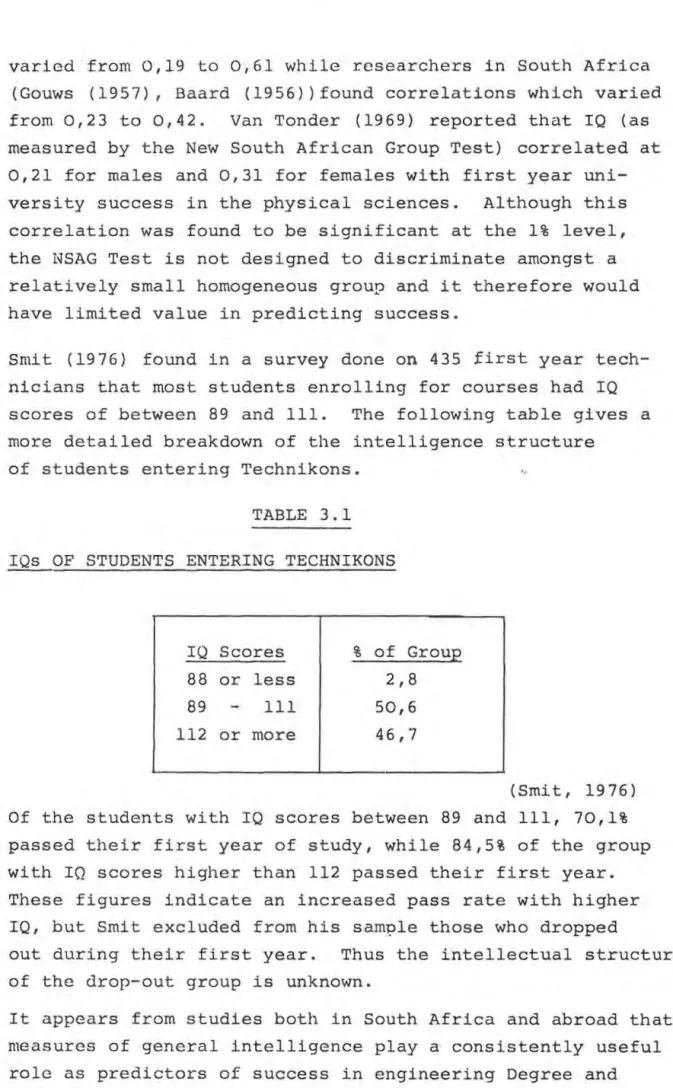
Smit (1976) found in a survey done on 435 first year tech-nicians that most students enrolling for courses had IQ scores of between 89 and 111. The following table gives a more detailed breakdown of the intelligence structure of students entering Technikons.
TABLE 3.1 IQs OF STUDENTS ENTERING TECHNIKONS
IQ Scores 88 or less 89 111 112 or more % of Group 2,8 50,6 46,7 (Smit, 1976) Of the students with IQ scores between 89 and 111, 70,1% passed their first year of study, while 84,5% of the group with 10 scores higher than 112 passed their first year. These figures indicate an increased pass rate with higher IQ, but Smit excluded from his sample those who dropped
out during their first year. Thus the intellectual structure of the drop-out group is unknown.
It appears from studies both in South Africa and abroad that measures of general intelligence play a consistently useful role as predictors of success in engineering Degree and
Diploma oourscs,
3.2.4 Research in prediction of engineering success using
measures of specific abilities.
In a large study carried out to establish how the predictive
validity of a battery of ability tests varied (Vaughn, 1943/4), the Yale Aptitude Test battery was administered at five dif-ferent colleges and correlations with first term engineering subjects were calculated (i.e. with engineering drawing,
descriptive geometry and engineering problems). Correlations
of the tests with a comprehensive criterion of first term academic results revealed the following variations:
TABLE 3.2
CORRELATIONS OF THE YALE APTITUDE TEST BATTERY WITH FIRST TERM ENGINEERING RESULTS. Colleges Tests n A B C D E 1"
-
-
-
-
-
-1 56 0,208 0,439 0,273 0,567 0,571 0,348 2 60 -0,041 0,150 0,376 0,182 0,394 0,175 3 196 0,112 0,012 0,161 0,347 0,151 0,186 4 201*
0,235 0,399 0,396 0,449 0,286 5 293*
0,223 0,377 0,446 0,358 0,301--*
No figures available (From Vaughn, 1943/4)KEY OF YALE APTITUDE TEST BATTERY
A. Verbal Comprehension B_ Artificial Language C. Quantitative Reasoning D. Spatial Visualization E_ Mathematical Aptitude F. !<Iechanical Ingenuity
27
It can be seen from the table that the tests which correlate best with first term academic results are the tests of Spatial Visualization, Mathematical Aptitude and Quantitative Reasoning. Predictive validity of this test battery varies between the
samples, but uncontrolled criterion variables include different standards of lecturing and examining, different interpretations of syllabi and various selection strategies used by the
colleges.
Vaughn (1947/8) later suggested that there are four factors which are necessary for success at an engineering college, namely:
i) Ability to understand and interpret scientific material;
ii) General mathematical ability;
iii) Ability to understand mechanical principles; and iv) Spatial perception.
Vaughn (1947/8) developed a test battery intended to measure the above-mentioned abilities in order to predict the academic achievement of students at ten engineering colleges. The tests used in this "Pre-Engineering Inventory" are given in Table 3.3
TABLE 3.3
CORRELATIONS OF TilE PRE-ENGINEERING INVENTORY I<HTH FIRST SEMESTER RESUL'rS OF ENGINEERING STUDENTS
-
-.
Tests Range of Median
Coefficients
l . General Verbal Ability 0,16
-
0,50 0,382. Technical Verbal Ability 0,25
-
0,55 0,473. Comprehension of Scientific
0,41 0,65 0,55
Material
-4 . General Mathematical Ability 0,57
-
0,71 0,62 5. Comprehension of Mechanical0,30 0,55 0,39
Principles
-6 . Spatial Visualizing Ability 0,22
-
0,42 0,357. Understanding of Modern 0,25 0,53 0,41 Society
-ComE'osite Value 0,38-
0,68 0,62 r (From Vaughn 1947/8)I
A continuation of this study was made by Lord et al (1950) who found that ttere was hardly any difference in correlation medians obtained from another twelve engineering colleges. The composite correlation value found was 0,60. This support for the '~re-Eng ineering Inventory" indicates that i t is a fairly effective pre-dictor battery, of which the General Mathematical Ability and Comprehension of Scientific Materials tests appear to be the best predictors of success. Johnson (1955), using only these two tests found an average validity coefficient of 0,57 with first term
examination results from 305 engineering students, and the same tests produced a validity coefficient of 0,68 with first semester examination marks from 260 engineering students at the Carnegie Institute of Technology.
In South Africa, Barnard (1969) attempted to predict academic success of English and Afrikaans first year engineering tech-nicians at a Technikon using a battery of psychological tests. He tested 569 subjects of whom 86 were selected who had both matriculation exemption for mathematics and science and a com-bined stanine total of 26 or more on four ability tests and a test of general intelligence. These tests were correlated with marks achieved for five course subjects:
TABLE 3.4
TEST CORRELATIONS WITH FIRST TERM SUBJECTS AT A TECHNIKON
Principles
Engin-Test n Mathematics Physics of Applied eering
Electricity Mechanics Drawing
All 86 0,17 0,09 0,07 0,18 0,08 A/68 86 0,30 0,41 0,31 0,34 0,05 A/3 86 0,16 0,11 0,21 0,23 0,11 A/16 86 0,44 0,37 0,28 0,28 -0,10 A/80 86 -0,14 -0,06 0,12 0,04 0,40 Sum of Standard scores of all 5 tests 86 0,40 0,40 0,30 0,45 0,09 (Barnard, 1969)