Graduate Student Theses, Dissertations, &
Professional Papers Graduate School
2020
Mathematical Creativity and Problem Solving
Mathematical Creativity and Problem Solving
Brooke GruntowiczFollow this and additional works at: https://scholarworks.umt.edu/etd
Part of the Science and Mathematics Education Commons
Let us know how access to this document benefits you.
Recommended CitationRecommended Citation
Gruntowicz, Brooke, "Mathematical Creativity and Problem Solving" (2020). Graduate Student Theses, Dissertations, & Professional Papers. 11562.
https://scholarworks.umt.edu/etd/11562
This Thesis is brought to you for free and open access by the Graduate School at ScholarWorks at University of Montana. It has been accepted for inclusion in Graduate Student Theses, Dissertations, & Professional Papers by an authorized administrator of ScholarWorks at University of Montana. For more information, please contact [email protected].
MATHEMATICAL CREATIVITY AND PROBLEM SOLVING By
BROOKE DANIELLE GRUNTOWICZ Bachelor of Arts
University of Montana-‐Missoula May 2018
Thesis
presented in partial fulfillment of the requirements for the degree of
Master of Arts in Teaching and Learning
University of Montana Missoula, MT
May 2020 Approved by:
Scott Whittenburg, Dean of The Graduate School Graduate School
David R. Erickson, Chair Teaching and Learning
Frederick A. Peck
Department of Mathematical Sciences
Matthew B. Roscoe
Department of Mathematical Sciences
Chairperson: David R. Erickson
Abstract
Many mathematical problems can only be solved in routine ways. But when students see that
problems can be solved in innovative, original, or novel ways, unexpected benefits arise such as development in one’s mathematical creativity. The general mathematics classroom must be reformed into a more perceptive atmosphere that challenges all students, where student mathematical creativity is fostered, and creative insights are encouraged. Mathematical creativity encourages the fulldevelopment of the learner, all students on the spectrum from underchallenged to traditional.
Mathematical creativity is the ability of "divergent production in mathematical situations, and the ability to overcome fixations in mathematical problem solving” (Haylock, 1987, p. 69). Mathematical creativity can be broken down into three dimensions of divergent thinking – fluency, flexibility, and originality. Educators must provide tasks that promote divergent thinking and creativity, such as challenging mathematical problems that give students opportunities to problem solve/pose and showcase their talents. But because of fixations, it is difficult for students to showcase originality on their own. Therefore, the goal of this study is to improve mathematical creativity in secondary mathematics students using good problem-‐solving tasks and finding best methods for promoting and rewarding divergent thinking. High school students in an Intermediate Algebra class partook in pre-‐intervention-‐ post cycles over the course of five weeks. Students took a pre-‐ Math Creativity Test, comprised of four open-‐ended, multiple solution tasks, designed for students to provide multiple solutions, distinct from what their peers would provide. Students were given scores for fluency, flexibility, originality, and total mathematical creativity. Students completed an intervention process of developing divergent thinking
flexibility, originality, and total math creativity between the pre-‐ and posttests. Results informed effective ways to develop mathematical creativity.
Chapter 1 – Focus of Study ... 1
Chapter 2 – Literature Review ... 4
Defining and Measuring Mathematical Creativity ... 4
Assessing Math Creativity ... 6
Figure 1. Mathematical Creativity Cycle ... 6
Figure 2. Example of tasks from the Mathematical Creativity Test ... 8
Rewarding Originality and Creativity… ... 9
Good Problem-‐Solving Tasks ... 10
How Educators Create Problem Solving Tasks ... 12
Figure 3. Cognitive Demand of Mathematical Tasks ... 13
What the Research Says ... 13
Chapter 3 – Methodology ... 15
Chapter 4 – Results ... 17
Mathematical Creativity Pretest ... 17
Table 1. Assignment of Originality Scores from Zero to Four ... 18
Table 2. Fluency, Flexibility, Originality, Total Math Creativity Pretest Scores ... 19
Figure 4. Pretest Mathematical Creativity Scores ... 21
Encouraging and Awarding Divergent Thinking Through Problem Solving ... 22
Figure 5. Equidistant Points, Kaplinsky (2020) ... 22
Figure 6. Equations of Parallel and Perpendicular Lines, Kaplinsky (2020) ... .23
Figure 7. Parallel Lines and Perpendicular Transversals, Kaplinsky (2020)… ... 23
Figure 8. Finding the Length of a Right Triangle’s Altitude, Kaplinsky (2020) ... 24
Figure 9. Triangle Perimeter, Liljehdal (2014) ... 24
Figure 10. Reward for Divergent Thinking ... 25
Student Work ... 25
Figure 11. Student A Work, Problem-‐Solving Activity #1 ... 26
Figure 12. Student B Work, Problem-‐Solving Activity #1 ... 26
Figure 16. Student C Work, Problem-‐Solving Activity #2 ... 28
Figure 17. Student D Work, Problem-‐Solving Activity #2 ... 28
Figure 18. Hints and Guiding Prompts for Problem-‐Solving Activity #3 ... 29
Figure 19. Student Responses to Online Disc. Forum, Problem-‐Solving Activity #3 ... 30
Figure 20. Student B Work, Problem-‐Solving Activity #3 ... 30
Figure 21. Student C Work, Problem-‐Solving Activity #3 ... 31
Figure 22. Hints and Guiding Prompts for Problem-‐Solving Activity #4 ... 31
Figure 23. Student Responses to Online Disc. Forum, Problem-‐Solving Activity #4 ... 32
Figure 24. Student B Work, Problem-‐Solving Activity #4 ... 32
Figure 25. Student E Work, Problem-‐Solving Activity #4 ... 32
Figure 26. Student E Work, Problem-‐Solving Activity #4 ... 33
Figure 27. Hints and Guiding Prompts for Problem-‐Solving Activity #5 ... 33
Figure 28. Student F Work, Problem-‐Solving Activity #5 ... 34
Mathematical Creativity Posttest ... 34
Table 3. Fluency, Flexibility, Originality, Total Math Creativity Posttest Scores ... 36
Figure 29. Posttest Mathematical Creativity Scores ... 38
Analyzing Results ... 38
Table 4. Corresponding Pretest Scores Verse Posttest Scores ... 41
Figure 30. Corr. Pre-‐ and Posttest Math Creativity Scores Box Plot ... 42
Figure 31. Corr. Pre-‐ and Posttest Math Creativity Scores Scatterplot ... 42
Figure 32. Corresponding Pre-‐ and Posttest Fluency Scores Box Plot……… ... 43
Figure 33. Corresponding Pre-‐ and Posttest Fluency Scores Scatterplot ... 43
Figure 34. Corresponding Pre-‐ and Posttest Flexibility Scores Box Plot ... 44
Figure 35. Corresponding Pre-‐ and Posttest Flexibility Scores Scatterplot ... 44
Figure 36: Corresponding Pre-‐ and Posttest Originality Scores Box Plot ... 45
Figure 37. Corresponding Pre-‐ and Posttest Originality Scores Scatterplot ... 45
Chapter 5 – Reflections and Next Steps ... 47
Chapter 1 – Focus of Study
Throughout my undergraduate and graduate experiences in mathematics and education courses, my eyes were opened to the benefits of active learning, inquiry-‐based, and exploratory mathematical opportunities, all full of rich mathematical tasks. From experiencing these mathematical opportunities and the benefits firsthand, I envisioned my future mathematics classroom to be a place filled of rich mathematical tasks facilitated through active learning strategies. Since becoming a high school mathematics teacher only a short year ago, I have experienced a few days where my classroom looked like how I envisioned. But, it proves difficult to achieve this type of classroom environment every day, or even once a week, when the pressure to complete the curriculum in such a short amount of time kicks in. As a result, students receive an education of minimal depth in a wide range of topics, lacking opportunities for investigation and exploration of the concepts, and leaving no room for opportunities to problem-‐solve, or create, only opportunities to follow algorithms.
A common perception of mathematics arises from attitudes of mathematics to be boring and irrelevant. Possible factors of these attitudes include, “the perceived poor quality of the teaching and learning experience, the perceived relative difficulty of the subject, the failure of the curriculum to excite interest, and the lack of awareness of the importance of mathematical skills for future career options and advancements” (Santos & Barmby, 2010, p. 199). These attitudes and perceptions are heightened with the traditional school experience, where educators are required to cover a wide range of material in a short amount of time, and have the expectations to differentiate instruction and scaffold to meet the needs and abilities of all learners in the classroom. These traditional methods of schooling fail to develop rich experiences for creating talent in the youth (Renzulli, 2005, p. 80). Schools are inadequate at providing education to students who show their potential in nontraditional ways. Schools “can and should be places for developing the talents of all students, rather than merely being sources for the acquisition of information” (Renzulli, 2005, p. 80).
A possible factor of the aforementioned perception regarding lack of student interest in the curriculum is that many mathematical problems within the curriculum can only be solved in routine ways. The curriculum has a focus on guided tasks and learning algorithms. But when students see that problems can be solved in innovative, original, or novel ways, unexpected benefits arise such as
development of one’s mathematical creativity. Mathematical creativity lies within the umbrella term of mathematical enrichment, where one purpose of mathematical enrichment opportunities is to heighten interest in mathematics, and to contextualize mathematics in real world applications. The second purpose of mathematical enrichment is to develop mathematical talent and deepen mathematical understanding. Mathematical enrichment is providing students with opportunities to enhance mathematical learning processes and develop learning skills, specifically problem-‐solving ability and ability to provide multiple perspectives. Mathematical enrichment opportunities are encouraged to be utilized in a wide range of school types and levels. It gives all students opportunities to develop their talents through a “collaborative school culture that takes advantage of resources and appropriate decision-‐making opportunities to create meaningful, high-‐level, and creative opportunities” (Renzulli & Reis, 2000, p. 367). Educators should encourage the full development of the learner, no matter where they are on the learner spectrum, instead of seeing them as a repository for information. Mathematical enrichment and creativity addresses “the problem of students who have been underchallenged but also provides additional important learning paths for students who find success in more traditional ways” (Renzulli & Reis, 2000, p. 367). Teaching mathematics without providing for creativity denies all
students the opportunity to fully develop their talents or experience the beauty of mathematics. Hence, educators of mathematics must reform the general mathematics classroom into a more perceptive atmosphere that challenges all students, where student mathematical creativity is fostered, and creative insights are encouraged.
The goal of this study is to improve mathematical creativity in secondary mathematics students using good problem-‐solving tasks. The term ‘good’ in good problem solving comes from the creator of good problem-‐solving tasks, Peter Liljehdal. Good problem-‐solving tasks are challenging mathematical problems that give students opportunities to problem-‐solve and problem-‐pose. Peter Liljehdal is recognized for helping teachers create classroom environments in which students learn math through problem-‐solving activities. Good problem-‐solving activities provide opportunities for students to engage in ‘doing mathematics.’ Doing mathematics means exploring the mathematical landscape. And while exploring this territory, students are either problem solving or being creative.
Which leads to the research question – How is the documentation of mathematical creativity of high school algebra students changed by implementing selected problem-‐solving tasks?
Chapter 2 – Literature Review Defining and Measuring Mathematical Creativity
In order to effectively research mathematical creativity, we must accept a definition of mathematical creativity. The term ‘creativity’ has historically been interpreted in many different ways and has many different definitions, and so it is most appropriate to find a definition that fits with the needs of the research study. Mathematical creativity is the ability of “divergent production in mathematical situations, and the ability to overcome fixations in mathematical problem solving” (Haylock, 1987, p. 69). Creativity is a multifaceted construct and so is most appropriate to summarize the kinds of thinking in mathematical tasks that qualify for creativity. Mathematical creativity is a process of, “formulating problems, finding means for solving these problems, invention of proofs and theorems, independent deduction of formulas, and finding original methods of solving nonstandard problems” (Haylock, 1987, p. 68). These ways of thinking follow a problem-‐solving framework that involves problem formulation, invention, independence and originality. Another description of
mathematical creativity that fits appropriately with the research is, “divergent and convergent thinking, problem finding and problem solving, self-‐expression, intrinsic motivation, a questioning attitude, and self-‐confidence” (Runco, as cited in Mann, 2006, p. 238). Mathematics is more than arriving at a solution, it involves the process of thinking creatively.
When researching and measuring mathematical creativity, two criteria are addressed – convergent and divergent thinking. Divergent thinking is described as finding patterns and breaking fixed mindsets, formulating mathematical conjectures, evaluating original mathematical ideas,
identifying missing components, and moving from general to specific, while convergent thinking is the ability to give the correct answer while not requiring significant creativity (Mann, 2006, p. 239). The aspect of breaking fixed mindsets is important in fostering mathematical creativity, especially in
fostering divergent thinking. One issue in problem solving is why do people who have all the required knowledge to solve a problem still fail to solve the problem? The reason behind this is usually due to fact that the problem-‐solver’s thinking is fixated on an approach that is leading them in an inappropriate direction. Educators must realize that this fixation is a common characteristic among many
mathematics students. Many student mindsets are fixated on rule-‐based applications, where
mathematical problems are closed and only one answer is appropriate; a result of traditional teaching methods. This type of fixation is called algorithmic fixation, where “a student shows continued adherence to an initially successful algorithm, even when this approach becomes inappropriate”
(Haylock, 1987, p. 70). In a traditional classroom, students are successful when looking for algorithms or processes that can be applied repeatedly to problems that look very similar. But creative problem solving requires students to break away from stereotypes and this type of fixed mindset. Another type of fixation that is characteristic of traditionally taught students is content-‐universe fixation. Students must overcome a range wider than what is initially presented or what first comes into awareness of the problem solver (Haylock, 1987, p. 69). These fixated mindsets hinder mathematical creativity and put limits on problem-‐solving creativity. Students must learn to leave the stereotyped means of problem solving behind and search for new ways of solving. Students who are able to overcome these fixations will stand out as being more creative than others who cannot overcome such fixations.
Other criteria addressed while researching and measuring mathematical creativity is problem posing and problem solving. There are claims that the ability to pose problems in mathematics is linked to creativity (Yuan & Sriraman, 2011, p. 6). Providing all students with opportunities to pose problems and partake in inquiry-‐based mathematics, can assist all students in developing mathematical creativity. Through problem-‐posing and problem-‐solving tasks, student creativity can be increased in aspects of fluency, flexibility and originality, and can encourage divergent and flexible thinking (Yuan & Sriraman, 2011). For students to be creative in mathematics, “they should be able to pose mathematical
questions that extend and deepen the original problem as well as solve the problem in a variety of ways” (Yuan & Sriraman, 2011, p. 6). In genuine mathematical activity, “it is more common for
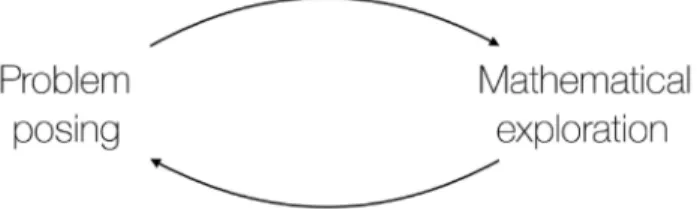
problems to arise out of attempts to generalize a known result, or as tentative conjectures for working hypotheses, or as subproblems embedded in the search for the solution to a larger problem” (Silver, 1997, p. 76). Through the use of problem-‐solving and problem-‐posing tasks, educators can increase student capacity of the dimensions of creativity, and capacity is enhanced through the use of the cycle between problem posing and exploration (see Figure 1).
Figure 1. Mathematical Creativity Cycle, Bolognese & Steward (2017).
“It is in the interplay of formulating, attempting to solve, reformulating, and eventually solving a
problem,” that can assist students to develop more creative approaches to mathematics (Silver, 1997, p. 76). It is throughout this cycle that mathematical creativity and mathematical problem solving are indistinguishable, and it is then that the process of ‘doing’ mathematics appears (Liljehdal, 2004, p. 10).
Assessing Mathematical Creativity
There is a need for mathematics teachers to identify, encourage, and improve creative
mathematical ability at all levels. It is productive for educators to view creativity as something that can be fostered in the general population because creativity-‐enriched mathematics instruction increases divergent thinking with a wide range of students. Neglecting to recognize creativity might cause the mathematically creative to give up the study of mathematics. It is important to develop creative
mathematical ability and talents in students for the fact that “mathematical creativity ensures the growth of the field of mathematics as a whole” (Yuan & Sriraman, 2011, p. 5). There is also a need to design problems and situations for students that help foster mathematical creativity. Assessing creativity, and even more challenging -‐ mathematical creativity, has proved to be a difficult task. Traditional tests do not typically measure creativity, and traditional mathematics tests often reward accuracy and speed over being mathematically creative. These tests typically only identify students who are computationally fluent and not students who are creatively talented in mathematics. “Encouraging mathematical creativity in addition to computational fluency is essential for children to have a
productive and enjoyable journey while developing a deep conceptual understanding of mathematics” (Mann, 2006, p. 240). Students must be provided opportunities within an authentic high-‐end learning environment where they can apply relevant knowledge and skills to solve real world problems (Reis & Renzulli, 2004). Real problems include problem-‐solving and also entails problem-‐finding, or in other words, formulating and answering their own problems. Students need to be provided with
opportunities to design and solve their own problems. In a step toward identifying and improving mathematical creativity in students, mathematical creativity tests were created. Specifically used throughout this research study is the Mathematical Creativity Test of Kattou, Christou, and Pitta-‐Pantazi (2016). The Mathematical Creativity Test is comprised of four to five multiple solution tasks with problem solving and problem posing situations (see Figure 2). For each task, students are assessed on their ability to provide multiple solutions, solutions different from their peers’ solutions, and original solutions that no other peers provided (fluency, flexibility, and originality).
In order for students to exhibit mathematical creativity, they must think differently. They must learn to use more than rote learning and existing knowledge. Einstein is famously quoted for saying, “Mathematical creativity is more than the ability to solve the problem, but it is about the ability to see
Figure 2. Example of tasks from the Mathematical Creativity Test, Kattou, Christou, & Pitta-‐Pantazi
(2016).
the problem” (Walia & Walia, 2017, p. 1294). Seeing the problem means representing mathematical thinking of the highest level – divergent thinking. Assessing mathematical creativity is assessing divergent thinking, which is broken up into three components – originality, fluency, and flexibility. Originality can be measured when a response is novel as compared to responses from peers. Fluency can be measured by determining the frequency of responses given. Flexibility can be measured by determining the different measures used in responses. Problem-‐solving tasks encourage flexibility and fluency, while originality is where students will showcase their creativity. It is unlikely that students will exhibit creative instincts in problem-‐solving settings if they have not broken from their fixations and mental sets. While problem-‐solving settings will indeed provide opportunities to express originality and creativity, students will need to be prompted and rewarded for expressing originality and creativity. Students must be encouraged to “break from established mindsets to obtain solutions in a
mathematical situation” through rewarding mathematical creativity (Haylock, 1987, p. 69). Kattou, Christou, and Pitta-‐Pantazi (2016) determined scores for originality, fluency, and flexibility as follows: a) Fluency score: the ratio between the total number of relevant and accurate responses provided by the student to a particular item to the maximum number of relevant and accurate responses provided by a student in the investigative population, b) Flexibility score: the ratio
between the different types of categories or number of different types of accurate solutions to the maximum number of types of categories or number of different types of accurate solutions by a student in the investigative population, and c) Originality score: is calculated according to the frequency of a student’s solutions in relation to the solutions provided by all the students. Scores for originality will be given on a scale from 0-‐4. Originality scores come from ability to produce uncommon responses. If a student produces responses where more than 10% of other students gave the same response, a score of 0 is awarded. If a student produces a response where 8-‐10% of other students gave the same response, a score of 1 is awarded. If a student produces a response where 6-‐8% of other students gave the same response, a score of 2 is awarded. If a student produces a response where 4-‐6% of other students gave the same response, a score of 3 is awarded. If a student produces a response where 0-‐3% of other students gave the same response, a score of 4 is awarded. The average of the sum of the fluency, flexibility, and originality scores will yield an estimated mathematical creativity value.
Rewarding Originality and Creativity
Convergent thinkers are always in pursuit of one right answer, while divergent thinkers generate ideas beyond stereotypical logical expectations. An aspect of divergent thinking is originality, where divergent thinkers seek novel solutions to problems, which is hard to reward through traditional strategies and standardized testing. Students from young ages bring imagination and curiosity to education, but somewhere along their educational careers their fearlessness of exploration and being wrong fades away. One contributing factor is that schools reward convergent thinking by encouraging memorization, valuing one correct solution, and penalizing for giving the wrong answer. Instead of the traditional teaching methods, collaborative problem-‐solving based learning experiences will provide students with the opportunity to engage in divergent thinking and creativity. But in order for students to produce novel ideas and exhibit creativity, they must be encouraged and rewarded for thinking divergently. Students are held back from risk-‐taking because of a fear of ridicule and uncertainty
established within them from the culture of traditional schooling. Divergent thinking and originality can be promoted through prioritizing collaboration, fostering open sharing and idea building, encouraging risk-‐taking and normalizing failure and dead ends.
Good Problem-‐Solving Tasks
Problem-‐solving activities that provide such opportunities for students to engage in ‘doing mathematics’ are so-‐called ‘good problems.’ ‘Good problems’ are problem-‐solving tasks that foster meaningful discussions around rich mathematics (Liljehdal, 2017). ‘Good problems’ are designed to foster a sense of collaboration among the students and to maintain a state of flow by providing students with problems that have the appropriate level of difficulty for their skill set. Another type of problem-‐ solving activity that provides students with opportunities to engage in ‘doing mathematics’ are ‘open middle’ problems. A specific type of problem is encouraged, where the problems have “a ‘closed beginning’ or all start with the same initial problem, a ‘closed end’ or they all end with the same answer, but there is an ‘open middle’ which encourages multiple ways to approach and ultimately solve the problem” (Kaplinsky, 2020, ¶. 1). ‘Open middle’ problems require a higher depth of knowledge than procedural math problems, and have opportunities for multiple ways of solving the problem, in contrast to using specific algorithms or methods. Using ‘good problems’ and ‘open middle problems’ throughout a lesson requires considering both a good task and an effective delivery method for the type of students in the classroom.
The delivery method of investigations is important for aspects of mathematical creativity and perceptions and attitudes towards mathematics. Mathematics in schools is seen to be without purpose or meaning, and is perceived to only be a set of algorithms (Battista, 2010, p. 37). But, mathematics as a subject domain is with context, purpose, and meaning and can be used as a tool for understanding the world around us. Investigations allow students to assume a role as a first-‐hand inquirer, and give
students the opportunity to apply their knowledge to real world, relevant situations. Students tackle real problems of interest that “are valuable to students as they can bring about some form of change and/or contribute to something new” (Reis & Renzulli, 2018, p. 204). Investigating and exploring mathematics changes student perspectives on what mathematics is – not just a set of algorithms.
Another aspect of the delivery method required for promoting mathematical creativity through problem solving is to use aspects of a thinking classroom as presented by Peter Liljehdal. A thinking classroom is “a space inhabited by thinking individuals, as well as individuals thinking collectively, learning together, and constructing knowledge and understanding through activity and discussion” (Liljehdal, 2016, p. 364). The teacher’s job is to foster and expect thinking. In order to foster and encourage collaboration, a thinking classroom requires a specific room arrangement, specific types of tasks used, specific student workspace, and specific formation of groups. It became obvious to Liljehdal that working at desks is not conducive to collaboration. Giving students opportunities to work on alternative surfaces, such as vertical white boards, white boards on desks, and poster boards
encourages collaboration and discussion between peers. Although working in groups is conducive to a thinking classroom, it is encouraged to assign visibly random groups to help foster a thinking classroom. Students will be more willing to work in any group in which they are placed, “mobility of knowledge between students will increase, and reliance on inter-‐group answers will increase,” with less reliance on the teacher for answers (Liljehdal, 2016, p. 375). Liljehdal also states the importance of the types of tasks used in a thinking classroom. Lessons are encouraged to begin with good problem-‐solving tasks, that are “highly engaging collaborative tasks that drive students to want to talk to each other as they try to solve them” (Liljehdal, 2016, p. 381). The problem-‐solving tasks need to emerge rich mathematics that are linked to the curriculum, and should permeate the entire lesson (Liljehdal, 2016, p. 281). These components are a part of Stage 1 in building a thinking classroom, and will be used throughout the research.
On the curriculum side of investigations, the cycle between problem-‐posing and exploring are important aspects of engaging in mathematical exploration. With an inquiry-‐based approach, students are expected to ask interesting questions and explore possible solutions to those questions. Bolognese and Steward (2017) advocated in the framework for problem posing that interesting questions were those questions for which you do not have a known method for getting the answer. Allowing students to ask interesting questions gives opportunities for students to stay in flow. For a problem to be
classified as a problem, it must be problematic. “Any problem by which you can see how to attack it is a routine problem and cannot be an important discovery” (Liljehdal, 2004, p. 34). Just as questions lead to explorations, so too do explorations lead to questions. Investigations allow students to explore mathematics in depth and to create.
How Educators Create Problem Solving Tasks
Mathematical tasks can be examined for their variety of ways to solve, kinds of representations, requirement of student communication, and cognitive demand. Opportunities for student learning are “created by the level and kind of thinking in which students engage that determines what they will learn” (Stein, 2000, p. 11). There are four different categories of tasks that students may endure in their mathematics careers, and they appear under two different demands – lower-‐level versus higher-‐level. Lower-‐level tasks are described as “memorization, and procedures without connections to
understanding, meaning, or concepts” (Stein, 2000, p. 12). These tasks are the traditional ‘drill and kill’ practice problems where students will do around 30 (give or take) in a class period. But the higher-‐level cognitive demands come from different types of tasks, described as “procedures with connections to understanding, meaning, or concepts,” or even simply put – doing mathematics (Stein, 2000, p. 12). These tasks require students to explore relationships, and present various representations. Figure 3 describes some great example tasks of each category, all based on conversions with fractions.
Figure 3. Cognitive Demand of Mathematical Tasks (Stein, 2000, p. 13).
In contrast to lower-‐level demand tasks, higher-‐level demand tasks require far fewer problems in one sitting based on the cognitive demand level. But one aspect of creating these tasks for students is figuring out what type of cognitive demand the tasks requires, and what skills and ability is required to complete the task. Educators are sometimes caught up in the superficial aspects of how tasks “look.” Such as, if it is a word problem, if manipulatives are involved, or if it has real-‐world context. It is much easier for educators to pick an appropriate level task for students when they consider the learning goals. In the case of the learning goals of mathematical creativity, tasks that require higher-‐level demands, such as procedures with connections and doing mathematics are the most appropriate tasks.
What the Research Says
There are relationships between mathematical creativity and other concepts such as “academic ability, visualization and verbal abilities, and mathematical background” (Kajander, Manuel, & Sriraman, 2018, p. 2). Students in the classroom are often referred to by their ability level – low, average, and high
ability. High ability students might be referred to as gifted, and hence would also be considered highly creative, as creativity is a characteristic of giftedness. The high ability students would be expected to have high achievement on the Mathematical Creativity Test. The average ability students are expected to have average performance and achievement on the Mathematical Creativity Test. The low ability students would be expected to have low creative potential and have low performance and achievement on the Mathematical Creativity Test. But, the main goal of this research is to improve student’s
mathematical creativity. Research shows that “challenging mathematical problems and flexible teaching can help the development of mathematical creativity” (Kajander, Manuel, & Sriraman, 2018, p. 3). Good problems provide opportunities to challenge student’s thinking and opportunities to problem-‐solve and display mathematical creativity. Research also shows that mathematical creativity is influenced by the classroom environment. Providing students with opportunities to collaborate in groups, ask their own questions, explore their own questions, make conjectures, find patterns, and work on spaces other than desks will provide students with a classroom environment that fosters mathematical creativity.
Chapter 3 – Methodology
The intervention will be implemented in two math classes at Great Falls High School in Great Falls, Montana, throughout the Spring Semester of the 2019-‐2020 school year. A sample of forty-‐one high school students, ages 15-‐17, were chosen for the intervention. The forty-‐one students are made up of two Intermediate Algebra sections.
Prior to the intervention, the classroom environment was structured in a traditional manner. Desks were arranged in rows facing the front of the room. The curriculum was presented in a lecture-‐ based manner, where occasionally the students were asked to work collaboratively on the white boards. The curriculum was structured in a way such that students were required to do little thinking. The students were regularly asked to repeat what had been shown during lecture, and to repeat algorithms presented by the teacher. There was little opportunity for students to display their mathematical creativity or problem-‐solving skills.
For my research, I made use of a plan/act/reflect cycle, where one day was considered to be one cycle. When implementing the classroom environment aspect of the intervention, an environment of collaboration was fostered. The desks were arranged in pods of four, not necessarily front facing. Students were assigned groups using Liljehdal’s method of visibly random grouping. The method chosen for grouping was assigning a playing card that corresponded with a pod number (Ace to six). Students were expected to draw a card, and sit at the pod with the corresponding number from the card, along with up to three other classmates who were also randomly assigned to their pod. These pod numbers also corresponded to a whiteboard around the room, giving each group the opportunity to use vertical nonpermanent surfaces for collaboration as an option instead of sitting at the desks. Qualitative data through field observations and notes will be kept on the effectiveness of visibly random grouping and vertical nonpermanent surfaces throughout the intervention.
When implementing the curriculum component of the intervention, the students will be exposed to a non-‐traditional learning environment. Students will be asked to problem-‐solve, showcase mathematical creativity, and break from mental mathematical fixations. Student progress in increasing mathematical creativity will be charted through aspects of fluency, flexibility, and originality on
Mathematical Creativity pre-‐ and posttests, validated by Walia & Walia (2017). Quantitative data will be compared between pre-‐ and posttests by examining scores for fluency, flexibility, and originality, and a summated score of all three components which will yield an estimated total of mathematical creativity. In between the pre-‐ and posttests, student mathematical creativity will be fostered through selected problem-‐solving activities. The structure of each lesson was changed to utilize good problem-‐solving tasks, connected to the curriculum, permeating the entirety of the lesson. For resources on good problem-‐solving tasks, Liljehdal’s ‘Good Problems’ were utilized, and Kaplinsky’s ‘Open Middle Problems’ were utilized. In order to encourage students to break fixations and mental sets that hold them back from creativity, a reward system was developed to encourage and reward students for thinking divergently and showcasing originality. This reward system was validated and modified from Kaplinsky (1987).
Chapter 4 – Results Mathematical Creativity Pre-‐Test
Students were given a bell ringer to start off thinking about the question – “What is
mathematical creativity?” Student answers were spot on with the definition of mathematical creativity quoted throughout this research. Some student responses are as follows: “Finding real world situations to represent math,” “Solving problems different than how you were taught,” “Freestyling the way you want to do it,” “Using a different method but getting the same answer,” “Solving a problem in a way you are comfortable.”
After the bell ringer, students were briefed on the basics of the research and the expectations for the Mathematical Creativity Pre-‐Test. A research assistant distributed the pretests to the students, matching students with their appropriate pseudonym that is to be used on both pre-‐ and posttest, in order for the results of the mathematical creativity scores to remain anonymous. Students were
allotted seven minutes per question, to answer as mathematically creative as possible the following four questions (Walia & Walia, 2017, p. 1300):
1. Write as many relationships as you can between 64 and 144.
2. Select few numbers from the given numbers (1, 2, 3, 4, 8, 9, 16, 24, 27, 28, 32, 36, 40, 43, 44, 48, 49), showing some pattern or having relation with each other.
3. Write 1000𝑎!𝑏! in different ways without changing the value.
4. Write as many geometrical shapes, figures and concepts in relation to different objects which you observe in day to day life.
Students were assessed on their creativity and their ability to think divergently. Students were given scores for fluency, flexibility, and originality using the following rubric:
You will be scored as follows:
Fluency Score: the ratio between the total number of relevant and accurate responses provided by the student to a particular item, to the maximum number of relevant and accurate responses provided by a student in the investigative population.
Flexibility Score: the ratio between the different types of categories or number of different types of accurate solutions, to the maximum number of types of categories or number of different types of accurate solutions by a student in the investigative population.
Originality Score: calculated according to the frequency of a student’s solutions in relation to the solutions provided by all the students. Scores for originality will be given on a scale from 0-‐4 (See Table 1).
Table 1.
Assignment of Originality Scores from Zero to Four You will be awarded a:
0, if … 1, if … 2, if… 3, if … 4, if … >10% of other
students gave the same response
8-‐10% gave the
same response 6-‐8% gave the same response 4-‐6% gave the same response <4% gave the same response Source: Adapted from Walia and Walia (2017, p. 1296)
The scoring percentages were adapted to accommodate a sample size of 41 students. Earning a percentage of less than 4% allows one student to be eligible for a score of 4, indicating an idea that no other students gave the same response. Earning a percentage between 4 to 6% allows two students to be eligible for a score of 3, indicating an idea that two students gave the same response. Earning a percentage between 6 to 8% allows three students to be eligible for a score of 2, indicating an idea that three students gave the same response. Earning a percentage between 8 to 10% allows four students to be eligible for a score of 1, indicating an idea that four students gave the same response. And earning a percentage of 10 percent or more allows the remaining students to be eligible for a score of 0, indicating an idea that many students gave the same response. Students were eligible to earn at most 4 points per
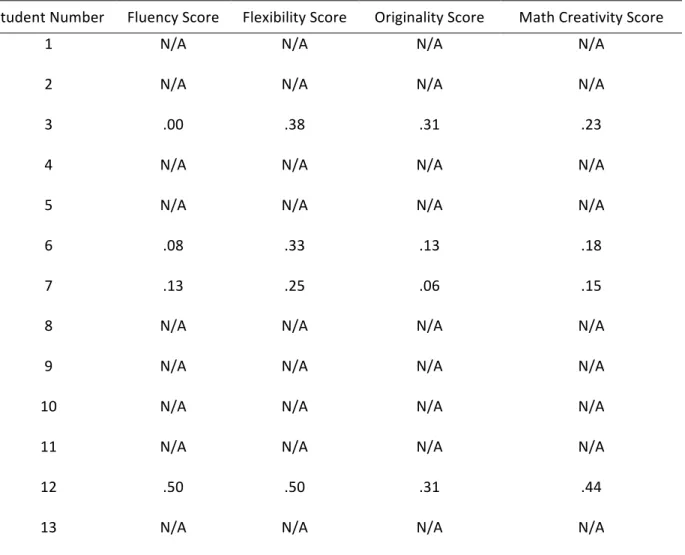
problem, and 16 points in total. The total originality score was calculated by the ratio of individual points earned by the student to the maximum possible points available for originality (16 points). As the study was intended to be completed with a sample size of 41 students, the study ended with only a sample size of 13 students because of the Covid-‐19 impact, and the adaptation to distance learning. Because of this limited data set of 13 students, these percentages could not be utilized on a total of 13 students, and hence the results could not be generalized to a population because of the limited data set.
The mean score of fluency, flexibility, and originality will yield an estimated total of
mathematical creativity! Student scores for fluency, flexibility, originality, and the average mathematical creativity score are listed in Table 2. Figure 4 is a box and whiskers plot of the math creativity scores for students on the pretest. Figure 4 shares median scores, the range and spread of scores, and any outlier scores that are particularly higher or lower than the rest of the student scores.
Table 2.
Fluency, Flexibility, Originality, Total Math Creativity Pretest Scores
Student Number Fluency Score Flexibility Score Originality Score Math Creativity Score
1 .51 .27 .00 .26 2 .36 .28 .13 .26 3 .33 .37 .13 .28 4 .16 .14 .00 .10 5 .35 .41 .19 .32 6 .27 .30 .19 .25 7 .31 .26 .00 .19 8 .17 .17 .00 .11
Student Number Fluency Score Flexibility Score Originality Score Math Creativity Score 10 .46 .41 .25 .37
11 .57 .49 .13 .40 12 .66 .40 .00 .35 13 .28 .19 .00 .16 14 N/A N/A N/A N/A 15 .34 .27 .00 .20 16 .30 .32 .06 .23 17 .30 .35 .00 .22 18 .80 .67 .25 .57 19 .36 .40 .19 .32 20 .20 .22 .25 .22 21 .16 .23 .25 .21 22 N/A N/A N/A N/A 23 .27 .44 .19 .30 24 .30 .45 .00 .25 25 .23 .29 .00 .17 26 .27 .22 .00 .16 27 .53 .32 .06 .30 28 .21 .33 .19 .24 29 .79 .89 .38 .69 30 .46 .46 .25 .39 31 .55 .41 .00 .32 32 .23 .28 .00 .17
Student Number Fluency Score Flexibility Score Originality Score Math Creativity Score 33 N/A N/A N/A N/A
34 .21 .24 .00 .15 35 .60 .23 .25 .36 36 .55 .85 .56 .65 37 .37 .33 .25 .32 38 .64 .52 .06 .41 39 .42 .22 .00 .21 40 N/A N/A N/A N/A 41 .23 .22 .00 .15
Encouraging and Awarding Divergent Thinking Through Problem Solving
After the pre-‐test, students partook in selected problem-‐solving activities, originally planned to be facilitated face-‐to-‐face, using aspects of a thinking classroom and collaboration in groups. But, because of circumstances beyond my control, the Covid-‐19 pandemic caused a school closure, and hence resulted in a change in how the problem-‐solving intervention was presented. It was deemed prohibited through the Institutional Review Board (IRB) that any study continue face-‐to-‐face research. So, the study was converted to an online format, facilitated through Google Classroom and online discussion forums. The students were to work through the selected problem-‐solving activities in Figures 5–9.
Problem-‐Solving Activity #1
Figure 5. Equidistant Points, Kaplinsky (2020)
Problem-‐Solving Activity #2
Figure 6. Equations of Parallel and Perpendicular Lines, Kaplinsky (2020)
Problem-‐Solving Activity #3
Problem-‐Solving Activity #4
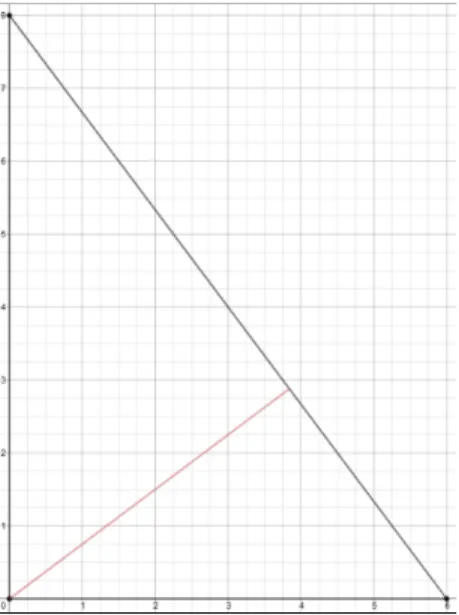
Figure 8. Finding the Length of a Right Triangle’s Altitude, Kaplinsky (2020)
Problem-‐Solving Activity #5
Figure 9. Triangle Perimeter, Liljehdal (2014)
In substitution of face-‐to-‐face collaboration, students were encouraged to collaborate through discussion forums, sharing strategies they tried that were either successful or unsuccessful. In order to encourage divergent thinking, students were expected to work through the exploratory and problem-‐
solving activities using a graphic organizer (see Figure 10), encouraging and rewarding students to think outside the box, and to break fixed mental sets. Students were encouraged to try six attempts at each
Figure 10: Reward for Divergent Thinking, adapted from Kaplinsky (2020)
problem-‐solving activity, while explaining failed attempts, false starts, the strategy they chose, and how the strategy will be adapted for the next attempt. The more attempts and the more explanations given, the more points awarded to the student. The six attempts were allotted to encourage students to try different strategies, think in novel ways, take risks, and be creative with the mathematics.
Student Work
For problem-‐solving activity #1 (Figure 5), students were encouraged and facilitated to gain a deeper understanding of equidistance, slope, and the distance formula. Figure 11 and Figure 12 share some of the student’s responses.
Figure 11. Student A Work, Problem-‐Solving Activity #1
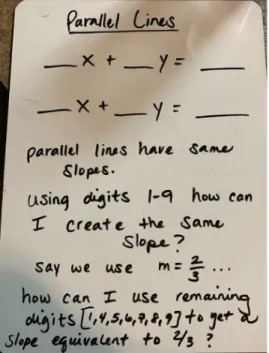
For problem-‐solving activity #2 (Figure 6), students were encouraged to share knowledge and understanding of equations of parallel and perpendicular lines. Little participation in the discussion forums led me to guide the discussions by providing hints and starting points. I gave hint and question prompts to start the discussion between peers (see Figure 13).
Figure 13. Hints and Guiding Prompts for Problem-‐Solving Activity #2
Figure 14 contains some responses students left in the discussion forum.
Figure 14. Student Responses to Online Discussion Forum, Problem-‐Solving Activity #2
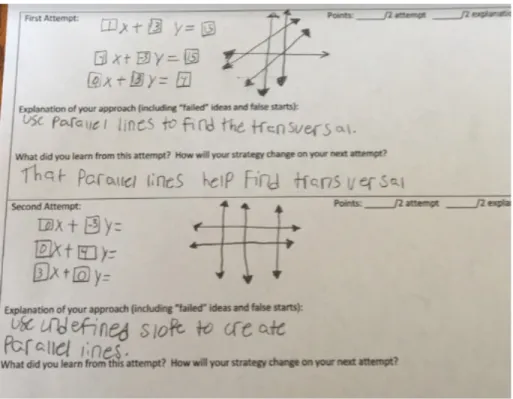
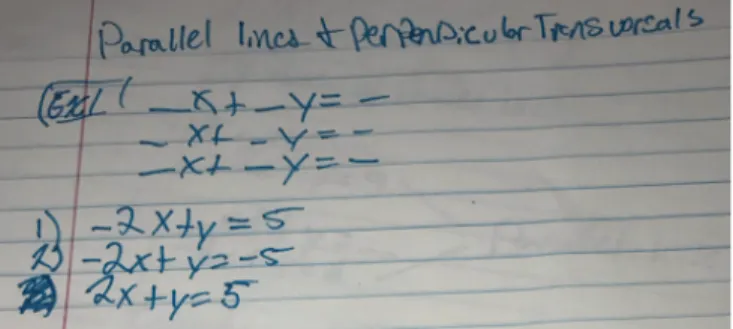
Students used aspects of the hints and guiding prompts strategies listed in Figure 13 to come up with the work shared in Figure 15 through Figure 17.
Figure 15. Student B Work, Problem-‐Solving Activity #2
Figure 16. Student C Work, Problem-‐Solving Activity #2
Throughout this activity, students really started to understand characteristics of parallel and perpendicular lines, such as, parallel lines have same slope and different y-‐intercept, while
perpendicular lines have opposite reciprocal slopes. Students struggled using the restrictions – only allowed digits 1 through 9 to be used at most once – so, I typed feedback on each submission and gave students opportunities to try again and resubmit.
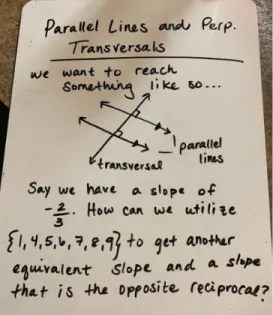
For problem-‐solving activity #3 (Figure 7), students were to gain a deeper understanding of equations of parallel lines cut by a perpendicular transversal. Again, I prompted students to collaborate on strategies in the discussion forum, initiating the discussion with the following hints and question prompts shared in Figure 18.
Figure 18. Hints and Guiding Prompts for Problem-‐Solving Activity #3
Figure 19. Student Responses to Online Discussion Forum, Problem-‐Solving Activity #3
Students used aspects of the strategies listed in Figure 19 to come up with the work shared in Figure 20 and Figure 21.
Figure 21. Student C Work, Problem-‐Solving Activity #3
Students tried to be creative, and use their developing understanding of what it means to be parallel or perpendicular. Students seemed to struggle again with the restrictions – using only digits 1 through 9 at most once. Again I gave the students feedback and an opportunity to try again and resubmit.
For problem-‐solving activity #4 (Figure 8), students were encouraged to gain a deeper understanding of finding distance from a point to a line, finding equations of lines, distance, area of a triangle, and perpendicular lines. I prompted students to collaborate on different strategies and facilitated discussion using the below hints and questions prompts in Figure 22.
Figure 23 shares some responses students left in the discussion forum.
Figure 23. Student Responses to Online Discussion Forum, Problem-‐Solving Activity #4
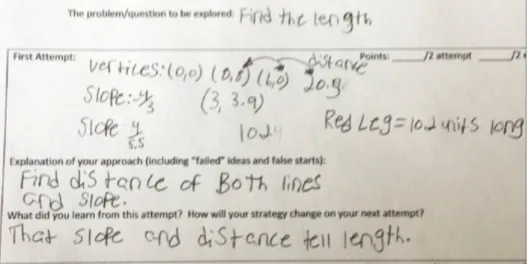
Strategies from Figure 23 were utilized to come up with the work found in Figures 24 through 26.
Figure 24. Student B Work, Problem-‐Solving Activity #4