Table of Contents
Table of Contents... 2
1. Introduction... 3
2. Background and targets for the Second Action Plan ... 4
2.1 Developments in the Slovak Republic’s energy intensity ... 4
2.2 Background to the Second Energy Efficiency Action Plan ... 6
2.3 Energy savings target... 7
3. Methods for evaluating the measures of the First Action Plan... 11
3.1 Bottom-up evaluation method... 11
3.2 Top-down evaluation method... 12
4. Assessing the First AP by the bottom-up method by sector... 13
4.1 Horizontal measures ... 13 4.2 Buildings ... 18 4.3 Appliances... 28 4.4 Public sector ... 32 4.5 Industry ... 35 4.6 Transport ... 39
4.7 Overall evaluation of the implementation of measures by the bottom-up method ... 44
5. Evaluation of energy savings by the top-down method ... 46
5.1 Households ... 50
5.2 Service sector ... 50
5.3 Transport sector ... 50
5.4 Industry sector ... 51
5.5 Overall evaluation of the implementation of measures by the top-down method... 52
6. Overall evaluation of the implementation of the First Action Plan... 53
7. Measures for the 2011–2013 period... 54
7.1. Buildings ... 54 7.2 Appliances... 60 7.3 Public sector ... 65 7.4 Transport ... 71 7.5 Industry ... 76 7.6 Horizontal measures ... 78
8. Overview of energy savings planned for 2011–2013 ... 84
1. Introduction
The Energy Efficiency Action Plan 2011–2013 (the “Second AP” or “Second Action Plan”) has been prepared in accordance with Section 3 of Act No 476/2008 on efficiency in energy use (the Energy Efficiency Act) and amending Act No 555/2005 on the energy performance of buildings and amending certain laws, as amended by Act No 17/2007 (the “Energy Efficiency Act”). The Second AP is the second implementing measure under the Energy Efficiency Policy of the Slovak Republic adopted by Government Resolution No 576 of 4 July 2007. The Energy Efficiency Policy of the Slovak Republic defines the overall national indicative energy savings target for 2008–2016 as 9% of the average final energy consumption from the 2001–2005 period, i.e. 37 215 TJ. This target includes the final energy consumption of companies involved in the trading of greenhouse gas emission allowances (“ETS companies”).
The role of the Second AP is to establish a second intermediate indicative energy savings target in the Slovak Republic for the three-year period from 2011 to 2013. The Second Action Plan defines measures and financial and legal instruments to achieve the energy savings target.
The Second Action Plan builds on the Energy Efficiency Action Plan 2008–2010 (the “First AP” or the “First Action Plan”), approved by Government Resolution No 922 of 24 October 2007. Therefore, the Second AP includes an evaluation of measures proposed in the First AP. This evaluation proposes a continuation of the measures under the First AP which have not yet been completed. These measures are supplemented by newly proposed measures so that, during the second three-year period, foundations will be laid for achieving the overall nine-year energy savings target by 2016. This will fulfil the energy savings targets set under Directive 2006/32/EC on energy end-use efficiency and energy services (the “Energy Services Directive”) and adopted in the Energy Efficiency Policy of the Slovak Republic. As a percentage, this target is identical in all EU Member States; in order to meet it, energy efficiency measures need to be set so that it is possible, over a period of nine years, to demonstrate energy savings equivalent to 9% of the average final energy consumption in the 2001–2005 period.
The First AP set an intermediate energy savings target for the first three-year period from 2008 to 2010 at a level equivalent to 3% of the average final energy consumption in the years 2001 to 2005, i.e. 12 405 TJ. In view of the European Commission’s requirement for the final energy consumption of ETS companies to be removed from the overall target, the Second AP includes both a calculation of the absolute net target reduced by ETS company consumption and the net energy savings sub-targets.
According to the European Commission, it is important to stress the leading role played by the public sector in energy efficiency, in particular through pilot and model projects aimed at energy savings. The public sector plays an important role in this Action Plan.
The measures under the Second AP also reflect the requirement arising from Directive 2010/31/EC on the energy performance of buildings (recast) to support the development of low-energy houses and passive buildings.
2.
Background and targets for the Second Action Plan
2.1 Developments in the Slovak Republic’s energy intensity
One of the Slovak Republic’s priorities in the energy sector is a gradual reduction in the energy intensity of the national economy, as evidenced by developments between 2002 and 2008, when the Slovak Republic’s energy intensity contracted by nearly 32%, which represents the greatest reduction in energy consumption among all OECD and EU Member States in that period (Fig. 1). Taking the 2001–2005 period as the basis for calculating the savings target, it is clear the Slovak Republic has made significant energy savings.
Fig. 1: Comparison of the energy intensity of the Slovak Republic and EU Member States Energetická náro•nos• 2002-2008 0 200 400 600 800 1000 1200 1400 Írsko Dán sko Ve• ká B ritánia Rakú sko TalianskoNem
ecko Švéds ko Luxem burs ko Franc úzsk o EU27 Hol ands ko Gréc ko Špa niel sko Portu gals ko Mal ta Belgi cko Cyp rus Fíns ko Slov insko Loty šsko Po• sko Ma• arsko Litva Slo vens ko •eská rep ublik a Estóns ko Rum unsko Bul hars ko koe/1000EUR 2002 2003 2004 2005 2006 2007 2008 Energy Intensity 2002-2008 Ireland Denmark UK Austria Italy Germany Sweden Luxembourg France EU27 Netherlands
Greece Spain Portugal Malta
Belgium Cyprus Finland Slovenia Lithuania Poland Hungary Lithuania Slovakia
Czech Rep
Estonia
Romania Bulgaria
Source: Eurostat
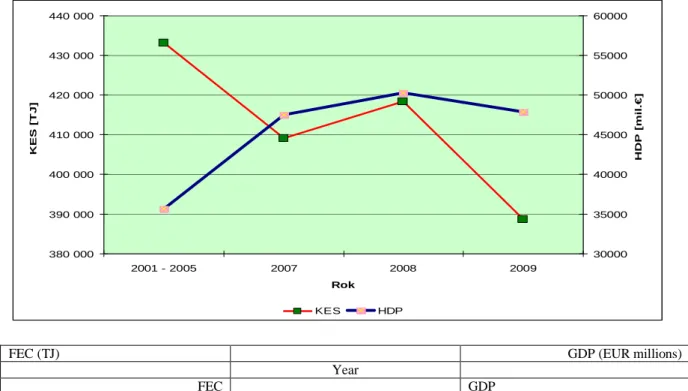
Compared with the average energy consumption in 2001–2005 (12.158 TJ/EUR million), the Slovak Republic reported a marked decline in energy intensity by as much as 31.5% in 2008 and 33.2% in 2009. Compared to 2007, energy intensity decreased by 3.4% in 2008 and 5.7% in 2009 (Fig. 2).
Fig. 3 shows the course of final energy consumption in various sectors of the national economy. Compared with the average values in 2001–2005, energy savings in all sectors of the national economy were reported at 3.4% (in 2008) and 10.2% (in 2009). However, in comparison with 2007, which preceded the First AP, there was a rise in final energy consumption in most sectors in 2008 and 2009. The exception was industry, where, compared to 2007, FEC decreased by 2% in 2008 and by as much as 15% in 2009. It should be noted,
however, that the 2009 FEC reduction in industry was considerably affected by the impact of the economic crisis.
The increase in final energy consumption (“FEC”) in the household and service sectors in 2008 and 2009 was greatly influenced by climate conditions (a higher number of degree days in those years).
Fig. 2: Developments in FEC and GDP at constant year-2000 prices
380 000 390 000 400 000 410 000 420 000 430 000 440 000 2001 - 2005 2007 2008 2009 Rok KES [TJ] 30000 35000 40000 45000 50000 55000 60000 HDP [mil.€] KES HDP
FEC (TJ) GDP (EUR millions)
Year
FEC GDP
Fig. 3: Developments in final energy consumption in various sectors in the Slovak Republic 0 50 000 100 000 150 000 200 000 Rok KES [TJ]
Priemysel Domácnosti Služby Doprava Pôdohospodárstvo
Priemysel 151 668 153 704 150 591 130 038 Domácnosti 117 869 87 248 89 209 89 994 Služby 87 335 77 404 81 162 81 405 Doprava 68 522 85 004 91 490 81 895 Pôdohospodárstvo 7 689 5 673 5 839 5 393 2001 - 2005 2007 2008 2009 FEC (TJ) Year Industry Households Services Transport Agriculture
Industry Households Services Transport Agriculture
Source: Statistical Office of the Slovak Republic
2.2 Background to the Second Energy Efficiency Action Plan
The Second Action Plan is the second implementing instrument under the Energy Efficiency Policy of the Slovak Republic and is a continuation of the First AP. The most important documents for the preparation of the Second Action Plan are:
• Directive 2006/32/EC on energy end-use efficiency and energy services and repealing Council Directive 93/76/EEC;
• Act No 476/2008 on efficiency in energy use (the Energy Efficiency Act) and amending Act No 555/2005 on the energy performance of buildings and amending certain laws, as amended by Act No 17/2007;
• European Commission recommendations for the Slovak Republic regarding the preparations for the Second AP, set out in the “Synthesis of the Complete Assessment of National Action Plans”,1 which includes the European Commission’s requirement to supplement the specific calculation of the energy efficiency target and to remove the final energy consumption of ETS companies from that calculation;
• European Commission Recommendations on measurement and verification methods in the framework of Directive 2006/32/EC on energy end-use efficiency and energy services – preliminary draft (the “methodology for calculating savings”), approved by the Commission Committee on Consumption Control of 2 July 2009;
1
• International Energy Agency (IEA) recommendations on energy efficiency, published in the “Energy Efficiency Progress Report, The Slovak Republic”, which was released in 2009 as part of the document “Implementing Energy Efficiency Policies: Are IEA countries on track?”.
According to Section 3(1)(c) of the Energy Efficiency Act, the Action Plan should include, in particular:
• the energy savings target in the Slovak Republic and the measures to achieve that target for a period of three consecutive years;
• an analysis and evaluation of measures taken;
• the proposal of new measures for achieving the energy savings target;
• information for citizens and companies about the exemplary role and actions of the public sector;
• ways to achieve the planned energy efficiency;
• financial and legal instruments for achieving the national indicative energy savings target.
Based on the Energy Services Directive, the Second AP is to be submitted to the European Commission by 30 June 2011.
2.3 Energy savings target
The Energy Efficiency Policy of the Slovak Republic contains concise information on the calculation of the overall national indicative target. Based on the European Commission’s comments on the First AP, the Second AP must include an exact calculation of the overall national indicative target for the entire nine-year period, as well as the documentation used in this calculation.
2.2.1 Calculation of the gross overall national indicative energy savings target
According to Article 4 of the Energy Services Directive, Member States “shall adopt and aim to achieve an overall national indicative energy savings target of 9% for the ninth year of application of this Directive" compared to the average final energy consumption in 2001– 2005; they are also required to adopt an intermediate national indicative energy savings target for a three-year period, based on the methodology set out in Annex I to the Energy Services Directive.
In this respect, the Energy Efficiency Policy calculates the average FEC in 2001–2005 as follows:
FEC2001-2005 = (FEC2001+FEC2002+ FEC2003+ FEC2004+FEC2005)/5
[2.3-1]
FEC2001-2005 = 413 506 TJ
[2.3-2] The actual FEC in 2001–2005 is set out in Fig. No 1. These values also include the FEC of ETS companies.
Table 1: Final energy consumption in the years 2001–2005 (TJ/year)
Indicator 2001 2002 2003 2004 2005 2001–2005 average Final energy consumption (FEC) [TJ/year] 435 192 435 510 400 383 386 340 410 103 413 506
Source: Statistical Office of the Slovak Republic
The average final energy consumption under Table 1 was used to calculate the energy savings target in three of the Slovak Republic’s strategy documents, namely the Energy Efficiency Policy of the Slovak Republic (July 2007), the Energy Efficiency Action Plan 2008–2010 (October 2007), and the Energy Security Strategy of the Slovak Republic (October 2008). Energy savings targets, calculated from the average FEC under Table 1, are listed in Table 2 and were calculated using the following equation:
SAVING [TJ] = SAVING [%] * FEC2001-2005 [TJ]
[2.3-3]
Table 2: Energy savings targets up to 2020
Energy savings based on the average FEC in 2001–2005 Indicator [%] [TJ] Annual target 1 4 135 Medium-term target up to 2010 3 12 405 Long-term target up to 2016 9 37 215 Long-term target up to 2020 11 45 486
The policy stipulates that the overall national indicative energy savings target up to 2016 will be met on a linear basis. Energy efficiency measures therefore need to be taken every year so as to ensure annual energy savings of 1% of the average FEC in 2001–2005, i.e. 4 135 TJ. The First AP set a medium-term target of 3% of the average FEC in 2001–2005 (12 405 TJ) and a long-term target of 9% of the average FEC in 2001–2005 (37 215 TJ).
2.2.2 Calculation of the net overall national indicative energy savings target
No uniform methodology has been set for separating the consumption of ETS companies from final energy consumption. The overall national indicative target was therefore also set to take account of the consumption of these companies. The measures proposed in the First AP did not include specific measures exclusively for ETS companies.
According to Article 2(b), the Energy Services Directive does not apply to ETS companies which are involved in the trading of greenhouse gas emission allowances pursuant to Directive 2003/87/EC,2 and the Commission therefore asked Member States to review their energy savings target by separating the consumption of ETS companies and to adjust draft measures so that the energy savings of ETS companies could not be included in the fulfilment of the energy savings target.
Since the separation of ETS company consumption may involve commercially sensitive information, the energy savings target was calculated on the basis of an expert estimate. The system of emission allowance trading mainly includes industrial companies and producers of electricity and heat. The consumption of ETS companies in the Slovak Republic was
2
Directive 2003/87/EC of the European Parliament and of the Council of 13 October 2003 establishing a scheme for greenhouse gas emission allowance trading within the Community and amending Council Directive
determined on the basis of the National Allocation Plan 2005–2007, the published list of ETS companies and information from the Statistical Office of the Slovak Republic, broken down into industries and regions. Using this background documentation, the share of ETS companies in overall final energy consumption in industry was calculated at approximately 70%. Once converted, the share taken by ETS companies in the Slovak Republic’s final energy consumption is approximately 24.5%.
The average final energy consumption for the period from 2001 to 2005, net of the share of ETS companies, was 312 220 TJ. This basis was used to determine the short-, medium- and long-term savings targets, which are listed in Table 3. The recalculated FECKOR value, i.e. adjusted for the impact of ETS company consumption, was determined as follows:
FECKOR,2001-2005 = FEC2001-2005 – FECof ETS companies [2.3-4]
Table 3: Energy savings targets up to 2020, net of ETS companies’ consumption
Energy savings
based on the recalculated average FEC in 2001–2005 Indicator [%] [TJ] Annual target 1 3 122 Three-year target up to 2010* 3 9 366 Medium-term target up to 2013* 6 18 722 Long-term target up to 2016* 9 28 098 Long-term target up to 2020* 11 34 342
* Note: the objectives are set for the end of the year, i.e. including the year to which the target applies.
It follows that the energy savings target for the three-year period, after conversion, is
9 366 TJ. This target is also used as the basic target for the 2011–2013 three-year period in the Second AP. The converted long-term target for the nine-year period from 2008 to 2016, adjusted for the impact of ETS companies, is 28 098 TJ. These values are relevant only if there is no change to the list of ETS companies after 2012.
2.2.3 Calculation of the energy savings target for 2020
The Energy Efficiency Policy of the Slovak Republic defines the Slovak Republic’s basic energy efficiency principles up to 2020.
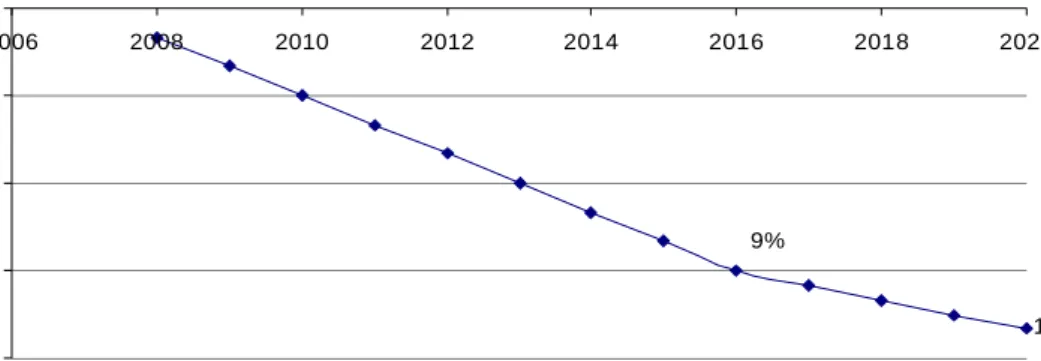
The long-term energy savings target up to 2020 was clarified for the years 2017 to 2022 in the Energy Security Strategy of the Slovak Republic, showing energy savings of 0.5% per year. This means that the total value of energy savings over the 2008–2020 period is set at 11% of the average FEC in 2001–2005 (45 486 TJ). The smaller anticipated energy savings in the years 2017 to 2020 are due to the reduced potential for less costly savings and the increased cost of other measures. The energy savings target up to 2020, as shown in Fig. 4, was also adopted in the 2010 National Reform Programme as one of the Europe 2020 goals for the Slovak Republic.
Fig. 4: Energy savings targets up to 2020
European energy efficiency measures are currently being updated in response to Europe 2020, the strategy which defines the EU energy efficiency objective of achieving 20% savings in primary energy consumption by 2020. The proposed substantial changes in the way energy efficiency is perceived by the European Commission, the designation of energy efficiency as a top priority for the next ten-year period, the change in the nature of the targets from final energy consumption savings to primary energy savings, the resizing of the target from 9% by 2016 to 20% by 2020, and the drafting of new EU energy efficiency legislation and amendments to existing legislation in this sphere will have a significant impact on the promotion of energy efficiency in the Slovak Republic.
It is likely that, along with the new EU energy efficiency action plan being prepared for spring 2011 and the amendment to the Energy Services Directive planned for summer 2011, the European Commission will set entirely new parameters and solutions which will require a response at national level.
Negotiations are currently underway between Member States and the European Commission on what the energy efficiency targets for 2020 should look like. According to the outcome of the Transport, Telecommunications and Energy Council of 7 December 2010, energy efficiency targets for 2020 will be non-binding on Member States.
The Energy Efficiency Policy of the Slovak Republic is regularly evaluated and updated in accordance with the Energy Efficiency Act. In 2012, the Ministry of Economy (“MoEc”) will submit an update of the policy taking account of the new energy efficiency proposals, which should then be reflected in the third action plan.
9% 11% -12 -9 -6 -3 0 2006 2008 2010 2012 2014 2016 2018 2020 [%]
3.
Methods for evaluating the measures of the First
Action Plan
In accordance with the Energy Services Directive, and on the basis of the documents referred to in Section 2.1, two methods for assessing the energy savings achieved (bottom-up and top-down) were used to evaluate the First Action Plan.
3.1 Bottom-up evaluation method
The bottom-up evaluation method evaluates planned measures based on detailed information on the individual projects under each measure. This method allows for concrete energy savings to be determined directly on the basis of a specific calculation. The Commission recommends that Member States, in assessing the results of the First AP, account for 20% to 30% of energy savings in this way.
To apply the bottom-up evaluation method, detailed documentation is necessary from the ministries responsible for the implementation of individual measures, along with information on the implementation of the specific energy saving projects. When collecting the information, it was impossible to use the system for monitoring efficient energy use (the “monitoring system”) as this is not scheduled to be put into operation until 2011. For many measures, parameters such as energy savings and energy consumption were not monitored directly at the ministries; often, it was only other parameters, focusing, for example, on climate change (CO2 emissions) or the different amounts of energy needed to heat buildings, that were tracked rather the differences in their actual consumption before and after project implementation. Therefore, in many cases it was necessary to calculate energy savings by alternative means.
Members of staff designated by the ministries were trained to verify the collection of data on energy savings which was in the competence of the ministries. In many cases, the ministry representatives did not have enough information on how energy savings could be quantified or where the basic data required for calculating them could be found.
Nor was an objective evaluation of energy savings an easy task in relation to projects financed from EU Structural Funds, despite the fact that the National Strategic Reference Framework for 2007–2013 (the “NSRF”) includes energy-saving indicators among the horizontal priorities of sustainable development. However, these indicators are not mandatory for all types of projects because some projects deliver energy savings only outside the main objective of the project or programme. In the previous programming period from 2004 to 2006, energy savings were not monitored as an indicator.
The effect of some of the proposed measures, particularly legislative ones, cannot be evaluated objectively on an independent basis, due to their cross-cutting impact. Based on this experience, these measures are listed in the Second Action Plan as support measures. Where a legislative measure sets a specific obligation which directly achieves energy savings, the actual savings can be quantified. Energy savings achieved by the implementation of measures on the basis of a legal obligation have not been studied. The obligation to provide information on energy consumption based on the provisions of the Energy Efficiency Act is being phased
in gradually; the necessary data were therefore unavailable by the deadline for the draft of the Second AP.
3.2 Top-down evaluation method
The Commission recommendations served as the basis for determining energy savings via the top-down method. The harmonised indicators and statistical data available from Eurostat, the Statistical Office and the Odyssee-Mure database were used. The calculation of energy savings by this method is based on aggregated data on final energy consumption in different sectors of the national economy, which are subsequently adjusted for “external” influences on energy consumption, such as changes in outdoor temperature, the number of vehicles, the population, GDP and others.
The quantification of energy savings based on harmonised indicators is very sensitive to the quality of the input data. Total energy savings in the First AP were quantified by reference to savings calculated for mandatory indicators in all sectors of the national economy. It was also important to monitor developments in the input data needed to calculate indicators, such as energy consumption and the activities of sectors to which such consumption is linked. In addition, links between energy consumption increases and decreases in inter-related sectors (e.g. a fall in energy consumption in passenger rail transport may be directly linked to increased energy consumption in passenger road transport) needed to be analysed.
It was a major problem to define the index year to which the calculated indicators relate. The energy savings target is proposed on the basis of average final energy consumption from the years 2001 to 2005, and it was therefore assumed that the savings achieved would be relative to that value. However, the Commission requested that the indicators for the years 2008 to 2010 be compared with the year preceding the application of the First AP, i.e. 2007.
There is a large amount of statistical data showing that final consumption developments in 2007 fall outside the overall trend of final energy consumption in the Slovak Republic over the last 10 years. The energy savings were therefore calculated by comparing the indicators with both the 2007 consumption values and average energy consumption in the years 2001 to 2005, which was the basis for planning savings.
4. Assessing the First AP by the bottom-up method by
sector
The method for preparing the First Action Plan and Second Action Plans differed significantly in that there was a possibility in the Second AP of drawing on experience from the implementation of measures under the First AP in order to make improvements. This makes it possible to obtain more realistic information on the impacts of individual measures and their contribution to the target, as well as on the importance of a particular measure compared to other measures.
As the implementation of the energy efficiency monitoring system was postponed, this system was not yet in operation when the Second AP was being prepared; system outputs were therefore not available for use in the evaluation of measures from the First AP. Most of the data for assessing the implementation of the First AP were obtained from representatives of the individual ministries in the form of questionnaires prepared by MoEc staff.
One of the significant advantages of this method of data collection was direct contact with the responsible and relevant parties. A significant disadvantage is the labour-intensive, time-consuming nature of the assessment, the different approach to assessment at the individual ministries, and the different factors considered in the calculation of savings. This method made it possible to evaluate those measures in which measurable and calculable energy savings could be directly identified.
4.1 Horizontal measures
Horizontal measures affect several sectors of energy consumption simultaneously. These measures create the conditions for applying the principle of energy efficiency in the economy as a whole as well as in its individual sectors. Since these measures are aimed at energy savings mainly from an investment, educational or organisational perspective, they have a significant impact on the planning and implementation of other specific measures. These other measures include, in particular, legislative measures and informational, monitoring, training and consulting activities aimed at energy savings.
The impact of most horizontal measures is impossible to quantify in terms of measurable savings. Their impact can be better identified by the top-down method. If necessary, the contribution of individual horizontal measures may be determined only on the basis of an expert estimate. For this reason, only the implementation of these measures during the reporting period is described, with no quantification of specific energy savings.
4.1.1 “Energy Auditor” training course
Since 1996, the Slovak Innovation and Energy Agency (the “SIEA”) has been responsible for training specialists in the performance of energy audits. The training is rounded off with a qualification examination, which includes an assessment of energy audit reports. The course has been taken by more than 400 specialists so far.
The Energy Efficiency Act modified the status of energy auditors within the framework of the energy service system. A register of energy auditors is currently maintained by the Ministry of
Economy (the “MoEc”). Applicants are entered in the register of energy auditors once they meet the statutory qualification requirements. By the end of 2010, more than 90 auditors had been enrolled in the register. An energy auditor is required to attend periodic training, provided by the SIEA, every three years. High-quality work by the energy auditors is paving the way for the correct determination of the potential for energy savings.
4.1.2 Provision of information on energy efficiency and on the opportunities for energy efficiency project funding
The SIEA provides information on energy efficiency and funding opportunities for energy efficiency projects in households, businesses and the public sector on the basis of annual contracts between the MoEc and the SIEA. Information is provided at four centres (Bratislava, Tren•ín, Banská Bystrica and Košice) by telephone, in writing (e-mail) or in person. Information is also regularly provided at selected exhibitions and trade fairs on energy savings and renewable energy sources, such as AQUATHERM Nitra, KLIMATHERM – ENERGO – EKO Košice andRACIOENERGIA Bratislava. Between 2008 and 2010, several thousand consultations of varying nature and scope were provided.
4.1.3 Educating children on energy efficiency via the Rainmakers Club
As part of the international Kids4Future project aimed at economical energy use and environmental improvements, co-financed by the Intelligent Energy – Europe programme, a three-part story for children aged 6 to 12 years, “The Rainmakers”, has been translated and adapted to national languages and traditions. The story is published in book form and has been gradually distributed to schools. A special website has also been created with activities for children and a teacher’s manual.
The project is being continued on an optional basis by educating children on how they can save energy through collections of stories, games and experiments under the title “Auntie Eta’s Advice”. The project started in 2010 and is part of the national project “Promotion of Education and Guidance on Energy Efficiency and Renewable Energy Use, Including Greater Public Awareness”, which is financed by the Structural Funds under the Competitiveness and Economic Growth Operational Programme, Measure 2.2 “Building and upgrading public street lighting for towns and villages and providing energy guidance”. The national project has the working title “ENERGY FOR LIFE”.
4.1.4 Draft legislation
The main legislation on energy efficiency adopted in this period is Act No 476/2008 of 4 November 2008 on efficiency in energy use (the Energy Efficiency Act) and amending Act No 555/2005 on the energy performance of buildings and amending certain laws, as amended by Act No 17/2007. The provisions of this Act relate to energy conversion, the “transportation” of energy from the point of conversion to the point of consumption, and actual energy consumption. The Act defines the obligations for each sector of energy consumption and creates conditions for the monitoring and evaluation of energy efficiency and energy savings. The Act also lays down the obligation to conduct energy audits in industry and agriculture (by the end of 2011 and 2013, respectively) and determines the status of energy auditors. In addition, the Act defines energy services and the obligation for owners of buildings with a floor area of over 1 000 m2 to employ the hydraulic balancing of heating systems and ensure the proper insulation of hot water distribution systems.
4.1.5 Energy efficiency monitoring and information system
The obligation to implement and operate a system monitoring energy use efficiency arises from the Energy Efficiency Act. As the Energy Efficiency Fund which was to have funded the monitoring system had not been established, alternative funding had to be found. After funds were earmarked in the Energy Efficiency Support Programme, an agreement on monitoring system implementation was signed on 1 June 2010. MoEc Decision No 4/2010 designated the SIEA as the organisation responsible for the preparation and operation of the monitoring system. The monitoring system launch date is contractually bound to a deadline of 1 June 2011. Work is currently underway on the software and organisational requirements of the system.
The monitoring system is the most important tool for the assessment of energy savings using the bottom-up method. It is used for data collection and for evaluating the energy saving measures taken; this should result in regular assessments of and, where appropriate, adjustments to energy efficiency measures, after taking account of their overall effect and the capital required to implement them.
4.1.6 “Good advice = savings” awareness campaign
If energy is to be used efficiently, consumers must have access to the information they need (in the form of education, awareness campaigns and guidance) to make decisions about their energy consumption. The SIEA has been running the planned awareness campaign since 2010 under the national ENERGY FOR LIFE project. As part of the campaign, a public opinion poll was conducted in 2010 on awareness of energy conservation and RES use among households and businesses. The poll results are used to plan additional awareness activities, mainly seminars, roundtable discussions, the publication of promotional materials and greater communication with the media.
4.1.7 Energy advice centres in the regions
The originally plan to establish regional advice centres funded by the Intelligent Energy – Europe (“IEE”) programme and the Energy Efficiency Fund (“EEF”) did not materialise as the EEF was not set up. In 2008, IEE funds were used to establish the Nitra Energy Agency; the Ša•a Energy Agency is also in operation. Under the ENERGY FOR LIFE project, the SIEA has significantly expanded its guidance services at the advice centres in Tren•ín, Banská Bystrica and Košice; free telephone advice is also available. Since this is a project funded by the CaEG OP, these funds could not be used to establish an advice centre in Bratislava.
4.1.8 Support for the development of energy services
An important prerequisite for promoting the development of energy services was the establishment of an Energy Efficiency Fund. As the plan was to finance the Fund on the basis of a proportion of energy sales and because of the Government’s efforts not to increase energy prices, no Fund has been established. As an alternative solution, the MoEc approved the Energy Efficiency Support Programme, but the funding for this programme was limited to funds for the establishment of a monitoring system. No funds were allocated to promoting the development of energy services.
4.1.9 “E2” in the state administration - training programme
As part of the training on “E2” in the state administration, the MoEc, in cooperation with the SIEA, drew up methodological guidelines for central government authorities on the provision of data on energy consumption by the central government authorities and the organisations under their control. In 2010, a seminar was held for the responsible staff from central government and public administration bodies on the system and method for collecting and evaluating data on energy efficiency. Training will continue after the launch of the monitoring system, with a focus on its actual use; this measure is funded under a contract between the MoEc and the SIEA.
4.1.10 Energy efficiency – a component of sustainable development education for children and young people
The education of children and young people in the field of sustainable development is covered by the Slovak Environmental Agency’s activities under the “Carbon Footprint” project. In late 2010, under the ENERGY FOR LIFE project, the SIEA prepared an energy “quartet” for distribution to schools along with guidelines on its use.
4.1.11 Application of the principle of energy efficiency in public procurement
Numerous central and local government authorities have incorporated energy efficiency criteria into public procurement technical specifications, contributing to energy savings of
358 TJ in the reporting period. These measures include energy auditing, the procurement and purchasing of products in the best energy classes, improvements in the thermal properties of the envelopes of buildings owned by those institutions, the installation of new control valves, the hydraulic balancing of heating systems, the purchase of energy-saving lamps, the replacement of boilers, and application of the principles of green public procurement, when buying appliances, computers, vehicles and so on. To facilitate the implementation of energy efficiency criteria in public procurement, the SIEA has drawn up criteria for buildings, computer equipment and passenger vehicles.
4.1.12 Support for research into energy savings – additional measure
Research and development plays an important role in energy savings. In the reporting period, several research projects were carried out with results that may contribute to energy saving in the Slovak Republic. These projects were supported by the Slovak Research and Development Agency (SRDA) and the Scientific Grant Agency of the Ministry of Education, Science, Research and Sport of the Slovak Republic (SGA). A list of projects can be found in Annex 2.
4.1.13 Overall evaluation of horizontal measures
Apart from Measure 1.11 on public procurement, the bottom-up method could not be applied to the evaluation of horizontal measures due to the cross-cutting impact of these measures. The broader application of horizontal measures was hampered by the fact that the Energy Efficiency Fund, intended to finance numerous activities, had not been established. There was a significant shift in the launch date of the monitoring system which is to form an information framework for energy efficiency activities and the monitoring of energy savings. The application of Energy Efficiency Act is expected to be highly beneficial in the coming period as numerous deadlines for legislative obligations are to be met during the Second AP.
Table 4: Summary overview of horizontal measures in the 2008–2010 period Energy savings planned in the First AP Energy savings achieved in 2008–2010 Investment planned in the First AP Actual investment in 2008– 2010
No Title of measure Details Year,
period Duration of measure [TJ] [TJ] [EUR thousands] [EUR thousands]
1.1 “Energy Auditor” training course SIEA training course focusing on energy audits in industry 2008 -2010 Since 1997 75.00 A) 29.87 0.00 1.2
Provision of information on energy efficiency and on the opportunities for energy efficiency project funding
Contract between the MoEc and SIEA 2008 -2010 Since 1997 225.00 A) 1493.73 165.00
1.3 Educating children on energy efficiency via
the Rainmakers Club
A Kids4Future project co-funded by
Intelligent Energy – Europe 2008 -2010 Since 2007 7.50 A) 109.54 60.00
1.4 Draft legislation Energy Efficiency Act 2008 -2010 Since 2009 0.00 A) 165.97 200.00
1.5 Energy Efficiency Monitoring and
Information System Energy Efficiency Fund 2008 -2010 Since 2009 2600.00 A) 3983.27 1000.00
1.6 “Good Advice = Savings” awareness
campaign
Structural Funds (2007–2013), CaEG OP, Measure 2.2 “Building and upgrading public street lighting for towns and villages and providing energy guidance”
2008 -2010 Since 2010 300.00 A) 1668.99 987.00
1.7 Regional energy advice centres Intelligent Energy – Europe Programme Energy Efficiency Fund 2008 -2010 - 75.00 A) 2489.54 0.00
1.8 Energy service development support Energy Efficiency Fund 2008 -2010 - 145.00 A) 4315.21 0.00
1.9 “E
2
” in state administration – training
programme Central government authorities 2008 -2010 - 3.00 A) 199.16 5.00
1.10
Energy efficiency – a component of sustainable development education for children and young people
Supplementary programmes to complement comprehensive and vocational education at schools
2008 -2010 Since 2010 210.00 A) 1327.76 0.00 1.11 Application of the principle of energy
efficiency in public procurement
Commitment for central government
authorities 2008 -2010 Since 2006 135.00 357.85 8298.48 649038.00
B)
1.12 Support for research into energy savings –
additional measure SRDA, SGA 2008 -2010 - A) A) 0.00 0.00
TOTAL 3775.50 357.85 24081.52 651455.00
A) In view of the nature of the measure, it cannot be evaluated by the bottom-up method
4.2 Buildings
In the First AP, the building sector comprises residential buildings (family houses and blocks of flats), public sector buildings and buildings in the commercial services sector. Energy savings for most of the measures planned in the building sector can be evaluated by the bottom-up method; the necessary information was provided by operators of buildings, providers of aid and support, and support programme administrators.
4.2.1 Application of legislative measures – hydraulic balancing of heating systems
Act No 70/1998 on energy efficiency lays down rules on efficiency in the operation of heating equipment systems. Under this Act, owners and managers of blocks of flats are required to provide the hydraulic balancing of heating systems, including the installation of thermoregulatory radiator valves. The operating efficiency of heating equipment systems beyond the service point (i.e. heat consumption for heating and hot water) was evaluated on an annual basis. The SIEA drew up an overview of compliance with these obligations up to 2004, which found that roughly 60% of blocks of flats used hydraulic balancing of heating systems, including the installation of thermoregulatory radiator valves.
Paradoxically, the highest energy savings in the heating of blocks of flats were recorded only after the installation of heat cost allocators. Although these allocators made no direct physical contribution to energy savings, they strongly influenced the behaviour of residents, who were able to regulate their heat with thermoregulatory valves, thereby reducing heat consumption for heating by up to 30%.
The “thermal energy” part of Act No 70/1998 was replaced as of 1 January 2005 by the separate Act No 657/2004 on thermal energy, which, in relation to final energy consumption in buildings supplied with heat, laid down the requirement of rational energy use. Compliance is monitored by the State Energy Inspectorate. The obligation to ensure the hydraulic balancing of heating and hot water and the insulation of hot water distribution systems in large buildings is based directly on the Energy Efficiency Act.
The obligation to provide regular information on rational energy use in residential buildings was dropped because of the considerable administrative burden it created. Hydraulic balancing projects, however, continued. By 2010, the number of hydraulically balanced blocks of flats is expected to increase to 80%. However, information on such projects has been limited since 2005, preventing an accurate assessment of the energy savings achieved.
4.2.2 Application of legislative measures – energy performance certification of buildings, periodic inspections of boilers, heating systems and air-conditioning systems
Since 1 January 2008, Act No 555/2005 on the energy performance of buildings and amending certain laws has required building owners to have their buildings certified for energy performance upon the sale or lease of such buildings, upon completion of a new building, or in cases where existing buildings undergo major renovation. This Act was amended by the Energy Efficiency Act, which made it mandatory to register the energy performance certificates of buildings. The Ministry of Transport, Construction and Regional Development (MoTCRD) is responsible for keeping records of certificates. Decree of the
Ministry of Construction and Regional Development (MoCRD) No 625/20063 was issued to implement the Act, replaced in 2009 by MoCRD Decree No 311/2009,4 which reflected the practical need to adjust the criteria values for the measured building operation energy requirement in the certification of buildings.
At the end of 2010, the MoTCRD’s database held 9 343 building energy performance certificates. The energy savings amounted to approximately 36.27 TJ. The calculation of these savings is based on a comparison of the better thermal indicators of certified buildings, weighed against the minimum values for thermal indicators in the relevant class, as specified in MoCRD Decree No 311/2009.
Periodic inspections of facilities used for heat supply in commercial operations on the heat market were carried out annually as of 1998, in accordance with Act No 70/1998 on energy. Since 2005, following the adoption of Act No 657/2004 on thermal energy, these inspections have been carried out every three years. Every year, SIEA officials verify the efficiency of approximately 1 500 boilers. The implementation of Directive 2002/91/EC on the energy performance of buildings introduced the obligation for periodic boiler inspections for all boilers in non-manufacturing structures with an effective rated output of 20 kW or more (Act No 17/2007 on periodic inspection of boilers, heating systems and air-conditioning systems). Reports on inspections of boilers, heating systems and air-conditioning systems under Act No 17/2007 are registered and evaluated by the SIEA. In 2009 and 2010, 750 inspections of boilers were carried out in non-manufacturing structures, of which approximately 15% were voluntary since they were conducted much earlier than required by law. An initial analysis of the reports shows that, in family houses in particular, approximately 15% of boilers have poorer combustion efficiency than that prescribed in the relevant decree.
In view of the delayed implementation of the monitoring system, sufficiently accurate documentation is not currently available for the evaluation of this measure by the bottom-up method.
4.2.3 Improvements in the thermal properties of buildings – State Housing Development Fund (SHDF) – building insulation
The State Housing Development Fund (SHDF) was established in 1997 under Act No 124/1996 on the State Housing Development Fund; it provides support for the expansion and modernisation of the housing stock, particularly in the form of favourable long-term loans. SHDF assistance is available subject to a reduction of at least 20% in heat consumption required for heating purposes compared to the computationally determined requirement for heat for heating purposes. The heating energy savings actually achieved are not monitored in the individual projects supported by the SHDF. In 2008–2010, the SHDF provided assistance for the insulation of 446 buildings. Since energy savings in individual projects were not monitored, energy savings could be quantified only by applying an average energy savings value of 20% for all projects, i.e. on the basis of the condition for qualifying for loans from SHDF funds. This method for determining the savings resulting from the implementation of projects in 2008–2010 indicates energy savings of approximately 200.7 TJ.
3
MoCRD Decree No 625/2006 implementing Act No 555/2005 on the energy performance of buildings and amending certain laws
4
4.2.4 Improvements in the thermal properties of buildings – Housing Development Support Programme, grants for the removal of system defects in blocks of flats
The purpose of this form of support is to remove system defects in blocks of flats originating from the incorrect specification of materials and details, the incorrect use of construction technology, or a failure to comply with the planned construction procedures. It is used only for the reconstruction of blocks of flats built with panel (prefab) technology.
In light of the primary objective of removing a structural defect, the award of a grant is not subject to the submission of a thermal assessment of structural elements and of the building by the applicant, despite the fact that the technical procedure includes the partial or full insulation of blocks of flats when removing multiple system defects. There has recently been a substantial rise in the proportion of defect repair projects involving the thermal insulation of buildings. As in the case of the SHDF, eligibility for support is not tied to achieving specific minimum savings in heating energy by fixing the defect.
The actual energy savings from the projects supported were not evaluated, which prevents an accurate assessment of the contribution of this measure to overall energy savings. Based on the information available, average energy savings of 20% were used to quantify the energy savings achieved. Energy savings thus calculated can be quantified at 15.78 TJ for the 2008– 2010 period.
4.2.5 Improvements in the thermal properties of buildings – “Building and development of civil infrastructure”
This measure was referred to as a continuation in the upgrading of the existing infrastructure of buildings carried out in 2004–2006 with the support of the Structural Funds. Measure 3.1 (“Building and development of civil infrastructure”) of the Basic Infrastructure Operational Programme (BI OP) supported projects for the insulation of buildings and upgrading of existing technologies within the scope set out in Table 5.
Table 5: Measures supported under the BI OP – “Building and development of civil infrastructure” Number of projects supported Grant awarded Title of sub-measure [number] [SKK] [EUR] 3.1.1 Building and development of education
infrastructure 86 1 047 176 963 34 759 907
3.1.2 Building and development of healthcare infrastructure 28 946 596 703 31 421 254 3.1.3 Building and development of social infrastructure 26 213 960 754 7 102 196 3.1.4 Building and development of cultural
infrastructure 38 316 487 146 10 505 448
Source: Report on the implementation of the BI OP
This measure cannot be evaluated by reference to data on quantified energy savings, but only based on the number of completed projects and project costs. During the implementation of the BI OP, energy savings were not monitored in the form of indicators, even in building insulation projects. As most of the 178 renovated buildings are schools and healthcare
facilities, it can be assumed that the energy savings, although precisely quantifiable, were significant.
4.2.6 Improvements in the thermal properties of buildings – Renovation of blocks of flats through commercial banks and building societies
The Slovak Republic provides state subsidies for building-society savings schemes.5 The concept of building-society savings schemes can be used to implement measures delivering energy savings. Due to the unavailability of relevant structured information, the savings achieved cannot be evaluated by the bottom-up method. The support for construction and reconstruction projects by means of soft loans does not require any evaluation of building energy indicators. For new non-manufacturing structures, the project evaluations will be encapsulated to some extent through energy performance certification.
4.2.7 Improvements in the thermal properties of buildings – Internally-funded renovation of blocks of flats and family houses
No information is currently available on thermal insulation projects for blocks of flats and family houses financed by the residents. The database of building certificates is not sufficient for this purpose because it does identify the source of funding for renovation projects. Due to the lack of information, this measure cannot be evaluated by the bottom-up method. As with the previous measure, any significant energy-related renovation of buildings should, as a rule, go through the building permit procedure and then energy performance certification. In the certificate database, 720 renovated family houses are currently registered. It should also be noted that major building renovations do not usually include an “operational assessment” that would provide a realistic view of the achievable energy-savings of buildings after their renovation.
4.2.8 Draft legislative measures – amendment of building regulations
A draft measure included plans for the following activities:
• the creation of a mandatory “building documentation package” in order to clarify and simplify the processing of energy audits and certification of buildings, MoCRD (2008);
• more stringent requirements regarding the thermal properties of buildings and structural elements for new and renovated buildings, MoCRD (2010);
• regular updating of building regulations and procedures for the design, construction and commissioning of buildings, and a further improvement in the quality of work by building authorities, MoCRD (2010).
Of the planned activities, only the draft of the new Building Act (2009) was prepared; however, the legislative process for the preparation of this legal amendment had not been completed by the end of 2010. The measure essentially remains to be implemented in its entirety. It will be applied in the Second AP to a certain degree as part of the transposition of Directive 2010/31/EU on the energy performance of buildings.
4.2.9 Draft legislative measures – updating and amendment of regulations on the energy efficiency of buildings
Act No 476/2008 on energy efficiency amended Act No 555/2005 on the energy performance of buildings; it introduced the requirement to register the energy performance certificates of buildings, evaluate them on a regular basis, and provide information to the monitoring system operator.
In 2009, MoCRD Decree No 311/2009 entered into effect, fully replacing the original Decree No 625/2006 and adjusting the boundaries of energy classes based on the experience of certification. Methodological guidance was also issued with the decree.
On 1 January 2010, a building energy assessment module was launched in the INFOREG information system, which automatically assigns serial numbers for the energy performance certificates of buildings and keeps records of them. The Slovak Chamber of Civil Engineers, which carries out tests of professional competence for individual points of consumption, had a register of 320 competent officials at the end of 2010. The nature of the measure prevents an evaluation using the bottom-up method.
4.2.10. Improvements in the thermal properties of buildings used within the framework of civil infrastructure
In the 2008–2010 period, 14 projects to improve the infrastructure of amenities were carried out under the Regional Operational Programme (ROP) with the backing of the Ministry of Agriculture and Regional Development (MoARD), achieving energy savings of 22.44 TJ. Contracts to implement over 900 projects have been signed under this measure. However, actual project implementation is not planned until the years 2011 to 2013, and therefore the savings under this measure will be reflected in the next period. The estimated amount of savings achievable by implementing these contracted projects in the next period is approximately 1 900 TJ.
4.2.11 Improvements in the thermal properties of buildings where health care is provided
In the 2008–2010 period, no projects aimed at improving the thermal properties of operational buildings were implemented under the Health OP, coordinated by the Ministry of Health. In the evaluation of the First AP, only projects financed from the internal resources of healthcare facilities, the budgets of municipalities and higher territorial units (HTUs) or contributions from the national budget were taken into consideration. Underlying documentation was provided by the Ministry of Health (MoH). These projects improved the thermal properties of solid cladding, replaced openings, or upgraded heat sources and heating systems. Energy savings under the projects implemented during the 2008–2010 period were quantified at
46.94 TJ.
During the 2011–2013 period, the Health OP will support further projects; 25 projects with expected savings of 47 TJ are already known. Projects funded from central government, local and private sources will also continue.
4.2.12 Improvements in the thermal properties of buildings used for education
Under the Research and Development Operational Programme, coordinated by the Ministry of Education, Science, Research and Sport (MoESRS), grant contracts have been signed for
20 projects aimed at improving and enhancing research and development infrastructure in the Slovak Republic, including improving the thermal properties of such facilities’ buildings. However, none of the projects had been completed by the end of 2010. Most of these projects will be implemented in 2011 and 2012; therefore the projected savings of approximately 35 TJ will be included in the years 2011 to 2013.
4.2.13 Improvements in the thermal properties of buildings during the regeneration of settlements in the Bratislava Region
Under Measure 1.1 Regeneration of settlements, activity group 1.1.1 Preparation and implementation of integrated urban development strategies in selected areas of Bratislava, no call has yet been made seeking applications for grants under the Bratislava Region Operational Programme. Energy savings under this measure cannot be reported for the period covering the First AP.
4.2.14 Installation of heat pumps and high-efficiency air-conditioning systems in non-manufacturing structures
In view of the link to support from the EEF, which has not been established, this measure was not implemented in practice.
4.2.15. Measures to promote voluntary certification and auditing
In view of the link to support from the EEF, which has not been established, this measure was not implemented in practice.
4.2.16 Construction of buildings with enhanced thermal indicators (new construction systems, low-energy houses, passive houses...)
In view of the link to support from the EEF, which has not been established, this measure was not implemented in practice.
4.2.17 Improvements in the thermal properties of buildings - SLOVSEFF (additional measure)
The SLOVSEFF Programme (2007–2010, Stage I) was allocated support of EUR 15 million from the Bohunice International Decommissioning Support Fund (BIDSF) and credit of EUR 60 million from the European Bank for Reconstruction and Development (EBRD). The funds were divided among the participating commercial banks (Dexia banka Slovensko, a. s., Slovenská sporite••a, a. s., Tatra banka, a. s., Všeobecná úverová banka, a. s.) for lending to the private sector, housing managers and residential consumers to invest in energy efficiency development and renewable energy source projects in the Slovak Republic in line with the objectives of the BIDSF.
In preparing the projects, applicants were provided with free technical support in the form of simplified energy audits, a rational energy use plan, and assistance with the submission of loan applications from project consultants. Building renovation grants were awarded subject to proof of energy savings of at least 15% per year after completion of the project. In the first stage, the amount of the grant was 20% of the loan for financing the planned measures. The funds were used mainly to improve the thermal properties of cladding and to build boiler rooms.
The implementation of projects supported under the SLOVSEFF I Programme achieved energy savings of 128.1 TJ in the 2008–2010 period. The quantification of savings was
form of support from a grant. The successful running of the programme prompted the launch of Stage II of the SLOVSEFF Programme in 2010.
4.2.18 Government Thermal Insulation Programme (additional measure)
In 2009, the Slovak Government allocated EUR 70.87 million to the Government Thermal Insulation Programme, under which a 15-year interest-free loan was granted to improve the thermal properties of 346 blocks of flats and family houses. The programme was aimed at reducing energy consumption; at the same time, it was conceived as a measure to mitigate the economic crisis. The SHDF was responsible for programme administration, and loans were granted only on condition that, when the application was submitted, the project demonstrated a reduction of at least 20% in the energy requirements for heating.
Since the energy performance results of projects were not subsequently monitored, the assessment of the First AP can only include savings quantified by the reduction in energy requirements, which totalled 15.57 TJ. Experience of the SLOVSEFF Programme and other specific projects indicates that the actual savings are higher.
4.2.19 Improvements in the thermal properties of buildings – Ekofond (additional measure)
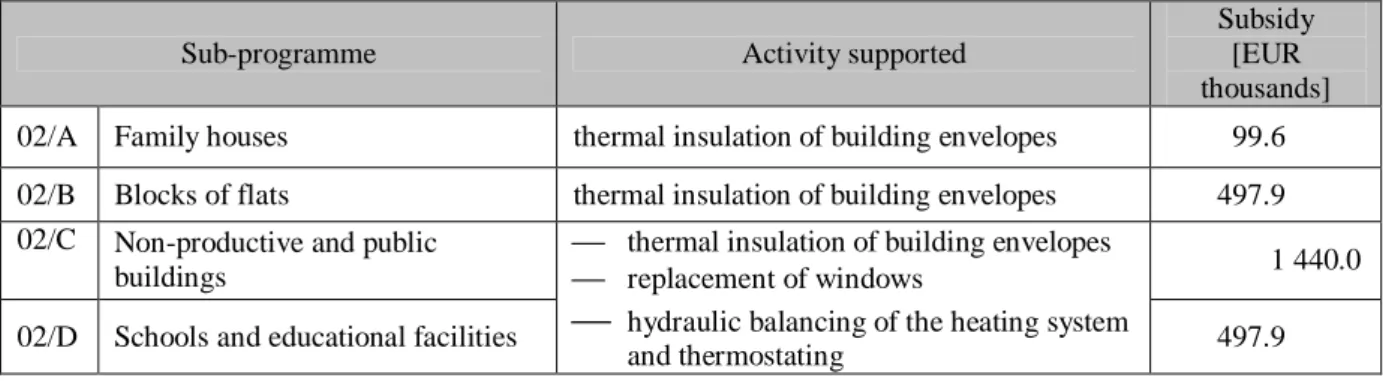
SPP, a.s. set up a non-investment, non-profit fund known as the “Ekofond”, geared towards the promotion of projects aimed at implementing measures to improve energy efficiency and the environment. The fund allocates financial resources through various programmes. Programme 02 (Improvements in the energy performance of buildings) was funded in the reporting period within the scope indicated in Table 6.
Table 6: Measures supported by the Ekofond
Sub-programme Activity supported
Subsidy [EUR thousands] 02/A Family houses thermal insulation of building envelopes 99.6 02/B Blocks of flats thermal insulation of building envelopes 497.9 02/C Non-productive and public
buildings 1 440.0
02/D Schools and educational facilities
thermal insulation of building envelopes
replacement of windows
hydraulic balancing of the heating system
and thermostating 497.9
Total energy savings from individual projects under this measure are 28 TJ. In the subsidy allocation process, the projects are evaluated in terms of the achievability of energy savings; the savings are then verified one year after completion of the project, with the release of 30% of the agreed subsidy. The quantified savings may therefore be deemed reliable.
4.2.20 Increase in the energy efficiency of the technical facilities of buildings – Ekofond (additional measure)
In 2009, the replacement of existing boilers with condensing boilers was supported in a Boiler Scrappage Scheme under the Ekofond. In all, 440 boilers were replaced, with a contribution of EUR 223 000 from the Ekofond.
The Ekofond, together with its founder, Slovenský plynárenský priemysel, a.s. (SPP), built on the extremely successful Boiler Scrappage Scheme from 2009 by announcing a new project called EkoBonus on 22 March 2010. Under the EkoBonus project, EUR 568 035 was disbursed and 1 847 boilers were replaced. Minimum savings of 10% of the average fuel consumption of households with gas-fired heating were used for calculating the savings achieved. This measure achieved total energy savings of 3.77 TJ.
4.2.21 Energy Efficiency in Public Buildings – pilot project (additional measure)
In 2008, a call for the implementation of projects was published under the SIEA-managed pilot project Energy Efficiency in Public Buildings. The project was initiated by the EBRD and is funded by the BIDSF.The aim is to reduce energy intensity in the operation of public buildings in the Trnava and Nitra Regions by means of energy efficiency measures. Renovation work is in progress in the first 16 buildings; procurement procedures are underway for a further 26 projects. This measure will continue in 2011 and 2012; the decision on whether to continue the project after that period will depend on how successful the project is. No projects were completed in the reporting period, and it will therefore not be possible to assess the effect of this measure until the following 2011–2013 period.
4.2.22 Overall evaluation of measures in the Buildings sector
Of all the sectors, Buildings accounted for the most measures. In the 2008–2010 period, savings determined by the bottom-up method amounted to approximately 498 TJ. The greatest energy savings were achieved by means of support from the SHDF and the SLOVSEFF Programme.
A drawback of some of these measures is the inconsistent monitoring or complete failure to monitor the energy savings achieved by individual projects; this makes subsequent quantification very challenging. One of the reasons why energy savings cannot be accurately quantified is that most of the major renovation projects implemented with the backing of multiple support mechanisms did not include a building certification process.
A significant improvement in project monitoring is expected once the monitoring system has been brought into operation; interim evaluations are also planned.
As the Energy Efficiency Fund was not established, the support measures planned under this fund were not implemented (installation of heat pumps and high-efficiency air-conditioning systems in non-manufacturing structures, measures to promote voluntary certification and auditing, construction of buildings with enhanced thermal indicators). As an alternative solution, the MoEc decided to create an Energy Efficiency Support Programme; however, not enough funding was allocated to this programme. Special action was taken to allocate funds from the MoEc’s heading in the national budget so that at least to the system for monitoring energy use efficiency could be implemented.
In the Second AP, the measures aimed at buildings operated by central and local government authorities have been transferred from “buildings” to “public sector”. This is a way of highlighting the public sector’s role in energy efficiency.
Table 7: Summary overview of measures in the Buildings sector in the 2008–2010 period Energy savings planned in the First AP Energy savings achieved in 2008–2010 Investment planned in the First AP Actual investment in 2008– 2010 No Title of measure Details Year,
period Duration of measure [TJ] [TJ] [EUR thousands] [EUR thousands] 2.1 Application of legislative measures Act 657/2004 – hydraulic balancing of
heating and hot water systems
2008
-2010 Since 2006 641.19 0.00 33 161 0.00 2.2 Application of legislative measures
Act 555/2005 and Act No 17/2007 – energy certification of buildings, regular inspections of boilers, heating systems and air-conditioning systems
2008
-2010 Since 2005 18.99 36.27 1 892 3613.73
2.3 Improvements in the thermal properties of buildings
State Housing Development Fund – thermal insulation of buildings
2008
-2010 Since 1996 146.25 200.70 91 283 84360.00 2.4 Improvements in the thermal properties of
buildings
Housing Development Support Programme, subsidies for the removal of systemic defects in blocks of flats
2008
-2010 Since 1996 16.64 15.78 8498 87731.00
2.5 Improvements in the thermal properties of buildings
Structural Funds 2004–2006, BI OP, Measure 3.1 “Building and
development of civil infrastructure”, with a focus on the insulation of buildings and upgrading of existing technologies
2008
-2010 2004-2008 13.68 0.00 6 987 0.00
2.6 Improvements in the thermal properties of buildings
Renovation of blocks of flats – commercial banks, including building societies
2008
-2010 No limits 148.20 0.00 74686 0.00
2.7 Improvements in the thermal properties of buildings
Renovation of blocks of flats and family houses (thermal insulation, window replacement) – own funds
2008
-2010 No limits 39.00 0.00 19 916 0.00 2.8 Draft legislative measures Amendment of building regulations 2008
-2010 Since 2008 0.00 A) 199 0.00
2.9 Draft legislative measures
Update and amendment of provisions on the energy performance of buildings
2008
-2010 Since 2008 0.00 A) 199 0.00
2.10
Improvements in the thermal properties of buildings used by civil infrastructure facilities
Structural Funds (2007–2013), Regional Operational Programme, MoCRD
2008
-2010 2007-2015 36.24 22.44 18 502 0.00 2.11 Improvements in the thermal properties of Structural Funds (2007–2013), Health 2008 - 2007-2015 10.20 46.94 3 455 432536.00
Energy savings planned in the First AP Energy savings achieved in 2008–2010 Investment planned in the First AP Actual investment in 2008– 2010 No Title of measure Details Year,
period Duration of measure [TJ] [TJ] [EUR thousands] [EUR thousands] buildings where health care is provided Operational Programme, MoH 2010
2.12 Improvements in the thermal properties of buildings used for education
Structural Funds (2007–2013), Research and Development Operational Programme, MoESRS
2008
-2010 2007-2015 45.87 0.00 23402 811.00
2.13
Improvements in the thermal properties of buildings during the regeneration of settlements in the Bratislava Region
Structural Funds (2007–2013), Bratislava Region Operational Programme, MoCRD
2008
-2010 2007-2015 24.15 0.00 12 328 0.00
2.14
Installation of heat pumps and high-efficiency air-conditioning systems in non-productive structures
HP Support Programme (funding from the EEF)
2008 -2010
Not
implemented 83.33 0.00 25354 0.00
2.15 Measures to promote voluntary certification and auditing
Measures to promote voluntary certification and auditing (funding from the EEF)
2008 -2010
Not
implemented 17.5 0.00 5045 0.00
2.16
Construction of buildings with enhanced thermal indicators (new construction systems, low-energy houses, passive houses...)
Low-energy and Passive House Support Programme (funding from the EEF)
2008 -2010
Not
implemented 16.73 0.00 10622 0.00
2.17 Improvements in the thermal properties of
buildings – Slovseff Slovseff
2008
-2010 Since 2008 0.00 128.10 0.00 38255.43 2.18 Government Thermal Insulation
Programme 2009
Rounding-off of the measure from
2009 2009 2009 0.00 15.57 0.00 70871.00
2.19 Ekofond – Improvements in the thermal
properties of buildings Ekofond
2008
-2010 Since 2009 0.00 28.00 0.00 4200.00 2.20 Ekofond – Increase in the energy efficiency of technical facilities in buildings Ekofond 2008
-2010 Since 2009 0.00 3.77 0.00 660.00 2.21 Energy Efficiency in Public Buildings –
pilot project Project funded by the BIDSF
2008
-2010 Since 2008 0.00 0.00 0.00 0.00
Total 2008
-2010 1257.97 497.57 335 529 723 038.16

![Fig. 3: Developments in final energy consumption in various sectors in the Slovak Republic 050 000100 000150 000200 000 RokKES [TJ]](https://thumb-us.123doks.com/thumbv2/123dok_us/9969886.2892964/6.892.103.770.151.648/developments-energy-consumption-various-sectors-slovak-republic-rokkes.webp)


![Table 5: Measures supported under the BI OP – “Building and development of civil infrastructure” Number of projects supported Grant awardedTitle of sub-measure [number] [SKK] [EUR]](https://thumb-us.123doks.com/thumbv2/123dok_us/9969886.2892964/20.892.97.794.809.1022/measures-supported-building-development-infrastructure-projects-supported-awardedtitle.webp)