Lea rnin g s tyl e s a n d p e d a g o g y in p o s t-1 6 l e a rnin g A s y s tem a tic a n d cr it ic a l r e v ie w LSRC r e fe re n c e LSRC reference
Learning styles and pedagogy in
post-16 learning
A systematic and critical review
This repor t critically
reviews
the literature on learning styles
and examines in detail 13
of the most influential models.
The repor t concludes that
it matters fundamentally which
instrument is chosen
. The
implications for teaching and
learning in post-16 learning
are serious
and should be
of concern to learners, teachers
and trainers, managers,
Lea rnin g s tyl e s a n d p e d a g o g y in p o s t-1 6 l e a rnin g A s y s tem a tic a n d cr it ic a l r e v ie w LSRC r e fe re n c e LSRC reference
Learning styles and pedagogy in
post-16 learning
A systematic and critical review
This repor t critically
reviews
the literature on learning styles
and examines in detail 13
of the most influential models.
The repor t concludes that
it matters fundamentally which
instrument is chosen
. The
implications for teaching and
learning in post-16 learning
are serious
and should be
of concern to learners, teachers
and trainers, managers,
Frank Coffield Institute of Education University of London David Moseley University of Newcastle Elaine Hall University of Newcastle Kathryn Ecclestone University of Exeter LSRC reference
Learning styles and pedagogy in post-16 learning
The Learning and Skills Research Centre is supported by the Learning and Skills Council and the Department for Education and Skills
The views expressed in this publication are those of the authors and do not necessarily reflect the views of the Learning and Skills Research Centre or the Learning and Skills Development Agency Published by the
Learning and Skills Research Centre www.LSRC.ac.uk
Feedback should be sent to: Sally Faraday
Research Manager
Learning and Skills Development Agency Regent Arcade House
19–25 Argyll Street London W1F 7LS Tel 020 7297 9098 Fax 020 7297 9190 [email protected] Copyedited by Helen Lund Designed by sans+baum Printed by Cromwell Press Ltd Trowbridge, Wiltshire 1543/06/04/500 ISBN 1 85338 918 8
© Learning and Skills Research Centre 2004
Section 1 Section 2 Section 3 Section 4 Section 5 Section 6 Section 7 Section 8 Section 9 1 9 13 37 47 61 91 119 133 Acknowledgements
A systematic review of learning-styles models Introduction
Aims of the project
Approaches to the literature review Introduction to Sections 3–7
A continuum of learning styles Families of learning styles
Genetic and other constitutionally based factors Introduction
3.1 Gregorc’s Mind Styles Model and Style Delineator
3.2 The Dunn and Dunn model and instruments of learning styles The cognitive structure family
Introduction
4.1 Riding’s model of cognitive style and his Cognitive Styles Analysis (CSA)
Stable personality type Introduction
5.1 The Myers-Briggs Type Indicator (MBTI) 5.2 Apter’s reversal theor y of motivational styles,
the Motivational Style Profile (MSP) and related assessment tools
5.3 Jackson’s Learning Styles Profiler (LSP) Flexibly stable learning preferences
Introduction
6.1 Kolb’s Learning Style Inventor y (LSI)
6.2 Honey and Mumford’s Learning Styles Questionnaire (LSQ) 6.3 The Herrmann ‘whole brain’ model and the
Herrmann Brain Dominance Instrument (HBDI) 6.4 Allinson and Hayes’ Cognitive Style Index (CSI) Learning approaches and strategies
Introduction
7.1 Entwistle’s Approaches and Study Skills Inventor y for Students (ASSIST)
7.2 Vermunt’s framework for classifying learning styles and his Inventor y of Learning Styles (ILS)
7.3 Sternberg’s theor y of thinking styles and his Thinking Styles Inventor y (TSI)
Implications for pedagogy
What advice for practitioners? The appeal of learning styles The objections to learning styles Still no pedagogy in the UK Recommendations and conclusions
Positive recommendations
Continuing problems with the research field of learning styles Gaps in knowledge and possible future research projects Final comments
LSRC reference Contents
References
List of learning-styles instruments and theories List of search terms used in the literature review Glossary of terms Appendix 1 Appendix 2 Appendix 3 147 166 170 171
page ?/? LSRC reference Section ? 1 2 3 4 5 6 7 8 9 10 11 12 13 1 2 3 4 5 6 7 8 9 10 11 12 13 14 15 16 17 18 19 20 21 22 23 24 25 LSRC reference Figures and tables
6 9 10 10 16 42 48 55 63 63 73 96 124 20 22 23 26 31 36 37 39 40 45 48 48 48 52 56 58 58 58 60 71 73 73 76 77 79 Figures
Selection of literature for review Curr y’s ‘onion’ model of learning styles Vermunt’s model of learning styles (1998) Families of learning styles
Gregorc’s four-channel learning-style model The two dimensions of the CSA
The four bipolar discontinuous scales of the MBTI
Possible motivational style reversals in four experiential domains Kolb’s four learning styles
The experiential learning theor y of growth and development Dimensions of Honey and Mumford’s learning cycle
Conceptual map of components of effective studying from ASSIST The 4MAT system
Tables
Gregorc’s Mind Styles Model and Style Delineator (GSD)
Variables and factors in the Dunn and Dunn learning-styles model Elements of learning style from the Dunn and Dunn model Percentages of respondents preferring a specific time of day Studies of the learning-style preferences of able students Dunn and Dunn’s model and instruments of learning styles Learning-styles instruments in the cognitive structure family Kogan’s classification of learning styles
Studies of the interaction of field independence and attainment with learners aged 14+ years
Riding’s Cognitive Styles Analysis (CSA) The 16 MBTI personality types
Summar y of the 10 most common MBTI types
Authors’ repor t of test–retest reliability of the MBTI Form G Myers-Briggs Type Indicator (MBTI)
Apter’s Motivational Style Profile (MSP) Key characteristics of each style
Strengths and weaknesses of the different preferences The extent to which corresponding scales – Jackson (LSP) and Honey and Mumford (LSQ) – measure the same constructs Jackson’s Learning Styles Profiler (LSP)
Kolb’s Learning Style Inventor y (LSI) Strengths and weaknesses
LSQ retest correlations, by learning style Activities and preferences
Honey and Mumford’s Learning Styles Questionnaire (LSQ) ‘Whole brain’ learning and design considerations
26 27 28 29 30 31 32 33 34 35 36 37 38 39 40 41 42 43 44 81 81 83 85 87 90 95 97 103 105 105 107 110 111 116 116 118 135 140
Summar y of positive and negative loading items on two HBDI factors Item loadings on the four main HBDI factors
Illustrative occupational group norms
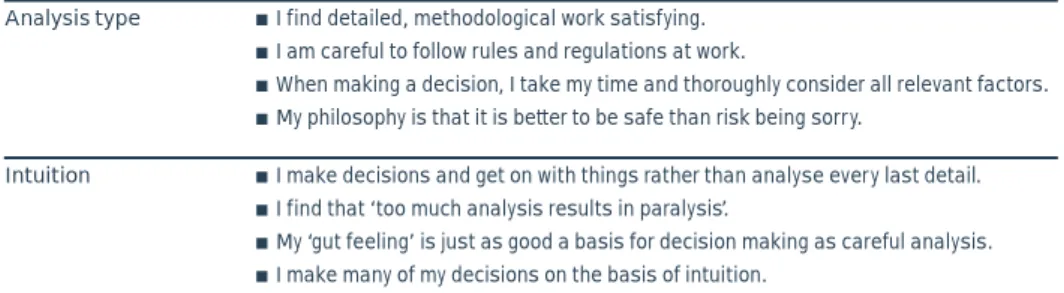
Herrmann’s Brain Dominance Instrument (HBDI) Items which best characterise analysisand intuition
Allinson and Hayes’ Cognitive Styles Index (CSI)
Defining features of approaches to learning and studying Reliability of ASI sub-scales
Entwistle’s Approaches and Study Skills Inventor y for Students (ASSIST) Vermunt’s learning styles with illustrations of their components
Areas and sub-scales of the ILS
Exemplar vignettes of Vermunt’s four learning styles using ILS items Vermunt’s Inventor y of Learning Styles (ILS)
Summar y of styles of thinking
Thinking styles and methods of instruction Thinking styles and methods of assessment Sternberg’s Thinking Styles Inventor y (TSI) Effect sizes for different types of intervention
The project team would like to extend thanks to the authors of the models reviewed in this repor t for their comments and reactions to our work which enabled us to improve the quality of the final version.
We also wish to acknowledge the steady and sensitive suppor t of John Vorhaus of the Learning and Skills Development Agency (LSDA) and the administrative skills of Louise Wilson of the University of Newcastle upon Tyne. Eugene Sadler-Smith read an earlier version of this repor t and made some useful comments for which we are also grateful.
Acknowledgements LSRC reference
The theor y and practice of learning styles has
generated great interest and controversy over the past 20 years and more. The Learning and Skills Research Centre would like to express its appreciation to the authors of two complementar y repor ts, for the time and effor t that went into their production and for providing a valuable resource for researchers and practitioners in the learning and skills sector.
These repor ts serve two key purposes: first, they contribute to what we know about models of learning styles and to our knowledge of what these offer to teachers and learners. Second, the repor ts identify an agenda for fur ther research: to evaluate rigorously key models in a variety of learning environments in order to better understand their merits and deficiencies. We publish these repor ts in the spirit of stimulating debate and enabling knowledge of learning styles to be developed for the benefit of practice and policy. The complementar y repor t Should we be using learning styles?explores what research has to say to practice. Final sections are common to both repor ts: these draw out the implications for pedagogy and offer recommendations and conclusions for practitioners, policy-makers and the research community.
LSDA would also like to thank the steering committee for incisive commentar y and suppor t throughout the project.
Dr John Vorhaus Research Manager
Learning and Skills Development Agency Steering committee members:
Professor Charles Desforges Professor Noel Entwistle Professor Phil Hodkinson Dr John Vorhaus
LSRC reference Foreword
LSRC reference
Introduction
How can we teach students if we do not know how they learn? How can we improve the performance of our employees if we do not know how we ourselves learn or how to enhance their learning? Are the learning difficulties of so many students/employees better understood as the teaching problems of tutors/workplace training managers? How can we pretend any longer that we are serious about creating a learning society if we have no satisfactor y response to the questions: what model of learning do we operate with and how do we use it to improve our practice and that of our students/staff/organisation? These are just some of the issues raised by those researchers who for the last 40–50 years have been studying the learning styles of individuals.
There is a strong intuitive appeal in the idea that teachers and course designers should pay closer attention to students’ learning styles – by diagnosing them, by encouraging students to reflect on them and by designing teaching and learning interventions around them. Fur ther evidence for the idea that we have individual learning styles appears to be offered when teachers notice that students var y enormously in the speed and manner with which they pick up new information and ideas, and the confidence with which they process and use them. Another impetus to interest in post-16 learning styles is given by a government policy that aims to develop the necessar y attitudes and skills for lifelong learning, par ticularly in relation to ‘learning to learn’. These are widely assumed by policy-makers and practitioners to be well delineated, generic and transferable.
The logic of lifelong learning suggests that students will become more motivated to learn by knowing more about their own strengths and weaknesses as learners. In turn, if teachers can respond to individuals’ strengths and weaknesses, then retention and achievement rates in formal programmes are likely to rise and ‘learning to learn’ skills may provide a foundation for lifelong learning. Perhaps a more instrumental impetus is provided by pressures on resources in many post-16 institutions. For example, if students become more independent in their learning as a result of knowing their strengths and weaknesses, then negative effects from lower levels of contact between lecturers and students will be counterbalanced if students develop more effective learning strategies which they can use outside formal contact time.
A complex research field
Yet beneath the apparently unproblematic appeal of learning styles lies a host of conceptual and empirical problems. To begin with, the learning styles field is not unified, but instead is divided into three linked areas of activity: theoretical, pedagogical and commercial. The first area is a growing body of theoretical and empirical research on learning styles in the UK, the US and Western Europe that began in the early years of the 20th centur y and is still producing ideas and an ever-proliferating number of instruments. Our review has identified 71 models of learning styles and we have categorised 13 of these as major models, using criteria outlined below. The remaining 58 (listed in Appendix 1) are not critically analysed in this repor t. Many consist of rather minor adaptations of one of the leading models and therefore lack influence on the field as a whole; a large number represent the outcomes of doctoral theses. Some offer new constructs1(or new labels for existing constructs) as the basis for a claim to have developed a new model. Others have been used only on ver y small or homogeneous populations, and yet others have had a brief vogue but have long fallen into obscurity. It is impor tant to note that the field of learning styles research as a whole is characterised by a ver y large number of small-scale applications of par ticular models to small samples of students in specific contexts. This has proved especially problematic for our review of evidence of the impact of learning styles on teaching and learning, since there are ver y few robust studies which offer, for example, reliable and valid evidence and clear implications for practice based on empirical findings.
The second area is a vast body of research into teaching and learning which draws researchers from diverse specialisms, mainly from different branches of psychology, but also from sociology, business studies, management and education. Researchers working in the field of learning styles across or within these disciplines tend to interpret evidence and theories in their own terms. Evidence about learning is guided by contrasting and disputed theories from psychology, sociology, education and policy studies, and valued in different ways from different perspectives. Education is also influenced strongly by political
ideologies and social values that create preferences as to which type of theor y is given greatest weight. The problem is compounded by the way in which academic researchers develop their reputations by establishing individual territories and specialisms, which are then stoutly defended against those from a different perspective. This form of intellectual trench warfare, while common throughout academia, is not a par ticular feature of the learning styles literature, where the leading theorists and developers of instruments tend to ignore, rather than engage with, each other. The result is fragmentation, with little cumulative knowledge and cooperative research. Section 1
A systematic review of learning-styles models
page 1
1
Bold italic text indicates the first usage in the text of a term in the glossar y (Appendix 3).
The third area consists of a large commercial industr y promoting par ticular inventories and instruments. Cer tain models have become extremely influential and popular: in the US, for example, the Dunn, Dunn and Price Learning Styles Inventory(LSI) is used in a large number of elementar y schools, while in the UK, both Kolb’s Learning Style Inventor y (LSI) and Honey and Mumford’s Learning Styles Questionnaire (LSQ) are widely known and used. The commercial gains for creators of successful learning styles instruments are so large that critical engagement with the theoretical and empirical bases of their claims tends to be unwelcome.
Many teachers use the most well-known instruments with explicit acknowledgement of the source and a clear idea of why they have chosen a par ticular model. However, it is also common, par ticularly on in-service training, management or professional development courses, for par ticipants to analyse their learning styles using an unnamed questionnaire with no accompanying explanation or rationale. In many ways, the use of different inventories of learning styles has acquired an unexamined life of its own, where the notion of learning styles itself and the various means to measure it are accepted without question. Mainstream use has too often become separated from the research field. More problematically, it has also become isolated from deeper questions about whether a par ticular inventor y has a sufficient theoretical basis to warrant either the research industr y which has grown around it, or the pedagogical uses to which it is currently put. A final aspect of complexity is that researchers produce their models and instruments for different purposes. Some aim to contribute to theor y about learning styles and do not design their
instrument for use in mainstream practice. By contrast, others develop an instrument to be used widely by practitioners in diverse contexts. This difference affects the type of claims made for the instrument and the type of research studies that evaluate it. These three areas of research and activity and their potential and pitfalls, militate against the type of integrative review that we have carried out for the Learning and Skills Research Centre (LSRC). We have found the field to be much more extensive, opaque, contradictor y and controversial than we thought at the star t of the research process. Evaluating different models of learning styles and their implications for pedagogyrequires an appreciation of this complexity and controversy. It also requires some understanding of ideas about learning and measurement that have preoccupied researchers in education, psychology and neuroscience for decades.
The extensive nature of the field surprised us: we underestimated the volume of research which has been carried out on all aspects of learning styles over the last 30 years, although most of it refers to higher education and professional learning rather than work in fur ther education (FE) colleges. Three examples illustrate this point. First, in 2000, David Kolb and his wife Alice produced a bibliography of research conducted since 1971 on his experiential learning theor y and Learning Style Inventor y (LSI) : it contains 1004 entries. Second, the website for the Dunn and Dunn Learning Styles Questionnaire (LSQ) has a bibliography with 1140 entries. Lastly, it has been estimated that 2000 ar ticles have been written about the Myers-Briggs Type Indicator (MBTI) between 1985 and 1995 (see our evaluations later in this repor t for more detail).
The enormous size of these literatures presents ver y par ticular problems for practitioners, policy-makers and researchers who are not specialists in this field. It is extremely unlikely that any of these groups will ever read the original papers and so they are dependent on reviews like this one, which have to discard the weakest papers, to summarise the large numbers of high-quality research papers, to simplify complex statistical arguments and to impose some order on a field which is marked by debate and constructive critique as well as by disunity, dissension and conceptual confusion. The principal tasks for the reviewers are to maintain academic rigour throughout the processes of selection, condensation, simplification and interpretation, while also writing in a style accessible to a broad audience. In these respects, the field of learning styles is similar to many other areas in the social sciences where both the measurement problems and the implications for practice are complex.
Competing ideas about learning
Conflicting assumptions about learning underpin mainstream ideas about learning and the best-known models of learning styles. For example, some theories discussed in this repor t derive from research into brain functioning, where claims are made that specific neural activity related to learning can be identified in different areas of the brain. Other influential ideas derive from established psychological theories, such as personality traits, intellectual abilities and fixed traits which are said to form learning styles. From this latter perspective, it is claimed that learning styles can be defined accurately and then measured reliably and validly through psychological tests in order to predict behaviour and achievement. Claims about learning styles from the perspective of fixed traits lead to labels and descriptors of styles as the basis for strong claims about the generalisability of learning styles. These can take on unexpected predictive or controversial characteristics. For example, the belief that styles are fixed has led to propositions that marriage par tners should have compatible learning styles, that people from socially disadvantaged groups tend to have a par ticular style or, as Gregorc (1985) believes, that styles are God-given and that to work against one’s personal style will lead to ill-health (see Section 3.1 for evaluation of his Style Delineator).
Even if we dismiss these extreme examples, the notion of styles tends to imply something fixed and stable over time. However, different theorists make different claims for the degree of stability within their model of styles. Some theories represent learning styles as ‘flexibly stable’, arguing that previous learning experiences and other environmental factors may create preferences, approaches or strategies rather than styles, or that styles may var y from context to context or even from task to task. Never theless, suppor ters of this view still argue that it is possible to create valid and reasonably reliable measures and for these to have diagnostic and predictive use for enhancing students’ learning. By contrast, other theorists eschew all notions of individual traits and argue that it is more productive to look at the context-specific and situated nature of learning and the idea of learning biographies rather than styles or approaches.
Competing ideas about learning have led to
a proliferation of terms and concepts, many of which are used interchangeably in learning styles research. For example, terms used in this introduction include ‘learning styles’, ‘learning strategies’ and ‘approaches to learning’. In addition, we have referred to ‘models’, ‘instruments’ and ‘inventories’. Our investigation has revealed other terms in constant use: ‘cognitivestyles’, ‘conativestyles’, and ‘cognitive structures’; ‘thinking styles’, ‘teaching styles’, ‘motivational styles’, ‘learning orientations’ and ‘learning conditions’. Sometimes these terms are used precisely, in order to maintain distinctions between theories; at other times, they are used ver y loosely and interchangeably. Some theorists offer clear definitions of their key concepts at the outset, but forget to maintain the limitations they have placed on their language in later papers. Rather than attempting to offer yet another set of definitions of each concept, this repor t aims to define these terms as clearly as possible within par ticular families of ideas about learning in order to show how they are used by different learning styles theorists.
Implications for defining and measuring learning styles
It is possible to explain the main dimensions that underpin different approaches to learning styles and this repor t does so in later sections. Never theless, the competing theories and techniques of measuring them, and the effectiveness of such measures are so varied and contested that simple choices about the most suitable are difficult to substantiate. Different ideas about learning styles create distinct approaches to identifying the specific attitudes and skills that characterise styles and different measures designed to generalise between learning contexts and types of learner.
Evaluating the claims for various models requires an understanding of the psychometricvocabular y that underpins par ticular constructs and measures of reliabilityand validity. For example, there are various dimensions to validity: including whether the various test items appear to capture what they set out to measure (face validity) and whether the range of behaviours can be seen to have an impact on task performance (predictive validity). In addition, a number of other types of validity are impor tant, including ecological validity, catalytic validityand construct validity. In addition, there is the frequently overlooked issue of effect size.
The notion of reliability is also impor tant because some of the most popular models extrapolate from evidence of reliability to strong asser tions of generalisability, namely that learners can transfer their styles to other contexts or that measures will produce similar results with other types of student. We provide a summar y of measurement concepts in a glossar y in Appendix 3. Finally, the technical vocabular y needed to understand and interpret the various claims about learning styles also requires an appreciation that for some researchers, a reliable and valid measure of learning styles has not yet been developed; and for some, that the perfect learning style instrument is a fantasy. From the latter perspective, observation and interviews may be more likely than instruments to capture some of the broad learning strategies that learners adopt. Those who reject the idea of measurable learning styles consider it more useful to focus on learners’ previous experiences and motivation.
Implications for pedagogy
A number of options for pedagogy flow from the different perspectives outlined in this introduction. For example, suppor ters of fixed traits and abilities argue that a valid and reliable measure is a sound basis for diagnosing individuals’ learning needs and then designing specific interventions to address them, both at the level of individual self-awareness and teacher activity. This, however, might lead to labelling and the implicit belief that traits cannot be altered. It may also promote a narrow view of ‘matching’ teaching and learning styles that could be limiting rather than liberating.
In order to counter such problems, some theorists promote the idea that learners should develop a reper toire of styles, so that an awareness of their own preferences and abilities should not bar them from working to acquire those styles which they do not yet possess. In par ticular, as students move from didactic forms of instruction to settings with a mixture of lectures, seminars and problem-based learning, it may become possible for them to use a range of approaches. This can lead to a plan for teachers to develop these styles through different teaching and learning activities, or it can lead to what might be seen as a type of ‘pedagogic sheep dip’, where teaching strategies aim explicitly to touch upon all styles at some point in a formal programme.
page 2/3
Other theorists promote the idea of learning styles instruments as a diagnostic assessment tool that encourages a more self-aware reflection about strengths and weaknesses. For suppor ters of this idea, the notion of learning styles offers a way for teachers and students to talk more productively about learning, using a more focused vocabular y to do so. Finally, those who reject the idea of learning styles might, never theless, see value in creating a more precise vocabular y with which to talk about learning, motivation and the idea of metacognition– where better self-awareness may lead to more organised and effective approaches to teaching and learning. A large number of injunctions and claims for pedagogy emerge from the research literature and we provide a full account of these in Section 8, together with an indication of their strengths and weaknesses. However, although many theorists draw logical conclusions about practice from their models of learning styles, there is a dear th of well-conducted experimental studies of alternative approaches derived from par ticular models. Moreover, most of the empirical studies have been conducted on university students in depar tments of psychology or business studies; and some would criticise these as studies of captive and perhaps atypical subjects presented with contrived tasks.
Aims of the project
The Learning and Skills Development Agency (LSDA) commissioned a number of research projects in post-16 learning through a new Learning and Skills Research Centre (LSRC) suppor ted by the Learning and Skills Council (LSC) and the Depar tment for Education and Skills (DfES). The University of Newcastle upon Tyne carried out two projects: an evaluation of models of learning style inventories and their impact on post-16 pedagogy (this repor t and Coffield et al.2004) and an evaluation (with the University of Sunderland) of different thinking skills frameworks (Moseley et al.
2003). Other projects in the LSRC’s programme include an evaluation by the University of Strathclyde of the impact of thinking skills on pedagogy (Livingston, Soden and Kirkwood 2003), a repor t by the universities of Surrey and Sheffield on the extent and impact of mixed-age learning in fur ther education (McNair and Parr y 2003) and a mapping by the University of Leeds of the conceptual terrain in relation to informal learning (Colley, Hodkinson and Malcolm 2003).
The evaluation of learning styles inventories was originally a separate project from the evaluation of the impact of learning styles on post-16 pedagogy. However, the two projects were merged in order to maximise the synergy between the theoretical research on learning styles and its practical implications for pedagogy. The aims of the joint project were to carr y out an extensive review of research on post-16 learning styles, to evaluate the main models of learning styles, and to discuss the implications of learning styles for post-16 teaching and learning. These broad aims are addressed through the following research questions and objectives.
Research questions
We addressed four main questions. 1
What models of learning styles are influential and potentially influential?
2
What empirical evidence is there to suppor t the claims made for these models?
3
What are the broad implications for pedagogy of these models?
4
What empirical evidence is there that models of learning styles have an impact on students’ learning? Research objectives
The objectives that arose from our questions enabled us to:
identify the range of models that are: available
influential or potentially influential in research and practice
locate these models within identifiable ‘families’ of ideas about learning styles
evaluate the theories, claims and applications of these models, with a par ticular focus on evaluating the authors’ claims for reliability and validity
evaluate the claims made for the pedagogical implications of the selected models of learning styles identify what gaps there are in current knowledge and what future research is needed in this area make recommendations and draw conclusions about the research field as a whole.
In Sections 3–7, we repor t the results of our in-depth reviews, based on these research questions and objectives, of individual models of learning styles. In Section 8, we evaluate the implications of the main learning styles models for pedagogy; Section 9 contains our conclusions and recommendations. The repor t ends with lists of all the studies included in our review (in the references Section) and all the learning styles instruments identified in the course of the review (Appendix 1). We also provide a list of the search terms used in the review (Appendix 2) and a glossar y of terms used in the repor t (Appendix 3).
The second project is presented in Coffield et al.
(2004), which places learning styles in the educational and political context of post-16 provision in the UK. The second repor t discusses the appeal of learning styles as well as offering an overview of ways in which political and institutional contexts in the learning and skills sector affect the ways that learning styles might be put into practice.
The team who carried out the research have combined exper tise in cognitive psychology, education, professional development of post-16 practitioners, sociology and policy studies. This combination of perspectives and interests has proved useful in understanding the research into learning styles, in providing a strong internal critique which helped to improve the quality of the written repor ts, and in coming to a considered and balanced judgement on the future of learning styles for a range of different audiences.
The project team also sought advice from a local advisor y group whose members read our draft repor ts from a mainly practitioner perspective. The group comprised:
Emeritus Professor Tony Edwards Chair
Nor thumberland Lifelong Learning Par tnership Lesley Gillespie
Head of the Nor thern Workers’ Education Association Joan Harvey
Char tered Psychologist
University of Newcastle upon Tyne Simon James
Learning and Skills Development Agency Jan Por tillo
Director of the School of Teaching and Learning Gateshead College
Mar tin Slimmings
Head of Teacher Education
Har tlepool College of Fur ther Education Isabel Sutcliffe
Chief Executive NCFE
(an awarding body for qualifications and cer tificates in fur ther and adult education).
We also received advice from a steering group which was set up by the LSDA. Its members were:
Professor Charles Desforges University of Exeter
Professor Noel Entwistle University of Edinburgh Professor Phil Hodkinson University of Leeds John Vorhaus
(Steering Group Chair)
Learning and Skills Development Agency. In addition, an impor tant par t of our evaluation of each of the 13 models was to send the authors a copy of our repor t on their model and to ask for comment. Apar t from Rober t Sternberg who has not yet replied, we have taken account of the responses of the other 12 in our repor t. Responses varied in terms of length, engagement with issues and constructive criticism. We are also grateful to those who sent us additional materials.
The main focus of this review is the impact of learning styles on post-16 learning. But the issue of the role that learning styles should play in pedagogy is of growing interest to a much broader range of constituencies. We therefore list below some of the potential audiences for this repor t:
the DfES Standards Unit
the National Institute of Adult and Continuing Education (NIACE)
post-16 Office for Standards in Education (Ofsted) and the Adult Learning Inspectorate (ALI)
the new Centre for Excellence in Leadership (CEL) curriculum and qualification designers at the Qualifications and Curriculum Authority (QCA) and in awarding bodies
research managers in the local Learning and Skills Councils (LSCs)
staff development managers in colleges
staff running initial teacher education and professional development programmes for teachers and managers across the learning and skills sector
academics working in post-16 research the Assessment Reform Group
the University for Industr y (UfI), the Sector Skills Councils (SSCs), the Sector Skills Development Agency (SSDA)
the Higher Education Funding Council for England (HEFCE), the Learning and Teaching Suppor t Network (LTSN) and the Institute for Learning and Teaching in Higher Education (ILTHE)
the Association of Colleges (AoC), the Association of Learning Providers (ALP)
the National Research and Development Centre for Adult Literacy and Numeracy
the Adult Basic Skills Strategy Unit (ABSSU) unions: including the National Association
of Teachers in Fur ther and Higher Education (NATFHE); the Association of Teachers and Lecturers (ATL); the National Association of Head teachers (NAHT); the National Union of Teachers (NUT); the Secondar y Heads Association (SHA); the Headmasters Conference (HMC); the National Association of Schoolmasters Union of Women Teachers (NASUWT)
employers, including the Confederation
of British Industr y (CBI), the Institute of Directors, the Confederation of Small Businesses
the House of Commons Select Committee on Education.
page 4/5
Approaches to the literature review Selecting the literature
The brief for this research was twofold: first, to assess the theoretical basis of claims made for learning styles and their impor tance for pedagogy; second, to map the field of learning styles and to gain an understanding of the variety of models produced, their histor y
and pedagogical relevance. For this reason, it was not practical to follow the stringent, limiting criteria of, for example, the reviews produced by the Evidence for Policy and Practice Information and Co-ordinating Centre (EPPI-Centre), since the second aspect of the project would have been neglected. However, we adopted some of the processes of a systematic literature review, based on the research questions outlined above. These processes included: identifying literature and search terms; and locating the
literature through materials already in our possession, by following up citations, interrogating databases, searching websites, and making use of personal contacts. We developed a reference management system using Endnote software and this enabled us to define and hone our criteria (see below), both for selecting literature initially and then for closer analysis. The categor y ‘texts in the references’ covers both this repor t and Coffield et al.2004.
In the literature review, we used a range of search terms (see Appendix 2) which revealed the titles of thousands of books, journal ar ticles, theses, magazine ar ticles, websites, conference papers and unpublished ‘grey’ literature. Our criteria have been relatively flexible compared with those used in EPPI-Centre reviews, since we have had to take into account the need to sample at least some of the large number of ar ticles in professional magazines designed to promote par ticular models of learning styles, even though these ar ticles tend not to engage critically with the instrument either theoretically or empirically.
Figure 1
Selection of literature for review
We have accumulated a database containing over 800 references and papers relating to the field of post-16 learning styles. The majority are scholarly ar ticles in journals or books, written by academics for other academics. We have developed the following structure to impose some order on a large, complex and confusing literature, and to evaluate all repor ts and papers critically. Our evaluation criteria, therefore, take account of both the scholarly quality of an ar ticle and its impact on a par ticular professional or academic audience. The criteria for selecting par ticular theorists or research studies to examine in depth were as follows.
The texts chosen were widely quoted and regarded as central to the field as a whole.
The learning styles model was based on an explicit theor y.
The publications were representative of the literature and of the total range of models available (eg experiential, cognitive and brain dominance). The theor y has proved to be productive – that is, leading to fur ther research by others.
The instrument/questionnaire/inventor y has been widely used by practitioners – teachers, tutors or managers.
Total number of references identified:3800
Texts reviewed and logged in the database:838
Texts in the references:631
The criteria used to reject other contenders were as follows.
The approach was highly derivative and added little that was new; for example, the names of the individual learning styles, but little else, had been changed. The research’s primar y focus was on an allied topic rather than on learning styles directly; for example, it was a study of creativity or of teaching styles. The publication was a review of the literature rather than an original contribution to the field, such as Curr y’s (1983) highly influential ‘onion’ model which groups different approaches into three main types. Such reviews informed our general thinking, but were not selected for in-depth evaluation as models of learning style.
The study was a standard application of an instrument to a small sample of students, whose findings added nothing original or interesting to theor y or practice. The methodology of the study was flawed.
It was not necessar y for all five inclusion criteria to be met for a par ticular theorist to be included, nor for all five rejection criteria to be fulfilled to be excluded. In fact, it did not prove ver y difficult or contentious to decide which models were most influential. We outline the main models reviewed for the repor t, together with a rationale for their selection, in Section 2, which forms an introduction to Sections 3–7 below.
page 6/7
This repor t reviews the most influential and potentially influential models and instruments of learning styles and their accompanying literatures with a par ticular focus on validity, reliability and practical application. The main models chosen for detailed study are as follows:
Allinson and Hayes’ Cognitive Styles Index (CSI) Apter’s Motivational Style Profile (MSP)
Dunn and Dunn model and instruments of learning styles
Entwistle’s Approaches and Study Skills Inventor y for Students (ASSIST)
Gregorc’s Mind Styles Model and Style Delineator (GSD) Herrmann’s Brain Dominance Instrument (HBDI) Honey and Mumford’s Learning Styles
Questionnaire (LSQ)
Jackson’s Learning Styles Profiler (LSP) Kolb’s Learning Style Inventor y (LSI) Myers-Briggs Type Indicator (MBTI) Riding’s Cognitive Styles Analysis (CSA) Sternberg’s Thinking Styles Inventor y (TSI) Vermunt’s Inventor y of Learning Styles (ILS). The material we have reviewed varies enormously, both in the quality of the methodology and the scope of the investigation. In some instances, studies that might have been excluded in a typical academic review on the grounds of dubious methodology have been included here because of their impact on practitioners or on other researchers, but in all such cases, the methodological weaknesses are made explicit.
A continuum of learning styles
As we pointed out in Section 1, the research field of learning styles is both extensive and conceptually confusing. In a review of the psychometric qualities of different learning styles instruments, Curr y (1987) categorised different research approaches. These were: ‘instructional preferences’, ‘information processing style’ and ‘cognitive style’.
In Curr y’s model (1983; see Figure 2), the inner layer of cognitive personality style is both more stable (and therefore less easily modified or changed) and more significant in complex learning, while the outer layer of instructional preferences is easier to modify and influence, but less impor tant in learning. Many researchers in the learning styles field have seen Curr y’s model as a useful, pragmatic way to present different models within these broad categories (eg Price and Richardson 2003). Yet, however attractive the onion metaphor may be, it is far from clear what lies at the centre. Conceptions of cognitive style relate to par ticular sets of theoretical assumptions, some of them psychoanalytic in origin. Ideas about stability are influenced more by theoretical concerns than by empirical evidence. There is not a single theor y of cognitive or of learning style which is suppor ted by evidence from longitudinal studies of stylistic similarities and differences in twins.
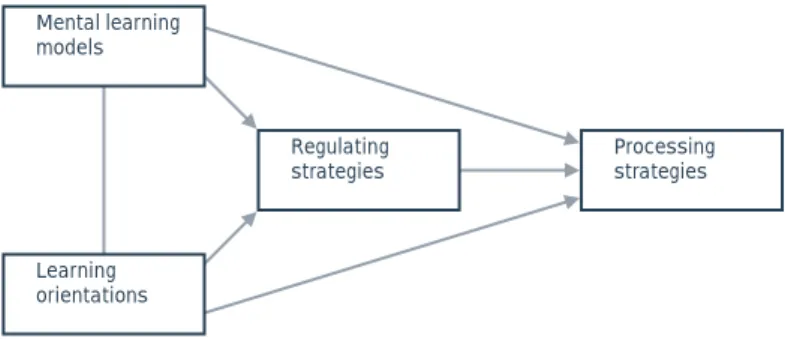
As an alternative model, Vermunt (1998; see Figure 3) aimed to integrate different learning processes, some of which are thought to be relatively stable (mental learning models and learning orientations) and some of which are contextually determined (choice between regulating and processing strategies).
Section 2
Introduction to Sections 3–7
page 8/9
LSRC reference
Instructional preferences
Information processing style
Cognitive personality style
Figure 2
Curr y’s ‘onion’ model of learning styles Source: Curr y (1983)
Figure 3
Vermunt’s model of learning styles (1998)
Source: Price and Richardson (2003) Figure 4 Families of learning styles Mental learning models Learning orientations Regulating strategies
Learning styles and preferences are largely
constitutionally based
including the four
modalities: VAKT2.
Learning styles reflect deep-seated features
of the cognitive
structure, including ‘patterns of ability’.
Learning styles are one component of
a relatively stable
personality type.
Learning styles are flexibly stable learning preferences. Move on from learning styles to learning approaches, strategies, orientations and conceptions of learning. Entwistle Sternberg Vermunt Biggs
Conti and Kolody Grasha-Riechmann Hill
Mar ton and Säljö McKenney and Keen Pask
Pintrich, Smith, Garcia and McCeachie Schmeck
Weinstein,
Zimmerman and Palmer Whetton and Cameron
Allinson and Hayes Herrmann
Honey and Mumford Kolb
Felder and Silverman Hermanussen, Wierstra, de Jong and Thijssen Kaufmann Kir ton McCar thy Apter Jackson Myers-Briggs
Epstein and Meier Harrison-Branson Miller Riding Broverman Cooper Gardner et al. Guilford Holzman and Klein Hudson Hunt Kagan Kogan Messick Pettigrew Witkin
Dunn and Dunn3
Gregorc Bar tlett Betts Gordon Marks Paivio Richardson Sheehan Torrance Processing strategies 2
VAKT = Visual, auditor y, kinaesthetic, tactile 3
Some of the models we have reviewed, such as the Dunn and Dunn learning styles model, combine qualities which the authors believe to be constitutionally fixed with characteristics that are open to relatively easy environmental modification. Others, such as those by Vermunt (1998) and Entwistle (1998), combine relatively stable cognitive styles with strategies and processes that can be modified by teachers, the design of the curriculum, assessment and the ethos of the course and institution. The reason for choosing to present the models we reviewed in a continuum is because we are not aiming to create a coherent model of learning that sets out to reflect the complexity of the field. Instead, the continuum is a simple way of organising the different models according to some overarching ideas behind them. It therefore aims to capture the extent to which the authors of the model claim that styles are constitutionally based and relatively fixed, or believe that they are more flexible and open to change (see Figure 4). We have assigned par ticular models of learning styles to what we call ‘families’. This enables us to impose some order on a field of 71 apparently separate approaches. However, like any theoretical framework, it is not perfect and some models are difficult to place because the
distinction between constitutionally-based preferences or styles and those that are amenable to change is not always clear-cut. We list all 71 in the database we have created for this review (see Appendix 1). The continuum was constructed by drawing on the classification of learning styles by Curr y (1991). We also drew on advice for this project from Entwistle (2002), and analyses and overviews by key figures in the learning styles field (Claxton and Ralston 1978; De Bello 1990; Riding and Cheema 1991; Bokoros, Goldstein and Sweeney 1992; Chevrier et al.2000; Sternberg and Grigorenko 2001). Although the groupings of the families are necessarily arbitrar y, they attempt to reflect the views of the main theorists of learning styles, as well as our own perspective. Our continuum aims to map the learning styles field by using one kind of thematic coherence in a complex, diverse and controversial intellectual territor y. Its principal aim is therefore classificator y.
We rejected or synthesised existing overviews for three reasons: some were out of date and excluded recent influential models; others were constructed in order to justify the creation of a new model of learning styles and in so doing, strained the categorisations to fit the theor y; and the remainder referred to models only in use in cer tain sectors of education and training or in cer tain countries.
Since the continuum is intended to be reasonably comprehensive, it includes in the various ‘families’ more than 50 of the 71 learning style models we came across during this project. However, the scope of this project did not allow us to examine in depth all of these and there is therefore some risk of miscategorisation. The models that are analysed in depth are represented in Figure 4 in bold type.
Our continuum is based on the extent to which the developers of learning styles models and instruments appear to believe that learning styles are fixed. The field as a whole draws on a variety of disciplines, although cognitive psychology is dominant. In addition, influential figures such as Jean Piaget, Carl Jung and John Dewey leave traces in the work of different groups of learning styles theorists who, never theless, claim distinctive differences for their theoretical positions. At the left-hand end of the continuum, we have placed those theorists with strong beliefs about the influence of genetics on fixed, inherited traits and about the interaction of personality and cognition. While some models, like Dunn and Dunn’s, do acknowledge external factors, par ticularly immediate environment, the preferences identified in the model are rooted in ideas that styles should be worked with rather than changed. Moving along the continuum, learning styles models are based on the idea of dynamic interplay between self and experience. At the right-hand end of the continuum, theorists pay greater attention to personal factors such as motivation, and environmental factors like cooperative or individual learning; and also the effects of curriculum design, institutional and course culture and teaching and assessment tasks on how students choose or avoid par ticular learning strategies. The kinds of instrument developed, the ways in which they are evaluated and the pedagogical implications for students and teachers all flow from these underlying beliefs about traits. Translating specific ideas about learning styles into teaching and learning strategies is critically dependent on the extent to which these learning styles have been reliably and validly measured, rigorously tested in authentic situations, given accurate labels and integrated into ever yday practices of information gathering, understanding, and reflective thinking.
page 10/11
We devised this classificator y system to impose some order on a par ticularly confusing and endlessly expanding field, but as a descriptive device, it has cer tain limitations. For example, it may overemphasise the differences between the families and cannot reflect the complexity of the influences on all 13 models. Some authors claim to follow cer tain theoretical traditions and would appear, from their own description, to belong in one family, while the application (or indeed, the marketing) of their learning styles model might locate them elsewhere. For example, Rita Dunn (Dunn and Griggs 1998) believes that style is (in the main) biologically imposed, with the implication that styles are relatively fixed and that teaching methods should be altered to accommodate them. However, in a UK website created by Hankinson (Hankinson 2003), it is claimed that significant gains in student
performance can be achieved ‘By just understanding the concept of student learning styles and having a personal learning style profile constructed’. Where such complexity exists, we have taken decisions as a team in order to place theorists along the continuum. Families of learning styles
For the purposes of the continuum, we identify five families and these form the basis for our detailed analyses of different models:
constitutionally-based learning styles and preferences cognitive structure
stable personality type
‘flexibly stable’ learning preferences learning approaches and strategies.
Within each family, we review the broad themes and beliefs about learning, and the key concepts and definitions which link the leading influential thinkers in the group. We also evaluate in detail the 13 most influential and potentially influential models, looking both at studies where researchers have evaluated the underlying theor y of a model in order to refine it, and at empirical studies of reliability, validity and pedagogical impact. To ensure comparability, each of these analyses, where appropriate, uses the following headings:
origins and influence
definition, description and scope of the learning style instrument
measurement by authors description of instrument reliability and validity external evaluation reliability and validity general
implications for pedagogy
Introduction
Widespread beliefs that people are born with various element-based temperaments, astrologically determined characteristics, or personal qualities associated with right- or left-handedness have for centuries been common in many cultures. Not dissimilar beliefs are held by those theorists of cognitive and/or learning style who claim or assume that styles are fixed, or at least are ver y difficult to change. To defend these beliefs, theorists refer to genetically influenced personality traits, or to the dominance of par ticular sensor y or perceptual channels, or to the dominance of cer tain functions linked with the left or right halves of the brain. For example, Rita Dunn argues that learning style is a ‘biologically and developmentally imposed set of characteristics that make the same teaching method wonderful for some and terrible for others’ (Dunn and Griggs 1998, 3). The emphasis she places on ‘matching’ as an instructional technique derives from her belief that the possibility of changing each individual’s ability is limited. According to Rita Dunn, ‘three-fifths of style is biologically imposed’ (1990b, 15). She differentiates between environmental and physical elements as more fixed, and the emotional and ‘sociological’ factors as more open to change (Dunn 2001a, 16).
Genetics
All arguments for the genetic determination of learning styles are necessarily based on analogy, since no studies of learning styles in identical and non-identical twins have been carried out, and there are no DNA studies in which learning style genes have been identified. This contrasts with the strong evidence for genetic influences on aspects of cognitive ability and personality.
It is generally accepted that genetic influences on personality traits are somewhat weaker than on cognitive abilities (Loehlin 1992), although this is less clear when the effects of shared environment are taken into account (Pederson and Lichtenstein 1997). Pederson, Plomin and McClearn (1994) found
substantial and broadly similar genetic influences on verbal abilities, spatial abilities and perceptual speed, concluding that genetic factors influence the development of specific cognitive abilities as well as, and independently of, general cognitive ability (g). However, twin-study researchers have always looked at ability factors separately, rather than in combination, in terms of relative strength and weakness. They have not, for example, addressed the possible genetic basis of visual-verbal differences in ability or visual-auditor y differences in imager y which some theorists see as the constitutional basis of cognitive styles.
According to Loehlin (1992), the propor tion of non-inherited variation in the personality traits of agreeableness, conscientiousness, extraversion, neuroticismand openness to experience is
estimated to range from 54% for ‘openness’ to 72% for ‘conscientiousness’. Extraversion lies somewhere near the middle of this range, but the estimate for the trait of impulsivity is high, at 79%. To contrast with this, we have the finding of Rushton et al.(1986) that positive social behaviour in adults is subject to strong genetic influences, with only 30% of the variation in empathy being unaccounted for. This finding appears to contradict Rita Dunn’s belief that emotional and social aspects of behaviour are more open to change than many others.
The implications of the above findings are as follows. Learning environments have a considerable influence on the development of cognitive skills and abilities. Statements about the biological basis of learning styles have no direct empirical suppor t.
There are no cognitive characteristics or personal qualities which are so strongly determined by the genes that they could explain the supposedly fixed nature of any cognitive styles dependent on them.
As impulsivity is highly modifiable, it is unwise to use it as a general stylistic label.
‘People-oriented’ learning style and motivational style preferences may be relatively hard to modify.
Modality-specific processing
There is substantial evidence for the existence of modality-specific strengths and weaknesses (for example in visual, auditor y or kinaesthetic processing) in people with various types of learning difficulty (Rourke et al.2002). However, it has not been established that matching instruction to individual sensor y or perceptual strengths and weaknesses is more effective than designing instruction to include, for all learners, content-appropriate forms of presentation and response, which may or may not be multi-sensor y. Indeed, Constantinidou and Baker (2002) found that pictorial presentation was advantageous for all adults tested in a simple item-recall task, irrespective of a high or low learning-style preference for imager y, and was especially advantageous for those with a strong preference for verbal processing.
Section 3
Genetic and other constitutionally based factors
page 12/13
The popular appeal of the notion that since many people find it hard to concentrate on a spoken presentation for more than a few minutes, the presenters should use other forms of input to convey complex concepts does not mean that it is possible to use bodily movements and the sense of touch to convey the same material. Cer tainly there is value in combining text and graphics and in using video clips in many kinds of teaching and learning, but decisions about the forms in which meaning is represented are probably best made with all learners and the nature of the subject in mind, rather than tr ying to devise methods to suit vaguely expressed individual preferences. The modality-preference
component of the Dunn and Dunn model (among others) begs many questions, not least whether the impor tant par t of underlining or taking notes is that movement of the fingers is involved; or whether the impor tant par t of dramatising historical events lies in the gross motor coordination required when standing rather than sitting. Similarly, reading is not just a visual process, especially when the imagination is engaged in exploring and expanding new meanings.
More research attention has been given to possible fixed differences between verbal and visual processing than to the intelligent use of both kinds of processing. This ver y often involves flexible and fluent switching between thoughts expressed in language and those expressed in various forms of imager y, while searching for meaning or for a solution or decision. Similarly, little attention has been given to finding ways of developing such fluency and flexibility in specific contexts. Never theless, there is a substantial body of research which points to the instructional value of using multiple representations and specific devices such as graphic organisers and ‘manipulatives’ (things that can be handled). For example, Marzano (1998) found mean effect sizes of 1.24 for the graphic representation of knowledge (based on 43 studies) and 0.89 for the use of manipulatives (based on 236 studies). If such impressive learning gains are obtainable from the general (ie not personally tailored) use of such methods, it is unlikely that basing individualised instruction on modality-specific learning styles will add fur ther value.
Cerebral hemispheres
It has been known for a ver y long time that one cerebral hemisphere (usually, but not always, the left) is more specialised than the other for speech and language and that various non-verbal functions (including face recognition) are impaired when the opposite hemisphere is damaged. Many attempts have been made to establish the multifaceted nature of hemispheric differences, but we still know little about how the two halves of the brain function differently, yet work together. New imaging and
recording techniques produce prettier pictures than the electroencephalographic (EEG)recordings of 50 years ago, but understanding has advanced more slowly. To a detached observer, a great deal of neuroscience resembles tr ying to understand a computer by mapping the location of its components. However, there is an emerging consensus that both hemispheres are usually involved even in simple activities, not to mention complex behaviour like communication.
Theories of cognitive style which make reference to ‘hemisphericity’ usually do so at a ver y general level and fail to ask fundamental questions about the possible origins and functions of stylistic differences. Although some authors refer to Geschwind and Galaburda’s (1987) testosterone-exposure hypothesis or to Springer and Deutsch’s (1989) interpretation of split-brain research, we have not been able to find any developmental or longitudinal studies of cognitive or learning styles with a biological or neuropsychological focus, nor a single study of the heritabilityof
‘hemisphere-based’ cognitive styles.
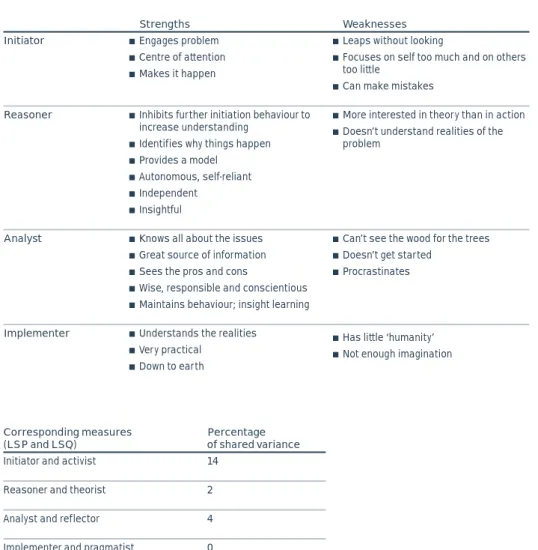
Yet a number of interesting findings and theories have been published in recent years which may influence our conceptions of how cognitive style is linked to brain function. For example, Gevins and Smith (2000) repor t that different areas and sides of the brain become active during a specific task, depending on ability level and on individual differences in relative verbal and non-verbal intelligence. Burnand (2002) goes much fur ther, summarising the evidence for his far-reaching ‘problem theor y’, which links infant strategies to hemispheric specialisation in adults. Burnand cites Wittling (1996) for neurophysiological evidence of pathways that mainly serve different hemispheres. According to Burnand, the left hemisphere is most concerned with producing effects which may lead to rewards, enhancing a sense of freedom and self-efficacy. The neural circuitr y mediating this is the dopamine-driven Behaviour Activation System (BAS) (Gray 1973). The right hemisphere is most concerned with responding to novel stimuli by reducing uncer tainty about the environment and thereby inducing a feeling of security. In this case, the neurotransmitters are serotonin and non-adrenalin and the system is Gray’s Behavioural Inhibition System (BIS). These two systems (BAS and BIS) feature in Jackson’s model of learning styles (2002), underlying the initiatorand
However plausible Burnand’s theor y may seem, there is a tension, if not an incompatibility, between his view of right hemisphere function and the well-known ideas of Springer and Deutsch (1989) – namely that the left hemisphere is responsible for verbal, linear, analyticthinking, while the right hemisphere is more visuospatial, holisticand emotive. It is difficult to reconcile Burnand’s idea that the right hemisphere specialises in assessing the reliability of people and events and turning attention away from facts that lower the hope of cer tainty, with the kind of visually imaginative, explorator y thinking that has come to be associated with ‘right brain’ processing. There is a similar tension between Burnand’s theor y and Herrmann’s conception of brain dominance (see the review of his ‘whole brain’ model in Section 6.3). New theories are constantly emerging in neurobiology, whether it be for spatial working memor y or
extraversion, and it is cer tainly premature to accept any one of them as providing powerful suppor t for a par ticular model of cognitive style. Not only is the human brain enormously complex, it is also highly adaptable. Neurobiological theories tend not to address adaptability and have yet to accommodate the switching and unpredictability highlighted in Apter’s reversal theor y (Apter 2001; see also Section 5.2). It is not, for example, difficult to imagine reversal processes between behavioural activation and behavioural inhibition, but we are at a loss as to how to explain them.
We can summarise this sub-section as follows. We have no satisfactor y explanation for individual differences in the personal characteristics associated with right- and left-brain functioning.
There does not seem to be any neuroscientific evidence about the stability of hemisphere-based individual differences.
A number of theories emphasise functional differences between left and right hemispheres, but few seek to explain the interaction and integration of those functions.
Theorists sometimes provide conflicting accounts of brain-based differences.
Comments on specific models, both inside and outside this ‘family’
Gregorc believes in fixed learning styles, but makes no appeal to behavioural genetics, neuroscience or biochemistr y to suppor t his idiosyncratically worded claim that ‘like individual DNA and fingerprints, one’s mind quality formula and point arrangements remain throughout life.’ He argues that the brain simply ‘serves as a vessel for concentrating much of the mind substances’ and ‘permits the software of our spiritual forces to work through it and become operative in the world’ (Gregorc 2002). Setting aside this metaphysical speculation, his distinction between sequentialand
randomordering abilities is close to popular psychology conceptions of left- and right-‘brainedness’, as well as to the neuropsychological concepts of simultaneous and successive processing put for ward by Luria (1966).
Torrance et al.(1977) produced an inventor y in which each item was supposed to distinguish between left, right and integrated hemisphere functions. They assumed that left hemisphere processing is sequential and logical, while right hemisphere processing is simultaneous and creative. Fitzgerald and Hattie (1983) severely criticised this inventor y for its weak theoretical base, anomalous and faulty items, low reliabilities and lack of concurrent validity. They found no evidence to suppor t the supposed location of creativity in the right hemisphere, nor the hypothesised relationship between the inventor y ratings and a measure of laterality based on hand, eye and foot preference. It is wor th noting at this point that Zenhausern’s (1979) questionnaire measure of cerebral dominance(which is recommended by Rita Dunn) was supposedly ‘validated’ against Torrance’s seriously flawed inventor y.
One of the components in the Dunn and Dunn model of learning styles which probably has some biological basis is time-of-day preference. Indeed, recent research points to a genetic influence, or ‘clock gene’, which is linked to peak aler t time (Archer et al.2003). However, the idea that ‘night owls’ may be just as efficient at learning new and difficult material as ‘early birds’ seems rather simplistic. Not only are there repor tedly 10 clock genes interacting to exer t an influence, but according to Biggers (1980), morning-aler t students generally tend to outperform their peers. We will not speculate here about the possible genetic and environmental influences which keep some people up late when there is no imperative for them to get up in the morning, but we do not see why organisations should feel obliged to adapt to their preferences.
A number of theorists who provide relatively flexible accounts of learning styles never theless refer to genetic and constitutional factors. For example, Kolb (1999) claims that concrete experienceand
abstract conceptualisationreflect right- and left-brain thinking respectively. Entwistle (1998) says the same about (holist) comprehensionlearning and (serialist)
operationlearning, as do Allinson and Hayes (1996) about their intuition-analysisdimension. On the other hand, Riding (1998) thinks of his global-analytic
dimension (which is, according to his definition, ver y close to intuition-analysis) as being completely unrelated to hemisphere preference (unlike his
visual-verbaldimension). This illustrates the
confusion that can result from linking style labels with ‘brainedness’ in the absence of empirical evidence. The absence of hard evidence does not, however, prevent McCar thy from making ‘a commonsense decision to alternate right- and left-mode techniques’ (1990, 33) in each of the four quadrants of her learning cycle (see Section 8 and Figure 13; also Coffield et al.
2004, Section 4 for more details).
page 14/15
Although we have placed Herrmann’s ‘whole brain’ model in the ‘flexibly stable’ family of learning styles, we mention it briefly here because it was first developed as a model of brain dominance. It is impor tant to note that not all theorists who claim a biochemical or other constitutional basis for their models of cognitive or learning style take the view that styles are fixed for life. Two notable examples are Herrmann (1989) and Jackson (2002), both of whom stress the impor tance of modifying and strengthening styles so as not to rely on only one or two approaches. As indicated earlier in this section, belief in the impor tance of genetic and other constitutional influences on learning and behaviour does not mean that social, educational and other environmental influences count for nothing. Even for the Dunns, about 40% of the factors influencing learning styles are not biological. The contrast between Rita Dunn and Ned Herrmann is in the stance they take towards personal and social growth.
3.1
Gregorc’s Mind Styles Model and Style Delineator Introduction
Anthony Gregorc is a researcher, lecturer, consultant, author and president of Gregorc Associates Inc. In his early career, he was a teacher of mathematics and biology, an educational administrator and associate professor at two universities. He developed a metaphysical system of thought called Organonand after interviewing more than 400 people, an instrument for tapping the unconscious which he called the Transaction Ability Inventor y. This instrument, which he marketed as the Gregorc Style Delineator (GSD), was designed for use by adults. On his website, Gregorc (2002) gives technical, ethical and philosophical reasons why he has not produced an instrument for use by children or students. Gregorc Associates provides services in self-development, moral leadership, relationships and team development, and ‘core-level school reform’. Its clients include US government agencies, school systems, universities and several major companies.
Origins and description
Although Gregorc aligns himself in impor tant respects with Jung’s thinking, he does not attribute his dimensions to others, only acknowledging the influence of such tools for exploring meaning as word association and the semantic differential technique. His two dimensions (as defined by Gregorc 1982b, 5) are ‘perception’ (‘the means by which you grasp information’) and ‘ordering’ (‘the ways in which you authoritatively arrange, systematize, reference and dispose of information’). ‘Perception’ may be ‘concrete’ or ‘abstract’ and ‘ordering’ may be ‘sequential’ or ‘random’. These dimensions bear a strong resemblance to the Piagetian concepts of
‘accommodation’ and ‘assimilation’, which Kolb also adopted and called ‘prehension’ and ‘transformation’. The distinction between ‘concrete’ and ‘abstract’ has an ancestr y vir tually as long as recorded thought and features strongly in the writings of Piaget and Bruner. There is also a strong family resemblance between Gregorc’s ‘sequential processing’ and Guilford’s (1967) ‘convergent thinking’, and between Gregorc’s ‘random processing’ and Guilford’s ‘divergent thinking’.
Gregorc’s Style Delineator was first published with its present title in 1982, although the model underlying it was conceived earlier. In 1979, Gregorc defined learning style as consisting of ‘distinctive behaviors which serve as indicators of how a person learns from and adapts to his environment’ (1979, 234). His Mind Styles™ Model is a metaphysical one in which minds interact with their environments through ‘channels’, the four most impor tant of which are
supposedly measured by the Gregorc Style Delineator™ (GSD). These four channels are said to mediate ways of receiving and expressing information and have the following descriptors: concrete sequential (CS), abstract sequential (AS), abstract random (AR), and concrete random (CR). This conception is illustrated in Figure 5, using channels as well as two axes to represent concrete versus abstract perception and sequential versus random ordering abilities.
Figure 5
Gregorc’s four-channel
learning-style model Concrete
sequential Concrete random Abstract random Abstract sequential Mind