Fiscal Year 2014
Operating Plan
(To implement the FY 2014 Budget Request)
Approved
An electronic version of this document is available at:
http://www.CPSC.gov/Performance-and-Budget/U.S. Consumer Product Safety Commission
FY 2014 Operating Plan
Table of Contents
Page
Funding and FTE by Major Organization ... 1
FY 2014 Plan by Strategic Goal and Program Component ... 2
Budget Key Performance Measures Summary ... 3
Voluntary Standards Summary ... 5
Mandatory Standards Summary ... 7
Operating Plan Details for Mission Organizations ... 9
Hazard Identification ... 10 Compliance ... 21 Import Surveillance ... 29 Global Outreach ... 33 Office of Communications ... 36 Information Technology ... 41
TABLE 1
FUNDING AND FTE BY MAJOR ORGANIZATION
The operating budget level for each organization at the FY 2014 Request to Congress (column 1) and the corresponding full-time equivalent (FTE) levels (column 2) are shown in the table below.
(Dollars in Thousands) FY 2014 Request
BUDGET DETAILS Column 1 BUDGET Column 2 FTE Commissioners $ 132.0 21
Office of Compliance & Field Operations
Compliance – HQ $ 363.0 50
Compliance – Field Operations $ 1,587.0 107
Office of Education, Global Outreach, and Small Business Ombudsman
$ 826.0 10 Office of Import Surveillance $ 500.0 34 Office of Hazard Identification & Reduction 162
Office of Hazard Identification $ 2,260.0
Laboratory Sciences $ 1,100.0
Nano $ 2,000.0
NEISS $ 2,150.0
Office of Communications 10
Office of Communications $ 2,220.0
VGB PSSA Information & Education $ 1,000.0
Office of Information & Technology Services 41
Office of Information Technology $ 78.0
IT Infrastructure $ 6,082.8
Commission's Information Systems $ 1,461.0
CPS Risk Management System $ 2,715.0
Risk Assessment Methodology – Import $ 1,870.0
Office of the Executive Director $ 52.0 5 Office of the General Counsel $ 590.0 50 Office of Human Resources Management $ 416.0 10 Office of Financial Management, Planning, & Evaluation $ 1,303.8 26
Financial Audit $ 150.0
Office of Facilities Services (excludes Rent/Util/Security) $ 1,810.0 10 Office of Legislative Affairs $ 15.0 3 Office of EEO & Minority Enterprise $ 42.0 2 Office of the Inspector General $ 132.0 7 Centrally Managed Costs:
Salaries $ 76,280.2
Rent/Util/Security $ 9,360.2
VGB $ 500.0
Representation Fund $ 4.0
TABLE 2
FY 2014 PLAN BY STRATEGIC GOAL AND PROGRAM COMPONENT
(Dollars in Thousands)Organization
FY 2014
Op Plan FTE Goal 1 Goal 2 Goal 3 Goal 4 Goal 5
Chairman & Commissioners $ 3,009 21 $ 3,009 $ - $ - $ - $ - Hazard Identification and
Reduction $ 29,704 162 $ - $ 12,267 $ 11,243 $ 6,194 $ - Compliance and Field
Operations $ 23,596 157 $ 708 $ 472 $ 5,191 $ 16,989 $ 236 Import Surveillance $ 4,884 34 $ - $ - $ 4,200 $ 684 $ - Education, Global Outreach,
and Small Business $ 2,196 10 $ 2,196 $ - $ - $ - $ - General Counsel $ 7,885 50 $ 315 $ 2,839 $ 710 $ 2,286 $ 1,735 Information Technology $ 18,098 41 $ 1,629 $ 2,172 $ 9,772 $ 3,258 $ 1,267 Office of Communications $ 4,766 10 $ - $ - $ 1,001 $ - $ 3,765 Agency Management $ 21,771 56 $ 4,572 $ 3,701 $ 5,007 $ 6,096 $ 2,395 Inspector General $ 1,091 7 $ 218 $ 218 $ 218 $ 219 $ 218 Total $ 117,000 548 $ 12,647 $ 21,669 $ 37,342 $ 35,726 $ 9,616
BUDGET KEY PERFORMANCE MEASURES SUMMARY
The Budget Key Performance Measures are the measures the agency submits with its Congressional Budget submission.
ID Office Performance Measure Statement FY 2014
Target Strategic Goal 1: Leadership in Safety
1.2.1 Global Number of training or outreach seminars for foreign
manufacturers conducted by CPSC staff 3 1.2.2 Global Number of staff exchanges with foreign counterparts
undertaken as part of the Extended Training Exchange Program 4 1.2.3 Global
Number of new collaborations undertaken with domestic nongovernment organizations (NGOs) such as trade associations, universities, or federations
3
1.4.1 Global Number of products on which CPSC had consultations with
foreign counterparts 4
1.6.1 Personnel Employee retention rate 85%
1.6.2 Personnel Average hiring time (recruitment time using OPM’s
End-to-End hiring process) (days) 80
1.6.3 Personnel Training participation rate 85%
Strategic Goal 2: Commitment to Prevention
2.1.1 Hazard Number of voluntary standards activities supported or
monitored by CPSC staff 83
2.1.2 Hazard
Number of collaborations established or maintained with other organizations to work on nanotechnology research or issues affecting consumer products
5
2.1.3 Hazard Number of reports produced on the results of collaboration on
nanotechnology issues affecting consumer products 5 2.2.1 Hazard Number of candidates for rulemaking prepared for Commission
consideration 22
2.3.1 Global Number of domestic training activities made available to
industry stakeholders 7
Strategic Goal 3: Rigorous Hazard Identification
3.1.1 Hazard Percentage of National Electronic Injury Surveillance System
(NEISS) member hospitals evaluated at least once a year 98% 3.1.2 Hazard Percentage of consumer product-related injury cases correctly
captured at NEISS hospitals 90%
3.2.1 Hazard Time from incident received to integrated team adjudication of
incident report (business days) 10
3.2.2 Hazard Percentage of priority import regulated samples (excluding
fireworks) tested within 30 days of collection 85% 3.2.3 Hazard Percentage of priority import fireworks samples tested within
60 days of collection 90%
3.4.1 Import Number of import examinations 20,000
3.4.2 Import
Sample yield per 100 import entries examined as identified through the Risk Assessment Methodology (RAM) pilot system
26
3.4.3 Import
Percentage of import shipments processed through the Risk Assessment Methodology (RAM) pilot system that are cleared within 1 business day
ID Office Performance Measure Statement FY 2014 Target 3.4.4 Import Percentage of CPSC import entry hold requests acted on by
CBP TBD
3.4.5 Import
Establish an ITDS/RAM rule set to target intellectual property violations where a health and safety hazard is suspected in consumer product imports
Rule set established 3.5.1 Compliance Total number of products screened by CPSC Field staff Est.
250,000 3.5.2 Compliance Number of consumer products screened by CPSC Field staff
through Internet surveillance activities
Est. 25,000 3.5.3 Hazard Number of annual reports completed on consumer
product-related fatalities, injuries, and/or losses for specific hazards 10 3.6.1 Compliance Number of used/resale consumer products screened by CPSC
Field staff
Est. 200,000 Strategic Goal 4: Decisive Response
4.1.1 Compliance Number of establishment inspections conducted by CPSC Field
staff 1,000
4.1.2 Compliance Percentage of products screened by CPSC Field staff resulting in violations
Est. 6% 4.1.3 Hazard Total number of items/component parts from samples tested at
NPTEC for specific standards and regulations 36,000 4.3.1 Compliance Percentage of all cases for which the preliminary determination
is made within 85 business days of the case opening 70% 4.3.2 Compliance Percentage of cases for which the corrective action is accepted
within 60 business days of the preliminary determination 80% 4.3.3 Compliance Percentage of cases in which the firm is notified of a violation
in a timely manner
Est. 90% 4.3.4 Compliance Percentage of Fast-Track cases with corrective actions initiated
within 20 business days 90%
4.4.1 Communications Average number of days from first draft of recall press release completed to recall press release issued (in days)
Est. 22 4.5.1 Compliance
Percentage of compliance defect investigation cases referred within 10 business days to OGC for review of firms’ timely reporting pursuant to § 15(b)
Est. 95% Strategic Goal 5: Raising Awareness
5.1.1 Communications Percentage of the population that reports awareness of the
CPSC TBD
5.1.2 Communications Percentage of consumers who report acting on a CPSC safety
message TBD
5.2.1 Communications Number of public information campaigns conducted by CPSC
on targeted consumer product safety hazards 24 5.2.2 Communications
Number of impressions of CPSC safety messages received by consumers on targeted consumer product safety hazards (in millions)
3,215
5.3.1 Communications
Number of impressions of CPSC safety messages received by consumers on priority hazards in vulnerable communities (in millions)
425
TBD (to be determined): For performance measures newly established for FY 2013, performance data are being collected and analyzed to establish a Baseline for FY 2013. In some cases, TBD has been indicated for the performance targets for FY 2014 for these measures.
Est. (estimated): For some performance measures newly established for FY 2013, staff estimated tentative target levels for FY 2014. The estimates are subject to change once the actual FY 2013 baseline values are determined.
VOLUNTARY STANDARDS SUMMARY
A consumer product voluntary standard is a prescribed set of rules, conditions, or requirements
concerning definitions of product-related terms; classification of components; specification of materials, performance, or operations; delineation of procedures; or measurement of quantity and quality in
describing products, materials, systems, services, or practices relating to the safety of consumer products used in and around the home, outdoors, and in schools.
The CPSC’s statutory authority requires it to rely on voluntary standards rather than promulgate mandatory standards if compliance with a voluntary standard would eliminate or adequately reduce the risk of injury identified and it is likely there will be substantial compliance with the voluntary standard. CPSC staff works with organizations that coordinate the development of voluntary standards.
Voluntary standards activity is an ongoing process that may involve multiple revisions to a standard within one year or over multiple years, and such activity may continue in subsequent years, depending on the activities of the voluntary standards committees and the priorities of the Commission.
During FY 2014, CPSC staff plans to provide support for1, or monitor, voluntary standards work for the products below:
# FY 2014 Op Plan
1 air cleaners (ozone-generating) 2 amusement rides (portable) 3 architectural glazing 4 baby monitors 5 bassinets/cradles 6 bath seats (infant)
7 batteries (e.g., lithium, electronic devices, toy, button) 8 bed rails (adult)
9 bed rails (children’s) 10 beds (bunk) 11 beds (toddler) 12 bedside sleepers 13 bicycles 14 booster seats
15 building materials and furnishings (emissions) 16 candles 17 cellulosic insulation 18 chairs (high) 19 chairs (youth) 20 changing tables 21 child-resistant packaging 22 clothes dryers 23 clothing textiles 24 CO alarms 25 cooktops 26 cribs (commercial) 27 cribs (full-size)
1 Support may include, among other things, providing injury data and hazard analyses, encouraging the development
of a voluntary safety standard, identifying specific risks of injury, performing research, developing health science data, performing laboratory technical assistance, and/or taking other actions that the Commission, in a particular situation, determines may be appropriate. A listing of these activities can be found at 16 C.F.R. § 1031.7.
# FY 2014 Op Plan
28 cribs (non-full-size/play yards) 29 drywall
30 firearm security containers 31 fireworks
32 flammable liquids (material handling) 33 flammable refrigerants
34 fuel tanks (leakage) 35 furnaces
36 furniture, upholstered
37 gasoline containers (flame arrestors) 38 glass front gas fireplaces
39 headgear (recreational) 40 heaters, electrical 41 infant bedding/accessories 42 infant bouncers
43 infant carriers (frame) 44 infant carriers (handheld) 45 infant carriers (soft) 46 infant gates
47 infant inclined sleep products 48 infant slings
49 infant swings 50 infant tubs 51 infant walkers
52 inflatable play devices (constant air) 53 ladders
54 laundry packets (liquid) 55 lighters, cigarette 56 mattresses, inflatable air 57 microwave ovens 58 nanotechnology 59 National Electrical Code
60 non integral firearm locking devices 61 off-highway vehicles, recreational 62 phthalates
63 playground equipment (children under 2 yrs.) 64 playground equipment (home)
65 playground equipment (public) 66 portable generators
67 power cords
68 power equipment (table saws) 69 ranges (tip overs)
70 slow cookers (cord pulls) 71 smoke alarms
72 soccer goals
73 spray poly foam insulation (residential off-gas) 74 stationary activity centers
75 strollers
76 swimming pools/spas 77 torch fuels (containers) 78 toys
79 trampoline courts 80 trampolines 81 tree stands (hunting) 82 unvented alcohol appliances 83 window coverings
MANDATORY STANDARDS SUMMARY
Mandatory standards are federal rules set by statute or regulation that impose requirements for consumer products. They typically take the form of performance requirements that consumer products must meet or warnings they must display in order to be imported, distributed, or sold in the United States.
The CPSC may set a mandatory standard when it determines that compliance with a voluntary standard would not eliminate or adequately reduce the risk of injury or finds that it is unlikely that there will be substantial compliance with a voluntary standard. The Commission may also promulgate a mandatory ban of a hazardous product when it determines that no feasible voluntary or mandatory standard would
adequately protect the public from an unreasonable risk of injury. In some cases, Congress directs and authorizes the Commission to set a mandatory standard.
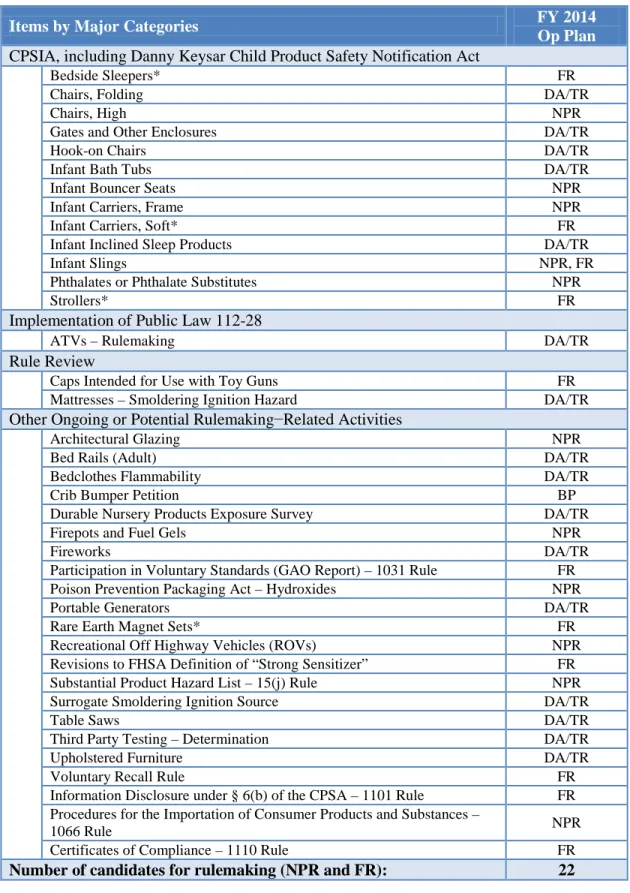
CPSC staff plans to work on the projects in the table that follows. This work will involve continuation of rulemaking activities related to the CPSIA, as well as other laws, and it will include data analysis and technical review activities in support of rule review or potential rulemaking activities.
Key to Table
The terms NPR and FR in the columns below indicate that a briefing package with a draft NPR or a draft FR was or will be submitted to the Commission. It does not indicate the final action of the Commission.
Beginning in FY 2014, proposed and draft final notices of requirements will be included within the rulemaking briefing package for the applicable product; they will not be submitted to the
Commission in a separate rulemaking briefing package and, therefore, are not listed separately. NPR Notice of proposed rulemaking
FR Final rule BP Briefing package
Mandatory Standards Summary
Items by Major Categories FY 2014 Op Plan
CPSIA, including Danny Keysar Child Product Safety Notification Act
Bedside Sleepers* FR
Chairs, Folding DA/TR
Chairs, High NPR
Gates and Other Enclosures DA/TR
Hook-on Chairs DA/TR
Infant Bath Tubs DA/TR
Infant Bouncer Seats NPR
Infant Carriers, Frame NPR
Infant Carriers, Soft* FR
Infant Inclined Sleep Products DA/TR
Infant Slings NPR, FR
Phthalates or Phthalate Substitutes NPR
Strollers* FR
Implementation of Public Law 112-28
ATVs – Rulemaking DA/TR
Rule Review
Caps Intended for Use with Toy Guns FR
Mattresses – Smoldering Ignition Hazard DA/TR Other Ongoing or Potential Rulemaking−Related Activities
Architectural Glazing NPR
Bed Rails (Adult) DA/TR
Bedclothes Flammability DA/TR
Crib Bumper Petition BP
Durable Nursery Products Exposure Survey DA/TR
Firepots and Fuel Gels NPR
Fireworks DA/TR
Participation in Voluntary Standards (GAO Report) – 1031 Rule FR Poison Prevention Packaging Act – Hydroxides NPR
Portable Generators DA/TR
Rare Earth Magnet Sets* FR
Recreational Off Highway Vehicles (ROVs) NPR Revisions to FHSA Definition of “Strong Sensitizer” FR Substantial Product Hazard List – 15(j) Rule NPR
Surrogate Smoldering Ignition Source DA/TR
Table Saws DA/TR
Third Party Testing – Determination DA/TR
Upholstered Furniture DA/TR
Voluntary Recall Rule FR
Information Disclosure under § 6(b) of the CPSA – 1101 Rule FR Procedures for the Importation of Consumer Products and Substances –
1066 Rule NPR
Certificates of Compliance – 1110 Rule FR
Number of candidates for rulemaking (NPR and FR): 22
OPERATING PLAN DETAILS FOR MISSION ORGANIZATIONS
Office Page Hazard Identification 10 Compliance 21 Import Surveillance 29 Global Outreach 33 Communications 36 Information Technology 411. Resource Summary
FY 2014 Request Budget
(in thousands) FTE Office of Hazard Identification $2,260 162
Laboratory Sciences $1,100
Nanotechnology $2,000
NEISS $2,150
Total $7,510 162
2. Overview and Key Priorities
The Office of Hazard Identification and Reduction (EXHR) is responsible for managing the
Commission’s Hazard Identification and Analysis Program and its Hazard Assessment and Reduction Program. The Office develops and implements the agency’s operating plans for these two hazard programs. The operating plans generally include the collection and analysis of data to identify hazards and hazard patterns; coordination of voluntary standards activities and international liaison activities related to consumer product safety; and overall direction and evaluation of projects that focus on identifying emerging hazards, developing proposals for submittal to voluntary standards development organizations, evaluating petitions, and providing technical support for rulemaking activities. The Office ensures that relevant technical information is presented comprehensively and objectively to the Commission for consideration in its decision-making. The Office has line authority over the
Directorates for Epidemiology, Health Sciences, Economic Analysis, Engineering Sciences, and Laboratory Sciences. In FY 2014, the key priorities will be: maintaining the National Electronic Injury Surveillance System (NEISS), mortality and incident data collection, and follow-up investigations; meeting the mandatory requirements of the CPSIA and P.L. 112-28; continuing to implement the Integrated Product Team process more completely into incident review and assignment for action; and maintaining and safely operating the National Product Testing and Evaluation Center to support Hazard Reduction, Compliance, and Import Surveillance programs.
3. Strategic Plan Alignment and Project Summary
Project Strategic Goal
11179 – National Electronic Injury Surveillance System (NEISS) 3
11282 – Mortality/Incident Data 3
12165 – Investigations 3
13327 – Emerging Hazards 3
13328 – Consumer Product Safety Risk Management System 3
13329 – Integrated Teams 3
13330 – Data Intake and Clearinghouse 3
13331 – Petitions and Other Non-Programmed Hazard Work 3
14125 – Economic Studies 3
21103 – Fireworks Regulatory Options 2
21146 – Bedclothes (Open-Flame Ignition) 3
21498 – Upholstered Furniture 2
21636 – Firepots and Gel Fuel Rulemaking 3
21660 – Electrical Codes and Standards (Fire) 2
Hazard Identification Operating Plan Details – George Borlase, AED
Project Strategic Goal
22411 – Architectural Glazing 2
22560 – Children's Hazards (Other than Drowning) 2
22637 – All-Terrain Vehicles (ATVs) 2
22638 – Recreational Off-Highway Vehicles (ROVs) 2
22642 – Children’s Hazards (Drowning) 2
22666 – Mechanical Codes and Standards 2
22727 – Durable Children's Products/Registration (CPSIA § 104) 2
23259 – Chemical Hazards (Other) 2
23335 – Carbon Monoxide Activities 2
23336 – Portable Generators 2
23447 – Poison Prevention 2
23704 – Nanotechnology 2
23705 – Lead (CPSIA § 101) 2
23706 – Phthalates (CPSIA § 108) 2
24013 – Laboratory Equipment and Operations Support 3 and 4
24505 – Project Support 2
25100 – EXHR Training All
25375 – International Program Support 1
25376 – Hazard Assessment and Reduction (HAR) Management 2
25547 – Rule Review 2
25722 – Hazard Assessment and Reduction (HAR) Legal/Regulatory Flexibility Act Support
2
25723 – Lab Accreditation (CPSIA § 102) 2
25725 – Voluntary Standards Coordination 2
25727 – Third Party Testing – Determination 2
25777 – EXHR Administration 2
• National Electronic Injury Surveillance System (NEISS) (11179): This project supports collection and analysis of initial hazard and injury reports that support Commission actions. The staff contracts for approximately 410,000 injury reports each year from a statistical sample of about 100 hospital emergency departments. This project also includes coordination of NEISS activities funded by other federal agencies. Staff provides technical statistical support to ensure that: (1) data are collected appropriately; (2) estimates are made using valid statistical techniques; and (3) data are released in a manner that is accurate and verifiable.
• Mortality/Incident Data (11282): This project includes two major activities: gathering mortality data and gathering incident data. This project covers death certificate reporting from each of the 50 states and reporting from the national network of medical examiners/coroners. Data on deaths associated with specific products and hazards provide important information to support hazard projects and Section 15 action. This project provides support for collection of injury data from news clips; consumer complaints; federal, state, and local governments; fire departments; attorneys; burn centers; and other sources.
• Investigations (12165): This project provides resources for about 2,000 telephone investigations and for on-site investigations of product-related hazards identified for study. Since initial reports from consumer complaints, news clips, Medical Examiners and Coroners Alert Project
(MECAP), NEISS, and death certificates generally lack specific details about the incident and the product, follow-up investigations are needed to determine how injuries happen and to gather
specific product information. This project covers the assignment, performance, review, and disposition of investigation reports. The resulting reports are available for use by analysts inside and outside of the Commission.
• Emerging Hazards (13327): This project focuses on review and analysis of new or potential emerging hazards identified through information that comes into the agency through NEISS, death certificates, incident data, www.SaferProducts.gov, or other sources. For example, when a new or potential emerging hazard is identified, staff gathers and analyzes information related to the incidents, injuries, and/or deaths associated with it. At times, staff must collect information on the product’s availability in the market. If the product is an emerging chemical hazard, staff will conduct a toxicity assessment.
• Consumer Product Safety Risk Management System (13328): The Consumer Product Safety Risk Management System (RMS) provides a single, integrated Web-based environment to accommodate a searchable database for consumers; enhances the efficiency and effectiveness of CPSC staff's consumer product safety work by providing a system to identify hazard trends quickly (Early Warning System); and enables more rapid and increased dissemination of information. This enhances the CPSC's ability to achieve its mission of increasing consumer product safety, reducing injuries, saving lives, and informing the public of both consumer product hazards and ways to provide product incident information to CPSC staff.
• Integrated Teams (13329): This project supports tasking and coordinating activities pertaining to incident reports that have been assigned to the integrated teams through an intake and triage process. Activities include: initial review of the assigned incident; referral as necessary to a subject matter expert (SME) for further evaluation; review by the SME, and/or assigning the incident for an in-depth investigation, a public service announcement, corrective action, standards development, and/or a public safety campaign.
• Data Intake and Clearinghouse (13330): The Data Intake and Injury Information branch of the Directorate for Epidemiology, which includes the National Injury Information Clearinghouse, is responsible for: (1) performing coding, data entry, and quality control of reports to be included in the CPSC’s public database and/or its internal database; (2) requesting verification of reports and consent for publication from submitters; (3) determining eligibility of reports for the CPSC’s public database (SaferProducts.gov); (4) providing notification to manufacturers under sections 6(c) and 6A of the CPSA of reports that describe a hazardous incident or safety concern associated with one of their products; (5) processing confidential information claims, claims of material inaccuracy, and general comments related to reports posted or to be posted on
www.SaferProducts.gov; (6) providing customer support to users of the CPSC’s Business Portal; (7) responding to requests for injury data; and 8) developing computer programs used to report on database operations and status.
• Petitions and Other Unanticipated Non-Programmed Hazard Work (13331): This project pertains to hazard-related work that arises unexpectedly during the fiscal year. Of particular focus under this project are petitions from the public to initiate, amend, or revoke regulatory standards. Petitions require that staff evaluate the petitioner’s request and determine if it meets the
Commission’s docketing criteria. If the docketing criteria are met, then staff: (1) reviews and responds to comments submitted in response to a Federal Register notice announcing receipt of the petition, and (2) provides a briefing package to the Commission with a recommendation about the options the Commission has for addressing the petition.
• Economics Studies (14125): This is a multielement project to provide specialized economic information and reports to hazard and other project teams and offices, Commissioners, Congress, other agencies, and the public on an as-needed basis. The project also provides data or support
Hazard Identification Operating Plan Details – George Borlase, AED
services to intra- and inter-agency taskforces. Project staff develop and maintain economic models and information to provide: injury cost estimates, estimates of product life and numbers in use; analysis of general and small business impacts (e.g., production costs and competition) resulting from proposed regulation; analysis of the environmental impact resulting from proposed regulation; estimates of labeling and recall costs; and international trade statistics. Model
maintenance includes periodic review to ensure that methodological approaches and models are current and adequate for use by the CPSC.
• Fireworks Regulatory Options (21103): This project supports work to develop a more efficient and quantitative test method to evaluate aerial firework break charge energy release and to assess potential hazards to consumers associated with new “adult snapper” fireworks.
• Bedclothes (Open-Flame Ignition) (21146): This project is to develop requirements to regulate the flammability performance of bedclothes to reduce their contribution to mattress fires and limit the impact of the fire hazards.
• Upholstered Furniture (21498): This project focuses on the development of a rule to reduce fire risk from ignitions of upholstered furniture
• Firepots and Gel Fuel Rulemaking (21636): Firepots used with gel fuel present serious fire and burn hazards to consumers. The CPSC issued an ANPR in FY 2012, concluding that firepots and gel fuels present an unreasonable risk to consumers
• Electrical Codes and Standards (Fire) (21660): This project provides resources to develop and recommend revisions to voluntary standards and model building codes to reduce fire deaths and injuries associated with electrical equipment and appliances.
• Fire Codes and Standards (21725): This project provides resources for staff monitoring of, and participation in, voluntary codes and standards related to fire hazards. Staff participates in voluntary standards for the following products: candles, upholstered furniture, cigarette lighters, drywall, cellulosic insulation, fireworks, unvented alcohol appliances, flammable liquids, and clothing textiles.
• Architectural Glazing (22411): This project consists of work to amend the existing federal regulation, 16 C.F.R. part 1201, Safety Standard for Architectural Glazing Materials, by replacing the current testing procedures for glazing materials in Section 1201.4 with those contained in ANSI Z97.12009€, American National Standard for Safety Glazing Materials Used
in Building- Safety Performance Specifications and Methods of Test. This work is in response to
Commission direction to the staff as stated in its vote to grant Petition CP12-3.
• Children's Hazards (Other than Drowning) (22560): This project is to develop and
recommend revisions to voluntary standards to reduce death and injuries to children associated with juvenile products and toys.
• All-Terrain Vehicles (ATVs) (22637): This project provides support for staff to repropose a draft NPR for a rulemaking that began with the 2005 ANPR, and will fulfill the Congressional direction of the CPSIA and P.L. 112-28. As background preparation of the draft NPR, staff will begin in FY 2014 to address the activities set forth below in the following priority, as resources permit: (1) consulting with the National Highway Traffic Safety Administration regarding the categorization of youth ATVs as well as the establishment of additional safety standards for ATVs; (2) assessing the inclusion in the NPR of a performance standard related to preventing passengers on ATVs; (3) contracting for further testing of a child-resistant ATV ignition
prototype device; (4) conducting a literature review and developing a testing strategy to evaluate steering and stability issues related to ATVs; (5) conducting a literature review and analysis
regarding roll-over protection systems for ATVs; and (6) conducting an ATV off-road exposure survey (the first year of a thre
e-year effort)
.• Recreational Off-Highway Vehicles (ROVs) (22638): ROVs are a relatively new product category with a significant number of fatalities and injuries. The Commission issued an ANPR in 2009, and since then has conducted testing and evaluation.
• Children's Hazards (Drowning) (22642): This project provides resources for staff’s voluntary standards activities related to swimming pools and spas.
• Mechanical Codes and Standards (22666): This project provides resources for staff‘s activities relating to voluntary codes and standards related to mechanical products. Staff continues to participate in consensus standard activity on table saws, football helmets, portable amusement rides, bicycles, recreational headgear, fuel tanks (gas-powered equipment), gasoline cans, ladders, trampolines, ranges (tip overs), soccer goals, and tree stands (hunting), and provides support for the development or revision of these standards to improve product safety.
• Durable Children's Products/Registration (CPSIA § 104) (22727): This project addresses the CPSIA’s direction to promulgate two durable infant or toddler product rules every six months, beginning in August 2009, and continuing until all products specified in the Danny Keysar Child Product Safety Notification Act have a mandatory safety standard. This project also includes resources for preparing status technical reports on data analysis for folding chairs, gates and other enclosures, hook-on chairs, infant bath tubs, and infant inclined sleep products. This project also provides resources for staff to continue its work on a durable nursery products exposure survey designed to provide baseline data on the exposure to and use of durable nursery products. Data from the survey will be used in support of Section 104 rulemaking activities as well as
compliance activities and information and education campaigns.
• Chemical Hazards (Other) (23259): This project provides resources for exploring new technologies, developing standards, or forming partnerships to help reduce product-related ingestion, inhalation, or other chemical hazards. Staff will continue to participate in voluntary standards activities.
• Carbon Monoxide Activities (23335): This project is to develop and recommend revisions to voluntary standards and model building codes to reduce deaths and injuries associated with carbon monoxide (CO) poisonings. In FY 2014, staff will prepare the annual update on CO fatalities associated with engine driven tools. Staff also will undertake activities to gain a better understanding of the current state of technology of gas sensors and their use for CO safety shutdown of vented gas heating appliances. These activities will include hosting a forum and issuing a Request for Information about gas sensors and monitors. Additionally, staff will also continue to provide support for voluntary standards activities.
• Portable Generators (23336): This project addresses the hazards of CO poisoning associated with portable generators. The work includes evaluating technologies that protect against or reduce CO emissions from small utility engines. The work will be done by modeling different incident scenarios with reduced CO engine emissions rates to assess the health hazard for indoor occupants exposed to the engine exhaust when the generator is running in the garage. Staff also will update its annual report on incident data associated with portable generators.
• Poison Prevention (23447): The purpose of the project is to reduce injuries and deaths of children associated with ingestion of household chemicals.
• Nanotechnology (23704): The focus of this project is the use and safety of nanotechnology applications in consumer products. Because nanotechnology applications in consumer products
Hazard Identification Operating Plan Details – George Borlase, AED
are relatively new and have not yet been researched in depth, much of the CPSC’s work in this area focuses on research and is done in collaboration with other federal agencies. Interagency collaborative studies conducted thus far have identified several nanomaterials in commerce including nanosilver, nanotitania and carbon nanotubes, and have confirmed their presence in a wide range of products including sports equipment, paints, flooring and floor finishes, clothing, and children’s products. These products have been shown to release nanomaterials in laboratory studies, and additional studies will characterize the releases and better understand the potential exposures to consumers and the effects from these releases. Staff continues to collaborate with federal agencies such as the U.S. Department of Defense (DOD), U.S. Environmental Protection Agency (EPA), U.S. Food and Drug Administration (FDA), National Institute of Standards and Technology (NIST), National Science Foundation (NSF), and National Institute for Occupational Safety and Health (NIOSH) to identify new product applications for existing nanomaterials in addition to new nanomaterials entering the market, and develop methods to test for the release of nanomaterials from these products. Staff will collaborate to identify best approaches for
informatics, sharing data collected in these studies with relevant stakeholders including manufacturers who may use measurement protocols resulting from these studies to test their products, and the general public who want to make informed decisions regarding products containing nanomaterials. Staff will work with the relevant agencies to develop voluntary standards that may incorporate these assessment approaches.
• Lead (CPSIA § 101) (23705): The CPSIA requires periodic review of rules under Section 101. A portion of the resources allocated to this project will be used to conduct the statutory five-year rule review for inaccessible parts and a review of the limit for lead in paint. Resources will also be used to complete staff work on the BIC USA, Inc. petition for an exemption from the Section 101 lead limits for a new line of writing instrument products designed for children 5 years of age and older (Docket No. CPSC-2013-0016).
• Phthalates (CPSIA § 108) (23706): The CPSIA directed that the Commission appoint a Chronic Hazard Advisory Panel (CHAP) to review the potential effects on children’s health of all
phthalates and phthalate alternatives in children’s toys and child care articles. The CHAP held its first meeting in FY 2010 and will continue its work into FY 2014.
• Laboratory Equipment and Operations Support (24013): This project is to maintain and operate the laboratory and testing activities safely and in compliance with applicable regulations, codes, and laws. It includes the upgrade and purchase of new equipment (e.g., replacement of gas analyzers and dividers, and a Varian Inductively Coupled Plasma Spectrophotometer); purchase of new equipment for human factors/applied research; calibration of equipment and test
instruments; and materials associated with the construction of test fixtures.
• Project Support (24505): This project provides support across EXHR for unforeseen activities that may include the need for outside expertise, peer review, specialized testing, equipment, supplies, and samples.
• EXHR Training (25100): This project includes resources for registration fees and tuition expenses for attendance by EXHR staff at long-distance and local conferences, meetings, and educational courses that support the mission of the agency and the professional growth and development of staff in implementing their duties.
• International Program Support (25375): This project supports the work of the CPSC Office of Education, Global Outreach, and Small Business Ombudsman (EXGO). Activities include presentations about products, regulations, and requirements at meetings in the United States and abroad; leading CPSC laboratory tours; providing training, through webinars or in-person
sessions, for regulators or firms in foreign countries; attending trade fairs or conferences; and providing market data on imports.
• Hazard Assessment and Reduction (HAR) Management (25376): This project provides resources for the overall management of the implementation and support of hazard program projects in the CPSC Operating Plan. This includes providing management, technical, and administrative support for hazard identification and reduction and hazard identification and analysis activities carried out by the Directorates of Economic Analysis, Epidemiology, Health Sciences, Engineering Sciences, and Laboratory Sciences. This project also includes
management, technical, and administrative support for policy and long range planning issues; processing and review of technical documents; participation in Commission briefings,
epidemiological special studies, special economic studies and assessments; and maintenance of the Commission’s Product Population and Injury Cost models.
• Rule Review (25547): This project involves a retrospective review of existing rules in accordance with Executive Orders 13579 and 13563, to the extent applicable to independent agencies.
• Hazard Assessment and Reduction (HAR) Legal/Regulatory Flexibility Act Support (25722): This project provides legal support for hazard assessment and reduction activities not currently identified for specific hazard projects. This includes providing legal advice, reviewing staff correspondence, drafting Federal Register notices and other legal documents, maintaining and updating the Commission’s regulatory agenda, and participating in Commission briefings. This project also includes rule review as required by the Regulatory Flexibility Act, at regular intervals, to determine whether rules should be continued, amended, or revoked in order to minimize any impact they may have on small businesses.
• Lab Accreditation (CPSIA § 102) (25723): This project provides resources to administer the requirements for accreditation of third party conformity assessment bodies to assess conformity with children’s product safety rules, and manage the application review process and the periodic audit of third party conformity assessment bodies as a condition for continuing accreditation by the CPSC. Certification requirements will be developed for certain durable infant or toddler products and/or other children’s products.
• Voluntary Standards Coordination (25725): This project supports the coordination of the CPSC’s participation in voluntary standards organizations. The agency’s voluntary standards coordinator prepares semiannual and annual summaries of staff’s voluntary standards activities for the Commission and serves as the liaison between the governing bodies of the voluntary standards organizations and the Commission.
• Third Party Testing – Determinations (25727): A number of stakeholders have requested the Commission expand its determinations process. CPSC staff believes that the determinations of the types of materials listed in the four Requests for Information (RFIs) regarding Consideration of Opportunities to Reduce Third Party Testing Costs Consistent with Assuring the Compliance of Children’s Products (briefing package dated August 29, 2012, OS No. 5716)—heavy metals, phthalates, adhesives in manufactured woods, and synthetic food additives—if scientifically defensible, could contribute to lower costs without negatively affecting the safety and compliance of children’s products. This project will review the responses to the four RFIs, undertake
additional necessary research and/or necessary testing with priority given to those materials most likely to provide the widest scope of relief. Based upon the outcome of staff’s review of the materials and consistent with assuring compliance with all applicable consumer product safety requirements, staff will also begin drafting a notice of proposed rulemaking on expanding the list of materials that are eligible for determinations.
Hazard Identification Operating Plan Details – George Borlase, AED
The Commission also directs staff to draft a statement of policy that sets forth a protocol for the submission of requests for determinations of equivalency between tests administered in CPSC’s regulations and comparable tests administered in international standards. Such protocol, at a minimum, shall require requests for equivalency determinations to establish that the testing requirements of any alternative tests administered in an international standard will assure
compliance with all applicable children’s product safety rules, regulations, standards, or bans and are as stringent, or more so (including third party testing where required), as the current CPSC testing requirements. The burden of demonstrating equivalence shall be on the submitter of information and must include such data and technical support necessary to support the requested determination. In addition, the protocol shall clearly state that any determination recommended by staff must be approved by the Commission.
• EXHR Administration (25777): This project provides resources for EXHR travel, supplies, and equipment to support organizational operations.
4. Unfunded Work at FY 2014 Request Level
Unfunded Work includes projects, products, or services that were not identified during the original FY
2014 budget formulation phase. These needs have emerged in the intervening time. Should additional resources become available during FY 2014, the listed project may receive priority consideration for potential staff time and project funding.
Project Strategic Goal
22560 – Children’s Hazards 2
22637 – All-Terrain Vehicles (ATVs) 2
23335 – Carbon Monoxide Activities 2
25376 – Hazard Assessment and Reduction (HAR) Management 2
25547 – Rule Review 2
• Children’s Hazards (22560): The purpose of this addition to the project would be to republish the Public Playground Safety Handbook and provide leadership to those who have a stake in preventing furniture, appliances, and television tip overs by holding a public symposium on furniture tip overs.
• All-Terrain Vehicles (ATVs) (22637): Additions to this project would include five new work items. Staff plans to conduct an ATV off-road exposure survey. This effort would be the first year of a three-year effort. This effort would update the 2001 ATV exposure study. Staff would conduct a literature review and develop a testing strategy to evaluate steering and stability issues related to ATVs. Staff would create guidance to allow CPSC port staff to clearly differentiate ATVs that are designed or intended for youth from those designed or intended for adults. In addition, a suggested performance test for ATV sizing was mentioned in the 2005 ATV ANPR package, and this method would be tested using current ATVs. Staff would also conduct a literature review and analysis regarding roll-over protection systems for ATVs, develop a testing strategy, and prepare a statement of work to evaluate roll-over protection systems potential. Finally, staff would contract out further testing of a child resistant ATV ignition prototype device.
• Carbon Monoxide Activities (23335): Additions to this project would include two new work items. It would provide resources to study the effect of small engine exhaust, such as that from portable generators, on the ability of a CO alarm that has previously alarmed during a single CO
incident to alarm during subsequent CO incidents. Staff would investigate methods to increase effectiveness and make a recommendation to UL. Also, staff has identified an emerging hazard from the CPSC Public Database of unattended ranges that spontaneously turn on without any consumer action. Staff would work with American National Standards Institute (ANSI) and UL to recommend changes to electric panel circuitry of the ranges to address this hazard.
• Hazard Assessment and Reduction (HAR) Management (25376): Staff would develop a project management framework that would be used to train new project managers in the general basic principles of project management and the specific procedures relevant to CPSC project management. The project management framework also would be useful to refresh the skills of past and current project managers.
• Rule Review (25547): Staff would review two additional existing rules, 16 C.F.R. part 1505,
Requirements for Electrically Operated Toys or Other Electrically Operated Articles Intended for
Use by Children and 16 C.F.R. part 1512, Requirements for Bicycles.
5. Summary of Budget Key Performance Measures
Control ID Performance Measure Statement FY 2014 Target
2014BK2.1.1 Number of voluntary standards activities supported or monitored by CPSC staff
83 2014BK2.1.2 Number of collaborations established or maintained with other
organizations to work on nanotechnology research or issues affecting consumer products
5
2014BK2.1.3 Number of reports produced on the results of collaboration on nanotechnology issues affecting consumer products
5 2014BK2.2.1 Number of candidates for rulemaking prepared for Commission
consideration
22 2014BK3.1.1 Percentage of National Electronic Injury Surveillance System (NEISS)
member hospitals evaluated at least once a year
98% 2014BK3.1.2 Percentage of consumer product-related injury cases correctly captured
at NEISS hospitals
90% 2014BK3.2.1 Time from incident received to integrated team adjudication of incident
report (business days)
10 2014BK3.2.2 Percentage of priority import regulated samples (excluding fireworks)
tested within 30 days of collection
85% 2014BK3.2.3 Percentage of priority import fireworks samples tested within 60 days of
collection
90% 2014BK3.5.3 Number of annual reports completed on consumer product-related
fatalities, injuries, and/or losses for specific hazards
10 2014BK4.1.3 Total number of items/component parts from samples tested at NPTEC
for specific standards and regulations
36,000
6. Summary of Operating Plan Performance Measures
Control ID Performance Measure Statement FY 2014 Target
2014OP01 Number of work-related injuries and illnesses per 100 National Product Testing and Evaluation Center (NPTEC) employees in a year (incident rate)
Hazard Identification Operating Plan Details – George Borlase, AED
Control ID Performance Measure Statement FY 2014 Target
2014OP02 Number of incident reports collected from medical examiners and coroners
4,500 2014OP03 Number of incident reports obtained from news clips 6,000 2014OP04 Percentage of incident report verification requests mailed – either e-mail
or postal mail – within two business days
95% 2014OP06 Percentage of reports from eligible sources for which clerical coding is
completed within one business day following receipt.
95% 2014OP07 Percentage of notifications sent to manufacturers named in all reports
eligible for the public database within five business days of eligibility determination.
95%
2014OP08 Percentage of cases in which staff reviews or refers comments and claims from manufacturers, importers, and private labelers within one business day
95%
2014OP09 Percentage of business registration requests for www.SaferProducts.gov processed within two business days
80% 2014OP10 Percentage of headquarters telephone investigations of NEISS cases
completed in fewer than 45 business days
98% 2014OP53 Percentage of completed product investigation reports provided to
manufacturers within 50 business days of receiving the report.
75%
7. Annual Milestones
Control ID Milestone FY 2014 Target
2014M01 A statement of work prepared for a contract report on validation tests of ignition-prevention capabilities of prototype ranges
Met 2014M02 Draft technical report on performance of two proximity sensing
technologies for electric heaters prepared
Met 2014M03 Draft status report on activities related to children's exposure to flame
retardants prepared
Met 2014M04 Guidance documents prepared about lead exception requests under
CPSIA § 103 and risk assessments of FR chemicals conducted
Met 2014M05 Three new hospitals recruited to participate in NEISS Met 2014M06 A risk-based methodology is used to identify and prioritize hazards to
guide the Commission's work on addressing consumer product hazards
Met 2014M07 Status report on the update to the Age Determination Guidelines manual
prepared
Met 2014M08 A gas sensor forum held to learn about the current state of technology of
gas sensors and their availability for use for CO safety shutdown of vented gas heating appliances and a summary report prepared
Met
2014M09 A draft report on research related to fuel leakage from gas-fueled products prepared
Met 2014M10 Briefing package on portable adult bed rails submitted to the
Commission
Met 2014M11 Requests for Information on the state of current CO sensor technologies
and evaluation of their performance over the expected life-cycle published in the Federal Register
Control ID Milestone FY 2014 Target
2014M12 Data report on cord sets and power supply cords prepared Met 2014M13 Briefing package with a staff recommendation on the candle standard
petition prepared and sent to Commission
Met 2014M14 Mattress flammability (16 C.F.R. part 1632) laboratory manual prepared
for publication on the CPSC website
Met 2014M15 Briefing package on window coverings submitted to the Commission Met 2014M16 Status report prepared on the analysis of data collected from the durable
nursery products exposure survey
Met 2014M17 Status report prepared on the progress in collaborating with other federal
agencies to conduct studies to determine the potential health impacts and consumer exposure to chemicals released during and after the application of spray foam
Met
2014M18 Data report prepared documenting results of long-term testing program on pool drains
Compliance Operating Plan Details – Ray Aragon, AED 1. Resource Summary
FY 2014 Request Budget
(in thousands) FTE
Compliance HQ $363 50
Compliance Field $1,587 107
Total $1,950 157
2. Overview and Key Priorities
The Office of Compliance and Field Operations (EXC) is responsible for enforcing rules, as well as conducting surveillance to ensure that hazardous products do not enter or remain in the distribution chain. Enforcement of existing rules and targeted surveillance activities allow for a multidisciplinary approach to enforcement. Identifying products that present a risk (in an effort to be more proactive than reactive) requires close and constant interaction with technical and epidemiological staff. Once hazardous products have been identified, the CPSC will take action to protect consumers, remove the product from the marketplace, and hold violators accountable. Continued rulemaking under the CPSIA also requires enforcement activities to ensure stakeholders are well informed of the requirements, provide for a level playing field, and ensure that all stakeholders meet the mandated requirements.
Compliance efforts also support ongoing regulatory compliance activities, including data analysis, investigations, and assessments of the level of compliance with new regulations. Regulatory areas include: public pool and spa requirements (there are more than 300,000 public pools and spas across the nation under the Commission’s jurisdiction); CPSIA-mandated requirements for cribs, toddler beds, play yards, bath seats, bed rails, strollers, and swings; Federal Hazardous Substances Act (FHSA) regulations for toys, rattles, pacifiers, and infant pillows; refuse bins and refrigerators. The plan also supports analysis of epidemiology data to determine if there are patterns of defects that might warrant conducting investigations of hazards, including evaluation of technical reports and in-depth field investigations.
3. Strategic Plan Alignment and Project Summary
Project Strategic Goal
31100 – Fire Hazards 4
31102 – Fire Hazards Section 15 4
31103 – Fire Hazards Regulated 4
31163 – Fireworks 4
31183 – Lighters 4
31193 – Children's Gasoline Burn Prevention Act (P.L. 110–278) 4
31600 – Electrocution Hazards 4
31602 – Electrocution Hazards Section 15 4
31603 – Electrocution Hazards Regulated 4
32200 – Mechanical Hazards to Children 4
32202 – Mechanical Hazards to Children Section 15 4 32203 – Mechanical Hazards to Children Regulated 4
32213 – Tracking Labels (CPSIA § 103) 4
32223 – Virginia Graeme Baker Pool and Spa Safety Act (VGB Act) (P.L. 110-140)
Project Strategic Goal
32233 – Durable Children's Products/Registration (CPSIA § 104) 4 32243 – Certification Enforcement (CPSIA § 102) 4
32252 – Mechanical Child Drowning 4
32253 – All-Terrain Vehicles (ATVs) (CPSIA 232) – Compliance Enforcement
4 32272 – Substantial Product Hazard List and Destruction of
Noncompliant Imported Products (CPSIA 223) Section 15(j) Generic Defect Rules
4
32277 – EXC Administration 4
32400 – Mechanical Hazards 4
32402 – Mechanical Hazards Section 15 4
32403 – Mechanical Hazards Regulated 4
33700 – Chemical Hazards 4
33702 – Chemical Hazards Section 15 4
33703 – Chemical Hazards Regulated 4
33713 – Phthalates Compliance (CPSIA § 108) 4
33762 – Carbon Monoxide (CO) Hazards Section 15 4 33763 – Poison Prevention Packaging Act (PPPA) Hazards 4 33777 – Division of Field Investigations (CFI) Administration 4
33803 – Lead Compliance (CPSIA § 101) 4
34301 – State/Local Programs 4
34380 – Compliance Management 1
34789 – Recall Effectiveness 4
• Fire Hazards (31100): This project provides for compliance enforcement and remediation activities to address risks to consumers from fire hazards. Included in this funding are Section 15 resources, resources to address flammable fabrics, and investigation support funds.
• Fire Hazards Section 15 (31102): This project supports evaluation and analysis of incoming epidemiology data to determine if there is a pattern of defect that might warrant opening a case. The work involves conducting investigations of hazards, including evaluation of technical reports and in-depth field investigations, and using resources to investigate the case and proceed with the recall. Staff engages management and the Office of the General Counsel (OGC) to assist in final negotiations. The work includes fire hazards not covered by mandatory regulations or standards that may involve a substantial product hazard, such as household furnishings (with no applicable regulations), outdoor furnishings, children's products, candles, furnaces, gasoline cans, grills, gas and oil appliances, smoke detectors, fire extinguishers, kerosene heaters, gasoline-powered tools, power strips, extension cords, holiday lights, batteries, stereo equipment, lamps, phones,
televisions, and hot plates. This includes evaluation of articles seized at U.S. ports of entry.
• Fire Hazards Regulated (31103): This project involves monitoring compliance with mandatory standards under the Flammable Fabrics Act within the industries that the CPSC regulates. The work involves firm inspections, sample collection, testing products to the mandatory standards, remediation, summarizing overall compliance within industries, trade complaint follow-up, monitoring incident reports to determine additional focus of annual field investigative and import programs, and case development activities. The project includes funds to complete dry cleaning on fabrics tested to the Standard for the Flammability of Clothing Textiles.
Compliance Operating Plan Details – Ray Aragon, AED
• Fireworks (31163): This project pertains to compliance enforcement and remediation activities to inspect, collect samples, test, and remediate consumer fireworks that are subject to regulation under the FHSA. Tasks include import surveillance and monitoring of entries; in-depth
investigations; follow-up to trade complaints; firm inspections, sample collection and analysis; and case development activities.
• Lighters (31183): This project pertains to compliance enforcement and remediation activities to inspect, collect samples of, test, and remediate multipurpose, disposable, and novelty lighters that are subject to regulation under the CPSA and the FHSA. Tasks include import surveillance and monitoring of entries; in-depth investigations; follow-up to trade complaints; firm inspections, sample collection, and analysis; and case development activities.
• Children’s Gasoline Burn Prevention Act (P.L. 110-278) (31193): This project provides resources for compliance, inspection, and remediation activities to reduce the risk of injury and death to children from fire hazards involving portable fuel containers.
• Electrocution Hazards (31600): This project supports compliance enforcement and remediation activities to address defective products that present risks of electrocution to consumers. The primary work is in support of Section 15 activities. Resources can be used for collection of consumer/media samples, samples submitted by firms for opinions, or other samples with no analysis/assessments under the following subcategories: 31602 – Electrical Hazards Sec. 15 and 31603 – Electrical Hazards Regulated.
• Electrocution Hazards Section 15 (31602): This project provides for electrocution hazards associated with products not covered by mandatory regulations or standards that may involve a substantial product hazard, such as electrocution or shock hazards associated with power strips, extension cords, holiday lights, batteries, stereo equipment, lamps, phones, televisions, and hot plates. It also includes counterfeit products, such as circuit breakers. Efforts are made to hold violators accountable for hazardous consumer products on the market by using enforcement authorities. The project supports evaluation and analysis of incoming epidemiology data to determine if there is a pattern of defect that might warrant opening a case. Resources can be used to conduct investigations of hazards, including evaluation of technical reports and in-depth field investigations, and to investigate a case and proceed with a recall. In addition, the project supports engaging with management and OGC to assist in final negotiations.
• Electrocution Hazards Regulated (31603): This project provides resources for electrocution hazards associated with products covered by mandatory regulations, standards, or bans, (e.g., CB stations, electric toys, or metallized polyester kites).
• Mechanical Hazards to Children (32200): This project provides resources for compliance enforcement and remediation activities to address risks to children from products that present mechanical hazards. Included in this project are children’s articles regulated under the FHSA and products that may present substantial product hazards (excluding drowning). The project involves evaluation and analysis of incoming epidemiology data to determine if there is a pattern of defect that might warrant opening an investigation under Section 15. Resources can be used to conduct investigations of hazards, including evaluation of technical reports and in-depth field
investigations, and to investigate cases and proceed with recalls. In addition, the project supports engaging with management and OGC to assist in final negotiations.
• Mechanical Hazards to Children Section 15 (32202): This project provides resources for compliance activities to address mechanical hazards to children not covered by mandatory regulations or standards that may involve a substantial product hazard (excluding head injuries). Examples include: buckets, blind cords, television stands, AV Carts, folding tables, drawstrings,
baby carriers, toy chests, bath aids, trampolines, go-karts, air guns, and hammocks. The project supports evaluation and analysis of incoming epidemiology data to determine if there is a pattern of defect that might warrant opening a case. Resources can be used to conduct investigations of hazards including evaluation of technical reports and in-depth field investigations, and to investigate cases and proceed with recalls. In addition, the project supports engaging with management and OGC to assist in final negotiations.
• Mechanical Hazards to Children Regulated (32203): This project provides resources for compliance staff to provide programs for the enforcement of Section 104 of the Consumer Product Safety Improvement Act. The Commission decided on 24 categories of durable infant or toddler products for which it would promulgate rules. This project provides staffing for
compliance activities to address mechanical hazards to children associated with household products covered by mandatory regulations or standards (excluding drowning), such as CPSA requirements for toys under ASTM F963, cribs, toddler beds, play yards, walkers, jumpers, bath seats, bunk beds, bed rails, strollers, and swings; FHSA regulations for toys, rattles, pacifiers, and infant pillows; and refuse bins and refrigerators.
• Tracking Labels (CPSIA § 103) (32213): This project provides staffing for compliance activities to monitor and assess compliance with the rule prohibiting the sale of children’s products that fail to bear the required manufacturer tracking information on their products and packaging.
• Virginia Graeme Baker Pool and Spa Safety Act (VGB Act) (P.L. 110-140) (32223): This project provides staffing and funding for compliance and remediation activities to address risks of drowning and entrapment hazards in pools and spas. Included are state and local contract
resources for investigation support to monitor and assess compliance with the VGB Act at the local level. This includes investigation of secondary vacuum release system devices and other alternative back-ups as they become available.
• Durable Children's Products/Registration (CPSIA § 104) (32233): This project supports conducting Commission enforcement activities to monitor and assess compliance with the mandatory rules or standards pertaining to durable infant or toddler products, including full-size cribs, non-full-size cribs, toddler beds, high chairs, booster chairs, hook-on chairs, bath seats, gates, other enclosures for confining a child, play yards, stationary activity centers, infant carriers, strollers, walkers, swings, bassinets, and cradles. It provides support for monitoring the consumer registration forms that enable manufacturers and retailers to contact consumers for the purpose of distributing safety and recall information.
• Certification (CPSIA § 102) (32243): This project supports conducting Commission
enforcement activities to monitor and assess compliance with the Commission rule or standard pertaining to General Certificates of Conformity, Children’s Product Certificates, and third party testing requirements of Section 14 of the CPSA.
• Mechanical Child Drowning (32252): This project supports monitoring compliance with mandatory standards within the industries that CPSC regulates and gives a summary of overall compliance in combination with monitoring incident reports to determine additional focus for annual investigative programs. This project provides staffing for compliance enforcement and remediation activities to address risks to children from products that present drowning hazards. Included in this project are children’s products that may present a substantial product hazard.
• All-Terrain Vehicles (ATVs) (CPSIA 232) – Compliance Enforcement (32253): This project provides staffing for compliance enforcement and remediation activities to address risks