Characteristic features and structural evolution of a post collisional
basin: The Sivas Basin, Central Anatolia, Turkey
Ali Yılmaz
a,*, Hu¨seyin Yılmaz
b aEngineering Faculty, Department of Environmental Engineering, Cumhuriyet University, 58140 Sivas, Turkey b
Engineering Faculty, Department of Geophysical Engineering, Cumhuriyet University, 58140 Sivas, Turkey
Received 17 March 2004; revised 27 September 2004; accepted 17 February 2005
Abstract
The ENE-SSW trending Sivas Basin is located at the easternmost wedge-like tip of the Central Anatolian Block and exhibits characteristics of two other basins, one in west-central Anatolia and the other in eastern Anatolia. The Sivas Basin started to form within a collisional mosaic during Maastrichtian time with the Pre-Maastrichtian basement, the latter composed of continental metamorphic rocks, Jurassic-Lower Cretaceous platform carbonates of the Tauride Belt, and ophiolites and ophiolitic mela´nge derived from closure of the northern branch of Neo-Tethys. Similar Tertiary basins were developed on comparable collisional mosaics in other parts of Anatolia.
The Sivas Basin is asymmetrical in both the longitudinal and transversal directions. Its infill is dominated by a thick Maastrichtian-Tertiary shallow marine-continental succession resting unconformably on Pre-Maastrichtian basement rocks and dissected into several subbasins. This infill consists of post-collisional deposits which overlie paleotectonic units unconformably and each subbasin is bounded by northeast– southwest trending oblique-slip faults exhibiting dominant strike-slip. The subbasins are characterized by contrasting stratigraphic successions, although all are composed of interstratified continental and shallow-marine facies. Both the northern and southern margins of the subbasins include Upper Eocene olistostromes containing mega-blocks of varied origin. The latter are sourced in paleotectonic units and were reworked in a shallow-marine depositional setting. The fill of the middle subbasins exhibits strong vertical and lateral facies changes, characterized by local and regional unconformities and includes continental to shallow-marine volcanic rocks.
This basin was deformed under north–south-directed compression during Late Pliocene-Quaternary times during the neotectonic phase of deformation. This deformation divided the basin into new, small-scale, mainly pull-apart subbasins including those at I˙mranlı, I˙s¸hanı, Altınyayla and S¸arkıs¸la. From stratigraphic and structural correlations, a post collisional intra-continental basin model for the Sivas Basin is preferred.
q2005 Elsevier Ltd. All rights reserved.
Keywords:Post collisional basin; Central Anatolia; Turkey
1. Introduction
The Sivas Basin is a 60 km long, 30 km wide Tertiary basin in northeastern Turkey, developed mainly on the Neo-Tethyan ophiolitic suture separating the Tauride Platform in the south from the Pontides in the north (Fig. 1). Numerous general geological studies of the region have been published (e.g.Altınlı, 1963; Baykal and Erento¨z, 1966; Artan and Sestini, 1971; Kurtman, 1973; Tatar, 1977;
Yılmaz, 1980, 1981; Yılmaz and O¨ zer, 1984; Go¨kten, 1983, 1984; Su¨mengen et al., 1987; Yılmaz et al., 1989; I˙nan et al., 1993; Alpaslan, 1993; Temiz, 1996; Kavak et al., 1997; O¨ zden et al., 1998; Ocakog˘lu, 1999; C¸ubuk and I˙nan, 1999; Kangal and Varol, 1999; Kos¸un and C¸ iner, 2002; C¸ iner et al., 2002).
Studies interpreting the structural evolution of the Sivas Basin, however, are few. In this context, a general paleogeographic evolutionary model of Go¨kc¸en (1981) is one of a few that attempts to address this question. In addition, it has been suggested that the Sivas Basin formed during closure of the northern branch of Neo-Tethys in Early Tertiary times as a remnant basin between the
www.elsevier.com/locate/jaes
1367-9120/$ - see front matterq2005 Elsevier Ltd. All rights reserved.
doi:10.1016/j.jseaes.2005.02.006
* Corresponding author. Tel.:C90 346 219 1010/1289; fax:C90 346
219 1177.
Pontide and Tauride Platforms (Kelling et al., 1989; Cater et al., 1991; Poisson et al., 1996). Ophiolites on the southern side of the basin are interpreted as products of the Inner Tauride Ocean that closed sometime between the end of the Eocene and Early Miocene times (S¸engo¨r and Yılmaz, 1981; Koc¸yig˘it, 1990; Go¨kten, 1993a). However, the relationship between the northern branch of Neo-Tethys and the Inner Tauride Ocean, and the setting of the Sivas Basin between them, is an unresolved question. As a result, an alternative solution is suggested; this interprets the basin as an intracontinental basin that developed mainly after closure of the northern branch of Neo-Tethys and accompanied neotectonic collisional processes in Central Anatolia (Yılmaz, 1994, 1998).
In view of these contradictory analyses, the present paper re-evaluates the main geological characteristics of the Sivas Basin in order to constrain the structural framework of the basin.
Based on new field data, the Sivas Basin is found to have formed on a basement consisting of ophiolitic units of the northern branch of Neo-Tethys obducted onto the Tauride Platform and its metamorphic equivalents such as the Akdag˘madeni-Kırs¸ehir metamorphic terrain. The basement of the basin represents mainly a suture zone developed between the Pontide Arc and Tauride Platform. Hence, the
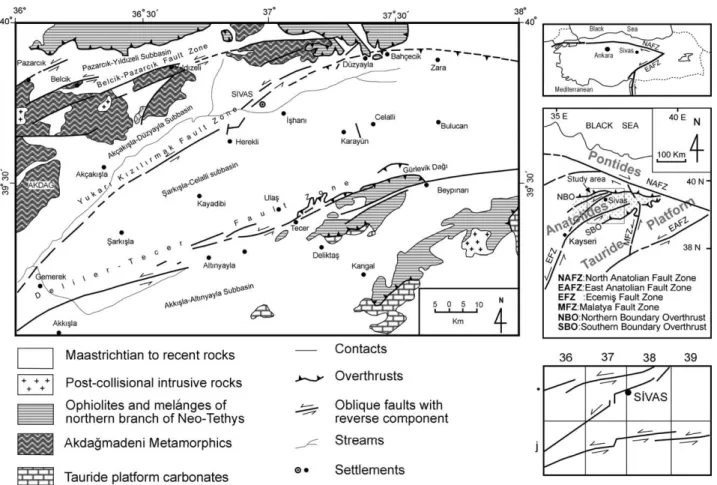
Sivas Basin is of post-collisional origin and may be a peripheral or foredeep basin according to the classification of Dickinson (1974) and Miall (1981). The sedimentary infill of the basin is made up of molasse (Kukal and Al-Jassim, 1971) with shallow marine interbeds and is divided into four subbasins by left lateral oblique fault zones with reverse components (Fig. 1).
Interpretations of the evolution of the Sivas Basin outlined above are the result of a scarcity of geological evidence. In this study, we aim to rectify this situation by providing detailed geological data from the basin. These data include the regional geological setting, and stratigraphical, sedimentary and tectonic features of the region; the little known differences between the subbasins and the structural evolution of the basin are also described.
2. Regional geological setting of the study area
The Sivas Basin is developed on Anatolide and Tauride tectonic units as defined by Ketin (1966). An important question relates to the type of basement on which the basin formed. Since the boundaries of the basin are overthrusts or left-lateral oblique faults with reverse components, there is no outcrop of basement within the central basin. This makes
Fig. 1. Location and simplified geologic map showing tectonic units of the Sivas Basin.
it difficult to examine the relationship between the basement and the sedimentary fill. All rock units of the regional basement are of pre-Maastrichtian age (Yılmaz, 1994), and are composed mainly of ophiolites belonging to the northern branch of Neo-Tethys. They include mela´nges with fore-arc deposits, the Akdag˘madeni metamorphic suite (O¨ zcan et al., 1980; Yılmaz, 1980) and Tauride Platform carbonates overthrusted by tectonic slices of mela´nges and ophiolites. This mosaic is a product of collision. Maas-trichtian-Paleocene carbonates overlie this mosaic uncon-formably in the northern part of the area (Fig. 2) around Karac¸ayır (Yılmaz and O¨ zer, 1984). On the other hand, Maastrichtian-Paleocene carbonates of shallow marine origin unconformably overlie Jurassic-Lower Cretaceous carbonates of the Tauride Platform and ophiolitic units in the southern part of the basin (Yılmaz et al., 1990; I˙nan et al., 1993). The carbonates pass conformably into the upper levels of the basin fill in the S¸arkıs¸la area. In addition, Maastrichtian clastic rocks unconformably overlie the older tectonic units around the Munzur Mountains in the eastern part of the basin (O¨ zgu¨l, 1981). These relationships illustrate a regional pre-Maastrichtian unconformity fol-lowed by formation of a new basin. The ophiolitic associations at the northern and southern margins of the Sivas Basin have similar characteristics of emplacement age and rock type (Yılmaz, 1985). Therefore, it is concluded that the ophiolitic associations on both sides of the basin have the same origin and are not products of different oceans.
There is no evidence of volcanic activity along the Eastern Pontide Arc from Maastrichtian to Paleocene times (Yılmaz and Terziog˘lu, 1994), to the north of the Sivas Basin. Hence, the arc activity in the Eastern Pontides appears to have terminated before the Maastrichtian. From geochemical evidence, it is considered that pre-Eocene and apparently Upper Maastrichtian-Paleocene granitoids that intruded metamorphic basement of Central Anatolian basins are of post-collisional origin (Bayhan, 1986; Tu¨reli, 1991; Geven et al., 1993; Yılmaz et al., 1993; Boztug˘ et al., 1994; Boztug˘, 1997). In addition, there is no metamorphism of Maastrichtian-Recent deposits around the Sivas Basin. In light of these observations, we conclude that post collisional sedimentary processes started immediately after formation of the Sivas Basin.
Imbrication of the oceanic crust, growth of a mela´nge prism and their emplacement took place before Maastrichtian times. These events occured between the Pontide Arc, representing an active continental margin to the north, and the Tauride-Anatolide Platform representing a passive continental margin to the south (S¸engo¨r and Yılmaz, 1981). No observations identify a relict oceanic crust of post-Maastrichtian age. It is, therefore, proposed that the Sivas Basin began to form on continental crust and reworked mela´nges after collision of the Pontide Arc and Tauride-Anatolide Platform. Mega-olistoliths within Upper Eocene olistostromal levels are interpreted as reworked materials of a mela´nge prism and its fore-arc association
formed by compression during intracontinental convergence (Yılmaz and O¨ zer, 1984). The basin fill and its deformation are of post collisional origin.
3. The Sivas Basin and its subbasins
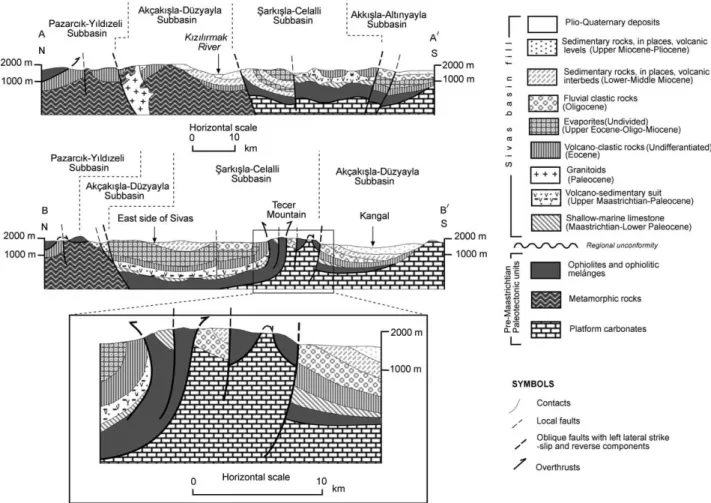
During continuing intracontinental convergence, the Sivas Basin was dissected into small-scale subbasins bounded by fault contacts at one or both margins (Figs. 1–3). SeeFigs. 4–7for the generalized stratigraphy and characteristic faunal content of each subbasin.
Maastrichtian-Tertiary basin infill of the basin is of continental and shallow-marine (in places, hemipelagic) facies. Sedimentary structures such as cross-bedding, graded bedding, flute casts, convolute bedding, asymme-trical ripple marks and turbidites formed in a shallow marine environment. Frequent lateral and vertical facies changes occur. Local or regional unconformities are common in the basin fill (Fig. 8) but deposition was not of deep marine flysch type. Volcanism occurred in shallow-marine and continental environments and without subsequent meta-morphism of the infill. Hence, this infill is similar to shallow marine molasse deposition as defined by Kukal and Al-Jassim (1971) and Miall (1981). Subdivision into subbasins by the oblique faults, along with left lateral strike slip, is dominant. Rock units showing different stratigraphic sequences are observed on each side of the faults. These subbasins, from north to south, are the Pazarcık-Yıldızeli, Akc¸akıs¸la-Du¨zyayla, S¸arkıs¸la-Celalli and Akkıs¸la-Altınyayla (Figs. 2 and 3).
3.1. Pazarcık-Yıldızeli subbasin
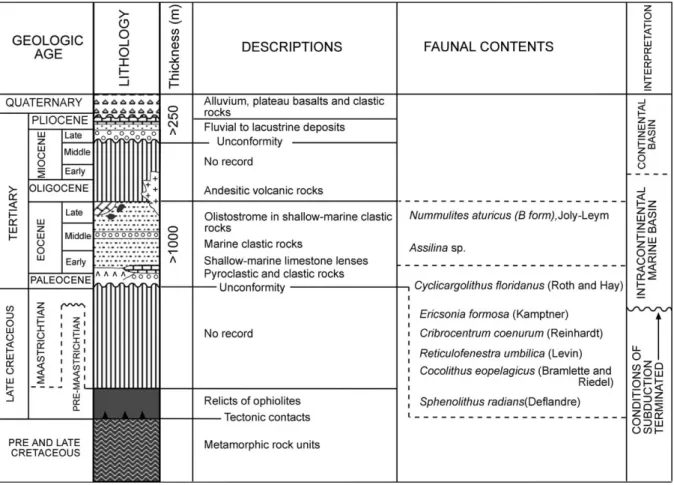
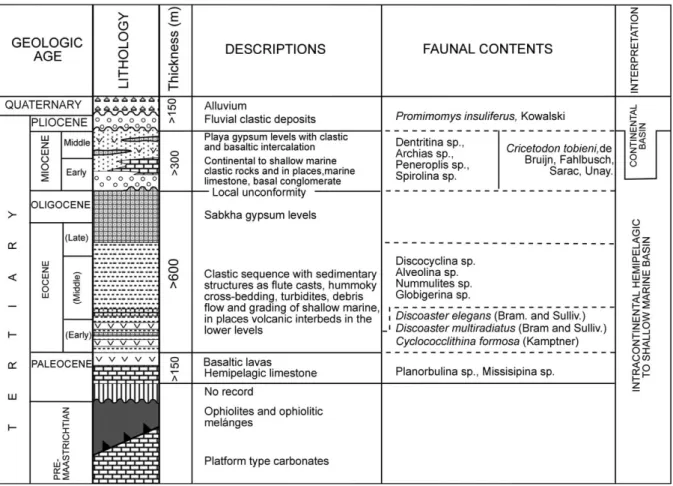
Geological characteristics of the basin, which are bounded by the North Anatolian Overthrust Zone to the north and the Pazarcık Fault Zone to the south, are described by Tatar (1977), O¨ zcan et al. (1980), Yılmaz (1980) and Yılmaz and O¨ zer (1984). The lowermost level of the subbasin is made up of (?)Paleocene–Eocene pyroclastic rocks unconformably overlying the Akdag˘ma-deni metamorphic complex and relict ophiolitic units in the western part of the study area (Figs. 3 and 4). Eocene marine and clastic rocks conformably overlie the volcanic rocks and pass upward into an olistostromal level containing reworked material from ophiolitic units and limestones (Fig. 4). Olistostrome with mega-olisto-liths are the product of reactivation of ophiolitic nappes from north to south during the Late Eocene. Subsequently, volcanic rocks were emplaced within the Eocene sequence and Upper Miocene–Pliocene fluvial deposits were deposited unconformably on older units. The northern boundary of this deposition was affected by overthrusting (Figs. 1 and 2) and the North Anatolian Overthrust Zone originated from reactivation of the nappe emplacement. These renewed movement’s occured
Fig. 2. Ge ologic map of the w estern part of the Sivas Basin.
during Late Miocene–Pliocene times. Plio-Quaternary basalts and clastic rocks unconformably overlie the overthrusts and older units.
3.2. Akc¸akıs¸la-Du¨zyayla subbasin
This basin is bounded by the Pazarcık Fault Zone to the north and the Yukarıkızılırmak Fault Zone to the south (Figs. 1–3). The Akdag˘madeni metamorphic complex comprises the northeastern part of the Central Anatolian Massif and, together with obducted ophiolite and metavol-cano-sediments of ophiolitic me´lange, forms the basement. Metamorphic rocks of amphibolite to greenschist facies and ophiolitic units were intruded by granitoids (Fig. 5) interpreted to be of postcollisional origin based on geochemical data (Bayhan, 1986; Tu¨reli, 1991; Alpaslan, 1993; Geven et al., 1993). Maastrichtian-Paleocene lacus-trine-lagoonal carbonates unconformably overlie the basement to the east of Karac¸ayır, northeast of the study area (Yılmaz and O¨ zer, 1984). Middle Eocene units unconformably overlie all older rocks in this basin and pass upwards into basaltic lavas southwest of Yıldızeli and gypsum levels northwest of Akc¸akıs¸la (Fig. 5). At lower
levels of the Eocene units, fluvial to alluvial fans are dominant. At the upper levels, facies change from hemipelagic to sabkha. Lower-Middle Miocene volcano-clastic rocks incorporate playa gypsum levels and overlie Oligocene deposits with a local unconformity around Ortako¨y (Fig. 2). Upper Miocene–Pliocene fluvial and lacustrine deposits and Quaternary alluvium unconformably overlie the older rocks.
3.3. S¸arkıs¸la-Celalli subbasin
This basin is bounded by the Yukarıkızılırmak Fault Zone to the north and the Deliler-Tecer Fault Zone and the Tecer overthrust to the south. Lowermost levels of the basin fill are composed of Maastrictian (?)-Paleocene hemipelagic limestones (Figs. 1–3 and 6), passing upwards into Paleocene basaltic lavas and Eocene clastic rocks. The latter include sedimentary structures such as flute casts, hummocky cross bedding, turbidites, debris flow and graded bedding of shallow-marine origin. Eocene olistostromal levels, Late Eocene–Oligocene sabkha gypsum levels, and Oligocene fluvial deposits are also present (Go¨kten, 1983; Go¨kc¸en and Kelling, 1985; Su¨mengen et al., 1987; Yılmaz Fig. 3. Cross-sections of the Sivas Basin (For location seeFig. 2).
et al., 1989, 1990). In the east, Lower Miocene clastic rocks or neritic carbonates overlie older units with a local unconformity and pass upward into playa gypsums. There are basalt intercalations within the Middle Miocene continental deposits in the west, and the sequence indicates a gradual transition between continental levels of Oligocene and Early Miocene age. There is also a gradual facies change between the eastern and western sequences. Plio-Quaternary fluvial deposits and Quaternary alluvium unconformably overlie the Miocene rocks.
3.4. Akkıs¸la-Altınyayla subbasin
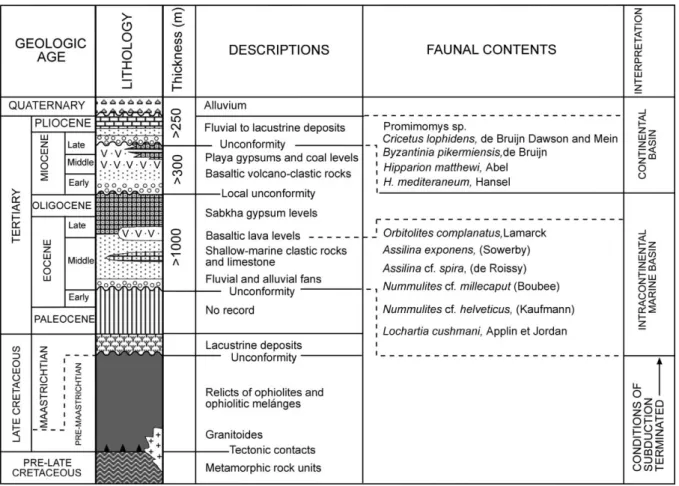
This subbasin was formed on a basement consisting Jurassic-Cretaceous carbonates of the Tauride Platform and obducted ophiolites and mela´nge. It is bounded by the Deliler-Tecer Fault Zone and overthrusts in the north. Maastrichtian-Paleocene neritic carbonates overlie the basement unconformably (Yılmaz et al., 1989, 1990; I˙nan et al., 1993) and are underlain unconformably by Eocene marine clastic rocks (Gu¨rsoy, 1986). This sequence passes upwards into Upper Eocene–Oligocene sabkha gypsums, Oligocene and Lower-Middle Miocene fluvial-lacustrine deposits (Figs. 1–3 and 7), Upper Miocene–Pliocene fluvial-lacustrine deposits, Plio-Quaternary plateau basalts and Quaternary alluvial deposits.
4. Correlation of subbasins
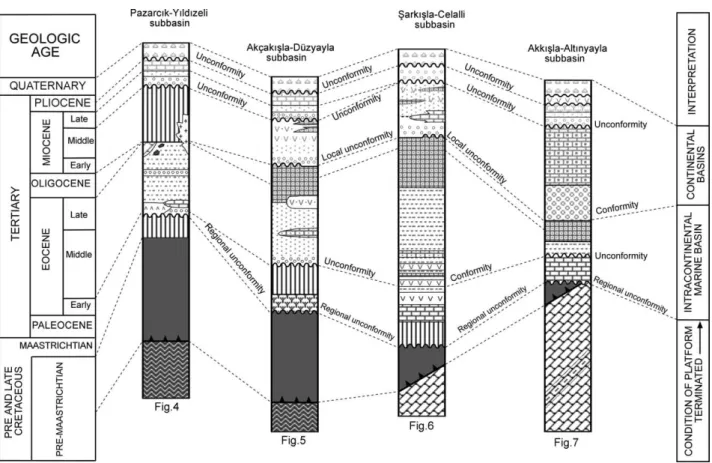
When subbasins of the Sivas Basin are interpreted as a whole (Fig. 8) it is apparent that Maastrichtian-Paleocene rocks of lacustrine-lagoonal origin and shallow-marine carbonates unconformably overlie basement composed of continental and oceanic assemblages. There are sharp facies changes in both lateral and vertical directions in each subbasin and among the subbasins. These changes are products of post collisional compression and/or extension.
Paleocene pyroclastic rocks with lavas have been observed in the Pazarcık-Yıldızeli subbasin to the north and the S¸arkıs¸la-Celalli subbasin to the south. In both basins, Eocene marine clastics conformably overlie the volcanic rocks, although Eocene units overlie the older rocks unconformably in the Akc¸akıs¸la-Du¨zyayla and Akkıs¸la-Altınyayla subbasins situated to the south of the other basins. This could record depositional processes in the former basins and erosional processes in the latter basins at the beginning of the Eocene.
Lower-Middle Miocene units representing shallow marine and transitional to lacustrine environments have been observed in the Akc¸akıs¸la-Du¨zyayla and S¸arkıs¸la-Celalli subbasins, but overlie the Oligocene deposits with a local unconformity. In the latter subbasins Lower-Middle
Fig. 4. Generalized columnar section of the Pazarcık-Yıldızeli subbasin (AfterYılmaz et al., 1995).
Miocene neritic carbonates and clastic rocks are observed in the eastern part of the Sivas Basin (Kurtman, 1973). Coastal sand bars and fluvial to lacustrine clastic rocks of the same age are observed on the western side of Sivas. Lower-Middle Miocene fluvial and deltaic facies are observed on the westernmost part in the Gemerek region (Su¨mengen et al., 1987). Transgression during this period occurred from east to west within the subbasin (Cater et al., 1991). Lower-Middle Miocene fluvial and lacustrine deposits conformably overlie Oligocene fluvial rocks in the Akkıs¸la-Altınyayla subbasin (Yılmaz et al., 1989).
Upper Miocene–Pliocene deposits composed of fluvial clastics at the lower level and lacustrine carbonates at high levels, unconformably overlie older rocks in the Akc¸akıs¸la-Du¨zyayla and Akkıs¸la-Altınyayla subbasins. Upper Plio-Quaternary fluvial deposits unconformably overlie older units in general, and Plio-Quaternary plateau basalts are observed within the northern and southern subbasins but not in the central subbasins. Transtensional and transpressional oblique faults, including mainly left lateral strike-slip (in places with reverse components), separate the subbasins.
Hence, each subbasin in the Sivas Basin has a different stratigraphic sequence that resulted from variable influences
of post collisional processes in both time and place. As a whole, the basin infill represents molasse deposits with shallow marine intercalations, and is therefore, interpreted as an intracontinental sequence recording post collisional processes.
5. Tectonics
5.1. Pre-Maastrichtian
In the northern part of the study area, Pre-Maastrichtian olistostrome of the mela´nge are observed in megablocks comprising Eocene sequences along the North Anatolian Overthrust (Yılmaz and O¨ zer, 1984). These megablocks and pre-Maastrichtian tectonic slices of serpentinite and meta-volcanic rocks within the mela´nge on the Akdag˘madeni metamorphic rocks east of Karac¸ayır indicate that transport of the main nappe transportation occurred before the Maastrichtian. This follows because Maastrichtian-Paleo-cene lacustrine and lagoonal carbonates overlie older units, recording different geotectonic environments.
Fig. 5. Generalized columnar section of the Akc¸akıs¸la-Du¨zyayla subbasin (Rodent determinations afterU¨ nay et al., 2003; the other determinations from Yılmaz et al., 1995).
5.2. Eocene
5.2.1. North Anatolian and Tecer Overthrusts
The North Anatolian Overthrust is situated in the northern part of the study area and dips to the north. However, the Tecer Overthrust situated in the southern part of the study area dips to the south (Figs. 1 and 3). Along both overthrusts, ophiolitic mela´nge and cover rocks are obducted into the Eocene olistostrome. The olistostrome in both the northern and southern parts include megaolistoliths derived from the mela´nge and forearc deposits. Both structures probably formed by reactivation and secondary nappe transport during Late Eocene times as a result of intensified post collisional processes.
5.2.2. Pazarcık Fault Zone
Brecciated conglomerates are observed within and around this fault zone that delimits (Fig. 2) the Akdag˘madeni metamorphic rocks and Paleocene–Eocene units of the Pazarcık-Yıldızeli subbasin. The fault was active during the Eocene, and probably during pre-Eocene times. Metamorphic rocks are thrust over Eocene units along the fault zone. The angle of dip of the fault plane increases eastwards. Tectonic juxtaposition of older and younger rock units, offset streams, and oblique striations
along the fault zone all show that the Pazarcık Fault Zone is oblique-slip and active.
5.3. Late Miocene–Pliocene
5.3.1. Yukarıkızılırmak and Deliler-Tecer Fault Zones
Oligocene-Lower/Middle Miocene units and Upper Miocene–Pliocene clastic rocks are juxtaposed by oblique faults with a predominant left lateral slip component (Erkan et al., 1978; I˙nan et al., 1993) in the central and southern parts of the Sivas Basin. The Yukarıkızılırmak Fault Zone has reverse motion with the upthrust hanging wall dipping to the south. In contrast, the Deliler-Tecer Fault Zone is also reversed but dips north. The amount of upthrust increases towards the eastern part of the area (Figs. 1–3) where both fault zones trend in an east–west direction. Both zones more closer to each other in the southwest part of the study area and may merge into the Ecemis¸ Fault Zone.
Gypsums, which mainly precipitated between the Late Eocene and Oligocene, occur as diapiric structures along the oblique-slip boundary faults at the contacts between Lower and Middle Miocene rocks. The diaprism caused defor-mation of the basin fill into small-scale overturned folds and intrabasin overthrusts. We, therefore, propose that the study
Fig. 6. Generalized columnar section of the S¸arkıs¸la-Celalli subbasin (Rodent determinations afterSu¨mengen et al., 1990; the other determinations from Yılmaz et al., 1989).
area was affected by north–south compression between Late Miocene and Pliocene times.
5.4. Plio-Quaternary
Pull-apart basins are dominant structures along the northeast–southwest trending oblique fault during Plio-Quaternary time. The Altınyayla basin is a typical example of a pull-apart basin (Yılmaz et al., 1989; Koc¸yig˘it and Beyhan, 1998). In addition, approximately north–south trending oblique faults with predominant normal slip components were also active during this time. Hot springs such as those at C¸ ermik (Fig. 2) are located along these faults. In conclusion, all these faults may have been resulted from the same tectonic regime, representing north–south directed intracontinental convergence.
6. Evolution of the Sivas Basin
Based on the internal structure of the basin fill and the relationship between basement and cover, we propose that the Sivas Basin was shaped by four stages (Fig. 9).
6.1. Maastrichtian-Oligocene stage
The Sivas basin began to form on top of the Neo-Tethyan ophiolitic suture zone composed of Pre-Maastrichtian tectonic units as well as the Tauride platform (Fig. 9(a)). Slow subsidence was initiated under a regime of local tension following collision at the beginning of the Maastrichtian. This extension was accompanied by lacustrine and lagoonal to shallow marine carbonate sedimentation. Subsidence increased from the Late Maastrichtian to Paleocene time. At first, hemi-pelagic carbonate accumulated followed by basaltic volcanism (Fig. 9(b)). Eocene volcanoclastics, turbidites and olistostromal deposits conformably overlie the volcanic rocks in the Pazarcık-Yıldızeli and S¸arkıs¸la-Celalli subbasins. In contrast, the unconformity between Eocene clastic rocks and Maastrichtian-Paleocene carbon-ates and the tectonic units in the Akc¸akıs¸la-Du¨zyayla and Akkıs¸la-Altınyayla subbasins, is related to a compressional tectonic regime before the Eocene. The basin underwent intensive regional compression during the Late Eocene leading to reactivation and nappe motion of tectonic units derived from the basement to the north and south of the study area (Fig. 9(c)). As a result, a regressive sequence was deposited and conformably followed by Upper Eocene– Oligocene sabkha gypsum and Oligocene deltaic-fluvial
Fig. 7. Generalized columnar section of the Akc¸akıs¸la-Altınyayla Subbasin (Rodent determinations afterU¨ nay et al., 2003; the other determinations from Yılmaz et al., 1990).
deposits. The regression was a consequence of ongoing compression and continued intracontinental convergence.
6.2. Early-Middle Miocene stage
The regime became subaerial at the end of the Oligocene, and sedimentation of fluvial and lacustrine deposits continued during the Early-Middle Miocene in the Akkıs¸la-Altınyayla subbasin to the south. However, Lower-Middle Miocene shallow marine carbonates and clastics with basaltic flows unconformably overlie Oligocene fluvial rocks in the S¸arkıs¸la-Celalli subbasin. This transgressive relationship may be related to a compressional regime during the Oligocene-Early Miocene that was followed by local tension (Fig. 9(d)) leading to formation of the Early Miocene basin with a transgression advancing towards the west. The subbasin underwent compressional deformation during Middle Miocene times and then closed, terminating in deposition of fluvial clastics and playa gypsums. There are no Lower-Middle Miocene deposits in the northern subbasins and these regions may have been sites of erosional ridges resulting from compression-induced uplift.
6.3. Late Miocene-Pliocene stage
This represents the neotectonic phase of transpression and transtension. Transpression in the Middle Miocene was
followed by transtension in the Late Miocene. Fluvial clastics, were deposited first, followed by lacustrine carbonates and ended with eruption of plateau basalt during the transtensional phase.
6.4. Plio-Quaternary stage
This last stage followed the transpressive episode and deposition of fluvial clastics. The Sivas Basin was subjected to both transpressional and transtensional processes with the latter resulting in formation of local pull-apart basins (Fig. 9(e); see Yılmaz et al., 1989; Koc¸yig˘it and Erol, 2001). New small scale, mainly pull-apart-type basins such as I˙mranlı, I˙s¸hanı, Altınyayla and S¸arkıs¸la basins occur as superimposed basins.
7. Discussion
The western and northern Central Anatolian basins have been interpreted as both fore-arc basins (Go¨ru¨r et al., 1984; Koc¸yig˘it, 1991; Go¨kten, 1993a) and collisional basins (Erdog˘an et al., 1996). The Sivas Basin has been interpreted as a remnant basin between the Pontides and the Tauride Platform (Kelling et al., 1989; Cater et al., 1991) or as a remnant basin resulting from Inner Tauride Ocean closure (S¸engo¨r and Yılmaz, 1981; Koc¸yig˘it, 1990; Go¨kten, 1993a; Guezou et al., 1996) and/or a collisional relict of the
Fig. 8. Correlation table of the Sivas Basin (For explanations seeFigs. 4–7).
Neo-Tethyan Ocean (Go¨kten, 1993b; Poisson et al., 1995, 1996). Alternatively, it has also been interpreted as a post-collisional basin that formed after closure of the northern branch of Neo-Tethys (Yılmaz, 1994, 1998). These varied interpretations are a reflection of the paucity of data.
It is clear that there are two main ophiolitic belts, one located to the north, the other to the south of the Sivas Basin. The northern belt is interpreted as a relict of the northern branch of Neo-Tethys (S¸engo¨r and Yılmaz, 1981), whereas the southern belt is interpreted as a product of the Inner Tauride Ocean (S¸engo¨r and Yılmaz, 1981; Koc¸yig˘it and Erol, 2001; Go¨kten, 1985, 1986; Go¨kten and Floyd, 1987; Go¨kten, 1993b; Go¨kten, 1983a,b). However, the age and setting of these ophiolitic belts are the same and they merge in the east to combine in the Erzincan area where they are interpreted as products of the same ocean (Yılmaz, 1985).
The Sivas Basin developed on the Neo-Tethyan ophiolitic suture zone between the Pontide Arc and Tauride Platform, and started to form on a mosaic of obducted ophiolitic units derived from the northern branch of Neo-Tethys and the northern margin of the Tauride Platform. There is a regional unconformity between the mosaic and sedimentary fill and no link between pelagic levels of the ophiolites and basin fill, implying that the Sivas Basin is a relict ocean. This key observation leads to the
interpretation of the Sivas Basin as a post collisional basin and is classified as a peripheral or foredeep basin according to the definitions ofDickinson (1974) and Miall (1981).
Sedimentary facies include shallow-marine and continental facies. Each subbasin has a different stratigraphic sequence. Both lateral and vertical facies changes of shallow-marine (locally hemipelagic) and continental deposits are common. Sedimantary structures indicate that the basin fill is not deep marine flysch, but instead a shallow marine molasse comparable to that described by Kukal and Al-Jassim (1971) from the Mesopotamian Area. In this respect, the Sivas Basin appears to have had a setting similar to the Persian Gulf today during the Oligocene–Miocene times.
Volcanism in the Sivas Basin occured in shallow-marine and continental environments. Upper Maastrichtian (?)-Paleocene volcanic rocks of the S¸arkıs¸la area (Fig. 2) are interpreted as products of a local basinal area (Go¨kten and Floyd, 1987). Pre-Eocene granitoids that intrude the metamorphic rocks comprising the basement of the Central Anatolian basins are evidence of a post collisional phase within the framework defined by geochemical data (Bayhan, 1986; Tu¨reli, 1991; Alpaslan, 1993; Geven et al., 1993; Yılmaz et al., 1993; Boztug˘ et al., 1994; Yılmaz and Boztug˘, 1996;Boztug˘, 1997). As a result, we propose that the chemical signature of igneous rocks in the Sivas Basin
Fig. 9. Simplified geological sections depicting synthetic structural evolution of the Sivas Basin (Tension or compression is represented by the horizontal arrows).
and surrounding area is a record of post collisional magmatism.
Other characteristics of the Sivas Basin fill are as follow: the basin was divided into subbasins by predominantly left lateral strike-slip oblique faults. Reverse slip is exhibited north and south of the area. Both longitudinal (east–west) and lateral (north–south) asymmetries occur along the basin and there is close relationship between regional tectonics and salt tectonics within the Sivas Basin. Local unconfor-mities within the infill are common.
8. Conclusion
The Sivas Basin is re-defined here as a post-collisional basin developed on ophiolitic units of the northern branch of Neo-Tethys obducted over the Tauride Platform. The basin fill, as a whole, was deformed during the Neotectonic Phase, mainly during the Plio-Quaternary, when transtentional and transpressional processes were dominant. This deformation is continuing in small-scale pull-apart basins such as I˙mranlı, I˙s¸hanı, Altınyayla and S¸arkıs¸la (Yılmaz et al., 1989; Yılmaz, 1998; Koc¸yig˘it and Erol, 2001). In this respect, the Sivas Basin, as a whole, can also be interpreted as a superimposed basin, as defined byKoc¸yig˘it (1996)for the Refahiye Basin.
Acknowledgements
This study was carried out as a part of MTA and Cumhuriyet University geological projects. The directors of the geological department and Sivas Headquarter of MTA have accelerated and facilitated the work. Interesting and fruitful discussions were held in the field with many colleagues. The first version of the manuscript was criticized by Prof. Dr Ali KOC¸ YI˙G˘ I˙T and Prof. Dr Ali O¨ZTU¨RK. In addition, the manuscript was improved in the light of constructive and useful critics by anonymous referee and also Dr Andre´ POISSON. The authors are grateful to them.
References
Alpaslan, M., 1993. Yıldızeli yo¨resi (Sivas batısı) metamorfitlerinin petrolojik incelemesi. PhD Thesis, Cumhuriyet University, Unpublished, Sivas, p. 359.
Altınlı, I.E., 1963. Kayadibi-S¸arkıs¸la bo¨lgesinin jeolojisi ve hidrojeolojisi. I˙stanbul U¨ niversitesi Fen Faku¨ltesi Bu¨lteni 26, 162–199.
Artan, U¨ ., Sestini, G., 1971. Geology of the Beypınarı-Karababa area (Sivas Province). Bulletin of the Mineral Research and Exploration 76, 72–89. Bayhan, H., 1986. I˙c¸ Anadolu Granitoyid Kus¸ag˘ı’ndaki C¸ elebi Sokulu-mu’nun jeokimyası ve ko¨kensel yorumu. Geological Engineering Journal, Ankara 29, 27–36 (in Turkish with English Abstract). Baykal, F., Erento¨z, C., 1966. Explanatory text of the Geological Map of
Turkey, Sivas Sheet, at 1/500.000 scale. Mineral Research and Exploration Special Publication Ankara, p. 116.
Boztug˘, D., 1997. Post-Collisional Central Anatolian Alkaline Plutonism, Turkey. Proceedings Tubitak-Bayg/Nato-D Program on Alkaline Magmatism, Sivas-Turkey, pp. 105–146.
Boztug˘, D., Yılmaz, S., Keskin, Y., 1994. I˙c¸-Dog˘u Anadolu Alkalin Provensindeki Ko¨sedag˘ Plu¨tonu (Sus¸ehri-KD Sivas) Dog˘u Kesiminin Petrografisi ve Petrojenezi. Geological Bulletin of Turkey 37 (2), 1–14. Cater, J.M.L., Hanna, S.S., Ries, A.C., Turner, P., 1991. Tertiary evolution
of the Sivas Basin, Central Turkey. Tectonophysics 195, 29–46. C¸ iner, A., Kos¸un, E., Deynoux, M., 2002. Fluvial, evaporitic and
shallow-marine facies architecture, depositional evolution and cyclicity in the Sivas Basin (Lower to Middle Miocene), Central Turkey. Journal of Asian Earth Sciences 21 (2), 147–165.
C¸ ubuk, Y., I˙nan, S., 1999. I˙mranlı gu¨neyinde (Sivas) Miyosen havzasının stratigrafik ve tektonik o¨zellikleri. Bulletin of the Mineral Research and Exploration 120, 45–60.
Dickinson, W.R., 1974. Plate tectonics and sedimentation. In: Dickinson, W.R. (Ed.), Tectonics and Sedimentation. Society of Economic Paleontologists and Mineralogists, pp. 1–27. Special Publications.
Erdog˘an, B., Akay, E., Ug˘ur, M.S., 1996. Geology of the Yozgat Region and Evolution of the Collisional C¸ ankırı Basin. International Geology Review 38, 788–806.
Erkan, E.N., O¨ zer, S., Su¨mengen, M., Terlemez, I˙., 1978. Sarız, S¸arkıs¸la, Gemerek, Tomarza arasının temel jeolojisi. Mineral Research and Exploration Report No. 5646, Unpublished, Ankara, p. 241.
Geven, A., Unan,C., Erler, A., Akıman, O., 1993. Cefalıkdag˘ granitoidinin petrolojisi (Kaman-Kırs¸ehir). In: 25th Anniversary Symposium of Hacettepe University Earthsciences, Abstracts, Ankara, p. 43 (in Turkish with English Abstract).
Go¨kc¸en, S.L., 1981. Zara-Hafik gu¨neyindeki Paleojen istifinin sedimento-lojisi ve paleocog˘rafik evrimi. Yerbilimleri 8, 1–25 (in Turkish with English Abstract).
Go¨kc¸en, S.L., Kelling, G., 1985. Oligocene deposits of the Zara-Hafik region (Sivas Central Turkey): evolution from storm-influenced shelf to evaporitic basin. Geologische Rundschau 74, 139–153.
Go¨kten, E., 1983. S¸arkıs¸la (Sivas) gu¨neydog˘usunun stratigrafisi ve jeolojik evrimi. Geological Bulletin of Turkey 26, 167–176 (in Turkish with English Abstract).
Go¨kten, E., 1984. S¸arkıs¸la (Sivas) yo¨resinin tektonig˘i. Geological Engineering Journal 20, 3–9 (in Turkish with English Abstract). Go¨kten, E., 1985. The inner structure and emplacement of the allochtonous
units in the area around Cemal, Mudarasın and Deliilyas villages (S¸arkıs¸la-Sivas). Communication de la Faculte des Sciences de l’Universite d’Ankara 1 (27/28), 17–31.
Go¨kten, E., 1986. Paleocene carbonate turbidites of the S¸arkıs¸la region, Turkey—their significance in an orogenic basin. Sedimentary Geology 49, 143–165.
Go¨kten, E., 1993a. Ulas¸ (Sivas) dog˘usunda Sivas havzası gu¨ney kenarının jeolojisi; Neotetis’in kuzey kolunun kapanması ile ilgili tektonik gelis¸im. In: 46th Geology Congress of Turkey, Abstracts, Ankara, p. 68. Go¨kten, E., 1993b. Geology of the southern boundary of Sivas basin in the east of Ulas¸ (Sivas-Central Anatolia); Tectonic development related to the closure of Inner Tauride Ocean. Turkish Association of Petroleum Geologists Bulletin 5 (1), 35–55.
Go¨kten, E., Floyd, P., 1987. Geochemistry and tectonic environment of the S¸arkıs¸la area volcanic rocks in Central Anatolia, Turkey. Mineralogical Magazine 51, 553–559.
Go¨ru¨r, N., Oktay, F.Y., Seymen, I., S¸engo¨r, A.M.C., 1984. In: Dixon, J.E., Robertson, A.H.F. (Eds.), Paleo-tectonic Evolution of the Tuzgo¨lu¨ Basin Complex, Central Turkey: Sedimentary Record of a Neo-Tethyan Closure. The Geological Evolution of the Eastern Mediterranean, vol. 17. Geological Society, London, pp. 455–466. Special Publications. Guezou, J.C., Temiz, H., Poisson, A., Gu¨rsoy, H., 1996. Tectonics of the
Sivas Basin. The Neogene record of the Anatolian accretion along the inner Tauric Suture. International Geology Review 38, 901–925.
Gu¨rsoy, H., 1986. O¨ renlice-Eskiko¨y (Sivas) yo¨resinin stratigrafik ve tektonik o¨zellikleri: Master Thesis, Cumhuriyet University, Unpublished, Sivas, p. 48.
I˙nan, S., O¨ ztu¨rk, A., Gu¨rsoy, H., 1993. Ulas¸-Sincan (Sivas) yo¨resinin stratigrafisi. Turkish Journal of Earth Sciences 2, 1–15.
Kangal, O¨ ., Varol, B., 1999. Sivas Havzası Alt Miyosen istifinde havza kenarı fasiyesleri. Turkish Association of Petroleum Geologists 11 (1), 31–53.
Kavak, K.S., Poisson, A., Guezou, J.C., 1997. Tectonostratigraphy of the sothern Sivas Tertiary Basin (Central Turkey) and comparison with landsat MSS imagery. International Geology Review 39, 353–364. Kelling, G., Go¨kc¸en, S.L., Go¨kc¸en, N.S., Go¨kten, E., Bromley, A.J., 1989.
Tectono-Sedimentary Evolution of a Neo-Tethyan Collisional Trough: Sivas-Refahiye Basin Central Turkey: 28th International Geological Congress, Washington, DC, USA, Abstracts, 2(3), pp. 171–172. Ketin, I., 1966. Tectonic units of Turkey. Bulletin of the Mineral Research
and Exploration 66, 20–34.
Koc¸yig˘it, A., 1990. U¨ c¸ Kenet Kus¸ag˘ı’nın Erzincan batısındaki (KD Tu¨rkiye) yapısal ilis¸kileri: Karakaya, I˙c¸ Toros ve Erzincan Kenetleri. In: 8th Petrol Congress of Turkey, Abstracts, Ankara, pp. 152–160.
Koc¸yig˘it, A., 1991. An example of an accretionary forearc basin from northern central Anatolia and its implications for the history of subduction of Neo-Tethys in Turkey. Geological Society of America Bulletin 103, 22–36.
Koc¸yig˘it, A., 1996. Superimposed Basins and their relations on the recent strike-slip fault zone. A case study of the Refahiye superimposed Basin adjacent to the North Anatolian Transform Fault, Northeastem Turkey. International Geology Review 38, 701–713.
Koc¸yig˘it, A., Beyhan, A., 1998. A new intracontinental transcurrent structure: the central Anatolian Fault Zone, Turkey. Tectonophysics 284, 317–336.
Koc¸yig˘it, A., Erol, O., 2001. A tectonic escape structure: Erciyes pull-apart basin, Kayseri, central Anatolia, Turkey. Geodinamica Acta 14, 133–145.
Kos¸un, E., C¸ iner, A., 2002. Zara gu¨neyi (Sivas Havzasi) karasal-sıg˘ denizel miyosen c¸o¨kellerinin litostratigrafisi ve fasiyes o¨zellikleri. Bulletin of the Mineral Research and Exploration 125, 65–88.
Kukal, Z., Al-Jassim, J., 1971. Sedimentology of Pliocene Molasse sediments of the Mesopotamian Geosyncline. Sedimentary Geology 5, 57–81.
Kurtman, F., 1973. Sivas-Hafik-Zara ve I˙mranlı bo¨lgesinin jeolojik ve tektonik yapısı. Bulletin of the Mineral Research and Exploration 80, 1–32.
Miall, A.D., 1981. In: Miall, A.D. (Ed.), Alluvial Sedimentary Basins: Tectonic Setting and Basin Architecture Sedimentation and Tectonics in Alluvial Basins. Special Publications, vol. 23. Geological Assoccia-tions of Canada, London, pp. 1–33.
Ocakog˘lu, F., 1999. Evidences of the ductile deformation in evaporates around Zara area (E Sivas), Sivas Basin. Bulletin of the Mineral Research and Exploration 121, 19–31.
O¨ zcan, A., Erkan, A., Keskin, A., Keskin, E., Oral, A., O¨zer, S., Su¨mengen, M., Tekeli, O., 1980. Kuzey Anadolu Fayı-Kırs¸ehir Masifi arasının temel jeolojisi. Mineral Research and Exploration Institute of Turkey Report No. 6722, Unpublished, Ankara, p. 139.
O¨ zden, S., Poisson, A., O¨ztu¨rk, A., Bellier, J.P., Blondeau, A., Wernli, R., 1998. Tectonostratigraphic relationships between the North Anatolian thrust zone (NATZ) and the Kırs¸ehir massif to the North of Sivas (Turkey). Comptes Rendus de L’acade´mie des Sciences; Serie II Fascicule A-Sciences de la Terre et des Planetes 327, 705–711. O¨ zgu¨l, N., 1981. Munzur dag˘larının jeolojisi. Mineral Research and
Exploration Institute of Turkey Report No. 6995, Ankara, p. 136. Poisson, A., Guezou, J.C., O¨ ztu¨rk, A., I˙nan, S., Temiz, H., Gu¨rsoy, H.,
Kavak, S¸.K., O¨ zden, S., 1995. The Central Anatolian Basins in Turkey. General Evolution of The Sivas Basin as an Example. In: International Earth Sciences Colloquium on the Aegean Region, Gu¨llu¨k-I˙zmir, Proceedings, vol. 1, Gu¨llu¨k-I˙zmir, pp. 113–134.
Poisson, A., Guezou, J.C., O¨ ztu¨rk, A., I˙nan, S., Temiz, H., Gu¨rsoy, H., et al., 1996. Tectonic setting and evolution of the Sivas basin, Central Anatolia, Turkey. International Geology Review 38, 838–853. S¸engo¨r, A.M.C., Yılmaz, Y., 1981. Tethyan evolution of Turkey: a plate
tectonic approach. Tectonophysics 75, 181–241.
Su¨mengen, M., Terlemez, I˙., Tayfun, B., Gu¨rbu¨z, M., U¨ nay, E., Ozaner, S., Tu¨fekc¸i, K., 1987. S¸arkıs¸la-Gemerek dolayı Tersiyer havzasının stratigrafisi, sedimentolojisi ve jeomorfolojisi. Mineral Research and Exploration Institute of Turkey Report No. 8118, Unpublished, Ankara, p. 241.
Su¨mengen, M., U¨ nay, E., Sarac¸, G., de Bruijn, H., Terlemez, I˙, Gu¨rbu¨z, M., 1990. New Neogene rodent assemblages from Anatolia (Turkey). In: Lindsay, E.A., Fahlbush, V., Mein, P. (Eds.), Eurpean Neogene Mammal Chronology NATO ASI Series, Series A, Life Sciences. Plenum Press, New York, pp. 61–72.
Tatar, Y., 1977. Ofiyolitli C¸ amlıbel (Yıldızeli) bo¨lgesinin stratigrafisi ve petrolojisi. Bulletin of the Mineral Research and Exploration 88, 56–72.
Temiz, H., 1996. Tectonostratigraphy and thrust tectonics of the Central and eastern parts of the Sivas Tertiary Basin, Turkey. International Geology Review 38, 957–971.
Tu¨reli, T.K., 1991. Geology. Petrography and Geochemistry of Ekecikdag˘ Plutonic Rocks (Aksarak Region-Central Anatolia). PhD Thesis, Middle East Technical University, Unpublished, Ankara, p. 194. U¨ nay, E., de Bruijn, H., Sarac¸, G., 2003. A preliminary zonation of the
continental Neogene of Anatolia based on rodents. Deinsea 10, 1–10. Yılmaz, A., 1980. Tokat ile Sivas arasındaki bo¨lgede ofiyolitlerin ko¨keni, ic¸
yapısı ve dig˘er birimlerle ilis¸kisi. PhD Thesis, Ankara University, Unpublished, p. 136.
Yılmaz, A., 1981. Tokat ile Sivas arasındaki bo¨lgede ofiyolitli karıs¸ıg˘ın ic¸ yapısı ve yerles¸me yas¸ı. Geological Bulletin of Turkey 24, 31–36 (in Turkish with English Abstract).
Yılmaz, A., 1985. Yukarı Kelkit C¸ ayı ve Munzur dag˘ları arasının temel jeoloji o¨zellikleri ve yapısal evrimi. Geological Bulletin of Turkey 28, 79–92 (in Turkish with English Abstract).
Yılmaz, A., 1994. An example of post-collisional trough: Sivas Basin, Turkey. 10th Petroleum Congress of Turkey, Proceedings, Ankara 1994 pp. 21–23.
Yılmaz, A., 1998. Sivas Havzasinin Jeodinamik Evrimi, Tu¨rkiye. In: Boztug˘, D., O¨ zer, T., Otlu, N. (Eds.), Ofiyolit-Granitoyid I˙lis¸kisiyle Gelis¸en Demir Yatakları Sempozyumu Bildiriler Kitabı, Sivas, pp. 66–82 (in Turkish with English Abstract).
Yılmaz, A., O¨ zer, S., 1984. Kuzey Anadolu Bindirme Kus¸ag˘ı’nın Akdag˘madeni (Yozgat) ile Karac¸ayır (Sivas) arasındaki bo¨lu¨mu¨nu¨n temel jeoloji incelemesi ve Tersiyer havzasının yapısal evrimi. In: Ketin Symposium, Geolical Society of Turkey, Special Publications, Ankara, pp. 163–174 (in Turkish with English Abstract).
Yılmaz, A., Terziog˘lu, N., 1994. The geotectonic setting of Late Cretaceous-Tertiary volcanism along the Eastern Pontian Zone. In: International Volcanological Congress, Theme-2, Ankara, p. 39. Yılmaz, A., Su¨mengen, M., Terlemez, I˙., Bilgic¸, T., 1989. 1/100.000 o¨lc¸ekli
ac¸ınsama nitelikli Tu¨rkiye Jeoloji Haritaları Serisi, Sivas-. G23 Sheet. Mineral Research and Exploration Institute of Turkey, Special Publications, Ankara, p. 23.
Yılmaz, A., Su¨mengen, M., Terlemez, I˙., Bilgic¸, T., 1990. Sivas ile S¸arkıs¸la arasındaki bo¨lgenin jeolojisi. Mineral Research and Exploration Institute of Turkey Report No. 9090, Unpublished, Ankara, p. 54. Yılmaz, S., Boztug˘, D., O¨ ztu¨rk, A., 1993. Geological setting, petrographic
and geochemical characteristics of the Cretaceous and Tertiary igneous rocks in the Hekimhan-Hasanc¸elebi area, northwest Malatya, Turkey. Geological Journal 8, 383–398.
Yılmaz, A., Uysal, S¸., Bedi, Y., Yusufog˘lu, H., Havzog˘lu, T., Ag˘an, A., et al., 1995. Akdag˘ Masifi ve dolayının jeolojisi. Bulletin of the Mineral Research and Exploration 117, 125–138 (in Turkish with English Abstract).