Degree distribution of random Apollonian
network structures and Boltzmann sampling
Alexis Darrasse and Mich`ele Soria
LIP6 - Equipe SPIRAL, 104 avenue du pr´esident Kennedy, F-75016 Paris, France received26thFeb 2007,revised 20thMay 2007,accepted tommorow.
Random Apollonian networks have been recently introduced for representing real graphs. In this paper we study a modified version: random Apollonian network structures (RANS), which preserve the interesting properties of real graphs and can be handled with powerful tools of random generation. We exhibit a bijection between RANS and ternary trees, that transforms the degree of nodes in a RANS into the size of particular subtrees. The distribution of degrees in RANS can thus be analysed within a bivariate Boltzmann model for the generation of random trees, and we show that it has a Catalan form which reduces to a power law with an exponential cutoff:αkk−3/2, withα=8/9. We also show analogous distributions for the degree in RANS of higher dimension, related to trees of higher arity. Keywords:Boltzmann sampling, random networks, bivariate generating functions
1
Introduction
The introduction of computers as a tool in every scientific domain has allowed the analysis of an ever increasing volume of data. It became possible to represent, in every detail, complex networks that emerge from the interaction of different entities. But traditional graph theory is not sufficient for the study of these real-life networks, in particular random graphs have very different properties than the networks under consideration. This created an interest for a formal description of the characteristic properties of real-life networks and the development of random network models respecting these properties. The most important results were the description of two sets of properties, accompanied by models respecting them. The first is the small world model, characterized by a small mean distance and a large clustering coefficient. The second is scale free networks, characterized by the fact that the vertex degrees follow a power-law distribution.
Current research is trying to provide a single model having all the significant properties at the same time. Ravasz et al. (2002) introduced the hierarchical networks, a model that satisfies these properties but is deterministic; followed by a similar model, the Apollonian networks by Andrade Jr et al. (2005). That in turn inspired the random Apollonian networks (RAN) proposed by Zhou et al. (2005). The RAN model provides a simple random model with very interesting properties, particularly a large clustering coefficient and power-law degree distribution. For more information on these notions, Newman et al. (2006) give a compilation of recent developments and results on the structure and dynamics of networks.
Fig. 1:An Apollonian network and a random Apollonian network
In this paper we propose a variation of RAN that we call random Apollonian network structures (RANS). Our study of the RANS model relies on a bijection with unlabeled ternary trees. This bijec-tion can be extended to the RAN model, which is isomorphic to increasing ternary trees. Indeed RANS and RAN are the same objects but generated with different distributions: a RANS corresponds to many different RAN when underlying labelings are taken into account.
In the RANS model, generated networks have a distribution for degrees which has the form of a power law with an exponential cutoff, a distribution appearing in real graphs, as pointed out by Amaral et al. (2000). Large clustering is also preserved due to its direct relation to degree (a relation which is established for RAN and is carried over to RANS).
As for the RAN model (see Zhang et al. (2006)), the basic RANS model can be extended to higher dimensions and the same properties still hold. The key point for RANS is that they are isomorphic to families of trees that can be efficiently generated within a generic model of random sampling for combinatorial structures: Boltzmann model. This model does not reduce to efficient sampling but is also used to show properties of random objects.
This paper is divided in five parts. After this introduction, we present the random Apollonian network structures together with the bijection with ternary trees, and show the correspondence between the degree of a vertex in a RANS and the size of a partial subtree of the ternary tree. Part 3 is dedicated to Boltz-mann sampling of trees and the distribution of underlying parameters. We exhibit non critical substitution schemas that lead to discrete distributions. Part 4 deals with the degree distribution in RANS. Using bivariate analysis we show that it reduces to a non critical substitution of trees within trees and the distri-bution has a Catalan form that expresses as a power law with an exponential cutoff. In part 5 the RANS model is extended to higher dimensions with analog distributions.
2
Random Apollonian network structures
Original RAN can be generated using a simple iterative algorithm. Starting with an empty triangle, repeat the following step until the network reaches the desired size: choose randomly an empty triangle, place a new vertex in it and connect the new vertex to the three vertices of the triangle.
In this generation the order of creation of the vertices is relevant whereas for RANS we consider the resulting structure, independently of generation order. This leads to the following definition.
A
B
C
1
2
3
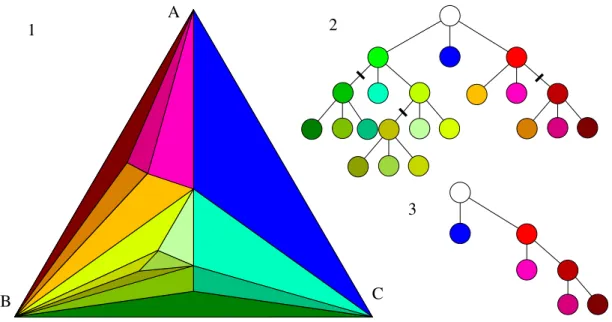
Fig. 2:A random Apollonian network structure of order 7 (1), its corresponding treeT (with the neighborhood of the center delimited by cuts on the branches) (2) and the ¯1-subtree ofT (3).
Definition A random Apollonian network structure (RANS) is recursively defined as: • an empty triangle (corresponding to order 0) or
• a triangleTsplit in three parts, by placing a vertexvconnected to the three vertices of the triangle; each sub-triangle being a RANS (see figure 2).
TriangleT will be called theoutermost triangleof the RANS, its vertices theoutermost vertices; and vertexvwill be called thecenterof the RANS.
The order of the RANS is one plus the sum of the orders of the three sub-RANS.
Proposition 2.1 There is a bijection between random Apollonian networks structures of order N and rooted plane ternary trees of size N (counting only internal nodes).
Proof A ternary tree is recursively defined as either an empty tree or an internal node with three ternary trees as children. In the bijection the root of the ternary tree corresponds to the center of the RANS and each internal node corresponds to a vertex of the RANS. At the same time, every node of the ternary tree (including leaves) corresponds to a triangle of the RANS.
Ternary trees are planar trees, the linear ordering of siblings being relevant. This order is carried over to triangles: namingA,B,Cthe outermost vertices of the RANS, imposes a linear ordering on the sub-RANS: the first (resp. second, third) one will be the one not containingA(resp.B,C). Recursively replacing the missing outermost vertex by the center of the RANS preserves the order in sub-RANS. 2 Remark In the original RAN the order of creation of the vertices is relevant (note that this order has nothing to do with the linear ordering of siblings). Labeling the vertices by their time of creation leads to a labeled network with a corresponding tree in which the labels increase on every branch, from the root to
the leaves. Extended in this way, the bijection of proposition 2.1 transforms RAN into increasing ternary trees.
We show that in this bijection, the degree of the center of a RANS can be read on a triplet of binary subtree at the root of the corresponding tree. The important point for constructing these binary trees is the operation of recursively cutting a specified son in the tree.
Definition The binary tree that remains after cutting the first son of all nodes in a ternary tree will be called ¯1-subtree, and more generally we call ¯n-subtree the binary tree that remains after cutting eachn-th son of all nodes in a ternary tree.
Let’s callneighborhood of an outermost vertex in a RANSthe neighbors of the vertex in the RANS seen as a graph, excluding the two other outermost vertices.
Lemma 2.2 The size of the neighborhood of outermost vertex A (resp. B, C) in a RANS is equal to the size (counting only internal nodes) of the¯1-subtree (resp.¯2,¯3) of the corresponding ternary tree. Proof This is a consequence of the linear ordering of the triangles, recursively applied. 2
Let’s callneighborhood of the center of a RANSthe neighbors of the vertex in the RANS seen as a graph, excluding the outermost vertices of the RANS. This corresponds to the neighborhood of outermost vertexAin the first sub-RANS, plus the neighborhood of outermost vertexBin the second sub-RANS, plus the neighborhood of outermost vertexCin the third sub-RANS.
Lemma 2.3 The degree of the center of a RANS is equal to three plus the size of its neighborhood. Proof The centervof a RANS of non-zero order is always linked with the three vertices of the outermost triangle. The other links come from the sub-RANS wherevbecomes an outermost vertex. 2 TerminologyWe shall callR-degreeof a ternary treeT =Node(T1,T2,T3)the degree of the center of
the corresponding RANS; that is equal to three plus the size of the ¯1-subtree ofT1plus the size of the
¯2-subtree ofT2plus the size of the ¯3-subtree ofT3. Thus theR-degree of a ternary tree is the size of a
triplet of binary trees.
ExampleLet’s illustrate the preceding notions on the example of figure 2. The outermost vertexAhas a neighborhood made of three vertices (its neighbors in the graph excludingBandC),Bhas a neighborhood of seven vertices andC of three vertices. The neighborhood of outermost vertexAcorresponds to the ¯1−substreeof ternary tree T (figure 2.3). The neighborhood of the center of the RANS is made of three vertices, as also seen on treeT when cutting as indicated on figure 2.2. Two vertices come from the (internal) nodes of the ¯1-subtree of the first subtree at the root ofT, and one vertex comes from the internal node of the ¯3-subtree of the third subtree at the root ofT. Thus the degree of the center is six, and this is theR-degree ofT.
It is also important to notice that every vertex can be seen as the center of the smallest RANS containing it; all its neighbors are exclusively included in this sub-RANS. Section 4 will use this bijection to study the degree distribution of the RANS by analysing the different tree classes.
3
Boltzmann sampling
Boltzmann model for random generation by Duchon et al. (2004) relies on the idea that an object receives a probability proportional to an exponential of its size Pr(γ)x|γ|, wherexis a tuning parameter.
This model well combines with analytic combinatorics to produce efficient samplers for structures described in terms of combinatorial constructors, with composition of generators designed according to composition of structures.
Boltzmann sampling is not only of interest for it’s efficiency but it also provides a way of proving properties of random objects by studying the structure of the underlying sampler.
This section concentrates on bivariate Boltzmann sampling especially in the case of trees. Section 4 relies on properties of Boltzmann model to deduce the degree distribution in RANS.
3.1
Distribution of a parameter under Boltzmann sampling
In the case of unlabeled structures, the normalizing factor is given by the value at xof the ordinary generating functionC(z) =∑Cnzn, whereCnis the number of objects of sizen: Pr(γ) = x
|γ|
C(x), withxin the
range]0,ρ[, whereρis the radius of convergence ofC(z).
Boltzmann sampling is uniform (all objects of a given size have the same probability to be generated), but the sizeNof the generated object is a random variable, with probability distribution depending on the tuning parameter: Pr(N=n) =Cnxn
C(x).
Bivariate generating functions classically take into account the enumeration of structures according both the size and another parameterΩ:C(z,u) =∑n,kCn,kukzn, whereCn,kis the number of objectsγof
sizensuch thatΩ(γ) =k(see eg. Sedgewick and Flajolet (1996)). AndCn,k/Cnrepresents the probability
distribution of parameterΩ, conditioned on structures with fixed sizen.
In the usual exact model, one considers the probability generating function ofΩover objects of sizen: pn(u) =
∑
k Cn,k Cn uk = [z n]C(z,u) [zn]C(z) . (1)In Boltzmann model, the distribution ofΩunder a Boltzmann sampling of the objects is obtained by
summing over all possible sizes: Pr(Ω=k) =
∑
n Pr(Ω=k/N=n)×Pr(N=n) =∑
n Cn,k Cn ×Cnx n C(x)= ∑nCn,kxn C(x) = [uk]C(x,u) C(x,1) .Thus the probability generating function of parameterΩon Boltzmann generated objects is given by
p(u)≡
∑
k
Pr(Ω=k)uk=C(x,u)
C(x,1). (2)
3.2
Tree sampling
Tree structures (simple families of trees as in Meir and Moon (1978)) constitutes a basic family of objects, constructed on the sole operations of sum, product and recursion. Their generating functions satisfy
equations of the formT(z) =zφ(T(z)), where operatorφencodes the possible degrees of nodes in trees of the given family (the caseT(z) =1+φ(T(z))can also be treated in the same way). This recursive schema leads to square root singularity for the corresponding generating function. The series has radius of convergenceρand a singular extension of the form
T(z) =τ−hp1−z/ρ+O(1−z/ρ).
There are several efficient methods to generate random trees (Lothaire (2005)). The seminal paper by Duchon et al. (2004) presents singular Boltzmann samplers (i.e.tuned onx=ρ) for trees, that lead to size
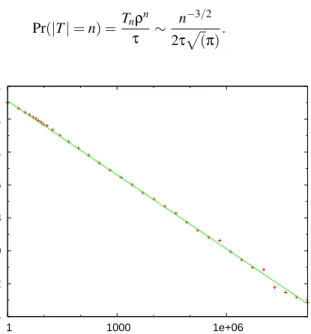
distribution according to a power law with parameter 3/2: for large enoughn, Pr(|T|=n) =Tnρ n τ ∼ n−3/2 2τp(π) . 1e-14 1e-12 1e-10 1e-08 1e-06 0.0001 0.01 1 1 1000 1e+06 probability size
Fig. 3:Distribution of sizes of ternary trees generated using a singular Boltzmann sampler.
Figure 3 shows the sizes of 100,000 ternary trees generated using a singular Boltzmann sampler (the generating function isT(z) =1+zT3(z); with radius of convergenceρ=4/27 and singular valueτ=3/2).
Both axes are in a logarithmic scale: the points follow a line of slope−3/2, which confirms the fact that the distribution follows a power law with parameter 3/2.
To be able to analyse the generated trees we need to assure that they can be contained in the memory of our computer. Most generated trees are of manageable sizes, and the probability of generating an infinite tree is null, but for any given size we will obtain a tree bigger than that with probability one if we wait long enough. We will thus reject all trees exceeding a fixed size. Since the rejection is based solely on the size of the trees, we preserve the uniformity of the sampling on any given size class.
3.3
Non critical substitution schemas
In families of trees, the square root nature of the singularity implies a finite valueτfor the seriesT(z)at its singularityρ. SubstitutingT(z)in a construction with radius of convergence bigger thanτgives a so called
non critical substitution schema. In this context, Boltzmann sampling comes to discrete distributions for parameters. Non critical substitution schema is a keystone in our analysis of degree distribution in (regular or higher dimensional) RANS.
As examples of non critical substitution schemas, one can cite the distribution of the root degree in general trees randomly produced by singular Boltzmann samplers. In the case of planar non labeled trees the distribution is geometric: and in the case of Cayley trees (non planar labeled trees) it is Poisson. Moreover, by proposition 4.1 these results hold for the distribution of degrees in random trees.
Proposition 3.1 Let F(t) =∑fntnbe a series with non negative coefficients and radius of convergence
r>0, associated to
F
structures; and let T(z)be the generating function of a simple family of treesT
: T(z) =τ−cp1−z/ρ+O(1−z/ρ), with c>0.Consider the bivariate generating function C(z,u) =F(uT(z)), with u marking substitution of
T
inF
. Ifτ<r, then the distribution for the number ofT
-structures in a randomF
-structure generated by aBoltzmann sampler tuned atρfollows a discrete law
p(u) =F(uτ)
F(τ).
Proof The proof uses equation (2), and relies on the hypothesis thatFis regular at the singular value of
T, so that forz=ρ,F(T(z)) =F(τ). 2
Remark There exists a non critical substitution schema in the exact model: under the same hypothesis, the distribution for the number of
T
-structures in a randomF
-structure of sizenasymptotically follows a discrete law, which is the derivative of the corresponding law in proposition 3.1. Using equation (1), and expandingF(T(z))aroundz=ρ, one getspn(u)∼n→∞
uF0(uτ)
F0(τ) .
4
Degree distribution in RANS
The results of section 2 show that the degree distribution in RANS is the same as the distribution of the sizes of ¯1-subtrees in triplets of ternary trees. The analysis relies on two points. First notice that, for additive parameters in trees, Boltzmann sampling emphasizes the fact that the distribution at the root of a tree is the same as the distribution at any node of the tree. Second express the parameter in terms of subcritical substitution of trees within trees and thus conclude with a Catalan law.
4.1
Degree distribution and tree parameters
Our goal is to study the distribution of degrees for the set of vertices in a RANS. This resumes to studying the distribution of theR-degree for the set of subtrees in the random ternary tree corresponding to the RANS. Each vertex in the RANS is the center of a sub-RANS and it’s degree is theR-degree of the ternary subtree corresponding to this sub-RANS.
Instead of analysing the properties of the set of subtrees in a single random ternary tree, we will work on a set of Boltzmann generated random ternary trees and use the fact that both sets have the same statistical properties.
Proposition 4.1 The statistical properties of the set of all subtrees of a random tree are the same as the statistical properties of a set of random trees independently generated with a Boltzmann sampler. Proof The proof simply relies on the principle of Boltzmann sampling: every subtree of a random tree is generated by an independent call to the Boltzmann sampler, with the same parameter. 2 Corollary 4.2 The degree distribution in a RANS is the same as the distribution of the R-degree in a set of ternary trees using a Boltzmann sampler.
Proof As noted at the end of Section 2, the degree distribution in a RANS can be seen as the distribution of the center of each of its sub-RANS. This in turn, by Lemmas 2.2 and 2.3 is related to properties of the subtrees of the corresponding ternary tree and by proposition 4.1 it suffices to study a set of Boltzmann
randomly generated ternary trees. 2
The analysis of the degree distribution in RANS, which is done in subsection 4.2, reduces to studying the size distribution of triplets of binary trees and leads to a power law of parameter 3/2 with an exponen-tial cutoffαk,α<1. More precisely the result is stated in the proposition below, which will be proved by
bivariate analysis in next subsection.
1e-05 0.0001 0.001 0.01 0.1 1 10 100 probability degree
triplets of binary trees root bar subtrees of ternary trees bar subtrees of one ternary tree f(x)
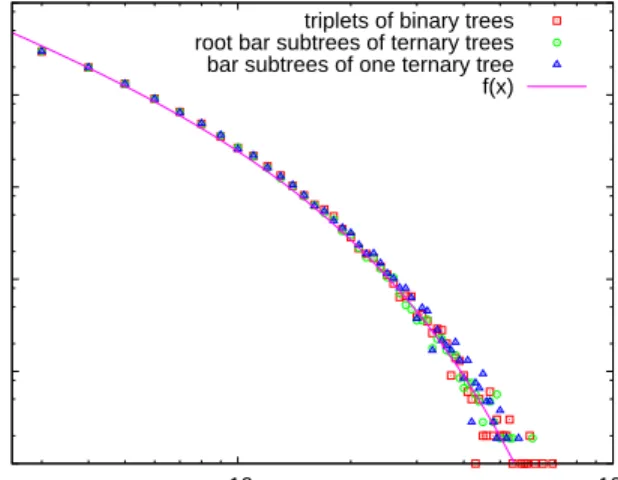
Fig. 4:Degree distribution in RANS: theory, simulation and counting
Theorem 4.3 The degree distribution in random Apollonian network structures has mean value 6, and a Catalan form for the probability generating function, which reduces to a power law with an exponential cutoff: Pr(D=3+k) =8 9 1 k+3 2k+2 k 2k 9k that is Pr(D=3+k)∼C 8 9 k (k+3)−3/2.
Figure 4 shows the degree distribution in RANS of size 100,000 using four overlayed plots. The squares show the distribution of sizes in 100,000 triplets of binary trees generated using a Boltzmann sampler
tuned at the singularity of ternary trees. The circles show the degree distribution of vertices in one big RANS of size 100,000. The triangles show the distribution of the degree of the center in 100,000 RANS. The line is the theoretical distribution of the size of triplets of binary trees, as given by theorem 4.3.
4.2
Bivariate analysis
Following Lemma 2.3 theR-degreeDof a ternary treeT =Node(T1,T2,T3)is:
D(T) =3+|N¯1(T1)|+|N¯2(T2)|+|N¯3(T3)|
where ¯Ni(Ti)denotes the size of the ¯i−subtree ofTi.
Clearly the distribution of the size of ¯n-subtrees is the same for anynin{1,2,3}. So that ifD(z,u)
represents the bivariate generating function marking theR-degree of a ternary tree, one has D(z,u) =
∑
T
z|T|uD(T)=zu3T3(z,u), (3) whereT(z,u)is the bivariate generating function for ternary trees withumarking the size of the ¯1-subtree. In the following, the distributions in bothT(z,u)andD(z,u)are shown to be of Catalan type.
Recursively marking only two over the three subtrees at each node one gets:
T(z,u) =1+uzT(z)T2(z,u). (4) One can read on this equation thatT(z,u)is obtained by substituting a ternary tree at the internal nodes of a binary tree, withucounting the number of ternary trees. Moreover this is a non critical substitution schema, and by proposition 3.1 the distribution is discrete.
Proposition 4.4 In random ternary trees generated by a singular Boltzmann sampler, the size of the ¯1 -subtree has a Catalan distribution, with mean value 1 and probability generating function
p(u) =1
τ
∑
k Bkρk
τkuk,
whereρandτare respectively the singularity and the singular value of the generating function of ternary trees, and Bkthe kthCatalan number. For large values of k, the probability is asymptotic to
Pr(|¯1-subtree|=k)∼Cαkk −3/2 √ π with α=8/9 and C=2/3 √ π.
Proof The substitution induced by equation (4) isT(z,u) =B(zuT(z)), whereB(t) =∑Bntnis the
gen-erating function for binary trees: B(t) =1+tB2(t), andBn=n+11
2n
n
. This substitution is non-critical sinceρτ<1/4, the radius of convergence ofB(t).
Hence the probability generating function for the size of the ¯1-subtree of a ternary tree generated with a singular Boltzmann sampler is
p(u)≡T(ρ,u) T(ρ,1)= 1 τ
∑
k Bkρ k τkuk (5)and the probability evaluates to Pr(|¯1-subtree|=k) = 2 3(k+1) 2k k (2/9)k. (6)
Deriving equation (5), an easy computation shows that the mean value of the parameter under singular Boltzmann sampling is constant:µ≡p0(1) = (τ−1)
τ(1−2ρτ2) =1.
Using Stirling approximation, the probability of equation (6) can be transformed as stated in the text of
the proposition. 2
Proof of theorem 4.3 By (3), the bivariate generating function for the degree at the center of a RANS is D(z,u) =zu3T3(z,u), so that the probability for havingR-degreekin a random ternary tree generated by a singular Boltzmann sampler, is
Pr(D=k) = 1 ρτ3[u k] ρu3T3(ρ,u) = u 3 τ3[u k]B3(u ρτ).
By B¨urmann-Lagrange theorem,[tk]B3(t) =3k 2kk−+12, thus Pr(D=3+k) =8 9 1 k+3 2k+2 k 2k 9k.
And the power law with exponential cutoff comes from Stirling approximation:
Pr(D=3+k)∼C
8
9
k
(k+3)−3/2.
The mean value is computed by derivation: for ternary trees, the average number of nodes in the ¯1-subtree isρB0(ρτ) =1. The mean degree of six for the center corresponds to the three edges from the center to the outermost vertices, plus the edges in each of the three sub-RANS.
This completes the proof for the degree distribution of the center in a RANS. Theorem 4.3 states that these statistics apply to the degree distribution of vertices in a RANS. And this result comes from
corollary 4.2. 2
5
Extensions
The RAN model is very easy to extend, and so is the RANS model. High dimensional random Apollonian networks have been proposed and analysed by Zhang et al. (2006), showing that increasing the dimension gives a wider degree distribution. Here we show that random Apollonian network structures can be ex-tended to higher dimensions and have a similar behavior for large degrees. These extensions rely on using d-ary trees (dis the dimension) instead of ternary trees, and the generation and analysis develop along the same lines as for regular RANS.
The first step is to extend the bijection between RANS and ternary trees: RANS of dimensiond (d -RANS) correspond tod-tuples ofd-ary trees, and the degree of the center of thed-RANS still expresses in terms of the size of ad-tuple of ¯n-subtrees, which are (d-1)-ary subtrees. In the bijection, the trees
under consideration ared-ary trees, with generating functionTd(z) =1+zTdd(z), radius of convergence
ρdand singular valueτd.
Marking ¯1-subtrees gives the bivariate generating functionTd(z,u), that satisfies
Td(z,u) =1+uzTdd−1(z,u)Td(z) =Td−1(uzTd(z))
which is still a non critical substitution schema, sinceρdτd<ρd−1. By proposition 3.1 the distribution is
of Catalan type. Finally the bivariate function markingR-degree ind-ary trees isDd(z,u) = zudTdd(z,u),
and the result stated below, follows from B¨urmann-Lagrange theorem.
Proposition 5.1 The degree distribution in random Apollonian network structures of dimension d≥3 has a Catalan form
Pr(Dd=d+k) = d τd 1 k(d−2) +d k(d−1) +d−1 k ρkdτkd that is Pr(Dd=d+k)∼Cαk k+ d d−2 −32 with C=√d 2π d−1 d−2 32 and α= (d−1) 2d−3 dd−1(d−2)d−2.
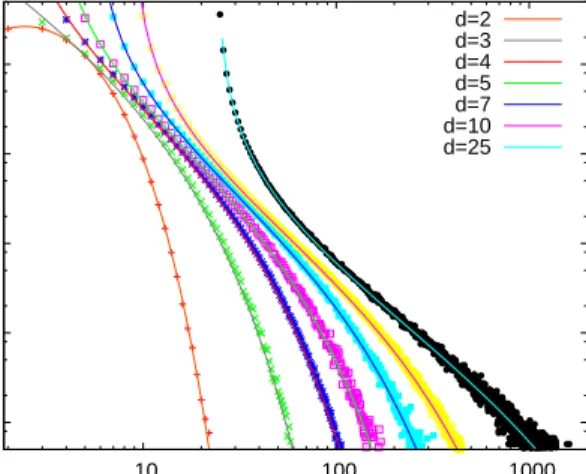
Remark In the cased=2 the subcritical schema substitutes trees in a list, leading to a geometric distribution. Figure 5 shows the distribution of degrees in d-RANS ford∈ {2,3,4,5,7,10,25}. Apart from the special cased=2, every law is of the formαk×(k+δ)−32 whereα andδtend to 1 whend becomes large, so that the limiting law is a power law with parameter 3/2. The adequacy between the theoretical distributions (solid lines) and the clouds of points resulting from Boltzmann sampling is almost perfect.
1e-05 0.0001 0.001 0.01 0.1 10 100 1000 probability degree d=2 d=3 d=4 d=5 d=7 d=10 d=25
There are other interesting extensions, each one associated with a particular tree class. For example triangles can be reused, creating multiple layers, or different dimensions can be combined. These various refinements may be studied with the same tools and combine to conform to the behavior of real networks as far as degree is concerned. Moreover other relevant parameters of networks, such as mean distance, can also be dealt with in the same analytic framework; for example we show in a forthcoming work that the mean distance between vertices in a RANS is of order√n.
References
L. Amaral, A. Scala, M. Barthelemy, and H. Stanley. Classes of small-world networks. Proceedings of the National Academy of Sciences of the United States of America, 97(21):11149–11152, 2000. J. S. Andrade Jr, H. J. Herrmann, R. F. Andrade, and L. R. da Silva. Apollonian networks: Simultaneously
scale-free, small world, euclidean, space filling, and with matching graphs. Physical Review Letters, 94(1):18702, 2005.
P. Duchon, P. Flajolet, G. Louchard, and G. Schaeffer. Boltzmann samplers for the random generation of combinatorial structures.Combinatorics, Probability and Computing, 13(4-5):577–625, 2004. M. Lothaire.Applied Combinatorics on Words, chapter 8. Cambridge University Press, 2005.
A. Meir and J. W. Moon. On the altitude of nodes in random trees.Canadian Journal of Mathematics, 30 (1978):9971015, 1978.
M. E. Newman, A. Barab´asi, and D. Watts.The structure and dynamics of networks. Princeton University Press, 2006.
E. Ravasz, A. Somera, D. Mongru, Z. Oltvai, and A.-L. Barab´asi. Hierarchical organization of modularity in metabolic networks. Science, 297(5586):1551, 2002.
R. Sedgewick and P. Flajolet. An introduction to the analysis of algorithms. Addison-Wesley, 1996. Z. Zhang, L. Rong, and F. Comellas. High-dimensional random apollonian networks. Physica A:
Statis-tical Mechanics and its Applications, 364:610–618, 2006.
T. Zhou, G. Yan, and B.-H. Wang. Maximal planar networks with large clustering coefficient and power-law degree distribution.Physical Review E, 71(4):46141, 2005.