Yamaguchi, M., Randle, J. M., Wilson, T. J., & Logan, G. D. (2016). Pushing typists back on the learning curve: Memory chunking improves retrieval of prior typing episodes. Journal of Experimental Psychology: Learning, Memory, and Cognition, in press.
Pushing Typists Back on the Learning Curve:
Memory Chunking Improves Retrieval of Prior Typing Episodes
Motonori Yamaguchi and James M. Randle Edge Hill University, Ormskirk, UK
Thomas L. Wilson
Bellarmine University, Louisville, KY
Gordon D. Logan
Vanderbilt University, Nashville, TN
© 2017 American Psychological Association. This paper is not the copy of record and may not exactly replicate the final, authoritative version of the article. Please do not copy or cite without authors permission. The final article will be available, upon publication, via its DOI: 10.1037/xlm0000385
Author Notes
Motonori Yamaguchi and James M. Randle, Department of Psychology, Edge Hill University, Ormskirk, the United Kingdom; Thomas L. Wilson, Department of Psychology, Bellarmine University, Louisville, KY; Gordon D. Logan, Department of Psychological Sciences, Vanderbilt University, Nashville, TN. The present study was supported in part by the Research Investment Fund from Edge Hill University and by the National Science Foundation (BCS 1257272). We would like to thank Robert Greene and Alice Healy for their valuable comments on earlier drafts of the manuscript.
Correspondence concerning this article should be addressed to Motonori Yamaguchi, Department of Psychology, Edge Hill University, St Helens Road, Ormskirk, Lancashire, L39 4QP, UK. E-mail: [email protected] or [email protected].
Abstract
Hierarchical control of skilled performance depends on chunking of several lower-level units into a single higher-level unit. The present study examined the relationship between chunking and recognition of trained materials in the context of typewriting. In three experiments,
participants were trained with typing nonwords and were later tested on their recognition of the trained materials. In Experiment 1, participants typed the same words or nonwords in five consecutive trials while performing a concurrent memory task. In Experiment 2, participants typed the materials with lags between repetitions without a concurrent memory task. In both experiments, recognition of typing materials was associated with better chunking of the materials. Experiment 3 used the remember-know procedure to test the recollection and familiarity
components of recognition. Remember judgments were associated with better chunking than know judgments or non-recognition. These results indicate that chunking is associated with explicit recollection of prior typing episodes. The relevance of the existing memory models to chunking in typewriting was considered, and it is proposed that memory chunking improves retrieval of trained typing materials by integrating contextual cues into the memory traces.
Many aspects of modern life are made possible by computerized systems. Computers have made our lives convenient, and they have also changed the way we perform common tasks. A representative example of such changes is writing. In higher education, for instance, most coursework assignments require students’ work to be typed out on a computer and submitted electrically through a virtual learning environment, instead of writing on a sheet of paper and handing it to lecturers. Similarly, business correspondence has replaced traditional paper
documents with electrical forms that are communicated through the computer networks. As such, typewriting has replaced traditional handwriting in many domains of modern society. A recent study reported that university students have started typing at the age of 10 or younger on average and have more than 10 years of typing experience by the time they enter a university (Logan & Crump, 2011). These students typically spend more than four hours using computers every day (e.g., Yamaguchi & Logan, 2014a; Yamaguchi, Logan, & Li, 2013). Thus, typing is one of the modern skills that are practiced most extensively. This makes typewriting a good subject to investigate cognitive processes underlying skilled performance. The present study examined the development of complex skill in the context of typewriting. We focused on the development of memory chunks, which are the basic building blocks for hierarchical control of skilled
performance.
Chunking in Expert Performance
Chunking has been an important theoretical construct in cognitive sciences since Miller’s (1956) seminal paper, which emphasized that the ability to maintain information for immediate recall is limited to only about seven items at most (and three to four items on average; Broadbent, 1975; Cowan, 2001). Miller suggested this limitation of short-term retention could be overcome by chunking a number of items to be remembered to reduce them to a smaller number of units.
For instance, if a phone number consists of eleven digits, we may have difficulty remembering all eleven digits separately, but we may be able to remember the same phone number when the eleven digits are divided into three chunks (e.g., 0123-456-7890). By chunking, the short-term memory demand for retaining the phone number is reduced below capacity. Consistent with this chunking theory, short-term retention is better when remembering a 3-letter word than when remembering three consonants, despite the fact that the number of letters is the same (Murdock, 1961). Furthermore, short-term retention is as good when remembering three 3-letter words (nine letters) as when remembering three consonants, although there are three times more letters in the former than in the latter. Thus, the capacity of short-term memory is best described in terms of the number of chunks rather than the number of individual items within the chunks.
For individual items to be represented as a chunk, these items have to compose a familiar pattern that is already stored in long-term memory (Ericsson & Kintsch, 1995). A representative example is superior memory of chessboards for chess experts as compared to novices (Chase & Simon, 1973). It was suggested that the number of chunks that can be retained in short-term memory is about the same between experts and novices, but the size of a chunk (i.e., the number of individual items in a chunk) is larger for experts than for novices because experts already have familiar chess positions in long-term memory. This allows experts to retrieve existing chunks from long-term memory and retain a larger amount of information in short-term memory than the amount of information that novices could retain. In fact, when chess pieces are positioned
randomly on the chess board, the superiority of experts is reduced considerably (Chase & Simon, 1973). There is also a report of a runner who attained a memory span of 106 digits by encoding digit strings into a combination of running time, age, and date, that served as the bases of chunking (Ericsson, Chase, & Faloon, 1980; Ericsson & Staszewski, 1988). These studies
demonstrate the importance of long-term memory to overcome the limitation of short-term memory by chunking.
The involvement of chunking is often implicated on the basis of inter-item intervals. In a digit span task, long inter-item intervals have been taken as indicating chunk boundaries
(Ericsson et al., 1980). In motor learning, longer interkeystroke intervals (IKSI) have also been considered to reflect the beginnings of chunks (Bryan & Harter, 1899; Chapman, Healy, & Kole, 2016; Verwey, 1996). In rare cases, the pattern of performance errors can also be considered to reflect chunking, because errors tend to occur more frequently at the beginning of a chunk than within a chunk (Elman, 1990). In all cases, however, researchers have not considered the possibility that different types of chunks may be involved in performing a single task. To our knowledge, no attempt has been made to dissociate different types of chunks in previous studies, with an exception in our previous study that investigated chunking in skilled typewriting
(Yamaguchi & Logan, 2014b).
We have found evidence for chunking in three processing stages (perception, translation, and execution) of skilled typewriting, and different experimental manipulations dissociate the three types of chunks, perceptual, memory, and motor chunks. Perceptual chunks allow a number of letters to be encoded as a single word, providing a many-to-one mapping from multiple perceptual elements to a single perceptual unit (McClelland & Rumelhart, 1981). Motor chunks allow a series of keystrokes to be prepared and executed concurrently, providing a one-to-many mapping from a single motor unit to multiple motor elements (Klapp & Jagacinski, 2011). Memory chunks bridge perceptual and motor chunks, mapping many perceptual units to many motor units through a single cognitive unit. It is yet to be seen whether these three types of chunks are different manifestations of the same representational structure or they constitute
distinct representations, but different experimental manipulations can be used to reveal chunking in different processing stages. Previously, we examined the process by which memory chunks develop through training and theorized that memory chunking requires two copies of the same memory item to be active simultaneously in short-term memory (Yamaguchi & Logan, 2016). The present study submitted this theory to a critical test.
Memory Chunks in Typewriting Skill
In typewriting, memory chunks allow a number of letters to be retrieved and maintained as a single word. They make parallel processing of letters and keystrokes possible (Logan et al., 2011) and reduce short-term memory load (Cowan, 2001; Miller, 1956; Yamaguchi & Logan, 2016). The most direct behavioral measure of memory chunks is a concurrent memory load procedure (Yamaguchi & Logan, 2014b). As concurrent memory performance is independent of perceptual and motor processes, it only reflects the contribution of memory chunks to typing performance. The concurrent memory load procedure requires typists to type a word or string of random letters (nonword) on each trial while performing a memory task for which a series of random digits has to be remembered for later recall. A word or nonword to type and a digit string to remember are given at the beginning of a trial, and the word or nonword has to be typed in the retention interval of the digit recall task. Thus, digits are maintained in short-term memory while typing, so the recall of digits depends on the short-term memory demand of typing. The higher the short-term memory demand is for typing, the greater the interference with digit recall. It was shown that digit recall was worse when typing nonwords than when typing words,
indicating that short-term memory demand is higher for nonwords than for words (Yamaguchi & Logan, 2014b). Digit recall also depended on the number of letters in nonwords but not much on the number of letters in words, implying that letters in nonwords are represented as distinct
memory chunks whereas letters in words are represented as a single memory chunk. These results reflect the fact that typists already have chunks associated with familiar words, and they can use these chunks to process letters and keystrokes efficiently. Typists do not have chunks associated with unfamiliar nonwords, so they have to process letters and keystrokes individually, increasing the short-term memory demand.
A more recent study examined the development of memory chunks in typing (Yamaguchi & Logan, 2016). Typing unfamiliar nonwords repeatedly reduced interference with digit recall over repetitions, indicating that letters in nonwords were chunked in memory. Interestingly, memory chunks developed under concurrent memory load when typists typed the same nonword in six consecutive trials, but not when typists typed the same nonword six times with spacing between the repetitions. These outcomes were counterintuitive because spacing is known to improve learning in many domains (Braun & Rubin, 1998; Cepeda, Pashler, Vul, Wixted, & Rohrer, 2006; Dempster, 1989; Greene, 1989; Hintzman, 1974; Ruch, 1928). These outcomes depended on training with a concurrent memory load. When typists trained without a concurrent memory load, memory chunks developed better with spacing between repetitions, yielding a typical spacing effect.
Yamaguchi and Logan (2016) interpreted these results as indicating that memory
chunking requires typists to be ‘reminded’ an earlier typing episode in which the same nonword was presented during training (Benjamin & Tullis, 2010; Ross, 1984). With consecutive
(massed) repetitions, the nonword from the previous trial could be carried over to the next trial, which allows two representations of the same nonword to be maintained simultaneously in short-term memory (one from the previous trial and the other from the current trial). With spaced repetitions, a prior typing episode is no longer available in short-term memory and would have to
be retrieved from long-term memory. When short-term memory is already occupied by a concurrent memory load, prior typing episodes cannot be retrieved into short-term memory. When training without a concurrent memory load, short-term memory is available to retrieve prior typing episodes from long-term memory, which allows two representations of the same nonword to be active in short-term memory. Therefore, it appears that memory chunking requires two representations of the same study item to be maintained simultaneously in short-term memory.
The Present Study
Although previous studies have suggested the importance of chunking in expert performance, little attention has been paid to the conditions under which memory chunks develop through training. Our previous study showed that merely repeating the same study item is not sufficient to develop memory chunks (Yamaguchi & Logan, 2016). Instead, we suggested that two copies of a study item need to be retained in short-term memory. Three experiments tested this proposal in the present study. If prior typing episodes have to be retrieved into short-term memory for novel typing materials to be chunked and stored in long-short-term memory, there should be a positive association between memory chunking of the study materials and the recognition of these materials. To examine the relationship between memory chunking and recognition of prior typing episodes, typists typed words and nonwords repeatedly in the training phase, and the association between memory chunking and the recognition of typing materials was examined in the test phase.
Our experiments were replications of the previous experiments (Yamaguchi & Logan, 2016) with tests of recognition memory added. The hypothesis that two copies of the same material have to be present in short-term memory simultaneously was derived to explain those
experiments, so adding recognition memory tests to the same procedures provides a very strong test of the hypothesis and its ability to account for the results. It also provides an opportunity to directly replicate the previous results, which is important under the current climate that values direct replication of key findings in psychology (e.g., Open Science Collaboration, 2015).
Experiment 1
The present experiment used the concurrent memory procedure that was developed in a previous study. Based on our previous findings, we suggest that memory chunking requires two copies of the same study item to be present simultaneously in short-term memory, one copy from the current trial and another copy from a previous trial. The present experiment tested this theory by revealing the relationship between memory chunking and the recognition of prior study episodes. In the training phase, typists memorized a word or nonword and a string of digits at the beginning of each trial. They were then prompted to type the word or nonword as quickly as possible, and then recall the digits. Typists trained typing unfamiliar nonwords in five consecutive trials under a concurrent memory load. We expected that digit recall would be better initially when typing words than when typing nonwords because fewer short-term memory chunks are required when typing words than when typing nonwords. Memory chunks should develop for nonwords as typists type them repeatedly, so the difference between typing words and typing nonwords should decrease over repetitions.
In the test phase, participants performed the same concurrent memory procedure and typed the materials that occurred in the training phase and new materials that did not occur in the training phase. There was an additional recognition test at the end of each trial, in which
participants indicated whether the material they just typed had been presented during the training phase. If memory chunking requires prior typing episodes to be retrieved, chunked typing
materials should be associated with better recognition of the typing materials. Thus, it was expected that digit recall would be more accurate for typing materials that typists recognized than for typing materials that they did not recognize.
Method Participants
Twenty eight participants (18 females; mean age = 21.39, SD = 6.38) were recruited from the Edge Hill University community. They received £6 per hour or experimental credits toward their psychology modules for participation. All reported having normal or corrected-to-normal visual acuity and no hearing problem. Their typing ability was assessed by a typing test used in previous studies (e.g., Logan & Zbrodoff, 1988; Yamaguchi & Logan, 2016), which showed that the average typing rate of 52.07 (SD = 13.68) words per minutes (WPM) with mean accuracy of 91.38 (SD = 5.76). Participants also filled out a questionnaire, on which they reported having typing experience of 13.54 (SD = 4.75) years and using computers for 4.18 (SD = 2.71) hours per day. None of the participants reported having prior formal typing training.
Apparatus and Stimuli
The apparatus consisted of a personal computer and a 23-in flat-screen monitor. A standard QWERTY keyboard (UK) was used to register responses. Stimuli were 5-letter words and nonwords for the typing task and five unique digits for the concurrent memory task. Word and noword stimuli were selected from the lists developed in a previous study (Yamaguchi & Logan, 2014b), which consisted of 200 words and nonwords. Digits strings were constructed randomly on each trial, with a restriction that no digit repeat in a string. Both stimuli were presented in the 24-pt Courier New font, printed in black against a white background. Letters
were presented in upper case. The backspace key on the keyboard was disabled, so participants could not correct their mistakes during the task.
Procedure
The present experiment followed the method used in a previous experiment (Yamaguchi & Logan, 2016, Experiment 1) with a few modifications. The experiment was conducted individually under normal fluorescent lighting. Participants sat in front of the computer monitor and read on-screen instructions. The instructions emphasized the accuracy of the memory task as well as the speed and accuracy of the typing task. A session consisted of two phases, training and test. The training phase started with a practice block of six trials, whereby three consecutive trials presented the same word or nonword. The practice block was followed by four training blocks of 120 trials each. The same word or nonword was repeated on five consecutive trials in the training blocks. In total, there were 48 words and 48 nonwords for each participant. The test phase also started with a practice block of 8 trials; half of the trials presented a trained word or nonword. The practice block was followed by the actual test trials, which were divided into two blocks of 72 trials. Half of the trials presented a trained word or nonword, and the other half presented a new word or nonword. There were 24 trained words, 24 new words, 48 trained nonwords, and 48 new nonwords, in the test phase. Fewer word trials were included in the test phase to shorten the duration of a session as much as possible, as the main focus of the
experiment was on nonword trials.
Each trial started with a word or nonword presented in an upper portion of the display (6.5 cm above the screen center) for 500 ms, followed by a blank display for 750 ms. Five unique digits appeared at the screen center for 1,000 ms, which was also followed by a blank display for 500 ms. The message “GO!” then appeared at the location of the typing material,
prompting participants to start typing. Typed letters were echoed in a lower portion of the display (6.5 cm below the screen center). When five letter keys were pressed or when 5,000 ms elapsed after the go signal, the message prompted participants to enter the five digits. There was a 5,000-ms time window to enter five digits. A trial ended with a feedback display for the typing and memory tasks, which was the message “Correct!” or “Error!” The message appeared in the upper portion of display for the typing task and in the lower portion for the memory task. In the test phase, there was an additional recognition test at the end of each trial. After the feedback display for the typing and memory tasks, participants were asked to enter ‘y’ (for “yes”) or ‘n’ (for “no”) according to whether they recognized the word or nonword they typed on that trial. There was no time limit or feedback for the recognition test, and the next trial started after the response.
For the typing task, RT was the interval between onset of the go signal and the first keystroke, and IKSI was the interval between two successive keystrokes. Trials were considered correct only if all letters were typed correctly. For the digit recall task, only the accuracy of response was recorded; again, trials were considered correct only if all digits were entered correctly.
Results
Trials were discarded if participants did not complete typing or digit entry within the time window (1.97% of all trials).
Recognition Rates
For the test phase, the recognition rates of words and nonwords were computed for each participant and used to derive the sensitivity measure, d’. Mean recognition rates were .85 for old words (hit), .14 for new words (false alarm), .78 for old nonwords (hit), and .12 for new
nonwords (false alarm); d′ was 2.49 for words and 2.28 for nonwords, which did not differ statistically, t(27) = 1.08, p = .288, which corresponds to the Beyes factor (BF) of .2541 (Rouder et al., 2009) and favors the null hypothesis. Thus, typists formed memories of the typing
materials that they could access later in an explicit memory test. The remaining analyses assess whether these memories were also available during training to support the development of memory chunks.
Memory Chunking
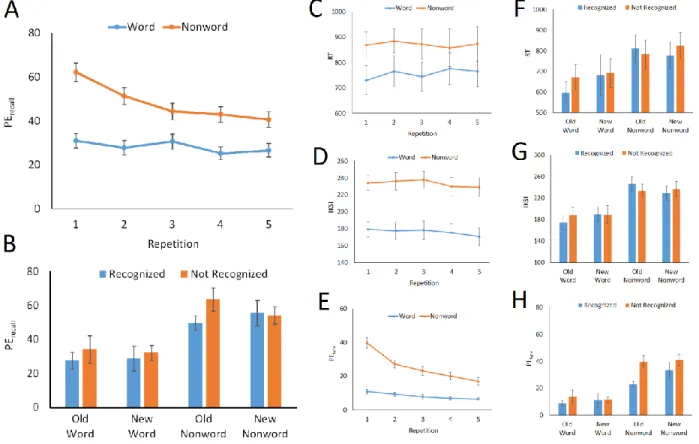
For the training phase, percentages of recall error for the concurrent memory task (PErecall) were computed for each participant (see Figure 1A). Recall error decreased over repetitions, and it decreased more for nonwords than for words. These observations were supported by a 2 (Typing Material: word vs. nonword) x 5 (Trial Repetition: 1-5) repeated-measures ANOVA, showing significant main effects of Typing Material and Trial Repetition and the interaction of the two factors (see Table 1). These results indicate that memory chunks developed for nonwords during the training phase.
For the test phase, PErecall was computed for each participant for each combination of Typing Material (word vs. nonword), Prior Occurrence (old vs. new), and Recognition Response (recognized vs. not recognized). Figure 1B summarizes the results. A number of participants produced an empty cell in one or more conditions because it depended on recognition
performance; there were only 14 participants who had no empty cells. This precluded the use of an ANOVA on this data set. Consequently, the results were analyzed in two ways. First, PErecall was compared between trials for which typing material was recognized and trials for which
1BFs reported in the present article were computed by using the online calculator (http://pcl.missouri.edu/bf-one-sample) with the effect size r = 1 as recommended by Rouder et al. (2009). When the output supported the null hypothesis, the inverse of the Bayes factor obtained in the calculator (i.e., 1/BF) was reported.
typing material was not recognized, using separate paired-sample t-tests for the four conditions (old word, new word, old nonword, and new nonword). They showed that PErecall depended on recognition of typing material for old nonwords, t(27) = 3.00, p = .006, BF = 6.36, but not for old words, t(21) = .90, p = .378, BF =.24, new words, t(23) = .69, p = .500, BF = .20, or new
nonwords, t(21) = .27, p = .793, BF = .17.
Second, logistic regression analysis was carried out on the test phase, with concurrent memory performance (0 = error, 1 = correct) on each trial as the response variable and three categorical variables, Typing Material (0 = word, 1 = nonword), Prior Occurrence (0 = old, 1 = new), and Recognition Response (0 = recognized, 1 = not recognized), as the predictor variables. All interaction terms among the three predictor variables were also created. The regression model was fitted to the data using a backward stepwise procedure. The best fit model included four predictor variables; Typing Material (b = 1.55, SE = .16, p < .001), the interaction between Typing Material and Prior Occurrence (b = .41, SE = .17, p = .015), the interaction between Typing Material and Recognition Response (b = .79, SE = .17, p < .001), and the 3-way
interaction of Typing Material, Prior Occurrence, and Recognition Response (b = .75, SE = .28, p = .008), χ2(4) = 198.39, p < .001, R2 = .089. As summarized in Figure 1B, PErecall was generally
higher for nonwords (M = 52.45%) than for words (M = 28.43%). PErecall differed more between old nonwords (M = 50.05%) and new nonwords (M = 55.41%) than between old words (M = 27.67%) and new words (M = 29.19%). PErecall also depended on recognition more for nonwords (Ms = 38.54% and 53.61% for recognized and not-recognized nonwords) than for words (Ms = 40.00% and 44.51% for recognized and not-recognized words). Finally, the 3-way interaction supports the earlier results of multiple comparisons that recall error depended on recognition of typing material only for old nonwords but not for new nonwords or new/old words.
Overall, the results indicate that memory chunks developed for nonwords in the training phase and that the recognized nonwords were chunked better than nonwords that were not recognized. Another way to understand these results is that, for nonwords, hits (recognized old nonwords) were associated with better concurrent memory performance (chunking) than misses (not-recognized old nonwords), but neither false alarms (recognized new nonwords) nor correct rejections (not-recognized new nonwords) were predictive of better concurrent memory
performance. There was no association between recognition and concurrent memory performance for words that had already been chunked prior to the experiment. Typing Performance
Mean RT, IKSI, and percentages of error trials for the typing task (PEtype), were computed for each participant (see Figure 1C-1H).
In the training phase, RT was generally shorter for words (M = 757 ms) than for nonwords (M = 872 ms), but it did not change over repetitions (see Figure 1C). IKSI was also shorter for words (M = 176 ms) than for nonwords (M = 233 ms), and it decreased over
repetitions (Ms = 207 ms and 200 ms for the first and fifth repetitions, respectively; see Figure 1D). PEtype was smaller for words (M = 8.34%) than for nonwords (M = 25.45%), and it decreased over repetitions to a greater extent for nonwords than for words (see Figure 1E). These outcomes are statistically supported by the results of 2 (Typing Material: word vs. nonword) x 5 (Trial Repetition: 1-5) repeated-measures ANOVAs (see Table 1).
For the test phase, RT, IKSI, and PEtype, were analyzed in terms of paired t-tests to reveal the influence of recognition. No effects were significant for RT (see Figure 1F) or IKSI (see Figure 1G; all ps > .05). For PEtype, recognized nonwords resulted in smaller typing error rates
than not-recognized nonwords, whereas no effect of recognition was obtained for new nonwords or new/old words (see Figure 1H), which agreed with the results of PErecall.
Therefore, the results of typing error rates indicated the development of memory chunks for nonwords in the training phase, and recognition of typing materials was associated with better typing performance. These outcomes are consistent with the conclusions based on recall error rates for the concurrent memory task. RT and IKSI were not very sensitive measures of memory chunking in the present procedure as suggested previously (Yamaguchi & Logan, 2016).
Discussion
From the results of our previous study, it was expected that memory chunking requires retrieval of prior typing episodes, and typists would be able to recognize typing material (i.e., retrieve prior episodes) more easily if the typing material has been chunked. The present results were consistent with this prediction. Typing materials that were recognized in the test phase produced smaller error rates in the concurrent memory task, suggesting better chunking for these materials. This association between memory chunking and recognition confirmed the earlier proposal that memory chunking requires ‘reminding’ of prior typing episodes (Yamaguchi & Logan, 2016).
The present experiment also reproduced the previous results that typing words produced lower error rates in the concurrent memory task than typing nonwords during the training phase. This indicated that nonwords required more chunks in short-term memory than words did. The difference between typing words and typing nonwords decreased, implying that letters in nonwords got chunked gradually over repetitions. Although five repetitions may or may not be sufficient to chunk all letters in a nonword into a single chunk, it did reduce the number of chunks in short-term memory to type the nonword. The error rates for nowords did not reach
those for words, but this should not be a concern as nonwords need not be processed as words at the end of training. An important outcome for the present purpose is that the error rates for nonwords decreased over repetitions, implying that fewer chunks were required to maintain the nonwords in short-term memory.
Similarly, the present experiment also reproduced the previous finding that RT did not change much over repetitions of the typing materials. This could be due to the fact that typing started when a go signal occurred, and there was a preparatory interval during which the outer loop might have completed. There was a reduction of IKSI over repetitions, although this effect did not depend statistically on typing materials. We have suggested previously that typing performance depends on other types of chunks, which might develop differently from memory chunks. In fact, RT and IKSI did not show any reliable associations with recognition
performance in the present experiment. This dissociation makes sense if memory chunks are required to bridge between perceptual and motor chunks. If typing performance depends on three types of chunks, acquiring one of them may not improve the performance much. It is also possible that training with a concurrent memory load also prevented perceptual or memory chunk from developing. Our previous study suggested this possibility, showing that typing performance improved over repetitions when the concurrent memory load was removed (Yamaguchi & Logan, 2016).
Interestingly, however, typing error rate showed a similar pattern to that obtained for the concurrent memory performance. During the training phase, it decreased over repetitions especially for nonwords. In the test phase, there was a reliable association with recognition performance, such that error rate was lower for old nonwords that were recognized than for old nonwords that were not recognized. As typing performance reflects three types of chunks
(Yamaguchi & Logan, 2014b), it may be that RT reflects perceptual chunks that instantiate encoding of typing materials, and IKSI reflects motor chunks that instantiate execution of keystrokes. Typing accuracy may reflect memory chunks more strongly than other types because memory chunks instantiate response selection (i.e., translation of perceptual chunks to motor chunks), which is presumably the main source of errors in typewriting (Yamaguchi, Crump, & Logan, 2013).
Experiment 2
Experiment 1 revealed a positive association between the recognition of a prior episode and chunking of a study item that occurs under a concurrent memory load. As in Experiment 1, the present experiment also used another design of our previous study, in which typists trained typing without a concurrent memory load (Yamaguchi & Logan, 2016) with an additional recognition test to test whether chunking developed without a concurrent memory load is also associated with explicit retrieval of past typing episodes. The previous results suggested that memory chunking is affected by spacing between repetitions of study trials differently when a concurrent memory load is required during training and when it is not required, but we proposed a single theory that explains memory chunking in both conditions and predicts that there should be a similar positive association between the recognition of a prior study episode and memory chunking. Thus, we expected that Experiment 2 should also demonstrate a positive association between chunking and recognition of a prior typing episode.
When typing unfamiliar nonwords during training, a concurrent memory load overloads short-term memory because the unfamiliar nonwords impose high short-term memory demands. If so, typists are not able to retrieve (or be reminded of) a prior typing episode from long-term memory in order to create a new memory chunk. Thus, a concurrent memory load during
training prevents memory chunking when there are lags between repetitions (Yamaguchi & Logan, 2016). When the concurrent memory load is removed, short-term memory may have room for retrieval of prior typing episodes from long-term memory, allowing a new memory chunk to develop even when there are lags between repetitions. Despite the apparent differences between memory chunking with and without a concurrent memory load, we suggest that memory chunking develops in the same manner in both conditions. Thus, Experiment 2 examined
whether the recognition of study materials is also associated with memory chunks that develop without a concurrent memory load, as we have observed in Experiment 1. Typing materials were distributed across the five blocks of the training phase as we have found previously that memory chunks developed more efficiently with longer lags between repetitions.
In the training phase, participants typed a word or nonword on each trial, and the typing material was distributed across five blocks of 30 trials each. Each word or nonword occurred only once in a block, so there was an average lag of 30 trials between repetitions. The test phase was the same as that of Experiment 1, which required typists to type new or trained words or nonwords while performing the concurrent memory load. Memory chunking was examined in terms of the concurrent memory performance. It was expected that memory chunking would occur over repetitions in the training phase. The test phase was essentially the same as
Experiment 1: typists typed old and new typing materials under a concurrent memory load, and their recognition was tested at the end of each trial. If memory chunking requires explicit retrieval of prior typing episodes, typing materials that typists recognize should be associated with better concurrent memory performance than typing materials that typists do not recognize, reflecting the advantage of chunked materials to retrieve prior typing episodes.
Participants
A new group of thirty participants (19 females; mean age = 21.00, SD = 4.34) was recruited from the same pool of participants, with the same selection criteria. The typing test revealed the average typing rate of 48.28 (SD = 10.71) WPM with mean accuracy of 93.09% (SD = 3.27). They reported having 12.63 (SD = 3.84) years of typing experience and spending 4.67 (SD = 2.07) hours per day in front of computers. None had prior formal training in typing. Apparatus, Stimuli, and Procedure
The apparatus was identical with that of Experiment 1, but words and nonwords consisted of four letters. The new set of words was obtained from the MRC Psycholinguistic Database (Coltheart, 1981), and nonwords were created by scrambling the order of letters in the words. The procedure followed a previous experiment (Yamaguchi & Logan, 2016, Experiment 4). Two main differences from the procedure of Experiment 1 were that (a) there was no concurrent memory load during the training phase and that (b) the same word or nonword was repeated with lags between repetitions. Thus, in the training phase, participants only typed words or nonwords without a concurrent memory load. A trial started with a word or nonword at the center of screen, and participants started typing as soon as they could. RT was the interval between the stimulus onset and the first keystroke. Each word or nonword appeared once in each of the five training blocks, and each block presented 15 words and 15 nonwords in a different random order,, creating an average lag of 30 trials between repetitions of the same word or nonword.
After the five training blocks, participants performed the test phase, in which they typed words and nonwords under a concurrent memory load. The concurrent memory load consisted of four unique digits randomly selected on each trial. Note that the lengths of digit strings and typing materials were reduced from 5 items to 4 items in the present experiment, as a pilot study
indicated that response accuracy in the test phase was lower in the present method for which participants did not have a chance to practice the concurrent memory procedure during the training phase. Except for the lengths of stimuli, this phase was the same as the test phase in Experiment 1, including the recognition test at the end of each trial. Thus, a trial started with a word or nonword, followed by a digit string. Participants started typing as the go signal
appeared. Again, RT was the interval between the go-signal onset and the first keystroke. The test phase consisted of 60 trials; half of the trials presented the words and nonwords that appeared during the training phase, and the other half consisted of new words and nonwords. The cycle of the training and test phases was repeated twice for each participant with different sets of words and nonwords. In the first cycle, both the training and test phases started with a practice block of six trials, but there were no practice blocks in the second cycle.
Results
The data were analyzed in the same manner as in Experiment 1 (0.49% of the trials were discarded).
Recognition Rates
The rates of recognition were .78 for old words (hit), .11 for new words (false alarm), .67 for old nonwords (hit), and .10 for new nonwords (false alarm); d′ was 2.31 for words and 1.89 for nonwords, and this difference was statistically significant, t(29) = 3.26, p = .003, BF = 11.57. Thus, typists formed memories of the nonwords during training that were accessible in a
subsequent explicit memory test. It was hypothesized that these memories should support the development of memory chunks in the training phase.
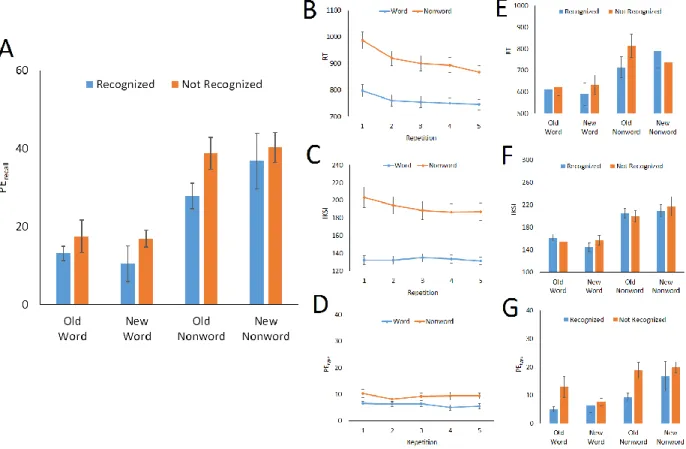
There was no concurrent memory task in the training phase, so the analysis focused only on the test phase (see Figure 2A). As in Experiment 1, concurrent memory performance was analyzed in terms of t-tests on PErecall to compare recognized and not-recognized typing materials for the four conditions (old word, new word, old nonword, and new nonword) separately. The results showed PErecall depended on recognition only for old nonwords, t(29) = 2.93, p = .007, BF = 5.49, but not for old words, t(28) = 1.14, p = .265, BF = 3.75, new words, t(22) = 1.19, p = .247, BF = 3.22, or new nonwords, t(23) = .524, p = .605, BF = .18.
Next, logistic regression analysis was carried out on concurrent memory performance (0 = error, 1 = correct) on each trial with the predictors, Typing Material (0 = word, 1 = nonword), Prior Occurrence (0 = old, 1 = new), and Recognition Response (0 = recognized, 1 = not
recognized). The best fitting model included Typing Material (b = .93, SE = .13, p < .001), Prior Occurrence (b = .35, SE = .16, p = .026), Recognition Response (b = .59, SE = .12, p < .001), the interaction between Typing Material and Prior Occurrence (b = .91, SE = .32, p = .004), and the 3-way interaction of Typing Material, Prior Occurrence, and Recognition Response (b = .64, SE = .29, p < .001), χ2(5) = 202.37, p < .001, R2 = .093. Thus, recall error was generally higher for
nonwords (M = 34.52%) than for words (M = 14.69%), and for new materials (M = 25.66%) than for old materials (M = 22.45%). However, the differences between old and new words was very small (Ms = 14.44% vs. 14.94% for old and new words), as compared to that between old and new nonwords (Ms= 31.17% vs. 38.15% for old and new nonwords). Recall error was also lower for recognized materials (M = 19.34%) than for not-recognized materials (M = 27.44%), but the 3-way interaction term qualifies this outcome, reflected in the results of t-tests that recall error depended on recognition only for old nonwords.
These findings are consistent with Experiment 1, indicating that memory chunks
developed in the training phase, but chunking was more efficient for nonwords that typists could recognize in the test phase.
Typing Performance
Mean RT, IKSI, and PEtype, were analyzed for the training phase (see Figure 2B-2D) and the test phases (see Figure 2E-2G).
In the training phase, RT was generally shorter for words (M = 761 ms) than for nonwords (M = 913 ms), and it decreased over repetitions (87-ms reduction from the first repetition to the fifth repetition). There was a larger reduction for nonwords (120-ms reduction from the first repetition to the fifth repetition) than for words (52-ms reduction from the first repetition to the fifth repetition; see Figure 2B). IKSI also showed similar results (see Figure 2C): IKSI was shorter for words (M = 133 ms) than for nonwords (M = 192 ms). There was a steady reduction over repetitions (9-ms reduction from the first repetition to the last repetition), but this reduction was mainly due to nonwords (16-ms reduction from the first to the fifth repetition); there was little change for words. PEtype was larger for nonwords (M = 9.27%) than for words (M = 5.96%), but there was no effect of repetition (see Figure 2D). These results are confirmed by a 2 (Typing Material: word vs. nonword) x 2 (Trial Repetition: 1-5) repeated-measures ANOVAs (see Table 2).
In the test phase, RT was shorter for old nonwords that typists recognized (M = 713 ms) than for old nonwords that they did not recognize (M = 814 ms), t(29) = 2.64, p = .013, BF = 2.95, but recognition did not influence new nonwords or old or new words (see Figure 2E). IKSI did not show any significant effect of recognition on any of the typing materials (see Figure 2F). However, PEtype depended on recognition for old words (see Figure 2G), t(28) = 2.10, p = .045,
BF = 1.05, and old nonwords, t(29) = 3.54, p = .001, BF = 22.42. Typing error was larger for old words and nonwords when typists did not recognize the materials (Ms = 12.88% and 18.76% for words and nonwords) than when they did recognize the materials (Ms = 4.91% and 9.19% for words and nonwords). These results are also consistent with Experiment 1, suggesting that recognition was associated with better typing performance.
Discussion
Although the training phase of the present experiment differed from that of Experiment 1, the results still showed that concurrent memory performance was better for old nonwords that typists recognized in the test phase than old nonwords that they did not recognize. The results are again consistent with our earlier conclusion that recognition of typing materials is associated with better memory chunking of those materials, supporting the proposal that memory chunking improves retrieval of prior typing episodes.
The results of typing performance also agreed with those obtained in Experiment 1. In the test phase, typing accuracy was associated reliably with recognition performance, such that typing was more accurate for old nonwords that typists recognized than for old nonwords that they did not recognize. The outcome also supports the claim that typing accuracy reflects memory chunks that affect translation from perceptual chunks to motor chunks. As in
Experiment 1, IKSI did not show any influence of recognition, but RT was shorter for nonwords that were recognized than for nonwords that were not recognized, consistent with the results of recall errors. During the training phase, typing error rate was low because there was no
concurrent memory load. In contrast to Experiment 1, RT and IKSI decreased over repetitions. There was greater improvement for typing nonwords than for typing words. Whereas typing started only after a go signal in Experiment 1, typing started as soon as material appeared on the
screen in the present experiment, so there was no preparatory period. RT and IKSI may have been more sensitive to memory chunking when typists start typing without a delay.
Alternatively, perceptual and motor chunks may have developed better when there was no concurrent memory load than when there is a concurrent memory load.
It was shown recently in a digit entry task (Chapman et al., 2016) that the requirement to hold a 4-digit string in short-term memory can reduce the tendency to segment the string into multiple chunks, presumably because it is more economical if all letters are maintained as a single chunk. Whereas the concurrent memory procedure in the training phase of Experiment 1 required typists to hold all letters in short-term memory before they started typing, the training phase of the present experiment presented all letters on the screen until typists finished typing. Experiment 1 might have reinforced the tendency to chunk all letters more than the present experiment. Unfortunately, there were other differences between the two experiments, which precluded a direct comparison between them. Nevertheless, the results do suggest that, in either case, memory chunking is predicted by recognition of the typing material.
Experiment 3
The preceding two experiments agree that memory chunking is associated with better recognition of the typing materials. The results support the hypothesis that chunking depends on retrieving prior typing episodes during training (Yamaguchi & Logan, 2016). However, many researchers propose that recognition memory involves two different processes, recollection and familiarity (Mandler, 1980; Wixted & Mikes, 2010; Yonelinas, 2002). Although researchers still debate as to the nature of recollection and familiarity processes, an experimental method widely used to examine the contributions of these components is the remember/know procedure
if they recognize a test item and can remember specific details about the item or associated events at the time they study the item, and the ‘know’ response when they recognize a test item but cannot remember any detail. Some researchers suggest that remember responses reflect recollection of the prior occurrence of the item or event, whereas know responses reflect familiarity of the item or event without recollecting the prior occurrence (Yonelinas, 2002). Others propose that remember and know responses only differ in the strength of memory signal, with remember responses representing stronger memory signals than know responses (Wixted & Mickes, 2010). Regardless of the theoretical positions, the instructions usually define remember responses as a case in which a greater number of contextual details can be recollected (e.g., Bruno & Rutherford, 2010). The present experiment was essentially the same as Experiment 2 but with the remember/know procedure following the yes/no recognition when typists reported that they recognized the typing material. If memory chunking is associated with explicit
retrieval of prior typing episodes, typing materials that typists ‘remember’ should produce better chunking than typing materials that they only ‘know’ or do not recognize.
Method Participants
Another group of thirty participants (19 females; mean age = 20.20, SD = 2.82) was recruited for the present experiment. The average typing rate was 47.90 (SD = 11.97) WPM with mean accuracy of 93.13% (SD = 5.06). They reported having 12.47 (SD = 2.57) years of typing experience and spending 4.77 (SD = 3.43) hours per day in front of computers. None had prior formal training in typing.
The apparatus and stimuli were essentially the same as those of Experiment 2, but all trials presented a nonword. In the training phase, each block consisted of 30 4-letter nonwords, and the test phase consisted of a block of 30 trained nonwords and 30 new nonwords. There was no concurrent memory task in the training phase. In the test phase, each trial involved typing a nonword under concurrent memory load of four unique digits and a remember/know recognition test of the typed nonword. Participants were first asked whether they recognized the nonword, if they recognized it, they were further asked whether they ‘remembered’ the occurrence of the nonword in the training, merely ‘knew’ it without remembering a specific instance, or only ‘guessed’ that the nonword occurred in the training phase (Gardiner, Java, & Richardson-Klavehn, 1996). The exact instructions for the remember/know procedure are shown in
Appendix (also see Bruno & Rutherford, 2010). Typists pressed “r” for remember, “k” for know, and “g” for guess. There was no time limit or feedback for the recognition test. As in
Experiment 2, each participant had two cycles of the training and test phases with different sets of nonwords in each cycle. RT and IKSI were defined in the same manner as in Experiment 2.
Results
The same filtering criteria were used to discard trials (0.87%). Recognition Rates
The rate of recognition in the present experiment was the proportion of trials on which typists chose ‘remember’, ‘know’, or ‘guess.’ The rates were .52 for old nonwords (hit) and .13 for new nonwords (false alarm); d′ was 1.32. There were three participants who did not recognize any of the new nonwords. For recognized old nonwords, 57.81% were remembered, 41.93% were known, and .36% were guessed. For recognized new nonwords, 27.56% were
remembered, 69.24% were known, and 3.2% were guessed. Thus, typists formed memory representations during training that they could access in a subsequent test of explicit memory. Memory Chunking
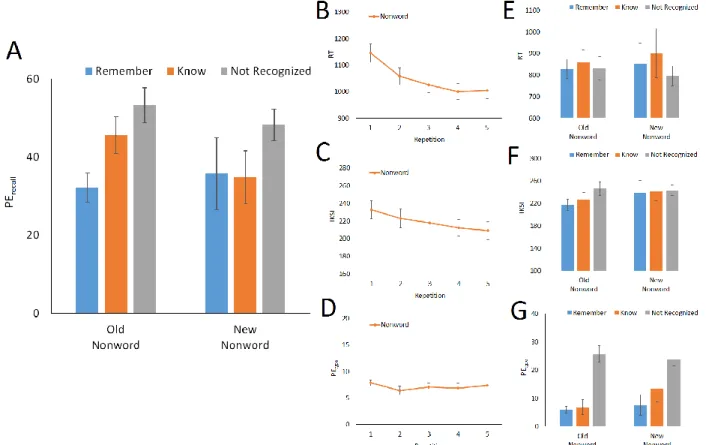
As in Experiment 2, there was no concurrent memory task in the training phase, so this section reports the results of the test phase. First, PErecall was computed for each participant in terms of Prior Occurrence (old vs. new) and Recognition Response2 (not recognized vs. known vs. remembered). The results are summarized in Figure 3A. Thirteen participants did not produce Remember responses for any new nonwords, and five participants did not produce Know response for any new nonwords (three of those did not recognize any new nonwords). This again precluded the use of a full-factorial ANOVA. Hence, multiple comparisons were conducted to compare PErecall for remembered, known, and not-recognized materials separately for old and new nonwords. For old nonwords, recall error was smaller when participants remembered the nonwords (M = 32.19%) than when they did not recognize the nonwords (M = 53.36%), t(29) = 4.54, p < .001, BF = 273.69, or when they only knew the nonwords (M = 45.63%), t(29) = 2.84, p = .008, BF = 4.51. Recall error was not significantly different between when participants knew the nonwords and when they did not recognize the nonwords, t(29) = 1.78, p = .086, BF =.61. For new nonwords, recall error was smaller when they knew nonwords (M = 34.83%) than when they did not recognize the nonwords (M = 48.22%), t(24) = 2.25, p = .034, BF = 1.43. The differences between remembered nonwords (M = 31.67%) and not-recognized nonwords, t(14) = .39, p = .700, BF = .21, and between known nonwords and remembered nonwords, t(16) = 1.31, p = .210, BF = .40, were not significant.
Next, logistic regression analysis was carried out on concurrent memory performance (0 = error, 1 = correct) on each trial with the predictors, Prior Occurrence (0 = old, 1 = new) and Recognition Response3 ([0,0] = not recognized, [1,0] = know, [1,1] = remember), along with all interaction terms. The best fit model included Recognition Response (b1 = .52, SE = .19, p = .005; b2 = .36, SE = .19, p = .057), Prior Occurrence (b = .29, SE = .14, p = .036), and the interaction between Prior Occurrence and Recognition Response (b = –.53, SE = .27, p = .048), χ2(4) = 27.29, p < .001, R2 = .026. Thus, recall error was generally lower for old materials (M =
41.68%) than for new materials (M = 44.09%), but the differences between old and new nonwords depended on Recognition Response, consistent with the results of multiple comparisons (see Figure 3A).
Therefore, the results showed that memory chunks were manifested most strongly when participants remembered nonwords from the training phase, as compared to when they only knew nonwords or when they did not recognize nonwords. These outcomes extend the findings in Experiments 1 and 2, suggesting that explicit retrieval of prior typing episodes is a reliable predictor of memory chunking.
Typing Performance
Typing performance in the training phase was analyzed in terms of a repeated-measures ANOVAs on RT, IKSI, and PEtype, with Repetition (1-5) as the only factor. Both RT and IKSI showed significant effects, F(4, 116) = 44.70, MSE = 2396.57, p < .001, ηp2 = .607 for RT (see
Figure 3B) and F(4, 116) = 9.01, MSE = 290.26, p < .001, ηp2 = .237 for IKSI (see Figure 3C).
However, it was not significant for PEtype, F(4, 116) = 1.10, MSE = 8.39, p = .361, ηp2 = .036
(see Figure 3D).
3 Recognition Response consisted of two dummy variables with binary responses (0 or 1). The first variable reflected whether typists recognized (1) or did not recognized (0) the typing material. The second variable reflected whether typists remembered (1) or only knew (0) the typing material, given that they recognized the material.
As in PErecall, typing performance in the test phase was analyzed in terms of paired t-tests for old and new nonwords separately. For RT, there were no significant effect, all ps > .18 (see Figure 3E). For IKSI, the only significant difference was obtained between remembered old nonwords (M = 217 ms) and old nonwords that were not recognized (M = 246 ms), t(29) = 2.96, p = .018, BF = 5.86; all other ps > .11 (see Figure 3F). For PEtype (see Figure 3G), there were significant differences between known old nonwords (M = 6.86%) and old nonwords that were not recognized (M = 25.72%), t(29) = 4.96, p < .001, BF = 812.26, and between remembered old nonwords (M = 5.94%) and old nonwords that were not recognized, t(29) = 6.09, p < .001, BF = 15403.49. There were no significant difference between known and remembered old nonwords, t(29) = .31, p = .761, BF =.15. There was also significant difference between remembered new nonwords (M = 5.94%) and not-recognized new nonwords (M = 25.72%), t(16) = 3.55, p = .009, BF = 15.69, but not between remembered new nonwords and known new nonwords (M =
13.47%), t(15) = .90, p = .383, BF = .28, or between known new nonwords and not-recognized new nonwords, t(25) = 1.81, p = .082, BF = 1.48.
Discussion
The results showed that concurrent memory performance was better for old nonwords that typists remembered than for those that they only knew or did not recognize, supporting the proposal that memory chunking requires explicit recollection of prior typing episodes.
Interestingly, the present results also showed that new nonwords that typists knew were
associated with lower recall error rates than new nonwords that they did not recognize. Although the recall error rate was similar between new nonwords that typists remembered and new
typists did not recognize. Note that typists rarely recognized new nonwords in the present experiment (13%), so these results relied on very small samples and yielded larger error terms4.
Furthermore, the results of typing speed were not consistent with the preceding
experiments: RT was not reliably associated with recognition whereas IKSI was shorter for old nonwords that was remembered than for old nonwords that was not recognized; no difference was detected between old nonwords that were remembered and old nonwords that were
recognized. As in the preceding two experiments, typing accuracy was better for old nonwords that typists remembered or knew than old nonwords that they did not recognize. There was no advantage of remembered nonwords over known nonwords.
Overall, the present results extend the findings in Experiments 1 and 2, showing that memory chunking is associated, not only with recognition of typing materials, but with explicit recollection of prior typing episodes (Yonelinas, 2002; cf., Wixted & Mickes, 2010). This conclusion further supports the proposal that memory chunking requires typists to be remind of typing episodes.
General Discussion
The present study investigated the development of memory chunking in skilled performance in the context of typewriting. Chunking allows division of the labor involved in typewriting, such that the higher level control focuses on language processing (e.g.,
comprehending and composing sentences) whereas the lower-level control focuses on keystrokes
4 Although the number of these trials was very small, it may be interesting to consider why there was a significant difference between falsely known new nonwords and correctly rejected new nonwords (note that there was no significant difference between falsely remembered nonwords and correctly rejected new nonwords). A possibility is that some of the new nonwords happen to be similar to the trained nonwords by chance. Especially in Experiment 3, we have doubled the number of nonwords by excluding words from Experiment 2, so there was a larger probability that such similarities between new and old nonwords occur just by chance. If so, some of the ‘intermediate’ chunks that typists learned for the trained nonwords might have been retrieved to maintain the new nonwords in short-term memory.
(e.g., translating letters into finger movements and moving the fingers to the key locations). Memory chunking interfaces the and lower-level processes by associating one higher-level unit with several lower-higher-level units, making parallel processing of keystrokes possible (e.g., Crump & Logan, 2010a; Logan et al., 2011).
It was observed previously that memory chunks developed under a concurrent memory load only when the same material was presented on consecutive trials (massed training) but not when there were lags between repetitions (spaced training); in contrast, memory chunks
developed better when there were lags between repetitions if training did not involve a
concurrent memory load (Yamaguchi & Logan, 2016). We proposed that two representations of the same typing material need to be active simultaneously in short-term memory for the material to be chunked; in other words, typists had to be reminded of a prior typing episode to chunk letters that occurred together repeatedly (cf. Benjamin & Tullis, 2010; Ross, 1984). The present study tested this proposal by observing the relationship between memory chunking and
recognition of typing materials.
Experiment 1 used the training condition in which typists typed words and nonwords under a concurrent memory load, and Experiment 2 used the training condition in which typists typed words and nonwords without a concurrent memory load. Both experiments showed that better chunking (i.e., lower error rate for the concurrent memory task) was associated with recognition of the typing materials. However, when they did recognize the materials with the yes/no recognition of Experiments 1 and 2, they could have retrieved prior typing episodes based solely on familiarity without explicit recollection (Yonelinas, 2002). Thus, Experiment 3
extended the findings of Experiments 1 and 2 by using the remember/know procedure, revealing that recollection of typing materials (i.e., remember judgements) was associated with better
memory chunking. These results are consistent with the idea that explicit retrieval of prior typing episodes is required for memory chunking.
The Role of Chunking in Typewriting
Typewriting performance manifests hierarchically structured cognitive processes. Cognitive processes that control typewriting skill have to comprehend the language, break down larger linguistic units into individual letters, and execute keystrokes that correspond to the letters. We have suggested elsewhere that skilled typewriting is controlled by two nested cognitive processes (Crump & Logan, 2010a; Logan & Crump, 2011; Logan, Ulrich, & Lindsey, 2016; Snyder, Logan, & Yamaguchi, 2015; Yamaguchi & Logan, 2014a; Yamaguchi, Logan, et al., 2013). The higher level process constitutes an outer loop that operates at the word level, which starts with encoding or retrieving individual words from a sentence and passing one word at a time to the lower level process. The lower level process constitutes an inner loop that operates at the letter level, which decomposes the word from the outer loop into individual letters, translates each letter to a keystroke, and executes the keystroke. These two loops divide the labor in typewriting, allowing multiple keystrokes to be activated in parallel. The outer-loop processing is explicit and the inner loop processing is implicit (Logan & Crump, 2010; Snyder et al., 2015), so typists are fully aware of the words they are typing, but they may not be aware of letters they are typing or the keystrokes they are making (Liu, Crump, & Logan, 2010; Logan & Crump, 2009; Snyder, Ashitaka, Shimada, Ulrich, & Logan, 2014).
The present study suggests that memory chunks are explicit memory traces that belong to the outer loop. This is consistent with the previous studies of typewriting that showed that the outer loop operates on words, while the inner loop operates on letters or keystrokes (Crump & Logan, 2010a, 2010b; Logan et al., 2011; Yamaguchi & Logan, 2014a, 2014b; Yamaguchi,
Logan, et al., 2013). Thus, typists should shift from using many letter units to using fewer word units as they gain more experience with typing. There have been studies suggesting gradual changes from smaller typing units to larger typing units with the development of typing skill (e.g., Fendrick, 1937; Salthouse & Saults, 1987; West & Sabban, 1982). For instance, Bryan and Harter (1899) has reported in their study of telegraphic skill that the learning curve that had reached a plateau had the second phase of a rapid performance improvement, which the
researchers suggested to reflect a shift of chunk units. Nevertheless, there has not been any study that assessed changes in typists’ awareness of different typing units as they are trained with the skill. It would be interesting to see if changes in the awareness of different typing units can be demonstrated in future studies.
Whereas concurrent memory performance is a direct measure of memory chunking, many factors contribute to typing performance in general. Memory chunking reduces short-term memory loads in typing, but other types of chunking (perceptual and motor chunking) should also contribute to other aspects of typing such as the speed of encoding typing materials and executing keystrokes. In the method of the present study, typing performance also depended on the concurrent memory load task. In the training phase of Experiment 1, there was little
evidence that typing speed improved over repetitions, despite the fact that typing accuracy showed a large improvement. As suggested earlier, the three measures of typing (RT, IKSI, and PEtype) may reflect different types of chunking; RT for perceptual chunking, IKSI for motor chunking, and PEtype for memory chunking.
In our concurrent memory load procedure, the benefit of perceptual chunking is excluded because typing materials are encoded before the go signal is presented, so RT does not include the encoding time. A concurrent memory load might also have interfered with the execution of
keystrokes. For instance, retrieved motor schemata may be stored in a temporary motor buffer (Sternberg, Monsell, Knoll, & Wright, 1978), and the concurrent memory load may interfere with accessing the motor schemata in the buffer. This interference could also have prevented motor chunks to develop under a concurrent memory load. When the concurrent memory load is removed in Experiments 2 and 3, we observed that typing speed improved over repetitions. Under these conditions, RT did include the encoding time as typists started typing immediately as the typing material appeared on the screen, and motor chunks might have developed better as there was no interference from a concurrent memory load. Instead, PEtype showed little evidence for an improvement, supporting that PEtype does reflect memory chunking; there was a sufficient space to maintain all letters in short-term memory or there was no need to maintain them as typing materials were displayed on the screen. There were also consistent effects of recognition on PEtype throughout the three experiments, whereas better recognition was associated with RT only in Experiment 2 and IKSI only in Experiment 3. Thus, with a concurrent memory load, the results of RT and IKSI are not very clear. These findings suggest that different methods are required to examine perceptual and motor chunking (Yamaguchi & Logan, 2014b).
The Role of Chunking in Memory Retrieval
There are several possibilities as to how chunks are represented in long-term memory and short-term memory. As shown in the present study, the number of chunks required to represent a single nonword reduces as the nonword is typed repeatedly. This may occur because typists develop a single memory trace that represents a set of letters (e.g. a word), and the memory trace serves as a pointer to a number of letters (or keystrokes) in long-term memory (Newell &
Rosenbloom, 1981). Typists may only need to retrieve the pointer to maintain chunked letters, reducing short-term memory demand. In this case, there would be one memory trace that
represents a chunk (nonword) and several memory traces that represent constituent elements (letters or keystrokes) in long-term memory. Chunking may also occur by creating clusters of associated letters instead of pointers to representations in long-term memory. As letters co-occur repeatedly, associations between the memory traces of the letters get stronger, producing clusters of letters with strong associations. Eventually, associations may become strong enough that activating one letter activates all the remaining ones. Thus, a cluster of letters may operate as if it is a single representation, reducing short-term memory demand. Both kinds of chunking seem relevant to skilled typing. Strongly interconnected representations form single chunk units in the outer loop, and those single units point to a series of keystrokes in the inner loop.
Although the present study cannot distinguish between the two possible mechanisms of chunking, both cases predict that chunking would improve retrieval of prior typing episodes. Thus, both accounts are consistent with the present results. It has been proposed that learning is better when a prior study state is retrieved and more variable contextual cues can be associated with the memory traces of the study materials (Glenberg, 1979; Greene, 1989; Kang & Pashler, 2012; Raaijmakers, 2003; Siegel & Kahana, 2014). Many researchers have assumed that memory retrieval is a function of the number of contextual cues that are associated with a
memory trace (Anderson & Bower, 1972; Estes, 1955; Howard & Kahana, 2002; Slotnick, 2010; Raaijmakers & Shiffrin, 1980). Retrieval would be more successful if there are more retrieval cues. At the beginning of learning, a study item is represented by several memory traces that contain a small number of contextual cues. The memory trace integrates more contextual cues as the same material is repeated in various contexts. With a large number of contextual cues, there will be a greater chance that one or more of these contextual cues are available later when the
memory trace needs to be retrieved, so the likelihood of retrieving the memory trace is increased as more contextual cues are integrated into the trace.
Learning a novel string of letters (nonword) would start with associations between a letter and its surrounding letters (inter-item associations), but repeated exposures to the same string would allow typists to integrate the co-occurring letters into a single structure (intra-item associations) and provide opportunities to elaborate the internal organization of the string. In typewriting, letters in a nonword are represented by separate memory traces before chunking occurs. As the same letters co-occur repeatedly, retrieval of prior typing episodes would
associate memory traces of the co-occurring letters, whereby one letter serves as a contextual cue for other letters. An advantage of chunking letters is that the context within a chunk is constant, so the contextual cues are present whenever a chunk is presented. Thus, as several letters get chunked, each of the letters in the nonword will have more letters that serve as contextual cues to facilitate retrieval of its memory retrieval. Note also that the same letters can serve as contextual cues for other nonwords; however, as the number of letters in a chunk increases, the internal structure of a chunk becomes more distinct from other chunks. This would reduce interference in memory retrieval from irrelevant memory traces (Newell & Rosenbloom, 1981). Therefore, we suggest that memory chunking improves retrieval of prior typing episodes by integrating many contextual cues and making the chunk more distinct from other chunks.
Concluding Remarks
Chunking has been an important theoretical construct in cognitive science. One of the novel contributions of the present study was to isolate the contribution of memory chunking in skilled performance by using the concurrent memory load procedure. Based on our previous study (Yamaguchi & Logan, 2016), the present study examined the hypothesis that the
development of memory chunks requires explicit recollection of a prior typing episode. The results confirmed that typing materials that typists recognized (Experiments 1 and 2) or recollected (Experiment 3) were chunked better than typing materials that typists did not recognize or were only familiar with. In addition, the present findings are consistent with the existing memory models that assume that memory retrieval is better as greater contextual detail is integrated into a memory trace, making it easier to retrieve prior typing episodes. Therefore, explicit recollection of prior typing episodes improves memory chunking, whereas memory chunking improves retrieval of prior typing episodes.