INTRODUCTION
There are more than one million insect species on this planet but less than one percent of those are considered pests. The other 99 percent play a crucial role in our food chain and many are indispensable. Flying insects such as bees and butterflies pollinate fruits and vegetables. Burrowing insects aerate soil and assist in the decomposition of organic material by returning nutrients to the soil. Insects also serve an important role as a food source for birds, fish, other animals and some plants. These facts seem to be forgotten in our quest to attain a “perfect lawn” and a pest-free home. Many people seem to think it is an “us against them” world in battling
insects. But remember, a perfect lawn and pest-free homes are not really important in the big picture. What is important is preserving our health and maintaining a balance with nature.
What is Common Sense Pest Control?
This Common Sense Pest Control program is an educational program designed to help residents maintain a comfortable, healthy home, landscape, and garden while reducing their reliance on pesticides. Common Sense Pest Control is not a “no pesticides ever” program. It utilizes integrated pest management techniques that emphasize physical, biological and cultural pest controls, alternatives to pesticides and least toxic pesticides. The use of pesticides is suggested as a last resort and only when necessary.
The program will give you the information necessary to implement
Integrated Pest Management (IPM) a.k.a. Least Toxic Pest Management in your home and yard. IPM utilizes regular monitoring to determine if and when treatments are needed. It employs physical, mechanical, cultural, biological and educational tactics to keep pest numbers low enough to
prevent damage and annoyance through least toxic and economical methods of pest management. IPM utilizes information on the pest and
environmental conditions as well as the best available pest management methods.
Unlike most commercial pesticide applications, IPM treatments are not made on a schedule. Treatments are made only if monitoring indicates that pests will cause an unacceptable amount of economic, medical or aesthetic
damage. Treatments are timed to be made when they will be most
Common Sense Pest Control Goals
Our goal is to educate residents about using least-toxic and alternatives to pesticides and synthetic fertilizers, and to help Broward County residents recognize the need to protect and preserve the quality of our surface and ground water resources in response to the pressures of a rapidly growing population.
Pesticides are toxic to both humans and the environment. Reducing
pesticide use to the greatest extent practicable will maximize the protection of both human and environmental health. In other words, implementing least toxic pest management prevents pollution and protects your health and the health of your family, friends, pets, etc.
Why are these workshops of value to you?
Pesticides are toxic chemicals. Many are known to cause cancer, chronic health problems and other adverse health effects in humans and other animals. The health effects of many of these substances is unknown. By implementing least toxic pest management in your home and yard, you will be protecting yourself, your family, and your pets from unnecessary
exposures to toxic compounds.
This project is being administered by the Broward County Environmental Protection and Growth Management Department (Broward County) funded by the U.S. Environmental Protection Agency.
CHAPTER TWO - Information About Pesticides
A. GENERAL
Pesticide - Any substance used to kill, repel or otherwise control a pest. These include insecticides, herbicides, fungicides, rodenticides and
disinfectants. Pesticides are designed to be toxic and can pose a risk to children, adults, pets and beneficial creatures and plants. Common
pesticides include herbicides for weed control, indoor ant and roach sprays, outdoor foggers, insect repellents, flea collars and pet shampoos.
According to section(s) 62-256.200 (20) Florida Administrative Code- "Pesticide" means any substance or mixture of substances intended for preventing, destroying, repelling or mitigating any insects, rodents,
nematodes, fungi, weeds, or other forms of plant or animal life or viruses, except viruses or fungi on or in living man or other animals, which the
regulator, defoliant or dessicant. Types of Pesticides
Acaricides - kill mites and spiders
Algicides - kill algae
Antibiotics - kill bacteria and viruses
Avicides - kill birds
Dessicants - dry up animals and plants
Fungicides - kill fungi
Herbicides - kill plants
Insecticides - kill insects Molluscicides - kill molluscs
Nematocides - kill nematodes
Piscicides - kill fish
Plant Regulators - alter the growth of plants
Repellents - drive pests away
Rodenticides - kill rodents
Sterilants - stop reproduction
Types of injury or damage caused by pests Economic -
- crop loss
- home damage from termites - clothes damage from moths - property loss due to tree damage Medical damage-
- bubonic plague bacillus passed by fleas on rats, - lyme disease passed from ticks on deer, wild mice; - encephalitis transmitted by mosquitos
Aesthetic damage - - loss of ornamental plants
Pesticide Usage in The United States (Taken from - “Pesticide Industry Sales and Usage, 1992-1993 Market Estimates, June 1994, Office of
U.S. pesticide user purchases account for one-third of the world market (dollars).
1.1 billion pounds of active ingredients of conventional pesticides are used annually in the U.S.
There are 21,000 pesticide products containing 860 active
ingredients
1993 annual U.S. pesticide user expenditures - $8.5 billion
- 56% herbicides - 30% insecticides - 7% fungicides - 7% other Household Use
Pesticides are used in more than 69 million households out of 94 million total households in the U.S.
In 1993, expenditures on insecticides for homes and gardens totaled $ 875 million, 32 million pounds or 13% of the total insecticide use by volume in the U.S.
Herbicide use in home and garden accounted for $219 million, 27 million pounds, or 4% of the total herbicide use in the U.S.
Fungicide use in the home and garden accounted for $16,000,000
11 million pounds or 8% of the total fungicide use in the home and garden
Other pesticides accounted for $108 million, three million pounds or 4% of the total other pesticide use in the home and garden.
Most Common Pesticides in the United States
General Non-Agriculture
Atrazine 2,4-D
glyphosate malathion dicamba diuron naled MCPP carbaryl Pesticide Usage in Florida
Florida is the second largest user in the United States for pesticides. 12,000 pesticides are used in Florida containing more than 600 active ingredients.
Forty-five of these ingredients are "restricted use pesticides." These are classified based on their acute toxicity to humans.
The EPA report “Pesticide in Groundwater Database: A Compilation of Monitoring Studies: 1971-1991" contains the following conclusions:
18,153 well samples were collected during the sampling period.
2362 samples contained detectable pesticides.
1708 samples had detectable pesticides above the drinking
water standards.
Florida groundwater significant detections included:
EDB (a nematocide)
alachlor (a herbicide)
bromacil (a herbicide)
aldicarb (a herbicide)
The ten most commonly detected in Florida compounds were:
aldicarb sulfone aldicarb sulfoxide atrazine alachlor simazine carbofuran aldicarb ethylene dibromide DBCP oxamyl
B. THE PATHWAYS FOR PESTICIDES IN THE ENVIRONMENT
Scientists cannot determine exactly what will happen to a particular pesticide once it enters the environment. They gather information which is used to make informed decisions about pesticide use and possible risks resulting from that particular use.
PLEASE REMEMBER- Pesticides are made to be toxic. Be an informed consumer and use environmental common sense when using pesticides in your home and garden. These chemicals may effect your health, the health of your neighbors and the health of smaller animals and plants in your community.
The fate of pesticides released into the environment is unknown. Releases may be followed by a very complex series of events which can transport the pesticide through the air or water, into the ground or even into living organisms. The medium for movement (air, water, soil, organisms) and the degree of movement (local or long distance distribution) will be different for each pesticide.
Following release into the environment, pesticides may have many different fates. Pesticides which are sprayed move through the air and eventually end up in other parts of the environment, such as soil or water. Pesticides applied directly to the soil may be washed off the soil into nearby bodies of surface water, may evaporate into the air, or may percolate through the soil to lower soil layers and groundwater. Pesticides may enter surface waters when applied for weed control, or indirectly as a result of leaching from boat paint, runoff from soil or other routes.
Properties of Pesticides
The properties of pesticides determine their fate and behavior in the environment. The important properties are persistence, volatility, and solubility in water.
When pesticides are released into the environment, they are either: 1) broken down, or degraded, by the action of sunlight, water or other chemicals, or microorganisms, such as bacteria; or 2) resist degradation and thus remain unchanged in the environment for long periods of time.
Persistence is measured by half-life. The half-life is the time it takes for half of the initial amount of a pesticide to breakdown. Thus, if a pesticide's
half-life is 30 days, half will be left after 30 days, quarter after 60 days, one-eighth after 90 days and so on.
When the pesticide is broken down, this usually leads to the formation of
less harmful products.
However, in some instances the products can be more toxic than the original pesticide.
Pesticides that are easily
broken down generally
move the shortest distance and have the least adverse effects on people or other organisms. Persistent pesticides generally move the longest distances and have the greatest potential to bioaccumulate in living organisms.
The volatility of a pesticide is its ability to evaporate. Pesticides that are more volatile have the greatest potential to go into the atmosphere. If they are persistent, they can move long distances.
The solubility of a pesticide is its ability to dissolve. If a pesticide is very soluble in water, it is more easily transported by rainwater, as runoff or through the soil as a potential groundwater contaminant. Water soluble pesticides are more likely to remain in the surface water where they may adversely affect fish and other organisms.
Properties of the Environment photo of dispersion of pesticides 1
The individual properties of soil, water and living organisms affect the fate and behavior of pesticides. Climate and topography also play a role. Soils vary in their ratios of sand, organic matter, metal content, acidity, porosity, permeability, etc. These soil characteristics influence the behavior of pesticides. Water characteristics also vary and influence pesticide behavior. Some of the characteristics are acidity, depth, temperature, clarity, flow rate, presence of biological organisms and general chemistry.
Living organisms accumulate certain pesticides. Through the process of bioaccumulation, pesticides accumulate in lower organisms and are passed to higher organisms in the food chain when eaten. The higher organism will accumulate the pesticides at higher levels than their food source. Pesticide levels in fish, for example, can be tens to hundreds of thousands of times greater than ambient water levels in which they live.
Humans are at the top of the food chain. They bioaccumulate the pesticides accumulated by the lower animals and plants that they eat. It is not only fish but also domestic farm animals and plant food which can accumulate pesticides. Care must be used in the use of pesticides in agricultural as well as home and garden scenarios.
C. HEALTH CONCERNS OF PESTICIDES
Pesticides are designed to kill living organisms and EPA prohibits claims that these chemicals are safe or nontoxic. Studies on animals have shown that of the 34 chemicals encompassing 95% of lawn pesticides, 10 are carcinogens, 12 caused birth defects, 20 are neurotoxic, seven alter the reproductive process, 13 cause liver and kidney damage, and 29 are sensitizers or irritants.
A study of indoor air quality by EPA in 1990 detected 26 pesticides. In animals, 19 of these pesticides are nerve poisons, 18 may cause cancer, 15 are mutagens, 15 could cause birth defects, and 19 can cause reproductive problems.
DEET, the active ingredient in many insect repellants, is responsible for more than 5,000 poisonings every year in the U.S. (National Capitol Poison Center, Georgetown University Hospital, Washington, D.C.). DEET can cause central nervous system disturbances, dermatitis, and skin irritation.
At EPA's current rate of testing, it will take more than a decade before 32 of the 34 most commonly used lawn chemicals can be fully tested for their effects on human health.
Inert ingredients are another problem with pesticides. Inert ingredients are designed to preserve the active ingredients, make them easier to apply or improve their killing ability. Information on inert ingredients is not required to be put on a product's label because this information is considered proprietary. These ingredients typically comprise between 80 - 90% of a pesticide, and can be more toxic than the active ingredients. Hazardous wastes such as chloroform and toluene are legally allowed to be recycled into pesticides.
Children and individuals with impaired immune systems are more vulnerable than adults to pesticide poisoning. Children have higher metabolic rates, and absorb higher concentrations of toxins from the environment than adults. In addition, children have not fully developed their body's defense systems against toxins. Their livers and kidneys, the organs that detoxify and excrete foreign substances, and act as barriers to absorption of toxic substances, such as those that protect the brain, have not fully developed.
D. PESTICIDE HANDLING AND DISPOSAL
Handling Pesticides
It is the intention of this book to dissuade you from excessive use of pesticides, but if you decide to use pesticides, they can be handled in a safe manner to avoid risking the health of you and your family, your environment and the wildlife around you. The following are some suggestions for more safe use.
1. Choosing the pesticide
a. Do not use a pesticide unless you have a pest problem b. Do not buy more pesticide than you can use in one season c. Identify the pest before purchasing the pesticide
d. Choose the pesticide that is least toxic
e. Read the label to determine the proper application amount, requirements for protective equipment and the potential hazards associated with the pesticide.
f. Do not use a "restricted use" pesticide unless you are a formally trained, certified pesticide applicator. These products are too dangerous to be used without special training.
a. The pests that the product will control
b. How to mix and apply the product. Double the dose does not do twice the job. It is hazardous to you and the environment. c. When to apply the product
d. How the pesticide will affect crops, animals, and people e. How much and how often to apply
f. READ THE LABEL COMPLETELY EVERY TIME YOU USE THE
PESTICIDE AND REMEMBER THAT YOU ARE HANDLING A TOXIC CHEMICAL. DO NOT USE THE CHEMICAL OTHER THAN ACCORDING TO THE LABEL
3. Other information to consider
a. Mix the chemical outdoors or in a well-ventilated area. Mix only the amount you need
b. Keep children and pets away from areas where you mix or apply pesticides.
c. Never mix different pesticides.
d. Never eat, drink or smoke when working with pesticides. e. Wear rubber gloves, a long sleeved shirt, long pants, foot
protection, goggles, a hat and preferable a mask when mixing and applying pesticides. Remember that pesticides can be absorbed into your body through the skin, as well as orally and through inhalation.
f. Always shower and shampoo after working with pesticides. Wash
your work clothes separately from the family laundry. g. Always keep the pesticides in the original container.
h. Store pesticides in a ventilated, dry and cool place, preferably locked and away from children.
i. Use all the pesticide in the container, do not pour unused pesticides down the drain.
j. Triple rinse empty pesticide containers and use the residue for application. If the pesticide is a solid, shake the bag to remove and use all product before you dispose of the container.
k. Do not store anything in an empty pesticide container and do not reuse the container.
1. Any unused product that can no longer be used should be taken to the local household hazardous waste collection for disposal. For additional information , contact the Broward County Office of Integrated Waste Management Household Hazardous Waste Disposal Hotline at (954) 765-4900.
m. If a spill occurs, do not wash it away. Sprinkle with sawdust, or kitty litter, sweep into a plastic garbage bag, and dispose with the rest of the trash.
n. When treating indoor areas, remove pets (including birds and fish) from the area to be treated. Also, remove food, dishes, pots and pans before treating kitchen cabinets.
o. Allow adequate ventilation and go away from the areas for at least the length of time prescribed by the label.
p. When treating outdoor areas, close the windows. Never spray or dust outdoors on a windy day.
q. Evaluate the results of your pesticide use to determine whether future applications will be effective. Continue reading this manual to learn how to avoid pesticide use altogether.
CHAPTER THREE - Alternative Pest Control Methods
Integrated Pest Management (IPM) utilizes regular monitoring to determine if and when treatments are needed. It employs physical, mechanical,cultural, biological and educational tactics to keep pest numbers low. Least-toxic pest control methods are used as a last resort.
No animal is a pest in and of itself. Whether a creature is a pest or guest depends on your point of view. To some, a mouse can be a pet; to others, a pest. Another consideration is how much damage is tolerable? Remember, complete elimination of a pest is not cheap and in some cases, not possible. If your dog stays outside, he will have fleas. The question is whether he has a few (tolerable damage) or if he has so many that he has scratched the fur off his back (not tolerable). Types of damage include economic, medical and aesthetic.
A. FIVE STEPS TOWARD ACHIEVING INTEGRATED PEST
MANAGEMENT
:
1. Identify the Pest
If your only interest is to kill a pest, all you may need to do is identify it. But if you also want to use least-toxic pest control you need to understand the role the pest plays in relation to its environment. This is called an ecosystem perspective. It will reveal many pest control options you can’t perceive if you only focus on the pest.
2. Manipulate the Pest’s Ecosystem Components:
a. Limit access to food
c. Encourage natural enemies
d. Limit energy by moving the food source further from the pest’s
habitat
e. Reduce the carrying capacity of a site (ability of a particular site to support a pest - reduce the site’s carrying capacity for the pest, and increase the carrying capacity for the pest’s natural enemies).
3. Utilize Natural Pest Controls a. Climate & Weather b. Food & Habitat
c. Pathogens
d. Predators
e. Parasites & Parasitoids (see page three for a definition) 4. Pick a Treatment Strategy (an overall approach to a problem)
5. Pick a Tactic (a specific action or series of actions within that strategy) IPM Program Components
Monitoring Determining
Injury Levels Applying Strategies and Tactics
Evaluation and Program Redesign
Treatment Strategies and Tactics
I. Indirect Suppression
Strategy A: Design/Redesign the Landscape or Physical Structure (design the pest out of the system)
Tactic 1: Select plants that resist pests
Tactic 2: Use landscape that promotes the health of the host plant
Strategy B: Modify the habitat
Tactic 1: Reduce pests’ food, water, shelter
Tactic 2: Enhance environment for the pest’s natural enemies
Strategy C: Change human behavior
Tactic 1: Change cultivating, mowing, watering, fertilizing, pruning, mulching practices
Tactic 2: Modify waste management and sanitation procedures Tactic 3: Inspect & quarantine new plants, pets and materials
II. Direct Suppression
Strategy A: Physical and Mechanical Controls
Tactic 1: Manually remove pests (hedge clippers, flea comb,
vacuum, hoe)
Tactic 2: Use barriers (nets, screens, caulking)
Tactic 3: Use heat, cold, or water
Strategy B: Biological Controls
Tactic 1: Conservation of biological controls
a. Treat only if injury levels will be exceeded
b. Spot-treat to reduce the impact on the
natural enemies of pest
c. Time treatments to be least disruptive
d. Select the most species-specific, least
broadly damaging treatment
Tactic 2: Augmentation of natural enemies (artificially increase enemies who are already present in low numbers)
Tactic 3: Inoculation with natural enemies (release enemies
early in the season before they are generally present)
Tactic 4: Importation of natural enemies (introduce new
enemies)
Strategy C: Least Toxic Chemical Controls
Example of Treatment Strategy I. A. Tactic 2: Better Planning To Eliminate Pests
Florida is number two in pesticide use amongst all states. There are several factors that contribute to this excessive use of pesticide. One factor is in how we design our landscapes. Generally speaking, we choose plants based on their appearance, not on realistic criteria. We tend to emphasize a monoculture-that is we like to segregate different species. A perfect example is a backyard garden. Most gardeners plant rows of corn, rows of tomatoes, and rows of cucumbers. This allows a pest to specialize and eliminates competition. Nature never segregates plants in such a way. In nature, the plants grow
haphazardly. Because most pests are host -specific, growing different species together prevents pests from readily spreading. Another step is to choose the plant to fit the site. Even a native species will not do well if it is placed inappropriately. Plants need to fit the location, soil, and water conditions.
Example of Treatment Strategy I. C. Tactic 1: Better Lawn Care Lawn care companies usually apply standard chemicals on a fixed, year round basis. This means your lawn is getting fertilizer, herbicides and pesticides whether it needs them or not. This continuous “quick fix” may make your lawn look nice in the short term, but it creates a chemically dependant lawn, susceptible to weather and pests. Your lawn service may also be responsible for killing beneficial earthworms and microorganisms which are necessary to break down thatch (plant debris) naturally.
What can you do to have a healthy lawn, free of pests? To avoid stressing grass, mow no more than one-third of the blade of grass off at one time and cut it no shorter than 2.5 inches. This will require more frequent mowing. Pathogens such as fungus can be spread by lawn mower blades. Clean your blades or if you use a lawn service, ask them to spray clean their blades with a ten-to-one dilution of
alcohol to kill pathogens. Make sure the mower blades are sharp. The number one cause of lawn grass death is from misuse of lawn mowers. Dull blades rip grass instead of cutting it, which weakens it and makes it more susceptible to disease and pests. Frequent, light watering encourages shallow roots, which increases the potential for disease. Water your lawn less often, once per week but for longer periods of time up to 30 minutes. This will make the roots grow longer and deeper and make the grass less susceptible to disease. Rather than applying chemicals at set times, only apply them when there is a problem and spot treat problem areas only.
Example of Treatment Strategy II. B. Tactic 2: Common Natural Enemies
Biological control uses natural enemies to keep pests in check. Natural enemies are called “beneficial” because they assist us in controlling pests. Identification of beneficial insects is the first step in
implementing biological control. Natural enemies are placed in three major groups: Predators, Parasitoids and Pathogens.
A predator attacks, kills and eats its prey. Some predators are host-specific and some eat a wide variety of pests. A Lady Beetle is a common example of a predator that eats aphids. Praying mantis, spined soldier bugs,
lacewing, flower bug, and spiders are also predators.
Parasitoids lay eggs in or on a host. When the eggs hatch, they kill the host by consuming it’s organs or body fluids. A common example is the
parasitic wasp which lays its eggs on pest larva. Most parasitoids come from the fly and wasp family.
Pathogens are bacteria, fungi or viruses that invade pests, causing disease. The disease often weakens the pest and kills it.
Beneficial insects are important to you as a homeowner. Distinguishing pests from beneficials can prevent the killing of a beneficial (pest controlling insect). Avoid the use of broad-spectrum pesticides because they will kill both pests and beneficial insects. There are catalogs available which list suppliers of beneficial organisms in the United States.
Now that we know the five steps toward achieving IPM, let’s examine the cultural, physical and biological ways to further reduce pests.
A. Why Do We Have Pest Problems From the Start? 1. Landscape design
2. Landscape maintenance 3. Landscape goals
B. Cultural Controls
1. Compatible plants for the landscape 2. Avoid mono-cultures
3. Correct watering and fertilizing procedures C. Knowing When to Walk Away
1. Effect of no action scenario 2. Effect of natural controls D. Physical and Mechanical Controls
1. Use a hose to wash the pest out 2. Use shears to trim the pest out 3. Use traps or barriers
4. Use a hoe for weed control and design the landscape to avoid weeds
E. Biological Controls
1. Identify the predator
2. Attract and keep predators 3. Obtain predators
F. Last Approach
1. Identify pesticide spray options
2. Identify the most effective spray options
G. Improving our Integrated Pest Management Procedures - Learn from the pest infestation
Basics of a healthy lawn:
- Do not over water. Daily watering encourages shallow roots.
- Do not cut grass too short.
- Avoid chemical fertilizers.
- Fertilize only as needed, not on a schedule.
- Use organic fertilizers.
- Leave grass clippings on lawn.
- Monitor for early signs of pest problems. Take preventive non-toxic
action first.
- Use pesticides only as a last resort.
- Be patient, it takes time to detoxify your lawn.
Benefits of a chemical free lawn:
- It takes care of itself, requires less time, effort or money.
- Grass grows slower, needs less mowing and watering because it will
have longer roots.
- It is better able to withstand stress including pests, diseases, and
weather.
B. WHY DO WE HAVE PEST PROBLEMS?
The answer to why there are pest problems on lawns and landscapes is simple . . . it’s us. Most people create very unnatural plant and animal communities around their homes. Take the lawn, for example, where one type of plant is grown in a large area. This is called a mono-culture. It is seen in agriculture and of course in lawn and landscape designs. Nowhere in nature is one type of plant growing in large areas. In a natural scenario, other plants are present trying to take a foot hold, just as is seen on a lawn. Wherever the conditions change just enough to make it possible for a seed to sprout, and the grass is not able to choke it out, weeds will grow. The only way to have a weed free lawn is to dream about it. There are some lawns that appear to be perfect, but they are not. Chemicals are short cuts which create a lot of environmental problems and often do not work in the long run. A system that closely simulates natural conditions will decrease
pest problems.
How much grass do you really need? Consider planting some ground covers, shrubs or wild flowers as an alternative to some of your grass area. For areas where lawns are necessary, minimize the area because lawns are the largest users of our resources like water, maintenance (time & money) and chemicals. The way that we cut the grass is also very important. Dull mowers do most of the damage. More grass is killed by mowers and weed eaters than chinch bugs and fungus. Lawns are often overfed and over watered. Over watering attracts insects, fungi and the standing water in some areas of the lawn will attract weeds. Grass should be watered only when necessary. This will increase root growth.
C. SOUTH FLORIDA TREE AND PLANT NATIVE SPECIES
WITH IDENTIFYING PHOTOGRAPHS
When choosing landscape material try to use native species in the
appropriate locations. Some of the best natives to use in Florida are the plants and trees from coastal areas and pine communities. However, there are many others that will work just as well. Most, if not all, new home sites are very hot, open areas, with very poor soil conditions. The plants along the south Florida coast have evolved under similar conditions. They are adapted to high wind, salt, poor soils, and sparse water, which makes them perfect for the home landscape. One misconception with natives is that they must have an uncontrolled look or add little color to the landscape. This is untrue. The photographs which follow prove this point. The three most important benefits of using native plants are: 1) the decrease in the
amounts of insecticides and fertilizers required to maintain the landscape; 2) the amount of wild life that is supported by these plants and trees; and 3) decreased water use. Native plants and trees will attract more butterflies and birds, which many people desire around their homes. Most, if not all, of pests that feed on exotic plants are also exotic and they don't feed on native plants.
These are a few of the choices for native and wildlife landscape. These plants, trees and palms need very little help, if any, once established.
Palms
CABBAGE PALM, Sabal palmetto- This is a great palm for any location in South Florida, it is very drought tolerant (will survive without supplemental irrigation after establishment). The average height is 40 feet, but Cabbage Palms can reach 90 feet tall. Also, this palm is our state tree. The fruit is
eaten by mocking birds, red-bellied woodpeckers, thrashers and many others.
ROYAL PALM, Roystonea elata - Florida royal palms have become very rare in the wild. We have been using Cuban royals (R. regia) along with Florida royals for some time now. Both are tall (80 feet), and very similar in
appearance. Many birds eat the fruit of this palm. It is moderately drought tolerant (will require supplemental irrigation during extreme dry periods to maintain attractive appearance.)
SAW PALMETTO, Serenoa repens - The Saw Palmetto is a low- growing
shrub-like palm, but it can reach a height of 10 feet. It is very hardy in almost any conditions and a great accent plant. Birds love the fruit and cover this palm provides.
Shade Trees
LIVE OAK, Quercus virginiana - This large, long-living shade tree grows to 50 feet tall. Don't plant it under power lines. It is best planted on the west side of home for shade and it is very drought tolerant. Its acorns are eaten by lots of birds and small mammals. It helps support the resurrection fern, Spanish moss and other epiphytes.
LAUREL OAK, Quercus laurifolia - The Laurel Oak is taller and shorter lived than the Live Oak and not as wide. Do not plant it under power lines. Laurel Oaks will support a large amount of wild life and it is very drought tolerant.
BALD CYPRESS, Taxodium distichum - This deciduous tree is great for the wet areas on new home sites between the properties and it is very drought tolerant. It will reach 70 feet tall. Its seed cones are fed upon by grey squirrels and many birds.
GUMBO LIMBO, Bursera simaruba - The Gumbo Limbo has beautiful red, peeling bark. It will reach 50 feet and the trunks can have a lot of character on older specimens. The fruit is eaten by mocking birds and other birds and it is very drought tolerant.
PIGEON PLUM, Coccoloba diversifolia - This very hardy, very drought tolerant small tree will grow to 35 feet. The crown will sometimes stay lolly-pop shaped. Its fruit is eaten by many species of birds
SATIN LEAF, Chrysophyllum oliviforme - The leaves have a brown satin look to them on the under side. The fruit can be eaten raw or made into a jelly when ripe. It is very drought tolerant.
PARADISE TREE, Simarouba glauca - The Paradise Tree reaches fifty feet high and provides abundant shade. The fruit and blooms are used by lots of wild life and it is very drought tolerant.
STRANGLER FIG, Ficus aurea - At times this very drought tolerant tree will start life as an epiphyte in cabbage palms and other trees. It attracts cedar waxwing birds and ruddy daggerwing butterflies. Watch out for the roots and plant this tree away from the home. It will reach 60 feet.
SEAGRAPE, Coccoloba uvifera - The sea grape can be a large tree and grow up to 40 feet with a large spread of equal size. The fruit is eaten by birds, mammals and turtles. It can be a messy tree with leaf and fruit drop and it is very drought tolerant.
Small Trees
GEIGER TREE, Cordia sebestena - The Geiger Tree blooms orange flowers all year around. It’s average height is 25 feet and it will attract humming birds.
It is very drought tolerant.
BUTTONWOOD, SILVER AND GREEN, Conocarpus erectus - This great small tree will grow to 35 feet in both forms, and is used as a nest and cover by birds and other animals. It is very drought tolerant.
Hedges and Shrubs
FLORIDA PRIVET, Forestiera segregata - This is the best hedge to replace Ficus benjamina, it requires very little trimming to keep it formal looking. Warblers feed on insects attracted to the flowers during the blooming season and other birds feed on fruit. It is moderately drought tolerant and will grow to 10 feet but can be kept at four feet.
NECKLACE POD, Sophora tomentosa- This great free standing shrub has yellow blooms. Humming birds feed on the nectar and warblers and other birds fed on the insects attracted to the blooms. It can reach a height of eight feet and is moderately drought tolerant.
BEAUTY BERRY, Callicarpa americana - Its large clusters of purple berries are eaten by woodpeckers, cardinals and other birds. It’s maximum height
reaches six feet, but it is best if cut back to four feet every year or two. Beauty Berry is very drought tolerant.
WAX MYRTLE, Myrica cerifera - The wax myrtle can be used as a small tree of 20 feet or as a hedge. It is one of the best plants for attracting birds and is very drought tolerant.
YAUPON HOLLY / SHILLINGS HOLLY Ilex vomitoria -One of the best small hedges and small trees, it grows up to eight feet tall. Its red fruit is eaten by many types of birds and it is very drought tolerant.
JAMAICAN CAPER, Capparis cynophallophora - This beautiful spring bloomer
attracts all kinds of insects for pollination. It can reach nine feet tall and is very drought tolerant.
WILD COFFEE, Psychotria nervosa - Wild coffee is a great hedge for shady areas and for attracting birds. It will grow up to five feet tall, sometimes taller, if not trimmed. It can become a very attractive formal looking hedge with time. Wild Coffee is moderately drought tolerant.
FIRE BUSH, Hamelia patens - The best hedge for butterflies and humming birds, its red flowers bloom all year. Fire Bush can reach a height of 10 feet. It can be kept cut back to five feet.
COCOPLUM, Chrysobalanus icaco - New growth of the red tip variety is a great way of adding color without blooms. Birds and people like the fruit. The Coco Plum can be a unique small tree and is moderately drought tolerant.
SIMPSON STOPPER Myrcianthes fragrans - All stoppers are great for birds and the hedges reach five feet or greater. It smells like nutmeg when you trim the foliage. Spanish Stopper is a great low- light thick hedge. The Spanish, Redberry, White and Red Stoppers are Eugenias and all are great hedges and bird attracters which are very drought tolerant.
Ground Covers And Wild Flowers
FAKAHATCHEE GRASS, Tripsacum dactyloides - It is a good ground cover for large areas. The seeds may attract seed-eating birds. It’s average height is three feet.
DUNE SUNFLOWER, Helianthus debilis - The dune sunflower has daisy-like blooms all year round. Once established, it needs no supplemental
watering. It will cover large areas quickly and is a great replacement for grass areas.
COONTIE, Zamia pumila - The Coontie is a low, fern-like ground cover growing to three feet. It serves as larval plant food for the Atala butterfly and is very drought tolerant.
BLANKET FLOWER, Gaillardia pulchella - The blanket flower blooms all year with red and/or yellow daisy-like flowers. It will seed itself and loves hot dry locations.
TROPICAL/TEXAS SAGE, Salvia coccinea - Red or pink blooms all year with quick re-seeding, the tropical sage attracts lots of pollinators to the blooms.
TICK SEED, Coreopsis leavenworthii - The tick seed has small daisy-like blooms and will work well in low, wet areas. It will spread into other areas by seeding.
SCARLET MILKWEED, Asclepias curassavica - Monarch and Queen butterflies
use this plant as a larval plant food. It will look leggy and will need to be cut back when being fed upon heavily. Although not our native milkweed, it is easily cultivated and can seed itself fast.
SWORD FERN, Nephrolepis biserrata - The Sword Fern creates a cover for wildlife and will fill in large areas fast. Sword Fern is questionable as a native, but it makes a great ground cover.
PORTERWEED, Stachytarpheta spp.- Porterweeds attract lots of butterflies. The "tall blue" seems to do the best for Zebra Long Wing, Gulf Fruitfly and Julia Butterflies. The native lower growing porterweed will attract skipper butterflies. Porterweeds reach about three feet tall.
LANTANA/YELLOW SAGE, Lantana camara - The lantana is a good butterfly plant. The native L.ovatifolia is nonpoisonous and not as weedy.
PENTAS, Pentas lanceolata - Although not a native, the Pentas is from East Africa and it serves as a great butterfly plant. Red and pink seem to attract the most butterflies. Don't let them get too wet once they are established.
D. KNOW YOUR SITE CONDITIONS
The first consideration, when choosing a plant species should be conditions surrounding the home. For example, if the sides of a home tend to retain standing water during the summer, plants that live in standing water should be chosen. This is a very common problem with new home communities due to the lack of gutters, the soil conditions, and the flood control systems for the home site. There are many options available when designing the
landscaping for your home. It is better to work with the existing conditions than to try to make a major physical change. If changes are made, higher maintenance will be needed to help them stay that way. The more natural the conditions the plant is put in, the less work will be necessary. A plant that lives naturally in full sun with very little water should not be placed on the shady side of a home with sprinklers on three times per week. The natives, once place properly and established, will need little help to stay looking their best.
It is possible to design landscapes which use no pesticides, little fertilizers and very little water. Conditions around the home should be surveyed. Native plants, palms and trees, compatible with site conditions should be chosen for planting around the home. Trees should be added whenever possible. They will cool down the home, keep down street noise and help support wildlife. New home communities always seem very hot and barren because of the lack of trees. This feeling declines as the trees start to
mature. There never seems to be enough tree cover on large home sites. Ten thousand square feet of sod and one lonely tree is a common sight. Grass requires higher maintenance and will use up a large amount of water and money. A few good trees and shrub material would last longer, use very little resources and help support the native wild life. Grass is a very inexpensive ground cover which makes it so popular to developers. However, the cost to the home owner to maintain these grassed areas is a lot higher than landscaping with native trees, shrubs and ground covers. There has been great success in communities that have restored natives or who have protected natives during the development.
E. CONTRASTING YARDS
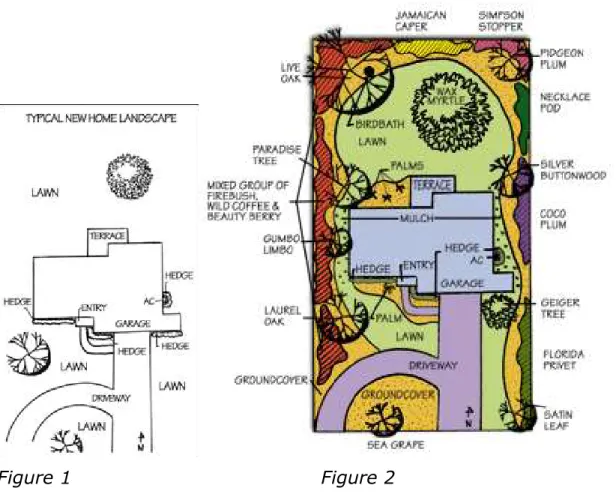
Figure One and Figure Two demonstrate two different south Florida yards. The first yard represents a typical new home landscape. The second yard demonstrates that native plants are more wildlife-friendly and require less maintenance and pesticides for their upkeep. Compare the new home landscape with the native species landscape. Keep in mind that these are suggestions, not a design specifically for your home. Site conditions vary and one design does not fit all.
In the native species landscape there is a significant reduction of lawn. This reduces water use, pesticide use and labor. Eliminate as much grass as possible to limit the amount of water, time and money necessary for maintenance. Grass also requires the largest quantities of chemicals you use around your home.
Figure 1 Figure 2
Small Trees
Four small trees have been placed along the east side of the property. Satin Leaf has been placed on the southeast corner, a Geiger Tree is located near the garage, a Silver Buttonwood is located at the corner of the home and at the far north east corner of the property there is a Pigeon Plum tree. A Wax Myrtle is planted in the lawn area in the back yard to draw the birds out of the surrounding plantings to feed on the fruit
Shade Trees
Larger tree species have been placed on the west side of the property to provide shade. This will lower the electricity bill by cutting air-conditioning use. A Laurel Oak has been placed in the south west corner of the property. A Gumbo Limbo is then planted on the west side, next to the house. A
Paradise Tree is placed north of the Gumbo Limbo and a Live Oak is located at the north west corner of the property.
the leaves drop once a year as it gets new foliage, the trunk of the tree can be very attractive. This is a good location for more aggressive ground covers because the driveway and side walk would keep it in bounds
Palm trees add greenery and texture without becoming overpowering and hiding the home. Palms are used near the front entryway and the rear terrace area.
Hedges and Shrubs
Use more than one type of hedge on your property. Utilizing one hedge species can result in an insect problem and a maintenance nightmare. Plant your hedges along the property line in shrub groupings and mix them up. This is to avoid monocultures as mentioned previously. Look along the east (right-hand) side of Figure Two. Florida Privet, Cocoplum and Necklace Pod are utilized along the property line. The Florida Privet and Cocoplum can be more formally trimmed while the Necklace Pod is allowed to grow more naturally toward the back yard.
On the west side of Figure Two, Wild Coffee, Fire Bush, and Beauty Berry are placed in alternate groupings of five to seven per group. This area will have a lot of bird and butterfly activity.
The back of the property has been designed with a mass planting of Jamaican Caper. A second planting of Wild Coffee, Fire Bush, and Beauty Berry continue along the northwest corner. Simpson Stopper is planted on the northeast corner.
Ground Covers
Ground covers are used to fill in the remaining areas. The east side of the property could utilize a more full sun type of ground cover depending on the height of this home and the neighbor’s home on the right. Dune Sunflowers would work if they have enough room to grow and if they do not take over everything else. Salvia, Blanket Flower, Pentas and Lantana would work in large groupings if they have the right light and growth potential.
Ground covers such as Sword Fern, native Porterweed and taller Porterweeds are used on the west side because they are more shade tolerant. The front and back yards have more light exposure so Pentas and Milkweed are placed there. The milkweed will have a beautiful bloom, however it will look thin and leggy when fed upon by the Queen and Monarch caterpillars.
Do not leave any open areas. Use mulch to fill in as a ground cover, but design the planting areas to be very tight. This will reduce the possibility of a major weed problem. Also, plant a ground cover under the trees to keep lawn maintenance equipment away from the trunks.
One fun thing to do is to experiment with different groundcovers. Most of the ground covers should last at least one to three years; some can last a lot longer. Some of the more permanent ground covers are Sword Fern,
Cocoplum (horizontal), Coontie and Ilex Shillings Holly. All will stay, or can be kept with very little effort, at three feet or less.
Benefits Derived From the Native Species Landscape
What does the use of native plants have to do with common sense pest control? Native plants need very little, if any, pesticides. This results in less opportunity for chemicals to get into the food chain and affect man and
animals. Native plants will be bothered by an occasional native insect pest. But because the pest is native, it will have many native enemies to keep it under control. This will prevent the pest population from getting large enough to make a significant impact on the plant. Native plants have evolved with the native insects and the plants have adapted their own defenses.
On the other hand, the use of exotic (native) plants results in non-native insect infestations. The non-non-native pests have very few natural
enemies to control them. The pest’s population can grow astronomically and pesticides are often needed to keep it in check.
Another benefit of native plants is that they need less fertilization if the design and plant selection are done correctly. This is because they are more adapted to our climate and soils. It is important to design the landscape based on the condition you have naturally. Native plants will thrive with less water once established. The normal rainfall patterns should be enough unless there is a severe drought. The natives may need to be watered approximately three to five times per year. This is opposed to exotic plants which may need water three to five times per week! Native hedges will need less trimming than exotic hedges, especially in the winter. Once native
hedges are topped and faced for the normal hedge look, they will go longer between trimmings than tropical exotics. This will save time and money. In summary, native landscaping will:
1. Lower pesticide use, possibly eliminate pesticide use
3. Lower fertilizer use, possibly eliminate fertilizer use
4. Drastically lower water use
5. Save time and money on maintenance
Figure Two is by no means a design for every home. The main concept is to show the diversity of native and wildlife landscaping. Try to use as many different types of plant species as possible. This will create the greatest amount of diversity in wildlife attracted to your yard. This design was also to show you a design featuring less grass . Keep in mind some maintenance will need to be done to keep the garden somewhat under control. The plants in the drawings around the home can also be native and kept more formal as to not block windows and fit the architecture of the home. This would be a good location for some of our native palms.
Design is very important from a usage standpoint. It may look nice but it may not work. If you need help, find a designer who works with natives and let him/her know what you want out of your landscape (lower water and maintenance bills, what types of wildlife you would like to see) and talk with him or her. So go have some fun and watch all the wildlife you have been missing out on.
The next time you purchase plants for landscaping, think of the following: 1. What does the plant need to stay in good health? (Water, light, soil, etc.)
2. Do you have those conditions naturally or do you have to create them?
3. What is the long-term goal of my landscape project? 4. What does this plant provide for the native wildlife?
Keeping these things in mind will help keep costs down and will lower the negative impact the landscape will have on the environment.
CHAPTER FOUR - Less Toxic Steps
A. INTRODUCTION
Gardeners often call the Agriculture and Extension Education Division office when they have seen something unusual among their plants, something that alarms them. Unfortunately, some people react first by reaching for a pesticide, mixing it, often double-strength, and spraying like crazy. All too
often, no pesticide was needed. It was a case of "mistaken identity."
The thing that alarmed them might have been a beneficial insect, a harmless creature, or a perfectly natural growth. But by spraying, they may have done damage-- putting the environment, beneficial insects, and possibly themselves at risk. So how do we avoid making these mistakes? We will learn how to use this technique to combat problems in our gardens and homes. At the end of this presentation we will summarize the easy steps of this technique and show how each and every gardener can do something to prevent future problems for the environment.
This chapter will first point out some of the most common mistaken identities, reviewing what they are and what they are not. Secondly, it will address some of the problems found in local landscapes and around the home. Finally, the chapter will identify the most common insect pests- the ones you are likely to see in your home and yard, compare them to beneficial or harmless insects, and explain how to tell them apart. The steps involved in least-toxic pest management, will be summarized, explaining exactly what to do when there is a problem in your home or garden.
Our goal is not to convince you that you must put up with roaches in your kitchen. Rather, it is to teach you what you can do to control them in ways that do not impact negatively on the environment. We want you to think of chemical control as an option which is available to you, but which should be used only after other control options have been exercised. We want to identify the chemical controls which are the least toxic to the environment.
B. MISTAKEN IDENTITIES
"Scouting" is the first task that gardeners should get into the habit of performing. Scouting is simply taking a walk in the yard. Walking around the yard every week and getting to know what your plants actually look like and how they grow is an important step in gardening. In order to know when there is something wrong with a plant, you have to know what it looks like when it is healthy.
Spanish moss and ball moss on trees are good examples of mistaken identities. People complain that these are killing their trees because they increase as the tree declines. Research has shown us that neither Spanish moss nor ball moss parasitizes trees. The tree thins out and dies of stress (usually root damage or disease), and the mosses proliferate at the same time, because they enjoy the increasing sunlight. These plants are epiphytes, which means that they derive all their nutrients and water from the air, not from the plants to which they are attached. Both are members
of the Bromeliad family. The only time you'd want to remove epiphytes is if they are so thick that they are shading leaves or breaking branches. Spanish moss will sometimes do that.
Another example is ground mosses. Ground mosses grow when a lawn thins out due to low vigor, excessive moisture, or excessive shade. This gelatinous alga did not kill the grass; it simply moved in as the lawngrass declined.
Some plant parts might be mistaken as a pest. For example, ferns have reproductive structures called sori on their lower leaf surfaces which look a lot like scale insects. Glossy privet stems have lenticels which might be mistaken for insects--they are actually corky structures which function in gas exchange, and therefore perfectly normal. Some other corky outgrowths occur on stems and are perfectly normal for certain plants. In Florida, they are seen on Sweetgum and Winged Elm. Some plants have bark characteristics which can be mistaken for problems. Examples are the peeling or exfoliating outer bark layer of Riverbirch (north Florida) and Gumbo Limbo, Eucalyptus and Melaleuca; the blotchy look of Crape Myrtles and Guavas, and a large number of plants found here in South Florida. This is by no means an exhaustive list of all of the common instances of mistaken identities. Please refer to the section "Helpful or Harmful?"; many beneficial insects are illustrated there. Pay special notice to the section in which certain beneficials are placed beside the harmfuls with which they are often confused.
The following are often mistaken for pest damage, but cannot be cured by applying pesticides.
l. Leaves turn yellow (hibiscus, gardenia) due to nutrient deficiency and
soil conditions
Leaves drop in large numbers in Spring (live oak) due to deciduous nature of live oak trees
2. White spots on African Violet leaves--cold water
3. Sunscald on tomato fruit
4. Tipburn on ligustrum--due to root damage or transplanting
5. Galls, swollen areas on leaves or stems, are harmless
6. Emerging palm frond--damaged by wind or fertilizer
7. Thorn or spine damage on fruit or leaves (Holly)
8. Weed-eater damage to small trees
9. Dog damage (Junipers; lawngrass)
Citrus rust mite damage can be controlled, but there is no need to do so under home growing conditions because the damage is superficial.
C. RECOMMENDED CONTROLS
Before listing the pests, let’s discuss some of the recommended controls: For Weeds:
ORGANIC HERBICIDES: Soaps, read labels carefully since many of the original products are being reformulated with the toxic ingredient, piperonyl butoxide. Soap also kills other vegetation so be sure to only apply to the weed. Vinegar and salt also kill weeds. Vinegar is especially useful when killing weeds breaking through paved areas where you are not worried about killing surrounding vegetation.
OLD-FASHIONED METHODS: Use physical methods such as hoeing, hand pulling, using weed whackers. Pull weeds before they set seed.
For Pests:
SOAPS - Soaps act selectively on many damaging insect pests, including aphids, squash bug nymphs, leafhoppers, and thrips. These soaps break down quickly and do not cause any long-term environmental contamination. Due to the selective action of these products, most beneficial insects are not harmed by soap sprays. When we recommend soap & water, we're talking about "Insecticidal soap," which is a commercially-available product. Just ask for it by name where you buy your other garden supplies. You can also make these for yourself by mixing a mild liquid dish soap with water.
Recipe for Insecticidal Soap
Distilled water (available at grocery stores) is preferable to tap water because you need a neutral pH. Any liquid dishwashing soap that does not contain a degreaser will do. Start by mixing 4-8 drops of soap with one gallon of water. This may be strong enough for some insect problems. You can go up to about 2 TBSP. for herbaceous plants and 3 TBSP. for woody plants.
But it is important that you test your mixture to determine if it is safe for the plants you plan to treat. Before you spray any plants, test your mixture by spraying a little on a few leaves of the plant. If, after a day or two, the
mixture does not burn the plant, your mixture should be safe. It’s a good idea to avoid spraying soap onto plants while the sun is shining directly on them, so do it early or late in the day.
For more recipes for non-toxic pesticide sprays you can make yourself, refer to the one-page brochure, “Home Brewed Pest Control” also produced by Broward County Department of Natural Resource Protection.
INSECTICIDAL OILS - Oil sprays suffocate insects, and also have the advantage of rapid breakdown. These compounds are not toxic to humans and will not cause environmental contamination. They are not selective in their action, so overuse may have detrimental effects on beneficial insects. Insecticidal oils are usually sold as "Horticultural oil" or "Dormant oil," or "Summer oil." If you spray oil onto plants during the warm part of the year, you have to be careful not to make the mixture too strong. Check the label for the "summer strength." You can also make this at home.
Recipe for Insecticidal Oils
Use a light cooking oil--corn, soybean, peanut, or sunflower oils are OK. Mix l/2 to l teaspoon with l gallon of water. You can go up to a maximum of about 2 TBSP. per gallon of water. Whatever strength you use, you also have to test it for safety on your plants. Again, spray a leaf or two and wait a day or so. If it doesn't burn the plant, the mixture should be safe. It’s also a good idea to avoid spraying oil onto plants while the sun is shining directly on them, as with soap spray early or late in the day.
COMBINE INSECTICIDAL SOAPS AND OILS - You will often get the best results by combining oil and soap. If you were using chemical insecticides, it absolutely would not be safe to mix two chemicals together unless the label tells you to use the product that way. It is, however, safe to mix oil and soap. You start with the safe soap you mixed and tried out, then add the appropriate amount of oil for the amount of water you’re using. You will find that the soap will help the oil stick to the plants. Be sure to also check this oil + soap mixture for safety before spraying the whole plant, and spray early or late in the day.
bacterium which attacks caterpillars. There are also many other Bt strains available which attack other garden pests. When this product is sprayed on plants and is eaten by insects, it is as if a disease has started. They stop feeding soon after exposure, and die within a few days. B.t. is available under that name, or as a powder or a liquid. There may be other trade names for it.
DIATOMACEOUS EARTH - Diatomaceous earth is the remains of ancient one-celled plants. The remains are silicate (the material in sand and glass), and sharp, like needles and broken glass. It punctures the insects, especially the breathing system, and causes them to dry out. You want the "natural-grade," or “agricultural grade” of diatomaceous earth. Don’t use the type sold for use in swimming pools; it contains free silica, which can be harmful.
BORIC ACID - Boric acid comes as a white crystalline powder. It is also
found in some liquid ant baits, and many of the roach baits. The powder is useful against fleas and roaches. It should be applied to carpets and worked in, then left for a few hours or days. After this time, vacuum well to remove the boric acid and the dead bugs. Pets, children, and bare feet should stay off the carpet while the boric acid is doing it’s work.
PYRETHRINS - Pyrethrin or pyrethrins is an extract from the African daisy called painted daisy or Pyrethrum. It is a natural product made in the plant much as nicotine, another natural insecticide, is made in tobacco plants. Pyrethrin is useful against fleas, especially since fleas have become resistant to the synthetic products formerly used to control them. Refer to the label, because this natural product is useful against other pests in and around the home.
INSECT GROWTH REGULATORS Pills or drops which contain Insect Growth Regulator (IGRs) are also available for flea control. The IGRs end up in the blood stream of the pet, and female fleas that feed on the blood lay eggs that will not hatch. This is most successful when used on pests which rarely go outside.
INSECT TRAPS - Insect traps can use color or odors to attract a particular insect species to sticky cards. They can be used for spotted cucumber beetles. Yellow plastic dish pans filled with soapy water may be used to attract aphids. Some traps use chemical bait to attract insect species. These chemicals lure pests to a sticky trap because either the pests mistake
the smell for food or a potential mate (pheromone-baited traps).
NEMATODES - Commercially available beneficial nematodes - tiny insect-attacking worms - attack several insects, including many garden pests. These nematodes are not to be confused with plant-parasitic nematodes which harm garden vegetables. Beneficial nematodes enter an insect pest and release a symbiotic bacterium inside the pest. The bacterium multiplies and kills the pest within two days. The nematode feeds and reproduces inside the dead pest. Nematodes are excellent for combating larval cutworms, fleas and chinch bugs in the garden. They provide a safe alternative to insecticides and are available in an inactive form. They are activated with water and release at night following rain or watering.
BENEFICIAL INSECTS - The use of natural enemies to suppress or prevent insect pest outbreaks is termed “biological control.” Natural enemies are called beneficials because they aid in controlling insect pests. Beneficial insects are classified in three major groups: Predators, Parasites and Pathogens. Predators attack, kill and eat prey. Parasites lay an egg in or on a host which later hatches at the expense of the host. Pathogens are bacteria, fungus or viruses that invade the host and cause disease.
DRY ICE TRAPS - Ticks are attracted to hosts when they detect carbon dioxide. This can be utilized by designed a carbon dioxide tick trap.
Directions to Make Your Own Dry Ice Tick Trap: (from Common Sense Pest Control)
1. Find a covered ice bucket or other Styrofoam container measuring six by six by 12 inches.
2. Cut four 3/4 inch holes in the sides near the bottom to allow the dry ice to vaporize outward and attract ticks.
3. Drop 2 lbs. of dry ice into the bucket. It will last about 3 hours and most ticks within a 75 square foot radius will be captured within 3 hours.
4. Place the dry ice-filled container over a piece of plywood. Place masking tape, sticky-side-up on the plywood and attached it with a stapler around the perimeter. The dry ice will attract ticks and the tape will catch them. Remove the masking tape as it catches the ticks and replace it.
D. HELPFUL OR HARMFUL?
Of the almost one million species of insects known, only about l/l0th of l% are serious pests. The remainder either help us by destroying the damaging
organisms or they are neutral--they simply coexist with us and are neither helpful nor harmful. Excessive or unwise use of pesticides, especially chemical insecticides, is more likely to eliminate or reduce the numbers of a harmless or beneficial creature than one that does damage. An important step in insuring a healthy environment within your garden, and lessening the negative impacts that your practices have on the outside environment, is to learn to distinguish between actual pests and beneficial insects.
E.
SOUTH
FLORIDA
PESTS
WITH
IDENTIFYING
PHOTOGRAPHS
The pests listed below, which have been referred to as the “bad guys” are harmful and should be monitored whenever they are found to determine if control measures are indicated:
Scale insects have a needle-like mouth designed for extracting juice from plant parts. The following are insects which do damage by chewing plant parts: - grasshoppers - katydids - caterpillars - bagworms - beetles
Stinging caterpillars are especially unwelcome because of the sting they deliver if touched. Persons who are especially susceptible to bee and wasp stings should also be very careful around the stinging caterpillars.
The following insects and mites feed in various ways: - aphids
- mealybugs - thrips
- mites. (Mites are not insects.)
The following household pests are simply not tolerated in most homes: - spiders - fleas - ticks - lice - cockroaches - silverfish - ants
around homes and gardens in South Florida.
Group I: Scale Insects: have piercing mouth parts. Scales occur on many ornamental plants and they resemble small shells on the stem or leaf.
l. Florida wax scale
- Found on indoor and outdoor plants
- Cause misshapen leaves and stems
- Trim out
- Control with soap & water + oil 2. Florida red scale
- Found on many fruit trees and outdoor ornamentals
- Cause misshapen leaves and stems
- Trim out
- Control with soap & water + oil 3. False Oleander scale (Magnolia scale)
- Found on Oleander
- Cause misshapen leaves and stems
- Trim out
- Control with soap & water + oil 4. Cottony-cushion scale
- Found on indoor and outdoor plants
- Cause misshapen leaves and stems
- Trim out
- Hose down
- Control with soap & water + oil Group II: Chewing Insects:
5. Lubber grasshopper
- Found on outdoor plants
- Eat leaves
- Control by handpicking
6. Katydid--egg and adult
- Found on outdoor plants
- Control by handpicking 7. Orange dog caterpillar
- Found on outdoor plants
- Eat leaves
- Accept the damages and you will have Swallowtail butterflies as
a result; or
- Control with B.t.
8. Oleander caterpillar
- Found on Oleander
- Eat leaves
- Prune out & remove damage
- Control with B.t.
9. Bagworm
- Found on woody outdoor plants
- Eat leaves and twigs
- Control by handpicking
- Put in a plastic bag, freeze for two weeks, discard
10. Tent caterpillar
- Found on woody outdoor plants
- Eat leaves
- Wash off with hose
- If they re-form, use B.t.
11. Apopka beetle (leaf notcher)
- Found on woody outdoor plants
- Eat notches in leaf margins
- Control with nematodes
- Soap & water + oil
Group III: Stinging Caterpillars (chew on plants; sting by contact with skin). These can be carefully removed with pliers and destroyed.
12. Saddle-back caterpillar
- Found on woody outdoor plants
- Eat leaves
- Pick off with pliers or control with B.t. 13. Pussmoth
- Found on woody outdoor plants
- Eat leaves
- Pick off with pliers or control with B.t. 14. Io moth
- Found on woody outdoor plants
- Eat leaves
- Pick off with pliers or control with B.t.
Group IV: Aphids, Mealybugs, and Thrips--feed in various ways 15. Aphids (plant lice)
- Found on indoor and outdoor plants
- Cause misshapen leaves and stems
- Trim out
- Hose down
- Control with soap & water + oil
- Use yellow pans, pheromone, lacewings
l6. Mealybugs
- Found on indoor and outdoor plants
- Cause weak or misshapen leaves and stems
- Trim out
- Hose down
- Control with soap & water + oil l7. Thrips
- Found on indoor and outdoor plants
- Cause surface damage to leaves
- Trim out
- Control with soap & water + oil l8. Cutworms
- Found on seedling vegetables and flowers
- Cut the plant at the soil level
- Control with a physical barrier
Group V: Mites--these are not insects, but are more like spiders 19. Citrus rust mites