Introduction
Sunburn is a major cause of apples (Malus domestica Bork) being discarded in those parts of the world with
high temperatures and intense solar radiation (Yuri et al., 1998). The most obvious symptom is discoloration. The red colour is weakened while yellow tones increase, and the waxy cuticle is dissipated. Sunburn also leads to the establishment of sugar and mineral gradients within the fruits, e.g., calcium is found in greater con-centrations on the shaded side (Andrews and Johnson,
Shade nets effect on canopy light distribution and quality of fruit
and spur leaf on apple cv. Fuji
M. C. Dussi*, G. Giardina, D. Sosa, R. González Junyent, A. Zecca and P. Reeb
Facultad de Ciencias Agrarias. Universidad Nacional del Comahue.Ruta Nacional n.º 151, km 22. CC 85 Cinco Saltos. 8303 Río Negro. Argentina
Abstract
The upper region of the Río Negro and Neuquén valley, Argentina (latitude: 38º 55’ South) experiences high temperatures and light intensities before the apple harvest. This hinders these fruits turning red and increases the risks of them becoming sunburnt. In the December of two growing seasons (when the fruits were about 43 mm in diameter), still some 80 days before harvest, 15% and 55% density shade nets were placed over ‘Fuji’ apple trees. At harvest time, light distribution was determined at two canopy heights (1 and 3 m) on either side of the trees. Fruiting spurs were examined, and colour, sunburn damage, weight, soluble solid content and flesh firmness of the fruits determined. Specific leaf weight (SLW) was also established. Shade nets notably decreased the amount of photosynthetically active radiation (PAR) available; they also reduced fruit colour (redness), soluble solid content and flesh firmness, and the SLW. The 55% density net decreased fruit sunburn, but no differences were found between the 15% density net and control treatments. Spurs at the bottom of the canopy received less light, and the SLW, as well as the colour and soluble solid content of their fruit, was lower than observed for the higher spurs. The impossibility of exporting fruits damaged by high temperatures and intense solar radiation during ripening requires shade nets be used, their density depending on the conditions experienced.
Additional key words:photosynthetically active radiation, specific leaf weight, sunburn.
Resumen
Efecto de la malla de sombreo sobre la distribución de la luz y la calidad de frutos y hojas de dardos de manzano cv. Fuji
La región del Alto Valle de Río Negro y Neuquén, Argentina (latitud 38° 55’ Sur) presenta temperaturas e intensi-dades lumínicas altas durante los meses anteriores a la cosecha. Esto dificulta el desarrollo de color rojo y aumenta el riesgo de golpe de sol en los frutos. Durante dos temporadas, en diciembre, con los frutos en estado fenológico de crecimiento (43 mm de diámetro) y a 80 días de la cosecha, se colocaron mallas de sombreo de densidades 15 y 55% sobre plantas de manzano cv. Fuji. Durante la cosecha, en cada árbol y a ambos lados de la fila se determinaron dos alturas (1 y 3 m) para la medición de luz y muestreo de frutos y hojas de dardos, evaluándose golpe de sol, color ro-jo de la piel, peso del fruto, contenido de sólidos solubles, firmeza de pulpa y peso específico de hoja. Las mallas re-dujeron notablemente la radiación fotosintéticamente activa (PAR) disponible para las plantas, observándose un me-nor color de los frutos, contenido de sólidos solubles, firmeza de pulpa y peso específico de hoja (PEH). La malla de 55% redujo el golpe de sol, no observándose diferencias entre la malla de 15% y el testigo. Dardos en alturas infe-riores de la copa del árbol presentaron menor cantidad de luz, frutos con menor color, contenido de sólidos solubles y PEH respecto a los dardos de las partes altas de la planta. La imposibilidad de exportar frutos de calidad por falta de color o golpes de sol debido a la influencia de la radiación, la temperatura y la amplitud térmica durante la madu-ración del fruto, determina la colocación de mallas de sombreo y la densidad de las mismas en el cv. Fuji.
Palabras clave adicionales:golpe de sol, peso específico de hoja, radiación fotosintéticamente activa.
* Corresponding author: [email protected] Received: 01-09-03; Accepted: 14-03-05.
1996; Curry, 1996; Yuri et al., 1996). Generally, intense sunlight leads to changes in the ripening characteristics of the side affected, the softening of the fruit, and rotting during storage (Yuriet al., 1996).
One way to reduce sunburn is to provide water via raised sprinklers when conditions so demand; this reduces the temperature by simulating rainfall (Parchomchuk and Meheriuk, 1996; Dussi et al., 1997). Chemical sun protectants can also be used (Yuri et al., 2000; Schupp et al., 2002). «SunShield», for example, prevents the passage of UV radiation (Curry, 1996), and the use of antioxidants can eliminate the free radicals produced during exposure to intense sunlight (Curry, 1996).
In Chile and Europe, shade nets are now being tested as a practical means of reducing sunburn damage to fruit crops; in the USA, the same types of net are used for a number of reasons (Andrews and Johnson, 1996; Yuri et al., 1996). The costs associated with this tech-nique are high, but in Argentina the damage caused to apples cvs. Braeburn and Fuji by the sun means a large percentage of the crop cannot be exported. Fuji is the most susceptible to this kind of damage; Colavita (2003), who studied the problem in the upper valley of the Río Negro, reports 20.8% of the crop to suffer mild damaged and 34.8% to suffer severe damage. However, even mild damage means these apples cannot be exported, and there is no domestic market for the Fuji variety.
In the upper valley region of Río Negro and Neuquén, Argentina, rainfall is scarce, the majority falling in autumn and winter (Fig. 1). Low rainfall at times of high temperatures only increases the sunburn damage suffered by cv. Fuji, although it does help prevent cracking.
Certain environmental (mainly temperature and light levels) and physiological factors affect the development of colour in apples, which is largely due to the accumulation of anthocyanins (Arakawa et al., 1988; Lancaster, 1992; Dussi and Huysamer, 1995). Shading reduces the specific leaf weight (SLW), and this can be used as an indicator of the distribution of light in the crown of the tree (Barden, 1978; Dussi and Huysamer, 1995; Dussi et al.,2004). The amount of light available affects photosynthesis and determines productivity. It also affects the initiation of flowering and fruit quality (e.g., colour, taste, acids/soluble solids ratio) (Arthey, 1975), and via its effect on the for-mation of flowering branches it influences the amount of fruit that can be produced in the following year (De Jong and Day, 1991).
The aim of this work was to determine the effects of different density shade nets (at the start of the summer) on light penetration in the crowns of ‘Fuji’ apple trees, on the level of sunburn suffered by the crop, and on the characteristics of the spur leaves and fruits.
Material and Methods
The study was performed in the upper region of the Río Negro and Neuquén valley (Argentina) (latitude 38° 55’ South) over two growing seasons (1999-2000 and 2000-2001). The climate of the area is cold-temperate and semiarid, with a Mediterranean rainfall pattern (200 mm per year). During the months prior to the apple harvest, temperatures and sunlight levels are high (maximum mean temperature 29.15ºC; solar radiation in full sunlight 1,400 µmol cm-2s-1).
The study was conducted in an orchard containing seven year-old ‘Fuji’ (clone Iguafu 10) apple trees growing on M9 rootstocks. Trees were placed 4×2.50 m in North-South rows and trained to a central leader 3.5 m high.
Three treatments were tested during the month of December, when the fruits were 43 mm in diameter and harvest was still 80 days away. The orchard was divided into three equal plots. The rows of one plot were covered with black shade netting (pores 3×6 mm, lifespan 8 years) (Polysack Plastic Industries, Israel) to provide 55% shading. In the second plot the rows were covered with a similar netting (pores 4.5×6 mm, 4 year lifespan) to provide 15% shading. The third plot was left uncovered (control).
Monthly rainfall (1972-2003) 0 5 10 15 20 25 30 35 40 J F M A M Ju Jul Aug S O N D Month mm
Figure 1.Rainfall data provided by the Agrometeorology
Station, Facultad de Ciencias Agrarias, Universidad Nacional del Comahue, Río Negro, Argentina.
At the time of commercial harvesting, when refrac-tometer readings showed a value of 14ºBrix and the starch content had been degraded by 35% (20thMarch),
five trees were randomly selected from each treatment. These held some 200-250 apples each. On the same day, the light reaching the leaves of all 15 trees at heights of 1 m and 3 m from the ground, and on both sides of the rows, was measured. The fruits and leaves of the spurs were also sampled. Light levels were measured as the amount of photosynthetically active radiation (PAR, 400-700 nm) available, using an AccuPAR PAR 80 ceptometer with 80 linearly-arranged photodiode sensors on an 80 cm probe. Readings were taken at midday (± 1 h) over the top of each tree, and within the canopy at the two specified heights, and on either side of the row. The probe was kept at right angles to the trellis and placed horizontally within the canopy. The instrument was conf igured to take 20 readings over the probe length at intervals of 20 ms. The mean of these 1600 individual readings was taken as the PAR.
At harvest, PAR readings were taken on either side of the row at the two specified heights. The means were calculated and compared to the PAR recorded above the trees. This allowed the amount of light available to be calculated and the percentage interception occasioned by the two types of shade net. At the same time (midday), the temperature of the air surrounding the covered and uncovered trees was recorded (25.62ºC for the control, 22.16ºC under the 15% netting, and 21.02ºC under the 55% netting).
The minimum and maximum daily temperatures and thermal amplitude for the month of February were recorded during both growing seasons; during this month, Fuji apples begin to change colour.
Five spurs with one fruit and a number of leaves were selected from the upper and lower parts of each tree, i.e., at 3 m and 1 m, and from both sides of the row. Sunburn damage of each fruit was assessed and the percentage area of red coloration measured subjectively. Fruits were weighed, their soluble solid contents determined using a Bertuzzi refractometer (scale 0-32º Brix), and the f irmness of their flesh measured with an Effegi model FT 327 manual penetrometer (scale 0-13 kg cm-2). Sunburn damage
was taken to be manifested by any discoloration that reduced the aesthetic quality of the fruit (similar assessments are made at packing plants). Colour was determined on a scale of 1-5 (1 = fruits with 0-20% red coloration, 5 = fruits with 80-100% red coloration).
Five leaves were removed from each spur and discs were cut from them using an 18 mm borer. These were dried in an oven for 24 h and the SLW of each determined.
In the second year, the sunburn damage classi-fication of the fruits was determined (by the authors) at a packing plant.
Statistical analyses were undertaken using the SAS statistical package (2004). Analyses were based on a four-factorial mixed linear design: year (1 and 2), treatment (15% density shade net, 55% density shade net, control), side of row (East, West), and growing height (low or high).
ANOVA was used to examine the data for PAR, red coloration, fruit weight, soluble solid content, flesh firmness and SLW. The percentage of fruits not affected by sunburn damage under the different treatments and years was analysed using a generalised linear model (GLM).
Y = µ + αi+ Bj(α) + γk+ αγ+ B(α)γ+ δl+ αγ+ Bδ+
+γδ+ αγδ+ Bγδ+ εijklm
where:
α= treatment; i = 1-3; B = tree; j = 1-5 (random); γ= height; k = 1-2; δ = side of row; l = 1-2; ε= error; m = 1-5.
Results and Discussion
In the analysis of the results, interactions with the factor «year» were significant; each year was therefore analysed separately.
Fruit weight
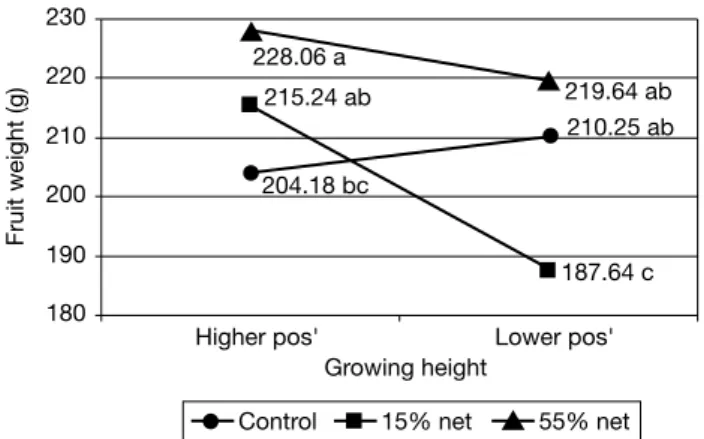
In the first year, neither treatment, side of row, nor growing height affected the fruit weight (Table 1). This agrees with that reported by Erez and Flore (1986) in peaches cv. Redhaven exposed to different levels of sunlight. In the second year, the interaction treat-ment ×growing height was significant (Fig. 2), although shading had no notable effect. This agrees with the results of Podestá et al. (2002) for peaches grown under anti-hail netting. However, Lakso and Corelli Grappadelli (1992) found an immediate reduction in fruit growth of around 30% under moderate levels of shade at 4 weeks post-flowering. This lasted until harvest time.
Soluble solid content
In both growing periods, the height at which the fruit grew, and the side of the tree it grew on, significantly affected its soluble solid content (Table 1). In year 1, shading also had an effect. The control fruits, those from the East side of the trees, and those from the higher position, had a greater content of soluble solids (Table 2). These results confirm that shading reduces the soluble solid content of fruits (Heinicke, 1966; Seeley et al., 1980; Robinson et al., 1983; Yuriet al., 1996), delaying their ripening.
Flesh firmness
During the first year, flesh firmness was not affected by the shading treatments, the side of the tree, nor the
growing height of the fruit (Table 1). Similarly, Campbell and Marini (1992) found the light levels they tested to have no signif icant effect on flesh f irmness in Red Prince Delicious apples. However, in year two, flesh f irmness was lower in fruits grown under the 55% shade netting (Fig. 3). Yuriet al.(1996, 2000) reported flesh firmness in fruits from plants grown under shade nets to be lower than that of the fruits of uncovered trees. Loreti et al.(1993) reported similar results for peaches shaded during the last phase of ripening. These authors attribute this to the reduced light the plants received, leading to poor cell wall formation and a greater influx of water into the cells forming the flesh. In year two, however, greater flesh f irmness was recorded for the fruits under the 15% shade netting (compared to the controls) (Fig. 3).
Table 1.Effect of shade nets (treatment) on fruit weight, soluble solid content, flesh firmness, fruit colour, SLW and PAR in apple trees Fuji
Source
Weight Soluble solids Flesh firmness Colour SLW PAR
of variation DF
(g) (°Brix) (kg cm–2) (%) (mg cm–2) (%)
Year 1 Year 2 Year 1 Year 2 Year 1 Year 2 Year 1 Year 2 Year 1 Year 2 Year 1 Year 2
Treatment (T) 2 ns ns ** ns ns ** ns * * ns ** ** Side (S) 1 ns ns * ** ns * ns ns ns ns ** ** Growing height (H) 1 ns ns * ** ns ns ** ** ** ** ** ** T ×H 2 ns * ns ns ns ns ns ns ns ns ** ** T ×S 2 ns ns ns ns ns * ns ns ns ns ns ** S ×H 1 ns ns ns ns ns ns ns ns * ns ns ns T ×S ×H 2 ns ns ns ns ns ns ns ns ns ns ns ns
DF: degrees of freedom. ns: not significant. *: significant at/above 5% level. **: significant at/above 1% level. SLW: specific leaf weight. PAR: photosynthetically active radiation.
Control 15% net 55% net 210.25 ab 187.64 c 215.24 ab 219.64 ab 228.06 a 180 190 200 210 220 230
Higher pos' Lower pos' Growing height
Fruit weight (g)
204.18 bc
Figure 2.Influence of interaction treatment ×growing heighton
fruit weight in year 2. Figures followed by the same letter are not significantly different (LSD test) at the 5% probability level.
Table 2.Influence of treatment, growing height and side of row on soluble solid content (°Brix) in both years
Treatment Year 1 Year 2
Control 15.17a 13.22
15% net 14.15b 12.19
55% net 12.74c 12.78
Height
Higher 14.18a 13.12a
Lower 13.86b 12.35b
Side
West 14.14a 12.99a
East 13.89b 12.46b
Figures in the same column followed by the same letter are not significantly different (LSD test) at the 5% probability level.
Fruit colour
Fruit colour was influenced by the growing height of the fruits in both years, although the treatment only had an effect in year two (Table 1). The apples with the largest percentage of red coloration were those from the control trees and at the higher position (Table 3). This agrees with the results of Heinicke (1966), Jackson (1968), Jackson et al. (1977), Wertheim et al. (1986) and Yuriet al. (1996) among others. According to Proctor and Lougheed (1976), an increase in the concentration of anthocyanins only occurs when apples are exposed to adequate sunlight for 20 days before harvest. In the February (when Fuji apples change colour) of the f irst year, the minimum temperature was lower and the thermal amplitude wider than in the second year, and this probably caused the apples in all treatments to develop more colour (Table 3, Figs. 4 & 5). Between 15-20ºC has been reported the optimum tempera-ture range for the production of anthocyanins in these fruits, depending on their maturity (Arakawa,
1991; Arakawa et al.,1999). Certainly, temperature variations are known to affect anthocyanin accumu-lation in apples (Gil, 1981; Arakawa et al., 1985; Saure, 1990).
The side of the tree had no effect on fruit colouration in either year (Table 1). Although significant differences were seen in the amount of light available to the different sides of the trees (Table 5, Fig. 7), even the highest PAR recorded was insufficient to allow good fruit colouration. According to Faust (1989), satisfactory colour development requires more than 70% of the total sunlight available. Rom (1993) reported similar results. 5.69 c 5.99 c 6.63 b 7.34 a 4.98 d 5.06 d 4 5 6 7 8 East West Side of row Flesh firmness (kg cm -2)
Control 15% net 55% net
Figure 3. Influence of interaction treatment × side of row
on flesh f irmness in year 2. Figures followed by the same letter are not signif icantly different (LSD test) at the 5% probability level.
Table 3.Influence of treatment and growing height on the percentage of fruit surface coloration (area) in both years
Treatment Year 1 Year 2
Control 62.93 38.38a
15% net 55.40 32.05a
55% net 52.85 21.60b
Height
Higher 68.07a 37.23a
Lower 52.63b 23.87b
Figures in the same column followed by the same letter are not significantly different (LSD test) at the 5% probability level.
0 10 20 30 40 1 3 5 7 9 11 13 15 17 19 21 23 25 27 Days T emperatur es ° C
Max Temp´ for February Year 1
Min Temp´ for February Year 1 Max Temp´ for February Year 2
Min Temp´ for February Year 2
Figure 4.Maximum and minimum daily temperatures for
Fe-bruary of both years. Data provided by the Agrometeorology Station, Facultad de Ciencias Agrarias, Universidad Nacional del Comahue, Río Negro, Argentina.
0 5 10 15 20 25 30 1 2 3 4 5 6 7 8 9 10 11 12 13 14 15 16 17 18 19 20 21 22 23 24 25 26 27 28 Days Thermal amplitude
February Year 1 February Year 2
Figure 5. Daily thermal amplitude for February in both years.
Data provided by the Agrometeorology Station, Facultad de Ciencias Agrarias, Universidad Nacional del Comahue, Río Ne-gro, Argentina.
Specific leaf weight
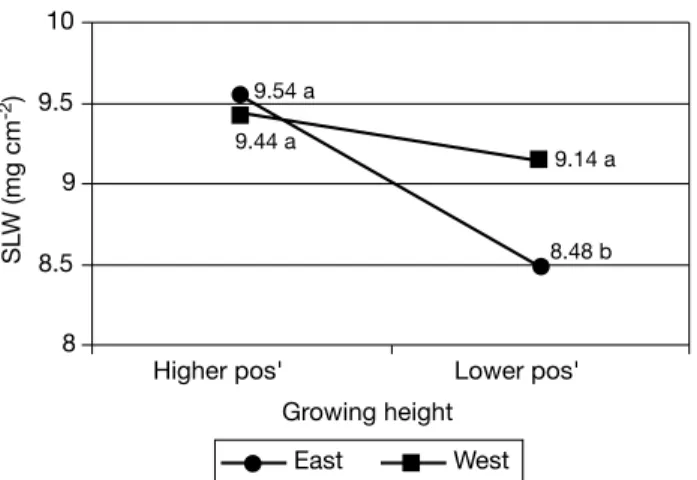
SLW of the control spur leaves was the greatest, this value diminishing with shade netting density, although only in year one (Table 4). In both growing seasons, SLW was greater for the higher spur leaves (Fig. 6, Table 4). This agrees with results reported by Barden (1978) and Dussi and Huysamer (1995), and due to the greater amount of light intercepted by the higher leaves. Nii and Kuroiwa (1988), who worked with peaches, showed that leaves exposed to 100% of the solar radiation available had an SLW 2.6 times greater than that of leaves with received only 10% of the PAR.
Sansavini and Corelli (1992) reported low light levels to negatively affect spur leaves and flowering branches; this may explain the reduction of SLW seen in the second year. Shading in one year would therefore seem to affect fruit production in the next.
Table 4.Influence of treatment and growing height on spe-cific leaf weight (SLW, mg cm-2) in both years
Treatment Year 1 Control 9.62a 15% net 9.13ab 55% net 8.69b Height Year 2 Higher 7.97a Lower 7.30b
Figures in the same column followed by the same letter are not signif icantly different (LSD test) at the 5% probability level. 9.54 a 8.48 b 9.44 a 9.14 a 8 8.5 9 9.5 10
Higher pos' Lower pos' Growing height
SL
W (mg cm
-2)
East West
Figure 6.Influence of the interaction growing height ×side of
rowon specific leaf weight (SLW) in year 1. Figures followed by the same letter are not significantly different (LSD test) at the 5% probability level.
62.60 a 22.09 c 20.22 c 40.73 b 24.33 c 25.55 c 10 20 30 40 50 60 70 80 East West Side of row P AR (%)
Control 15% net 55% net
Figure 7. Influence of the interaction treatment ×side of row
on photosynthetically active radiation (PAR) available in year 2. Figures followed by the same letter are not significantly different (LSD test) at the 5% probability level.
Table 5.Influence of treatment, growing height and side of row on percentage of photo-synthetically active radiation available in both years
Treatment Year 1 Year 2
Higher position Lower position Higher position Lower position
Control 79.03a 34.59c 65.40a 21.53c
15% net 50.99b 16.52d 42.27b 18.68c
55% net 33.88c 16.24d 36.89b 10.71d
Side of row Year 1 Year 2
East 42.67a 42.72
West 34.42b 22.11
Figures in the same column followed by the same letter are not significantly different (LSD test) at the 5% probability level.
Photosynthetically active radiation (PAR)
In general, the availability of light in the two seasons was greater for the control plants than for those that were shaded, and at the higher rather than the lower position. This agrees with the results of Dussi and Huysamer (1995). In addition, the light available was greater on the East side of the trees in all treatments (Fig. 7, Table 5). In the second year, the PAR was not signif icantly influenced by the side of the tree. Similar results were reported by Khemira et al.(1993) who worked with pear trees cv. Beurre D’Anjou.Sunburn
The percentage of fruits not affected by sunburn differed significantly between treatment and years.
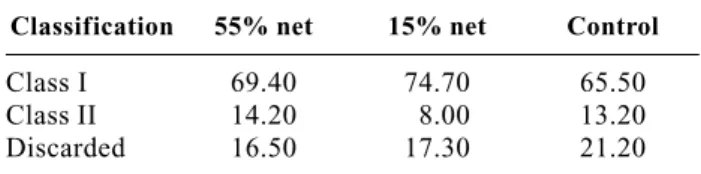
The 55% shade netting signif icantly reduced sunburn damage; 99% of fruits were healthy in year one, and 100% in year two. No significant differences were seen in this respect between the 15% shade and control treatments in either year (Table 6), although there was a trend towards less damage among fruits grown under the net. Yuriet al.(1996), who worked with ‘Gala’ apples, found that 17% shade nets signif icantly reduced the number of fruits damaged by sunburn, although the development of a red colour was not affected. In the present study, however, the 55% netting did reduce red coloration compared to the control fruits in year two (Table 3). This led to a lower percentage of the crop being deemed acceptable at the packing plant. However, the number of fruits discarded because of sunburn was lower than for the control fruits (Table 7).
In conclusion, both nets notably reduced the PAR available to the plants (Table 5, Fig. 7), fruit coloration was less complete (Table 3), the soluble solid content of the shaded fruits was reduced (Table 2), their flesh
firmness was poorer (Fig. 3), and the SLW was dimi-nished (Table 4, Fig. 6).
The 55% shade netting signif icantly reduced sunburn damage; no differences were seen between the 15% net and the control treatments (Table 6).
The lower spurs received less light (Table 5), had a lower SLW (Table 4, Fig. 6), and produced fruits with less colour (Table 3) and a lower soluble solid content (Table 2) than did the higher spurs. Shading did not significantly affect the weight of the fruits (Fig. 2).
Given the large numbers of fruits under the 15% netting that were affected by sunburn, and the signi-ficant reduction in the colour of those grown under the 55% netting, it might be advisable to use a netting of intermediate density. This might reduce sunburn damage without seriously affecting fruit colour.
The impossibility of exporting fruits damaged by high temperatures and intense solar radiation during maturation requires shade nets be used with this cultivar, their density depending on the conditions experienced.
Acknowledgements
The authors thank the Universidad Nacional del Comahuefor funding this project, and Los Alamos de Rosauer SA for the plant material.
References
A N D R E W S P. , J O H N S O N J. , 1 9 9 6 . P hy s i o l og y o f sunburn development in apples. Good Fruit Grower 35, 33-36.
ARAKAWA O., 1988. Characteristics of colour development in some apple cultivars: changes in anthocyanin synthesis during maturation as affected by bagging and light quality. J Jpn Soc Hortic Sci 57, 373-380.
ARAKAWA O., 1991. Effect of temperature on anthocyanin accumulation in apple fruit as affected by cultivar, stage of fruit ripening and bagging. J Hortic Sci 66, 763-768. ARAKAWA O., HORI Y., OGATA R., 1985. Relative
effectiveness and interaction of ultraviolet-B, red and blue
Table 6.Influence of treatment on the percentage of apples not affected by sunburn in both growing seasons
Treatment Year 1 Year 2
Control 60b 80b
15% net 63b 89b
55% net 99a 100a
Figures in the same column followed by the same letter are not significantly different (LSD test) at the 5% probability level.
Table 7.Effect of treatment on fruit classif ication at the packing house in year 2
Classification 55% net 15% net Control
Class I 69.40 74.70 65.50
Class II 14.20 8.00 13.20
light in anthocyanin synthesis of apple fruit. Physiol Plan-tarum 64, 323-327.
ARAKAWA O., SHINODA M., HIRAGA M., WANG H., 1999. Comparison of anthocyanin synthesis of true-to-type ‘Tsugaru’ apple and its red sport strains. J Hortic Sci 74(6), 738-742.
ARTHEY V.D., 1975. Quality of horticultural products. Butterworths, London, 228 pp.
BARDEN J.A., 1978. Apple leaves, their morphology and photosynthetic potential. HortScience 13, 644-646. CAMPBELL R.J., MARINI R.P., 1992. Light
environ-ment and time of harvest affect delicious apple fruit quality characteristics. J Amer Soc Hort Sci 117, 551-557. COLAVITA G., 2003. Incidencia de daño por asoleado
en frutos de manzanas. Evaluación preliminar, tempo-rada 2002-2003. Informe Secretaría Fruticultura Río Negro, Fac. Ciencias Agrarias. Universidad Nacional del Comahue.
CURRY E.A., 1996. Golpe de sol – La experiencia norte-americana. Proc. del Coloquio en Pomáceas de la Uni-versidad de Talca, Chile, October, pp. 64-74.
DEJONG T.M., DAY K.R., 1991. Relationship between shoot productivity and leaf characteristics in peach canopies. HortScience 26, 1271-1273.
DOOLEY L., BROHIER L., 1986. Sunburn of Jonathan and Granny Smith apple. HortScience 21, 201-202.
DUSSI M.C., HUYSAMER M., 1995. Severe postharvest summer pruning of mature ‘Forelle’ pear trees influences canopy light distribution, and fruit and spur leaf charac-teristics in the following season. J S Afr Soc Hort Sci 5(2), 57-60.
DUSSI M.C., SUGAR D., AZARENKO A.N., RIGHETTI T., 1997. Effect of cooling by overtree sprinkler irriga-tion of fruit colour and f irmness in ‘Sensairriga-tion Red Bartlett’ pear. HortTech 7(1), 55-57.
DUSSI M.C., SOSA D., GONZÁLEZ JUNYENT R., GIARDINA G., 2004. Poda de verano en manzanos Red Delicious. Efecto sobre la calidad de la fruta y las hojas de los dardos. Rev FCA UNCuyo 36(2), 15-22.
EREZ A., FLORE J.A., 1986. The quantitative effect of solar radiation on ‘RedHaven’ peach fruit skin color. HortScience, 21(6), 1424-1426.
FAUST M., 1989. Physiology of temperate zone fruit trees. John Willey and Sons. NY. 388 pp.
GIL G., 1981. El color de la manzana roja. Rev Frutícola 2(1), 23-26.
HEINICKE D.R., 1966. Characteristics of McIntosh and ‘Red Delicious’ apples as influenced by exposure to sun-light during the growing season. Proc Amer Soc Hort Sci 89, 10-13.
JACKSON J.E., 1968. Effects of shading on apple fruits. Rep. E. Malling Res. Sta. For 1967, pp. 69-73.
JACKSON J.E., PALMER J.W., PERRING M.A., SHAR-PLES R.O., 1977. Effects of shade on the growth and cropping of apple trees. III. Effects on fruit growth, chemical composition and quality at harvest and after storage. HortScience 52, 267-282.
KHEMIRA H., LOMBARD P.B., SUGAR D., AZARENKO N., 1993. Hedgerow orientation affects canopy exposure,
f l ow e r i n g , a n d f r u i t i n g o f ‘A n j o u ’ p e a r t r e e s . HortScience 28(10), 984-987.
LAKSO A.N., CORELLI GRAPPADELLI L., 1992. Impli-cations of pruning and training practices to carbon parti-tioning and fruit development in apple. Acta Hortic 322, 231-239.
LANCASTER J., 1992. Regulation of skin colour in apples. Crit Rev Plant Sci 10, 487-502.
LORETI F., MORINI S., MULEO R., MASETTI C., VITAGLIANO C., 1993. Effect of solar radiation on selected parameters of peach fruits. Adv Hort Sci 7, 105-105.
MELZER R., EBERT A., 1986. Factores abióticos. Ma-nual da cultura da macieira. Empresa Catarinense de Pesquisa Agropecuaria S.A., Florianópolis, Brazil. pp. 467-471.
NII N., KUROIWA T., 1988. Anatomical changes including chloroplast structure in peach leaves under different light conditions. J Hort Sci 63(1), 37-45.
PARCHOMCHUK P., MEHERIUK M., 1996 Orchard cooling with pulsed overtree irrigation to prevent solar injury and improve fruit quality of ‘Jonagold’ apples. HortScience 31(5), 802-804.
PODESTÁ L., ARJONA C., OJER M., GIL F., 2002. Du-razneros bajo tela antigranizo, efectos sobre la madurez y calidad. Rev FCA UNCuyo 34(1), 1-8.
PROCTOR J.T.A., LOUGHEED E.C., 1976. The effect of covering apples during development. HortScience 11, 108-109.
ROBINSON T.L., SEELEY E.J., BARRIT B.H., 1983. Effect of light enviroment and spur age on Delicious apple fruit size and quality. J Am Soc Hortic Sci 108, 855-861.
SANSAVINI S., CORELLI L., 1992. Canopy efficiency of apple as affected by microclimatic factors and tree struc-ture. Acta Hort 322, 69-77.
SAS INSTITUTE INC., 2004. SAS.doc on line. Version 8.2. SAURE M., 1990. External control of anthocyanin
forma-tion in apple. Sci Hortic 42, 181-218.
SCHUPP J., FALLAHI E., CHUN I., 2002. Effect of particle f ilm on fruit sunburn, maturity and quality of ‘Fuji’ and ‘Honeycrisp’ apples. Hortechnology 12(1), 87-90.
SEELEY E.J., MICKE W.C., KAMMERECK R., 1980. Delicious apple fruit size and quality as influenced by radiant flux density in the immediate growing enviroment. J Am Soc Hortic Sci 105, 645-647.
YURI J.A., VÁSQUEZ J., TORRES C., VÁSQUEZ J.L., 1996. Golpe de sol – La experiencia chilena. Proc. Coloquio en Pomáceas. University of Talca, Chile, October, pp. 75-101.
YURI J.A., TORRES C., BASTIAS R., NEIRA A., 1998. Estudio del golpe de sol en manzanos y algunos factores que lo inducen. Proc. IX Congreso Lat. de Hortic. and XLIX Congreso Agron. de Chile. Santiago Chile, 30 November. Ref. 206.
YURI J.A., TORRES C., VÁSQUEZ J., 2000. Golpe de sol en manzanas. I. Evaluación del daño y métodos de con-trol. Agro-Ciencia 16(1), 13-21.