FROM MATERIALS TO ECO-MATERIALS:
LIFE-CYCLE ENVIRONMENTAL APPROACH FOR
INSULATION PRODUCTS IN BUILDING
APPLICATIONS
B. DeBenedetti
1, L. Maffia
1, S. Rossi
21Dipartimento di Scienza dei Materiali ed Ingegneria Chimica, Politecnico di Torino and CESISP, Italy,
[email protected], [email protected]
2Life Cycle Engineering (LCE), Torino, Italy, [email protected]
Abstract
In recent years, Life Cycle Assessment (LCA) has been often used to support management
and marketing strategies in the building sector, with particular regard to the choice among
alternative solutions for specific applications, such as insulation, roofing, etc. The work
presents the “eco-approach” that has been followed in cooperation with two Italian
manufacturers Associations belonging to the building products with insulating functions
sector (AIPE – Expanded Polystyrene EPS and ANPE – Rigid Polyurethane PUR). The
developed projects had the objective of adopting either the LCA or the materials selection
methodologies for the evaluation of the environmental and technical performances of two
classes of products of common use in Italy. The goal is constituted by the benchmarking of
their environmental burden compared with other insulating product categories. The most
life-cycle environmentally friendly materials can be then defined as “eco-material”.
Keywords: LCA, insulation products, eco-materials, Cambridge Engineering Selector (CES), Environmental Product Declaration (EPD®)
1. Introduction
The environmental consciousness in the building sector is rising at European level [1], probably pushed by the need of energy saving targets, but a reduction of other impacts to the environment is also seen as a relevant issue both by private and public organisations. The possibility to use LCA and materials selection techniques offers the opportunity to introduce a satisfactory approach to eco-materials. In this work, the significant role achieved by the insulating materials selection in green procurements practices is highlighted. With the contribution of a couple of national Associations of insulating products manufacturers, some case studies are presented. Furthermore, the results are here discussed to introduce the issue of benchmarking using the life-cycle environmental burden as main discriminator (by means of specific parameters such as the Global Warming Potential [2]) and the Cambridge Engineering Selector (CES) [3] as functional interface. The Environmental Product Declaration (EPD®) scheme is then introduced as a valid support and vehicle for the environmental communication (ISO 14025 application), with particular attention to the strategic importance of the Product Category Rules (PCR) document setting.
2. Life Cycle Assessment approach
Life Cycle Assessment is widely recognized as a scientific tool to measure the global environmental performance of products and processes [4]. Guidelines are provided by the recently updated EN ISO 14040:2006 and 14044:2006 Standards. Final results of the study are composed by a set of parameters describing the eco-performance of the considered system, such as:
• the gross energy consumption;
• the feedstock energy stored in the materials;
• the energy sources used;
• the greenhouse gas emissions;
• the amount of ozone depleting gases emission and other parameters.
Generally used to supply management strategies (with particular attention to the choice between alternative processes/products), LCA has also become one of the main internationally recognised methods to set up criteria for environmental labels [5] as the European EcoLabel (e.g. hard floor coverings) and the Environmental Product Declaration (EPD®). Among several LCA experiences developed in the building sector, the thermal insulation case is particularly interesting due to the recent attention to household energy saving and greenhouse gas emissions targets.
3. The thermal insulation choice
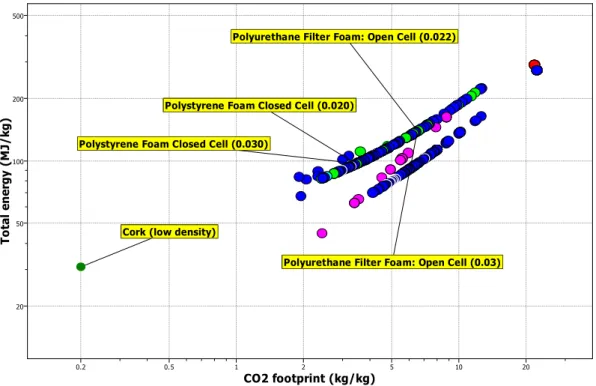
Thermal insulation is one of the focal point in modern building design, both for controlling the energy consumption in winter and summer. The traditional design principles take into account technical parameters like thermal conductivity, thermal diffusivity, density, price, etc. The actual innovative eco-design approach introduces the opportunity of taking into account also environmental characteristics. An example is given in Fig. 1: each bubble identifies a defined material, among them only few are here highlighted by associating their identification label, nevertheless the CES supplies the complete list of the materials considered.
CO2 footprint (kg/kg) 0.2 0.5 1 2 5 10 20 T o ta l e n e rg y ( M J / k g ) 20 50 100 200 500
Cork (low density)
Polyurethane Filter Foam: Open Cell (0.03) Polyurethane Filter Foam: Open Cell (0.022)
Polystyrene Foam Closed Cell (0.030)
Polystyrene Foam Closed Cell (0.020)
4. Environmental Product Declaration (EPD
®)
While it is possible to publish LCA data concerning a given product, a further step is to provide third party certified eco- profile. This is an added value to be used in advanced green markets and to support green purchasing, especially by public authorities (GPP – green public procurement).
Systems usually employed in Life Cycle Assessment studies trace all energy and materials flows starting from the extraction from the earth through their use and destination in a product/service until their final disposal [6]. The International EPD® System (www.environdec.com) has developed a set of rules able to guarantee a higher reproducibility of figures and contents extracted by an LCA analysis. These data are published in a short document structured as a label, containing the following information:
• presentation of the Company and details on the product
• global environmental performance of the product as o use of renewable resources
o use of non-renewable resources o emission of pollutants
It is of course a voluntary tool, as LCA, but it is furthermore oriented towards a complete transparency for what concerns the environmental aspects that can then be added to the environmental general information.
From this point of view, besides the consistency of making available figures and performances, the EPD® provides data that can be directly compared for an environmentally conscious choice.
5. An EPD
®case study
A pilot project driven by the Italian Association of Expanded Polystyrene (AIPE), which involved some associated companies - and followed by other similar projects managed by the Italian Polyurethane Rigid Foam Association (ANPE) - constitutes a good example of environmental sensibility. The LCA procedures have demonstrated their potential and have been then widely used.
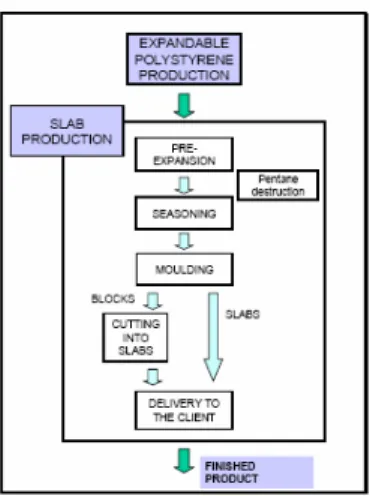
In particular, an Italian company, that is active in the sintered polystyrene foam sector for noise and heat insulation and food/industrial packaging, after several activities for environmental certifications, started an LCA study (Fig. 2) that arose in an EPD® for Greypor Foam Polystyrene, available at www.environdec.com. Data, provided for 1 kg of product, are presented in Table I and II.
Table I
Data for the considered EPD® case study
Data per kg of board Consumption of resources Production of
raw materials Board production Total
Total renewable1 0.1 1.3 1.4 Petroleum 37.8 5.5 43.3 Gas 49.7 33.3 83.0 Other 1.1 2.6 3.7 Non renewable Total2 88.6 41.4 130.0
With energy content [data in MJ]
Of which electricity - 3.68 3.68
Total renewable - - -
Total non renewable 6.6 5.2 11.8
Without energy content [data in g]
Water 184,700 15,200 199,900
Table II
Data per kg of board Indicator Unit of measure
Production of raw material Production of boards Total
Global Warming Potential kg CO2-eq. 2,8 2,9 5,7
Acidification Potential mol H+-eq. 0,58 0,36 0,94
Eutrophication Potential g O2-eq. 74,4 42,6 117,0
Ozone Depletion Potential g CFC11-eq. 0 0 0
Photochemical Ozone
Creation Potential g C2H4-eq. 2,6 19,4 22,0
6. The key role of functional unit
The functional unit (FU) is a measure of the performance of the functional outputs of the product systems and its primary purpose is to provide a reference to which inputs, outputs and results are related. With respect to thermal insulation products, the thermal resistance R has to be chosen as operational parameter [1] and, for this reason, the FU which should be adopted for the systems under study is R = 1 m2*K/W.
Correspondingly, the mass (m) of product is defined as
m = R * λ * A * ρ
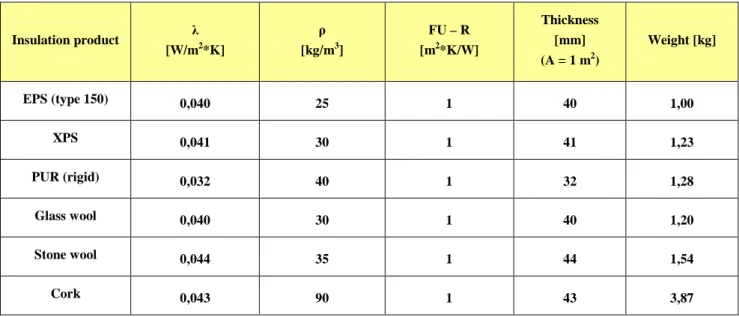
where λ is the thermal conductivity, A is the insulation product area and ρ is the density. In the following approach, the area (A) has been fixed equal to 1 m2: consequently, based on the above definition of FU, the thickness and the mass of different equi-functional insulation products can be evaluated (Table III).
1 Including hydroelectric, wood, biomass, regenerated, geo-thermal, solar, sea, and waste energy. 2
Table III
Weight and thickness of different insulating products (data from Italian Standard UNI)
Insulation product λ [W/m2*K] ρ [kg/m3] FU – R [m2*K/W] Thickness [mm] (A = 1 m2) Weight [kg] EPS (type 150) 0,040 25 1 40 1,00 XPS 0,041 30 1 41 1,23 PUR (rigid) 0,032 40 1 32 1,28 Glass wool 0,040 30 1 40 1,20 Stone wool 0,044 35 1 44 1,54 Cork 0,043 90 1 43 3,87
The approach of adopting the same thermal resistance for all the considered materials involved their different weights. Taking into account that the environmental performance is traditionally referred to the unit of mass, the up described choice of functional unit opens a new framework for the choice of the most environmentally friendly material. In some cases artificial products can be more performing than the natural ones.
7. Conclusions
The increasing use of “Bio” and “Eco” prefixes are a good opportunity to identify natural perceived solutions fulfilling common requests, but usually no further data are provided to quantify the role within a sustainable life-cycle approach. Any solution is supposed to come from the market starting from technical characteristics, marketing features and an opportune price. Selecting materials by a technical and environmental point of view is the challenge to optimize materials selection by means of an eco-design tool. This innovative eco-design approach has proved to be a good way to manage with efficiency the involved parameters, adding certified data about effects on global scale and looking at the quantification of the environmental sustainability of products.
The EPD® procedures demonstrates its importance because allows the establishment of a clear choice between various materials if the data are introduced in a correct LCA scheme. It is confirmed that the “eco-material” is not an absolute value but it is depending on the specific function which is played in the considered system.
References
[1] A.C. Schmidt, A.A. Jensen, A.U. Clausen, O. Kamstrup, D. Postlethwaite (2004) – A comparative Life Cycle Assessment of
building insulation products made of Stone Wool, Paperwool and Flax - International Journal of Life Cycle Assessment, Ecomed
Publishers, Germany, Vol. 9, No.1-2, 2004;
[2] Y. Yamaguchi, Y. Shimoda, M. Mizuno (2006) - City-level Evaluation of measures for reducing CO2 emission from the
commercial sector - Proc. 7th International Conference on EcoBalance-EcoBalance2006, sect. C1-6 - 14-16 November 2006,
Tsukuba, Japan;
[3] M.F. Ashby, D. Cebon (2007) - Teaching Engineering Materials - White Paper, 2007;
[4] Baldo G.L., Marino M., Rossi S. (2005) – Analisi del Ciclo di Vita LCA – Materiali, Prodotti, Processi – Edizioni Ambiente, Milano;
[5] K. Kuroda (2006) – International Development and Standardisation of Environmental Information Indices of Materials - Proc. 7th International Conference on EcoBalance-EcoBalance2006, sect. E1 -1 - 14-16 November 2006, Tsukuba, Japan;