Vol. 3. No. 2. March 2013 Issue. Pp. 158 – 169
Introducing the Multi-Layered Information Technology
Ecosystem Model
Milad Fathi Baghbadorani* and Amirpouyan Harandi **
A new trend in strategic management and strategy formulation is business ecosystem. Instead of a supply chain view, business ecosystem sees companies as members of networks of organizations across various domains that work on and contribute to technologies, products and solutions for the end users. Business ecosystem is often used to explain the success of businesses within the ICT industry and as such, Information Technology Ecosystem has become of considerable importance among scholars and businesses. Given the novel nature of the concept and lack of clear understanding of structure and dynamics of such business networks, in this paper The Multi-layered IT Ecosystem (M-LITE) model has been proposed. The model clearly identifies four types of entities within an IT ecosystem, namely, the leader(s), the contributors, the users and the environment, and explains the value that each building block brings to the ecosystem. The M-LITE model is expected to ease understanding the concept and pave the way for future research in this domain of theory.
1. Introduction
Business ecosystem is regarded as an important theoretical stream in strategic management (Lengnick-Hall and Wolff, 1999). However, business ecosystems are neither understood nor managed well (Iansiti and Levien, 2004b) and despite recent attention from scholars and businesses (Adner, 2006) within ICT industry in particular (Eisenhardt and Brown, 1999) , the literature of business ecosystem is still at its infancy (Zhang and Liang, 2011) with most studies being focused on case studies (Anggraeni et al., 2007).
In this paper we present the Multi-Layered IT ecosystem model. Based on our studies of business ecosystems and its subcategories (Digital Business Ecosystem, Software Ecosystem, Electronic Business Ecosystem, etc) we can identify two major shortcomings which our presented work of study will address.
Firstly, various scholars have acknowledged that organizations forming a business ecosystem come from many diverse domains and industries and even include competitors, media, universities and regulatory agencies (Iansiti and Levien, 2004b, Moore, 1993, Moore, 1996). This extreme diversity has the potential to lead to ambiguities in analyzing business ecosystems and formation of organizations within them. As a result, a model that explains business ecosystem or any of its subcategories should be able to clarify the position of organizations and individuals in a distinguishable manner and categorize them based on their level and nature of contribution. Thus, the multi-layered approach of our model becomes of value, since it groups ecosystem members according to their level of contribution to the ecosystem as a whole and clears the aforementioned ambiguities.
* Milad Fathi Baghbadorani, Paris Graduate School of Management, France Email: [email protected]
** Amirpouyan Harandi, Multimedia University, Graduate School of Management, Malaysia. Email: [email protected]
159
Secondly, a shortcoming of the previously proposed models is an evident lack of comprehensiveness and failing to explain the interdependencies among both organizations within a business ecosystem, and the technologies that they provide. Technology platforms are a critical part of business ecosystems (Iansiti and Levien, 2004b) to the extent that ecosystems are normally formed around them. On the one hand, there are interconnected and interdependent organizations that work together, as well as on common platforms, to deliver products and services. Models and illustrations provided by Zhang and Liang (2011) and Yu et al. (2011) share this organization oriented view, but pay little to no attention to technologies these organizations provide and interactions at technology level.
On the other hand, there are technologies that these organizations offer as the fruit of their contributions. The aforementioned interdependencies also exist at technology level, but in a different way and view. The literature of Software Ecosystem (Messerschmitt and Szyperski, 2003, Bosch, 2009), Digital Business Ecosystem and Digital Ecosystem (FeijÛo et al., 2009) is rich in studies, examples and models that try to explain these relationships at technology level. However, unlike the previous view, here technology is the main focus with little attention to organizations.
Hence, we believe that there is a need for a more comprehensive model that can explain not only the formation of organizations within an ecosystem but also the value that members provide the ecosystem with, including the technologies. To that end, not only the building blocks of business ecosystems are identified in the proposed model, the value side that has been added to the model is expected to address the lack of comprehensiveness issue.
In this paper, after a broad review of the literature of business ecosystem and IT ecosystem, the M-LITE model is presented. The remaining chapters are dedicated to explaining the components of the model with especial attention to the value that each entity provides the ecosystem with. This paper ends with a discussion of findings and implications for future research.
2. Literature Review
The concept of business ecosystems was first introduced by Moore (1993) and has since received considerable attention from both scholars and businesses (Adner, 2006). Despite the fact that there is no consensus over the term "business ecosystem" (Zhang and Liang, 2011) a business ecosystem can be described as a network of companies and individuals that share the same vision and destiny, and co-evolve by working on common platforms (Moore, 1993, Iansiti and Levien, 2004b, Peltoniemi, 2006, Zhang and Liang, 2011, Kilamo et al., 2011).
A business ecosystem has many similarities with biological ecosystems, as they are both formed by a random collection of entities that have interdependencies, evolve overtime and follow the same fate (Moore, 1993). Thus, performance of each of the members within the business ecosystem has an effect on its overall health (Iansiti and Levien, 2004b).
Compared to the conventional supply chain view, business ecosystem offers a dynamic, system view that not only includes the value chain of a business, but also
160
those with rather indirect roles, such as companies from other industries producing complementary products or equipment, outsourcing companies, regulatory agencies, financial institutes, research institutes, media, universities and even competitors (Yu et al., 2011, Moore, 1993, Iansiti and Levien, 2004b, Anggraeni et al., 2007, Moore, 1996, Li, 2009).
Following the same view, today, it is not only businesses that compete, but competition is formed and defined between business ecosystems (Hearn and Pace, 2006). More interestingly, the level of exclusivity of businesses active in each ecosystem is generally low, and even rival ecosystems within a market share a considerable number of common ecosystem members. Hence, it is unclear as to where the borders of an ecosystem can be defined (Gueguen and Isckia, 2011). There are many advantages and benefits to being a part of a healthy business ecosystem. Considering the fact that the fierce competition today has left many businesses operating in survival mode and with many markets seeing supply overtake the demand (Chan Kim and Mauborgne, 2005), business ecosystem opens doors to new opportunities for creating value (Li, 2009) and ultimately, gaining the competitive edge.
Iansiti and Levien (2004a) define five strategic positions within a business ecosystem that members can take:
Keystones possess and control critical ecosystem assets and tend to share
the value that ecosystem creates with other members
Landlords possess and control essential ecosystem assets and have the
tendency to derive as much value as they can
Dominators extract maximum possible value from the ecosystem and gain
control through horizontal or vertical integration
Niche Players often drive innovation by investing in and developing specific
functionalities within a business ecosystem
Commodity are ecosystem members involved in production at lowest
possible price
Regardless of their position, in a business ecosystem, members normally invest on platforms usually created by ecosystem leader(s), leading to evolution and expansion of the ecosystem as a whole and improvement in the performance of ecosystem members (Moore, 1993, Iansiti and Levien, 2004b, Chesbrough and Schwartz, 2007).
Ecosystem members must constantly monitor the health of their business ecosystem. In particular, business ecosystem leader(s) play a critical role in regulating ecosystem health. Iansiti and Levien (2004a) offer three criteria for assessing the health of a business ecosystem:
Robustness shows the degree to which a business ecosystem has the ability
to survive in the face of technological or environmental changes. Robustness is measured through survival rate of ecosystem members.
161
Productivity is the extent to which a business ecosystem can constantly turn
its resources to new products and lower costs. Here return on invested capital is used to measure the level of productivity.
Innovation or niche creation is the ability of a business ecosystem to create
innovative, new functions or products. The number of new innovations and niches is used to measure innovation.
Later, Iansiti and Richards (2006b) used different indicators to assess the health of business ecosystems. Here, output per hour of employees, also referred to as labor productivity, was used to measure the level of ecosystem productivity. Furthermore, persistence towards major downturns and ability to recover, in addition to financial betas were two criterion used to measure robustness. As for innovation, Return on Venture Capital Investment was chosen for assessment.
2.1 IT Ecosystem
One of the industries where the concept of business ecosystem has been used extensively is the ICT industry (Eisenhardt and Brown, 1999). Since its introduction, business ecosystem literature has explored various IT related subcategories, such as Software Ecosystem (Messerschmitt and Szyperski, 2003, Bosch J., 2009), Digital Business Ecosystem (Nachira, 2002), E-Business ecosystem (Zhu and Zhang, 2009), Social Media Ecosystem (Hanna et al., 2011), and Information Technology Ecosystem (Iansiti and Richards, 2006b). In particular, Software Ecosystem and Digital Business Ecosystem seem to have received more attention from scholars. However, despite the existence of many areas of similarity between digital business ecosystem, software ecosystem and IT ecosystem concepts, the amount of research available on Information Technology Ecosystem in particular is fairly small.
The model presented in this paper is defined under the rubric of Information Technology Ecosystem developed by Iansiti and Richards (2006b) and tries to define the structure of Information Technology Ecosystems together with the value that each entity or group of entities deliver to the ecosystem as a whole.
IT ecosystem is defined as a community or loose network of businesses and individuals that together work on platforms which will lead to delivery of information technology products and services (Iansiti and Richards, 2006b). Much like business ecosystems, IT ecosystems have many similarities with their biological counterparts, as the interdependencies between ecosystem members is necessary for the survival and evolution of the ecosystem. Also, the emergence and formation of IT ecosystem members is not necessarily planned and the network is normally formed randomly, heterogeneously and gradually (Ammann, 2011).
3. Results and the M-LITE Model
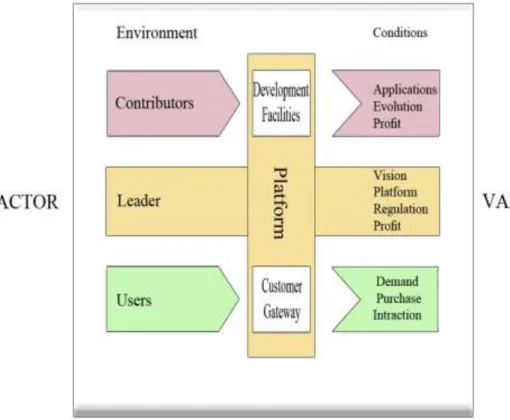
The M-LITE (Multi-Layered IT Ecosystem) model presented in this paper consists of 4 layers, namely, the leader(s), the contributors, the users and the environment. On the left, actors, representing organizations or individuals that each play a role within the IT ecosystem are placed, and on the right, the value that each actor contributes
162
to the ecosystem is mentioned. The environment is the final and outer layer and surrounds the leader(s), the users and the contributors all together.
The M-LITE (Multi-Layered Information Technology Ecosystem) conceptual model is depicted below:
Figure 1: The Multi-Layered Information Technology Ecosystem Conceptual Model
The Leader in the middle provides the Platform as a critical building block of the IT ecosystem. Contributors use the facilities that the platform provides to develop applications. Users on the other hand bring demand to the ecosystem, as well as possible interactions with the Leader(s) and/or Contributors. All entities within the ecosystem are surrounded by the Environment that provides Conditions for the evolution of the business ecosystem. Each component of the model together with the values offered are explained further.
3.1 The Leader(s)
At the center of the M-LITE model stands the ecosystem leader(s). An ecosystem can have one or more leaders. The leader, also referred to as "central contributor" (Moore, 1993), acts as a hub (Iansiti and Levien, 2004b), a chokehold without which other ecosystem members cannot continue their business life (Moore, 1993).
The decisive position of ecosystem leader and the assets that it possesses enables it to collect a higher share of the value that the ecosystem creates (Moore, 1993). Ecosystem leader sets the vision for other members of an ecosystem to follow
163
(Moore, 2006) and while taking a regulatory position, encourages other members to follow its philosophy and standards (Torrès-Blay, 2010, Gueguen, 2009).
Perhaps one of the most critical roles of ecosystem leaders is providing the ecosystem platform as a critical building block of a business ecosystem (Iansiti and Levien, 2004a, Iansiti and Levien, 2004b, Iansiti and Richards, 2006b, Iansiti and Levien, 2002, Iansiti and Richards, 2006a, Moore, 1993, Moore, 1996). Members of a business ecosystem often invest on a shared platform (Bosch J., 2009). In other words, the main value that the business ecosystem leader brings to an ecosystem is the platform upon which the ecosystem is based, as it provides different parties involved, with tools and frameworks that assists them in driving innovation and improvement of their performance.
In the context of IT ecosystems, a platform is defined as "a set of tools or components that provide building blocks for application providers" (Eisenmann et al., 2006). An application in turn, is a product that offers a solution to an end user (Iansiti and Richards, 2006a). Evans et al. (2006) find the relationship between hardware and software platforms to be symbiotic and that many advancements of software platforms are owed to hardware developments and innovations.
Hardware platforms (also referred to as CPU families) are made up of Microprocessors, Memories and other components (Evans et al., 2006) based on different hardware architectures such as x86 and ARM and are used by manufacturers to produce IT devices, such as PCs and workstations, servers, printers, mobile handsets, gaming consoles, tablet computers, consumer electronics, etc (Iansiti and Richards, 2006a). These hardware platforms act as the basis for the software that is installed on them.
Hardware platforms aside, Bosch (2009) identifies three types of software platforms:
Operating System-centric where the ecosystem leader offers an operating system and developers use the operating system and the tools that accompany it as a basis for creating applications.
Application-centric platforms are where instead of an operating system, an successful application becomes the basis for development.
End-User Programming is where a platform is intuitive enough that the user can use it to create his/her own needed application.
Of the three types of platforms, perhaps the most important one is the operating system. An operating system as a platform acts like a hub, an access point, that has its own rules set by the ecosystem leader, and contributors (developers) use it to create applications (Eisenmann et al., 2006). An operating system is what stands between hardware and applications. Software platforms are multi-sided businesses, in that, they bring together developers and applications and should always find ways to attract both groups in order to stay competitive (Zhu and Iansiti, 2007).
For an operating system to become popular among developers, stability and reliability are of great importance (Iansiti and Richards, 2006a). In addition, pricing is also a decisive factor in the success of software platforms(Evans et al., 2006). Bosch J. (2009) finds the following as critical success factors of operating system centric platforms:
164 Easy development of applications with minimum efforts
Constant development of the operating system features to attract developers and users while maintaining the existing ones.
The number of users of an operating system that developers can count on as buyers of their applications.
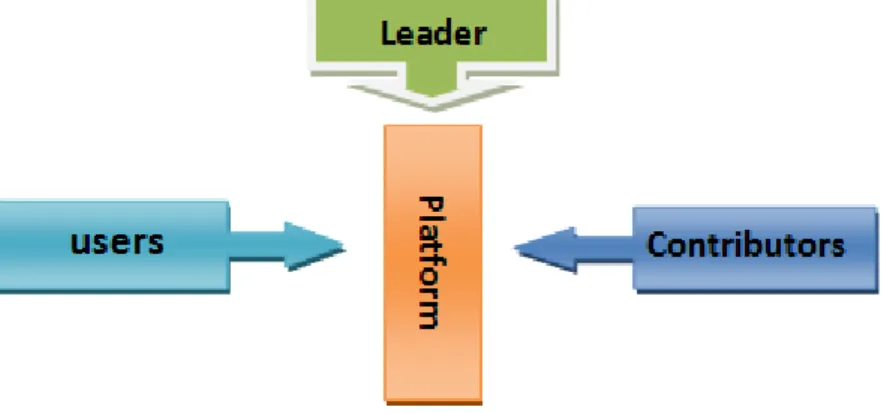
In order to facilitate development of applications, operating system vendors provide developers with application development tools that make creation of applications easier. Application Programming Interfaces (APIs) are used by developers to create applications for end users (Jansen et al., 2009). Figure 2 depicts the role of platform in an IT ecosystem.
Figure 2: The role of platform in an IT ecosystem
A Software Marketplace, also referred to as Application Distribution Platform, App store or Application store is another common form of platform that IT ecosystem leaders often provide. A Software Marketplace is where developers of a software platform offer their Applications to users. Due to its nature, a software marketplace also acts as a "customer gateway" (Moore, 1993) as it is where users normally go to in order to access applications. This can result in delivering more value to developers, while improving the penetration rate of the operating system.
3.2 The Contributors
Stepping outside the core of IT ecosystem (where the ecosystem leader is placed), come the long array of contributors to the ecosystem. Numerous interdependent organizations and individuals contribute to the evolution of an IT ecosystem, each carrying out tasks related to various areas from design, to production, operations, distribution and delivery of IT related products, systems and services while all depending on each other to survive and to improve their performance (Iansiti and Richards, 2006a). These organizations actively work on platforms that the ecosystem leaders provide to improve their performance, while extending the capabilities of the platform itself at the same time (Moore, 1993, Iansiti and Levien, 2004b). The range of activities and the level of diversity of ecosystem members at this layer of the model is normally high.
In the context of an IT ecosystem, Iansiti and Richards (2006a) find three types of core domains within the IT industry, namely, IT Hardware, Software and Services.
165
Based on our studies, Content is another vast and important domain in the IT industry that needs to be considered.
Despite the diversity of roles, organizations in this layer can be categorized in four groups:
Software oriented organizations play a vital role in the business ecosystem.
They include computer games, database software, business software suites, etc however, a considerable number of these organization are involved in development of applications.
Hardware oriented organizations use hardware platforms to create IT
devices, such as PCs, workstations, mobile phones, tablet computers, printer, etc. This domain also includes manufacturers of complementary hardware components and peripherals.
Content providers are organizations or individuals that provide content, such
as digital multimedia, electronic books, music, films, etc. Contents provided by these organizations are offered either directly or through content distribution platforms, such as iTunes or Google Play.
Operations and Services include IT outsourcing companies, process
management and IT, consulting, development, hardware and software support, Internet Service Providers, etc (Iansiti and Richards, 2006a). A businesses ecosystem often includes organizations from other industries as well (Li, 2009), thus, organizations at this domain also include the ones active in logistics, research, financial services, education, human resources, etc, that are not necessarily IT oriented, but have a role in the solutions that the IT ecosystem offers to its users.
Developers are of great importance to software platforms due to the multi-sided nature of platform businesses (Katz and Shapiro, 1994). The higher number of applications an operating system has the more the popularity of the operating system . Also, a higher number of users results in a higher number of applications due to higher demand. Moreover, applications developed by developers can add abilities and functionalities to a platform that the platform wouldn't otherwise have. Platform providers should constantly attract both customers and developers to improve the health of their ecosystem as one group alone is unlikely to result in the success of an ecosystem. (Zhu and Iansiti, 2007, Iansiti and Richards, 2006b, Evans et al., 2006).
3.3 The Users
Users are a vital component of business ecosystems. They, either individuals or businesses, are the ones who purchase the products and services that business ecosystems are formed to produce. Hence, without users, formation of an ecosystem could be meaningless.
As was mentioned in the previous sections, IT ecosystems are often formed around platforms. Platforms on the other hand are two sided businesses that need both developers and users in order to survive and succeed (Zhu and Iansiti, 2007, Evans
166
et al., 2006, Eisenmann et al., 2006, Parker and Van Alstyne, 2005). As a result, customers are obviously of great importance for the success of an IT ecosystem. More users result in more applications for the respective platform due to higher demand (Zhu and Iansiti, 2007). Customer expectation is also found to be an important factor for the health and success of platforms, as customers often make assumptions about popularity of platforms and tend to choose the one with the highest number of consumers, which is consequently perceived to give them access to more applications (Zhu and Iansiti, 2007, Katz and Shapiro, 1994). Hwang and Thorn (1999) meta analyzed 25 different studies on effect of user participation and user involvement on six system success variables and found them both to have positive effects to varying degrees.
3.4 Environment
The environment surrounding Leaders, Contributors and Users forms the conditions in which the business ecosystem evolves. Many scholars have studied the impact of environment on businesses and strategies that they adopt according to the environment around them. Lawrence and Lorsch (1986) find that an uncertain environment asks for greater differentiation and consequently, more complex business processes. Also, the market and its level of competition can lead to more dynamism in organization structures (Rumelt, 1974). Thus, there is a strong link between organizations, strategies they adopt and the environment outside (Miller and Friesen, 1983). As a result, environment scanning becomes of utmost importance (Kourteli, 2000).
Fahey and Narayanan (1986) uncover four dimensions of the environment that managers should be concerned about, namely, Economic, Political, Technological and Social environments. Economic dimension refers to measures of productivity, demand and other economic factors that can affect a business. Political dimension refers to regulatory bodies and their regulatory and governance policies that control a business environment. Technological refers to current level of technological advancement within the community that an organization lives in. Social, refers to socio cultural, demographic and lifestyle that is forms the environment around a business.
In the context of business ecosystem, Yu et al. (2011) categorizes entities forming the environment around a business ecosystem to at least 6 groups, namely, Economic Environment, Technique Environment, Natural Environment, Social and cultural Environment, Law and Policy Environment, Credit Environment.
4. Summary and Conclusion
In this paper a model for Information Technology ecosystem was introduced. The Multi-Layered Information Technology Ecosystem Model (M_LITE) groups entities within a business ecosystem into four categories, the leader, the contributors, the users and the environment. Furthermore, the model depicts and explains the value that is expected of these building blocks.
Despite a number of attempts at providing a broad picture of business ecosystem, this paper is the first to offer a single model that can explain the interdependencies at
167
both organizations, and technology level. The Multi-layered Ecosystem Model (M-LITE) is presented under the rubric of IT ecosystems introduced by Iansiti and Richards (2006b), however, we believe that its usage can be extended to other forms of business ecosystem due to the aforementioned characteristics. Overall, this study is expected to be of value to the body of knowledge of business ecosystems and IT ecosystems as it can be used as the basis for the study of each component of an IT ecosystem and the impact of each on the health and performance of the ecosystem as whole.
Moreover, our findings can benefit businesses and managers better explain formation of organizations within an ecosystem together with the value and contribution they can expect from a respective ecosystem member. Furthermore, the M-LITE model can help visualize Business Ecosystem and Information Technology ecosystem concepts in a more understandable way.
The M-LITE conceptual model paves the way for analysis of each of the components of Information Technology ecosystem, as well as the impact that each layer/component has on the health and performance of such networks. Authors are of the view that despite the profound impact of IT ecosystems in driving innovation in today's world, the amount of theoretical work on the subject is fairly limited and there is a lot of potential for future research in this novel stream of theory. We also believe that the proposed model can be studies and tested in other forms of business ecosystem (E-business ecosystem, Software ecosystems, Digital business ecosystems, etc) both at firm and industry level.
References
Adner, R 2006, 'Match your innovation strategy to your innovation ecosystem',
Harvard business review, 84, 98.
Ammann, D 2011, 'Requirements Elicitation: Tools for End-Users',
amadeus.ifi.uzh.ch.
Anggraeni, E, Hartigh, E D & Zegveld, M 2007, 'Business ecosystem as a perspective for studying the relations between firms and their business networks', presented at the ECCON 2007Annual meeting, Bergen aan Zee,The Netherlands.
Bosch, J 2009, 'From software product lines to software ecosystems'. Secondary 'From software product lines to software ecosystems'. San Francisco, California: Carnegie Mellon University.
Chan Kim, W & Mauborgne, R 2005, 'Blue Ocean Strategy: How to Create Uncontested Market Space and Make Competition Irrelevant Harvard Business School Press, 2005'. Secondary 'Blue Ocean Strategy: How to Create Uncontested Market Space and Make Competition Irrelevant Harvard Business School Press, 2005'. ISBN 1-59139-619-0.
Chesbrough, H & Schwartz, K 2007, 'Innovating Business Models with Co-development Partnerships', Research-Technology Management, 50, 55-59. Eisenhardt, K M & Brown, S L 1999, 'Patching. Restitching business portfolios in
dynamic markets', Harvard business review, 77, 72.
Eisenmann, T, Parker, G & Van Alstyne, M W 2006, 'Strategies for two-sided markets', Harvard business review, 84, 92.
Evans, D S, Hagiu, A & Schmalensee, R 2006, 'Invisible engines: how software platforms drive innovation and transform industries', The MIT Press.
168
Fahey, L & Narayanan, V K 1986, 'Macroenvironmental analysis for strategic management', West.
Feijûo, C, Maghiros, I, Abadie, F & Gûmez-Barroso, J È L 2009, 'Exploring a heterogeneous and fragmented digital ecosystem: Mobile content', Telematics and Informatics, 26, 282-292.
Gueguen, G 2009, 'Coopetition and business ecosystems in the information technology sector: the example of Intelligent Mobile Terminals', International Journal of Entrepreneurship and Small Business, 8, 135-153.
Gueguen, G & Isckia, T 2011, 'The borders of mobile handset ecosystems: Is coopetition inevitable?', Telematics and Informatics, 28, 5-11.
Hanna, R, Rohm, A & Crittenden, V L 2011, 'We're all connected: The power of the social media ecosystem', Business Horizons.
Hearn, G & Pace, C 2006, 'Value-creating ecologies: understanding next generation business systems', foresight, 8, 55-65.
Hwang, M I & Thorn, R G 1999, 'The effect of user engagement on system success: a meta-analytical integration of research findings', Information & Management,
35.
Iansiti, M & Levien, R 2002, 'The New Operational Dynamics of Business Ecosystems: Implications for Policy, Operations and Technology Strategy', Division of Research, Harvard Business School.
Iansiti, M & Levien, R 2004a, 'The keystone advantage: what the new dynamics of business ecosystems mean for strategy, innovation, and sustainability', Harvard Business Press.
Iansiti, M & Levien, R 2004b, 'Strategy as ecology', Harvard business review, 82. Iansiti, M & Richards, G 2006a, 'Information technology ecosystem health and
performance', Division of Research, Harvard Business School.
Iansiti, M & Richards, G L 2006b, 'Information Technology Ecosystem: Structure, Health, and Performance', Antitrust Bull., 51, 77.
Jansen, S, Brinkkemper, S & Finkelstein, A Year, Published. 'Business network management as a survival strategy: A tale of two software ecosystems'. 2009. Citeseer, 34-48.
Katz, M L & Shapiro, C 1994, 'Systems competition and network effects', The Journal of Economic Perspectives, 8.
Kilamo, T, Hammouda, I, Mikkonen, T & Aaltonen, T 2011, 'From proprietary to open source—Growing an open source ecosystem', Journal of Systems and Software.
Kourteli, L 2000, 'Scanning the business environment: some conceptual issues',
Benchmarking: An International Journal, 7, 406-413.
Lawrence, P R & Lorsch, J W 1986, 'Organization and Environment: Managing Differentiation and Integration (Harvard Business School Classics)'.
Lengnick-Hall, C A & Wolff, J A 1999, 'Similarities and contradictions in the core logic of three strategy research streams', Strategic Management Journal, 20, 1109-1132.
Li, Y-R 2009, 'The technological roadmap of Cisco's business ecosystem',
Technovation, 29, 379-386.
Messerschmitt, D G & Szyperski, C 2003, 'Software Ecosystem: Understanding an Indispensable Technology and Industry (Chapter 6: Organization of the Software Value Chain). 424 pages', MIT Press, Cambridge, MA, USA.
Miller, D & Friesen, P H 1983, 'Strategy‐making and environment: The third link',
169
Moore, J F 1993, 'Predators and prey: a new ecology of competition', Harvard business review, 71.
Moore, J F 1996, 'The death of competition: leadership and strategy in the age of business ecosystems', HarperBusiness New York.
Moore, J F 2006, 'Business ecosystems and the view from the firm', Antitrust Bull.,
51.
Nachira, F 2002, 'Towards a network of digital business ecosystems fostering the local development'.
Parker, G G & Van Alstyne, M W 2005, 'Two-sided network effects: A theory of information product design', Management Science.
Peltoniemi, M 2006, 'Preliminary theoretical framework for the study of business ecosystems', EMERGENCE MAHWAHLAWRENCE ERLBAUM, 8, 10-19.
Rumelt, R P 1974, 'Strategy, structure, and economic performance', Division of Research, Graduate School of Business Administration, Harvard University. Torrès-Blay, O 2010, 'Economie d'entreprise: organisation, stratégie et territoire',
Economica.
Yu, J, Li, Y & Zhao, C 2011, 'Analysis on Structure and Complexity Characteristics of Electronic Business Ecosystem', Procedia Engineering, 15, 1400-1404.
Zhang, J & Liang, X J 2011, 'Business ecosystem strategies of mobile network operators in the 3G era: The case of China Mobile', Telecommunications policy,
35, 156-171.
Zhu, F & Iansiti, M 2007, 'Dynamics of platform competition: Exploring the role of installed base, platform quality and consumer expectations', Division of Research, Harvard Business School.
Zhu, X & Zhang, J 2009, 'Study on Niches of Enterprises and Strategy in E-business Ecosystem', academypublisher.com.